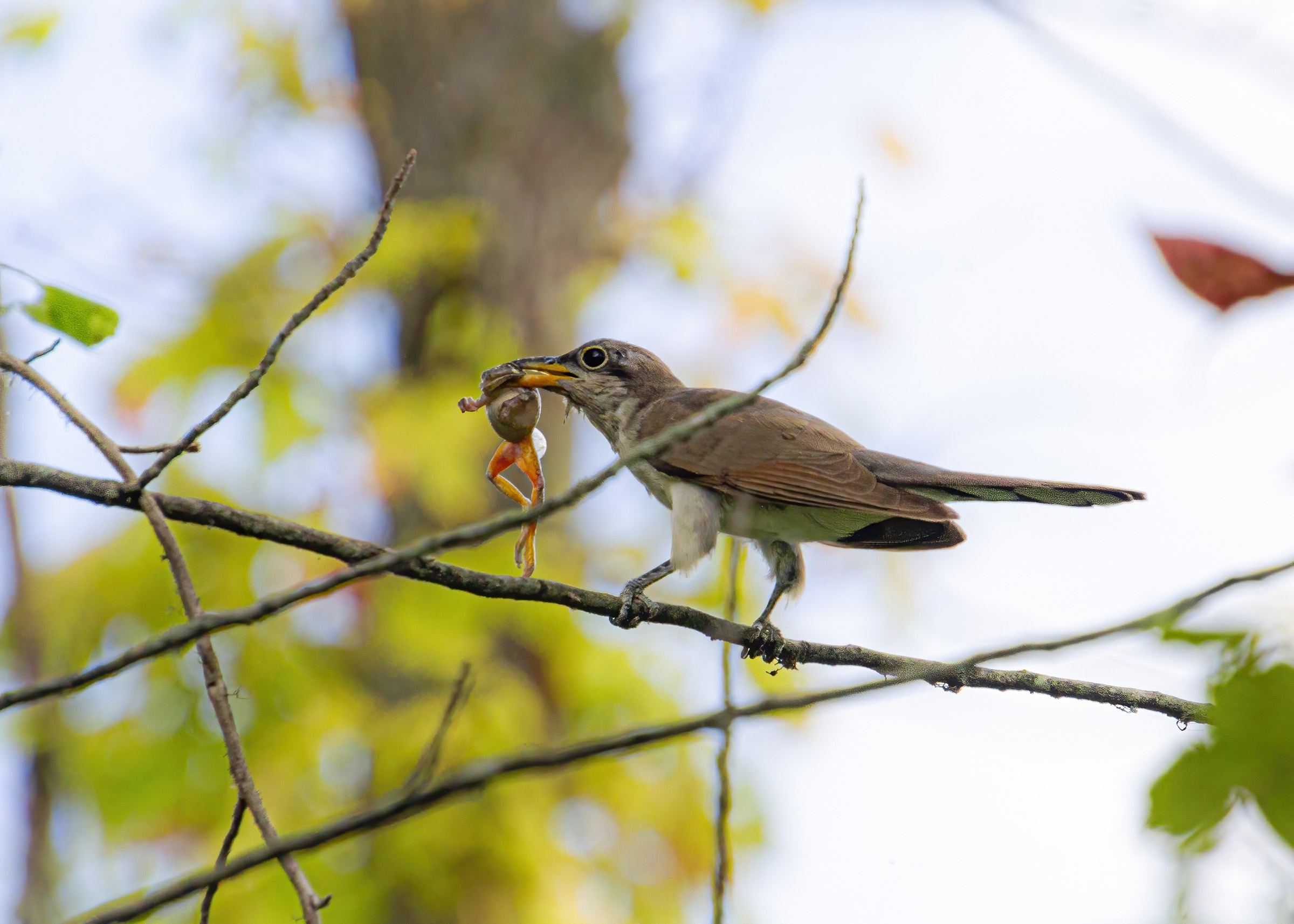
I was quite shocked when I spotted this Yellow-billed Cuckoo (Coccyzus americanus) with a frog in its mouth on this past Tuesday at Occoquan Bay National Wildlife Refuge. When I first spotted the bird, it was mostly hidden in the foliage of the tree, but I could clearly see the dangling frog. I stopped in my tracks, quickly adjusted the settings on my camera, and took some shots. When I moved slightly to the side to try to get a better angle, alas, the bird detected my presence and flew away with its prey.
I had no idea that a bird like a cuckoo would consume a frog. Wow! According to the Cornell Lab of Ornithology, “Caterpillars top the list of Yellow-Billed Cuckoo prey: individual cuckoos eat thousands of caterpillars per season. On the East coast, periodic outbreaks of tent caterpillars draw cuckoos to the tentlike webs, where they may eat as many as 100 caterpillars at a sitting. Fall webworms and the larvae of spongy (formerly gypsy), brown-tailed, and white-marked tussock moths are also part of the cuckoo’s lepidopteran diet, often supplemented with beetles, ants, and spiders. They also take advantage of the annual outbreaks of cicadas, katydids, and crickets, and will hop to the ground to chase frogs and lizards. In summer and fall, cuckoos forage on small wild fruits, including elderberries, blackberries and wild grapes. In winter, fruit and seeds become a larger part of the diet.”
I love to capture images like this one. No how many times I visit a familiar location, there always seems to be something new to see. My favorite encounters most often seem to occur when I am by myself and moving slowly, immersed in the natural world. Fortunately I am quick to react with my camera, for these moments tend to be ephemeral and fleeting.
© Michael Q. Powell. All rights reserved.












 Mike Powell