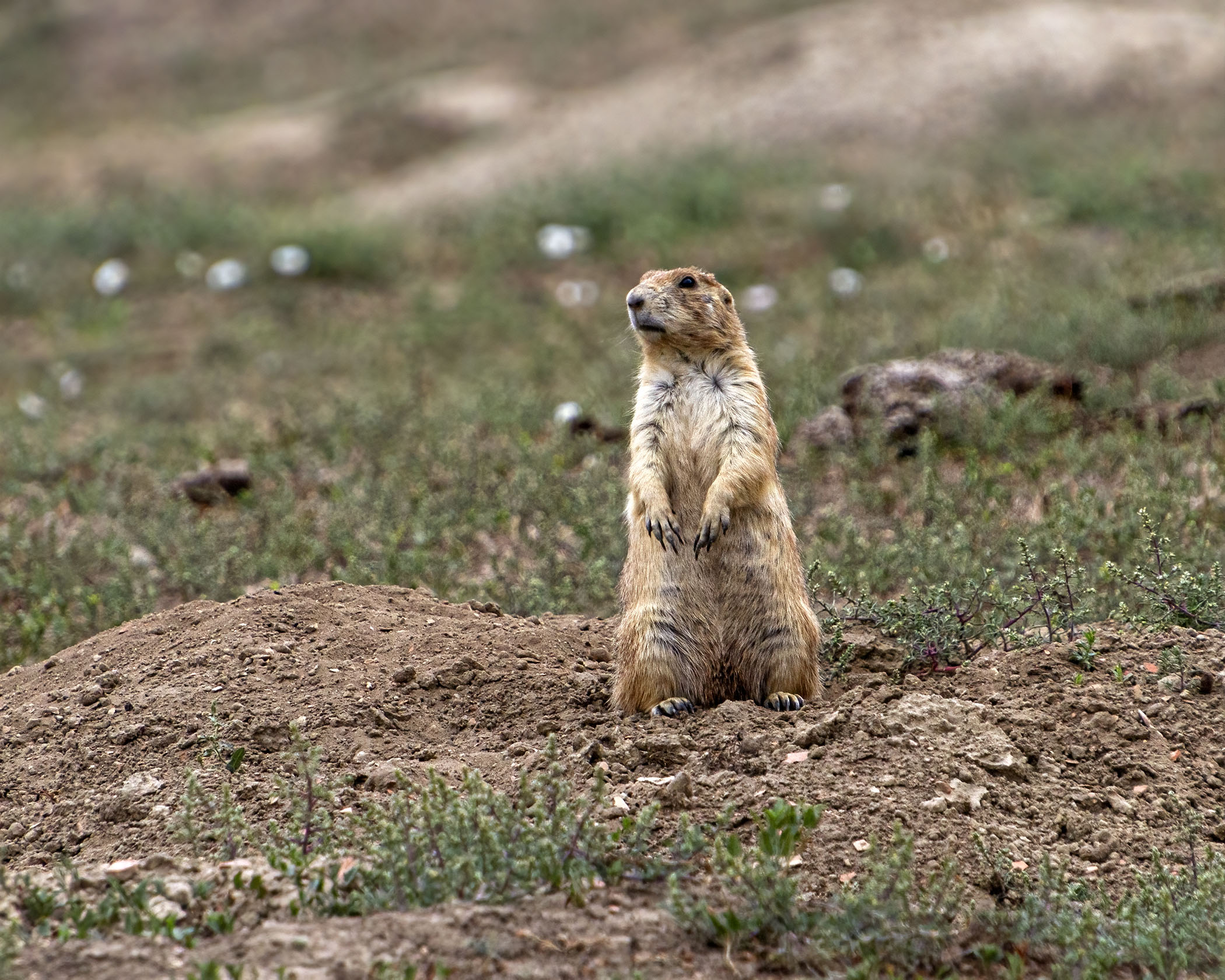
It was so much fun watching black-tailed prairie dogs (Cynomys ludovicianus) scampering in and out of their interconnected holes this past week at several locations at Theodore Roosevelt National Park in North Dakota. According to information on the park’s website, “Originally named “petits chiens,” or “little dogs,” by early French explorers, these highly social animals are not really dogs, but rodents. They are members of the Sciuridae or squirrel family, closely related to ground squirrels, chipmunks, woodchucks and marmots. There are five species of prairie dogs in North America, but only the black-tailed prairie dog inhabits Theodore Roosevelt National Park.”
I can usually tell when I am approaching a prairie dog “town,” which can be quite large, when I hear a lot of high-pitched squeaking, the primary means of communication used by these cool little creatures. As Theodore Roosevelt himself described them, “Prairie-dogs are abundant…; they are in shape like little woodchucks, and are the most noisy and inquisitive animals imaginable. They are never found singly, but always in towns of several hundred inhabitants; and these towns are found in all kinds of places where the country is flat and treeless.”
Prairie dogs may not be as exciting to many as the much larger bison and wild horses, but there is something that always makes me smile about their energetic hyperactivity. Prairie dog towns reportedly attract predators looking for a quick meal, but I did not spot any during this visit. In November 2024, however, I managed to photograph a coyote (Canis latrans) hanging around a prairie dog town and documented it in a blog posting called “Coyote in Theodore Roosevelt National Park.”


© Michael Q. Powell. All rights reserved.


