Feeds:
Posts
Comments

Posts Tagged ‘Canon 50D’

Beavers are nocturnal creatures and consequently the best times to see them generally are at dawn and at dusk. Dragonflies, on the other hand, mostly like bright sunlight and they are often most visible during the hottest part of the day.

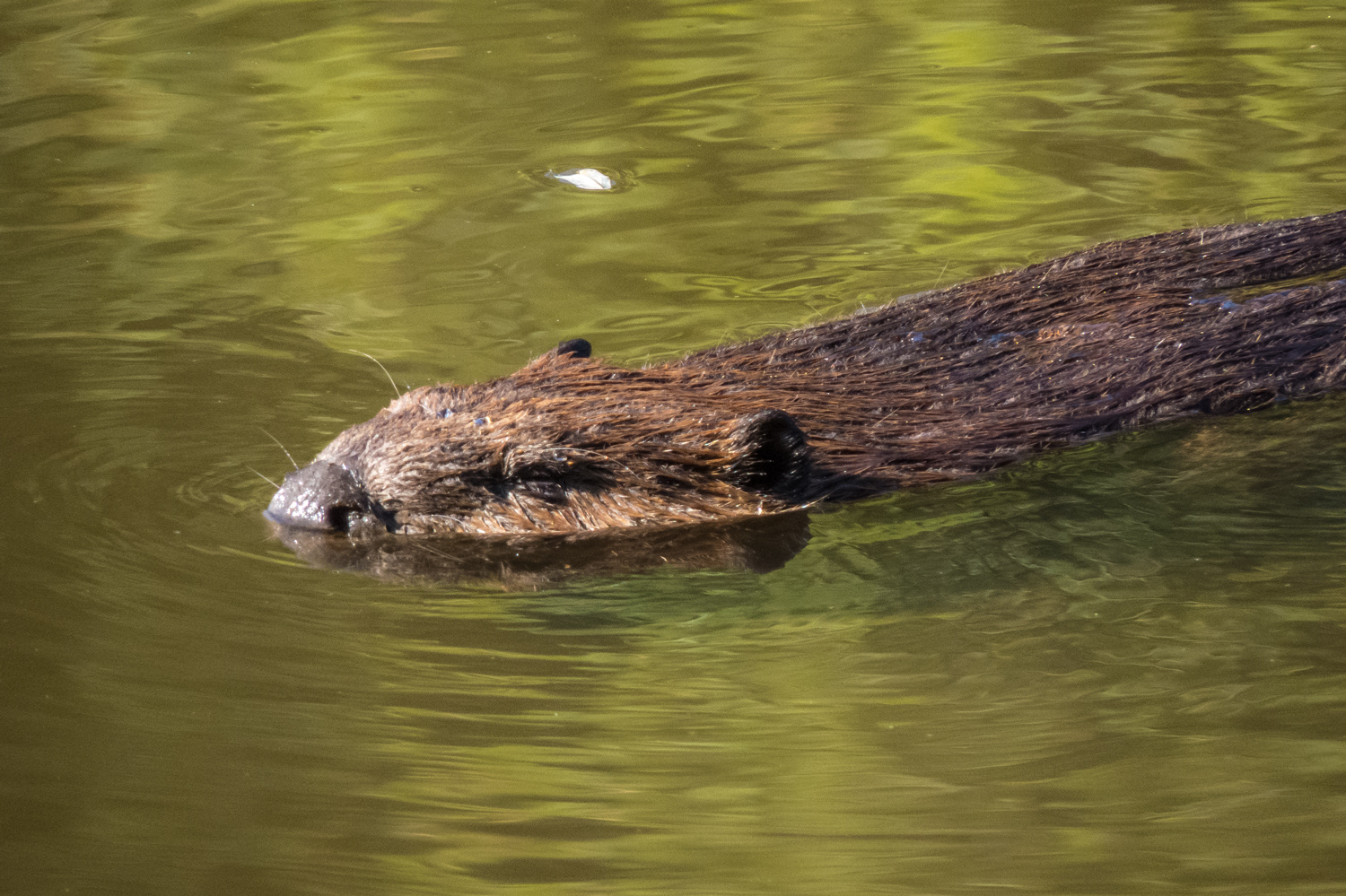
When I was walking around the small pond at Jackson Miles Abbott Wetland Refuge yesterday morning around 10:00, therefore, I was expecting to see dragonflies. Imagine my shock when some motion in the water caught my eye and I spotted a North American Beaver (Castor canadensis) lazily swimming by parallel to the shore on which I was standing.

The light on the water was amazing and gave it a golden glow, as you can see in the first image. The beaver made a gentle u-turn and I was able to capture the ripples and the wake it created in the second image. The beaver was then swimming  toward the light and that is why you can see some of the details of the eye in that second image.

I then decided to switch from my DSLR with my 180mm macro lens that I used for the first two shots to my Canon SX50 superzoom camera. The third image is framed just as it came out of the camera with no cropping and it lets you see some of the texture of the beaver’s fur and the little hairs that stick out of its face. I also love the way the patterns of the water look in this image.

This little incident was a reminder to be eternally vigilant. Wild creatures don’t always follow the rules and may turn up in unexpected places at unanticipated times.

beaver

beaver

beaver

© Michael Q. Powell. All rights reserved.
Read Full Post »

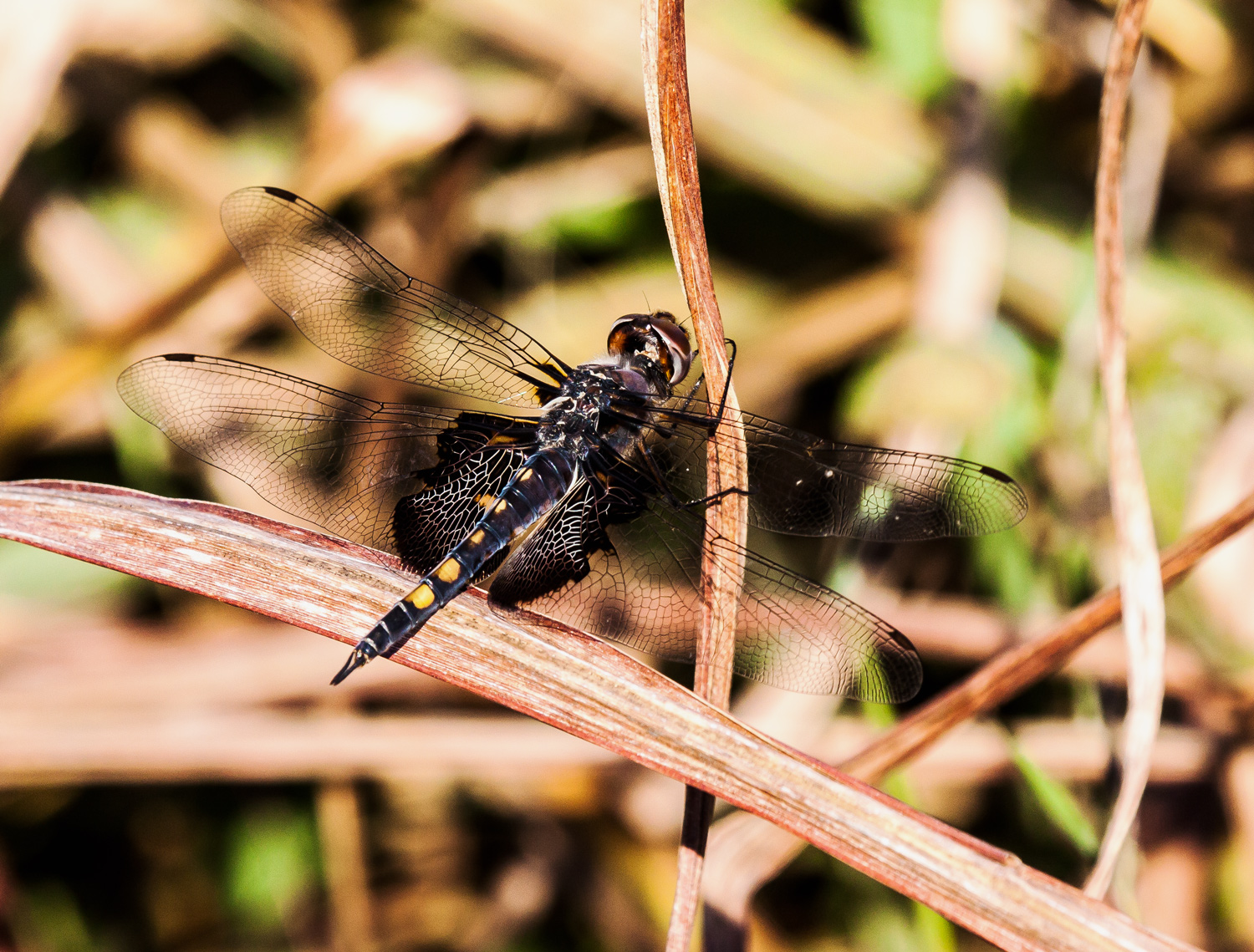
I don’t know if this is a local dragonfly or was merely stopping by while migrating south, but I was happy when this Black Saddlebags dragonfly (Tramea lacerata) stopped circling a field and perched for a moment earlier this week at Occoquan Bay National Wildlife Refuge.

This species of dragonfly is one of several migratory species and in the early autumn I tend to see more Black Saddlebags dragonflies than at any other time of the year. As you might have guessed, the dark blotches on the wings caused some scientist to imagine that they looked like saddlebags. In some cases, I scratch my head when I learn the name of a species, but in this case the name seems to fit and doesn’t require too big a stretch of the the imagination.

Black Saddlebags

© Michael Q. Powell. All rights reserved.


Read Full Post »

I love to photograph bees and realize that I have not featured one for quite some time. I captured this image of one as it perched on some pickerelweed this past weekend at Ben Brenman Park in Alexandria, VA.

In many ways, this image is as much about the flowering plant as it is about the bee. It speaks to me of the interaction between those two main subjects.

For me, photographing nature is about balancing the depiction of the small details, as I often do, with the “bigger” picture—the framing of this shot helps to give the viewer a better sense of the environment than if I had done an extreme close-up shot of the bee itself.

bee and pickerelweed

© Michael Q. Powell. All rights reserved.

Read Full Post »

Despite seeing several Fine-lined Emerald dragonflies (Somatochlora filosa) last Friday at Occoquan Bay National Wildlife Refuge, only this one was cooperative enough to land for a moment and allow me to get some shots.

Previously I posted some photos I took of Fine-lined Emeralds in flight. I had chased and chased these elusive dragonflies, but they never seemed to stop flying. I was beginning to think that I would not get a shot of one perched when suddenly one that I was tracking dropped down into the vegetation. I approached very cautiously and spotted it clinging vertically to a narrow stem.

My heart was racing as I switched to manual focusing—the profile of the perched dragonfly was so slim that I didn’t think my auto-focus would lock on my subject. I took a couple of shots and then inched forward a little. This is part of an eternal struggle for a wildlife photographer, deciding how close you can get to a subject without disturbing it.

I was pretty happy with this image, because I was able to capture a lot of details of this cool-looking species. I recommend clicking on the image to see a higher resolution view of the dragonfly’s spectacular emerald eyes, beautiful body markings, and wonderful wings.

Fine-lined Emerald

© Michael Q. Powell. All rights reserved.
Read Full Post »

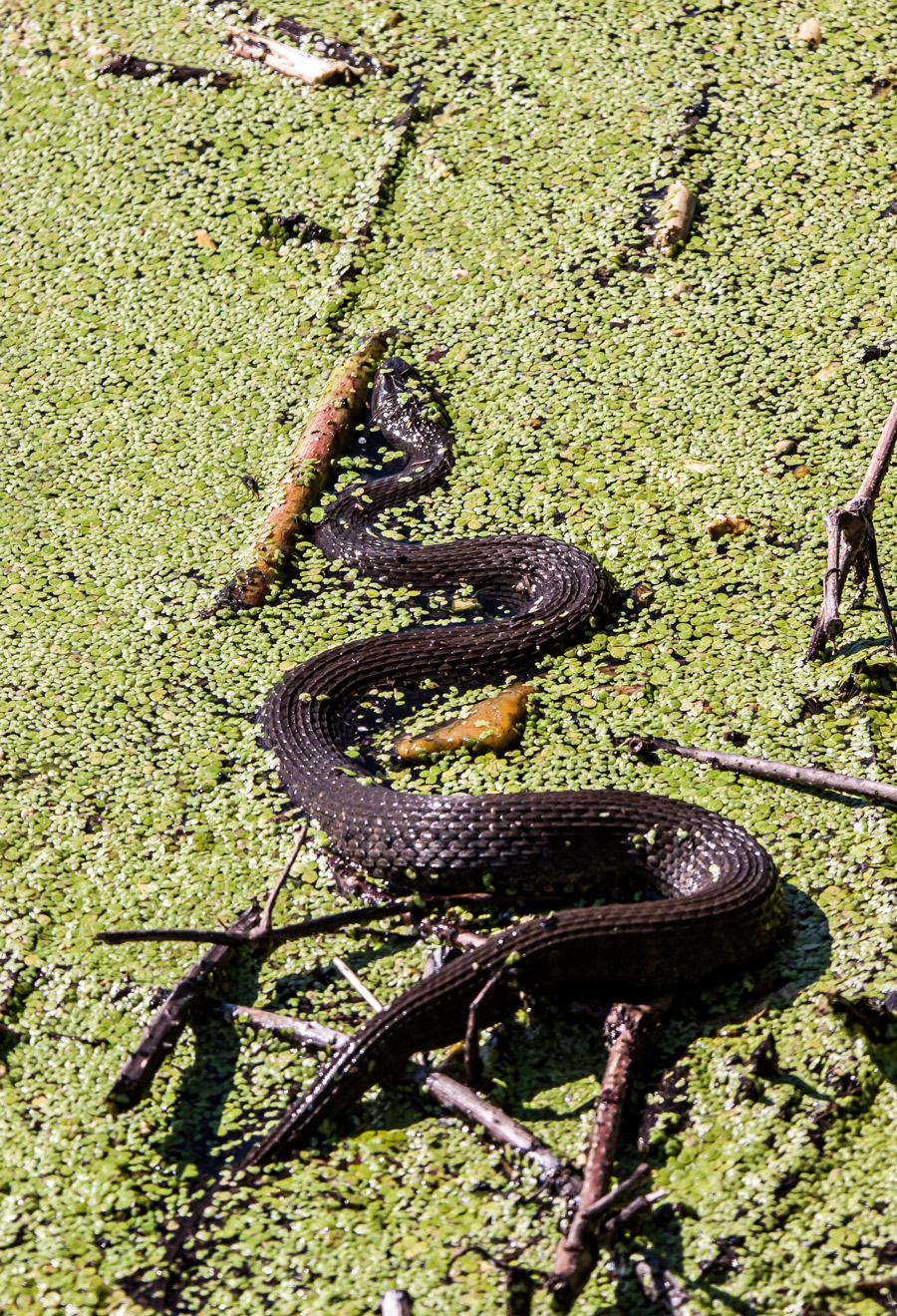
Semi-submerged in the duckweed in the shallow water, this snake patiently awaited an unseen prey yesterday at the pond at Ben Brenman Park, a small suburban park not far from where I live in Alexandria, Virginia. I did not get a really good look at the snake, which dove into the water shortly after I took this shot, but I think it might be a Northern Water Snake (Nerodia sipedon).

In many ways I was more interested in the sinuous curves of the snake’s body than in the identification of the snake’s species. There is an abstract beauty in the colors and the shapes in this image that appeals to me, though I know that some of my viewers are so creeped out by the main subject that they will find it hard to see any beauty whatsoever in the image.

Northern Water Snake

© Michael Q. Powell. All rights reserved.

Read Full Post »

Orange and brown seem to be the perfect color combination for the autumn and this Question Mark butterfly (Polygonia interrogationis) was suitably celebrating the season this past Friday at Occoquan Bay National Wildlife Refuge.

Question Mark butterfly

© Michael Q. Powell. All rights reserved.

Read Full Post »

Orange is one of the colors that I tend to associate with autumn. Some leaves are already turning orange and pumpkin decorations and displays have started to appear on my neighbors’ doorsteps.

As I was exploring Occoquan Bay National Wildlife Refuge yesterday morning, my eyes detected some motion in the nearby grass. I leaned forward and was delighted to see this tiny damselfly decked out in the colors of Halloween—orange and black. I had no idea what species it was, but fortunately I have a really good guide for damselflies and was able to identify it as an immature female Eastern Forktail damselfly (Ischnura verticalis).

Although there are already lots of symbols for autumn, I think this tiny damselfly could be added to the list.

Eastern Forktail

© Michael Q. Powell. All rights reserved.

Read Full Post »

I was thrilled yesterday to see that there are still Fine-lined Emerald dragonflies (Somatochlora filosa) at Occoquan Bay National Wildlife Refuge. I was afraid that all of the recent rain had washed them away.

This particular dragonfly species is pretty uncommon, but the wildlife refuge that has become my go-to place for photography is one of the few local spots where they can be found. I think its peak period in our area is September-October, judging from my experience last year, so I was anxious to see them some more before they disappeared for the year.

It is easy to see a Fine-lined Emerald dragonfly when it is patrolling, because it often flies at knee to shoulder height. It is a whole different problem, though, to get a shot of one, because they spend most of their time in the air rather than perching. I spent quite a bit of time yesterday chasing after these dragonflies, hoping in vain to be able to catch the moment when one decided to take a break.

Finally I decided to change my approach and see if I could capture a shot of one as it flew by me. I know that it can be done, because last year I captured an in-flight image using my 150-600mm zoom lens. The lens that I had on my camera, however, was my 180mm macro lens, which meant that I had to get pretty close to the dragonfly rather than zooming in. That particular lens is slow to focus, so I decided to focus manually, which can be tricky with a moving subject. One of the downsides of the lens is it has no built-in image stabilization, so I decided to keep the camera affixed to my monopod for the sake of stability.

It took some time, but eventually I was able to capture a few shots of flying Fine-lined Emeralds that were relatively in focus, aided by the fact that these dragonflies hover a little from time to time.

I particularly like the first image because it shows both the emerald eyes and the fine lines near the tip of the abdomen that are responsible for the name of the species. It was also cool that the angle of view was unusual, given that I was looking down at the dragonfly as I took the shot. I also like the touch of brownish-orange from the out-of-focus leaves that gives the image an autumn feel.

The second shot gives a more “normal” view of a Fine-lined Emerald dragonfly as it flew by.  I was happy to be able to separate it somewhat from the leafy backdrop by carefully focusing on the dragonfly. This is one of those situations when the auto-focusing system of the camera would have been challenged—the subject was pretty small in the viewfinder and the auto-focus probably would have tried to lock on the background.

fine-lined emerald

fine-lined emerald

© Michael Q. Powell. All rights reserved.

Read Full Post »

I suspect that all of the Monarch butterflies (Danaus plexippus) will soon be leaving our area for warmer places, so I am really trying to enjoy each and every encounter with one. I spotted this beauty feeding on some kind of thistle plant thispast weekend at Occoquan Bay National Wildlife Refuge.

monarch butterfly

© Michael Q. Powell. All rights reserved.

Read Full Post »

The muted tones of this Great Blue Heron (Ardea herodias) seemed to be a perfect match for the gray water and skies this past weekend at Occoquan Bay National Wildlife Refuge. The heron almost seemed to be playing hopscotch as it made its way along a series of posts and then extended its wings for balance when it reached the final post.

If you closely at the water you can see a lot of floating debris, caused by runoff and tidal surges from recent heavy rains—we have had well over double the normal amount of rainfall during the month of September.

Great Blue Heron

© Michael Q. Powell. All rights reserved.

Read Full Post »

Now that fall has officially arrived, I look forward to seeing more Autumn Meadowhawk dragonflies (Sympetrum vicinum), like this stunning female that I spotted last Friday at Occoquan Bay National Wildlife Refuge. Adult males of this dragonfly species are bright red in color, but females can be either tan or red. The “spike” near the end of the abdomen makes it easy. though, to identify this one as a female.

In Northern Virginia, where I live, the Autumn Meadowhawk tends to be the latest surviving dragonflies—I have spotted them in mid-December and others have seen them in early January.

Autumn Meadowhawk

© Michael Q. Powell. All rights reserved

Read Full Post »

Sometimes I don’t have to venture far to capture images. I took this shot recently of a flower growing out of one of the hosta plants in my front yard as the rain was falling.

Simple colors and shapes and the sparkle of raindrops—photography doesn’t always have to be complicated. The challenge is to slow down, to really see the world around us, and to recognize its inherent beauty.

hosta in the rain

© Michael Q. Powell. All rights reserved

Read Full Post »

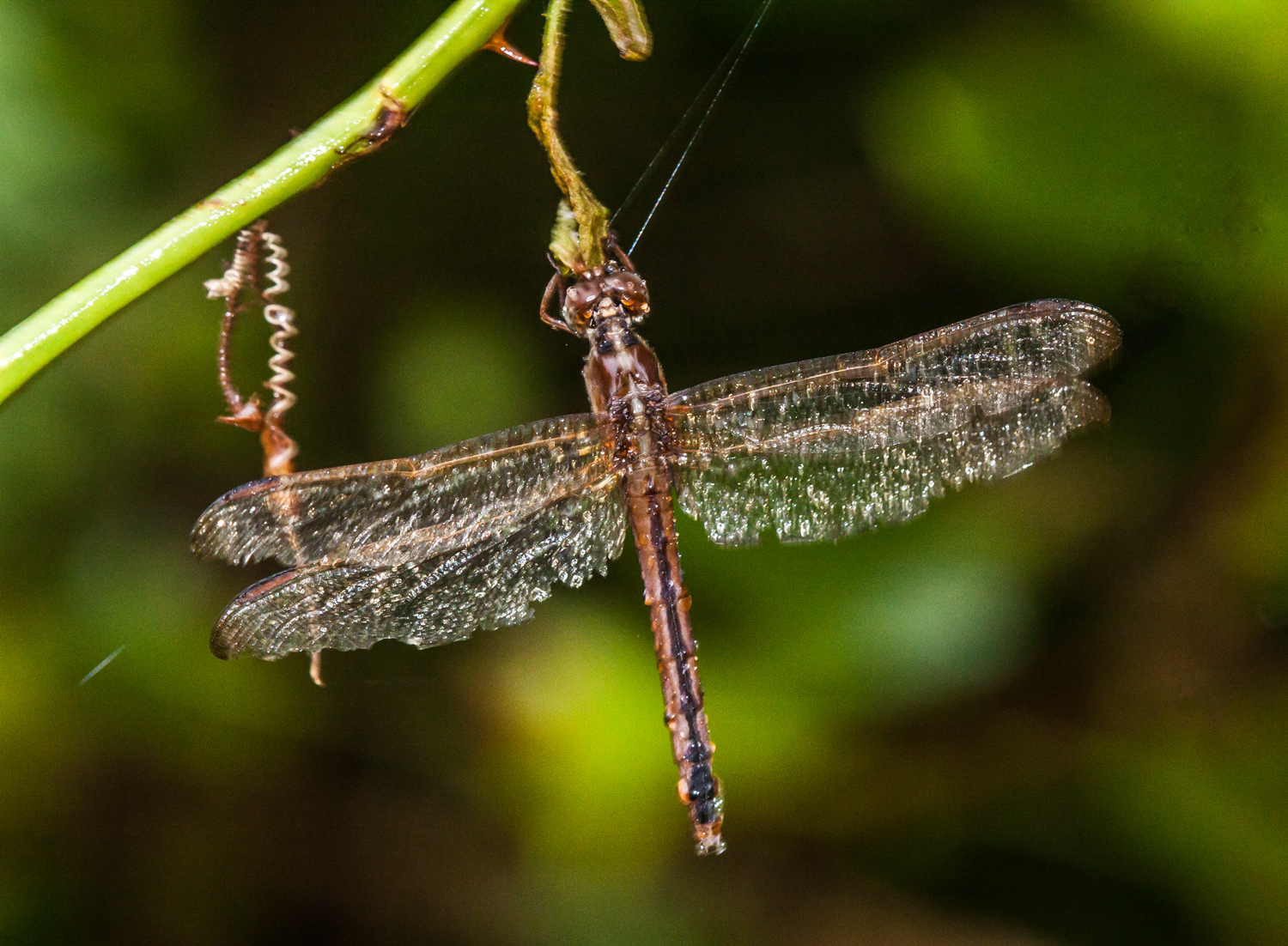
I don’t expect to see dragonflies flying in the rain, so I was a little shocked to see this one in the air this past weekend at Occoquan Bay National Wildlife Refuge. I captured this shot when it landed and hung vertically in the vegetation in an apparent attempt to drip dry.

I not certain of the identification of this dragonfly, but think it might be a Needham’s Skimmer (Libellula needhami), judging from the markings. Normally Needham’s Skimmers perch horizontally rather than vertically, but the unusual perching behavior might have merely been a consequence of the rainy conditions.

If you click on the image, you can see it in slightly higher resolution, including the tiny drops of water at the lower end of the abdomen (the “tail”).

Needham's Skimmer

© Michael Q. Powell. All rights reserved.


Read Full Post »

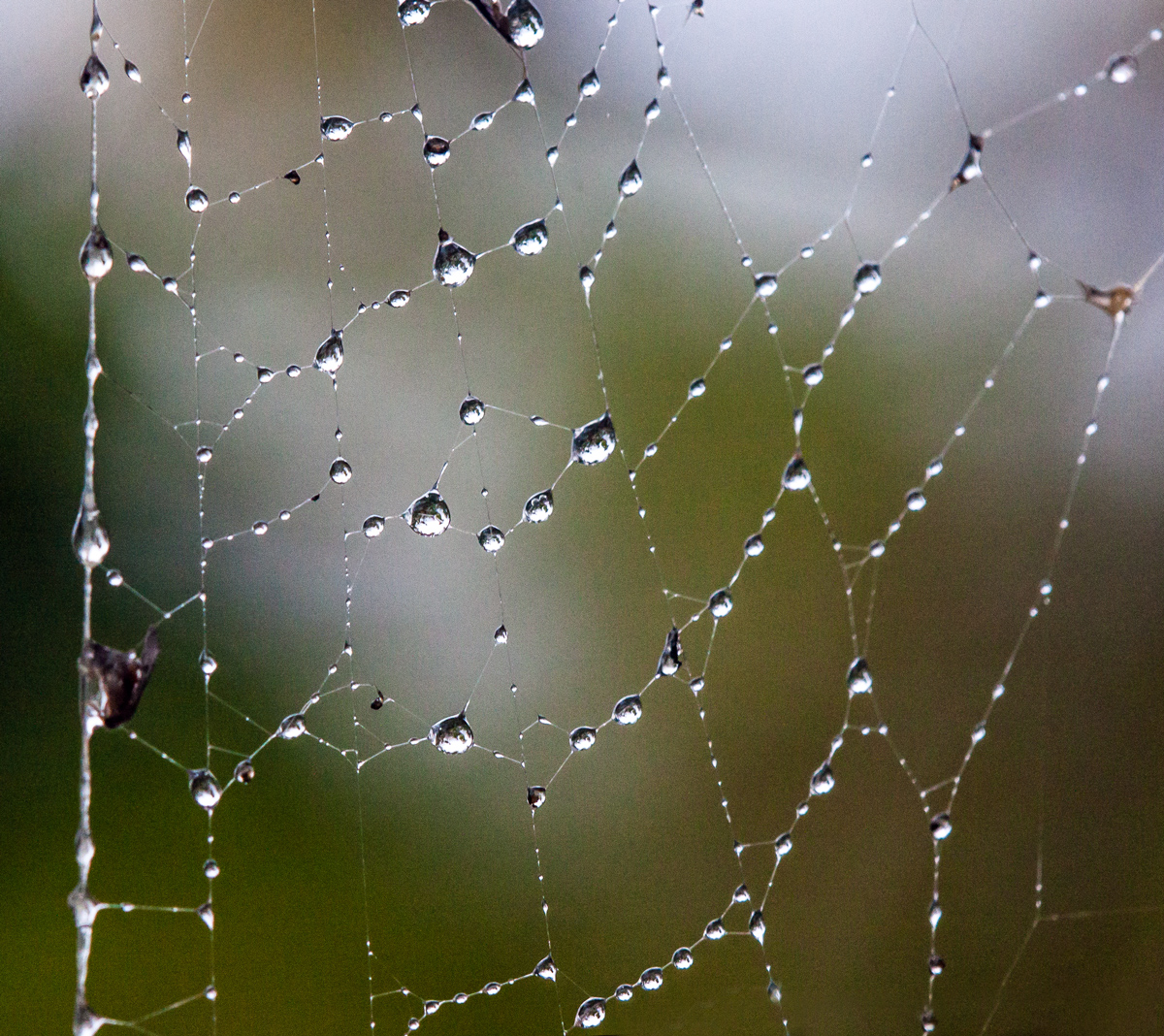
Raindrops can enhance the beauty of many subjects, like this spider web that I photographed on Friday at Occoquan Bay National Wildlife Refuge. As I looked at the drops, they somehow brought to mind an elaborate necklace of loosely strung pearls.

wet spider web

© Michael Q. Powell. All rights reserved

Read Full Post »

Milkweed plants provide a wonderful habitat for all kinds of creatures, including this Large Milkweed Bug (Oncopeltus fasciatus) that I spotted earlier this week at Green Spring Gardens. These  bugs go through a fascinating series of physical transformations as they move though different nymph phases. A little over six years ago, I studied these bugs  pretty closely and documented their stages of development in a posting that I called Life phases of the large milkweed beetle. Be sure to check it out for more information and fascinating photos of these colorful little bugs.

I really like the combination of colors in this simple shot, colors that remind me a little of Christmas. However, I doubt that anyone would choose to feature this image on their annual Christmas card. 🙂

Large Milkweed Bug

© Michael Q. Powell. All rights reserved

Read Full Post »

Today I decided to feature two butterflies that I have seen over the past week. I saw them at different times and at different places, so normally I would not put them together in a posting.

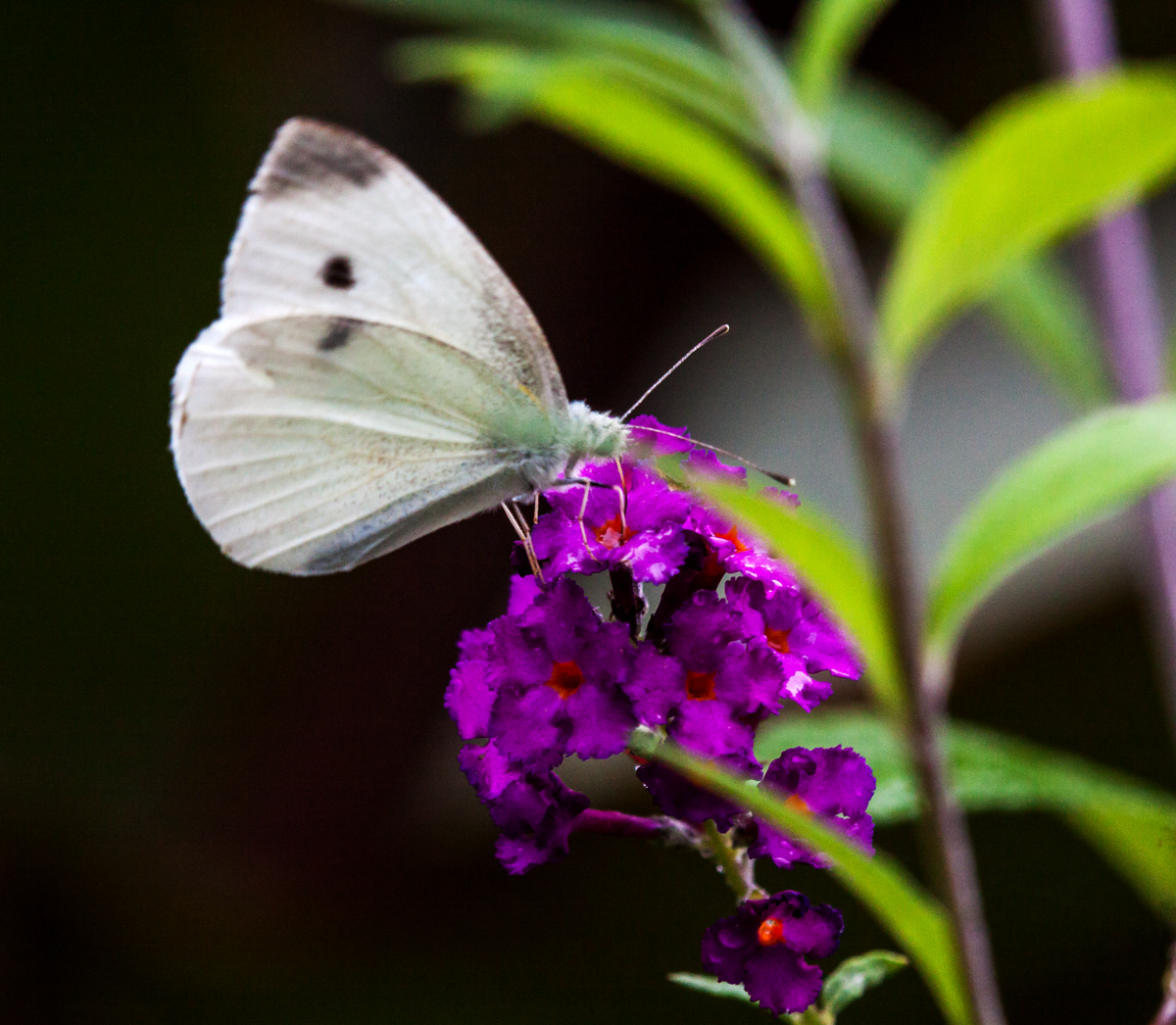
I was struck, however, by the contrast between the two of them. One of them, a Viceroy butterfly (Limenitis archippus), is brightly colored and hard to miss. The other, a Cabbage White (Pieris rapae) is so pale and nondescript that many people don’t notice it at all or dismiss it as being “only” a moth.

Beauty speaks to people in individual deeply personal ways. I find these two butterflies to be equally beautiful.

What do you think? Instinctively do you find one of these two to be more beautiful than the other?

Of course, there is no “right” answer. It seems to me that beauty is almost always subjective rather than universal. Our assessments of beauty tend to be influenced by a whole host of internal factors including our mood, personality, and background as much as by the external characteristics of the subject being considered.

Viceroy butterfly

Cabbage White butterfly

© Michael Q. Powell. All rights reserved


Read Full Post »

Normally I don’t do consecutive blog posts of the same subject, but I got such an overwhelmingly positive response yesterday to my images of Ruby-throated Hummingbirds (Archilochus colubris) that I decided to post a few more. All of these hummingbirds, the only species found in the eastern part of the US, will probably depart soon to winter in a warmer climate, so I figure I better take advantage of this opportunity while I have it.

The best chance to snap a photo of a hummingbird is when it hovers to gather nectar (or when it is perched), but I managed to capture the first image as the hummingbird was zooming on by. I love its body position.

From an artistic perspective, the second image is my favorite. The background is simplified and less cluttered than in other images and the bright color of the flowers really grabs the viewer’s eyes. The slightly blurred wings are in a wonderful position and help to emphasize the sense that the hummingbird is in motion.

The final shot was taken with a different camera. As I noted yesterday, I was shooting with my 180mm macro lens, but I also had my Canon SX50 superzoom camera with me. It has a long reach, but doesn’t handle fast action very well, so it mostly stayed in the camera bag. When one of the hummingbirds perched in a distant tree, however, I was able to pull it out and use it for this static portrait.


Ruby-throated Hummingbird

Ruby-throated Hummingbird

Ruby-throated Hummingbird

© Michael Q. Powell. All rights reserved

Read Full Post »

It was cloudy and there was intermittent rain, but some Ruby-throated Hummingbirds (Archilochus colubris) were active at Green Spring Gardens yesterday. My macro lens might not have been the optimal choice for photographing them, but it is what I had on my camera and I was pleasantly surprised by the results.

As I have noted many times before, I really like my macro lens, a Tamron 180mm lens. Because of the crop sensor of my Canon 50D DSLR, the lens has an equivalent field of view of 288mm, which lets me use if as a telephoto lens in a pinch. The only down side of the lens is that it does not have any image stabilization so I have to pay attention to my shutter speed and/or use a monopod as I was doing yesterday.

I noted that the hummingbirds seemed to like a particular kind of flower, so I planted myself in front of a patch of them and waited. The hummingbirds returned several times and I was able to decent shots. As I was waiting, it began to rain a bit, so I opened my umbrella and kept shooting—the hummingbirds did not seem to mind the light rain. It must have been quite a sight to see me with my umbrella in one hand and my camera on the monopod in the other.

For those of you who are interested in camera settings, I was shooting at ISO 1600 in aperture-preferred mode with an aperture setting of f/5. The relatively poor lighting meant that my shutter speed generally was 1/500 or slower, which was not fast enough to freeze the motion of the wings, but did allow me to capture the body fairly well when the hummingbird hovered.

I have a few more hummingbird shots that I may use in another posting, but wanted to share these initially.

Ruby-throated Hummingbird

Ruby-throated Hummingbird

Ruby-throated Hummingbird

© Michael Q. Powell. All rights reserved


Read Full Post »

When you shoot with a zoom lens, you can change the look of an image without moving from where you are standing. That can be an advantage, but it can also be a disadvantage, because it can discourage you from exploring different angles or different perspectives.

I really enjoy shooting with a lens of a fixed focal length, especially my macro lens, because it forces me to think more about composition. If I decide that I want the subject to be larger in the frame, I have to move physically closer to the subject. If the terrain doesn’t let me get any closer, then I have to consciously consider how else I could frame the shot.

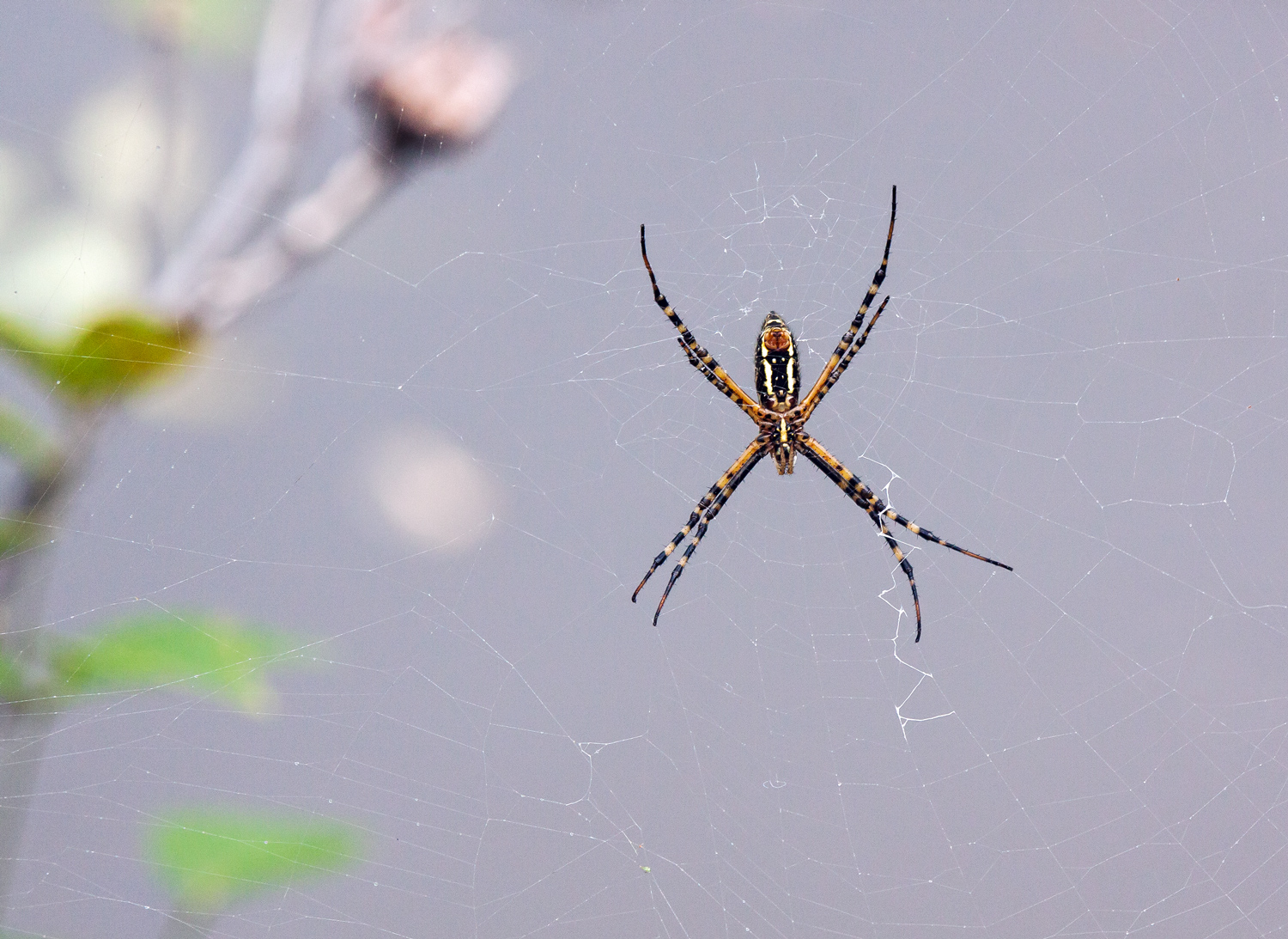
This past weekend I saw a lot of black and yellow garden spiders (Argiope aurantia) when I was exploring Jackson Miles Wetland Refuge, a small park not too far from where I live. Some of the spiders were in bushes and others were overhanging the water of a small pond. It was a fun challenge to figure out how to photograph the spiders in different and interesting ways.

In the first shot, I decided to shoot the spider from the side rather than from the front as I normally do. I was delighted to see the way the the shape of the vegetation in the background almost matched the shape of the spider’s legs.

I also photographed the spider in the second image from the side, but the leafy backdrop and the inclusion of more of the spider’s web gives the image a completely different feel as compared to the first one.

When I saw the spider in the third image overhanging the water, I loved the shape of its body and its extended legs. If I had had a zoom lens, I am pretty sure I would have zoomed in on the spider. When processing the image, I was also tempted to crop in closely. I remember when I was shooting, though, that I deliberately included the vegetation on the left hand side, because I liked the way that it looked. So the image that you see is pretty much the one that I chose when I shot it, having zoomed in as closely as my feet would allow (without getting really wet). Despite my normal desire to fill my frame with my subject, I think it was good that I was not able to do so in this case.

argiope spider

argiope spider

argiope spider

© Michael Q. Powell. All rights reserved


Read Full Post »

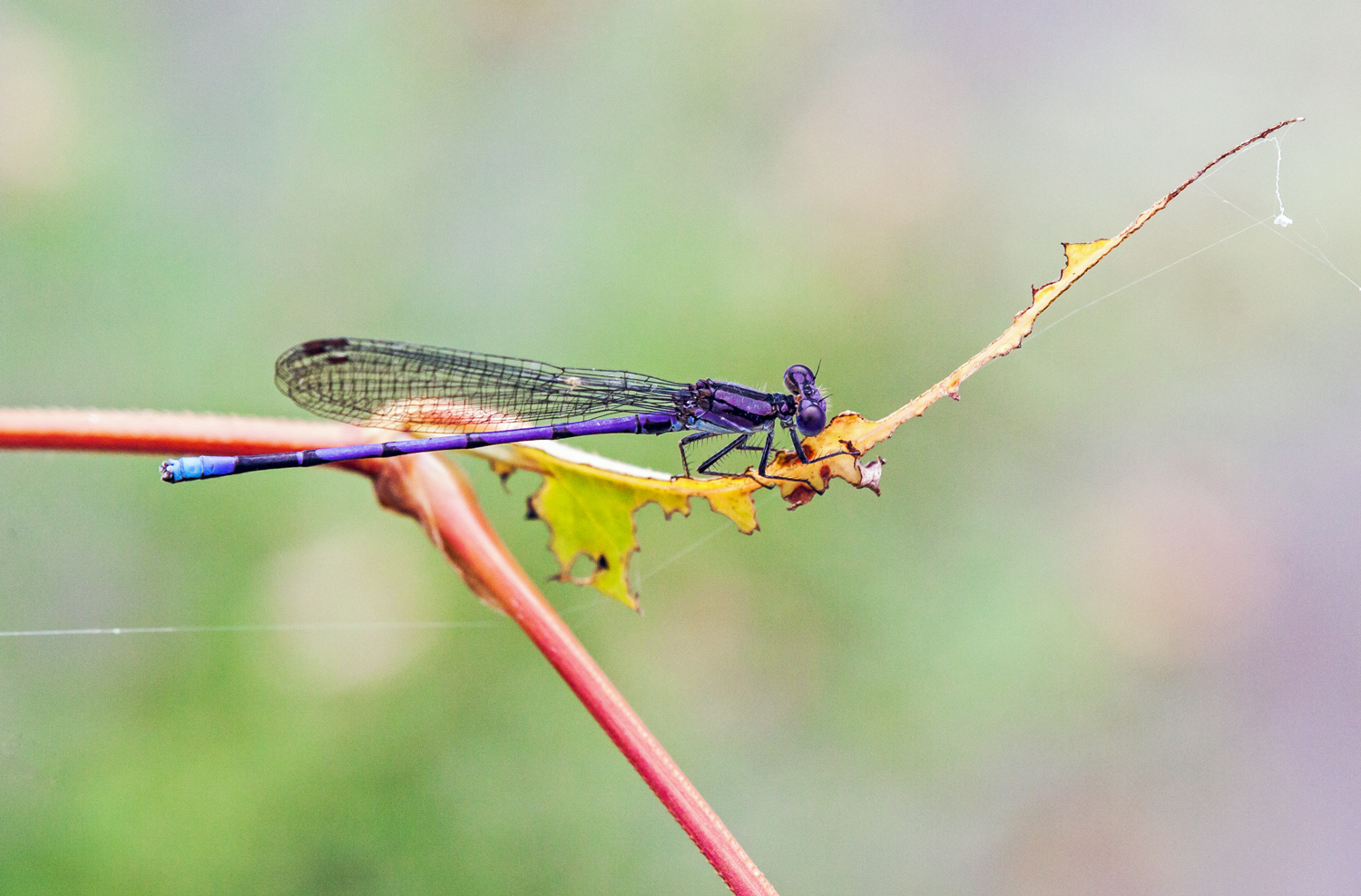
On Friday I was delighted to capture this image of one of my favorite damselflies, the beautifully colored Variable Dancer (Argia fumipennis), while exploring Jackson Miles Abbott Wetland Refuge. The red and yellow colors of the vegetation are vaguely autumn-like, a reminder that the clock is ticking for the end of the dragonfly/damselfly season this year. If only I could slow down the passage of time.

Variable Dancer

© Michael Q. Powell. All rights reserved


Read Full Post »

I was thrilled yesterday to see that at least one Swift Setwing dragonfly (Dythemis velox) is still present at Jackson Miles Abbott Wetland Refuge. Based on past records, the Swift Setwings should be with us at least until the end of September, but this has been a crazy year weatherwise, so I never know whether the different dragonflies will appear and disappear on schedule.

If you look really closely at the wings of this dragonfly, you’ll discover some really cool shapes and patterns—-not all of the individual “cells” in the wings are of the same shape and size. Together they form an intricate mosaic that reminds me of a stained glass window. (I encourage you to click on the image to see it in higher resolution.)

Swift Setwing

© Michael Q. Powell. All rights reserved

Read Full Post »

On Monday at Occoquan Bay National Wildlife Refuge I watched with fascination as this spider (maybe a Marbled Orbweaver (Araneus marmoreus) spider) worked on her web. She seemed to have started with the spokes coming out of the middle and was adding the ribs when I photographed her.

If you look closely in the first image, you can actually see the web material coming out of one of her spinnerets, the organs in which a spider produces the different kinds of silk that make up a web. I tried to figure our her process as I observed her. It looks like she would produce a length of silk, maneuver it into place on one of the spokes with one or more of her legs, affix it in place, and then start the process over again. For the final image, I moved back a little to give you a somewhat better view of more of the web and a sense of its shape.

I have photographed spiderwebs many times before, but this was the first time that I watched one being built. My admiration for the skills and artistry of spiders continues to grow—they are simply amazing.

spider making web

spider making web

spider making web

© Michael Q. Powell. All rights reserved


Read Full Post »

It was cool and wet on Monday and clouds covered the entire sky, but I felt an irresistible need to return to the wild after a week in the urban confines of Brussels, Belgium. Many of the trails at Occoquan Bay National Wildlife Refuge, my recent favorite shooting location, were blocked by standing water and there was not a great abundance of wildlife to be seen.

Most dragonflies prefer warm, sunny weather, so I was not surprised when I did not see many of them. I was happy, though, to see that damselflies were active and I spent quite a bit of time trying to capture images of them. They seemed more skittish than normal and the poor lighting made it tough to keep my shutter speed high enough to keep my images from being blurry.

This is one of my favorite damselfly shots of the day. I was able to isolate the subject, which I believe is a male Big Bluet (Enallagma durum) damselfly, while still including enough of the vegetation to give you a sense of the environment in which I found him.

Big Bluet

© Michael Q. Powell. All rights reserved

Read Full Post »

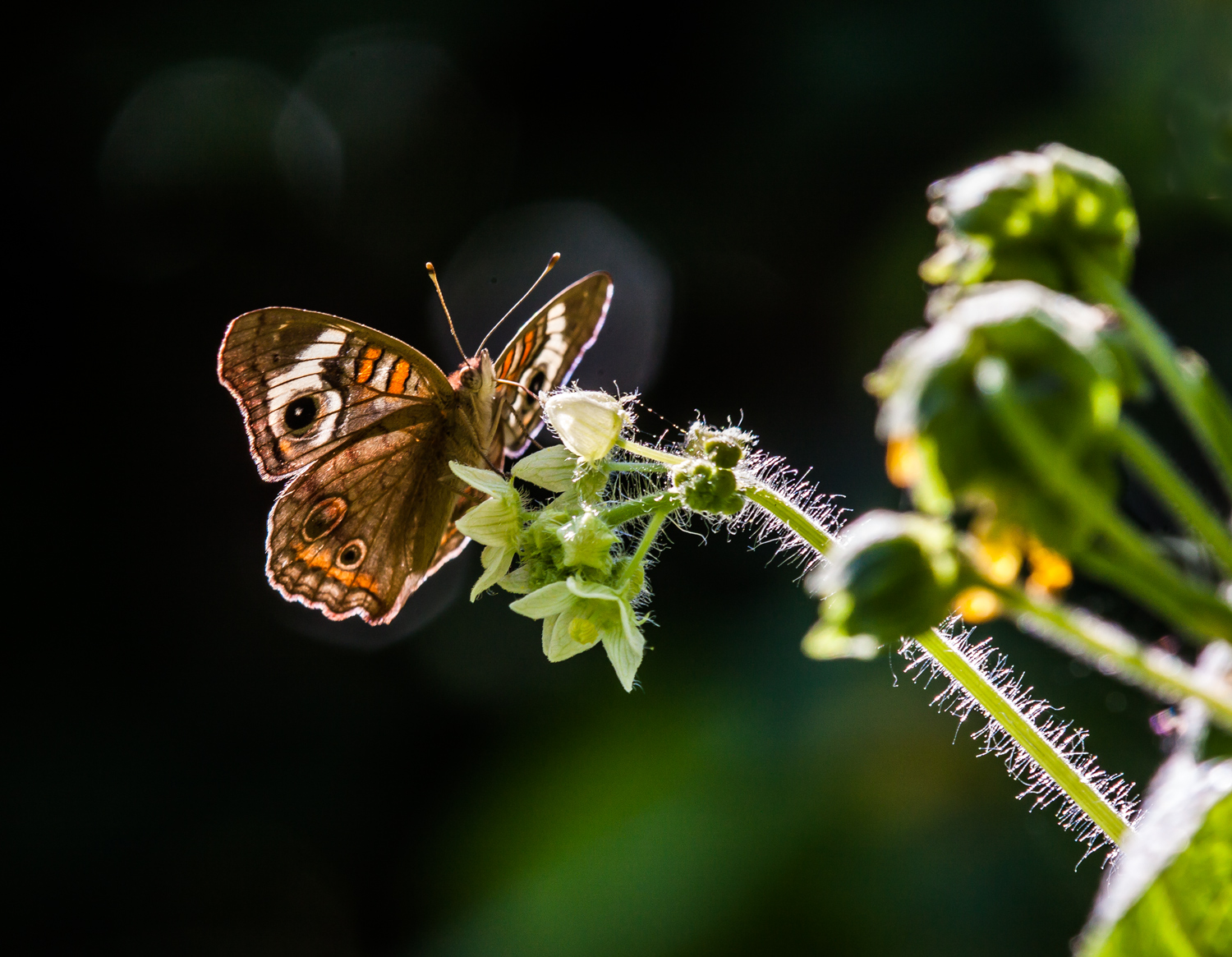
The directional lighting from the back and side gave a cool and dramatically uncommon vibe to this image of a Common Buckeye butterfly (Junonia coenia) that I photographed on 31 August at Occoquan Bay National Wildlife Refuge.

The ground is saturated and rain continues to fall, so I am not sure that I will be out and about today with my camera. It is actually a good thing, I think, to go back and look over my photos—I sometimes get so caught up in taking new photos that I don’t stop and look over my slightly older ones. I am often pleasantly surprised to discover some jewels, like this image.

Common Buckeye

© Michael Q. Powell. All rights reserved

Read Full Post »

The incessant rain and cooler weather since my return from Brussels make it feel like it’s already autumn. Like this Monarch butterfly (Danaus plexippus) at Occoquan Bay National Wildlife Refuge, however, I am not quite ready to cease sipping the sweet nectar of summer.

I captured this image on 31 August, the day before my departure for my recent overseas trip. The combination of rainy weather can jet lag have so far kept me from venturing out with my camera, but I hope to do so this coming week.

monarch butterfly

© Michael Q. Powell. All rights reserved

Read Full Post »

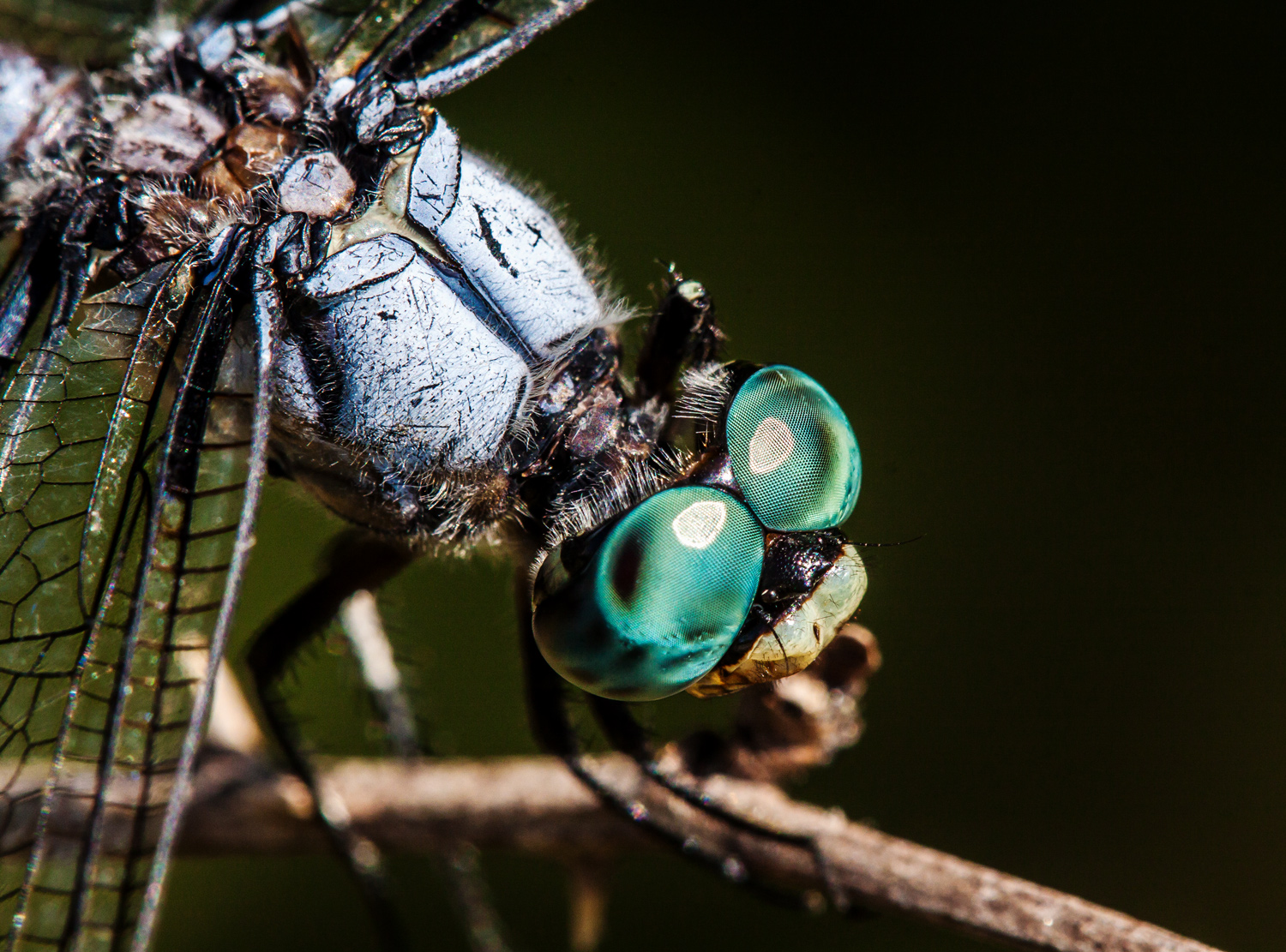
It almost looks like this Great Blue Skimmer dragonfly (Libellula vibrans) was wearing cool wraparound sunglasses this past weekend when I spotted him chilling out at Occoquan Bay National Wildlife Refuge. From a distance, it looks like dragonflies have smooth bodies, but when you get a good look up close, you discover that they have tiny hairs covering various parts of their bodies.

Great Blue Skimmer

© Michael Q. Powell. All rights reserved


Read Full Post »

As a nature photographer, I am used to living with compromises. Unlike some other kinds of photographers, I don’t have the luxury of waiting for perfect light or photographing only perfect subjects. I can make a few adjustments or move about a bit to improve my composition, but most of the time I deal with imperfections of one sort or another.

Every once and a while, though, I’ll take a photo that doesn’t require any substantial adjustments or even cropping–it looks just like I imagined it would. That was the case with a recent image I captured of a female Eastern Amberwing dragonfly (Perithemis tenera) at Occoquan Bay National Wildlife Refuge.  I like the way that I captured the subject, I like the curved of the vegetation on which it is perched, and I like the background. It’s a bonus that I didn’t need to crop.

Perfection is elusive in any pursuit—this is about as close as I can come to it in my photography.

Eastern Amberwing

© Michael Q. Powell. All rights reserved

Read Full Post »

I tend to be an opportunistic photographer, content to wander about and shoot whatever I happen to find. For the last couple of weeks, though, I have been searching diligently for a particular species of dragonfly, the Fine-lined Emerald (Somatochlora filosa), and yesterday, the final day of August, I finally found one at Occoquan Bay National Wildlife Refuge.

What makes this dragonfly so special? In his excellent website Dragonflies of Northern Virginia, Kevin Munroe described some of the allure of this particular species— “One of Northern Virginia’s most rare dragonflies, possibly our rarest, this species is seldom seen and little known throughout its range, from New Jersey to Florida, and west to Kentucky and Texas. Most field guides describe its breeding habitat as “unknown”.”

Last year I was lucky enough to see a Fine-lined Emerald several times, but I wanted more. As befits its name, my first glimpse yesterday of the dragonfly was of its brilliant green eyes as it flew by me. Unlike some species that fly high the air, Fine-lined Emeralds often patrol at waist to eye level. I was able to follow and track the dragonfly until it perched. This species hangs vertically from vegetation when perching, so it can be tough to spot one unless you have seen it land.

I was fortunate to be able to photograph this beautiful dragonfly on several different perches until it finally disappeared from sight. Here are a couple of my favorite shots from our altogether too brief encounter yesterday.

Fine-lined Emerald

Fine-lined Emerald

© Michael Q. Powell. All rights reserved

Read Full Post »

When recently at Occoquan Bay National Wildlife Refuge I spotted these two damselflies, which an expert identified as probable Big Bluets (Enallagma durum), I initially thought they were mating. Then I realized that the positions were all wrong and the nibbling on the neck was probably indicative of a literal hunger. Yikes.

As Tina Turner once sang, “What’s love got to do with it?”

damselflies

daamselflies

© Michael Q. Powell. All rights reserved

Read Full Post »

Two different colored dragonflies, a Needham’s Skimmer (Libellula needhami) and a Great Blue Skimmer (Libellula vibrans), were peacefully sharing a prime perch on Monday at Occoquan Bay National Wildlife Refuge.

Why is it so hard for us to peacefully coexist with one another?

peaceful co-existence

© Michael Q. Powell. All rights reserved

Read Full Post »

Have you ever gotten into a staring contest with a dragonfly? Dragonfly eyes can have an almost hypnotic effect on you when you look directly into them..

I went eye-to-eye with this Eastern Pondhawk dragonfly (Erythemis simplicicollis) on Monday at Occoquan Bay National Wildlife Refuge. She was the one to break eye contact first as she cocked her head, smiled at me, and decided the contest was over.

Eastern Pondhawk

Eastern Pondhawk

© Michael Q. Powell. All rights reserved

Read Full Post »

« Newer Posts - Older Posts »