August 10, 2018 by Mike Powell
Recently I spotted this small orange and brown butterfly while I was roaming the trails at Occoquan Bay National Wildlife Refuge. I initially thought it was a Pearl Crescent butterfly, a familiar species, and posted a photo on Facebook. One of my friends there, however, pointed out that my little butterfly was actually a Silvery Checkerspot butterfly (Chlosyne nycteis), a new species for me.
The composition in my image is pretty simple, but I really like the way that it turned out, with the soft contours of the butterfly juxtaposed with the linear veins of the leaf and the sharp contrast between the dominant green and orange tones. The shadows are a real bonus, adding additional interest to the photo.

© Michael Q. Powell. All rights reserved.
Posted in Butterflies, Insects, Nature, Photography, Summer, wildlife | Tagged Canon 50D, Chlosyne nycteis, Occoquan Bay National Wildlife Refuge, Silvery Checkerspot, Silvery Checkerspot butterfly, Tamron 180mm, Woodbridge VA | 4 Comments »
August 9, 2018 by Mike Powell
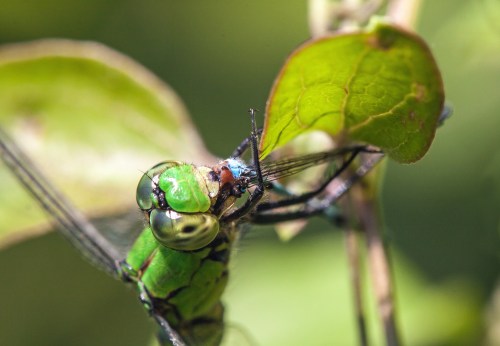
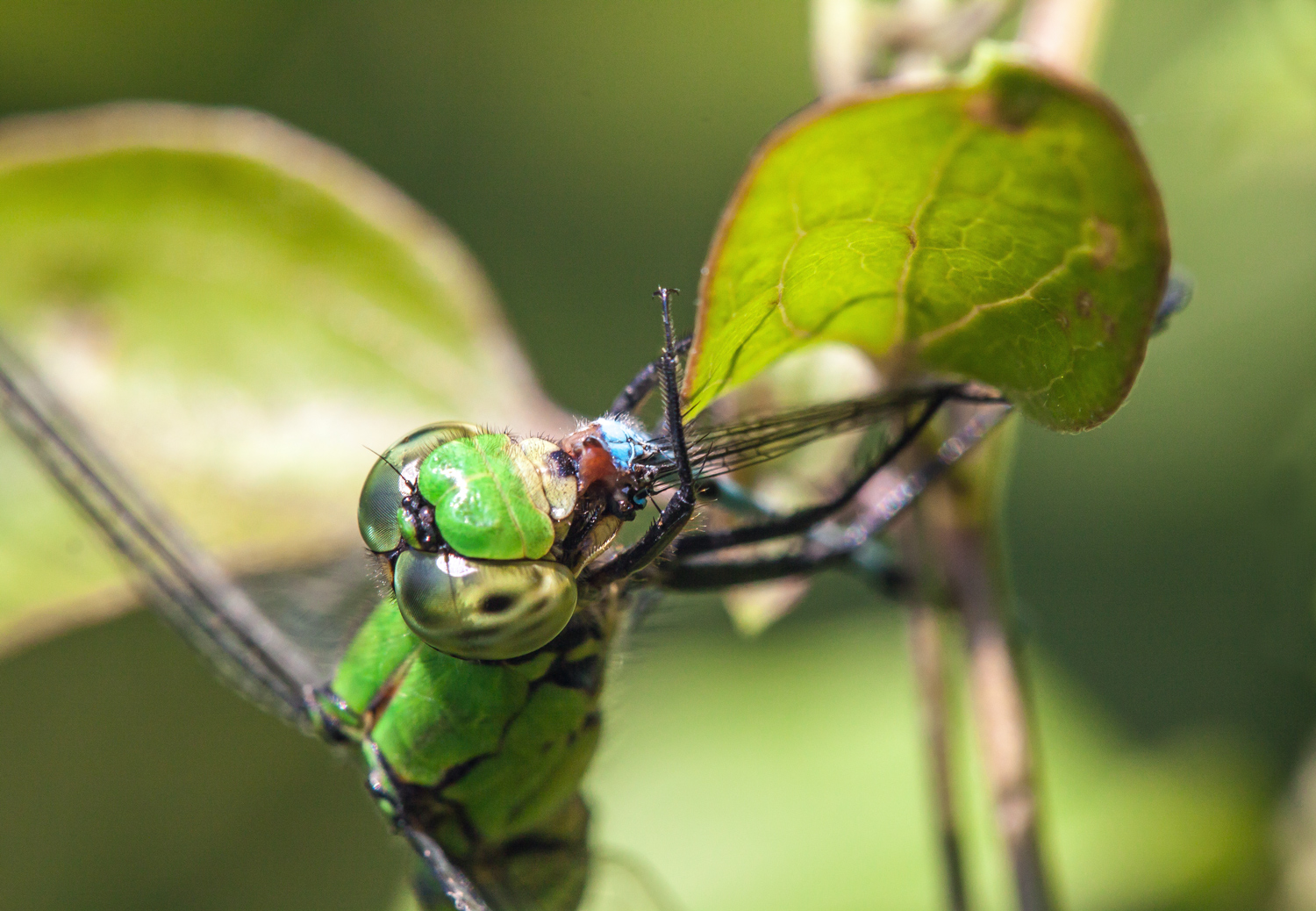
This image is a little gruesome, but here is a close-up look at an Eastern Pondhawk dragonfly (Erythemis simplicicollis) as it consumed a damselfly that it had captured this past Monday at Occoquan Bay National Wildlife Refuge in Northern Virginia. The second image shows a different Eastern Pondhawk with a different damselfly—the pondhawks seemed to have a particularly voracious appetite that day.
© Michael Q. Powell. All rights reserved.
Posted in damselfly, dragonfly, Insects, Macro Photography, Nature, Photography | Tagged Canon 50D, damselfly, Eastern Pondhawk, Eastern Pondhawk dragonfly, Erythemis simplicicollis, Occoquan Bay National Wildlife Refuge, Tamron 180mm, Woodbridge VA | 6 Comments »
August 8, 2018 by Mike Powell
I spotted this beautiful butterfly this past weekend at Jackson Miles Abbott Wetland Refuge. I am pretty sure that it is a Question Mark butterfly (Polygonia interrogationis), judging from the pattern of its wing spots.
While I may not be absolutely certain that it is a Question Mark butterfly, its beauty is unquestionable.

© Michael Q. Powell. All rights reserved.
Posted in Art, Butterflies, Insects, Nature, Photography, Summer, wildlife | Tagged beauty, Canon 50D, Fort Belvoir VA, Jackson Miles Abbott Wetland Refuge, Polygonia interrogationis, Question Mark butterfly, Tamron 180mm, unquestionable beauty | 8 Comments »
August 7, 2018 by Mike Powell
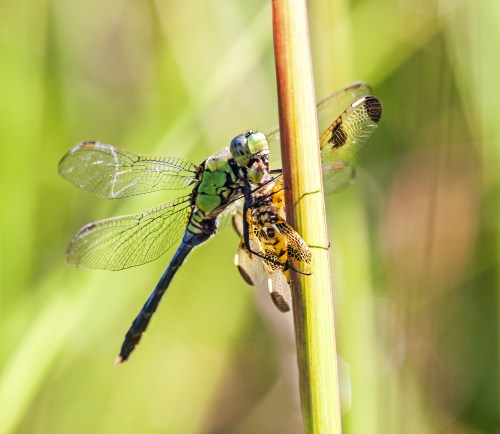
I was simultaneously fascinated and horrified yesterday at Occoquan Bay National Wildlife Refuge as I watched this Eastern Pondhawk dragonfly (Erythemis simplicicollis) gnaw on the head of a colorful Calico Pennant dragonfly (Celithemis elisa) that it had captured. I know that dragonflies eat other insects, but in my mind I tend to think of them consuming mosquitoes and other such smaller insects. Some of them, however, apparently prefer larger prey, including other dragonflies.
© Michael Q. Powell. All rights reserved.
Posted in Dragonflies, dragonfly, Insects, Nature, Photography, Summer, wildlife | Tagged Calico Pennant, Calico Pennant dragonfly, Canon 50D, Celithemis elisa, Eastern Pondhawk, Eastern Pondhawk dragonfly, Erythemis simplicicollis, Occoquan Bay National Wildlife Refuge, Tamron 180mm, Woodbridge VA | 7 Comments »
August 6, 2018 by Mike Powell
At this time of the year it’s tough for me to photograph birds—often when I spot them, they are mostly hidden in the foliage. This hawk, however, cooperated by perching out in the open this past Saturday at Jackson Miles Abbott Wetland Refuge. I was uncertain about the identification, so I checked with the experts in several Facebook birding groups and they indicated that this is an immature Cooper’s Hawk (Accipiter cooperii).
Cooper’s Hawks belong to the group of hawks called accipiters, also known as bird hawks. Accipiters have short rounded wings and a long tail and are better adapted to hunting in the woodlands that most other hawks.

© Michael Q. Powell. All rights reserved.
Posted in Birds, Nature, Photography, Summer, wildlife | Tagged Accipiter cooperii, Canon SX50, Cooper's Hawk, Fort Belvoir VA, immature Cooper's Hawk, Jackson Miles Abbott Wetland Refuge | 10 Comments »
August 5, 2018 by Mike Powell
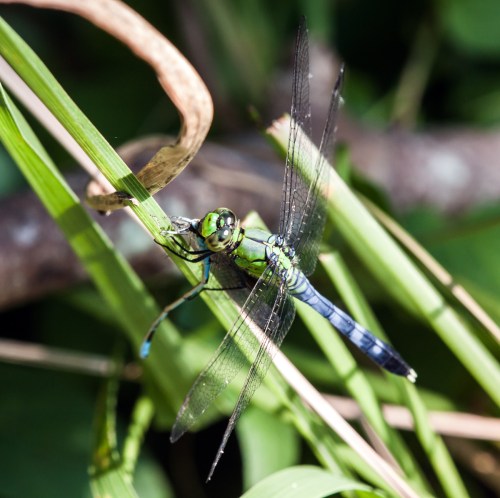
Normally when I see a Common Green Darner dragonfly (Anax junius) it is patrolling in the air and it is mostly a greenish blur. This past Friday, however, I was fortunate enough to spot one on the ground, nestled low in the vegetation at Occoquan Bay National Wildlife Refuge. At this closer distance I was able to marvel at all of the wonderful colors of this beautiful dragonfly.
Be sure to click on the images to see the details of this dragonfly at higher resolution. Did you notice the blue color near the tip of its “nose?”


© Michael Q. Powell. All rights reserved.
Posted in Dragonflies, dragonfly, Insects, Nature, Photography, Summer, wildlife | Tagged Anax junius, Canon 50D, Canon SX50, Common Green Darner, Common Green Darner dragonfly, green darner, Occoquan Bay National Wildlife Refuge, Tamron 180mm, Woodbridge VA | 6 Comments »
August 4, 2018 by Mike Powell
This Prince Baskettail dragonfly (Epitheca princeps) almost looks like it was flying at an airplane’s cruising altitude and was looking down at a landscape with rivers, mountains, and lakes. I spotted this dragonfly last weekend at Occoquan Bay National Wildlife Refuge and spent quite a while trying to get a shot of it in flight.
The dragonfly, however, never ventured close enough to shore for me to get a detailed shot of it. I was a little disappointed until I opened up the image on my computer and discovered that I had managed to capture a wonderful, fanciful background. Sometimes I try to document the reality that I see and other times it seems like it is just my imagination running away with me.

© Michael Q. Powell. All rights reserved.
Posted in Art, Dragonflies, dragonfly, Insects, Nature, Photography, Summer | Tagged Canon 50D, dragonfly in flight, Epitheca princeps, Occoquan Bay National Wildlife Refuge, Prince Baskettail, Prince Baskettail dragonfly, Tamron 180mm, Woodbridge VA | 6 Comments »
August 4, 2018 by Mike Powell
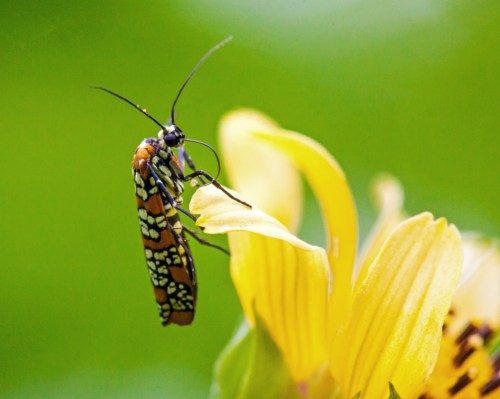
When you closely at flowers, you discover all kinds of cool insects, like this Ailanthus Webworm Moth (Atteva aurea) that I spotted yesterday at Occoquan Bay National Wildlife Refuge. My eyes were drawn to the colorful pattern on the body of this insect, which I initially assumed was some kind of beetle. Because of the distinctiveness of the pattern, it was not hard to identify it after a Google search, but I was a bit surprised to learn that it is a moth, not a beetle.
I thought that this was my first time spotting this moth, but a search of my blog shows that I saw one in 2016 and did a posting entitled Not a Beetle. Although my memory may not be perfect, apparently my reaction was almost identical both times.
© Michael Q. Powell. All rights reserved.
Posted in Insects, Macro Photography, Nature, Photography, Summer, wildlife | Tagged Ailanthus Webworm moth, Atteva aurea, Canon 50D, Occoquan Bay National Wildlife Refuge, Tamron 180mm, Woodbridge VA | 7 Comments »
August 3, 2018 by Mike Powell
Most folks are familiar with the comic book hero the Green Hornet, but have you ever seen a green bee? I don’t see them very often, so I was pretty excited to spot this one in some flowers last weekend at Occoquan Bay National Wildlife Refuge. I think this kind of bee is generally known as a metallic green sweat bee and is of the genus Agapostemon.

© Michael Q. Powell. All rights reserved.
Posted in Bees, Insects, Macro Photography, Nature, Photography, Summer | Tagged Canon 50D, genus Agapostemon, green bee, metallic green sweat bee, Occoquan Bay National Wildlife Refuge, sweat bee, Tamron 180mm, Woodbridge VA | 13 Comments »
August 2, 2018 by Mike Powell
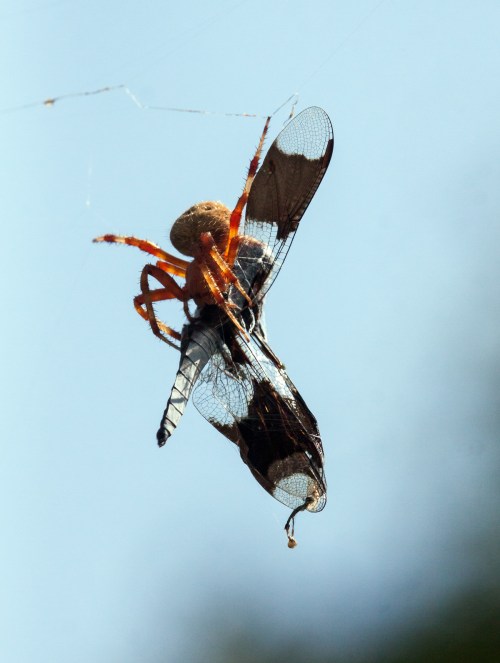
Sometimes the dragonfly is the predator and sometimes it is the prey—it appears to be primarily a matter of circumstances and timing. This male Common Whitetail dragonfly (Plathemis lydia) met his demise this past Friday at Occoquan Bay National Wildlife Refuge.
I am not sure how exactly the spider managed to snag the dragonfly, but I assume the dragonfly flew into the spider’s web, which was high in the air, spanning a gap between some tall trees. Interesting enough, I was only able to see a few strands of the web, so I wonder if this action took place at the extreme edge of the web.
© Michael Q. Powell. All rights reserved.
Posted in Arachnids, Dragonflies, dragonfly, Insects, Nature, Photography, spiders, Summer | Tagged Canon 50D, Common Whitetail, Common Whitetail dragonfly, Occoquan Bay National Wildlife Refuge, Plathemis lydia, predator, predator or prey, prey, Tamron 180mm, Woodbridge VA | 6 Comments »
August 1, 2018 by Mike Powell
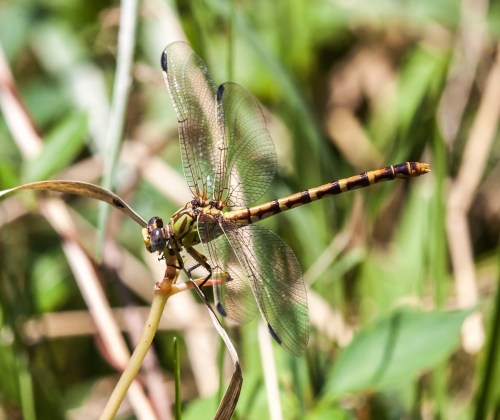
I spotted this beautiful female Eastern Ringtail dragonfly (Erpetogomphus designatus) last week along the Potomac River while exploring Great Falls Park. Unlike some of the dragonflies that I have photographed recently that perched at the very tips of tall stems, this species likes to perch in vegetation relatively low to the ground. As a result, the background in this image is a little more cluttered than I prefer.
If you double click on the image, you will see the image in greater detail, including its marvelous multi-colored eyes and the wonderful colors and patterns on its body.
© Michael Q. Powell. All rights reserved.
Posted in Dragonflies, dragonfly, Insects, Nature, Photography, Summer, wildlife | Tagged Canon 50D, Eastern Ringtail, Eastern Ringtail dragonfly, Erpetogomphus designatus, great falls park, Great Falls VA, Tamron 180mm | 3 Comments »
July 31, 2018 by Mike Powell
I love photographing the nondescript butterflies that are so common that they fly by virtually unnoticed, like this beautiful little sulphur butterfly that I spotted last week at Occoquan Bay National Wildlife Refuge. I believe it is an Orange Sulphur butterfly (Colias eurytheme), though it is often hard to distinguish that species from the Clouded Sulphur (Colias philodice), so I am a little uncertain of the identification.
What I am certain of, however, is the delicate beauty of this butterfly and I am happy that I was able to capture some of that beauty in this image. As I gaze at this photo, I am reminded of the moment when I took it, a moment when I was enveloped by a sense of deep tranquility as the gorgeous sunlight illuminated the wings of the butterfly. Quite often when I am pursuing a subject, I can feel my heart racing a little as adrenaline kicks in. This was one of the rare circumstances when I had the opposite physical reaction.
It is hard to describe in words what I was feeling, though it was definitely cool to experience. I hope that some of you will get a sense of that tranquility from this image. Iam becoming more and more convinced of the value of taking life a little more slowly, of opening myself up to experiencing the beauty that surrounds us every day.

© Michael Q. Powell. All rights reserved.
Posted in Art, Butterflies, Insects, Nature, Photography, Summer | Tagged Canon 50D, Clouded Sulphur, Clouded Sulphur butterfly, Colias eurytheme, Colias philodice, Occoquan Bay National Wildlife Refuge, orange sulphur, orange sulphur butterfly, Tamron 180mm, Woodbridge VA | 13 Comments »
July 30, 2018 by Mike Powell
Do you consider yourself to be artistic? All of my life I have been in awe of people who can draw and paint and create art, but have never considered myself to be artistic. Increasingly, though, my photography has opened up a creative side that I am trying to nurture.
As some of you know, I decided that I want to try my hand at watercolor painting and did a posting not long ago on my first efforts at doing a landscape. I don’t usually shoot landscapes with my camera, so I thought that I would try a more familiar subject for my second project—I decided to try to paint a dragonfly. In retrospect, I probably should have chosen an easier subject, but I am so inexperienced in art that I didn’t realize what I was getting myself into.
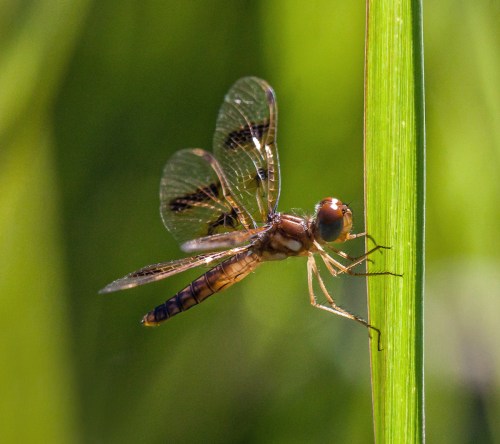
For inspiration, I used a recent photo that I took of a female Eastern Amberwing (Perithemis tenera). I have already included it in a blog posting, but am reprising it as the final photo, so you’ll know what my artistic efforts were supposed to look like.
I tried a couple of different approaches to my subject. First I tried sketching the dragonfly. I didn’t have a pencil handy, so I used a Bic ballpoint pen. My observation skills and sense of proportion are definitely lacking, but it was surprisingly fun to try. Without an eraser to correct my errors, I felt a bit like I was walking on a tightrope without a net.
Then I tried to draw with Crayola crayons? Why? I happened to be at Walmart yesterday and picked up a pack of 24 for only 50 cents at a back-to-school sale. My drawing looks a bit like a cartoon to me.
Finally I was ready to try watercolor. I decided that I would do the painting without bothering to sketch it out. Oops. I was using some inexpensive paper and it started to buckle a bit when I tried to cover the entire area with an overly wet wash of light green. I think I then attempted to put on the next layer before the first one was fully dry. I still feel like a second-grader in my watercolor skills, but it still was enjoyable trying to see what worked and what didn’t.
I did my final attempt in a sketchbook that is not intended for watercolor. I sketched out the dragonfly with a mechanical pencil and then colored the sketch with my watercolor paints. Out of all of my attempts, this is the one that I like the most. I felt a bit more confident in using the paints and in some of my strokes.
So what did I learn? Most significantly I learned that it’s worth taking a risk of feeling embarrassed; that it’s ok to try something new and achieve only a limited amount of success;, and that the amount of enjoyment that I can derive from a creative pursuit is not directly tied to any specific outcome.


© Michael Q. Powell. All rights reserved.
Posted in Art, dragonfly, Insects, Nature, Summer, watercolor, wildlife | Tagged #world watercolor month, #worldwatercolormonth, Crayola crayons, Eastern Amberwing, female Eastern Amberwing, Perithemis tenera, sketching, watercolor | 26 Comments »
July 30, 2018 by Mike Powell
Eastern Amberwings (Perithemis tenera) are the smallest dragonflies in our area. You can often find males buzzing around at the water’s edge, but females are harder to spot because they hang out in vegetation away from the water. I was thrilled therefore to see a beautiful female this past Friday at Occoquan Bay National Wildlife Refuge in some beautiful morning sunlight.
I decided to give a male Eastern Amberwing dragonfly equal billing in this post, because I really like the way that the shadows and the reflections make it look like he has an elongated body and extra sets of wings.

© Michael Q. Powell. All rights reserved.
Posted in Dragonflies, dragonfly, Insects, Nature, Photography, Summer, wildlife | Tagged Canon 50D, Canon SX50, Eastern Amberwing, Eastern Amberwing dragonfly, female Eastern Amberwing, male Eastern Amberwing, Occoquan Bay National Wildlife Refuge, Perithemis tenera, Tamron 180mm, Woodbridge VA | 3 Comments »
July 29, 2018 by Mike Powell
In a moment of calm amidst the storms this past Monday, I captured this shot of a beautiful little Cabbage White butterfly (Pieris rapae) in the garden of my neighbor and fellow photographer Cindy Dyer. The shot is a little grainy, because there was not a great deal of light, but somehow the image fills me with an overwhelming sense of serenity.

© Michael Q. Powell. All rights reserved.
Posted in Butterflies, Gardening, Insects, Nature, Photography, Summer, wildlife | Tagged Alexandria VA, Cabbage White, Cabbage White butterfly, Canon 50D, Cindy Dyer, Pieris rapae, Tamron 180mm | 4 Comments »
July 29, 2018 by Mike Powell
I love the dark, slate-blue tones of the male Slaty Skimmer (Libellula incesta), one of the most common dragonflies in our area. The beauty of this handsome Slaty Skimmer was further enhanced by the colorful backdrop that I managed to capture this past Friday at Occoquan Bay National Wildlife Refuge.
It is hard to come up with a composition that is more basic—beauty can often be found in simplicity.

© Michael Q. Powell. All rights reserved.
Posted in Art, Dragonflies, dragonfly, Insects, Nature, Photography, Summer, wildlife | Tagged Canon 50D, Libellula incesta, male Slaty Skimmer, Occoquan Bay National Wildlife Refuge, Slaty Skimmer, Slaty Skimmer dragonfly, Tamron 180mm, Woodbridge VA | 13 Comments »
July 28, 2018 by Mike Powell
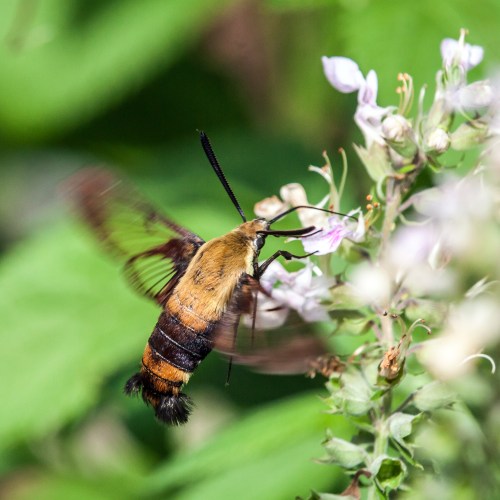
Many of my photographer friends have been posting photos of hummingbirds and I felt a little left out. I didn’t see any yesterday, but did spot several Snowberry Clearwing moths (Hemaris diffinis) at Occoquan Bay National Wildlife Refuge. This species, along with other clearwing moths, is sometimes called a “hummingbird moth” because of its appearance and behavior, which reminds some folks of a hummingbird.
Most of the times in the past that I have seen a hummingbird clearwing moth, it has been a “cousin” of this species, the very similar Hemaris thysbe. That species, however, has more red on its body and has lighter colored legs, according to the butterfliesandmoths.org website.
As you might suspect, these moths are in almost constant motion. Its is quite a challenge, therefore, to track them and keep them in focus as they dart among the flowering plants.
As I was tracking one, a second one flew in and seemed intent on dislodging the first one. I reflexively I pressed the shutter button and was a little shocked to see that I managed to capture them both in a single frame. It’s cool that they both had their long proboscises curled up at the moment I took the shot.


© Michael Q. Powell. All rights reserved.
Posted in Insects, Macro Photography, Nature, Photography, Summer, wildlife | Tagged Canon 50D, clearwing moth, Hemaris diffinis, hummingbird moth, Occoquan Bay National Wildlife Refuge, Snowberry Clearwing Moth, Tamron 180mm, Woodbridge VA | 12 Comments »
July 27, 2018 by Mike Powell
Yesterday as I was exploring Riverbend Park in Great Falls, Virginia, I encountered several damselflies that were new to me. When you spend as much time as I do searching for insects to photograph, you develop a sense of what is “normal” and I am able to decide almost immediately whether a subject is a familiar one or not. Those of you who know my work are aware that familiarity with a subject is not a criterion for photographing it—I am just as likely to take a shot of a common subject as a rare one.
As I looked though my reference books and material on line, I was able to determine that I had captured images of both the male and the female American Rubyspot damselfly (Hetaerina americana). One of the experts in a Facebook dragonfly forum pointed out the dragonfly in the first photo below is an immature male, which helps to explain why the red spot for which the species is named is not yet prominent.
I won’t go into the details of damselfly anatomy, but if you compare the dragonflies in the two photos, you can see some of the gender differences that often help in identification. The very tip of the abdomen, the part of the body that many folks refer to as the “tail,” is quite different for the male and the female. There is also some color differentiation. Alas, these are general rules that don’t apply in all cases, so I am often confounded when trying to identify the species of a given subject.
It is really cool that I continue to encounter new species. Part of the reason for that, I suspect, is that I am exploring some new locations. More importantly, though, my observational skills have improved dramatically over time and I am seeing things that I might not have noticed several years ago.


© Michael Q. Powell. All rights reserved.
Posted in damselfly, Dragonflies, dragonfly, Insects, Nature, Photography, Summer, wildlife | Tagged American Rubyspot, American Rubyspot damselfly, Canon 50D, Canon SX50, Great Falls VA, Hetaerina americana, Riverbend Park, Tamron 180mm | 5 Comments »
July 26, 2018 by Mike Powell
From time to time I will try to capture images of dragonflies in flight. Even under the best of circumstances it is a tough challenge for dragonflies are small, fast, and agile. Occasionally they will hover briefly, though most of the time it seems they choose to do so only when they are a long way away from me.
This past Monday I visited Jackson Miles Abbott Wetland Refuge and was surprised at the number of Swift Setwing dragonflies (Dythemis velox) that I observed there. As far as I know, this is the only location in our area where this species can be found. Swift Setwings are primarily a southern species, but seem to be migrating slowing northward.
Swift Setwings are pretty small, about 1-6 to 2 inches long (42 to 50 mm), and the males, the only ones that I generally see, tend to perch at the edge of the water in overhanging vegetation. On this particular day, the dragonflies seemed to be particularly skittish, flying off as soon as I approached them. That was what prompted me to try to photograph them in flight. My Tamron 180mm macro is notoriously slow in focusing and tends to hunt a lot, so I switched to manual focusing. I made a lot of attempts and managed to get a few photos that were relatively in focus like the second image below.
While I was tracking one Swift Setwing in my viewfinder, a second one flew in and the two hooked up in mid-air in a mating position. They held the position for only a brief moment before disengaging and flying away in separate directions. I will spare you the anatomical details, but, as you can see in the first photo, dragonflies are quite acrobatic and flexible when mating.
So if you want a real photographic challenge, go out and see if you can capture some images of dragonflies in flight. It’s a fun challenge for me, even when I am not successful. If others see you doing so, it will reinforce the notion that wildlife photographers are a bit crazy, a perception that is accurate in many cases.


© Michael Q. Powell. All rights reserved.
Posted in Dragonflies, dragonfly, Insects, Nature, Photography, Summer, wildlife | Tagged Canon 50D, dragonfly in flight, Dythemis velox, Fort Belvoir VA, Jackson Miles Abbott Wetland Refuge, mating dragonflies, Swift Setwing, Swift Setwing dragonfly, Tamron 180mm | 7 Comments »
July 25, 2018 by Mike Powell
When I came upon this little praying mantis during a recent trip to Occoquan Bay National Wildlife Refuge, I couldn’t decide if it was the predator or the prey. Although the mantis seemed to be at least partially trapped in a spider’s web, the spider no longer seemed to be present. In addition, the mantis appeared to be trying to work its way out of the web.
There is definitely a story here, but I can’t figure out for sure what it is. You’ll have to choose an ending to the story on your own.


© Michael Q. Powell. All rights reserved.
Posted in Arachnids, Insects, Macro Photography, Nature, Photography, spiders, Summer, wildlife | Tagged Canon 50D, caught in a web, mantis, mantis religiosa, Occoquan Bay National Wildlife Refuge, praying mantis, predator or prey, Tamron 180mm, Woodbridge VA | 7 Comments »
July 24, 2018 by Mike Powell
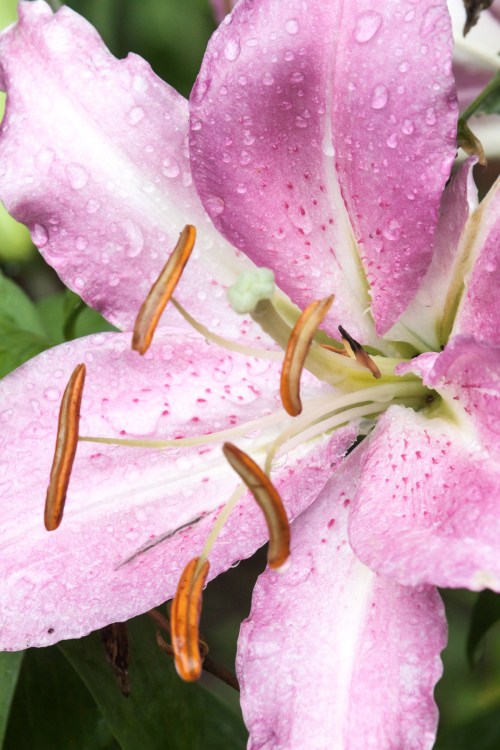
This past week we have had an amazing amount of rain. It has not been a single, prolonged storm, but instead has been a series of bands of heavy rain.
The rain slowed down a little yesterday morning, so I popped over to the garden of my neighbor and fellow photographer Cindy Dyer to see what was in bloom. My eye was immediately drawn to a gorgeous pinkish lily in her side garden and to some pear-shaped tomatoes on her front landing. The raindrops still glistening on both of the subjects seemed to add to their beauty and interest.
Thanks, Cindy for planting such photogenic species.

© Michael Q. Powell. All rights reserved.
Posted in Art, Flowers, Gardening, Nature, Photography | Tagged Alexandria VA, Cindy Dyer, Kingstowne, lily, pink lily, rain, tomatoes | 6 Comments »
July 23, 2018 by Mike Powell
What a difference the background makes when photographing a damselfly. This past Friday I saw lots of damselflies as I was exploring Riverbend Park in Great Falls, Virginia. My eyes were repeatedly drawn to one species that a dark abdomen (the “tail” part) and speckled green eyes and I was able to photograph these damselflies in a number of different settings. I usually have problems in identifying damselflies, so I posted the third image below to a Facebook forum and one of the experts there identified it as an immature male Powdered Dancer damselfly (Argia moesta).
Normally I prefer to photograph dragonflies and damselflies in a natural environment, but the first photo is definitely an exception. I love the juxtaposition of the rust and corrosion of the curved man-made metal with the lines and color of the damselfly (and the cool shadow was a real bonus). In the second shot, the damselfly is perched on the ground and the unevenness of the surface makes for an intriguing shadow. The setting in the final shot is the most “natural” and the image gives viewers the best overall view of this damselfly species, but it doesn’t grab me as much as the first image.


© Michael Q. Powell. All rights reserved.
Posted in damselfly, Dragonflies, dragonfly, Nature, Photography, Summer, wildlife | Tagged Argia moesta, Canon 50D, Great Falls VA, Powdered Dancer, Powdered Dancer damselfly, Riverbend Park, Tamron 180mm | 6 Comments »
July 22, 2018 by Mike Powell
Anyone who has ever gone fishing has a story of “the one that got away.” This Northern Water Snake (Nerodia sipedon) wanted to make sure that it did not have such a story to tell and dragged its prey onto dry land. Then the snake faced the challenge of figuring out how to swallow the large fish. The snake twisted and turned and contorted its body and head as it gradually ingested the fish. When the fish was part way down its throat, the snake appeared to push up against a log for additional leverage.
I captured a sequence of shots that speak for themselves, so I will not bother to explain each of them. Like me, you will probably feel a kind of macabre mixture of horror and fascination as you view them.


© Michael Q. Powell. All rights reserved.
Posted in Fish, Nature, Photography, Reptiles, Summer, wildlife | Tagged Canon SX50, Great Falls VA, Nerodia sipedon, Northern Water Snake, Northern Watersnake, Riverbend Park, snake versus fish | 11 Comments »
July 21, 2018 by Mike Powell
July is World Watercolor Month. Ever since the beginning of the year I have wanted to try watercolor painting, so this should be the perfect time. I have watched countless YouTube videos, bought all kinds of art supplies, and even purchased some books. Despite all of this, I have not been able to overcome my fears and actually put paint on paper. In my job, we sometimes talk about “the paralysis of analysis.” I have been stuck in place, unable to take my first step as I try to figure out how best to start.
I think that I am supposed to do practice exercises and learn about color mixing by swatching my paints or perhaps even take a class. I don’t really know how to sketch and probably should learn to do that first. Maybe then I would be ready.
Well, today I decided that, ready or not, I am jumping into the deep end and that I will learn about watercolor painting by actually trying it. What a novel concept!
I decided to use some pretty basic supplies—a Winsor & Newton Cotman Sketcher’s Pocket Box; some Derwent water brushes; and a little block of 4 inch by 6 inch 140 lb cold press paper by Fluid 100. For the subject, I drew inspiration from a landscape photo taken by one of my friends (who is a real painter) that depicts a little house on the prairie, with grass in the foreground and mountains in the background.
The second image below was my first attempt. Things got out of control pretty quickly and I felt like I was hurrying myself. The first image below is my second attempt and is somewhat of an improvement. I felt more comfortable and a slight bit more in control of what I was doing.
I am pretty excited to play some more soon, perhaps in a more systematic way or maybe not. I think that most of all I need to work towards letting go of my inhibitions and becoming more like a child.


© Michael Q. Powell. All rights reserved.
Posted in Art, Nature, painting, watercolor | Tagged #world watercolor month, cotman, Fluid 100 paper, water brush, watercolor, watercolor beginnings, winsor and newton | 31 Comments »
July 21, 2018 by Mike Powell
As I was exploring the edge of the Potomac River yesterday at Riverbend Park, I flushed a fairly large dragonfly. Rather than fly away, it perched in a nearby tree, just above eye level. I suspected that I had interrupted a meal and that it wanted to enjoy its prey in peace.
The dragonfly was in the shade and the light was filtering in from in front of me, so the shadows made it hard to tell exactly what was going on. I fired away anyways, hoping that I would be able to salvage the images afterwards.
It turns out that the dragonfly is a Black-shouldered Spinyleg (Dromogomphus spinosus). You definitely can see the large spines on the dragonfly’s back legs, which help in capturing and holding prey, and you can sort of see the black shoulders. As I suspected, there was a prey–the dragonfly had captured some kind of damselfly.
I decided to try a couple of different techniques to try to capture a usable image. In the first shot, I used software to adjust the exposure levels and remove some of the shadows, which had the side effect of brightening the entire image and blowing out some of the detail in the background. As a result, the leaves also look a little washed out. In the second shot, I used my camera’s pop-up flash to help eliminate some of the shadows. The resulting image retains a bit more of the full range of tonal values, but may still be a little too dark. Neither image is perfect, but wildlife photography is so often about making compromises.


© Michael Q. Powell. All rights reserved.
Posted in damselfly, Dragonflies, dragonfly, Insects, Nature, Summer, wildlife | Tagged Black-shouldered Spinyleg, Black-shouldered Spinyleg dragonfly, Canon SX50, Dromogomphus spinosus, Great Falls VA, Riverbend Park | 6 Comments »
July 20, 2018 by Mike Powell
You never know for sure when a dragonfly will let you get close. Although some species tend to be less skittish than others, each individual dragonfly seems to have its own sense of “personal space.” Some will let you get really close and may even perch on you, but others will take flight or keep their distance as soon as they detect your presence.
On a recent trip to Occoquan Bay National Wildlife Refuge I was able to see eye to eye with this handsome male Widow Skimmer (Libellula luctuosa). I love the wonderful symmetry of looking straight into the multi-faceted eyes of a dragonfly, as in the first photo below, though I will admit that it really limits the depth of field in the image and does not let you see much of its body. For the second photo, I moved a little and shot if from a slight angle.
I tend to prefer the first image. What do you think?


© Michael Q. Powell. All rights reserved.
Posted in Dragonflies, dragonfly, Insects, Nature, Photography, Summer, wildlife | Tagged Canon 50D, eye to eye, Libellula luctuosa, Occoquan Bay National Wildlife Refuge, personal space, Tamron 180mm, Widow Skimmer, Widow Skimmer dragonfly, Woodbridge VA | 14 Comments »
July 19, 2018 by Mike Powell
When they are immature, the males and females of many dragonfly species are very similar in coloration. To make matters worse, immature dragonflies of several different species are also similar in appearance, with only subtle differences to distinguish one species from another, like the color of the upper portions of their legs.
As a result, I am not really sure of my identification of this particular dragonfly. I lean towards it being an immature male Great Blue Skimmer (Libellula vibrans), but it might instead be a Slaty Skimmer (Libellula incesta). (The adults of these two species, by contrast, are very different in appearance and would never be mistaken for each other.)
Whatever the case, I love the two-toned eyes and overall body position of this beautiful dragonfly. It might be my imagination, but it seemed to me that the dragonfly had tilted its head a bit to check me out.

© Michael Q. Powell. All rights reserved.
Posted in Dragonflies, dragonfly, Insects, Nature, Photography, Summer, wildlife | Tagged Canon 50D, Great Blue Skimmer, Great Blue Skimmer dragonfly, Libellula incesta, Libellula vibrans, Occoquan Bay National Wildlife Refuge, Slaty Skimmer, Slaty Skimmer dragonfly, Tamron 180mm, Woodbridge VA | 2 Comments »
July 18, 2018 by Mike Powell
I tend to be more of a dog person than a cat person. Cats have always been somewhat mysterious creatures to me, a bit wild and uncontrollable. Nonetheless, I am usually the go-to person to watch her three cats when my neighbor and fellow photographer Cindy Dyer goes out of town.
This past weekend I watched and fed the three male cats and, as is usually the case, I attempted to take some photos of them. Cindy often manages to capture them in wonderful candid moments, but it was hard for me to get them to cooperate. I am not used to shooting indoors with limited light, so that was an additional challenge. I learned pretty quickly that the 180mm macro lens that I happened to have on my camera is not optimal for this task—it was tough to get far enough away to capture the cats’ major facial features.
Eventually I was able to capture a portrait of each of them. Queso, the orange cat who was rescued in the bushes outside of a Mexican restaurant, is the youngest one; Pixel is the one with the pixelated hair who loves to roll over to have his tummy scratched; and Lobo, the gray lone wolf of the pack, fixed me with a fierce stare when he finally let me take his picture.
I should be back to my more typical wildlife shots tomorrow in case any of you were concerned that I had abandoned my butterflies and dragonflies. I enjoy the challenge of a different set of subjects and I must admit that it was nice to shoot in the coolness of the air-conditioned indoors rather than in the hot, humid summer weather we have been experiencing.
.


© Michael Q. Powell. All rights reserved.
Posted in animals, Cat, Nature, Photography, Portraits | Tagged Alexandria VA, Canon 50D, Canon SX50, Cindy Dyer, Kingstowne, Lobo, Pixel, Queso, Tamron 180mm | 11 Comments »
July 17, 2018 by Mike Powell
While they have been out of town, I have been watering the flowers in my neighbors’ garden and watching (and feeding) their three cats. The garden was planted by my photography mentor, Cindy Dyer, who always selects particularly photogenic species. She asked me document some of the flowers as they bloomed in case she does not return in time to see them herself.
Yesterday I was particularly struck by the beauty of the different lilies that are now blooming. Some of them probably qualify as day lilies, but there is another cool variety that has blooms that face downward. The big star of the show, though, is undoubtedly an enormous cream-colored lily that just opened and is the one that is featured in the first photo.
Many of you know that I am generally in ceaseless pursuit of animate subjects, but it is good to periodically stop and take the time to smell the lilies.


© Michael Q. Powell. All rights reserved.
Posted in Art, Flowers, Gardening, Macro Photography, Nature, Summer | Tagged Alexandria VA, Canon SX50, Cindy Dyer, day lily, garden, Kingstowne, lilies | 12 Comments »
July 16, 2018 by Mike Powell
Although many damselflies are black and blue in coloration, I was particularly struck by the powdery blue coloration on the upper body of this damselfly when I first spotted it, a beautiful shade of blue interrupted only by a very thin line of black. I did some searching about on the internet and have concluded that this is probably a Blue-fronted Dancer damselfly (Argia apicalis).
I really like the way that the blue colors of this damselfly help it stand out in an otherwise mostly monochromatic image. I also enjoy the fact that this damselfly comes from a family of dancers, a term that seems appropriate for these aerial acrobats.
Dance on, tiny damselflies, dance on through the summer.

© Michael Q. Powell. All rights reserved.
Posted in damselfly, Dragonflies, dragonfly, Insects, Nature, Photography, Summer, wildlife | Tagged Argia apicalis, Blue-fronted Dancer, Blue-fronted Dancer damselfly, Canon 50D, Prince William Forest Park, Tamron 180mm, Triangle VA | 2 Comments »
July 15, 2018 by Mike Powell
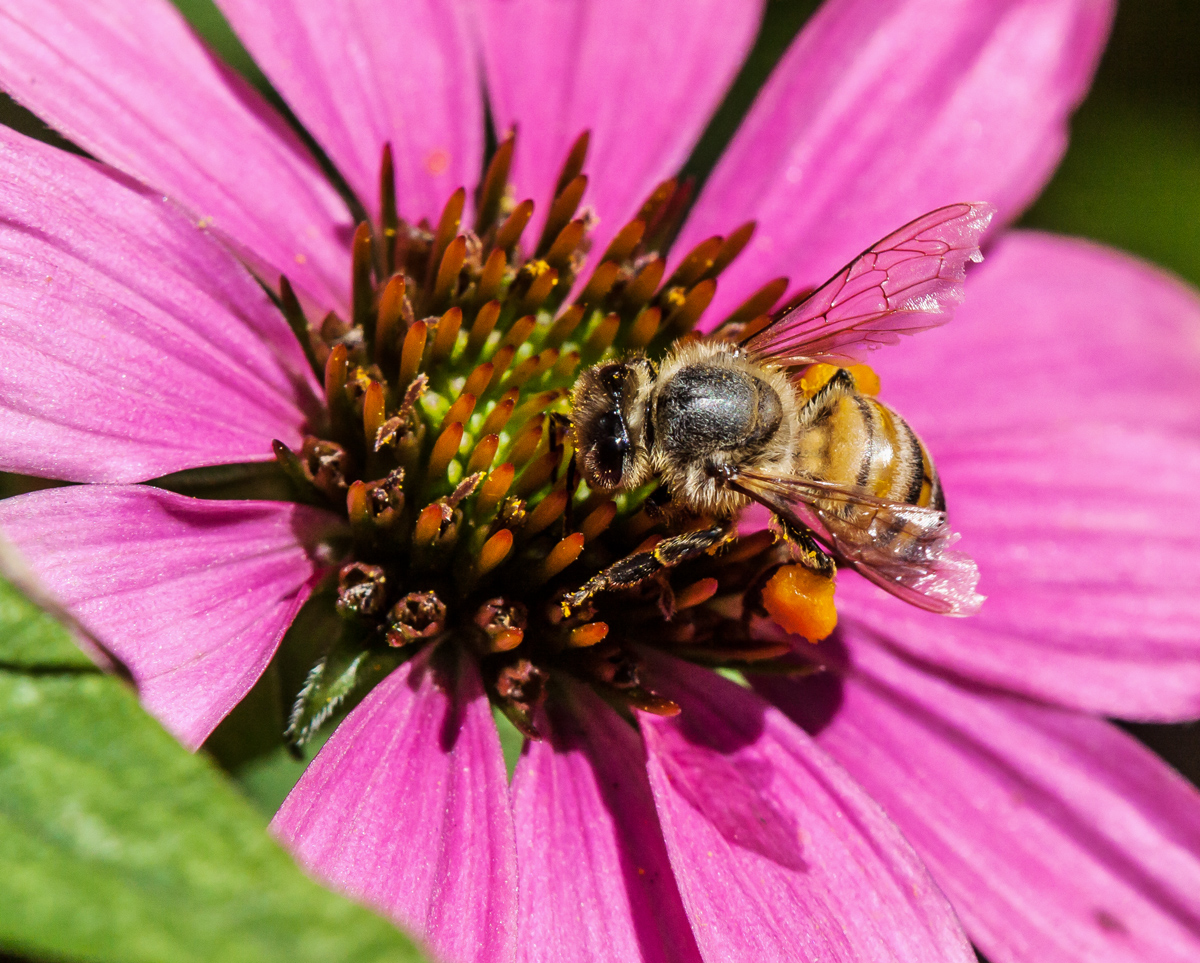
I love to watch bees as they gather pollen—they seem so industrious and focused as they systematically work their way through a group of flowers. This honey bee had both of its pollen sacs almost completely filled when I spotted it yesterday on a cone flower in the garden of one of my neighbors, fellow photographer Cindy Dyer.
One of the joys of shooting with a macro lens is that it lets you capture so many fine details, like the pollen grains on the legs of this bee and the slight damage on the trailing edges of the bee’s wings. Bees are also a great subject to practice macro techniques, because they often let you get really close without being spooked and flying away.

© Michael Q. Powell. All rights reserved.
Posted in Bees, Flowers, Gardening, Insects, Nature, Photography, Summer | Tagged Alexandria VA, Apis, Canon 50D, cone flower, coneflower, honey bee, honeybee, Tamron 180mm | 2 Comments »
« Newer Posts - Older Posts »






 Mike Powell