July 9, 2020 by Mike Powell
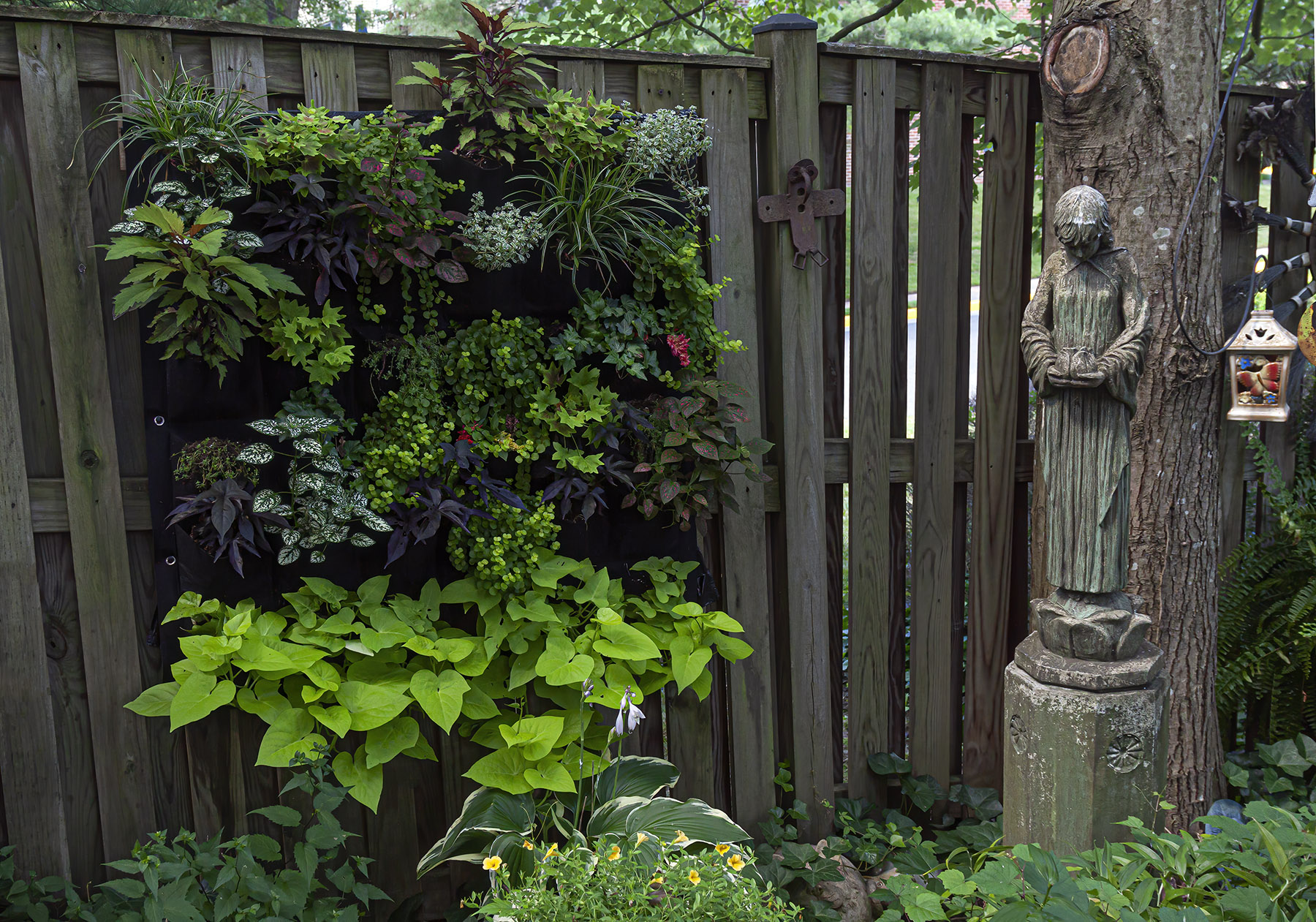
A little over a month ago I did a posting entitled ‘Flower wall’ that featured a hanging panel of flowers and plants on the interior portion of the fence that encloses the back yard of my friend Cindy Dyer. At that time the plants were just getting established and one of my viewers asked me to do a follow-up post when they all fill in.
As I went into Cindy’s backyard garden this morning to take an update photo of the hanging garden, I decided to try to capture the atmosphere that she has created in this small space. We live in a townhouse community and each of us has a tiny space behind our houses that is enclosed with a privacy fence. Cindy lives in an end unit (as do I) and her yard is slightly larger than the inner units, with a neighbor on only one side.
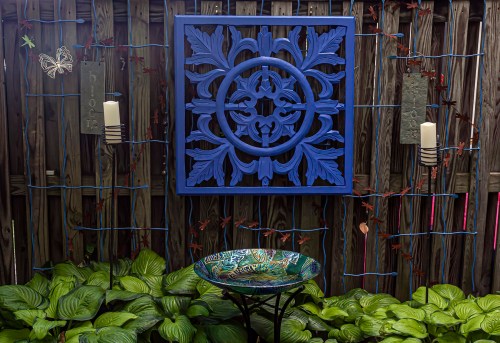
The first image shows the current state of the hanging garden. Some of the plants have grown more quickly than others, giving the wall a slightly wild look that I really like. I deliberately framed this shot wider than necessary to show you part of the rest of the garden that Cindy has decorated with statues, figurines, and all kinds of plants and flowers. It feels like a secret refuge, a world apart from one of the main streets in our neighborhood that is barely visible through the slats of the fence.
The second image shows a portion of the fence that separates her yard from that of her neighbor. Here she has created an almost meditative space featuring a wall hanging and a spectacular bird bath that rises up out of a bed of hostas. If you click on the image and examine the details, you will see that Cindy had decorated the blue grid with dozens of colorful dragonflies.
As you can readily see from these two images, Cindy is amazingly creative and is an incredible gardener and designer. You might have thought that I was a little over the top in yesterday’s blog anniversary posting in which I expressed my admiration and gratitude for all that she does to inspire me—here is visual evidence of why those words were well-deserved.

© Michael Q. Powell. All rights reserved.
Posted in Art, Flowers, Gardening, Nature, Photography, Summer | Tagged Alexandria VA, Canon 24-105mm, Canon 50D, Cindy Dyer, garden, hanging garden, Runnymeade, vertical gardening | 15 Comments »
July 9, 2020 by Mike Powell
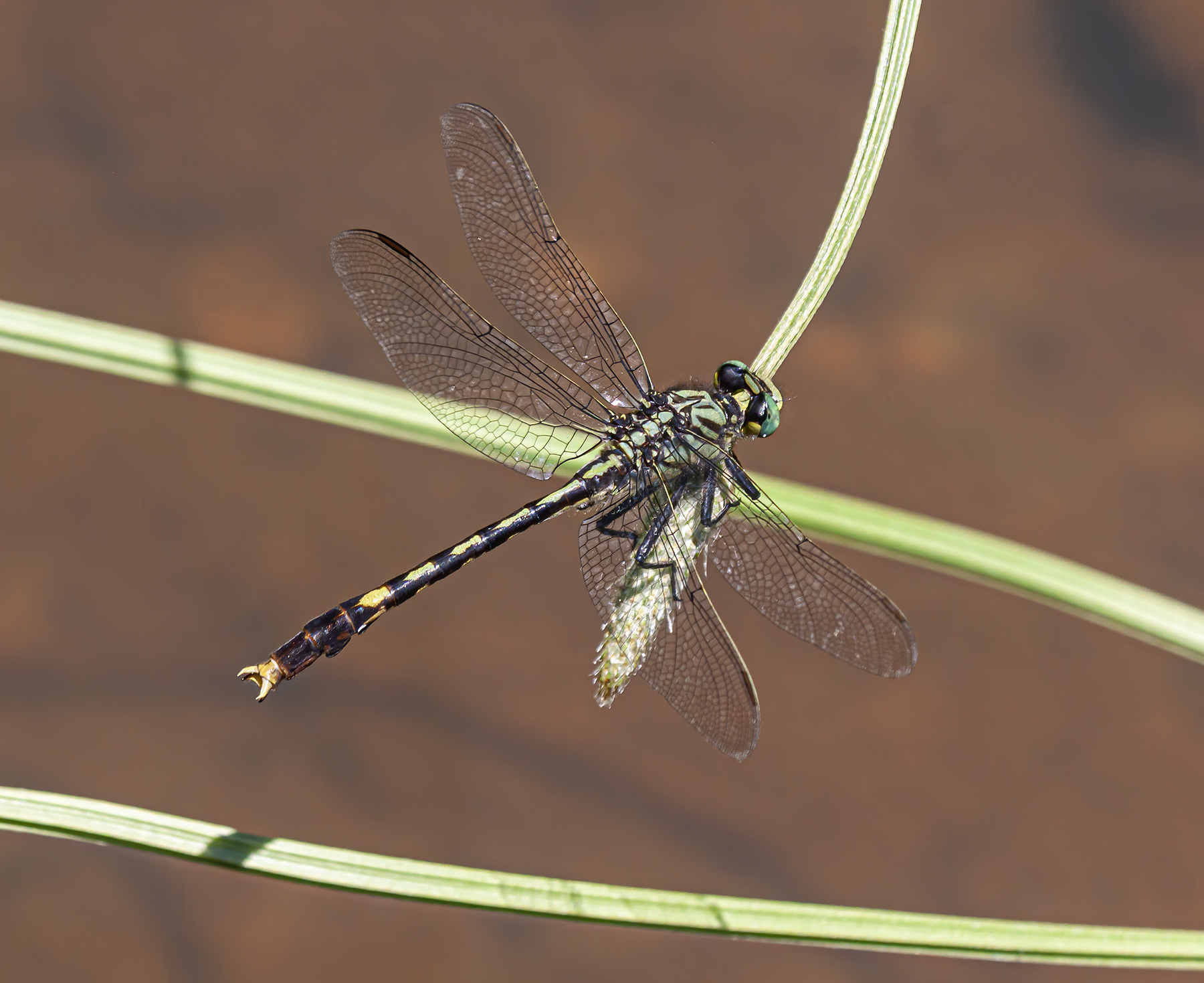
I was happy on Tuesday to spot this male Lancet Clubtail dragonfly (Phanogomphus exilis) perched in the vegetation overhanging the small pond at Jackson Miles Abbott Wetland Refuge. I would like to have gotten a closer shot, but the bank was steep and the water in the pond appears to be deep at that spot. Staying dry, I was content to capture this environmental portrait of the handsome little dragonfly with such striking blue eyes.

© Michael Q. Powell. All rights reserved.
Posted in Art, Dragonflies, dragonfly, Insects, Nature, Photography, Summer, wildlife | Tagged Canon 50D, Fort Belvoir VA, Jackson Miles Abbott Wetland Refuge, Lancet Clubtail, Lancet Clubtail dragonfly, Phanogomphus exilis, Tamron 180mm | 8 Comments »
July 8, 2020 by Mike Powell
Eight years ago yesterday my dear friend and photography mentor Cindy Dyer sat me down and told me that I was going to start a blog. She is a professional photographer and graphic designer and already had a well-established blog. I had gone shooting with her multiple times and we had spent countless hours together reviewing my photos to improve my skills in capturing images and processing them. She had decided it was time to broaden my audience beyond that of Facebook.
Cindy showed me the basics of WordPress editing and navigation and helped me to set up my initial pages. I do not think that either of us anticipated the degree to which I would grow to love the process of blogging, a process that has allowed me daily to express myself creatively in both words and images.
WordPress data show that I have published 3628 posts, which probably includes the occasional re-blog of a post written by someone else, and have had almost 249 thousand views. Those posts have included over 580 thousand words (about 160 words per posting) and well over 4000 photos.
Although I look at the numbers from time to time, they are not that important to me. It is personally more important to me that the blog has helped me to develop relationships with a lot of different viewers, to share with so many of you my sometimes faltering steps on my meandering journey into photography.
Thanks to all of you for helping me along the way and sharing your comments, suggestions, and recommendations. I especially owe a debt of gratitude to Cindy Dyer for motivating me throughout this entire period, for pushing me at times when I was hesitant, and for serving as my muse. Many of you probably feel that you already know Cindy, given that I have featured flowers from her garden repeatedly during this year as I have been forced to stay close to home. Thanks, Cindy.
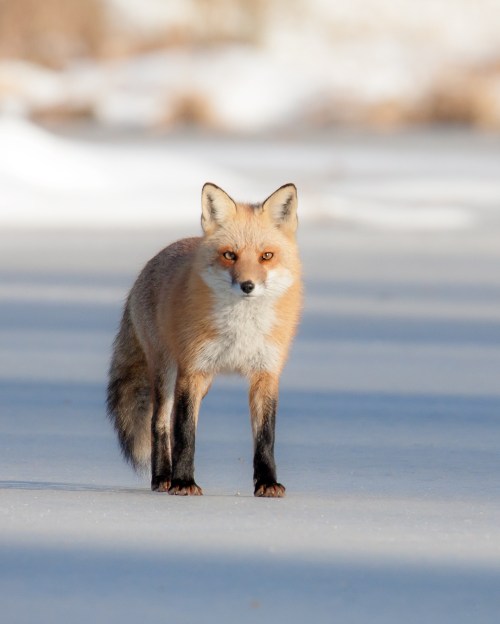
To celebrate this anniversary, I thought I would reprise two of my favorite photos. These are not necessarily my most popular images or my “best” images, but they are ones that are particularly memorable to me. I am also including links to the original postings so you can read the accompanying text and additional commentary about the circumstances under which they were captured. Links to original postings: Visible Song (8 March 2016) and Fox on a frozen pond (31 January 2016).
But wait, there’s more. As a bonus, I am including an image that I captured last week of a spectacular male Halloween Pennant dragonfly (Celithemis eponina). Most of you know that I am somewhat obsessed with dragonflies and they have been an almost constant focus of my photography during the warm months over the last eight years. In fact, my very first blog posting featured a dragonfly. So, I feel it is only appropriate to include a dragonfly as I look back at where I have been.
Thanks again for all of your support and encouragement over these past eight years. The journey continues onward. I hope to continue to walk side-by-side with so many of you as we support and encourage one another. “Therefore, as we have opportunity, let us do good to all people.” (Gal. 6:10)


© Michael Q. Powell. All rights reserved.
Posted in Art, Nature, Photography, wildlife | Tagged Celithemis eponina, Cindy Dyer, fox on a frozen pond, halloween pennant, Halloween Pennant dragonfly, red fox, red-winged blackbird, visible song | 80 Comments »
July 7, 2020 by Mike Powell
If you are lucky and persistent, it is not hard to photograph a perched dragonfly. Some of them are amazingly tolerant of the presence of a human and will let you get really close to them. Even when they do fly away, many of them will return to the very same perch.
If you want to really challenge your skills as a photographer and perhaps even your sanity, you attempt to photograph members of dragonfly species that fly almost constantly and rarely perch, like this male Prince Baskettail dragonfly (Epitheca princeps) that I spotted late in June at Jackson Miles Abbott Wetland Refuge. This dragonfly was flying irregular patrols low over the waters of a small pond at the refuge—sometimes he would fly relatively close to the shore, but often his flight path was unpredictable.
So how do I do it? I generally use the same 180mm macro lens that I use for close-up shots of dragonflies. However, I know that the lens tends to focus slowly and autofocus simply can’t acquire the subject, because it fills such a small part of the frame, so I switch to manual focus. I pre-focus on a general area and then as I track the dragonfly, I adjust the focus on the fly as he zooms by and fire away in burst mode. As dragonflies go, a Prince Baskettail is relatively large, almost 3 inches in length (75 mm), but it is really tough to get an in focus shot of one while he is flying.
On a second occasion when I was visiting the same refuge, I got a chance to try a variation of the technique. The dragonflies were patrolling high overhead as I stood in a grassy area at one end of the pond. The second shot was the best that I could manage—the wing pattern suggests that it is also a Prince Baskettail, but the eye coloration and the terminal appendages at the tip of the abdomen make me wonder if this one is a female. What I discovered is that it is actually a lot harder to focus on a dragonfly when I am looking straight up than when looking down at the water and my arms get tired a lot quicker when holding my camera up hight for an extended period of time.


© Michael Q. Powell. All rights reserved.
Posted in Dragonflies, dragonfly, Insects, Nature, Photography, Summer, wildlife | Tagged Canon 50D, dragonfly in flight, Epitheca princeps, Fort Belvoir VA, Jackson Miles Abbott Wetland Refuge, Prince Baskettail, Prince Baskettail dragonfly, Tamron 180mm | 10 Comments »
July 6, 2020 by Mike Powell
Wishing you all a sense of inner peace as you begin a new week, something that we all need during these troubled times. That was definitely the feeling that enveloped me as I contemplated this beautiful water lily last Thursday at Meadowlark Botanical Gardens during a short photography expedition there with my friend Cindy Dyer.

© Michael Q. Powell. All rights reserved.
Posted in Art, Flowers, Inspiration, Nature, Photography | Tagged Canon 50D, Meadowlark Botanical Gardens, Tamron 180mm, Vienna VA, water lily, waterlily | 23 Comments »
July 6, 2020 by Mike Powell
I spotted this mating pair of Halloween Pennant dragonflies (Celithemis eponina) last Thursday during a brief visit to Meadowlark Botanical Gardens in Vienna, Virginia with my dear friend and photography mentor Cindy Dyer. The wing patterns and coloration of Halloween Pennants have always attracted me, making them one of my favorites. As most of you know, however, I tend to have lots of favorites when it comes to dragonflies.
I was in stealth mode as I slowly moved closer to this couple and attempted to frame the image in a way that was interesting and creative, while trying not to feel too much like a voyeur. Yes, I will boldly assert that this is art, and not insect porn.

© Michael Q. Powell. All rights reserved.
Posted in Art, Dragonflies, dragonfly, Insects, Nature, Photography, Summer, wildlife | Tagged Canon 50D, Celithemis eponina, halloween pennant, Halloween Pennant dragonfly, halloween pennants mating, Meadowlark Botanical Gardens, Tamron 180mm, Vienna VA | 21 Comments »
July 5, 2020 by Mike Powell
July is World Watercolor Month. I was inspired by that celebration two years ago and, after gathering a bunch of supplies, I finally put brush to paper and made my first little watercolor paintings. They were not very good, but the experience was a lot of fun and I documented it in a posting called Jumping into Watercolor. I produced a few more small paintings during the summer of 2018, but somehow my interest waned.
I spent three weeks last November in Paris and brought along some art materials. Paris reignited my desire to play with watercolor and I was inspired enough to produce some more little paintings that you can see in the posting Playing with watercolor in Paris. My skill level had improved marginally and I eventually painted a few more times before I left Paris.
Alas, I did not continue with watercolors, although I kept buying supplies and watching lots of YouTube videos. A few days ago, I downloaded the list of daily prompts for World Watercolor Month and decided I would try to paint something on as many days as I could this July. I chose to paint in a relatively small watercolor journal that is 5.5 x 8 inches (14 X 20 cm) so I would not feel intimidated by a big sheet of blank paper.
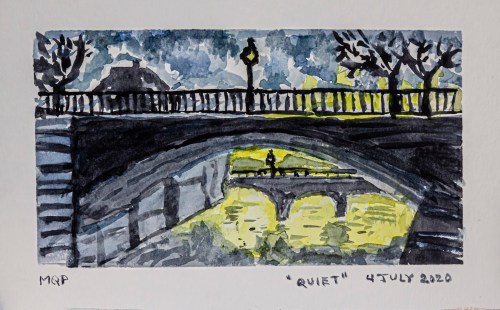
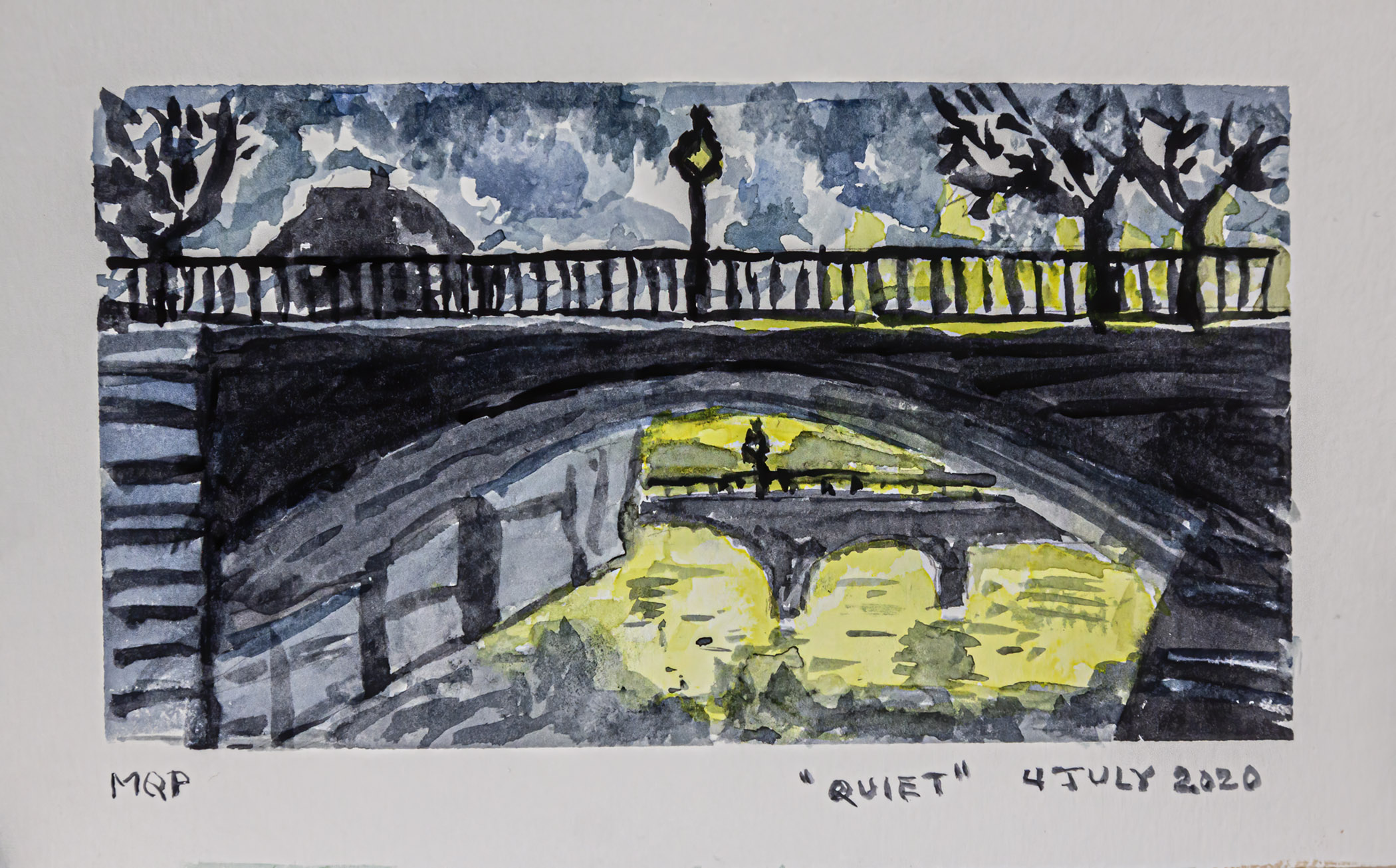
So here are my paintings for the first four days of July in reverse order. The prompt for 4 July was “Quiet” and as I though about it, my mind transported me back to an early morning last November when I watched the sun rise slowly over the Seine River.
The prompt for 3 July was “Playful” and I chose to reprise a painting style and subject that I had used once before. I used a style based on Chinese ink painting (sumi-e) that emphasizes using a minimum number of strokes to capture the essence of the subject, in this cases some frogs and dragonflies.
The prompt for 2 July was “Texture” and I decided to try to paint a wart-covered toad that I had photographed earlier this year. The prompt for 1 July was “Rejoice” and I painted a chubby little bird that was singing.
It is both rewarding and humbling to post these paintings. I feel like a little kid who is excited about producing something with his own hands and this posting serves as a virtual refrigerator door on which I can display my art. Of course I realize that my current skill level is pretty low, but was one video that I watched recently emphasized, “there is no shame in being a beginner.”
I am confident that if I can carve out some time each day to paint this month, I am sure to improve. Most importantly, I am having fun. I was chatting recently with a friend who is an accomplished watercolor artist. She confessed it is a little tougher for her to have fun, because she is a perfectionist. As our skill levels increase in any area, I think there is a danger that we may lose our initial sense of joy and wonder. I consciously try to remain on guard against that danger when it comes to my photography.
If you want to learn more about World Watercolor Month, click on this link or go directly to doodlewash.com. In addition to raising awareness and interest about watercolor painting, World Watercolor Month raises support for The Dreaming Zebra Foundation, a charity providing support so that children and young adults are given an equal opportunity to explore and develop their creativity in the arts.


© Michael Q. Powell. All rights reserved.
Posted in Art, painting, watercolor | Tagged #worldwatercolormonth, dragonfly, frog, Paris, playful, quiet, rejoice, sunrise, texture, toad, watercolor, watercolour | 46 Comments »
July 4, 2020 by Mike Powell
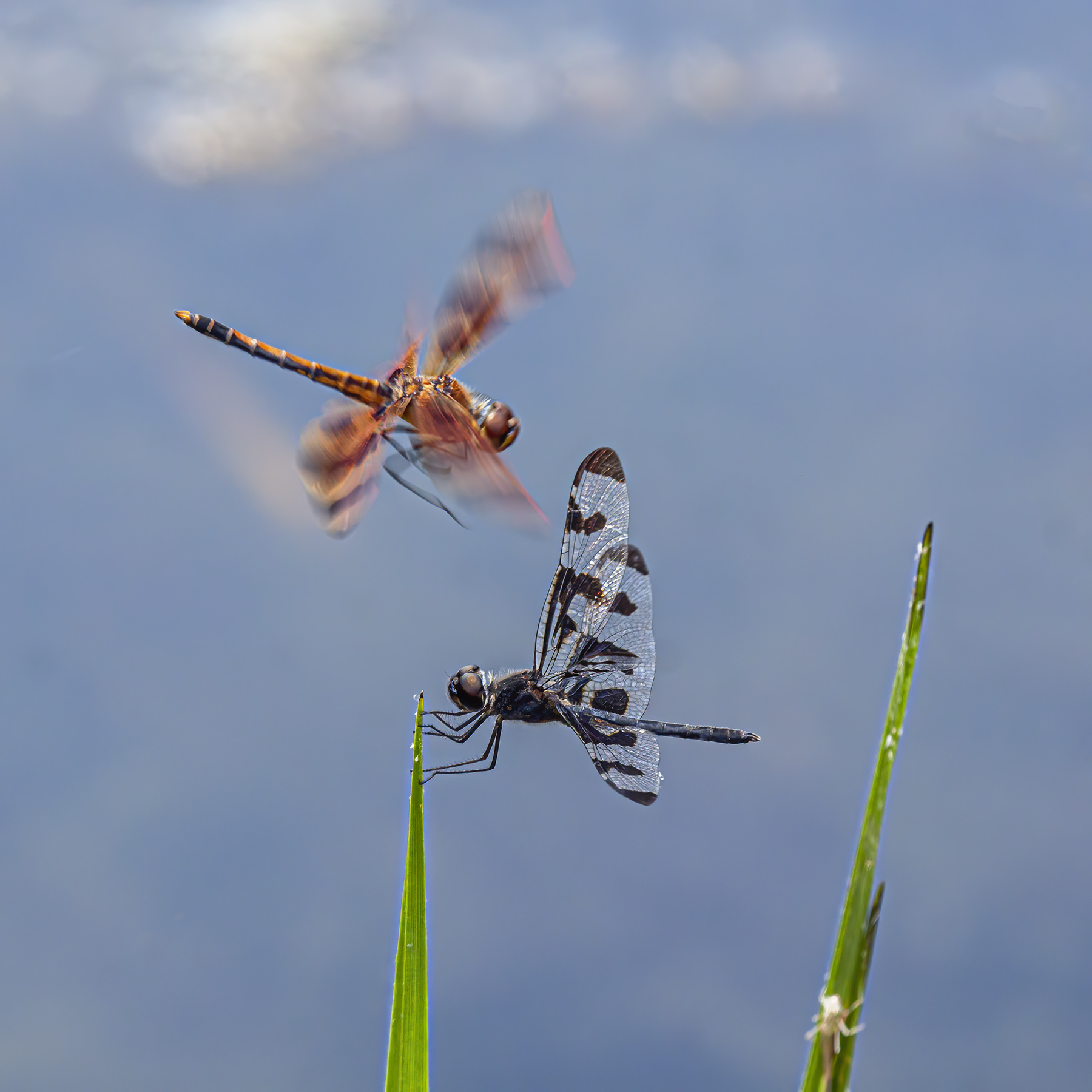
Perhaps it was a territorial dispute, but whatever the reason, a male Halloween Pennant dragonfly (Celithemis eponina) came screaming in determined to dislodge a perched male Banded Pennant dragonfly (Celithemis fasciata) on Thursday at Meadowlark Botanical Gardens and achieved his goal. A few moments earlier I had spotted the two dragonflies perched in a moment of peaceful co-existence (with appropriate social distancing), but that moment of tranquility did not last very long.
Can’t we all just get along and live in harmony with one another?


© Michael Q. Powell. All rights reserved.
Posted in Dragonflies, dragonfly, Nature, Photography, Summer, wildlife | Tagged Banded Pennant, Banded Pennant dragonfly, Canon 50D, Celithemis eponina, Celithemis fasciata, halloween pennant, Halloween Pennant dragonfly, Meadowlark Botanical Gardens, Tamron 180mm, Vienna VA | 29 Comments »
July 4, 2020 by Mike Powell
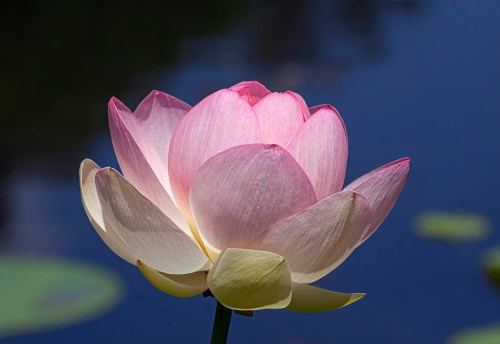
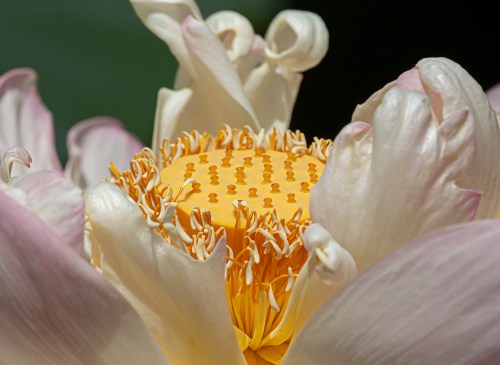
There were only a few lotuses in bloom on Thursday at Meadowlark Botanical Gardens, but they were more than sufficient to sate my senses. How much beauty is “enough?”
Increasingly I am finding that I enjoy beauty in small doses. So many voices in our society try to convince us that we need “more,” when perhaps “less” is even better, especially when we slow down and take the time to explore and appreciate that beauty.
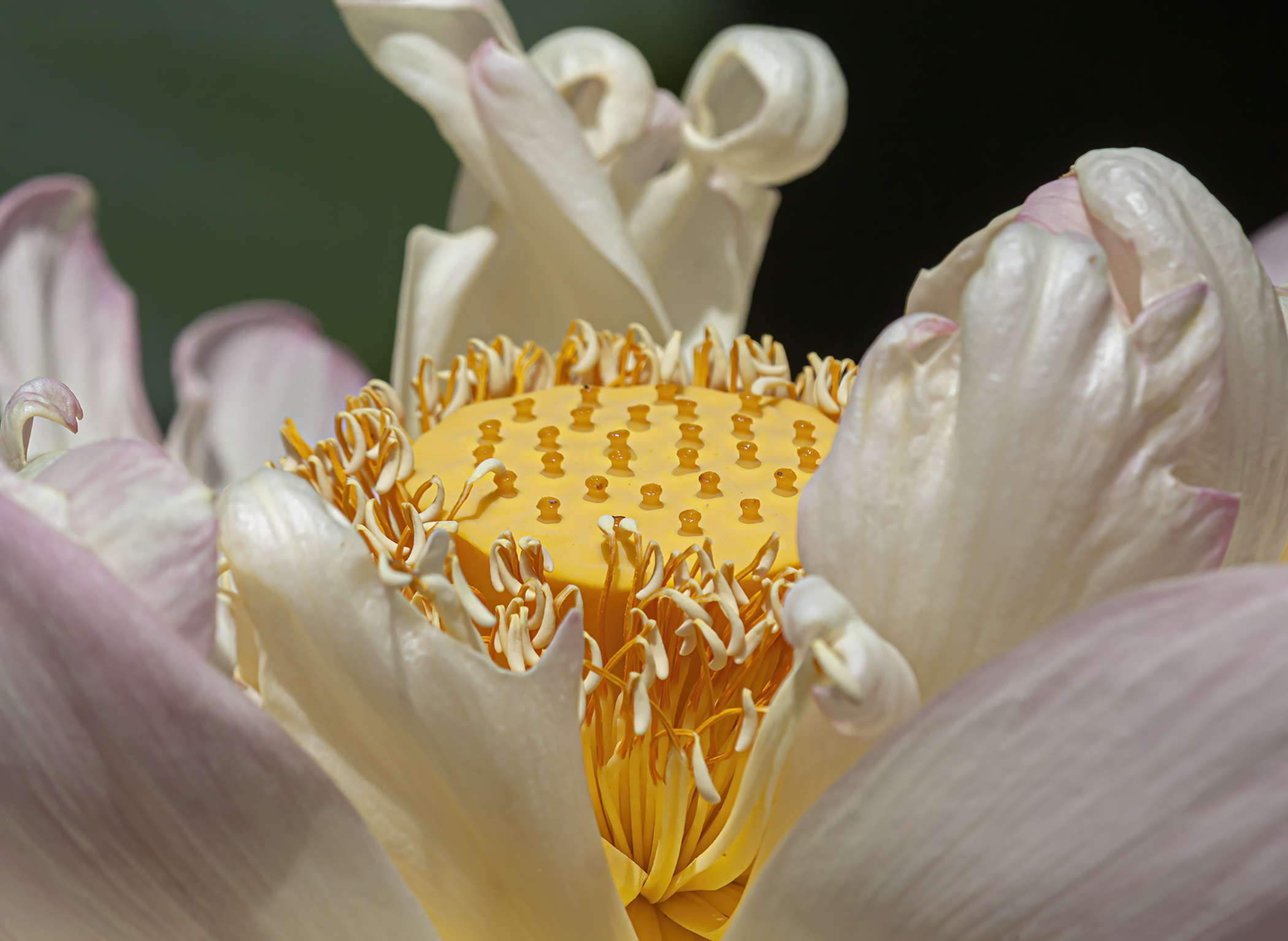
I love the layers of petals of the lotus flower; the details of the center of the lotus, revealed when the petals open up and begin to shrivel; and the promise of future beauty in the lotus bud on which the Slaty Skimmer dragonfly (Libellula incesta) had chosen to perch.
Sometimes when searching for beauty, it is more beneficial to search deeply, focusing on a few things, than to search widely, always looking for something newer and better.

© Michael Q. Powell. All rights reserved.
Posted in Art, dragonfly, Flowers, Nature, Photography, Summer | Tagged beauty, Canon 50D, Libellula incesta, lotus, lotus bud, lotus flower, Meadowlark Botanical Gardens, Slaty Skimmer, Slaty Skimmer dragonfly, Tamron 180mm, Vienna VA | 12 Comments »
July 3, 2020 by Mike Powell
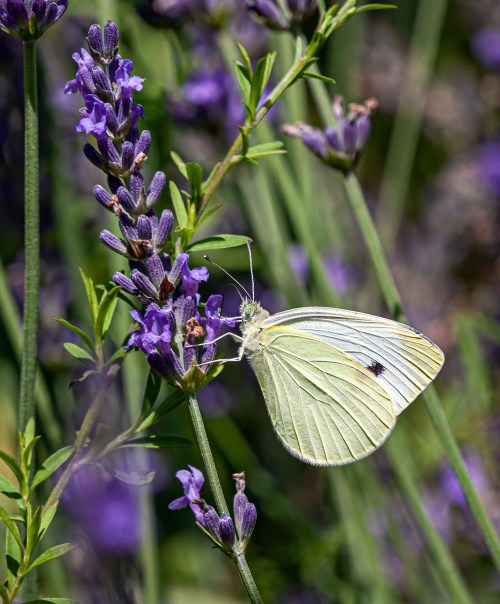
Cabbage White butterflies (Pieris rapae) are so small and plain that many people mistakenly believe they are moths. I find real elegance in their simplicity, especially when I am able to see their striking speckled green eyes. I spotted this little beauty during a brief visit yesterday to Meadowlark Botanical Gardens in Vienna, Virginia with my friend and photography mentor Cindy Dyer.
Cabbage Whites are always hyperactive, in constant motion as they flit about from flower to flower, stopping only momentarily for a short sip. Consequently they are hard to track and you have to be quick on the trigger to have a chance of getting a shot. In the first photo I was lucky enough to capture a “bonus bug,” a hoverfly that was in action below the much larger butterfly. Cindy coined the term “bonus bug” to refer to insects that are in the frame that you never even noticed when you were taking the shot.
Be sure to double-click on each image to get a more detailed view of this beautiful butterfly, including its mesmerizing eyes.

© Michael Q. Powell. All rights reserved.
Posted in Butterflies, Insects, Nature, Photography, Summer, wildlife | Tagged Cabbage White, Cabbage White butterfly, Canon 50D, Cindy Dyer, Meadowlark Botanical Gardens, Pieris rapae, Tamron 180mm, Vienna VA | 17 Comments »
July 3, 2020 by Mike Powell
Most dragonflies are slender and acrobatic, prompting one of my friends recently to call them “dainty.” There is absolutely nothing dainty, however, about Dragonhunter dragonflies (Hagenius brevistylus)—with their massive upper bodies and powerful legs, they remind me of powerlifters. Dragonhunters, unlike some other large dragonflies, do not fly patrols overhead in their search for food. Instead, they are patient hunters who perch, waiting for passing prey, and then use their powerful back legs to snag their victims, which are often other dragonflies.
One thing that always strikes me when I spot perched Dragonhunters is that they seem uncomfortable. Their back legs are so long and ungainly that Dragonhunters’ poses look awkward, bringing to mind gawky teenage males who have undergone recent growth spurts and have not yet gotten used to their longer limbs.
I was thrilled to spot this Dragonhunter last week while exploring a stream in Fairfax County with my friend and fellow dragonfly enthusiast Walter Sanford. It was a hot, humid day and we did not have any success in finding Eastern Least Clubtails, our main focus for the day. In fact, during the day we did not see many dragonflies at all. Walter had been at this location repeatedly and at the start of the day had commented to me that he had often seen Dragonhunters perched on branches overhanging the stream. In fact, we spotted Dragonhunters several times during the day, but did not manage to get good shots of them.
As the skies began to darken, signaling an approaching rainstorm, I knew our time was drawing to an end. I decided to return to a fallen tree where we had seen a Dragonhunter earlier in the day and was pleasantly surprised to see a Dragonhunter holding on to the very tip of a branch. I waded into the stream and moved a little closer to the dragonfly, slowly making my way across the slick, uneven rocks. I called out loudly to Walter, who was a good distance downstream from me, and eventually I heard his response.
I became the patient hunter now as I stood in the calf-high waters of the stream, trying to minimize my movements as I struggled to get a decent shot without disturbing the dragonfly, waiting for the arrival of my friend and hoping that the dragonfly would stay in place. Well, Walter arrived and we both managed to get some shots. I then felt free to move a bit more and crouched low to get a better angle for a shot. Lost in the moment, I did not initially notice that my backside was getting wetter and wetter as I squatted lower and lower. Fortunately I had moved my wallet and keys to my backpack which remained dry.
Eventually the Dragonhunter flew away from its initial perch, but the flights were short and relatively direct and we were able to track the dragonfly to its subsequent positions. The Dragonhunter looked a bit more comfortable at its new perches, but I was not. The rocks underfoot were getting bigger and more uneven and navigation through the water was increasingly difficult. At one moment I encountered an unexpected small drop (maybe 6 inches or so) and I slipped and momentarily lost my balance, but somehow managed to stay dry.
I was tired and wet when we began the uphill trudge back to the parking area, but I was feeling happy about our encounter with this Dragonhunter, one of the powerful giants of the dragonfly world. If you would like to see Walter’s photos and commentary on our Dragonhunter adventure, be sure to check out his blog posting today entitled “Dragonhunter dragonfly (male).” While you are there, be sure to poke around on his site—he has lots of cool images and fascinating information on all kinds of dragonflies and other creatures too.


© Michael Q. Powell. All rights reserved.
Posted in Dragonflies, dragonfly, Insects, Nature, Photography, Summer, wildlife | Tagged Canon 50D, Dragonhunter, dragonhunter dragonfly, Fairfax County Virginia, Hagenius brevistylus, stream, Tamron 180mm, Walter Sanford | 16 Comments »
July 2, 2020 by Mike Powell
Some folks are a bit shocked when I post photos of mating insects, so here is a more discreet look at a damselfly couple in tandem that I encountered last week at Jackson Miles Abbott Wetland Refuge. Somehow I can’t help but think of the old doo wop song “Silhouettes,” which recounts the story of a man who sees two silhouettes on a shade. He thinks his girlfriend is kissing another guy, only to find out that he is at the wrong house.
I may have heard the original version by The Rays that came out in 1957, but suspect I actually recall the cover version done by Herman’s Hermits that came out in 1965. In case you have never heard the song or are simply feeling nostalgic, here is a link to YouTube for the original version and a link to the cover by Herman’s Hermits.

© Michael Q. Powell. All rights reserved.
Posted in Art, damselfly, Nature, Photography, Summer, wildlife | Tagged Canon 50D, damselflies, Fort Belvoir VA, Herman's Hermits, Jackson Miles Abbott Wetland Refuge, mating damselflies, silhouettes, Tamron 180mm, The Rays | 32 Comments »
July 2, 2020 by Mike Powell
The lilies blooming in the garden of my friend and neighbor Cindy Dyer are so lush and the colors so vivid that they seem almost tropical.


© Michael Q. Powell. All rights reserved.
Posted in Art, Flowers, Gardening, Nature, Photography, Summer | Tagged Alexandria VA, Canon 50D, Canon 60mm, Cindy Dyer, garden, lilies, Runnymeade, tropical | 11 Comments »
July 1, 2020 by Mike Powell
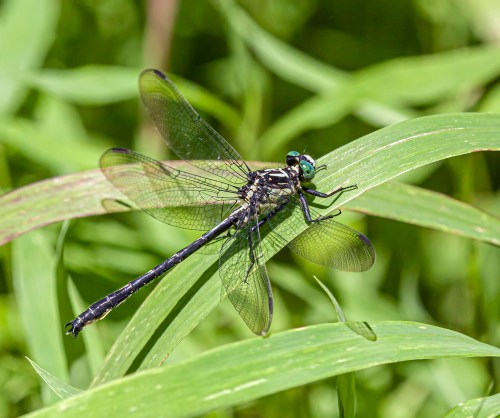
Some of the dragonflies that I feature in my postings are uncommon species in my area. They are found in very small numbers, have a short flight period, and require very specific habitats. My good friend and fellow dragonfly enthusiast Walter Sanford did an extensive amount of research two years ago and re-discovered the Sable Clubtail dragonfly (Stenogomphurus rogersi), a species that is considered to be rare in Northern Virginia. Several of us were able to capture numerous images of this beautiful species during the 2018 dragonfly season.
Since that time, however, the habitat at that location has deteriorated significantly. As a result of some imprudent dumping of dirt and the resulting runoff, the stream habitat has been compromised by increased silt and higher levels of vegetation. Last year, as far as we know, there was only a single sighting of Sable Clubtails at this spot.
Had the population of Sable Clubtails been wiped out? During May and June this year, I made repeated trips to this location and on 12 June I captured the second shot below. When I took the shot, I was not sure if it was a Sable Clubtail, so my excitement was somewhat muted while I was in the field. However, when Walter confirmed that it was in fact a male Sable Clubtail, I was really happy. In many ways, though, my excitement was no match for Walter’s the next day, when we returned to that location and, after much searching, had several encounters with Sable Clubtails, including the one shown in the first image.
For more background on the saga of the Sable Clubtails, be sure to check out Walter’s posting from last Friday entitled “Sable Clubtail dragonfly (Male No. 1).” The posting includes Walter’s photos, range maps for the species, and fascinating details on the backstory. Walter has a background in science and his systematic and analytical approach allows him to view things from a different perspective than I do with my background in languages, literature, and political science. Our approaches are quite different, but are definitely complementary.

© Michael Q. Powell. All rights reserved.
Posted in Dragonflies, dragonfly, Macro Photography, Nature, Photography, Summer, wildlife | Tagged Canon 50D, Fairfax County Virginia, Sable Clubtail, Sable Clubtail dragonfly, Stenogomphurus rogersi, Tamron 180mm | 5 Comments »
June 30, 2020 by Mike Powell
How much does the background matter in a wildlife photograph? Is it merely a potentially distracting element or should it help convey a sense of the environment? Like many photographers, I often obsess over the background when I compose my images, trying to frame the shot and to adjust the camera settings to produce a certain effect. I suspect that my mindset is frequently more like that of a portrait photographer, who wants to draw your attention to the main subject, than that of a landscape photographer, who wants everything in the viewfinder to be in focus.
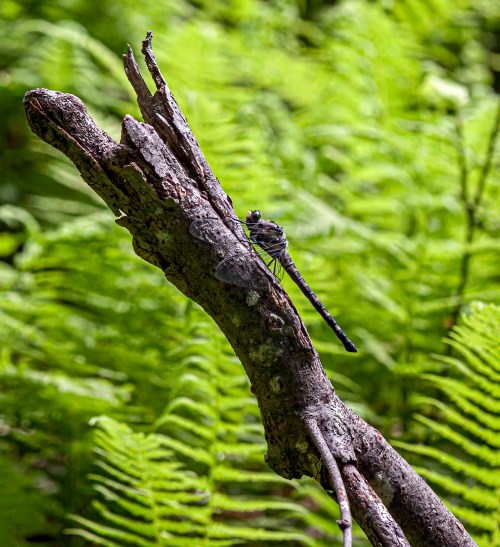
During the month of June I have been blessed to spot Gray Petaltail dragonflies (Tachopteryx thoreyi) on multiple occasions at several locations. I have taken lots of photos of them and the majority of those photos show the dragonfly perched vertically on the trunk of a tree—that is what petaltails do most of the time. My personal challenge has been to capture some images of Gray Petaltails doing something a bit different.
In the first image, the Gray Petaltail was perched horizontally, a position that I have rarely seen. The background in this shot is completely blurred—you don’t know for sure what is behind the dragonfly, though the colors suggest that it is vegetation. The blurred background forces you to focus on the main subject and to a limited extent on its perch. It is the type of portrait image that I strive to capture most often, though rarely am I this successful in doing so.
The second image uses a different approach. I visually separated the dragonfly from its perch by shooting from the side so that the details of its body are not lost in the shadows of the tree. The background is slightly blurred, but it lets you know that the dragonfly was perched in a sea of interrupted ferns. I like the way that you can see the patterns and color of those ferns. I took the shot from a lot farther away than I did with the first image, so the dragonfly occupies a much smaller part of the frame. As a result, the details of the perch grow in importance and in many ways the tree shares the spotlight with the dragonfly. This is the kind of environmental portrait that I really like, but often forget to take. Too often I am so driven to fill the frame with my subject that I forget to try different approaches.
The final shot is a kind of compromise shot, taken from a medium distance with a background that is more suggestive of the environment than in the first image, but not as detailed as in the second one. The perch has some details, but is intended to play a supporting role, rather than be the co-star as in the the second image. The dragonfly fills less of the frame than in the first image, but more than in the second.
In the story of Goldilocks and the three bears, she repeatedly tried two extremes, before setting on one that was “just right.” Is that the moral of the story here? Au contraire, mes amis. You can come to your own conclusions as you look at these three images, but for me it is clear that there is no single solution to the question of backgrounds. Blurry backgrounds can be good, but not always. Close-up shots are great, but may come with a cost. Showing some details in the background can enhance an image, except when it doesn’t.
What is best? Some folks may be unhappy with the lack of clarity, but the best answer seems to be, “it depends.” With backgrounds, as with so much in photography, we are left in an ambiguous situation in which “rules” are at best general guidelines, intended to be broken as the situation dictates or as the photographer decides. That gives me unlimited possibilities and a maximum amount of freedom to create more cool images.


© Michael Q. Powell. All rights reserved.
Posted in Dragonflies, dragonfly, Insects, Nature, Photography, Summer, wildlife | Tagged background information, Canon 50D, Fairfax County Virginia, Gray Petaltail, Gray Petaltail dragonfly, Prince William County VA, Tachopteryx thoreyi, Tamron 180mm | 16 Comments »
June 29, 2020 by Mike Powell
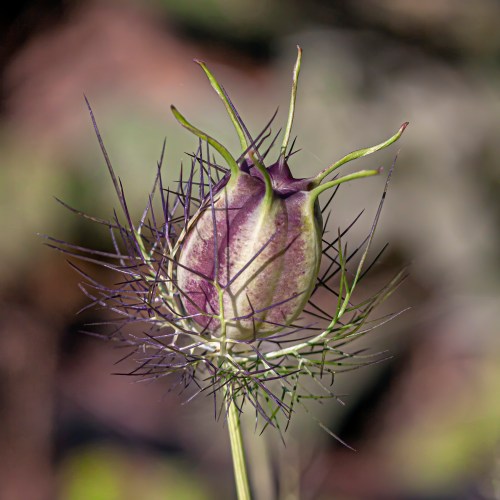
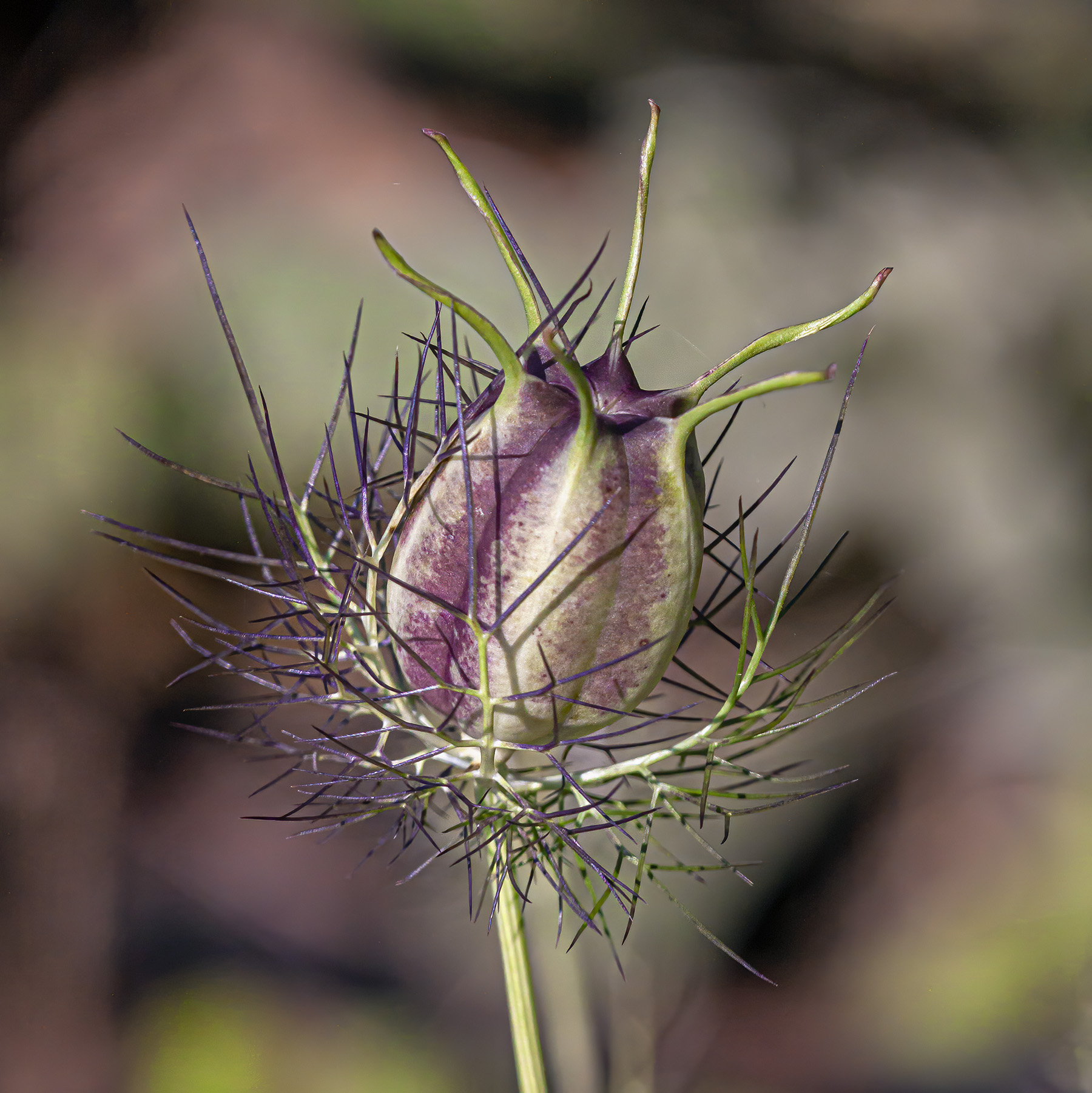
The alien-looking plant in the first photo is a seedpod of ‘Love in a mist’ (Nigella damascena), one of my favorite flowers, that I spotted during a short visit last Monday to Green Spring Gardens with my friend and photography mentor Cindy Dyer. It was a little late in the season, but I managed to spot a few flowers still in bloom, as shown in the second image. This flower is typically blue, but love-in-a-mist also comes in shades of white, pink, and lavender.
When I did a little research on-line, I learned that the striped, balloon-shaped object that I call a seedpod, is actually an inflated capsule composed of five fused true seedpods, according to an article by Wisconsin Horticulture. I also learned that the thorny-looking spikes that make up the “mist,” which are not sharp, despite their appearance, are technically bracts, a specialized kind of leaves.
This is one of the few local places where I know I can find this exotically beautiful flower. If you want to see love-in-a-mist yourself, you should probably go to a large garden. Otherwise you could waste a lot of your time looking for love in all the wrong places.

© Michael Q. Powell. All rights reserved.
Posted in Art, Flowers, Gardening, Humor, Macro Photography, Nature, Photography, Summer | Tagged Alexandria VA, Canon 50D, Cindy Dyer, green spring gardens, Love-in-a-mist, Nigella damascena, Tamron 180mm | 12 Comments »
June 29, 2020 by Mike Powell
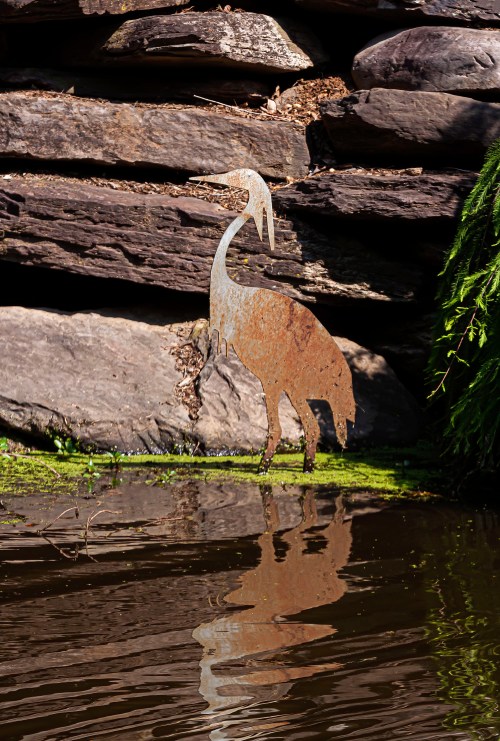
The shape of the silhouette is familiar and if the lighting is bad, you might be able to convince yourself that a Great Blue Heron (Ardea herodias) is standing in the corner of a small pond at Green Spring Gardens. I have visited the pond dozens of times, so I know that the heron is not real, but it still makes for a fun subject to photograph.
I love the heron’s distorted reflection in the first photo and the touches of green provided by a small tree to the side and the duckweed floating on the surface of the water. I was equally thrilled when a male Blue Dasher dragonfly (Pachydiplax longipennis) perched on the heron’s head after I had moved in closer. I doubt that a real heron would have been quite as accommodating in permitting the dragonfly to perch and seem to recall having seen a Great Blue Heron attempt to snatch a dragonfly out of the air as it flew by.

© Michael Q. Powell. All rights reserved.
Posted in Art, Birds, dragonfly, Nature, Photography, Summer, wildlife | Tagged Alexandria VA, Ardea herodias, Blue Dasher, Blue Dasher dragonfly, Canon 50D, Great Blue Heron, green spring gardens, Pachydiplax longipennis, Tamron 180mm | 16 Comments »
June 28, 2020 by Mike Powell
Bright, saturated colors can be wonderful, but in large doses they can overwhelm the senses and confuse a viewer’s eyes. I am often drawn to simple scenes with a limited palette of colors, scenes in which light and shadows and shapes and textures play a more prominent role than colors.
Those were my thoughts when I started to review my images of this male Powdered Dancer damselfly (Argia moesta) that I spotted on Thursday while exploring a stream in Fairfax County with fellow dragonfly enthusiast Walter Sanford. The Powdered Dancer is the closest that we come to having a monochromatic dragonfly or damselfly—the thorax and tip of the abdomen of males becomes increasingly white as they age.
I love the way that the coolness of the white on the body contrasts with the brownish-red warmth of the branch, the leaves, and the out-of-focus rocks in the background of the initial image. I like too the texture in the images, particularly in the bark in the first photo and in the rock in the second one. Shadows help to add some additional visual interest to both of these images, drawing a viewer’s attention to the damselfly’s head in the first image and to the details of its entire body in the second.


© Michael Q. Powell. All rights reserved.
Posted in damselfly, Insects, Macro Photography, Nature, Photography, Summer, Winter | Tagged Argia moesta, Canon 50D, Fairfax County Virginia, Powdered Dancer, Powdered Dancer damselfly, Tamron 180mm | 3 Comments »
June 27, 2020 by Mike Powell
In some of the locations that I visit, Blue Dasher dragonflies (Pachydiplax longipennis) are the most common species that I encounter. They are pretty easy to photograph, because they hunt by perching and waiting for suitable prey to come within range. When it does, they dart from their position to catch it and often return to the same perch.
Over the years, I am sure that I have taken hundreds of photos of Blue Dashers, but I still enjoy trying to capture new and potentially better images of these beautiful little dragonflies. Blue Dashers have a special place in my heart in part because my very first posting on this blog almost eight years ago featured a photo of one. My gear has changed over those eight years, but my approach has remained pretty consistent. If you are curious about the kind of images I was capturing way back then, check out the posting that was entitle simply “Blue Dasher dragonfly.”
One thing that has changed, though, is that I now have a greater appreciation for female dragonflies, which are generally less colorful than their male counterparts. Some might see the females as drab and uninteresting, but I often find a special beauty in them that is more subtle and refined than the garish males.
The images below are shots of female Blue Dashers that I have taken during the month of June. The final photo shows a younger female with brighter colors and a more distinct pattern on her abdomen. The first two images feature a more mature female—both sexes of Blues Dashers develop a waxy, frosted color with age, a phenomenon known as “pruinescence.” One of the coolest features of these females is their two-toned eyes, with a prominent red color on the top half of the large compound eyes.


© Michael Q. Powell. All rights reserved.
Posted in Dragonflies, dragonfly, Insects, Macro Photography, Nature, Photography, Summer, wildlife | Tagged Blue Dasher, Blue Dasher dragonfly, Canon 50D, female Blue Dasher, Lorton VA, Occoquan Regional Park, pruinescence, Tamron 180mm | 13 Comments »
June 26, 2020 by Mike Powell
When I was photographing bees on Monday at Green Spring Gardens, I had no idea that it was the start of Pollinator Week (22-28 June 2020), “an international celebration of the valuable ecosystem services provided by bees, birds, butterflies, bats and beetles,” according to the pollinator.org website. All I knew was that I love bees and enjoy trying to photograph them.
I was reminded of this week’s celebration yesterday in an e-mail from Benjamin, a knowledgeable budding naturalist who is almost certainly the youngest reader of my blog, and his grandmother Ellen (Gem). The two of them were busily making special honey treats to celebrate the week.
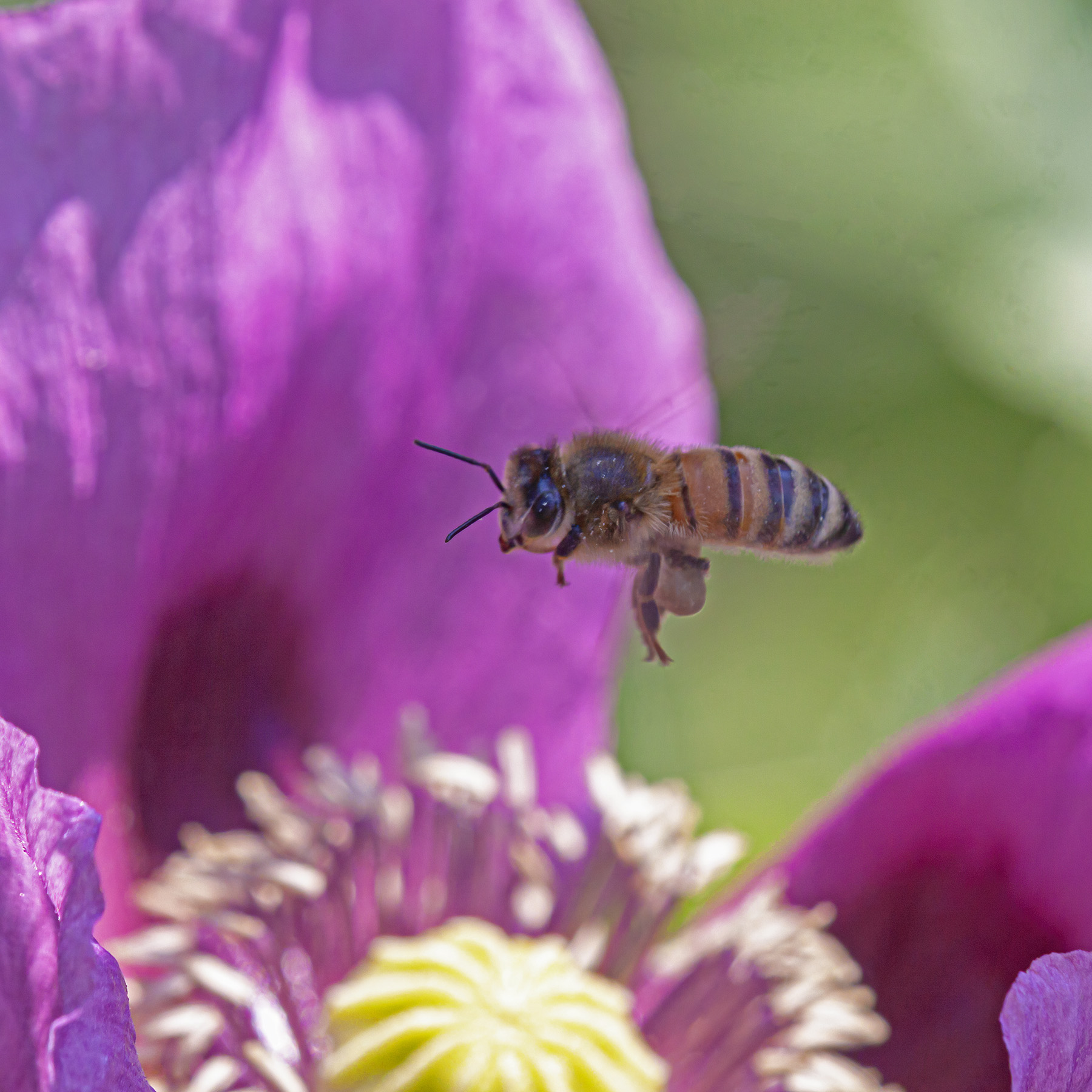
A honeybee came buzzing by me as I was attempting to photograph a poppy on Monday. Although the poppy was quite beautiful, I quickly abandoned it and decided that it was more fun to focus on the bee. The bee seemed to have been quite successful in gathering pollen and, as you can see in the first two photos, one of its pollen sacs seemed to be filled to its maximum capacity.
The final photo shows a honeybee at work in a Stokes’ Aster flower (Stokesia laevis) that I spotted in another part of the gardens. If you double-click on the image, you will see little white grains of pollen covering different many parts of the bee’s body.


© Michael Q. Powell. All rights reserved.
Posted in Bees, Insects, Macro Photography, Nature, Photography, Summer, wildlife | Tagged Alexandria VA, Canon 50D, green spring gardens, honey bee, honeybee, pollen sacs, poppy, stokes' aster, Stokesia laevis, Tamron 180mm | 13 Comments »
June 26, 2020 by Mike Powell
Can dragonflies smile? It sure looked like this male Great Blue Skimmer dragonfly (Libellula vibrans) was flashing me a toothy grin when I spotted him last Friday at Occoquan Bay National Wildlife Refuge. Perhaps it was just my imagination, running away with me.

© Michael Q. Powell. All rights reserved.
Posted in Dragonflies, dragonfly, Humor, Insects, Macro Photography, Photography, Summer, wildlife | Tagged Canon 50D, Great Blue Skimmer, Great Blue Skimmer dragonfly, Libellula vibrans, Occoquan Bay National Wildlife Refuge, Tamron 180mm, Woodbridge VA | 16 Comments »
June 25, 2020 by Mike Powell
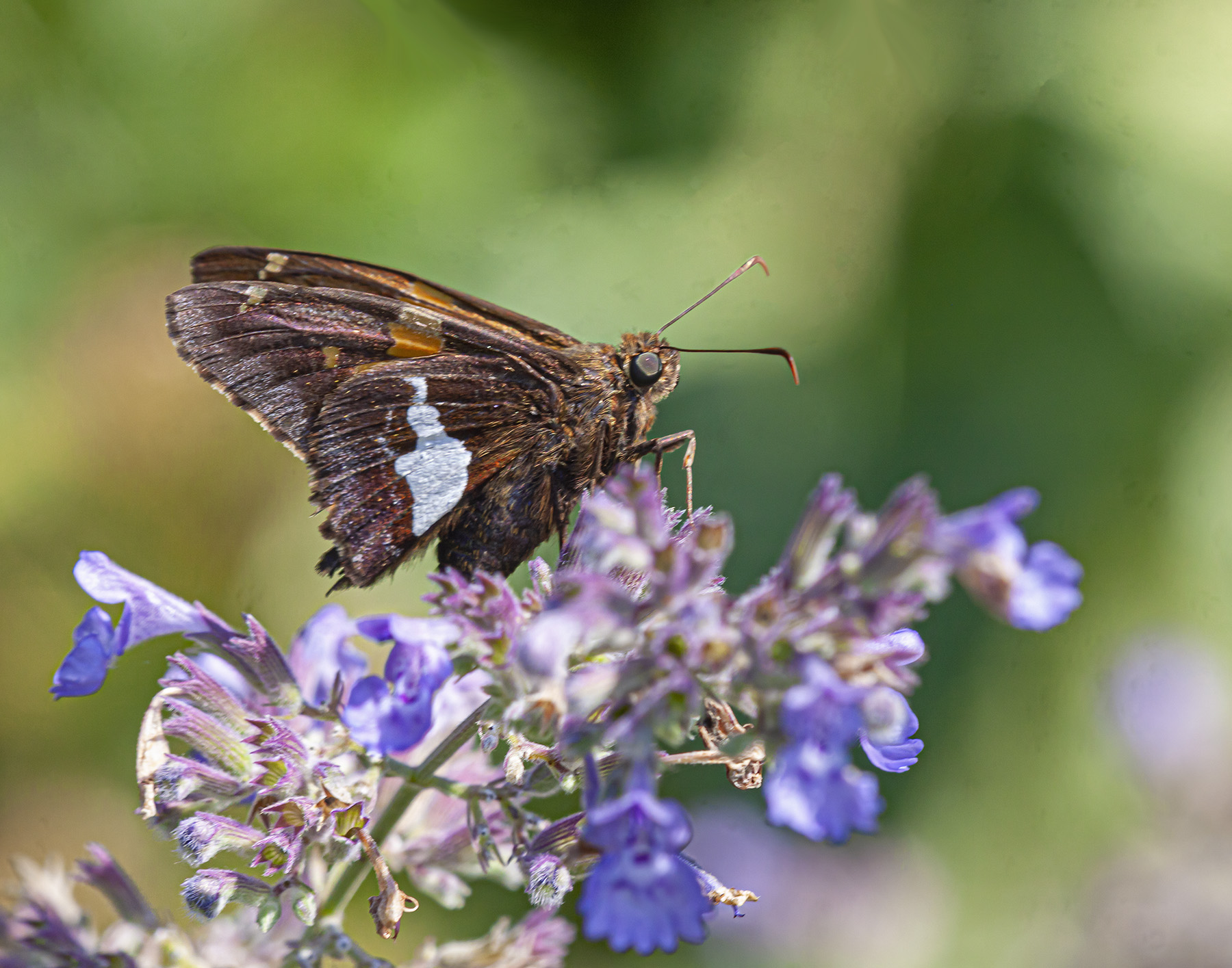
Out of the more than 3500 species of skipper butterflies worldwide, there is only one that I can reliably identify, the Silver-spotted Skipper (Epargyreus clarus). I spotted this little beauty on Monday during a brief visit to Green Spring Gardens with my friend and photography mentor Cindy Dyer.

© Michael Q. Powell. All rights reserved.
Posted in Butterflies, Flowers, Macro Photography, Nature, Photography, wildlife | Tagged Alexandria VA, Canon 50D, Epargyreus clarus, green springs garden, Silver-spotted Skipper, Silver-spotted Skipper butterfly, Tamron 180mm | 14 Comments »
June 25, 2020 by Mike Powell
During a brief visit to Green Spring Gardens on Monday with fellow photographer Cindy Dyer, I was thrilled when this Northern Mockingbird (Mimus polyglottos) landed close to me on an evergreen tree and I was able to capture this shot with my macro lens. I was focusing primarily on flowers and bugs, as one tends to do when visiting a garden, and simply reacted when this unexpected opportunity presented itself.
One of my goals in spending so much time in the field is to become so familiar with my camera gear that I can instinctively capture an image like this without having to think consciously about my camera. It is hard to explain, but it was one of those magical moments when I felt at one with my camera. Yeah, that sounds a little weird, but it is hard to put into words.

© Michael Q. Powell. All rights reserved.
Posted in Birds, Nature, Photography, Summer, wildlife | Tagged Alexandria VA, Canon 50D, green spring gardens, Mimus polyglottos, mockingbird, Northern Mockingbird, Tamron 180mm | 9 Comments »
June 24, 2020 by Mike Powell
Although Calico Pennant dragonflies (Celithemis elisa) are quite small, about 1.3 inches (33 mm) in length, they pack a lot of color into their tiny bodies and wings. Adult females have bright yellow markings, as shown in the first photo, and wonderful designs on their wings that appear to be outlined in gold when the sun hits them from the right angle. Adult males have bright red markings that look almost like little hearts and have similarly detailed patches on their wings, although the pattern and colors are different from those of the females.
What about the dragonfly in the third photo? Its coloration is similar to that of the adult female, but it is in fact a juvenile male that will eventually turn red. How can I tell it is a male? If you look closely at the tips of the abdomen (the “tail”) in all three images, you will note that the terminal appendages are similar in the final two photos and are different from those in the first photo. Normally I will try to rely on those anatomical features when trying to tell the gender of a subject, because in quite a large number of dragonfly species, juvenile males and females have the same coloration.
I spotted all three of these Calico Pennant dragonflies during a visit last Friday to Occoquan Bay National Wildlife Refuge, one of my favorite places to spend time with my camera. This refuge was one of the few facilities in our area to remain open during the stay-home period and got a bit too crowded for my taste. Now that other parks have reopened, the number of visitors has dropped to much lower levels and I am able to enjoy the solitude of nature once again.


© Michael Q. Powell. All rights reserved.
Posted in Dragonflies, dragonfly, Insects, Nature, Photography, Summer, wildlife | Tagged Calico Pennant, Calico Pennant dragonfly, Canon 50D, Celithemis elisa, Occoquan Bay National Wildlife Refuge, Tamron 180mm, Woodb | 19 Comments »
June 23, 2020 by Mike Powell
There was only a single water lily in bloom at a pond at Occoquan Bay National Wildlife Refuge last week, but its beauty brightened the entire area and brought a smile to my face. Water lilies are one of the reasons why Claude Monet is one of my favorite painters.
Monet did some 250 oil paintings of water lilies (“Nymphéas” in French), many depicting the garden at his home in Giverny, and they were the main focus of his artistic production during the last thirty years of his like, according to Wikipedia.

© Michael Q. Powell. All rights reserved.
Posted in Art, Flowers, Nature, Photography, Summer | Tagged Canon 50D, Claude Monet, Nymphéas, Occoquan Bay National Wildlife Refuge, Tamron 180mm, water lilies, water lily, Woodbridge VA | 11 Comments »
June 23, 2020 by Mike Powell
Ebony Jewelwings (Calopteryx maculata) are everywhere in some of the forest streams I like to explore at this time of the year. Still, I love when I can get a good angle on these beautiful damselflies when they are in wheel position and forming a sidewards heart, as was the case with this pair that I spotted last Thursday in Fairfax County.
Yes, as some of you already know, the damselflies are in the process of mating, with the male on the right and the female on the left.

© Michael Q. Powell. All rights reserved.
Posted in damselfly, Nature, Photography, Summer, wildlife | Tagged Calopteryx maculata, Canon 50D, Ebony Jewelwing, Ebony Jewelwing damselfly, Fairfax County Virginia, mating ebony jewelwings, sidewards heart, Tamron 180mm | 11 Comments »
June 22, 2020 by Mike Powell
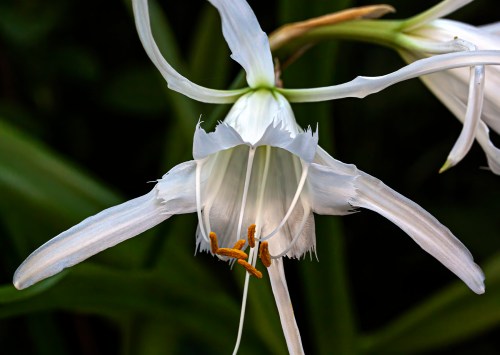
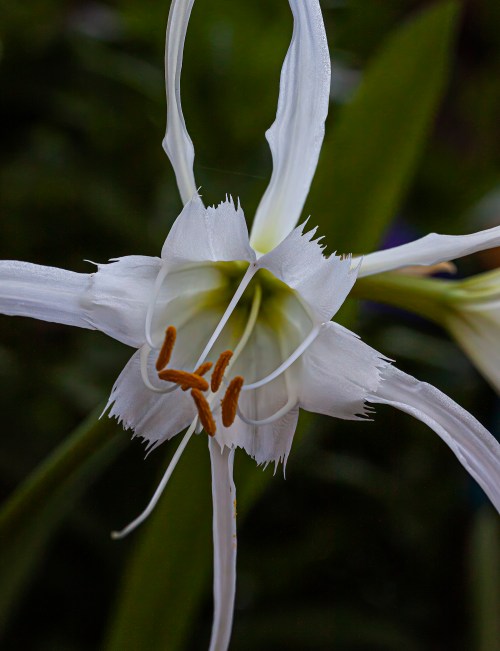
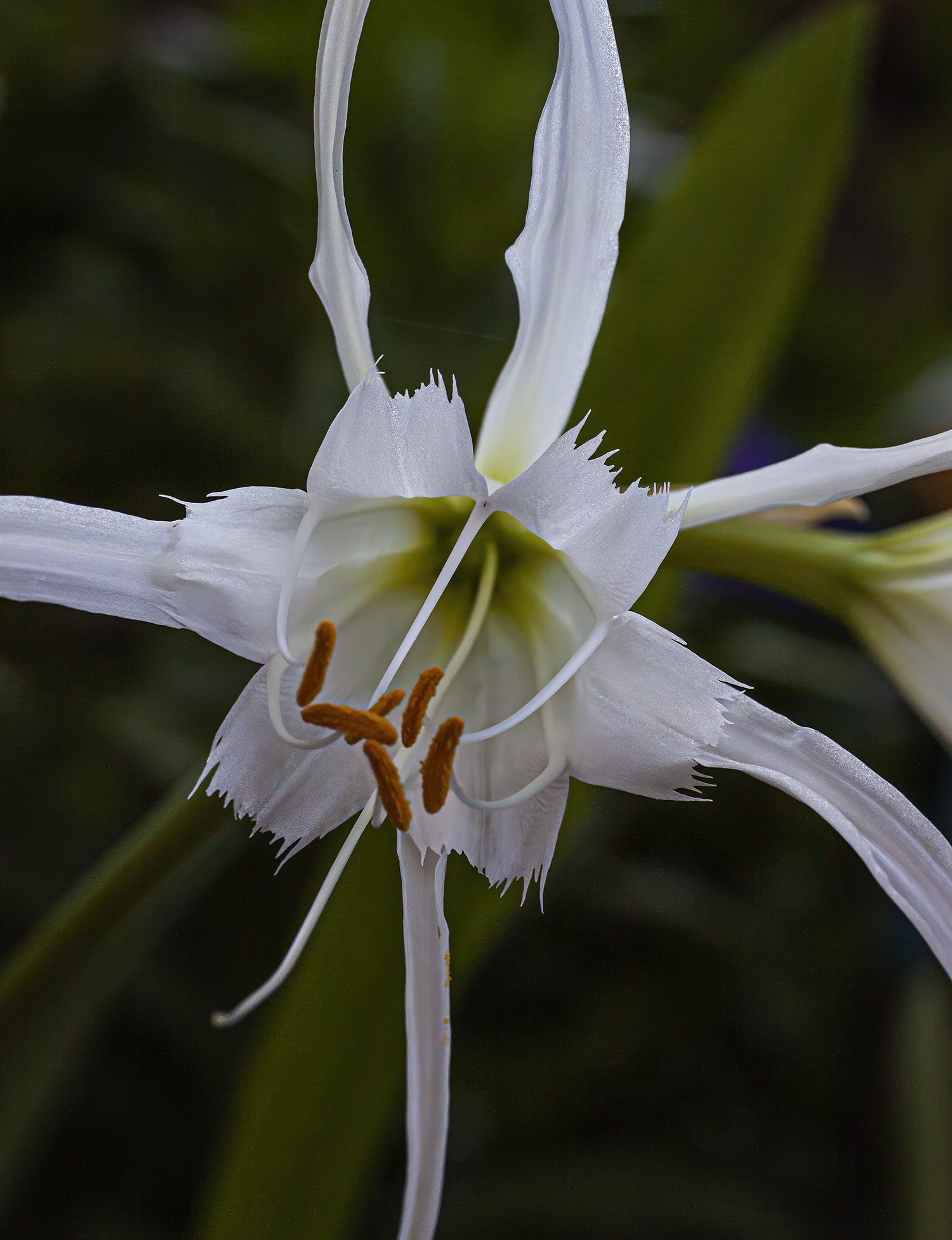
When I spotted this strange-looking flower yesterday in the garden of my photography mentor and neighbor Cindy Dyer, I had no idea what it was—she informed me that it was a Peruvian Daffodil (Hymenocallis narcissiflora). This flower, according to information at gardeningknowhow.com, is native to the Andes of Peru and is a member of the daffodil and amaryllis family, Amaryllidaceae. Its flowers resemble a “spidery” version of these flowers, as you can see in my photos. The elongated, sometimes curved, petals have led to the plant’s alternate common names, “spider lily” and “basket flower.”
Further exploration on the internet led me to wonder if this is actually the hybrid version known as Hymenocallis x festalis, a hybrid of the aforementioned Peruvian Daffodil as the female parent and the Hymenocallis. longipetala, another Peruvian flower, as the male parent, as detailed in an article by the University of Arkansas Division of Agriculture. Fearing that I would get sucked deeper into the world of plant ancestry, I stopped my research there.
Personally, I think that the name “spider lily” fits best and maybe that that is the name I will use in the future to refer to this crazy-looking flower.
© Michael Q. Powell. All rights reserved.
Posted in Flowers, Gardening, Photography, Summer | Tagged Canon 50D, Canon 60mm, Cindy Dyer, daffodil, Hymenocallis narcissiflora, Hymenocallis x festalis, Peruvian Daffodil | 14 Comments »
June 22, 2020 by Mike Powell
Skipper butterflies are common and Black-eyed Susans (Rudbeckia hirta) are common too, but what a lovely combination they made when I spotted them together on Friday at Occoquan Bay National Wildlife Refuge.

© Michael Q. Powell. All rights reserved.
Posted in Butterflies, Flowers, Nature, Photography, Summer | Tagged black-eyed susan, Canon 50D, Occoquan Bay National Wildlife Refuge, Rudbeckia hirta, skipper, skipper butterfly, Tamron 180mm, Woodbridge VA | 4 Comments »
June 21, 2020 by Mike Powell
Do you believe in unicorns? I am always happy when I manage to spot a Unicorn Clubtail (Arigomphus villosipes), a beautiful dragonfly species in which both sexes have a small hornlike projection between their eyes that gives rise to their common name. I recently spotted the dragonflies in this posting while exploring a small pond in Fairfax County, where I live.
This is the only clubtail species in our area that prefers ponds and marshes over streams and rivers, according to the Dragonflies of Northern Virginia website. It is fairly easy to identify this species, because of the rusty-edged club at the bottom portion of the dragonfly’s abdomen and the very visible bright tip. Male Unicorn Clubtails tend to fly short patrols and perch quite often on low vegetation, so it is not hard for me to spot them if I am in the appropriate environment. The third photo below shows a male in a typical perching pose.
Female Unicorn Clubtails, on the other hand, are hard to find—I do not know where they hang out, but it seems that they come to the water only when they are ready to mate. The only two times that I have ever seen a female Unicorn Clubtail dragonfly was when when she was ovipositing, like this one in the first two photos that I spotted this past Thursday. I captured these shots as she hovered momentarily in the air, getting ready to tap the water again with the tip of her abdomen to release more eggs.
Chasing unicorns? Yes, that is how I enjoy spending my time in the wild.


© Michael Q. Powell. All rights reserved.
Posted in Dragonflies, dragonfly, Insects, Nature, Photography, Summer, wildlife | Tagged Arigomphus villosipes, Canon 50D, chasing unicorns, Fairfax County Virginia, female Unicorn Clubtail, Tamron 180mm, Unicorn Clubtail, Unicorn Clubtail dragonfly | 6 Comments »
June 20, 2020 by Mike Powell
I was really happy that I was able to track this Swamp Darner dragonfly (Epiaeschna heros) after it zoomed by me yesterday afternoon at Occoquan Bay National Wildlife Refuge. When I finally caught up to it, the large dragonfly was hanging vertically, high in a tree among the leaves, leisurely munching on its bee lunch in the shade.
Yes, I recognize that bees play an important role as pollinators and highlighted that in yesterday’s posting. Bees, however, also serve as a food source for other creatures higher up on the food chain—they are all part of the circle of life.
Swamp Darners are among the largest dragonflies in our area, about 3.4 inches (86 mm) in length. I really like the description that Kevin Munroe provided of Swamp Darners on the wonderful Dragonflies of Northern Virginia website. “I often tell people on dragonfly walks that if they see a rhino with wings, it’s a swamp darner. Slight exaggeration, perhaps, but they are pretty impressive. June is their month and the best time to see them, as they cruise, slow and purposefully, over shallow, swampy pools, or hunt high over nearby meadows.”

© Michael Q. Powell. All rights reserved.
Posted in Dragonflies, dragonfly, Insects, Nature, Photography, Summer, wildlife | Tagged bee, bee lunch, Canon 50D, Epiaeschna heros, Occoquan Bay National Wildlife Refuge, Swamp Darner, Swamp Darner dragonfly, Tamron 180mm, Woodbridge VA | 15 Comments »
June 20, 2020 by Mike Powell
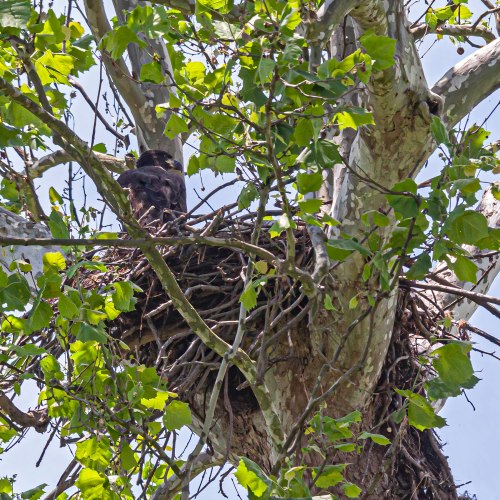
It has been a month since I visited the Bald Eagle (Haliaeetus leucocephalus) nest at Occoquan Bay National Wildlife Refuge, where I spotted an eaglet on 19 May and wrote a posting entitled “One little eaglet.” Yesterday I traveled to the refuge to check on the baby eagle and was a little surprised to find that the authorities had removed the barriers that had blocked access to the nesting area, which is adjacent to a trail. Did this mean that the eaglet had fledged and the family had left the nest?
I was happy to discover that the eaglet was still there, has grown considerably in size over the past month, and was sitting tall at one edge of the nest. The leaf coverage has also grown, making it pretty tough to get an unobstructed view of the little eagle. The vegetation also hid the presence of one of the parent eagles that flew away to a nearby grove of trees when I approached.
It is somehow reassuring to see that the cycle of life has continued undisturbed as our lives have been turned upside down by the global pandemic. I celebrate the new life of this young eagle and all of the other creatures who have begun their lives this spring and wish them success as they learn to navigate the challenges of their lives.
© Michael Q. Powell. All rights reserved.
Posted in Birds, Nature, Photography, Summer, wildlife | Tagged baby eagle, Bald Eagle, Canon 50D, eaglet, Haliaeetus leucocephalus, Occoquan Bay National Wildlife Refuge, Tamron 180mm, Woodbridge VA | 19 Comments »
« Newer Posts - Older Posts »


















 Mike Powell