July 9, 2014 by Mike Powell
Do your mix humor with your photography? I enjoy playing with words (and especially puns) and love looking for opportunities to inject humor into my blog postings. One of my favorite bloggers, Lyle Krahn at Krahnpix, is a real master at mixing his incredible wildlife shots with a kindred kind of humor (or perhaps he might say “humour.)
This past Monday was my blog’s second anniversary and I am taking a brief pause from posting new photos to think about the blog and my photographic journey over the last two years. During this period I am re-posting some of my favorite postings.
The re-posting today of an encounter between a Green Heron (Butorides virescens) and a frog was one of my earliest attempts to add humor, from the title all the way down to the last line of the posting, and is one of my favorites over the past two years. Here’s a link to the original posting or you can read it in its entirety below.
Full text of blog posting on 24 July 2012 that I entitled “Not Seeing Eye to Eye”:
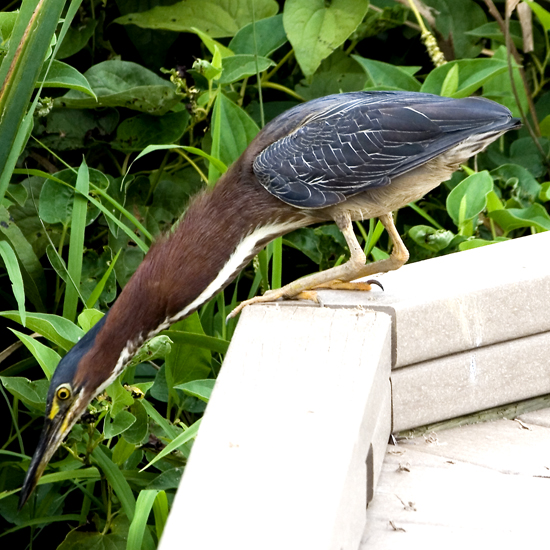
One can only imagine what is going through the frog’s mind as he looks into the crazed eyes of the green heron who has just speared him. Is he looking for mercy? Is he resigned to his fate?
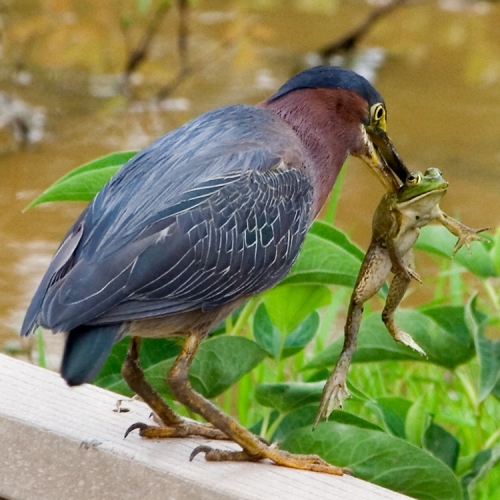
I watched the prelude to this moment unfold this afternoon at Huntley Meadows Park, a marshland park here in Virginia. The green heron was intently scanning the water from the edge of a boardwalk that runs through the march. Periodically he would extend his neck down toward the water.

Several times we heard an excited “eeep” sound followed by a splash, indicating another frog had escaped. After a few more minutes, however, the heron dived into the water and reappeared on the boardwalk with the speared frog you see in the first photo.
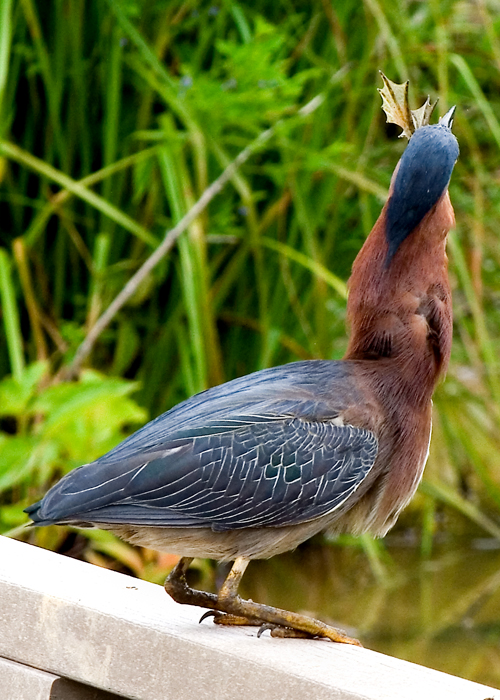
When you look at the comparative size of the heron’s mouth and the frog, it hardly seems possible that the green heron could swallow the entire frog. The heron took his time shifting the position of the frog and then all at once he turned his head, bent his neck back a little, and down went the frog. It happened so quickly that I was able to snap only a single photo that shows the frog’s webbed feet as the only remaining parts that have not yet been swallowed.

In this final photo the heron no longer has a slim neck. I have no idea how long it will take for the frog to reach the heron’s stomach but I am pretty sure he was not yet there when I took this photo.
And don’t try to talk with the heron during this period. Why not? Read the caption of the last photo!
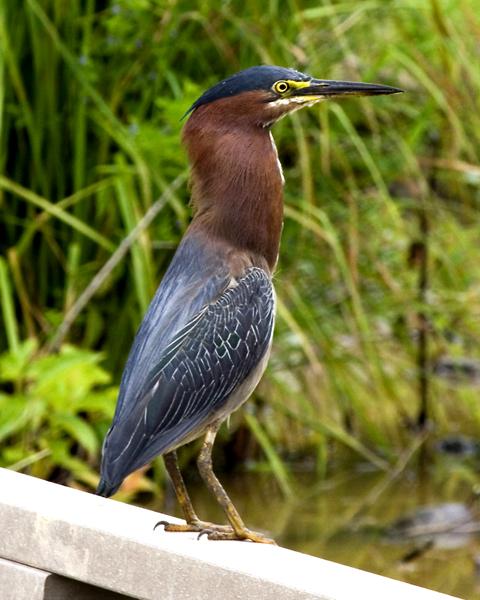
I can’t talk now. I have a frog in my throat.
© Michael Q. Powell. All rights reserved.
Posted in Amphibians, Birds, Humor, Nature, Photography, wildlife | Tagged Alexandria, Butorides virescens, Canon 55-250mm zoom lens, Canon Rebel XT, frog, green heron, humor, Huntley Meadows Park, retrospective | 17 Comments »
July 8, 2014 by Mike Powell
How do you decide which of your photos are your favorite ones? Do you rely on technical criteria, like sharpness, or do you rely more on the overall artistic impression? Do your memories of shooting an image factor into your calculations? Do WordPress statistics play any role in your thinking?
As I noted yesterday, my blog’s second anniversary, I am taking a brief pause from posting new photos to think about the blog and my photographic journey over the last two years. During this period, I though I would re-post some of my favorite postings. I am posting them in their entirety, because I think that my prose enhances the appeal of my blog (and I find that I enjoy the creative experience of expressing myself in my words as well as in my images).
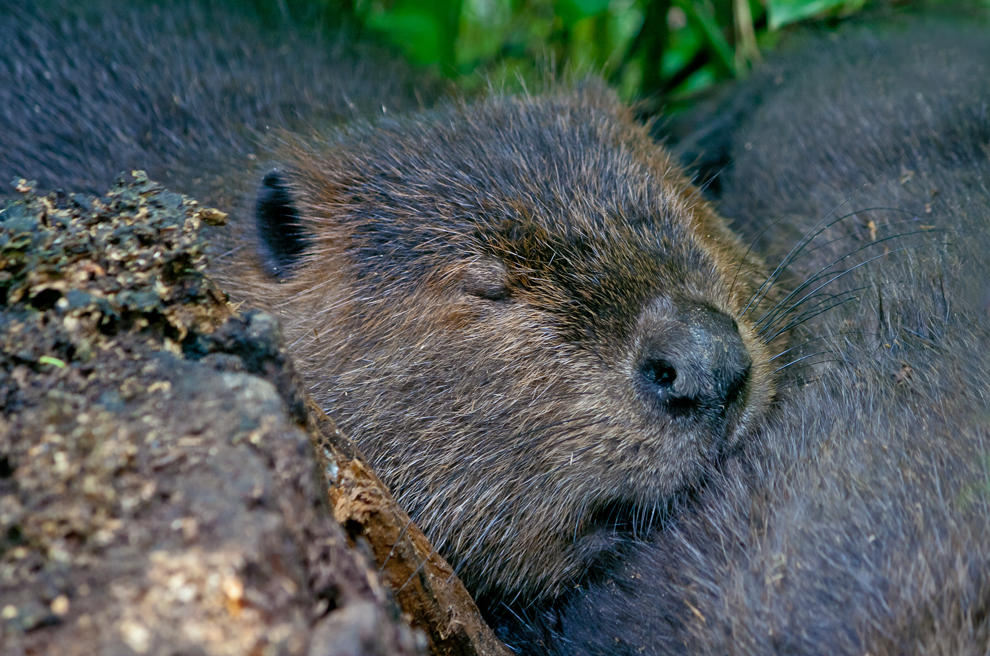
I tend to photograph a lot of insects in the summer and birds in the winter, but some of my most memorable images come from my infrequent encounters with mammals, like this tender moment that I shared with a beaver family last summer that was visible one day during the daylight hours.
In response to my initial questions, I tend to give my greatest priority to the overall artistic impression and give little weight to WordPress statistics. Some of my best photos have relatively few views, while I have a few unexceptional images that have a lot of views.
Text of the original blog posting that first appeared on 18 July 2013:
Last Friday, after some violent thunderstorms, I visited my local marshland park, where the staff alerted me that three beavers were sleeping on a patch of dry land near their lodge, which apparently had flooded. The three North American Beavers (Castor canadensis) were all snuggled together and reminded me a little of puppies. I am working up some more images, but thought that I would give a sneak preview of coming attractions.

© Michael Q. Powell. All rights reserved
Posted in animals, Nature, Photography, wildlife | Tagged A, Alexandria VA, beaver, Canon 55-250mm zoom lens, Canon Rebel XT, Castor canadensis, Huntley Meadows Park, North American Beaver, retrospective | 6 Comments »
July 7, 2014 by Mike Powell
Two years ago today, my photography mentor and dear friend Cindy Dyer sat me down at her computer and told me that I was going to start a blog. We had just returned from a photo shoot at Kenilworth Aquatic Gardens in Washington D.C. and had taken lots of shots of waterlilies, lotus flowers, and dragonflies.
Cindy is a professional photographer and web designer and I had previously looked at her blog (which currently has had over 560,000 views), but I had never really thought about starting a blog myself. Inside I had all kinds of concerns about my inadequacies as a photographer and about not being ready to share my images with an audience broader than, but Cindy was undeterred and helped me choose a theme and a banner and set up my basic page.
My first posting was short, only 14 words and included a shot of a Blue Dasher dragonfly. I have reposted it below for your convenience or you can use the link in the first sentence of this paragraph.
Today’s posting is posting number 1,224. I never imagined that I would enjoy this blog as much as I have or that I would continue so faithfully to document my journey into photography. Thanks to so many of you readers who have encouraged and supported me along the way.
I may take a pause this week to reflect on that journey and possibly re-post some of my favorites from the last two years. Don’t worry, though, I be back to posting new images before long.
My first WordPress posting on 7 July 2012:
I photographed this Blue Dasher dragonfly (Pachydiplax longipennis) at Kenilworth Aquatic Gardens this morning.
© Michael Q. Powell. All rights reserved.

Posted in Art, Dragonflies, Insects, Macro Photography, Nature, Photography, wildlife | Tagged anniversary, Blue Dasher, Blue Dasher dragonfly, Canon 55-250mm zoom lens, Canon Rebel XT, Kenilworth Aquatic Gardens, Pachydiplax longipennis, retrospective, Washington D.C. | 16 Comments »
July 6, 2014 by Mike Powell
Do your review your photos rapidly before you choose the ones to post or do you carefully and systematically evaluate them and only then select the best ones?
I am often in a hurry. Sometimes I will stop to work on a shot that I like before I have even reviewed the complete set of images. I generally don’t work up postings in advance and I’ll write up the posting and push the “Publish” button with out realizing that I may have unmined gold waiting to be discovered.
Only later, when I go through the entire set of shots do I realize that I have a better shot than the one I posted and realize I should have at least posted both of them. If the differences are only minor, I won’t do an additional posting, but sometimes, like today, I feel compelled to post a second image.
As was the case in yesterday’s posting, this is a shot of what I think is an Eastern Carpenter Bee (Xylocopa virginica)—or possibly a bumblebee— on a Purple Coneflower (Echinacea purpurea). The angle and the lighting helped me capture a significant amount of the detail and texture of both the bee and the flower and the colors came through with a beautiful vibrancy. The bee was in an unusual position, which adds to the visual interest of the image.
This is one of my favorites of my recent images. You might think that this experience will teach me a lesson about the value of a full review before choosing images to process, but I suspect that this will happen again from time to time. I know my habits too well.

© Michael Q. Powell. All rights reserved.
Posted in Art, Flowers, Gardening, Insects, Macro Photography, Nature, Photography, Portraits | Tagged Alexandria VA, Canon 50D, carpenter bee, coneflower, Eastern Carpenter Bee, Echinacea purpurea, purple coneflower, Runnymeade, Tamron 180mm macro lens | 12 Comments »
July 5, 2014 by Mike Powell
Yesterday was a beautiful, sunny day, but it was very breezy, which made it tough for me to get decent shots of bees in my neighbors’ garden. I am still going through my photos (and deleting a lot of them), but I was immediately drawn to this image of an Eastern Carpenter Bee (Xylocopa virginica) on a Purple Coneflower (Echinacea purpurea).
Although the dark background suggests the use of flash, I wasn’t using any flash and the shutter speed of 1/400 in the EXIF data is faster than the synch speed of my flash. I was trying to get as close to the bees as I could and the height of the coneflowers made it possible to get at eye level with the bee and get this head-on shot.

© Michael Q. Powell. All rights reserved.
Posted in Art, Flowers, Gardening, Insects, Macro Photography, Nature, Photography, wildlife | Tagged Alexandria VA, bee, Canon 50D, carpenter bee, coneflower, Eastern Carpenter Bee, Echinacea purpurea, purple coneflower, Runnymeade, Tamron 180mm macro lens | 11 Comments »
July 4, 2014 by Mike Powell
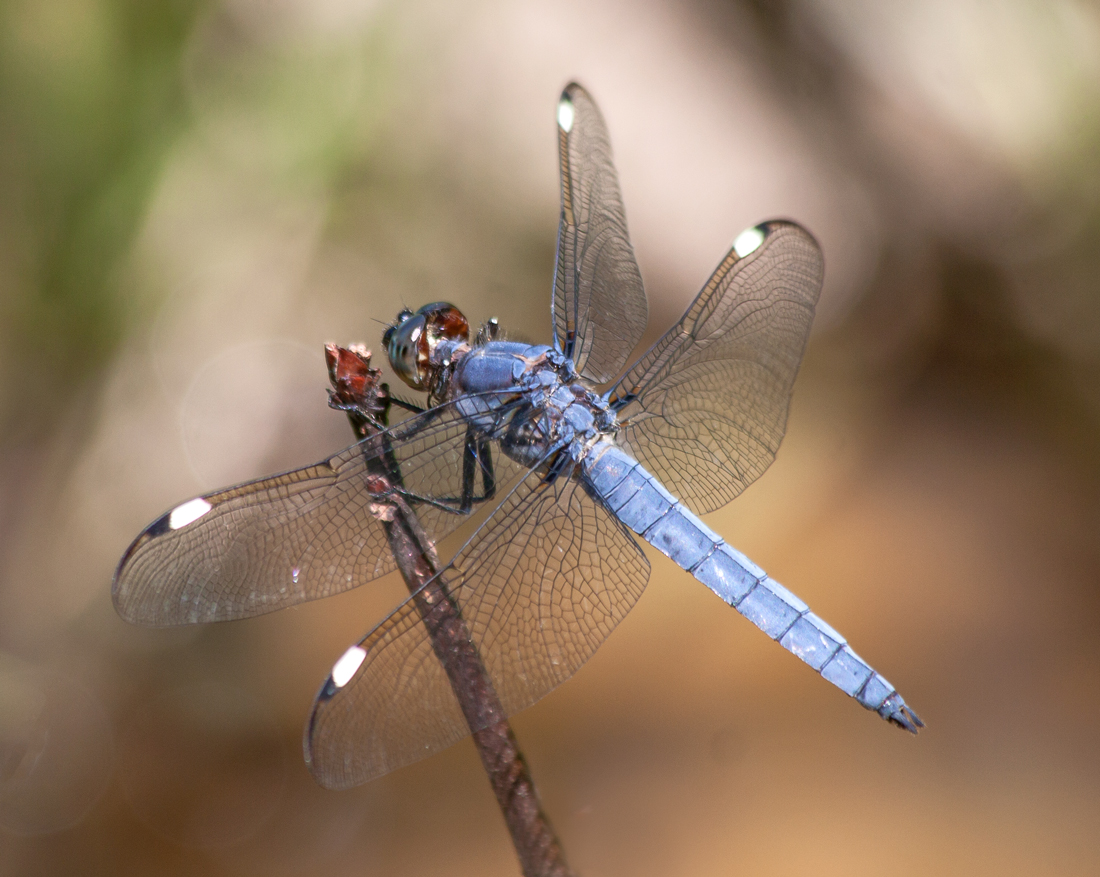
What adds drama to a photo? Sometimes it is the lighting of a scene or the positioning of a subject. These recent shots of Blue Dasher dragonflies (Pachydiplax longipennis) seem to have a bit more drama and are more “artsy” than many of my typical images.
Should I start wearing a beret now when I am shooting?


© Michael Q. Powell. All rights reserved.
Posted in Art, Dragonflies, Humor, Insects, Macro Photography, Nature, Photography, Portraits, wildlife | Tagged Alexandria VA, Blue Dasher, Blue Dasher dragonfly, Canon 50D, drama, dramatic, Huntley Meadows Park, Pachydiplax longipennis, Tamron 180mm macro lens | 11 Comments »
July 3, 2014 by Mike Powell
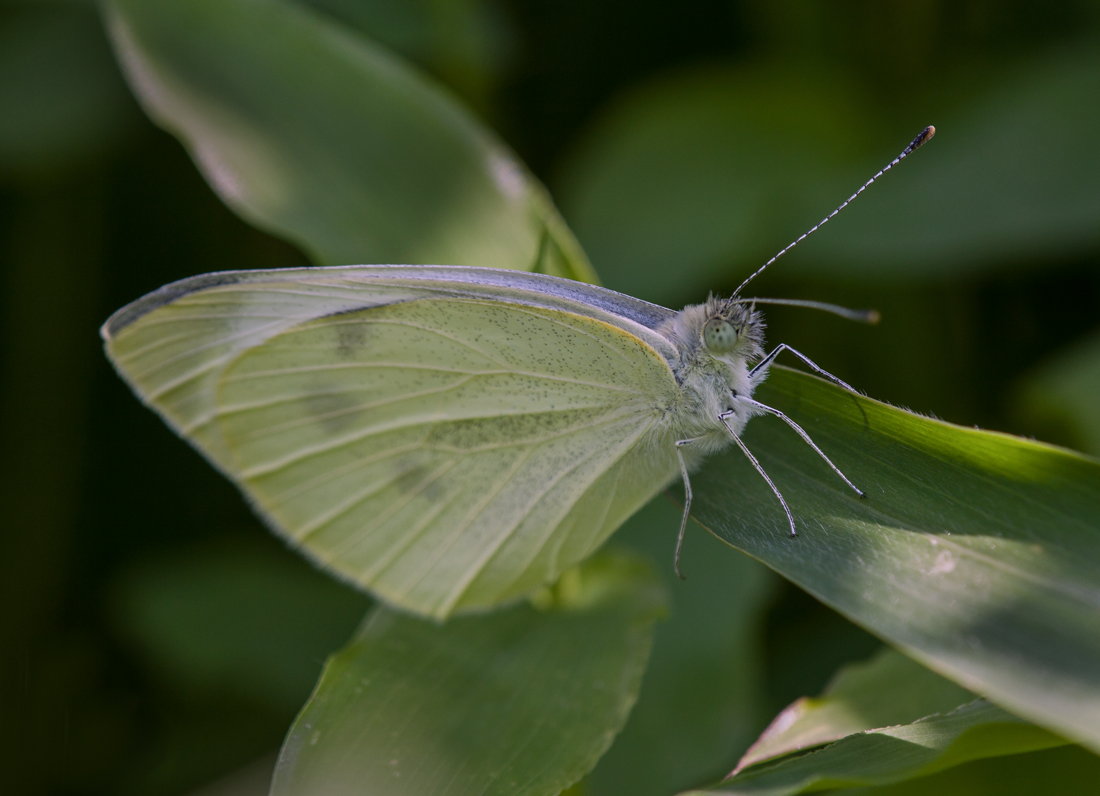
When the weather turns hot and humid, even the insects seem to enjoy the shade, like this Cabbage White butterfly (Pieris rapae) that I encountered recently while searching for dragonflies. I never fail to be amazed at the speckled green exotic eyes of this common butterfly.
The Cabbage White’s almost pure white body, though, is often a real challenge for me, because it seems to confuse my camera’s metering system and images are often severely overexposed. In this image. I think I used spot metering to try to get the correct exposure, which seemed to help. However, there was a greenish color cast in the initial shot, probably caused by the light filtering through the leaves, that I had to fix in post-processing.
The Cabbage White does not have the spectacular colors of many other butterflies, but nonetheless possesses an understated elegance that I find really attractive.

© Michael Q. Powell. All rights reserved.
Posted in Butterflies, Insects, Macro Photography, Nature, Photography, wildlife | Tagged Cabbage White, Cabbage White butterfly, Pieris rapae | 5 Comments »
July 2, 2014 by Mike Powell
Two things really struck me when I first encountered this damselfly—its captivating blue eyes and its extraordinarily long abdomen.
Most damselfly fold in their wings when they are at rest, but damselflies of the Lestidae family keep them open and are commonly known as spreadwings. Only two members of this family are on the species list for my marshland park—the Swamp and the Slender Spreadwing—and this looks to me like might be a male Slender Spreadwing damselfly (Lestes rectangularis).
I would welcome a correction or confirmation of my identification, because I feel almost clueless when it comes to identifying damselflies.

© Michael Q. Powell. All rights reserved.
Posted in Dragonflies, Insects, Macro Photography, Nature, Photography, Portraits, wildlife | Tagged Alexandria VA, Canon 50D, damselfly, Huntley Meadows Park, Lestes rectangularis, Slender Spreadwing, Slender Spreadwing damselfly, Tamron 180mm macro lens | 10 Comments »
July 1, 2014 by Mike Powell
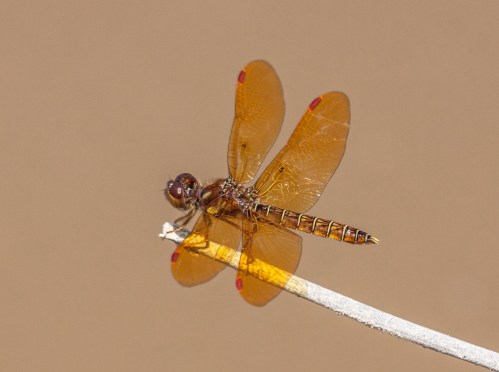
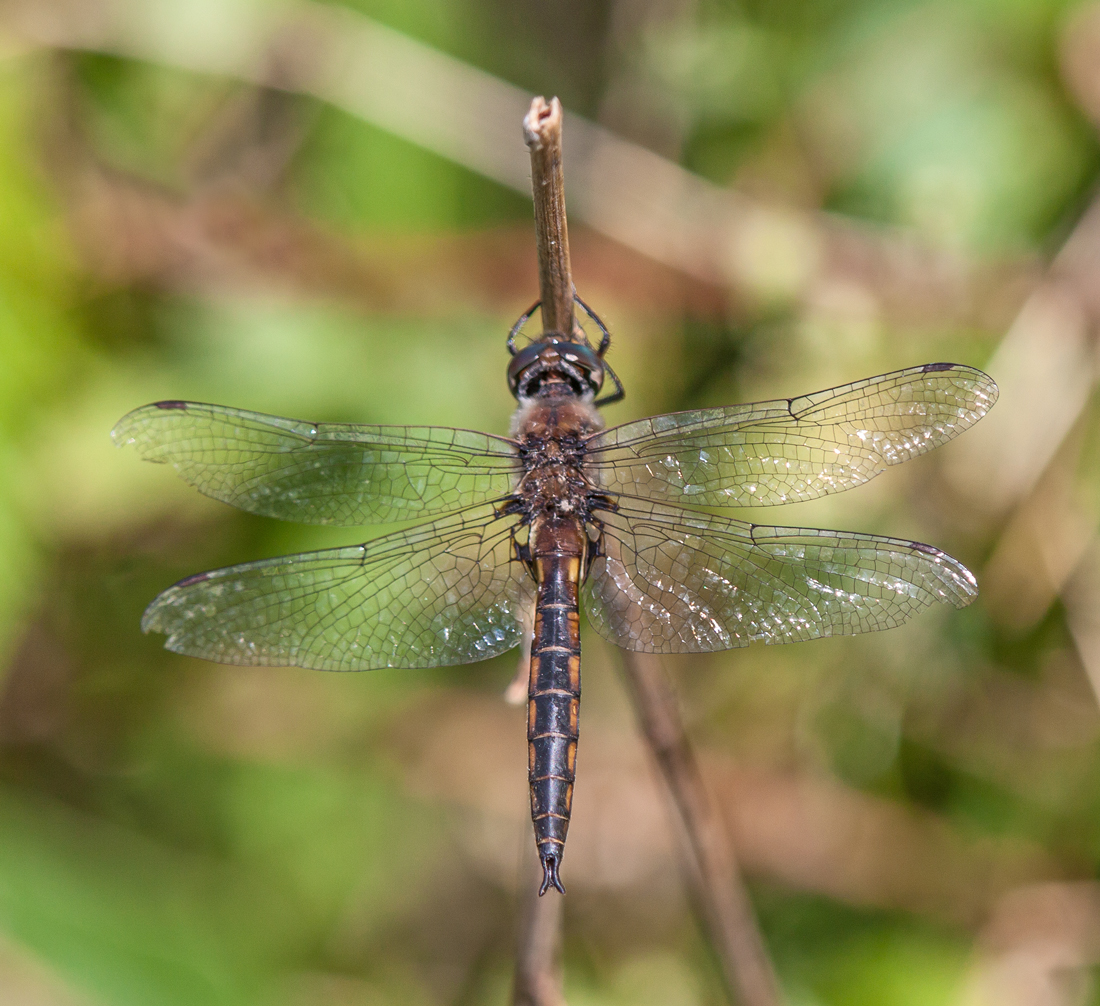
Compared to the other dragonflies that I have photographed, the Eastern Amberwing (Perithemis tenera) is tiny, typically less than an inch in size (25mm), but it has such a distinctive look that it is easy to identify.
I was able to approach this dragonfly from the rear and from above as it was perched on some vegetation overhanging a muddy creek and I don’t think it sensed my presence, even though I was pretty close to it. .
© Michael Q. Powell. All rights reserved.
Posted in Dragonflies, Insects, Macro Photography, Nature, Photography, Portraits, wildlife | Tagged Alexandria VA, Canon 50D, Eastern Amberwing, Eastern Amberwing dragonfly, Huntley Meadows Park, Perithemis tenera, Tamron 180mm macro lens | 11 Comments »
June 30, 2014 by Mike Powell
It’s unusual for me to take a photograph of a dragonfly with my camera pointed upward, but this Bar-winged Skimmer (Libellula axilena) kept perching in the branches of a downed tree limb, enabling me to include a little patch of sky in some of the shots. This is a new species for me that was pointed out to me by fellow photographer Walter Sanford when we ran into each other at one of our favorite spots at our local marshland park. The second shot shows part of the wing pattern that is responsible for the common name of this species, “Bar-winged.”


© Michael Q. Powell. All rights reserved.
Posted in Dragonflies, Insects, Macro Photography, Nature, Photography, Portraits, wildlife | Tagged Alexandria VA, Bar-winged Skimmer, Bar-winged Skimmer dragonfly, Canon 50D, Huntley Meadows Park, Libellula axilena, Tamron 180mm macro lens | 3 Comments »
June 29, 2014 by Mike Powell
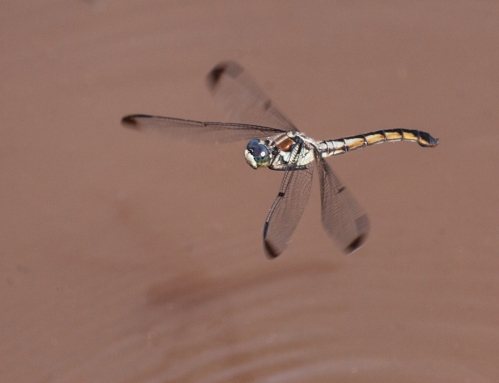
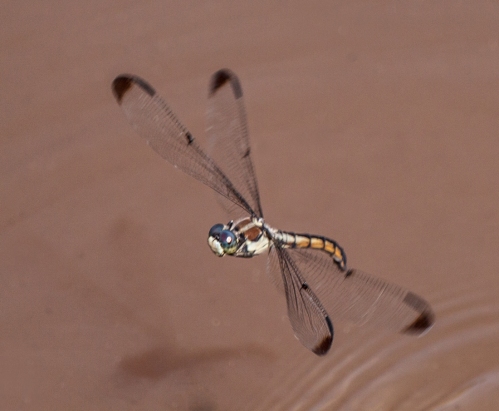
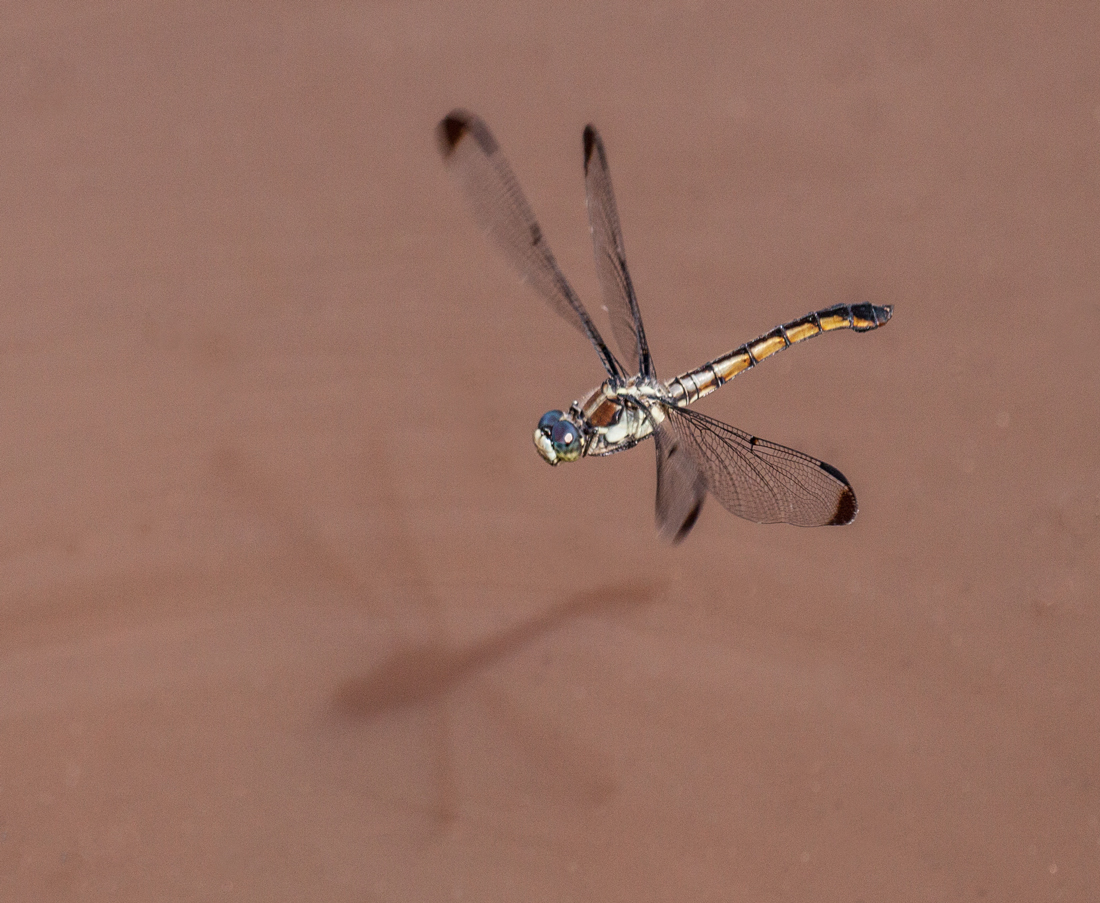
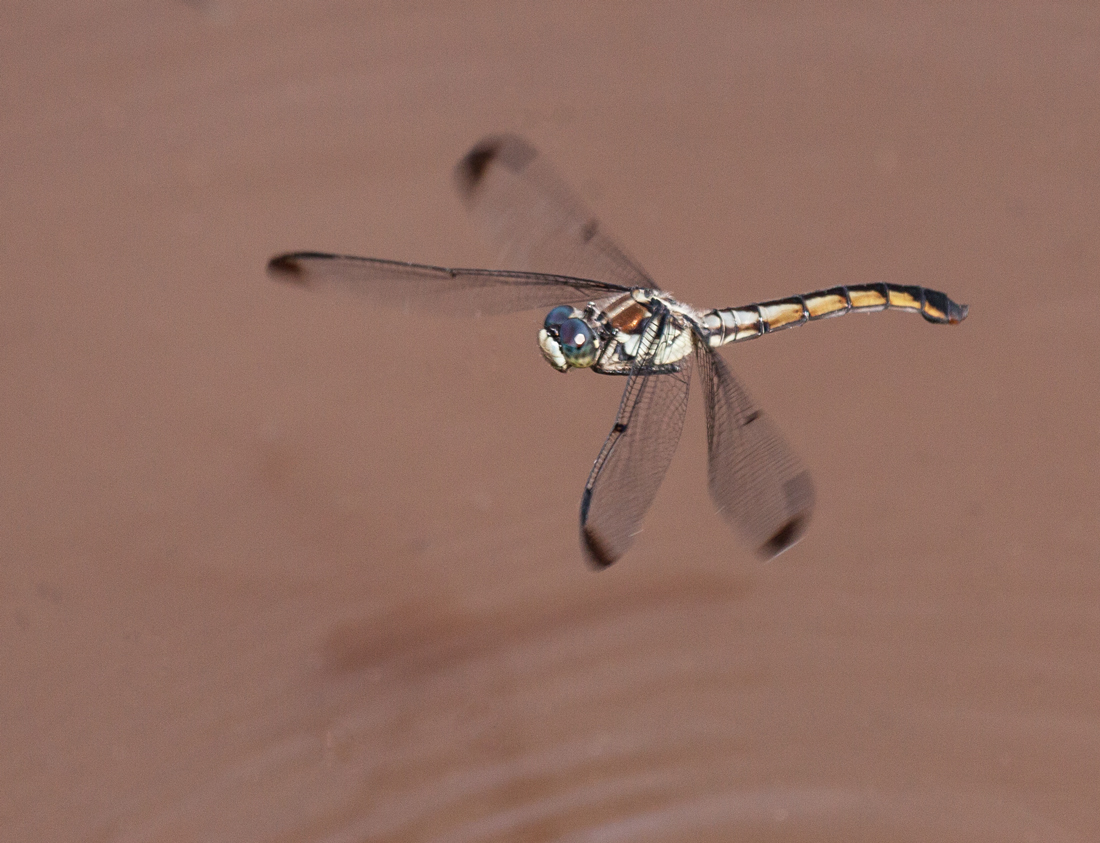
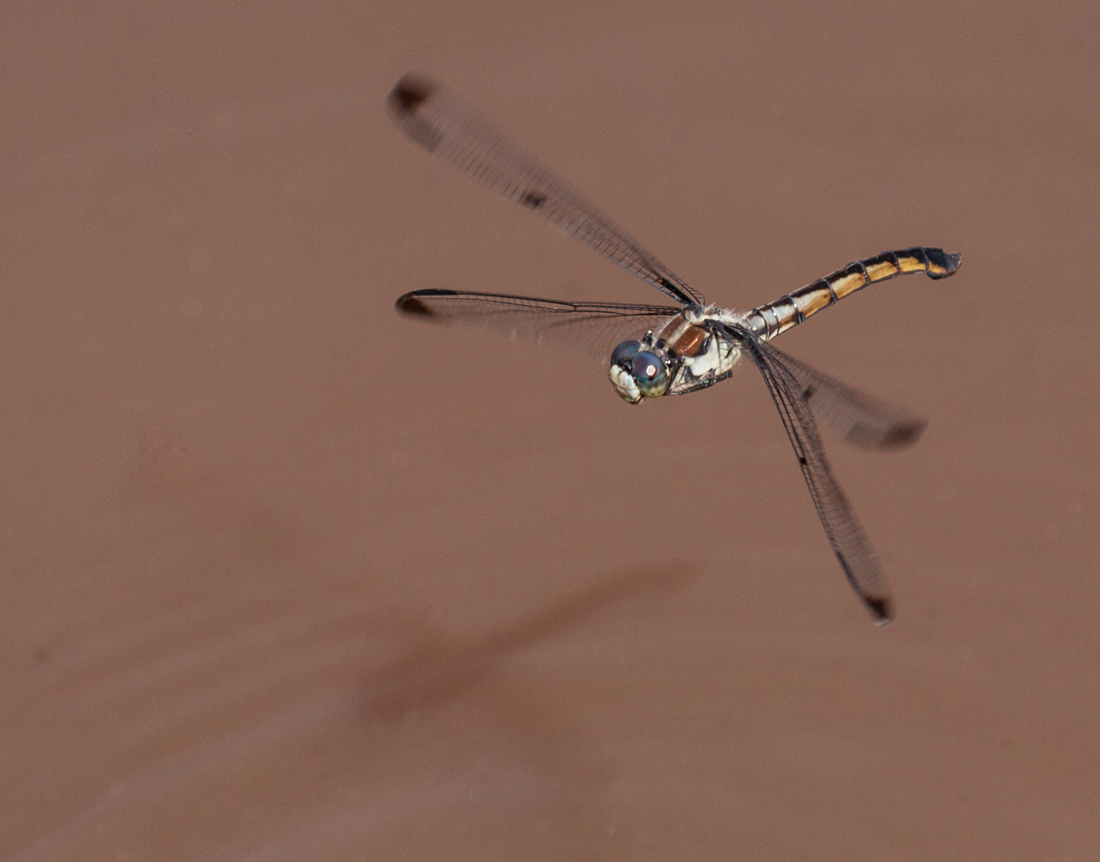
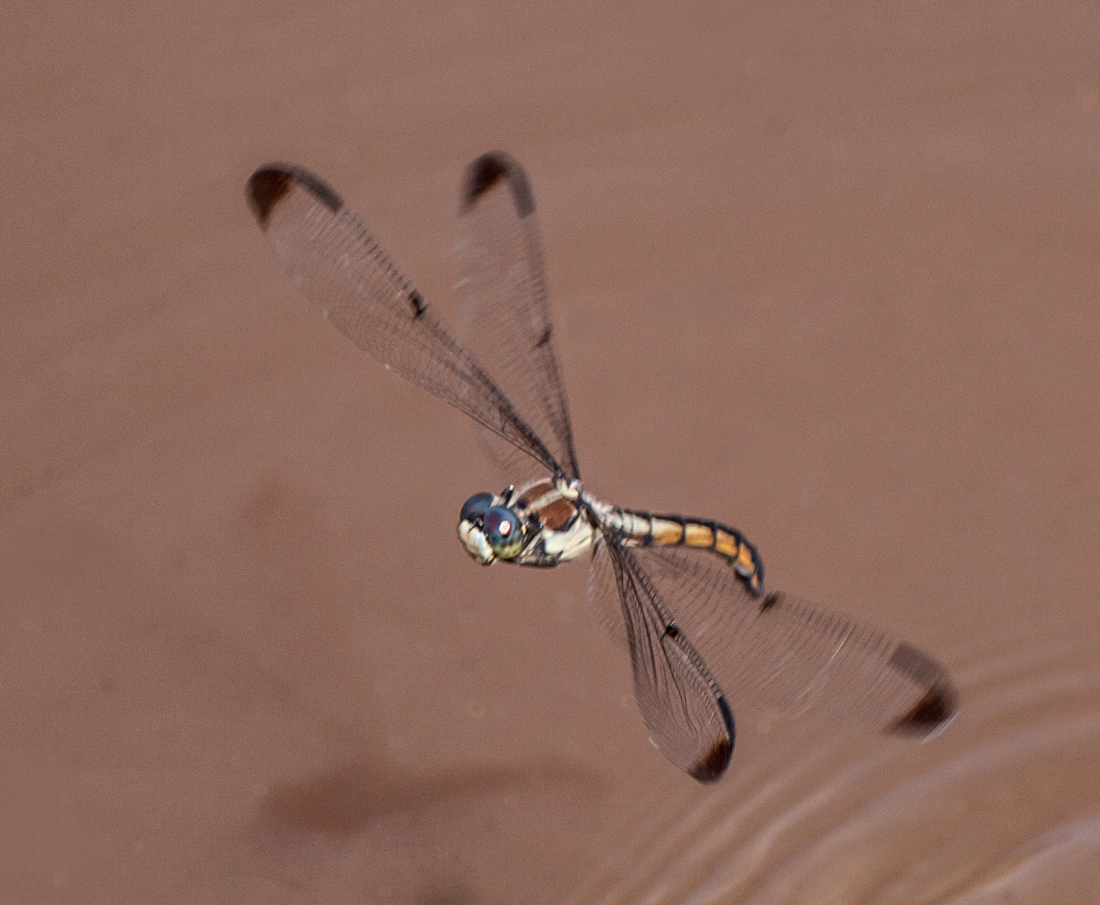
It’s tough to photograph a dragonfly in flight, but when it chooses to hover, there is a slightly better chance of getting a shot. That was the case recently when I encountered this female Great Blue Skimmer dragonfly (Libellula vibrans) that was in the process of depositing her eggs in the water. As her mate circled overhead, the female dragonfly would hover over the water and then periodically dip the tip of her tail in the water before returning to the hovering position. I was able to get several images of the hovering dragonfly, but got only a single image of her depositing the eggs.


© Michael Q. Powell. All rights reserved.
Posted in Dragonflies, Insects, Macro Photography, Nature, Photography, Portraits, wildlife | Tagged Alexandria VA, Canon 50D, female Great Blue Skimmer, Great Blue Skimmer, Great Blue Skimmer dragonfly, hovering, Huntley Meadows Park, Libellula vibrans, ovipositing, Tamron 180mm macro lens | 21 Comments »
June 28, 2014 by Mike Powell
Looking at my recent postings, you might come to the conclusion that I neglect damselflies, the smaller, less colorful members of the Odonata family, in favor of dragonflies. Actually, I really like damselflies, but they are so small that it is difficult to see them most of the time and quite a challenge to get a clear shot of one.
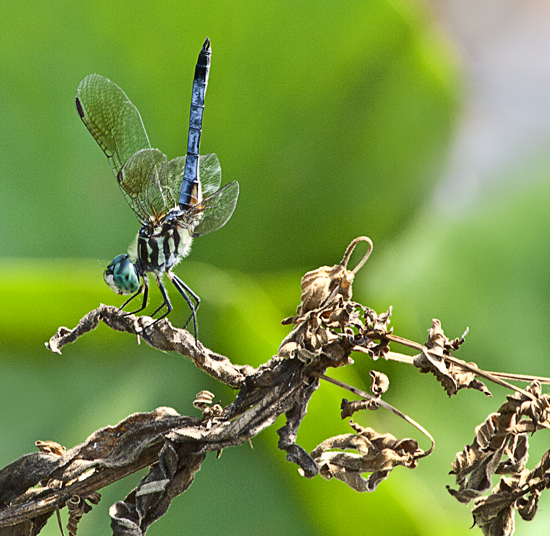
As I was searching for dragonflies, I came upon this beautiful black and blue damselfly perched on a small branch near the edge of a muddy creek and was able to get an unobstructed shot. You might think that identification would be easy, but there is a whole group of damselflies, the bluets, whose members have various combinations of black and blue.
So far, I haven’t been able to identify this damselfly, but I find its combination of black and turquoise to be elegant and really attractive.

© Michael Q. Powell. All rights reserved.
Posted in Dragonflies, Insects, Macro Photography, Nature, Photography, wildlife | Tagged Alexandria VA, bluet, bluet damselfly, Canon 50D, damselfly, Huntley Meadows Park, Tamron 180mm macro lens | 8 Comments »
June 27, 2014 by Mike Powell
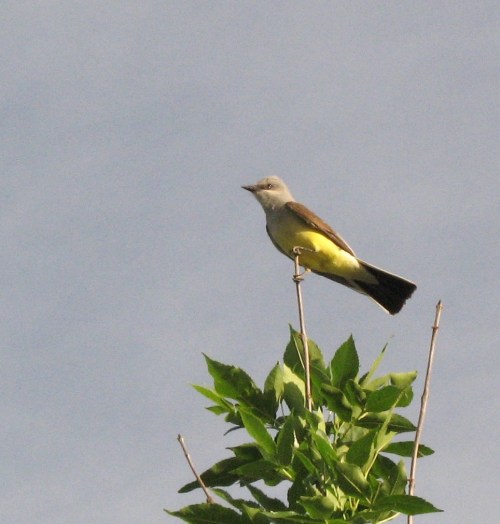
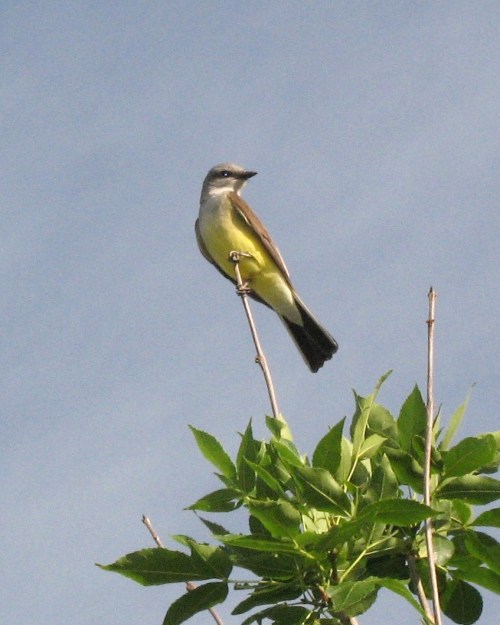
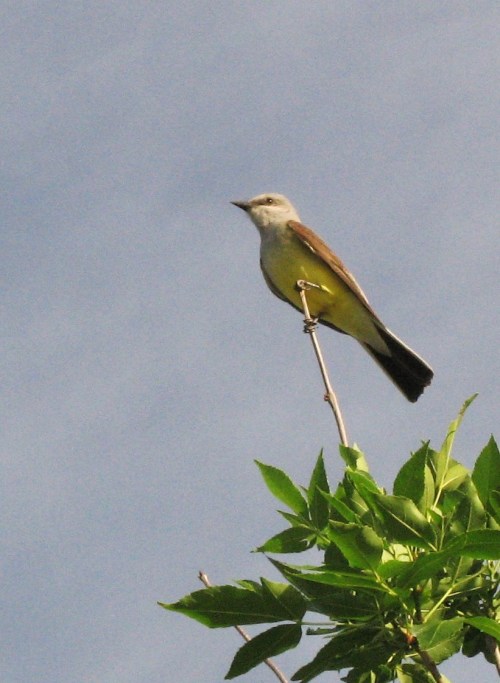
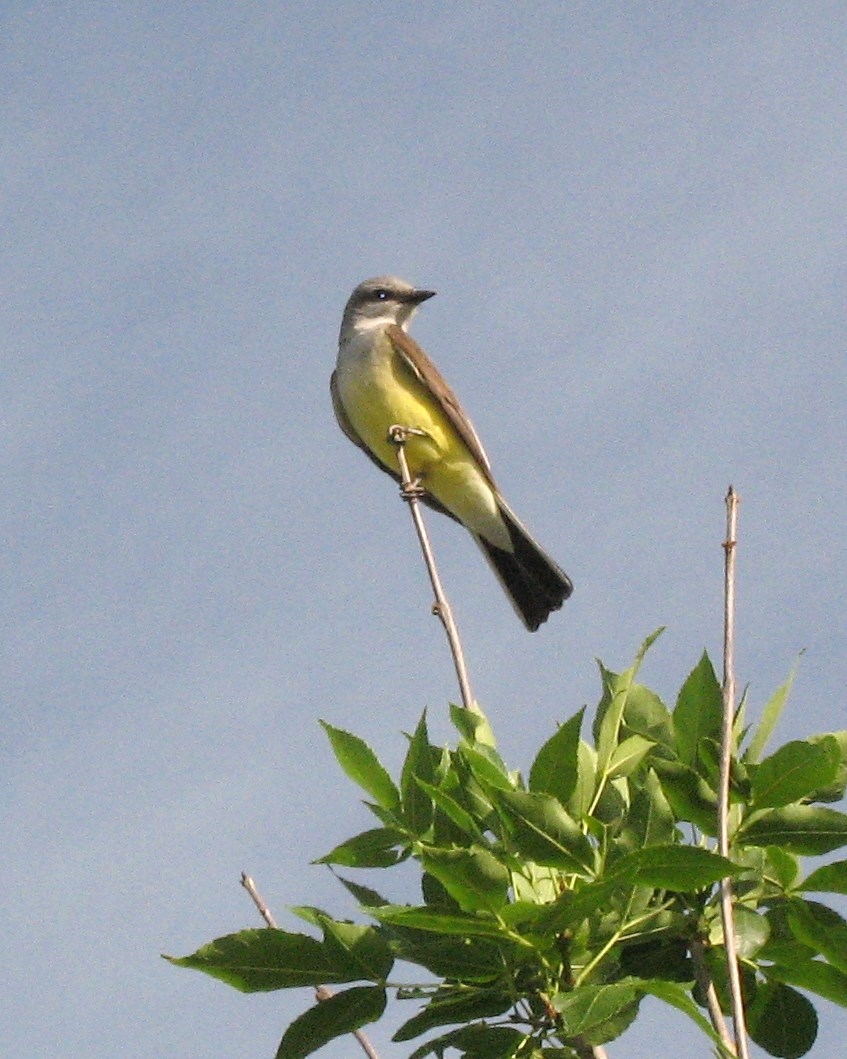
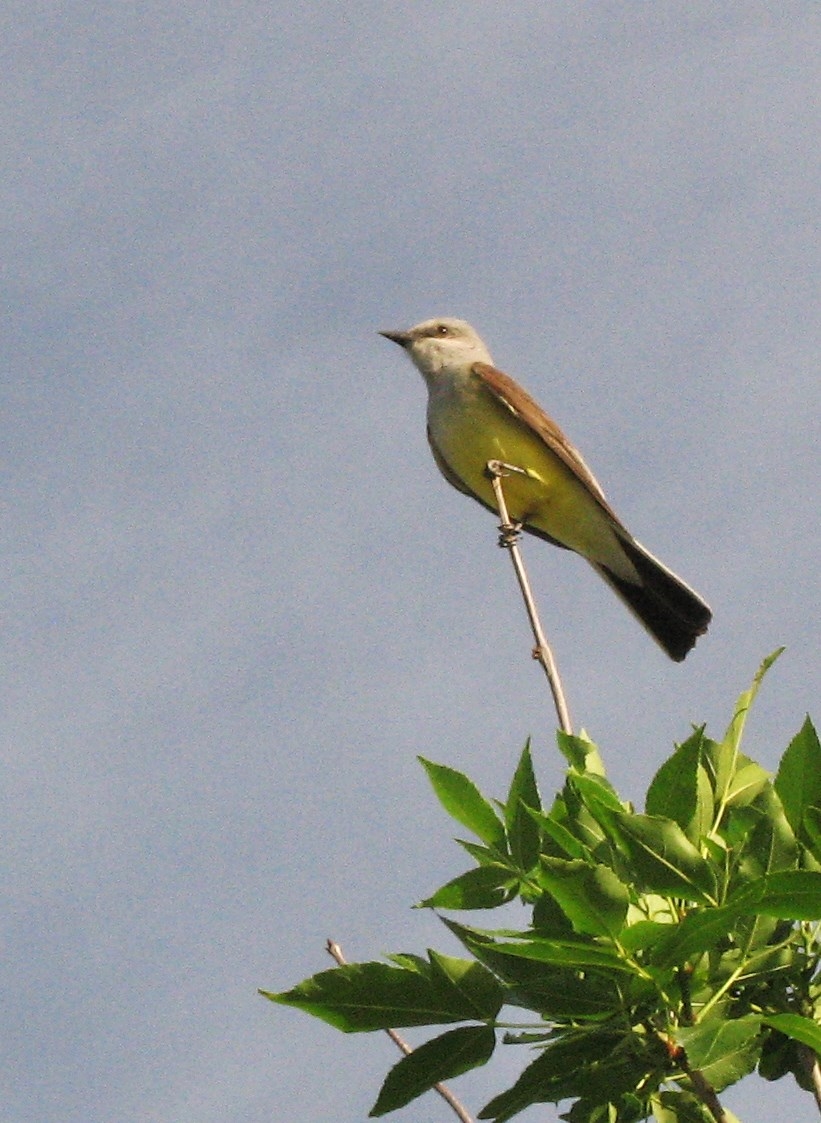
Walking along the sidewalk outside my hotel in Denver, Colorado, I caught sight of a beautiful shade of yellow on the breast of a bird that flew by me. I watched as it came to rest in a nearby tree, but couldn’t identify it.
Like the Black-billed Magpie that I featured yesterday, this bird, which I am pretty sure is a Western Kingbird (Tyrannus verticalis), is not found in Northern Virginia where I live.
As I watched, this bird flew off several times, presumably in search of insects, but returned to the same perch each time at the top of a tree. I would have liked to have watched this beautiful bird for a while longer, but duty called—this is a business trip after all.
© Michael Q. Powell. All rights reserved.
Posted in Birds, Nature, Photography, Portraits, Travel | Tagged Canon A620, Colorado, Denver, Tyrannus verticalis, Western Kingbird | 8 Comments »
June 26, 2014 by Mike Powell
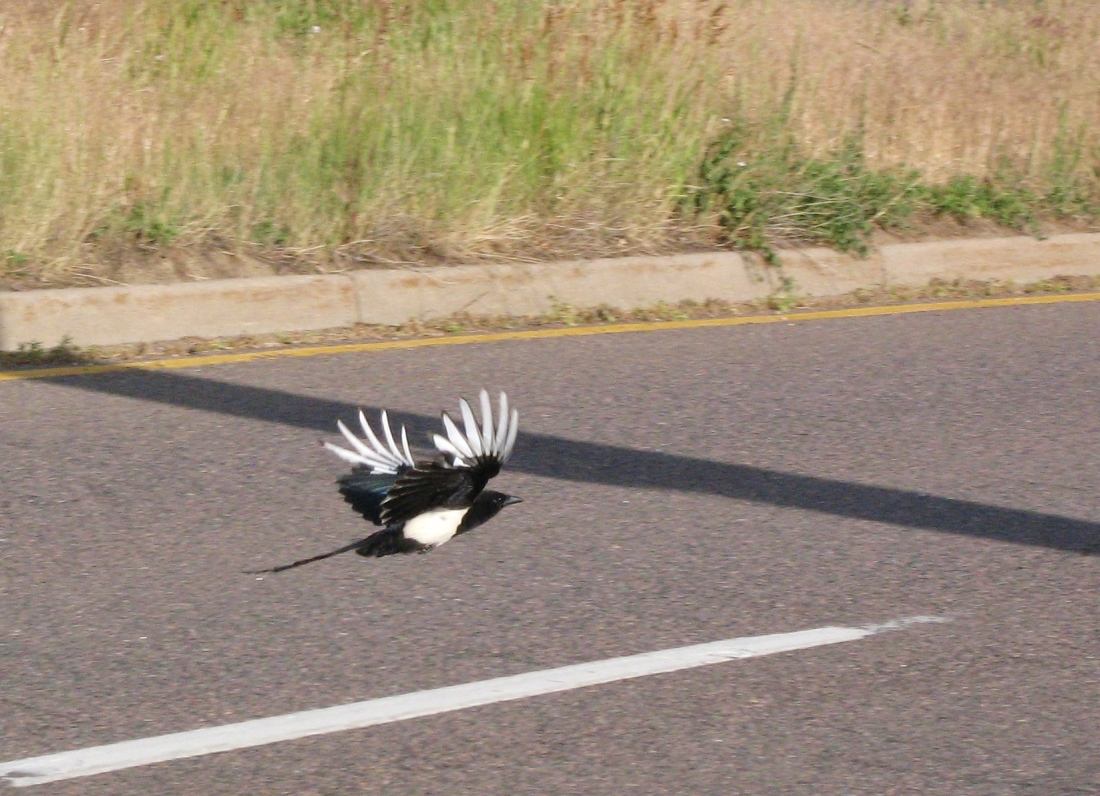
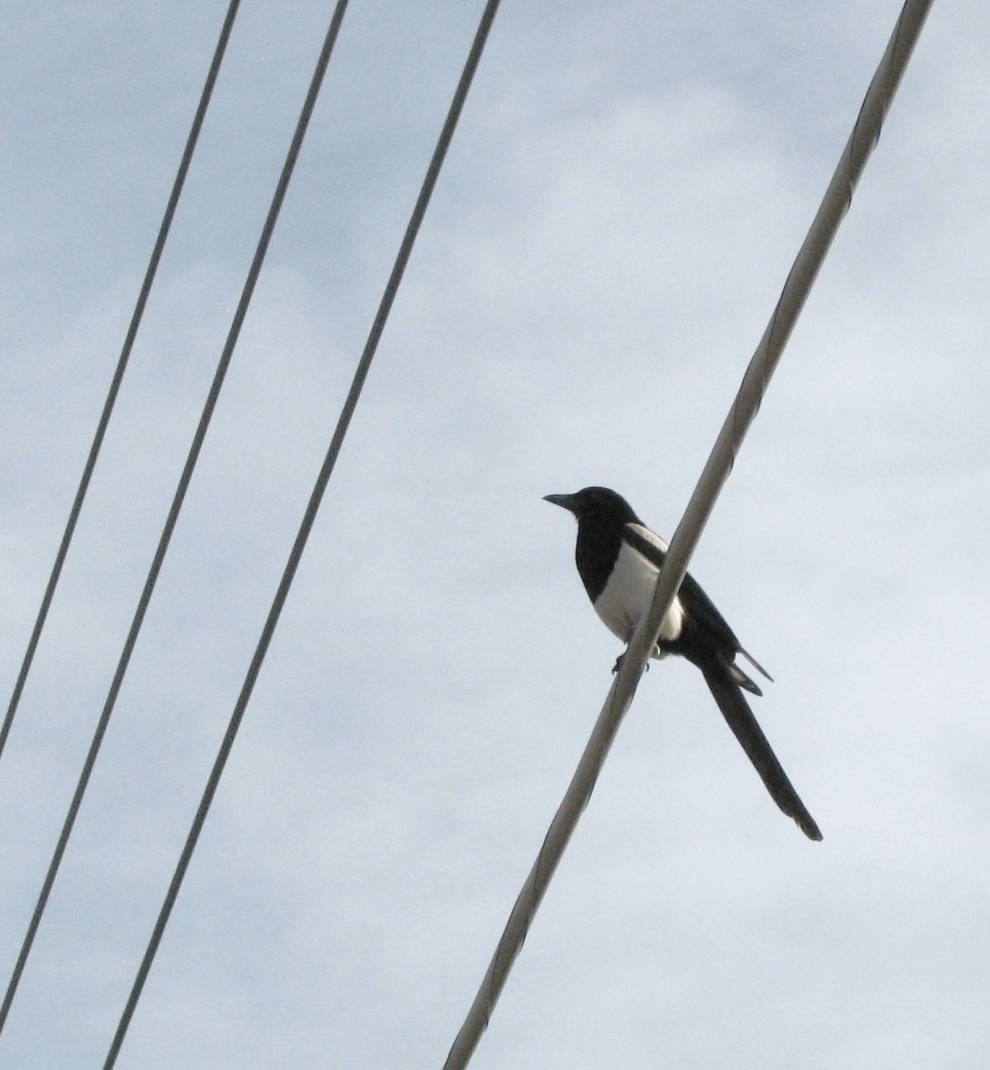
I couldn’t help but notice Black-billed Magpies (Pica hudsonia) here in Denver, Colorado, which I am visiting on a short business trip. The magpies are loud and boisterous, even in the area of my hotel just off of a major road.
It’s particularly nice to encounter these attractive birds because we don’t see them at all in Virginia. As is usually the case when I am travelling for business, I took these photos with a little Canon point-and-shoot and not my regular DSLR.
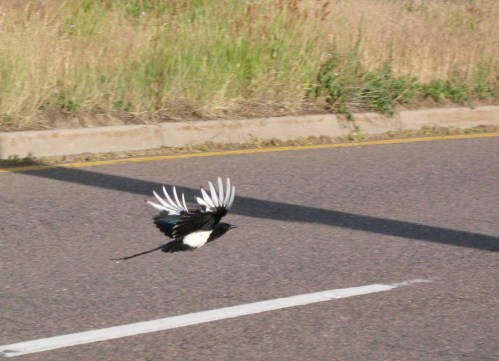

© Michael Q. Powell. All rights reserved.
Posted in Birds, Nature, Photography, Travel, Urban, wildlife | Tagged Black-billed Magpie, Canon A620, Colorado, Denver, Magpie, Pica hudsonia | 9 Comments »
June 25, 2014 by Mike Powell
A few days after I stumbled upon a Common Sanddragon dragonfly, a new species for my favorite marshland park, I returned to the remote location with fellow photographer and local dragonfly expert Walter Sanford (who made the initial identification for me). Walter has a science background and his posting today of our encounter with the Sanddragons is full of fascinating scientific information as well as awesome photos of these beautiful little dragonflies. Be sure to check out his complete posting.
 walter sanford's photoblog
Common Sanddragon dragonflies (Progomphus obscurus) are anything but common.
Despite its name, this species is rare in Northern Virginia. Source Credit: Common Sanddragon, Dragonflies of Northern Virginia, by Kevin Munroe, Park Manager, Huntley Meadows Park.
Kevin goes on to cite Bull Run and Goose Creek, two streams where he has seen Common Sanddragons, and speculates they may be found at two other locations in Northern Virginia. Well, you can add a third location where sanddragons have been seen and it’s right in Kevin’s wheelhouse!
Mike Powell, a fellow amateur wildlife photographer and blogger, photographed a clubtail dragonfly at Huntley Meadows Park on 17 June 2014 that he was unable to identify. Mike’s description of the habitat where he saw the dragonfly piqued my curiosity, so I asked him to send me a photo of the unknown dragon. Turns out Mike discovered a Common Sanddragon —…
View original post 247 more words
Posted in Dragonflies, Insects, Macro Photography, Nature, Photography, Portraits, wildlife | Tagged Alexandria VA, Common Sanddragon, Common Sanddragon dragonfly, Huntley Meadows Park, Progomphus obscurus | 2 Comments »
June 25, 2014 by Mike Powell
Female dragonflies are often less colorful and visible than their male counterparts, but are equally beautiful.
A week ago, I did a posting featuring the dark blue male Spangled Skimmer dragonfly (Libellula cyanea) and noted that the white stigma (markings) on the wings help in identifying this species. In today’s image, a female Spangled Skimmer appears to be a natural model as she smiles and poses for the camera

© Michael Q. Powell. All rights reserved
Posted in Dragonflies, Insects, Macro Photography, Nature, Photography, Portraits, wildlife | Tagged Alexandria VA, Canon 50D, Huntley Meadows Park, Libellula cyanea, Spangled Skimmer, Spangled Skimmer dragonfly, Tamron 180mm macro lens | 6 Comments »
June 24, 2014 by Mike Powell
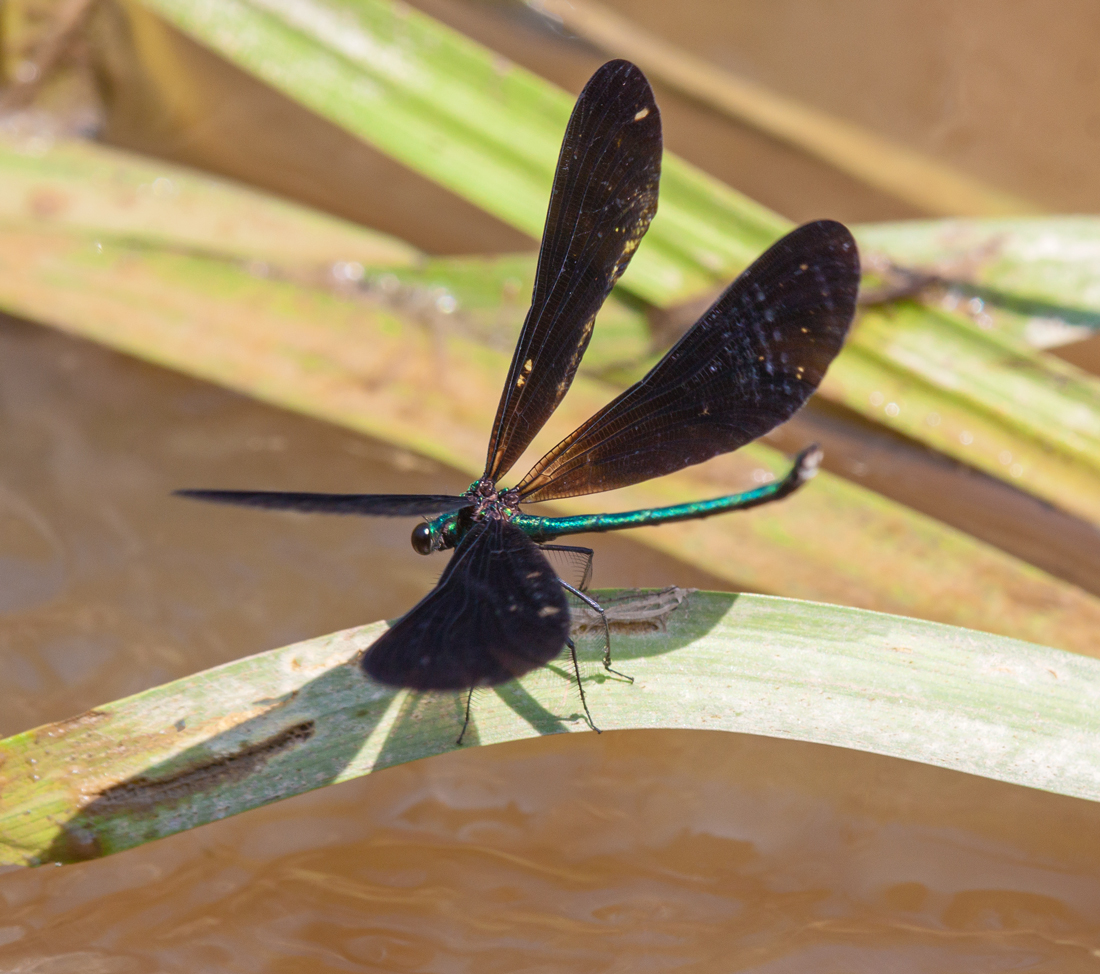
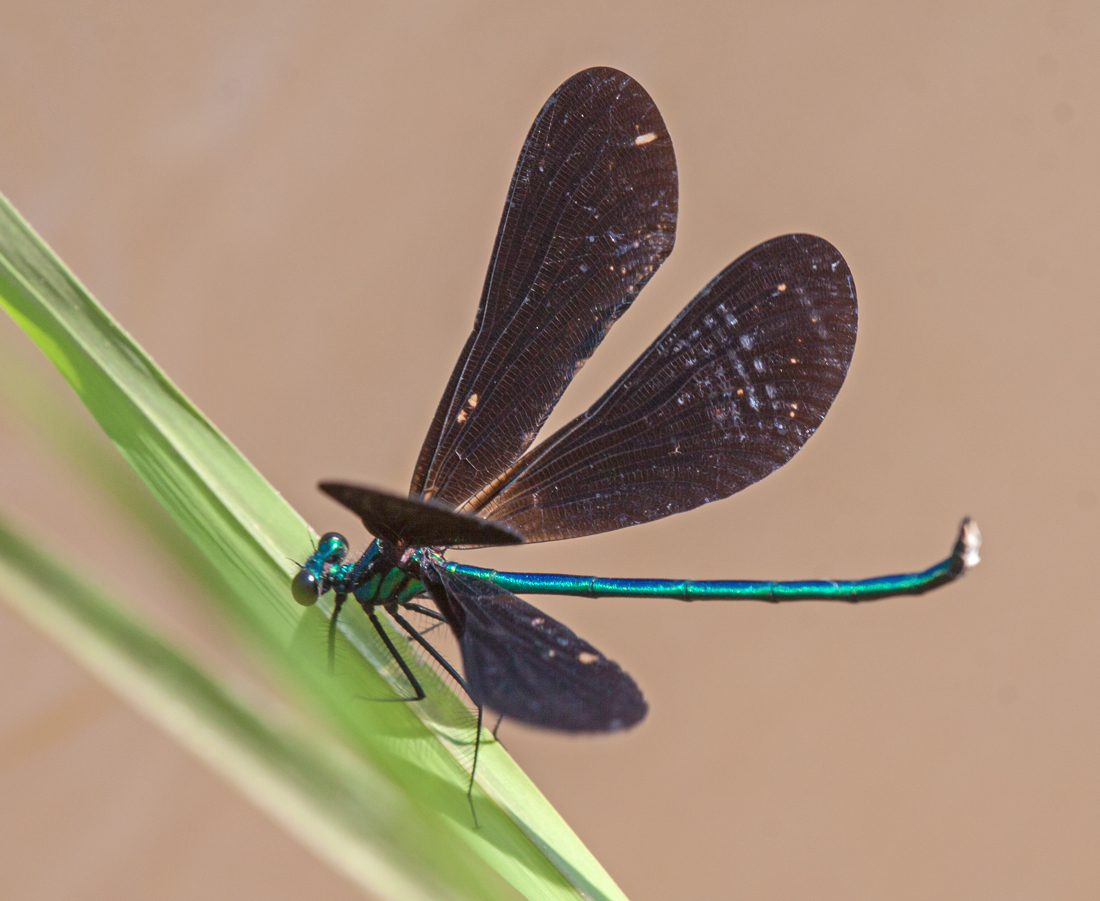
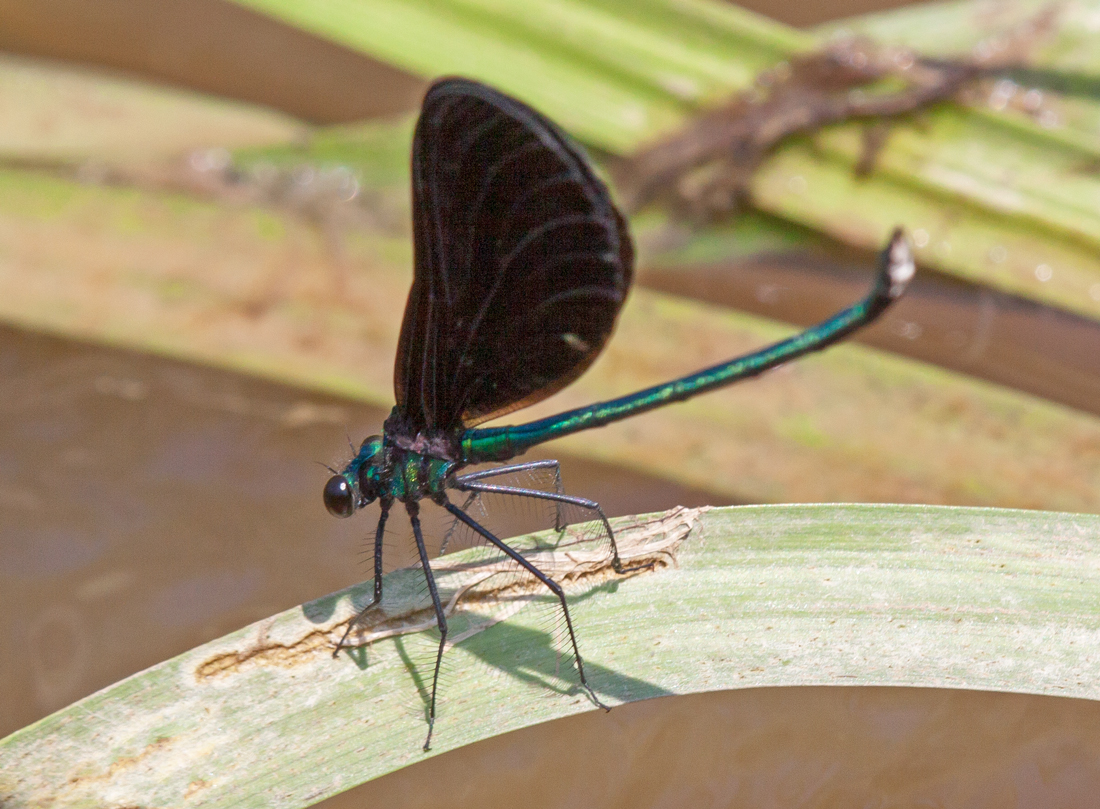
When you first catch sight of the fluttering flight of an Ebony Jewelwing damselfly (Calopteryx maculata) from a distance, it’s easy to think that it is a butterfly.
These damselflies are really weak fliers and they flutter slowly from one location to another nearby spot. Although they perch, they tend to do so on low vegetation and they don’t remain in one spot for very long, which makes it a challenge to get a decent photograph of one of them.
Their dark wings make them unusual and distinctive—all of the other damselflies that I have seen had clear wings—and help to set off the beautiful emerald color of their bodies.
According to bugguide.com, the Ebony Jewelwing’s scientific name Calopteryx maculata comes from the Greek “kalos” (beautiful) + “pteron” (wing or feather) and “macula” (a spot), a reference to the white spot near the tip of the female’s wing.
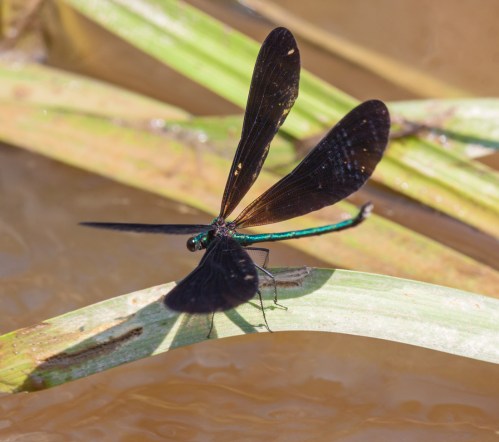

Ebony Jewelwing damselfly with opened wings

Ebony Jewelwing damselfly in a raised position with closed wings
© Michael Q. Powell. All rights reserved
Posted in Butterflies, Dragonflies, Insects, Macro Photography, Nature, Photography, Portraits | Tagged Alexandria VA, Calopteryx maculata, Canon 50D, Ebony Jewelwing, Ebony Jewelwing damselfly, fluttering flight, Huntley Meadows Park, Tamron 180mm macro lens | 11 Comments »
June 23, 2014 by Mike Powell
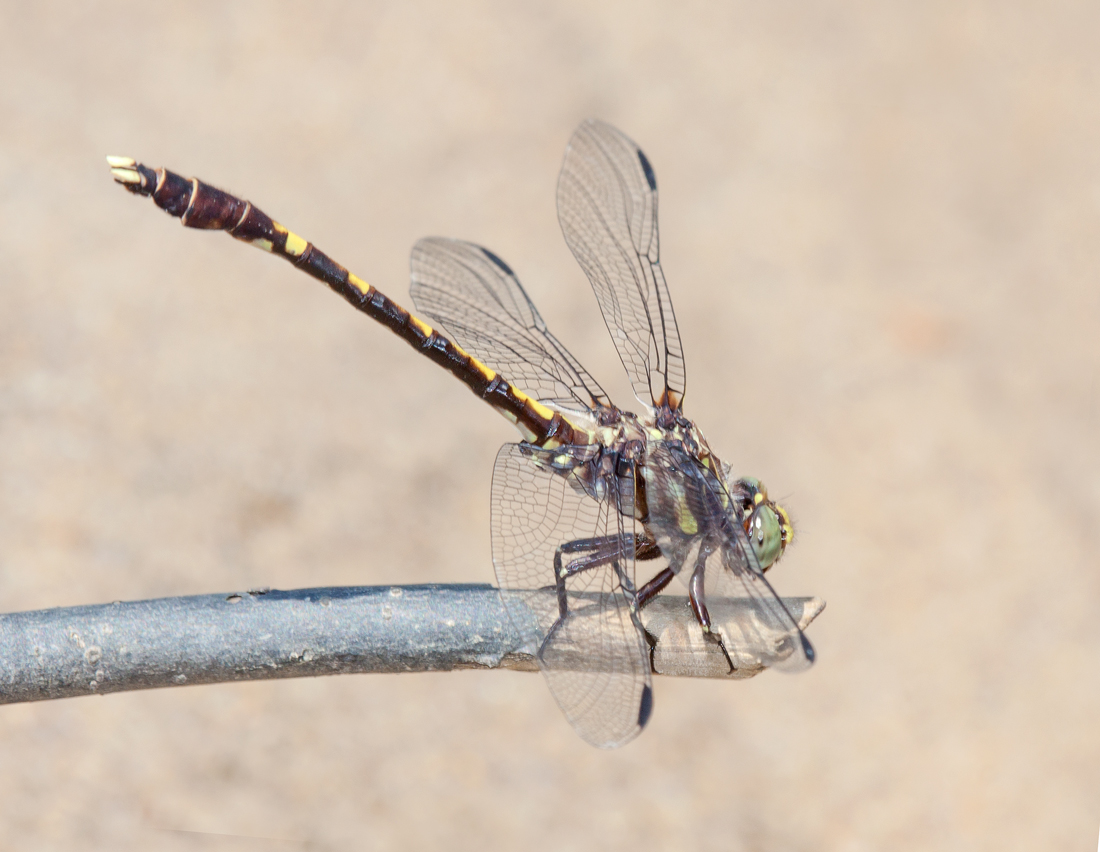
Last week I added the Common Sanddragon dragonfly (Progomphus obscurus) to the species list at Huntley Meadows Park, the marsh where I spend a lot of time walking and photographing. The park keeps a comprehensive list of species and it appears that this particular dragonfly had never before been observed and photographed within the park.
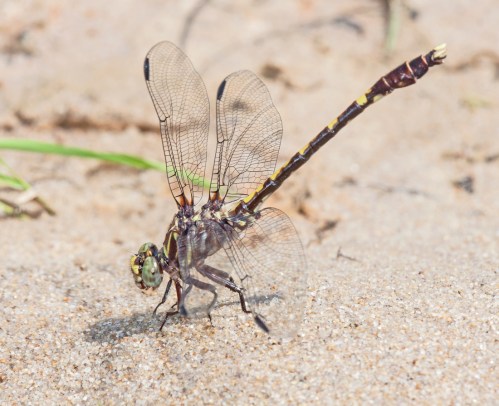
I came across this dragonfly, which I recognized as some kind of clubtail, when I was hiking through a back area of the park. I was struck by the way the dragonfly was patrolling a small sandy stretch of a creek and kept returning to perches on that little beach. I took quite a few photos of the dragonfly, though I really wasn’t sure of its identity.

The images would have remained unviewed on my computer for several days, but I mentioned my discovery to fellow blogger and photographer, Walter Sanford, who seemed to sense that I had captured something a bit out of the ordinary. He insisted that I send him a couple of images immediately, which I did. Walter tentatively identified the dragonfly as a Common Sanddragon and confirmed the identification with Kevin Munroe, who manages Huntley Meadows Park and is a dragonfly expert.
Kevin has a wonderful website, Dragonflies of Northern Virginia, that is full of fun and useful information about dragonflies in our area. In the section about Common Sanddragons, he notes, “Despite its name, this species is rare in Northern VA. In other parts of the country, where clean, sunny, shallow creeks with plenty of sandy/gravely banks are common, so too are Common Sanddragons. Our urban waterways are too influenced by stormwater, flowing fast and unchecked off impervious surfaces (roads, parking lots, roofs, etc.). This creates deeply incised, eroded banks and streambeds with excess silt, unstable flows.”
As a kind of experiment, I angled a couple of sticks in the sand to see if I could get one of them to perch on the stick. Although they kept returning primarily to the sand, a couple of times one perched on the stick and I got this shot.
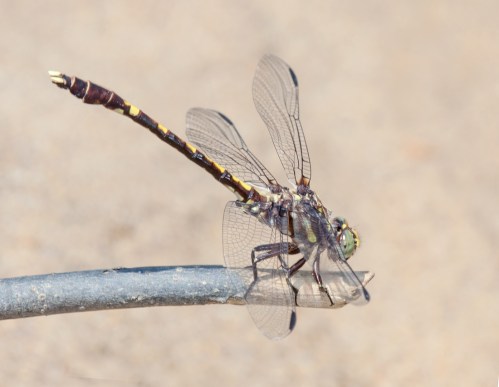
You may have noticed the raised tail in several of the shots. In other dragonflies, the “obelisk” position is a method of thermoregulation, but I am not sure if this is the case here—it might be related to efforts to attract a mate.
© Michael Q. Powell. All rights reserved
Posted in Dragonflies, Insects, Macro Photography, Nature, Photography, Portraits, wildlife | Tagged Alexandria VA, Canon 50D, Common Sanddragon, Common Sanddragon dragonfly, Huntley Meadows Park, Progomphus obscurus, Tamron 180mm macro lens | 16 Comments »
June 22, 2014 by Mike Powell
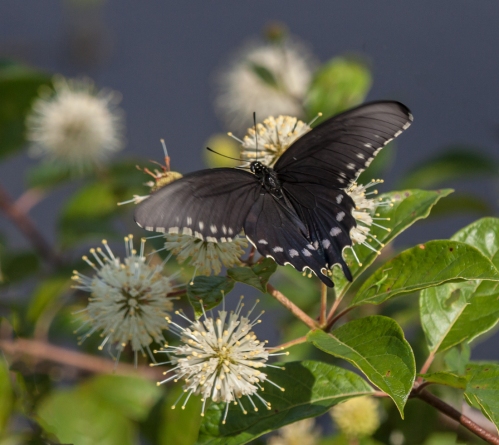
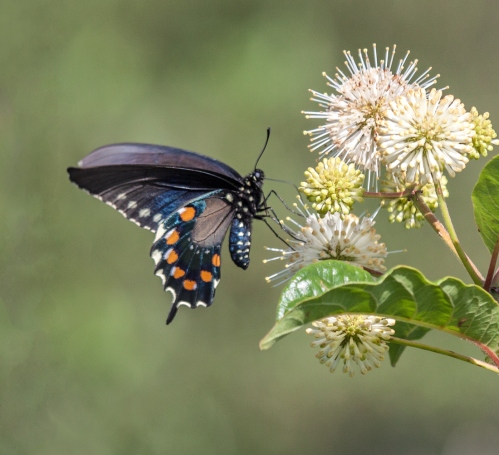
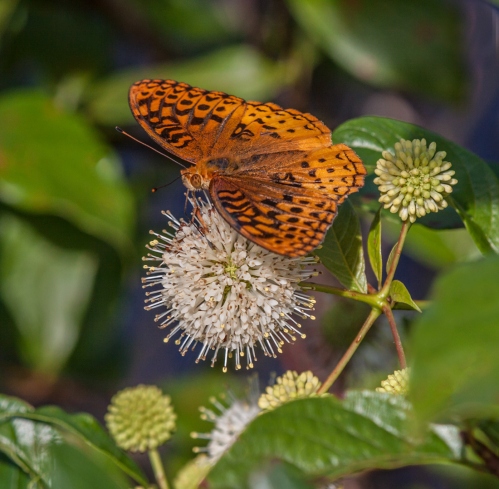
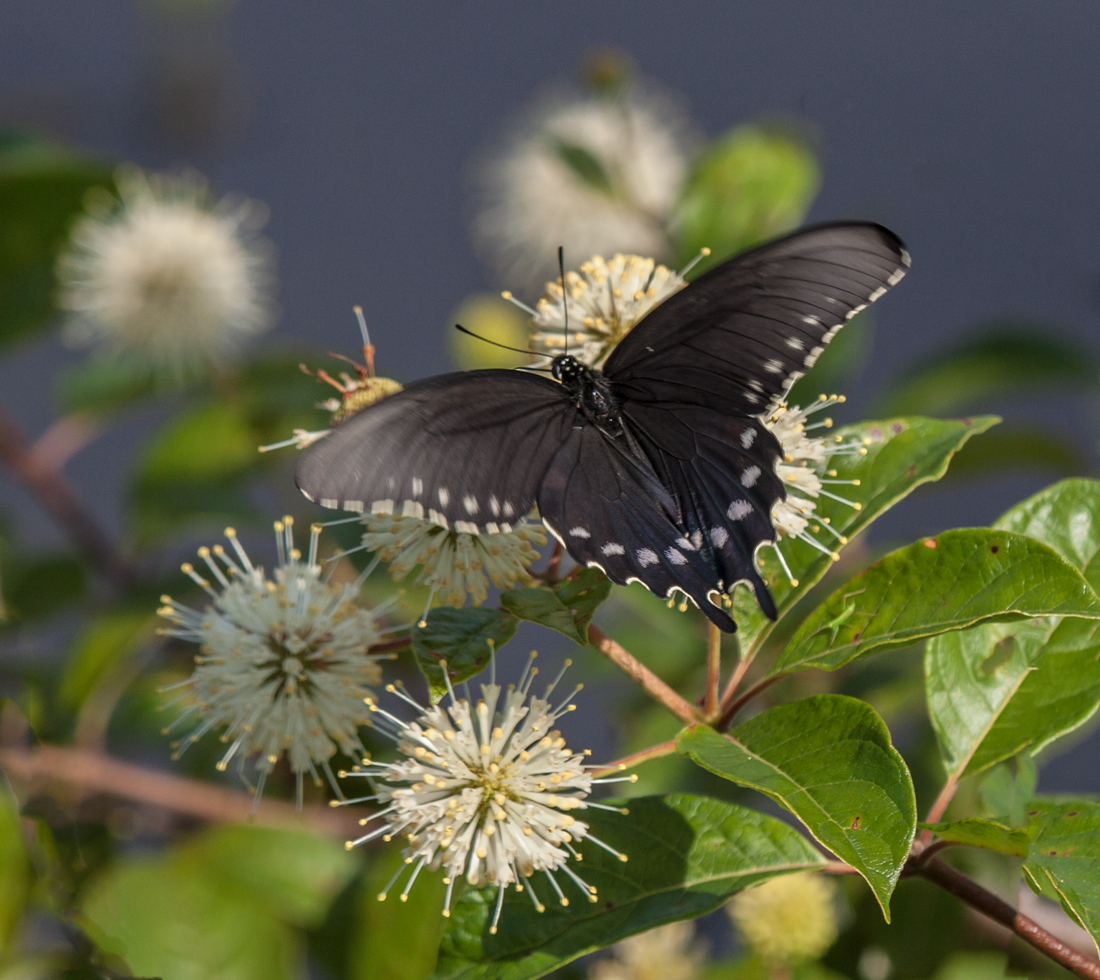
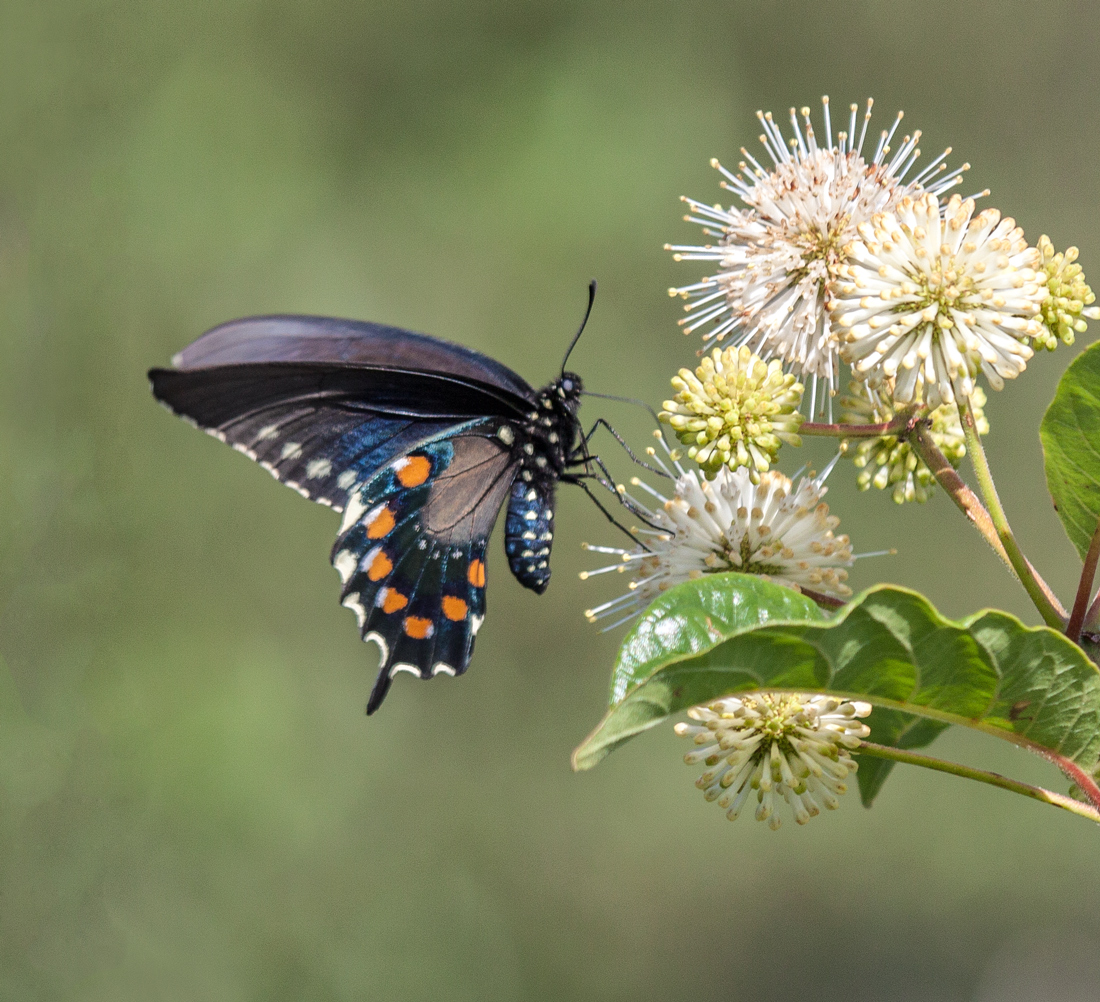
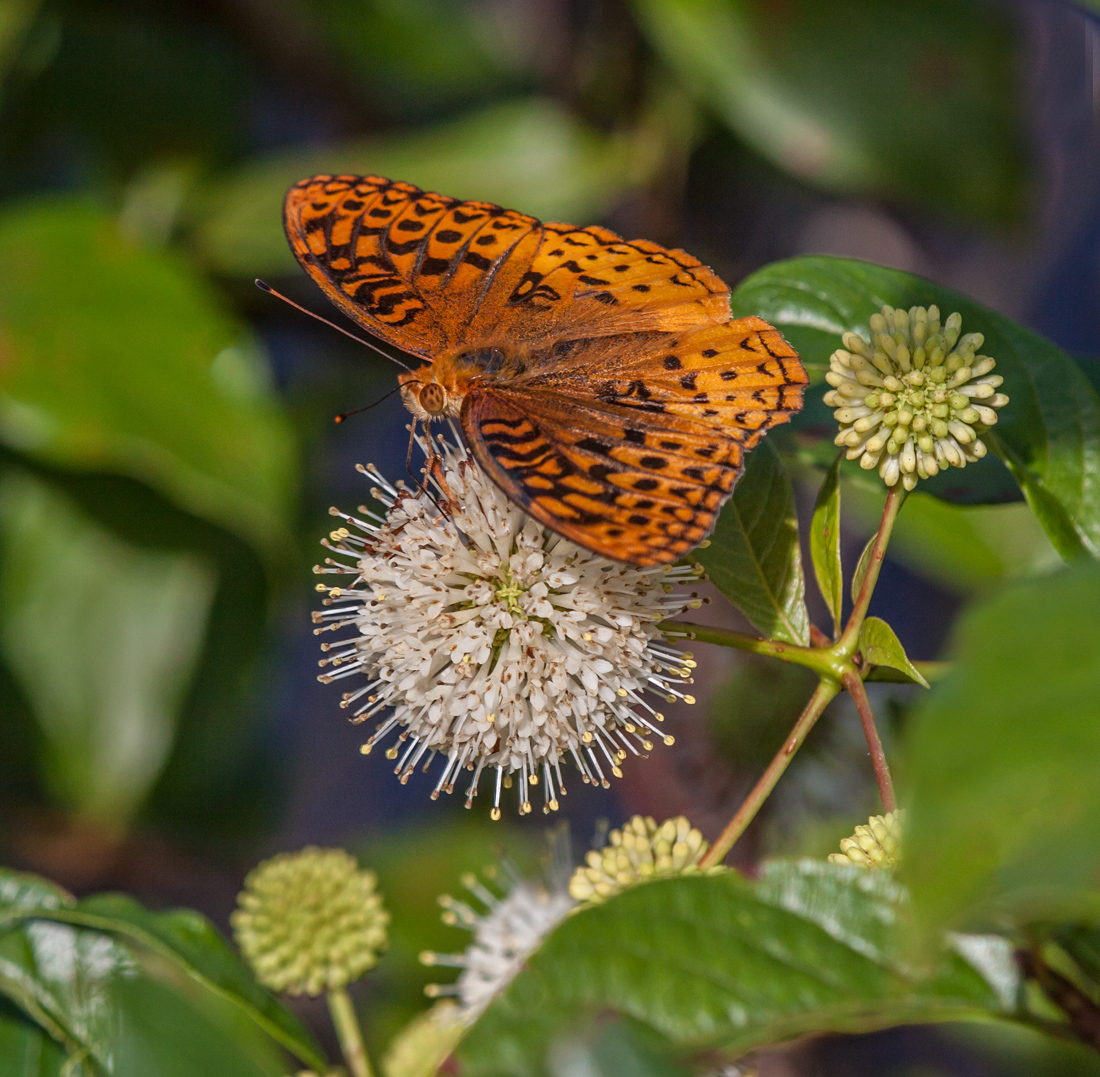
Buttonbushes are now blooming at my local marsh, attracting beautiful butterflies, including this Pipevine Swallowtail and this Great Spangled Fritillary.
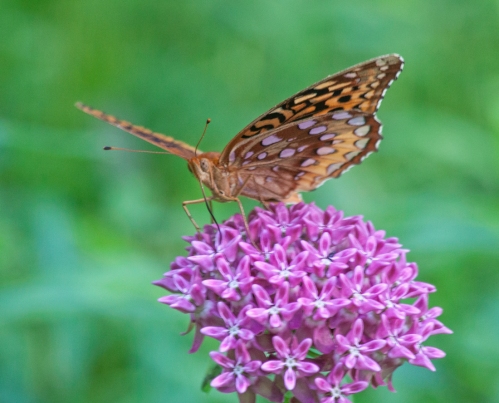
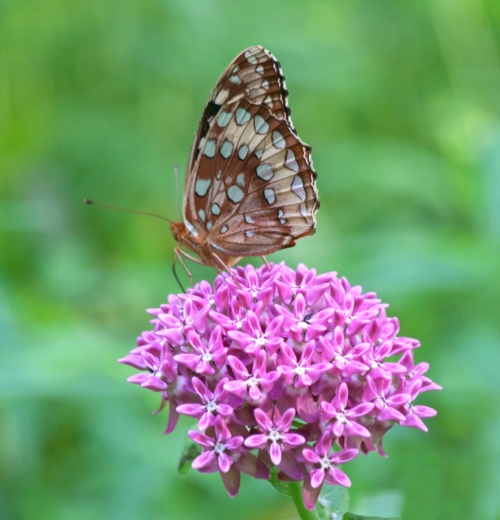
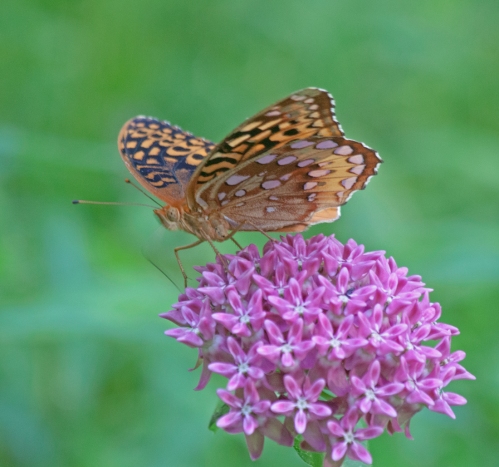
I don’t know what it is about the Common Buttonbush (Cephalanthus occidentalis), but butterflies seem to find it irresistible. Several Pipevine Swallowtails (Battus philenor) flitted all around the bushes in frenetic motion, hardly every stopping to perch. The Great Spangled Fritillary (Speyeria cybele), however, seemed to take its time, lingering over each of the spiky spherical globes of the buttonbush.
© Michael Q. Powell. All rights reserved
Posted in Butterflies, Flowers, Insects, Macro Photography, Nature, Photography | Tagged Alexandria VA, Battus philenor, Buttonbush, Canon 50D, Cephalanthus occidentalis, Great Spangled Fritillary, Great Spangled Fritillary butterfly, Huntley Meadows Park, Pipevine Swallowtail, Pipevine Swallowtail butterfly, Speyeria cybele, Tamron 180mm macro lens | 12 Comments »
June 21, 2014 by Mike Powell
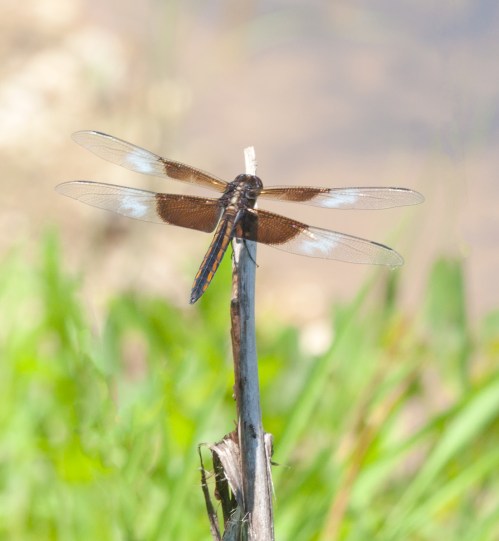
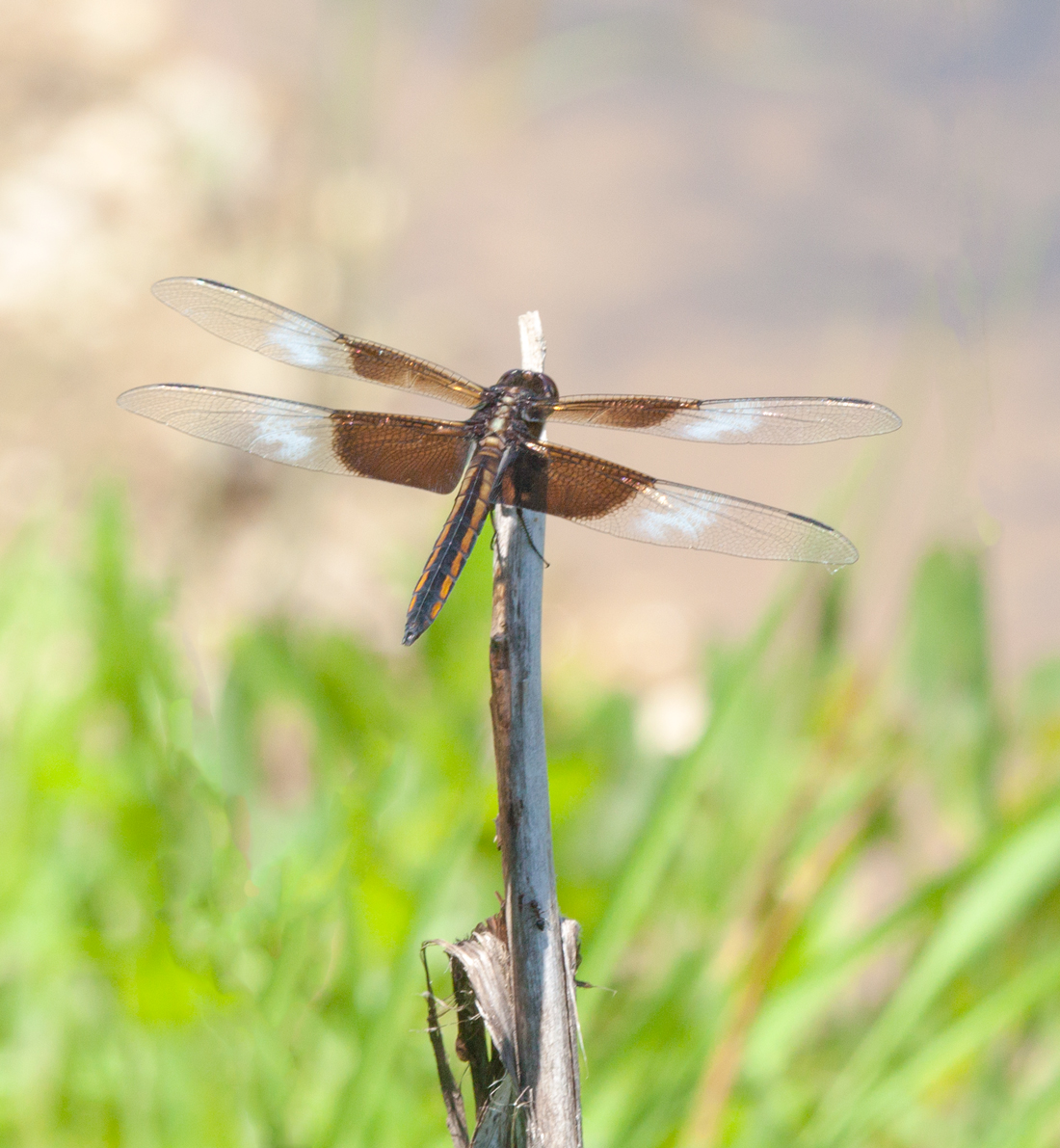
Although I usually try to get close up for my dragonfly photos, I am unusually pleased with this image I took yesterday of an immature male Widow Skimmer dragonfly (Libellula luctuosa), which has an artistic quality that is not always found in my close-ups.
For those who might be curious about the identification, the white on the wings indicates that it is a male (females have only dark blotches) and the yellow and black body indicates that it is immature,because adult males have bluish-colored bodies.
© Michael Q. Powell. All rights reserved
Posted in Art, Dragonflies, Insects, Macro Photography, Nature, Photography, Portraits | Tagged Alexandria VA, Canon 50D, Huntley Meadows Park, Libellula luctuosa, Tamron 180mm macro lens, Widow Skimmer, Widow Skimmer dragonfly | 3 Comments »
June 21, 2014 by Mike Powell
Do you believe in unicorns? I spent part of yesterday chasing a flying unicorn, although it was the Unicorn Clubtail dragonfly (Arigomphus villosipes), not the one that looks like a horse.
Normally Unicorn Clubtails like to perch on flat surfaces, but this one chose to perch on a dead branch overlooking the muddy stream, allowing me to get a good look at it and a decent photograph.
Many people seem to like unicorns and rainbows. Now that I have captured a unicorn, I’m on the lookout for a rainbow–and it looks like it may rain later today.

© Michael Q. Powell. All rights reserved.
Posted in Dragonflies, Insects, Macro Photography, Nature, Photography, Portraits, wildlife | Tagged Alexandria VA, Arigomphus villosipes, Canon 50D, Huntley Meadows Park, Tamron 180mm macro lens, Unicorn Clubtail, Unicorn Clubtail dragonfly | 5 Comments »
June 20, 2014 by Mike Powell
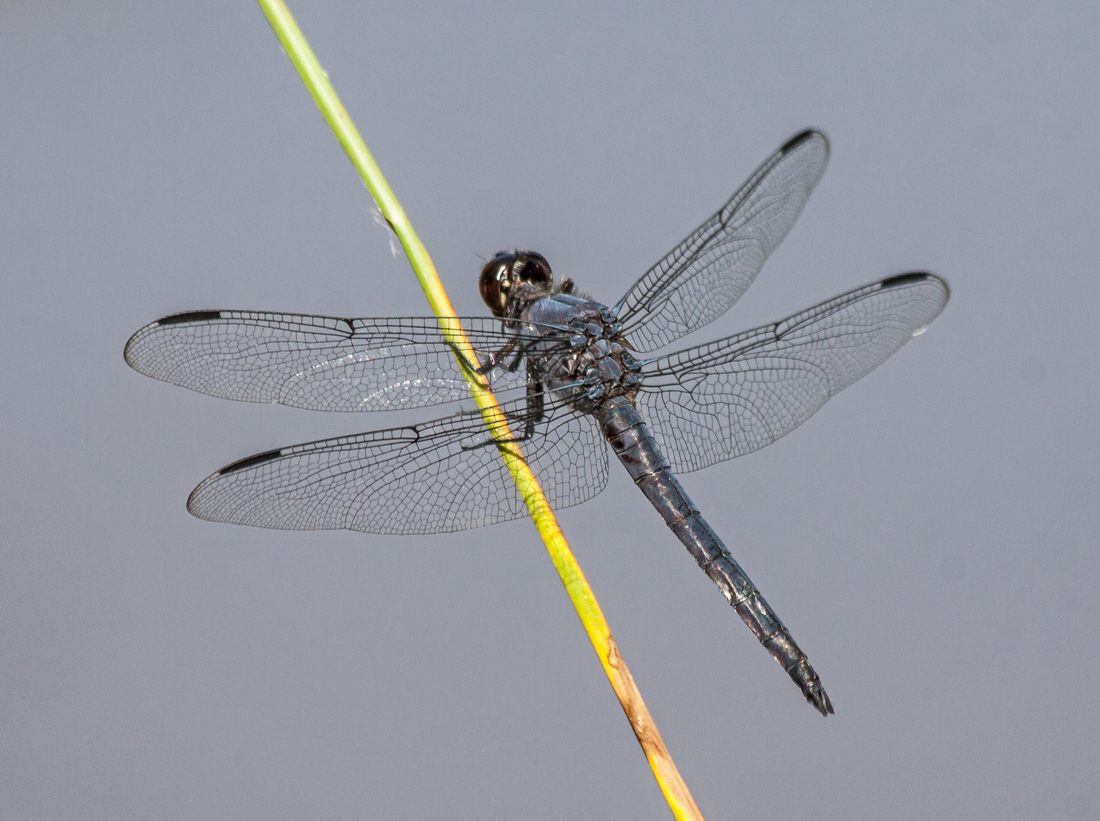
It’s prime season now for dragonflies and there are lots of them flying about. Some are brightly colored and gaudy, while others, like this Slaty Skimmer (Libellula incesta) that I encountered Tuesday at Huntley Meadows Park, have a more subdued and refined beauty.
I have been experimenting a bit with lenses and with camera settings as I chase after dragonflies. Although I often use my macro lens for this kind of shot, I took this one at 270mm of my 70-300mm telephoto zoom. I have been told that most telephoto lenses are a little soft at their extreme ends, so I pulled back a little from 300mm. Similarly, I shot this at f/10 to try to get a balance between sharpness and depth of field, while keeping the shutter speed high enough for me to easily handhold the camera.
Most of the time I use evaluative metering on my camera, but for most of my shots on Tuesday, I had the camera set for spot metering. In doing so, I realized quickly that I had to pay a lot more attention to the precise spot on which I was focusing, because that was going to play a disproportionate role in determining the exposure.
I realize, of course, that a lot of the choices will be situationally dependent, but it’s fun and instructive to try out new settings and combinations of settings in trying to improve the quality of my images. (Click on the image to see a higher resolution view of this dragonfly.)

© Michael Q. Powell. All rights reserved.
Posted in Dragonflies, Insects, Macro Photography, Nature, Photography, Portraits, wildlife | Tagged Alexandria VA, Canon 50D, Canon 70-300mm telephoto zoom lens, Huntley Meadows Park, Libellula incesta, Slaty Skimmer, Slaty Skimmer dragonfly | 11 Comments »
June 19, 2014 by Mike Powell
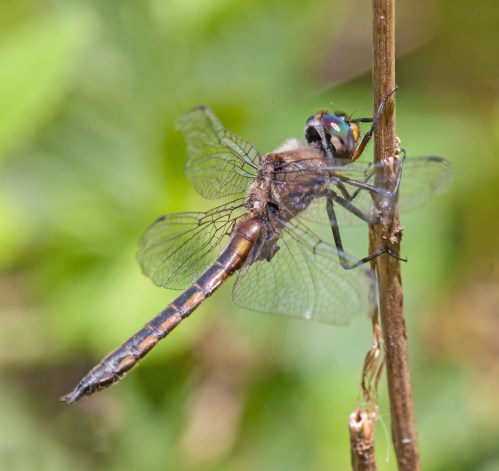
A few weeks ago, I did a posting with some close-up images of a Common Baskettail dragonfly (Epitheca cynosura), but one of my fellow photographers keeps reminding me that I have not posted any shots of the entire dragonfly, which it turns out is not all that common in our local marshland park.
This small collection of images highlights some of the notable features of the Common Baskettail dragonfly, including its beautiful blue eyes and unusual tail. I took these photographs a month ago (on 19 May), but I have fallen a bit behind on viewing and processing my shots.


© Michael Q. Powell. All rights reserved.
Posted in Dragonflies, Insects, Macro Photography, Nature, Photography, Portraits, wildlife | Tagged Alexandria VA, Canon 50D, Common Baskettail, Common Baskettail dragonfly, dragonfly, Epitheca cynosura, Huntley Meadows Park, Tamron 180mm macro lens | 8 Comments »
June 18, 2014 by Mike Powell
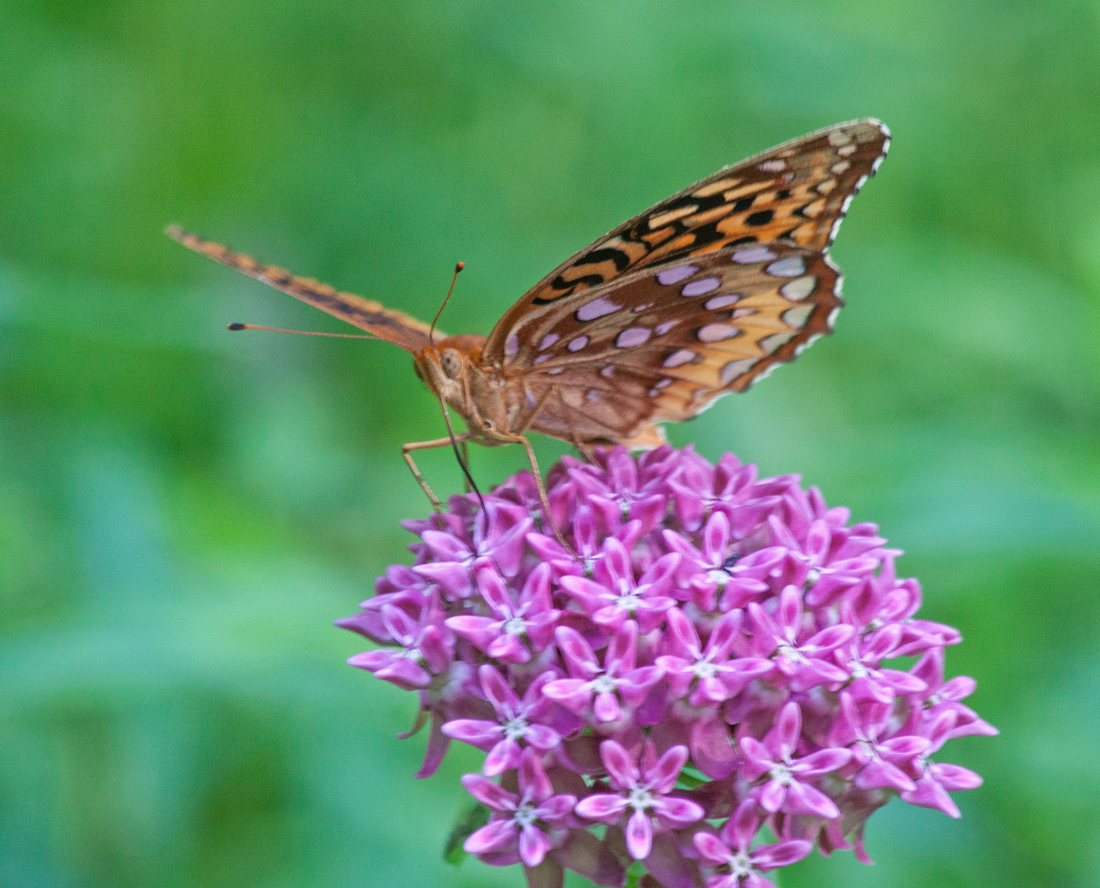
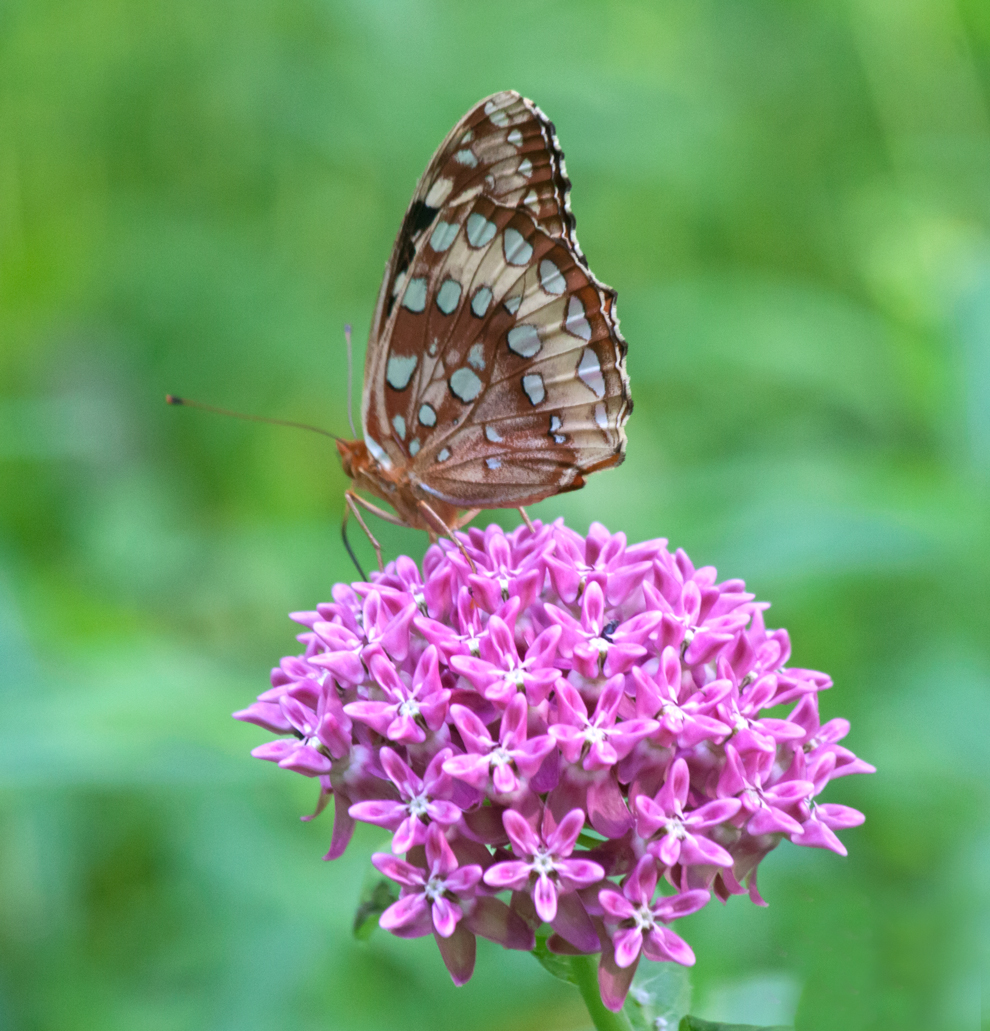
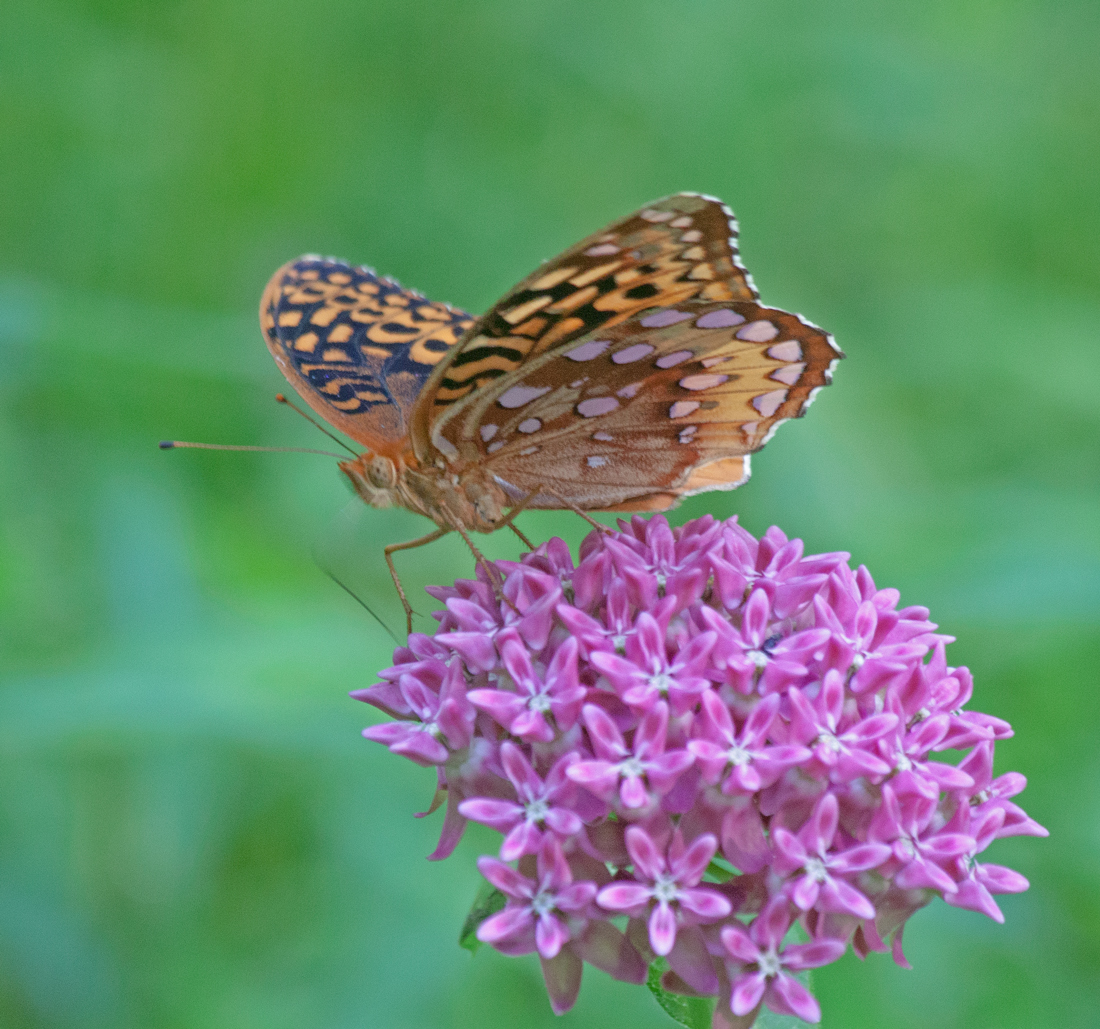
After a week and a half on the road, it was great for me to be able to return to my local marshland yesterday. I was thrilled to see that butterflies have reappeared, including Great Spangled Fritillary butterflies (Speyeria cybele). A group of about a half dozen or so of them kept returning to clusters of a pink-flowered plant that looks like a kind of milkweed, permitting me to get shots of the butterflies in various positions on the flowers.
© Michael Q. Powell. All rights reserved.
Posted in Art, Butterflies, Insects, Macro Photography, Nature, Photography, Portraits, wildlife | Tagged Alexandria VA, Canon 50D, Canon 70-300mm telephoto zoom lens, Great Spangled Fritillary, Great Spangled Fritillary butterfly, Huntley Meadows Park, Speyeria cybele | 11 Comments »
June 17, 2014 by Mike Powell
This dragonfly has such distinctive markings that I should have been able to identify it easily, but I had never seen one like it before, so I didn’t know what it was.
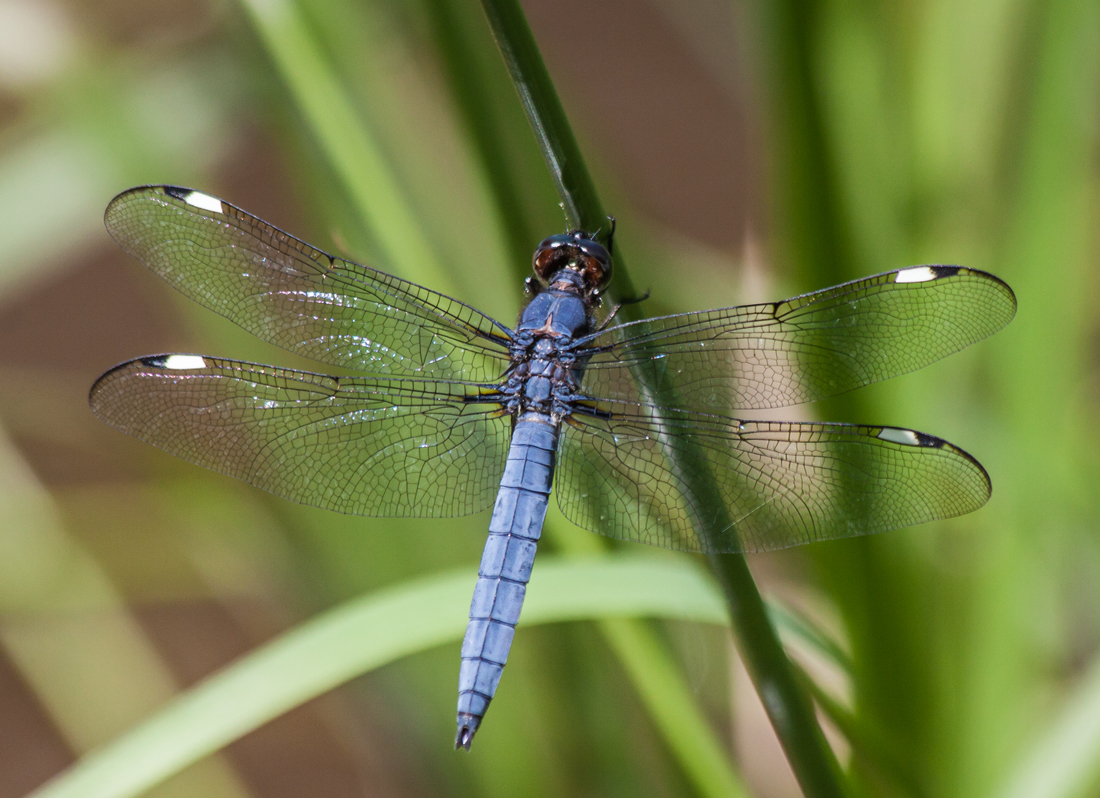
Fortunately, a short time later that day I ran into local dragonfly expert and fellow blogger Walter Sanford, who informed me that it was a Spangled Skimmer dragonfly (Libellula cyanea). Spangled Skimmers have black and white stigmas on their wings, which makes them unique among dragonflies in my part of Northern Virginia. As you may be able to guess from my images, Spangled Skimmers are among the species of dragonflies that like to perch, which makes it easier to photograph them—if you can find them.


© Michael Q. Powell. All rights reserved.
Posted in Dragonflies, Insects, Nature, Photography, Portraits, spring, wildlife | Tagged Alexandria VA, Canon 50D, Huntley Meadows Park, Libellula cyanea, Spangled Skimmer, Spangled Skimmer dragonfly, Tamron 180mm macro lens | 13 Comments »
June 16, 2014 by Mike Powell
I couldn’t help but laugh when I spotted this sign outside of the town hall in Exeter, New Hampshire, where I attended a wedding this past weekend. I can’t tell if the message is to be careful when you are smoking, lest you be caught, or that non-smoking could be a punishable offense.
It reminds me a bit of a parental admonition, “Don’t let me catch you doing that again,” and the teenager’s response, “Don’t worry, you won’t catch me again.”

© Michael Q. Powell. All rights reserved.
Posted in Architecture, Humor, Photography, Travel | Tagged Canon A620, Exeter, New Hampshire, smoking, town hall | 5 Comments »
June 16, 2014 by Mike Powell
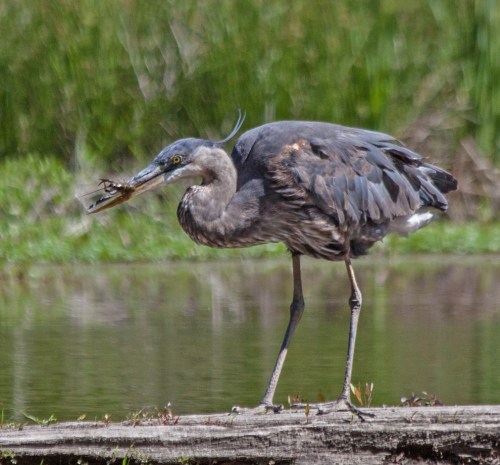
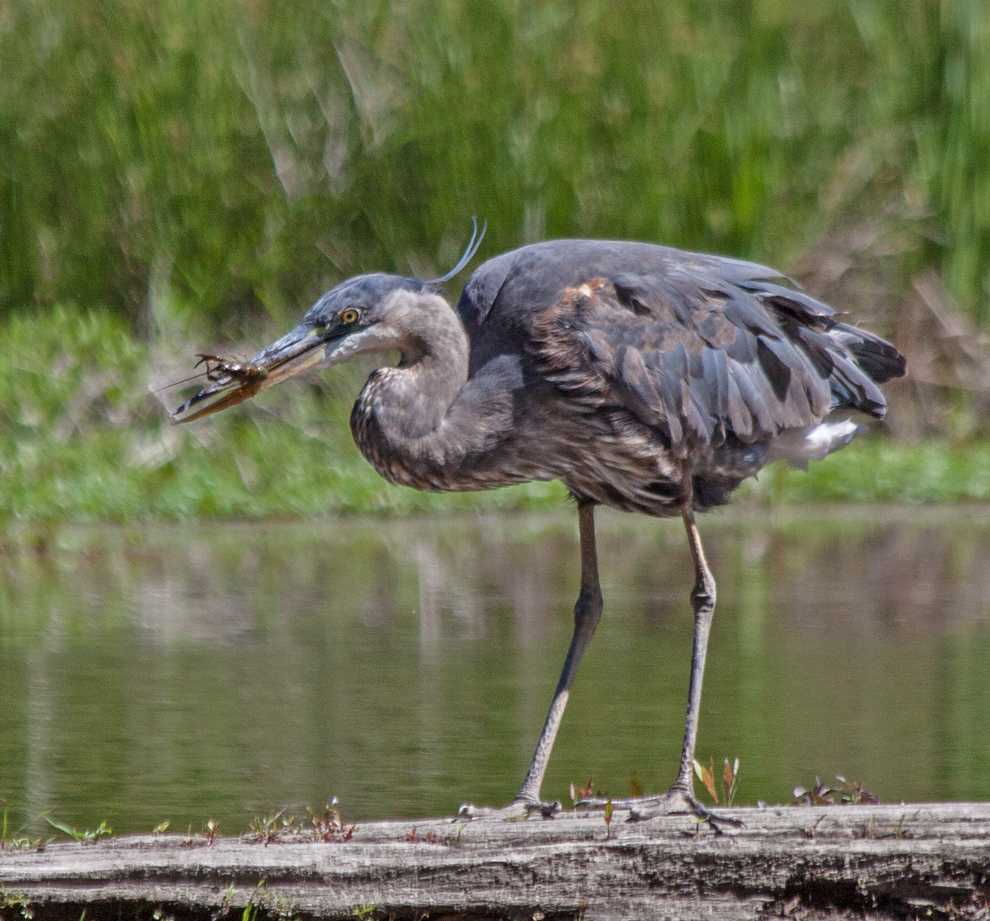
If I want to eat a lobster, I need lots of tools (and a bib). This Great Blue Heron (Ardea herodias) at my local marsh had to try a different technique and seemed to be trying to crack the crayfish’s shell with its bill (or was hoping the crayfish would simply crawl down its throat).

© Michael Q. Powell. All rights reserved.
About these ads
Posted in Birds, Humor, Nature, Photography, wildlife | Tagged Alexandria VA, Ardea herodias, Canon 50D, Canon 70-300mm telephoto zoom lens, crawfish, crayfish, Great Blue Heron, Huntley Meadows Park | 10 Comments »
June 16, 2014 by Mike Powell
Getting to the tastiest parts of crabs and lobsters is an awful lot of work, even when you have the proper implements. Imagine how tough it was for this Great Blue Heron (Ardea herodias) to figure out what to do with this crayfish that it caught at my local marsh.
Great Blue Herons generally swallow the frogs and fish that they catch after just a few adjustments to get it to slide down the throat, but the heron seemed to spend a long time with this catch, moving it back and forth in its bill. I was a bit too far away to tell if the heron eventually swallowed the crayfish whole or somehow was able to crack the shell. In either case, I’m impressed with the digestive system of this beautiful bird.
© Michael Q. Powell. All rights reserved.
Posted in Birds, Nature, Photography, wildlife | Tagged Alexandria VA, Ardea herodias, Canon 50D, Canon 70-300mm telephoto zoom lens, crayfish, Great Blue Heron, Huntley Meadows Park | 6 Comments »
June 13, 2014 by Mike Powell
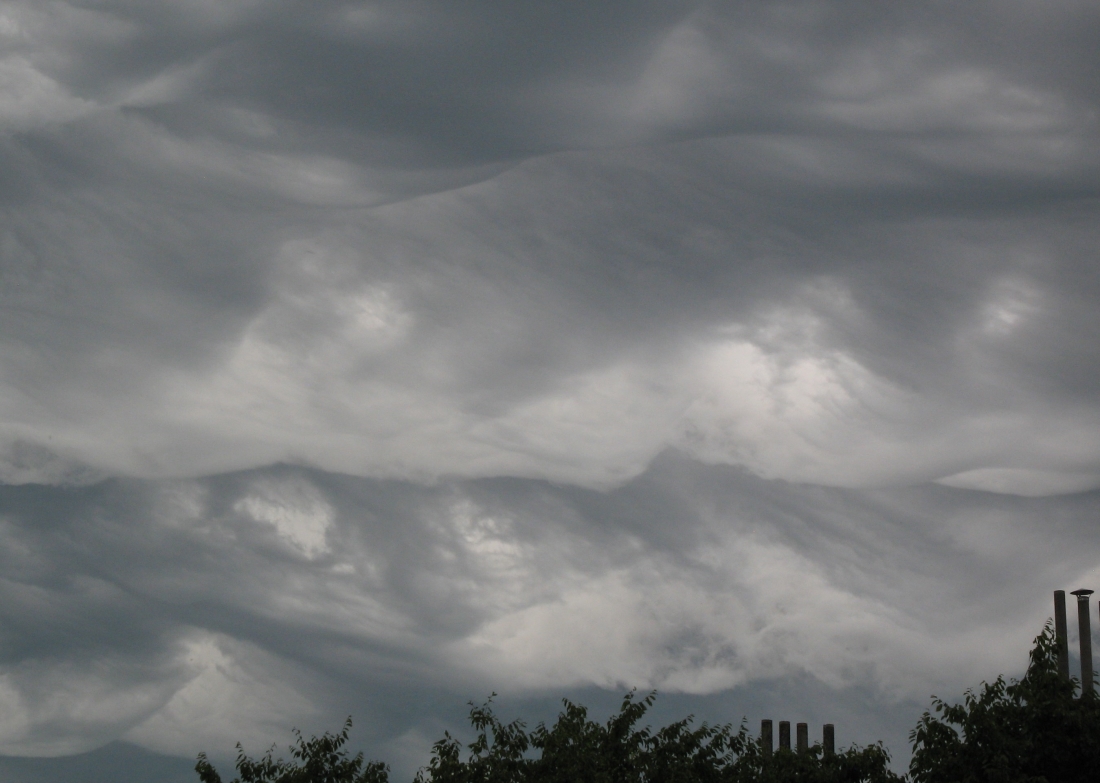
During this past week in Brussels, I experienced extremes of weather, ranging from dark, threatening thunder clouds to gorgeous light late one day that bathed the palace in shimmering gold.


© Michael Q. Powell. All rights reserved.
Posted in Landscape, Photography, Travel | Tagged belgium, brussels, Canon A620, clouds, dark clouds, golden light, palace | 6 Comments »
June 12, 2014 by Mike Powell
Another short business trip to Brussels is coming to an end. Here are some images of this beautiful city taken during the last few days with my old point-and-shoot Canon A620.


© Michael Q. Powell. All rights reserved.
Posted in Architecture, Landscape, Photography, Travel, Urban | Tagged belgium, brussels, Canon A620, moon, palace | 13 Comments »
June 10, 2014 by Mike Powell
One of my fellow photographers excitedly pointed out a small spiderweb to me as I was preparing to leave my local marsh and I moved closer to investigate. At the center of the web was a small colorful spider of a type which I had seen before, but had never identified. I realized that I must have a peculiar reputation when others start to get excited about spiders on my behalf.
I felt obliged to take some photos, given that my friend had gone to the trouble of spotting the spider for me, but I didn’t have any great expectations that they would turn out well. The spider was small and the angle of the web made it a little tough to keep everything on a single plane (and I was handholding the shot at close range).
I really admire the artistry of spiders and their webs, however, and have not seen many this spring, so I took quite a few images and was pleasantly surprised with the result. The spider probably is an Orchard Orbweaver spider (Leucauge venusta) or possibly the similar Leucauge argyra. As you may note, this is a kind of long-jawed spider with legs of differing lengths. It is an ongoing mystery to me how the spider is able to weave an intricate, symmetrical web with such asymmetrical appendages.
Out of all of the subjects that I photograph, spiders tend to be the most polarizing—readers tend to find spider images to be either creepy or beautiful. I hope that the majority of readers will view this colorful little spider as beautiful.

© Michael Q. Powell. All rights reserved.
Posted in Arachnids, Macro Photography, Nature, Photography, Portraits, wildlife | Tagged Alexandria VA, Canon 50D, Huntley Meadows Park, Leucauge argyra, Leucauge venusta, Orchard Orbweaver, Orchard Orbweaver spider, spider, Tamron 180mm macro lens, web | 8 Comments »
« Newer Posts - Older Posts »

















 Mike Powell