March 23, 2017 by Mike Powell
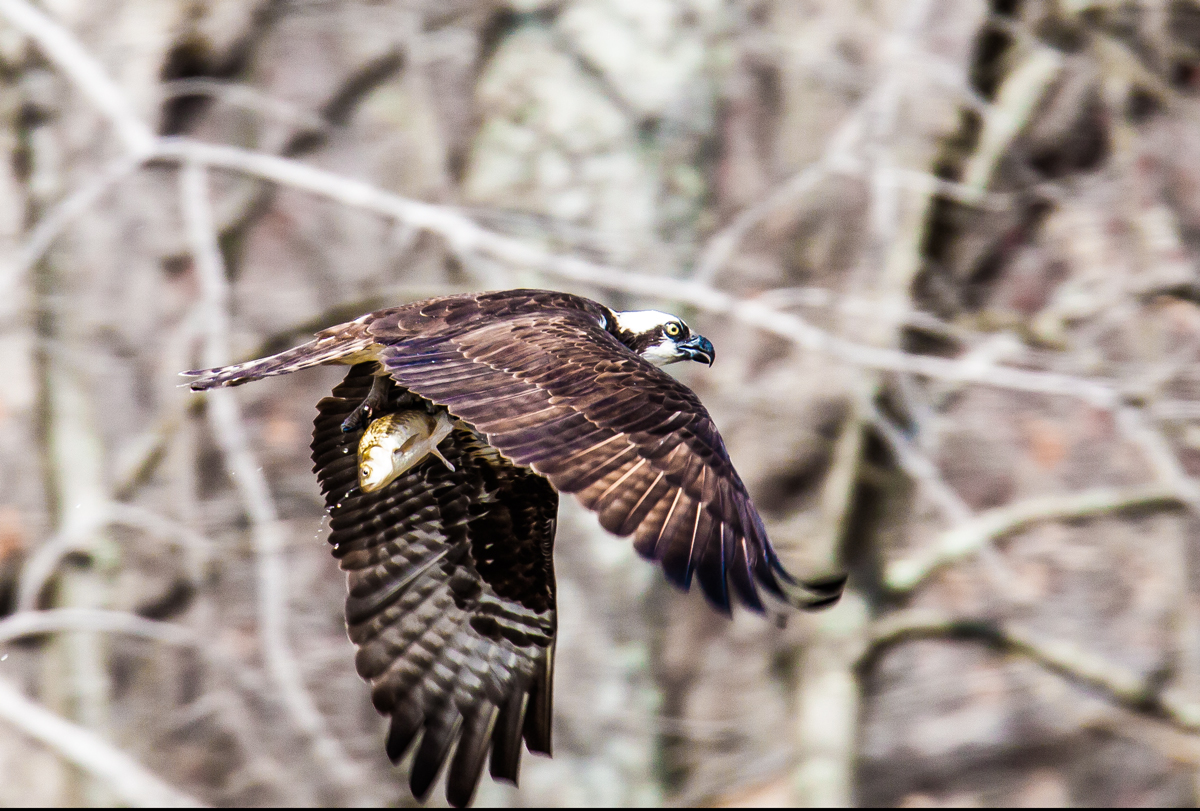
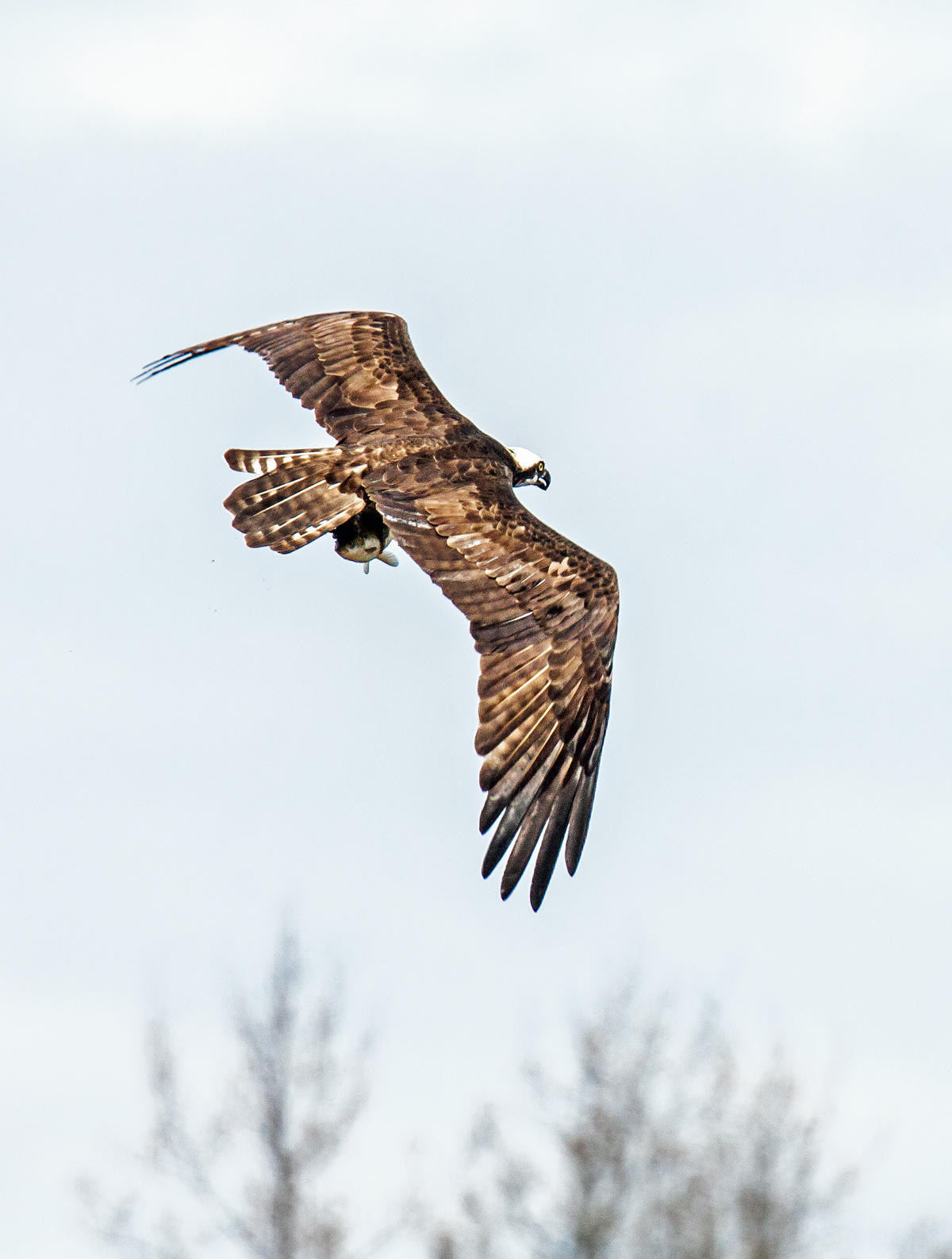
An osprey circled and circled overhead early Monday afternoon at Huntley Meadows Park and finally made a strike, pulling a good-sized fish out of the water. I captured the first shot as the osprey flew by me with its catch, which is just visible between the wings. In the second shot, the osprey was flying away over the trees.
Ospreys have recently reappeared at my favorite local marshland park and these are my first shots this spring at this location. The last couple of years they have shown up regularly enough that I wonder if there might be a nest somewhere in the park. I have wandered about in many remote areas of the park, but so far have not located a nest for the ospreys or for the bald eagles, which I also see pretty regularly in the park.


© Michael Q. Powell. All rights reserved.
Posted in Birds, Nature, spring, wildlife | Tagged Alexandria VA, Canon 50D, Huntley Meadows Park, Osprey, Osprey with fish, Pandion haliaetus, Tamron 150-600mm | 1 Comment »
March 22, 2017 by Mike Powell
This Great Blue Heron (Ardea herodias) decided to try out a new vantage point at Huntley Meadows Park on Monday and surveyed potential prey from atop the boardwalk. Although the heron looks to be contemplating diving into the water, it eventually jumped into the water feet first.
I love trying to capture birds in motion, but am happy to settle for images in which there is a kind of tension and anticipation of action, rather than a more static pose.

© Michael Q. Powell. All rights reserved.
Posted in Birds, Nature, Photography, spring, wildlife | Tagged Alexandria VA, Ardea herodias, Canon 50D, Great Blue Heron, heron, Huntley Meadows Park, Tamron 150-600mm | 2 Comments »
March 21, 2017 by Mike Powell
Like a runner at the starting blocks, this male Northern Cardinal (Cardinalis cardinalis) was tensed as he prepared to push off from the top of a dead tree yesterday morning at Huntley Meadows Park.
What a beautiful way to start the spring.

© Michael Q. Powell. All rights reserved.
Posted in Birds, Nature, Photography, spring, wildlife | Tagged Alexandria VA, Canon 50D, Cardinalis cardinalis, Huntley Meadows Park, male Northern Cardinal, Northern cardinal, Tamron 150-600mm | 4 Comments »
March 20, 2017 by Mike Powell
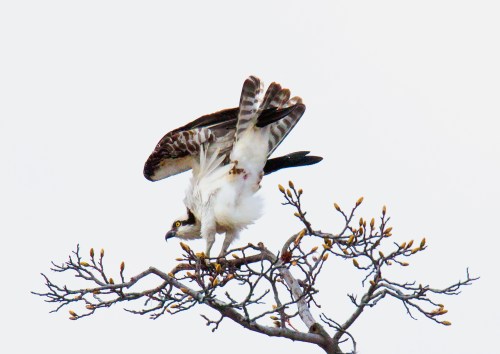
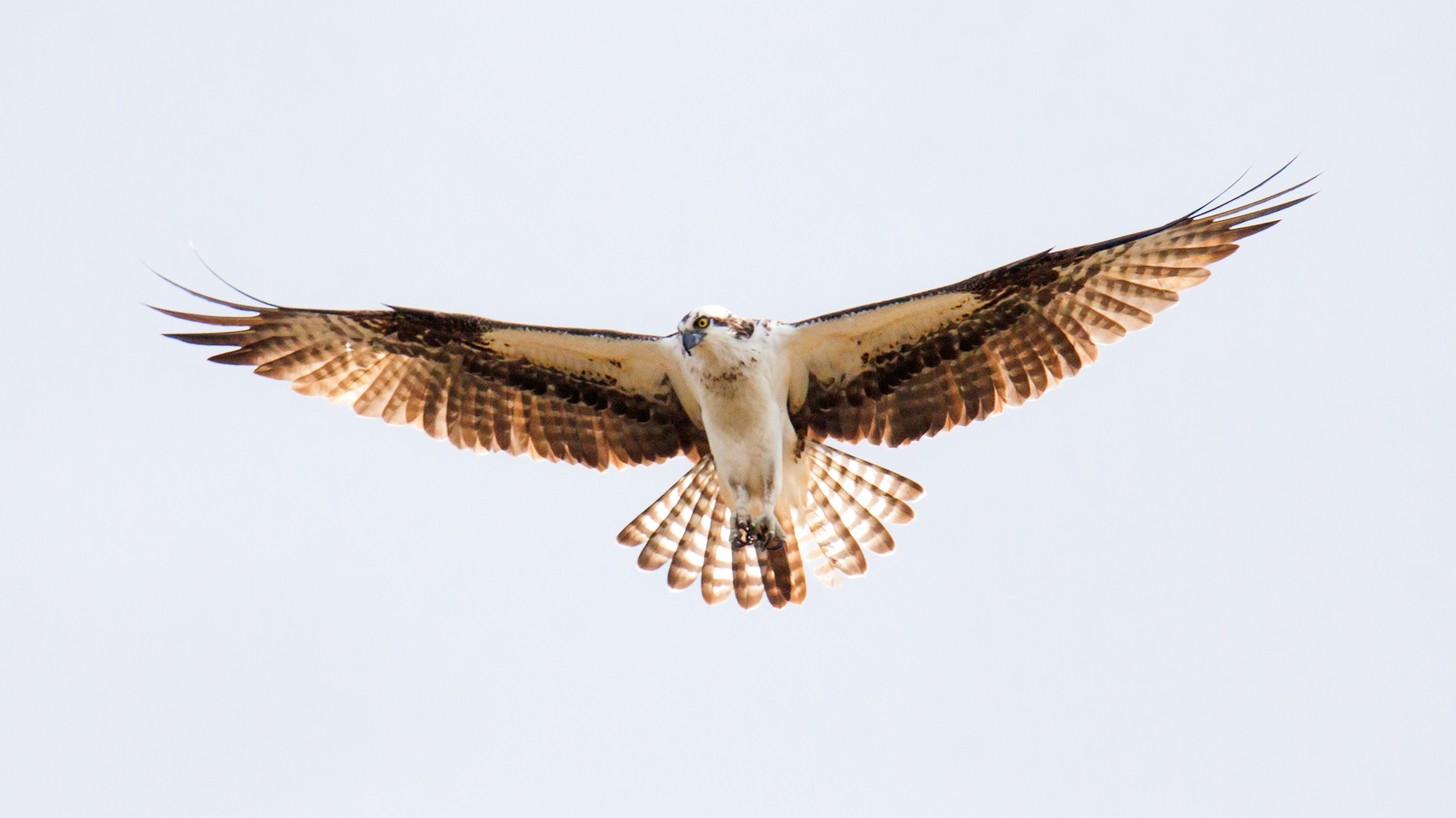
When I first spotted an Osprey (Pandion haliaetus) yesterday afternoon, it was perched at the top of a tall tree at Lake Cook in Alexandria, Virginia. Suddenly it began a series of what seemed to be warm-up, stretching exercises. The position reminds me a little of the obelisk position that some dragonflies assume to avoid excessive exposure to the sun. A short time later, the osprey took to the sky.
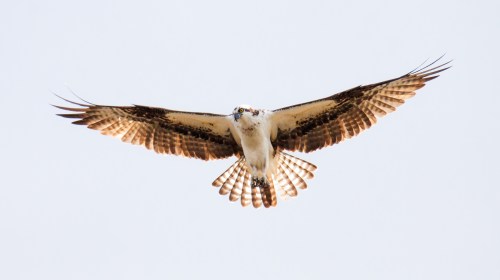
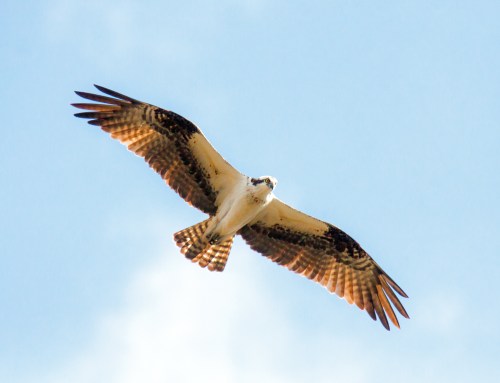
As I attempted to track the osprey circling overhead, I found myself shooting in radically varying lighting situations. The sky was blue, but there were large expanses of gray and white clouds. Some of the time I was also shooting directly into the sun. As a result, the two in-flight shots below look almost like they were shot on different days, when in fact they were taken only seconds apart.
© Michael Q. Powell. All rights reserved.
Posted in Birds, Nature, Photography, wildlife | Tagged Alexandria VA, Canon 50D, Lake Cook, Osprey, Pandion haliaetus, Tamron 150-600mm | 8 Comments »
March 19, 2017 by Mike Powell
This Double-crested Cormorant (Phalacrocorax auritus) was focusing so intently on the water yesterdy that I thought it was stalking a fish. I was initially shocked at the size of the fish that it pulled out of the water until I realized that it was only a large leaf.

The cormorant waved the leaf around proudly until it finally let go of the leaf. Obviously this bird has a policy of “catch and release.”

Undeterred, the cormorant went back to fishing—I never did see him land one, but he might have been catching small fish during his dives.

© Michael Q. Powell. All rights reserved.
Posted in Birds, Humor, Nature, Photography, wildlife | Tagged Alexandria VA, Canon 50D, cormorant, Double-crested Cormorant, Lake Cook, Phalacrocorax auritus, Tamron 150-600mm | 4 Comments »
March 18, 2017 by Mike Powell
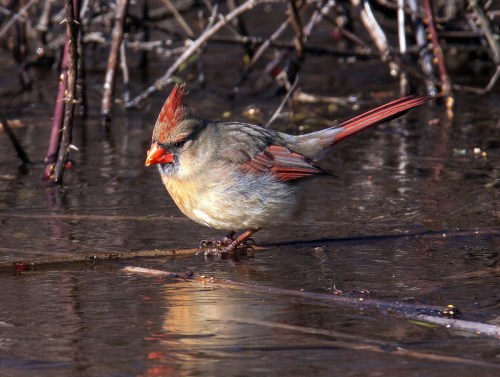
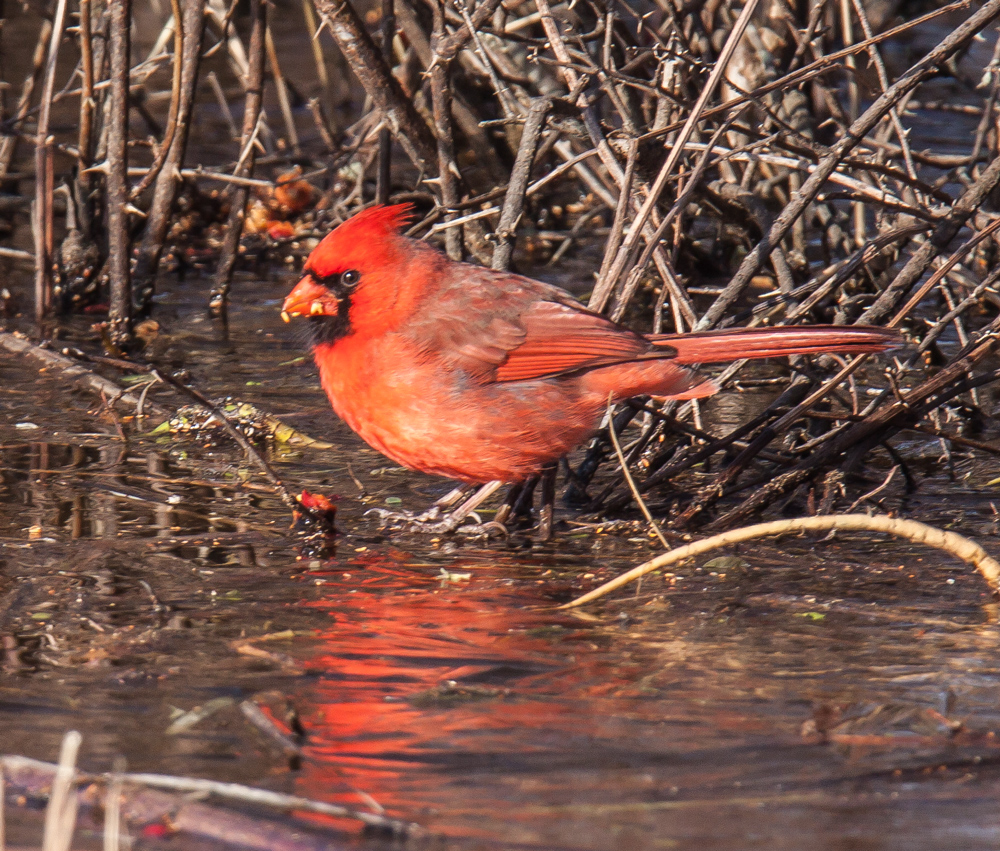
Early yesterday morning there was a coating of ice on much of the water at Huntley Meadows Park. Northern Cardinals (Cardinalis cardinalis) were taking advantage of this new surface to forage for seeds in the lower parts of the vegetation growing out of the frozen water.
The bright red one is immediately identifiable as a male. The other one looks like it could be a female or an adolescent male. As is often the case with birds, male cardinals start off looking like females before they acquire their adult plumage. I’m leaning towards it being a female because of the color of the bill—with younger cardinals, the bill is often dusky rather than bright orange.


© Michael Q. Powell. All rights reserved.
Posted in Birds, Nature, Photography, wildlife, Winter | Tagged Alexandria VA, Canon 50D, cardinal, Cardinalis cardinalis, female Northern Cardinal, Huntley Meadows Park, male Northern Cardinal, Northern cardinal, Tamron 150-600mm | 6 Comments »
March 17, 2017 by Mike Powell
Even familiar birds can look cool and different when viewed from an unusual angle. I photographed this Red-bellied Woodpecker (Melanerpes carolinus) Monday morning at Huntley Meadows Park. I was shooting almost straight up and the subject was mostly backlit and in the shadows, but I could just see the red color at the edge of the head.
As an added bonus, you can just see what appears to be the touch of red on the bird’s belly that is responsible for its name—normally you can’t see it and wonder why it is called “red-bellied.”

© Michael Q. Powell. All rights reserved.
Posted in Birds, Nature, Photography, wildlife | Tagged Alexandria VA, Canon 50D, Huntley Meadows Park, Melanerpes carolinus, Red-bellied Woodpecker, Tamron 150-600mm | Leave a Comment »
March 16, 2017 by Mike Powell
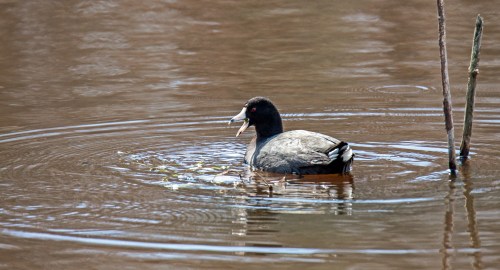
Do coots laugh? I don’t know for sure, but that’s certainly what this American Coot (Fulica americana) seemed to be doing when I spotted him on Monday morning at Huntley Meadows Park.
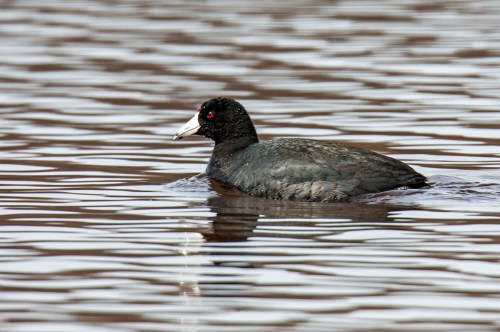
A bit later in the day, when the direction of the light was less harsh, I saw some more coots and was able to capture an image that shows more accurately the color of the coot’s body and its eerie red eyes.
© Michael Q. Powell. All rights reserved.
Posted in Birds, Nature, Photography, wildlife | Tagged Alexandria VA, American Coot, Canon 50D, coot, Fulica americana, Huntley Meadows Park, Tamron 150-600mm | 1 Comment »
March 15, 2017 by Mike Powell
The beavers at Huntley Meadows Park have been remarkably elusive this winter, so I was excited to see this one on Monday as it swam by in the beautiful early morning light.
There are several beaver lodges in the park where I have spotted North American Beavers (Castor canadensis) in the past, but it is hard to know for sure which ones are currently active. Occasionally I will come to the park really early or stay late, hoping to spot a beaver, but this is the first one that I have spotted in many months. With a little luck I will be able to see one a bit closer than this one, which quite a distance away when I photographed it.

© Michael Q. Powell. All rights reserved.
Posted in animals, Nature, Photography, wildlife | Tagged Alexandria VA, beaver, Canon 50D, Castor canadensis, Huntley Meadows Park, North American Beaver, Tamron 150-600mm | 3 Comments »
March 14, 2017 by Mike Powell
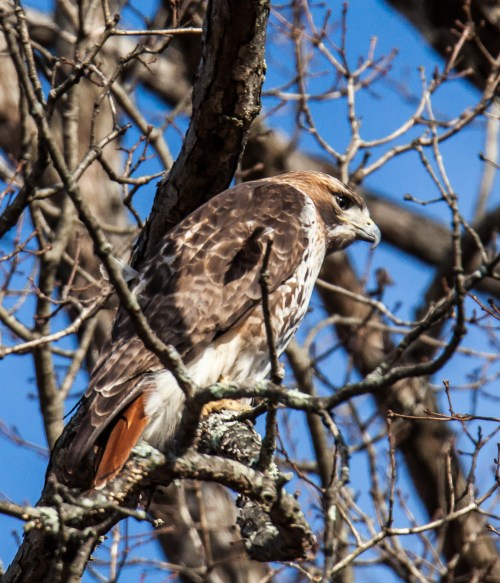
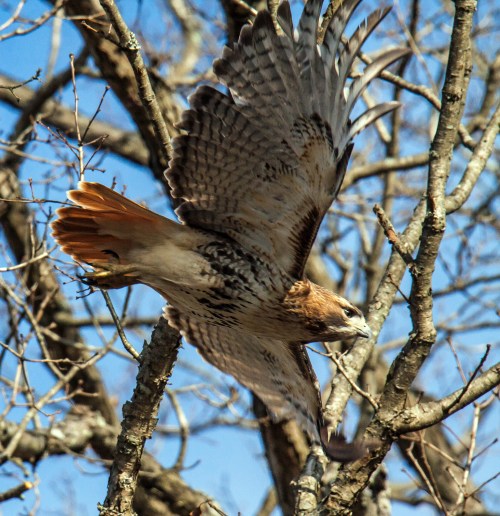
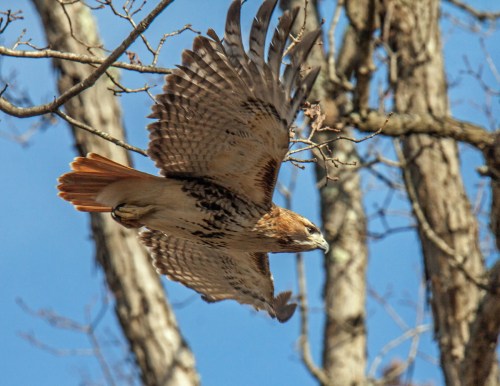
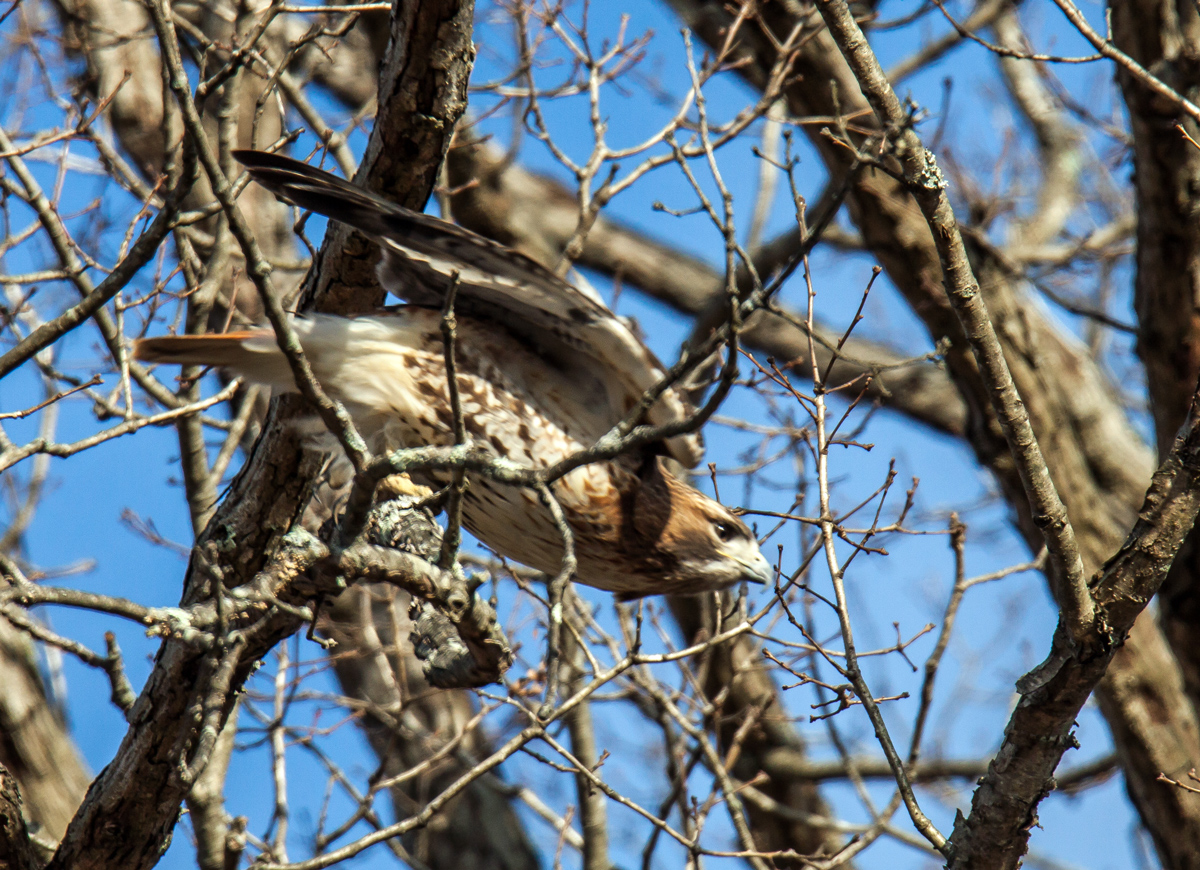
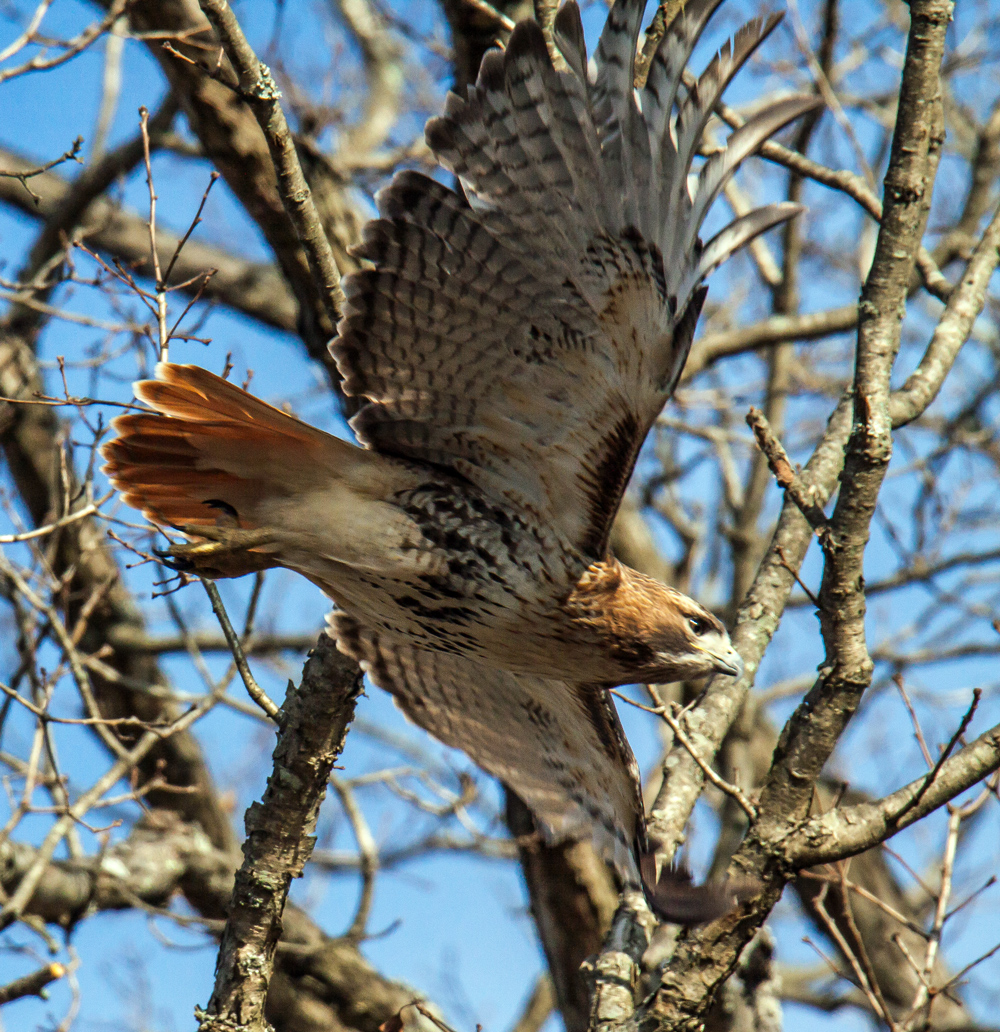
This Red-tailed Hawk (Buteo jamaicensis) seemed to be facing in the opposite direction when a sharp-eyed fellow photographer spotted it in a tree across a field. We were able to move quite a good distance across the field before the hawk became aware of our presence and took off.
Instead of flying up into the air, the hawk flew downwards initially and then flew behind the stand of trees, so I was unable to get any mid-flight shots with the sky as the background. However, I did manage to capture a sequence of shots as the hawk was getting ready to take off and also shortly after the takeoff.


© Michael Q. Powell. All rights reserved.
Posted in Birds, Nature, Photography, wildlife | Tagged Alexandria VA, birds in flight, Buteo jamaicensis, Canon 50D, hawk, Huntley Meadows Park, Red-tailed Hawk, Tamron 150-600mm | 11 Comments »
March 13, 2017 by Mike Powell
Male Wood Ducks (Aix sponsa) are colorful and unusual looking and are one of my favorites. I spotted this one atop a nesting box at Huntley Meadows Park on Friday as he was singing in the rain. He stayed there for quite some time, periodically moving from one side of the roof to the other.
I waited and waited to see if a female Wood Duck would emerge from the box. but I never saw her. Perhaps he is keeping watch over eggs that may have been laid in the box.


© Michael Q. Powell. All rights reserved.
Posted in Birds, Nature, Photography, Portraits, wildlife | Tagged Aix sponsa, Alexandria VA, Canon 50D, Huntley Meadows Park, male wood duck, Tamron 150-600mm, wood duck | 4 Comments »
March 12, 2017 by Mike Powell
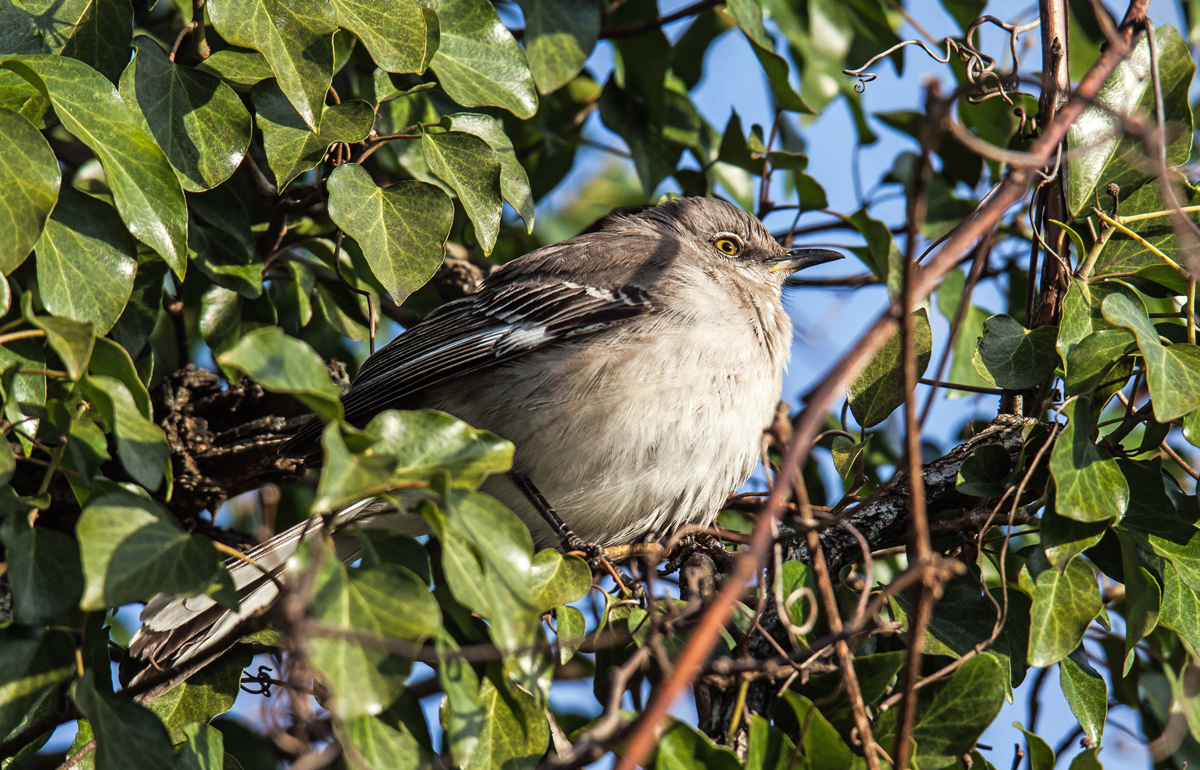
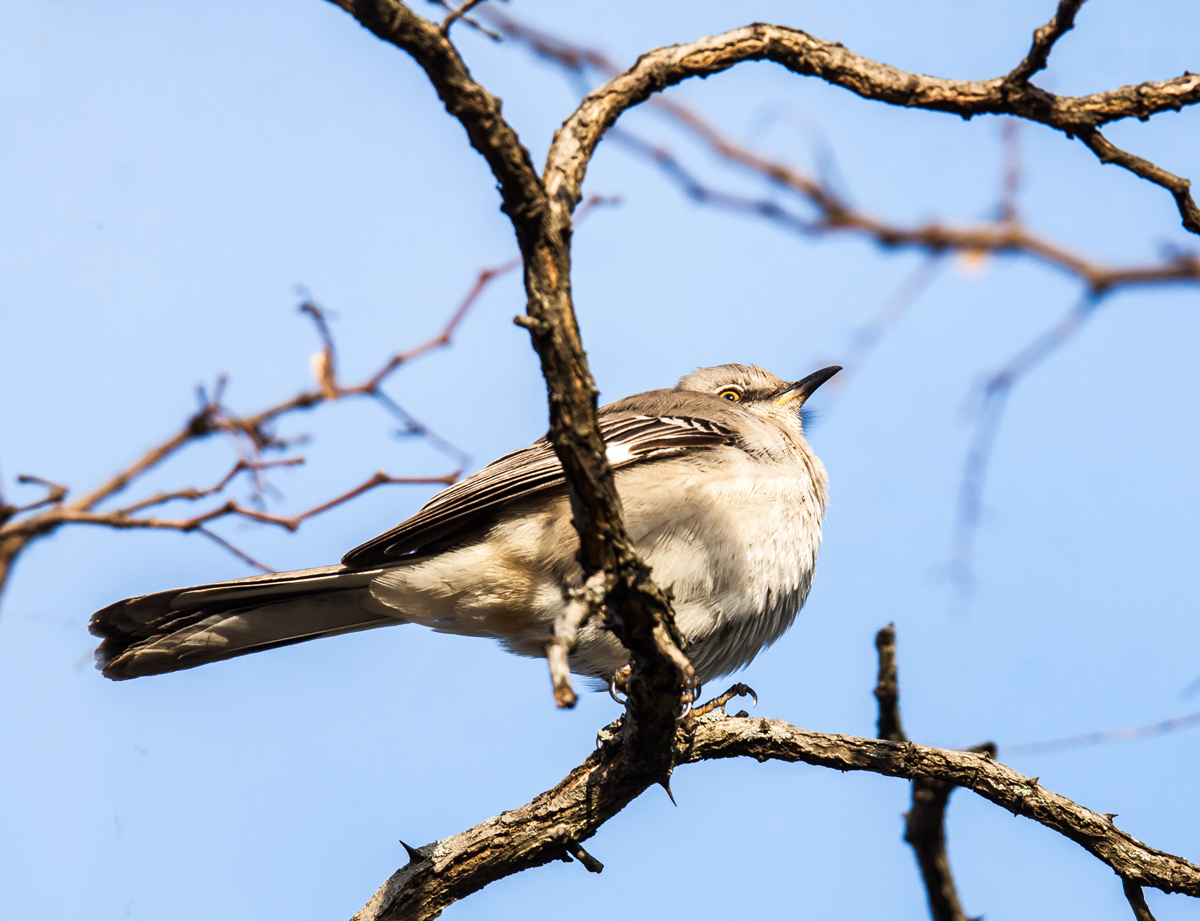
It was below freezing and windy yesterday morning when I headed out with my camera. I didn’t expect to see many birds and was a little surprised when I kept running across Northern Mockingbirds (Mimus polyglottos). They are pretty common where I live, but I just have not seen very many of them this winter.
The first one that I spotted was huddled inside a bush with its feathers all puffed up, probably in an effort to keep warm.

Another one seemed to be trying to warm up by facing the sun.
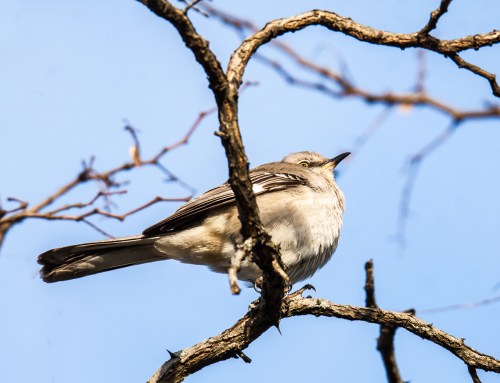
A final mockingbird seemed undeterred by the wind that was ruffling its feathers and boldly sang out a happy song, greeting the arrival of the new day.

© Michael Q. Powell. All rights reserved.
Posted in Birds, Nature, Photography, wildlife | Tagged Alexandria VA, Cameron Run, Canon 50D, Mimus polyglottos, mockingbird, Northern Mockingbird, Tamron 150-600mm, Tamron 150-600mm telephoto | 2 Comments »
March 11, 2017 by Mike Powell
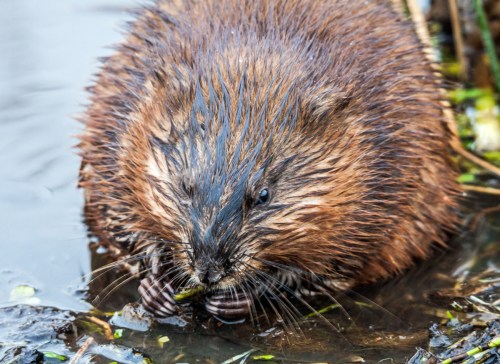
This muskrat (Ondatra zibethicus) was so close yesterday morning at Huntley Meadows Park that I almost stepped back off of the edge of the slippery boardwalk as I tried to make sure that I was within the focusing range of my telephoto zoom lens.
I ended up wet from the intermittent rain, but managed to avoid falling into the water.
© Michael Q. Powell. All rights reserved.
Posted in animals, Nature, Photography, Portraits, wildlife | Tagged Alexandria VA, Canon 50D, Huntley Meadows Park, muskrat, Ondatra zibethicus, Tamron 150-600mm | 8 Comments »
March 10, 2017 by Mike Powell
The Hooded Mergansers (Lophodytes cucullatus) of Huntley Meadows Park seem to spend a lot of their time in areas where they are partially hidden by the vegetation. Occasionally, though, a visual tunnel will open up briefly that lets me get a mostly unobstructed shot, like this one of a handsome male that I spotted this past Monday.

© Michael Q. Powell. All rights reserved.
Posted in Birds, Nature, Photography, wildlife | Tagged Alexandria VA, Canon 50D, Hooded Merganser, Hooded Merganser duck, Huntley Meadows Park, Lophodytes cucullatus, Tamron 150-600mm | 2 Comments »
March 9, 2017 by Mike Powell
Sometimes photography seems so complicated with a myriad of competing factors in play as I search for interesting subjects and seek to capture their beauty. There is a kind of pull to travel to ever more exotic locales and to constantly think of upgrading my gear.
Sometimes my favorite images, however, are my simplest ones, like these shots of a Carolina Chickadee (Poecile carolinensis) that I spotted last week in the midst of the cattails of Huntley Meadows Park. The subject is commonplace, the setting is ordinary, the composition is uncomplicated, and even the color palette is restricted.
I find a real beauty in this kind of minimalism. At its heart, photography is simple, although it requires a lot of effort.


© Michael Q. Powell. All rights reserved.
Posted in Uncategorized | Tagged Alexandria VA, Canon 50D, Carolina Chickadee, chickadee, Huntley Meadows Park, Poecile carolinensis, Tamron 150-600mm | 9 Comments »
March 8, 2017 by Mike Powell
It has been quite a while since I have seen any mammals other than squirrels, dogs, and humans at Huntley Meadows Park. Although I long to spot a fox, beaver, or even a coyote (someone saw one recently in one of the remote areas of the park), I was quite happy when I caught sight recently of a little muskrat (Ondatra zibethicus) as it munched away on some vegetation. The sound of my camera’s shutter or my movement must have alerted the muskrat to my presence and within seconds the furry creature disappeared beneath the surface of the water.

© Michael Q. Powell. All rights reserved.
Posted in animals, Nature, Photography, wildlife | Tagged Alexandria VA, Canon 50D, Huntley Meadows Park, muskrat, Ondatra zibethicus, Tamron 150-600mm | 3 Comments »
March 7, 2017 by Mike Powell
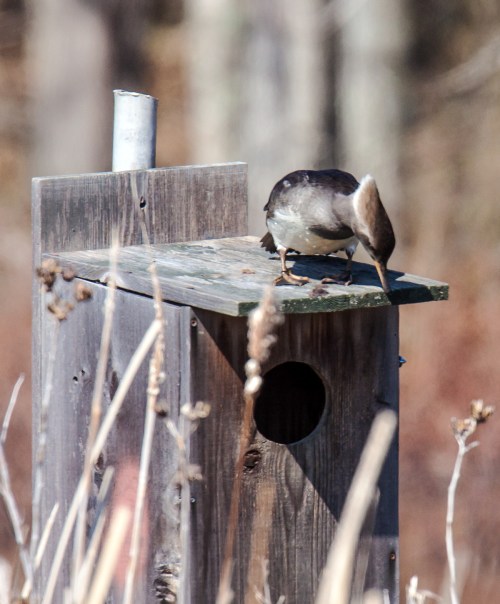
Hooded Mergansers (Lophodytes cucullatus) were really active yesterday at Huntley Meadows Park, including this female, who seemed to be contemplating using this nesting box to lay her eggs a little later this spring.
You might call it “thinking outside of the box”—or not.” 🙂


© Michael Q. Powell. All rights reserved.
Posted in Birds, Humor, Nature, Photography, spring, wildlife | Tagged Alexandria VA, Canon 50D, female Hooded Merganser, Hooded Merganser, Hooded Merganser duck, Huntley Meadows Park, Lophodytes cucullatus, Tamron 150-600mm | 2 Comments »
March 6, 2017 by Mike Powell
It’s so easy to overlook the ever-present, drab-colored sparrows when searching for birds to photograph. This past weekend, though, I stopped and watched one as it pecked away in the mud at Huntley Meadows Park, my favorite local marshland park. By slowing down and looking more closely, I was able to marvel in the beauty and industrious persistence of this little bird, which I believe is a Swamp Sparrow (Melospiza georgiana).
Slowing down and looking more closely—that’s probably a lesson I could probabl apply to more areas of my life than just photography.


© Michael Q. Powell. All rights reserved.
Posted in Birds, Nature, Photography, Portraits, wildlife | Tagged Alexandria VA, Canon 50D, Huntley Meadows Park, Melospiza georgiana, sparrow, swamp sparrow, Tamron 150-600mm | 2 Comments »
March 5, 2017 by Mike Powell
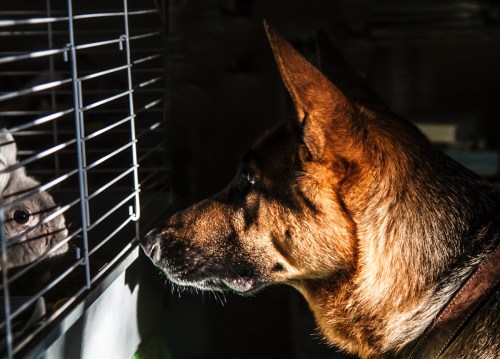
Whenever I walk the two year old German Shepherd who belongs to my son and daughter-in-law, one of the highlights for Katie is stopping by my house so that she can visit with Prime Rib (PR), my adopted rabbit.
The two of them seem to enjoy staring at each other and sniffing. Katie has never displayed any hostility towards PR and PR is not intimidated by her presence and often just ignores her.
It was an interesting challenge trying to get this shot using available light. Katie kept moving and PR often stayed in a position in which his eyes were not visible. Beautiful morning light was coming in from the right through the sliding glass doors, but it was not exactly where I would have liked it. I ended up using my Canon 24-105mm lens, a lens that I don’t use that often. I particularly like the way that I was able capture Katie’s intense focus and utter fascination with the little rabbit.
© Michael Q. Powell. All rights reserved.
Posted in animals, Dog, Photography, Portraits | Tagged Canon 24-105mm, Canon 50D, German Shepherd, Katie, PR, Prime Rib, rabbit | 7 Comments »
March 4, 2017 by Mike Powell
The wind was howling yesterday afternoon at Huntley Meadows Park, making the water really choppy and threatening to blow me off of the boardwalk. A solo American Coot (Fulica americana) was one of the few birds that attempted to navigate its way among the waves—it looked almost like a scene at the ocean’s shore.

© Michael Q. Powell. All rights reserved.
Posted in Birds, Nature, Photography, wildlife | Tagged Alexandria VA, American Coot, Canon 50D, coot, Fulica americana, Huntley Meadows Park, Tamron 150-600mm | 6 Comments »
March 3, 2017 by Mike Powell
A new alcoholic beverage? No, in this case, the title of my blog posting is literal.
When I first spotted this Double-crested Cormorant (Phalacrocorax auritus) on Monday, I thought it was wading in the water. Looking more closely, I realized it was standing on the rocks, giving us a really good view of its dark, webbed feet.

© Michael Q. Powell. All rights reserved.
Posted in Birds, Nature, Photography, wildlife, Winter | Tagged Alexandria VA, Canon 50D, cormorant, Double-crested Cormorant, Lake Cook, Phalacrocorax auritus, Tamron 150-600mm telephoto | 2 Comments »
March 1, 2017 by Mike Powell
I’d never before seen river barges, so it was pretty cool to watch these ones moving along the Ohio River in Wheeling, West Virginia during my brief trip there last month. I never realized that barges are pushed from behind rather than pulled from the front. How in the world are they able to steer?

© Michael Q. Powell. All rights reserved.
Posted in Landscape, Nature, Photography | Tagged barges, Canon SX50, Ohio River, West Virginia, Wheeling, Wheeling WV | 3 Comments »
February 28, 2017 by Mike Powell
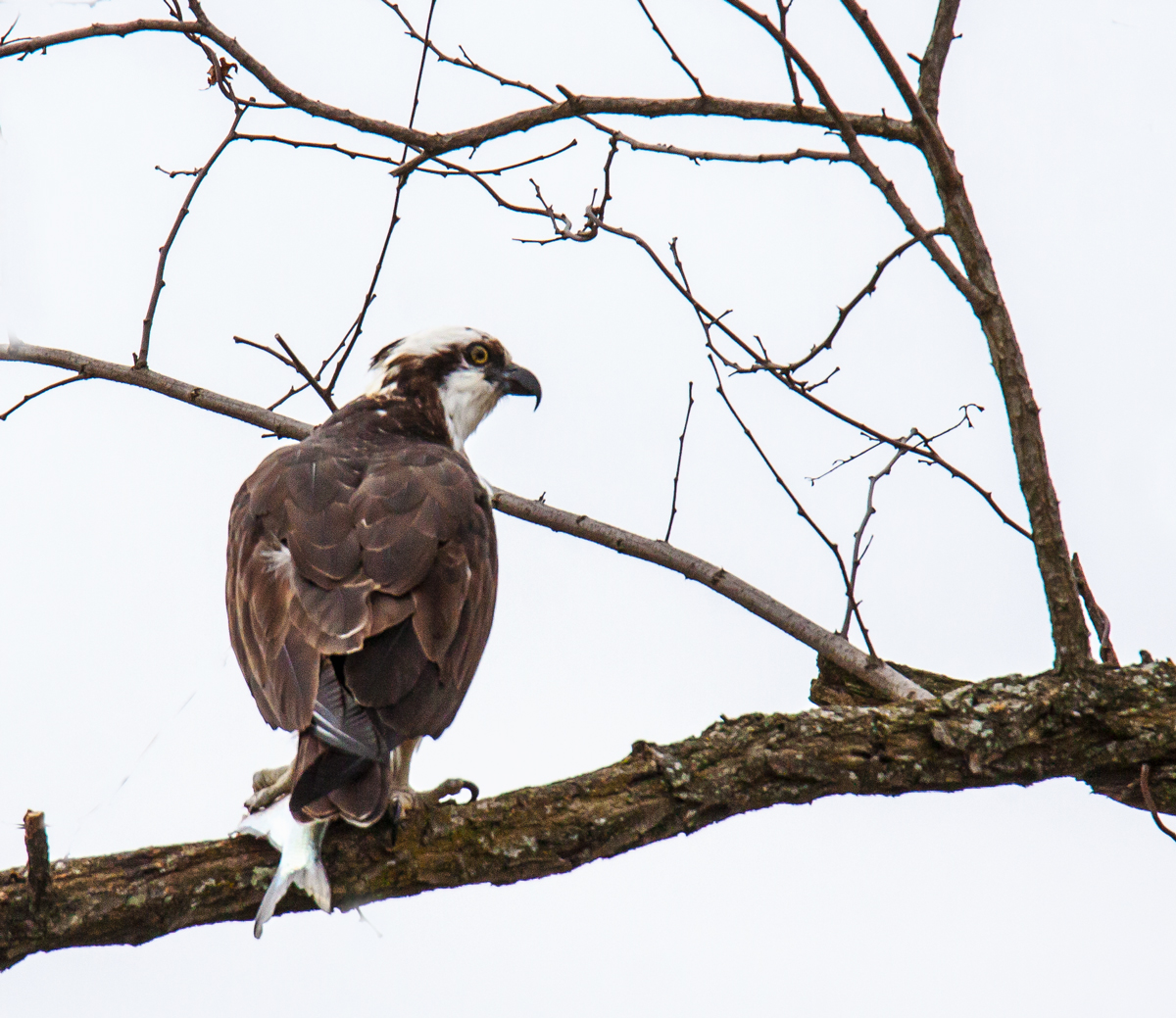
I inched my way forward yesterday when I spotted this bird in a tree at the edge of Lake Cook in Alexandria, Virginia. Gradually I came to see that it was an osprey (Pandion haliaetus) lunching on a fish. When I moved a few steps closer, however, it detected my presence and its reaction was quicker than mine—I couldn’t quite keep the osprey within the frame of my camera.
I have included an image of the osprey just before it took off to give you an idea of what I was seeing as I was doing my best to be stealthy. The eyesight and reactions of raptors is so good that it is really tough to get even this close. I suspect that in this case the osprey was slightly distracted because it was eating.
The osprey did not fly completely out of sight but perched in the highest branches of a tree on the other side of the small lake. There the osprey was able to continue its lunch without further interruptions.


© Michael Q. Powell. All rights reserved.
Posted in Birds, Nature, Photography, wildlife | Tagged Alexandria VA, Canon 50D, Lake Cook, Osprey, osprey in action, Osprey with fish, Pandion haliaetus, Tamron 150-600mm | 6 Comments »
February 27, 2017 by Mike Powell
During the winter months, my macro lens doesn’t get used much, but I was happy to have it with me during my recent trip to Georgia when I spotted this beautiful flower in bloom at the Oxbow Meadows Environmental Learning Center in Columbus. I’m pretty sure that it is a variety of spiderwort ( g. Tradescantia), a commonly seen flower where I live, but not in February
I grew to love this kind of shot when I first started shooting with Cindy Dyer, my photography mentor and muse. She infused me with a love for macro photography and for botanical subjects that is re-energized each spring. As I look at this image, I imagine her telling me how much she likes it, but also gently reminding me that I should have shot it with a tripod to get the extra degree of sharpness and more precise framing.

© Michael Q. Powell. All rights reserved.
Posted in Art, Flowers, Gardening, Macro Photography, Nature, Photography | Tagged Augusta GA, Canon 50D, g. Tradescantia, Oxbow Meadows Environmental Learning Center, spiderwort, Tamron 180mm | 5 Comments »
February 26, 2017 by Mike Powell
As I drove back yesterday from Georgia to Northern Virginia, an almost 800 mile drive (1287 km), I stopped at a rest area on I-95 in North Carolina. Noting that there was a small man-made pond, I decided to investigate for odes and spotted this damselfly. One of the experts in the Southeaster Odes Facebook Group helped to identify this beauty as a female Fragile Forktail damselfly (Ischnura posita).
It’s a whole lot cooler in Northern Virginia than it was in Georgia and North Carolina, so I suspect that I will have to wait a month or two for damselflies and dragonflies to emerge here. With this sneak preview, I can hardly wait.

© Michael Q. Powell. All rights reserved.
Posted in damselfly, Dragonflies, Macro Photography, Nature, Photography | Tagged Canon 50D, Fragile Forktail, Fragile Forktail damselfly, I-95, Ischnura posita, North Carolina, rest area, Tamron 180mm | 4 Comments »
February 25, 2017 by Mike Powell
It’s still a bit early for dragonflies in Northern Virginia, but when temperatures soared to almost 80 degrees (27 degrees C) yesterday in Columbus, Georgia, I decided to see if I could find some here. I had a wonderful time exploring some of the area of the Oxbow Meadows Environmental Learning Center that is not far from Fort Benning, where I was staying.
I came up empty-handed for dragonflies, but did spot some beautiful little damselflies. Later in the spring, these will be fairly common, but after a long period with no odonates, they seem rare and exotic.
The first one looks like a Fragile Forktail damselfly (Ischnura posita), but I am not sure about the others. Several of them flew so weakly that I wondered if they had only recently emerged.


© Michael Q. Powell. All rights reserved.
Posted in damselfly, dragonfly, Insects, Nature, Photography, wildlife, Winter | Tagged Canon 50D, Columbus GA, damselflies, damselfly, Fort Benning GA, Fragile Forktail, Fragile Forktail damselfly, Ischnura posita, Oxbow Meadows Environmental Learning Center, Tamron 180mm | 4 Comments »
February 24, 2017 by Mike Powell
I couldn’t help but do a double take when I saw this sign at Fort Benning, Georgia. I was filled with visions of dogs on automatic conveyor belts being sprayed with soap and slapped with moving towels. Was hot wax an option for dogs?
I did a little checking and learned that the dog wash is a separate facility adjacent to the car wash. It is the first of its kind on a US military installation and includes a coin-operated, do-it-yourself, climate-controlled booth that offers washing, drying and flea and tick bathing options. The booth is then automatically sterilized after each use.

© Michael Q. Powell. All rights reserved.
Posted in animals, Humor, Photography, Travel | Tagged Canon 24-105mm, Canon 50D, car wash, dog wash, Fort Benning GA, humor, humour | 2 Comments »
February 23, 2017 by Mike Powell
From a distance, it looks almost like they are drilling for oil in the center of Fort Benning, Georgia. Those towers, however, are not oil derricks, but are used for training soldiers who will become airborne-qualified. There are a series of towers of varying heights and as soldiers master their equipment and techniques, they are literally taken to greater heights.
In 1980 I was at Fort Benning for US Army Officer Candidate School (OCS), and I remember running on a track around those towers. During my Army career, I did not go through airborne training and I am happy to say that I have a perfect record—I have landed safely aboard every aircraft on which I have taken off.
I am currently at Fort Benning to celebrate my son’s graduation from OCS. Yesterday I had a chance to walk around the field on which the towers are located and to capture a variety of shots. Here are some of my favorites.


© Michael Q. Powell. All rights reserved.
Posted in Architecture, Army, Landscape, Photography | Tagged airborne, airborne training, Canon 24-105mm, Canon 50D, Fort Benning GA, jump towers, US Army | 8 Comments »
February 22, 2017 by Mike Powell
During my recent trip to Wheeling, West Virginia, I repeatedly encountered symbols of the town’s glorious past. Trains no longer run to the historic Baltimore and Ohio train station. The beautiful building has now been converted for use by West Virginia Northern Community College.

A prominent sign indicates the availability of the buildings of Marsh Wheeling Stogies. Could this possibly be a reference to cigars? As I did a little research, I learned that Mifflin M. Marsh began producing cigars in Wheeling in 1840. His cheap cigars were favored by the drivers of the Conestoga wagons that carried pioneers West and “stogies” are a shortened version of the wagon’s name. According to the website Archiving Wheeling, in 1877 almost 24 million cigars were sold in Wheeling. In 2001, the plant was closed after Marsh Wheeling was bought by National Cigar.

I suppose that Verizon now owns the Bell Telephone building in Wheeling, but Verizon is definitely not know for having buildings as interesting and beautiful as this one.

© Michael Q. Powell. All rights reserved.
Posted in Architecture, Landscape, Travel, Urban | Tagged B&O Railroad, Baltimore and Ohio Railroad, Bell Telephone, Canon SX50, Marsh Wheeling Stogies, West Virginia, Wheeling, Wheeling WV | 5 Comments »
February 20, 2017 by Mike Powell
This tiny chickadee was energetically digging into a cattail last week at Huntley Meadows Park. Although it is usually recommended not to photograph subjects mid-bite (at least human ones), I like the way this shot turned out of the industrious little bird.
Judging from the range maps, this is probably a Carolina Chickadee (Poecile carolinensis), although we sometimes also get Black-capped Chickadees (Poecile atricapillus). These two types of chickadees look quite similar and I am not yet skilled in distinguishing between them.

© Michael Q. Powell. All rights reserved.
Posted in Birds, Nature, Photography, wildlife | Tagged Alexandria VA, Black-capped Chickadee, Canon 50D, Carolina Chickadee, chickadee, Huntley Meadows Park, Poecile atricapillus, Poecile carolinensis, Tamron 150-600mm | 4 Comments »
February 19, 2017 by Mike Powell
This past Thursday I made a quick trip to Wheeling, West Virginia and fell in love with the signs that had been painted long ago on the sides of some of the brick buildings in the downtown area. Here are a few of my favorite ones.


© Michael Q. Powell. All rights reserved.
Posted in Architecture, Art, Landscape, Photography, Travel, Urban | Tagged Canon SX50, faded signs, painted signs, Wheeling, Wheeling WV. West Virginia | 8 Comments »
« Newer Posts - Older Posts »















 Mike Powell