Feeds:
Posts
Comments

Archive for the ‘Portraits’ Category

Whenever I am in Brussels, I always try to be sure that I see the Manneken Pis, the little boy who is one of the symbols of the city. Normally, he is naked and is peeing into a fountain, but on special occasions he is clothed in one of his many costumes. Yesterday, he was wearing an athletic suit, with what appeared to be a Belgian flag, and running shoes. The statue of the boy is not very big and I am also posting a shot of the alcove in which he is located to give you an idea of his size.

I will try to check him again before I leave and see if he has changed into a different set of clothes. If so, I’ll be sure to post another photo.

boy2_blogboy1_blog

© Michael Q. Powell. All rights reserved.

Read Full Post »

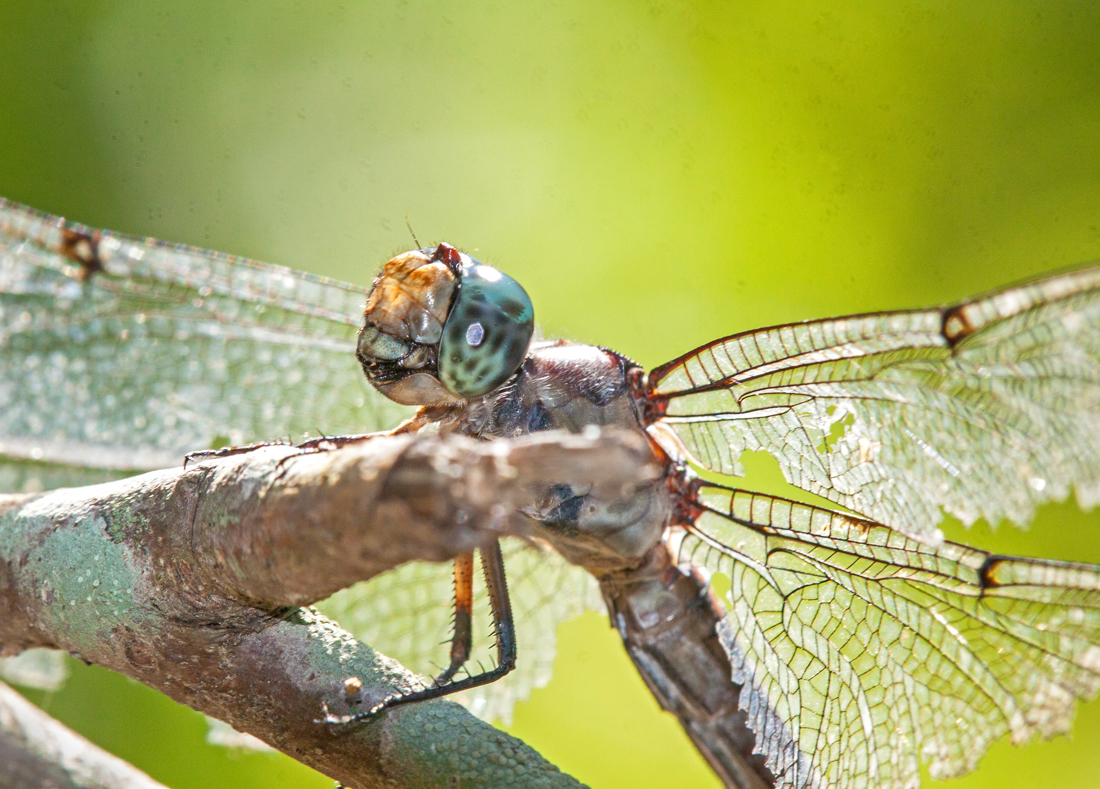
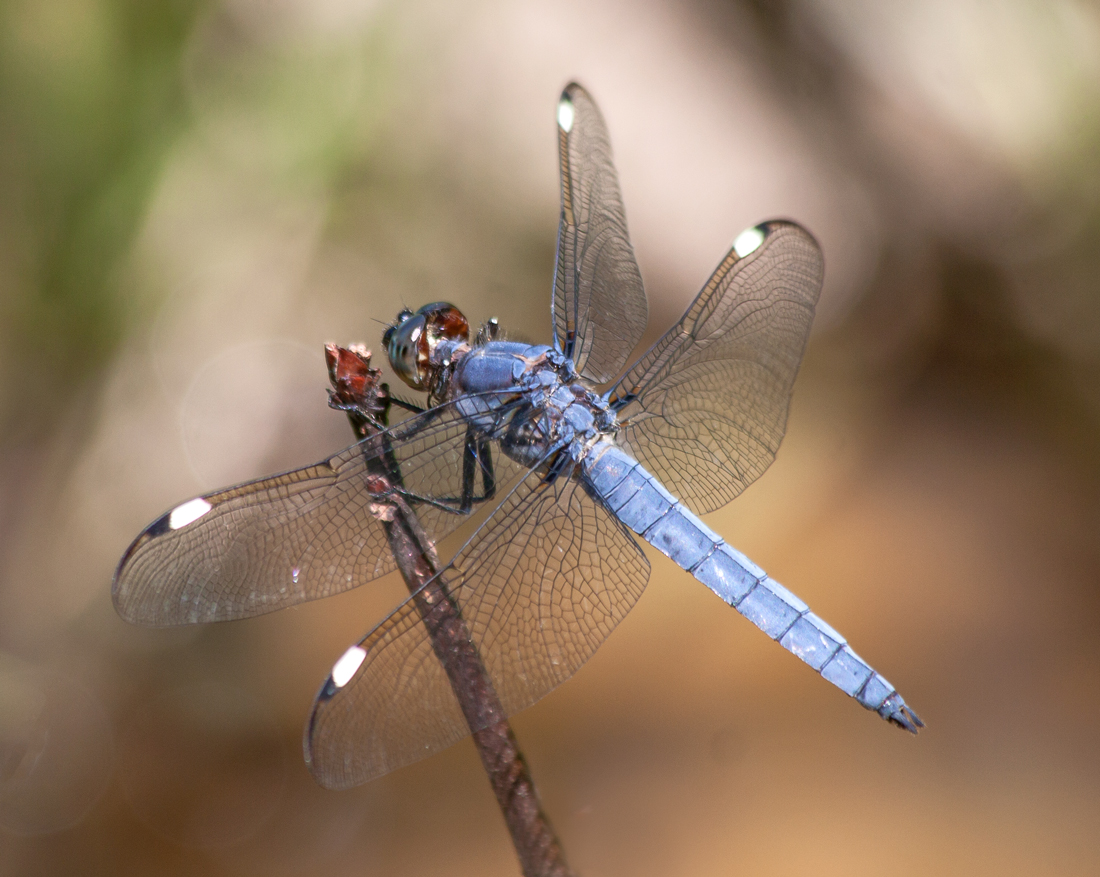
I was suffering in the heat and humidity on Friday, but this dragonfly, which I think is a female Great Blue Skimmer (Libellula vibrans), seemed to enjoy basking in the sunlight and let me get really close for this shot.

dragon_superclose_blog

© Michael Q. Powell. All rights reserved.

Read Full Post »

This past Friday morning, as I was following one of the creeks at Huntley Meadows Park, I caught sight of a large bird perched on the trunk of a fallen tree almost right in front of me. I had a 180mm macro lens on my camera, which proved just enough for me to almost fill the frame with images of the bird.

After consultations with the naturalist staff, I believe this to be an adolescent Red-shouldered Hawk (Buteo lineatus). Note that the young hawk has a band on one of its legs, which was put on it at Patuxent Wildlife Research Center in Maryland.

The hawk looks pretty bedraggled and the naturalists hypothesized that perhaps it had been harassed by some other birds and was recovering on the ground. The hawk was aware of my presence and looked in my direction a couple of times, but I stayed at a distance, fearful of disturbing it in a potentially vulnerable moment. Although I would have liked to have moved in closer for some shots, I moved away quietly after capturing some images, leaving the young bird in this position on the log as I departed.

Red-shouldered Hawk

© Michael Q. Powell. All rights reserved.

Read Full Post »

The lighting was breathtakingly beautiful and the reflections were amazing when I caught sight of this Great Blue Heron (Ardea herodias) late last month at my local marsh. The heron was close enough that the 100mm macro lens that i had on my camera was the perfect lens for a portrait of this beautiful bird.

Great Blue Heron

© Michael Q. Powell. All rights reserved.

Read Full Post »

The light reflecting off the water in the background was really bright, creating these disco ball highlights when I took these shots of a male Blue Dasher dragonfly (Pachydiplax longipennis) recently at Green Spring Gardens. Normally I try to avoid distinctive specular highlights, but in this case I decided to embrace them.

Why do I suddenly feel an irresistible urge to watch Saturday Night Fever?

disco1_blogdisco2_blog

© Michael Q. Powell. All rights reserved

Read Full Post »

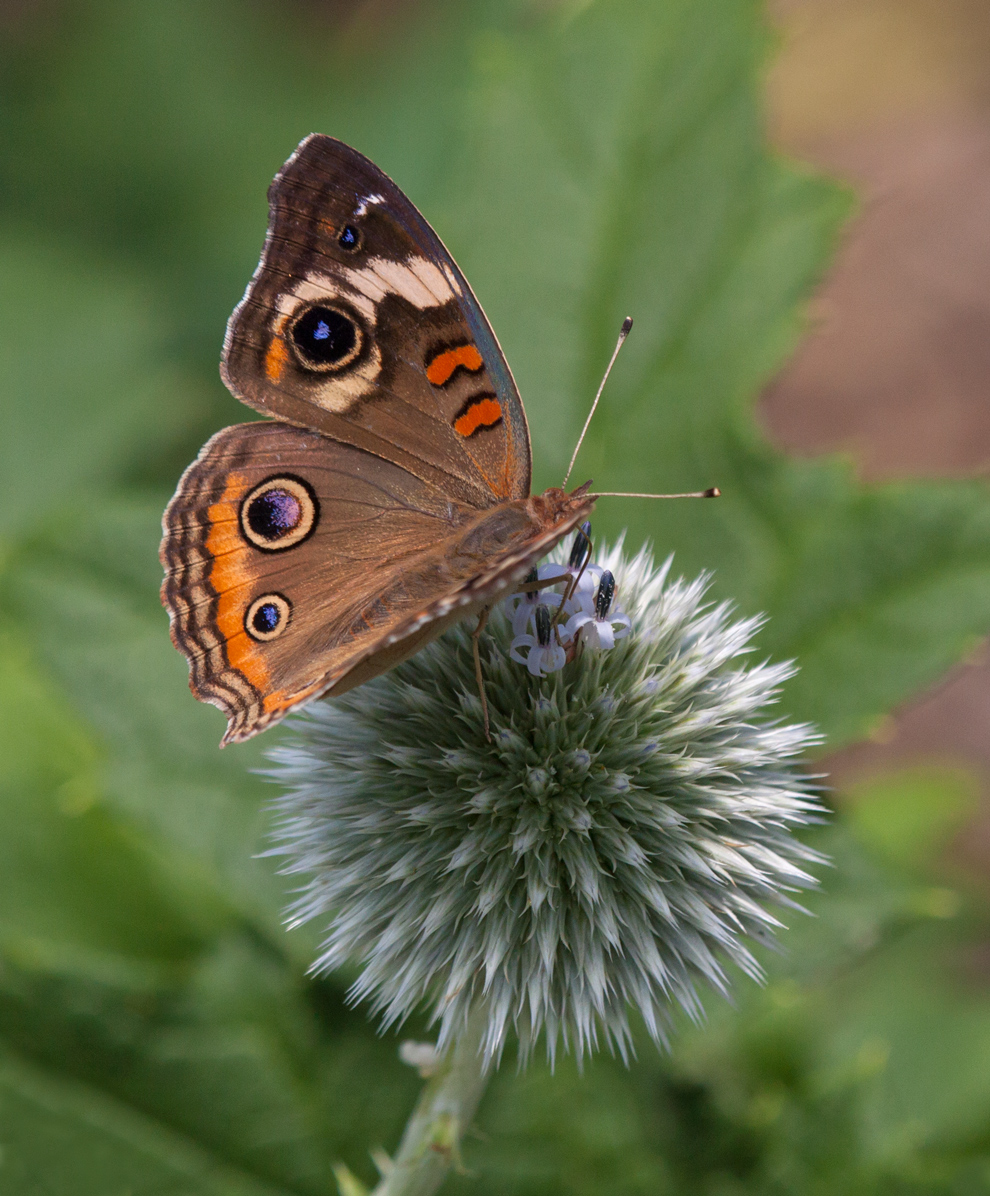
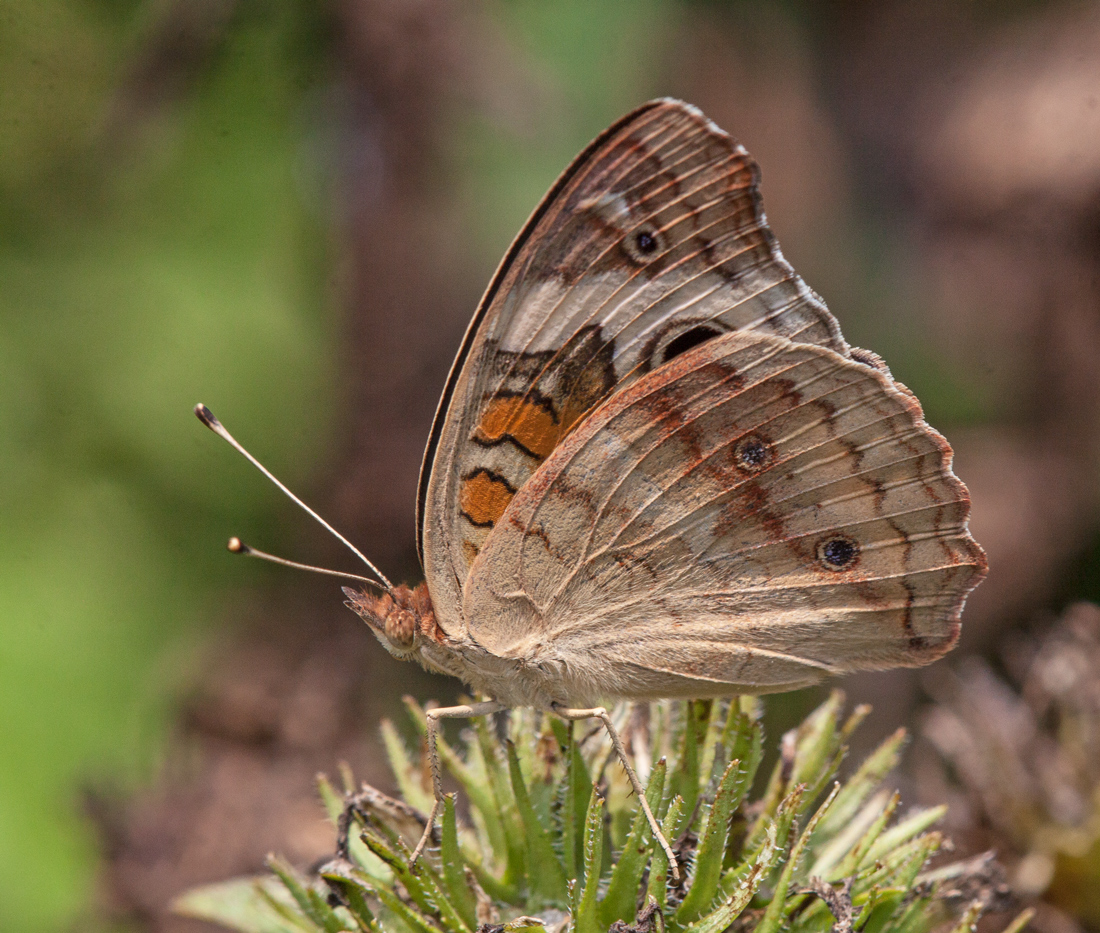
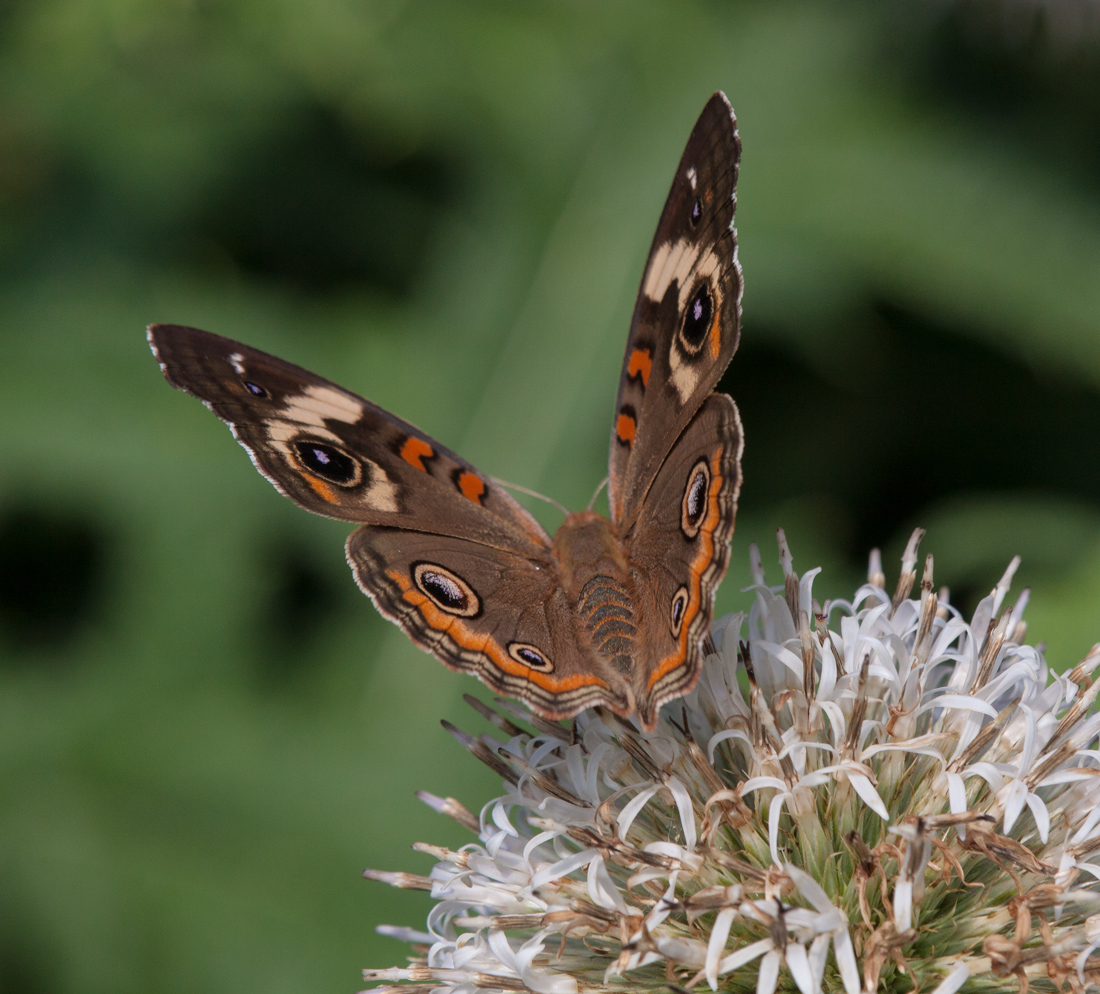
Although I don’t live in Ohio, nicknamed “The Buckeye State,” I think that I can claim that Virginia also is a Buckeye state, because we are a home to the uncommonly beautiful Common Buckeye butterfly (Junonia coenia).

Common Buckeye butterfly

I have seen few colorful butterflies so far this summer, besides the Great Spangled Fritillary butterflies that I featured in a posting in June. Where are all the Monarchs and Eastern Swallowtails? I don’t know if they were affected by the polar vortex of this past winter or if I am merely looking for them in all the wrong places, but their numbers seem to be unusually low this summer.

I was therefore thrilled this past Monday, when I caught sight of this Common Buckeye. Its coloration is so distinctive that I immediately recognized it and chased after it a bit. Fortunately I was able to capture several images of this beautiful creature before it flew out of sight.

Looking at these images, I am happy to proclaim that I live in a Buckeye state.

buckeye3_blog

buckeye2_blog

© Michael Q. Powell. All rights reserved.

Read Full Post »

Readers may have noticed that I rarely take photos of people and never photograph sporting events, but yesterday I found myself supporting one of my friends at the Capital Sprints Regatta in Washington D.C. on the Anacostia River. This was her first competition as a member of the DC Strokes Rowing Club and it was great to get some shots of her in action to commemorate the event.

I had never before been to a regatta and I took a lot of photos in an effort to capture the feeling of the experience. I selected a few of my favorites for this posting, including some close-up portraits as well as some action shots.

row4a_blog


© Michael Q. Powell. All rights reserved


Read Full Post »

Do your review your photos rapidly before you choose the ones to post or do you carefully and systematically evaluate them and only then select the best ones?

I am often in a hurry.  Sometimes I will stop to work on a shot that I like before I have even reviewed the complete set of images. I generally  don’t work up postings in advance and I’ll write up the posting and push the “Publish” button with out realizing that I may have unmined gold waiting to be discovered.

Only later, when I go through the entire set of shots do I realize that I have a better shot than the one I posted and realize I should have at least posted both of them. If the differences are only minor, I won’t do an additional posting, but sometimes, like today, I feel compelled to post a second image.

As was the case in yesterday’s posting, this is a shot of what I think is an Eastern Carpenter Bee (Xylocopa virginica)—or possibly a bumblebee— on a Purple Coneflower (Echinacea purpurea). The angle and the lighting helped me capture a significant amount of the detail and texture of both the bee and the flower and the colors came through with a beautiful vibrancy. The bee was in an unusual position, which adds to the visual interest of the image.

This is one of my favorites of my recent images. You might think that this experience will teach me a lesson about the value of a full review before choosing images to process, but I suspect that this will happen again from time to time. I know my habits too well.

bee2cone_blog

© Michael Q. Powell. All rights reserved.


Read Full Post »

What adds drama to a photo? Sometimes it is the lighting of a scene or the positioning of a subject. These recent shots of Blue Dasher dragonflies (Pachydiplax longipennis) seem to have a bit more drama and are more “artsy” than many of my typical images.

Should I start wearing a beret now when I am shooting?

dramatic_blog dramatic2_blog dramatic3_blog

© Michael Q. Powell. All rights reserved.

Read Full Post »

Two things really struck me when I first encountered this damselfly—its captivating blue eyes and its extraordinarily long abdomen.

Most damselfly fold in their wings when they are at rest, but damselflies of the Lestidae family keep them open and are commonly known as spreadwings. Only two members of this family are on the species list for my marshland park—the Swamp and the Slender Spreadwing—and this looks to me like might be a male Slender Spreadwing damselfly (Lestes rectangularis).

I would welcome a correction or confirmation of my identification, because I feel almost clueless when it comes to identifying damselflies.

damsel_blue1_blog

© Michael Q. Powell. All rights reserved.

Read Full Post »

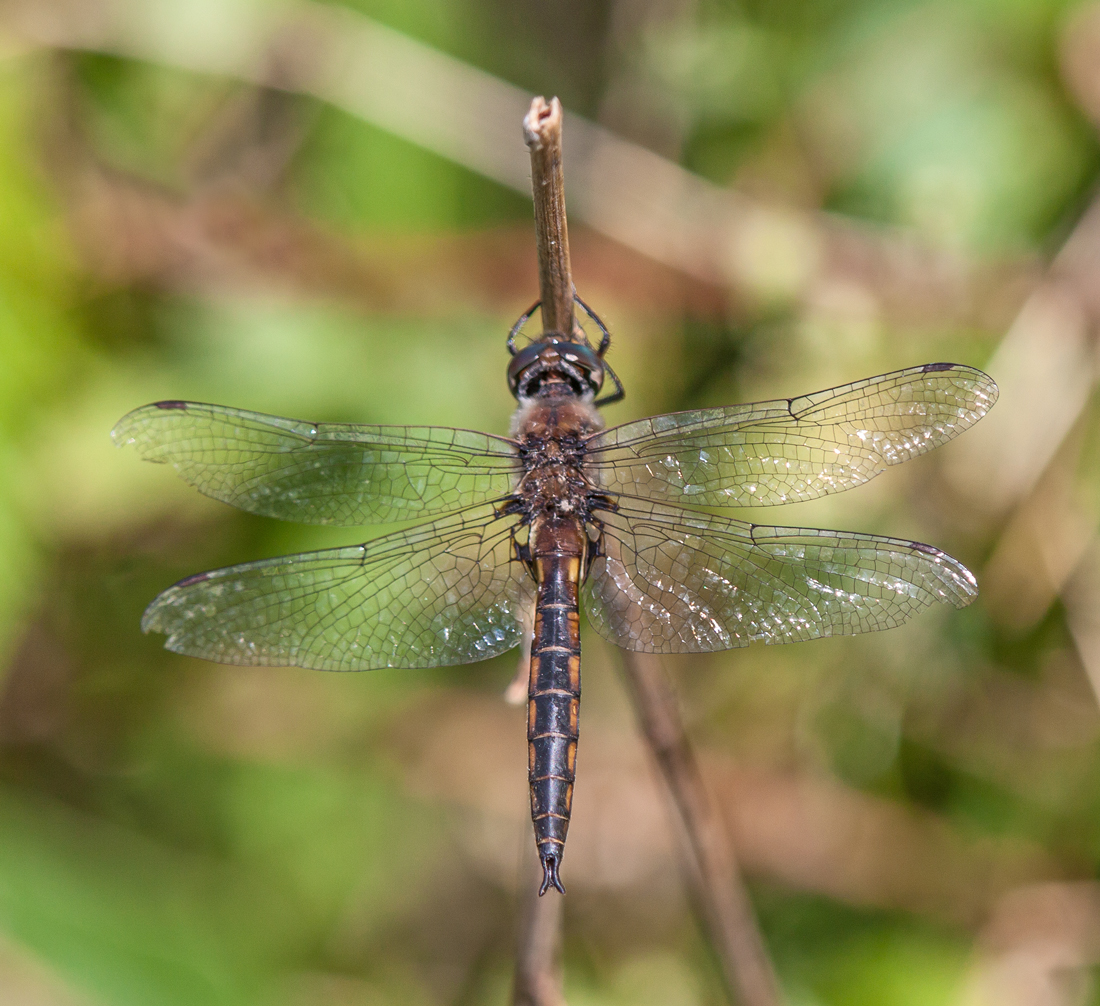
Compared to the other dragonflies that I have photographed, the Eastern Amberwing (Perithemis tenera) is tiny, typically less than an inch in size (25mm), but it has such a distinctive look that it is easy to identify.

I was able to approach this dragonfly from the rear and from above as it was perched on some vegetation overhanging a muddy creek and I don’t think it sensed my presence, even though I was pretty close to it. .

amber1_blog

© Michael Q. Powell. All rights reserved.

Read Full Post »

It’s unusual for me to take a photograph of a dragonfly with my camera pointed upward, but this Bar-winged Skimmer (Libellula axilena) kept perching in the branches of a downed tree limb, enabling me to include a little patch of sky in some of the shots. This is a new species for me that was pointed out to me by fellow photographer Walter Sanford when we ran into each other at one of our favorite spots at our local marshland park. The second shot shows part of the wing pattern that is responsible for the common name of this species, “Bar-winged.”

barred1_blogbarred2_blog

© Michael Q. Powell. All rights reserved.


Read Full Post »

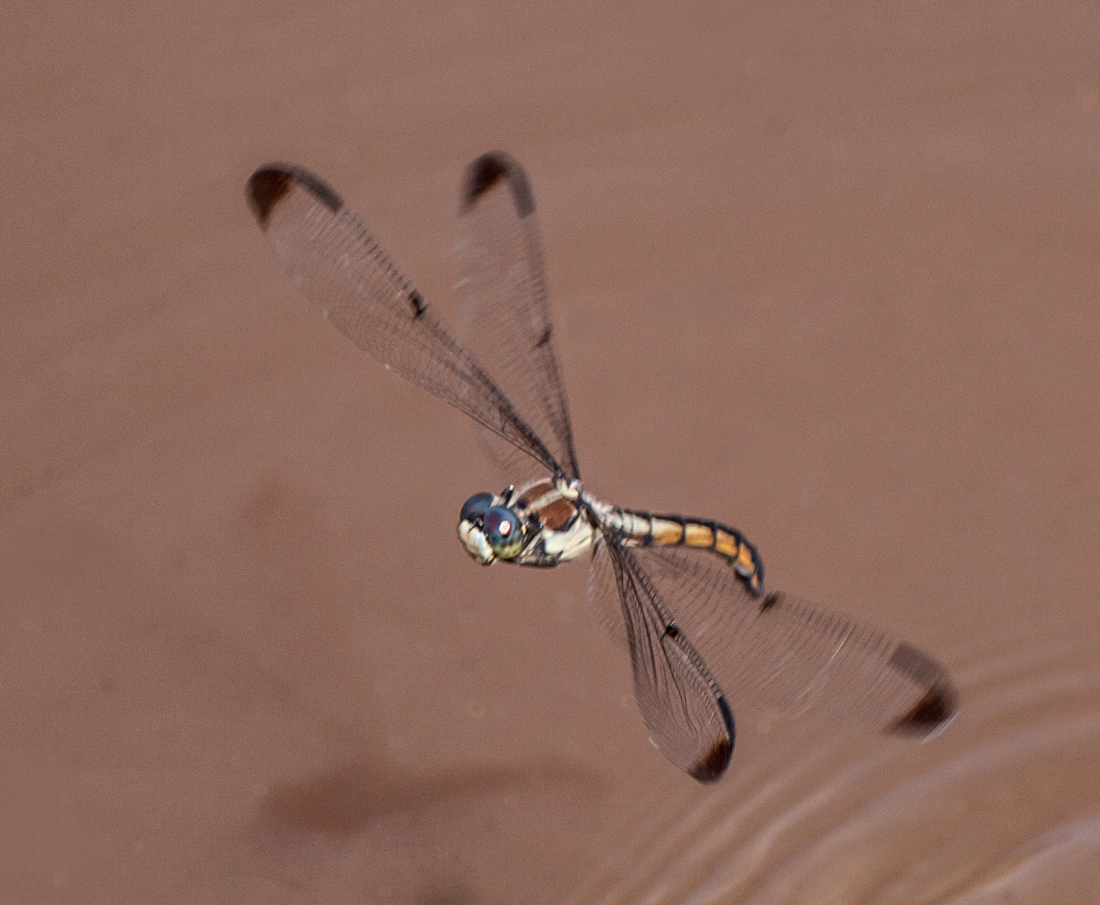
It’s tough to photograph a dragonfly in flight, but when it chooses to hover, there is a slightly better chance of getting a shot. That was the case recently when I encountered this female Great Blue Skimmer dragonfly (Libellula vibrans) that was in the process of depositing her eggs in the water. As her mate circled overhead, the female dragonfly would hover over the water and then periodically dip the tip of her tail in the water before returning to the hovering position. I was able to get several images of the hovering dragonfly, but got only a single image of her depositing the eggs.

flying1_skim_blogflying2_skim_blogflying3_skim_blogflying4_skim_blog

© Michael Q. Powell. All rights reserved.

Read Full Post »

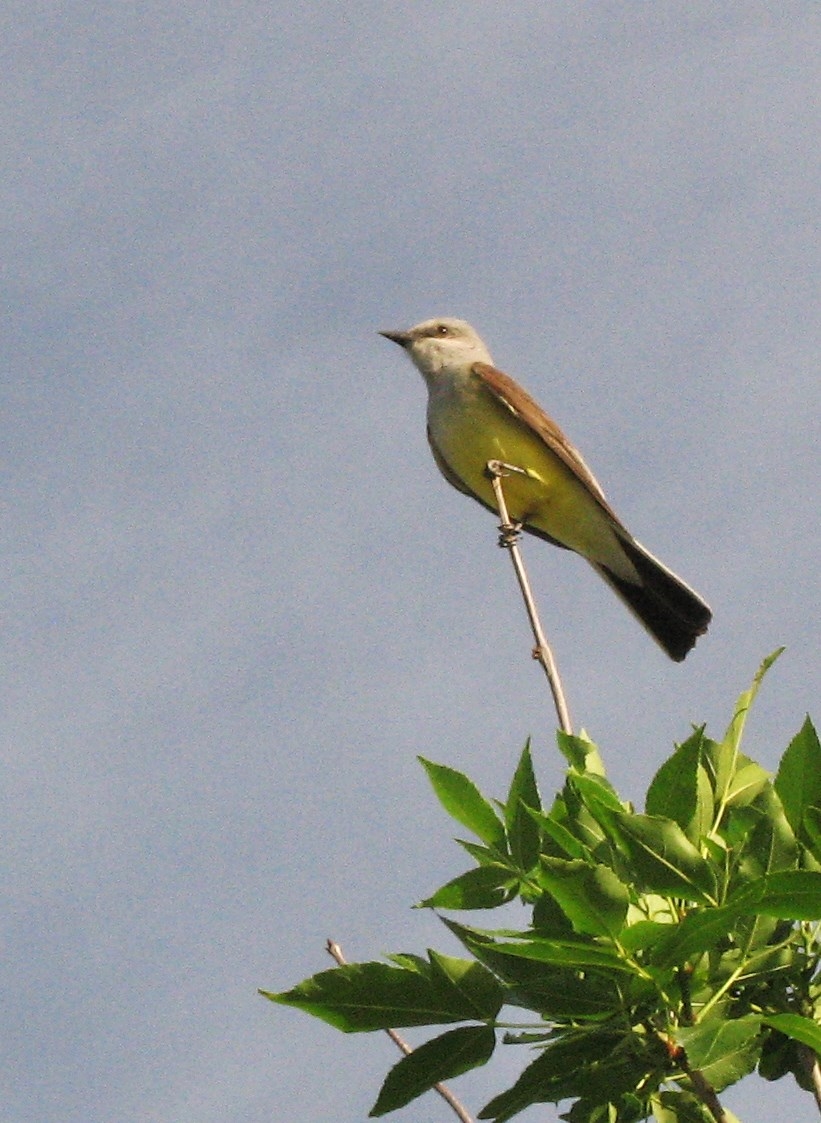
Walking along the sidewalk outside my hotel in Denver, Colorado, I caught sight of a beautiful shade of yellow on the breast of a bird that flew by me. I watched as it came to rest in a nearby tree, but couldn’t identify it.

Like the Black-billed Magpie that I featured yesterday, this bird, which I am pretty sure is a Western Kingbird (Tyrannus verticalis), is not found in Northern Virginia where I live.

As I watched, this bird flew off several times, presumably in search of insects, but returned to the same perch each time at the top of a tree. I would have liked to have watched this beautiful bird for a while longer, but duty called—this is a business trip after all.

kingbird1_blogkingbird2_blogkingbird3_blog

© Michael Q. Powell. All rights reserved.

Read Full Post »

A few days after I stumbled upon a Common Sanddragon dragonfly, a new species for my favorite marshland park, I returned to the remote location with fellow photographer and local dragonfly expert Walter Sanford (who made the initial identification for me). Walter has a science background and his posting today of our encounter with the Sanddragons is full of fascinating scientific information as well as awesome photos of these beautiful little dragonflies. Be sure to check out his complete posting.

waltersanford's avatarwalter sanford's photoblog

Common Sanddragon dragonflies (Progomphus obscurus) are anything but common.

Despite its name, this species is rare in Northern Virginia. Source Credit: Common Sanddragon, Dragonflies of Northern Virginia, by Kevin Munroe, Park Manager, Huntley Meadows Park.

Kevin goes on to cite Bull Run and Goose Creek, two streams where he has seen Common Sanddragons, and speculates they may be found at two other locations in Northern Virginia. Well, you can add a third location where sanddragons have been seen and it’s right in Kevin’s wheelhouse!

Mike Powell, a fellow amateur wildlife photographer and blogger, photographed a clubtail dragonfly at Huntley Meadows Park on 17 June 2014 that he was unable to identify. Mike’s description of the habitat where he saw the dragonfly piqued my curiosity, so I asked him to send me a photo of the unknown dragon. Turns out Mike discovered a Common Sanddragon —…

View original post 247 more words

Read Full Post »

Female dragonflies are often less colorful and visible than their male counterparts, but are equally beautiful.

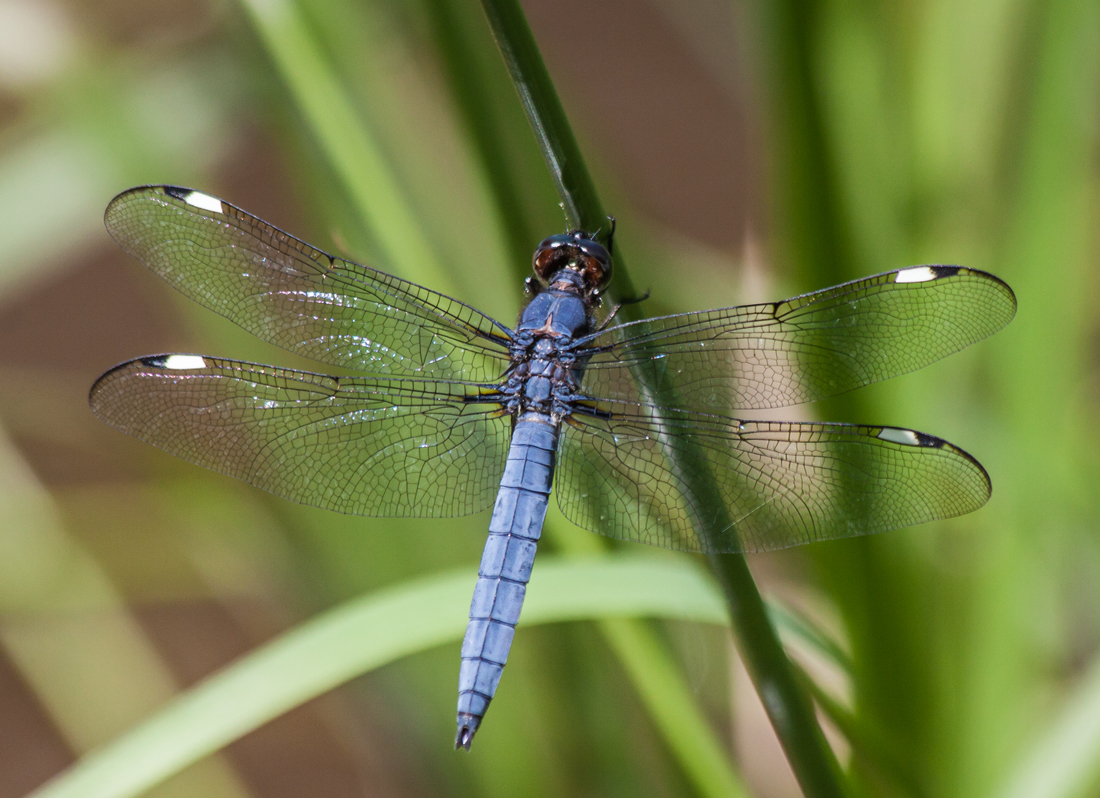
A week ago, I did a posting featuring the dark blue male Spangled Skimmer dragonfly (Libellula cyanea) and noted that the white stigma (markings) on the wings help in identifying this species. In today’s image, a female Spangled Skimmer appears to be a natural model as she smiles and poses for the camera

spangled_fem_blog

© Michael Q. Powell. All rights reserved

Read Full Post »

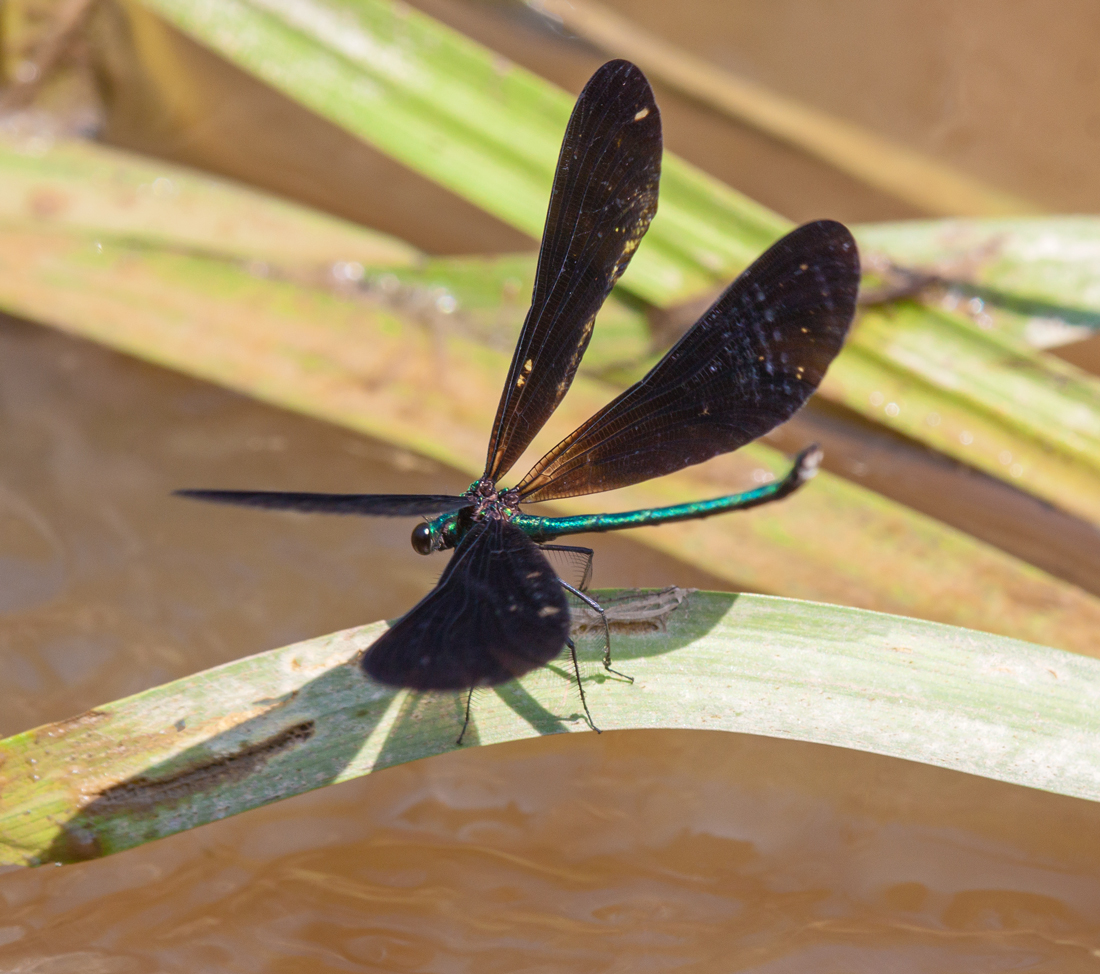
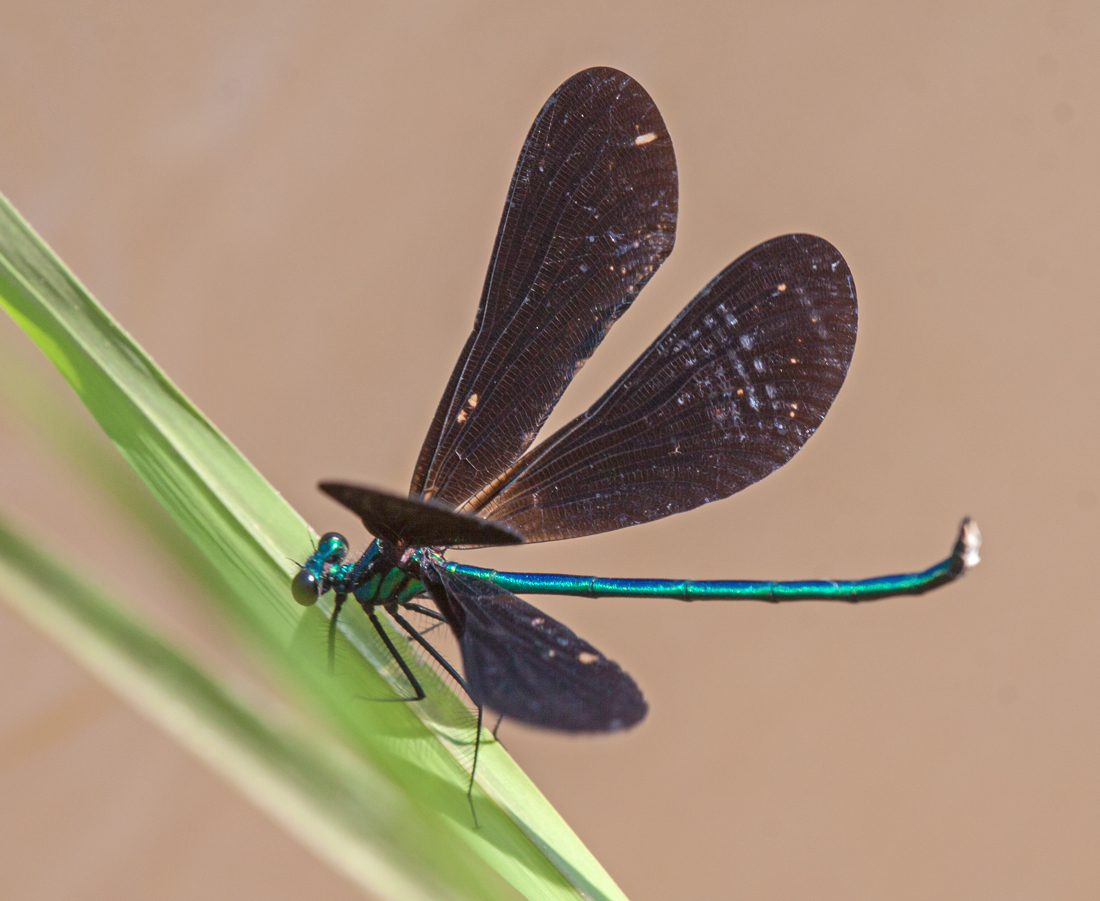
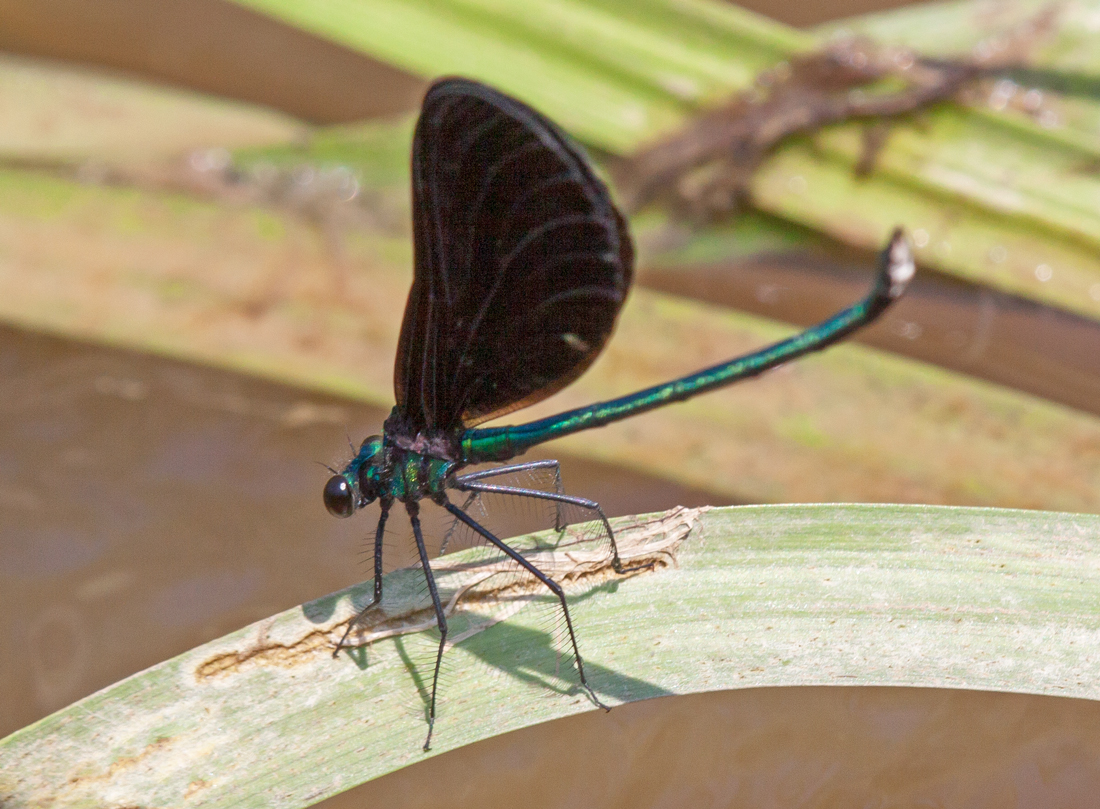
When you first catch sight of the fluttering flight of an Ebony Jewelwing damselfly (Calopteryx maculata) from a distance, it’s easy to think that it is a butterfly.

These damselflies are really weak fliers and they flutter slowly from one location to another nearby spot. Although they perch, they tend to do so on low vegetation and they don’t remain in one spot for very long, which makes it a challenge to get a decent photograph of one of them.

Their dark wings make them unusual and distinctive—all of the other damselflies that I have seen had clear wings—and help to set off the beautiful emerald color of their bodies.

According to bugguide.com, the Ebony Jewelwing’s scientific name Calopteryx maculata comes from the Greek “kalos” (beautiful) + “pteron” (wing or feather) and “macula” (a spot), a reference to the white spot near the tip of the female’s wing.

ebony1_blog

Ebony Jewelwing damselfly with opened wings

Ebony Jewelwing damselfly with opened wings

Ebony Jewelwing damselfly in a raised position with closed wings

Ebony Jewelwing damselfly in a raised position with closed wings

© Michael Q. Powell. All rights reserved


Read Full Post »

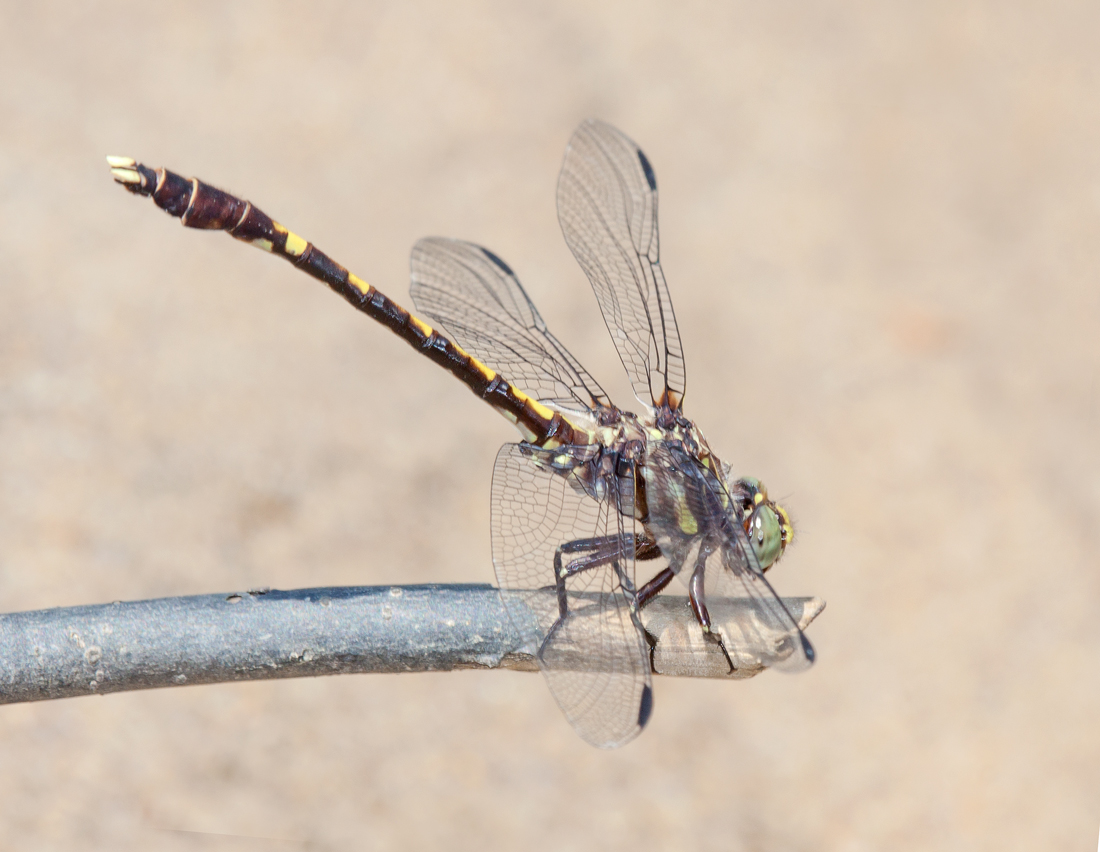
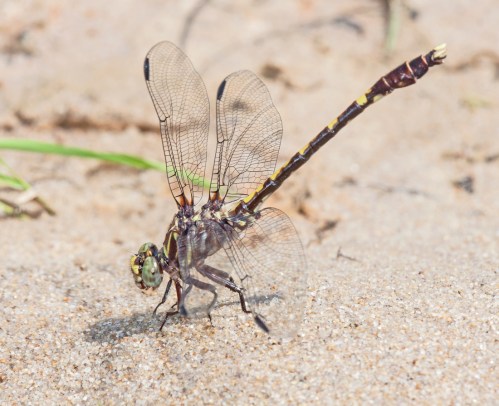
Last week I added the Common Sanddragon dragonfly (Progomphus obscurus) to the species list at Huntley Meadows Park, the marsh where I spend a lot of time walking and photographing. The park keeps a comprehensive list of species and it appears that this particular dragonfly had never before been observed and photographed within the park.
sand1_blog


I came across this dragonfly, which I recognized as some kind of clubtail, when I was hiking through a back area of the park. I was struck by the way the dragonfly was patrolling a small sandy stretch of a creek and kept returning to perches on that little beach. I took quite a few photos of the dragonfly, though I really wasn’t sure of its identity.

sand3_blog

The images would have remained unviewed on my computer for several days, but I mentioned my discovery to fellow blogger and photographer, Walter Sanford, who seemed to sense that I had captured something a bit out of the ordinary. He insisted that I send him a couple of images immediately, which I did. Walter tentatively identified the dragonfly as a Common Sanddragon and confirmed the identification with Kevin Munroe, who manages Huntley Meadows Park and is a dragonfly expert.

Kevin has a wonderful website, Dragonflies of Northern Virginia, that is full of fun and useful information about dragonflies in our area. In the section about Common Sanddragons, he notes, “Despite its name, this species is rare in Northern VA. In other parts of the country, where clean, sunny, shallow creeks with plenty of sandy/gravely banks are common, so too are Common Sanddragons. Our urban waterways are too influenced by stormwater, flowing fast and unchecked off impervious surfaces (roads, parking lots, roofs, etc.). This creates deeply incised, eroded banks and streambeds with excess silt, unstable flows.”

As a kind of experiment, I angled a couple of sticks in the sand to see if I could get one of them to perch on the stick. Although they kept returning primarily to the sand, a couple of times one perched on the stick and I got this shot.
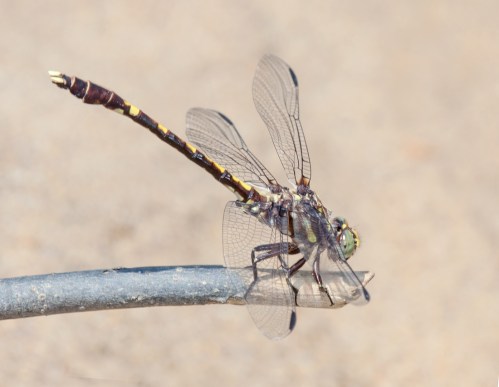
sand2_blog

You may have noticed the raised tail in several of the shots. In other dragonflies, the “obelisk” position is a method of thermoregulation, but I am not sure if this is the case here—it might be related to efforts to attract a mate.

© Michael Q. Powell. All rights reserved


Read Full Post »

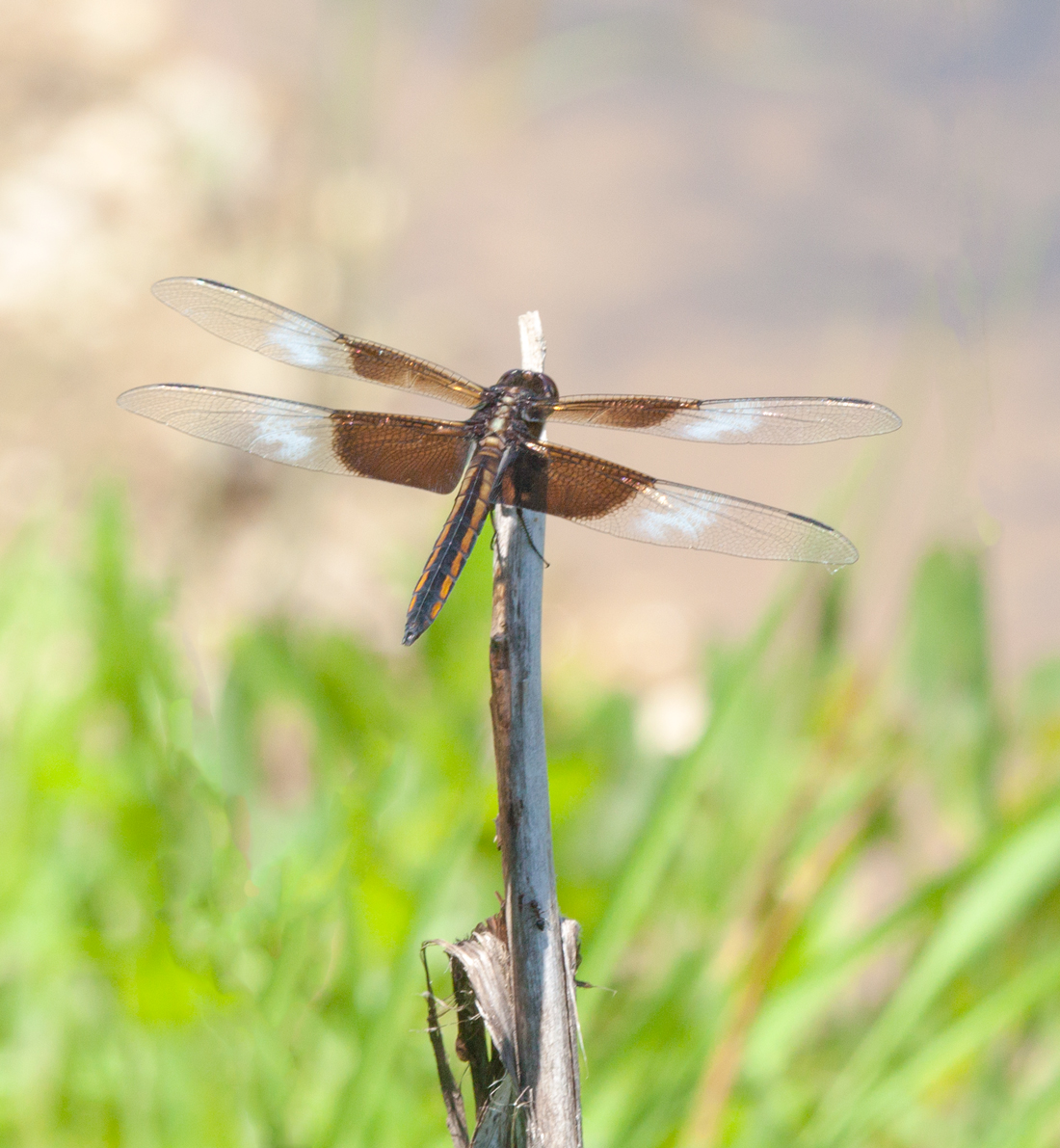
Although I usually try to get close up for my dragonfly photos, I am unusually pleased with this image I took yesterday of an immature male Widow Skimmer dragonfly (Libellula luctuosa), which has an artistic quality that is not always found in my close-ups.

For those who might be curious about the identification, the white on the wings indicates that it is a male (females have only dark blotches) and the yellow and black body indicates that it is immature,because adult males have bluish-colored bodies.

widow1_blog

© Michael Q. Powell. All rights reserved

Read Full Post »

Do you believe in unicorns? I spent part of yesterday chasing a flying unicorn, although it was the Unicorn Clubtail dragonfly (Arigomphus villosipes), not the one that looks like a horse.

Normally Unicorn Clubtails like to perch on flat surfaces, but this one chose to perch on a dead branch overlooking the muddy stream, allowing me to get a good look at it and a decent photograph.

Many people seem to like unicorns and rainbows. Now that I have captured a unicorn, I’m on the lookout for a rainbow–and it looks like it may rain later today.

unicorn1_blog

© Michael Q. Powell. All rights reserved.


Read Full Post »

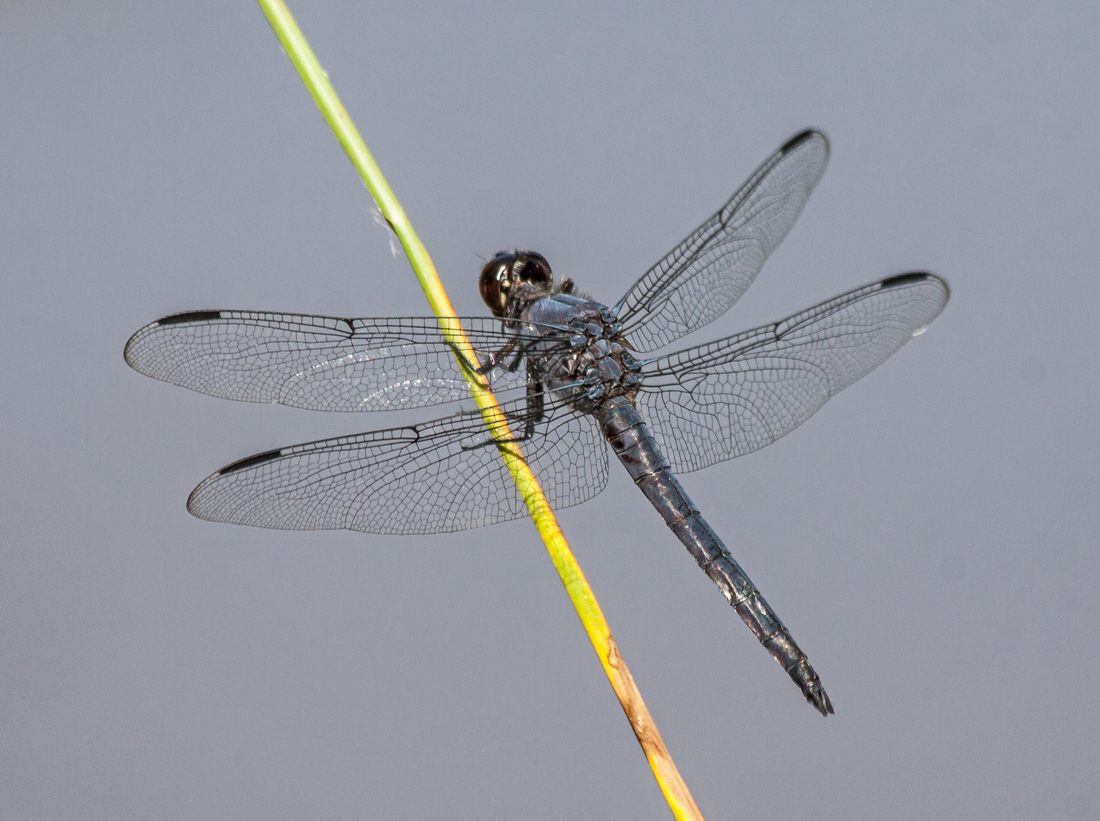
It’s prime season now for dragonflies and there are lots of them flying about. Some are brightly colored and gaudy, while others, like this Slaty Skimmer (Libellula incesta) that I encountered Tuesday at Huntley Meadows Park, have a more subdued and refined beauty.

I have been experimenting a bit with lenses and with camera settings as I chase after dragonflies. Although I often use my macro lens for this kind of shot, I took this one at 270mm of my 70-300mm telephoto zoom. I have been told that most telephoto lenses are a little soft at their extreme ends, so I pulled back a little from 300mm. Similarly, I shot this at f/10 to try to get a balance between sharpness and depth of field, while keeping the shutter speed high enough for me to easily handhold the camera.

Most of the time I use evaluative metering on my camera, but for most of my shots on Tuesday, I had the camera set for spot metering. In doing so, I realized quickly that I had to pay a lot more attention to the precise spot on which I was focusing, because that was going to play a disproportionate role in determining the exposure.

I realize, of course, that a lot of the choices will be situationally dependent, but it’s fun and instructive to try out new settings and combinations of settings in trying to improve the quality of my images. (Click on the image to see a higher resolution view of this dragonfly.)

slaty_skimmer1_blog

© Michael Q. Powell. All rights reserved.

Read Full Post »

A few weeks ago, I did a posting with some close-up images of a Common Baskettail dragonfly (Epitheca cynosura), but one of my fellow photographers keeps reminding me that I have not posted any shots of the entire dragonfly, which it turns out is not all that common in our local marshland park.

This small collection of images highlights some of the notable features of the Common Baskettail dragonfly, including its beautiful blue eyes and unusual tail. I took these photographs a month ago (on 19 May), but I have fallen a bit behind on viewing and processing my shots.

baskettail1_blogbaskettail2_blogbaskettail3_blog

© Michael Q. Powell. All rights reserved.


Read Full Post »

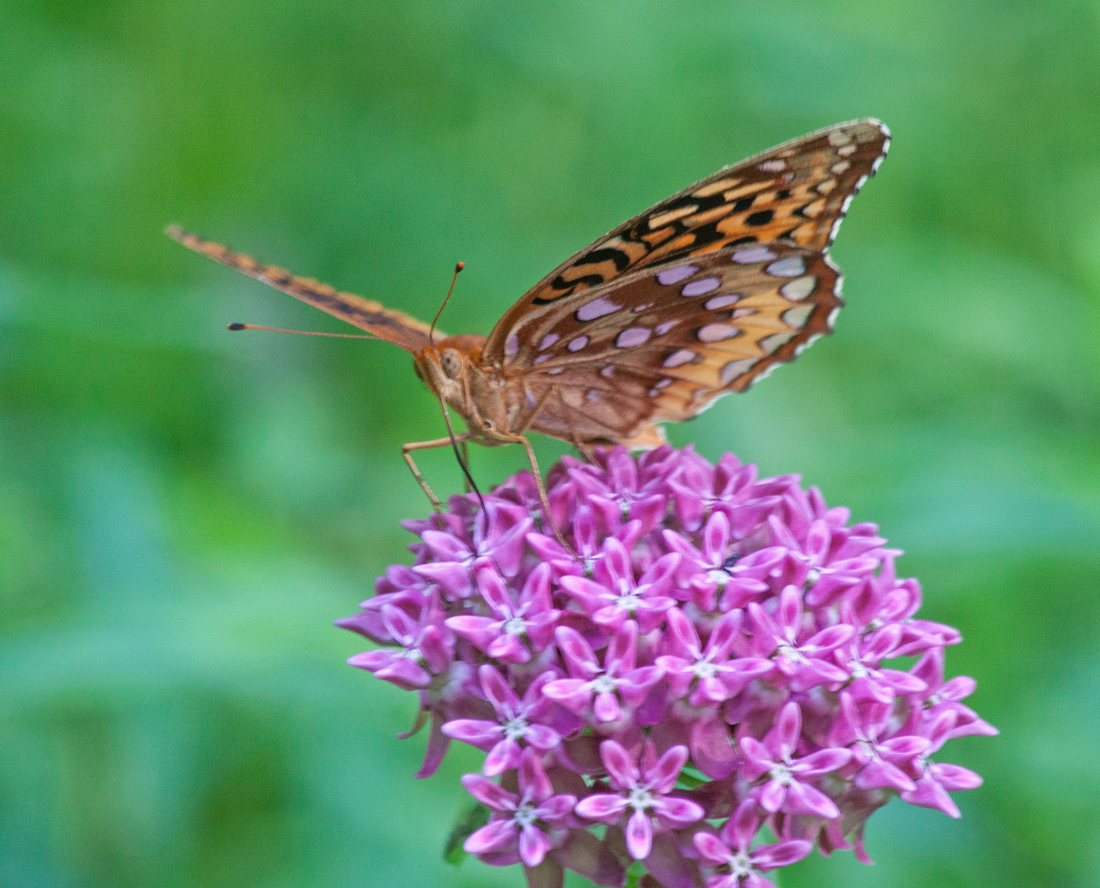
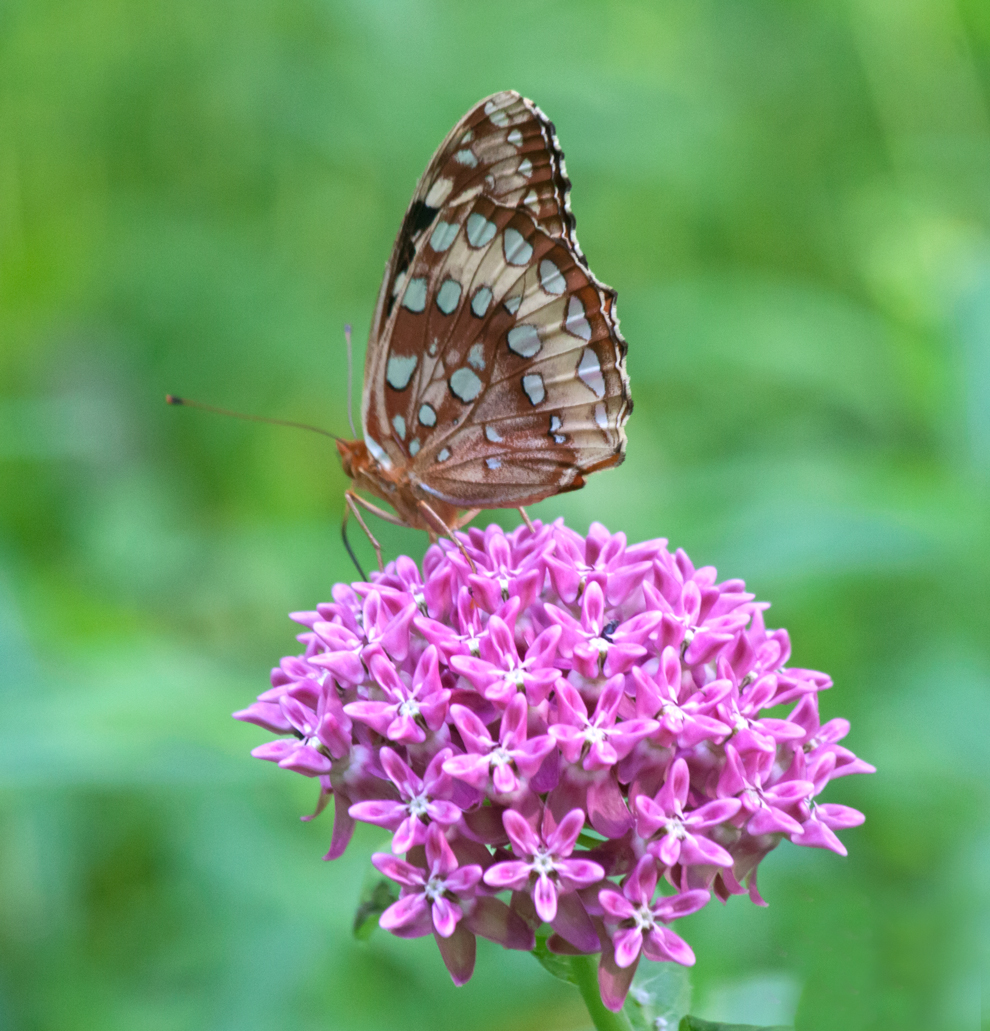
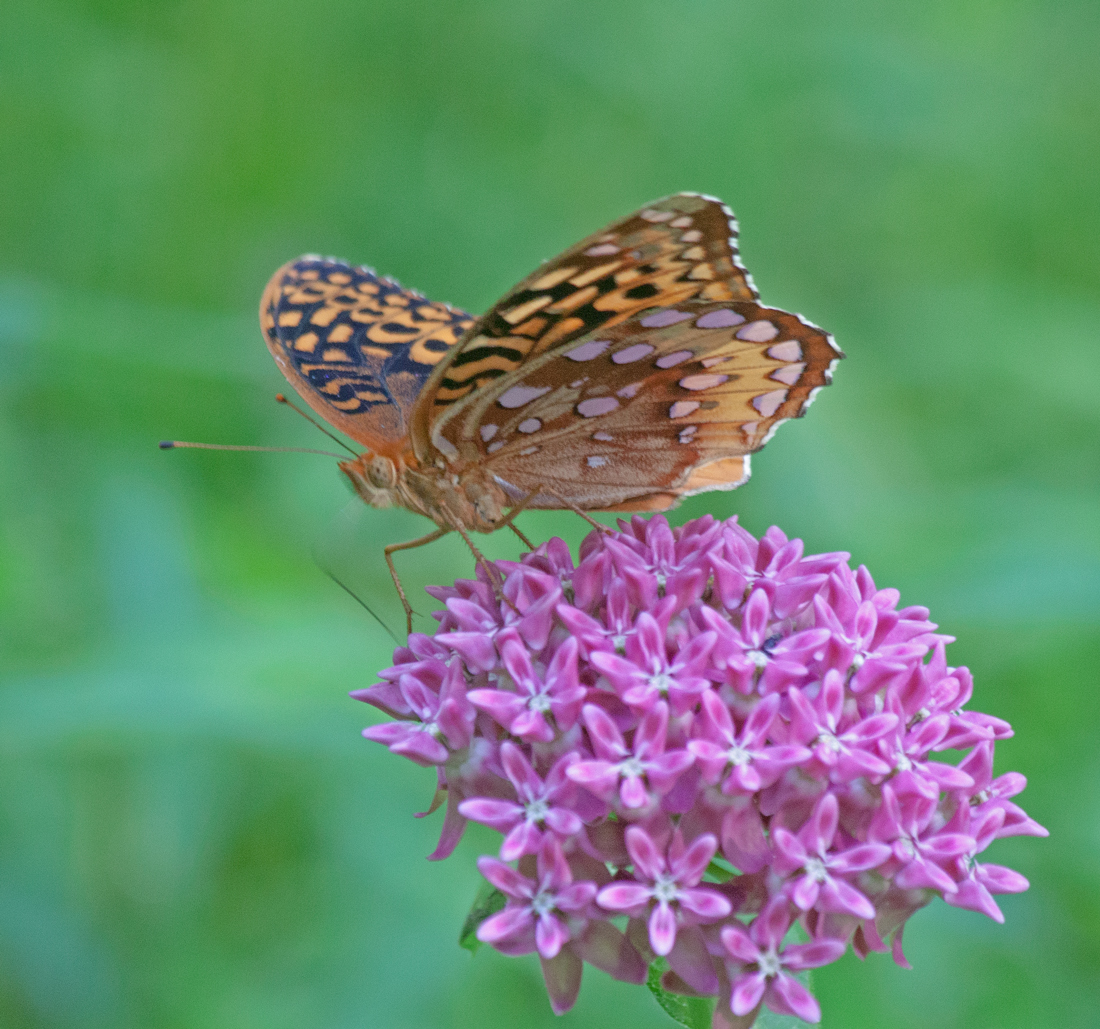
After a week and a half on the road, it was great for me to be able to return to my local marshland yesterday. I was thrilled to see that butterflies have reappeared, including Great Spangled Fritillary butterflies (Speyeria cybele). A group of about a half dozen or so of them kept returning to clusters of a pink-flowered plant that looks like a kind of milkweed, permitting me to get shots of the butterflies in various positions on the flowers.

spang_frit3_blogspang_frit1_blogspang_frit2_blog

© Michael Q. Powell. All rights reserved.

Read Full Post »

This dragonfly has such distinctive markings that I should have been able to identify it easily, but I had never seen one like it before, so I didn’t know what it was.

Fortunately, a short time later that day I ran into local dragonfly expert and fellow blogger Walter Sanford, who informed me that it was a Spangled Skimmer dragonfly (Libellula cyanea). Spangled Skimmers have black and white stigmas on their wings, which makes them unique among dragonflies in my part of Northern Virginia. As you may be able to guess from my images, Spangled Skimmers are among the species of dragonflies that like to perch, which makes it easier to photograph them—if you can find them.

spangled1_blogspangled2_blog

© Michael Q. Powell. All rights reserved.

Read Full Post »

One of my fellow photographers excitedly pointed out a small spiderweb to me as I was preparing to leave my local marsh and I moved closer to investigate. At the center of the web was a small colorful spider of a type which I had seen before, but had never identified. I realized that I must have a peculiar reputation when others start to get excited about spiders on my behalf.

I felt obliged to take some photos, given that my friend had gone to the trouble of spotting the spider for me, but I didn’t have any great expectations that they would turn out well. The spider was small and the angle of the web made it a little tough to keep everything on a single plane (and I was handholding the shot at close range).

I really admire the artistry of spiders and their webs, however, and have not seen many this spring, so I took quite a few images and was pleasantly surprised with the result. The spider probably is an Orchard Orbweaver spider (Leucauge venusta) or possibly the similar Leucauge argyra. As you may note, this is a kind of long-jawed spider with legs of differing lengths. It is an ongoing mystery to me how the spider is able to weave an intricate, symmetrical web with such asymmetrical appendages.

Out of all of the subjects that I photograph, spiders tend to be the most polarizing—readers tend to find spider images to be either creepy or beautiful. I hope that the majority of readers will view this colorful little spider as beautiful.


spider_color_blog

© Michael Q. Powell. All rights reserved.

Read Full Post »

As I was getting ready to leave my local marshland park on Friday, I spotted what I thought was a small dragonfly. Upon closer examination, it turned out to be a robber fly, subduing a captured prey.

There are a lot of varieties of robber flies in the Asilidae family and I am not sure which kind this is, but robber flies have a reputation for being really vicious predators.

Wikipedia describes their hunting method in these words, “The fly attacks its prey by stabbing it with its short, strong proboscis injecting the victim with saliva containing neurotoxic and proteolytic enzymes which very rapidly paralyze the victim and soon digest the insides; the fly then sucks the liquefied material through the proboscis.”

I guess we can all be thankful that robber flies are not big enough to hunt humans—except perhaps in science fiction movies.

robber1_june_blog

© Michael Q. Powell. All rights reserved.

Read Full Post »
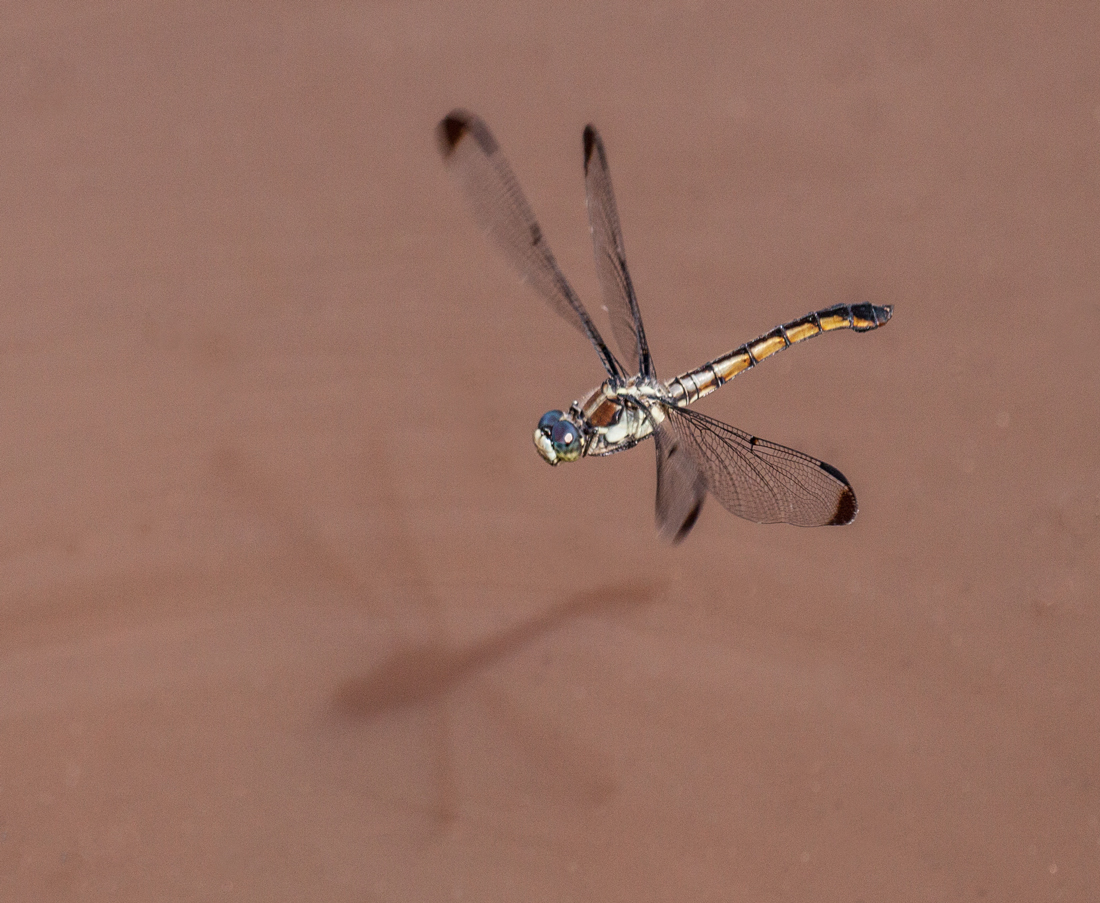
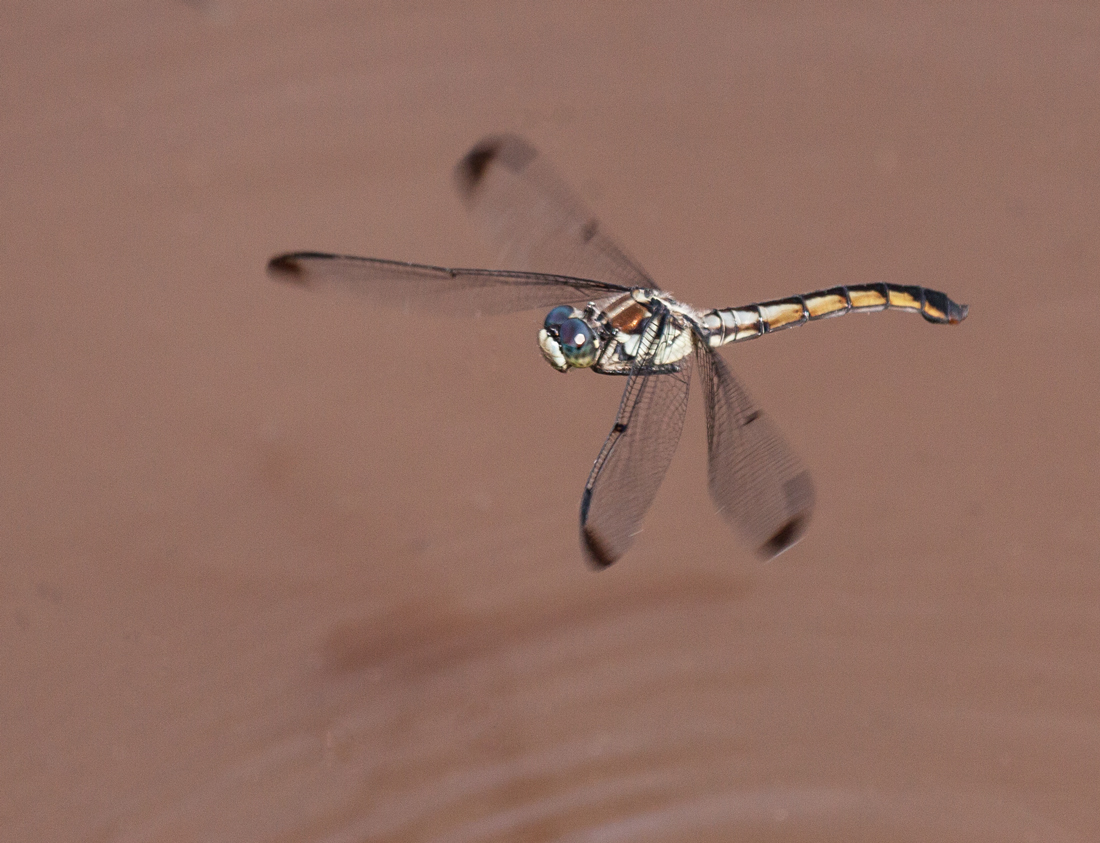
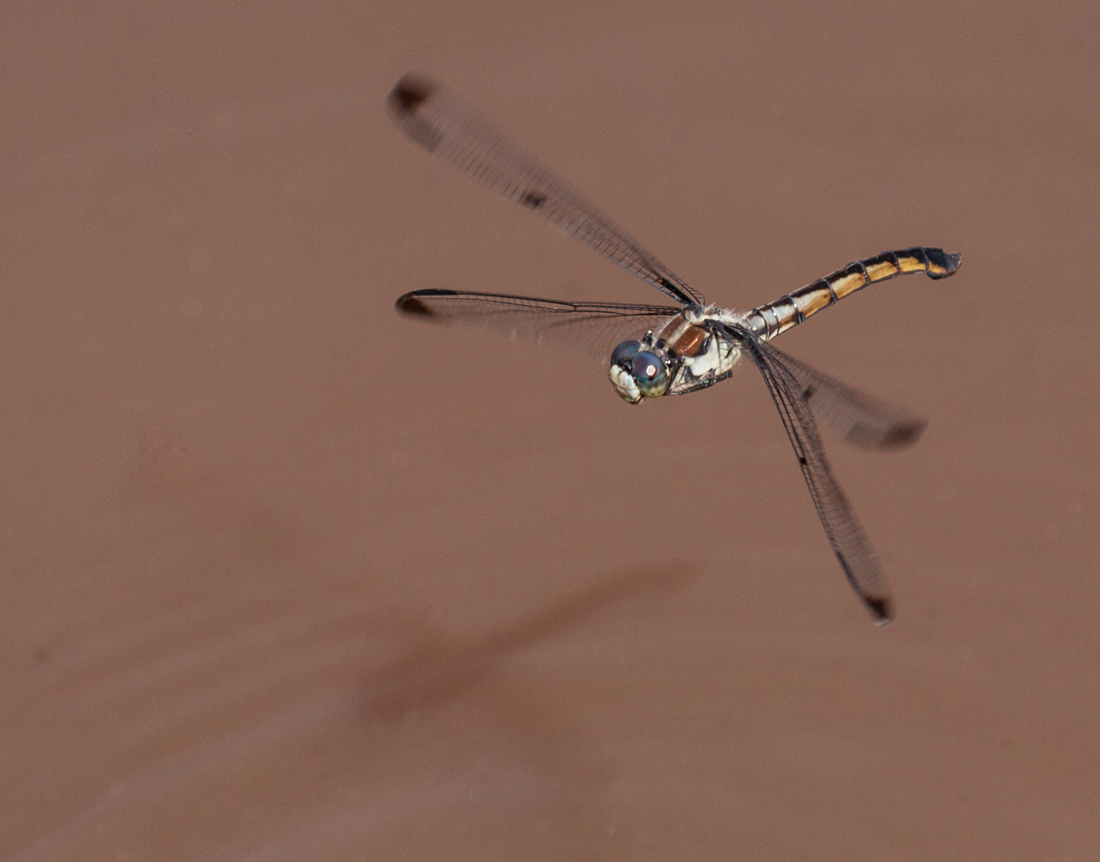
What do you think about when you hear the word “dasher?”  From my early childhood days, the word meant only one thing—it was the name of one of Santa’s reindeer.

Many of us grew up hearing these familiar words from the poem “Twas the Night Before Christmas” (“A Visit From St. Nicholas“) by Clement Clarke Moore:

More rapid than eagles his coursers they came,

And he whistled, and shouted, and called them by name;

“Now, Dasher! now, Dancer! now, Prancer and Vixen!

On, Comet! on, Cupid! on, Donder and Blitzen!

To the top of the porch! to the top of the wall!

Now dash away! dash away! dash away all!”

So, every time I see a Blue Dasher dragonfly (Pachydiplax longipennis), like this beautiful male that I photographed this weekend, I can’t help but have a little thought of Christmas, even on the hottest days of summer.

But Santa, some may complain, didn’t have a blue Dasher. That’s true, of course, but Elvis had no problem singing of a Blue Christmas, the perfect setting for a Blue Dasher. (Click here to watch a You Tube video of Elvis singing this signature tune.)

dasher1_june_blog

© Michael Q. Powell. All rights reserved.

Read Full Post »
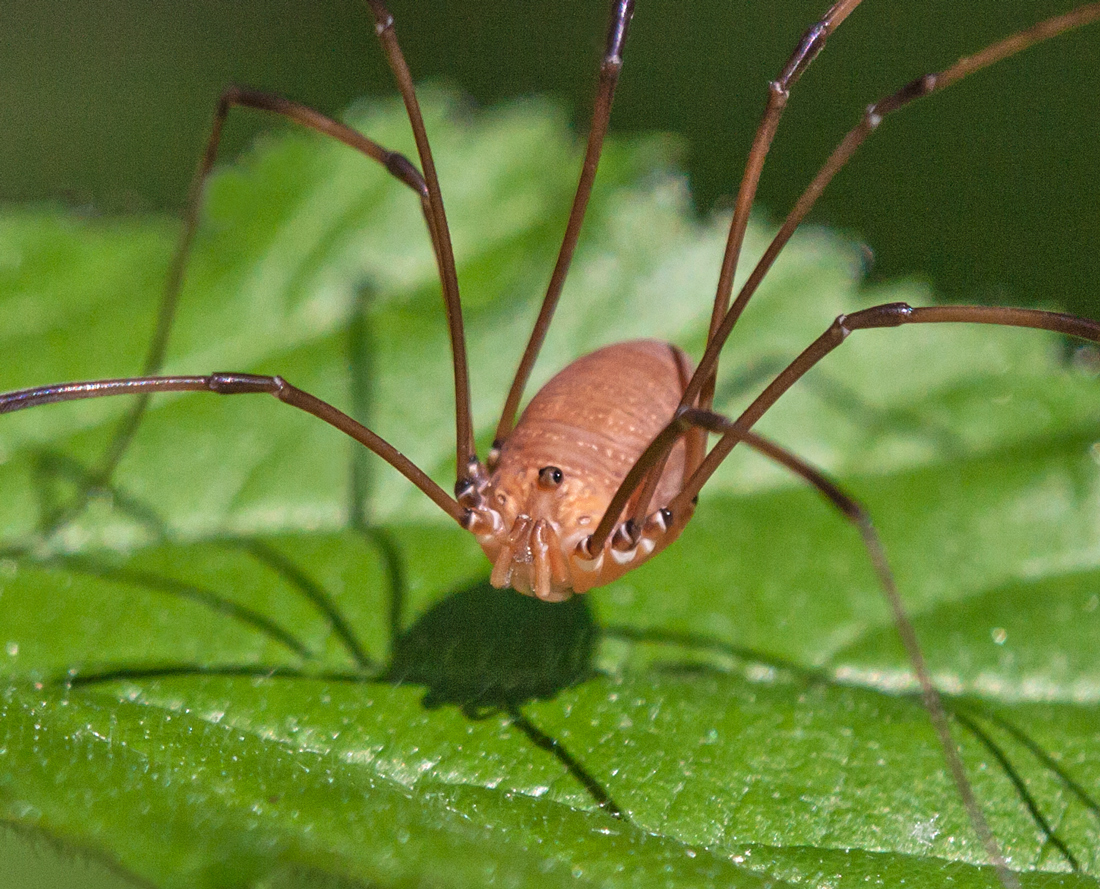
Daddy longlegs have a single pair of eyes, oriented sideways, in the middle of their heads and it’s a little disconcerting to peer through a macro lens and see one of these eyes looking toward you. Daddy longlegs (also known as harvestmen) belong to the arachnid family, but are not spiders. Harvestmen make up the order Opiliones and, according to Wikipedia, there may be as many as ten thousand species of harvestmen worldwide, with over 6500 already discovered.

I cropped the first shot of the harvestman to allow you to see the eyes better, but it doesn’t really give you a sense of the length of the legs. The second shot, which is actually a less-cropped version of the first one, shows you more of the legs. I did crop out the ends of the outermost legs, though, to keep the body from looking too small.


daddy1A_june_blogdaddy1_june_blog

© Michael Q. Powell. All rights reserved.

Read Full Post »
Is it just me, or does the word “skink” sound funny to you? Certain words simply sound odd to me and for some reason “skink” is one of them—I can’t help but smile whenever I say the word out loud.

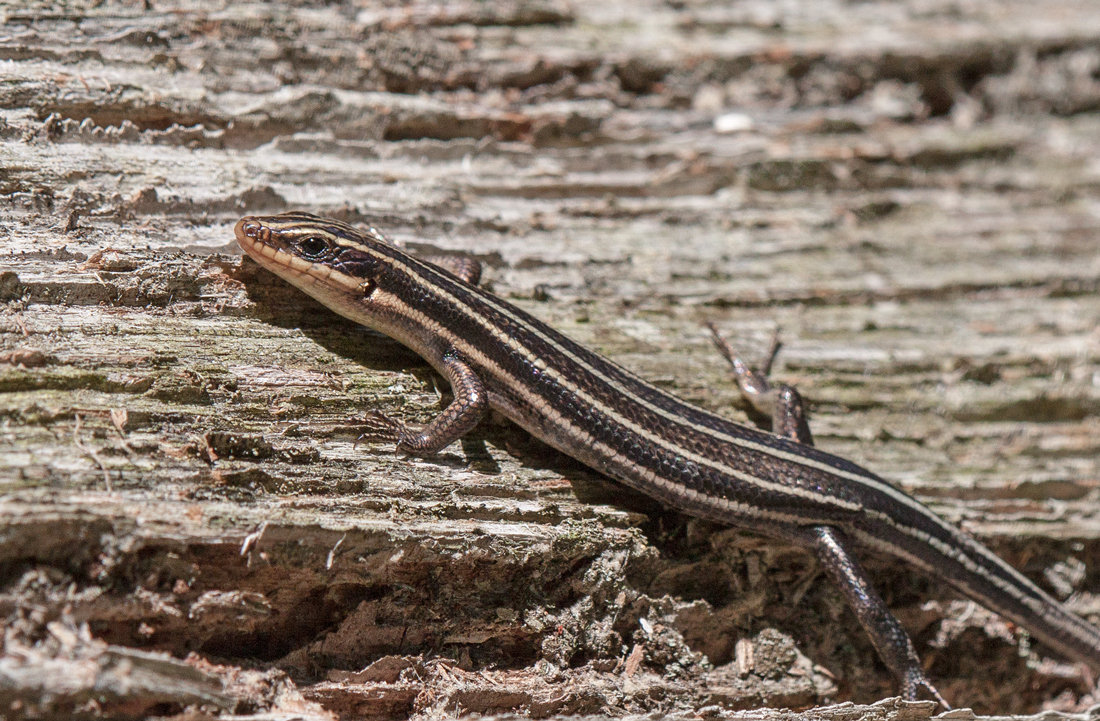
Recently I took this shot of a Common Five-lined Skink (Plestiodon fasciatus, formerly Eumeces fasciatus) at my local marshland park. It was sunning itself on a rotten log and didn’t detect my presence immediately and run away, which is what usually happens when I spot a skink. It seems to have its head cocked a little and has a smile on its face, as though daydreaming, as I do when sunbathing.

skink1_blog


I wonder if you could use “skink” as a verb to describe the crawling-type behavior typical of a skink, as in, “I saw my friend skinking about.” If “skink” were a verb, would it follow the model of “drink,” with verbal forms that included “skank” and “skunk?”  That might induce a bit of confusion, I suppose, since “skank” suggests a different kind of behavior, as does “skunk.” English can be a strange language.

I’ll just continue smiling.

© Michael Q. Powell. All rights reserved.

Read Full Post »
To crop, or not to crop—that is the question. At a certain point in time when we are processing our images, we are all come face to face with this question. To some photographers, composing perfectly in the camera is the ultimate virtue, and they take pride in the fact that they do not crop (and object when their images are cropped).

Moose Peterson is one prominent photographer who does not crop and he explained his views in a fascinating blog posting in 2012 entitled, “The Crop Revisited.” I am still pondering one of his conclusions, “When you don’t give yourself the option to “fix it in post,” photographers push themselves. This always make a better click and the story telling, the subject, that passion of that click becomes clearer and clearer.”

Most of us could not live with such a high standard and for various reasons we choose to crop. I am so used to cropping my images that even when I compose an image just the way that I want it, I am tempted to move in closer with my crop. That was my dilemma with this image of a damselfly on the edge of a lily pad, as it was framed when it came out of the camera.

damsel_pad_blogI really like the long sinuous curve on the left and the large expanse of green on the right. I worry, however, that the damselfly is taking up too little space of the image and is not prominent enough. So I cropped a bit and produced a second version.

damsel_pad_crop_blog

That’s not a very extreme crop, but somehow the image feels different to me. Does it make any difference to you? Do you prefer one of the two over the other?

UPDATE: Fellow blogger and local dragonfly expert, Walter Sanford, has identified this for me as an Eastern Forktail damselfly (Ischnura verticalis). Thanks, Walter.

© Michael Q. Powell. All rights reserved.


Read Full Post »

Green Herons (Butorides virescens) are once again hanging out at my local marshland park. Unlike Great Blue Herons (Ardea herodias), which fish while wading in the water, these smaller herons usually wait at water’s edge or on vegetation, which normally makes them tough to spot. This Green Heron, though, decided to perch on a log in plain view, which allowed to take this rather formal looking portrait shot.


heron_green_blog

© Michael Q. Powell. All rights reserved.

Read Full Post »
« Newer Posts - Older Posts »