Feeds:
Posts
Comments

Archive for the ‘Photography’ Category

I spotted this Common Green Darner dragonfly (Anax junius) during a recent trip to Occoquan Bay National Wildlife Refuge. It was patrolling overhead within a fairly confined area and I was able to track it visually until it finally landed. The photo makes it look like the dragonfly was climbing its way out of a deep pit. In reality, however, it was hanging from some roots sticking out from a big pile of dirt.

I was a little surprised that I was able to capture as much detail as I did, given that I was shooting with my Tamron 150-600mm lens fully extended to 600mm. Supposedly the lens is soft at 600mm, but good stabilization techniques (including using a monopod) and a little tweaking with software produce images that are acceptably sharp to my eyes.

I love the multi-colored bodies of Common Green Darners, one of the largest dragonflies in our area with a body length of about 3 inches (76 mm). I think that this is a male. Mature males normally have bright blue abdomens, but they may turn purple when temperatures are low, which seemed to be the case when I took this photo. Females, by contrast, have abdomens that tend to be a mixture of tan and gray-green. For both genders, the thorax (the “chest” area) is bright green.

If you click on the image, you can get a better look at the dragonfly’s “bullseye” marking, the black and blue dot that is found on the “nose” of both male and female Common Green Darners. I am always thrilled when I manage to get a shot that captures the bullseye so well.

We are in the midst of a spell of cool, rainy weather so I have not seen any dragonflies in over a week. The weather is forecasted to warm up a bit, so I am hoping that I will have better success in the upcoming week.

Common Green Darner

© Michael Q. Powell. All rights reserved.


Read Full Post »

It is prime time for the bearded irises in the garden of my dear friend and fellow photographer Cindy Dyer. There are several dozen irises in bloom now in multiple colors, including these beauties, and it looks like even more flowers will be blooming soon.

Beauty is everywhere.

bearded irises

Bearded Iris

Bearded Iris

© Michael Q. Powell. All rights reserved.

Read Full Post »

It did not seem like there was much pollen inside of each little phlox flower, but bees were busily collecting it when I spotted several of them last Saturday at Meadowlark Botanical Gardens in Vienna, Virginia. I love the way that some bees, including honeybees, collect pollen in little pouches on their back legs. When the pickings are really good, I have seen those pouches, which technically are called corbiculae, so full and bulging that they seem ready to burst—that was not the case this early in the spring, when not very many flowers were in bloom.

I was pleasantly surprised when I managed to capture a bee in flight in the second photo below as it surveyed the phlox flowers and planned its next assault. My 180mm macro lens is notoriously slow to acquire focus, so I rarely try to use it to try to capture moving subjects. The lens also is so noisy when focusing that one of my friends calls it “The Grinder.” Nonetheless, my trusty Tamron lens is my constant companion during the warm months and it is the one I use most often for my insects and other macro shots.

bee and phlox

Bee and Phlox

© Michael Q. Powell. All rights reserved.


Read Full Post »

Some of the coolest looking plants that I saw last Saturday at Meadowlark Botanical Gardens were Japanese Jack-in-the-Pulpit flowers (Arisaema sikokianum). There is something so alien and exotic about this plant that it stopped me in my tracks when I first spotted it.

According to the Plant Delights Nursery, Inc. website, the dark pitcher and two five-lobed leaves of this plant emerge on a 12 inch tall (30 cm) fleshy stalk from an underground tuber in early spring. As the pitcher opens, it reveals a swollen, pure white, protruding spadix that provides a dramatic contrast to the purple of the pitcher.

The Japanese Jack-in-the-Pulpit is closely related to the Jack-in-the-pulpit (Arisaema triphyllum), which, according to Wikipedia, is common to the eastern United States. I checked the range map and the Jack-in-the-Pulpit can be found in Virginia where I live, though I have not yet spotted one. When I looked at photos of the American species, it looks fairly similar to the Japanese variant, but the spadix, the part that is the “Jack” in the name, is darker in color and the pitcher more closely matches the leaves. Check out this blog posting by Steve Gingold to see a beautiful photo of a Jack-in-the-Pulpit growing wild in his area of New England.


Japanese Jack-in-the-Pulpit

Japanese Jack-in-the-Pulpit

Japanese Jack-in-the-Pulpit

© Michael Q. Powell. All rights reserved.

Read Full Post »

I am a bit of a romantic, so my eyes are immediately drawn to the heart-shaped blooms of Bleeding Heart flowers whenever they are present in a springtime garden. Most of the time they are reddish in color, as their name suggests, but they also come in other colors. I spotted these beautiful White Bleeding Hearts (Dicentra spectabilis alba) last Saturday at Meadowlark Botanical Gardens.

I was fortunate to be able to get close enough for the first photo to be able to focus on the delicate shape of a single flower. Somehow the little wings on the hearts make me think of angels or maybe the little cherubs that we associate with Valentine’s Day. The second image gives you an idea of the way that these flowers grow in rows, suspended from tiny filaments from a stalk, twisting and turning in the wind.

Bleeding Heart

Bleeding Heart

© Michael Q. Powell. All rights reserved.
Read Full Post »

A speedy little Barn Swallow (Hirundo rustica) was perched on a paved path at Meadowlark Botanical Gardens last Saturday and I captured this first image as it was taking off. The shot is a little blurry, but I love the the really cool shadow that the swallow was casting onto the ground. The second image shows the same swallow just before it took off and give you a better view of the coloration and markings of a Barn Swallow.

When I first spotted the birds in the final photo, I thought they might also be Barn Swallows, but when I took a closer look and did a little research, I determined that the bird on the outside of the nest was a male Purple Martin (Progne subis) and the one with her head poking out was a female Purple Martin. As far as I can recall, this is the first time that I have photographed this bird species, which is the largest swallow in our area.

Barn Swallow

Barn Swallow

Purple Martin

© Michael Q. Powell. All rights reserved.


Read Full Post »

I love the shape and colors of columbine flowers that appear in many of the gardens that I visit during the spring. According to Wikipedia, the genus name for these flowers Aquilegia is derived from the Latin word for eagle (aquila), because of the shape of the flower petals that are said to resemble an eagle’s claw. The common name “columbine” comes from the Latin for “dove”, due to the resemblance of the inverted flower to five doves clustered together.

I spotted several spectacular columbines during a visit to Meadowlark Botanical Gardens in Vienna, Virginia last Saturday. The purple columbine was in the middle of a flower bed and I could not get very close to it. I was really happy though that I had to shoot from a longer distance away than normally, because I able to capture some of the shadowy shapes of the ferns in the background.

I did manage to get quite a bit closer to the pretty pink columbine. I smiled when I saw a marker that indicated that this variety is called “Strawberry Ice Cream.” I now have an overwhelming urge to buy some strawberry ice, one of the many ice cream flavors that I love.

columbine

columbine

© Michael Q. Powell. All rights reserved.


Read Full Post »

As we were photographing some Spring Snowflake flowers (Leucojum vernum) on Saturday at Meadowlark Botanical Gardens, my dear friend and photography mentor Cindy Dyer noticed what looked like a spider’s leg on the side of one of the flowers and asked me to go around to the other side of the flower to investigate.

Sharp-eyed Cindy was right—I spotted this tiny spider clinging to the side of the snowflake and was delighted that I was able to capture this image of it.

Leucojum vernum

© Michael Q. Powell. All rights reserved.

Read Full Post »

Most warblers forage in the forest canopy and I have to strain my neck to search for them. Palm Warblers (Setophaga palmarum), however, mainly forage on open ground or in low vegetation.  When I saw a flash of yellow in some low bushes last week at Occoquan Bay National Wildlife Refuge, I therefore suspected that it might be a Palm Warbler.

I watched and waited and eventually the bird hopped up onto a branch and I managed to get a clear shot of it. I wasn’t one hundred percent sure that it was a Palm Warbler, but the color and markings looked about right and I could see the rust-colored cap on its head, another identification feature for a Pine Warbler. Some experts in a Facebook forum confirmed that “my” bird is indeed  a Palm Warbler.

The warblers are with us for only a limited period of time in the spring before they continue their migration northward, so I don’t know how many more times I will have a chance to photograph them. At this time of the year, though, colorful flowers are popping up and insects are reappearing, so I won’t suffer from a lack of subjects when the wablers depart.

Palm Warbler

© Michael Q. Powell. All rights reserved.
Read Full Post »

I love the rich color, velvet-like texture, and geometric shape of this beautiful little flower that I spotted yesterday at Meadowlark Botanical Gardens in Vienna, Virginia. I believe that this is a Red Trillium (Trillium erectum). According to Wikipedia, Red Trilliums are also known as wake robin, bethroot, and stinking benjamin.

I was curious about the name “stinking benjamin,” so I searched on-line and learned that Red Trilliums produce fetid or putrid odors purported to attract carrion fly and beetle pollinators. Some describe the odor as similar to that of a wet dog—I did not get close enough to verify personally the accuracy of this assertion.

Red Trillium

© Michael Q. Powell. All rights reserved.
Read Full Post »

Common Whitetail dragonflies (Plathemis lydia) are probably the most common dragonflies in my area. They are among the first species to appear in the spring and among the last to be seen in the autumn and can be found in a variety of habitats. I photographed my first Common Whitetails of the season last week at Accotink Bay National Wildlife Refuge.

When they are adults, it is easy to distinguish the male Common Whitetails from the females—the males have white-blue abdomens and the females have brown abdomens. Immature males, however, have the same coloration as the females. If you look at the first two photos below, you can see that the coloration and markings on the two dragonflies is quite similar, but the first one is an immature male and the second one is a female.

For Common Whitetails, the first thing I do is to look at the pattern of dark patches on the clear wings. Males have two patches per wing and females have three, including one that extends to the wingtip. This is really easy to see in the first two photos, because the dragonflies were perched above the ground.

Quite often, though, Common Whitetails will perch flat on the ground in the leaf litter, as in the third photo, and it is a little tougher to see the wing markings. As long as you can see a clear wingtip, however, you can tell that it is a male.

There are, of course, other ways to tell the gender of a Common Whitetail, if you can’t see the wings. If you look really closely at the tips of the abdomen (the “tail”), for example, you can see that they are shaped differently—the male’s terminal appendages are more tapered, while the female’s are more stubby in appearance.

I don’t consider myself an expert in dragonflies and my background is not in science, but I have learned about these colorful aerial acrobats over the last ten years of photographing them. Folks sometimes ask me how I can tell the gender of a dragonfly and I think it cool to be able to explain what is going on in my mind when I am trying to figure out what I have photographed. This is especially true when I have photos that show both the male and female of a species, as was the case with these Common Whitetail dragonflies.

Common Whitetail

Common Whitetail

Common Whitetail

© Michael Q. Powell. All rights reserved.

Read Full Post »

I spotted this colorful Prairie Warbler (Setophaga discolor) as it was singing high in a tree on Thursday at Occoquan Bay National Wildlife Refuge. Most of the time I spot birds like this when they fly to a new perch, but this warbler stubbornly refused to move. I stared and stared at the tree, desperately trying to locate the source of the song that the bird was singing over and over again.

I finally located the warbler in the crook of a branch. I was looking upward at such an acute angle that I mostly got a view of the underside of the bird, but eventually I captured the first image in which the warbler was singing. Prairie Warblers have an unusual rising song that the Cornell Lab of Ornithology described in these words, “The Prairie Warbler sings a distinctive, rising and accelerating song with a buzzy quality, zee-zee-zee-zee-zee-zeeeee.” If you click on this link, you can listen to several sound samples of the songs of the Prairie Warbler.

I do not know how much longer the migratory warblers will be in my area, but I hope to have another chance to see some of these joyous little birds. I am still not confident in my identification skills for warblers, so there is a chance that I am wrong about this being a Prairie Warbler, but its beauty is undeniable.

Prairie Warbler

Prairie Warbler

Prairie Warbler

© Michael Q. Powell. All rights reserved.

Read Full Post »

I was delighted yesterday to spot this beautiful Black Swallowtail butterfly (Papilio polyxenes) at Occoquan Bay National Wildlife Refuge, the first one that I have seen this season. At this time of the year I am always struck by the pristine look of the newly emerged butterflies—later in the season they will become tattered and faded.

In my area we have four different black swallowtails—the Black Swallowtail, the Spicebush Swallowtail, the Pipevine Swallowtail, and the dark morph female Eastern Tiger Swallowtail. Sometimes it can be difficult to distinguish between the species, but in this case it was really easy. Male and female Black Swallowtails can be identified by the black dot inside the orange dot in the middle of the bottom of the hind wings, as you can see in this photo. Several years ago I came across a wonderful posting by the Louisiana Naturalist that has side-by-side comparisons of these four species and tips on how to tell them apart.

Last Friday, Jet Eliot, a wonderful writer and blogger who lives on the West Coast, wrote a fascinating blog posting entitled Swallowtail Butterflies that looked at some of the swallowtails in her area as well as others that she has encountered during her worldwide travels. The photos in the posting by Athena Alexander are astounding and Jet’s prose is informative and inspiring. I encourage you to check out the posting and leave you with this wonderful snippet from Jet—”I am often buoyed by these dancing kaleidoscopic creatures who start out so immobile and teensy and dark, and as each day turns to the next, they somehow know what to do. Soon they have mysteriously blossomed into delicate splendor.”

Have a wonderful weekend.

Black Swallowtail

© Michael Q. Powell. All rights reserved.

Read Full Post »

Most flowers have blooms at the end of their stems or at least in places above their leaves. Each spring, though, I encounter Mayapples (Podophyllum peltatum), a weird plant that seems to work in a totally different way. It puts out large umbrella-shaped leaves and eventually a single white blossom appears at the juncture point where the stem branches off in two directions. If you don’t know that the blooms are there, it is easy to miss them, because the large leaves hide them from view.

I saw a large number of Mayapples on Wednesday at Accotink Bay Wildlife Refuge at the edge of Fort Belvoir, a nearby Army base where I have seen Mayapples in the past, but most often before or after they had flowered. I tried to capture the unique way that this plant grows in these photos, which was a bit of a challenge, because the blooms are so close to the ground.

I came across a fascinating article on the Wisconsin Horticulture website that noted that Mayapple  “typically grows in colonies from a single root in open deciduous forests and shady fields, riverbanks and roadsides…The upright stems grow from a shallow, creeping, branched underground rhizome, composed of many thick dark or reddish-brown tubers connected by fleshy fibers and downward spreading roots at the nodes. Each terminal bud produces a shoot. The mostly unbranched 12-18 inch tall stems are topped with umbrella-like (peltate) leaves. The leaves remain furled as the stem elongates in the spring, unfolding when the stem nears its full height. Each smooth, pale green, rounded, palmate leaf has 5-9 shallowly to deeply cut lobes. There are one or two leaves per stem, each up to a foot across. Only stems with more than one leaf will flower. Mayapple often forms large, dense colonies in the wild.”

As most of you know, I focus mostly on wildlife in my photography, but my almost insatiable sense of curiosity draws me to anything weird and wonderful that attracts my attention, like these Mayapples.

mayapple

Mayapple

Mayapple

© Michael Q. Powell. All rights reserved.
Read Full Post »

I was tracking a Common Green Darner dragonfly (Anax junius) in my viewfinder yesterday at Occoquan Regional Park, when suddenly another dragonfly flew into the frame. The two dragonflies appeared to hook up in mid-air and I assumed that they were mating. When they landed in some nearby vegetation, however, I discovered that it was hunger and not lust that had brought them together. The Common Green Darner was having lunch with a Common Whitetail dragonfly (Plathemis lydia), and it was the main course.

Dragonflies feed on other live insects and they aren’t picky eaters—they will eat any insect they can catch, including other dragonflies. Midges and mosquitoes make up the bulk of their diet, but dragonflies also prey on flies, bees, beetles, moths, butterflies, and other flying insects. The larger the dragonfly, the larger the prey insect it can consume.

As you can see from the photo, Common Green Darners are quite large, with an overall length of approximately three inches (76 mm), while Common Whitetails are considerably smaller, with an overall length of approximately 1.7 inches (43 mm).

Common Green Darners are really powerful fliers too and are one of only a handful of dragonfly species that migrate. The adult Common Green Darners that I see this early in the season are likely to be migrants from locations further south. Kevin Munroe described their migration really well on the wonderful Dragonflies of Northern Virginia website:

“They emerge in the Southeast and fly north, arriving here late March thru May. After their long flight, they mate, lay eggs and die. Their young emerge in July and August. Congregating in large swarms, this second generation begins flying south in September. They lay eggs that fall, after arriving in their southern destinations, and die. When their young hatch in March, they fly back to N. VA and it starts again – a two generation migration.”

The Common Whitetail in the photo probably emerged only recently and may have been particularly vulnerable. Some may find this photo to be a little disturbing or a bit too graphic, but I think it shows the “circle of life” in nature. Yesterday the Common Green Darner was the predator, but tomorrow it could become the prey of a bird or some other creature higher up on the food chain—all creatures have to eat.


Common Green Darner

© Michael Q. Powell. All rights reserved.

Read Full Post »

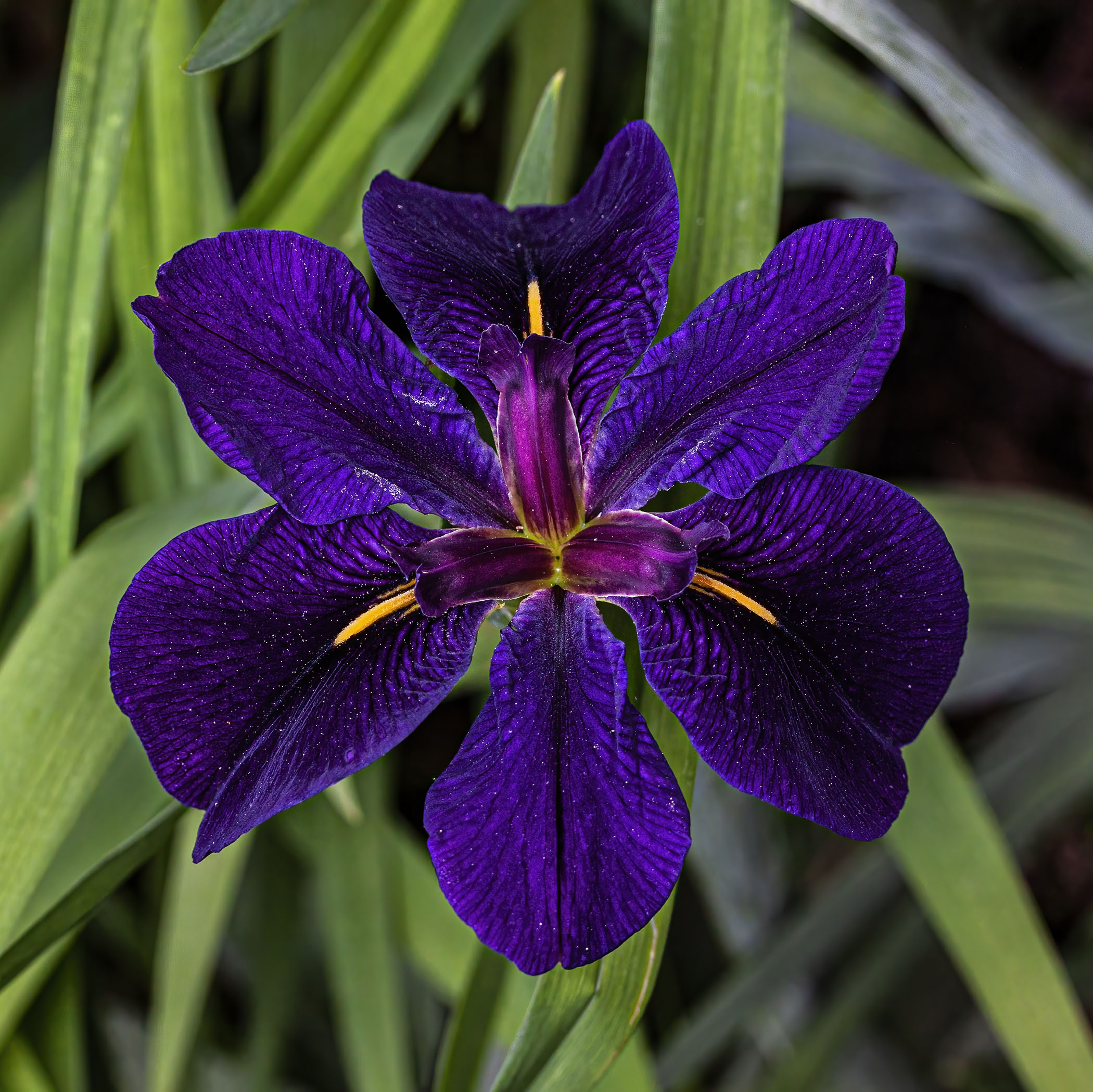
It is now the season for irises. All kinds of irises are starting to pop open in the garden of my dear friend and photography mentor Cindy Dyer. We are neighbors in a townhouse community in Northern Virginia, which means there is relatively little space for gardening, but Cindy manages to pack an amazing amount of flower power into her limited area. Fortunately, she and her husband, who is also a Michael, live in an end-unit, so they have a bit more space than the interior units.

Cindy likes to select flowers to grow that she knows will be photogenic and love to pore over the flower catalogues on line. Our challenge is to figure out how to capture the  beauty of these carefully selected flowers in the crowed garden. One of Cindy’s techniques is to use a small artificial background to help to isolate the flower. Often she uses a white foam core board to which she has attached a piece of black velvet-like material. She can then create studio-like images with a black or white background, depending on the flower.

This technique requires two people, because it is almost impossible to hold the background in place and frame a shot at the same time. I took these iris photos yesterday while Cindy held the background in place for me and then we reversed positions. In some of the images it looks like I was using some kind of studio lighting, but it was all natural night on a somewhat cloudy day that diffused the light nicely.

You don’t really need any special equipment to create this effect—you could use almost anything for a background. The day before, our improvised background was a collapsible black storage cube from IKEA that Cindy had just given me. The final photo, taken by Cindy with her iPhone, shows me holding that black cube and gives you a sense of the garden environment and how the technique is used.

bearded iris

bearded iris

bearded iris

iris

background

© Michael Q. Powell. All rights reserved.
Read Full Post »

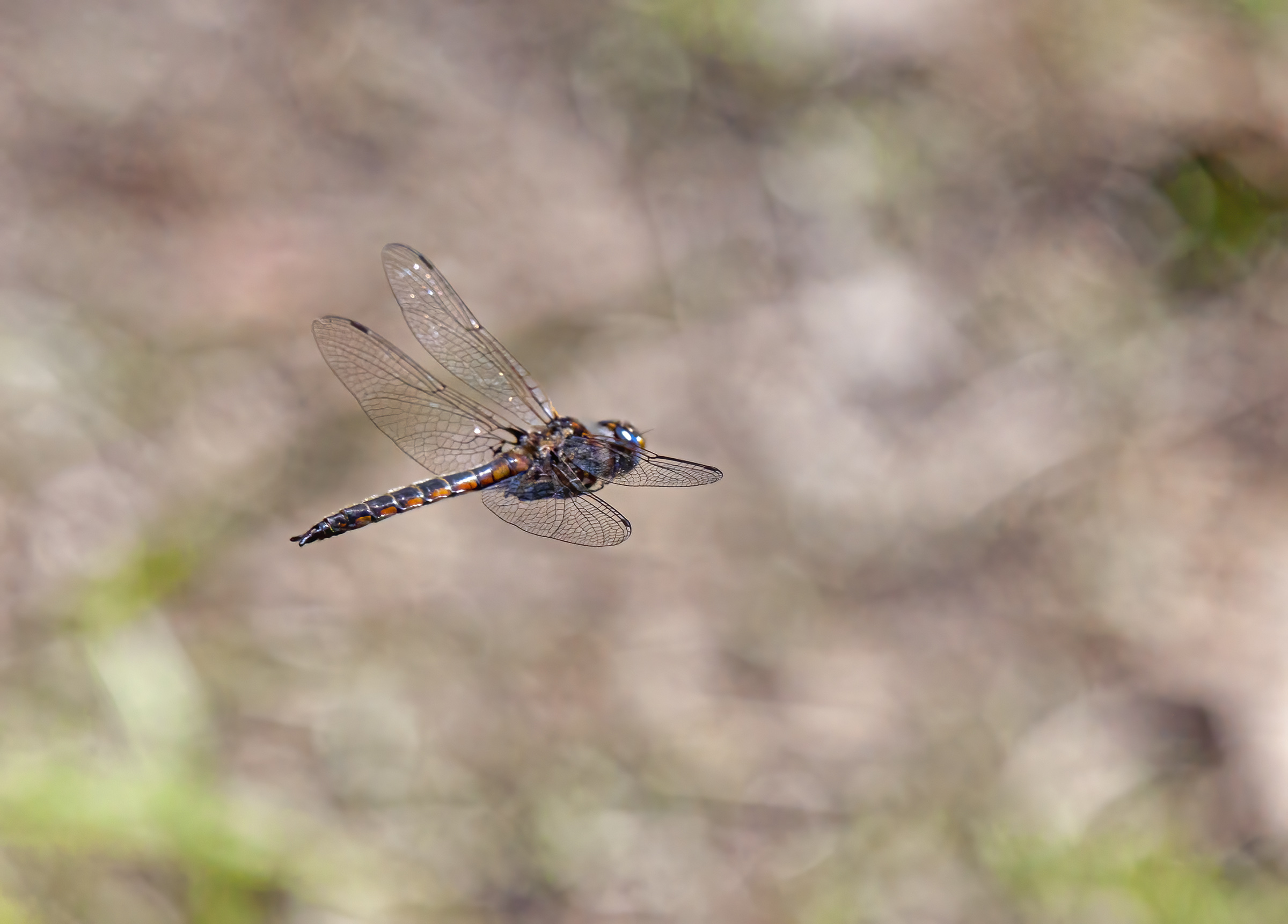
When the dragonfly season first starts, I am content to get a record shot of each species, which is to say that I am looking primarily to document the species and am not all that concerned about the quality of the initial images or their artistic merits. After the first excitement dies down, I try to get better and better images and one of the things that I often try to do is to photograph males and females of each species.

How do you tell the gender of a dragonfly? In some dragonfly species, the mature males and females have different colors and are easy to tell apart. However, quite often immature males have the same coloration as the females, so color alone is rarely a reliable marker. I have found that the best way to determine the gender is to look at the tips of the abdomen (the “tail”)—I won’t go into the details of dragonfly anatomy, but suffice it to say that the males and females have different shapes in this area so they can fit together for mating.

Over the last two weeks I have had several encounters with Uhler’s Sundragon dragonflies (Helocordulia uhleri) and was able to get shots of both a male and a female. The dragonfly in the first image is a female. I can tell its gender by the shape of the “terminal appendages” and also by the curved shape of the hind wings where they join the body.

If you look closely at the second image, which is a shot of a male, you can see that the lower portion of the abdomen is slightly enlarged—the abdomen is more uniformly shaped with a female—and the shape of the tip of the abdomen is different. You might also notice that the shape of the hind wings is “indented” where they meet the body, unlike the smooth curves of the female.

With some species, you can find the males and the females in the same area, so it is not hard to get shots of both genders. However, with other species, the females hang out in separate areas and do not mingle with the males until the females decide it is time for mating, which forces me to search a much wider area to photograph males and females.

I apologize if I got a little “geeky” in this posting. I am a little obsessed with dragonflies and am endlessly fascinated by them, so it is easy for me to get a little lost in the details.

female Uhler's Sundragon

male Uhler's Sundragon

© Michael Q. Powell. All rights reserved.

Read Full Post »

Quite often the simplest of subjects can be incredibly beautiful, like these little white butterflies that I photographed last week. Many folks might dismiss these nondescript creatures as moths or simply ignore them. It really is worthwhile to slow down and look at them closely.

The butterfly in the first photo is a Cabbage White (Pieris rapae) that was feeding on a patch of what I believe is purple dead nettle. Although it looks like a macro shot, I captured the image at the 600mm end of my telephoto zoom lens.

I took the next two pictures with an actual macro lens, my trusty Tamron 180mm lens. The tiny Eastern Tailed-Blue butterfly (Cupido comyntas) has a wingspan of about an inch (25 mm) and I was thrilled to capture so much detail of its beauty, including the little “tails.”

Beauty is everywhere.

Cabbage White

Eastern Tailed-blue

Eastern Tailed-blue

© Michael Q. Powell. All rights reserved.

Read Full Post »

As I was wandering about on Friday in Prince William County, a dragonfly zoomed by me and perched on some nearby vegetation. At the time I took the shots, I had no idea what it was because of the poor lighting. I was able to capture a few images and when I opened them on my computer I was delighted to discover that I had photographed a beautiful female Stream Cruiser dragonfly (Didymops transversa).

This was the first live Stream Cruiser dragonfly that I have photographed this spring. A week earlier I stumbled upon a Stream Cruiser that had had some unspecified problem in emerging and was dead, as shown in the second photo. Dragonflies are extremely vulnerable when they are emerging and unfavorable weather conditions and predators  almost certainly lower their survival rate. Given the magnitude of their remarkable metamorphosis, it seems remarkable to me that any of them can survive.

My experience with the Stream Cruiser in the first photo reminds me of the importance of being constantly vigilant. I was walking down a hill, headed towards a stream, when I glanced to the side and saw the flying dragonfly. I made a quick 180 degree turn and tracked the dragonfly as it landed. I took two steps forward and and had time to snap off only a few photos and that was it.

Fortunately I had my camera settings were somewhat appropriate and I was able to react quickly. As is often the case with wildlife photography, those two factors were key to capturing a shot. If the circumstances had been different, I might have been able to get a better image, but I am pretty happy with the image I captured. Needless to say, success is not guaranteed—I have plenty of stories from that day of the ones that got away.

Stream Cruiser

Stream Cruiser

© Michael Q. Powell. All rights reserved.
Read Full Post »

I could hear a bird singing in a tree on Wednesday at Occoquan Bay National Wildlife Refuge, but I had trouble finding it. Eventually I spotted some movement and was able to track the bird, but it remained mostly hidden. I saw some flashes of yellow and assumed that it was some sort of warbler. I finally managed to get decent shot of it and was anxious to check out my birding guide to see what it was.

When I looked through the warbler section of the book, none of the images seemed to match “my bird.” What else could it be? Suddenly I remembered that a couple of other local photographers had mentioned seeing vireo at this refuge. Could this be a vireo?

The overall coloration and the stunning eye convinced me that this is almost certainly a White-eyed Vireo (Vireo griseus), a new species for me. This is definitely one of the coolest looking birds that I have seen in a long time. I love the wash of pale yellow on its breast and the darker yellow around its bill. If you click on the image and look carefully at the bill, you will see that it is slightly hooked, which is not the case with warblers.

I went to the Cornell Lab of Ornithology website to learn a bit more about the behavior of this species—”White-eyed Vireos hop among branches and make short flights between shrubs, making sure to stay well hidden in the process. Males sing from the edges of understory vegetation all day long, even during the heat of the day.” I still have trouble geolocating a bird on the basis of sound, but can use all the help I can get.

I am currently alternating between looking for birds and looking for dragonflies. At this time of the year, they are found in vastly different habitats, so I have to make a decision when I set out in my car. I am absolutely thrilled that I have already had some success with both birds and dragonflies this spring and look forward to new discoveries.

White-eyed Vireo

© Michael Q. Powell. All rights reserved.

Read Full Post »

Yesterday I featured a warbler that was so brightly colored that it was impossible to miss. Today’s warbler is the complete opposite—it was so nondescript and so well hidden that it was almost impossible to see and initially I could not even identify it from my photos.

My eyes detected some motion high in a pine tree on Wednesday at Occoquan Bay National Wildlife Refuge and I stopped. I had set my long lens on a monopod, so my arms did not get tired as I strained to make out the bird that was moving about among the pine needles and the pine cones, though my neck quickly became sore. It looked like the bird was feeding on little seeds, so it would stop momentarily from time to time, giving me a change to find it in my viewfinder and acquire focus.

None of my shots was spectacular, but I was able to capture enough details of the bird’s body that some experts in a Facebook birding group identified it as a Pine Warbler (Setophaga pinus). Not only were they able to identify the species of the bird, they determined that it was a first year female on the basis of its markings and coloration. I am always amazed when confronted with that level of expertise.

Pine Warbler

Pine Warbler

Pine Warbler

© Michael Q. Powell. All rights reserved.

Read Full Post »

Yesterday I set aside my macro lens and put my telephoto zoom lens back on my camera.  Over the past week, I have seen some amazing photos by local photographers of a variety of colorful warblers that migrate through our area in the spring and the fall and I felt compelled to try to photograph them. I must confess, though, that I have never had much success photographing warblers. I can often hear these little birds, but have trouble locating them in the tops of the trees—they seem to be teasing me as they flit about and sing their songs.

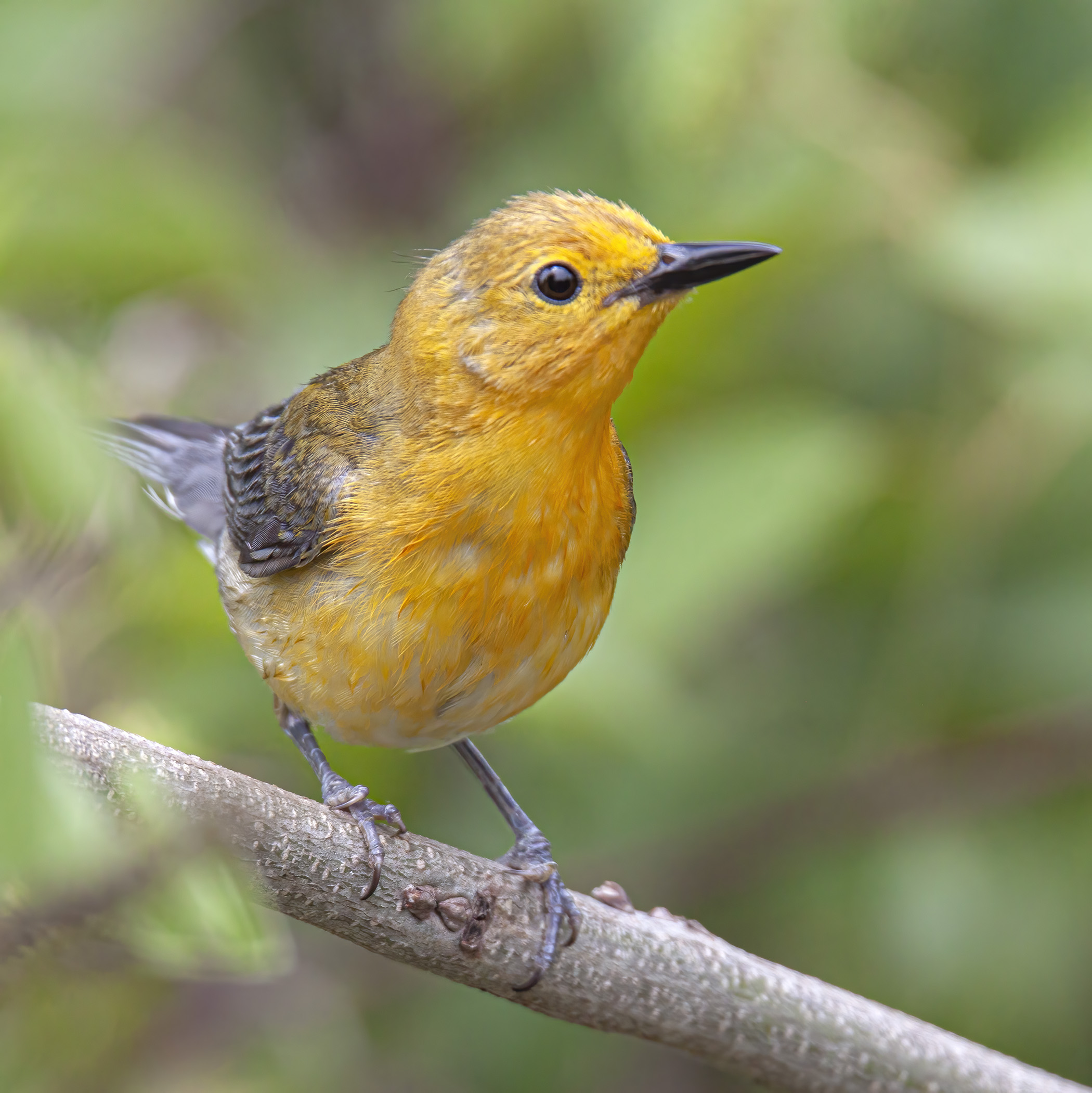
I walked around a lot and eventually had several encounters with Prothonotary Warblers (Protonotaria citrea) at Occoquan Bay National Wildlife Refuge. Some warblers have markings and colors that allow them to be camouflaged in the foliage, but the plumage of a Prothonotary Warbler is such a bright yellow that it is impossible for one to hide.

These warblers never seem to sit still for very long and they move quickly from branch to branch. I was happy that I was able to track them reasonably well, considering that I had my zoom lens extended to its maximum length. It takes some practice to be able to see something with your eye and then be able to point the lens in the proper direction.

I exceeded my expectations in getting these shots and also managed to photograph several other bird species that I will probably be featuring in future postings. Today I will probably switch back to my macro lens and focus again on insects. The transitional seasons definitely keep me busy as I try to keep an eye on close-in subjects and those that are farther away.

Prothonotary Warbler

Prothonotary Warbler

Prothonotary Warbler

© Michael Q. Powell. All rights reserved.

Read Full Post »

Ashy Clubtail dragonflies (Phanogomphus lividus) like to perch on the ground, which makes them really difficult to spot. Fortunately I saw these two dragonflies land last Friday during separate encounters in Prince William County and was able to get close enough and low enough to photograph them. If I had not seen them move, I probably would not have been able to detect them.

Both dragonflies had really shiny wings, an indication that they had emerged fairly recently. Initially the wings are fragile when a dragonfly emerges and they are folded above its head. The dragonfly gradually pumps fluid through the veins of the wings and they progressively harden and pop open into the normal outstretched resting position. Sometimes, as you can see in the final photo, a dragonfly will temporarily hold its wings closed over its head in their former position.

Dragonfly metamorphosis is a fascinating phenomenon, a remarkable transformation of a water-dwelling larva into an incredible aerial acrobat. Several years ago I managed to witness the entire process with a Common Sanddragon dragonfly and documented the thirty-minute process in a blog posting entitled Metamorphosis of a dragonfly. Be sure to check out that posting to see photos of the different stages of the amazing transformation.

Ashy Clubtail

Ashy Clubtail

Ashy Clubtail

© Michael Q. Powell. All rights reserved.

Read Full Post »

Recently I did a posting that featured Eastern Tiger Swallowtail butterflies (Papilio glaucus)—see Swallowtails in the forest.  None of those butterflies seemed to be involved in searching for nectar and seemed content to take in minerals and water.

Last Friday I returned to that same location in Prince William County, Virginia and discovered that the butterflies were taking advantage of the few small flowers that were blooming. In the first photo, an Eastern Tiger Swallowtail was nectaring on the small bluets (Houstonia caerulea) that are sometimes referred to as Quaker Ladies. The butterfly was so low to the ground that it looked like it was dragging its “tails.”

The butterfly in the second image is a dark morph Eastern Tiger Swallowtail female. Females of this species are dimorphic—there is a yellow variant that looks like the one in the first photo and a dark variant that looks like the one in the second image. The dark morph female was almost flat on the ground as she gathered nectar from a very short dandelion.

As more flowers begin to bloom, I am sure these butterflies will have a better selection of sources of nourishment, but the early arrivers have to make do with a really limited menu of choices.

Eastern Tiger Swallowtail

Eastern Tiger Swallowtail

© Michael Q. Powell. All rights reserved.

Read Full Post »

Have you ever taken a close-up look at a dragonfly’s amazing compound eyes? Dragonflies have the largest compound eyes of any insect; each containing up to 30,000 facets, and the eyes cover most of the insect’s head, resembling a motorcycle helmet. According to a wonderful article by GrrlScientist, “each facet within the compound eye points in a slightly different direction and perceives light emanating from only one particular direction in space, creating a mosaic of partially overlapping images.”

How exactly does that work? Scientists are still not sure how this visual mosaic is integrated in the dragonfly’s brain. If you can get close enough for a shot, you can actually see the individual facets, technically known as ommatidia. The first image below is a cropped image of an unusually cooperative Uhler’s Sundragon (Helocordulia uhleri) that I encountered last Friday while exploring a stream in Prince William County. If you click on the image, you can see the pattern of facets in the eyes.

The second image is an uncropped version of the first photo. I like the way that I as able to capture so many details of the dragonfly as it perched, like the spiky hairs on its legs and the stubble on its face as well as the pollen on its body.

The dragonfly in the third shot is another Uhler’s Sundragon that I spotted later in the day. From this angle, you can see the dragonfly’s tiny feet as it grasps the dried stalk of vegetation.

I love close-up images and will often try to capture them after I have taken some initial shots. When I am at close range, the angle of view is particularly important, because the depth of field is so shallow—some legs of the dragonfly, for example, will inevitably be out of focus, so I have to choose carefully what I want to be in focus.

Hand-holding and breathing techniques are also really important, because any movement will cause the fine details to be blurred. This is a bit of a challenge with the 180mm macro lens that I use because it does not have any built-in image stabilization.

Uhler's Sundragon

Uhler's Sundragon

Uhler's Sundragon

© Michael Q. Powell. All rights reserved.

Read Full Post »

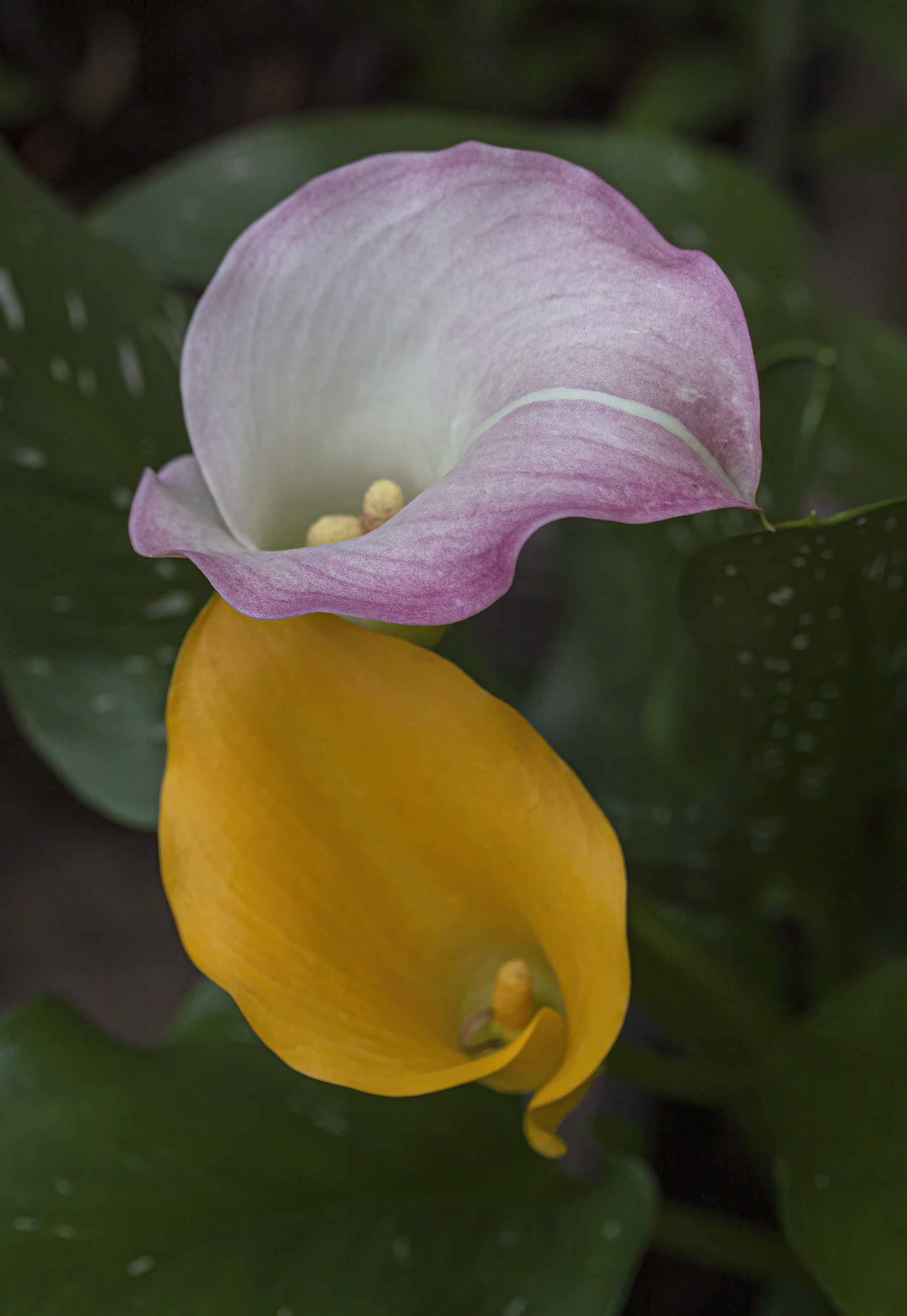
Happy Easter. My childhood memories of Easter are full of flowers, with the interiors of churches filled with lilies and tulips. Today, I decided to post images of some of the orchids that I photographed during a recent visit to Lewis Ginter Botanical Garden. This garden has a wonderful glass-domed conservatory that houses all kinds of exotic plants—it was a fun challenge to try to capture a sense of the beauty of these flowers in such a confined, warm, and humid space.

Not everyone, of course, is celebrating Easter and for Orthodox Christians Easter will come next Sunday. Still, I think that today is a good moment for us all to pause and reflect on what is important to us. My simple prayer is that all of our lives will be filled with peace, love, and with renewed hope, irrespective of whether you are observing this holy day today.

Alleluia! Christ is Risen! The Lord is risen indeed! Alleluia!

Orchid

orchid

orchid

© Michael Q. Powell. All rights reserved.

Read Full Post »

I was happy to spot several Blue Corporal dragonflies (Ladona deplanata) on Wednesday at Occoquan Bay National Wildlife Refuge, my first dragonflies of the year at that location. Blue Corporals almost always perch low to the ground, which makes them a challenge to photograph, as you can see in these photos.

In our area, Blue Corporals are found most often in the coastal plain region, unlike the Uhler’s Sundragon that I featured in an earlier posting (First dragonfly of 2022) that is found at rocky forest streams. Most of the early spring dragonflies are found in specific and limited habitats, while many of the summer species can thrive in a variety of habitats.

You may have noticed that none of these Blue Corporals are blue. Adult males are bluish in color and both the male and the female have two white stripes on their thoraxes in an area that you might think of as their shoulders. In the military of the United States, the rank insignia for corporals is two stripes, which accounts for that portion of the common name for the species.

When males first emerge, however, they share the same tan coloration as the females and as they mature they turn blue. (Here’s a link to a 2018 posting called A Bluer Corporal that shows a mature male.) The dragonfly in the final photo looks to be an immature and the one in the middle photo is a female—the angle of the first photo makes it hard for me to determine its gender.

It is still really early in the dragonfly season, so I am excited every single time that I spot one. Actually my enthusiasm for dragonflies barely wanes as we get deeper into the season and the early dragonflies give way to new species.

Blue Corporal

Blue Corporal

Blue Corporal

© Michael Q. Powell. All rights reserved.

Read Full Post »

On Monday I saw a surprisingly large number of Eastern Tiger Swallowtail butterflies (Papilio glaucus) as I explored a stream in Prince William County, Virginia. I used to associate these butterflies with gardens, because that is where I had previously seen them most of the time. Over the past years, though, as I have searched for early spring dragonflies, I have gotten used to seeing these colorful butterflies alongside the streams, often congregating in groups to drink and extract minerals from puddles (see my blog post from last year called A kaleidoscope of butterflies for more information and a photo of this phenomenon).

These swallowtails seemed content to fly about continuously, searching and exploring, but rarely perching. When they did come to the ground, they often landed in patches of fallen leaves, as you can see in the second and third images. I was happy when one of the butterflies opted to perch on a fern, which made it a little easier for me to photograph it.

Eastern Tiger Swallowtail

Eastern Tiger Swallowtail

Eastern Tiger Swallowtail

© Michael Q. Powell. All rights reserved.

Read Full Post »

I was delighted to spot some Virginia Bluebells (Mertensia virginica) during a trip last week to Lewis Ginter Botanical Garden. This spring ephemeral plant has beautiful bell-shaped sky-blue flowers and is native to eastern North America. The bees seemed to be equally excited to see these flowers. My photos suggest that the bees, which appear to be Carpenter Bees, were getting to the nectar through the tube of the flowers rather than through the bell.

I really like the varied shades of blues and pinks in the bluebells in different shades of development. The colors work well together, sometimes even combining to produce a lovely shade of violet.

Virginia Bluebells

Virginia Bluebells

Virginia Bluebells

© Michael Q. Powell. All rights reserved.

Read Full Post »

I finally found my first dragonfly of the season yesterday—a female Uhler’s Sundragon—while I was exploring a stream in Prince William County. Uhler’s Sundragons (Helocordulia uhleri) are considered to be rare in our area. This species requires a very specific type of habitat and has an early and very brief flight period.

So where would you find one? According to the wonderful Dragonflies of Northern Virginia website, “Uhler’s need clean, small to medium, rocky forest streams with gravelly and/or sandy substrate, and a decent flow. They can be found in sunny clearings and forest edges near their streams.”

Fortunately I have found this species at a particular stream the last several years, so that is where I headed yesterday. I searched the spots where I had found Uhler’s Sundragons in the past, but came up empty-handed. I walked along extended lengths of the stream and eventually found the one in the photograph below—it was the only dragonfly that I spotted all day.

My hike yesterday lasted 4 hours and 42 minutes and covered 7.18 miles (11.55 km), according to my GPS app. My pace was pretty slow, partly because I was scanning for dragonflies, but also because the terrain was full of ups and downs. I pasted in a chart from the GPS readout to give you an idea of the type of terrain that I covered. According to my iPhone, I walked up the equivalent of 21 floors, which explains why my legs are a little sore this morning.

As many of you know, dragonflies are my favorite subjects during the warm months—there is something almost magical about these beautiful aerial acrobats. I am therefore super excited that the 2022 dragonfly season has officially started for me.

Uhler's Sundragon

Hike 11 April 2022

© Michael Q. Powell. All rights reserved.

Read Full Post »

From a distance Common Grackles (Quiscalus quiscula) often appear to be black, but often you can spot their distinctive yellow eyes. When you get closer, especially when the lighting is good, you discover that the grackles are covered with an array of multi-colored iridescent feathers.

On Friday I spotted this grackle while I was exploring Lewis Ginter Botanical Garden in Richmond, Virginia with fellow photographer Cindy Dyer. The grackle was poking around at the edge of the water of a small pond and moving about a lot. I had to maneuver around to get a clear shot of the bird, which was a bit of challenge, because overhanging vegetation partially obstructed my view.

Eventually I was able to capture this image. I had my macro lens on my camera at the time, but fortunately its focal length of 180mm means that it also works as a short telephoto lens. I often tell people that it is best to take a photo with whatever camera gear you have in your hand when a situation arises, even if it does not appear to be the ideal option. If I had stopped to change lenses—I had a longer lens in my backpack—I am pretty sure I would missed this fun little shot of the grackle.

Grackle

© Michael Q. Powell. All rights reserved.

Read Full Post »

« Newer Posts - Older Posts »