Feeds:
Posts
Comments

Archive for the ‘Nature’ Category

I really like Green Herons (Butorides virescens). Unlike their more stoic Great Blue Heron “cousins”, Green Herons seem to be full of personality. I have not seen one in several months, so I was delighted when I spotted this one on Friday at a small pond at Occoquan Bay National Wildlife Refuge.

The vegetation around the pond had grown so high that I did not see the Green Heron until I was almost on top of him. My first indication that the heron was there was when I accidentally flushed him, but fortunately he flew away only a short distance and I was able to capture this image.

As is often the case, the heron was sporting the Mohawk-style look that always makes me think of punk rock. The lighting was good enough that I was able to capture some of the beautiful feather detail of the heron. Despite its name, though, I don’t really see much green on this green heron—I might have given it a different name if I had been in charge. 🙂

Green Heron

© Michael Q. Powell. All rights reserved.

Read Full Post »

Damselflies in the genus Argia are known by the rather whimsical name of dancers, because of the distinctive jerky form of flight they use, in contrast to the straightforward direct flight of bluets, forktails, and other pond damselflies. This past Monday I was delighted to spot this male Blue-fronted Dancer damselfly (Argia apicalis) while I was exploring at Occoquan Bay National Wildlife Refuge.

I have seen this species at other locations, but I think that this is the first time that I have spotted one at this refuge. Normally I have trouble identifying damselflies, because so many of them are similar in appearance, with multiple variations of black and blue. Blue-fronted Dancers, however, are quite distinctive because their thoraxes are almost completely blue, with only hairline black stripes on the shoulders and the middle of the back.

I like the way that the stems of the plants are arrayed in a linear, almost geometric pattern that adds visual interest to the background without distracting too much attention from the primary subject. The bright pops of blue on the damselfly really help to make it stand out from the primarily green background.

Blue-fronted Dancer

© Michael Q. Powell. All rights reserved.

Read Full Post »

It is almost autumn, late in the season for most dragonflies. For many of them, their bright colors have faded and their wings are growing increasingly tattered. Yet somehow their beauty still shines through in their mature days.

With dragonflies, as with people, I am often drawn to their eyes, the so-called “window to the soul.” Dragonflies have such striking eyes and I invariably feel myself being pulled in as I gaze into them.

This past Monday I photographed several female Great Blue Skimmer dragonflies (Libellula vibrans) as I wandered the trails at Occoquan Bay National Wildlife Refuge. In both of the photos below, the beauty of the dragonfly’s eyes really shows through. I encourage you to click on the images and you too can marvel at the wonderful colors and patterns of those eyes.

Our society tend to focus on youthful external beauty, which will inevitably fade. True beauty, I would argue, is not dependent on age—it depends more on the perspective of the beholder. If you look for beauty, you will find it for it is present all around us—beauty is everywhere.

Great Blue Skimmer

Great Blue Skimmer

© Michael Q. Powell. All rights reserved.

Read Full Post »

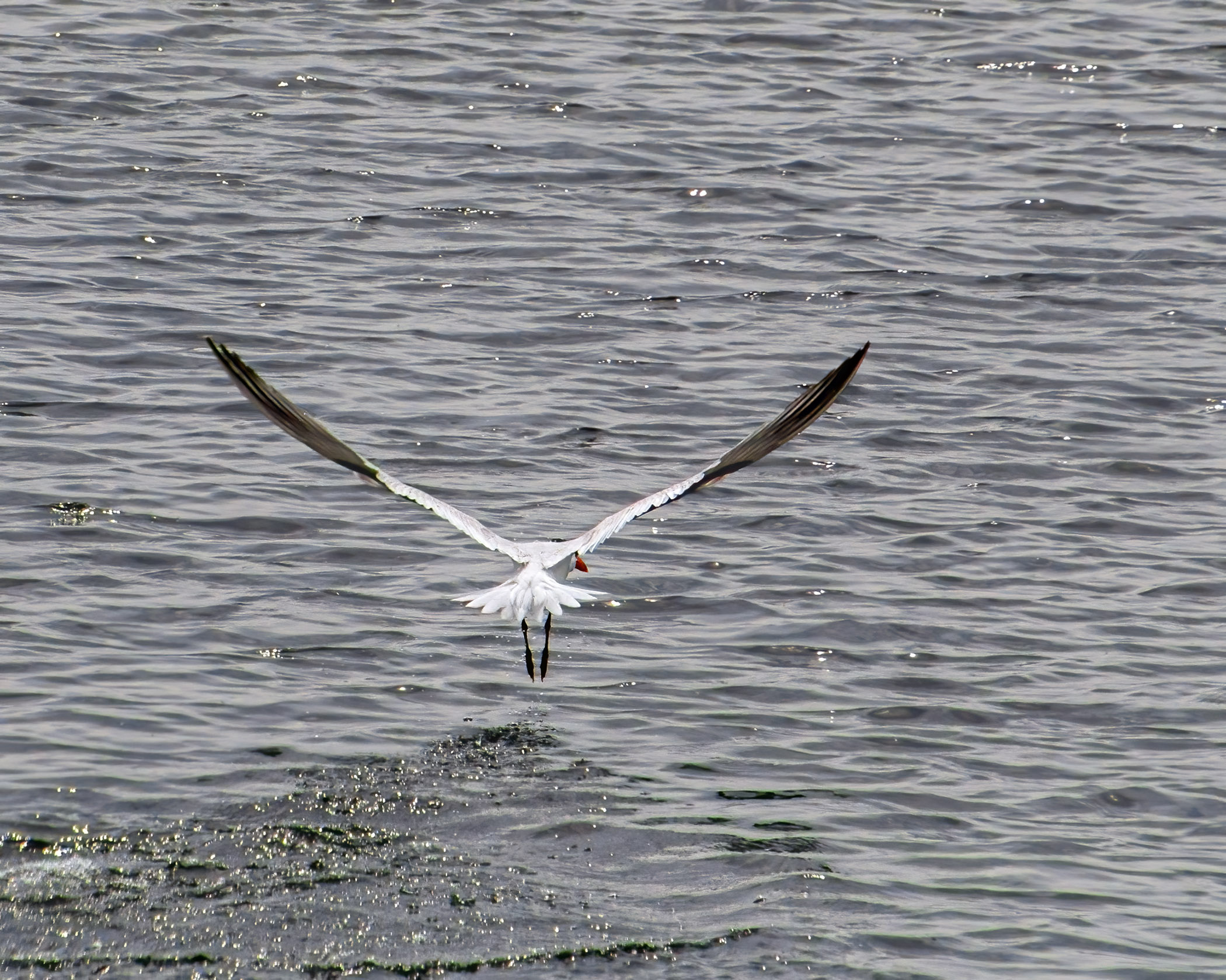
When I first saw this bird on Monday at Occoquan Bay National Wildlife Refuge, I thought it was a type of gull. However, its flying pattern—it repeatedly flew low above the water— suggested to me that it was some other kind of bird. When I looked at my photos afterwards and checked my bird identification book, I concluded that it was most likely some kind of tern.

When I posted an image to a birding forum in Facebook, one of the experts there informed me that it was a Caspian Tern (Hydroprogne caspia), a bird that I had never before seen. He pointed out “the heavy red bill, extensive black on the underside of the primaries, short tail, and full black cap” that indicated that this was a Caspian Tern and not the somewhat similar-looking Royal Tern.

As the summer begins to wind down, I will gradually shift my attention from insects to birds as my primary subjects. In the meantime, I will still be focused a lot on my beloved dragonflies and butterflies, with an occasional tern (or re-tern) to the birds.  🙂

Caspian Tern

Caspian Tern

Caspian Tern

© Michael Q. Powell. All rights reserved.

Read Full Post »

The sunlight was a bit harsh, but I actually like the way that it turned the background white, drawing even greater attention to the beautiful Viceroy butterfly (Limenitis archippus) that I spotted last week at Occoquan Bay National Wildlife Refuge.

Every now and then I will take a shot, like this one, that turns out more “artsy” and stylized than my “normal” shots. It’s hard to explain, but this simple photo really appeals to me.

Viceroy

© Michael Q. Powell. All rights reserved.

Read Full Post »
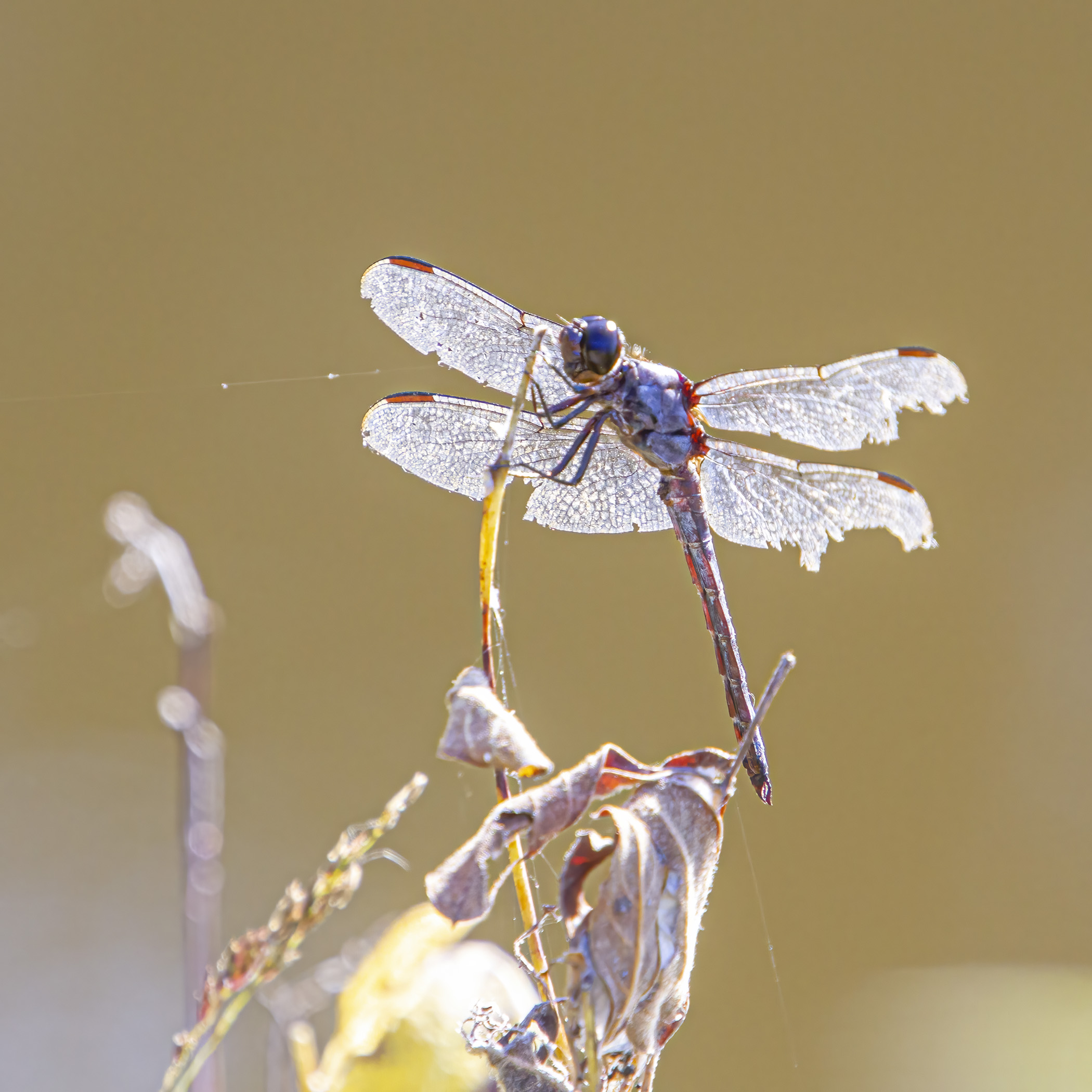
Throughout most of the summer I have seen very few large butterflies. Recently, though, I have been seeing them in greater numbers. I do not know if this is somehow linked to the blooming of the thistle plants, but I have spotted numerous butterflies in patches of this plant during recent visits to Occoquan Bay National Wildlife Refuge.

Last week I spotted this beautiful Eastern Tiger Swallowtail butterfly (Papilio glaucus) high atop a plant and I captured the first image with the sky in the background. The second image is linked to a short video I captured yesterday of a Monarch butterfly (Danaus plexippus). Most of the time I tend to associate Monarchs with milkweed, but this one sure seemed to be enjoying the thistle flower. Before long, it should begin its migration and perhaps this was part of the fueling process.

I am still experimenting with taking short videos with my iPhone and once again posted the video to YouTube. I have started a little channel on YouTube and have already posted a number of short clips, primarily of butterflies, bison, and butterflies, some of them with music tracks as accompaniment—I inserted some copyright free piano music, for example, in the Monarch video below. I have also experimented with some slightly longer compilations of clips with voiceover narration. Check out my channel Mike Powell if you are at all curious to see and hear what I have done so far.

Eastern Tiger Swallowtail

© Michael Q. Powell. All rights reserved.


Read Full Post »

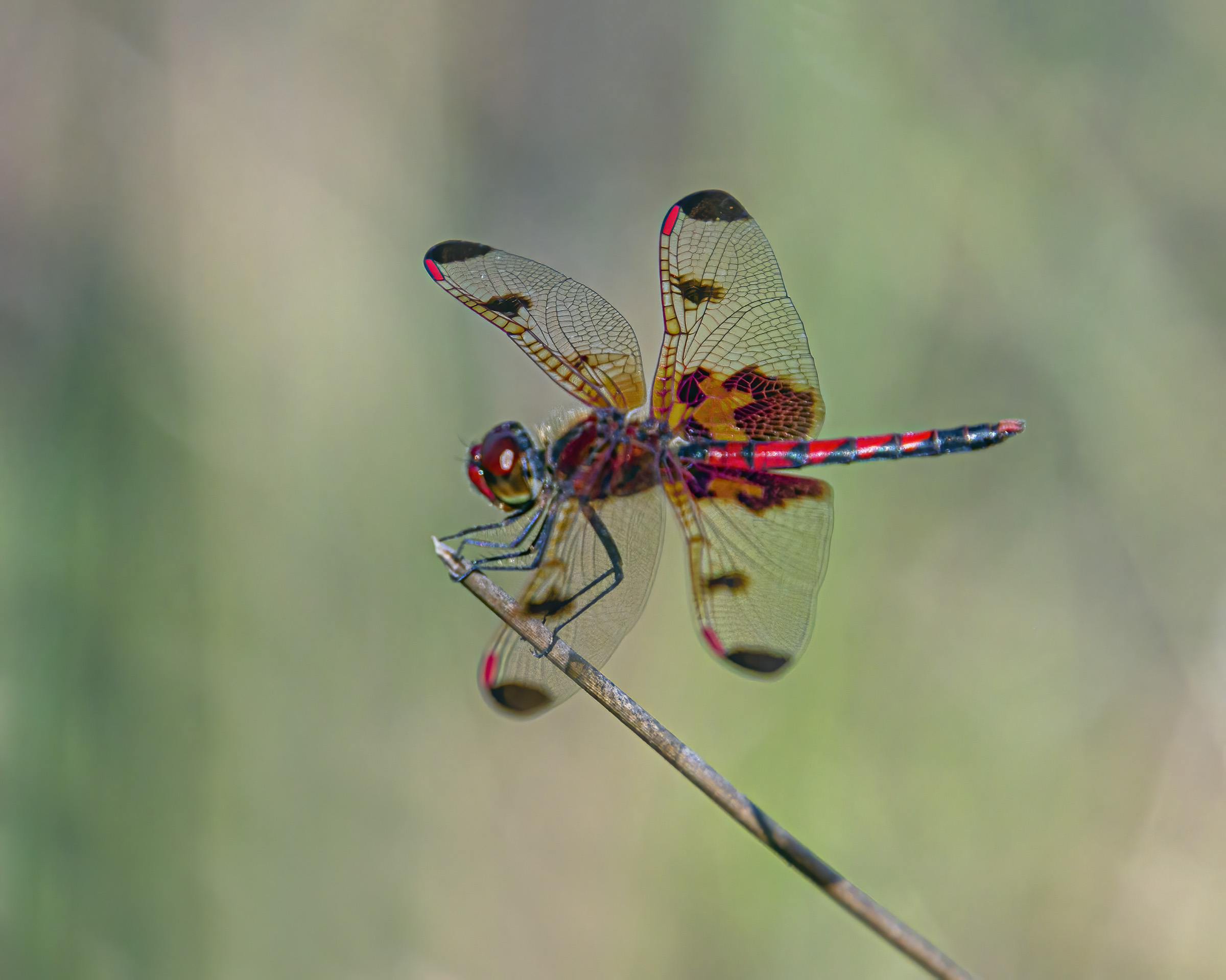
I was delighted to spot this beautiful female Calico Pennant dragonfly (Celithemis elisa) last Tuesday at Occoquan Bay National Wildlife Refuge. She was perched high in the vegetation and tolerated my presence pretty well, which permitted me to get shots from several angles. I love the way that the feet and the wings are in slightly different positions in each shot, as she adjusted her position to maintain her balance.

Calico Pennant

Calico Pennant

Calico Pennant

© Michael Q. Powell. All rights reserved.

Read Full Post »

You can’t get much more basic than this shot of a Blue Dasher (Pachydiplax longipennis), one of the most common dragonflies where I live, that I spotted last Tuesday at Occoquan Bay National Wildlife Refuge.. I find, though, that there is a really beauty in that simplicity that allows me to immerse myself in the details of my subject.

I am able to notice the two-toned eyes, the pattern on the abdomen, and the yellowish portions of the legs where they are connected to the body. Even the perch, which I think is stalk of Eastern Gamagrass (Tripsacum dactyloides), has fascinating details.

Beauty is everywhere.

Blue Dasher

© Michael Q. Powell. All rights reserved.

Read Full Post »

This looks like such a tranquil scene, with two dragonflies of different species sharing a prime perch on a branch overhanging the pond at Jackson Miles Abbott Wetland Refuge, a moment of peaceful coexistence. However, I had been watching these two dragonflies for an extended period of time and knew that the moment of sharing was the exception rather than the rule.

The male Slaty Skimmer dragonfly (Libellula incesta) on the left and the male Swift Setwing (Dythemis velox) had been repeatedly challenging each other for sole possession of the perch. Whenever one of them would perch on the end of the branch, the other dragonfly would fly straight at the one that was perched, attempting either to dislodge the interloper or at least convince him to fly away.  They went back and forth like this for quite a while, alternating possession, though I think the Slaty Skimmer, the larger of the two, held onto the branch for a longer period of time than the Swift Setwing.

I tried to capture them “buzzing” each other, but timing was really tricky and it was almost impossible to keep them both in focus. The second image below is my best effort in showing their interaction. I was low to the ground when I took the shot and really like the perspective with the sky in the background. If you look closely at the lower left corner of the second photo, you may notice that a long-jawed spider was also sharing the perch with the two dragonflies.

coexistence

coexistence


© Michael Q. Powell. All rights reserved.

Read Full Post »

Black Saddlebags dragonflies (Tramea lacerata) are one of a dozen or so dragonfly species in North America that migrate. Not surprisingly they are strong fliers and most of the time when I see one, it is flying high overhead—they do not seem to perch very often.The dark patches on their hind wings, which someone thought resembled saddlebags, are so distinctive that it is pretty easy to identify a Black Saddlebags when I see one in the sky.

As I was exploring Occoquan Bay National Wildlife Refuge on Tuesday, I spotted a dragonfly as it zoomed by me and watched it land low in the vegetation. I moved forward as stealthily as I could and was delighted to see that the perching dragonfly was a Black Saddlebags. The background was quite cluttered, but I managed to find a clear visual path to the dragonfly and was delighted to capture this detailed image—I encourage you to click on the photo to see the beautiful markings on the abdomen and the distinctive “saddlebags.”

If you want to learn more about this particular species, I recommend an article from the University of Wisconsin at Milwaukee entitled “Black Saddlebags Dragonfly (Family Libellulidae).” Among other things, you will learn that for Black Saddlebags dragonflies, “Mating is brief if done aerially [the ultimate multitasking] and only slightly longer if the pair is perched.”

Black Saddlebags

© Michael Q. Powell. All rights reserved.

Read Full Post »

As I approached a patch of thistle in bloom on Tuesday, I was looking carefully to see if there were any butterflies feeding on the flowers. Suddenly I noticed a flash of bright red and realized immediately that it was a Hummingbird Clearwing Moth (Hemaris thysbe).

Hummingbird Clearwing moths, which actually do resemble hummingbirds as they dart among the flowers, hovering periodically to such nectar, are not exactly rare where I live, but I tend to see them only a few times a year. Fortunately I reacted quickly enough to capture this image, because the moth flew out of sight after it had finished feeding on this flower.

For shots like this, the wing position is really important and I was thrilled that I was able to capture the wings fully extended, which highlights the transparent portions of the wing responsible the common name of this species. The details of the moth and the thistle are pretty sharp and the background is blurred enough that it is not a distraction—I like this shot a lot.

Hummingbird Clearwing Moth

© Michael Q. Powell. All rights reserved.


Read Full Post »

I am still learning to take videos with my iPhone 11. During my recent road trip, I convinced myself that it could be used with large subjects like bison and wild horses. I wasn’t sure, however, if it could be used effectively with the small subjects that I enjoy photographing.

Yesterday I visited Occoquan Bay National Wildlife Refuge, my favorite local wildlife photography spot, and kept my iPhone in my front pants pocket—normally I keep it in my backpack, which it is much less accessible. I was still using my Canon 7D with the Tamron 18-400mm zoom lens most of the time, but I made a conscious effort to look for subjects that I could also film with my iPhone.

I was astonished when I encountered a relatively cooperative Zebra Swallowtail butterfly (Eurytides marcellus). Normally these butterflies are extremely skittish and it is a challenge to get a photo of one, even with a long telephoto lens. How could I make a video of one when I would have to be really close to it?

The first video, which is hosted in YouTube, is a short clip I was able to capture of a Zebra Swallowtail. I added a piano track as accompaniment to enhance the experience.

The second video features an Eastern Tiger Swallowtail butterfly (Papilio glaucus) feeding on a colorful thistle plant. This video was a bit easier to capture, because the butterfly was perched much higher and was really preoccupied. I was therefore able to frame the video much better. Once again I added piano music to the video, using the copyright free music available in the YouTube Studio.

As I mentioned in a previous posting, I have chosen to embed YouTube links to the videos rather than place them directly in my blog, where they would count against the blog’s data limits. In order to have an image appear for this posting in the Reader section of WordPress, I have reprised an image of a Zebra Swallowtail that was in a May 2022 posting.

I am having fun playing with videos and think they give a slightly different perspective to my normal blog postings.  What do you think? Do you enjoy these kinds of short video clips?

Zebra Swallowtail

© Michael Q. Powell. All rights reserved.

Read Full Post »

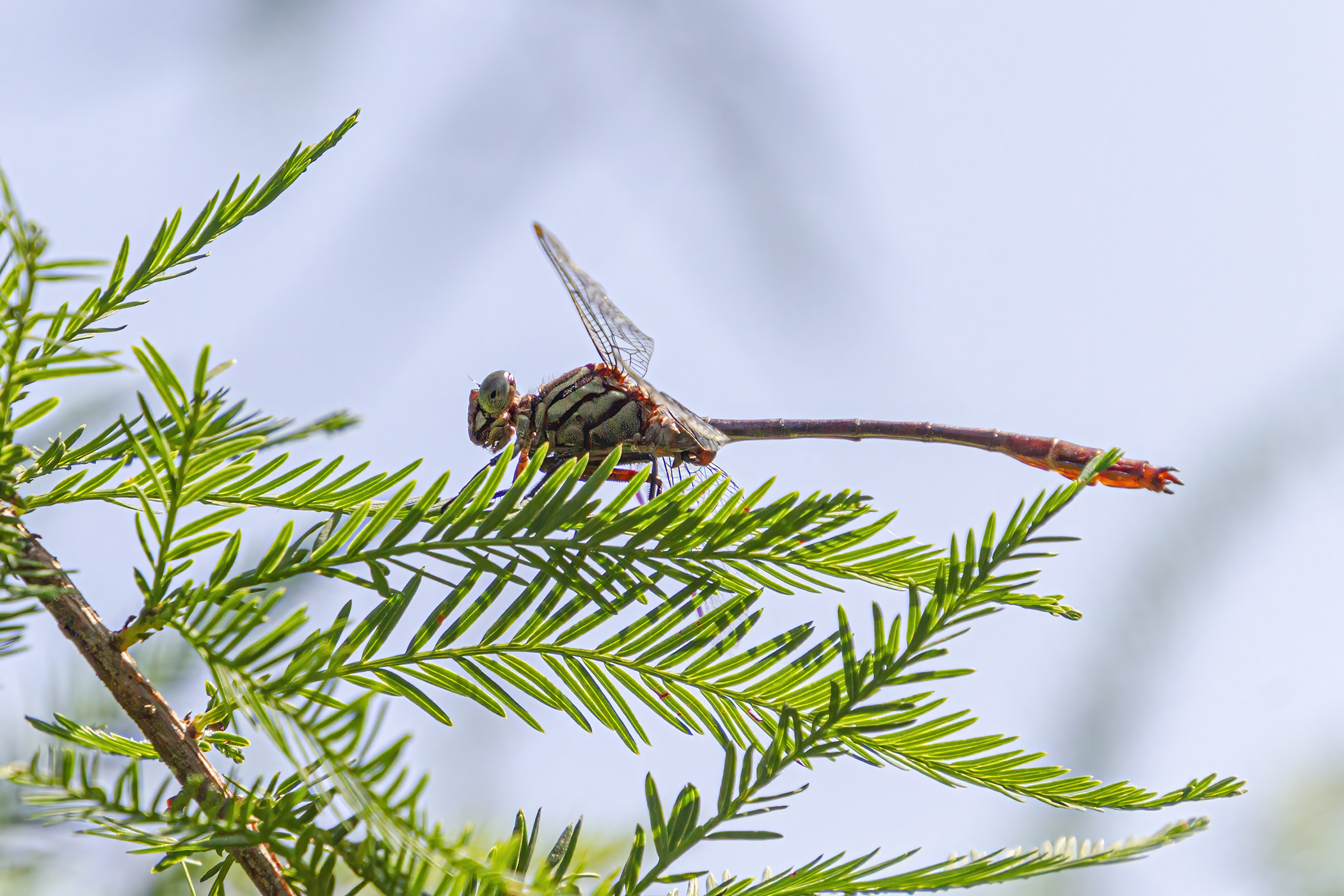
Here are some shots of Russet-tipped Clubtail dragonflies (Stylurus plagiatus) that I photographed at Jackson Miles Abbot Wetland Refuge last Saturday. The first image shows a male perched in an evergreen tree. Sharp-eyed views may recognize this tree, which is the same one on which yesterday’s Common Green Darner was perched.

The second image shows a female Russet-tipped Clubtail in some vegetation. If you compare the tip of her abdomen (the “tail”) with that of the first dragonfly, you can readily see they they are different. That is one of the reasons why the terminal appendages of a dragonfly are a key identification feature in determining the gender of an individual. You can’t help but notice that her left hind wind is almost completely shredded. I suspect that she can still fly, albeit with some difficulty.

The final shot shows a male in flight over the pond at the refuge. This is the first time that I have gotten an identifiable shot of this species in the air. I actually did not realize that it was a Russet-tipped Clubtail when I took a burst of shots of then flying dragonfly. I had simply reacted instinctively when I spotted the dragonfly—if it’s flying, I’m trying. It was a pleasant surprise when I opened the images on my computer and realized what I had captured.

There are a few species that emerge in September, so this year’s dragonfly season is far from over. Tomorrow marks the start of a new month, a month that I hope will be full of new opportunities for me and for all of you.

Russet-tipped Clubtail

Russet-tipped Clubtail

Russet-tipped Clubtail

© Michael Q. Powell. All rights reserved.

Read Full Post »
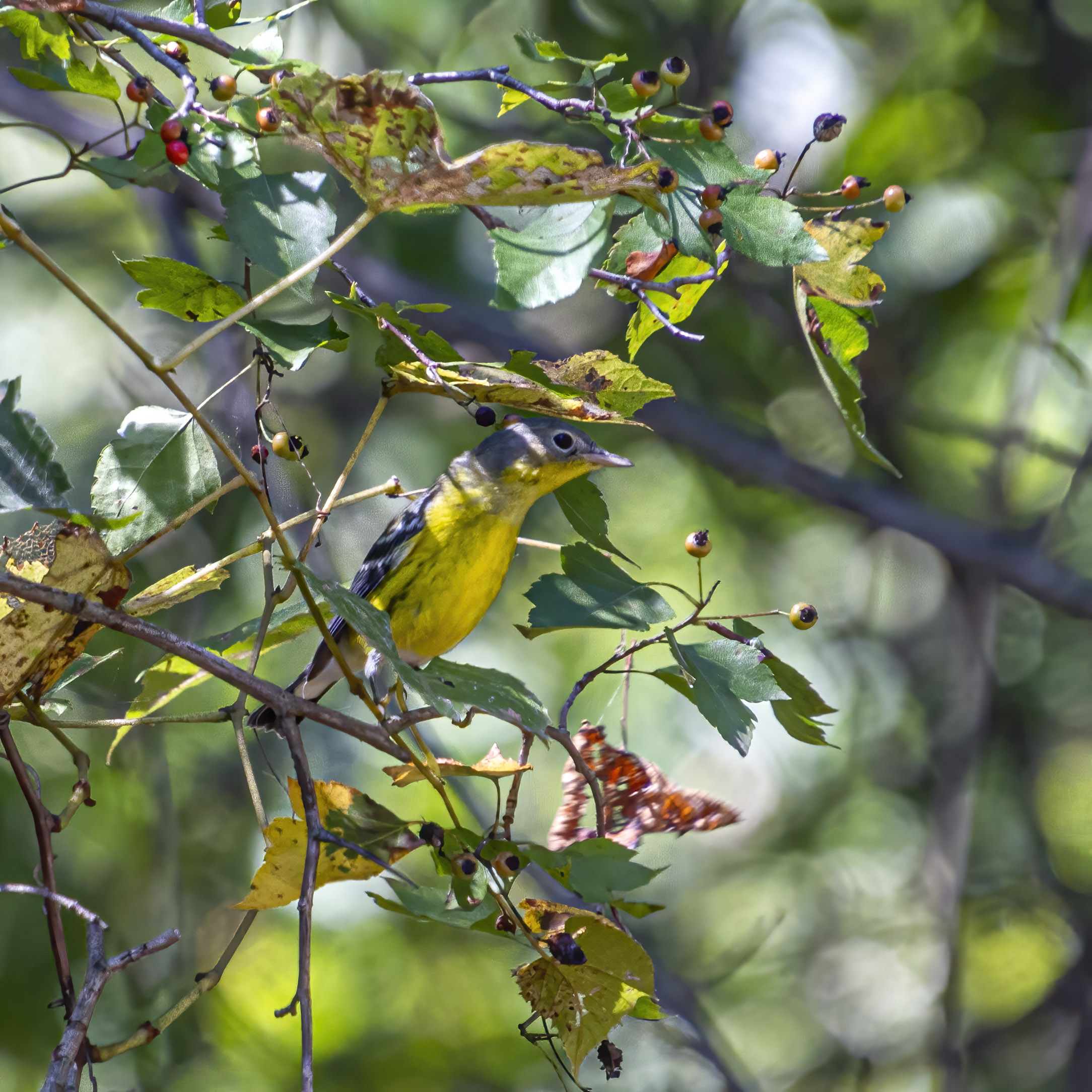
I was thrilled on Saturday when one of my fellow dragonfly enthusiasts spotted this colorful male Common Green Darner dragonfly (Anax junius) at Jackson Miles Abbott Wetland Refuge and pointed it out to me. Common Green Darners are relatively common, but most of the time when I see them they are patrolling overhead, so it was quite a treat to find one perched.

Common Green Darners are one of the few dragonfly species that migrate. According to Kevin Munroe, creator of the wonderful Dragonflies of Northern Virginia website, “Common Greens seen in our area in early spring are in fact migrants from points south. They emerge in the Southeast and fly north, arriving here late March thru May. After their long flight, they mate, lay eggs and die. Their young emerge in July and August. Congregating in large swarms, this second generation begins flying south in September. They lay eggs that fall, after arriving in their southern destinations, and die. When their young hatch in March, they fly back to Northern Virginia and it starts again—a two generation migration.” Wow!

This dragonfly was hanging on the same evergreen tree where I recently photographed a Russet-tipped Clubtail—see my blog posting entitled “Russet-tipped Clubtail dragonfly.” I guess that I will be checking that tree from now on to see if lightning will strike again. When I am hunting for dragonflies, I tend to return first to places where I have seen them previously and then widen my search. Sometime it pays off, though, as is the case for all wildlife photography, there are certainly no guarantees of success.

Common Green Darner

© Michael Q. Powell. All rights reserved.

Read Full Post »

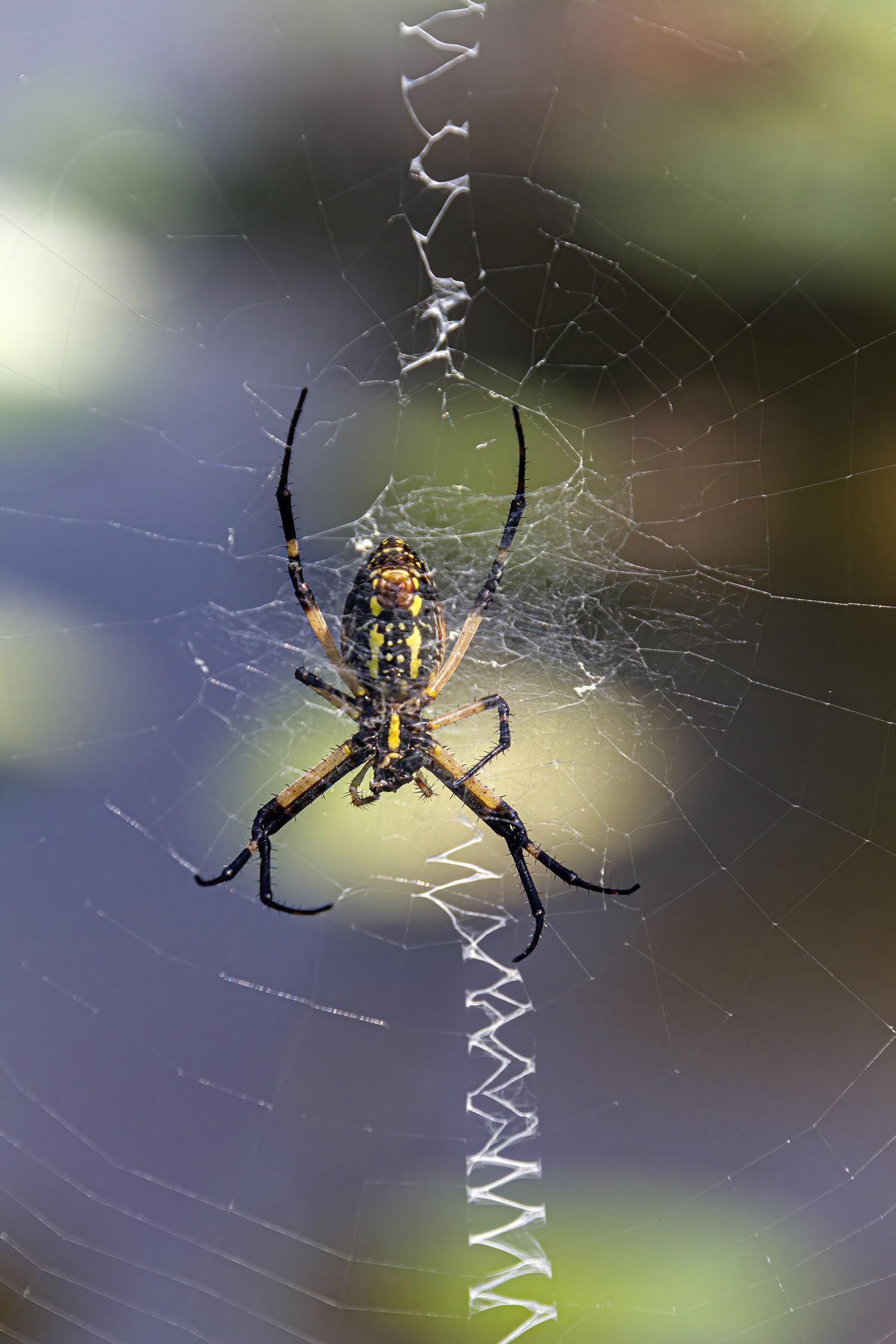
During my recent visits to Jackson Miles Abbott Wetland Refuge, I have noticed the reappearance of Black and Yellow Garden Orbweaver Spiders (Argiope aurantia). During the late summer and early fall, these relatively large spiders can be seen in the vegetation surrounding the pond and in the adjacent fields.

One of the coolest things about this spider is the distinctive zig-zag pattern, known technically as a stabilimentum that the spider uses for the central part of its web. According to Wikipedia, the purpose of the zig-zags is disputed. “It is possible that it acts as camouflage for the spider lurking in the web’s center, but it may also attract insect prey, or even warn birds of the presence of the otherwise difficult-to-see web.”

Argiope aurantia

© Michael Q. Powell. All rights reserved.

Read Full Post »

Goldenrod was in full bloom on Wednesday at Jackson Miles Abbott Wetland Refuge, attracting all kinds of insects, including a little Skipper butterfly and a colorfully-patterned Ailanthus Webworm moth (Atteva aurea). I believe that the butterfly is a Sachem Skipper (Atalopedes campestris), although it is hard to be confident when identifying skipper butterflies—there are quite a number of similar looking species.

I love the intricate orange, black, and white pattern on the body of the Ailanthus Webworm moth, a type of ermine moth. This moth looks quite a bit like a beetle when it is at rest with its wings tucked in, but reportedly it looks like a wasp when in flight. I encourage you to click on the image to get a better look at the wonderful details of the two insects.

When I composed this image, I was conscious of the fact that my primary subject, which was initially the skipper, filled only a small part of the frame. However, I really liked the brilliant yellow of the goldenrod and framed the shot to focus viewers’ attention as much on the sweeping curve and color of the goldenrod as on the insects. The goldenrod became the co-star of the photo and therefore has equal billing in the title of this blog posting.

goldenrod and insects

© Michael Q. Powell. All rights reserved.


Read Full Post »

I was delighted on Wednesday to spot this male Swift Setwing dragonfly (Dythemis velox) during a short visit to Jackson Miles Abbott Wetland Refuge. These little dragonflies perch in a distinctive pose with their wings pulled forward, which looked to some scientist like the “ready-set-go” position of a sprinter and is reportedly the reason for the name of the species.

This species is really special to me, because this primarily southern species had never before have been documented in Fairfax County, Virginia, the county where I live, until I spotted one six years ago at this same location. By now there seems to be an established breeding population, and I look forward to seeing them each summer.

As August draws to a close, I am acutely aware that each sighting of a dragonfly could be the last one of the season for that species, so I really savor each encounter. There is beauty all around us, but somehow I have a particular affinity for dragonflies and damselflies—I am endlessly fascinated by these colorful little aerial acrobats.


Swift Setwing

© Michael Q. Powell. All rights reserved.

Read Full Post »
Seasons are starting to change for those of us in the Northern Hemisphere as summer gradually releases its hold on us. Already the children in my area have returned to school and the weather is cooling off a bit.

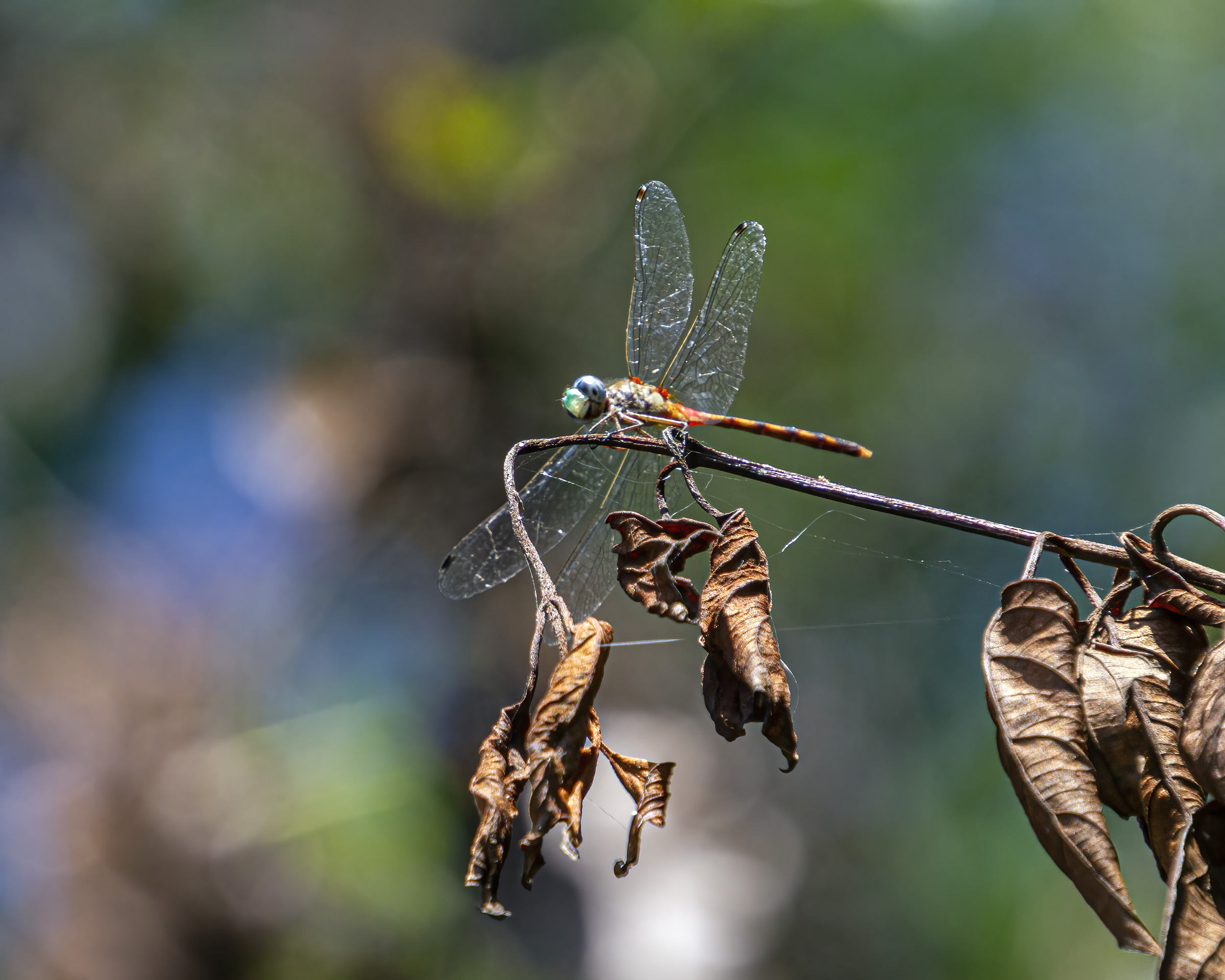
Some of the summer dragonfly species are starting to disappear or decrease in numbers. Fortunately, some new species appear late in the season to take their places, like this handsome male Russet-tipped Clubtail dragonfly (Stylurus plagiatus) that I spotted yesterday at Jackson Miles Abbott Wetland Refuge.

Russet-tipped Clubtails are a late season species and are seen most often in August and September. Unlike many of the dragonflies that I see regularly that seem to prefer pole-like perches or perch flat on the ground, Russet-tipped Clubtails like to hang from the leaves of vegetation at an angle or almost vertically—members of the genus Stylurus are sometimes called “Hanging Clubtails.”

I am not quite ready to welcome “autumn,” but there are signs everywhere that the seasons are inexorably changing. Autumn is probably my favorite season of the year, but I am still holding on to the summer.

Russet-tipped Clubtail

UPDATE: As a kind of experiment I decided to do a little video version of this posting that I put on my YouTube channel. What do you think?

© Michael Q. Powell. All rights reserved.

Read Full Post »
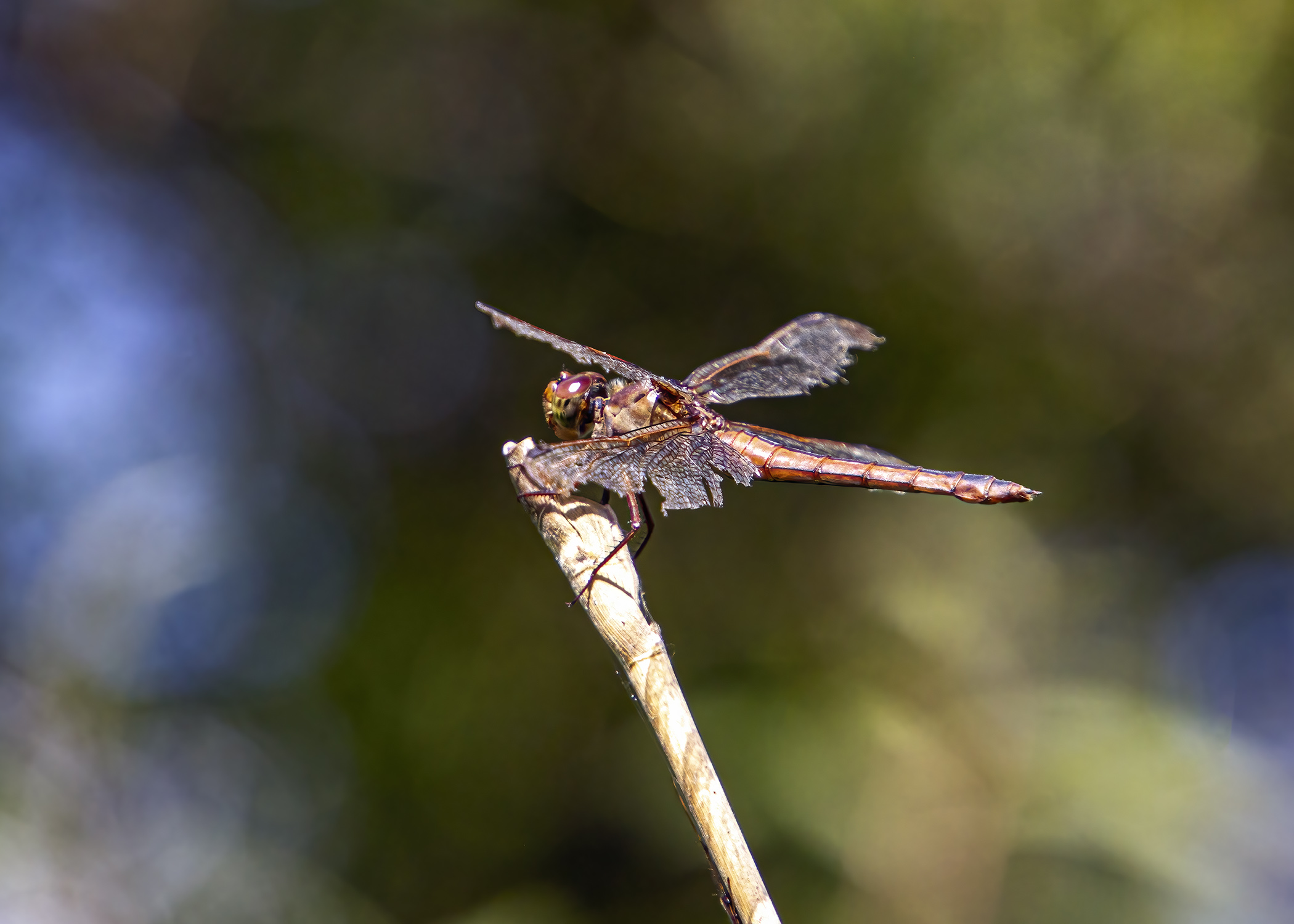
I was thrilled to spot this very pretty filly in the midst of a band of wild horses at Theodore Roosevelt National Park in North Dakota on 10 August 2022. If you look closely, you’ll see that she has incredible blue eyes.

I think that this baby horse may be named Dreamer, born on 2 June, judging from the photos of the 2022 foals at the park on the North Dakota Badlands Horse website. The North Dakota Badlands Registry, according to its website, is a non-profit organization that “was established to register, promote, appreciate and preserve the wild horses of Theodore Roosevelt National Park, North Dakota that are unique to the area.”

Several times during my visits to the national park, I encountered members of this organization while I was observing the , who shared with me a lot of information about the wild horses. One of the really cool things that the group does is keep track of the composition of the different bands of horses within the park—it is estimated that there are about 183 wild horses scattered throughout the national park.

It definitely was a challenge getting a clear shot of the baby horse’s face—most often her head was down or she was hidden behind her mother. However, I waited patiently and eventually was able to capture these shots of the sweet little horse.

wild horse filly

wild horse filly

© Michael Q. Powell. All rights reserved.


Read Full Post »
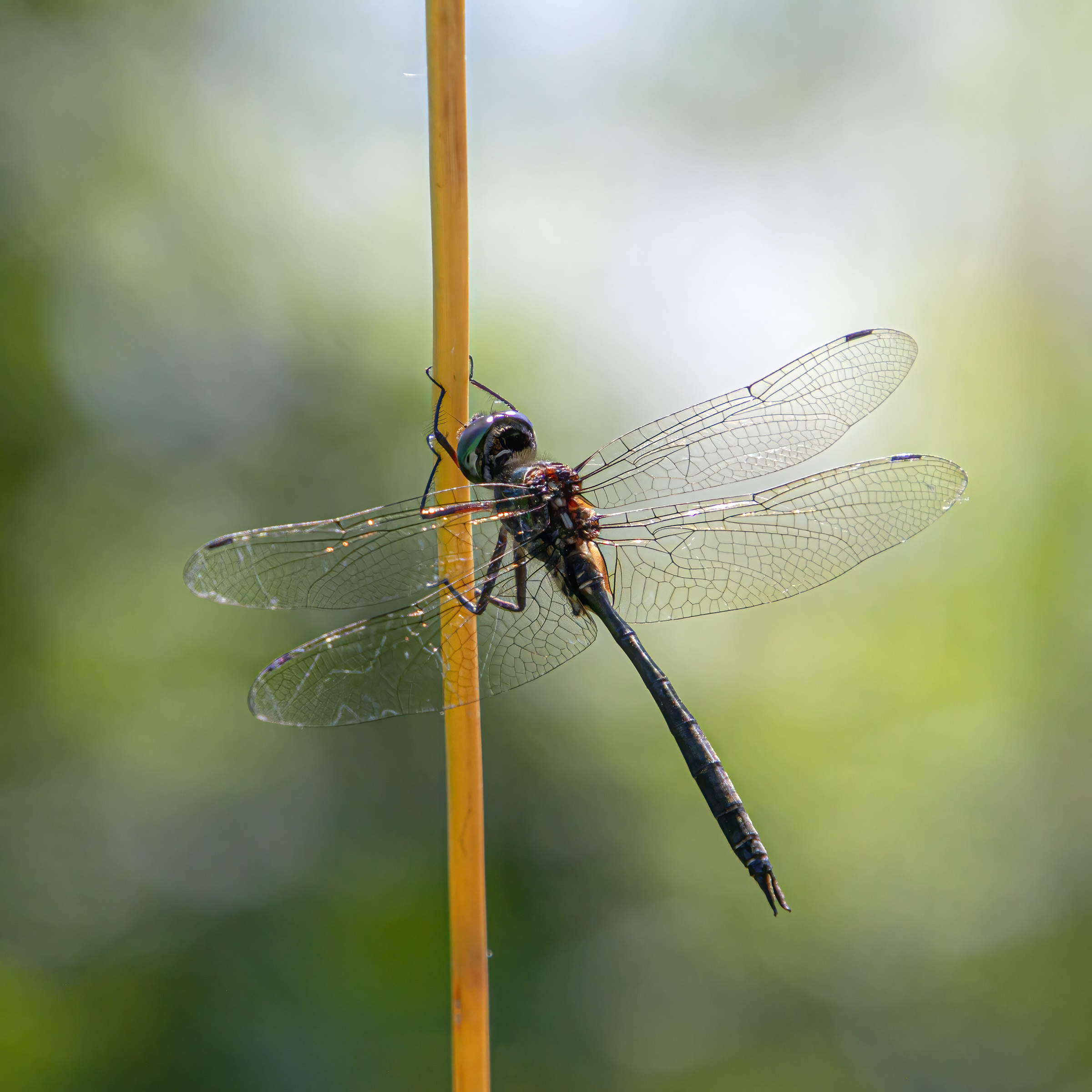
Today I am featuring the Blue Dasher dragonfly (Pachydiplax longipennis), one of the most common dragonflies in my area. The Blue Dasher is special to me because my very first posting on this blog in July 2012 included a shot of a Blue Dasher. Click on this link if you are curious to see what my photography looked like ten years ago.

I took these shots at two different locations in July, prior to my road trip, and am only now catching up on some of my backlog of shots. Blue Dashers seem to be quite adaptable and can be found in a wide variety of habitats, so it is not hard to find one.

These images show Blue Dashers in a variety of poses, including the “obelisk” pose in the final image, one of the signature poses of this species.

Blue Dasher

Blue Dasher

Blue Dasher

© Michael Q. Powell. All rights reserved.

Read Full Post »
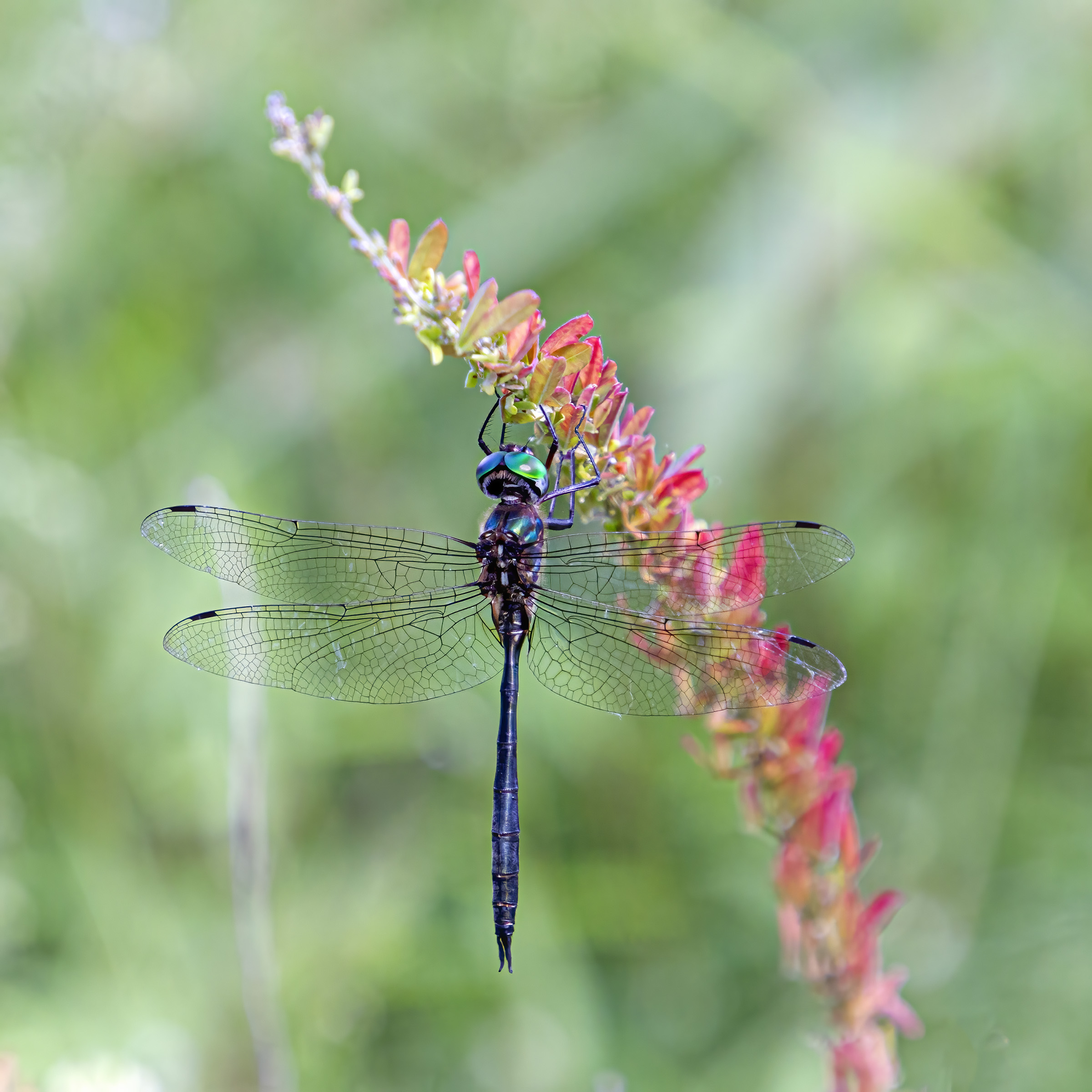
Most of the dragonflies that I spotted during my most recent visit to Occoquan Bay National Wildlife Refuge were common species that I have been seeing for months. Some photographers are driven to search for rare and exotic species and ignore the everyday ones. I am usually content with trying to capture the beauty of the ordinary ones.

In the first photo, I love the ways that the shadows of the wings of this female Common Whitetail dragonfly (Plathemis lydia) create the optical illusion that the dragonfly has extra wings. In the second photo, the female Blue Dasher dragonfly (Pachydiplax longipennis) is quite beautiful herself and the stunning background enhances that beauty.

The final photo shows a pair of Eastern Amberwing dragonflies (Perithemis tenera), the smallest dragonflies in our area. I love the way that the two dragonflies are reflected in the water.

Beauty can be found in the rare and exotic species, but I think that these images demonstrate that beauty can also be found in ordinary things. When we slow down and look closely, we discover that beauty is everywhere.

Common Whitetail

Blue Dasher

Eastern Amberwing

© Michael Q. Powell. All rights reserved.

Read Full Post »

I was hoping on Tuesday that this male Common Green Darner dragonfly (Anax junius) at Occoquan Bay National Wildlife Refuge would land, but his stamina was impressive and I had to content myself with a couple of shots as he zoomed by overhead.

I missed focus on most of my shot attempts, but the first shot below turned out pretty well—I encourage you to click on the image to see some of the beautiful colors and details of this dragonfly.

Tracking the dragonfly visually and keeping it in the viewfinder is a real challenge. I was intrigued to see that my camera more or less held onto focus in the second shot, despite the fact that the dragonfly had flown closer to the foliage.

Common Green Darner

Common Green Darner

© Michael Q. Powell. All rights reserved.

Read Full Post »
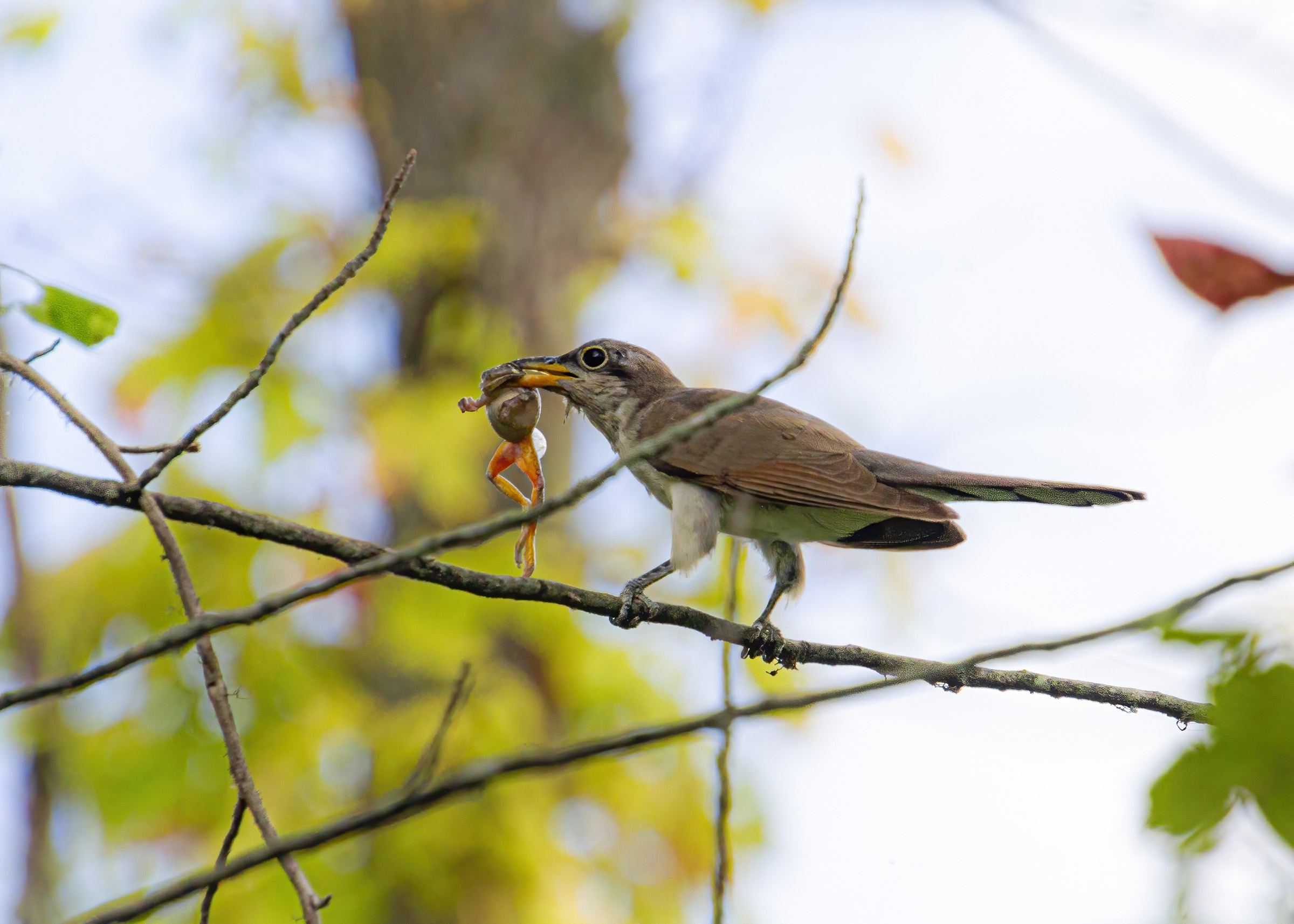
On Tuesday I was happy to see that there are still lots of dragonflies at Occoquan Bay National Wildlife Refuge. We still have at least several months before the dragonfly season will be over, but already I am noticing some changes in dragonfly demographics. Some of the dragonflies that I saw in great numbers in July, like Needham’s Skimmers for example, are now much less common.

When I visited the small pond at the refuge, I was delighted to spot some Calico Pennant dragonflies (Celithemis elisa), among the most colorful and prominently marked dragonflies in our area. The first two images show mature male Calico Pennants and highlight really well their wonderful wing markings and the beautiful red patterns on their abdomens.

Female and immature male Calico Pennants have yellow and black markings on their bodies, so when I first saw the dragonfly in the third image, I assumed it was a Calico Pennant. When I looked more closely at the image on my computer screen, however, I realized that the markings on the front wings of this dragonfly are shaped more like bands than spots. This means that the dragonfly is most likely a Halloween Pennant dragonfly (Celithemis eponina).

Pennant dragonflies, including the Calico and Halloween Pennants, love to perch at the very tip of vegetation. When even the slightest wind begins to blow, the dragonflies flap about, like pennants, especially when the vegetation is as flimsy as the one in the final photo.

Calico Pennant


Calico Pennant

Halloween Pennant

© Michael Q. Powell. All rights reserved.


Read Full Post »

Tuesday was a wonderful day for butterflies at Occoquan Bay National Wildlife Refuge and I was delighted to see lots of them, including the three orange varieties that I am featuring today. First up is a pretty Monarch butterfly (Danaus plexippus). Although its wings show some damage, it was happily feeding on some milkweed. Recent reports have shown that Monarchs are endangered, so it is always exciting to spot one.

The next photo shows a Viceroy butterfly (Limenitis archippus), which is visually quite similar to the Monarch. As I have noted before, the biggest distinguishing feature to tell the two species apart is the line on the hind wing of the Viceroys that Monarchs do not have.

The final orange butterfly is the much smaller Pearl Crescent butterfly (Phyciodes tharos). I see Pearl Crescent butterflies much more often than its larger counterparts, but they are usually quite skittish and perch so close to the ground that it is a challenge to photograph them.

Many of you know that I really like the color orange. I frequently wear a pair of orange Converse All-star sneakers and drive the orange KIA Soul that made a guest appearance in a recent blog post. For me, the color is warm and comfortable. Although it is often associated with the autumn, orange is very much a summer color too, as you can easily see in these butterfly photos.

Monarch

Viceroy

Pearl Crescent

© Michael Q. Powell. All rights reserved.


Read Full Post »

Yesterday I visited Occoquan Bay National Wildlife Refuge, my favorite local venue for wildlife photography, for the first time in almost a month. It was a beautiful summer day for a walk in nature, with temperatures and humidity lower than usual for this area. I was thrilled to be able to capture a few modest images of birds, which is a bit unusual for me during the summer, when most of the time I am more likely to hear birds hidden in the foliage than actually see them.

The first image shows a rather fluffy-looking Gray Catbird (Dumetella carolinensis). This is probably my favorite shot of the day, because the pose is more dynamic than most perched bird images. The little catbird seems to have a lot of personality and energy.

I was delighted to photograph a Bald Eagle (Haliaeetus leucocephalus) perched above the large eagle nest at the refuge. I composed the second shot to include some of the clouds that, in my view, add some visual interest to otherwise solid blue sky background. No matter how many times I see a Bald Eagle, it is always special for me.

The final image is a long distance shot of a Ruby-throated Hummingbird (Archilochus colubris). When I first spotted the hummingbird, I thought it was a butterfly as it flitted about among the flowers. When it finally registered on my brain that it was a hummingbird, I clicked off a series of shots, without much hope of getting a usable image. I was pleasantly surprised when several of the shots had the hummingbird relatively in focus. I selected this particular image because it shows the hummingbird hovering and because its wing positions reminded me of a butterfly.

It was exciting this month to be on the road, seeing different parts of the country and photographing some different subjects, but it was comforting to return to the familiar confines of a location that is a refuge for me in all senses of the word—it felt like I had returned home.

Gray Catbird

Bald Eagle

Ruby-throated Hummingbird

© Michael Q. Powell. All rights reserved.

Read Full Post »

When I tell people that I camped for several nights at Theodore Roosevelt National Park in Medora, North Dakota during my recently completed road trip, they have widely varying mental pictures about what that looked like. Some imagine that I was towing a recreational vehicle (RV) filled with all of the comforts of home and that I used hookups for electricity and water.

The truth, though, was that my form of camping was more akin to backpacking than to RV life. I carried with me a very small tent that I have owned for more than 30 years and more or less slept on the ground. I initially used the tent when I did some bike camping when I was stationed in South Korea in the late 1980’s during my service in the US Army. Before I left for my trip, I practiced setting the tent up in front of my house to reacquaint myself with it and to make sure I still had all of the component pieces.

Cottonwood Campground lies within the confines of the South Unit of this national park—there are two parts of the park that are separated by 75 miles (120 km)—and has relatively primitive campsites. RV’s are permitted, but most of the sites are pretty small and there are no hookups. Seasonally there are flush toilets available, a welcome surprise for me, and vault toilets during the off-season. There are no showers, but potable water is available. Because I have the lifetime Senior National Parks Pass, I had to pay only $7.00 per night for my site and I stayed two nights each time that I was there.

Half of the sites are by reservation while all remaining sites are first come, first served. I showed up without reservations on both my westward and eastward legs of the trip and was able to find a site both times without problem in the tenting area of the campground. In fact, I stayed in the exact same spot each time. I liked this spot because it was at the end of a row of spots, so I had a neighbor on only one side.

The first photo shows my view looking out from inside of my tent, with some buttes visible in the distance. The second image gives you a better view of the tent itself. It is taller at the front and has a vestibule area where I could store some gear. Importantly, there is netting to help keep the bugs out. I was not bothered by mosquitos, but there were a lot of grasshoppers and some flies from time to time.

The third shot shows the rest of my site that included a picnic table and a grill. In the photo you can see that I had a small cooler and I also had a water jug that held six gallons (23 liters)—many parts of the United States had been experiencing heat waves and I wanted to make sure that I had plenty of water in case I was stranded. You can also see my orange KIA Soul. I think that this was the only KIA Soul that I spotted when driving through North Dakota and Montana—most of the local folks seemed to be driving pickup trucks or large SUV’s.

I did not have a proper sleeping mat, but used a thick yoga mat, which did provide some cushioning from the hard ground. I had a blanket, sheet and pillow with me too and a sleeping bag. I did not think that I would need the sleeping bag, but the first night that I camped out, temperatures dropped to 44 degrees (7 degrees C), and I was able to snuggle up inside the sleeping bag.

In terms of cooking, I used a little camp stove with a propane/butane canister. The fourth photo shows my little setup as I boiled water to make instant oatmeal and instant coffee for breakfast one morning. I also had several boxes of granola bars on which I snacked throughout the day.

The final two photos shows views from the campsite. On the morning when it was cold, fog and mist were hanging over the Little Missouri River, which flowed very close to our location, and the surrounding area. The final shots shows the glow of the moon, which was almost full, just before it rose over the buttes in the distance. The lights in the right hand side of the image came from a row of cars that were heading in the direction of the park’s exit.

I hope you enjoyed my little tour of my modest camping setup. When I began my trip, I had no specific plans for camping, but brought along the gear so that I could do so if the right situation presented itself. I was really happy to find this gem of a National Park and would gladly return there in the future.

Camping in North Dakota

Camping in North Dakota

Camping in North Dakota

Camping in North Dakota

Camping in North Dakota

Camping in North Dakota

© Michael Q. Powell. All rights reserved.

Read Full Post »

What is the best way to convey a sense of the massive expanse of the badlands in North Dakota? That was the dilemma that faced me last week as I stood at the Skyline Vista observation point in Theodore Roosevelt National Park. Would a single photo suffice? What about a panorama shot? Perhaps a video might work?

An informational sign at Skyline Vista noted that, “They may look like mountains, but landforms in the badlands are buttes. Mountains form when land is thrust upwards. This process has not taken place in the badlands. Buttes form as erosion removes surrounding material. Rainwater, creeks, and the river are constantly eroding the badlands, leaving behind fantastically shaped buttes.”

My initial instincts pushed me to try a couple of traditional approaches. In the first image, I composed a shot with the flowers in the foreground to add some visual interest, rather then focusing attention simply on the buttes. In the second image, I tried to use the curving highway as a compositional element.

I then switched to considering methods that took advantage of the capabilities of the iPhone 11 with which I was shooting at that moment. I used the iPhone’s pano mode to create the third image and really liked the wide view that it provided of the badlands. In my final attempt, I filmed a short video in which I panned across the horizon, holding my phone vertically that I posted to YouTube (https://www.youtube.com/shorts/mTxPxVPlQVE) and have embedded below. The video provides an even wider view than the panoramic shot.

Is there a “best” way to show this rugged landscape? I would be hard pressed to say that any of the methods that I used was the “best”—each shows a slightly difference sense of what it was like for me to be at that observation point. Many of the other people that I observed simply took a single shot and returned to their cars and drove away. I personally think it is much more enjoyable to “work” a subject and look for creative ways to capture its beauty.

Skyline Vista

Skyline Vista

Skyline Vista

© Michael Q. Powell. All rights reserved.


Read Full Post »
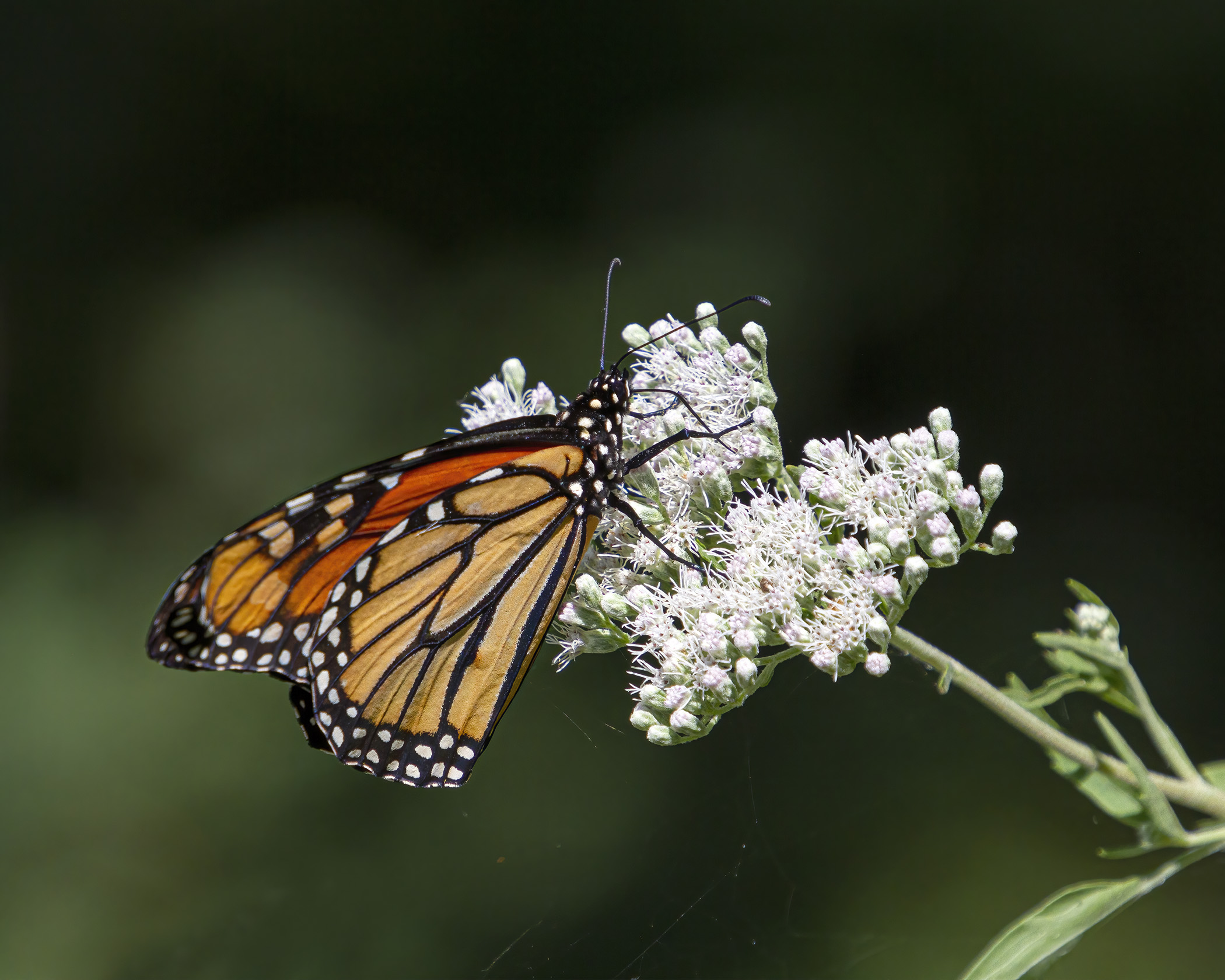
Until quite recently, I had never tried to create videos with my iPhone and still have not tried to do so with my DSLR camera. I guess that I am a little old-fashioned and think of a phone as primarily a device for making phone calls and a camera as a device for taking still photos. I am gradually changing to using my phone for texting and during my recently completed road trip, I played around with taking short videos with my iPhone. Maybe it is possible to teach an old dog new tricks.

The change was prompted in part by the fact that I had to radically change my shooting habits when visiting Theodore Roosevelt National Park in North Dakota. I camped out at the park for two nights when I was headed westward towards Seattle and another two nights on my return trip eastward to Virginia. At that park, I got used to seeing large creatures like American Bison (Bison bison) at close-range and photographing them from inside my car. Suddenly it dawned on me that videos would be an effective way of capturing some of that action. In addition to bison, I also had several encounters with wild horses that I was able to document in videos.

As you probably noticed, the first image is not a video—I inserted it so that an image would show up as a thumbnail in the “Reader” feed for those who view my postings in that way. The still photo shows a large bull moving down the recently repaved roads of the park. At that time they had not yet painted lines on the road, so I had to pay a lot of attention while driving, given that many of the roads were full of curves and and in some cases there were steep drop-offs. I do not think that the bison cared about the lack of lines—as far as I was concerned, they owned the roads and always had right-of-way.

The first video shows one of the huge male bisons that I encountered on the roads at the national park. I was safely inside of my car when I took this video, though I must confess that this bull bison looked to be almost as big as my KIA Soul and may have outweighed it.

The second and third videos show bands of wild horses that I encountered at separate locations in the park. I was particularly impressed by the beauty of these horses and it was cool to capture them in action.

I was not sure how to present videos here in WordPress, but I think it works to post them to YouTube first and then to embed a link to that posting here. In this way, the videos do not count against my data allowance on my WordPress plan.

I definitely need to improve on my skills as a videographer, but I am happy with these initial results. The sound quality is still a problem, because it was often windy and the video also includes some extraneous conversation. I may have to learn to do voiceovers for the videos or to add some music to them.

So what do you think? These little clips are definitely a change from my normal content, but I thought it would be a fun way to share some of my experiences more directly with all of you. As you probably noticed, the first image is not a video—I inserted it so that an image would show up as a thumbnail in the “Reader” feed for those who view my postings in that way.

American Bison

Here is the YouTube link for the first video.

Here is the YouTube link for the second video.

Here is the YouTube link for the final video.

© Michael Q. Powell. All rights reserved.


Read Full Post »

I don’t take selfies very often, but decided to make an exception on Saturday when I was seated on Dege Peak (elevation 6982 ft (2128 m)) with Mount Rainier prominently behind me. I must confess, though, that I started my hike at 6100 feet (1859 m), so it is not all that impressive, though my iPhone indicates that I climbed the equivalent of 54 floors that day.

On previous visits to Mount Rainier, I have always entered at the Nisqually entrance that allows you to go as far as the Paradise Visitor Center, which is located at an elevation of 5400 ft (1645 m). It is the most easily accessible entrance and is therefore crowded most of the time.

During Saturday’s trip, I entered the park via the Sunrise entrance, which is located 60 miles (97 km) from the Nisqually entrance. The Sunrise entrance is open only from the beginning of July, when the snow is finally cleared, to early September. The Sunrise visitor center, located at an elevation of 6400 feet (1950 m), is the highest point you can access by car in the park.

I never did make it to the visitor center parking lot, which was crowded. Instead I stopped at a parking area at 6100 feet (1859 m) and hiked along the Sourdough Ridge Trail that took me up even higher than the visitor center. The views were spectacular and I was alone most of the time.

The second image shows one of those amazing views of Mount Rainier from that trail. I felt like I was looking straight across at the snow-covered mountain, although in actuality the peak of Mt Rainier was much higher at an elevation of 14,411 ft (4392 m).

I captured the final image of Sunrise Lake by looking back in the direction that I had hiked. The beautiful little lake was located just below Sunrise Point, where my car was parked.

Mt Rainier

Mt Rainier


Sunrise Lake

© Michael Q. Powell. All rights reserved.

Read Full Post »

Here are some shots of butterflies that I spotted yesterday while hiking in Mt Rainier National Park. All three were photographed at over 6000 feet altitude (1829 m), flying among the wildflowers and other vegetation.

I think they are an Anise Swallowtail (Papilio zelicaon), an Edith’s Checkerspot (Euphydryas editha), and an Arctic Fritillary (Boloria chariclea), none of which I had seen previously. As I have mentioned before, I am not very familiar with Western species, so I therefore welcome corrections if I have identified these butterflies.

Today is my last full day in Washington State—I will begin my long drive back to the East Coast tomorrow and my blog posting schedule will almost certainly will be sporadic during this coming week. With a little luck, I’ll be able to capture some images along the way that I can share with you when I am finally home in a week or so.

Anise Swallowtail

Edith's Checkerspot

Arctic Fritillary

© Michael Q. Powell. All rights reserved.

Read Full Post »

It was so much fun to watch the Black-tailed Prairie Dogs (Cynomys ludovicianus) that I encountered in multiple locations during my recent visit to Theodore Roosevelt National Park in Medora, North Dakota. I could see them from my car when I was driving along the roads looking for buffalo and wild horses, but I also encountered them on both sides of some of  the trails when I was hiking.

The prairie dogs seemed playful and energetic and were surprisingly vocal. They seemed to be calling out to each other all of the time in very distinctive squeaky voices. It seems like some of the calls were warnings that I was approaching, because quite often the prairie dogs would scurry into their holes as I drew near, sometimes peeking out with just the top of their heads and their eyes visible.

Here are some selected shots of prairie dogs in which I tried to capture a sense of their playful personalities.

Prairie Dogs

Prairie Dog

Prairie Dog


Read Full Post »

« Newer Posts - Older Posts »