Feeds:
Posts
Comments

Archive for the ‘Macro Photography’ Category

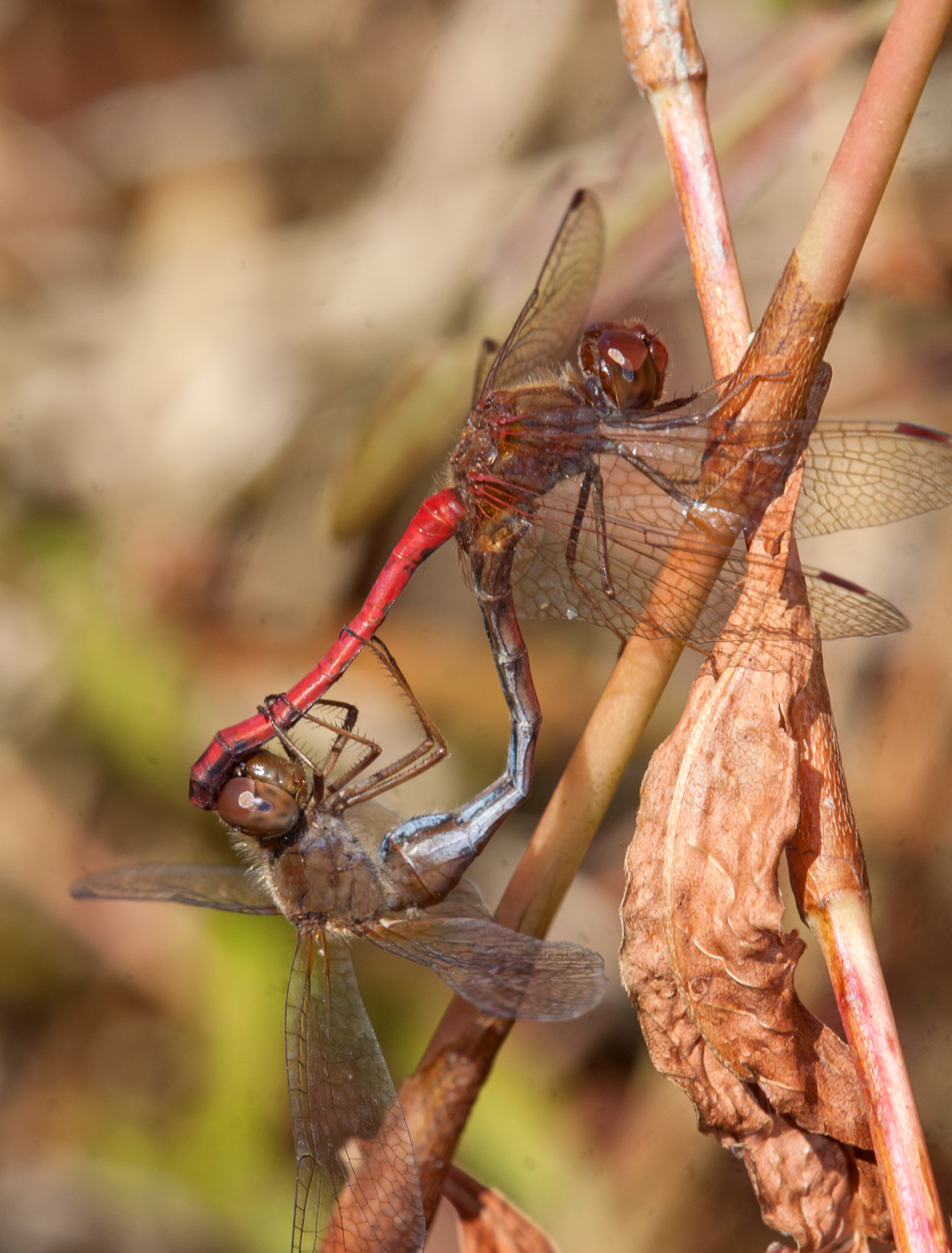
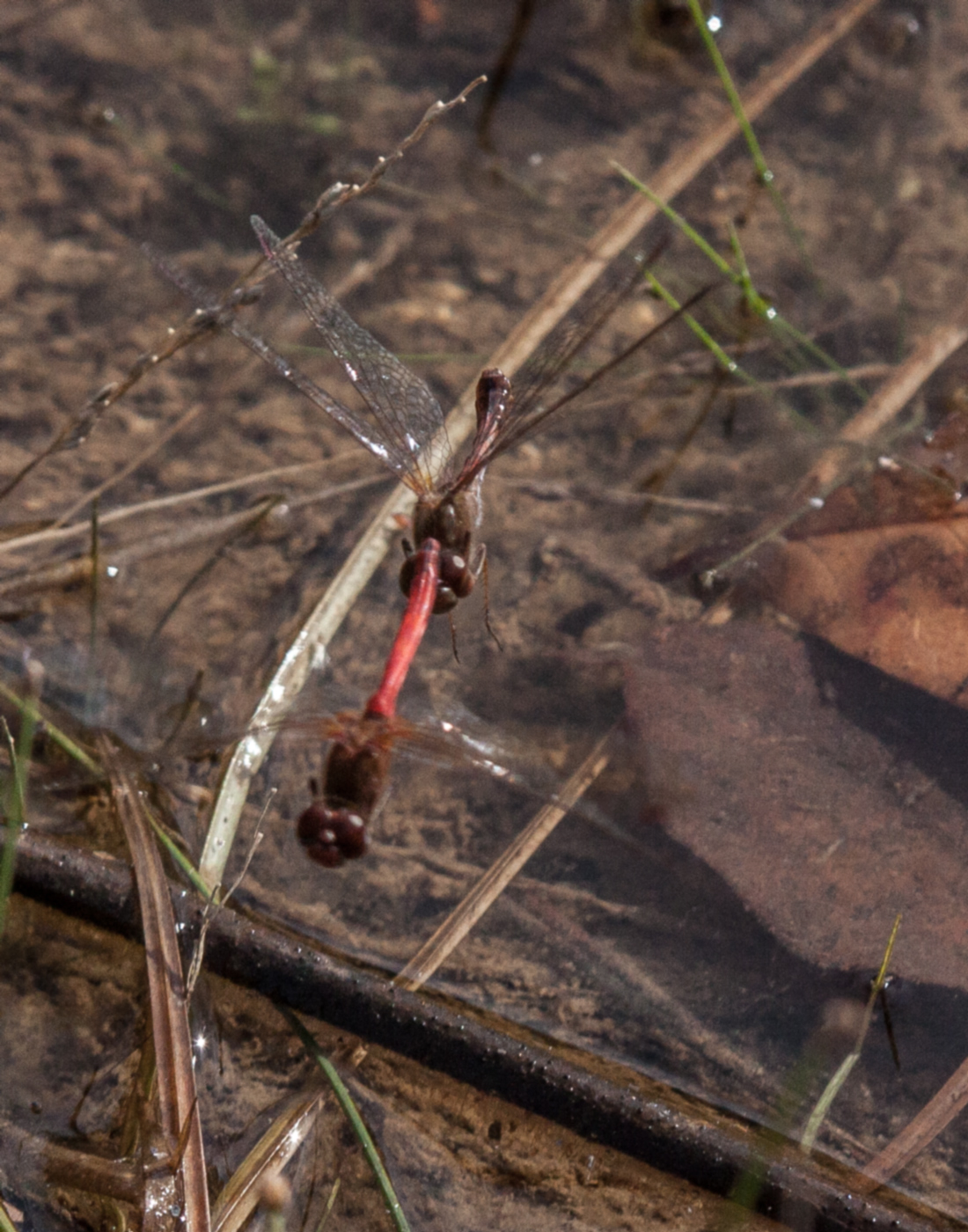
When I captured these two images of mating dragonflies on the 10th of November, I did not realize that their frantic efforts to perpetuate their species that day would mark an end to this year’s dragonfly season for me. There is a chance that some especially hardy Autumn Meadowhawks (Sympetrum vicinum) may have survived our recent spell of bitter cold, but realistically speaking, it’s time to put my macro lenses on the shelf and focus my photographic efforts and birds (and the occasional small mammal).

The Autumn Meadowhawks in the first image were a little higher off the ground that the Blue-faced Meadowhawks (Sympetrum ambiguum) in the second shot and I managed to get into a better shooting position to capture details and separate the dragonflies a bit from the background.  In case of the Blue-faced Meadowhawks, I was so thrilled to see them so late into November that I was willing to settle for a lower angle shot with a more cluttered background.

Most of the time I feature only a single species of dragonflies in a posting and it’s a little hard to compare the featured dragonflies with others. It’s a whole lot easier to see the differences between the species when you compare the two photos here.

And so this year’s dragonfly season draws to a close, as the mating couples dance their last tango of the autumn.
Autumn Meadowhawk matingBlue-faced Meadowawk mating

© Michael Q. Powell. All rights reserved.

Read Full Post »

During most of the year the bright red body of Blue-faced Meadowhawk dragonfly (Sympetrum ambiguum) would really stand out, but in the late autumn, it blends in pretty well with the vegetation. However, it is almost impossible to conceal this species’ stunning blue eyes and turquoise face, which cause it to stand out from even a very cluttered background.

Blue-faced Meadowhawk

© Michael Q. Powell. All rights reserved.
Read Full Post »

Although many summer dragonflies perch high on the vegetation, the autumn species seem to prefer the ground, so I have been spotting all kinds of cool-looking insects as I keep my eyes pointed down in my continuing search for dragonflies (and so far have not run into anything).

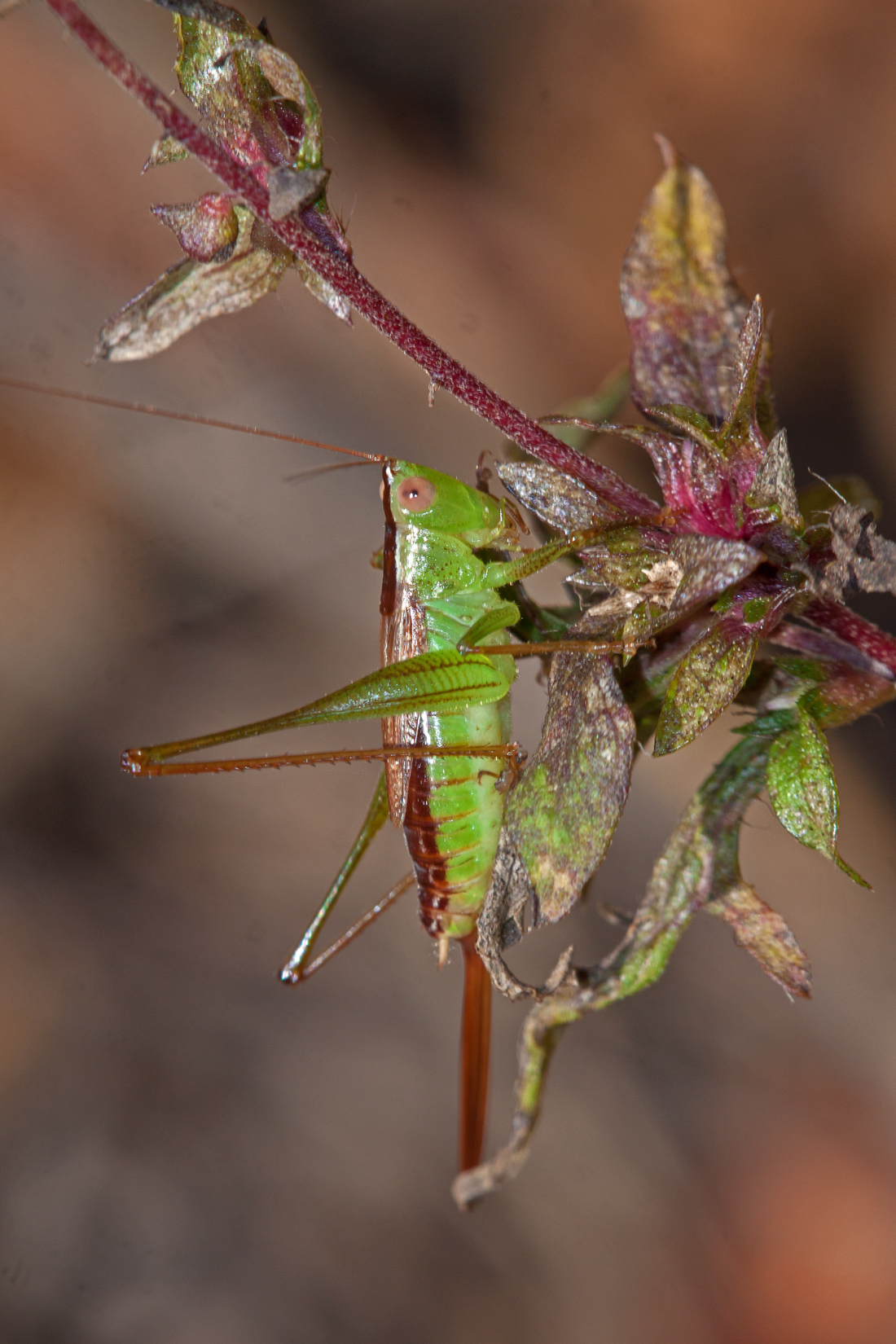
Earlier this week, I came across this beautiful grasshopper-like insect. It looks a bit like my all-time favorite insect, the  Handsome Meadow Katydid (Orchelimum pulchellum) and has the same long antennae, but this katydid’s colors are drab by comparison. (Check out one of my previous blog postings called Rainbow Grasshopper to see my favorite insect.)

This insect’s wings are pretty short and it looks to have a long ovipositor. As a result, I’ve tentatively concluded that it might be a female Short-winged Meadow Katydid (Conocephalus brevipennis) and have put in a request to the helpful folks at BugGuide for assistance in confirming my identification.

Short-winged Meadow Katydid

© Michael Q. Powell. All rights reserved.

Read Full Post »

“Make sure the eyes are in focus.” I can’t even count the number of times that I have read or heard these words of advice, which I usually try to follow, even when taking extreme close-up macro shots.

These are the compound eyes of the Autumn Medowhawk dragonfly (Sympetrum vicinum), a close relative of the Blue-faced Meadowhawk that I have featured in several postings recently. I took this shot on a cool day when the dragonfly was perched on a tree, trying to warm itself in the warmth of the sun. The camera’s aperture setting was in a middle range at f/9.0, but with the subject this close, the depth of field was pretty shallow and the eyes are pretty much the only portions of the dragonfly in focus (in addition to small section of the wings and the front legs).

autumn_close1_blog

© Michael Q. Powell. All rights reserved.
Read Full Post »

When Autumn Meadowhawk dragonflies (Sympetrum vicinum) have finished mating, the male does not release the female, but continues to clasp her head tightly with the tip of his abdomen. The pair flies off together in the “tandem” position and remains attached until the female has finished depositing her eggs, normally in the water.

A chivalrous interpretation of this behavior might be that the male is merely protecting his mate from clamoring suitors and allowing her to oviposit in peace. The reality, though, is that there is a fierce competition among males that can sometimes involve attempt to dislodge a rival’s sperm from a female and replace it with his own if the female has not yet laid her eggs. By holding onto the female, the male increases his odds of fathering some baby dragonflies.

Check out a 2006 National Georgraphic article called Dragonflies Strange Love for some other fascinating insights into the love life of dragonflies.

Earlier this month, I was at a small pool of water and I watched as a series of Autumn Meadowhawk couples in tandem went through the process of ovipositing and I attempted to get some in-flight shots of them. These dragonflies are really small and my success rate in keeping them in the frame was not high, but I did manage to get a few decent images.

Hopefully the practice in tracking a moving subject will carry over and help me as I move to photographing birds in flight, rather than dragonflies.

Autumn MeadowhawkAutumn Meadowhawk

© Michael Q. Powell. All rights reserved.

Read Full Post »

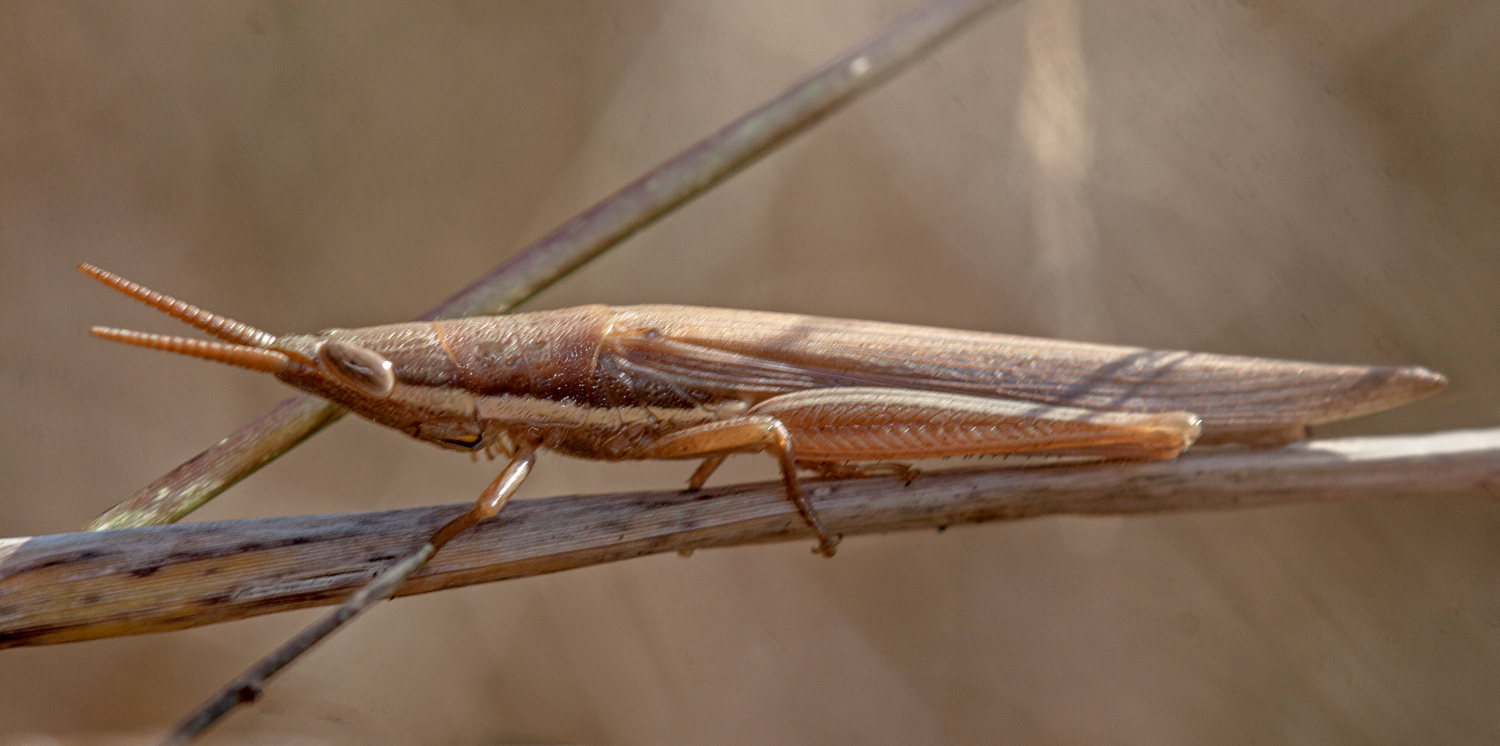
As I looked through my macro lens, I felt for a moment like a matador. The grasshopper in my viewfinder had lowered its head and was preparing to charge me, trying its best to gore me with its fearsome fluted horns. I wasn’t dressed for the part and had no little red cape to bravely wave at the charging grasshopper.

In reality, I am not sure what kind of a grasshopper this is. It looks a little like a Slant-faced Grasshopper, but I have never before seen one with such unusual, horn-shaped antennae. This grasshopper hopped up onto this stalk of grass as I was searching for dragonflies this past weekend. I don’t know much about the developmental cycle of grasshoppers and wonder if this might be a nymph.

In the absence of any scientific information, I think I’ll informally call this the Dual-unicorn Grasshopper, because the shape and pattern of the antennae remind me of so many of the depictions I have seen of the mythical unicorn.


charge_blogcharge2_blog

© Michael Q. Powell. All rights reserved.

Read Full Post »

My concerns about the potential demise of the Blue-faced Meadowhawk dragonflies (Sympetrum ambiguum) were greatly exaggerated and I saw a half-dozen or more yesterday on Veterans Day (Armistice Day).

Normally we stop seeing this species of dragonflies by the end of October, but we have not yet gone below freezing and perhaps that explains their unexpected longevity. Yesterday, for example, the temperatures soared to almost 70 degrees F (21 degrees C).  I have to note too that I am searching for them more diligently and in more remote locations of my marshland park, so that may help explain why I am seeing them more frequently.

As is the case with birds, male dragonflies tend to be more brightly colored and visible. Many female dragonflies are brown in colored and harder to spot. I was thus very happy yesterday to be able to get this close-up shot of a female Blue-faced Meadowhawk. Her body coloration may be a little bit drab, but those blue eyes are simply stunning.

In case you are curious, these dragonflies are small in size, with a body length of approximately 1.5 inches (38 mm), so I had to move in awfully close to get this shot. Surprisingly (and happily), this female tolerated my close presence for long enough for me to take several shots before she flew off into the distance.

female Blue-faced Meadowhawk

© Michael Q. Powell. All rights reserved.
 

Read Full Post »

Have you ever tried to photograph a living subject—or even worse, a pair of them—perched on one of your knees? Depth of field is a huge challenge and even trying to frame the subject is complicated, especially when you have a 180mm macro lens on your camera.

Autumn Meadowhawks (Sympetrum vicinum) are the most friendly dragonflies I have ever encountered. I don’t know what attracts them—perhaps it’s curiosity—but I found out last year that they are prone to perch on me.

Surprisingly, they will even perch as a pair when they are still in tandem, the position that this species uses when the female is ovipositing, i.e. placing her eggs in the water after mating. The male hangs on to the female by the head, presumably to keep other males from interfering with the process.

In my initial attempt to get a shot of the couple, I focused on the male, and the female is completely out of focus.  For the second attempt, I tried to twist myself around to photograph them from the side and almost fell over in the process. The female is more in focus, but the male is now slightly out of focus.

As the season progresses, I’ll see if I can find some even more cooperative Autumn Meadowhawks and try to get a shot of one perched on one of my fingertips, as I did last year.

Autumn Meadowhawk

Autumn Meadowhawk

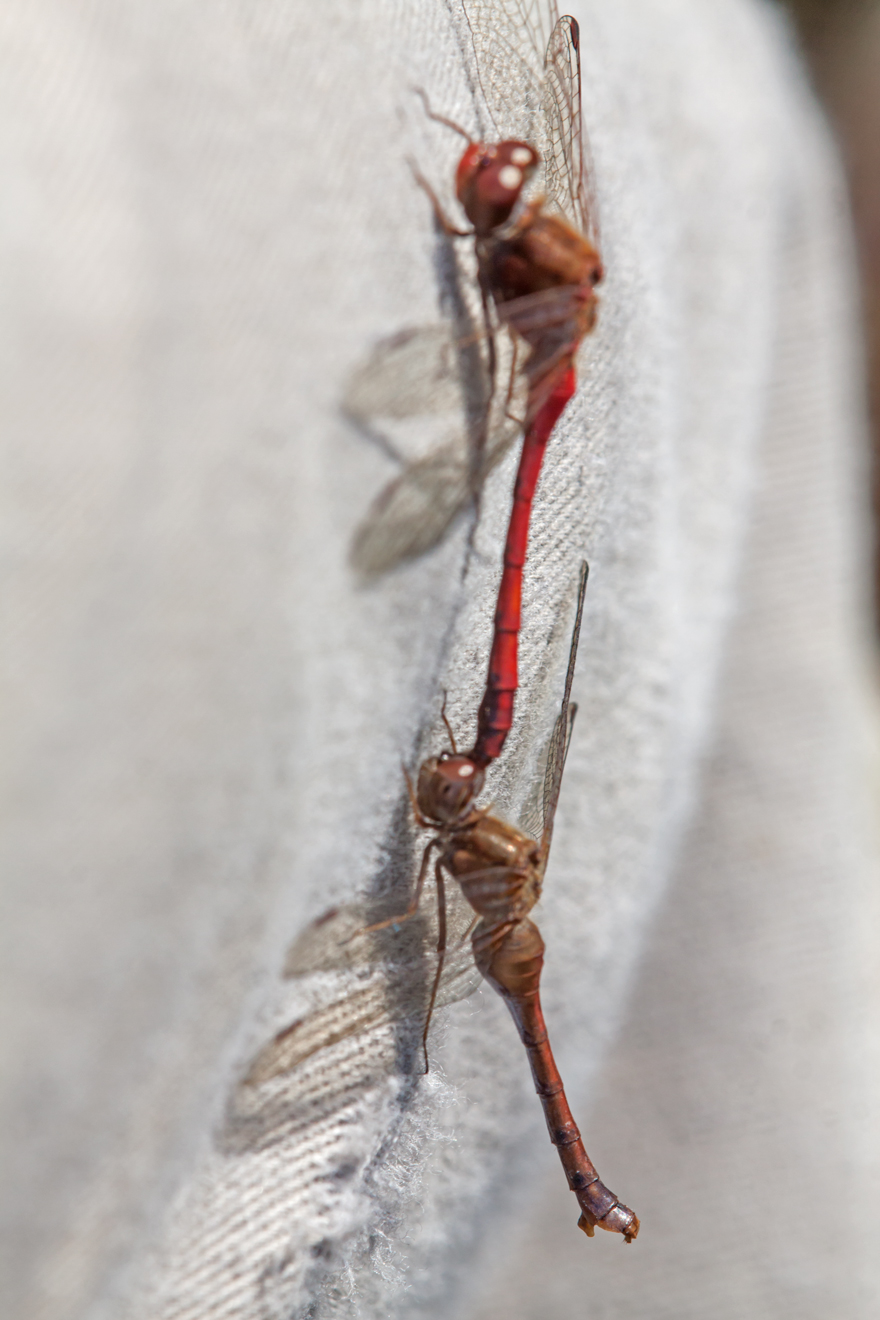
Later in the day, a male Autumn Meadowhawk landed on my leg and I had much better success in getting some clear shots. I used a similar approach, taking the first shot from above and the second one from the side. My pants are a solid tan color and it is interesting to see how it almost looks like I was wearing a seersucker suit.

Autumn Meadowhawk

Autumn Meadowhawk

© Michael Q. Powell. All rights reserved.


Read Full Post »

We’re almost at the end of the dragonfly season now in Northern Virginia and soon I’ll be seeing only the Autumn Meadowhawks (Sympetrum vicinum), historically the last dragonflies of the year to disappear. This past Monday, though, I managed to find a few Blue-faced Meadowhawk dragonflies (Sympetrum ambiguum), unusually hardy survivors this late in the season.

I really enjoy trying to get close-up shots of these colorful little dragonflies and my favorite shot is this close-up of one of them, perched on a fallen leaf.

Blue-faced Meadowhawk

When you pull back a little, you can see how tough the season has been for this dragonfly—portions of its wings are shredded. Somehow, however, it managed to fly about as though its wings were undamaged.

Blue-faced Meadwhawk

Temperatures last night dropped down into the upper 30’s F (3-4 degrees C) and I doubt that I will see any more Blue-faced Meadowhawks. I am resigned to the possibility that these may be my last shots of the year of these stunning little dragonflies, but that won’t keep me from searching really hard for them later today.

Blue-faced Meadowhawk

© Michael Q. Powell. All rights reserved.

Read Full Post »

It’s hard not to feel a little bit like a voyeur when I move in close to capture the details of an intimate encounter between two wild creatures. There is something especially intriguing about the acrobatic maneuvers of colorful mating dragonflies, like this pair of Autumn Meadowhawk dragonflies (Sympetrum vicinum) that I photographed in the “wheel” position at my local marshland park in late October.

Many times I have to assume equally acrobatic positions to capture the action. Fellow photographer and dragonfly enthusiast Walter Sanford photographed me in one such pose in an image that I included in a previous posting entitled “My view of the mating dragonflies.”

On this occasion, however, the dragonflies were much more accommodating and they perched at eye level on the top of some vegetation. The couple was back-lit, but a little fill flash helped to bring out the details and the colors.

In this case, at least, the brightly-colored  dragonflies seemed to be exhibitionists and I felt less like a voyeur, though I must confess that I did not shield my eyes and turn away from the activity.

Autumn Meadowhawks mating

© Michael Q. Powell. All rights reserved.
Read Full Post »

Continuing my quest to find and photograph the dwindling number of insects before winter sets in, I came upon this tiny green spider this past Monday as I was searching for dragonflies. It was almost hidden in the leaf litter, but made a slight motion as I happened to be looking at its direction.

It looks to be some kind of crab spider, though that is more a guess than an informed opinion. One thing that I do know, though, is that I am fascinated by its eyes, which you can see more closely if you click on the image.

I took this photo just about at the minimum focusing distance for my lens, which the manufacture says is 18.5 inches (47cm). I tried to get just a bit closer, but had to back off to keep the spider in focus. As you can probably tell, I was really low to the ground when I took this photo and was using my camera bag to stabilize the lens for the shot.

The weather has turned cooler and rainy, which does not bode well for the insect population. I’ll probably be out tomorrow looking for the survivors (and have a few more to post from Monday if I am unable to find new subjects).

spider1_nov_blog

© Michael Q. Powell. All rights reserved.

Read Full Post »

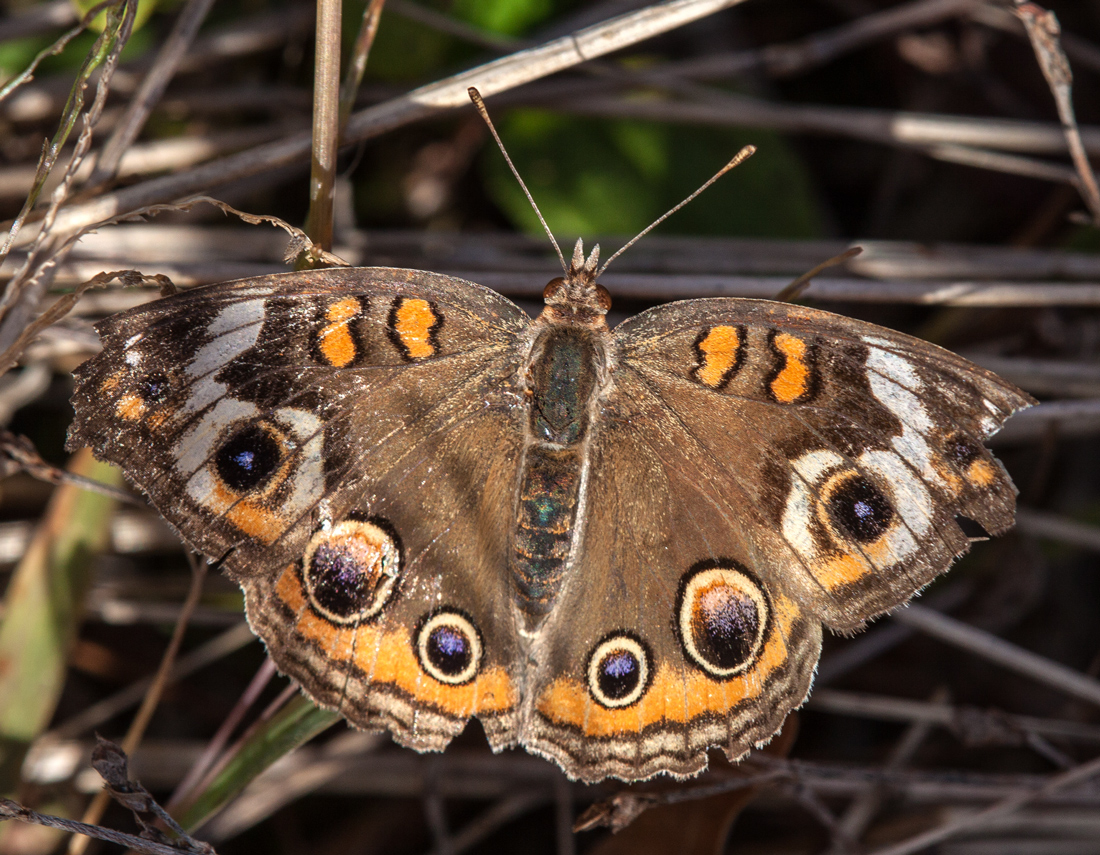
Butterflies in November? I didn’t really expect to see any, so it was a pleasant surprise when I came upon this Common Buckeye (Junonia coenia) on Monday at my local marsh. The butterfly is beat-up and bedraggled, but its beauty beams brightly—uncommon beauty at an unexpected time.

buckeye_nov_blog

© Michael Q. Powell. All rights reserved.

Read Full Post »

I am looking for some background information—do you generally prefer creamy smooth backgrounds in your photos or do like there to have some elements of texture?  This is a ridiculous question, of course, and it’s a bit like asking me if I like chocolate or strawberry ice cream. I like them both, but in certain situations I may prefer one over the other.

These musings came to mind when I was reviewing the some photos I took this past week of Autumn Meadownhawk dragonflies (Sympetrum vicinum). These little red dragonflies are perennially the last species to disappear in our area and I am likely to see them well into November and sometimes into early December.

The first image below shows a male Autumn Meadowhawk with the kind of background that I usually try to shoot, blurred and uncluttered. The thorn on the green stem adds an unexpected bit of additional interest for me.

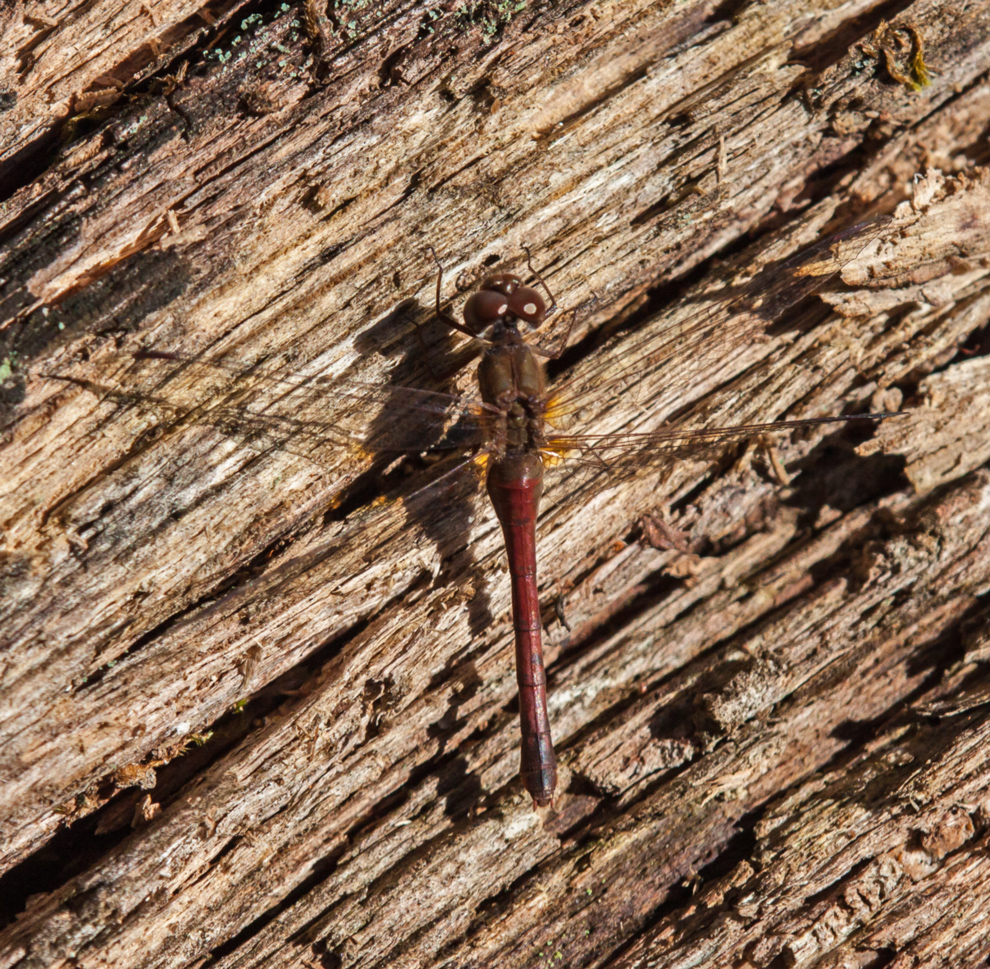
The background of the second image with a female Autumn Meadowhawk is completely different—the lines and texture of the decaying log are very evident. Sometimes when I look at the image I think that the background is too distracting, because I have to look hard to see the details of the dragonfly. At other times, I am drawn in by the organic feel of the wood in the background and I really like the diagonal lines and rough texture.

These two images work well for me in tandem, juxtaposing as they do different genders, very different backgrounds, and radically different angles of view. These kinds of sharp contrasts often prompt me to stop and think as I consider the images—and that is generally a good thing.


male Autumn Meadowhawkfemale Autumn Meadowhawk

© Michael Q. Powell. All rights reserved.

Read Full Post »

I’m not big on ghosts and goblins, so to celebrate Halloween I though I’d include a few recent images of spiders that I have not posted previously. Some of my readers may find certain spiders to be creepy and utterly appropriate for Halloween, though I tend to view as beautiful creatures, many of which are capable of creating beautiful web art.

Happy Halloween to all.

NOTE: If you click on any one of the images in the mosaic, you will be taken into slide show mode, where you will see larger versions of the images (when you are viewing the original posting).

© Michael Q. Powell. All rights reserved.

Read Full Post »

Even from a distance it’s hard to miss the bright lapis blue eyes of a male Great Spreadwing damselfly (Archilestes grandis). Unlike many damselflies, which are tiny, this species, as its name suggests, is a big damselfly, about 2 to 2 1/2 inches in length (50-62mm). According to Bugguide.net, though, the bright yellow”racing” stripe, which occurs on both males and females, is the most easily seen distinguishing identification feature for this species.

I had never even heard of this beauty until the 11th of October, when fellow dragonfly hunter Walter Sanford blogged about his discovery of one at Huntley Meadows Park on the 9th of October. I had no idea if this was the only member of the species at the park or how long it would hang around and didn’t hold much hope of seeing one of these damselflies myself.

I was shocked and pleased on the 20th of October when I spotted Walter and this damselfly. Walter graciously ceded to me the prime spot for taking a close-up shot. A week later I returned to the same location and the Great Spreadwing was gone.

In past years I didn’t pay much attention to the timing and location of various dragonflies and damselflies—they were either present or they weren’t. This summer and fall, however, I’ve been learning how important the specific habitat and the time of year are for certain species and the window of opportunity to observe them opens and closes pretty quickly.

Consequently, I consider myself very fortunate that I was able to capture this little portrait of the Great Spreadwing damselfly.


Great Spreadwing

© Michael Q. Powell. All rights reserved.

Read Full Post »

It’s hard enough to find the stunningly beautiful Blue-faced Meadowhawk dragonfly, but fellow photographer Walter Sanford set the bar higher this season by seeking to capture them against a backdrop of colorful autumn foliage. Check out his amazing results.

waltersanford's avatarwalter sanford's photoblog

This is Part 1 in a series of posts featuring photos of Blue-faced Meadowhawk dragonflies (Sympetrum ambiguum) spotted while photowalking Huntley Meadows Park during Fall 2014. All individuals are males, as indicated by their coloration and terminal appendages.

One of my overarching goals this fall is to shoot pictures of my favorite species of dragonfly against a background of autumn foliage. The color and clarity of these photographs is enhanced by using an external flash unit to add “fill” light.

… the real secret of wildlife photography is fill flash. Fill flash is one of the key techniques for easily improving wildlife images. Electronic flash improves the color balance of the image, improves color saturation, fills in dark shadows with detail, adds a catch light to an animal’s eye, and may help increase sharpness.” Source Credit: Wildlife Fill Flash.

Please view full-size versions of the following photos in…

View original post 46 more words

Read Full Post »

As the days grow colder, I am trying to capture images of almost any insect that I can find.

I was particularly happy this weekend when I came across this little flower fly (also called a hoverfly or syrphid fly) on a beautiful reddish-purple leaf. The leaf made for a simple backdrop that lets you see some of the details of the fly’s body, including the incredible compound eyes and the antennae.

I was also pleased that the out-of-focus area behind the lead is a orange-red color that seems appropriate for this autumn season.

flower fly

© Michael Q. Powell. All rights reserved.

Read Full Post »

Many of the other dragonflies are gone for the season, but the Autumn Meadowhawks (Sympetrum vicinum) will be around for quite some time, possibly even into December. Autumn Meadowhawks like to perch on the ground much of the time, but yesterday I was happy to capture one in what I consider to be its natural environment, perched among the colorful leaves of the autumn foliage.

Autumn Meadowhawk

© Michael Q. Powell. All rights reserved.

Read Full Post »

The calendar indicates that we are well into autumn, but this metallic green sweat bee (genus Agapostemon) that I observed on Friday at Huntley Meadows Park was busily gathering pollen as though it were spring. With eyes that look like a mask, it looks like he decided to dress us as a Teenage Mutant Ninja Turtle for Halloween.

Teenage Mutant Ninja Bee

Teenage Mutant Ninja Bee

© Michael Q. Powell. All rights reserved.
Read Full Post »

This re-posting is a bit of shameless self-promotion, but it is hard to describe how honored and thrilled I feel to be featured by Leanne Cole in a blog posting today. Leanne, who lives and works in Australia, is a wonderful photographer who spends a lot of time as a kind of photographic evangelist, sharing her passion for the art and practice of photography. She is constantly encouraging and teaching others, yet somehow seems to find time to explore new areas of her own photography, ranging from photographing the stars at night to investigating the close-up world of macro photography. Be sure to check out her incredible blog.

Read Full Post »

The weather may be cooling, but things are still hopping at my local marshland park.

As I was walking through one of the back meadows last Friday, grasshoppers were hopping every which way as I approached them. Most of them settled back down into the grass and I couldn’t get a good look at them, much less a photo. Suddenly one grasshopper jumped up onto a plant and posed for a moment. I used my popup flash because I was shooting directly into the sun, and I was able to capture a good deal of detail of the insect’s body.

grass1_oct_blog

Shortly thereafter a katydid did the same, but chose to perch at a titled angle.  I had time for only a single shot and did not use flash, so you can see some of the light shining through from behind (though I did have to lighten the shadows in post-processing). I especially like the way in which the angles of the insect’s long antennae mirror the shapes of the branches of the plant. I am not sure of the specific identification of this insect, but suspect that it’s a katydid vice a grasshopper because of the extremely long antennae.

grass2_oct_blog

© Michael Q. Powell. All rights reserved.

Read Full Post »

Do you ever shoot the same subject at the same time with another photographer and compare the results afterwards? It is fascinating to see how the choice of equipment, individual shooting styles, and angle of view affect the results.

Recently I was walking at Huntley Meadows Park, the local marshland park where I take a lot of my nature photos, with fellow blogger and photographer Walter Sanford when he spotted a mating pair of Blue-faced Meadowhawk dragonflies (Sympetrum ambiguum). Eventually they landed on the ground and Walter and I took up our shooting positions. He was seated on his Coleman folding camp stool facing the sun and I was crouching (and eventually sprawling flat on the ground) on the other side of the mating dragonflies, trying desperately not to cast a shadow on the action.

The dragonflies were surprisingly tolerant of us or were so caught up in the moment that they were oblivious to the outside world. We ended up shooting quite a few images during a lengthy session and couldn’t help but note the remarkable endurance of this couple. 

I started out in a position where I could capture both members of the couple (as you can see in the second photo), but then I started inching forward in an effort to see how close I could get to them, focusing my camera and my attention on the female. When I took the first photo below, I was pretty close to the minimum focusing distance of my Tamron 180mm macro lens, which is 1.54 feet (47cm). In case anyone is curious about the settings for that image, I was at ISO 400, f/13, and 1/20 of a second and used my pop-up flash.

There is no way that I can handhold this lens at 1/20 of a second, in part because it has no built-in image stabilization). It’s virtually impossible to use a tripod that close to the ground. So what I have started doing is using my camera bag as a kind of giant beanbag and resting my camera on the bag.

Walter took some shots of me in action and kindly agreed to let me use one of the resulting photos in this posting. He also circled in red the mating dragonflies to give you a better idea of how small our subjects were. In case you are wondering what the black object is that is underneath me, it’s my tripod bag—my photography mentor Cindy Dyer has influenced me to carry a tripod at almost all times.

In a final fashion note, I would like to point out that this is not the way that I usually wear a baseball cap. I turned the cap around in order to look through the viewfinder at this low angle. You will never catch me with my hat like that in public and I shudder every time I see a teenager with his hat tilted to the side or on backwards.


Blue-faced MeadowhaekBlue-faced MeadowhawkP1270731_Aperture-BFX_psda

© Michael Q. Powell. All rights reserved.
Read Full Post »

Fall foliage is great at this time of the year, but I am also finding beautiful colors as I walk deeper into the woods. I can’t identify these different fungi, but that doesn’t keep me from enjoying their beauty. I especially enjoy the rainbow shapes in the shades of autumn, with such a wide range of oranges and browns.

© Michael Q. Powell. All rights reserved.

Read Full Post »

This past Friday I spotted one of my favorite spiders, the Bold Jumping Spider (Phidippus audax), in the reeds adjacent to the boardwalk at Huntley Meadows Park. The spider was pretty active and jumped a couple of times, but I managed to get a shot that highlights its multiple eyes and colorful “fangs.”

“Here’s looking at you, kid.”


Bold Jumping Spider

© Michael Q. Powell. All rights reserved.

Read Full Post »

As their name suggests, Autumn Meadowhawks (Sympetrum vicinum) appear later in the year than most other dragonflies. This past weekend I spotted quite a number of mating pairs, including this couple that I captured in an acrobatic position worthy of the Cirque du Soleil. The dramatic lighting and colorful background added to the theatrical feel of the image, as all the elements worked together to focus our attention on the performance.

Autumn Meadowawk

© Michael Q. Powell. All rights reserved.


Read Full Post »

It has often been said that the eyes are the windows to the soul. I’m not sure what I can say about the soul of this Northern Watersnake (Nerodia sipedon), but I recently had a chance to take a long, close look into one of its eyes.

As I was walking in my local marshland park last week, one of my fellow photographers pointed out the snake to me in the low vegetation. Most of the time that I see this species, it is in the water, where it is almost impossible for me to get a close-up shot. The snake started to move several times as I got closer and closer to it, but then it would stop, thinking perhaps that it would be invisible if it remained motionless.

Most of the time, my view to the snake was obscured by the vegetation, so I waited and tried to anticipate where it would move next, hoping that it would move to a more open area. Finally, I was able to get a relatively clear shot of its eye in a head-and-shoulders portrait, though, of course, snakes don’t really have shoulders.

Northern Watersnake

© Michael Q. Powell. All rights reserved.

Read Full Post »

When I am trying to take a close-up shot of a dragonfly, I know that I have succeeded when I manage to capture some of the details of the ommatidia. What are ommatidia? Ommatidia are the up to 30,000 hexagonal facets that make up the incredible compound eyes of a dragonfly. For more information and a more scientific explanation, check out a posting entitled “Super-predators” that Sue did in June 2013 in her Backyard Biology blog.

Rather than think about science, today I would prefer to simply bask in the beauty of the blue-eyed Blue-faced Meadowhawk dragonfly (Sympetrum ambiguum) that I photographed yesterday as it perched on a fallen leaf at my favorite marshland park. The color of the dragonfly’s eyes completely captivate me.

As for the ommatidia, I’ve cropped a portion of the image and added it to the posting as a second image to make it even clearer what they look like. I chuckled a little when I examined the cropped image, because this dragonfly, like some others that I have photographed, has the sparsely distributed mustache and chin hairs that never fail to remind me of human teenagers who refuse to shave in a vain attempt to look older.

Blue-faced MeadowhawkBlue-faced Meadowhawk

© Michael Q. Powell. All rights reserved.

Read Full Post »

Do you post photos of only one particular genre or type of subject? Do you feel that you have to be specialized as a photographer? Are you afraid to post a photo that might be viewed as a cliché or hackneyed image?

This past weekend I was catsitting for a photographer friend, Cindy Dyer, who has two male cats named Pixel and Lobo. As she tells the story, she wanted to name them Pixel and JPEG, but her husband refused to let her name the cat JPEG, so she settled on Lobo.

Since I was going to be spending some quality time with the cats, I decided to take along my camera and see if I could capture a few shots of them. I quickly learned that cats are not very cooperative subjects—you can’t get them to pose when and where and how you want. I suspect that most of the best shots of cats are taken when someone catches them doing something they were doing anyways.

It was gray and overcast the day that I tried to photograph the cats, so natural light was pretty limited in the townhouse where they live. The pop-up flash was not really an option, because it produced the animal equivalent of red-eye in the one shot I attempted. I cranked up the ISO to 1600 and shot almost wide open, but even so the shutter speeds were below 1/30 of a second and many shots were blurred. In retrospect, I probably should have chosen a different lens for the task. I used my 180mm macro lens and often couldn’t get enough distance to capture even the entire head. Needless to say, I had no trouble filling the frame with my subjects.

Eventually I got some images I liked of Pixel, the striped cat, and Lobo, the gray one. I posted these images to Facebook so that Cindy and her husband could view them from Texas, where they were attending a photo workshop. In doing so, I added to the deluge of cat photos on the internet.

One of my fellow nature photographers, Walter Sanford, responded to the images with the comment, “If you persist in posting cat photos, then I’ll have to recommend the Society of Amateur Wildlife Photographers revoke your membership and ban you for life!” I’m pretty sure he was kidding, but it prompted me to think about the questions with which I opened this posting.

For me, I am on a journey into photography and I want to be free to explore and to share the results of my exploration. I don’t want to overspecialize and I don’t want to feel constrained to posting only “perfect’ images. I have no fear in posting imperfect images and have to come to appreciate the creative power of what others might view as inferior images.

So here, at last, are my shots of Lobo and Pixel—embrace the cliché and feel free to post pictures of your cats.

Lobopixel_oct_web

© Michael Q. Powell. All rights reserved.

Read Full Post »

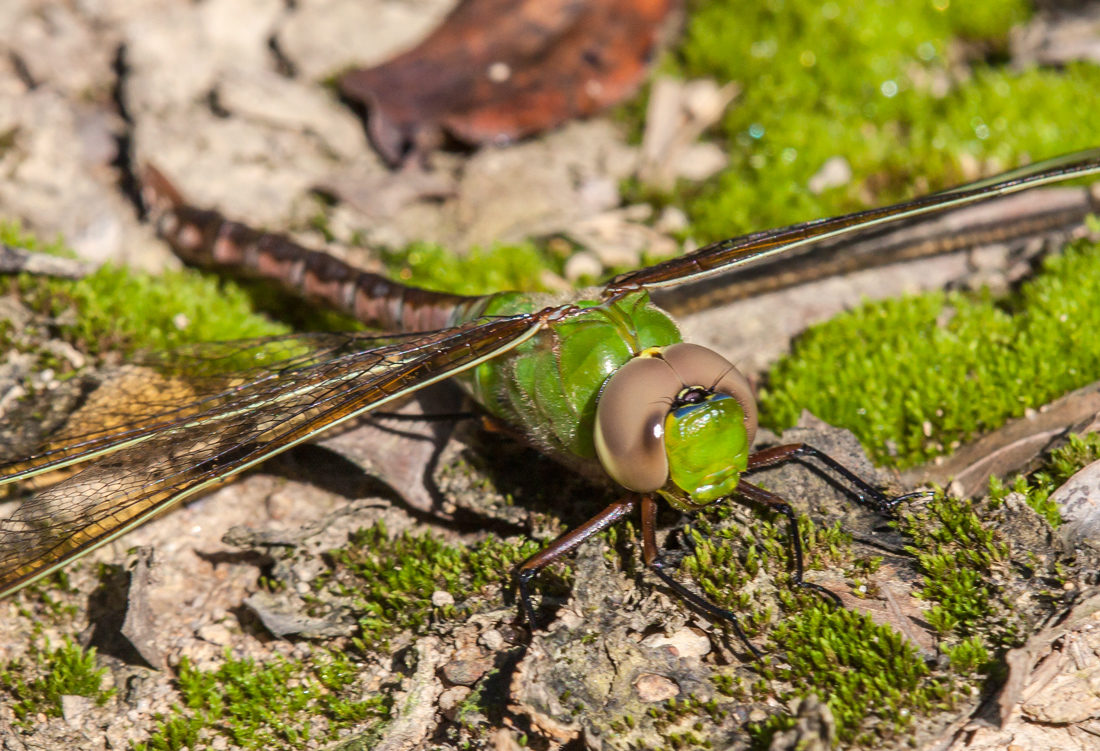
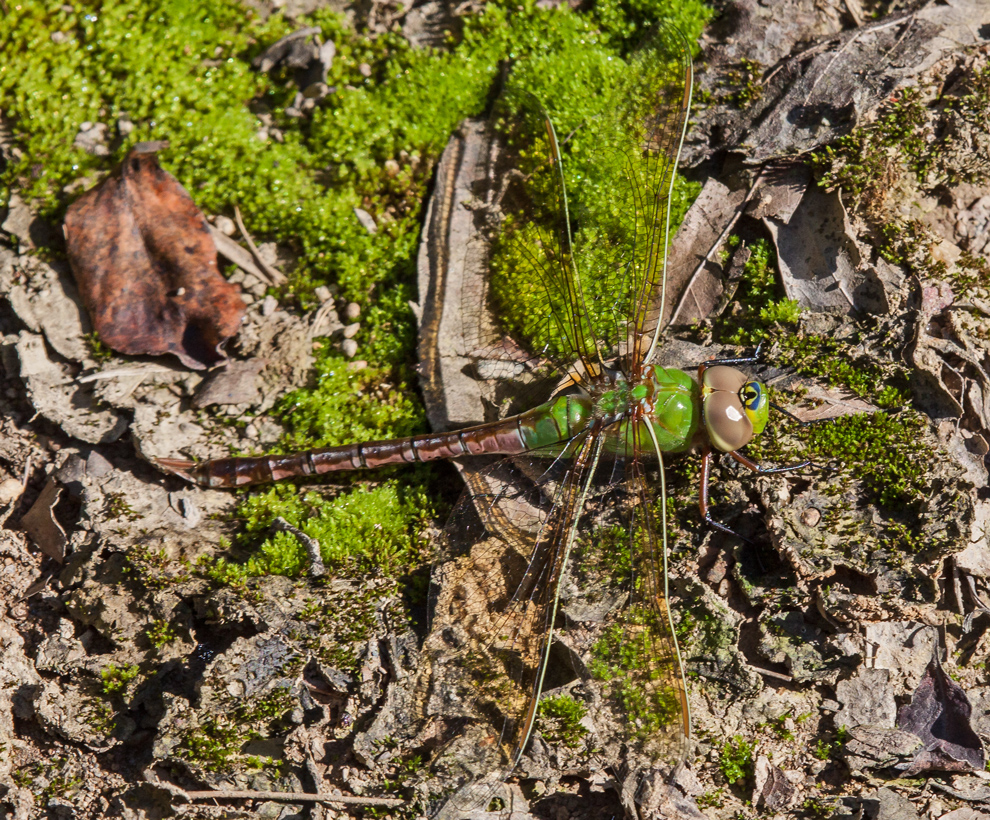
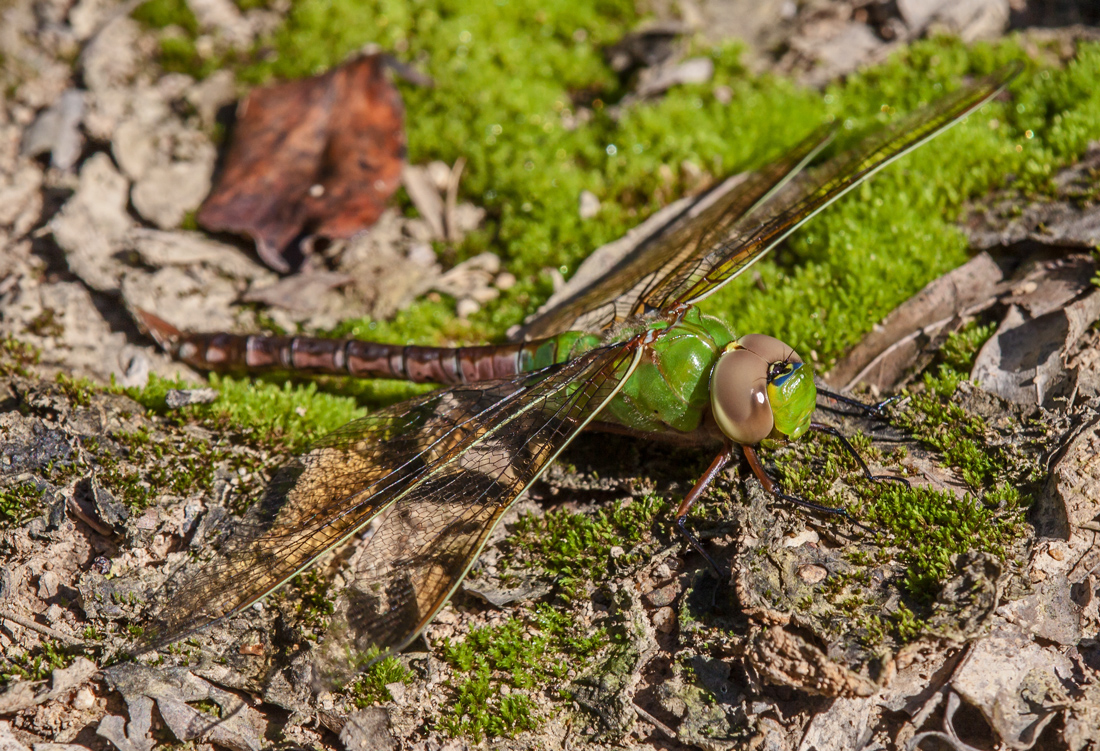
It’s migration time for Common Green Darner dragonflies (Anax junius) and last week one of my fellow photographers, Walter Sanford, reported a small swarm of Green Darners at my local marshland park.

I was walking in an entirely different area of the park from Walter and was surprised to see Green Darners, which are easily recognized thanks to their coloration and distinctive bullseye on their heads, flying up from the ground as I approached them. Rather than fly off into the distance, which is most often the case when I happen to disturb a dragonfly, these dragonflies moved only a short distance and came to rest again on the ground.

I don’t yet have the ability to interpret the movements of dragonflies, but it seemed to me that these Green Darners were conserving energy, as though they were resting in the midst of a long journey. I tried to be as quiet and stealthy as I could and moved closer and closer to one Green Darner perched near some green moss that was almost a perfect match for the color of the forward portion of her body. Judging from her overall coloration, I think this is probably a female.

My subject was amazingly cooperative and I was able to get shots of this beautiful dragonfly from a number of different angles. Although I normally try to have backgrounds that are must less cluttered than those in these images, I don’t find them to be too distracting here and they do help to show how well this colorful dragonfly blended in with her environment.

Common Green DarnerCommon Green DarnerCommon Green DarnerCommon Green Darner

© Michael Q. Powell. All rights reserved.

Read Full Post »

In between rain showers yesterday, I spotted this Banded Woolly Bear caterpillar (Pyrrharctia isabella) at Huntley Meadows Park, my local marshland. Unlike this photographer, most of the wildlife seemed to be taking shelter from the rain, so I was particularly excited when I caught sight of this caterpillar as I was trudging through the wet, calf-high vegetation.

Folklore says that the width of the brown band is an indicator of the severity of the upcoming winter. I can never remember whether a narrow band means a severe winter or the opposite, but Google came to the rescue again and indicated sources that say a narrow band means a colder winter. If that’s right, we may be in for a mild winter, given the size of the broad brown area on this caterpillar. Of course, there is no real scientific basis for this folklore, but it’s probably about as reliable as the weather forecasters in this area, who are notoriously bad in predicting the weather. They claim that we live in a complicated meteorological area.

When I was photographing this caterpillar, I noticed that it had a number of water drops on its “fur” and I was happy to see that I was able to capture them. There is something magical about those little globes of water and light.

Banded Woolly Bear caterpillar

© Michael Q. Powell. All rights reserved.

Read Full Post »

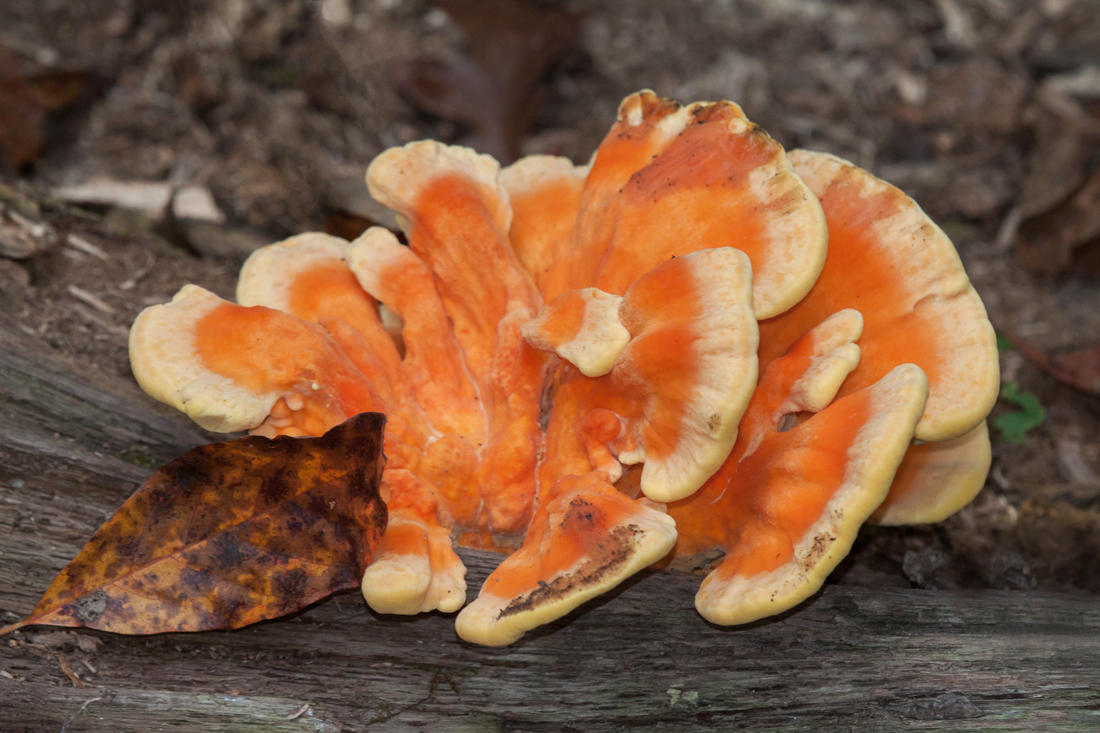
When I think of mushrooms, I usually imagine tiny, pale specimens growing in dark places close to the ground. I was startled, therefore, when I encountered this big, bold bright orange mushroom in plain view. The color was so vivid that I spotted it from a long way off and couldn’t help thinking at first that it looked like a smashed pumpkin.

It didn’t take too much searching on the internet to find this mushroom—its scientific name is Laetiporus sulphureus, but it is commonly known as the Chicken of the Woods mushroom. There are lots of recipes available for this edible mushroom, which can be sautéed, deep fried, baked, and may be used in soups.

I’m a chicken, though; when it comes to eating questionable things and don’t think I’d ever eat a mushroom that I encountered in the wild. The beautiful colors of this mushroom include the shades that I associate with autumn, which lets me enjoy it with my eyes, even if I won’t be putting it in my mouth.

chicken2_blogchicken1_blogchicken3_blogchicken4_blog

© Michael Q. Powell. All rights reserved.

Read Full Post »

« Newer Posts - Older Posts »