Feeds:
Posts
Comments

Archive for the ‘Insects’ Category

“Make sure the eyes are in focus.” I can’t even count the number of times that I have read or heard these words of advice, which I usually try to follow, even when taking extreme close-up macro shots.

These are the compound eyes of the Autumn Medowhawk dragonfly (Sympetrum vicinum), a close relative of the Blue-faced Meadowhawk that I have featured in several postings recently. I took this shot on a cool day when the dragonfly was perched on a tree, trying to warm itself in the warmth of the sun. The camera’s aperture setting was in a middle range at f/9.0, but with the subject this close, the depth of field was pretty shallow and the eyes are pretty much the only portions of the dragonfly in focus (in addition to small section of the wings and the front legs).

autumn_close1_blog

© Michael Q. Powell. All rights reserved.

Read Full Post »

When Autumn Meadowhawk dragonflies (Sympetrum vicinum) have finished mating, the male does not release the female, but continues to clasp her head tightly with the tip of his abdomen. The pair flies off together in the “tandem” position and remains attached until the female has finished depositing her eggs, normally in the water.

A chivalrous interpretation of this behavior might be that the male is merely protecting his mate from clamoring suitors and allowing her to oviposit in peace. The reality, though, is that there is a fierce competition among males that can sometimes involve attempt to dislodge a rival’s sperm from a female and replace it with his own if the female has not yet laid her eggs. By holding onto the female, the male increases his odds of fathering some baby dragonflies.

Check out a 2006 National Georgraphic article called Dragonflies Strange Love for some other fascinating insights into the love life of dragonflies.

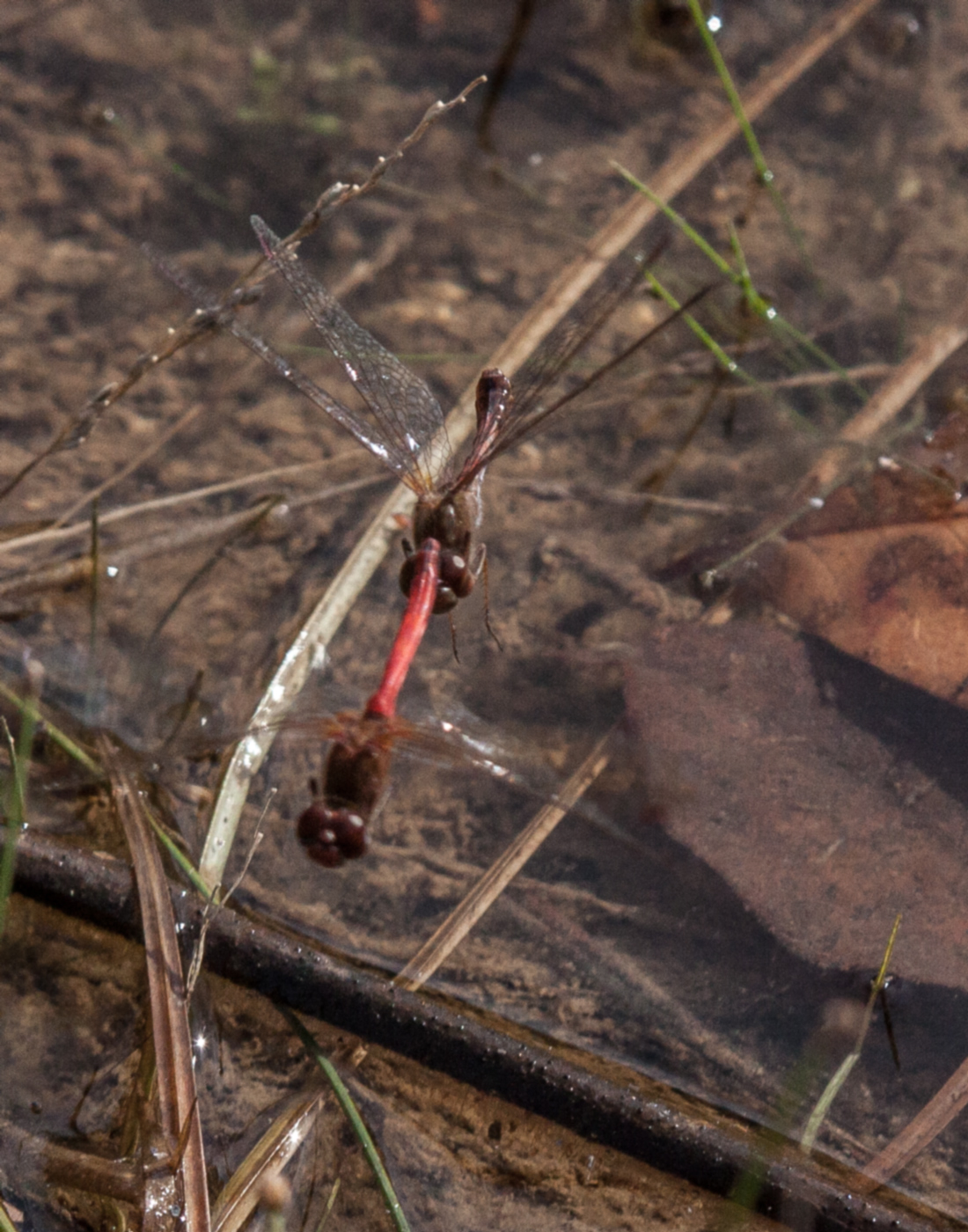
Earlier this month, I was at a small pool of water and I watched as a series of Autumn Meadowhawk couples in tandem went through the process of ovipositing and I attempted to get some in-flight shots of them. These dragonflies are really small and my success rate in keeping them in the frame was not high, but I did manage to get a few decent images.

Hopefully the practice in tracking a moving subject will carry over and help me as I move to photographing birds in flight, rather than dragonflies.

Autumn MeadowhawkAutumn Meadowhawk

© Michael Q. Powell. All rights reserved.

Read Full Post »

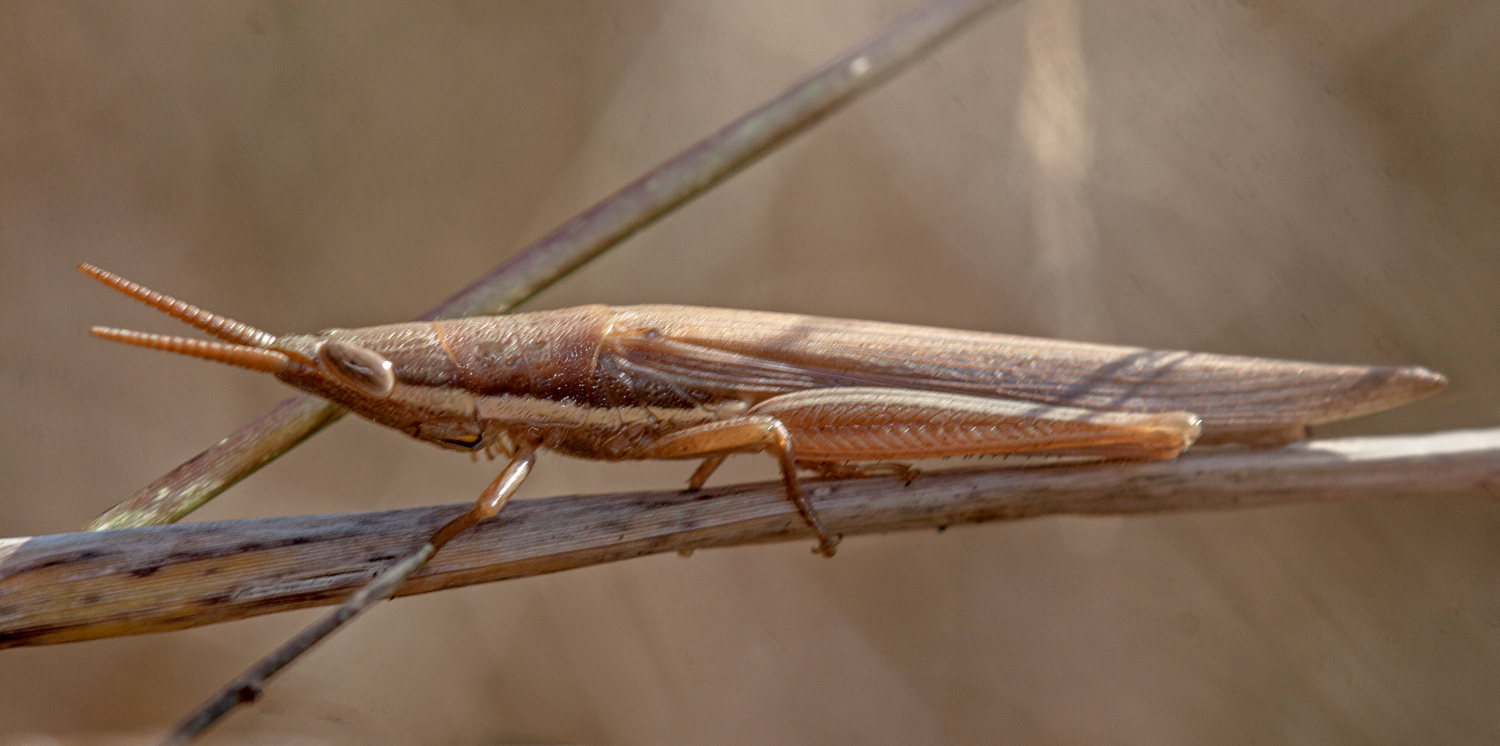
As I looked through my macro lens, I felt for a moment like a matador. The grasshopper in my viewfinder had lowered its head and was preparing to charge me, trying its best to gore me with its fearsome fluted horns. I wasn’t dressed for the part and had no little red cape to bravely wave at the charging grasshopper.

In reality, I am not sure what kind of a grasshopper this is. It looks a little like a Slant-faced Grasshopper, but I have never before seen one with such unusual, horn-shaped antennae. This grasshopper hopped up onto this stalk of grass as I was searching for dragonflies this past weekend. I don’t know much about the developmental cycle of grasshoppers and wonder if this might be a nymph.

In the absence of any scientific information, I think I’ll informally call this the Dual-unicorn Grasshopper, because the shape and pattern of the antennae remind me of so many of the depictions I have seen of the mythical unicorn.


charge_blogcharge2_blog

© Michael Q. Powell. All rights reserved.

Read Full Post »

My concerns about the potential demise of the Blue-faced Meadowhawk dragonflies (Sympetrum ambiguum) were greatly exaggerated and I saw a half-dozen or more yesterday on Veterans Day (Armistice Day).

Normally we stop seeing this species of dragonflies by the end of October, but we have not yet gone below freezing and perhaps that explains their unexpected longevity. Yesterday, for example, the temperatures soared to almost 70 degrees F (21 degrees C).  I have to note too that I am searching for them more diligently and in more remote locations of my marshland park, so that may help explain why I am seeing them more frequently.

As is the case with birds, male dragonflies tend to be more brightly colored and visible. Many female dragonflies are brown in colored and harder to spot. I was thus very happy yesterday to be able to get this close-up shot of a female Blue-faced Meadowhawk. Her body coloration may be a little bit drab, but those blue eyes are simply stunning.

In case you are curious, these dragonflies are small in size, with a body length of approximately 1.5 inches (38 mm), so I had to move in awfully close to get this shot. Surprisingly (and happily), this female tolerated my close presence for long enough for me to take several shots before she flew off into the distance.

female Blue-faced Meadowhawk

© Michael Q. Powell. All rights reserved.


Read Full Post »

Have you ever tried to photograph a living subject—or even worse, a pair of them—perched on one of your knees? Depth of field is a huge challenge and even trying to frame the subject is complicated, especially when you have a 180mm macro lens on your camera.

Autumn Meadowhawks (Sympetrum vicinum) are the most friendly dragonflies I have ever encountered. I don’t know what attracts them—perhaps it’s curiosity—but I found out last year that they are prone to perch on me.

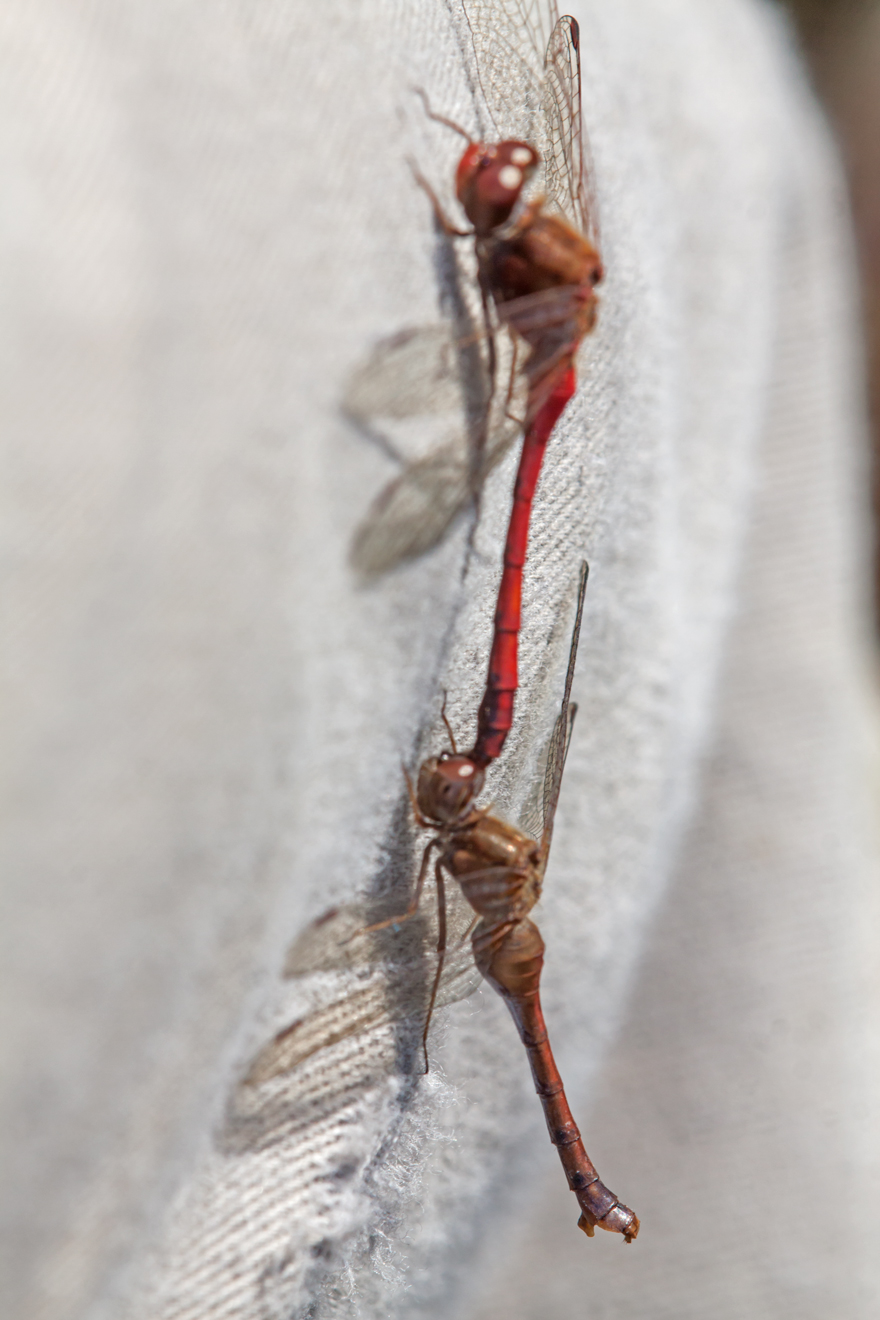
Surprisingly, they will even perch as a pair when they are still in tandem, the position that this species uses when the female is ovipositing, i.e. placing her eggs in the water after mating. The male hangs on to the female by the head, presumably to keep other males from interfering with the process.

In my initial attempt to get a shot of the couple, I focused on the male, and the female is completely out of focus.  For the second attempt, I tried to twist myself around to photograph them from the side and almost fell over in the process. The female is more in focus, but the male is now slightly out of focus.

As the season progresses, I’ll see if I can find some even more cooperative Autumn Meadowhawks and try to get a shot of one perched on one of my fingertips, as I did last year.

Autumn Meadowhawk

Autumn Meadowhawk

Later in the day, a male Autumn Meadowhawk landed on my leg and I had much better success in getting some clear shots. I used a similar approach, taking the first shot from above and the second one from the side. My pants are a solid tan color and it is interesting to see how it almost looks like I was wearing a seersucker suit.

Autumn Meadowhawk

Autumn Meadowhawk

© Michael Q. Powell. All rights reserved.


Read Full Post »

We’re almost at the end of the dragonfly season now in Northern Virginia and soon I’ll be seeing only the Autumn Meadowhawks (Sympetrum vicinum), historically the last dragonflies of the year to disappear. This past Monday, though, I managed to find a few Blue-faced Meadowhawk dragonflies (Sympetrum ambiguum), unusually hardy survivors this late in the season.

I really enjoy trying to get close-up shots of these colorful little dragonflies and my favorite shot is this close-up of one of them, perched on a fallen leaf.

Blue-faced Meadowhawk

When you pull back a little, you can see how tough the season has been for this dragonfly—portions of its wings are shredded. Somehow, however, it managed to fly about as though its wings were undamaged.

Blue-faced Meadwhawk

Temperatures last night dropped down into the upper 30’s F (3-4 degrees C) and I doubt that I will see any more Blue-faced Meadowhawks. I am resigned to the possibility that these may be my last shots of the year of these stunning little dragonflies, but that won’t keep me from searching really hard for them later today.

Blue-faced Meadowhawk

© Michael Q. Powell. All rights reserved.

Read Full Post »

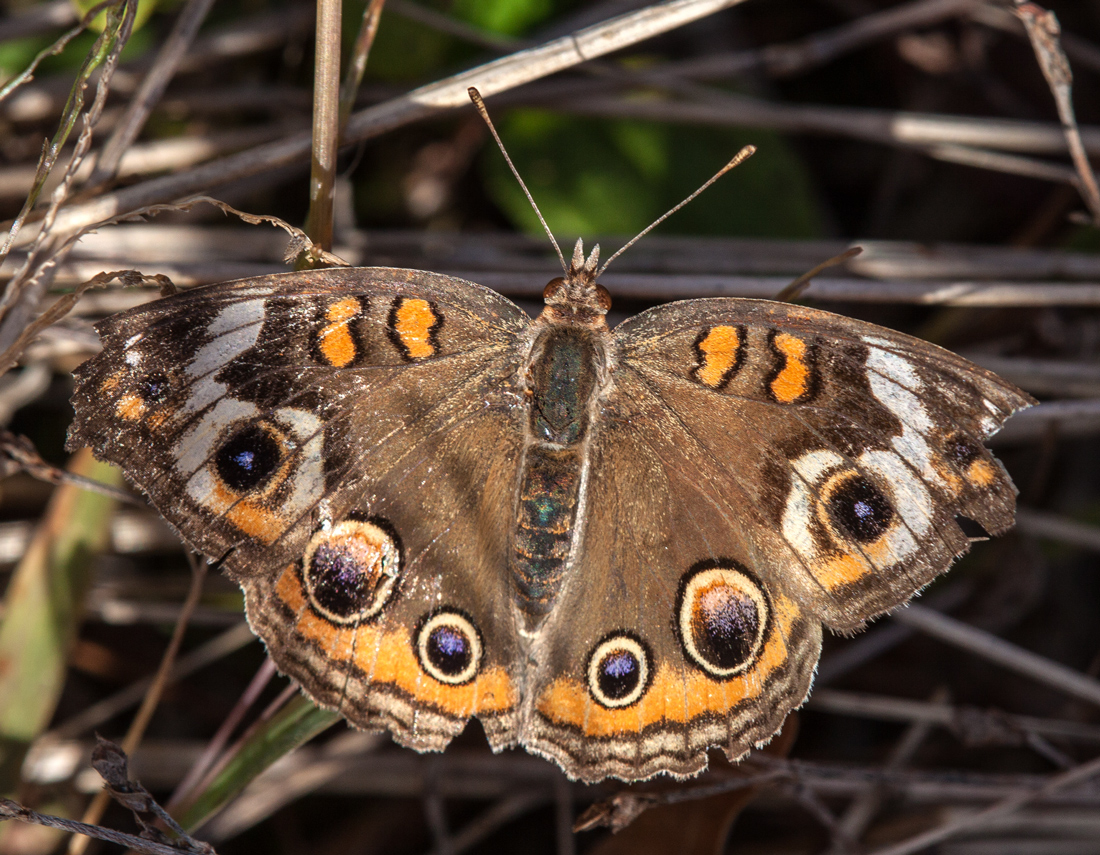
Butterflies in November? I didn’t really expect to see any, so it was a pleasant surprise when I came upon this Common Buckeye (Junonia coenia) on Monday at my local marsh. The butterfly is beat-up and bedraggled, but its beauty beams brightly—uncommon beauty at an unexpected time.

buckeye_nov_blog

© Michael Q. Powell. All rights reserved.

Read Full Post »

I am looking for some background information—do you generally prefer creamy smooth backgrounds in your photos or do like there to have some elements of texture?  This is a ridiculous question, of course, and it’s a bit like asking me if I like chocolate or strawberry ice cream. I like them both, but in certain situations I may prefer one over the other.

These musings came to mind when I was reviewing the some photos I took this past week of Autumn Meadownhawk dragonflies (Sympetrum vicinum). These little red dragonflies are perennially the last species to disappear in our area and I am likely to see them well into November and sometimes into early December.

The first image below shows a male Autumn Meadowhawk with the kind of background that I usually try to shoot, blurred and uncluttered. The thorn on the green stem adds an unexpected bit of additional interest for me.

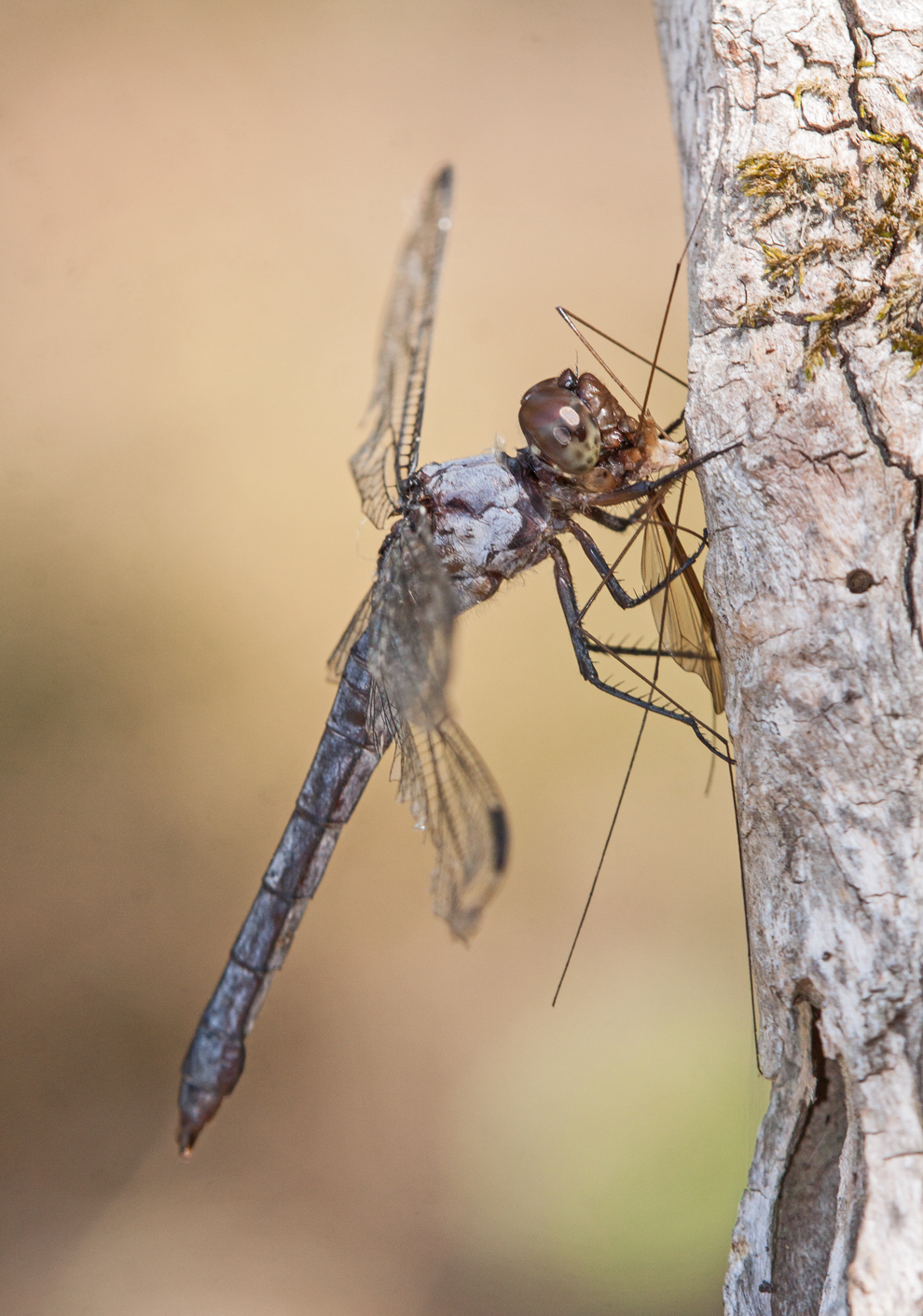
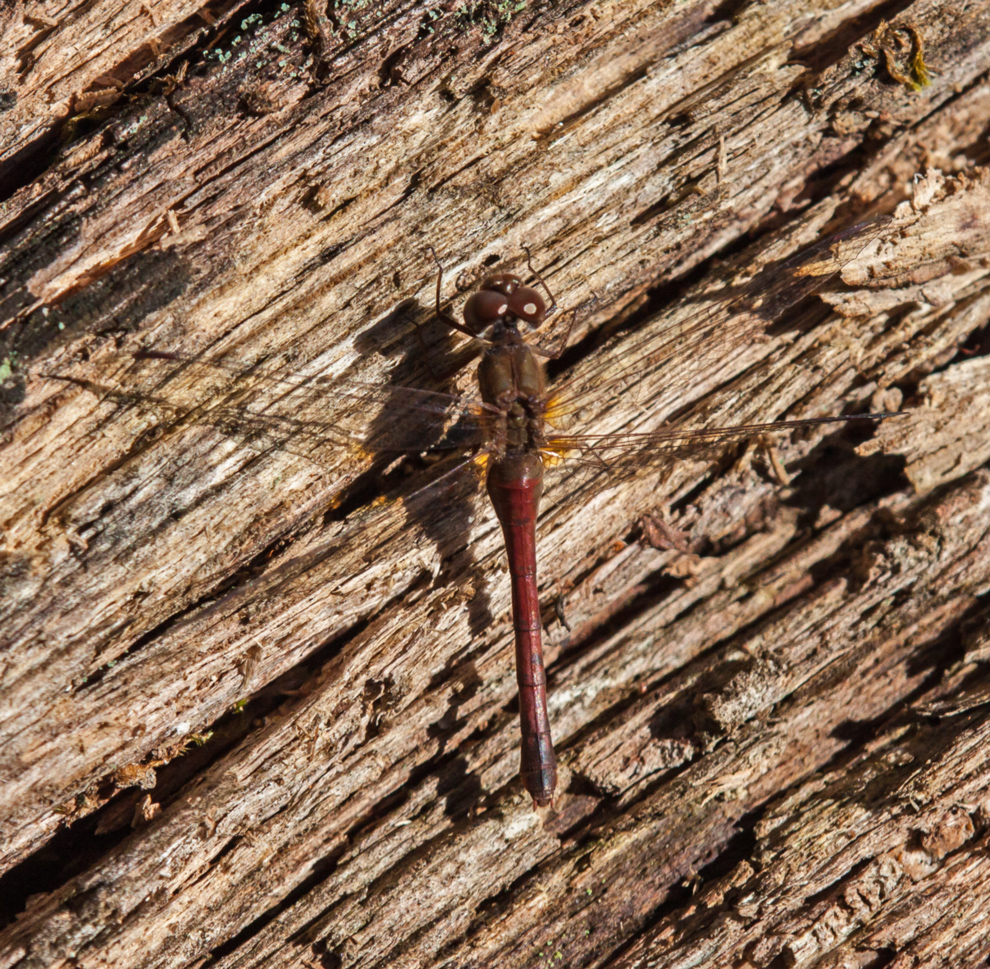
The background of the second image with a female Autumn Meadowhawk is completely different—the lines and texture of the decaying log are very evident. Sometimes when I look at the image I think that the background is too distracting, because I have to look hard to see the details of the dragonfly. At other times, I am drawn in by the organic feel of the wood in the background and I really like the diagonal lines and rough texture.

These two images work well for me in tandem, juxtaposing as they do different genders, very different backgrounds, and radically different angles of view. These kinds of sharp contrasts often prompt me to stop and think as I consider the images—and that is generally a good thing.


male Autumn Meadowhawkfemale Autumn Meadowhawk

© Michael Q. Powell. All rights reserved.

Read Full Post »

Even from a distance it’s hard to miss the bright lapis blue eyes of a male Great Spreadwing damselfly (Archilestes grandis). Unlike many damselflies, which are tiny, this species, as its name suggests, is a big damselfly, about 2 to 2 1/2 inches in length (50-62mm). According to Bugguide.net, though, the bright yellow”racing” stripe, which occurs on both males and females, is the most easily seen distinguishing identification feature for this species.

I had never even heard of this beauty until the 11th of October, when fellow dragonfly hunter Walter Sanford blogged about his discovery of one at Huntley Meadows Park on the 9th of October. I had no idea if this was the only member of the species at the park or how long it would hang around and didn’t hold much hope of seeing one of these damselflies myself.

I was shocked and pleased on the 20th of October when I spotted Walter and this damselfly. Walter graciously ceded to me the prime spot for taking a close-up shot. A week later I returned to the same location and the Great Spreadwing was gone.

In past years I didn’t pay much attention to the timing and location of various dragonflies and damselflies—they were either present or they weren’t. This summer and fall, however, I’ve been learning how important the specific habitat and the time of year are for certain species and the window of opportunity to observe them opens and closes pretty quickly.

Consequently, I consider myself very fortunate that I was able to capture this little portrait of the Great Spreadwing damselfly.


Great Spreadwing

© Michael Q. Powell. All rights reserved.

Read Full Post »

It’s hard enough to find the stunningly beautiful Blue-faced Meadowhawk dragonfly, but fellow photographer Walter Sanford set the bar higher this season by seeking to capture them against a backdrop of colorful autumn foliage. Check out his amazing results.

waltersanford's avatarwalter sanford's photoblog

This is Part 1 in a series of posts featuring photos of Blue-faced Meadowhawk dragonflies (Sympetrum ambiguum) spotted while photowalking Huntley Meadows Park during Fall 2014. All individuals are males, as indicated by their coloration and terminal appendages.

One of my overarching goals this fall is to shoot pictures of my favorite species of dragonfly against a background of autumn foliage. The color and clarity of these photographs is enhanced by using an external flash unit to add “fill” light.

… the real secret of wildlife photography is fill flash. Fill flash is one of the key techniques for easily improving wildlife images. Electronic flash improves the color balance of the image, improves color saturation, fills in dark shadows with detail, adds a catch light to an animal’s eye, and may help increase sharpness.” Source Credit: Wildlife Fill Flash.

Please view full-size versions of the following photos in…

View original post 46 more words

Read Full Post »

As the days grow colder, I am trying to capture images of almost any insect that I can find.

I was particularly happy this weekend when I came across this little flower fly (also called a hoverfly or syrphid fly) on a beautiful reddish-purple leaf. The leaf made for a simple backdrop that lets you see some of the details of the fly’s body, including the incredible compound eyes and the antennae.

I was also pleased that the out-of-focus area behind the lead is a orange-red color that seems appropriate for this autumn season.

flower fly

© Michael Q. Powell. All rights reserved.

Read Full Post »

Many of the other dragonflies are gone for the season, but the Autumn Meadowhawks (Sympetrum vicinum) will be around for quite some time, possibly even into December. Autumn Meadowhawks like to perch on the ground much of the time, but yesterday I was happy to capture one in what I consider to be its natural environment, perched among the colorful leaves of the autumn foliage.

Autumn Meadowhawk

© Michael Q. Powell. All rights reserved.

Read Full Post »

This re-posting is a bit of shameless self-promotion, but it is hard to describe how honored and thrilled I feel to be featured by Leanne Cole in a blog posting today. Leanne, who lives and works in Australia, is a wonderful photographer who spends a lot of time as a kind of photographic evangelist, sharing her passion for the art and practice of photography. She is constantly encouraging and teaching others, yet somehow seems to find time to explore new areas of her own photography, ranging from photographing the stars at night to investigating the close-up world of macro photography. Be sure to check out her incredible blog.

Read Full Post »

The weather may be cooling, but things are still hopping at my local marshland park.

As I was walking through one of the back meadows last Friday, grasshoppers were hopping every which way as I approached them. Most of them settled back down into the grass and I couldn’t get a good look at them, much less a photo. Suddenly one grasshopper jumped up onto a plant and posed for a moment. I used my popup flash because I was shooting directly into the sun, and I was able to capture a good deal of detail of the insect’s body.

grass1_oct_blog

Shortly thereafter a katydid did the same, but chose to perch at a titled angle.  I had time for only a single shot and did not use flash, so you can see some of the light shining through from behind (though I did have to lighten the shadows in post-processing). I especially like the way in which the angles of the insect’s long antennae mirror the shapes of the branches of the plant. I am not sure of the specific identification of this insect, but suspect that it’s a katydid vice a grasshopper because of the extremely long antennae.

grass2_oct_blog

© Michael Q. Powell. All rights reserved.

Read Full Post »

Do you ever shoot the same subject at the same time with another photographer and compare the results afterwards? It is fascinating to see how the choice of equipment, individual shooting styles, and angle of view affect the results.

Recently I was walking at Huntley Meadows Park, the local marshland park where I take a lot of my nature photos, with fellow blogger and photographer Walter Sanford when he spotted a mating pair of Blue-faced Meadowhawk dragonflies (Sympetrum ambiguum). Eventually they landed on the ground and Walter and I took up our shooting positions. He was seated on his Coleman folding camp stool facing the sun and I was crouching (and eventually sprawling flat on the ground) on the other side of the mating dragonflies, trying desperately not to cast a shadow on the action.

The dragonflies were surprisingly tolerant of us or were so caught up in the moment that they were oblivious to the outside world. We ended up shooting quite a few images during a lengthy session and couldn’t help but note the remarkable endurance of this couple. 

I started out in a position where I could capture both members of the couple (as you can see in the second photo), but then I started inching forward in an effort to see how close I could get to them, focusing my camera and my attention on the female. When I took the first photo below, I was pretty close to the minimum focusing distance of my Tamron 180mm macro lens, which is 1.54 feet (47cm). In case anyone is curious about the settings for that image, I was at ISO 400, f/13, and 1/20 of a second and used my pop-up flash.

There is no way that I can handhold this lens at 1/20 of a second, in part because it has no built-in image stabilization). It’s virtually impossible to use a tripod that close to the ground. So what I have started doing is using my camera bag as a kind of giant beanbag and resting my camera on the bag.

Walter took some shots of me in action and kindly agreed to let me use one of the resulting photos in this posting. He also circled in red the mating dragonflies to give you a better idea of how small our subjects were. In case you are wondering what the black object is that is underneath me, it’s my tripod bag—my photography mentor Cindy Dyer has influenced me to carry a tripod at almost all times.

In a final fashion note, I would like to point out that this is not the way that I usually wear a baseball cap. I turned the cap around in order to look through the viewfinder at this low angle. You will never catch me with my hat like that in public and I shudder every time I see a teenager with his hat tilted to the side or on backwards.


Blue-faced MeadowhaekBlue-faced MeadowhawkP1270731_Aperture-BFX_psda

© Michael Q. Powell. All rights reserved.

Read Full Post »

As their name suggests, Autumn Meadowhawks (Sympetrum vicinum) appear later in the year than most other dragonflies. This past weekend I spotted quite a number of mating pairs, including this couple that I captured in an acrobatic position worthy of the Cirque du Soleil. The dramatic lighting and colorful background added to the theatrical feel of the image, as all the elements worked together to focus our attention on the performance.

Autumn Meadowawk

© Michael Q. Powell. All rights reserved.


Read Full Post »
When I am trying to take a close-up shot of a dragonfly, I know that I have succeeded when I manage to capture some of the details of the ommatidia. What are ommatidia? Ommatidia are the up to 30,000 hexagonal facets that make up the incredible compound eyes of a dragonfly. For more information and a more scientific explanation, check out a posting entitled “Super-predators” that Sue did in June 2013 in her Backyard Biology blog.

Rather than think about science, today I would prefer to simply bask in the beauty of the blue-eyed Blue-faced Meadowhawk dragonfly (Sympetrum ambiguum) that I photographed yesterday as it perched on a fallen leaf at my favorite marshland park. The color of the dragonfly’s eyes completely captivate me.

As for the ommatidia, I’ve cropped a portion of the image and added it to the posting as a second image to make it even clearer what they look like. I chuckled a little when I examined the cropped image, because this dragonfly, like some others that I have photographed, has the sparsely distributed mustache and chin hairs that never fail to remind me of human teenagers who refuse to shave in a vain attempt to look older.

Blue-faced MeadowhawkBlue-faced Meadowhawk

© Michael Q. Powell. All rights reserved.

Read Full Post »

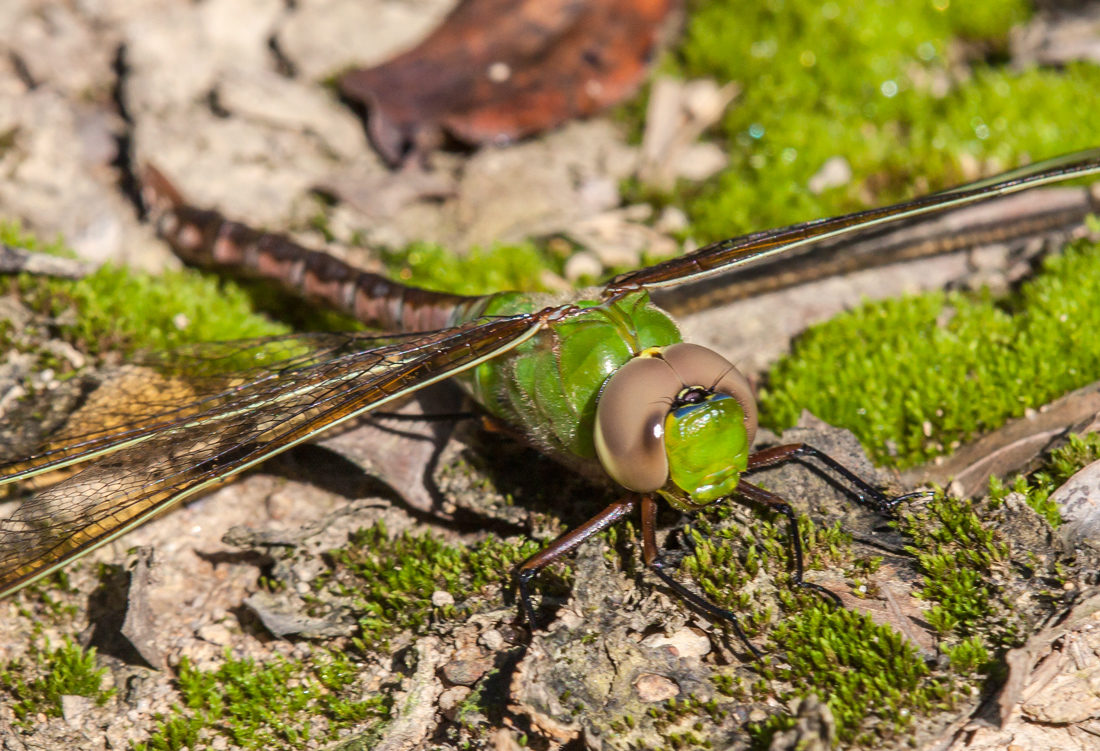
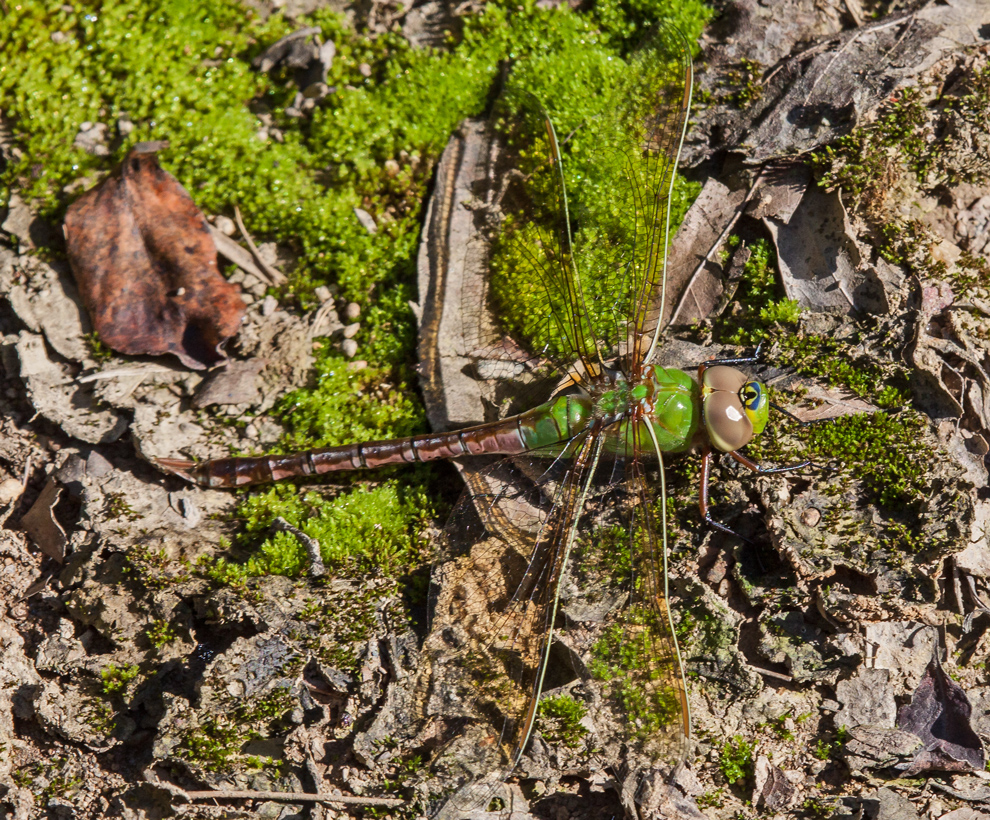
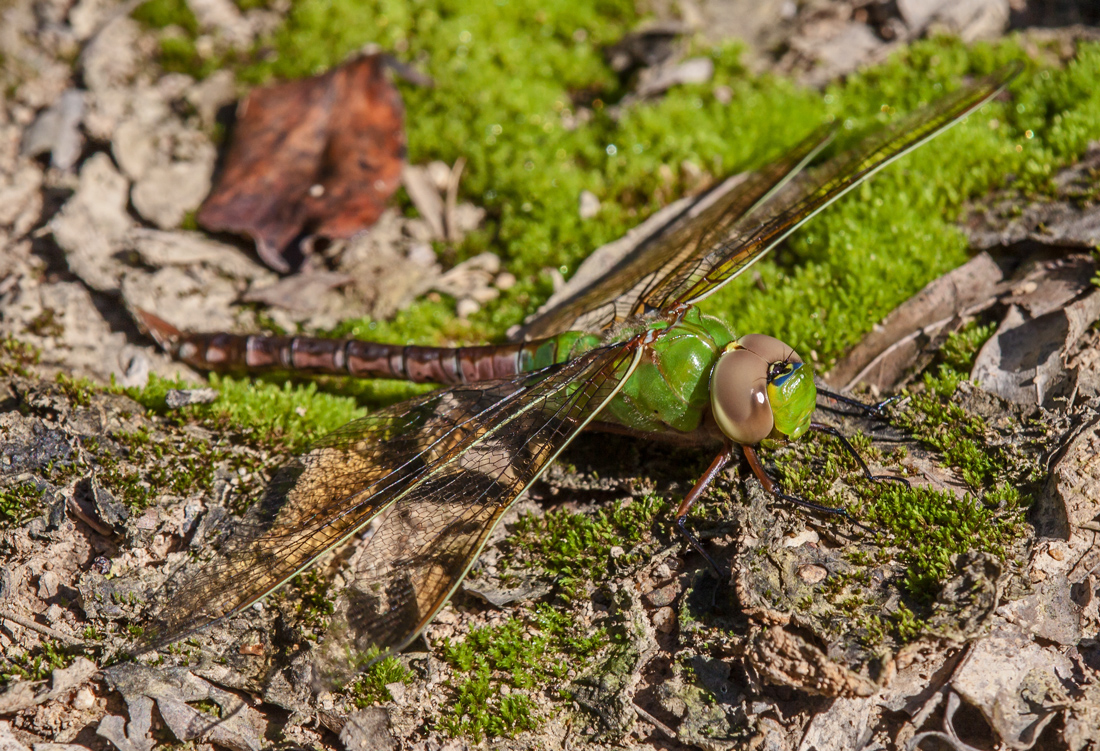
It’s migration time for Common Green Darner dragonflies (Anax junius) and last week one of my fellow photographers, Walter Sanford, reported a small swarm of Green Darners at my local marshland park.

I was walking in an entirely different area of the park from Walter and was surprised to see Green Darners, which are easily recognized thanks to their coloration and distinctive bullseye on their heads, flying up from the ground as I approached them. Rather than fly off into the distance, which is most often the case when I happen to disturb a dragonfly, these dragonflies moved only a short distance and came to rest again on the ground.

I don’t yet have the ability to interpret the movements of dragonflies, but it seemed to me that these Green Darners were conserving energy, as though they were resting in the midst of a long journey. I tried to be as quiet and stealthy as I could and moved closer and closer to one Green Darner perched near some green moss that was almost a perfect match for the color of the forward portion of her body. Judging from her overall coloration, I think this is probably a female.

My subject was amazingly cooperative and I was able to get shots of this beautiful dragonfly from a number of different angles. Although I normally try to have backgrounds that are must less cluttered than those in these images, I don’t find them to be too distracting here and they do help to show how well this colorful dragonfly blended in with her environment.

Common Green DarnerCommon Green DarnerCommon Green DarnerCommon Green Darner

© Michael Q. Powell. All rights reserved.

Read Full Post »

In between rain showers yesterday, I spotted this Banded Woolly Bear caterpillar (Pyrrharctia isabella) at Huntley Meadows Park, my local marshland. Unlike this photographer, most of the wildlife seemed to be taking shelter from the rain, so I was particularly excited when I caught sight of this caterpillar as I was trudging through the wet, calf-high vegetation.

Folklore says that the width of the brown band is an indicator of the severity of the upcoming winter. I can never remember whether a narrow band means a severe winter or the opposite, but Google came to the rescue again and indicated sources that say a narrow band means a colder winter. If that’s right, we may be in for a mild winter, given the size of the broad brown area on this caterpillar. Of course, there is no real scientific basis for this folklore, but it’s probably about as reliable as the weather forecasters in this area, who are notoriously bad in predicting the weather. They claim that we live in a complicated meteorological area.

When I was photographing this caterpillar, I noticed that it had a number of water drops on its “fur” and I was happy to see that I was able to capture them. There is something magical about those little globes of water and light.

Banded Woolly Bear caterpillar

© Michael Q. Powell. All rights reserved.

Read Full Post »
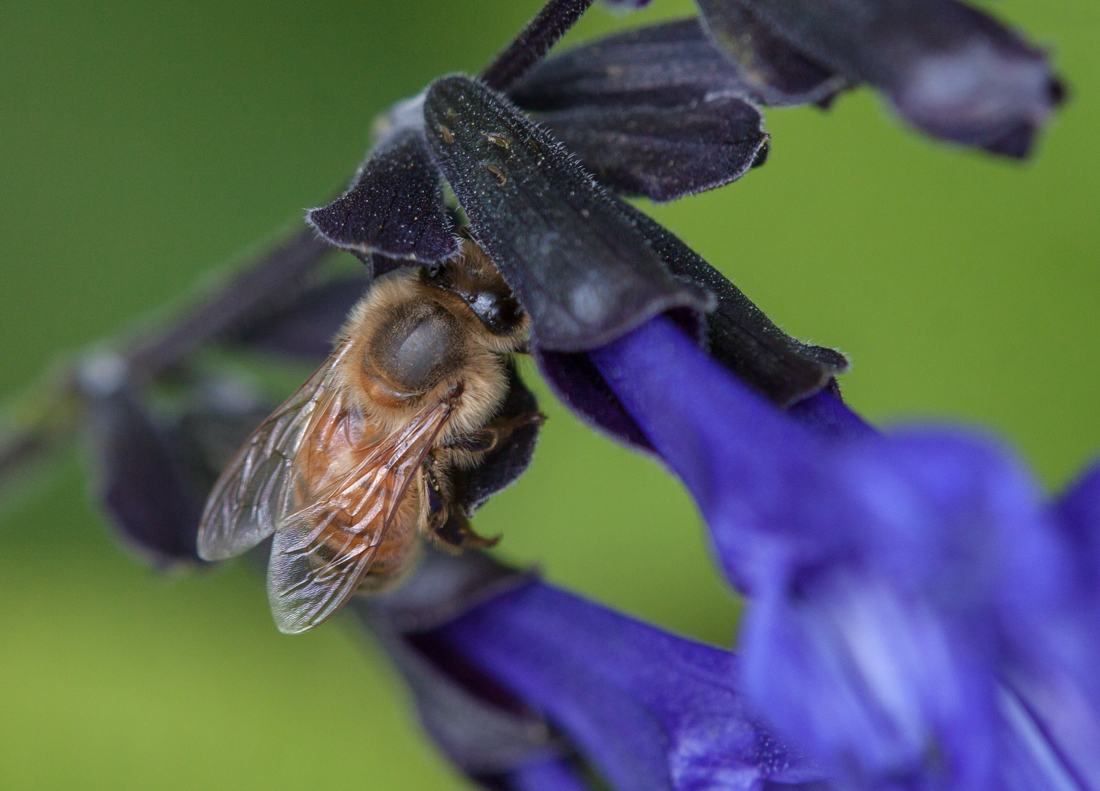
Flowers and bees have a mutualistic relationship—the flower provides the nectar and the bee assists in pollination. Sometimes, though, bees will circumvent the process by drilling a hole in the side of the flower and gaining access to the nectar without touching the reproductive parts of the flower, a process sometimes called “nectar robbing.”

Last weekend, I encountered this bee, which looks to be a honeybee, repeatedly taking nectar from the side of a Salvia flower. In an earlier posting, I showed that it was a tight fit for a bumblebee to enter the flower from the front, but it nonetheless did its part in pollination. The honeybee apparently decided it was easier to take a shortcut and go directly to the nectar.

honey2_bloghoney1_blog

© Michael Q. Powell. All rights reserved.


Read Full Post »

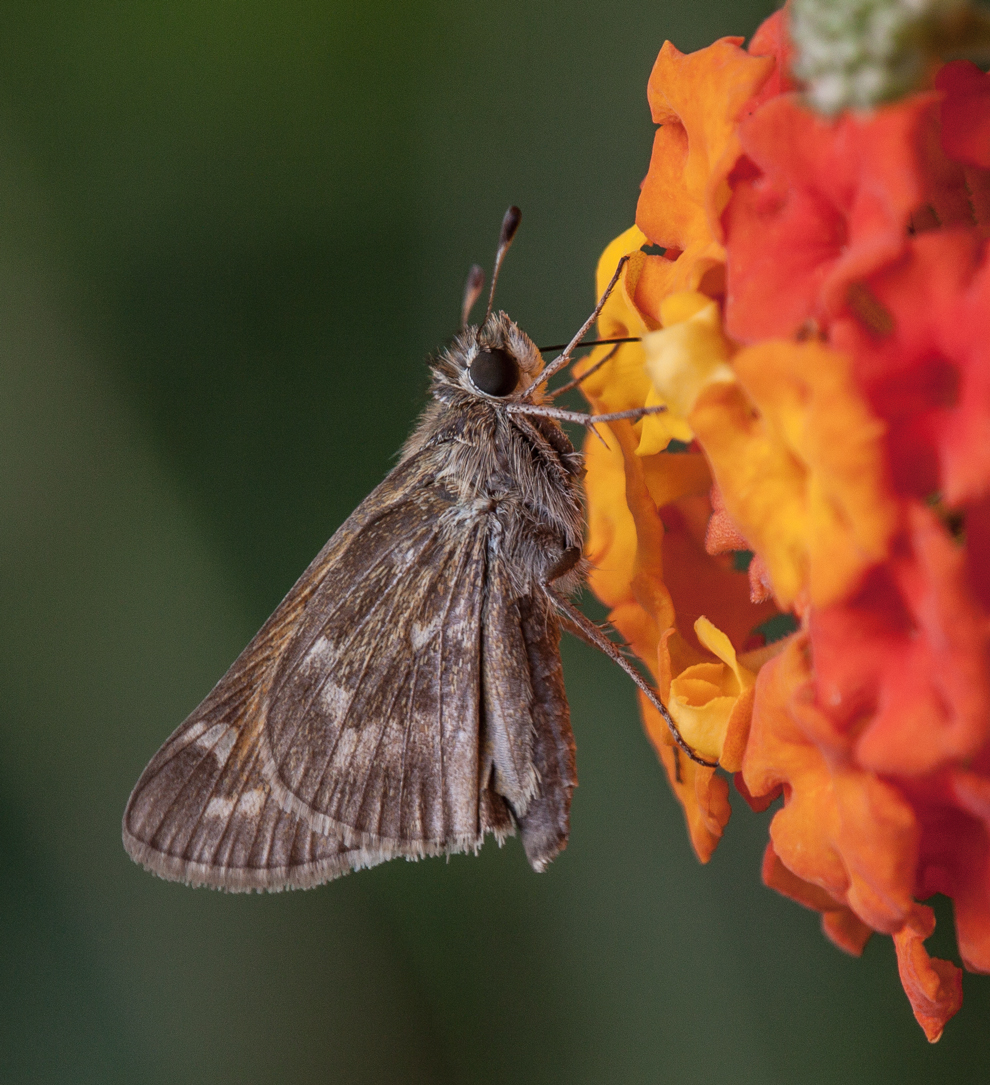
It’s a gray and gloomy day with intermittent rain—I feed the need for some color. This little skipper butterfly was busily at work last week on some very colorful flowers and I was able to catch him in action with his proboscis extended.

I am not sure what kind of skipper this is (there are more than 3500 species of skippers worldwide), but it looks a little like one that a reader identified for me as a Peck’s Skipper (Polites peckius). I must confess, though, that many skippers look very similar to me, so my identification is very tentative.

Capturing the butterfly with my macro lens was not too much of a problem, but I had a real problem in processing these shots because of some super bright highlights coming of the yellow flowers. I ended up darkening the highlights and desaturating the color in order to restore some detail to those flowers. I am not sure if I am happy with the results and might choose to process them differently another time. (The RAW images are still intact.)

skipper2_oct_blogskipper1_oct_blog

© Michael Q. Powell. All rights reserved.

Read Full Post »

The Wandering Glider dragonfly (Pantala flavescens) may look ordinary, but it has extraordinary flying abilities that fully justify its name. It is considered to be the most widespread dragonfly on the planet and is found on all continents except for Europe and Antarctica and one was even recorded at over 20 thousand feet (6200 meters) in the Himalayas, according to Wikipedia. It is also the only dragonfly to be found on Easter Island in the middle of the South Pacific Ocean.

These dragonflies are in almost constant motion, so I was thrilled when I stumbled across a male Wandering Glider perched on a plant at my local marshland last weekend. There were a lot of Green Darners buzzing around too and this Wandering Glider may have been part of a migrating group that had stopped for a rest. According to an article at Odonata Central, Wandering Gliders drift with the wind for long distances (even over water) and are often encountered by ocean freighters. They mate in flight and feed on aerial plankton when flying long distances. (I never knew that there was such a thing as ‘aerial plankton.”)

I wondered why there are no Wondering Gliders in Europe and found one answer in Wikipedia. These dragonflies like to fly in moist winds and the extremely dry winds coming off of the Sahara Desert may have a barrier effect.

wandering_blog

© Michael Q. Powell. All rights reserved.

Read Full Post »
Although it is already October and the weather is getting cooler, the local bees have not yet called it quits for the season. I am not sure what kind of purple flower this is, but the bumblebee was busily burrowing its head into its open blossoms.

I was happy to be able to catch the bee in action, capturing an “artsy” image of the moment.

October bee

© Michael Q. Powell. All rights reserved.

Read Full Post »

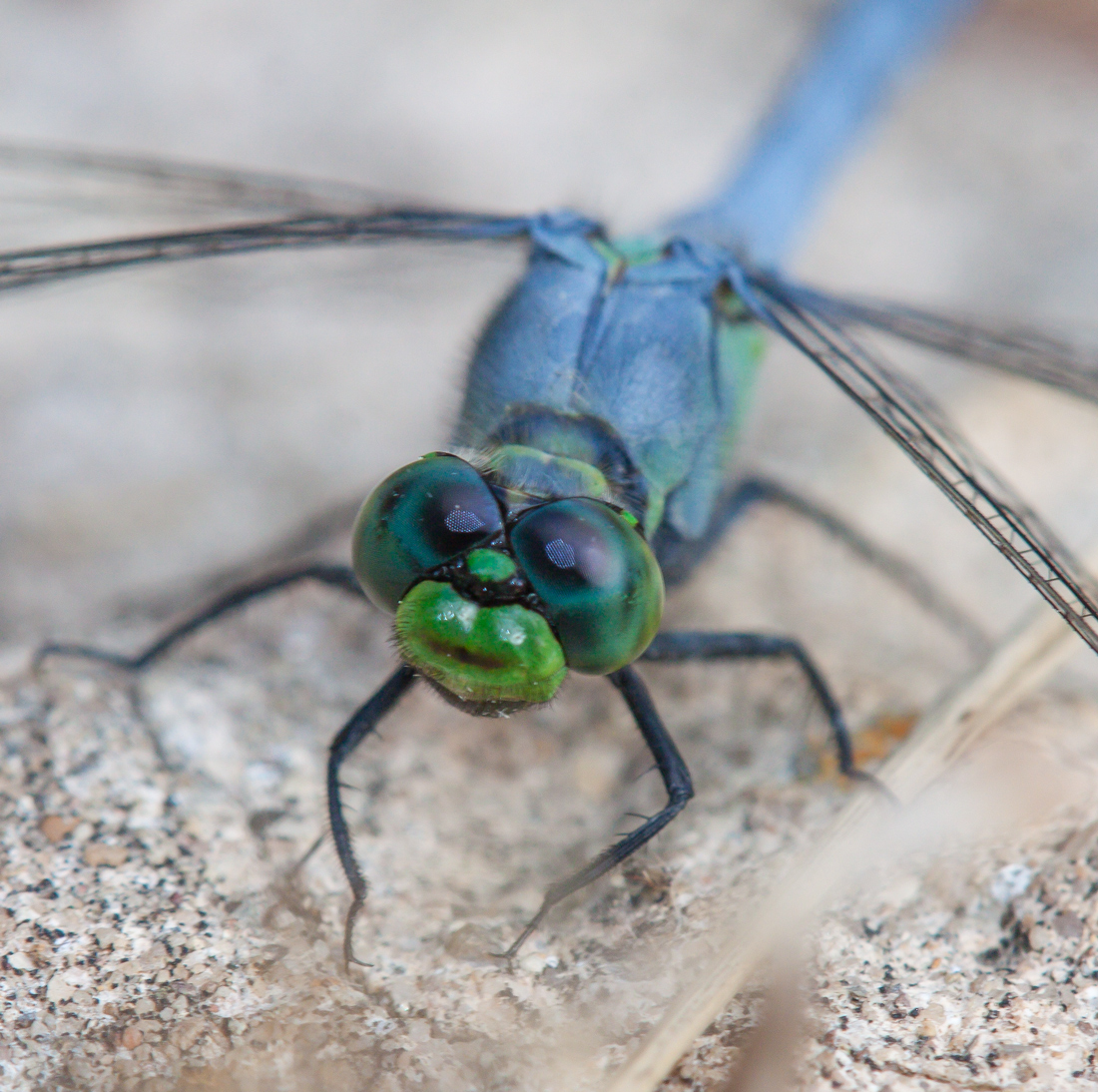
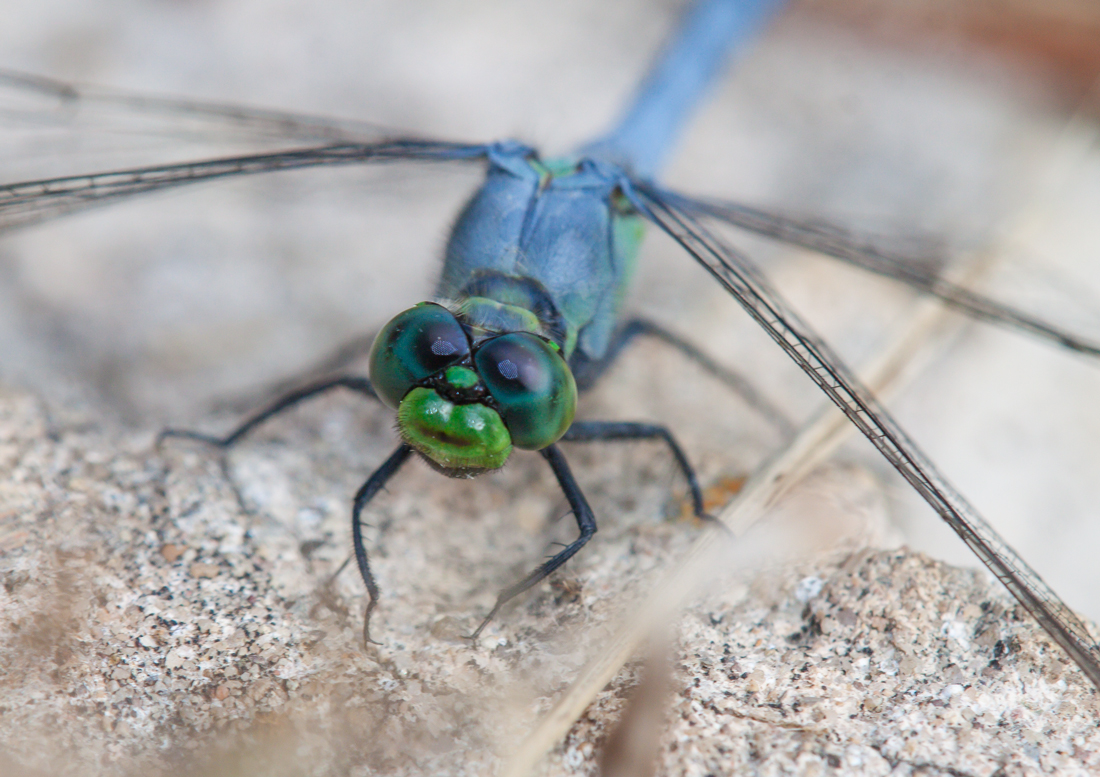
One of the main reasons why I love having a macro lens is that it that it lets me capture photos like this extreme close-up image of a male Eastern Pondhawk dragonfly (Erythemis simplicicollis) that I took yesterday at Green Spring Gardens, a historical, county-run garden in Alexandria, Virginia.

I have always been fascinated by the multi-faceted compound eyes of dragonflies and the blue-green eyes of the Eastern Pondhawk are particularly stunning. When I first caught sight of this dragonfly, he was sunning himself on a rock near the edge of a small pond. I kept low to the ground and approached him slowly. He didn’t fly away and seemed more curious about my presence than afraid.

For these shots, I rested the lens hood of the camera on the edge of the rock ledge to get this low, eye-to-eye perspective. This technique served to steady my camera, so I was able to capture a good deal of detail of the dragonfly’s face. In the initial photo, for example,which is a cropped version of the second image, you can see that the dragonfly has stubble on his chin. The third shot is a cropped version of the last photo, again to show greater detail and to draw the attention of viewers more directly to the eyes.

Do you think the shots are more effective when cropped or do you prefer the larger perspective images?

Eastern Pondhawk

Eastern Pondhawk

Eastern Pondhawk


pondhawk1_closeupb

© Michael Q. Powell. All rights reserved.


Read Full Post »

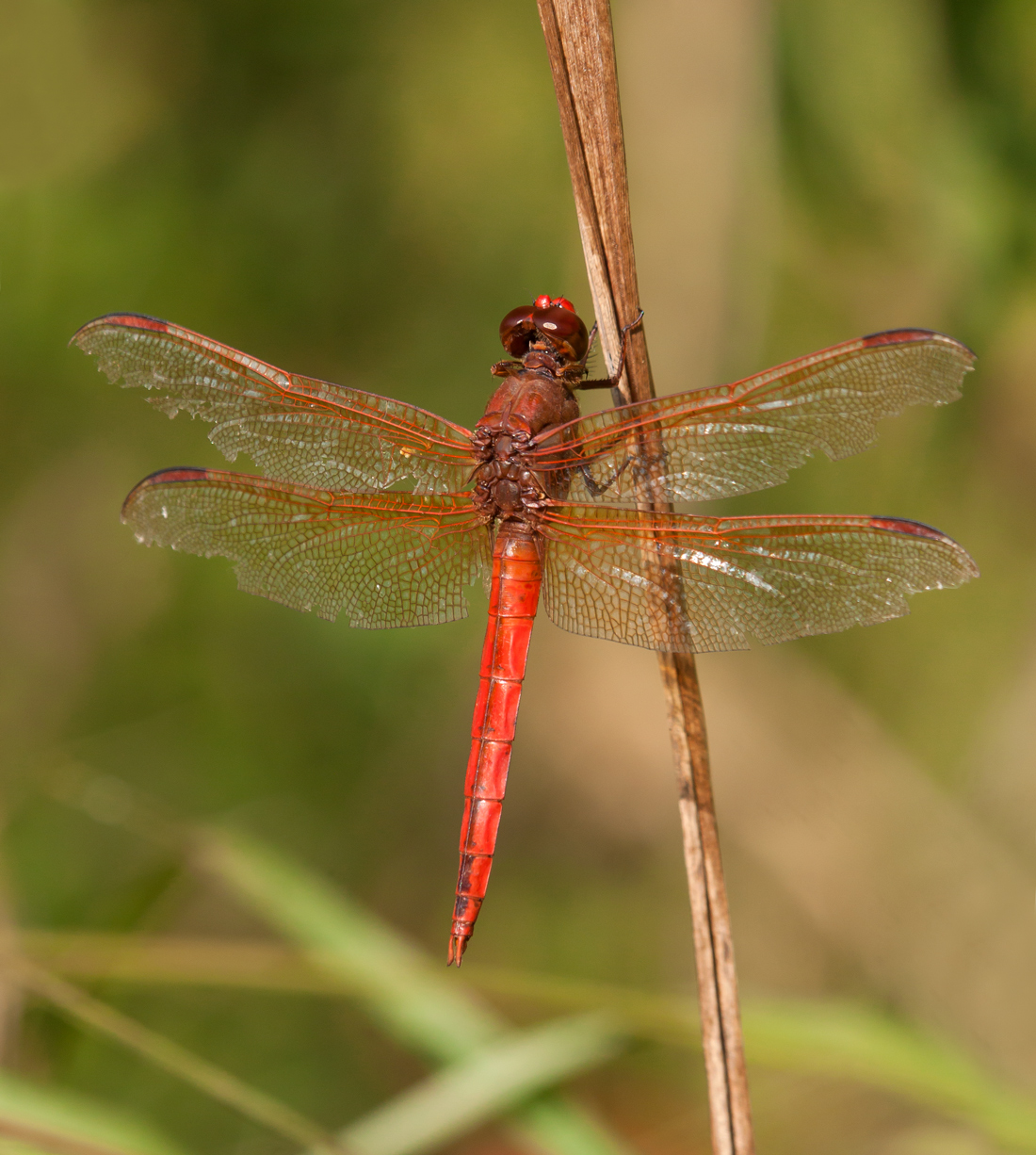
Two weeks ago, during the waning days of summer, I captured this image of a beautiful Needham’s Skimmer dragonfly (Libellula needhami) at Huntley Meadows Park, the local marshland where I do a lot of my shooting. The vivid red of its body made it really stand out—camouflage did not seem to be a viable option.

Although this dragonfly species is pretty common, I only saw a couple of them this season and this was the only one that I managed to photograph. The dragonfly was perched on a dried stalk in a field and it was tough to try to get any kind of clear background, particularly because I did not want to move too much and risk scaring away the dragonfly.

In these two images, you can see two slightly different approaches that I used. In the first one, I was not worried that there were some horizontal stalks in the background. In fact, I actually like the repetition of the horizontal line and don’t find them distracting, given how blurred they are. In the second image, I tried to get as uncluttered a background as I could, which isolates the dragonfly a little better. I tend to like the first image a little more, but I welcome any thoughts about which image you prefer.

Needham's SkimmerNeedham's Skimmer

© Michael Q. Powell. All rights reserved.


Read Full Post »

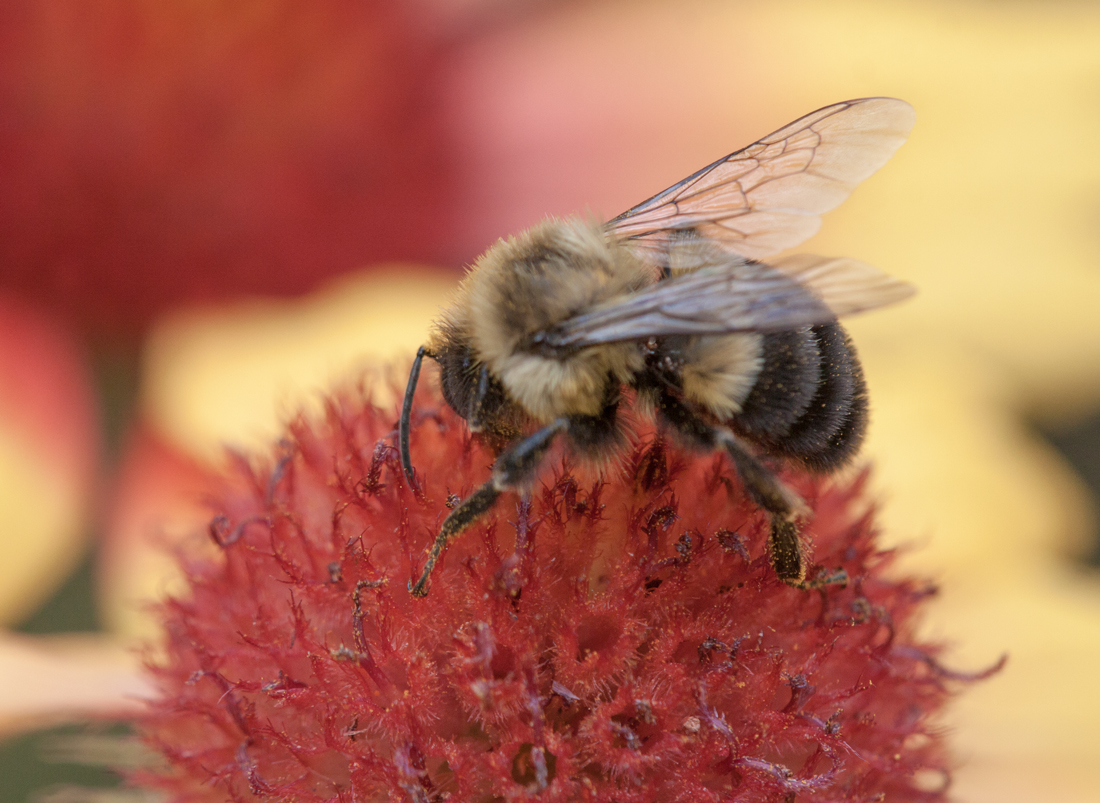
With rain and gray skies that started today, I feel the need to compensate with some bright colors, so I thought I’d post an image from this past weekend. I love the way that it looks like this bumblebee is clinging to a rolling red ball, which, of course, is merely the center of a flower in the garden of my neighbor and fellow photographer Cindy Dyer.

bee_fall_blog

© Michael Q. Powell. All rights reserved.

Read Full Post »

Here’s an awesome image of a pair of mating dragonflies by a photographer with whom I often go shooting at my local marshland park. Be sure to check out the rest of his blog for some more amazing shots.

waltersanford's avatarwalter sanford's photoblog

Lately I’ve been working harder at “making art” rather than just getting a shot. How am I doing?

Autumn Meadowhawk dragonflies (mating pair, in wheel)

The preceding photo shows a mating pair of Autumn Meadowhawk dragonflies (Sympetrum vicinum) spotted during a photowalk at Huntley Meadows Park on Sunday, 28 September 2014. The pair is shown “in wheel.”

The copulatory, or wheel, position is unique to the Odonata, as is the distant separation of the male’s genital opening and copulatory organs. Source Credit: Paulson, Dennis (2011-12-19). Dragonflies and Damselflies of the East (Princeton Field Guides) (Kindle Locations 377-378). Princeton University Press. Kindle Edition.

All dragonflies and damselflies have a 10-segmented abdomen: male dragonfly secondary genitalia are located in segments two and three (2 and 3); female genitalia in segment eight (8). Therefore, the male dragonfly is on top; the female is on the bottom.

Copyright © 2014 Walter Sanford. All rights reserved.

View original post

Read Full Post »

When the urge to take some photos strikes me and I don’t want to travel very far, I can usually depend on Cindy Dyer, my neighbor and photography mentor, to have something interesting to shot in her garden. About five o’clock today, I photographed what looks to be a tiny metallic green bee on one of the colorful flowers still in bloom at the side of her townhouse.

I like my fall colors to be bright and vivid, not muted and faded.

greenbee1_blog

© Michael Q. Powell. All rights reserved.

Read Full Post »

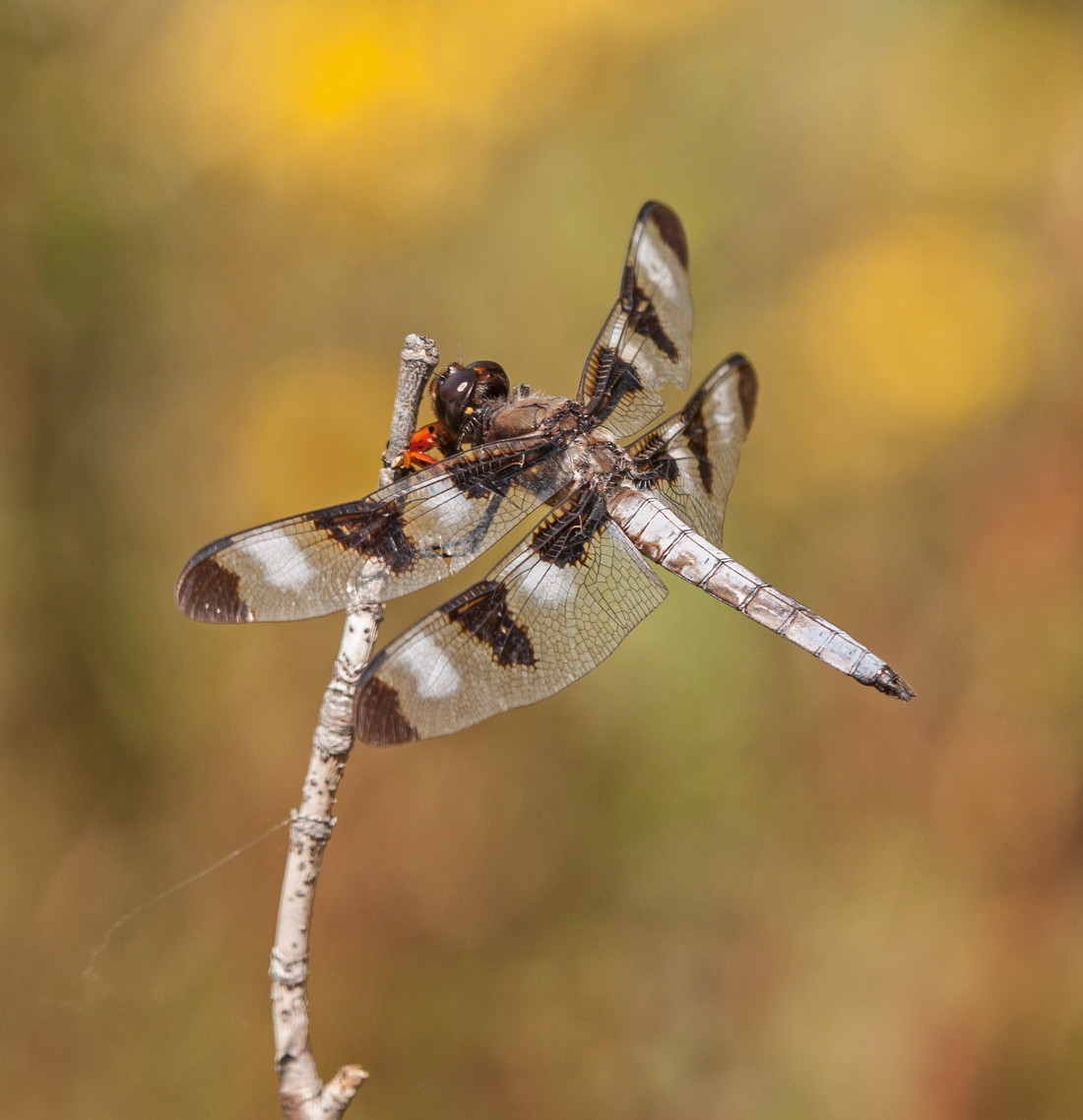
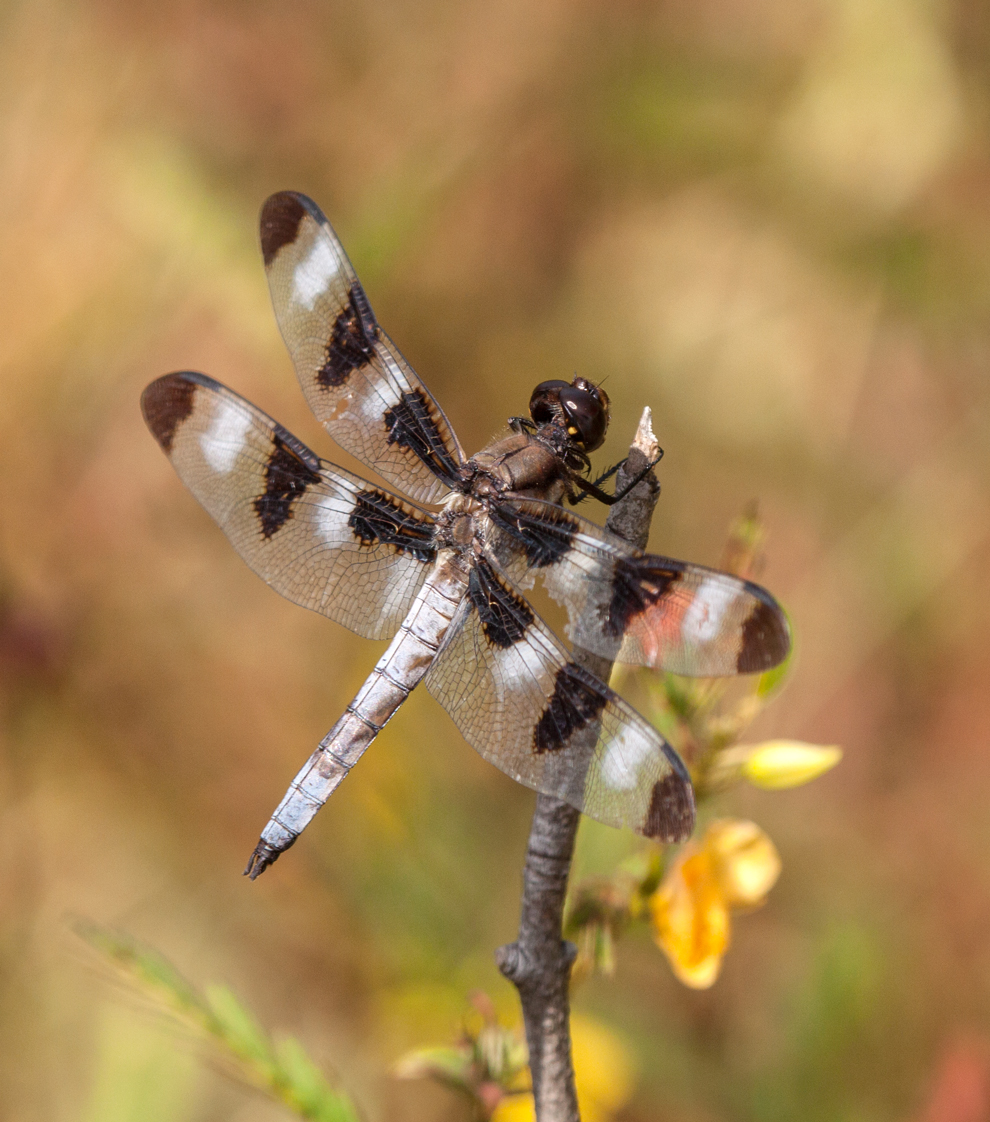
It won’t be long before most of the dragonflies are gone for the season, so I am really enjoying them while they are still around. A little over a week ago, I was able to capture images of some male Twelve-spotted Skimmer dragonflies (Libellula pulchella), a species that I had not seen previously this summer.

Twelve-spotted Skimmer

In the first shot, the dragonfly seems to be eating something that is bright red in color. I can’t tell for sure, but when I zoom in, it looks like it might be a ladybug. Whatever the case, I am happy that I was able to frame the shot to be able to get some of the yellow meadow flowers into the background.

In the other shots, I worked to get the wings into focus by shooting on a plane horizontal to their position. The dragonflies were reasonably cooperative and I am pretty happy with the resulting images.

12spot1_blog 12spot2_blog 12spot3_blog

© Michael Q. Powell. All rights reserved.

Read Full Post »
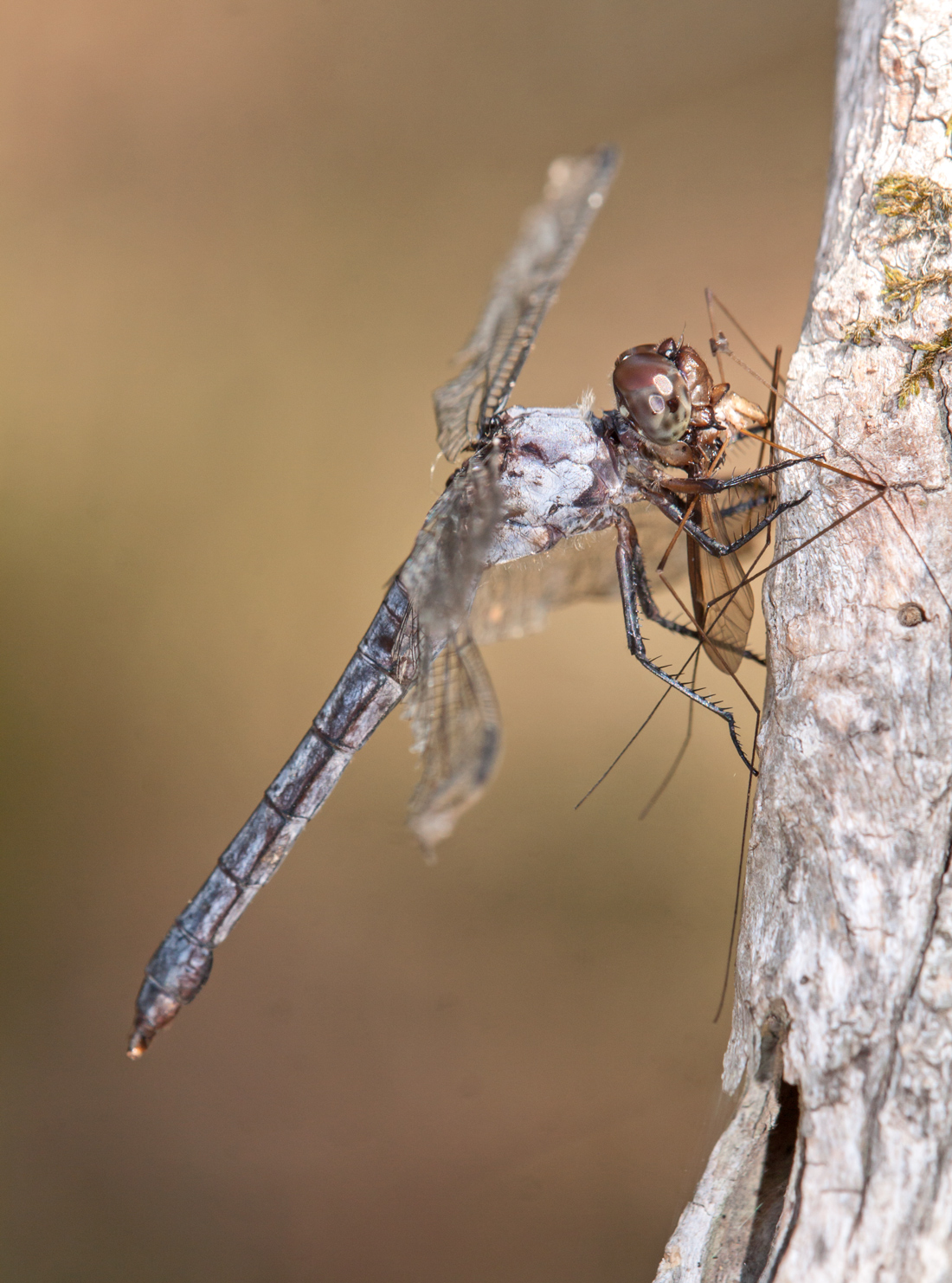
What do dragonflies eat for lunch? I stumbled upon this dragonfly earlier in September as it was beginning to enjoy a freshly caught insect. Judging from the long legs and wings of the prey, it looks like the dragonfly is munching on a crane fly.

The dragonfly was so focused on eating that it let me get pretty close without flying away and I was able to take a number of shots from different angles and with different settings. I defer to others on identification of the dragonfly species. I initially thought it was a Great Blue Skimmer, but the eye color seems wrong.

lunch3_bloglunch2_bloglunch1_blog

© Michael Q. Powell. All rights reserved.

Read Full Post »

Do you have a favorite insect? I realize that’s a strange question and, if pressed, most people probably would respond with the name of a butterfly or perhaps a ladybug or a dragonfly, but my favorite is unquestionably the Handsome Meadow Katydid (Orchelimum pulchellum).

Two summers ago, I had my initial encounter with the rainbow-colored grasshopper-like insect at my local marshland park and it was love at first sight. It was so unexpected to see those beautiful blue eyes staring at me with apparent curiosity. The amazing colors of the body are so vivid and varied that one of my friends accused me of creating them in Photoshop. I can’t help but be cheered up by the mere sight of one of these beauties.

There was a lot of reconstruction work at my marsh this past year and water levels are a lot higher than in the past. All summer I waited for my friends to reappear, fearing that the changed habitat or the polar vortex of this past winter had adversely affected their survival. Suddenly, two weeks ago I started hearing from others that the Handsome Meadow Katydids were back.

Last week, I finally saw a few of these beauties myself and took this shot of one of them. In addition to the gorgeous colors, you can’t help but notice the really long legs and antennae (is one of them missing).

I don’t care who you are—you have to agree that these katydids really are handsome, even if it’s not at the top of your list. As for me, it’s still my favorite.

Handsome Meadow Katydid

© Michael Q. Powell. All rights reserved.

Read Full Post »
« Newer Posts - Older Posts »