Feeds:
Posts
Comments

Archive for the ‘dragonfly’ Category

Orange is one of the colors that I tend to associate with autumn. Some leaves are already turning orange and pumpkin decorations and displays have started to appear on my neighbors’ doorsteps.

As I was exploring Occoquan Bay National Wildlife Refuge yesterday morning, my eyes detected some motion in the nearby grass. I leaned forward and was delighted to see this tiny damselfly decked out in the colors of Halloween—orange and black. I had no idea what species it was, but fortunately I have a really good guide for damselflies and was able to identify it as an immature female Eastern Forktail damselfly (Ischnura verticalis).

Although there are already lots of symbols for autumn, I think this tiny damselfly could be added to the list.

Eastern Forktail

© Michael Q. Powell. All rights reserved.

Read Full Post »

I was thrilled yesterday to see that there are still Fine-lined Emerald dragonflies (Somatochlora filosa) at Occoquan Bay National Wildlife Refuge. I was afraid that all of the recent rain had washed them away.

This particular dragonfly species is pretty uncommon, but the wildlife refuge that has become my go-to place for photography is one of the few local spots where they can be found. I think its peak period in our area is September-October, judging from my experience last year, so I was anxious to see them some more before they disappeared for the year.

It is easy to see a Fine-lined Emerald dragonfly when it is patrolling, because it often flies at knee to shoulder height. It is a whole different problem, though, to get a shot of one, because they spend most of their time in the air rather than perching. I spent quite a bit of time yesterday chasing after these dragonflies, hoping in vain to be able to catch the moment when one decided to take a break.

Finally I decided to change my approach and see if I could capture a shot of one as it flew by me. I know that it can be done, because last year I captured an in-flight image using my 150-600mm zoom lens. The lens that I had on my camera, however, was my 180mm macro lens, which meant that I had to get pretty close to the dragonfly rather than zooming in. That particular lens is slow to focus, so I decided to focus manually, which can be tricky with a moving subject. One of the downsides of the lens is it has no built-in image stabilization, so I decided to keep the camera affixed to my monopod for the sake of stability.

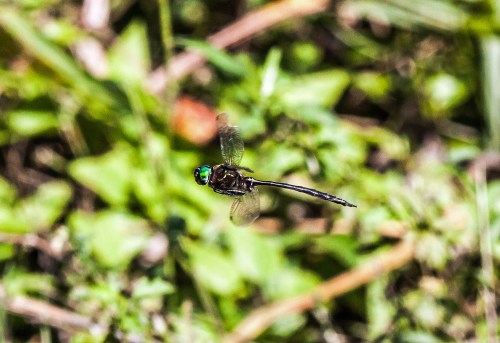
It took some time, but eventually I was able to capture a few shots of flying Fine-lined Emeralds that were relatively in focus, aided by the fact that these dragonflies hover a little from time to time.

I particularly like the first image because it shows both the emerald eyes and the fine lines near the tip of the abdomen that are responsible for the name of the species. It was also cool that the angle of view was unusual, given that I was looking down at the dragonfly as I took the shot. I also like the touch of brownish-orange from the out-of-focus leaves that gives the image an autumn feel.

The second shot gives a more “normal” view of a Fine-lined Emerald dragonfly as it flew by.  I was happy to be able to separate it somewhat from the leafy backdrop by carefully focusing on the dragonfly. This is one of those situations when the auto-focusing system of the camera would have been challenged—the subject was pretty small in the viewfinder and the auto-focus probably would have tried to lock on the background.

fine-lined emerald

fine-lined emerald

© Michael Q. Powell. All rights reserved.

Read Full Post »
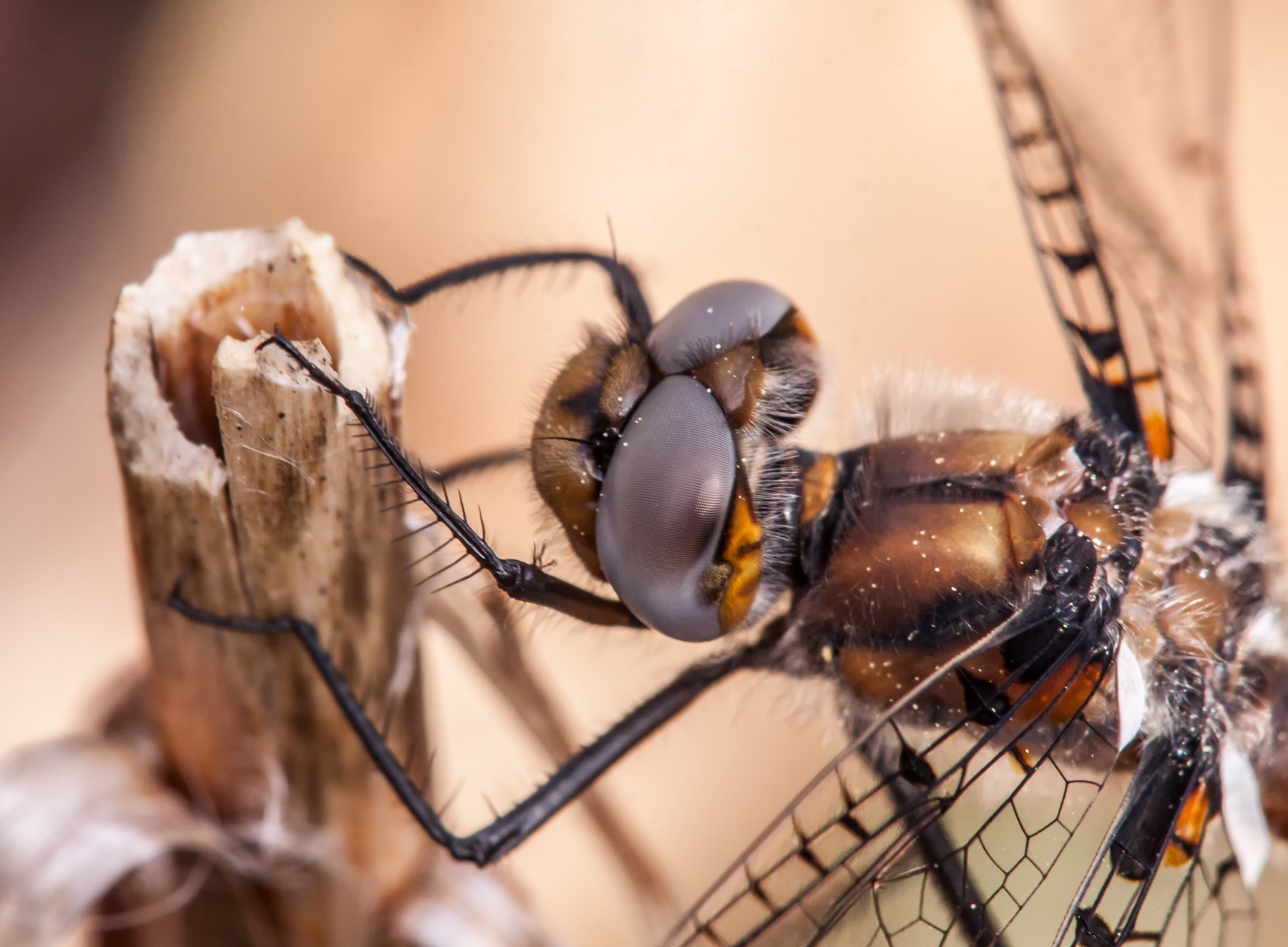
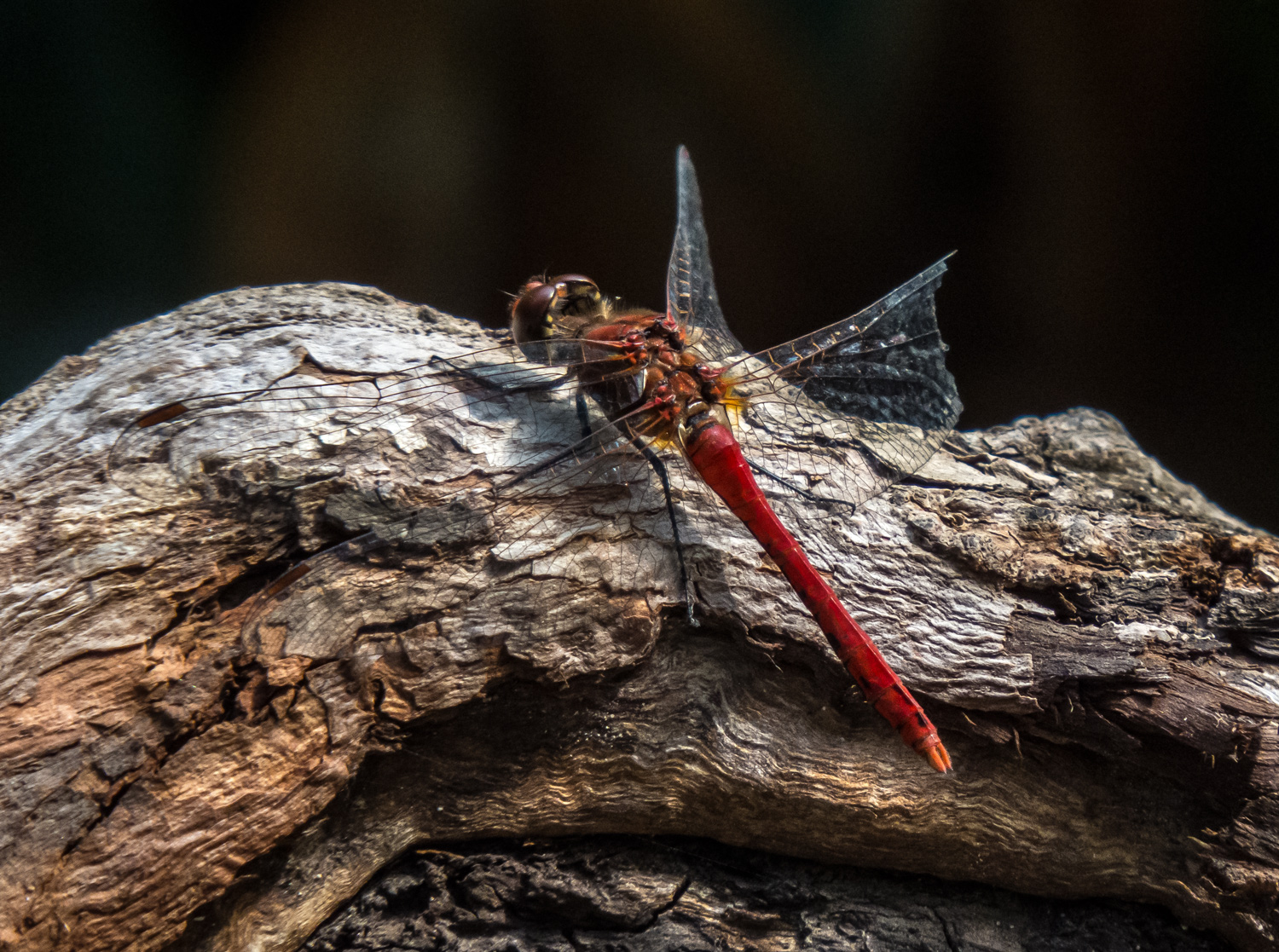
Now that fall has officially arrived, I look forward to seeing more Autumn Meadowhawk dragonflies (Sympetrum vicinum), like this stunning female that I spotted last Friday at Occoquan Bay National Wildlife Refuge. Adult males of this dragonfly species are bright red in color, but females can be either tan or red. The “spike” near the end of the abdomen makes it easy. though, to identify this one as a female.

In Northern Virginia, where I live, the Autumn Meadowhawk tends to be the latest surviving dragonflies—I have spotted them in mid-December and others have seen them in early January.

Autumn Meadowhawk

© Michael Q. Powell. All rights reserved

Read Full Post »

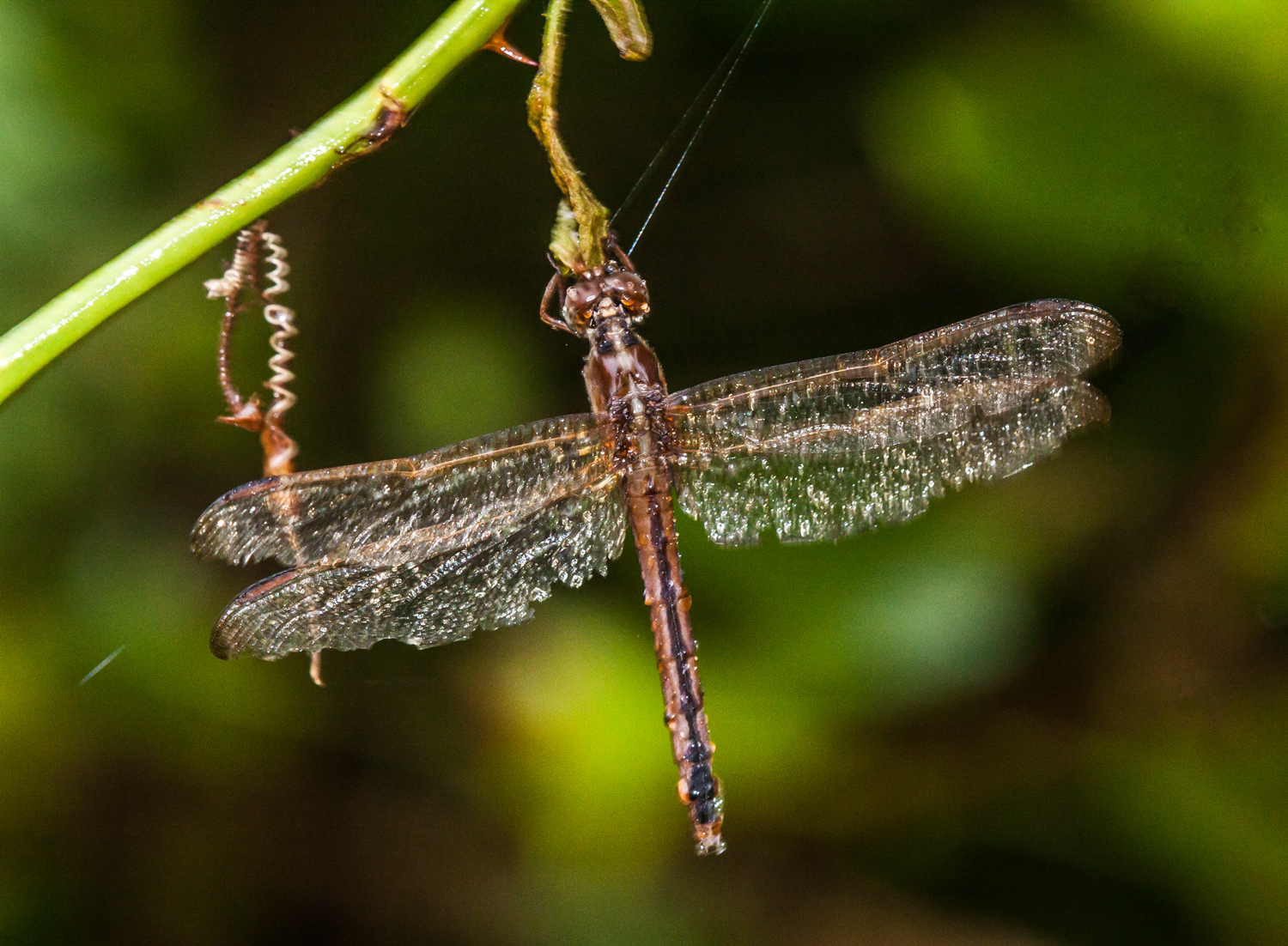
I don’t expect to see dragonflies flying in the rain, so I was a little shocked to see this one in the air this past weekend at Occoquan Bay National Wildlife Refuge. I captured this shot when it landed and hung vertically in the vegetation in an apparent attempt to drip dry.

I not certain of the identification of this dragonfly, but think it might be a Needham’s Skimmer (Libellula needhami), judging from the markings. Normally Needham’s Skimmers perch horizontally rather than vertically, but the unusual perching behavior might have merely been a consequence of the rainy conditions.

If you click on the image, you can see it in slightly higher resolution, including the tiny drops of water at the lower end of the abdomen (the “tail”).

Needham's Skimmer

© Michael Q. Powell. All rights reserved.


Read Full Post »

I was thrilled yesterday to see that at least one Swift Setwing dragonfly (Dythemis velox) is still present at Jackson Miles Abbott Wetland Refuge. Based on past records, the Swift Setwings should be with us at least until the end of September, but this has been a crazy year weatherwise, so I never know whether the different dragonflies will appear and disappear on schedule.

If you look really closely at the wings of this dragonfly, you’ll discover some really cool shapes and patterns—-not all of the individual “cells” in the wings are of the same shape and size. Together they form an intricate mosaic that reminds me of a stained glass window. (I encourage you to click on the image to see it in higher resolution.)

Swift Setwing

© Michael Q. Powell. All rights reserved

Read Full Post »

It was cool and wet on Monday and clouds covered the entire sky, but I felt an irresistible need to return to the wild after a week in the urban confines of Brussels, Belgium. Many of the trails at Occoquan Bay National Wildlife Refuge, my recent favorite shooting location, were blocked by standing water and there was not a great abundance of wildlife to be seen.

Most dragonflies prefer warm, sunny weather, so I was not surprised when I did not see many of them. I was happy, though, to see that damselflies were active and I spent quite a bit of time trying to capture images of them. They seemed more skittish than normal and the poor lighting made it tough to keep my shutter speed high enough to keep my images from being blurry.

This is one of my favorite damselfly shots of the day. I was able to isolate the subject, which I believe is a male Big Bluet (Enallagma durum) damselfly, while still including enough of the vegetation to give you a sense of the environment in which I found him.

Big Bluet

© Michael Q. Powell. All rights reserved

Read Full Post »

Later today I will board an airplane and fly across the Atlantic Ocean with the assistance of a significant amount of sophisticated machinery. I can’t help but marvel at the way that dragonflies and damselflies, by contrast, maneuver through the air so skillfully and effortlessly. Wouldn’t it be cool to be able to fly like that?

This past weekend I spent a good amount of time in one of my favorite photographic pursuits—trying to capture images of a dragonfly in flight. When I am traveling I usually don’t have my best camera gear with me and opt instead to use a Canon SX50, a superzoom point-and-shoot camera. It gives me a lot of reach, but is sometimes slow to focus and has a low frame rate. What that means is that I have to be even more careful than usual, because I can’t capture a lot of shots in an extended burst.

Mostly I was trying to photograph Migrant Hawker dragonflies (Aeshna mixta) at the botanical garden in Brussels. The good news is that Migrant Hawkers are relatively large in size and will sometimes hover a bit over the water. That increases slightly my chances of getting a shot, though many of my attempts resulted in cut-off or out-of-focus shots of the dragonflies.

This was probably my best shot of the session. I like the way that I captured a pretty clear view of the body, including the legs that are tucked in during the flight and managed to get the eyes in relatively sharp focus. One of my Facebook friends commented that it would make a handsome piece of jewelry made with gold, turquoise and onyx—I totally agree with her.

Migrant Hawker


© Michael Q. Powell. All rights reserved

Read Full Post »

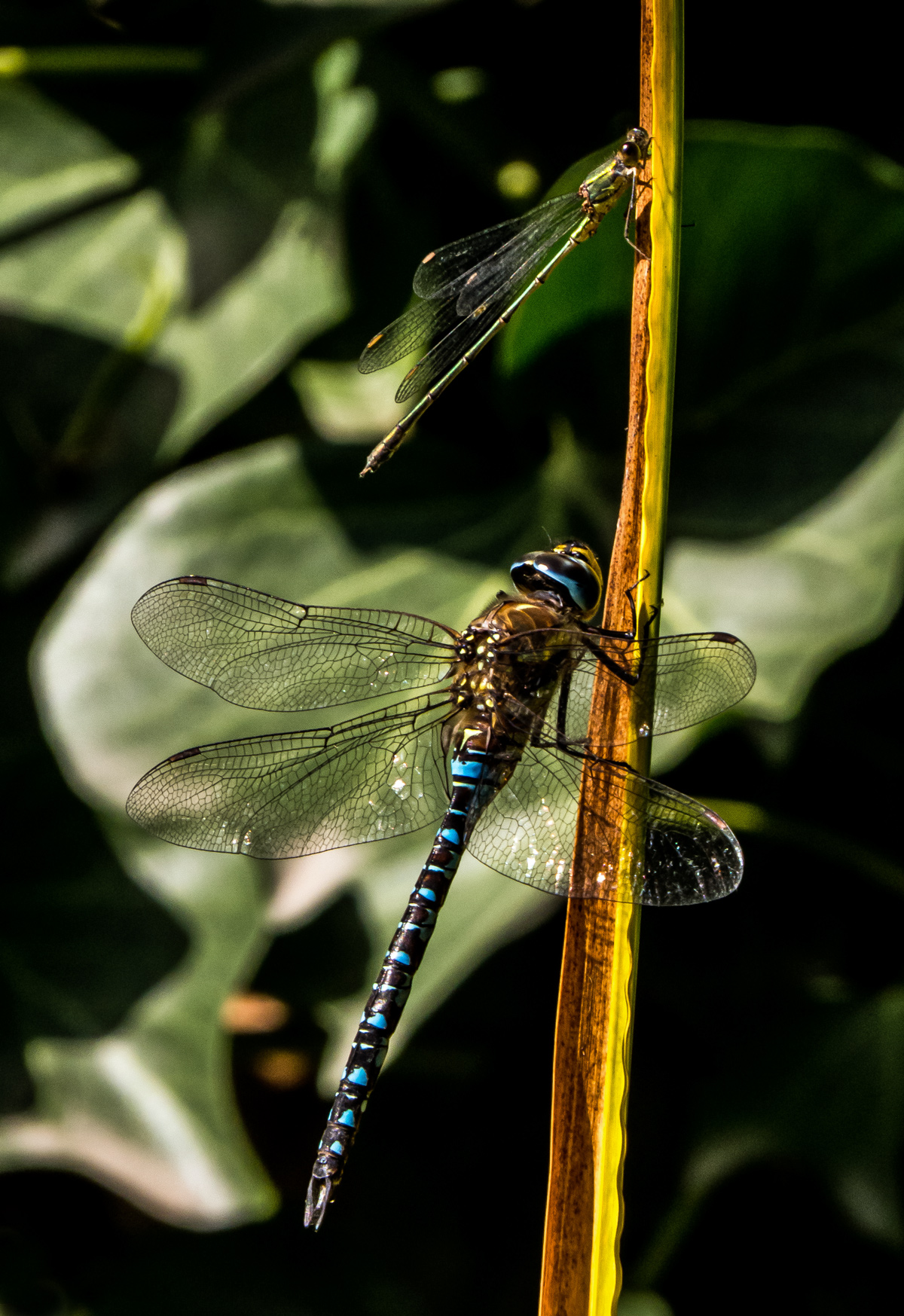
I can’t help but wonder what was going through the minds of these two insects as they perched on the same stalk of vegetation this past weekend at the botanical garden in Brussels, Belgium. Their postures suggest to me a heightened sense of alertness and a kind of wariness. The much smaller damselfly at the top seems to be cautiously looking down over its shoulder at the Migrant Hawker (Aeshna mixta), who appears to be focusing his attention upward. Was it a sign of curiosity or one of hunger? There was never any sign of direct aggression, but I note that the damselfly was the first one to take off and the dragonfly did not pursue it.

For those of you who are not as hooked on dragonflies as I am, this image shows pretty clearly some of the differences in the body shape and eye positions of a damselfly versus a dragonfly. It is important, though, to keep in mind the amazing diversity within the community of dragonflies and damselflies in terms of color, size, and behavior—these are some of the reasons why I am drawn to them as subjects for my photography.

friend or foe

© Michael Q. Powell. All rights reserved

Read Full Post »

Its colors are not quite as ostentatious as those of the Migrant Hawker dragonfly that I featured yesterday, but the bright red bodies of what I believe are Common Darter dragonflies (Sympetrum striolatum) made them equally hard to miss at the botanical garden in Brussels, Belgium. The colors of these beautiful little dragonflies remind me of those of the Autumn Meadowhawk (Sympetrum vicinum), a species that I see quite often in my home area of Northern Virginia and the shared Latin genus name of Sympetrum indicates their relationship.

I was able to photograph male Common Darters perched in several different spots and I particularly like the way that the fiery red of their bodies contrasts with the cooler green of the backgrounds.

Common Darter

Common Darter

Common Darter

© Michael Q. Powell. All rights reserved


Read Full Post »

Last year when visiting Brussels, Belgium in early September, I was excited to discover dragonflies at the botanical garden in the center of the city. I headed back to the same location on Sunday right after checking into my hotel to see if I could find some dragonflies there this year.

As soon as I arrived at the small pond at the botanical garden, I was thrilled to see a number of large, colorful dragonflies flying about. Although they spent most of their time flying patrols over the water, occasionally one of the dragonflies would perch on the vegetation at water’s edge, which allowed me to capture some images of them.

I absolutely love the beautiful colors and patterns of these dragonflies, which I believe are Migrant Hawker dragonflies (Aeshna mixta). I am definitely not an expert on European dragonflies, however, and there are a number of other hawker species that are somewhat similar in appearance. In North America, there are dragonflies of this same Aeshna genus, which are usually referred to as mosaic darners, but I don’t think that this particular species can be found on the other side of the Atlantic.

Migrant Hawker

Migrant Hawker

Migrant Hawker

© Michael Q. Powell. All rights reserved


Read Full Post »

It almost looks like this Great Blue Skimmer dragonfly (Libellula vibrans) was wearing cool wraparound sunglasses this past weekend when I spotted him chilling out at Occoquan Bay National Wildlife Refuge. From a distance, it looks like dragonflies have smooth bodies, but when you get a good look up close, you discover that they have tiny hairs covering various parts of their bodies.

Great Blue Skimmer

© Michael Q. Powell. All rights reserved


Read Full Post »

As a nature photographer, I am used to living with compromises. Unlike some other kinds of photographers, I don’t have the luxury of waiting for perfect light or photographing only perfect subjects. I can make a few adjustments or move about a bit to improve my composition, but most of the time I deal with imperfections of one sort or another.

Every once and a while, though, I’ll take a photo that doesn’t require any substantial adjustments or even cropping–it looks just like I imagined it would. That was the case with a recent image I captured of a female Eastern Amberwing dragonfly (Perithemis tenera) at Occoquan Bay National Wildlife Refuge.  I like the way that I captured the subject, I like the curved of the vegetation on which it is perched, and I like the background. It’s a bonus that I didn’t need to crop.

Perfection is elusive in any pursuit—this is about as close as I can come to it in my photography.

Eastern Amberwing

© Michael Q. Powell. All rights reserved

Read Full Post »

I tend to be an opportunistic photographer, content to wander about and shoot whatever I happen to find. For the last couple of weeks, though, I have been searching diligently for a particular species of dragonfly, the Fine-lined Emerald (Somatochlora filosa), and yesterday, the final day of August, I finally found one at Occoquan Bay National Wildlife Refuge.

What makes this dragonfly so special? In his excellent website Dragonflies of Northern Virginia, Kevin Munroe described some of the allure of this particular species— “One of Northern Virginia’s most rare dragonflies, possibly our rarest, this species is seldom seen and little known throughout its range, from New Jersey to Florida, and west to Kentucky and Texas. Most field guides describe its breeding habitat as “unknown”.”

Last year I was lucky enough to see a Fine-lined Emerald several times, but I wanted more. As befits its name, my first glimpse yesterday of the dragonfly was of its brilliant green eyes as it flew by me. Unlike some species that fly high the air, Fine-lined Emeralds often patrol at waist to eye level. I was able to follow and track the dragonfly until it perched. This species hangs vertically from vegetation when perching, so it can be tough to spot one unless you have seen it land.

I was fortunate to be able to photograph this beautiful dragonfly on several different perches until it finally disappeared from sight. Here are a couple of my favorite shots from our altogether too brief encounter yesterday.

Fine-lined Emerald

Fine-lined Emerald

© Michael Q. Powell. All rights reserved

Read Full Post »

When recently at Occoquan Bay National Wildlife Refuge I spotted these two damselflies, which an expert identified as probable Big Bluets (Enallagma durum), I initially thought they were mating. Then I realized that the positions were all wrong and the nibbling on the neck was probably indicative of a literal hunger. Yikes.

As Tina Turner once sang, “What’s love got to do with it?”

damselflies

daamselflies

© Michael Q. Powell. All rights reserved

Read Full Post »

Two different colored dragonflies, a Needham’s Skimmer (Libellula needhami) and a Great Blue Skimmer (Libellula vibrans), were peacefully sharing a prime perch on Monday at Occoquan Bay National Wildlife Refuge.

Why is it so hard for us to peacefully coexist with one another?

peaceful co-existence

© Michael Q. Powell. All rights reserved

Read Full Post »

Have you ever gotten into a staring contest with a dragonfly? Dragonfly eyes can have an almost hypnotic effect on you when you look directly into them..

I went eye-to-eye with this Eastern Pondhawk dragonfly (Erythemis simplicicollis) on Monday at Occoquan Bay National Wildlife Refuge. She was the one to break eye contact first as she cocked her head, smiled at me, and decided the contest was over.

Eastern Pondhawk

Eastern Pondhawk

© Michael Q. Powell. All rights reserved

Read Full Post »

It is great to see that at least a few colorful Calico Pennant dragonflies (Celithemis elisa) are still around. I photographed this handsome male last Friday as he perched at water’s edge at the small pond at Occoquan Bay National Wildlife Refuge.

Summer is slowly slipping away. Some species of dragonflies are already gone for the year and others will soon follow suit. A few species have yet to appear, so all of the news is not bad. Still, as kids return to school and the daylight hours become noticeably shorter, it’s hard not to have the feeling that the lazy days of summer are coming to a close.

Autumn is my favorite season for a number of different reasons, but I am not quite ready to give up on summer. So I’ll keep sweating and searching, seeking to capture the summer beauty that still surrounds us. Like this dragonfly, I’m still holding on.

calico pennant

© Michael Q. Powell. All rights reserved

Read Full Post »

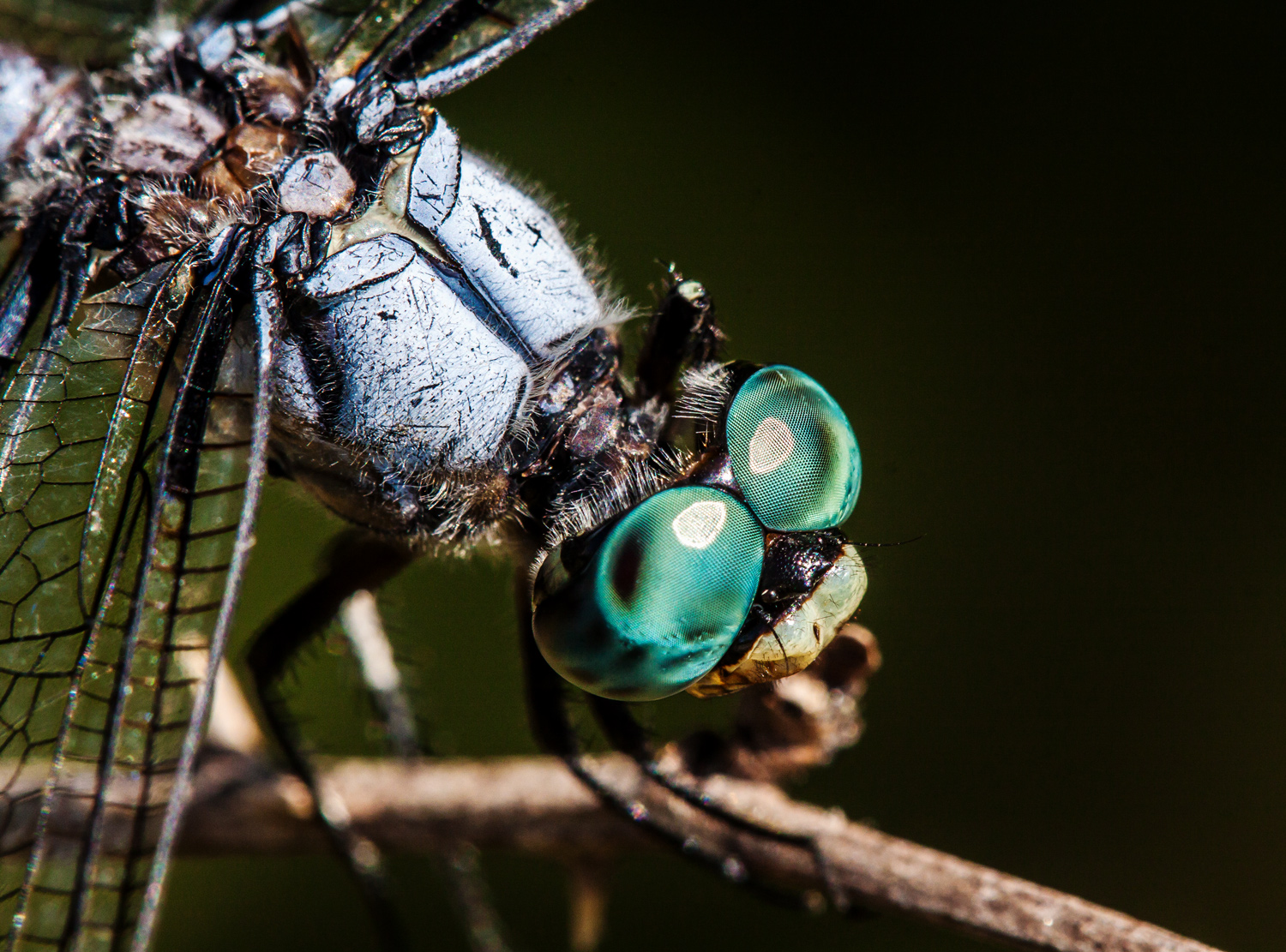
Dragonflies have amazing compound eyes that wrap around their heads. With up to 30,000 facets (ommatidia, to be technical), dragonflies have incredible vision and can even see colors beyond human visual capabilities, like UV light. For an easy to read discussion about dragonfly eyes, i.e. not overly scientific, check out this posting by “grrl Scientist” that was posted on scienceblogs.com.

I captured this close-up image of a Great Blue Skimmer dragonfly (Libellula vibrans) yesterday at Occoquan Bay National Wildlife Refuge. At least once a season, I manage to get a shot like this when a cooperative dragonfly lets me get close. I captured the image below with my trusty Tamron 180mm macro lens on my Canon 50D DSLR. This lens, which has a longer focal length than most macro lenses, gives me some stand-off distance so I can get a macro shot like this without actually being on top of the subject. The only downside to the lens is that it has no built-in image stabilization, so I have to pay extra attention to remaining steady when shooting with it—I generally use a monopod to help reduce camera shake and I think it helped for this image.

The image is framed just as I saw it in my viewfinder. Most of the time I end up cropping my images as part of my normal post-processing, but in this case it looked pretty good without any cropping whatsoever.

Great Blue Skimmer

© Michael Q. Powell. All rights reserved

Read Full Post »

There were only a few water lilies in bloom at the small pond at a local garden that I visited this past weekend. Surprisingly, they were all pink in color and not the white ones that I am more used to seeing—perhaps it is late in the season for the white ones. Not surprisingly, there were quite a few dragonflies buzzing about and I decided that I wanted to get a shot of one of them perched on one of the water lilies.

So I waited and hoped and waited some more. My patience was eventually rewarded when a tiny male Eastern Amberwing dragonfly (Perithemis tenera) landed on a partially open water lily bud and perched momentarily.

I really like the image that I managed to capture because of the way it conveys a sense of the mood of the moment, a calm, almost zen-like feeling of tranquility. The colors are subdued and the composition is minimalist—there is a real beauty in simplicity.

Dragonfly and water lily

© Michael Q. Powell. All rights reserved.


Read Full Post »

Last night I was playing again with watercolors and found inspiration in some videos about Chinese sumi-e brush painting, particularly one by Daleflix on YouTube that showed him painting a dragonfly and a frog. I really like the way that sumi-e painting, which is often done in ink on rice paper, emphasizes the importance of each brush stroke.

My painting skills still need a lot of work, but I especially like how the dragonfly turned out. There is a kind of minimalism in the dragonfly that appeals to me. It was really all-or-nothing when I painted it. Each of the wings, for example, was a single brush stroke, with a little bit of outlining done later. Similarly, the segmented body was done in a single pass.

I kind of got a little lost after I had painted the frog and the dragonfly and tried to add some contextual elements. The water ended up way too dark and some of the branches got too thick. In case you are curious, the painting is 4 x 6 inches in size (10 x 15 cm), so the brush strokes were pretty small.

Still, I like the overall feel of this little painting, which represents a new step for me as I explore watercolors. I think that I may explore this style of painting some more.

dragonfly and frog

© Michael Q. Powell. All rights reserved.

Read Full Post »

I love the stunning red-orange coloration of a male Needham’s Skimmer dragonfly (Libellula needhami), especially when the sunlight dances across its gold-tinged wings, as it did on Monday morning at Occoquan Bay National Wildlife Refuge.

Generally I prefer an uncluttered background for my subjects, but in this case I think the soft patterns of the grasses in the background enhance the image more than would have been the case with a uniform single color.

Needham's Skimmer

© Michael Q. Powell. All rights reserved.


Read Full Post »

What is your favorite dragonfly? Most people would have trouble answering a question like that. If they do happen to notice dragonflies, they generally have not looked closely enough at them to identify species—at best they might be able to say something like, “I like the big green ones that I see flying overhead” or “I like the little blue ones that perch on the reeds.”

Most of you know that I somewhat obsessed with dragonflies (and those who know me well might question my use of the qualifier “somewhat” in the first half of the sentence). I love the beauty and aerial agility of these flying insects and I spend endless hours searching for them for months on end.

How do I choose a favorite dragonfly? It’s kind of like asking a parent to choose a favorite child. There are different things that I like about different dragonfly species.

If I were asked the question directly, I would probably say that the Blue-faced Meadowhawk (Sympetrum ambiguum) is my favorite dragonfly. I absolutely love the striking combination of the turquoise blue eyes and the striking red body. Blue-faced Meadowhawks are also special to me for a personal reason—I was awarded second place in a local photo contest several years ago for a macro shot of a Blue-faced Meadowhawk. (Here is a link to the 2015 posting Second place in a local photo competition that shows that prize-winning entry and tells some of the back story of the image.)

Yesterday at Occoquan Bay National Wildlife Refuge I photographed my first Blue-faced Meadowhawk of the season, a handsome male with bright coloration. Even if you are not a big fan of dragonflies, I hope that you can agree this little dragonfly is strikingly beautiful—welcome to my world.


Blue-faced Meadowhawk

© Michael Q. Powell. All rights reserved.


Read Full Post »

This image is a little gruesome, but here is a close-up look at an Eastern Pondhawk dragonfly (Erythemis simplicicollis) as it consumed a damselfly that it had captured this past Monday at Occoquan Bay National Wildlife Refuge in Northern Virginia. The second image shows a different Eastern Pondhawk with a different damselfly—the pondhawks seemed to have a particularly voracious appetite that day.

Eastern Pondhawk

Eastern Pondhawk

© Michael Q. Powell. All rights reserved.


Read Full Post »

I was simultaneously fascinated and horrified yesterday at Occoquan Bay National Wildlife Refuge as I watched this Eastern Pondhawk dragonfly (Erythemis simplicicollis) gnaw on the head of a colorful Calico Pennant dragonfly (Celithemis elisa) that it had captured. I know that dragonflies eat other insects, but in my mind I tend to think of them consuming mosquitoes and other such smaller insects. Some of them, however, apparently prefer larger prey, including other dragonflies.

Eastern Pondhawk versus Calico Pennant

© Michael Q. Powell. All rights reserved.

Read Full Post »

Normally when I see a Common Green Darner dragonfly (Anax junius) it is patrolling in the air and it is mostly a greenish blur. This past Friday, however, I was fortunate enough to spot one on the ground, nestled low in the vegetation at Occoquan Bay National Wildlife Refuge. At this closer distance I was able to marvel at all of the wonderful colors of this beautiful dragonfly.

Be sure to click on the images to see the details of this dragonfly at higher resolution.  Did you notice the blue color near the tip of its “nose?”

Common Green Darner

Common Green Darner

© Michael Q. Powell. All rights reserved.


Read Full Post »

This Prince Baskettail dragonfly (Epitheca princeps) almost looks like it was flying at an airplane’s cruising altitude and was looking down at a landscape with rivers, mountains, and lakes. I spotted this dragonfly last weekend at Occoquan Bay National Wildlife Refuge and spent quite a while trying to get a shot of it in flight.

The dragonfly, however, never ventured close enough to shore for me to get a detailed shot of it. I was a little disappointed until I opened up the image on my computer and discovered that I had managed to capture a wonderful, fanciful background. Sometimes I try to document the reality that I see and other times it seems like it is just my imagination running away with me.

Prince Baskettail

© Michael Q. Powell. All rights reserved.

Read Full Post »

Sometimes the dragonfly is the predator and sometimes it is the prey—it appears to be primarily a matter of circumstances and timing. This male Common Whitetail dragonfly (Plathemis lydia) met his demise this past Friday at Occoquan Bay National Wildlife Refuge.

I am not sure how exactly the spider managed to snag the dragonfly, but I assume the dragonfly flew into the spider’s web, which was high in the air, spanning a gap between some tall trees. Interesting enough, I was only able to see a few strands of the web, so I wonder if this action took place at the extreme edge of the web.

common whitetail dragonfly

© Michael Q. Powell. All rights reserved.


Read Full Post »

I spotted this beautiful female Eastern Ringtail dragonfly (Erpetogomphus designatus) last week along the Potomac River while exploring Great Falls Park. Unlike some of the dragonflies that I have photographed recently that perched at the very tips of tall stems, this species likes to perch in vegetation relatively low to the ground. As a result, the background in this image is a little more cluttered than I prefer.

If you double click on the image, you will see the image in greater detail, including its marvelous multi-colored eyes and the wonderful colors and patterns on its body.

Eastern Ringtail

© Michael Q. Powell. All rights reserved.

Read Full Post »

Do you consider yourself to be artistic? All of my life I have been in awe of people who can draw and paint and create art, but have never considered myself to be artistic. Increasingly, though, my photography has opened up a creative side that I am trying to nurture.

As some of you know, I decided that I want to try my hand at watercolor painting and did a posting not long ago on my first efforts at doing a landscape. I don’t usually shoot landscapes with my camera, so I thought that I would try a more familiar subject for my second project—I decided to try to paint a dragonfly. In retrospect, I probably should have chosen an easier subject, but I am so inexperienced in art that I didn’t realize what I was getting myself into.

For inspiration, I used a recent photo that I took of a female Eastern Amberwing (Perithemis tenera). I have already included it in a blog posting, but am reprising it as the final photo, so you’ll know what my artistic efforts were supposed to look like.

I tried a couple of different approaches to my subject. First I tried sketching the dragonfly. I didn’t have a pencil handy, so I used a Bic ballpoint pen. My observation skills and sense of proportion are definitely lacking, but it was surprisingly fun to try. Without an eraser to correct my errors, I felt a bit like I was walking on a tightrope without a net.

Then I tried to draw with Crayola crayons? Why? I happened to be at Walmart yesterday and picked up a pack of 24 for only 50 cents at a back-to-school sale. My drawing looks a bit like a cartoon to me.

Finally I was ready to try watercolor. I decided that I would do the painting without bothering to sketch it out. Oops. I was using some inexpensive paper and it started to buckle a bit when I tried to cover the entire area with an overly wet wash of light green. I think I then attempted to put on the next layer before the first one was fully dry. I still feel like a second-grader in my watercolor skills, but it still was enjoyable trying to see what worked and what didn’t.

I did my final attempt in a sketchbook that is not intended for watercolor. I sketched out the dragonfly with a mechanical pencil and then colored the sketch with my watercolor paints. Out of all of my attempts, this is the one that I like the most. I felt a bit more confident in using the paints and in some of my strokes.

So what did I learn? Most significantly I learned that it’s worth taking a risk of feeling embarrassed; that it’s ok to try something new and achieve only a limited amount of success;, and that the amount of enjoyment that I can derive from a creative pursuit is not directly tied to any specific outcome.

dragonfly sketch

dragonfly crayon drawing

#worldwatercolormonth

#worldwatercolormonth

Eastern Amberwing

© Michael Q. Powell. All rights reserved.


Read Full Post »

Eastern Amberwings (Perithemis tenera) are the smallest dragonflies in our area. You can often find males buzzing around at the water’s edge, but females are harder to spot because they hang out in vegetation away from the water. I was thrilled therefore to see a beautiful female this past Friday at Occoquan Bay National Wildlife Refuge in some beautiful morning sunlight.

I decided to give a male Eastern Amberwing dragonfly equal billing in this post, because I really like the way that the shadows and the reflections make it look like he has an elongated body and extra sets of wings.

Eastern Amberwing

Eastern Amberwing

© Michael Q. Powell. All rights reserved.

Read Full Post »

I love the dark, slate-blue tones of the male Slaty Skimmer (Libellula incesta), one of the most common dragonflies in our area.  The beauty of this handsome Slaty Skimmer was further enhanced by the colorful backdrop that I managed to capture this past Friday at Occoquan Bay National Wildlife Refuge.

It is hard to come up with a composition that is more basic—beauty can often be found in simplicity.

Slaty Skimmer

© Michael Q. Powell. All rights reserved.

Read Full Post »

« Newer Posts - Older Posts »