Feeds:
Posts
Comments

Archive for the ‘Dragonflies’ Category

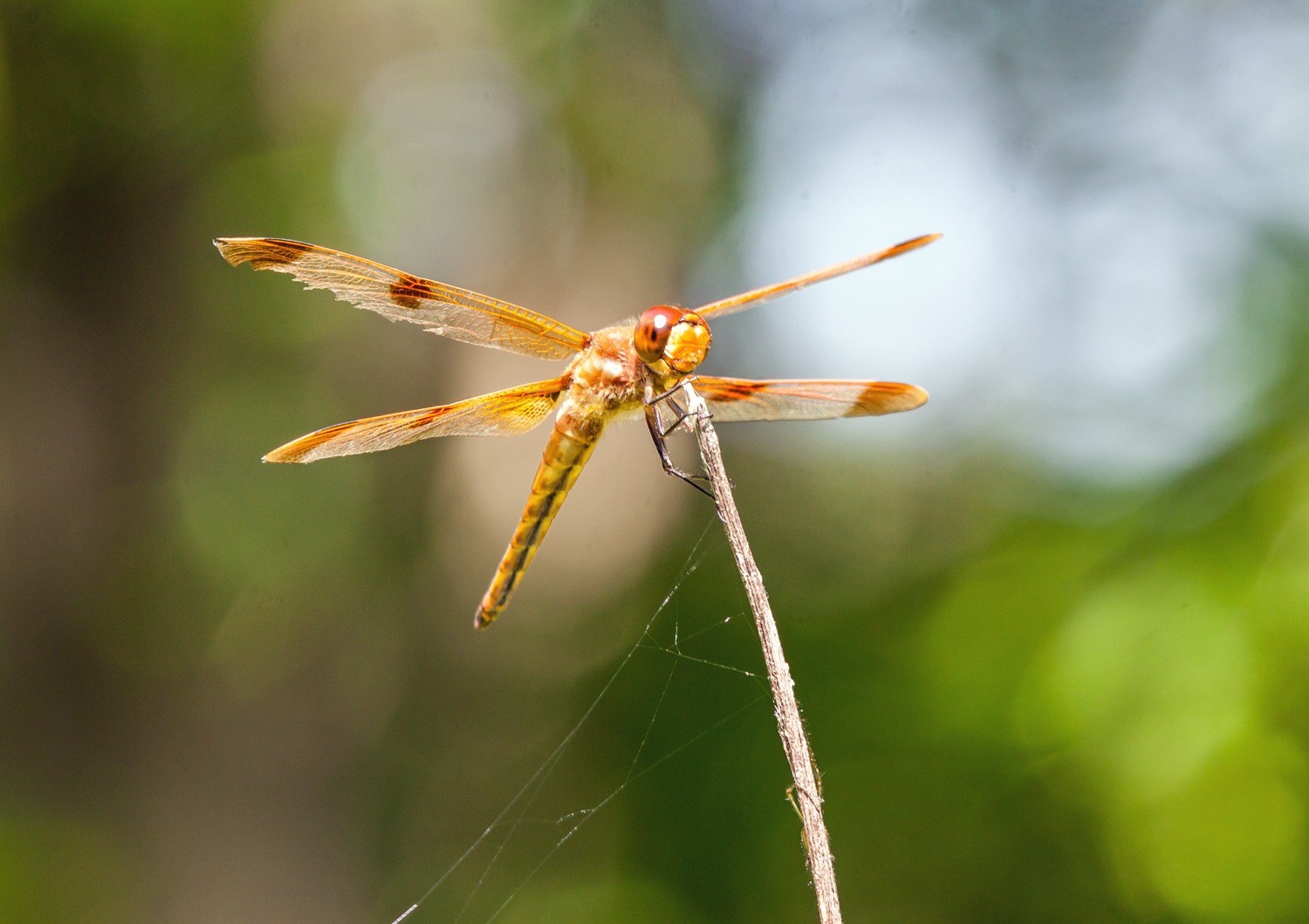
A breeze was blowing on Saturday morning at Occoquan Bay National Wildlife Refuge and this male Halloween Pennant dragonfly (Celithemis eponina) seemed to be struggling to maintain its perch as it was buffeted from side to side.

Halloween Pennant

© Michael Q. Powell. All rights reserved.


Read Full Post »

I watched a dragonfly flying around in the air for quite some time yesterday morning at Occoquan Bay National Wildlife Refuge and was thrilled when it finally perched for a moment on some vegetation low to the ground. Initially I thought that it was a Wandering Glider, a migratory species that I had seen a few times previously at this wildlife refuge.

After I posted an image to a couple of Facebook dragonfly fora, I learned that the dragonfly was in fact not a Wandering Glider, but instead was a close relative, a Spot-winged Glider (Pantala hymenaea). I like the way that Kevin Munroe described this species on his website Dragonflies of Northern Virginia—”Along with the Wandering Glider, this is the albatross of the dragonfly world. Both species are highly-evolved for sustained, efficient flight, drifting over summer fields for hours, like sea birds over a green ocean.”

If you look closely at this dragonfly’s hind wings, you will see that they are broader and appear less fragile than those of many other dragonflies. According to Dennis Paulson in his book Dragonflies and Damselflies of the East, within the genus Pantala, “The very broad hindwings represent an important adaptation for gliding, as does the ability to deposit fat and then use it for energy during a long flight just as a migratory bird does.”

It boggles my mind to think of these tiny creatures migrating for hundreds and in some cases thousands of miles. Wow!


Spot-winged Glider

© Michael Q. Powell. All rights reserved.

Read Full Post »

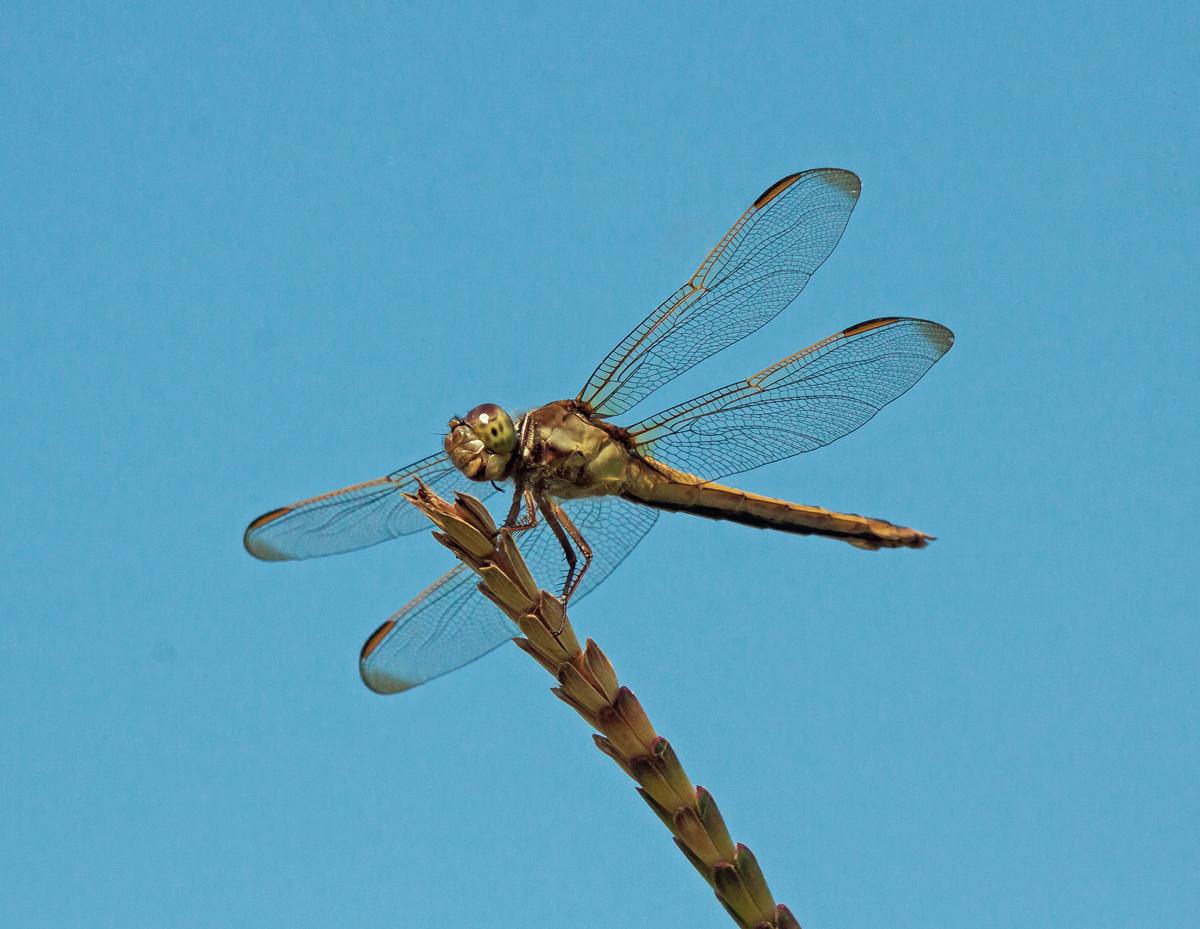
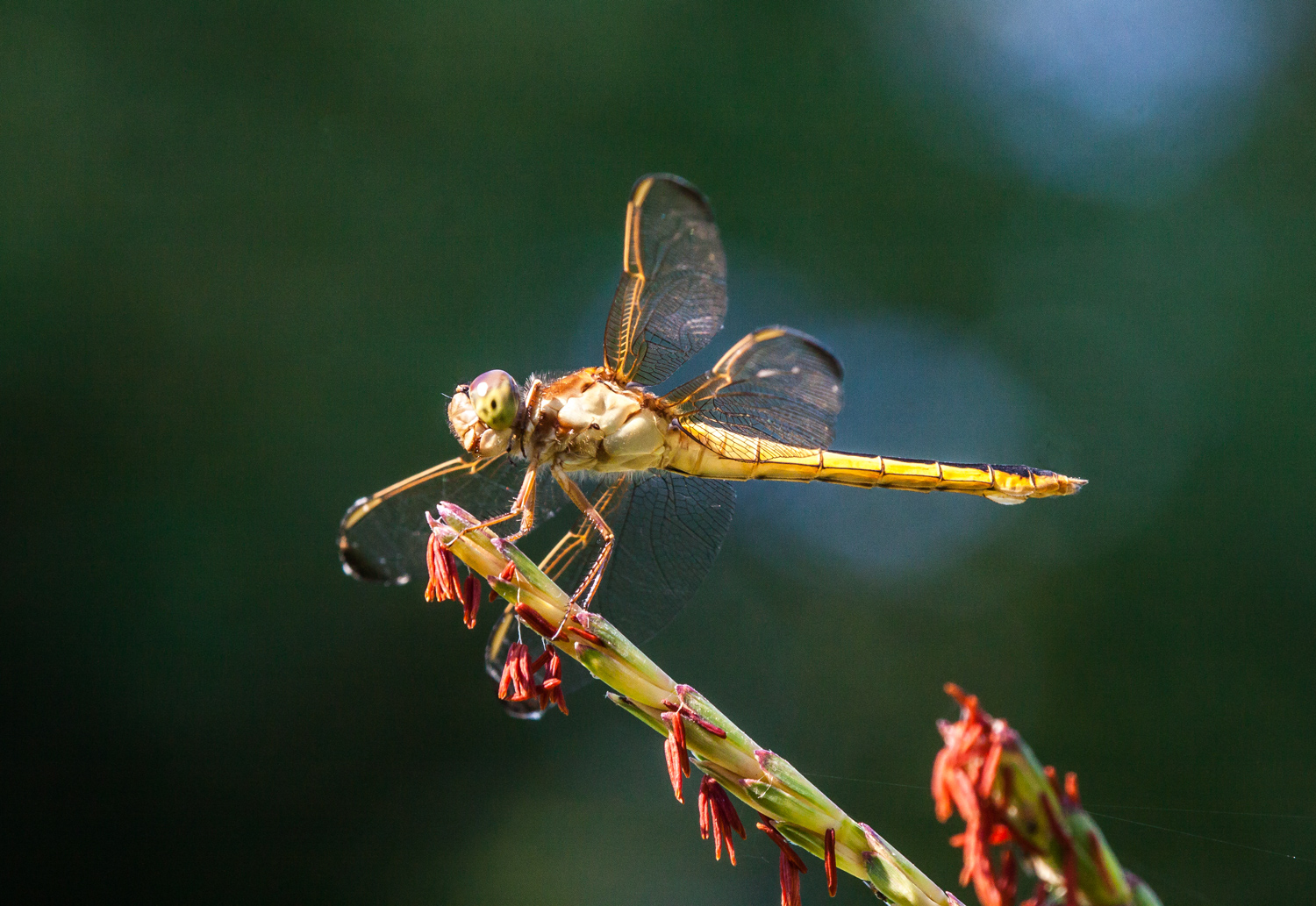
What a difference a background makes. Recently I have been seeing a lot of beautiful female Needham’s Skimmer dragonflies (Libellula needhami) at Occoquan Bay National Wildlife Refuge. It is often a challenge to try to separate them from the background vegetation so that you can focus in on the dragonfly’s wonderful details, like its gorgeous speckled green eyes.

Here are two images that I was able to capture with uncluttered backdrops, one with sky and one with vegetation. I tend to like the first shot a little bit more because of the beautiful blue sky, though I like the lighting and the wonderful Eastern gamagrass in the second shot.

It is fascinating to see what a different feel the background gives to images of similar subjects. Do you prefer one image over the other?

Needham's Skimmer

Needham's Skimmer

© Michael Q. Powell. All rights reserved.

Read Full Post »

Happy 4th of July! It is Independence Day here in the USA and in honor of this holiday I thought I’d post this shot of a patriotic Blue Dasher dragonfly (Pachydiplax longipennis) that was sporting a bit of red, white, and blue on its head this past Monday at Occoquan Bay National Wildlife Refuge. (Be sure to click on the image to see a higher resolution version of the dragonfly that shows the tiny hairs on its thorax (the torso) and its legs.)

Blue Dasher

© Michael Q. Powell. All rights reserved.


Read Full Post »

Some of my readers know that I especially love dragonflies with patterned wings and one of my favorites is the Halloween Pennnant (Celithemis eponina). Despite its name, it is a summertime dragonfly and I was thrilled to spot a beautiful female Halloween Pennant yesterday at Occoquan Bay National Wildlife Refuge.

The “Halloween” part of its name comes from the orange-brown color of its wings. The “pennant” comes from this predisposition of members of this genus to perch on the very tip of vegetation, which causes them to wave back in forth in even the slightest breeze.

In the photo below, the Halloween Pennant is perched on a stalk of very distinctive Eastern gamagrass (Tripsacum dactyloides). I have frequently seen this kind of grass with red bits hanging from its stalks, but it was only yesterday that I learned what it was called from fellow dragonfly enthusiast Walter Sanford.

Halloween Pennant

© Michael Q. Powell. All rights reserved.


Read Full Post »

It is easy to be so dazzled by the beauty and the aerial skills of dragonflies that you forget that they are also fearsome predators. I had a stark reminder of this grim reality on Friday when I encountered a Cobra Clubtail dragonfly (Gomphurus vastus) that had captured a Hackberry Emperor butterfly (Asterocampa celtis) at Riverbend Park. The dragonfly was starting to consume the butterfly and in the photo below almost appears to be suspended in mid-air.

In the past I have observed dragonflies with small butterflies, but this was the first time to see one with a larger butterfly. I really like butterflies and so I felt a mixture of horror and fascination when I stumbled upon this scene. Life in the wild can be brutal and today’s predators can become tomorrow’s prey—a fellow photographer posted a photo yesterday of a bird that had captured a dragonfly.

All in all, this moment served as a sober reminder to me of the fragility of life and of beauty. Somehow it brings to mind a country music song that I really like by Tim McGraw, a song that recommends that you live like you were dying. If you have not familiar with the song or simply want to hear it again, check out the official music video here on YouTube.

Cobra Clubtail

© Michael Q. Powell. All rights reserved.


Read Full Post »

With the temperatures today reaching almost 100 degrees (38 C), I long for the cooler weather of autumn, my favorite season of the year. The aptly named Autumn Meadowhawk (Sympetrum vicinum) is generally one of the last surviving dragonfly species each year and I was therefore a bit surprised last week when I spotted this young female Autumn Meadowhawk. The very clear wings and pale body coloration are an indication that it had only recently emerged.

Summer, though, is the prime season for dragonflies and I hope to be able to take advantage of this season to see lots more of them. I’ll just have to make sure that I pace myself and stay well hydrated as we move through a period of exceptionally hot weather.


© Michael Q. Powell. All rights reserved.

Read Full Post »

On Friday I kept encountering dragonflies that were clearly different from any I had seen before. There is a family of dragonflies known as “clubtails” in which the ends of their abdomens (the “tail”) are enlarged. I have seen a number of different members of this family, but none of them had as large a “club” as the ones that I spotted repeatedly as I explored Riverbend Park along the Potomac River.

I suspected and eventually was able to confirm that these are Cobra Clubtails (Gomphurus vastus). Isn’t that a cool name for a dragonfly—someone obviously thought that the “clubtail” looked like a cobra’s hood.

The Cobra Clubtails perched on the rocks and in the vegetation along the water’s edge and I was able to capture images of several of them. I am leading with a photo that provides a good look at the “clubtail,” though I tend to be drawn more to photos like final one in which you get to look into the eyes of the dragonfly.

This is probably the closest I want to be to staring into the eyes of a cobra.


Cobra Clubtail

Cobra Clubtail

Cobra Clubtail

© Michael Q. Powell. All rights reserved.

Read Full Post »

The Biblical book of Ecclesiastes reminds us that “to every thing there is a season, and a time to every purpose under the heaven” and that is certainly the case with dragonflies. Some dragonfly species are with us for the entire summer, but other species can be seen for only days or weeks and then their season is over. Short flight seasons and specific habitat requirements combine to make some dragonfly species uncommon or even rare.

This past Monday I was happy to capture some more photos of one of those uncommon species, the Gray Petaltail dragonfly (Tachopteryx thoreyi). Earlier this month I observed several of these gray and black beauties for the first time and I was thrilled to be able to take photos to document my sighting. That was the start of a familiar cycle for me—my momentary joy at documenting a new species was replaced by a desire to capture better images, ones that appeal to me artistically.

This may well be my last Gray Petaltail dragonfly sighting of the season, and that makes me a little sad, but other dragonflies will soon be coming onto the scene. So I’ll keep moving forward in search of my next subject, content to photograph familiar ones, but with eyes wide open as I scan my surroundings for new ones too—to everything there is a season.

Gray Petaltail

© Michael Q. Powell. All rights reserved.

Read Full Post »

Carolina Saddlebags dragonflies (Tramea carolina) bounce about as they fly, which makes them look a bit like butterflies as they move through the air. It is easy to spot their bright red bodies and prominent rear wing patches, but it is a challenge to photograph them, because they don’t perch very often.

I was fortunate on Monday to see one land high in a nearby tree and was able to capture this view of the underside of its wings. The vegetation was far enough away that it blurred out nicely, drawing the eye of viewers to this modest portrait of a beautiful little dragonfly.

Carolina Saddlebags

© Michael Q. Powell. All rights reserved.

Read Full Post »

Have you ever watched sprinters prepare for the start of a race? They get into their starting blocks and lean forward, ready to push off at the sound of the gun. Well, that’s what some scientist had in his mind when he first saw today’s dragonfly, the Swift Setwing (Dythemis velox). The forward tilting of the wings is very distinctive and makes this dragonfly easy to identify.

This is mostly a southern dragonfly and I was thrilled when I spotted one two years ago, the first time that a Swift Setwing had been documented in my county. Since then I have looked forward to finding them each year at Jackson Miles Abbott Wetland Refuge, where they appear to have established themselves.

Last weekend I spotted my first Swift Setwing of the season and I was able to capture these images.

Swift Setwing

Swift Setwing

© Michael Q. Powell. All rights reserved.

Read Full Post »

Summer officially starts today and if you are like many people, your summer plans may include a trip to the beach. I tend to associate dragonflies with marshes and ponds, but a few dragonflies also like sandy beaches. It’s not too likely that you will encounter them at an ocean beach, but if you spread out your towel at the sandy edge of a stream, perhaps you might see a Common Sanddragon (Progomphus obscurus).

Common Sanddragons like to perch flat on the sand and transform themselves from water-dwelling nymphs to dragonflies in the open on the sand, rather than attaching themselves to vegetation as do many other dragonfly species. (If you want to see that amazing metamorphosis documented in a series of photos, check out this blog posting, Metamorphosis of a dragonfly, from two years ago.)

I have begun to recognize the kind of habitat that Common Sanddragons prefer and spotted my first one of the year last weekend on the banks of a small stream in Northern Virginia that I was exploring. That dragonfly is featured in the first two photos below. The very next day, I spotted some more Common Sanddragons at a stream in a local park where I had seen them in previous years. The third photo, which gives you a good view of the body of a Common Sanddragon, is from the second day.

This little series of shots illustrates one of the basic dilemmas that I face when photographing dragonflies. Should I try to capture a bit of the personality of this little creatures, which usually means direct eye contact, or should I try to give the clearest possible view of the entire body of the dragonfly, which usually means a side view? Fortunately, I am sometimes able to get both types of shots, but I am instinctively drawn more to shots like the second one below than to ones like the third image.

Common Sanddragon

Common Sanddragon

Common Sanddragon

© Michael Q. Powell. All rights reserved.


Read Full Post »

What’s your strategy for beating the heat? One of the favorite approaches here in the Washington D.C. area is to stay indoors with the air conditioning cranked up. For a wildlife photographer, though, that is not really an option. My subjects manage to survive in the heat of the day and I need to be other there if I want to photograph them.

Birds seem to be most active early in the day and late in the day, when temperatures are usually coolest, but many dragonflies seem to thrive in bright, direct sunlight. How do they do it? How do they regulate their body temperatures?

If you have ever observed dragonflies on a hot summer day, you may have seen some of them perching in a hand-stand like position, like an Olympic gymnast. This is often referred to as the obelisk posture. The abdomen is raised to minimize the surface area exposed to the sun and when the sun is close to directly overhead, the vertical alignment of the dragonfly’s body suggests an obelisk, like the Washington Monument that I see every time that I venture into the city.

Here are a couple of shots of a Lancet Clubtail dragonfly (Gomphus exilis) that I spotted this past Monday at Jackson Miles Wetland Refuge, only a few miles from where I live. Unlike some clubtail dragonflies, like the Dragonhunter that I featured recently, the Lancet Clubtail is pretty small, about 1.7 inches (43 mm) in length. What I find to be particularly stunning about this dragonfly are its deep blue eyes, which seemed to draw me in.

Initially the dragonfly had its abdomen at an angle, but gradually it kept raising it higher until it ended up in an almost perfect obelisk pose. If I were a judge at the Olympics, I would give this dragonfly a perfect score of 10.

Lancet Clubtail

Lancet Clubtail

© Michael Q. Powell. All rights reserved.

Read Full Post »

Perhaps you are conservative in your style and find most dragonflies to be too flashy and colorful for you. If that’s the case, I have a dragonfly for you, the Gray Petaltail (Tachopteryx thoreyi). This large dragonfly is almost monochromatic—its eyes and body are colored in shades of gray and black. When it is perched vertically against the bark of a tree, this dragonfly almost disappears.

This species seems to like to perch on people, especially those wearing gray clothes. It happened to me a few times, but, alas, I was not able to get a shot to document it. I am pretty flexible, but I couldn’t figure out a way to take a photo when Gray Petaltails landed on my shoulder and on my chest.

The Gray Petaltail is so unusual and distinctive that it has its own genus. The Dragonflies of Northern Virginia website described the species in these words: “Our oldest and most primitive dragonfly, species almost identical to petaltails flew alongside dinosaurs during the Jurassic period.” Wow!

Gray Petaltails are uncommon, in part because they are found only in very specific habitats. In order to locate them, you need to find a small, shallow, sun-lit forest seep that is clean and flowing. It’s not likely that you will just stumble upon one of these cool dragonflies. It helps to have a friend who knows where they can be found. In my case, that was fellow blogger and dragonfly fanatic Walter Sanford. Check out his blog for wonderful images and information on Gray Petaltails and lots of other dragonflies.

Gray Petaltail

Gray Petaltail

Gray Petaltail

© Michael Q. Powell. All rights reserved.


Read Full Post »

Do you think about your photographic subjects one at a time? That’s the way that I tend to operate. One of my blogging friends, though, likes to organize photos of others around themes that transcend the boundaries of individual species. In this posting, Liz of Exploring Colour focused on the theme of Predators and Prey with photos that capture this reality of nature without becoming gruesome. Be sure to check out her other wonderful postings too that include her own photos as well of those of some other awesome photographers.

Ms. Liz's avatarExploring Colour

The reality of the natural world is that some creatures eat other creatures to survive. Nature photographers spend a lot of time outside and sometimes capture dramatic moments in the struggle for survival. Their photos and stories may shock us but we can learn so much from these encounters – animals seem capable of much more planning, strategy and applied knowledge than what most of us humans ever give them credit for.


** Click on any photo to view large-size version **

Note: Each photographer’s website/blog is listed at the bottom of this blog-post.


snake2_fish_blog

Mike Powell | Snake catches catfish | 20 July, 2017

  • Story plus 5 Photos showing the snake in various positions holding his catch, all the time in the water, until all of a sudden the snake somehow ingests the large fish and the last photo shows the snake with only the fish tail sticking out of…

View original post 409 more words

Read Full Post »

I remember reading an article once with tips on photographing butterflies. The article suggested that you photograph only the butterflies in perfect condition, the ones with no signs of aging, no faded colors, and no tattered wings.

I personally don’t believe in following that advice. Life can be really tough for the tiny creatures that I like to photograph (and for us two-legged creatures too) and I don’t mind at all when my photographs capture the effects of some of life’s struggles. As some of my friends are fond of saying, we have earned our wrinkles.

This past weekend I visited Huntley Meadows Park, a local marshland park that used to be my absolute favorite place to take photographs. In some ways it is a victim of its own success. Lots of photographers now flock to the park to photograph the wildlife there. I prefer, however, for my wildlife viewing to be more of a solitary pursuit than a group activity, so increasingly I have been spending my time in other local spots.

While at the park I spotted this beautiful Painted Skimmer dragonfly (Libellula semifasciata). Its wings are a bit tattered and somehow it seems appropriate that its perch shows some spider webs. Yet I couldn’t help but feel how confidently this little dragonfly perched on the tip of the vegetation, boldly displaying its faded beauty to the world.

The composition is simple, as is the message—true beauty is not about perfection.


Painted Skimmer

© Michael Q. Powell. All rights reserved.

Read Full Post »

Sometimes I feel like I am living in a mythical world, in an endless pursuit of dragons, dragonflies that is. I am hoping to capture them, but my weapon of choice is not a sword, but a camera and I am seeking only to capture their images. “Mike the Dragonhunter”—I like the sound of that nickname.

Actually, there is a dragonfly that is called a Dragonhunter (Hagenius brevistylus). As its name suggests, this monster of the dragonfly world specializes in hunting and consuming other dragonflies. Dragonhunters are huge, about 3.3 inches (84 mm) in length.  The male Dragonhunter’s clubtail is so large than it hangs down when it is perched and its powerful legs are so long that it looks awkward when it is perching.

Previously, I had seen a Dragonhunter only one time and it was from a distance. I had dreamed of encountering one at closer range for years. Imagine my surprise on Friday when one zoomed by and perched right in front of me when I was exploring a small pond. I stood still in absolute amazement and think I even forgot to breath—I was afraid to make any sudden moves for fear of scaring off the Dragonhunter.

I had a 180 mm macro lens attached to my camera and often it does not let me get close enough to a skittish dragonfly to get a shot. In this case, though, it was a perfect choice and I was able to get some detailed shots from where I was standing. In the shots below, there was only a minor cropping of the image. Wow! It’s almost a dream to fill the frame with a dragonfly.

I was totally psyched after this encounter. Little did I realize that I would encounter two more Dragonhunters that same day, but they will be subjects for other blog postings some time soon.


dragonhunter

dragonhunter

© Michael Q. Powell. All rights reserved.


Read Full Post »

Do you have rainbows and unicorns in your life? Despite all of the recent rain, I haven’t seen a rainbow in a long time, but I did spot a unicorn last Saturday at Occoquan Bay National Wildlife Refuge, this beautiful Unicorn Clubtail dragonfly (Arigomphus villosipes).

It’s a little hard to tell from these shots, but Unicorn Clubtails have a little “horn” between their eyes that gives rise to the species’ common name. (If you want a view of the “horn,” check out this posting that I did in 2017.)

There is always a certain tension between isolating your subject in a photo and showing it in its natural surroundings. It’s a whole lot easier to focus on the perched dragonfly in the first image below, but I love the color and the texture of the green leaves in the second image and don’t find them to be distracting. Sometimes in life you have to choose and make an either/or decision, but I think that it is often best to leave the options open and let the viewers decide which images they prefer.

Unicorn Clubtail

Unicorn Clubtail

© Michael Q. Powell. All rights reserved.


Read Full Post »

So many dragonflies…so little time. Although I have returned from my recent trip to Brussels, Belgium, I still have photos to share of dragonflies that I saw while I was there. I guess that I consider the species that I observed to be “exotic” and special because they were new to me, though many of them are probably quite common in Brussels.

The dragonfly species that I am featuring today is the Black-tailed Skimmer (Orthetrum cancellatum). When I first spotted these dragonflies at the  étang Tenreuken (Tenreuken Pond). I was struck by their resemblance to the Blue Dasher (Pachydiplax longipennis), a very common dragonfly where I live. The Blue Dasher is particularly special to me because it was the subject of my very first blog posting in July 2012. (For reference purposes, this will be posting number 2740.)

As I watched the Black-tailed Skimmers, I noticed some differences compared to the Blue Dashers. The bodies of the Black-tailed Skimmers appeared to be larger and broader; their eyes seemed greener; and they seemed to spend more time perching flat on the ground rather than on the tips of vegetation.

I thought about posting only the first image, my favorite, because it has a kind of artistic appeal to me. I like the low angle that I chose and the vegetation growing in the foreground out of what appears to be a rock, but is actually the deteriorated wood of a piling at the edge of the water. Ultimately I decided to share some additional shots that give you a more complete view of this beautiful “new” dragonfly species.

UPDATE: A sharp-eyed viewer from the United Kingdom noted that the dragonfly in the second photo appears to be a different species than the ones in the other photos. I did some additional checking and agree with him that it is probably a male Scarce Chaser (Libellula fulva), not a Black-tailed Skimmer. Thanks for the help, blhphotoblog, and others should check out his wonderful blog Butterflies to Dragsters for some wonderful photos.

Black-tailed Skimmer

Black-tailed Skimmer

Black-tailed Skimmer

© Michael Q. Powell. All rights reserved.


Read Full Post »

Emerging is a dangerous experience for dragonflies and doubly so when they do it in the rain. As the water-dwelling nymph is transformed into a beautiful aerial acrobat, it is very vulnerable to predators and weather. Initially the wings are extremely fragile and it takes some time for them to harden enough to permit flying.

On Monday, it was drizzling when I spotted this female Banded Pennant dragonfly (Celithemis fasciata) at a small pond in Northern Virginia. Its metamorphosis is almost complete and I am optimistic that it managed to weather the storm and survive its transformation. If you double click on the image, you can see it in higher resolution and see some of the wonderful details and patterns of its body and wings, as well as some drops of rain.

In case you are curious about a dragonfly’s magical metamorphosis, I was able to observe entire process two years ago with a Common Sanddragon dragonfly and documented it in a series of 15 photos in a blog posting entitled Metamorphosis of a dragonfly. The images are pretty intense and utterly amazing—I encourage you to check them out.

Banded Pennant

© Michael Q. Powell. All rights reserved.

Read Full Post »

Do you like to go off in pursuit of rare and exotic species to photograph? Most of the time I am content to travel again and again to familiar places, searching for both old and new species to photograph.

Yet I guess that I have a bit of an adventurous streak too, for my interest sparked when fellow blogger and dragonfly enthusiast Walter Sanford informed me that he had spotted one of the rarest dragonfly species in our area, the Sable Clubtail (Stenogomphurus rogersi). What makes this dragonfly so rare is that it is found only in a very specific type of habitat and it only for a very short period of time each year.

I was still a bit jet-lagged this past Saturday morning, having returned the previous afternoon from my week-long trip to Brussels, but decided to see if I could find this elusive dragonfly. Walter and I had searched for dragonflies in this area before, so I more or less understood where he had seen the Sable Clubtail dragonflies when he described the location to me.

In retrospect, though, I probably should have done a little more homework, because I suddenly realized as I began my search that I didn’t know very well the distinguishing characteristics of a Sable Clubtail. I knew that the tip of its “tail” (actually its abdomen) was somewhat enlarged, because it was part of the “clubtail” family and I remembered from a photo that extreme end of the “tail” was curved. Beyond that, I was somewhat clueless and I was a little disappointed later in the day when I thought that I had not seen a Sable Clubtail dragonfly, but only some Unicorn Clubtail dragonflies.

I am happy to say that I was wrong in my identification of the species that I had photographed—in my ignorance, I had missed some diagnostic clues that should have told me immediately that I was shooting a Sable Clubtail. Of course, if you never have seen a species before, it’s easy to categorize it as something that you have seen.

Here are a few images from my encounter with a Sable Clubtail. The different angles any varying perches help to highlight the beautiful markings of this dragonfly and its very striking eyes.

I am not quite ready to quit my job and travel the world in search for rare dragonflies, but it was exciting to play the role of an adventurer for a day—a tiny bit of Indiana Jones—and gratifying that I was able to find the treasure that I was seeking, the Sable Clubtail dragonfly.

Sable Clubtail

Sable Clubtail

Sable Clubtail

© Michael Q. Powell. All rights reserved.

Read Full Post »

Many dragonflies are colored with muted shades of green and brown and blend in well with their environments. Some, though, are more boldly colored and are hard to miss when they are present.

That is definitely the case for this Scarlet Darter dragonfly (Crocothemis erythraea) that I spotted last week at the Rouge-Cloître Park in Brussels, Belgium. I first noticed the bright red color of this dragonfly when it zoomed across my line of sight and I was thrilled later in the day when one accommodated me by landing on the ground not far from where I was standing.

Scarlet Darter

Scarlet Darter

© Michael Q. Powell. All rights reserved.

Read Full Post »

It’s amazing how many different species of dragonflies I have been able to spot and photograph during my brief stay here in Brussels, Belgium. One new species for me is the Four-spotted Chaser (Libellula quadrimaculata)—there were quite a few members of this species active at a pond in the Rouge-Cloître park. Unlike some of the species that I have seen here, this species is also found in North America, where it is known as the “Four-spotted Skimmer.”

This species is so popular that,  according to one website, it won a contest in 1995 to become the state insect of the state of Alaska. That may sound a bit strange to some readers, but personally I am happy that it beat out competitors that included the mosquito. (I have heard stories that mosquitoes in Alaska are large and aggressive and possibly are even larger than dragonflies, though that may be a slight exaggeration.)

Four-spotted Chaser

Four-spotted Chaser

© Michael Q. Powell. All rights reserved.


Read Full Post »
At several locations during this visit to Brussels, I have spotted large blue-and-green dragonflies flying patrols back and forth over the water. They reminded me a lot of the Common Green Darner dragonflies (Anax junius) that I see fairly often in my home area of Northern Virginia. I suspected correctly that Common Green Darners are a North American species and that the dragonflies that I was observing were European “cousins.”

It was not hard to establish that these are Emperor dragonflies (Anax imperator), a species that is also referred to as “Blue Emperor.” Because of their size and the fact that their territory seemed to be pretty small, it was easy to track the Blue Emperor dragonflies visually when they were flying. I had to wait a long time, however, for them to perch and then move quickly to get a shot when they did so. Their rest breaks frequently lasted only a few seconds and then they would begin to fly again.

I really like the blue and green color combination and the way that these colors coexist in both the bodies and in the eyes of these beautiful dragonflies.

Emperor dragonfly

Emperor dragonfly

© Michael Q. Powell. All rights reserved.

Read Full Post »
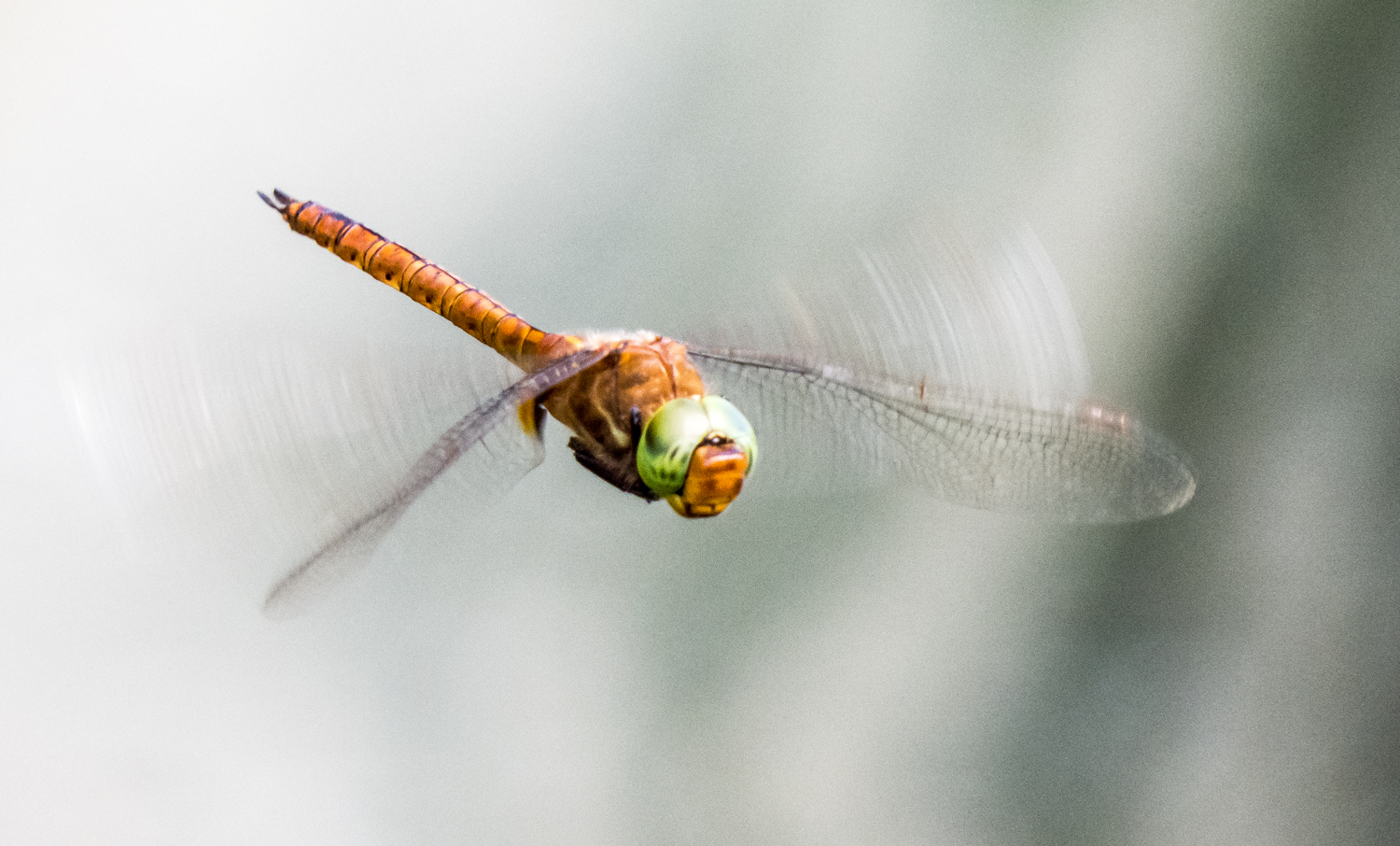
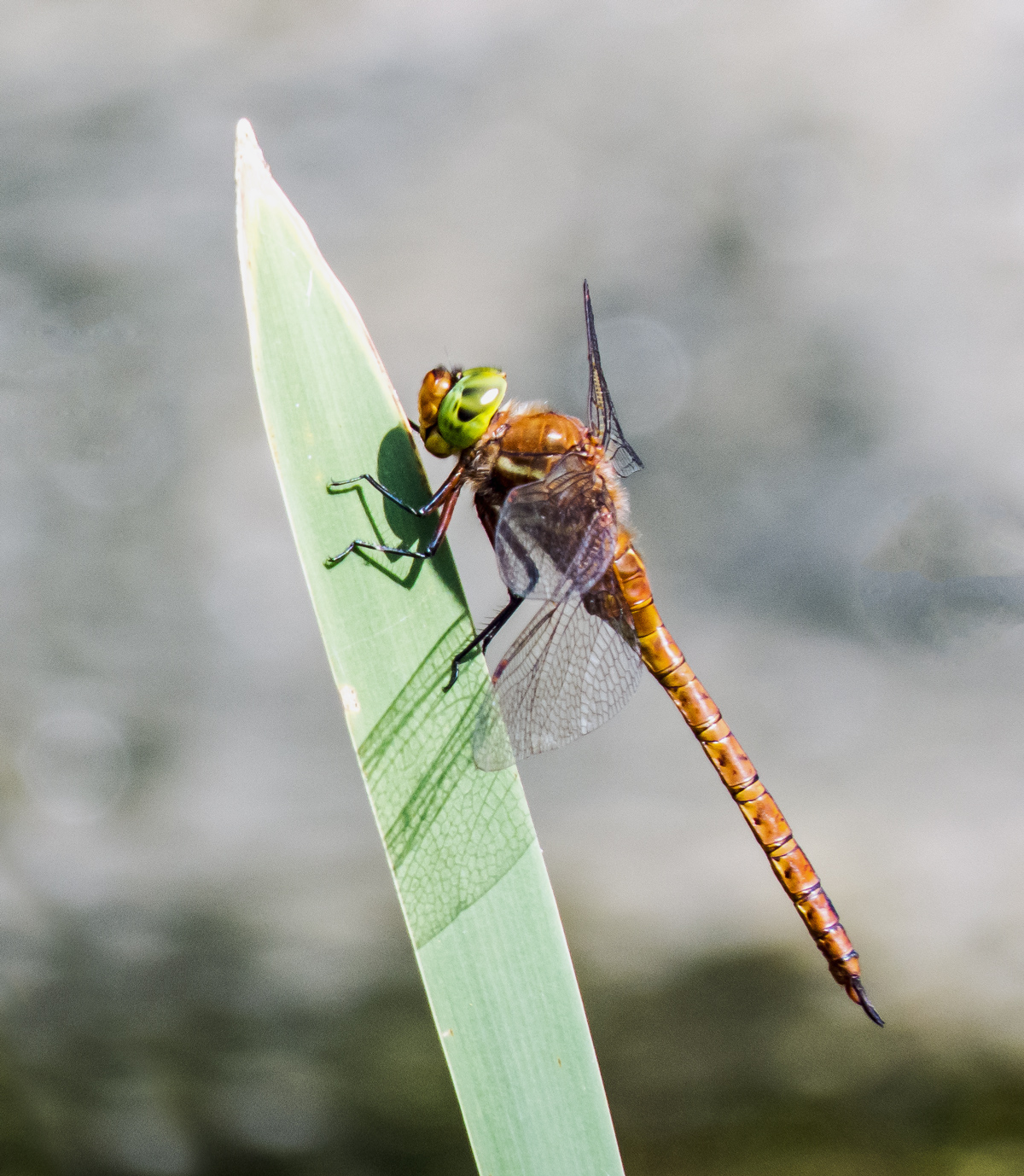
During this past weekend here in Brussels, I managed to find some really cool dragonflies, like this Green-eyed Hawker (Anaciaeschna isoceles or Aeshna isoceles) that I spotted at a pond in the Rouge-Cloître (Red Cloister) Park. This rather large dragonfly, also known as a Norfolk Hawker, is really striking as it flies, with a combination of colors that I have never seen before on a dragonfly.

With a bit of persistence and a lot of luck, I managed to capture an in-flight shot of a Green-eyed Hawker, but mostly I waited and waited for one to land. It was a little frustrating when one of them would land in a location that was too far away or in a location that did not afford me a clear shot, but eventually I was able to capture some images of a perching Green-eyed Hawker.

I was happy to capture the last photo that shows the yellow triangle on the upper part of the abdomen that is responsible for the “isoceles” portion of the Latin name of the species.

Green-eyed Hawker

Green-eyed Hawker

Green-eyed Hawker

© Michael Q. Powell. All rights reserved.

Read Full Post »

Most dragonflies have clear wings and different colors and patterns on their bodies. Some dragonflies, however, have patterns on their wings too that I think really accentuates their beauty and makes them particularly striking.

The first shot below shows a female Calico Pennant dragonfly (Celithemis elisa) that I spotted in mid-May at Occoquan Bay National Wildlife Refuge. The second shot shows a male Painted Skimmer dragonfly (Libellula semifasciata) that I spotted in late May at a small pond in Prince William County in Northern Virginia.

Calico Pennant

Painted Skimmer

© Michael Q. Powell. All rights reserved.


Read Full Post »

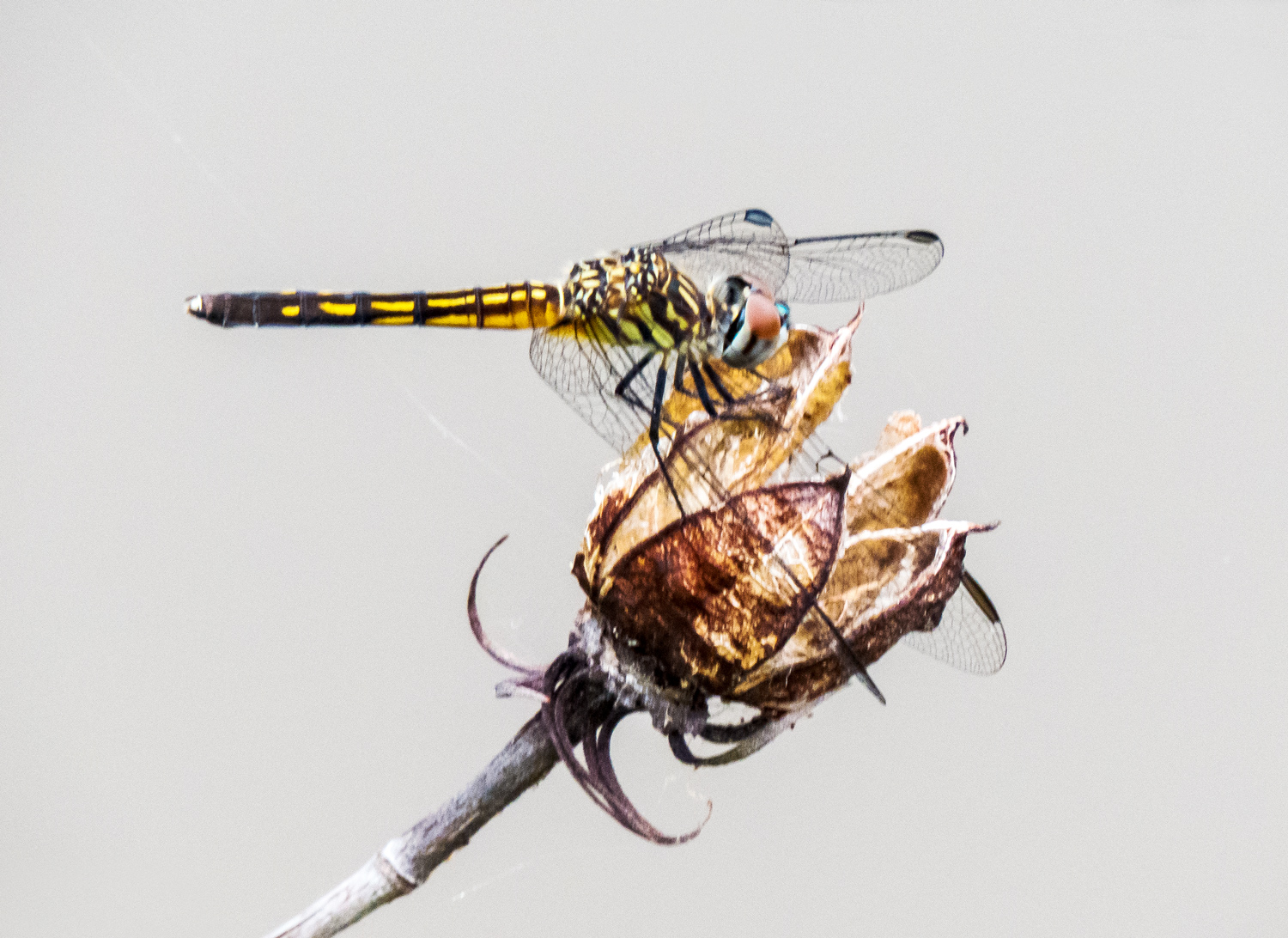
Blue Dasher dragonflies (Pachydiplax longipennis) are one of the most common and widespread dragonfly species in my area. You can get so used to their presence that you stop paying attention to them, which I think is a mistake, for in doing so you will miss their amazing beauty. The colors and patterns of this little dragonfly are stunning.

Here are a couple of shots of Blue Dashers that I captured this past weekend at Jackson Miles Abbot Wetland Refuge. This early in the season, when the dragonflies are newly emerged, the colors seem really saturated and fresh—later in the season the colors tend to become duller and more faded. I was shooting at the edge of a small pond and the water in the background turned into a neutral gray that gives the images an artistic feel, almost like they were shot in a studio environment. The uncluttered background helps to draw your attention to the dragonflies themselves and especially to those wonderful two-toned eyes. (The male’s eyes will eventually turn into a more uniform turquoise blue shade.)

In case you are curious, the Blue Dasher in the first shot looks to be a female and the one in the second image appears to be an immature male.

Blue Dasher

Blue Dasher

© Michael Q. Powell. All rights reserved.

Read Full Post »

Many dragonflies like to perch on or near the ground, but some prefer to relax at the top of the trees, like this Black Saddlebags dragonfly (Tramea lacerata) that I spotted last Monday at Occoquan Bay National Wildlife Refuge. From this angle you can easily see the dark patches on the rear wings that someone decided looked like “saddlebags.”

Those patches somehow remind me of the famous inkblots of the Rorschach test. I suspect that. if asked, people have widely varying ideas about what they look like, though I know that I personally would not want to have any psychological interpretations attributed to my perceptions or to my imagination.

Black Saddlebags

© Michael Q. Powell. All rights reserved.

Read Full Post »

When I am capturing wildlife images, I am usually driven by multiple motivations that sometimes come in conflict with each other. On the one hand, I am trying to capture reality, to record the presence of a given subject in a way that makes it recognizable and identifiable. On the other hand, I am trying to create art, by choosing compositional elements and camera settings that make an image that is visually pleasing to me.

At this time of the year, dragonflies become one of my favorite subjects and I eagerly await the emergence of new species as we move deeper into spring and eventually into summer. This past Monday at Occoquan Bay National Wildlife Refuge, I noted that Spangled Skimmer  dragonflies (Libellula cyanea) are now with us. This species is pretty easy to identify because it is the only local species that has black and white stigmas—stigmas are the narrow rectangular patches of color that can be found on the front edges of the wings.

In the first image, a male Spangled Skimmer was pretty cooperative and let me capture one of my favorite type of dragonfly images—a head-on shot. In this kind of shot, the dragonfly’s body is almost always out of focus, but I am ok with that, because it forces the viewer to focus on the dragonfly’s amazing eyes.

The dragonfly in the second shot, which is an immature male Spangled Skimmer, had flown into a tree after I inadvertently spooked it. I loved the way that it was clinging to a branch. Shooting at an upward angle, I tried to simplify the background to draw attention to the branches as well as to the dragonfly. (As is often the case with dragonflies, immature male Spangled Skimmers initially have the coloration of adult females—eventually the dragonfly in the second photo will look like the one in the first image.)

Spangled Skimmer

Spangled Skimmer

© Michael Q. Powell. All rights reserved.

Read Full Post »

I couldn’t help but notice Friday at Occoquan Bay National Wildlife Refuge how closely the green on the body of this Eastern Pondhawk dragonfly (Erythemis simplicicollis) matched the color of the vegetation on which it chose to perch. It won’t be long before pondhawks are all around us, but it was still nice to spot my first one of the season.

Eastern Pondhawk

© Michael Q. Powell. All rights reserved.

Read Full Post »

I was excited early on Friday morning to see my first Calico Pennant dragonflies (Celithemis elisa) of the season while exploring Occoquan Bay National Wildlife Refuge.  These small, brightly-colored dragonflies have become one of my favorites over the past year.

It is pretty early in their season and all of the ones that I spotted appeared to be immature—the patterns on the wings will soon get darker and more pronounced and bodies of the males, which start out yellow like those of the females, will turn red.

I have long wanted to capture shots of a dragonfly covered in morning dew or raindrops and the quest for these images helps motivate me to venture out early in the morning. If you click on the final photo and examine it at higher resolution, you will see tiny drops of water on the vegetation and a drop or two on the dragonfly’s wings. It’s not quite as I have imagined, but it is a good start.

Calico Pennant dragonfly

Calico Pennant dragonfly

Calico Pennant

© Michael Q. Powell. All rights reserved.

Read Full Post »

« Newer Posts - Older Posts »