Feeds:
Posts
Comments

Archive for the ‘Dragonflies’ Category

It’s amazing how many different species of dragonflies I have been able to spot and photograph during my brief stay here in Brussels, Belgium. One new species for me is the Four-spotted Chaser (Libellula quadrimaculata)—there were quite a few members of this species active at a pond in the Rouge-Cloître park. Unlike some of the species that I have seen here, this species is also found in North America, where it is known as the “Four-spotted Skimmer.”

This species is so popular that,  according to one website, it won a contest in 1995 to become the state insect of the state of Alaska. That may sound a bit strange to some readers, but personally I am happy that it beat out competitors that included the mosquito. (I have heard stories that mosquitoes in Alaska are large and aggressive and possibly are even larger than dragonflies, though that may be a slight exaggeration.)

Four-spotted Chaser

Four-spotted Chaser

© Michael Q. Powell. All rights reserved.


Read Full Post »

At several locations during this visit to Brussels, I have spotted large blue-and-green dragonflies flying patrols back and forth over the water. They reminded me a lot of the Common Green Darner dragonflies (Anax junius) that I see fairly often in my home area of Northern Virginia. I suspected correctly that Common Green Darners are a North American species and that the dragonflies that I was observing were European “cousins.”

It was not hard to establish that these are Emperor dragonflies (Anax imperator), a species that is also referred to as “Blue Emperor.” Because of their size and the fact that their territory seemed to be pretty small, it was easy to track the Blue Emperor dragonflies visually when they were flying. I had to wait a long time, however, for them to perch and then move quickly to get a shot when they did so. Their rest breaks frequently lasted only a few seconds and then they would begin to fly again.

I really like the blue and green color combination and the way that these colors coexist in both the bodies and in the eyes of these beautiful dragonflies.

Emperor dragonfly

Emperor dragonfly

© Michael Q. Powell. All rights reserved.

Read Full Post »

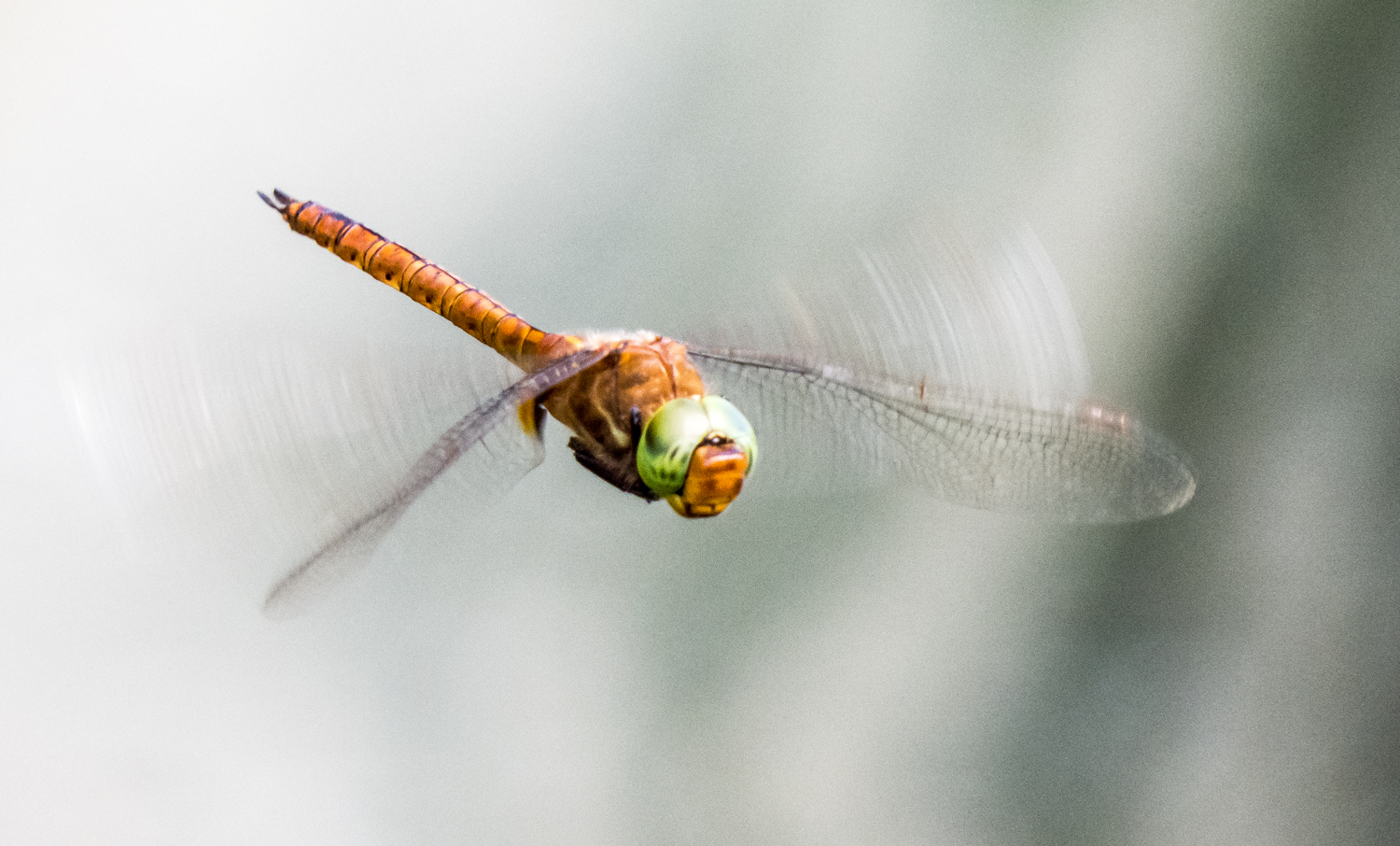
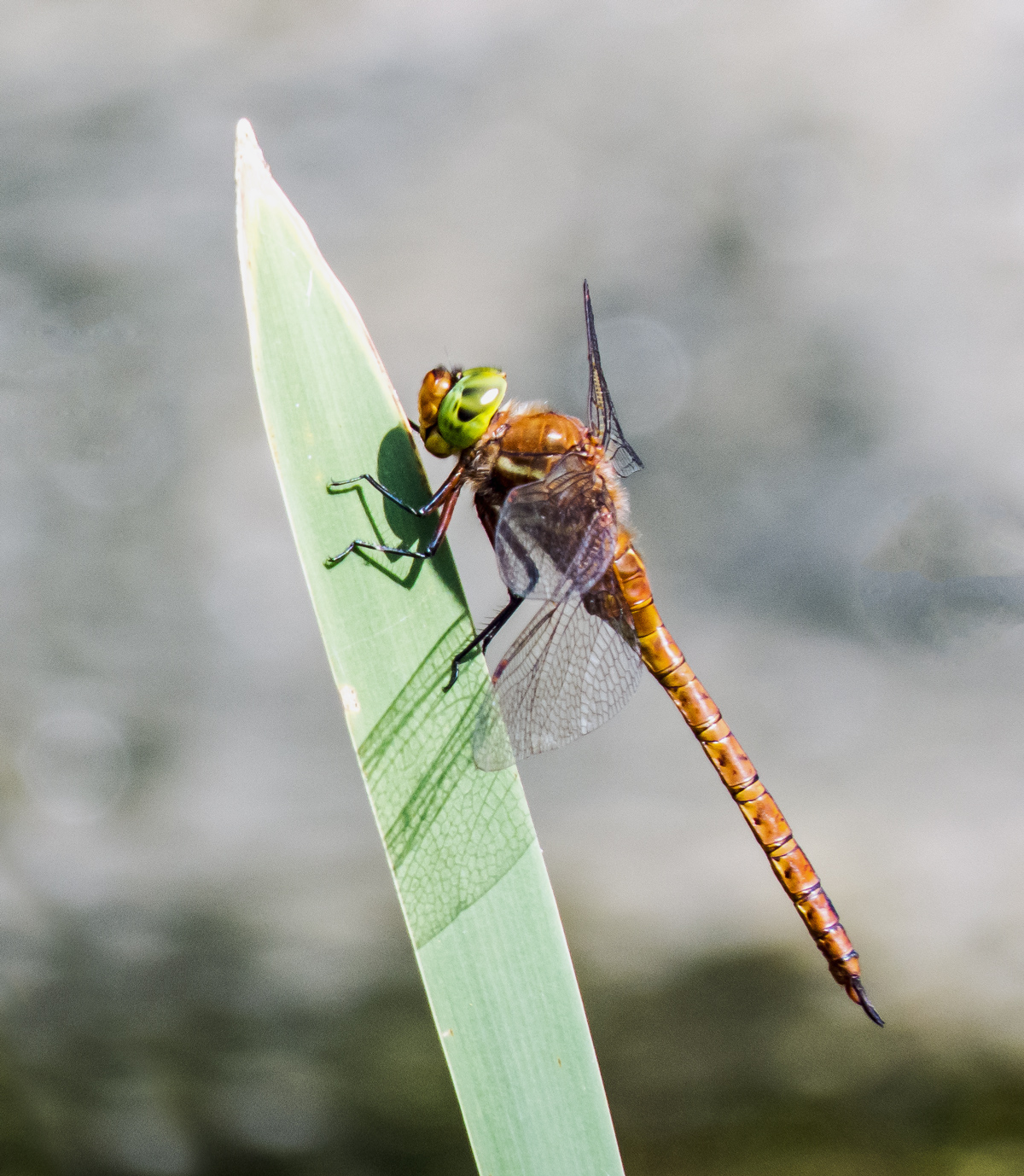
During this past weekend here in Brussels, I managed to find some really cool dragonflies, like this Green-eyed Hawker (Anaciaeschna isoceles or Aeshna isoceles) that I spotted at a pond in the Rouge-Cloître (Red Cloister) Park. This rather large dragonfly, also known as a Norfolk Hawker, is really striking as it flies, with a combination of colors that I have never seen before on a dragonfly.

With a bit of persistence and a lot of luck, I managed to capture an in-flight shot of a Green-eyed Hawker, but mostly I waited and waited for one to land. It was a little frustrating when one of them would land in a location that was too far away or in a location that did not afford me a clear shot, but eventually I was able to capture some images of a perching Green-eyed Hawker.

I was happy to capture the last photo that shows the yellow triangle on the upper part of the abdomen that is responsible for the “isoceles” portion of the Latin name of the species.

Green-eyed Hawker

Green-eyed Hawker

Green-eyed Hawker

© Michael Q. Powell. All rights reserved.

Read Full Post »

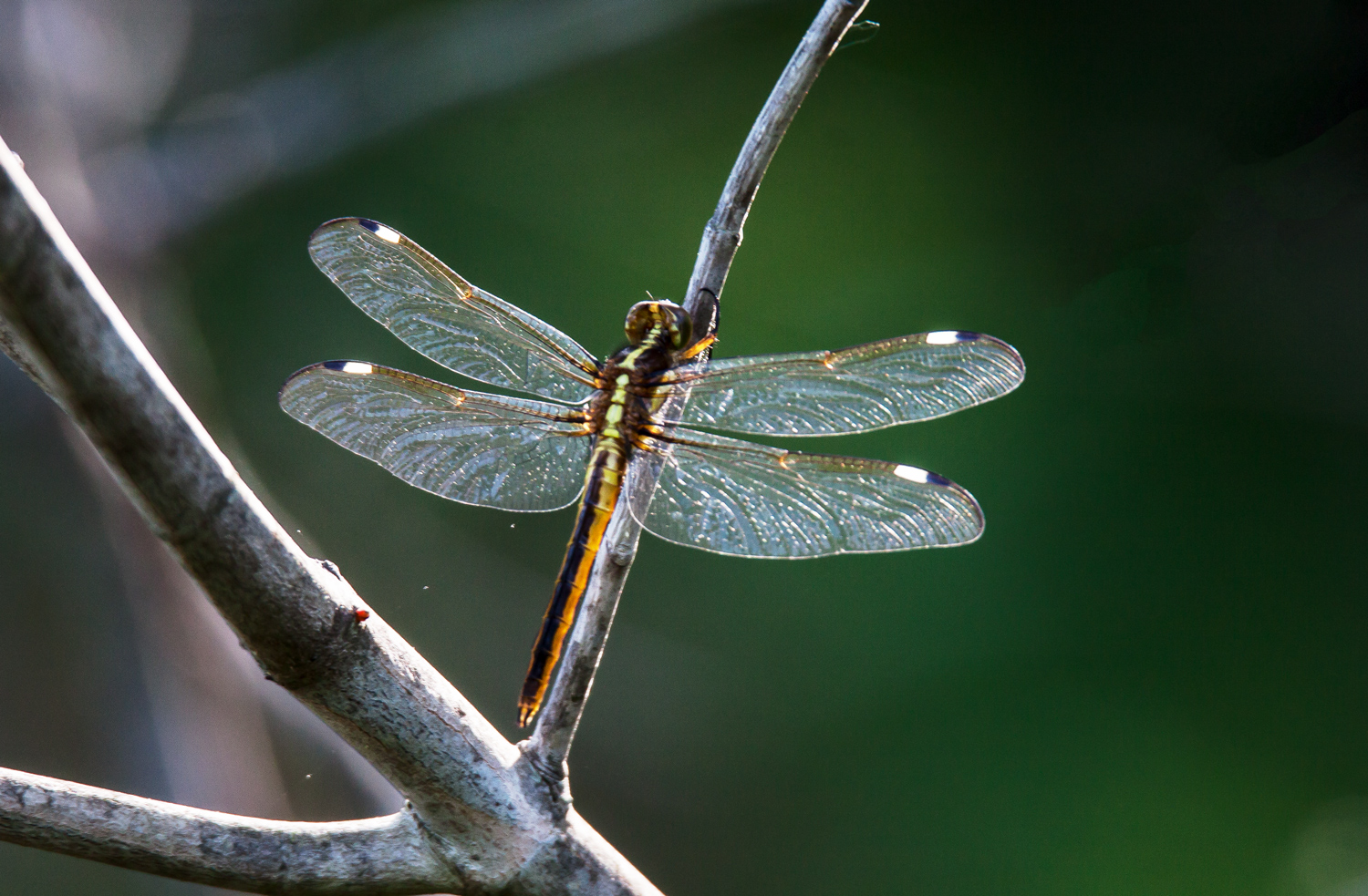
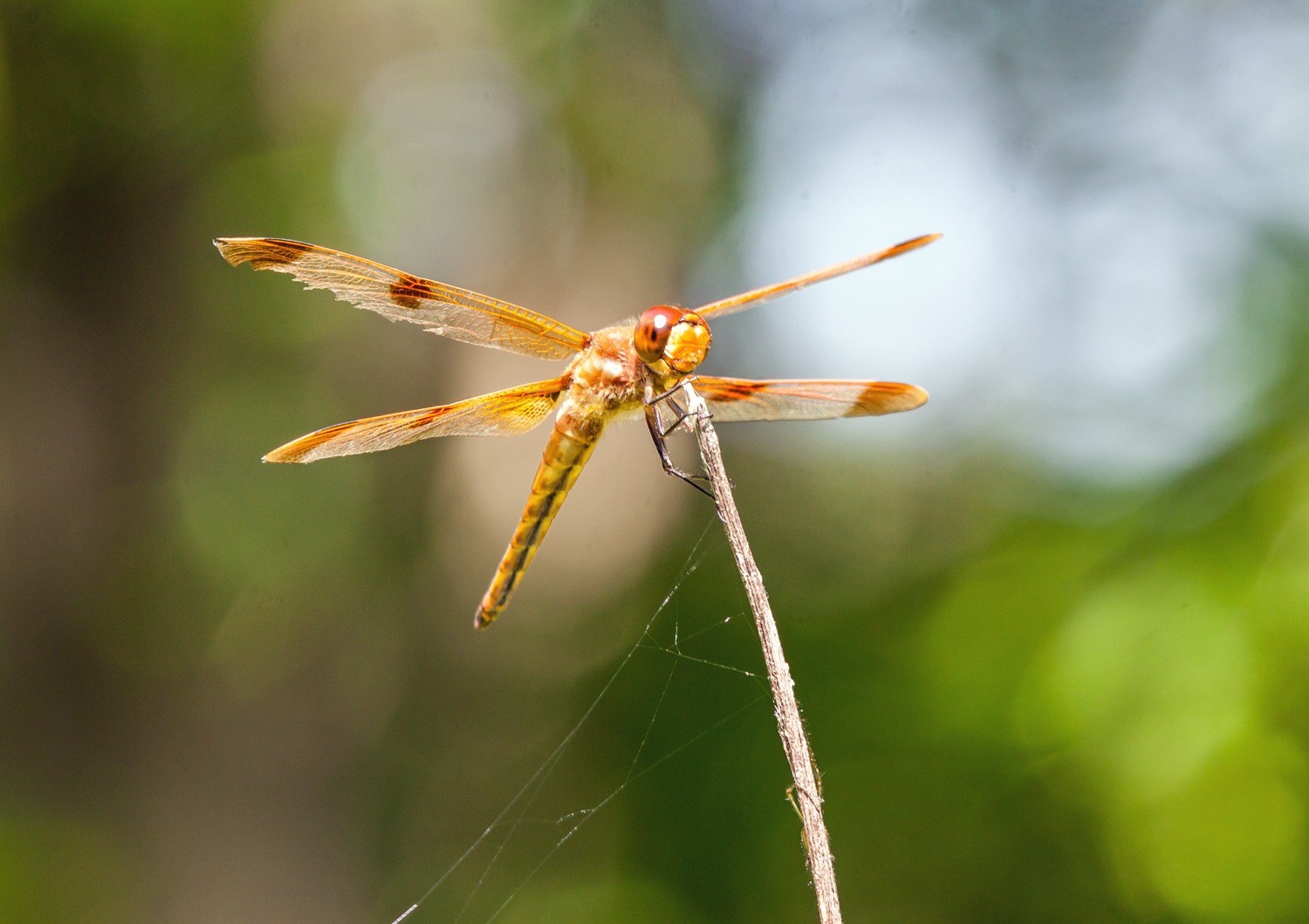
Most dragonflies have clear wings and different colors and patterns on their bodies. Some dragonflies, however, have patterns on their wings too that I think really accentuates their beauty and makes them particularly striking.

The first shot below shows a female Calico Pennant dragonfly (Celithemis elisa) that I spotted in mid-May at Occoquan Bay National Wildlife Refuge. The second shot shows a male Painted Skimmer dragonfly (Libellula semifasciata) that I spotted in late May at a small pond in Prince William County in Northern Virginia.

Calico Pennant

Painted Skimmer

© Michael Q. Powell. All rights reserved.


Read Full Post »

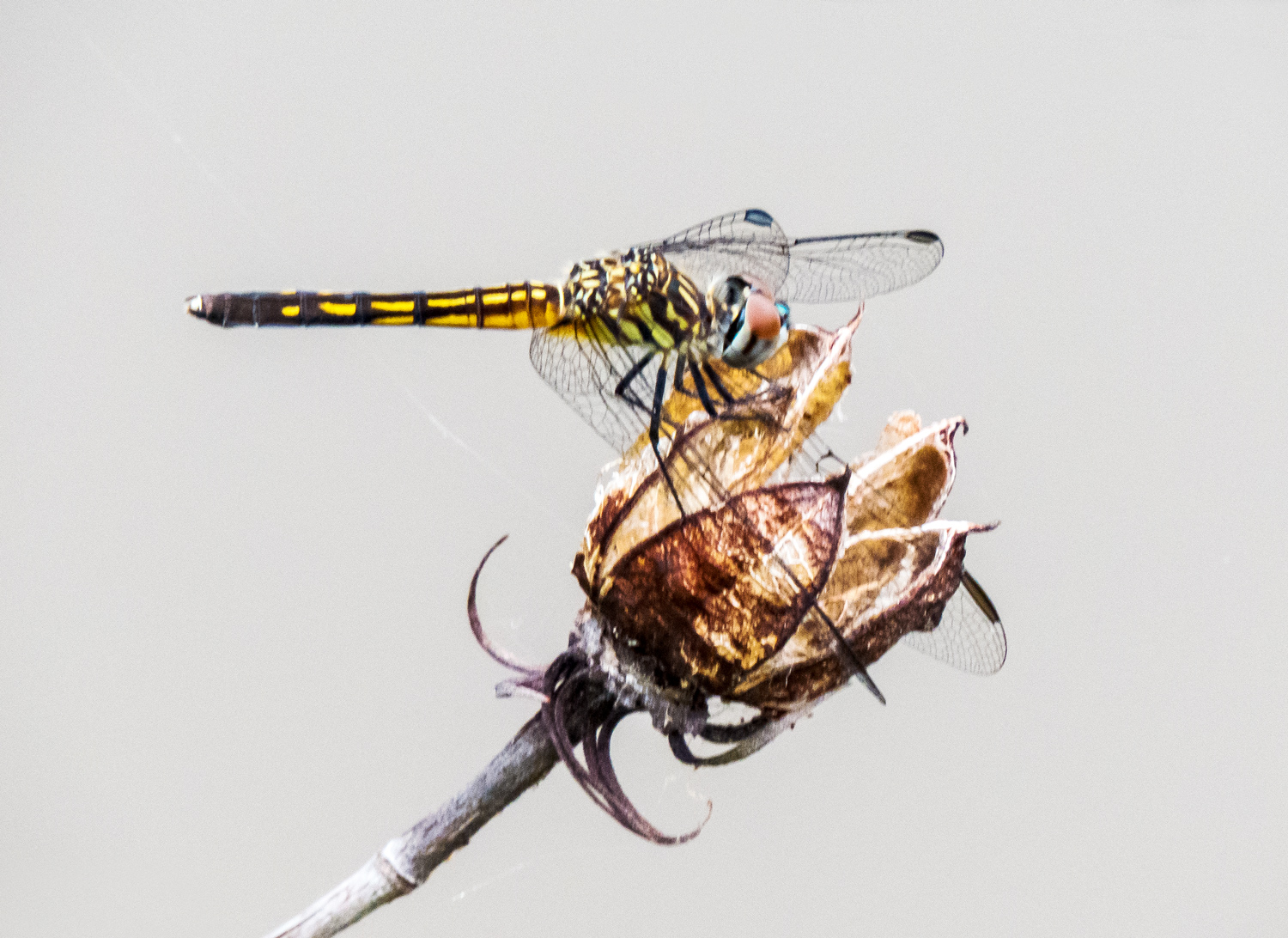
Blue Dasher dragonflies (Pachydiplax longipennis) are one of the most common and widespread dragonfly species in my area. You can get so used to their presence that you stop paying attention to them, which I think is a mistake, for in doing so you will miss their amazing beauty. The colors and patterns of this little dragonfly are stunning.

Here are a couple of shots of Blue Dashers that I captured this past weekend at Jackson Miles Abbot Wetland Refuge. This early in the season, when the dragonflies are newly emerged, the colors seem really saturated and fresh—later in the season the colors tend to become duller and more faded. I was shooting at the edge of a small pond and the water in the background turned into a neutral gray that gives the images an artistic feel, almost like they were shot in a studio environment. The uncluttered background helps to draw your attention to the dragonflies themselves and especially to those wonderful two-toned eyes. (The male’s eyes will eventually turn into a more uniform turquoise blue shade.)

In case you are curious, the Blue Dasher in the first shot looks to be a female and the one in the second image appears to be an immature male.

Blue Dasher

Blue Dasher

© Michael Q. Powell. All rights reserved.

Read Full Post »

Many dragonflies like to perch on or near the ground, but some prefer to relax at the top of the trees, like this Black Saddlebags dragonfly (Tramea lacerata) that I spotted last Monday at Occoquan Bay National Wildlife Refuge. From this angle you can easily see the dark patches on the rear wings that someone decided looked like “saddlebags.”

Those patches somehow remind me of the famous inkblots of the Rorschach test. I suspect that. if asked, people have widely varying ideas about what they look like, though I know that I personally would not want to have any psychological interpretations attributed to my perceptions or to my imagination.

Black Saddlebags

© Michael Q. Powell. All rights reserved.

Read Full Post »

When I am capturing wildlife images, I am usually driven by multiple motivations that sometimes come in conflict with each other. On the one hand, I am trying to capture reality, to record the presence of a given subject in a way that makes it recognizable and identifiable. On the other hand, I am trying to create art, by choosing compositional elements and camera settings that make an image that is visually pleasing to me.

At this time of the year, dragonflies become one of my favorite subjects and I eagerly await the emergence of new species as we move deeper into spring and eventually into summer. This past Monday at Occoquan Bay National Wildlife Refuge, I noted that Spangled Skimmer  dragonflies (Libellula cyanea) are now with us. This species is pretty easy to identify because it is the only local species that has black and white stigmas—stigmas are the narrow rectangular patches of color that can be found on the front edges of the wings.

In the first image, a male Spangled Skimmer was pretty cooperative and let me capture one of my favorite type of dragonfly images—a head-on shot. In this kind of shot, the dragonfly’s body is almost always out of focus, but I am ok with that, because it forces the viewer to focus on the dragonfly’s amazing eyes.

The dragonfly in the second shot, which is an immature male Spangled Skimmer, had flown into a tree after I inadvertently spooked it. I loved the way that it was clinging to a branch. Shooting at an upward angle, I tried to simplify the background to draw attention to the branches as well as to the dragonfly. (As is often the case with dragonflies, immature male Spangled Skimmers initially have the coloration of adult females—eventually the dragonfly in the second photo will look like the one in the first image.)

Spangled Skimmer

Spangled Skimmer

© Michael Q. Powell. All rights reserved.

Read Full Post »

I couldn’t help but notice Friday at Occoquan Bay National Wildlife Refuge how closely the green on the body of this Eastern Pondhawk dragonfly (Erythemis simplicicollis) matched the color of the vegetation on which it chose to perch. It won’t be long before pondhawks are all around us, but it was still nice to spot my first one of the season.

Eastern Pondhawk

© Michael Q. Powell. All rights reserved.
Read Full Post »

I was excited early on Friday morning to see my first Calico Pennant dragonflies (Celithemis elisa) of the season while exploring Occoquan Bay National Wildlife Refuge.  These small, brightly-colored dragonflies have become one of my favorites over the past year.

It is pretty early in their season and all of the ones that I spotted appeared to be immature—the patterns on the wings will soon get darker and more pronounced and bodies of the males, which start out yellow like those of the females, will turn red.

I have long wanted to capture shots of a dragonfly covered in morning dew or raindrops and the quest for these images helps motivate me to venture out early in the morning. If you click on the final photo and examine it at higher resolution, you will see tiny drops of water on the vegetation and a drop or two on the dragonfly’s wings. It’s not quite as I have imagined, but it is a good start.

Calico Pennant dragonfly

Calico Pennant dragonfly

Calico Pennant

© Michael Q. Powell. All rights reserved.

Read Full Post »

Are you ever fully satisfied when you meet a goal? I think that many of us drawn to wildlife photograph are restless in our pursuit of newer and better images. We can celebrate our successes, but we tend to be self-critical. We are convinced that we can always improve our skills and our photos, that we need to keep pushing and pushing in a never ending quest for more interesting subjects or better conditions or sharper images .

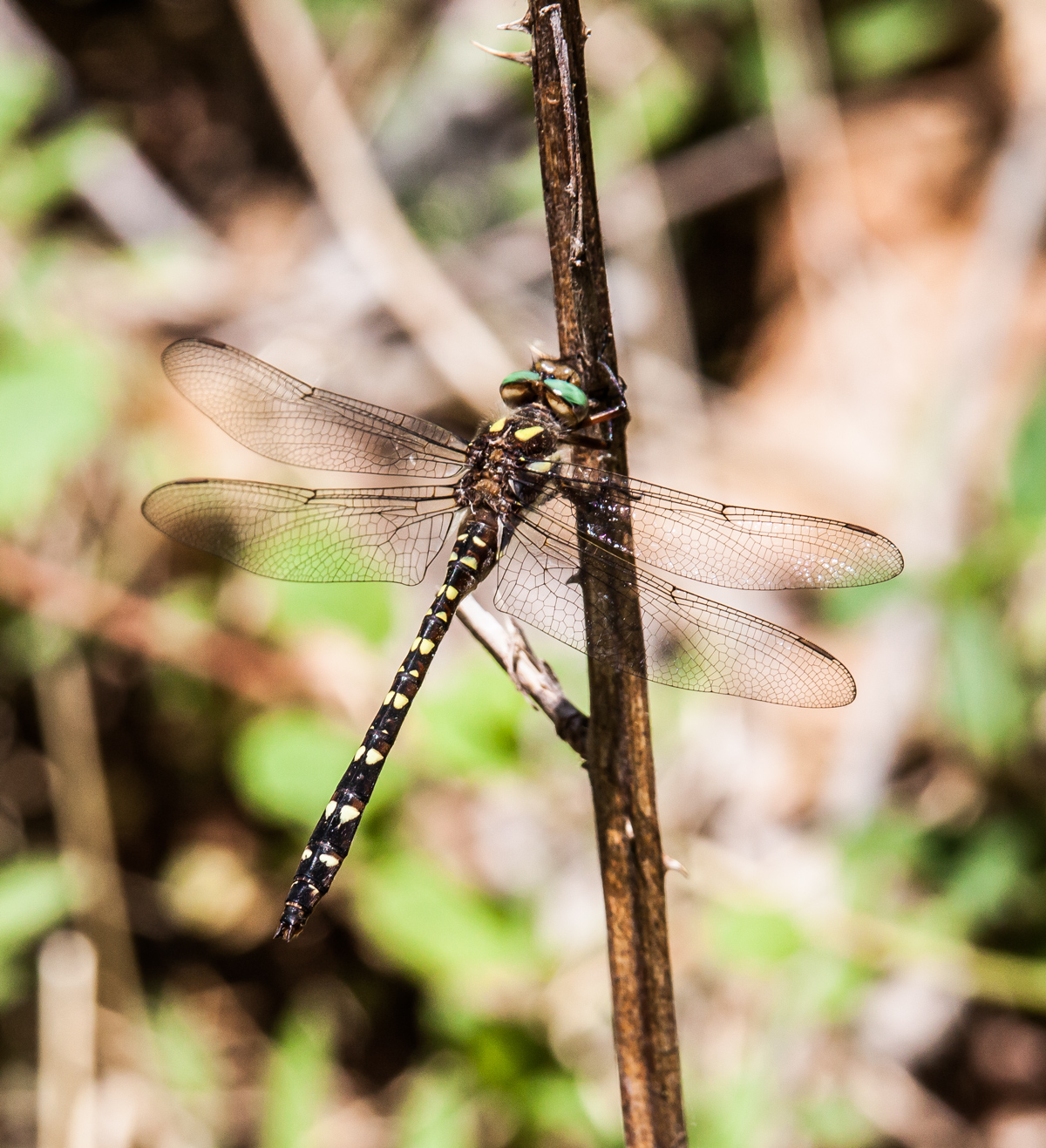
In many ways, that was the case for me this past Monday, when fellow dragonfly enthusiast Walter Sanford and I scoured an area of Occoquan Regional Park for spiketail dragonflies. In a blog posting earlier this week I chronicled our long and ultimately successful search for the elusive Twin-spotted Spiketail. I was feeling a bit tired by the time we saw that dragonfly, but Walter had told me that an additional dragonfly species had been spotted in that same area, the Brown Spiketail dragonfly (Cordulegaster bilineata).

So we kept going and went looking again in an area that we had searched earlier in the day. Some say that the definition of insanity is repeating the same actions and expecting different results. If that’s true, I guess that I qualify as being more than a little crazy. It turned out that we were lucky, really lucky and had multiple chances that afternoon to photograph several male Brown Spiketails. Unlike the Twin-spotted Spiketails from earlier in the day that flew away and never returned, the Brown Spiketails would fly only a short distance away when spooked and it was relatively easy to track them visually to their new perches. Eventually we reached a point of satiation where we would not even take a shot of a dragonfly if it was even partially obscured by vegetation or was facing in the wrong direction. We hoped we would see a female of the species, but it turns out that all of the spiketails we saw that day were males.

The Brown Spiketail dragonflies seem to have a lighter-colored bodies than the Twin-spotted Spiketails (brown vs black) and has paler spots, but to my inexperienced eye they otherwise look pretty similar. I was happy to capture some relatively sharp images that you can see in even greater resolution by clicking on them. For even more detailed photos, check out Walter’s excellent images of our adventures in his blog posting today. He has mastered some techniques that allow him to capture an amazing amount of detail in his dragonfly shots.

Brown Spiketail

Brown Spiketail

Brown Spiketail

© Michael Q. Powell. All rights reserved.

Read Full Post »

When you go out to take photos, do you have specific goals in mind? I consider myself to be an opportunistic shooter—I like to walk around in the wild and photograph whatever happens to catch my eye.

This past Monday, though, I joined fellow dragonfly enthusiast and photographer Walter Sanford on a very targeted mission. We were going to search for some relatively uncommon dragonfly species called spiketails in a location where they had been recently seen. These species can be found only during a limited period of the spring and only at small forest streams or spring-fed seepages.

We were particularly interested in the Twin-spotted Spiketail (Cordulegaster maculata), a dragonfly that is less than 3 inches in length (76 mm) and usually hangs vertically or at an angle in vegetation close to the ground. As you can probably tell from my description, these dragonflies are tough to find. Walter and I have hunted together for dragonflies in the past and have found that it helps to work in pairs, so that if one flushes a dragonfly, the other person can sometimes track it to its new location.

We searched and searched for what seemed like hours and came up empty-handed. Just when it seemed like we might be getting ready to concede defeat, I spotted what I think was a Twin-spotted Spiketail. I called out to Walter and put my camera to my eye. Alas, the dragonfly flew away before I could get a shot. Previously he and I had a conversation about whether it was better to have seen none or to have seen one and not gotten a shot. I was now faced with the second case.

We figured that our odds were about one in a million of spotting another Twin-spotted Spiketail, but having seen one, we had a glimmer of hope and kept searching. Without intending to do so, we drifted apart, out of sight of each other. Suddenly I heard Walter’s voice calling to me, saying that he had spotted one. The basic problem was that I did not know where he was. I wrongly assumed that he was near a small stream, so I rushed downhill through the muck and the thorns, but didn’t see him. He called out again even more insistently and I realized that he was uphill from me. Apparently I am not good at determining directions on the basis of sounds.

I scrambled up the bank to him and he motioned to me to move around him on the left. About that time, the dragonfly that he was photographing took off and headed down the trail. Walter was about ready to give chase when I told him to stop—I had spotted what turned out to be a male Twin-spotted Spiketail at ankle-height just a few feet from where he was standing. Our patience and persistence ended up being rewarded and I was thrilled to be able to get some shots of this beautiful dragonfly, a species that I had never before encountered.

Long-time readers may recall that Walter and I are very different in our approaches to many things. Our photography gear is different; my background and education is in liberal arts and his is in science; and our personalities are quite dissimilar. Not surprisingly, our writing styles vary too. Several times in the past we have done companion blog postings after our adventures. Check out Walter’s blog post today for his perspective on our hunt for this elusive dragonfly and for his wonderful images.

As it turned out, our day of dragonfly hunting was not yet over, but that will the subject of a future blog posting.

Twin-spotted Spiketail

© Michael Q. Powell. All rights reserved.

Read Full Post »

On the last day of April I spotted a Blue Corporal dragonfly (Ladona deplanata) that was newly emerged and was not yet blue. This past Friday I went back to the same location at Occoquan Bay National Wildlife Refuge and found a young male Blue Corporal that had already gained his blue coloration.

Additionally, he was now perching on some vegetation rather than on the ground, which allowed me to get a more artistic shot—I really like the arc of the vegetation and how it helped make for an interesting composition.

Blue Corporal

© Michael Q. Powell. All rights reserved.


Read Full Post »

Common Baskettail dragonflies (Epitheca cynosura) were flying yesterday at Jackson Miles Abbott Wetland Refuge and I managed to capture a few shots of them while they were patrolling over the pond.

There are some really cool things about dragonflies that you can observe from the photos. In the first one, you can see how dragonflies can eat on the move. Their amazing aerial skills help them to snag smaller insects out of the air. This is particularly important for species like this one that seem capable of flying for hours on end without pausing to perch. In both images you can see how the dragonfly tucks up its legs to make it more aerodynamic while flying.

So how do I get photos like this? Above all else, patience is the key. There were several dragonflies flying over the water yesterday and I observed each of them, trying to discern a pattern in their flights. The others were flying more erratically, but this one seemed to hover a bit from time to time. The subject was too small for my camera to grab focus quickly, so I resorted to focusing the lens manually.

It took a lot of shots, but eventually I was able to capture a few images that let you see some of the beautiful details of the dragonfly, particularly its very striking eyes. In case you are curious about the differing backgrounds, I shot the first image while pointing down at the dragonfly, while for the second one I was more level with the dragonfly, which caused the background to essentially disappear.

Common Baskettail

Common Baskettail

© Michael Q. Powell. All rights reserved.

Read Full Post »

It’s taken a while, but I have finally spotted my first locally-born dragonfly of the season. Previously I had seen some Common Green Darner dragonflies, which were probably migrants from the south, but on Monday, the last day of April, I spotted this newly-emerged Blue Corporal dragonfly (Ladona deplanata) at Occoquan Bay National Wildlife Refuge.

I did not get a really good angle for this shot, so I can’t be absolutely certain of the dragonfly’s gender, but I think that it may be a male. One of the tricky things about identifying the gender of dragonflies is that immature males often look similar in coloration to females. If this is a male its abdomen will eventually turn blue in color, which helps explain the first part of the species name. As for the “corporal,” I have been told that this is a reference to the two whitish lines on the dragonfly’s thorax that resemble the two stripes that corporals wear as their rank insignia in the US Army.

The weather is warming up and I expect to be seeing a whole lot more dragonflies in the upcoming weeks and months. Unlike this Blue Corporal, some of them will perch above the ground rather than on in, which should permit me to get some more photogenic shots. Our weather this spring has been a bit crazy and the emergence of dragonflies seems to have been delayed, but with this spotting I can confidently state that the dragonfly season has started for me.

Blue Corporal dragonfly

© Michael Q. Powell. All rights reserved.

Read Full Post »

Dragonflies are amazing. They spend most of their lives as nymphs in the water before they crawl out, discard their exoskeletons, and become beautiful aerial acrobats. I photographed this probable Downy Emerald dragonfly (Cordulia aenea) last weekend at the Donau-Auen National Park in Vienna, Austria.

The object in the upper right in the first image is the discarded exoskeleton, often called an “exuvia,” and further down the vegetation is the dragonfly itself.  The dragonfly appears to have recently emerged from that same exuvia. Note how much longer the dragonfly’s body has grown after emergence. The wings of the dragonfly are not yet fully extended, suggesting that it still is in the process of emergence. If you look closely at the exuvia, you may notice some white stringy looking parts. These are the breathing tubes are part of the respiratory system that helped the dragonfly breathe while still a water-dwelling nymph.

I was standing on a relatively steep incline and the reed-like vegetation was growing out of the water, so it was a challenge to get a good angle to photograph the dragonfly. The second image was taken from a different angle from the first (and I was happy that I was able to keep from sliding into the water).

I proceeded down the trail for a while before looping back and returning to the spot where I had seen the dragonfly. I think the dragonfly in the final image may be the same one as in the first two shots, though obviously the perch is not the same. After dragonflies have emerged, they generally have to wait some time for the wings to harden and for their metamorphosis to be complete.

dragonfly in Vienna

dragonfly in Vienna

dragonfly in Vienna

© Michael Q. Powell. All rights reserved.

Read Full Post »

Damsels in Vienna? Here are a few shots of some beautiful little damselflies that I encountered this past weekend during a visit to the Donau-Auen National Park in Vienna, Austria.

While traveling for work I normally leave at home my Canon DSLR and big lenses and use instead a Canon SX50 point-and-shoot camera with a super zoom lens. There are some compromises and limitations with this type of camera, but I am quite pleased with the results I can achieve using it, including these almost-macro images.

damselfly in Vienna

damselfly in Vienna

damselfly in Vienna

© Michael Q. Powell. All rights reserved.


Read Full Post »

I have been to Vienna, Austria often enough in the past 25 years that I have seen most of the big tourist sights. Now, when I have a bit of free time in the city, as I did yesterday, I like to go exploring in the Donau-Auen National Park and seek out wildlife.

I was thrilled when I spotted dragonfly in flight and was able to photograph it after it landed high in a tree. It is not a species with which I am familiar, but fellow bloggere and dragonfly enthusiast Walter Sanford suggested that it is of the Emerald family and I tend to agree with him.

dragonfly in Vienna

© Michael Q. Powell. All rights reserved.

Read Full Post »

I love dragonflies, but it will probably be a month or two before they reappear in my area. I bide my time and photograph birds during the winter, but one of my fellow dragonfly enthusiasts, Walter Sanford, has been spending his time studying exuviae, the exoskeletons that are discarded when nymphs almost magically undergo a metamorphosis and emerge as dragonflies. Check out Walter’s most recent posting in which he determined the species of an exuvia I collected last year and be sure to explore the rest of the fantastic photos and info in his blog.

waltersanford's avatarwalter sanford's photoblog

Michael Powell collected several odonate exuviae during a photowalk along the Potomac River in Fairfax County, Virginia USA, including two damselflies and two dragonflies. The exact date is uncertain, although Mike thinks the exuviae were collected sometime between 19-23 July 2017.

Both dragonfly exuviae are from the Family Gomphidae (Clubtails), as indicated by a flat labium that doesn’t cover the face as well as club-like antennae. Notice that abdominal segment nine (S9) is elongated, strongly suggesting this individual is a member of the genus Stylurus.

The dichotomous key for Stylurus larvae that appears on pp. 310-312 in Dragonflies of North America, Third Edition by Needham et al. was used to identify the species of the exuvia. The ninth couplet [9, 9′] is as follows.

9(7’). Length of abdominal segment 9 at least equal to its basal width; lateral spines of abdominal segment 9 at least…

View original post 670 more words

Read Full Post »

It was inevitable as we moved deeper into autumn that all of the summer dragonflies would eventually disappear. The nights have been getting colder and not long ago we went through a spell of rainy weather. Over the past two weeks I have searched all over Occoquan Bay Wildlife Refuge, my recent favorite photography location, desperately hoping each time to find a few survivors.

Well, it is beginning to look like the male Twelve-spotted Skimmer (Libellula pulchella) that I spotted on the 15th of October will be the last summer dragonfly for me, at least at that location. Earlier this month I had seen multiple Twelve-spotted Skimmers patrolling over a small pond at the wildlife refuge, but this old guy was perching alone in the vegetation adjacent to the pond and seemed reluctant to take to the air. It appeared that there were no rivals to fight off and no females to attract.

The colorful pattern on its wings is still very distinctive and the wings are amazingly intact. You may notice the uneven color on its body. As the males get older, their bodies develop a waxy blue powder called pruinescence. (Check out this link to get more information on this dragonfly from the wonderful website Dragonflies of Norther Virginia (dragonfliesnva.com).

It’s hard for me not to feel a little wistful as I bid farewell to the summer dragonflies, with whom I have spent so many pleasant moments this year. There are still autumn dragonflies around, most notably the little red Autumn Meadowhawks and Blue-faced Meadowhawks, and an occasional migrating dragonfly, like a Wandering Glider or Common Green Darner, so dragonfly season is not yet over. You will notice, however, that the proportion of postings on birds will continue to increase and those on insects will decrease in the upcoming months.

Twelve-spotted Skimmer

Twelve-spotted Skimmer

© Michael Q. Powell. All rights reserved.

Read Full Post »

Do you ever get so obsessed with a single species that you return over and over again to the same location, seeking another glimpse (and hopefully more photos) of that species? Generally I describe myself as an “0pportunistic” shooter—I like to walk around and photograph whatever I happen to see—and only rarely do I have specific goals for a photo shoot.

My normal approach changed this past month as I became somewhat obsessed with the Fine-lined Emerald dragonfly (Somatochlora filosa). My good friend and local dragonfly expert Walter Sanford encouraged me to seek out this rare species, which has been seen at only a single location, Occoquan Bay National Wildlife Refuge, in our area. I started spending most of my free time at this wildlife refuge, rather than at Huntley Meadows Park, my most frequent shooting location.

Mostly on my own, though occasionally shooting with Walter, I learned more and about this species, including its preferred perches and patrolling techniques. Over time, I learned to recognize Fine-lined Emeralds as they flew towards me at knee-level with their shiny green eyes glinting in the sunlight and spent endless hours chasing after them. Eventually I acquired a collection of shots of them perching and even managed to capture an image of one in flight and some shots of a couple mating.

I was painfully aware that, as the old saying indicates, all good things must come to an end. The excellent website Dragonflies of Northern Virginia showed the record late date for this species of 4 October in our area, so last Friday, 6 October, I went out to shoot with high hopes, but low expectations. I was thrilled to have multiple sightings of Fine-lined Emeralds during the day and the images below are among my favorites of the day.

We have now entered into a period of rain in our area and I fear that I may have seen my final Fine-lined Emerald dragonfly for the year. I am a bit stubborn and unusually persistent, though, so I may make a trip again on Friday, my next free day for shooting, hoping against the odds to see my Fine-lined friends one more time.

Fine-lined Emerald

Fine-lined Emerald

Fine-lined Emerald

© Michael Q. Powell. All rights reserved.

Read Full Post »

Autumn seems to be the season for migration—it’s hard to miss the flocks of honking geese that fill the skies and mysterious warblers taunt me with their songs from hidden haunts behind the foliage as they rest before continuing their journeys. Did you know that some species of dragonflies are also migratory?

Most of the migratory species unsurprisingly spend a lot of time in the air. They are visible as they pass through our area, but are tough to photograph. This past weekend I manage to get shots of two of the migratory species at Occoquan Bay National Wildlife Refuge. The first one is a Wandering Glider (Pantala flavescens) and the second is a Black Saddlebags (Tramea lacerata). What really stands out to me is the perfect condition of their wings, in contrast to the wings of the remaining resident dragonflies that are often tattered and torn this late in the season.

Wandering Glider

Black Saddlebags

© Michael Q. Powell. All rights reserved.

Read Full Post »

As October begins, I renew my search for red dragonflies. Autumn is quite naturally the season when Autumn Meadowhawks (Sympetrum vicinum) appear along with their more gaudily-colored brethren, the Blue-faced Meadowhawks (Sympetrum ambiguum). Both of these species have bright red bodies that should be easy to spot, but they like to perch low to the ground and sometimes even on fallen leaves, so you really have to pay attention.

I was a bit shocked on Monday to see some other small red dragonflies—at least three male Calico Pennant dragonflies (Celithemis elisa) were active at a small pond at Occoquan Bay National Wildlife Refuge. Calico Pennants are generally a summer species and I have featured them a couple of times earlier this year in this blog. According to the Dragonflies of Northern Virginia website, their peak flight time is June to July and their late date is 23 September (I saw the one below on 2 October).

There are still other active dragonflies, but over time their numbers will continue to drop. Autumn Meadowhawks, though, usually stay with us into December and, if I remember correctly, occasionally even into January. I’ll be continuing my October hunt for red dragonflies into November and beyond.

Calico Pennant

Calico Pennant on 2 October at Occoquan Bay National Wildlife Refuge


Blue-faced Meadowhawk

Blue-faced Meadowhawk at Occoquan Bay National Wildlife Refuge


Autumn Meadowhawk

Autumn Meadowhawk at Occoquan Bay National Wildlife Refuge

© Michael Q. Powell. All rights reserved.

Read Full Post »

As we move inexorably deeper into autumn, more and more flowers and leaves are fading and falling. Many of the familiar dragonflies of the summer also are disappearing. I was heartened yesterday at Occoquan Bay National Wildlife Refuge to spot this Fine-lined Emerald dragonfly (Somatochlora filosa), a survivor that is tattered and torn, but is still flying in October.

I mentioned in a recent blog posting that I am experimenting with carrying two cameras with me when I go out shooting. The first photo was shot with my Canon SX50, a super-zoom camera and the second was taken with my Canon 50D DSLR. The depth of field is so shallow with the DSLR, normally shooting close to the 600mm end of my zoom lens, that it seems more ideal for shots like the second image where the subject is flatter. The SX50 gives me more depth of field and I love the way that it allowed me to capture the background as circles of color.

Fine-lined Emerald

Fine-lined Emerald

© Michael Q. Powell. All rights reserved.

Read Full Post »

This Black Saddlebags dragonfly (Tramea lacerata) chose a beautiful perch and posed briefly for a couple of autumn portraits on Friday at Occoquan Bay National Wildlife Refuge. Black Saddlebags usually spend a lot of time soaring high in the air, so it is a special joy for me when one lands and I am able to get some decent shots. I have never before managed to get a good look at their eyes and absolutely love the two-toned color combination.

black saddlebags

black saddlebags

© Michael Q. Powell. All rights reserved.

Read Full Post »

I am becoming convinced that dragonflies are rulebreakers. Yesterday I noted that dragonflies do not always follow the rules and can sometimes be found in habitats where they are not supposed to be. Apparently they also do not know how to follow a calendar and can sometimes be found earlier or later than the rules and records indicate they will be present.

This past Monday I was back at Occoquan Bay National Wildlife Refuge, searching again for the rare Fine-lined Emerald dragonflies that I had seen there previously. When I saw a dragonfly with bright green eyes perch in a distant tree, I naturally assumed that it was a Fine-lined Emerald. It is getting to be late in the dragonfly season, so many other species are no longer present. The dragonfly never got any closer, so I had to be content with my long-distance shots.

When I pulled up the images on my computer, something didn’t look quite right. The shape of the body seemed a little different from the Fine-lined Emeralds that I had seen previously and the tips of the abdomen (the “terminal appendages”) also looked different. I consulted with some dragonfly experts and they identified the dragonfly to me as a Mocha Emerald dragonfly (Somatochlora linearis). I have seen this species before, but in a totally different environment and much earlier in the year, so I had mentally removed it from consideration.

Now I don’t feel too bad about missing the identification, because the two species are part of the same genus Somatochlora, also known as Striped Emeralds. The website Dragonflies of Northern Virginia indicates that the flight records for the Mocha Emerald are from 16 June to 16 September—I guess that window can now be extended a little.

I am including two photos of the Mocha Emerald that may look almost identical, but were shot with two very different cameras. The settings for the cameras were almost the same with an aperture of f/7.1 and a shutter speed of around 1/400 of a second and both were handheld. The first shot was with my Canon 50D DSLR and Tamron 150-600mm lens. Taking into account the crop factor of the camera, the field of view was equivalent to 960mm. The second shot was with my Canon SX50 with a field of view that was equivalent to 1200mm.

The DSLR was a lot heavier and a lot more expensive, but produced a more out-of-focus background. The Canon SX50 was cheaper, lighter, and brought me in closer to the subject. It’s clear to me that equipment did not make a huge difference in this case and that there are advantages and disadvantages to each system. I am increasingly drawn to the idea of carrying both with me for the moment and continuing to experiment with them.

The other big lesson that I continue to learn is to expect the unexpected. As I am discovering, subjects may pop up in places and at times when you least expect them.

Mocha Emerald

Mocha Emerald

© Michael Q. Powell. All rights reserved.

Read Full Post »

For the last couple of weeks I have been chasing male Fine-lined Emerald dragonflies (Somatochlora filosa) around Occoquan Bay National Wildlife Refuge in Northern Virginia in a series of patrolling and perching encounters. One day this past weekend a couple flew by me in wheel position, i.e. they were locked together in a mating position and were still able to fly. I was able to get a few shots of them when they landed nearby. Eventually they changed positions and hung together in tandem. Unfortunately I lost sight of them for a second and I didn’t see them actually fly away

Readers of this blog have seen multiple shots of mating dragonflies, but this was a really special encounter for me. Why? This species of dragonflies is pretty rare, both locally and nationally. As Kevin Munroe described it on his wonderful Dragonflies of Northern Virginia website, “One of Northern Virginia’s most rare dragonflies, possibly our rarest, this species is seldom seen and little known throughout its range, from New Jersey to Florida, and west to Kentucky and Texas. Most field guides describe its breeding habitat as “unknown”.” It is reassuring to see this species breeding in our area, so there is a chance I will see them again next year and in the future.

In the section of his website dealing with the Fine-lined Emerald, Kevin included a photo from 2012 of a pair of these dragonflies mating with a caption that indicated it was “the only record of this species breeding in N VA.” I don’t know if others have captured images of mating Fine-lined Emeralds more recently, but it is cool to realize that I am part of a really small group of folks who have documented this behavior.

Early this week I went back to the same area, hoping to find another mating pair, but was unsuccessful. I’d like to be able to learn how and where the females lay their eggs. I was told by one dragonfly expert on a Facebook forum that egg-laying behavior for this species has been observed and documented only once. I tend to think of myself as more of an artist than a scientist. I am, however, motivated by an almost overwhelming sense of curiosity that pushes me outdoors more and more frequently with my camera, striving and hoping to capture more interesting subjects and situations that I can share with others. Who knows, maybe I will be able to find out where female Fine-lined Emeralds hang out and deposit their eggs.

Fine-lined Emerald

Fine-lined Emerald dragonflies in wheel position


Fine-lined Emerald

Fine-lined Emerald dragonflies in tandem position

© Michael Q. Powell. All rights reserved.

Read Full Post »

For several years I have been on a quest, seeking to find a dragonhunter. No, I have not been playing a medieval role-playing game—I have been searching in vain for one of the monsters of the dragonfly world, the Dragonhunter (Hagenius brevistylus)As its name suggests, this fierce predator feeds on other insects, including darner and other clubtail dragonflies, sometimes ambushing them from above, according to Wikipedia.

As I was walking yesterday along one of the trails at Occoquan Bay National Wildlife Refuge, I was certainly not expecting to see a dragonhunter. Most of the time they perch in trees overhanging streams and wait for a prey to fly by. So when I saw a dragonfly perch vertically on the stem of a plant, I assumed that it was a Fine-lined Emerald or possibly a Russet-tipped Clubtail, species that I had previously encountered near this location.

When I zoomed in, I noticed that the coloration was different, but thought perhaps that it was a merely female of one of these two species. When I reviewed a couple of shots on the back of the camera and saw the bright yellow stripes on the thorax, I knew that I had captured images of a different species. I wasn’t sure what it was, but local dragonfly expert and fellow blogger Walter Sanford identified it for me as a male Dragonhunter.

This experience reminded me of one of the lessons that Walter has taught me over the years—it pays to be alert at all times, because dragonflies don’t always follow the “rules” when it comes to habitats and can sometimes be found in locations where you would never expect to find them.

dragonhunter

dragonhunter

© Michael Q. Powell. All rights reserved.
Read Full Post »

It is often said that springtime is a time for love, but so apparently is autumn, especially if you are a Blue-faced Meadowhawk dragonfly (Sympetrum ambiguum). This species appears most often during the latter part of the summer and in early autumn, so springtime is not really an option for them.

I spotted this couple in flagrante delicto during a recent trip to Huntley Meadows Park. It is hard to get a real sense of scale from this photo, so you will have to trust me that these brightly-colored dragonflies are really small, about an inch and a half in length (38 mm).

Blue-faced Meadowhawk

© Michael Q. Powell. All rights reserved.
Read Full Post »

Black Saddlebags dragonflies (Tramea lacerata) spend most of their time flying, so it was a rare treat to spot this beautiful female perching recently at Occoquan Bay National Wildlife Refuge. In the second image you can see the distinctive blotches on the dragonfly’s wings that make it look like it is wearing saddlebags, but the first image is my overwhelming favorite—the unique pose, the delicate coloration of the eyes, and the “artsy” overall feel of the first shot produce an emotional reaction in me than the more clinical second shot.

Do you prefer one image more than the other?


Black Saddlebags

Black Saddlebags

© Michael Q. Powell. All rights reserved.

Read Full Post »

On Monday at Occoquan Bay National Wildlife Refuge I was thrilled to spend some time hanging out with this Common Green Darner dragonfly (Anax junius). The range of colors on its body is so remarkable that I almost couldn’t believe my eyes when I zoomed in on it. An expert in a dragonfly forum on Facebook noted to me that the dragonfly is a teneral one, which means that it has only newly emerged. That would account for its relatively pale, almost pastel coloration and the perfect condition of its wings. If you click on the image, you can see even better some of the remarkable details of this dragonfly, like the colorful pattern on its “nose.”

The beautiful dragonfly was hanging vertically only a few inches above the ground, in a pretty safe location. I kept my distance as I took some photos and departed quietly, conscious of the fact that a dragonfly is fragile and vulnerable at this early stage of development. It remained in place as I slowly slipped away.

Green Darner

© Michael Q. Powell. All rights reserved.

Read Full Post »

Different dragonfly species rest in varying positions. Some of them hang vertically, but most of them perch at somewhat of an acute angle. Last week when I spotted this male Swift Setwing dragonfly (Dythemis velox), I was struck by the degree to which its rigid position reminded me of the diagrams of a right angle in my geometry textbook when I was a schoolboy—the dragonfly and the plant stem seemed to form an almost perfect 90 degree angle. One unusual thing about Swift Setwing dragonfly is the way that it holds its wings forward when perched and not straight out as most dragonflies do. Perhaps it helps to counterbalance the effects of gravity and helps it hold its abdomen so high for so long.

Swift Setwing

© Michael Q. Powell. All rights reserved.

Read Full Post »

« Newer Posts - Older Posts »