Feeds:
Posts
Comments

Archive for the ‘Dragonflies’ Category

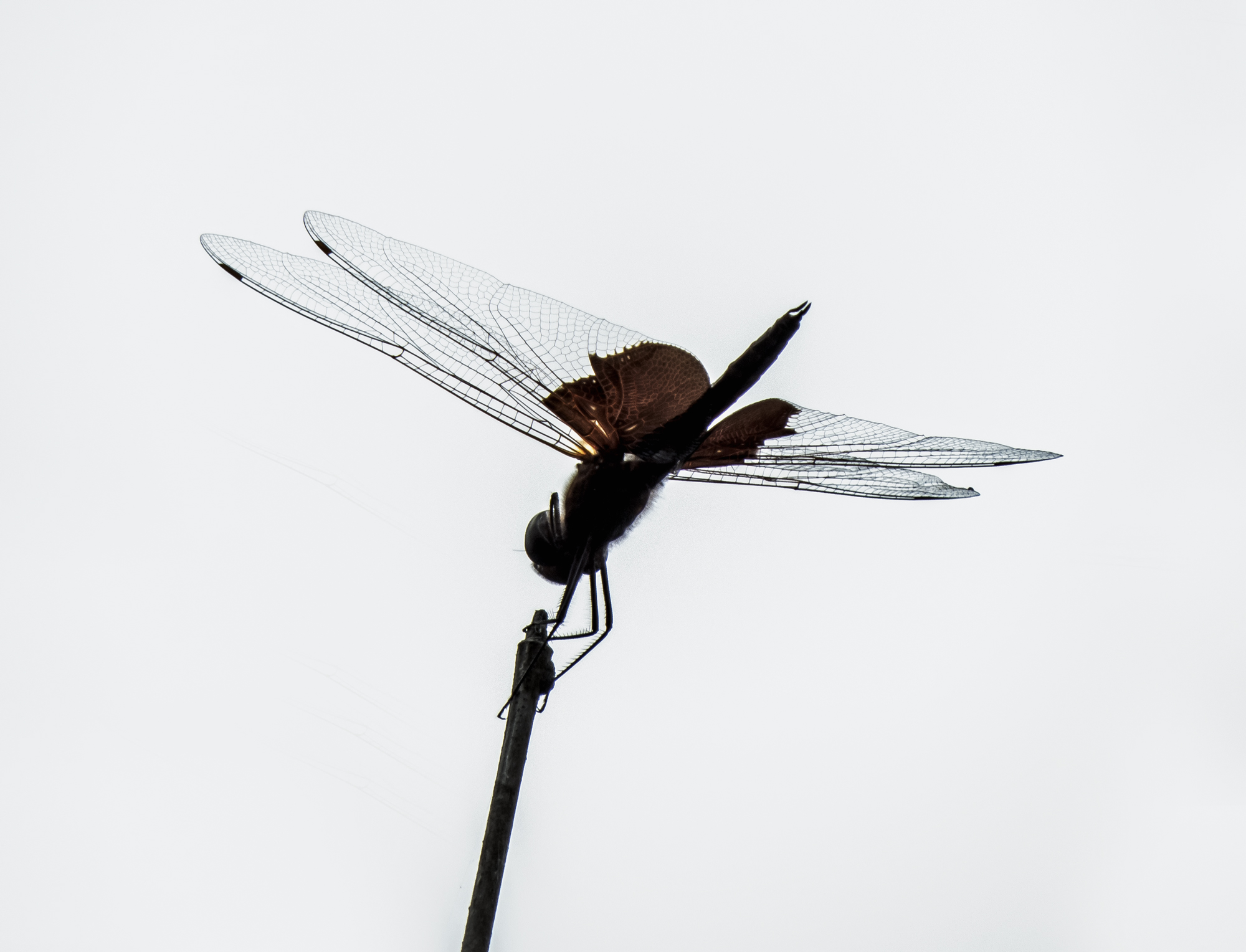
I have always been fascinated by shadows and reflections, which often lend an additional element of interest to a more straightforward shot. When a recently emerged dragonfly, probably a Lancet Clubtail (Gomphus exilis), flew into a nearby tree, I was utterly mesmerized by the shadow that it cast onto the leaves of the tree. The shapes and patterns of the green leaves create an almost abstract backdrop for the scene that really drew me in.

Most of my images are detailed, realistic portraits of my wildlife subjects, but at certain moment I love to attempt to capture more “artsy” images like this one.

Lancet Clubtail

© Michael Q. Powell. All rights reserved.

Read Full Post »

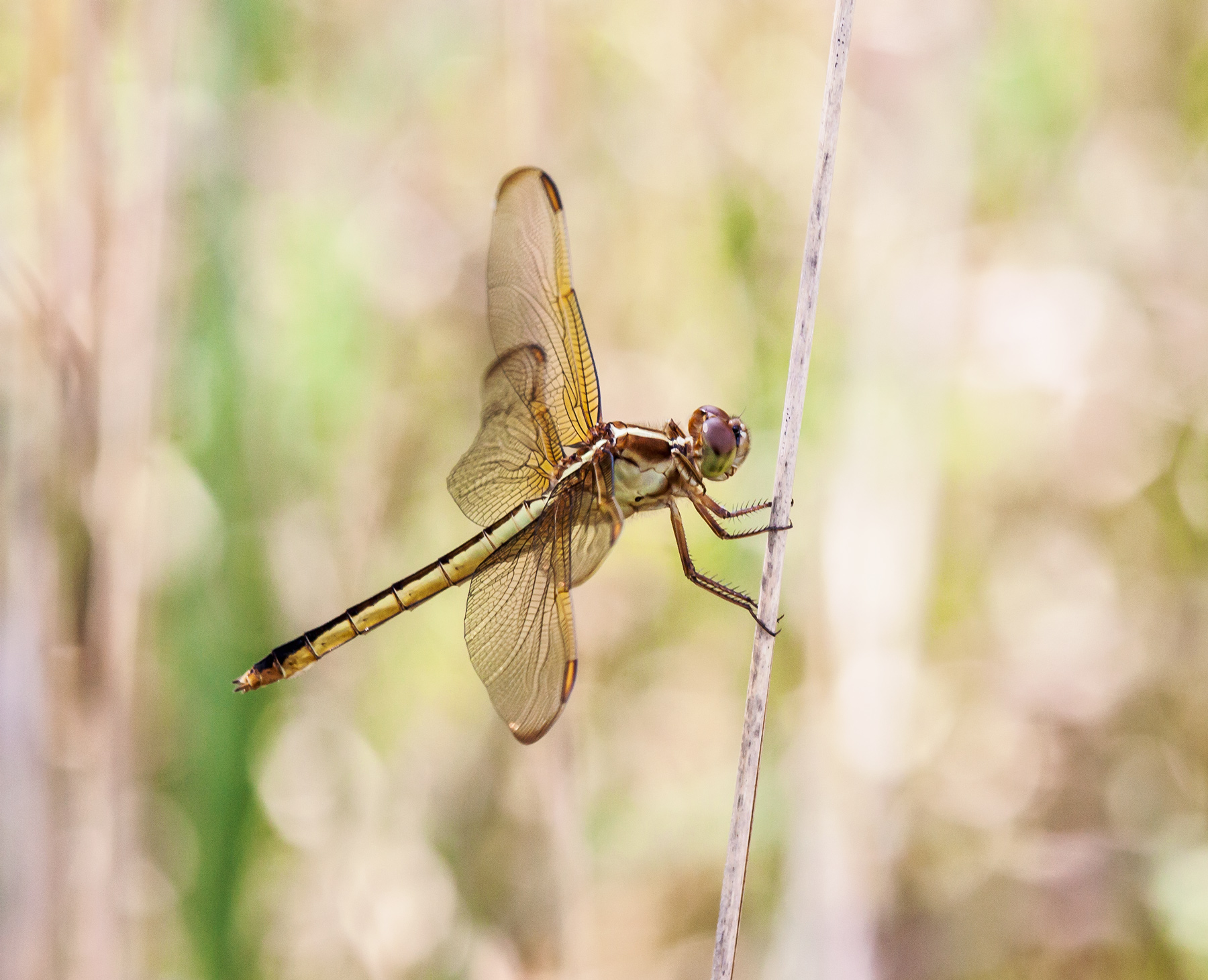
We are now in prime dragonfly season and many familiar species are reappearing, like this beautiful Needham’s Skimmer dragonfly (Libellula needhami) that I spotted on Wednesday at Occoquan Bay National Wildlife Refuge.

I love the beautiful orange-gold color on the leading edges of the wings of this species, a color that really sparkles in the sunlight. I was fortunate to capture this dragonfly in a way that blurred the background. Depth of field is always an issue in situations like this and you can probably see that the tips of the wings are not in sharp focus, but I am ok with that and think it helps draw the viewer’s eyes to the dragonfly’s main body and, in particular, to its wonderful eyes.

Needham's Skimmer

© Michael Q. Powell. All rights reserved.


Read Full Post »

Before we went out last week to hunt for Gray Petaltail dragonflies (Tachopteryx thoreyi), fellow blogger and dragonfly enthusiast Walter Sanford reminded me to wear gray-colored clothing, because Gray Petaltails are known to perch on people dressed this way, presumably because they resemble trees. Walter’s words proved to be prophetic and Gray Petaltails perched on me repeatedly that day.  Walter memorialized one such encounter in his posting last week You look like a tree to me! that included shots of one perched on my shoulder and one on my stomach.

It is generally pretty cool to have a dragonfly perch on you. It can be a little disconcerting, however, when a large dragonfly like a Gray Petaltail, which can be over three inches in length (75 mm), buzzes around your head. I couldn’t avoid flinching a couple of times that day when a dragonfly landed on me. Sometimes dragonflies are so incredibly cooperative that I am able to coax them to perch on my finger, as shown in a 2013 blog posting that I called Dragonfly Whisperer.

As the day wore on, Walter seemed disappointed that the dragonflies were not landing on him. As we were making some final checks before our departure, a Gray Petaltail finally made his wish come true and perched on him. Unlike the ones that landed on my front side, this one decided to land on his back side, on the untucked tail of his shirt. I am hoping that nobody was watching, because it would probably have looked a little strange for me to be pointing the long macro lens of my camera at that part of his anatomy.

Walter and I are good enough friends that he will laugh at my puns and attempts at humor, even when he is occasionally the butt of the joke. In fact, this is actually not the most embarrassing photo that I have taken of a dragonfly perching on Walter. In October 2013 I did a posting entitled Dragonflies mating on a calf that featured a dragonfly couple mating on his bare lower leg.

If you are really young, you may not remember Fred Astaire’s version of the song “Cheek to Cheek” that was the number one hit song of 1935, according to Wikipedia. Here is link to a YouTube clip of Fred Astaire and Ginger Rogers singing and dancing to that song.

Gray Petaltail

Gray Petaltail

© Michael Q. Powell. All rights reserved.

Read Full Post »

Throughout the month of May I have struggled to identify the dragonflies and damselflies that I have photographed. So many of the species seem so similar that I have had to defer to experts for help. Over the years I have learned that the best way to get help on a Facebook forum is to misidentify a subject—some experts, who might not respond to a request for help, feel compelled to correct you and demonstrate their superior knowledge.

This past Friday at Jackson Miles Abbott Wetland Refuge, it was nice to spot a familiar dragonfly species that was immediately identifiable—there is simply no other dragonfly in our area the looks like an Eastern Amberwing (Perithemis tenera). Even the name is helpful in drawing attention to the key identification feature, the distinctive amber wings.

These dragonflies are among the smallest ones in our area, but they tend to perch on low vegetation overhanging the water (especially males like this one), so they are relatively easy to spot. Although they tend to be a little skittish, if you are patient and persistent you can snag some shots that show the beautiful details of the Eastern Amberwing dragonfly.

Eastern Amberwing

© Michael Q. Powell. All rights reserved.

Read Full Post »

I was exploring a small creek in Prince William County, Virginia last week with fellow dragonfly enthusiast Walter Sanford when suddenly I spotted a dragonfly hanging almost vertically from a branch not far above the ground. It is always a good sign when a dragonfly is hanging vertically, because many of the uncommon species perch in this way. My initial thought was that it was a clubtail and I informed Walter, who was searching another part of the stream, that it had two yellow stripes on its thorax. He reminded me that most clubtails have two yellow stripes, but was interested enough to move closer to me.

Walter has a lot more experience with dragonflies than I do and he grew visibly excited when he looked at the dragonfly though his camera. It was not a clubtail at all, but a relatively uncommon Arrowhead Spiketail dragonfly (Cordulegaster obliqua). Not only was it an Arrowhead Spiketail, it was a female and females tend to be harder to find than males. As I got closer, I could see the “spike” protruding from the tip of the abdomen, which showed it was a female, and the telltale arrow shaped markings all the way down the abdomen. We believe that this was the first documented sighting of an Arrowhead Spiketail in Virginia this year.

The dragonfly was unusually cooperative and both Walter and I were able to take lots of shots without disturbing her. In fact, she was still on the same perch when we left, though she was absent when we returned an hour or so later.

In situations like this, Walter and I like to do companion blog postings independently. Our photography styles and personal backgrounds color the way in which we produce our blog postings and they help to give our readers different perspectives on the same subjects and situations.

I have provided an assortment of images that show the female Arrowhead Spiketail from different distances and angles. I decided to do them in a gallery style—if you want to see them in a larger format slide show, which I recommend doing, just click on any one of them and then click the arrows. You probably notice that some of the images are intended to help you to identify the dragonfly and others are more “artsy.”

Be sure to check out Walter’s companion posting. I will include a link to it after I have published this article and have a chance to check out Walter’s posting.

UPDATE: Walter’s posting is wonderful. In addition to some excellent photos of the dragonfly, Walter provides a lot of contextual information about the location at which we found it and additional information about the species. Click here to see his posting.

© Michael Q. Powell. All rights reserved.

Read Full Post »

Survival in the wild is challenging even when you are able-bodied. The difficulties are multiplied when you have a major deformity, like this Gray Petaltail dragonfly (Tachopteryx thoreyi) that I spotted on Friday at Occoquan Regional Park.

I not sure what caused the sharp bend in the abdominal region of this dragonfly, but I observed that it was able to fly and to perch. Perhaps it is able to capture prey, but mating seems out of the question. I admire that the fact that it appears to be fighting for its survival.

For the sake of contrast, I am including a photo of another Gray Petaltail dragonfly that I observed the same day at the park.

Gray Petaltail

Gray Petaltail

© Michael Q. Powell. All rights reserved.

Read Full Post »

I like dragonflies a lot, as most of you know, so it is only natural that they like me too. Two Gray Petaltail dragonflies (Tachopteryx thoreyi) showed their affection yesterday by perching on me.

Thanks to my good friend Walter Sanford for taking these shots. Check out his blog for lots of photos and information on dragonflies and other nature topics.

waltersanford's avatarwalter sanford's photoblog

Gray Petaltail dragonflies (Tachopteryx thoreyi) have a well-known preference for perching on gray or tan colored surfaces, including gray or tan colored clothing. Dressed appropriately, Mike Powell and I visited a hotspot for Gray Petaltail where we hoped to shoot some photographs of T. thoreyi perched on each other.

The first individual is a female, perched on the front of Mike Powell’s gray sweatshirt.

21 MAY 2018 | Northern Virginia | Gray Petaltail (female)

The last individual is a male, perched on Mike Powell’s left shoulder.

21 MAY 2018 | Northern Virginia | Gray Petaltail (male)

I’m guessing the dragonflies were thinking, “Hey Mike, you look like a tree to me!” No offense intended, buddy. In fact, I think you should be flattered that these spectacular specimens befriended you!

Copyright © 2019 Walter Sanford. All rights reserved.

View original post

Read Full Post »

This time of the year is always exciting for me as my favorite dragonfly species begin to emerge—it is like renewing a relationship with old friends after an extended absence. On Monday at Occoquan Bay National Wildlife Refuge I was thrilled to spot my first Calico Pennant (Celithemis elisa) dragonflies of the season.

As dragonflies go, Calico Pennants are small, a little over an inch (25 mm) in length and very colorful. In addition to their bright red (male) and yellow (female) bodies, they have beautifully patterned wings. Like other pennant dragonflies, Calico Pennants like to perch at the very tip of flimsy grasses and other vegetation. That makes them fairly easy to spot, but tough to photograph as they flap in the slightest breeze like a pennant.

I spotted a number of male Calico Pennants during my visit, but only a single female, the one that is mating with a male in the final photo. For those of you with curiosity or prurient interest, the couple are hooked up in what is often referred to as the “wheel position.” Anatomically speaking, it is a bit confusing, but you have to admire the couple’s acrobatic flexibility. The first two photos show perched males, with the initial photo a back-lit image that shows wing details and the second one a more traditional pose that highlights the body coloration.

Calico Pennant

Calico Pennant

Calico Pennant

© Michael Q. Powell. All rights reserved.


Read Full Post »

Do you like to hang out in the swamp? Swamps may not be the most hospitable place for humans, but they provide a wonderful environment for all kinds of photogenic creatures. For example, the bright yellow Prothontary Warbler that I featured yesterday likes to hang out in a wooded swamp, unlike most warblers that prefer trees in a drier environment.

As I was photographing that bird two weeks ago at Occoquan Bay National Wildlife Refuge, I noticed some very large dragonflies flying around in the same area.  I recognized them as Swamp Darner dragonflies (Epiaeschna heros) and I was thrilled when one of the females decided to deposit some eggs in a fallen log not far from where I was standing observing the warbler. I had to bend down a bit, but essentially my feet stayed in the same spot.

It is definitely cool to be able to photograph two such colorful species from the same spot. The experience is a good reminder not to get so focused on your primary subject that you lose sight of what is happening around you. You never know when an equally good or even better subject may be at your feet, above your head, or to your right or left.

Swamp Darner

© Michael Q. Powell. All rights reserved.

Read Full Post »

Are you so used to the common beauty that surrounds you every day that you no longer see it? What does it take for you to stop and take notice and maybe even pull out a camera to photograph a subject?

Almost six years ago I read a blog posting by fellow photographer Lyle Krahn that talked of a concept called “stopping power” and that posting has stuck with me to this day. Here’s a portion of that posting that describes the concept, “I think every beautiful scene has stopping power. That’s my term for the ability of a scene to make a person stop hiking or driving in order to pull out a camera and make images. Did you ever wonder what makes you stop? Do you ever hear the music?”

I try to pay attention to even the most common subjects and when it comes to dragonflies, that means the aptly named Common Whitetail (Plathemis lydia). Common Whitetails are among the first dragonflies to appear in the spring and among the last to disappear in the autumn. You can find lots of Common Whitetails almost everywhere it seems.

On Tuesday at Occoquan Bay Regional Park I stopped and photographed some Common Whitetail dragonflies as I was searching for some more exotic dragonfly species. This early in the season the Common Whitetails seem to be hanging out at a distance from the water—later in the summer I tend to find them buzzing around ponds and swamps.

The first two shots below are of male Common Whitetails. Although mature males are white, when they are young they have brown bodies similar to those of females. However, males have different patterns on their wings and the second and third images show those differences and may help you to distinguish immature males from females.

So, what has “stopping power” for you? I encourage you to think about that question, to make an effort to lower your threshold, and to look for the uncommon beauty in common subjects.

Common Whitetail

Common Whitetail

Common Whitetail

© Michael Q. Powell. All rights reserved.

Read Full Post »

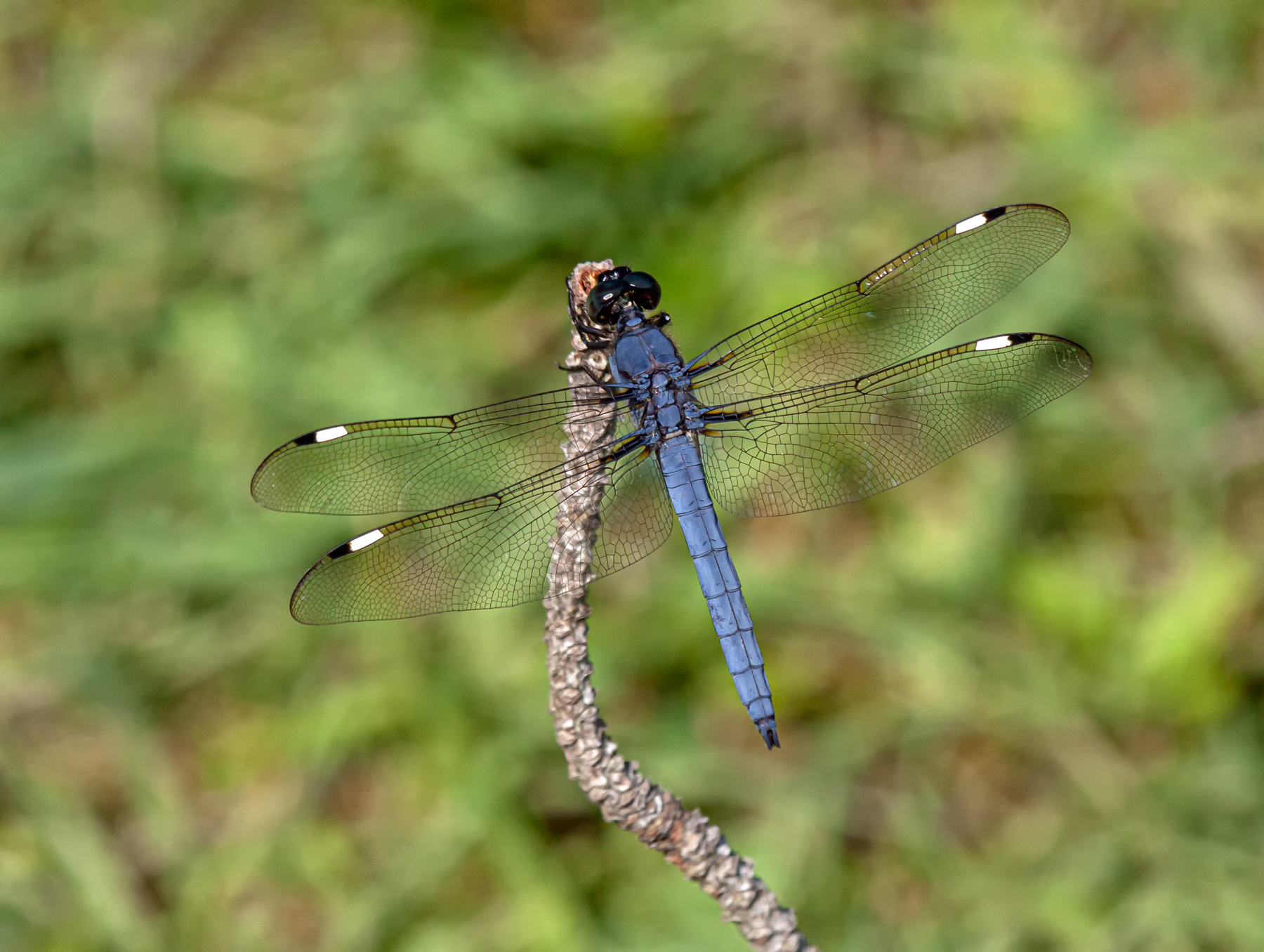
Yesterday I spotted this male Lancet Clubtail dragonfly (Gomphus exilis) while exploring Jackson Miles Abbott Wetland Refuge, a relatively small park not far from where I live. The dragonfly was perched on some leafy vegetation overhanging the water and I almost fell into the pond while trying to frame the shot. Fortunately I achieved my desired result by hanging over the edge of the steep bank.

If you look at the end of the “tail,” which technically is called the “abdomen,” you can see the enlarged section that gives rise to the term “clubtail.” Compared to the family of skimmers, which include most of the dragonflies that you probably see, like Blue Dashers and Common Whitetails, clubtails are relatively uncommon and it is always exciting for me to spot one.

I was particularly struck by this dragonfly’s brilliant blue eyes. For some reason I find blue eyes to be especially beautiful, irrespective of the species.

Lancet Clubtail

© Michael Q. Powell. All rights reserved.


Read Full Post »

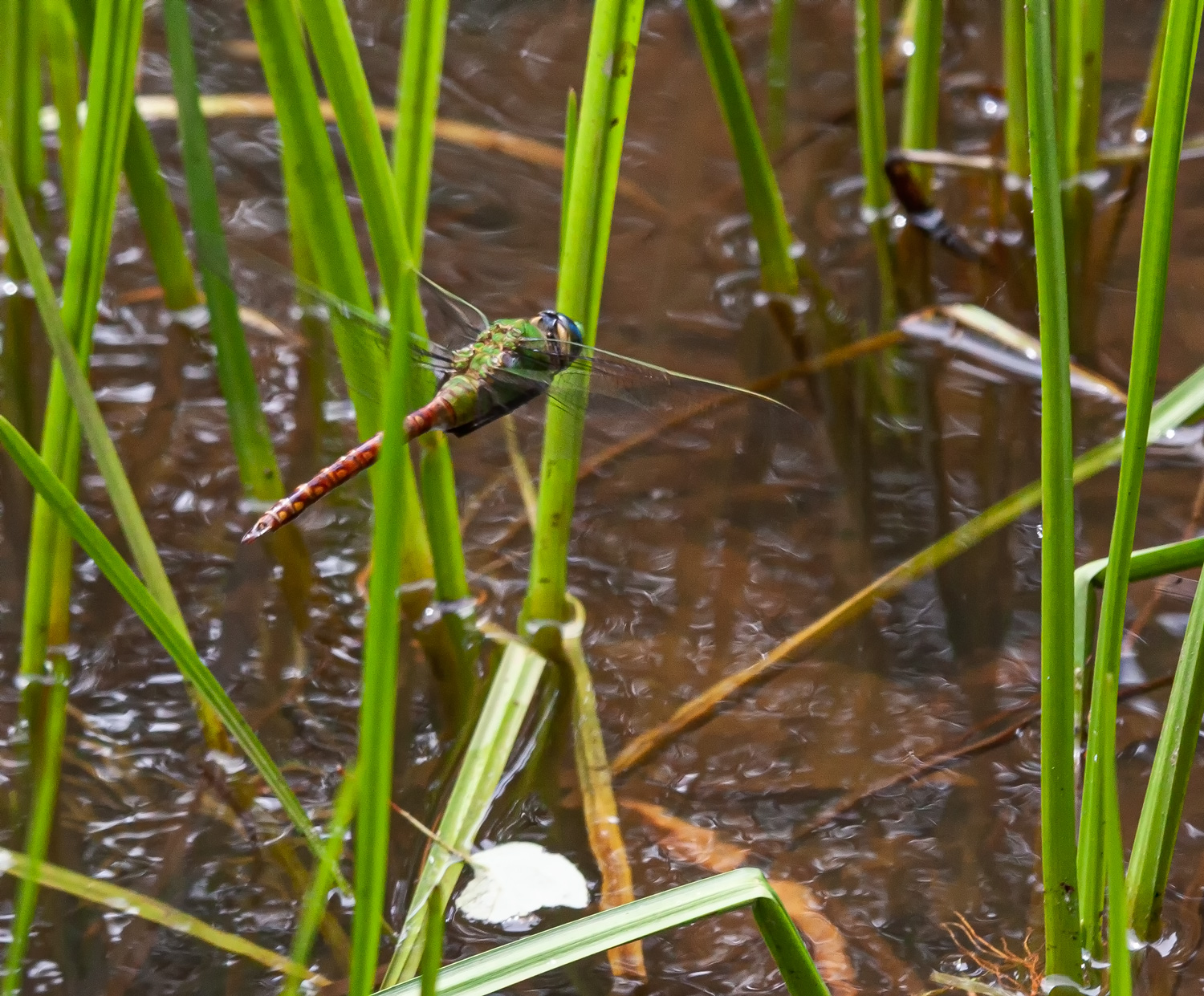
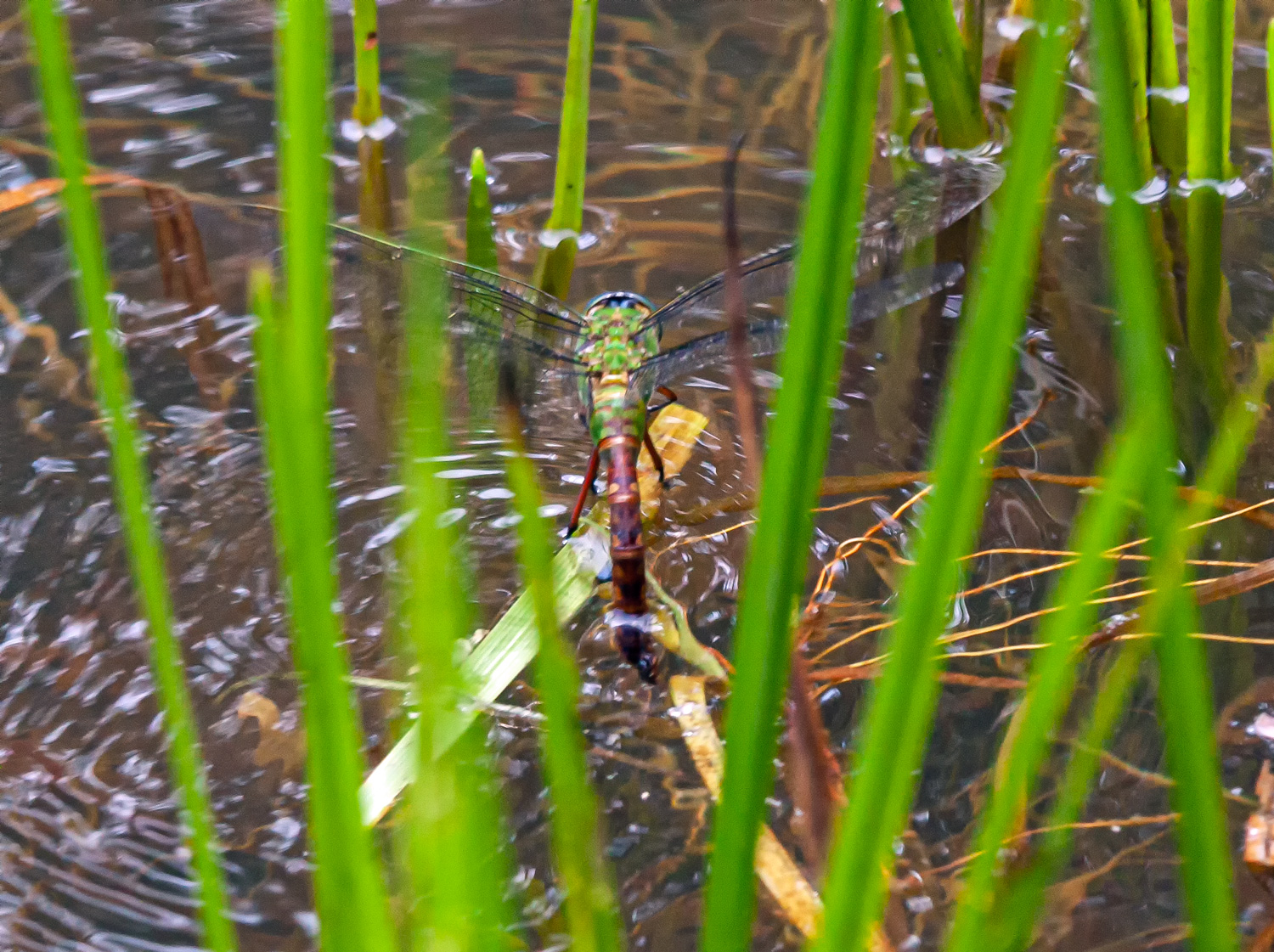
During my church retreat in Orkney Springs, Virginia this past weekend, I played hide-and-seek with a Common Green Darner dragonfly (Anax junius). It repeatedly flew teasingly close to me, trying to entice me to chase it.  I took the bait and pursued the big dragonfly for quite some time as it flew in and out of the reeds.

It tried to hide by hanging from some vegetation by the tips of its tiny toes—the second photo shows my initial view of the hidden dragonfly. By moving to the side and crouching low, I was able to peer through the vegetation and eventually spot the dragonfly. Realizing that it was found, the dragonfly tilted its head toward me and smiled, as you can see in the first image shown below.

Common Green Darner

Common Green Darner

© Michael Q. Powell. All rights reserved.


Read Full Post »

I try to do a blog posting almost every day, but I spent this weekend unplugged from the internet at a church retreat in the mountains of Virginia, so I missed a couple of days. When I first started blogging, I was a bit compulsive about it and worried that I would lose all of my followers if I did not post every single day. Now I have a more balanced approach and realize that it is not the end of the world if the clock strikes midnight and I have not posted something new.

Today I am featuring some Brown Spiketail dragonflies (Cordulegaster bilineata) that I spotted last week while exploring Occoquan Regional Park with my fellow dragonfly enthusiast and blogger Walter Sanford. He and I returned to a location where we had spotted this species last year and were delighted to see that members of this species had emerged on schedule. Like many other species that emerge in the early spring, Brown Spiketails have a limited flight period and are found in small numbers at a limited number of locations.

Walter and I discovered that it is helpful to search for these dragonflies together. Often one of us will flush the dragonfly and the other person can observe the direction and the spot to which the dragonfly has relocated. This is really important because, as you can see from the photos, Brown Spiketails perch at an angle or hang vertically from vegetation that is often low to the ground, which makes it difficult to spot them when they are stationary.

Be sure to check out Walter’s posting today of our encounter with the Brown Spiketails. Although he and I were shooting together, we use different camera gear and approaches and our respective images give you different perspective on the same subjects. We also craft our blog postings independently and the style and content of our individual postings tends to reflect our personalities and backgrounds—I have a liberal arts background and Walter has a background in science.

Brown Spiketail

Brown Spiketail

Brown Spiketail

© Michael Q. Powell. All rights reserved.

Read Full Post »

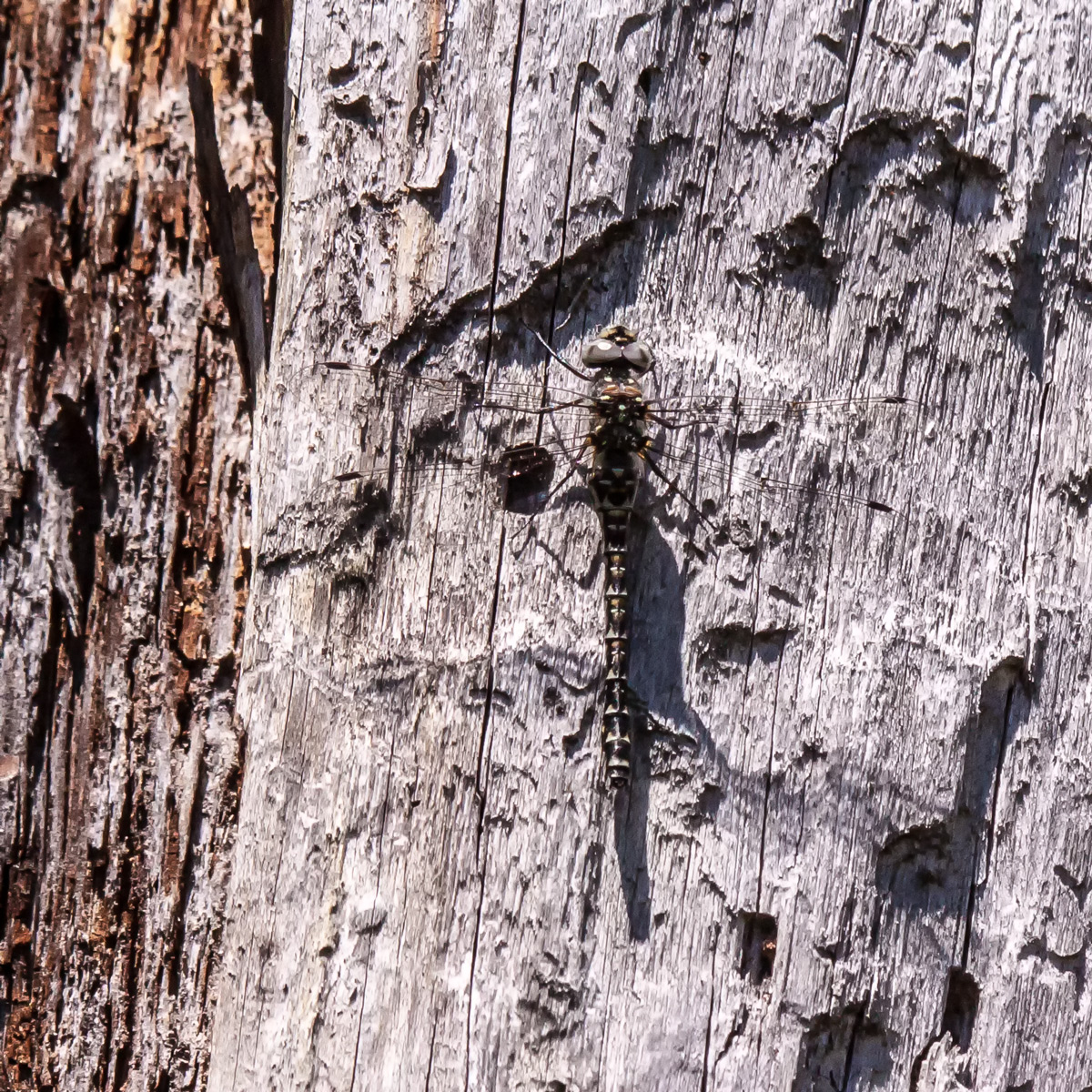
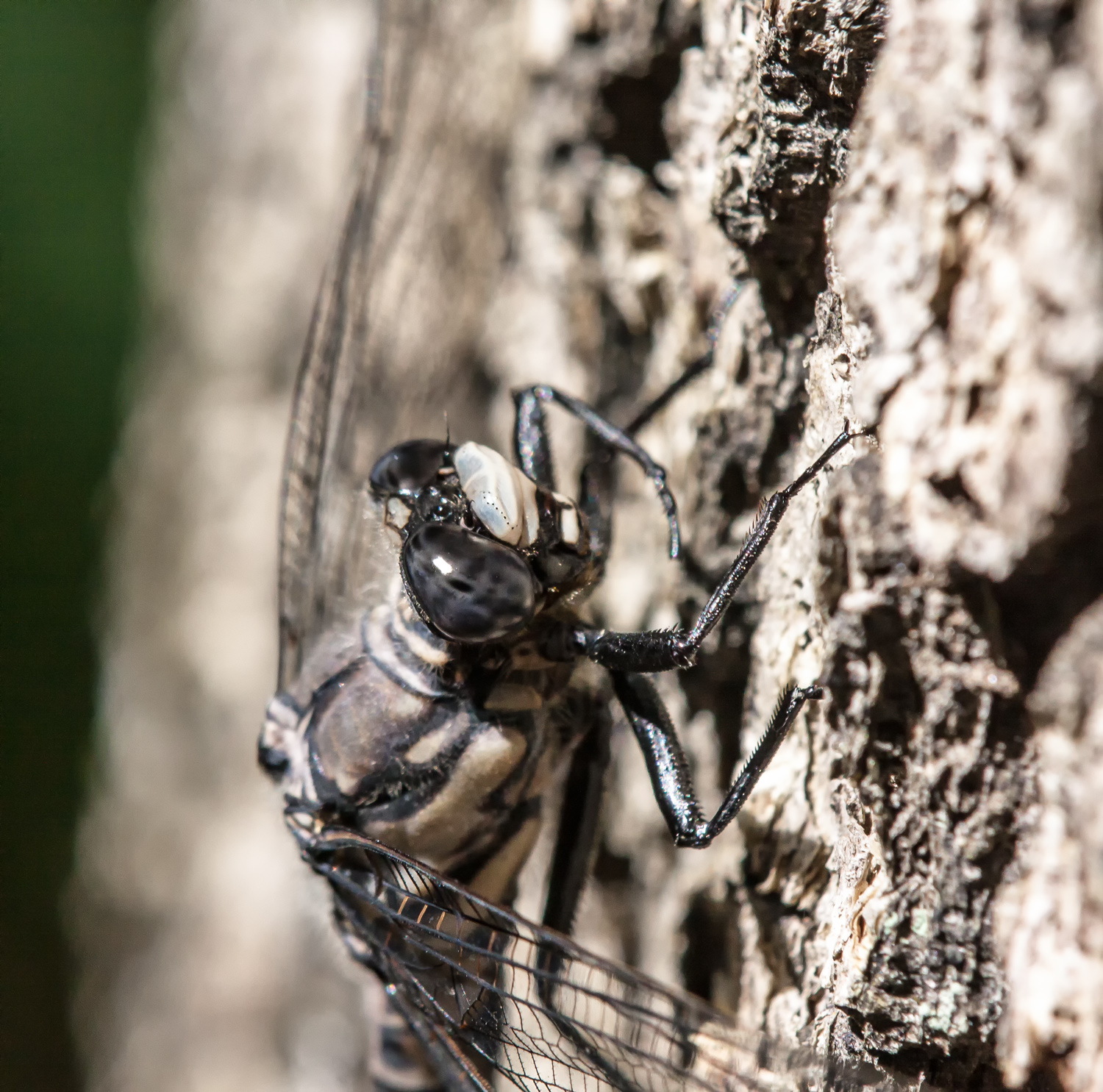
Natural camouflage in the coloration of birds and insects enhances their survivability, but it really makes them hard to find and photograph. Last week I made trips on two consecutive days to Patuxent Research Refuge in Laurel, Maryland to search for dragonflies. I have already posted photos of a Common Green Darner and a Swamp Darner that I saw during those trips—both of those dragonflies are large and colorful and relatively easy to spot.

One of the main purposes of the trip, though, was to look for a Harlequin Darner (Gomphaeschna furcillata), a species that is rare in our area and hard to spot in the field. Why? The Harlequin Darner is small for a darner, about 2.2 inches (56 mm) in length, and is in a sub-group know as pygmy darners. Its subdued coloration of gray and brown provide excellent camouflage, particularly because it often perches on tree trunks. The Harlequin Darner requires a specific type of habitat and has a flight season of only a few weeks in early spring.

On my first trip, I traveled with fellow dragonfly enthusiast and blogger Walter Sanford. We searched in vain for several hours, sometimes side-by-side and sometimes separated. As luck would have it, Walter located a Harlequin Darner at a moment when I was pretty far away. Alas, the dragonfly flew away shortly after I arrived at his location. Fortunately, Walter captured some excellent shots which you can see (along with some additional information) on his blog posting from last week. As it turned out, that was the only Harlequin Darner that either of us saw all day.

The following day I decided to return alone, hoping that I too might spot a Harlequin Darner. I saw a good number of dragonflies, including the Common Baskettail that I captured in flight, but as the day progressed, I began to wonder if I would ever find a Harlequin Darner. I kept searching and finally I saw a dragonfly perch vertically on the trunk of a tree. The lighting was harsh and the shadows distorted the proportions of the dragonfly, so I wasn’t sure what kind it was. At this point, though, I was focused on getting a shot and would worry later about identifying the dragonfly. The dragonfly remained in place for about 30 seconds and then flew away.

Well, it turns out this is a female Harlequin Darner. Every time that I see a new species for the first time, I am thrilled to get any kind of recognizable images. In the future I will try to get better shots, but for now I am content that once again my persistence paid off.

It’s great to celebrate small victories.

Harlequin Darner

Harlequin Darner

© Michael Q. Powell. All rights reserved.


Read Full Post »

It is a little unusual for me to post photos of the same species twice within a few days, but I could not help myself when I captured this image of a female Swamp Darner (Epiaeschna heros) that provides such a wonderful view of her remarkable eyes.

Dragonfly eyes are always amazing, with their multiple lens that give the dragonfly almost 360 degree vision and the ability to see parts of the color spectrum that are invisible to the human eye. What is particularly striking about this Swamp Darner’s eyes are its varied colors and patterns. Wow!

The second image shows the same female Swamp Darner as she rested in a tree prior to beginning the task of depositing her eggs, which is what you see her doing in the first shot. I captured these images this past Tuesday during a visit to Patuxent Research Refuge in Laurel, Maryland.


Swamp Darner

Swamp Darner

© Michael Q. Powell. All rights reserved.


Read Full Post »

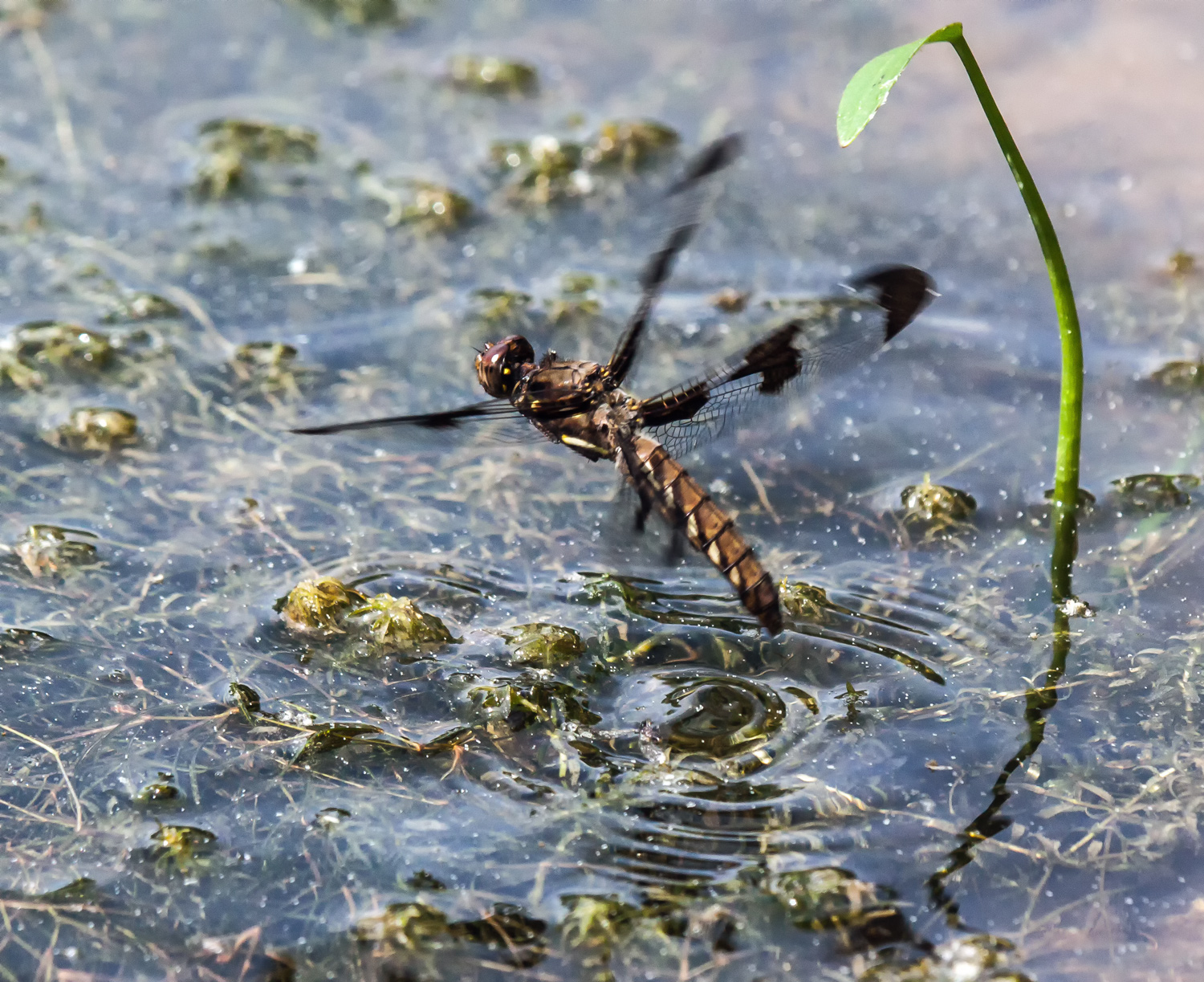
Do you like a fun photo challenge? Try taking a photo of a dragonfly as it zooms on by you.

Here’s an image I captured on Tuesday of a Common Baskettail dragonfly (Epitheca cynosura) in flight at Patuxent Research Refuge in Laurel, Maryland. In case you are curious, Common Baskettails are about 1.6 inches in length (41 mm).

So how would you go about getting a shot like this? I would say that the key requirements are patience and persistence. The first thing that I usually do is observe the dragonfly’s flight path and try to determine if there are particular places where it tends to hover or turn around. This particular dragonfly was flying low and not too far from the shore of a small pond.

Focusing is the biggest problem. Some photographers like to pre-focus on an area and wait for the dragonfly to fly into that area. Others will rely on the auto-focus capabilities of their cameras. I have had almost no success with those techniques. What I usually do is put my camera’s focus into manual mode and literally change focus on the fly as I attempt to track the dragonfly in the air.

I like to use my Tamron 180 mm macro lens, because it gives me a decent amount of reach and frees me from worrying about zooming in and out. I have found that simultaneously zooming and focusing manually while tracking the dragonfly is like patting your head and rubbing your stomach at the same time—it is theoretically possible but tough to accomplish in real life.

If you click on the image and view it in a larger size, you will see that I was fortunate to get my focus just about right for the middle of the dragonfly’s body. The shutter speed of 1/1000 of a second was fast enough to freeze most of the movement of the wings.

Needless to say, I took a lot of shots and my success rate was very low. Perhaps this is not your idea of a “fun” challenge. In that case, I would encourage you to find some area of your life and challenge yourself to do something that is difficult. Even if you are not successful, I think even the effort will help you to grow, especially in self-knowledge and self-awareness.

Common Baskettail

© Michael Q. Powell. All rights reserved.

Read Full Post »

Sometimes I can identify a dragonfly by the way that it perches. Some dragonflies like to perch high on the tip of vegetation and some perch low to the ground or even on the ground itself. Some will hang vertically or perch horizontally or at an angle somewhere in between.

On the rare occasions in the past when I have seen a Common Green Darner (Anax junius) perch (usually I see them in the air), it has usually been in vegetation relatively low to the ground. I was therefore surprised to see one spreadeagled on the side of a tree on Monday at Patuxent Research Refuge in Laurel, Maryland. Of course, the bright green color and the bull’s-eye pattern on the face made it easy to identify this dragonfly, despite her unconventional perching pattern.

I have learned from experience that the wildlife subjects that I love to photograph often do not look or act the way in the ways described in books. They are may also be found in different habitats or at different times than the range maps indicate. That is what makes this type of photography so challenging and so rewarding and it means I have to be constantly alert and vigilant when out in the field.

Common Green Darner

Common Green Darner

© Michael Q. Powell. All rights reserved.

Read Full Post »

On Monday I traveled to Patuxent Research Refuge in Laurel, Maryland with fellow dragonfly enthusiast and blogger Walter Sanford to search for dragonflies. One of the highlights of the visit for me was spotting this female Swamp Darner dragonfly (Epiaeschna heros) as she was laying her eggs. As you can see from these two photos Swamp Darners lay their eggs directly into wet wood with their blade-like ovipositor, unlike many other dragonflies that lay their eggs onto the water.

Swamp Darners are among the largest dragonflies in our area, about 3.4 inches in length (86 mm) and it was impressive to watch this one flying about over a swampy area of the refuge.

Swamp Darner

Swamp Darner

© Michael Q. Powell. All rights reserved.

Read Full Post »
Yesterday was a wonderful day for searching for dragonflies at Occoquan Regional Park and among my finds was this beautiful female Painted Skimmer (Libellula semifasciata). This is the first one of the season for this species, which is relatively common compared to most of the early spring species. The patterns on the wing make this species stand out and definitely help in identifying.

I love the way that the different colors on this dragonfly work so well together and give this dragonfly a refined and rather sophisticated look. It is an additional bonus that those colors are mirrored by the background colors in this image.

Painted Skimmer

© Michael Q. Powell. All rights reserved.

Read Full Post »
I sometimes complain about the names given to species and how little they correspond to what I actually see in the field. That certainly was not the case yesterday when I spotted a Twin-spotted Spiketail dragonfly (Cordulegaster maculata) along a creek in Northern Virginia. If you look closely at the image, ideally by double-clicking it, you will see the double row of spots on the dragonfly’s abdomen (the “tail”) and the long pointed ovipositor extending well beyond the end of the abdomen, the “spiketail.”

As I post photos of dragonflies, I realize that it is hard for readers to get a feel of the relative size of these beautiful creatures. The Uhler’s Sundragons that I have featured recently are about 1.7 inches in length (44 mm). A Twin-spotted Spiketail, by contrast, is much larger, about 2.8 inches in length (69 mm).

Both of these species are uncommon to rare in our area, primarily because of their specific habitat requirements—they require clean forest streams, which are not common in the Washington D.C. metropolitan area and they have an early and short flight season of only a few weeks.

Twin-spotted Spiketail

© Michael Q. Powell. All rights reserved.


Read Full Post »
You know you are pretty close to a dragonfly when you can see individual grains of pollen on its head and body. I photographed this Uhler’s Sundragon dragonfly (Helocordulia uhleri) on 12 April alongside a creek in Northern Virginia. Ideally it would be best to stabilize macro shots taken at this close a range by placing the camera on a tripod, but in a field situation with a live subject, that is rarely possible.

If you click on the individual images, you will see some wonderful details, like the ommatidia, the individual optical units that make up the amazing compound eyes of these dragonflies.

Uhler's Sundragon

uhler's sundragon

© Michael Q. Powell. All rights reserved.


Read Full Post »

On Wednesday I finally photographed my first dragonflies of the season, some Uhler’s Sundragons (Helocordulia uhleri) that I spotted while exploring a creek in Northern Virginia. This was my first time seeing this species and I was particularly excited, because it is considered to be rare in my area. According to the Dragonflies of Northern Virginia website, this species is a “scarce and seldom seen member of the emerald family” and is a “habitat specialist with a brief and early flight period.”

Initially I took some medium distance shots with my 180mm macro lens and them moved in closer to get the first shot. In order for me to get such a close-up shot, the dragonfly has to be cooperative and this female Uhler’s Sundragon was quite accommodating.

As you probably notice in the first photo, only a limited amount of details are in focus when shooting a subject this close.  One of the biggest challenges is to ensure that the most important features are the sharpest. Following the usual rule for photographing live subjects, I attempted to focus on the eyes.

For me, dragonfly season is now open and I anticipate that I will be featuring different species of these beautiful aerial acrobats quite regularly in the upcoming months.

Uhler's Sundragon

Uhler's Sundragon

Uhler's Sundragon

© Michael Q. Powell. All rights reserved.

Read Full Post »

I’m still looking for my first dragonfly of the season, but was thrilled yesterday afternoon when I spotted my first damselfly, a Fragile Forktail (Ischnura posita), at Jackson Miles Abbott Wetland Refuge. In anticipation of seeing one of these small insects, I mounted my Tamron 180mm macro lens on my camera, a lens that has gone largely unused during the long winter months in favor of my telephoto zoom lens.

Yesterday was a nice reminded of how much I enjoy using a macro lens. (To give you a sense of scale, a Fragile Forktail damselfly is about 0.8-1.1 inches in length (21-29mm).)


Fragile Forktail

Fragile Forktail

Fragile Forktail

© Michael Q. Powell. All rights reserved.

Read Full Post »

It will be a few more months until dragonflies reappear in our area, so for now I have to content myself with this one in my front yard that I photographed yesterday as the snow was gently falling. This metal dragonfly is part of a raised sprinkler that stands about three feet tall (about a meter).

I really like the way that the dragonfly has weathered and acquired various colors. I suppose I could talk of rust and tarnish, but I prefer to think of it as “patina.”

dragonfly

© Michael Q. Powell. All rights reserved.

Read Full Post »

As another year in my journey through photography comes to a close, I decided to share a few of my favorite photos of the past year. I initially planned to choose one image for each month and that was doable for the first few months of the year. Once I moved into the prime seasons for shooting, though, there were so many good photos I couldn’t select a single one, so I chose multiples for those months and ended up with these thirty photos.

If you want to see the images in a larger size, all you need to do is click on one of them and they will then be displayed in a slide show format.

Thanks so much to all of you who have followed my blog postings and supported and encouraged me in so many ways. It has been a wonderful year and I look forward to more photos and new adventures in the upcoming new year.

Happy New Year to you all and best wishes for a blessed 2019.


© Michael Q. Powell. All rights reserved.

Read Full Post »

Yesterday we were blessed with a sunny, warm day. The temperatures rose to over 60 degrees (16 degrees C) and my hopes that I might see some dragonflies increased correspondingly.

This autumn season we have already had some sub-freezing temperatures and even a couple of inches of snow. However, my past experience has shown that Autumn Meadowhawk dragonflies (Sympetrum vicinum) are unusually hardy.

Autumn Meadowhawks are small, about 1.3 inches (33 mm) in length and tend to perch on the ground, which is now covered with fallen leaves and other debris. As a result, it is pretty hard to spot these little dragonflies, despite their bright red coloration.

I searched and searched and eventually found a few of them at Occoquan Bay National Wildlife Refuge. I was able to capture a number of images and decided to feature this one, because it gives you a good look at the dragonfly’s beautiful two-toned eyes.

Today we are back to cooler temperatures and there is snow in the forecast for this weekend. Will this be my last dragonfly of the season? I will continue to search for dragonflies for another month or so, though I know that my chances of finding one of these beautiful aerial acrobats will continue to drop.

Autumn Meadowhawk

© Michael Q. Powell. All rights reserved.


Read Full Post »

It’s fun to remember the carefree days earlier this year that I spent hunting for dragonflies. Fellow dragonfly enthusiast Walter Sanford recently did a posting about a location where I photographed a Sable Clubtail dragonfly, one of the rarest species in our area, a place that he christened “Powell’s Place” after he too visited it and found a Sable Clubtail.

Be sure to check out his posting and I encourage you also to explore his blog for some amazing photos and information about dragonflies and other wild creatures.

waltersanford's avatarwalter sanford's photoblog

A single Sable Clubtail dragonfly (Stenogomphurus rogersi) was spotted perched alongside a small stream located in Fairfax County, Virginia USA.

I nicknamed a segment of the stream “Powell’s Place” in honor of Mike Powell, my good friend and photowalking buddy, who spotted the first Sable observed at this part of the stream. “Powell’s Place” is located downstream from Hotspot No. 1, where the stream re-emerges from an underground concrete pipe.

This individual is a male, as indicated by his indented hind wings and terminal appendages. Some dragonflies tend to be creatures of habit, returning to the same spot day-after-day. Perhaps this is the same individual spotted by Mike. Who knows?

I like the juxtaposition of complementary colors in the first photo.

12 JUN 2018 | Fairfax County, VA | Sable Clubtail (male)

The next photo shows the dragonfly perched deep within a shaded hidey-hole.

View original post 74 more words

Read Full Post »

I never got around to posting a shot of my final Halloween Pennant dragonfly (Celithemis eponina) of the 2018 season, so today seems an appropriate time to do so. I spotted this tattered beauty on 29 September at Ben Brenman Park, a small suburban park not far from where I live in Alexandria, Virginia.

Happy Halloween!

Halloween Pennant

© Michael Q. Powell. All rights reserved.

Read Full Post »

There are not a great number of dragonflies still around in my area, and those that are present can sometimes be really hard to spot. That was definitely the case with this beautiful female Autumn Meadowhawk dragonfly (Sympetrum vicinum) that blended in almost perfectly with the fallen leaves and other debris on the ground at Occoquan Bay National Wildlife Refuge this past week.

I initially spotted this dragonfly as she was flying and watched her land, but I couldn’t see her at first. Once I saw where she was, I had to back off, because I was shooting with my 150-600mm zoom lens that has a minimum focusing distance of almost 9 feet (270 cm).

Autumn Meadowhawks are only 1.2 to 1.4 inches in length (30 to 35mm) and spotting the tiny dragonfly from 9 feet away was a challenge to me and to the focusing system on my camera. I think that I was pretty much at the extreme end of the resolving power of the lens when I took this shot, i.e. it is tough to capture a subject with any detail that is much smaller than this.

I have already had to scrape frost from my windshield a couple of times this autumn, so the number of insects will inevitably continue to decrease. Past experience has shown me, however, that Autumn Meadowhawk dragonflies are hardy survivors and I expect to continue to see them for another month or so.

Autumn Meadowhawk

© Michael Q. Powell. All rights reserved.

Read Full Post »

Although we are well into October, some of my beloved dragonflies are still hanging on at Occoquan Bay National Wildlife Refuge. Here are some dragonfly shots from the past 10 days of (1) a male Blue-faced Meadowhawk (Sympetrum ambiguum); (2) a female Eastern Pondhawk (Erythemis simplicicollis) with a hoverfly in her mouth; and (3) a female Autumn Meadowhawk (Sympetrum vicinum).

I hadn’t really noticed before I aggregated this shots that all three of the dragonflies were perching on leaves. During the summer months, a significant number of the dragonflies that I photograph are perched higher on stalks of vegetation or on branches. In addition to these smaller dragonflies,

I have also recently spotted Common Green Darners, Wandering Gliders, and Black Saddlebags patrolling over the fields. Unfortunately, none of them paused long enough for me to get shots of them. All three of those species are migratory species and they may have been fueling up for a long journey ahead.

Blue-faced Meadowhawk

Eastern Pondhawk

Autumn Meadowhawk

© Michael Q. Powell. All rights reserved.

Read Full Post »
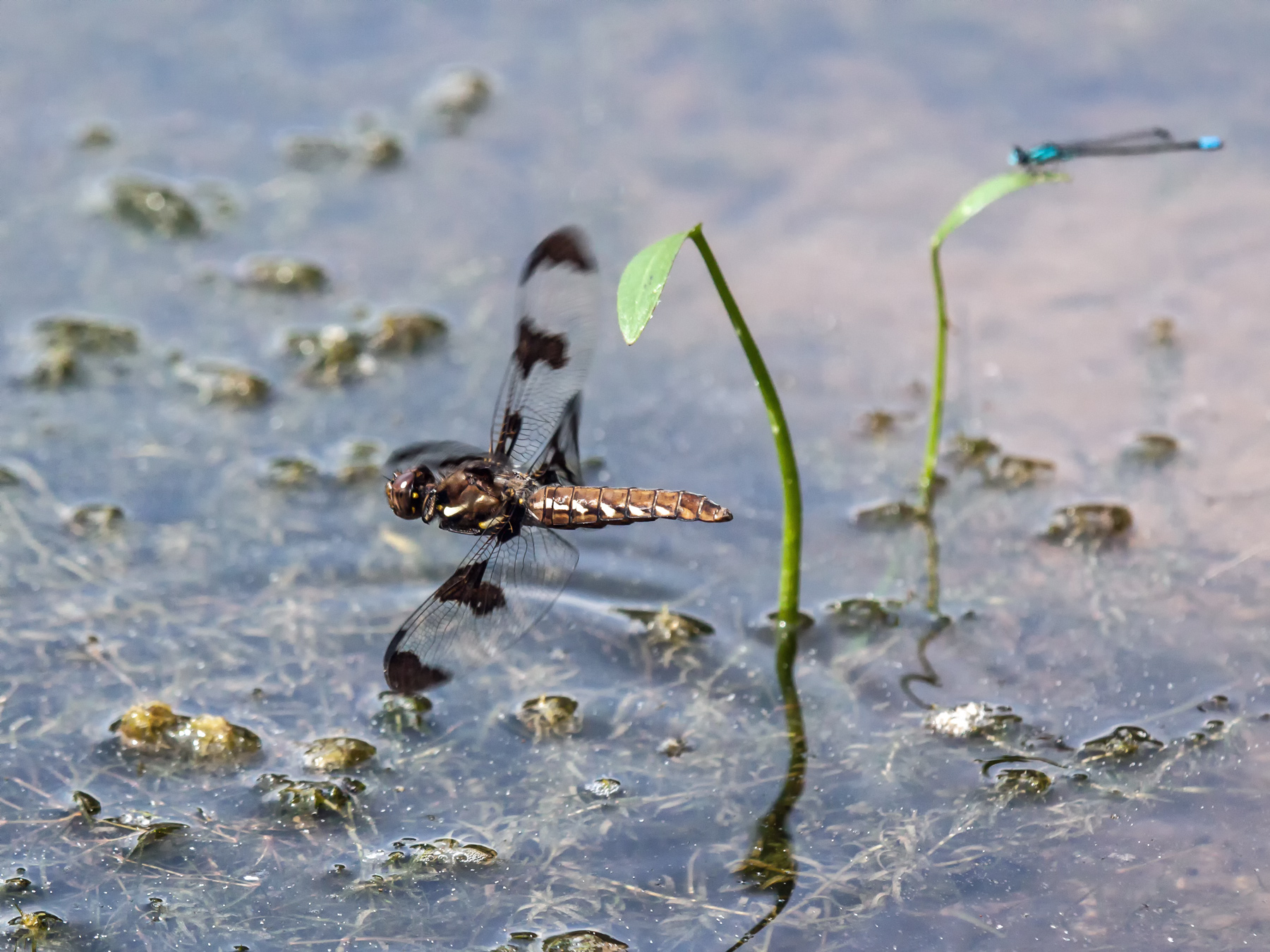
Each fall I look forward to the reappearance of the Blue-faced Meadhowhawk dragonflies (Sympetrum ambiguum). No matter how many times I see them, I never fail to be amazed at the wonderful combination of bright colors on these little beauties.

Quite often Blue-faced Meadowhawks perch in the crowded undergrowth, where the background is cluttered.  I was quite happy recently to capture a few images in which the dragonfly perched a little higher, which allowed me to isolate it from the background and ensure that the viewer’s attention is focused on the primary subject.

Blue-faced Meadowhawk

Blue-faced Meadowhawk

© Michael Q. Powell. All rights reserved.

Read Full Post »

« Newer Posts - Older Posts »