Feeds:
Posts
Comments

Archive for the ‘Autumn’ Category

It seems like we are at a time in the year when the number of birds has increased. I can hear them everywhere when I walk along the wooded trails of Occoquan Bay National Wildlife Refuge. The problem, though, is that most the leaves are still on the trees, so I am having huge problems spotting the birds and if I can’t see them, I can’t photograph them.

Earlier this week, I heard the familiar knocking sound of a woodpecker at work. I could see some movement in a tree amidst the foliage. I tracked the movement until suddenly the woodpecker popped into the open for a brief moment as it reached the top of the dead tree. I was able to capture this one shot of what appears to be a male Downy Woodpecker (Picoides pubescens)—only males have the red patch of feathers on the back of their heads. (The Hairy Woodpecker is similar in appearance to the Downy Woodpecker, but is larger and has a longer bill—the angle of this shot makes it tough for me to be absolutely certain of my identification.)

Downy Woodpeckers are the smallest woodpeckers in Northern America, but what they lack in size, they seem to make up in energy. They always seem to be super energetic and industrious and are one of the birds that I am able to spot throughout most the entire year.

downy woodpecker

© Michael Q. Powell. All rights reserved.

Read Full Post »

I love Wood Ducks (Aix sponsa), but haven’t seen any for quite some time. I was therefore really happy when I spotted this pair swimming in the distance in a  creek at Occoquan Bay National Wildlife Refuge earlier this week.

The male Wood Duck, as shown in the first image, is one of the most colorful and distinctively patterned birds in our area—there is no other bird that looks even vaguely similar. The duck stopped swimming for just a moment and I was able to capture this shot of him getting a drink of water.

The female Wood Duck shown in the second image is not quite as colorful as her male counterpart, but has an equally distinctive look with her windswept “hair” and prominent white eye ring.

wood duck

wood duck

© Michael Q. Powell. All rights reserved.

Read Full Post »

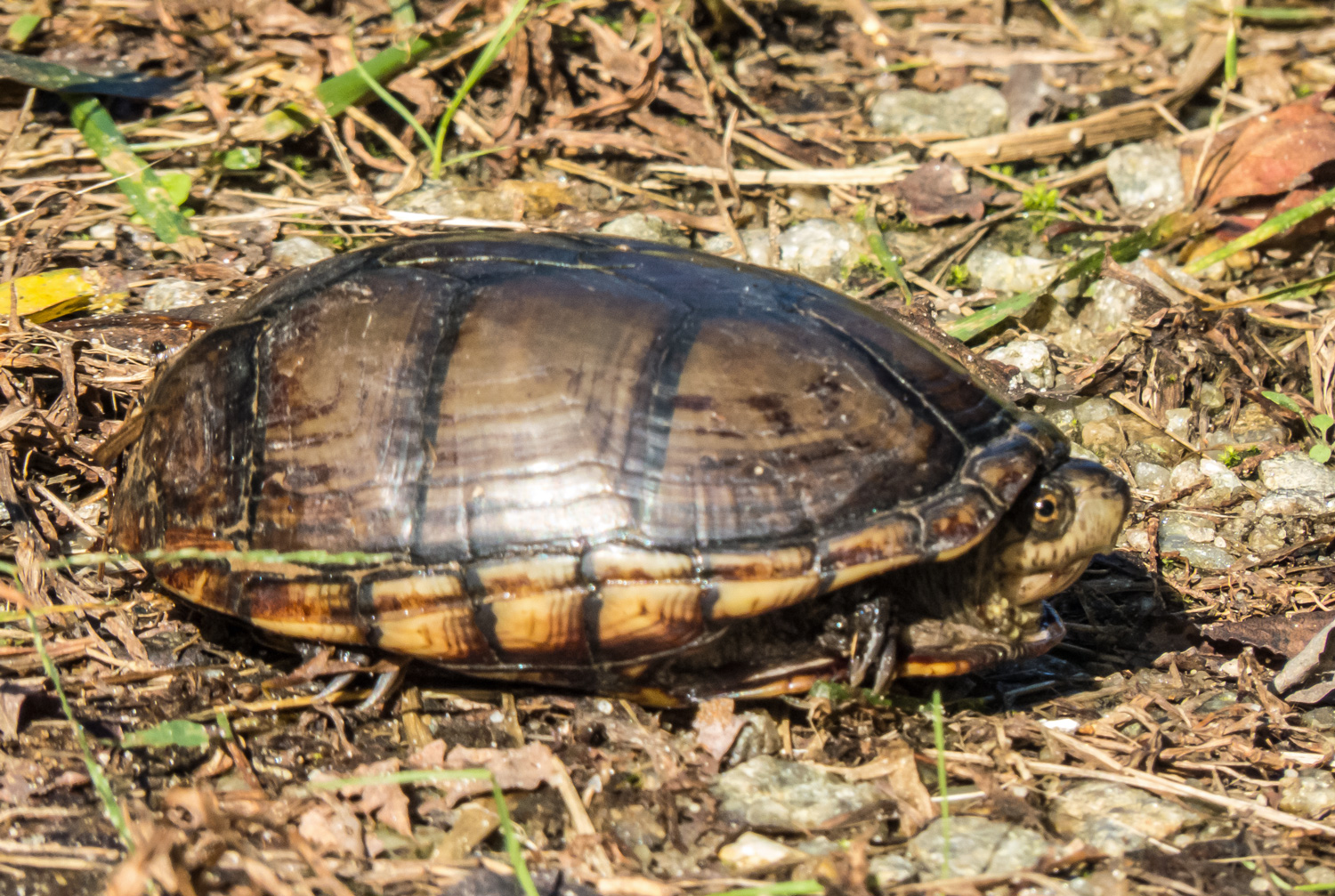
As I was exploring Occoquan Bay National Wildlife Refuge earlier this week, I stumbled upon this cute little Southeastern Mud Turtle (Kinosternon subrubrum subrubrum). It looks like the little turtle had attempted to withdraw its head into its shell, but it does not quite fit.

I’ve only spotted this species of turtle, also known an Eastern Mud Turtle, a few times, so I decided to do a little research. Among other things, I learned on the website of the Virginia Herpetological Society that Southeastern Mud Turtles are ominvores, eating, among other things, insects, crustaceans, mollusks, amphibians, carrion, and aquatic vegetation.

Here are a few more fun facts about these turtles from the same website: “Southeastern Mud Turtles are bottom walkers, spending most of their active time in water on the bottom. A substantial but unknown portion of their annual activity period is terrestrial. They seldom bask. Southeastern mud turtles are pugnacious when caught and many will try to bite, causing a minor wound from the curved beak.”

I am glad that I felt no desire to pick up the turtle.

Southeastern Mud Turtle

© Michael Q. Powell. All rights reserved.


.

Read Full Post »

Shining brightly from behind the leaves, the sun revealed their autumnal beauty.

This is completely different from my “normal” photography, but when I stumbled upon this blaze of color while exploring Occoquan Bay National Wildlife Refuge, I couldn’t help but try to capture a sense of the moment.

autumn leaves

© Michael Q. Powell. All rights reserved.

Read Full Post »

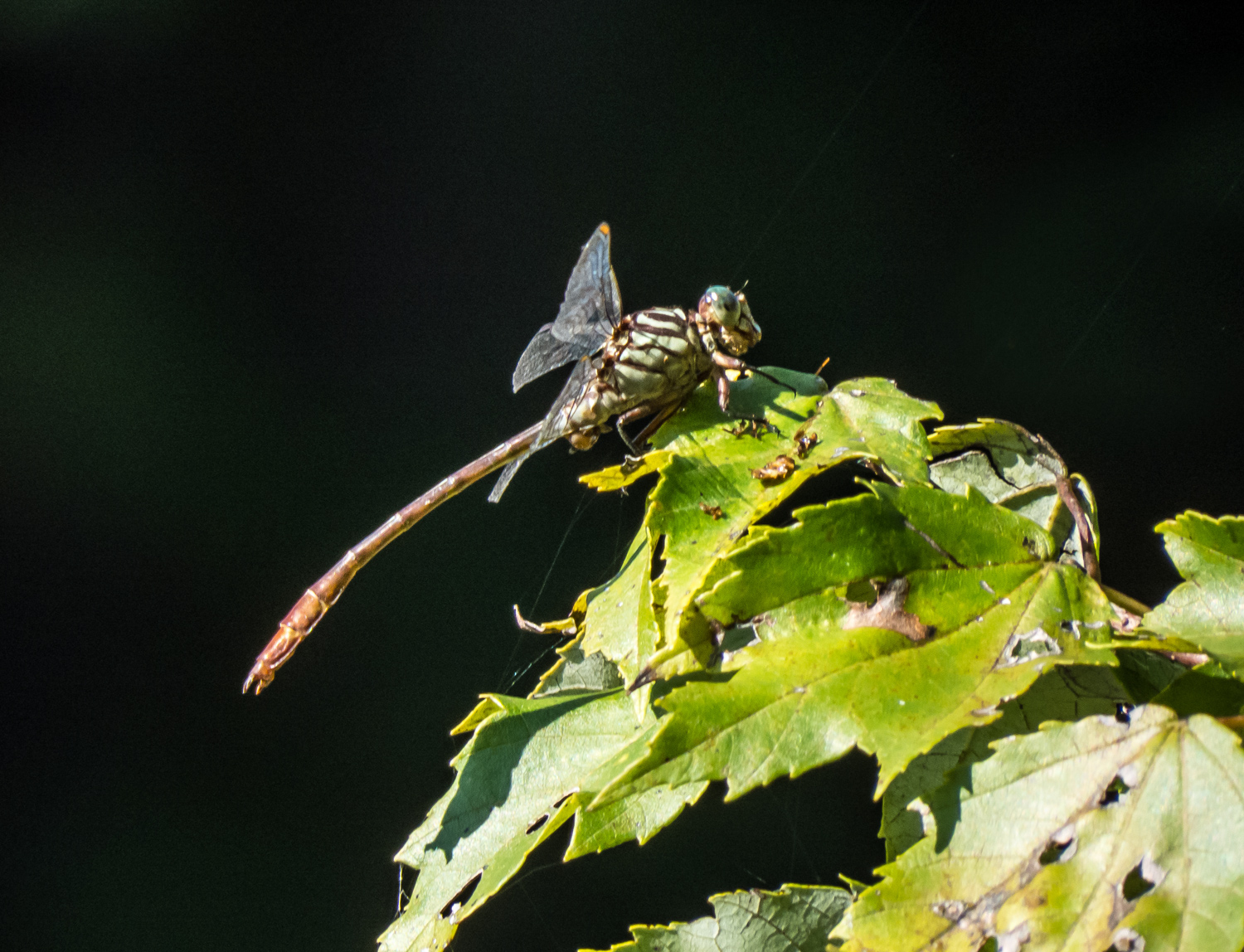
Although we are well into autumn, there are still dragonflies around, including some stunning Russet-tipped Clubtail dragonflies (Stylurus plagiatus) that I spotted earlier this week at Jackson Miles Abbott Wetland Refuge. As you can see from the photos Russet-tipped Clubtails like to perch on somewhat exposed leaves, which makes them a bit easier to spot than some species of dragonflies, though they are not common in my experience

I was able to capture images of Russet-tipped Clubtails (there were at least two individuals that I saw, both males) on several leafy perches in a tree overhanging a pond. My angle of view and the direction of the light gave each of these images a very different feel, primarily because of the way that the background was captured.

Depended on my mood, any one of these three images can be my favorite. Is there one that particularly appeals to you?

Russet-tipped Clubtail

Russet-tipped Clubtail

Russet-tipped Clubtail

© Michael Q. Powell. All rights reserved.

Read Full Post »

I spotted this little Ruddy Duck (Oxyura jamaicensis) all by itself on Wednesday morning at the far end of Painted Turtle Pond at Occoquan Bay National Wildlife Refuge. He must have been feeling a little lonely, however, and tried to strike up a conversation with the mallard decoy that is a permanent feature at this pond. The mallard remained silent.

I was trying to capture a shot of the Ruddy Duck by itself, as in the second image, but I like the eye contact in the first image so much that I decided to make it my lead photo for the posting. The shot simply makes me smile.

Have a wonderful Friday.

Ruddy Duck

Ruddy Duck

© Michael Q. Powell. All rights reserved.

Read Full Post »

Autumn is a prime season for migration. It is almost impossible to ignore the sounds of the Canada Geese as they pass overhead and thousands of other birds pass by unheard, heading south to warmer locations.

Some dragonflies migrate too and at this time of the year it is not unusual to see some of them patrolling high in the air. A good number of dragonflies spend a lot of time perching, and they tend to be easiest to photograph. Other dragonflies, like the species that migrate, spend most of their time in flight. Their stamina is amazing and your patience has to be equally amazing if you try to wait for them to land to photograph them. The alternative is to try to photograph them in flight.

Yesterday I spotted a couple of Wandering Gliders (Pantala flavescens) flying patrols over a small pond at Occoquan Bay National Wildlife Refuge. Wandering Gliders are the most widespread dragonflies on the planet and have an almost worldwide distribution.

I watched the Wandering Gliders for a while to see if I could figure out the patterns that they were flying. Gradually I realized that they often would pass by a certain part of the shore  and hover a little and that became my target zone. With my Canon SX50 superzoom camera in hand, I visually tracked the dragonflies in the air and attempted to photograph them. Mostly I was unsuccessful, but I did get a few decent shots.

In the first shot below, the sharpest that I was able to manage, the Wandering Glider was flying above eye level, so the beautiful blue sky served as a backdrop. In the second image, the dragonfly was flying below eye level and the ripples in the water create a beautiful pattern in the background. When I consider the two images, I am torn between two competing impulses—technically the first shot is superior, but artistically the second shot appeals to me more. Fortunately, I don’t have to choose one over the other and can post both of them.

Wandering Glider

Wandering Glider

© Michael Q. Powell. All rights reserved.

Read Full Post »

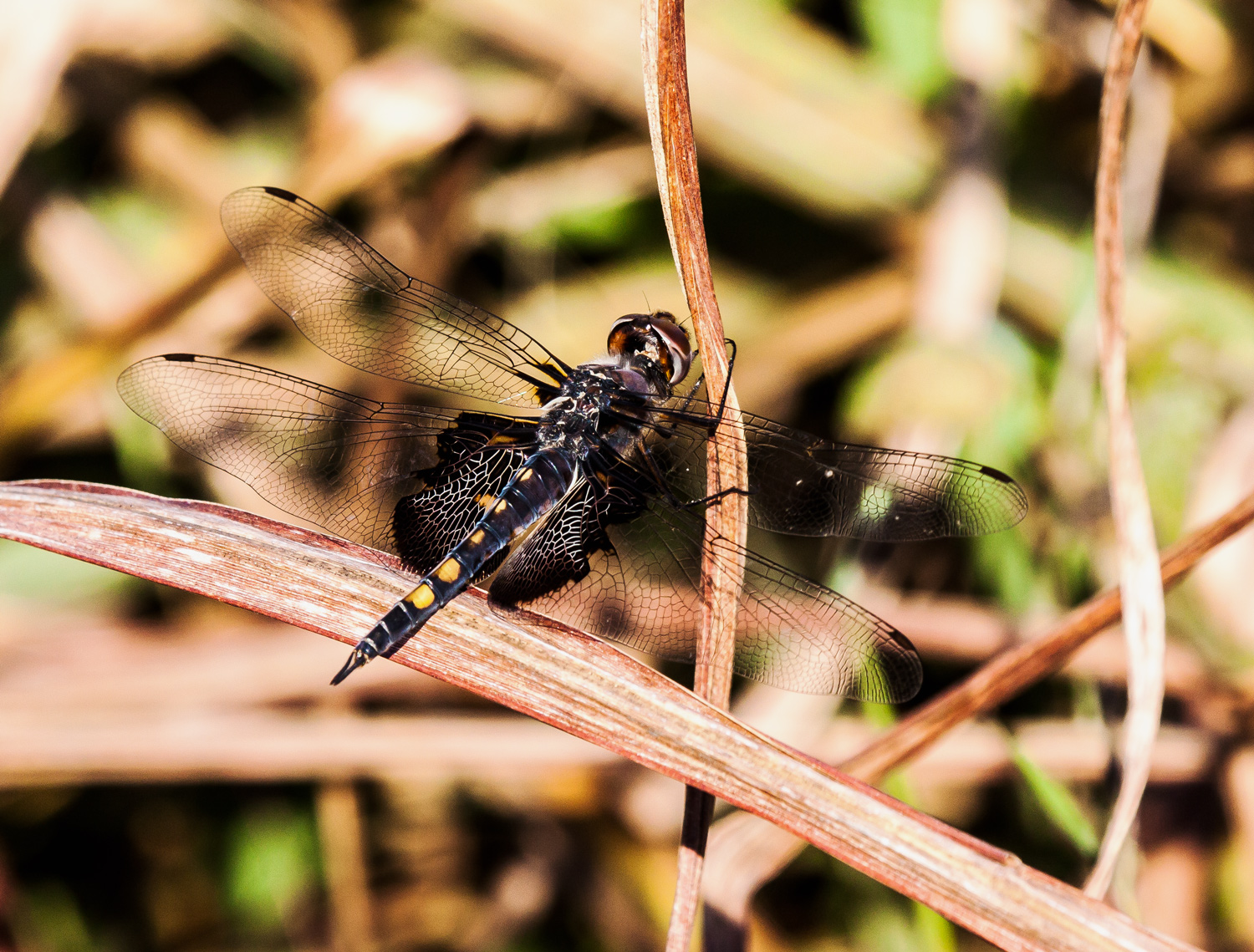
I don’t know if this is a local dragonfly or was merely stopping by while migrating south, but I was happy when this Black Saddlebags dragonfly (Tramea lacerata) stopped circling a field and perched for a moment earlier this week at Occoquan Bay National Wildlife Refuge.

This species of dragonfly is one of several migratory species and in the early autumn I tend to see more Black Saddlebags dragonflies than at any other time of the year. As you might have guessed, the dark blotches on the wings caused some scientist to imagine that they looked like saddlebags. In some cases, I scratch my head when I learn the name of a species, but in this case the name seems to fit and doesn’t require too big a stretch of the the imagination.

Black Saddlebags

© Michael Q. Powell. All rights reserved.


Read Full Post »

I love to photograph bees and realize that I have not featured one for quite some time. I captured this image of one as it perched on some pickerelweed this past weekend at Ben Brenman Park in Alexandria, VA.

In many ways, this image is as much about the flowering plant as it is about the bee. It speaks to me of the interaction between those two main subjects.

For me, photographing nature is about balancing the depiction of the small details, as I often do, with the “bigger” picture—the framing of this shot helps to give the viewer a better sense of the environment than if I had done an extreme close-up shot of the bee itself.

bee and pickerelweed

© Michael Q. Powell. All rights reserved.

Read Full Post »

Despite seeing several Fine-lined Emerald dragonflies (Somatochlora filosa) last Friday at Occoquan Bay National Wildlife Refuge, only this one was cooperative enough to land for a moment and allow me to get some shots.

Previously I posted some photos I took of Fine-lined Emeralds in flight. I had chased and chased these elusive dragonflies, but they never seemed to stop flying. I was beginning to think that I would not get a shot of one perched when suddenly one that I was tracking dropped down into the vegetation. I approached very cautiously and spotted it clinging vertically to a narrow stem.

My heart was racing as I switched to manual focusing—the profile of the perched dragonfly was so slim that I didn’t think my auto-focus would lock on my subject. I took a couple of shots and then inched forward a little. This is part of an eternal struggle for a wildlife photographer, deciding how close you can get to a subject without disturbing it.

I was pretty happy with this image, because I was able to capture a lot of details of this cool-looking species. I recommend clicking on the image to see a higher resolution view of the dragonfly’s spectacular emerald eyes, beautiful body markings, and wonderful wings.

Fine-lined Emerald

© Michael Q. Powell. All rights reserved.

Read Full Post »

Orange and brown seem to be the perfect color combination for the autumn and this Question Mark butterfly (Polygonia interrogationis) was suitably celebrating the season this past Friday at Occoquan Bay National Wildlife Refuge.

Question Mark butterfly

© Michael Q. Powell. All rights reserved.

Read Full Post »

Orange is one of the colors that I tend to associate with autumn. Some leaves are already turning orange and pumpkin decorations and displays have started to appear on my neighbors’ doorsteps.

As I was exploring Occoquan Bay National Wildlife Refuge yesterday morning, my eyes detected some motion in the nearby grass. I leaned forward and was delighted to see this tiny damselfly decked out in the colors of Halloween—orange and black. I had no idea what species it was, but fortunately I have a really good guide for damselflies and was able to identify it as an immature female Eastern Forktail damselfly (Ischnura verticalis).

Although there are already lots of symbols for autumn, I think this tiny damselfly could be added to the list.

Eastern Forktail

© Michael Q. Powell. All rights reserved.

Read Full Post »

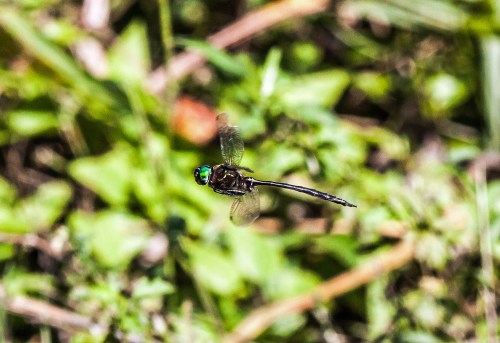
I was thrilled yesterday to see that there are still Fine-lined Emerald dragonflies (Somatochlora filosa) at Occoquan Bay National Wildlife Refuge. I was afraid that all of the recent rain had washed them away.

This particular dragonfly species is pretty uncommon, but the wildlife refuge that has become my go-to place for photography is one of the few local spots where they can be found. I think its peak period in our area is September-October, judging from my experience last year, so I was anxious to see them some more before they disappeared for the year.

It is easy to see a Fine-lined Emerald dragonfly when it is patrolling, because it often flies at knee to shoulder height. It is a whole different problem, though, to get a shot of one, because they spend most of their time in the air rather than perching. I spent quite a bit of time yesterday chasing after these dragonflies, hoping in vain to be able to catch the moment when one decided to take a break.

Finally I decided to change my approach and see if I could capture a shot of one as it flew by me. I know that it can be done, because last year I captured an in-flight image using my 150-600mm zoom lens. The lens that I had on my camera, however, was my 180mm macro lens, which meant that I had to get pretty close to the dragonfly rather than zooming in. That particular lens is slow to focus, so I decided to focus manually, which can be tricky with a moving subject. One of the downsides of the lens is it has no built-in image stabilization, so I decided to keep the camera affixed to my monopod for the sake of stability.

It took some time, but eventually I was able to capture a few shots of flying Fine-lined Emeralds that were relatively in focus, aided by the fact that these dragonflies hover a little from time to time.

I particularly like the first image because it shows both the emerald eyes and the fine lines near the tip of the abdomen that are responsible for the name of the species. It was also cool that the angle of view was unusual, given that I was looking down at the dragonfly as I took the shot. I also like the touch of brownish-orange from the out-of-focus leaves that gives the image an autumn feel.

The second shot gives a more “normal” view of a Fine-lined Emerald dragonfly as it flew by.  I was happy to be able to separate it somewhat from the leafy backdrop by carefully focusing on the dragonfly. This is one of those situations when the auto-focusing system of the camera would have been challenged—the subject was pretty small in the viewfinder and the auto-focus probably would have tried to lock on the background.

fine-lined emerald

fine-lined emerald

© Michael Q. Powell. All rights reserved.

Read Full Post »

Now that fall has officially arrived, I look forward to seeing more Autumn Meadowhawk dragonflies (Sympetrum vicinum), like this stunning female that I spotted last Friday at Occoquan Bay National Wildlife Refuge. Adult males of this dragonfly species are bright red in color, but females can be either tan or red. The “spike” near the end of the abdomen makes it easy. though, to identify this one as a female.

In Northern Virginia, where I live, the Autumn Meadowhawk tends to be the latest surviving dragonflies—I have spotted them in mid-December and others have seen them in early January.

Autumn Meadowhawk

© Michael Q. Powell. All rights reserved

Read Full Post »

The incessant rain and cooler weather since my return from Brussels make it feel like it’s already autumn. Like this Monarch butterfly (Danaus plexippus) at Occoquan Bay National Wildlife Refuge, however, I am not quite ready to cease sipping the sweet nectar of summer.

I captured this image on 31 August, the day before my departure for my recent overseas trip. The combination of rainy weather can jet lag have so far kept me from venturing out with my camera, but I hope to do so this coming week.

monarch butterfly

© Michael Q. Powell. All rights reserved

Read Full Post »

With the temperatures today reaching almost 100 degrees (38 C), I long for the cooler weather of autumn, my favorite season of the year. The aptly named Autumn Meadowhawk (Sympetrum vicinum) is generally one of the last surviving dragonfly species each year and I was therefore a bit surprised last week when I spotted this young female Autumn Meadowhawk. The very clear wings and pale body coloration are an indication that it had only recently emerged.

Summer, though, is the prime season for dragonflies and I hope to be able to take advantage of this season to see lots more of them. I’ll just have to make sure that I pace myself and stay well hydrated as we move through a period of exceptionally hot weather.


© Michael Q. Powell. All rights reserved.

Read Full Post »

Unlike most other woodpeckers, Northern Flickers (Colaptes auratus) like to spend a lot of time on the ground, which makes it tough to get a clear shot of one. According to the Cornell Lab of Ornithology website, “Although it can climb up the trunks of trees and hammer on wood like other woodpeckers, the Northern Flicker prefers to find food on the ground. Ants are its main food, and the flicker digs in the dirt to find them. It uses its long barbed tongue to lap up the ants.”

When I spotted this male Northern Flicker—females don’t have the black mustache stripe—last weekend at Huntley Meadows Park, it was perched horizontally on a fallen tree, which gave me a clear view of its beautiful colors and patterns. Other woodpeckers, which are mostly black and white, seem drab by comparison. For the first time ever, I was also able to see the downward curve of its bill that I had seen described in birding identification guides.

This bird remained still for only a moment and then seemed to fade away into the background.

Northern Flicker

© Michael Q. Powell. All rights reserved.

Read Full Post »

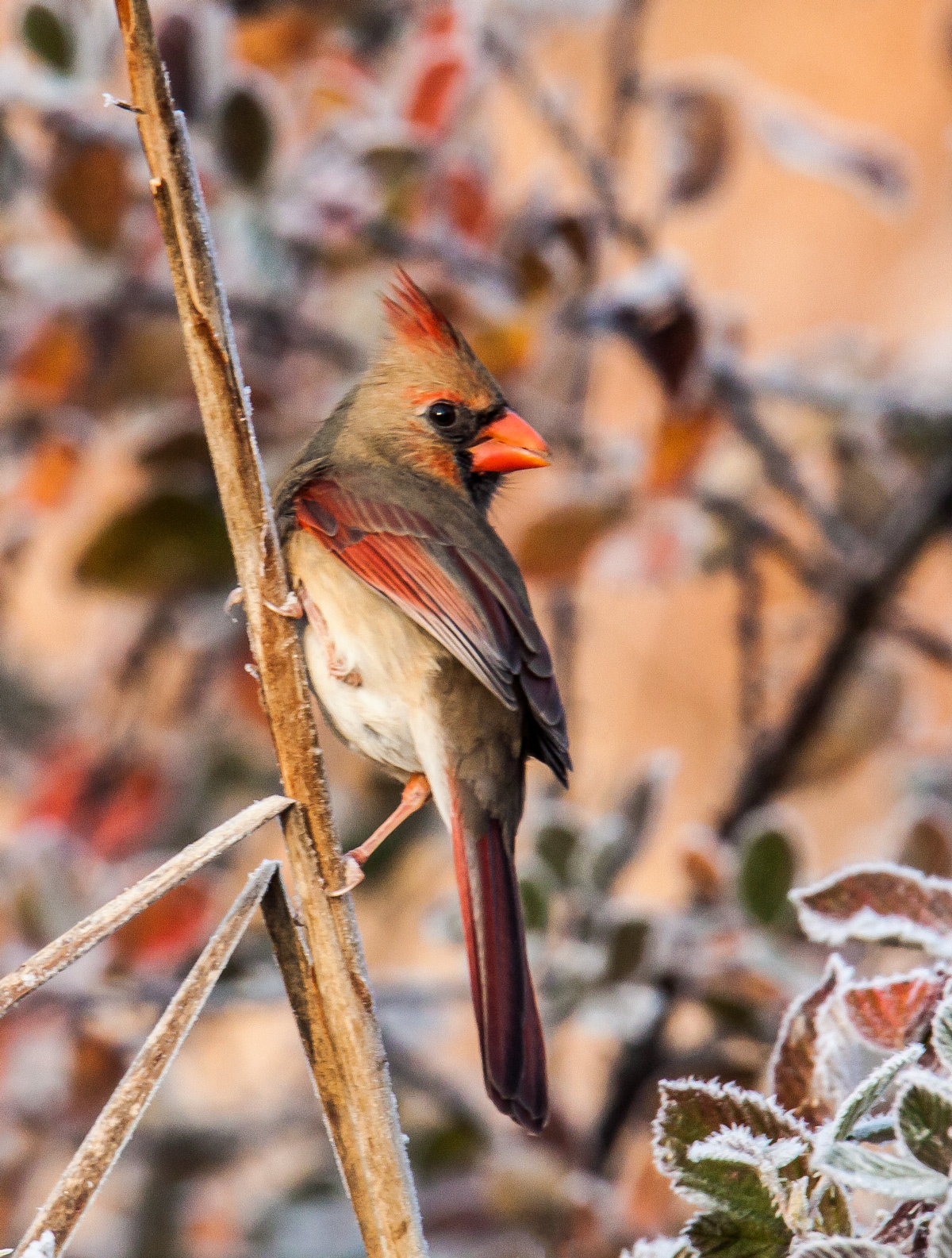
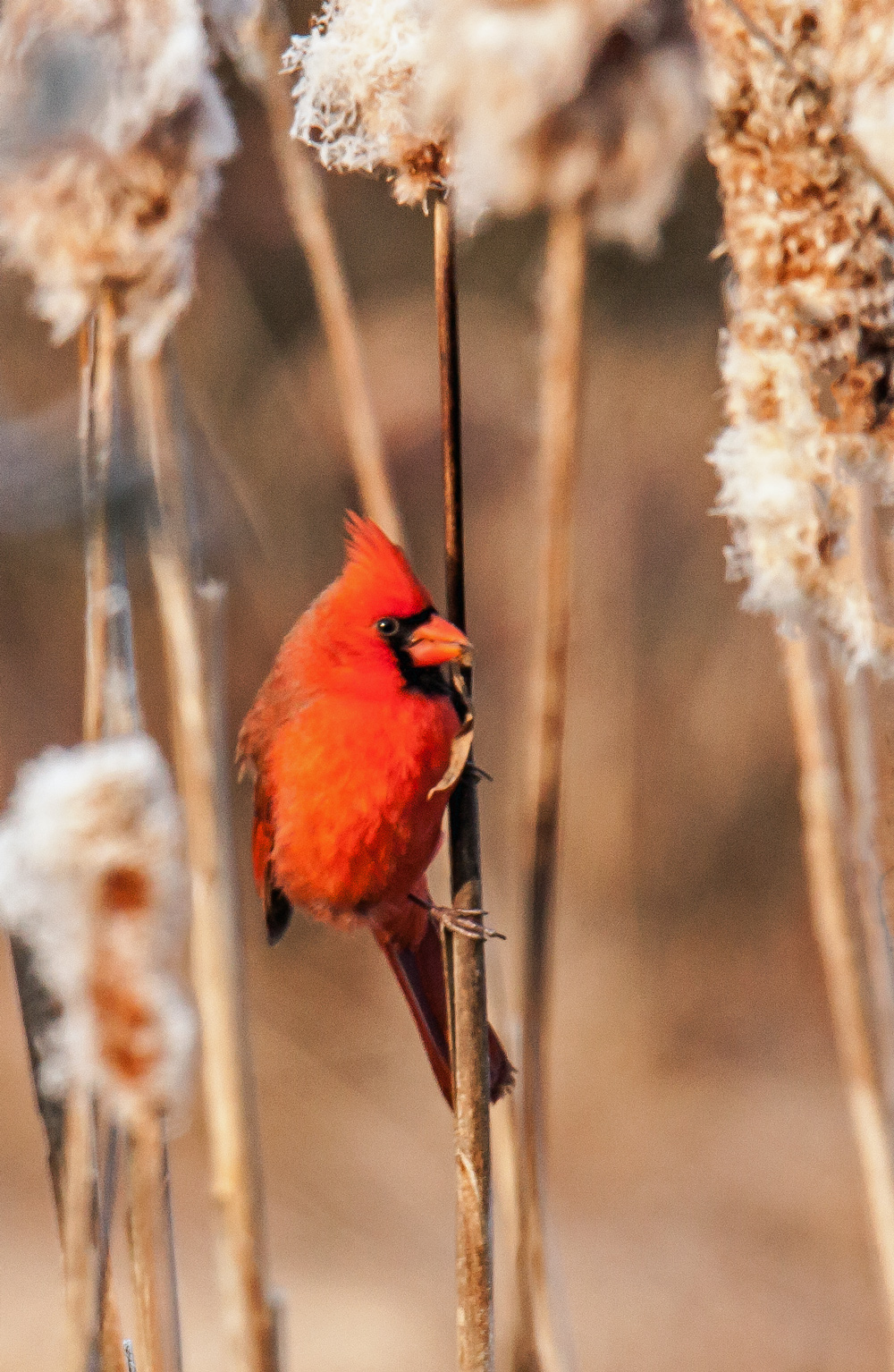
I love Northern Cardinals (Cardinalis cardinalis). The bright red of the male cardinal helps to lift my spirits throughout the winter when the world seems almost monochromatic. In terms of beauty, though, the more subdued coloration of the female cardinal is arguably even more impressive.

This past weekend I encountered several cardinals as I was exploring the frosty fields of Huntley Meadows Park in the early morning hours. I was focused on some sparrows in a patch of vegetation when suddenly a female cardinal flew in. I quickly adjusted my focus—I was focusing manually at that moment—and tried to steady my breathing as I took the first shot below just before she flew away.

A little while later, I caught sight of some movement out of the corner of my eyes in a stand of cattails. The red of a male cardinal is pretty hard to camouflage, so it was easy to spot him, but I was a little surprised by his pose. Somehow it looked more like the pose of a blackbird than that of a cardinal. Even though I was pretty far away, the cardinal seemed to be intently staring at me and didn’t seem too happy about my presence.

Cardinals are common where I live, but I never grow tired of photographing such ordinary subjects, seeking to discover and share the extraordinary that can often be found in the ordinary.

Northern Cardinal

northern cardinal

© Michael Q. Powell. All rights reserved.

Read Full Post »
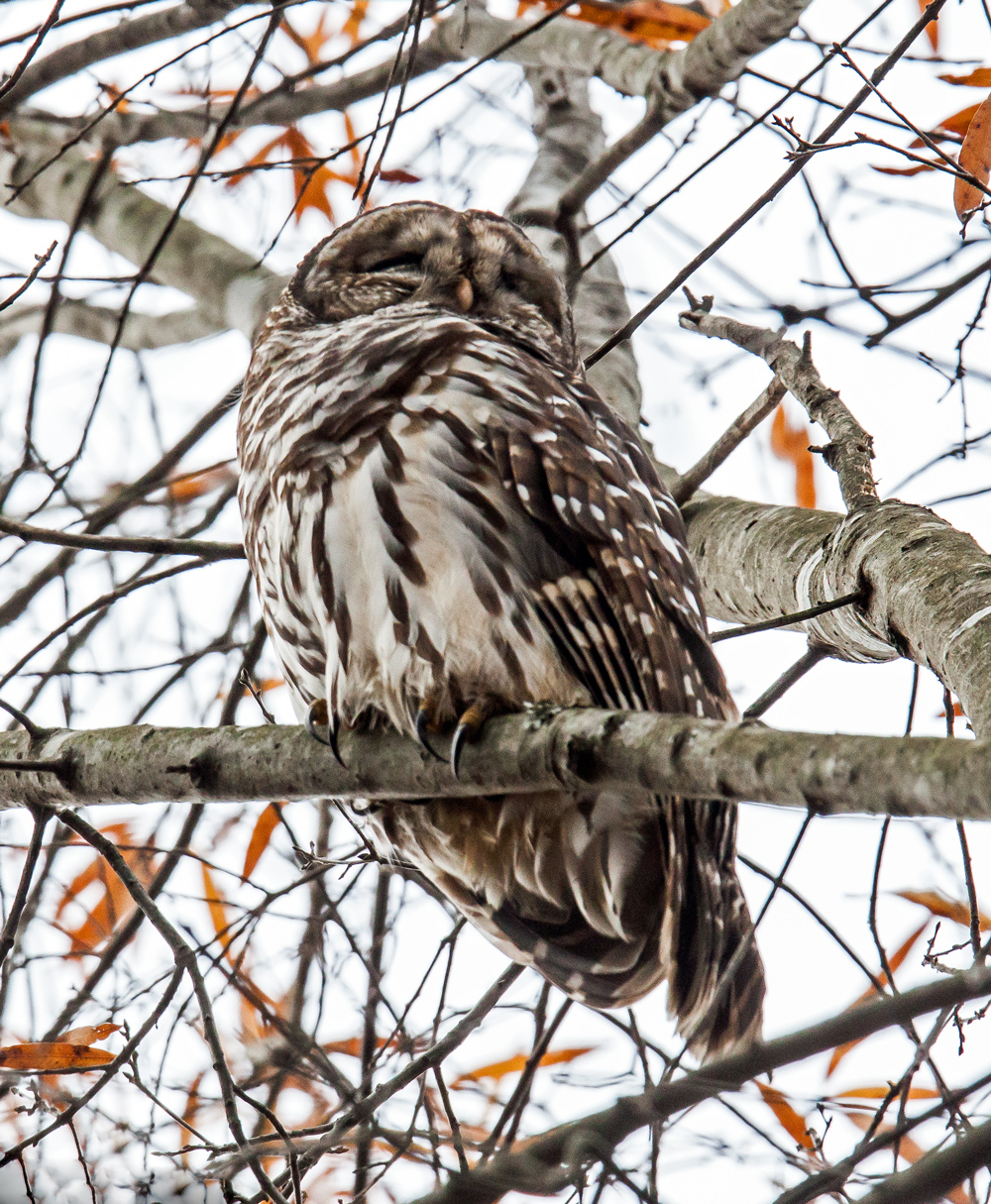
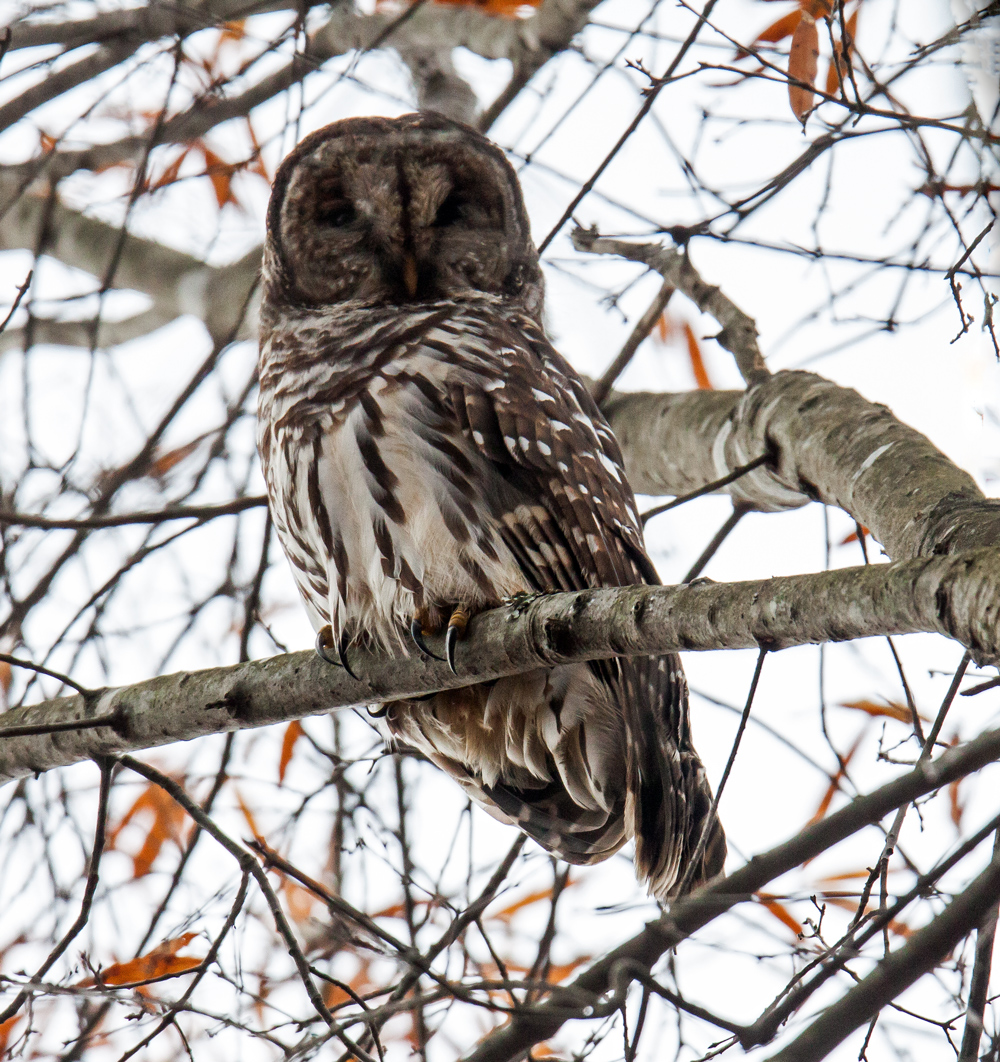
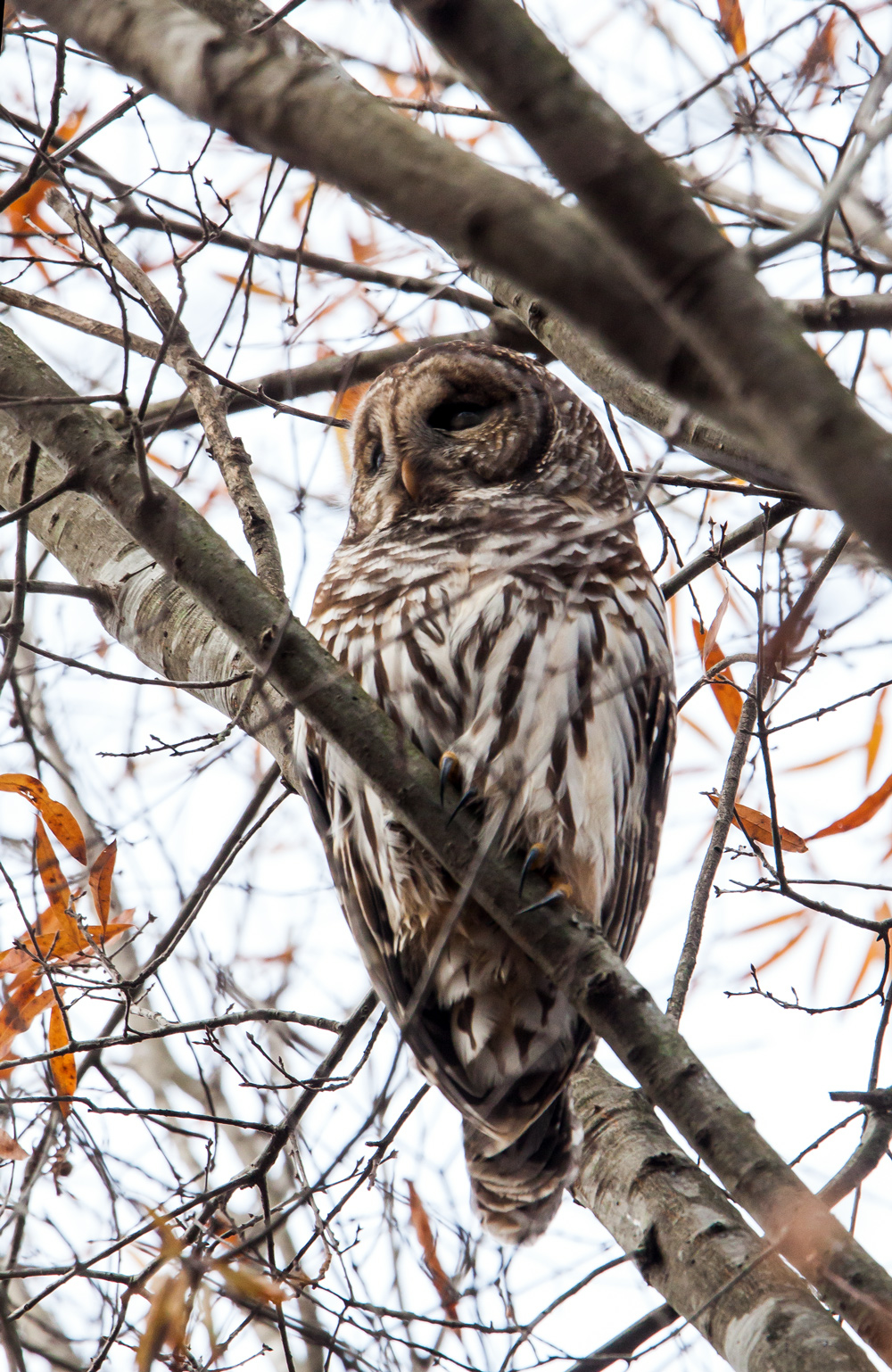
It’s not often that I see an owl during the day, but, thanks to a tip from a fellow visitor at Huntley Meadows Park, I managed to photograph this Barred Owl (Strix varia) on Saturday around noon.

Now, you might think that seeing an owl during daylight hours would make it simple to photograph, but, in fact, it was quite a challenge. The owl was perched high in a tree in a rather heavily wooded area. That meant that it was tough to get an unobstructed view of the owl. By moving a bit closer, I got a slightly better view, but was shooting almost straight up at an awkward angle. Then there was the problem of light, or more particularly the absence of light, especially on the face. I was patient and the owl appeared to be snoozing, so eventually I was able to get some decent shots.

I had never thought to look for an owl in that area of the park, but will now have to add it to my list of places to check out whenever I am visiting my favorite marshland park.

Barred Owl

Barred Owl

Barred Owl

© Michael Q. Powell. All rights reserved.

Read Full Post »

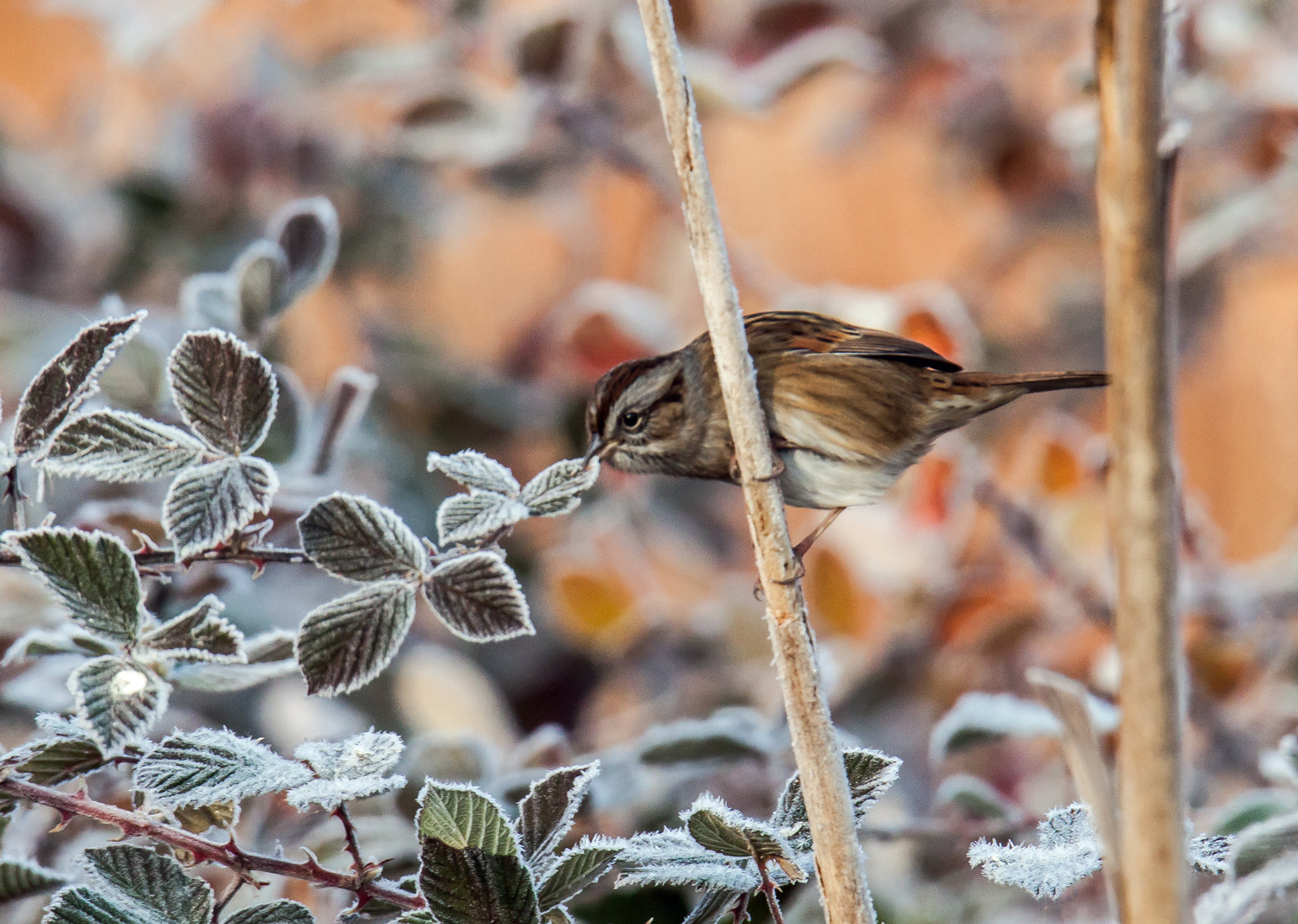
It was really frosty yesterday morning in the back area of Huntley Meadows Park where I spotted this Swamp Sparrow (Melospiza georgiana). I was standing in a mostly dried-up marshy area and noted that a series of little birds would stop at a little patch of vegetation in the middle as they pecked about in the cattails and denser vegetation at the tree lines on either side of me.

I parked myself with my monopod far enough away from the vegetation that I hoped that I would not disturb the birds and eventually the birds began to return to the area on which I was focused. There were a lot of small branches that kept misleading my auto-focus, so I switched to manual focus and waited. I could see birds pretty frequently, but most remained partially hidden down low near the ground.

Eventually my patience was rewarded and I got these two shots of a little sparrow.  I wasn’t sure what kind of sparrow it was, but got some assistance on-line and learned that it was a Swamp Sparrow.

The background looks a little unusual in terms of the coloration, but it is a pretty good reflection of what I was seeing. That is also the reason why I was willing to plant myself in one spot—generally I like to keep moving as I look for photo opportunities.

Swamp Sparrow

Swamp Sparrow

© Michael Q. Powell. All rights reserved.

Read Full Post »

In the interests of gender equality, I decided to feature a handsome male Hooded Merganser duck (Lophodytes cucullatus) after spotlighting his beautiful female counterpart yesterday. I captured this image yesterday afternoon at a small suburban pond in Kingstowne, a community about a mile or so from where I live.

Hooded Merganser ducks are notoriously skittish and will usually fly away as soon as they sense my presence. The small group of “Hoodies” at this pond, however, react by swimming slowly away toward the center of the pond, where they are out of range of my long telephoto zoom lens. As a result, I have to react quickly whenever I am luck enough to catch one relatively close to the shore.

Hooded Merganser

Having captured this image, I was faced with choices of how to crop it. Conventional wisdom dictates that a bird swimming to the right should be placed in the left side of the image. In this case, though, I really liked the V-shaped wake that the duck was leaving behind it, so I put the “Hoodie” just to the right of center. I encourage you to double-click on the image to see some of the details of this shot, like the drop of water on the tip of the duck’s bill.

As I contemplate the image, I can’t help but think how much the water deserves equal billing as the primary subject. I love the wake in the rear, the ripples in the front, the ripples coming toward the viewer, and the beautiful reflections.

© Michael Q. Powell. All rights reserved.


Read Full Post »

Hooded Mergansers (Lophodytes cucullatus) are among my favorite ducks, and I especially love the freaky hairstyle of the females, like this one that I spotted this past Friday at the a small pond in Kingstowne, a suburban community in Northern Virginia near where I live.

Hooded Merganser

© Michael Q. Powell. All rights reserved.


Read Full Post »
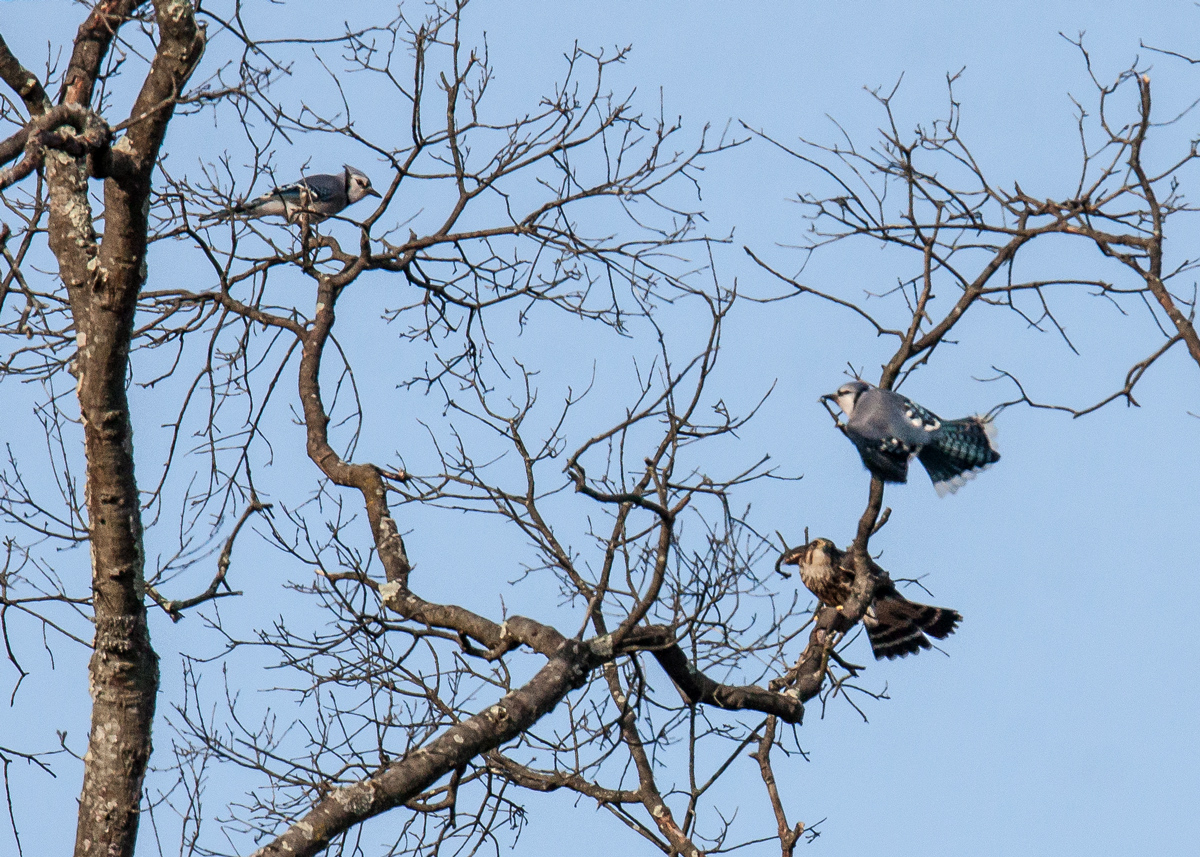
I really enjoy capturing action sequences of the interaction between creatures in the wild. It’s not easy sometimes to explain the behavior that I observe, but often it seems that many wild creatures have a sense of territoriality and will fiercely defend their space against all encroachers.

That seems to have been the case on Thanksgiving Day when I observed two Blue Jays (Cyanocitta cristata) harassing a Merlin (Falco columbarius) at Huntley Meadows Park in Northern Virginia. I have seen blackbirds and crows in the past harassing eagles and hawks and have been shocked to see how much smaller the aggressors were than the birds they were chasing. In this case, however, the blue jays and the merlin appeared to be about the same size.

The blue jays appeared to be using a variety of techniques. The two shots below show one of the blue jays buzzing the merlin, flying surprising close to the little falcon.

blue jays and merlin

blue jays and merlin

The next three shots show a concerted effort to crow the merlin. Initially the blue jays positioned themselves on opposite sides of the merlin. Then one of the blue jays moved closer, to a position almost directly below the merlin. In the final shot, the merlin exploded into the air and one of the blue jays simultaneously took off to chase after the merlin.

I took these shots from quite a distance away and still had to crop them a lot, but I think the images still manage to show some pretty fascinating behavior that I was privileged to observe and document.

blue jays and merlin

blue jays and merlin

blue jays and merlin

© Michael Q. Powell. All rights reserved.

Read Full Post »

When I saw this bird in the distance being harassed by two blue jays on Thanksgiving Day at Huntley Meadows Park, I wasn’t sure what it was, but folks at What’s This Bird Facebook group identified it for me as a Merlin (Falco columbarius), a type of small falcon. I shot quite a few photos attempting to pbotograph the two blue jays flying by the merlin and perching close to it, but I am not sure how well I was able to capture the action. If I get a few that are reasonably clear, I may do another posting with the merlin, a bird that I believe that I had previously seen only once before.

Merlin

Merlin

© Michael Q. Powell. All rights reserved.

Read Full Post »

Early on Thanksgiving morning, some Northern Pintail ducks (Anas acuta) at Huntley Meadows Park in Northern Virginia decided to celebrate the holiday by sleeping in a bit. Their decision may have been prompted in part by the weather—it was just below freezing and a thin layer of ice covered some of the water at the park. Unlike the ducks, I did not sleep in and ventured out into the frosty morning to see what I could discover.

Happy Thanksgiving to all those who are celebrating this special day. Even if you are not, it’s always a good idea to pause for a minute to remember all of the blessings in our lives that so often we take for granted.

Northern Pintail

© Michael Q. Powell. All rights reserved.

Read Full Post »

I have always admired the fierce determination and intense focus of little Downy Woodpeckers (Picoides pubescens) as they hammer away at the trees in search of something to eat, like this beauty that I spotted this past Monday at Occoquan Bay National Wildlife Refuge.

Downy Woodpecker

© Michael Q. Powell. All rights reserved.

Read Full Post »

Seeing one Bald Eagle (Haliaeetus leucocephalus) is pretty exciting, but seeing two together is even more awesome. I spotted these two eagles on Monday morning at Occoquan Bay National Wildlife Refuge.

At a certain location within the refuge there is a tall pole, which resembles a telephone pole, with a wooden platform. I am not sure of its purpose, but several times in the past I have seen a bald eagle perching on it. I have tried several times to get shots of the eagle, but have generally been unsuccessful, because of the height of the pole and the fact that I cannot get close to it.

When I spotted an eagle there yesterday morning, I decided to give it another shot, hoping that my monopod would help me to get a sharp enough shot to survive a severe crop. As my eye was pressed to the viewfinder taking some shots, imagine my surprise when another bald eagle entered the frame and landed next to the first one. They perched together for a little while and then the larger of the two, which I later learned is the female, began to embrace the other, eventually using her beak to give what looked like a kind of massage. What was going on?

Thanks to some experienced birders in a Facebook group, I learned that the breeding season for eagles in our area begins in early December and that this is likely a bonded pair. I also discovered that the pecking that I observed, as seen in the second photo below, is almost certainly a kind of courting behavior.

I think that there may be several pairs of bald eagles at this wildlife refuge, so I will keep my eyes open for more of this kind of behavior and for more photographic opportunities.

Bald Eagle

Bald Eagle

© Michael Q. Powell. All rights reserved.


Read Full Post »
I spotted this very blue Eastern Bluebird (Sialia sialislast Friday morning at Huntley Meadows Park. The brightness of its color suggests to me that it is probably a male—the females tend to have duller plumage.

When I posted this photo on Facebook, I got lots of “Likes,” which is not all that surprising to me. Over time I have come to realize that many of my best-like photos have been the ones with the simplest of compositions and often have featured relatively common subjects. In this case, I managed to capture the bluebird pretty well, but the branch on which it is perched has some nice texture and perhaps most important of all, the background is pretty cool, with the faint shapes of the tree trunks and autumn foliage rendered in a pleasing blur of shapes and colors.

Beauty is often very subjective, but in rare cases like this one an image seems to have an almost universal appeal.


Eastern Bluebird

© Michael Q. Powell. All rights reserved.

Read Full Post »

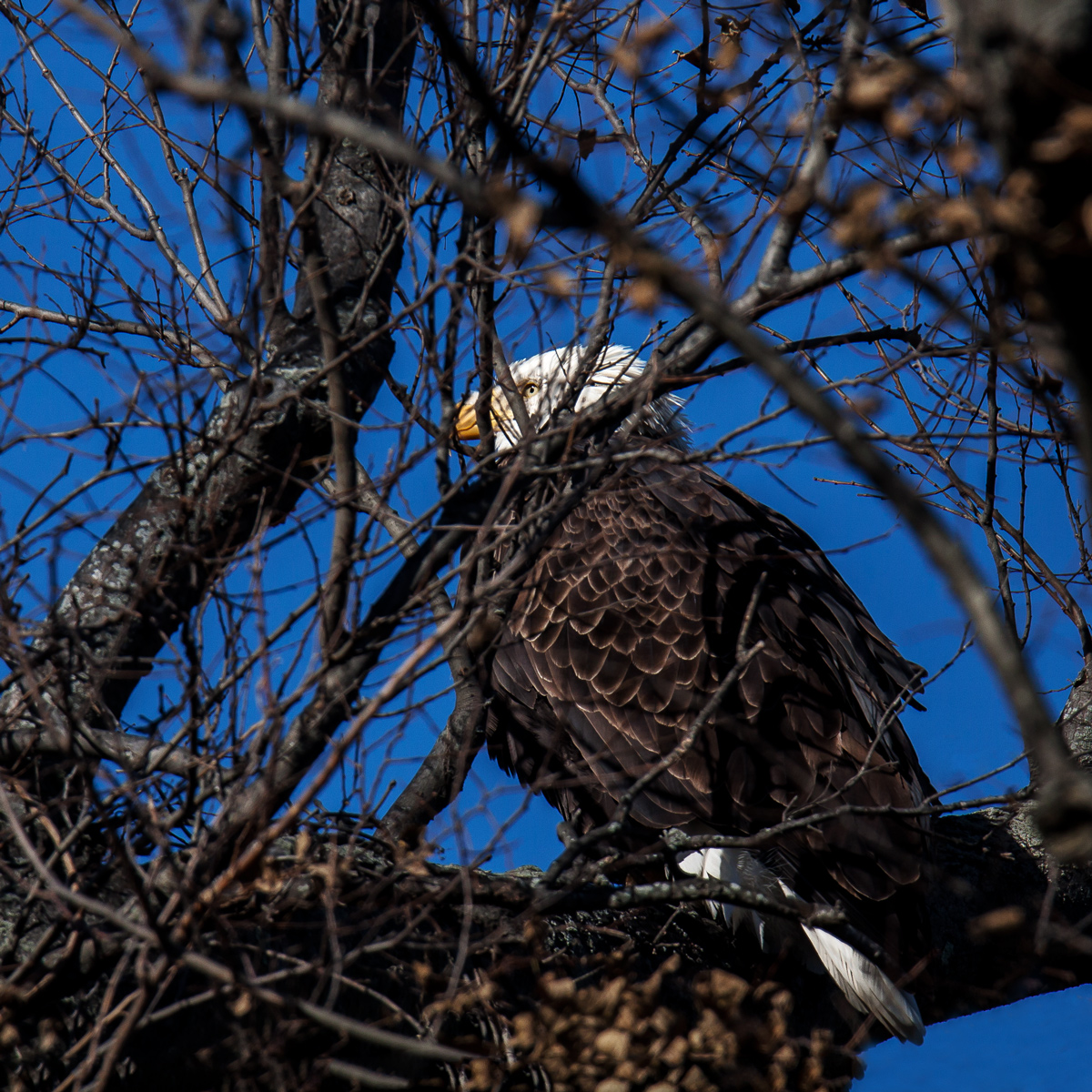
It’s almost impossible to sneak up on a Bald Eagle (Haliaeetus leucocephalus), but that didn’t stop me from attempting to do so this past Friday afternoon at Occoquan Bay National Wildlife Refuge. I was walking along a trail that runs to parallel to the water when I spotted the unmistakable white head of a Bald Eagle. The eagle was partially hidden in a mass of branches and was facing away from me, so I moved forward with as much stealth as I could manage.

When I reached a point where I was shooting up at a rather steep angle, I stopped and waited, hoping the eagle would turn its head to the side and offer me a glimpse of its eyes. Eventually that happened and I shifted from side to side in a desperate attempt to capture an unobstructed view of its eye. Clearly this is not the best shot of a Bald Eagle that I have ever captured, but I do like the pose and the details in its feathers. Besides, it’s a Bald Eagle, a subject that never fails to excite me.

Bald Eagle

© Michael Q. Powell. All rights reserved.

Read Full Post »

I spotted some cute little American Goldfinches (Spinus tristis) early on Friday morning as they foraged in the vegetation adjacent to the observation tower at Huntley Meadows Park. The lighting was somewhat limited, but it was soft and beautiful and gives the photos an overall sense of peace and serenity, the start of a new day.

American Goldfinch

American Goldfinch

© Michael Q. Powell. All rights reserved.

Read Full Post »

A group of five or so photographers stood on the boardwalk on Friday morning at Huntley Meadows Park watching a Red-shouldered Hawk (Buteo lineatus) in a tree above us. We waited and waited for the hawk to take off and when it finally did so, I almost managed to keep the hawk within the frame. I can’t really complain too much, though, because as far as I know, none of the others managed to get a shot off when the hawk took to the air.

We were in a really good position and the lighting was beautiful, but it is hard to remain alert and ready as you wait for a bird to spring into action. I was using a monopod again and I think it may be the reason why I was able to capture the hawk taking off. My camera was already at eye level and pointed in the direction of the hawk during the entire fifteen minutes or so that we watched the hawk. The other photographers had to raise their cameras and were not able to do so quickly enough.

It might be my imagination, but I also think that some of my shots with the monopod are sharper than they might otherwise be. I have balked a bit at carrying a big tripod, but think that the monopod will now be with me most of the time—it collapses to a pretty small size and, because it it carbon fiber, is both sturdy and light.
Red-shouldered Hawk

Red-shouldered Hawk

© Michael Q. Powell. All rights reserved.

Read Full Post »

« Newer Posts - Older Posts »