Feeds:
Posts
Comments

Archive for the ‘Autumn’ Category

Common Whitetail dragonflies (Plathemis lydia) are among the first dragonflies to appear in our area in the spring and among the last to disappear in the fall. They thrive in a wide variety of habitats and are probably our most frequently seen and easily identified dragonfly—the name “common” seems to fit quite well.

Despite their ubiquitousness, I enjoy trying to photograph these little dragonflies whenever I can. Many of my photos are almost carbon copies of previous photos (you have to pretty old to remember carbon copies), but sometimes I manage to capture an image that is different and distinctive. At times I can envision such a moment when I am out in the field, but often I discover that things “clicked” only when I am examining the images on my computer.

I captured this image of a female Common Whitetail last Tuesday at Occoquan Bay National Wildlife Refuge. The dragonfly had been perching on the ground, as dragonflies of this species are wont to do, and flew up to a precarious perch on a bent stalk of vegetation. She was not there long, but it was enough time for me to snag this shot. For me, it is the wonderful twisting curve of the vegetation that makes the shot work so well as an “artsy” environmental portrait of a Common Whitetail dragonfly.

Common Whitetail

© Michael Q. Powell. All rights reserved.

Read Full Post »

A bee and a flower—it’s such a simple, yet beautiful composition. I photographed this Eastern Carpenter Bee (Xylocopa virginica) on a globe thistle flower this past Tuesday in the garden of my neighbor and dear friend Cindy Dyer.

Some folks might suffer a little cognitive dissonance when they look at the flower in the photo and hear the name “globe” thistle. I thought about renaming it “hemisphere thistle” for the purposes of the picture.  🙂

Beauty is everywhere.globe thistle

© Michael Q. Powell. All rights reserved.
Read Full Post »

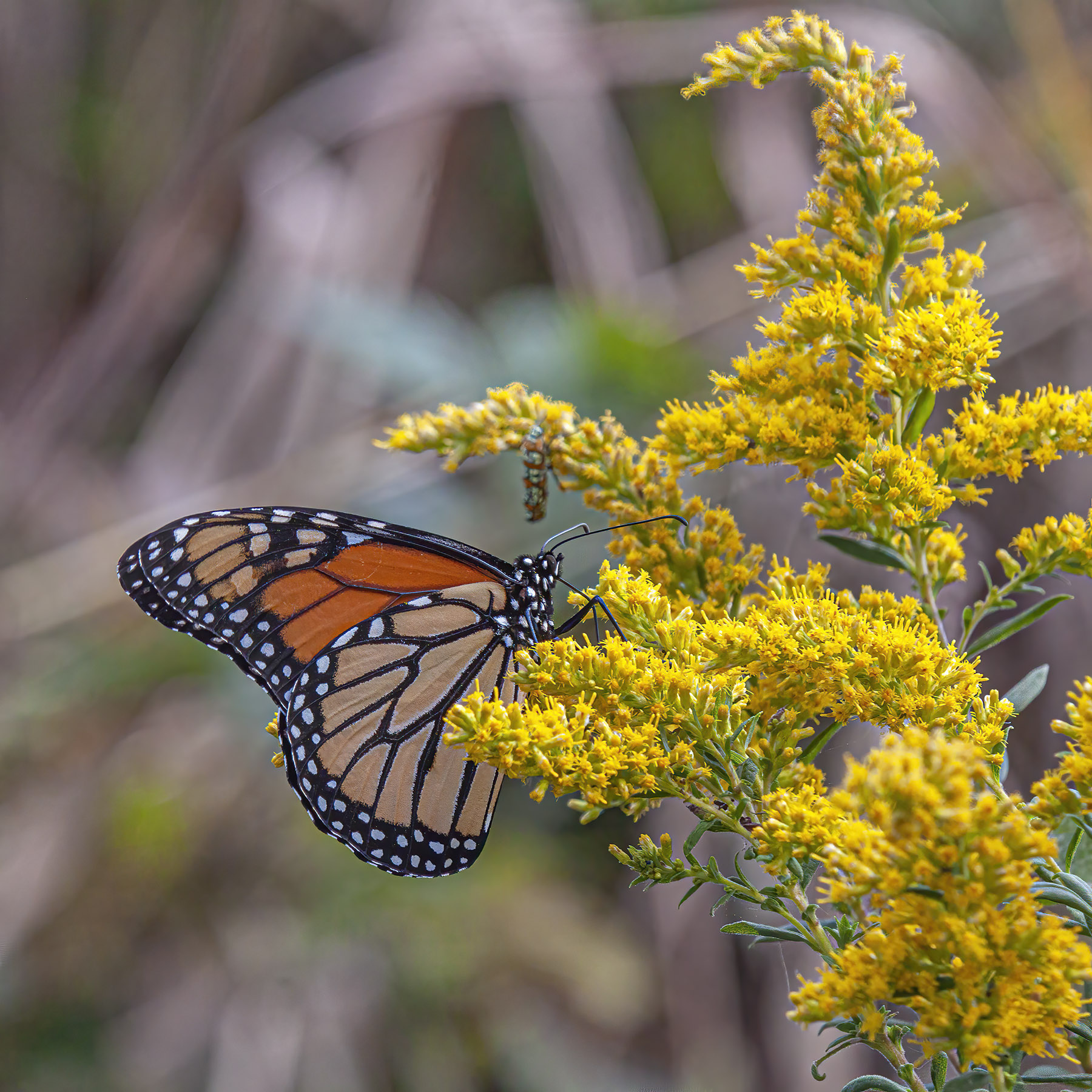
Have Monarch butterflies (Danaus plexippus) started their migration southward? I thought that they were already gone from my area, but was delighted to spot this one on Tuesday at Occoquan Bay National Wildlife Refuge in a newly blooming patch of goldenrod.

Is this butterfly a bit behind schedule? Perhaps this is a butterfly that started its migration journey from a point farther north and stopped in for a snack. Whatever the reason for its presence, my spotting of this beautiful butterfly added a colorful highlight to my day.

Keep your eyes open and look expectantly for colorful highlights in your own daily lives. That sense of joyful expectation will have a positive influence on your entire day.

Monarch butterfly

© Michael Q. Powell. All rights reserved.


Read Full Post »

Humans shed skin cells all of the time—according to one source, in one year, each of us sheds more than 8 pounds (3.6 kg) of dead skin. Snakes have an entirely different shedding process. Several times a year they grow a complete new layer of skin underneath the old layer. During shedding, snakes secrete a fluid to help separate the old skin from the new, and this fluid runs under their specialized eye caps, resulting in the opaque or blue quality of the eye.

Last Friday I encountered one of these blue-eyed snakes while exploring Occoquan Bay National Wildlife Refuge. Snakes are vulnerable during this stage when their vision is impaired and I was a little surprised to see this snake was in a fairly open area. I think this may be an Eastern Ratsnake (Pantherophis alleghaniensis), but did not examine the snake at length for fear of disturbing it.

Moving as stealthily as I could, I leaned in with my macro lens to capture this image. If you look carefully into the eye (or double-click on the image to enlarge it) you will see that I managed to capture a “selfie” reflection.

As an interesting coincidence, my most viewed posting of 2020 has been a May 2016 posting that also featured a snake with a blue eye. That posting, entitled Blue-eyed garter snake, has had 597 views so far this year. If you are not totally creeped out by today’s photo, you might want to check out the 2016 posting, which has some full body shots as well as a close-up shot of the snake’s head.

Eastern Ratsnake

© Michael Q. Powell. All rights reserved.

Read Full Post »

How flexible are you? I used to run marathons and, like most runners, I am not very flexible. I marvel at ordinary people who can bend down and touch the floor while keeping their knees straight and am utterly fascinated when I watch gymnasts and acrobats. Several years ago I attended a Cirque de Soleil performance and was mesmerized the entire time.

I don’t think of grasshoppers and katydids as being particularly flexible—their outer shell seems rigid and armor-like. Imagine my surprise and delight when I stumbled upon this flexible female Handsome Meadow Katydid (Orchelimum pulchellum) last week at Occoquan Bay National Wildlife Refuge. Normally her ovipositor, the yellow scimitar shaped appendage at the end of her abdomen, faces to the back. In this case, though, she has arched her back so much that the tip of the ovipositor extends further forward than her head.

What is she doing? I think that she is somewhere in the process of depositing eggs. I do not know exactly how that works, but a University of Arkansas website described the ovipositing for a similar katydid with these words, “An ovipositing female embraces a plant stem with her prothoracic and mesothoracic legs and brings the curved and sword-like ovipositor far forward so its tip can scrape the substrate.” There are a lot of unfamiliar scientific words there, but I think I get the gist of what is going on.

I do not recall photographing this process before, but a search of my blog revealed that, in fact, I captured a series of images in a September 2013 posting entitled “Rainbow katydid depositing eggs?“. Be sure to check out that earlier posing for more fascinating photos of a flexible katydid.

Handsome Meadow Katydid

© Michael Q. Powell. All rights reserved.

Read Full Post »

The weather has turned cooler, but traces of summer still remain, like this tiny Summer Azure butterfly (Celastrina neglecta) that I spotted last Wednesday at Occoquan Bay National Wildlife Refuge. The Azure butterflies are among the smallest butterflies in our area, with a wing span of just over one inch (25 mm). My current approach is to shoot any insect that I can find—it won’t be long before they are all gone and I will change to a longer lens and focus primarily on birds.

Summer Azure

© Michael Q. Powell. All rights reserved.

Read Full Post »

At this time of the year, the vegetation is thick and the leaves are still on the trees, so it is hard for me to spot birds. Of course, it is a bit easier when the birds are large in size, like this Great Blue Heron (Ardea herodias) that I spotted amidst the reeds and lily pads this past Wednesday at Occoquan Bay National Wildlife Refuge.

The heron did not show any signs that it was actively hunting, but with herons, it is hard to tell—they will stand for lengthy periods of time in a single spot and then strike suddenly and violently. As a photographer, it is tough for me to have that same amount of patience and vigilance. After a reasonable amount of waiting, I will often move on, as I did here, and leave the heron peacefully in place.

Great Blue Heron

© Michael Q. Powell. All rights reserved.


Read Full Post »

This year has been full of question marks as our lives have been turned upside down by the pandemic and so many of those questions have gone unanswered. Somehow, then, it seemed appropriate that I spotted this Question Mark butterfly (Polygonia interrogationis) on Tuesday when I was exploring Occoquan Bay National Wildlife Refuge.

At this time of the year, when the leaves are turning brown and falling to the ground, this butterfly blends in well with its surroundings. This butterfly, however, did not seem interested in blending in and chose instead a rocky surface to help highlight the irregular shape of its wings. Normally Question Marks are more opaque in their brown coloration, but the sun was illuminating the wings from behind and gave us a hint of the beautiful orange interior and distinctive markings of this butterfly—I love it when internal beauty shines through.

Question Mark butterfly

© Michael Q. Powell. All rights reserved.

Read Full Post »

Nature sometimes saves the best for last. Many dragonflies that have kept me company through the long, hot days of summer have started to disappear. The appearance in autumn of the spectacularly colored male Blue-faced Meadowhawk dragonfly (Sympetrum ambiguum) compensates in part for this sense of loss.

I spotted this handsome dragonfly on Wednesday as I was exploring Occoquan Bay National Wildlife Refuge. I hope to be seeing this species for another month or so and also its “cousin,” the Autumn Meadowhawk, which has a similarly colored body but has brown eyes. 

Blue-faced Meadowhawk

© Michael Q. Powell. All rights reserved.

Read Full Post »

Most of the butterflies that I have photographed this season have been in sunny fields, where they are attracted to wildflowers or other blooming vegetation. Last week while photowalking in Occoquan Bay National Wildlife Refuge, I was thrilled to spot a butterfly that prefers a marshy woodland and captured this image of an Appalachian Brown butterfly (Satyrodes appalachia).

The colors of this butterfly species are quite subdued, when compared with those of a Monarch or an Eastern Tiger Swallowtail, but I love the beautiful brown-on-brown patterns on the wings and the distinctive-looking series of eye spots. There are several similar butterflies with slightly different arrangements of eyespots. I am relatively confident that this one is an Appalachian Brown butterfly, but there is a chance that it is an Eyed Brown butterfly (Satyrodes eurydice).

As always, I defer to those with greater expertise in identification—I have been humbled multiple times when I have confidently made an identification and have been absolutely wrong.

Appalachian Brown

© Michael Q. Powell. All rights reserved.

Read Full Post »

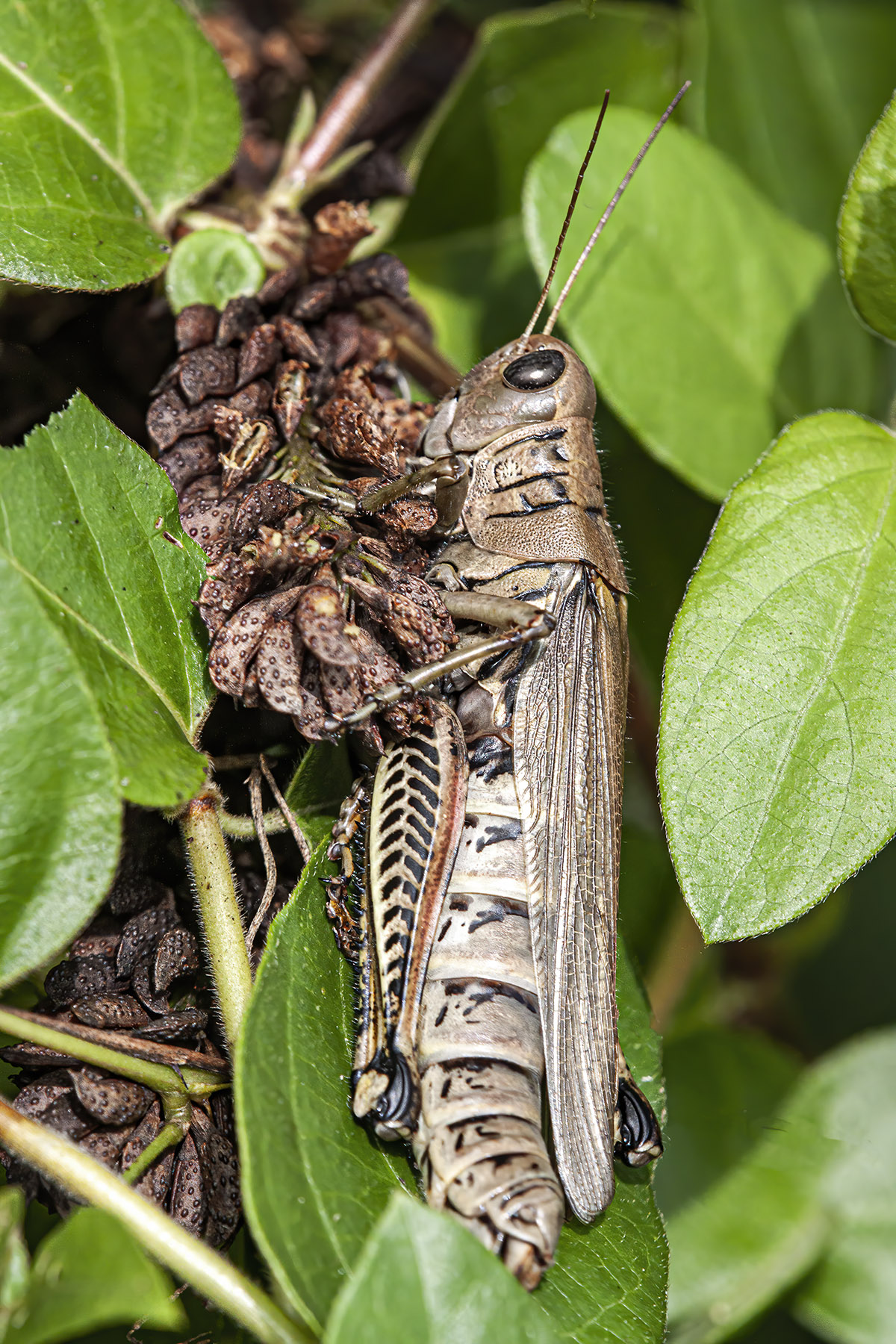
When I first spotted this large grasshopper last week at Occoquan Bay National Wildlife Refuge it was so still that I was not sure that it was alive. I gently rustled the vegetation and the grasshopper moved a little, so I knew that it was not dead. As I watched, I could see its mouth moving and I think that it might have been eating, which might explain why it was distracted and did not immediately fly away. The first photo was an unsuccessful attempt to determine what the grasshopper was eating.

I am not very good at grasshopper identification, but my friend Walter Sanford, with whom I was hunting for dragonflies, knew that it was a Differential Grasshopper (Melanoplus differentialis). The prominent chevrons on the hind femur are apparently one of the identification features for this species.

differential grasshopper

differential grasshopper

© Michael Q. Powell. All rights reserved.
Read Full Post »

Roses are red and bluets are blue, except when the bluets are damselflies, when they might be a different color. Last week while photowalking at Occoquan Bay National Wildlife Refuge, fellow dragonfly enthusiast Walter Sanford pointed out this Orange Bluet damselfly (Enallagma signatum) that was perched in a tree just above eye level. As he pulled back a branch that was blocking my view, I was able to get this unobstructed shot of the beautiful little damselfly.

You might think that the bright coloration of this damselfly would make it easy to spot, but Orange Bluers are small, less than an inch and a half (38 mm) in length, and elusive. I am lucky if I manage to spot a couple of them during an entire season, so I was thankful for Walter’s sharp eyes.

This Orange Bluet, I think, would make a good mascot for the autumn season, when oranges and browns begin to dominate the natural and manmade landscape and the stores are filled with decorations for Halloween and Thanksgiving. I suspect that some stores are already starting to decorate for Christmas, but I am not ready to give up on the waning moments of summer—for some of us, tomorrow is the autumnal equinox, the first day of fall.

Orange Bluet

© Michael Q. Powell. All rights reserved.


Read Full Post »

Spiders are really cool and I always marvel at the elaborate webs they weave out of material from their own bodies. Almost all my shots of Black and Yellow Garden Spiders (Argiope aurantia) have been taken from the front, primarily because the webs are generally in inaccessible locations. However, the placement of this spider’s web that I spotted recently at Occoquan Bay National Wildlife Refuge allowed me to view and photograph it from this unusual side angle.

It is always fun to play around and attempt to capture images of a subject from multiple perspectives. In this case, the spider was cooperative and I was able to capture this cool little portrait.

Argiope aurantia

© Michael Q. Powell. All rights reserved.

Read Full Post »

Sometimes I can get an indication of the species of a dragonfly by the way that it perches. Most skimmer dragonflies, the family of dragonflies that you are most likely to see, perch horizontally, sometimes on the ground or on vegetation. Other species perch vertically, hanging from vegetation. Finally, there are some dragonflies that never seem to perch and spend most of their time patrolling in the air—when they do take a break from flying, they often perch high in the tree canopy, where they are extremely hard to spot.

Stylurus is a genus of dragonflies whose members are commonly known as “Hanging Clubtails,” because of their habit of hanging nearly vertically when they perch. This past Tuesday I was thrilled to spot a male Russet-tipped Clubtail dragonfly (Stylurus plagiatus), one of the “Hanging Clubtails,” during a visit to Occoquan National Wildlife Refuge with fellow dragonfly enthusiast Walter Sanford.

During this summer I have been blessed to spot Russet-tipped Clubtails several times at two separate wildlife refuges. As the dragonfly season starts to draw down, it is special to find some of my favorites again, never knowing if it will be the final sighting of that species for the year.

The image below was my second sighting of a Russet-tipped Clubtail in the same general area. A short time earlier I had spotted another male Russet-tipped Clubtail in the trees, but it flew away before I could get any good shots of it. This may well be the same dragonfly, albeit in a different perch.

If you look closely at the image below you can see how the dragonfly is clinging to the leaf and hanging almost vertically. You can also note the prominent “club” that makes it easy to identify as a clubtail dragonfly and the terminal appendages (the shape at the end of the abdomen) show that this is a male. As you can imagine, dragonflies that perch this way are hard to spot—if they don’t move, it is easy to miss them.

Our weather has turned cooler now as we move deeper into autumn (or will begin it soon, depending on which calendar you use for the seasons). It is premature to start a countdown for the dragonfly season, but already I am noting diminishing numbers of certain species. Will I see another Russet-tipped Clubtail this season? If I am lucky, perhaps there will be another. For now I will simply say au revoir—one of the French ways of saying good-bye , with a literal meaning  of “until we meet again.”

Russet-tipped Clubtail

© Michael Q. Powell. All rights reserved.

Read Full Post »

I always feel like I am being hypnotized when I stare into the giant center eyes of a jumping spider. Resistance is futile when I try to look away—I am irresistibly drawn back to those mesmerizing eyes.

I spotted this really cool-looking Bronze Jumping Spider (Eris militaris) on Tuesday when I was photowalking at Occoquan Bay National Wildlife Refuge with my friend Walter Sanford. I was thrilled to spot this little spider perched atop of some waist-high vegetation. I had to move in close, though, to be sure that this was in fact a jumping spider, because the bodies of Bronze Jumping Spiders are only a bit over a quarter of inch (6-8 mm) in length.

The little spider was not jumping, but it was moving around a lot, which made it quite a challenge to photograph at such close range. However, that meant that I was able to get shots from multiple angles without having to change my shooting position, as you can see in the photos below.

I often encourage readers to double-click on the images to see the details of the subject and think that it is especially beneficial to do so with these images. You will be able to see the fascinating arrangement of the spider’s eyes—I think there are eight eyes—and the reflection of the sky and the landscape in the large front eyes.

My favorite photo is undoubtedly the first one. I love the direct view into the eyes of the jumping spider and its combative pose that reminds me of a sumo wrestler at the start of a match. Was the spider challenging me?


Bronze Jumping Spider

Bronze Jumping Spider

Bronze Jumping Spider

© Michael Q. Powell. All rights reserved.

Read Full Post »

What’s my favorite insect? If I were to do a survey of readers of this blog, I am confident that most would say that my favorite insect would have to be one of the many dragonflies that I regularly feature here. I do love dragonflies and spend endless amounts of time during the warm months photographing them, but if I had to choose one favorite insect, it would not be one of them—it would be the Handsome Meadow Katydid (Orchelimum pulchellum).

I remember my sense of amazement the first time that I spotted one of these multi-colored beauties. I literally could not believe my eyes and it was love at first sight. To this day, I never fail to be mesmerized by the neon colors and the blue eyes of the Handsome Meadow Katydid. Love is love—when we are smitten, words somehow are inadequate to explain our feelings.

I spotted this beautiful female Handsome Meadow Katydid on Tuesday while photowalking at Occoquan Bay National Wildlife Refuge with fellow dragonfly enthusiast Walter Sanford. You can tell that this one is a female because of the yellow scimitar-shaped appendage at the tip of the abdomen that is an ovipositor used to deposit eggs on plants.

I really like the the ways that the colors of the katydid are repeated in the background and the repeated pattern of the vegetation leads the eye and somehow manages to be unobtrusive. All in all, it seems to be the perfect backdrop for the appropriately-named Handsome Meadow Katydid, my favorite insect.

Handsome Meadow Katydid

© Michael Q. Powell. All rights reserved.

Read Full Post »

I spotted this beautiful Red-spotted Purple butterfly (Limenitis arthemis astyanax) last Friday at Occoquan Bay National Wildlife Refuge. When I first saw it flying around, I thought it might be one of the many dark swallowtail species that we have in our area. When the butterfly finally landed, however, I could see that it had no “tails,” not because it was damaged, but simply because it is not a swallowtail butterfly.

The name of this species has always confused me a bit. When I look at the image below I can see some red spots, but for the life of me I don’t see anything that looks purple. Nonetheless, I love the varying shades of blue on the butterfly’s body and the little red accents.

Red-spotted Purple

© Michael Q. Powell. All rights reserved.

Read Full Post »

It is always enjoyable to observe these fuzzy little Eastern Cottontail rabbits (Sylvilagus floridanus) when I am out walking the trails at Occoquan Bay National Wildlife Refuge. This one was suddenly alert as I was getting ready to take this shot and may have detected my presence. From a photographic perspective, I like the shot much better when its head is lifted up than when it is grazing, which is what the rabbit was doing most of the time that I observed it.

If you double-click on the image to see more details, be sure to look into the rabbit’s eye, where you can see a pretty reflection of the

Eastern Cottontail

© Michael Q. Powell. All rights reserved.


Read Full Post »

During my recent trips to Occoquan Bay National Wildlife Refuge I have been seeing a lot of Wild Turkeys (Meleagris gallopavo). Most of the time they have been in small groups, but occasionally I will run across one that seems to be alone or maybe simply separated temporarily from its group.

In the first photos, you will notice the long “beards” of two of the turkeys, which suggest that they are mature males. Generally flocks of turkeys are separated by gender and by age, so these may all be mature males, though the one on the left looks to be smaller than the other three, though that might simply be a factor of the viewing angle. The turkey in the second photo has a shorter “beard” and may be a jake, the term used for an immature male turkey.

It is interesting to watch wild turkeys. They seem slow and deliberate in all that they do, strutting and poking about for food. Even when they are spooked, they don’t accelerate quickly as most birds do, but instead they slowly fade into the underbrush.

Wild Turkey

Wild Turkey

© Michael Q. Powell. All rights reserved.


Read Full Post »

As I was going through my photos again from last week I came upon this image of an Autumn Meadowhawk dragonfly (Sympetrum vicinum) that I had spotted at Occoquan Bay National Wildlife Refuge. I already posted another shot of this dragonfly species from that day, but I like this shot even more, because it shows some of the details of the leaves on which the little red dragonfly was perched. I think the leaves help to give a better sense of the environment and emphasize the “autumn” in the name of the species.

Autumn Meadowhawk

© Michael Q. Powell. All rights reserved.

Read Full Post »

At this time of the year I have to work hard to get photographs of birds. If I am lucky, I will spot a Bald Eagle or another raptor, but most of the time I walk slowly down the trails, looking and listening for small birds. I know that they are there, but even with the leaves gone from most of the trees, the birds often remain hidden from view.

One of my favorites is the White-throated Sparrow (Zonotrichia albicollis), like this one that I spotted last week at Occoquan Bay National Wildlife Refuge. Maybe it is the effect of the season, but this sparrow always makes me think of Santa Claus. With the white “beard” and the distinctive yellow stripe over the eye, this sparrow is also relatively easy to identify, a real plus considering how many sparrow species are similar in appearance to each other.

An even smaller bird is the tiny Ruby-crowned Kinglet (Regulus calendula), which is about 4 inches in length (10 cm) and weighs only 0.2-0.3 ounces (5-10 g). This one was bouncing in and out of the vegetation so much that I thought I would never get a clear shot of it. Eventually I was more or less successful. What a sweet little bird.


White-throated Sparrow

Ruby-crowned Kinglet

© Michael Q. Powell. All rights reserved.

Read Full Post »

With the recent onset of cold and rainy weather here in Paris, it is hard to remember that we had a bit of sunshine earlier in the week. As I was walking along the banks of the Seine River during one such sunny period, I grew entranced by the shadows that trees were casting onto the embankment walls. People passing by me must have wondered what I was photographing, given that I was facing a seemingly blank wall and had my back to the river.

The images show mostly skeletal tree forms, but some show evidence of hardy leaves persistently clinging to the branches, not yet ready to fall. If you examine the photos carefully, you can see some of the details and textures of the materials used to build these embankments. Just a few yards above, there is busy world, full of cars and people hurrying about, but here, life moves at a slower pace.

I love too seeing the giant iron rings intermittently embedded in the embankment walls.  These, I believe, are a legacy of past commerce along this river, places where barges would tie up, perhaps for safety or sleep, or simply to silently surveil the scenic surroundings. There are times in our lives when we could all use spots like that.

shadow tree

Shadow Trees on Seine River

© Michael Q. Powell. All rights reserved.


Read Full Post »

We had crazy weather yesterday, with two big rainstorms, intermittent blue skies, and  thunder and lightning. The biggest surprise for me, though, was a hailstorm that dropped a coating of pea-sized hailstones everywhere.

There was such an accumulation of hail that in the first photo it looks almost like snow had fallen on the outdoor seating of the cafe. When I arrived at my apartment, however, I examined the small table on the balcony of “my” apartment up close and could see the individual, spherical hailstones. Wow!

I carefully tried to avoid the patches of hailstorms when walking after I nearly fell—hailstones on cobblestones are a treacherous mix.

Hail to Paris

Hail to Paris


Hail to Paris

© Michael Q. Powell. All rights reserved.

Read Full Post »

After I did the posting called Sunrise on the Seine earlier today, I realized that it did not truly give readers a sense of location. Yes, it was in Paris, and yes, it was on the Seine River. The image was pretty, but it didn’t really speak “Paris.”

I shot a lot of photos this morning as I walked and stopped on the paved pathway down near the water level of the river. I was hoping to be able to capture an image of Notre Dame at sunrise. The angles and timing did not quite work out as I expected. By the time Notre Dame came into view, the sun had already risen a little too high and was directly in front of me.

When sorting through my photos, I initially rejected this image because the bright sun created a hot spot in the image. Later today, I decided to revisit the image and decided I liked it. Why? It has Notre Dame in the frame, of course, but it also shows the effects of the early morning sun as the rays illuminate the boat on the right and the concrete barrier along the pathway.

So, I decided to break my normal pattern and post multiple images today. It’s Paris, after all—I am sure I will be forgiven if I feel extra inspired here.


Notre Dame at sunrise

© Michael Q. Powell. All rights reserved.

Read Full Post »

Evenings in Paris can be magical. Many of the buildings are wonderfully illuminated and it is easy to feel a sense of enchantment. The moon was moving in and out of the clouds yesterday evening as I walked past the Louvre, providing some natural illumination. I managed to capture this two second image of part of the traditional Louvre building by leaning my camera against a railing.

I am gradually getting used to the I. M. Pei glass pyramid that stands in the middle of the traditional courtyard. It was early evening and there were still a lot of people around, preventing me from capturing the simple geometric view I had in mind. In the end I settled for a somewhat closer view that cut off the lower corners of the pyramid.

The final shot is a view of the St Eustache church that is located not far from where I am staying. This church was built between 1532 and 1632 and, according to Wikipedia, its façade is in a Gothic style, while its interior is in the Renaissance and classical styles. I have not yet gone inside it, but definitely plan to do so. I also would love to be able to hear the church’s organ that has 8,000 pipes and is the largest pipe organ in France.

Louvre Museum

Louvre Museum

St Eustache

© Michael Q. Powell. All rights reserved.

Read Full Post »

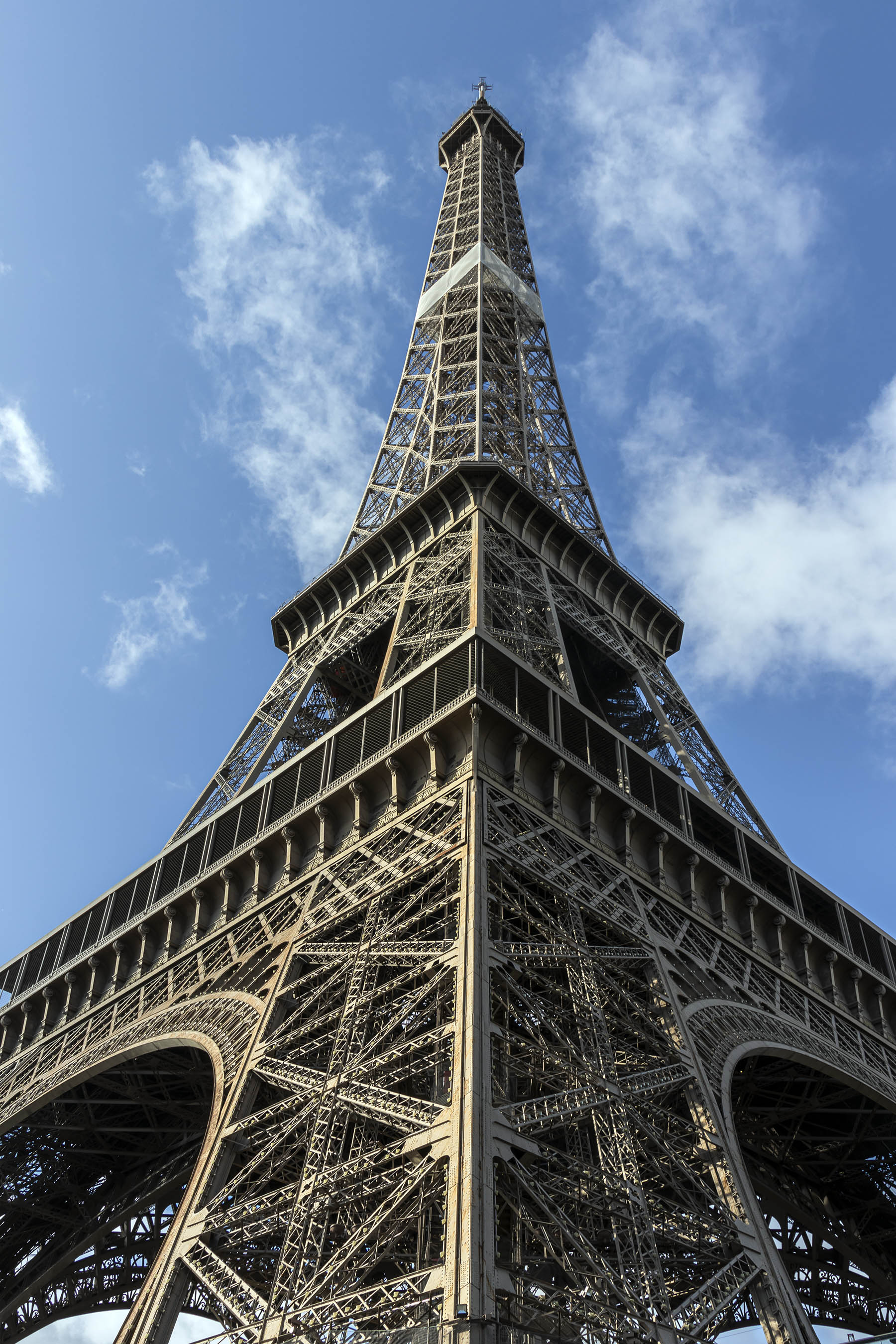
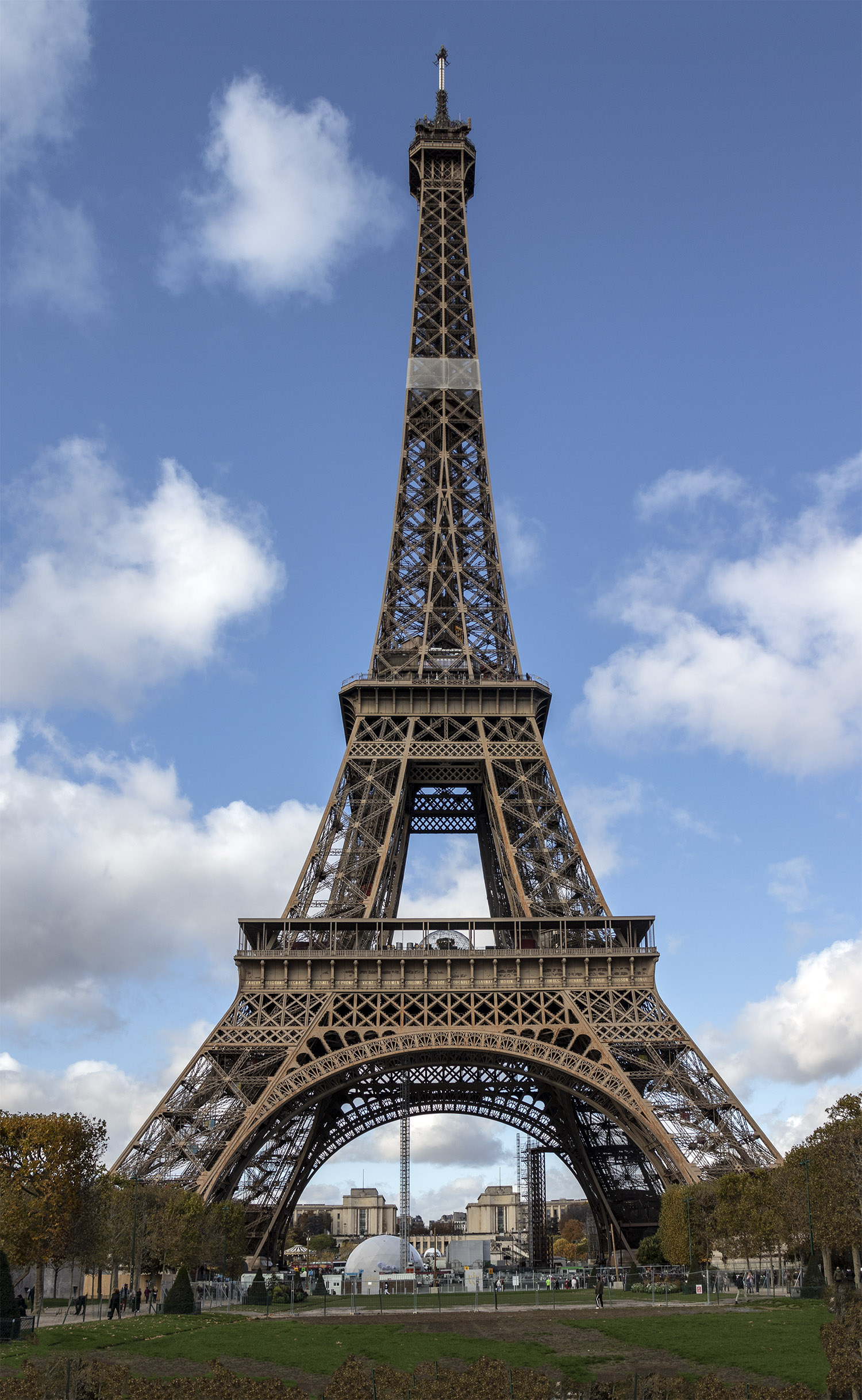
How do you photograph a structure like the Eiffel Tower that is so iconic and so well-known? The first choice is to decide which side of the Seine River you want to be on when taking the photos. You can get some good photos from the hilly area across the river called Trocadéro, or you can stay on the same side as the tower itself. I chose the latter option.

There are some real limitations, because the grassy areas leading away from the tower are fenced off.  If you get far enough away, you can get the traditional full-length shot like the second image below. I personally like to move closer and shoot upwards.

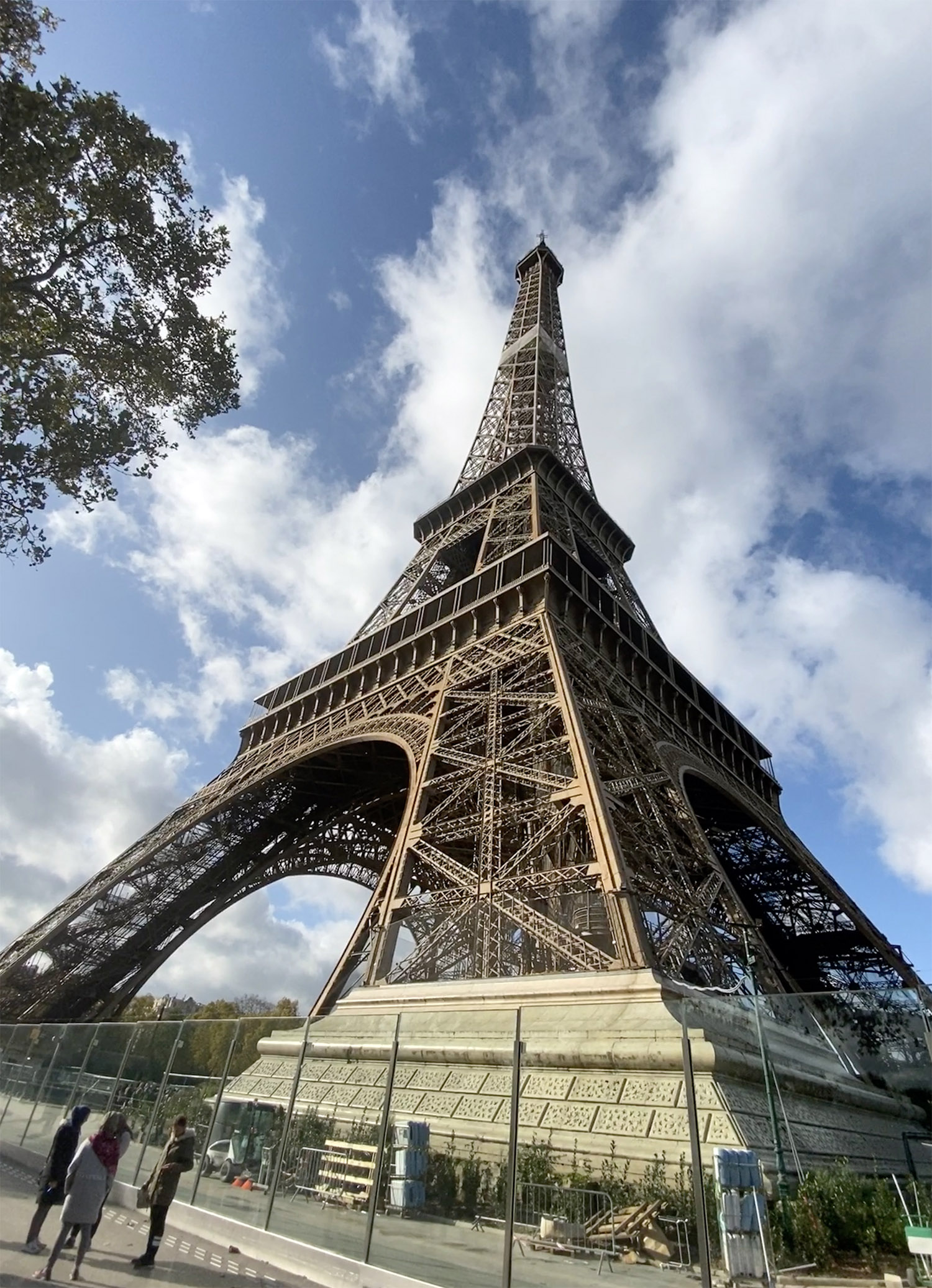
Unfortunately, my favorite angle is no longer available. In 2011 I was able to walk right underneath the tower and shoot direct upwards while standing in the middle of the four legs. Now there are plexiglass barriers surrounding the entire tower that are used to funnel visitors to a single entrance with fees and security checks for those who want to climb the tower or take the elevator.

The first show below is my favorite. I like the angle and was able to wait for the clouds to move into a photogenic position. I took the shot with a DSLR and a zoom lens. Recently, I bought my first real smartphone, an iPhone 11, and during this trip I am learning how to use it. I am still not used to the idea of taking photos with a phone and it feels so unnatural to hold at arms length to take a photo. However, this iPhone has a super-wide mode and I decided to use it to take the final photo. The perspectives are a little distorted, almost like a fisheye lens, but I like the effect.

As you probably have noticed, I am combining the roles of a tourist and a photographer, thinking a lot about my shots as I take them. Unlike most of the tourists I saw yesterday, though, I don’t plan to spend a lot of time taking multiple selfies.

Eiffel Tower

Eiffel Tower

Eiffel Tower

© Michael Q. Powell. All rights reserved.

Read Full Post »

I seem to be having problems recently getting unobstructed views of small birds. Although the leaves are falling from the trees at an increasingly rapid rate, there are still plenty of them to block my view. I have to admit, however, that the colors and texture of the fall foliage can sometimes provide additional visual interest to a shot of a perched bird.

I spotted this Gray Catbird (Dumetella carolinensis) last week at Occoquan Bay National Wildlife Refuge. The catbird’s direct look suggests that he had spotted me too. Normally I do no photograph birds head-on like this, but in this case I like the way that it gives the catbird a comical, almost cartoonish look.

I like to shoot whatever captures my attention and have a hopeful expectation that the images will turn out ok. I have found that most often when I shoot what I like, I like what I shoot.

Gray Catbird

© Michael Q. Powell. All rights reserved.

Read Full Post »

It is normally hard for a male Northern Cardinal (Cardinalis cardinalis) to camouflage itself, but it seemed to blend in pretty well with the brilliant red leaves of these sumac plants last week at Occoquan Bay National Wildlife Refuge.

Northern Cardinal

© Michael Q. Powell. All rights reserved.


Read Full Post »

I thought that the Great Egrets (Ardea alba) had already left our area, so I was pleasantly surprised to see this one on Tuesday at Occoquan Bay National Wildlife Refuge. The egret was perched on the ruins of a duck blind sticking out of the water and spent most of the time that I observed it preening and simply surveying the surroundings.

As I moved about trying to compose the shot, I was fortunate to be able to get an angle in which the colors of the autumn foliage were visible in the background. The autumn colors in my area are somewhat muted, but beautiful nonetheless.

Great Egret

© Michael Q. Powell. All rights reserved.

Read Full Post »

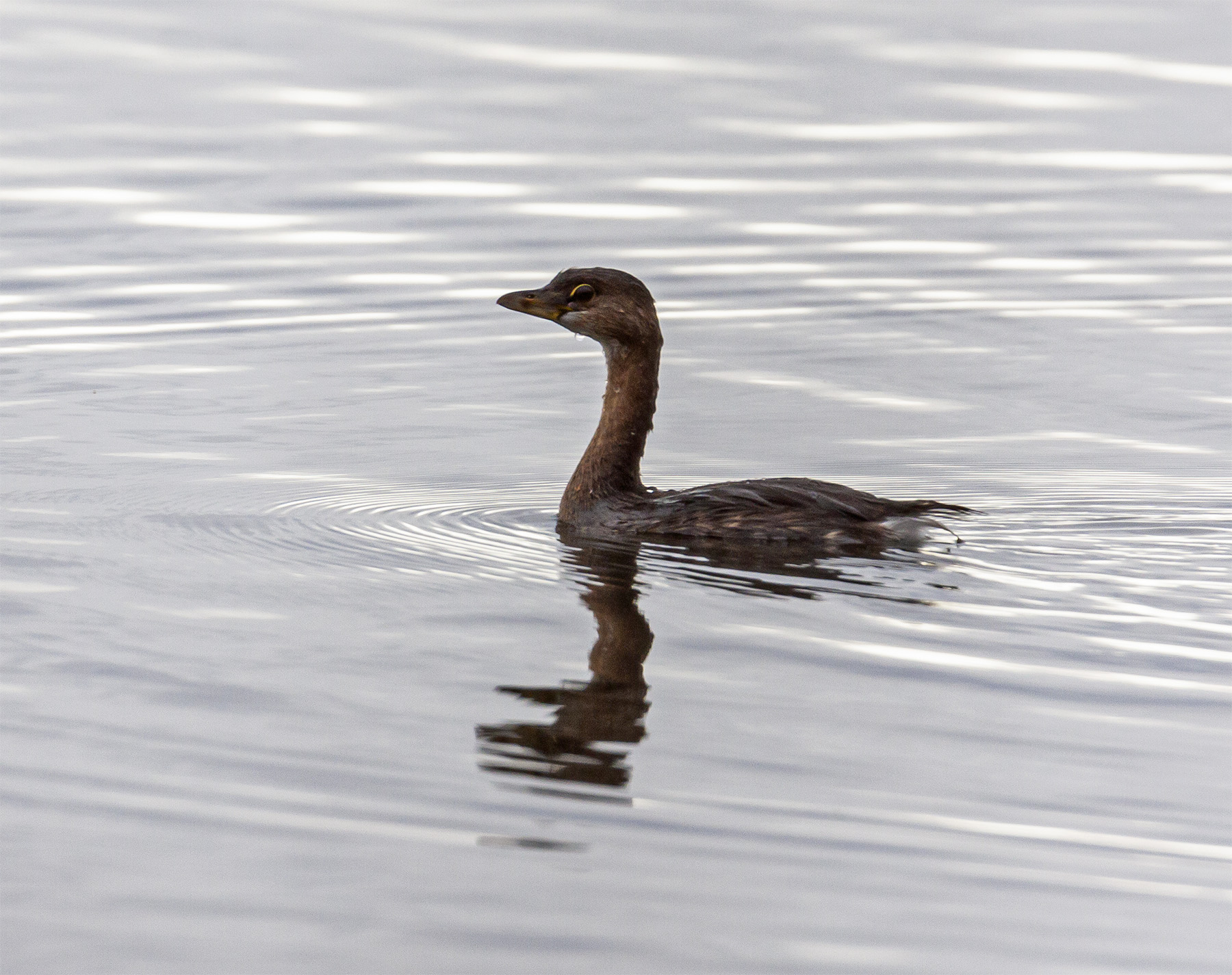
I do not know for sure if Pied-bill Grebes (Podilymbus podiceps) are migratory, but I had not seen any in a long time when I spotted a small flock of them on Tuesday in the waters off of Occoquan Bay National Wildlife Refuge. Pied-billed Grebes have a rather unusual and distinctive look—especially the bill— that makes them relatively easy to identify. Northern Virginia, where I live, is far enough south that it is a destination for some birds that will overwinter here, while many other species will pass through on their migration southward.

According to the Cornell Lab of Ornithology, “The Latin genus name for “grebe” means “feet at the buttocks”—an apt descriptor for these birds, whose feet are indeed located near their rear ends. This body plan, a common feature of many diving birds, helps grebes propel themselves through water. Lobed (not webbed) toes further assist with swimming. Pied-billed Grebes pay for their aquatic prowess on land, where they walk awkwardly.”

Pied-bill Grebe

© Michael Q. Powell. All rights reserved.


Read Full Post »

Perhaps it is because today is Halloween or because the overcast sky on Tuesday at Occoquan Bay National Wildlife Refuge caused everything to be shadowy and monochromatic. Whatever the reason, the shape of this Double-crested Cormorant (Phalacrocorax auritus) reminds me of a bat, especially in the first image.

I captured these two images as the cormorant was preparing to take off from the water. Unlike some birds that rise straight up, a cormorant has to bounce across the water to gain enough momentum for liftoff, which is why you can see the splashes of water behind the cormorant in both shots.

Double-crested Cormorant

Double-crested Cormorant

© Michael Q. Powell. All rights reserved.

Read Full Post »

« Newer Posts - Older Posts »