Feeds:
Posts
Comments

Posts Tagged ‘Tamron 180mm macro lens’

Far away from any adult supervision, this baby snapping turtle seemed to be having trouble figuring out how to forage for food on his own.  He stretched out his neck as far as it would go, but was still not within reach of the plants that he was eying. The realization had not yet struck him that was going to have to move his body closer. Just above him you can see a little fish that was monitoring his progress, but staying beyond the reach of those jaws, in case the turtle decides he needs a little protein in his diet.

baby_snapper_blog

© Michael Q. Powell. All rights reserved

Read Full Post »

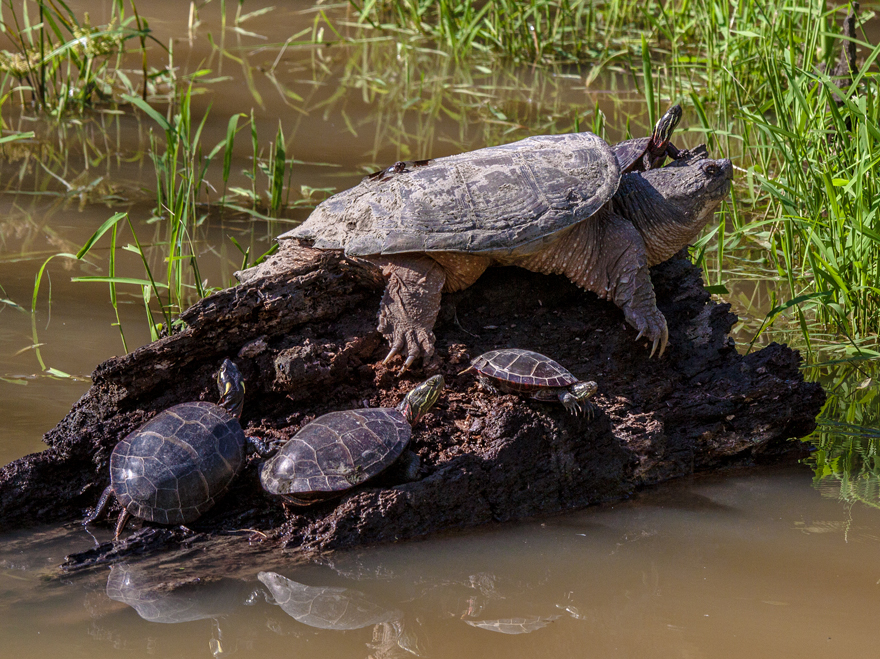
When the family of Red-eared Slider turtles (Trachemys scripta elegans) adopted an orphaned turtle, they had no idea that the baby would grow so big. Despite his disproportionate size, the larger turtle, an Eastern Snapping turtle (Chelydra serpentina serpentina), likes to participate in all family activities and doesn’t seem to realize that he is different from the other members of his adopted family.

I chose a natural setting for this family portrait and managed to catch almost everyone in a good pose—unfortunately, one of them had an attitude and refused to look directly at the camera and smile. Most of us have similar informal family portraits with the same problem. I don’t know how professional portrait photographers get everyone to cooperate.

co-existence_blog

© Michael Q. Powell. All rights reserved

Read Full Post »

This large bullfrog was so content in the mud that he did not budge at all when I moved closer to take this shot. Compared to the tiny tree frogs that I have been photographing recently, this frog seemed enormous.

The mud may not be the best backdrop for a photo, but I like the way that the image has become a study in greens and browns, with a golden eye as a accent.

frog_mud_blog

© Michael Q. Powell. All rights reserved.

Read Full Post »

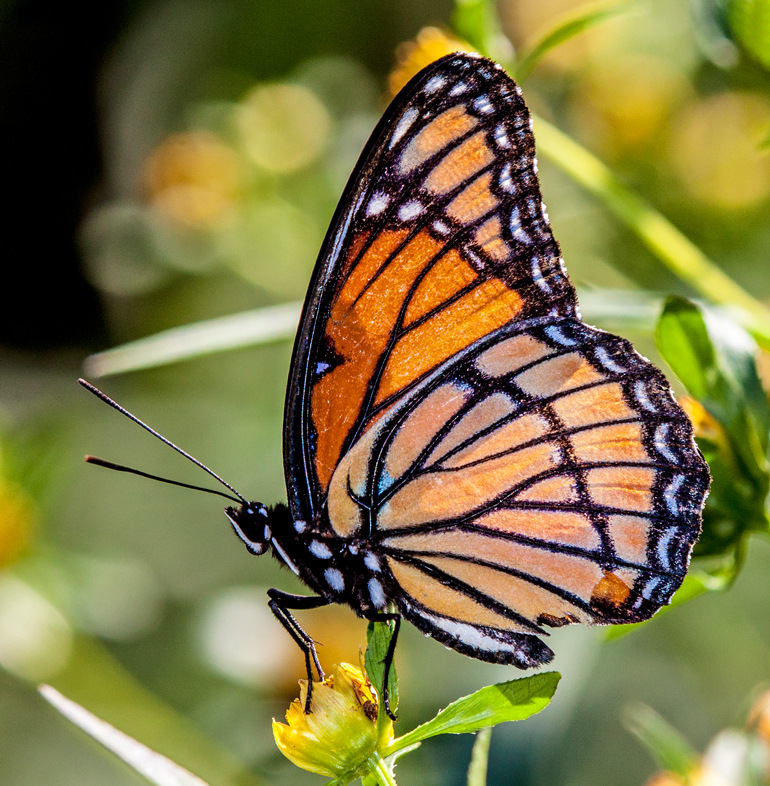
The days are getting cooler and leaves are starting to wither and fall, but there are still signs of the lingering summer, like this beautiful Viceroy butterfly (Limenitis archippus) that I photographed this past weekend. viceroy_bokeh_blog

© Michael Q. Powell. All rights reserved.

Read Full Post »

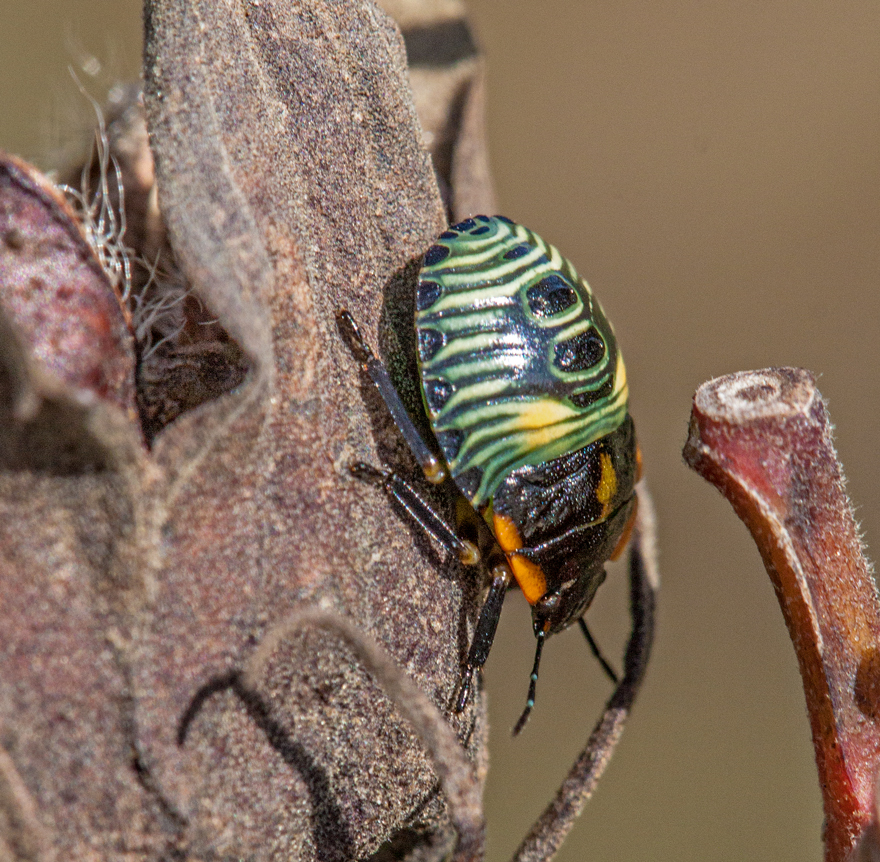
All the leaves are brown and the sky is gray as fall arrives in my local marsh, but there are still occasional spots of bright color, like this beetle that I encountered yesterday, crawling down a withered leaf. I have not been able to identify it, but its bold pattern and colors remind me of the art and fashions of the late 1960’s, when no combination was too wild. I graduated from high school in 1972 and still recall wearing some pretty wild-looking clothes.

Somehow I think the pattern on the beetle’s back would work well on a necktie. I guess it’s a commentary on how my life has progressed that I now think more in terms of neckties than tie-dyed t-shirts.

colorful_bug_blog

© Michael Q. Powell. All rights reserved.

Read Full Post »

Imagine how skinny this fuzzy white caterpillar would appear if its fur were “groomed,” like some of the dogs in my neighborhood. There is one fuzzy white dog, in particular, that looks huge, which I think is a Great Pyrenees. I was shocked one day when I saw that dog with closely cropped fur—it looked to be only half of its normal size.

For some reason, this caterpillar’s hair seems to be more tufted than usual, compared to similar caterpillars that I have seen. Maybe the hair is bunched because of the heavy dew or the way that the caterpillar slept. Clearly the caterpillar is having a bad hair day.

Do you think it could get away with wearing a hat to cover the bad hair?

really_fuzzy2_blogreally_fuzzy1_blog

© Michael Q. Powell. All rights reserved.

Read Full Post »

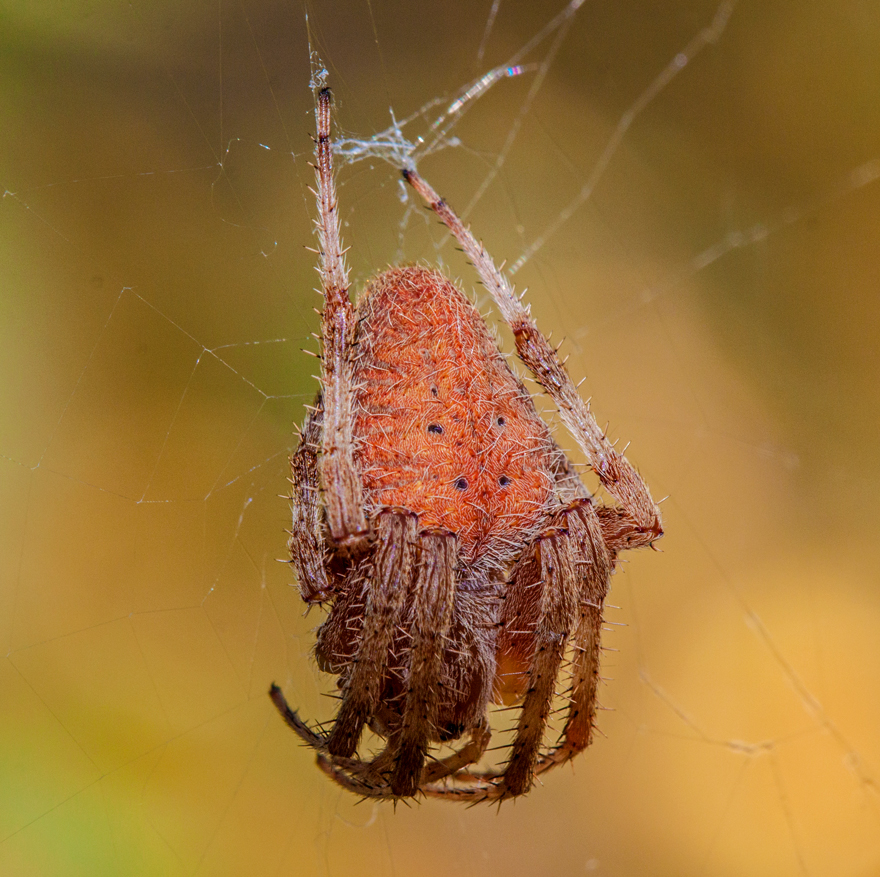
Walking along the boardwalk at my local marsh, I encountered this fairly large, hairy red spider in a web almost at eye level.

It was a little disconcerting to look a spider in the eye (eyes) at such close range, but it did allow me to get a pretty detailed shot at close range against an uncluttered background. I’ve been searching around on the internet, attempting to identify the spider but so far have not had any success. Can anyone identify this cool-looking spider?

orange_spider1_blog

© Michael Q. Powell. All rights reserved.

Read Full Post »

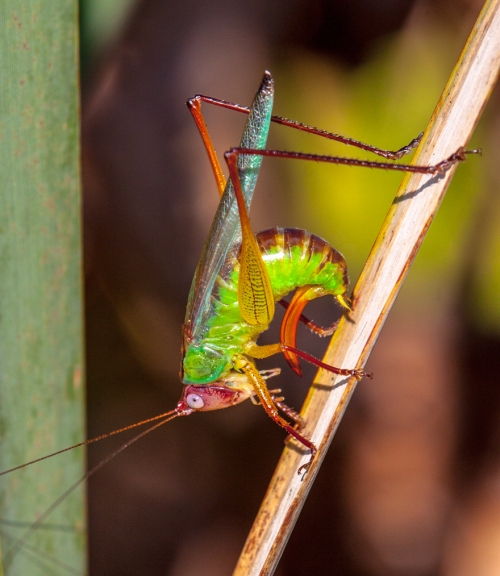
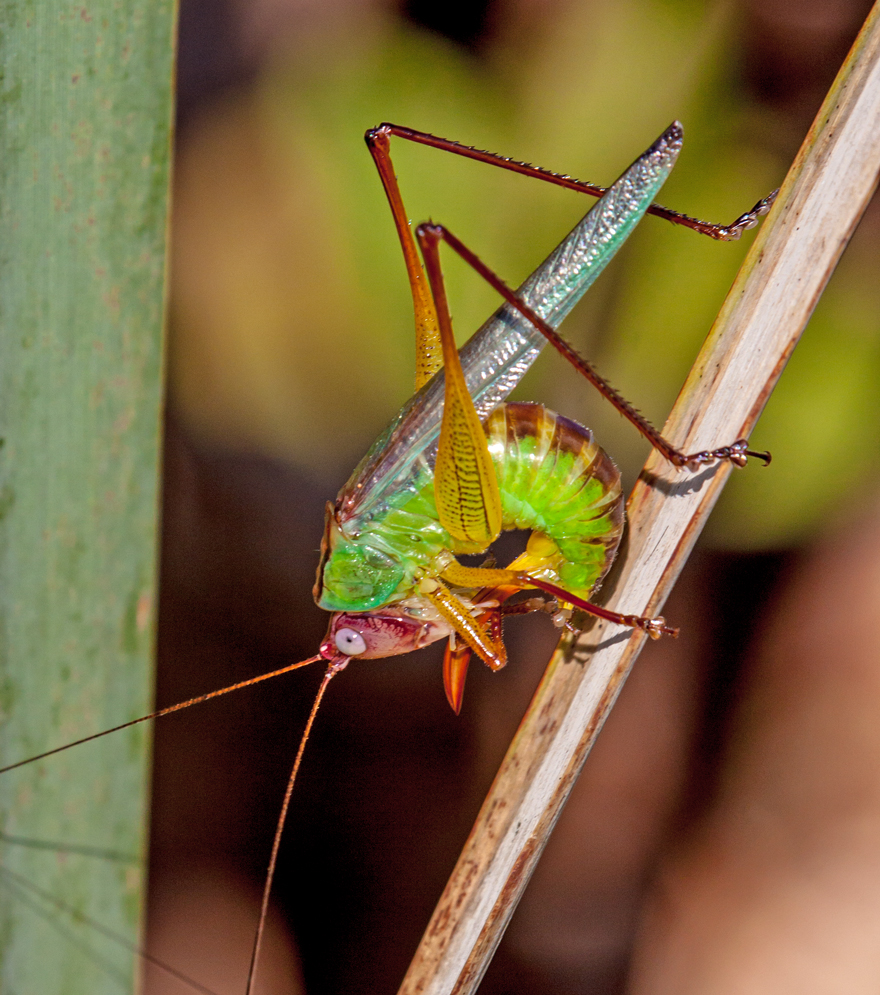
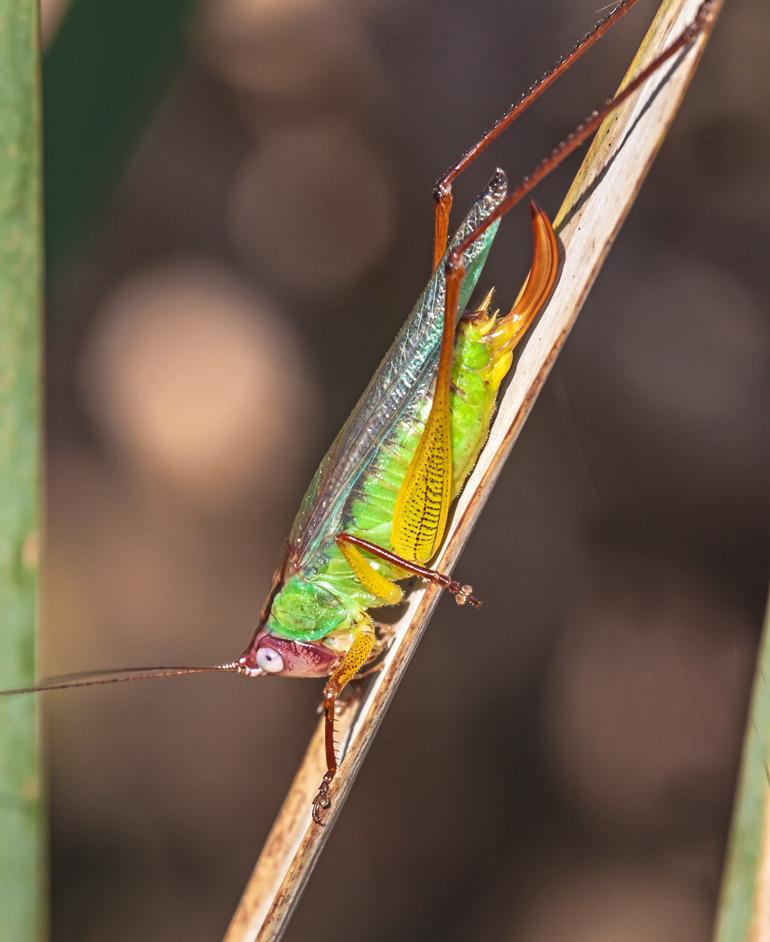
As was watching this Handsome Meadow Katydid (Orchelimum pulchellum) through my viewfinder,  it suddenly arched its body and assumed a position worthy of an world-class gymnast or yoga master. What was it doing?
rainbow_gymnastics_blog

My first thought was that the katydid was merely stretching, getting ready for the day’s activities. When you jump around as much as these insects do, you can’t risk a pulled muscle or other injury by not warming up properly.

Over the past year, this rainbow-colored katydid has become my favorite insect, but I confess that I don’t much about their anatomy. Looking over my photos, I realized that I needed to identify the orange-colored body part, a part that I don’t recall observing before, in order to figure out what was going on. What could it possibly be?

rainbow_gymnastics3_blog

Well, it looks like this katydid probably is a female and the orange-colored thing is her ovipositor, the organ used for depositing eggs. So, is she depositing eggs in the photos? I am not sure.

A University of Arkansas website describes the ovipositing for a similar katydid with these words, “An ovipositing female embraces a plant stem with her prothoracic and mesothoracic legs and brings the curved and sword-like ovipositor far forward so its tip can scrape the substrate.” It’s not really helpful when the explanation contains so many words with which I am unfamiliar. I think that I will leave this kind of science to the scientists.

As a photographer, I continue to be amazed by the multi-colored beauty of this fascinating insect and especially by its alluring blue eyes. I know that it’s an illusion, but those eyes often seem to be looking right at me. I’m not sure if this Handsome Meadow Katydid is depositing eggs in these photos, but I am sure that  I like the images a lot, including the final image, which shows the katydid in a more “normal” position following her brief series of gymnastics.

rainbow_gymnastics2_blog

© Michael Q. Powell. All rights reserved.

Read Full Post »

Most of the time, when I see these green snakes, they are half-buried in a bush and it is impossible to get a decent shot.  yesterday, however, I almost stepped on this Rough Green Snake (Opheodrys aestivus) on one section of the boardwalk at my local marsh and was able to compose this shot before he slithered away.

The snake had stopped moving and was surveying the situation, sticking its tongue out repeatedly. I got several shots with the tongue extended, but I especially like this one, because it shows the forked tongue.

green_snake_blog

© Michael Q. Powell. All rights reserved.

Read Full Post »
I can’t seem to get enough of these little green tree frogs and continue to try to get photos of them whenever I can.

In this shot, my eyes were drawn textures and colors—in particular, the bumpy texture of the frog’s skin and the contrast between the light olive green of the frog and the darker green of the leaf on which it is sitting.

frog_decay_blog

© Michael Q. Powell. All rights reserved.

Read Full Post »

Autumn is my favorite time of the year, a time when bright spots of spring-like color co-exist with the fading fall colors, a foretaste of the bleak winter landscape to come. Areas of my local marsh are dotted in bright red right now, the berries of a plant that I have been told is Winterberry (Ilex verticillata).

I’ve traipsed through lots of museums in my lifetime and seen innumerable paintings in which artists have arranged fruits and flowers and other objects into paintings that are generally known as “still life paintings.” I had those paintings in mind when I framed this shot in my viewfinder, attempting to capture a pleasing composition of colors and shapes. It’s rare that I don’t crop an image at all, but I decided to show this one composed just as it came out of the camera.

stillife_blog

© Michael Q. Powell. All rights reserved.

Read Full Post »
Summer is fading rapidly, but some flowers continue to bloom, like this beautiful Orange Jewelweed (Impatiens capensis) that I photographed recently at my local marsh.

Wikipedia claims that hummingbirds are the main pollinators of these flowers, which is not surprising, judging from their shape. Every time I pass by a cluster of these plants, I keep my eyes peeled for hummingbirds, but have not seen a single one and suspect that it is too late in the season for them.

jewelweed_blog

© Michael Q. Powell. All rights reserved.

Read Full Post »
Most of us have heard that female praying mantises eat their mates after mating, so what happens when a pair of cannibal flies mate?

I was quite a distance away when I spotted this pair of insects, but I immediately recognized them as  Red-footed Cannibalflies (Promachus rufipes), a species of giant robber flies. These flies are really big and have a very distinctively shaped body (and I had done some research on them for a previous posting). Cannibalflies are fierce predators and are reportedly very aggressive. Would the male survive the mating process?

I observed the pair for quite a while and concluded that the “cannibal” in this insect’s name refers to its behavior toward other insects. The male cannibal fly flew away unscathed.

robber_mating_blog

© Michael Q. Powell. All rights reserved.

Read Full Post »

When almost everything that you see looks like a bug, you know it may be time to take a break from photographing insects.

Recently I have been getting shots of different kinds of very fuzzy caterpillars and a posting on a fuzzy, white caterpillar has become my most viewed posting by a significant margin. This has whet my appetite to look even more intently for caterpillars and Monday I was pretty sure that I had spotted one with spiky tufts of hair on the thin branch of a plant. It was only when I got really close that I realized that my eyes had deceived me—it was not another fuzzy caterpillar.

Don’t get me wrong, it ‘s a pretty cool collection of seed pods and tendril-like branches, but it’s definitely not the caterpillar that I had in my mind.

not_caterpillar_blog

© Michael Q. Powell. All rights reserved.

Read Full Post »

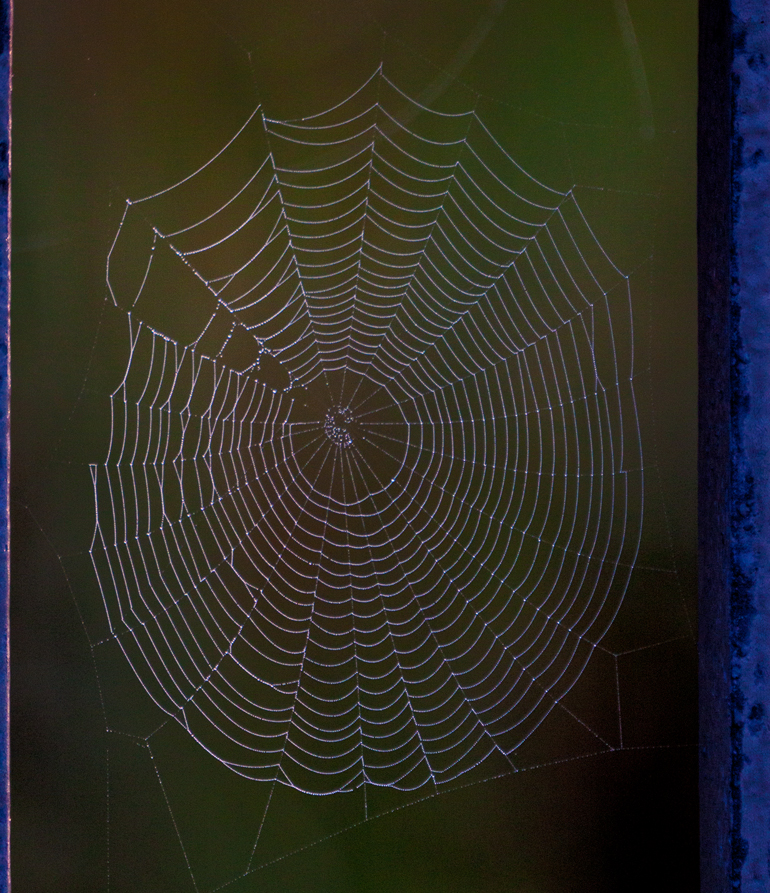
Last year at this time of the year there were lots of large Argiope orbweaver spiders at my local marsh, but I couldn’t find a single one this past Monday, when I showed up just after sunrise. I was able to find a number of smaller spider webs, however, on the railings of a raised section of the boardwalk. The photo looks to be more appropriate for a Halloween posting, but hopefully I can find something a bit creepier for that day.

web_rail1_blog

© Michael Q. Powell. All rights reserved.

Read Full Post »
As I was observing a tiny green tree frog in the cattails, a large fly suddenly buzzed into the frame and landed right next to the frog. Did the fly initially consider the frog to be a potential prey? Was the fly a daredevil who liked to flirt with danger? Was this an initiation test into a fly fraternity or perhaps the result of a bet between drunk buddies?

The unlikely juxtaposition of these two creatures makes me smile every time I look at it. As a child, I watched lots of cartoons in which frogs would flick out their very long tongues and snag unsuspecting flies from a great distance. I waited and watched, anticipating the moment when the frog would turn and strike. That moment never came—the fly eventually flew off to safety.

Real life doesn’t always live up to life in the cartoons.

frog_fly_blog

(Click on the photo to see a higher resolution view.)

© Michael Q. Powell. All rights reserved.

Read Full Post »

I always seem to have real problems making positive identification of the smaller, nondescript butterflies, like this little orange skipper butterfly that I photographed recently at my local marshland park.

If I had to go out on a limb, I’d hazard a guess that this is a Delaware Skipper (Anatrytone logan), although with more than 3500 recognized species of skippers, the odds are not in my favor.

tiny_orange_blog

© Michael Q. Powell. All rights reserved.

Read Full Post »
As summer fades, I have been seeing fewer and fewer dragonflies, so I decided to attempt some in-flight shots and managed to capture these images of a female Great Blue Skimmer dragonfly (Libellula vibrans).

Photographing dragonflies in flight is one of my toughest photographic challenges, but I have learned a few tricks about capturing these kinds of shots. One way is to find a favorite perch of a dragonfly and try to photograph the dragonfly arriving and departing from that perch, given that dragonflies often return to the same perches. That was not the approach that I used this time.

The approach I used is to capture the dragonfly while it is hovering and is therefore in the same spot for a few seconds. I  watched as two blue skimmers mated quickly and I knew that I had a target of opportunity, because the female would soon deposit the eggs in the water. She hovered in the air and then dipped her tail end down to the water to deposit some eggs and returned to the hover position and repeated the process. It was during this process that I got these shots.

I am always struck by the beautiful blue eyes of the Great Blue Skimmer, particularly in the female. The male is all blue, so his eyes don’t provide the same visual contrast as the drabber colored body of the female.

The dwindling dragonfly population is yet another sign of the changing of the seasons—it won’t be long before I begin to focus my camera lens more frequently on birds than on insects, but I am not giving up on my insects quite yet.

skimmer_air2_blogskimmer_air_blog

© Michael Q. Powell. All rights reserved.

Read Full Post »
The lighting and the pose add some drama to this almost formal portrait of a Green Treefrog (Hyla cinerea) that I encountered at my local marsh.

Most of the tree frogs that I have seen have been snoozing in the cattails and it’s been tough to get a clear shot, but this one was conveniently perched on a horizontal leaf, giving me pretty good latitude to compose the shot that I wanted. Even the frog was cooperative and stayed put while I made adjustments to the camera in between shots.

I’m really happy with this image and think that the frog too would be content with this portrait.

frog_leaf_blog

© Michael Q. Powell. All rights reserved.

Read Full Post »

I love the mix of colors that resulted when a male Blue Dasher dragonfly (Pachydiplax longipennis) that I was observing chose to perch on a plant with red leaves.red_obelisk_blog

© Michael Q. Powell. All rights reserved.

Read Full Post »

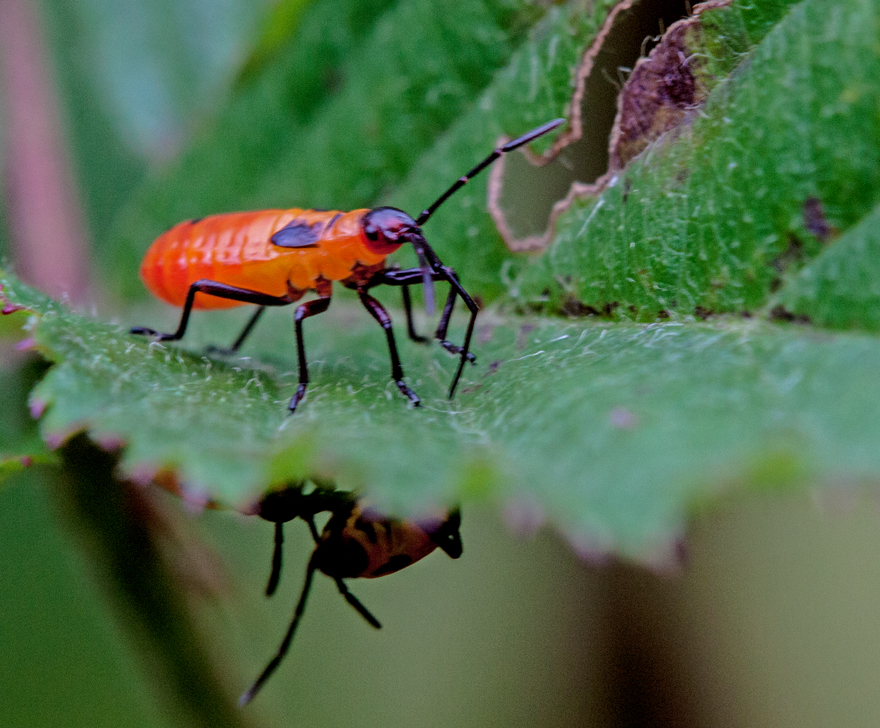
I continue to be fascinated by the metamorphosis of bugs and was happy to spot these familiar bright red milkweed bug nymphs recently at my local marshland.

Last year, I closely followed the development of Large Milkweed Bugs (Oncopeltus fasciatus) and documented my observations in a posting called Life Phases of the Large Milkweed Bug. I was a bit surprised when that posting turned out to be my fourth most visited posting of the year (it was since slipped to number six on the charts), because it was as much an educational posting as one to highlight my photos.

When I spotted these bugs, there were several clusters of them and the individuals seemed to be gradually separating as they sought out food. The bugs go through five phases (instars) as nymphs before they become adults and these look to be in one of the middle phases of development, judging from the size of the “wings.”

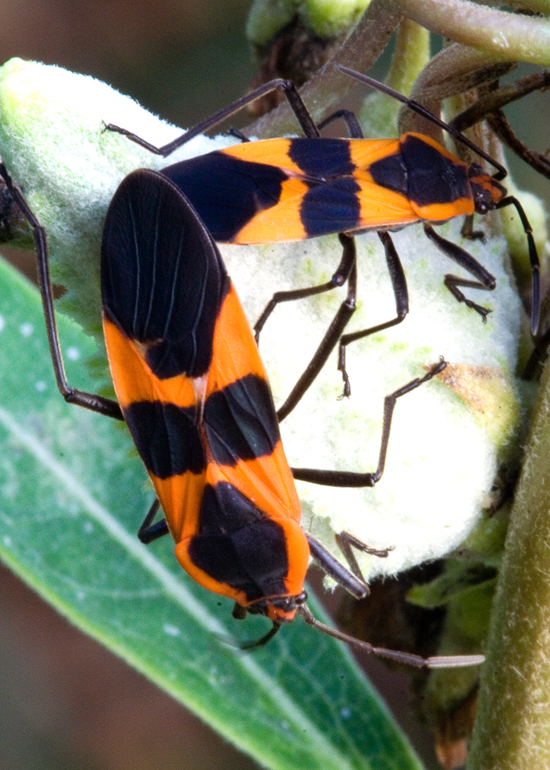
In case someone is not familiar with these bugs, I am attaching a photo from last year of adult milkweed bugs to give an idea of what these nymphs will eventually become.

red_bugs_blogred_bug_blog

bug8_5x7blog

© Michael Q. Powell. All rights reserved.

Read Full Post »

Recently I had the chance to observe a Green Heron (Butorides virescens), one of my favorite birds, as it waded into the water at the edge of a small pond and focused its attention on catching a meal.

It was fascinating to watch the heron’s movements—it moved so with such care and stealth that it almost seemed to be moving in slow motion. At times, the heron would lean forward, as in the first photo, perhaps when a potential prey caught its attention.

The water in the pond was very still and I was happy to capture some nice reflections of the heron. They presented a minor dilemma for me in deciding how to crop the shot. Was it better to crop tighter and emphasize the main subject, as I did in the first shot, or to show the entire reflection, as in the third shot, which is the same image cropped differently? What do you think?

In many ways, the second shot is my favorite one. The heron had started to slowly move away and then turned its head back and opened its mouth a little. That little gesture seemed to give the heron more personality and it looks almost like it is smiling.

green_heron_close2a_bloggreen_heron_close1_bloggreen_heron_close2_blog

Read Full Post »

I continue to see these white fuzzy caterpillars and have concluded that they may be Virginia Tiger Moth caterpillars (Spilosoma virginica), also known as Yellow Wooly Bear caterpillars.

I have seen some mating white moths in the same area that look like Virginia Tiger Moths and my photos of these caterpillars resemble some of the ones I find on-line for the Yellow Wooly Bear caterpillars.

In any case, I really like the way that the light fell on this caterpillar and illuminated the long white hairs of its body, giving it a halo-like effect.

wuzzy_blog

© Michael Q. Powell. All rights reserved

Read Full Post »

One of the advantages to living in a relatively southern state is that summer lingers on for a bit longer and flowers continue to bloom. As long as there are flowers blooming, bees continue in their efforts to gather pollen,

I am not sure what flower this is, but it was blooming in the garden of one of my neighbors, Cindy Dyer, a fellow photographer and blogger. She plants her garden with an eye toward plants that will photograph well and when I have a few minutes to spare, I enjoy making a quick trip to her garden to see what is blooming.

When I first spotted it, I had this mental picture of the bee working in the center of the flower, surrounded by a protective little fence.  I tried to frame the shot with that picture in mind and chose an angle that emphasized the “fence.”

Sep_bee_blog

© Michael Q. Powell. All rights reserved

Read Full Post »

Who knew that grasshoppers come in so many different sizes and colors?

I used to think that all grasshoppers were the same, but this year I have started to look at them more closely and have already seen their amazing diversity. I definitely do not know enough yet, though, to distinguish among the different species.

Two things really stood out for me in this image of a grasshopper—its coloration and its feet.  The metallic sheen of its body makes it almost look like it is wearing a suit of bronze armor.  I’ve never before noticed the cool little hooks at the end of the grasshopper’s feet, but you can see them easily in this shot.

bronze_blog

© Michael Q. Powell. All rights reserved

Read Full Post »
I feel lucky whenever I spot a praying mantis, because they are usually so well camouflaged that they are virtually invisible when motionless.

I was a little surprised to see a brown one recently (all the other ones that I have seen have been green), but I can’t help but note that the brown head makes those green compound eye really stand out. I really felt like the praying mantis was looking right at me as I tried to photograph it.

brown_praying_blog

© Michael Q. Powell. All rights reserved

Read Full Post »
It’s rare that I actually welcome an insect landing on me, which is usually a prelude to it biting me, but I was really happy when this Eastern Comma butterfly (Polygonia comma) decided it like the way that I tasted.

It initially landed right on my chest and began to lick my shirt and then moved over to the messenger bag in which I carry my camera gear. I carefully removed the bag and was able to get these shots while the Eastern Comma kept busy licking away my accumulated sweat (my apologies to those with delicate sensibilities, but these butterflies don’t land on pretty flowers and instead generally feed on the less photogenic sap, rotting fruit, and dung).

Normally this butterfly blends in well with its environment and is hard to see, but I guess that we would all agree that a blue Adidas bag is not its natural environment. It was also surprisingly easy to identify the butterfly. Last year I agonized in trying to decide if a butterfly I had photographed was a Question Mark or a Comma—the difference is in the shape of the white marking. Yes, those are actually the names of the butterflies. Who makes up these names? It’s the kind of job that I would enjoy.

I haven’t found any other insects named for punctuation marks, but won’t be surprised to find that there is an Asterisk caterpillar or an Ampersand beetle.

comma1_blogcomma2_blog

© Michael Q. Powell. All rights reserved

Read Full Post »

This little Green Treefrog (Hyla cinerea) was almost hidden in the cattails, comfortably napping at midday with its legs tucked under its body. It’s nice to know that I am not the only one who enjoys a little afternoon siesta.

sleeping_frog_blog

© Michael Q. Powell. All rights reserved

Read Full Post »

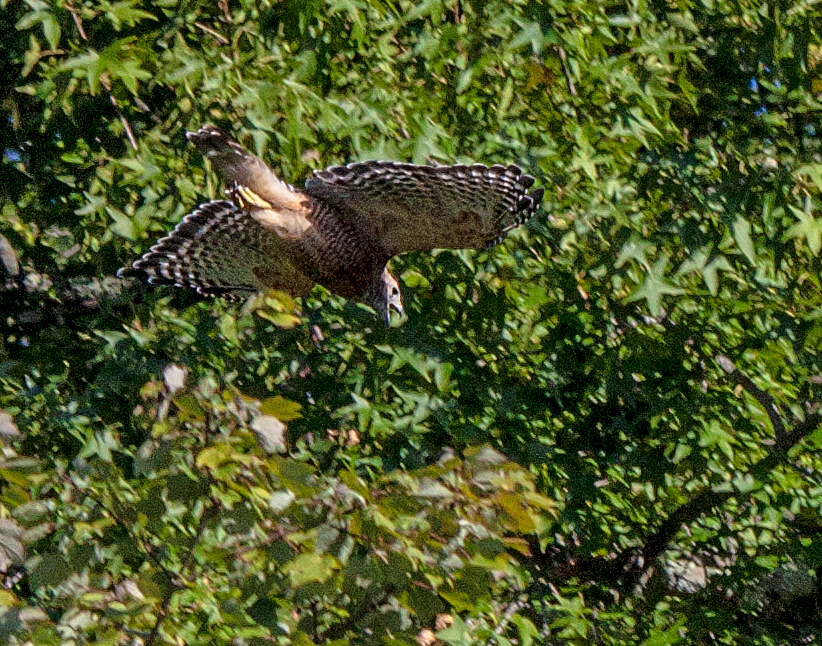
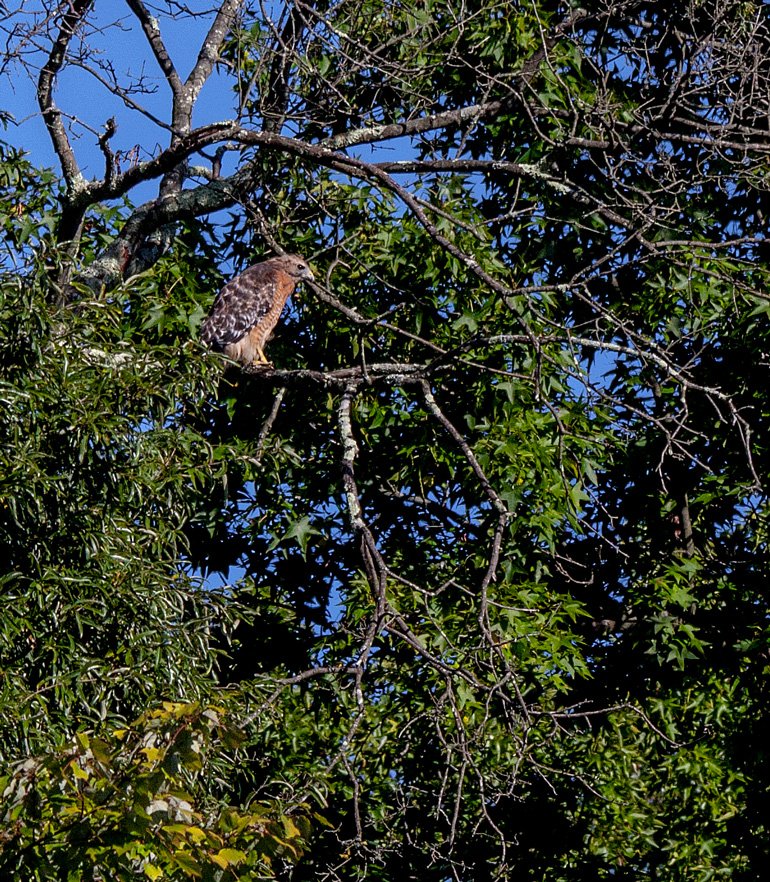
I have not seen any hawks at my local marsh for quite some time, so yesterday I was really happy when I heard the unmistakable sound of screaming Red-shouldered hawks (Buteo lineatus). (Check out the sound file on the Cornell Lab of Ornithology website if you have never heard the cry of these magnificent birds.)

From the sound of the loud screaming, I could tell that the hawks were not far away and eventually I spotted two of them soaring above the trees. After a few minutes, one of them flew silently into view and landed in a tree across the beaver pond from where I was standing. I suspected that he would not remain very long, so I decided to try to get some shots with the lens that I happened to have on my camera at the time, my Tamron 180mm macro lens, rather than take the time to set up my tripod and change to a longer lens.

Before long, I heard the cries of the other hawk and the one that I was watching took to the air and joined in the screaming. I was a little surprise to see that it flew laterally and downward, but I was able to track it pretty well and got the in-flight shot that you see below.

I was pleased to see that the lens was able to capture a pretty good amount of contrast and detail, even in heavily-cropped images like the two that I am posting. I enjoy the challenge of attempting to capture any birds in flight and look forward to more attempts as we move out of insect season, when my macro lens is use most of the time, into bird season, when I switch to a telephoto lens.

screaming3_blogscreaming2_blog

© Michael Q. Powell. All rights reserved

Read Full Post »

Earlier this week I came across this little Jumping spider, patiently waiting for a prey to come by.  I never fail to be amazed by those eyes that seemed to be staring right at me.

Transfixed, I can’t take my eyes off of you, tiny spider, and your eyes seem to follow me. I don’t want to seem paranoid, but when I am with you, I always feel like somebody is watching me.

Somehow I thought I heard the spider humming, “I only have eyes for you,” but it was just my imagination, running away with me.

jumping_marsh2_blog

© Michael Q. Powell. All rights reserved

Read Full Post »

Hoverflies normally are as busy as bees, in constant motion as they move from flower to flower. From time to time, though, I guess that they need to rest. Earlier this week, I captured this image of  a hoverfly relaxing on the dried out leaf of a cattail at my local marshland park.

hoverflyA_blog

© Michael Q. Powell. All rights reserved

Read Full Post »

« Newer Posts - Older Posts »