The intricate shape and delicate colors of this beautiful little flower simply captivated me yesterday at Meadowlark Botanical Gardens in Vienna, Virginia. (I think it is a kind of columbine flower.)

© Michael Q. Powell. All rights reserved.
Posted in Art, Flowers, Gardening, Macro Photography, spring, tagged Canon 50D, columbine, Meadowlark Botanical Gardens, Tamron 180mm macro lens, Vienna VA on May 17, 2015| 7 Comments »
The intricate shape and delicate colors of this beautiful little flower simply captivated me yesterday at Meadowlark Botanical Gardens in Vienna, Virginia. (I think it is a kind of columbine flower.)
© Michael Q. Powell. All rights reserved.
Posted in Macro Photography, Nature, Photography, Reptiles, spring, wildlife, tagged Alexandria VA, Canon 50D, Eastern Box Turtle, Huntley Meadows Park, Tamron 180mm macro lens, Terrapene carolina carolina on May 15, 2015| 20 Comments »
When you can see your own reflection in an eye, you know that you have managed to get really close to a subject, in this case an Eastern Box Turtle (Terrapene carolina carolina) that I encountered this past week while walking through the woods at my local marshland park.
Of course, it is equally possible that I am imagining things and the reflections are merely those of the trees and the sky. In either case, I really like the isolated, almost abstract view that I managed to get of the eye of the turtle.

© Michael Q. Powell. All rights reserved.
Posted in Macro Photography, Nature, Reptiles, spring, wildlife, tagged Alexandria VA, Canon 50D, Eastern Hognose, Eastern Hognose snake, Heterodon platirhinos, Huntley Meadows Park, Tamron 180mm macro lens on May 14, 2015| 8 Comments »
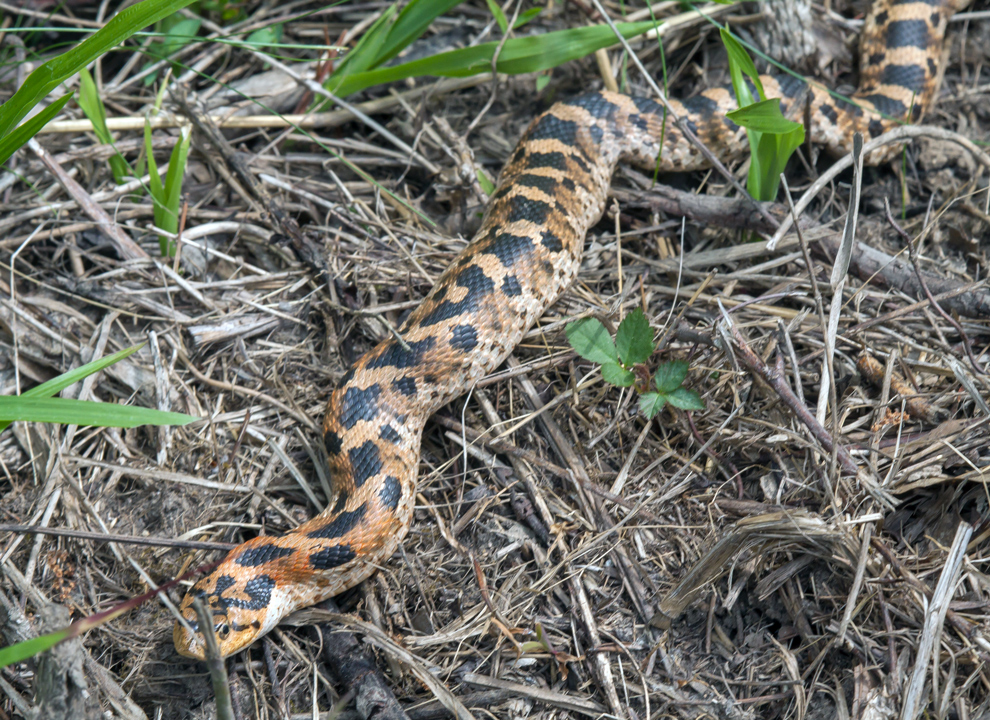
Most of the snakes that I encounter at my local marshland park blend in well with their surroundings, but the one that I almost literally stumbled on this past Monday in one of the park’s meadows was a notable exception—it was bright orange in color.
I had never before seen a snake that looked like this one and moved as close as I could to get a shot of its head with my macro lens. (During this time of the year I tend to have my 180mm macro lens on my camera much of the time.) The snake was cooperative when I was taking the close-up shots. However, after I backed up to try to get a shot of its whole body, the snake decided that enough was enough and slithered away quickly into the underbrush. I managed to get only a single body shot that has a partially obscured head, but I included it to give you an overall view of the snake.
I searched around several websites about snakes in Virginia and have concluded that this is probably an Eastern Hognose snake (Heterodon platirhinos. These snakes come in a variety of colors and I didn’t find too many photos of them with this exact coloration, but I did find several references to an “orange phase.”
I continue to be amazed at the diversity of wildlife that I find in Huntley Meadows Park—I have been going there regularly for several years now, but continue to find to find new and different creatures. It sure helps to keep me motivated to hit the trails in a constant state of excited expectation with my camera in hand.

© Michael Q. Powell. All rights reserved.
Posted in Dragonflies, Insects, Macro Photography, Nature, Photography, spring, wildlife, tagged Alexandria VA, Canon 50D, Eastern Pondhawk, Eastern Pondhawk dragonfly, Erythemis simplicicollis, Huntley Meadows Park, Tamron 180mm macro lens on May 12, 2015| 9 Comments »
Yesterday the fields at Huntley Meadows Park were abuzz with beautiful emerald-and-black dragonflies. As I walked through the grass, the Eastern Pondhawks (Erythemis simplicicollis) would fly up to about knee level and then settle back down on the ground or perch on some low hanging plants.

The dragonflies were a bit skittish and it was a bit of a challenge to get clear shots of them. Occasionally one of them would fly to a slightly higher perch and permit me to get a shot like the first one that separates the subject from the background. Long-time readers of this blog know that I will usually try to move it as close as I can and I was happy to get this close-up shot of an Eastern Pondhawk that lets you see some of the facets of its amazing compound eyes.
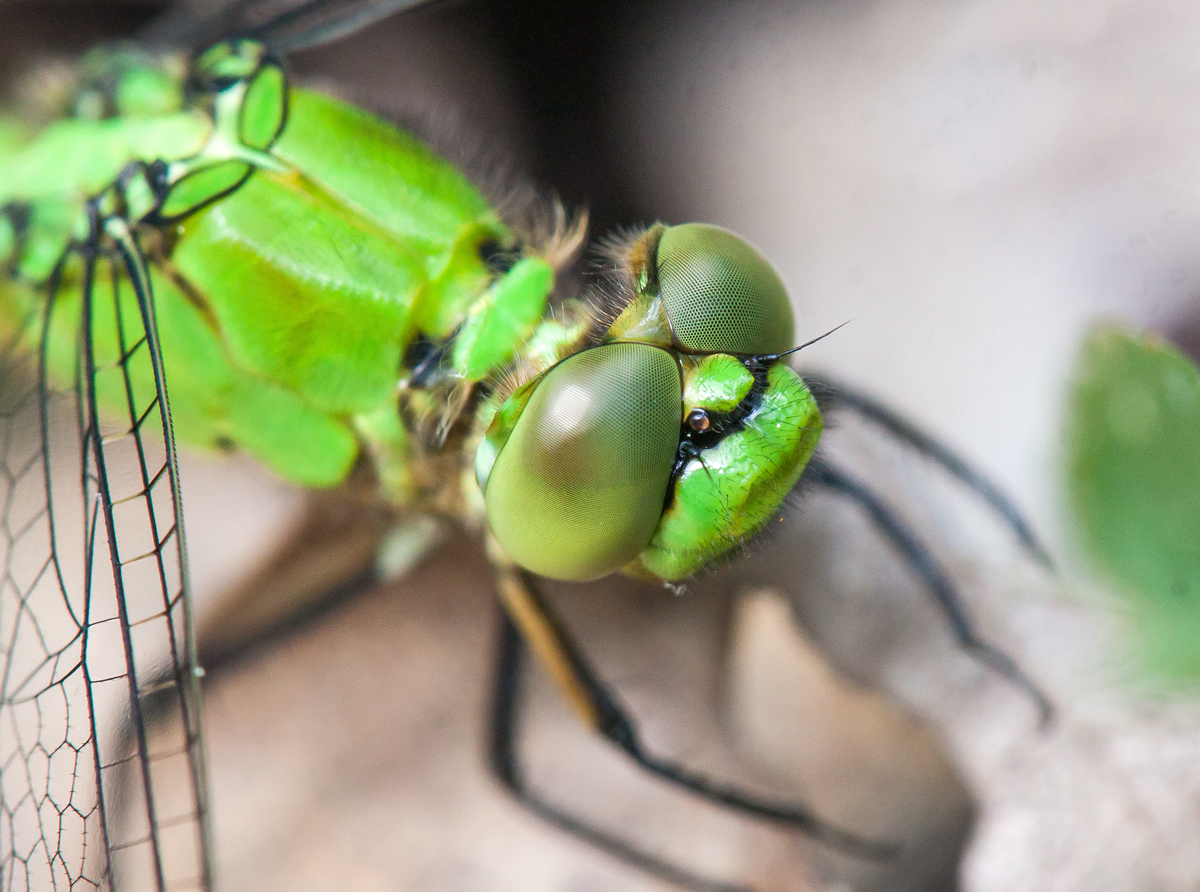
All of the Eastern Pondhawks had the same beautiful green coloration. Eventually the male Eastern Pondhawks will turn blue, but this early in the season the juvenile male have the same coloration as the females. How do you tell them apart? My fellow photographer and blogger Walter Sanford is an expert on this subject, but in this case even I can tell the difference by looking at the terminal appendages.
In the shot below, you can tell it is a male because the white cerci at the end of the abdomen are long and close together.
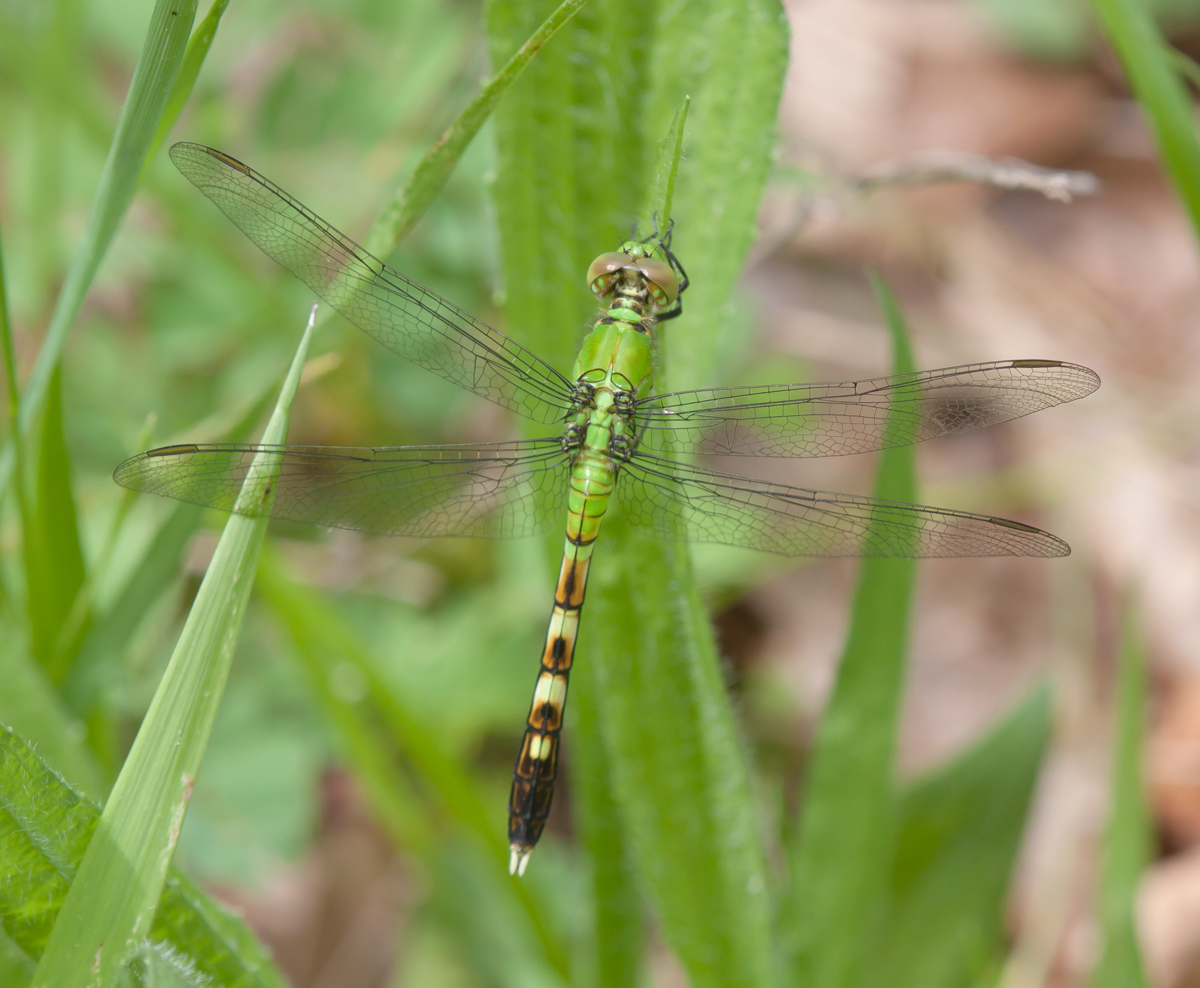
Juvenile Male Eastern Pondhawk
By contrast, the white cerci of the female are shorter and more widely spaced, as in the photo below.

Female Eastern Pondhawk
That just about exhausts my knowledge of dragonfly anatomy. My focus is mostly on capturing their beauty, but it is amazing how much I learn along the way about these fascinating little creatures.
© Michael Q. Powell. All rights reserved.
Posted in Dragonflies, Insects, Macro Photography, Nature, spring, wildlife, tagged Alexandria VA, Canon 50D, Huntley Meadows Park, Libellula semifasciata, Painted Skimmer, Painted Skimmer dragonfly, Tamron 180mm macro lens on May 11, 2015| 7 Comments »
Colorful dragonflies are gradually reappearing throughout my local marshland park and I’m reacquiring the skills needed to photograph them. For me, the amazing beauty of dragonflies is especially revealed when I manage to observe them up close. I can’t help but marvel at the incredible details of their eyes and their wings and even their delicate feet and the tiny hairs that sprout on their faces.
I spotted this dragonfly, which I believe is a Painted Skimmer (Libellula semifasciata), last Friday at Huntley Meadows Park in Alexandria, Virginia. The dragonfly allowed me to get quite close to be able to take this macro shot. In general, some dragonfly species tend to be less skittish than others, but it seems to vary from individual to individual.
Be sure to click on the image to get a higher resolution view of this beautiful little creature.

© Michael Q. Powell. All rights reserved.
Posted in Butterflies, Insects, Macro Photography, Nature, Photography, spring, wildlife, tagged Canon 50D, Danaus plexippus, Lewis Ginter Botanical Garden, Monarch, monarch butterfly, Richmond VA, Tamron 180mm macro lens on May 4, 2015| 4 Comments »
I don’t know if this Monarch butterfly (Danaus plexippus) migrated from the south or was a refugee from the indoor butterfly garden, but I was sure happy to see it this past Saturday at Lewis Ginter Botanical Garden outside of Richmond, Virginia. Monarch butterflies have been pretty scarce in this area the last couple of years.

© Michael Q. Powell. All rights reserved.
Posted in Art, Flowers, Gardening, Insects, Macro Photography, Photography, spring, tagged Alexandria VA, ant, Canon 50D, columbine, green spring gardens, Tamron 180mm macro lens on May 4, 2015| 11 Comments »
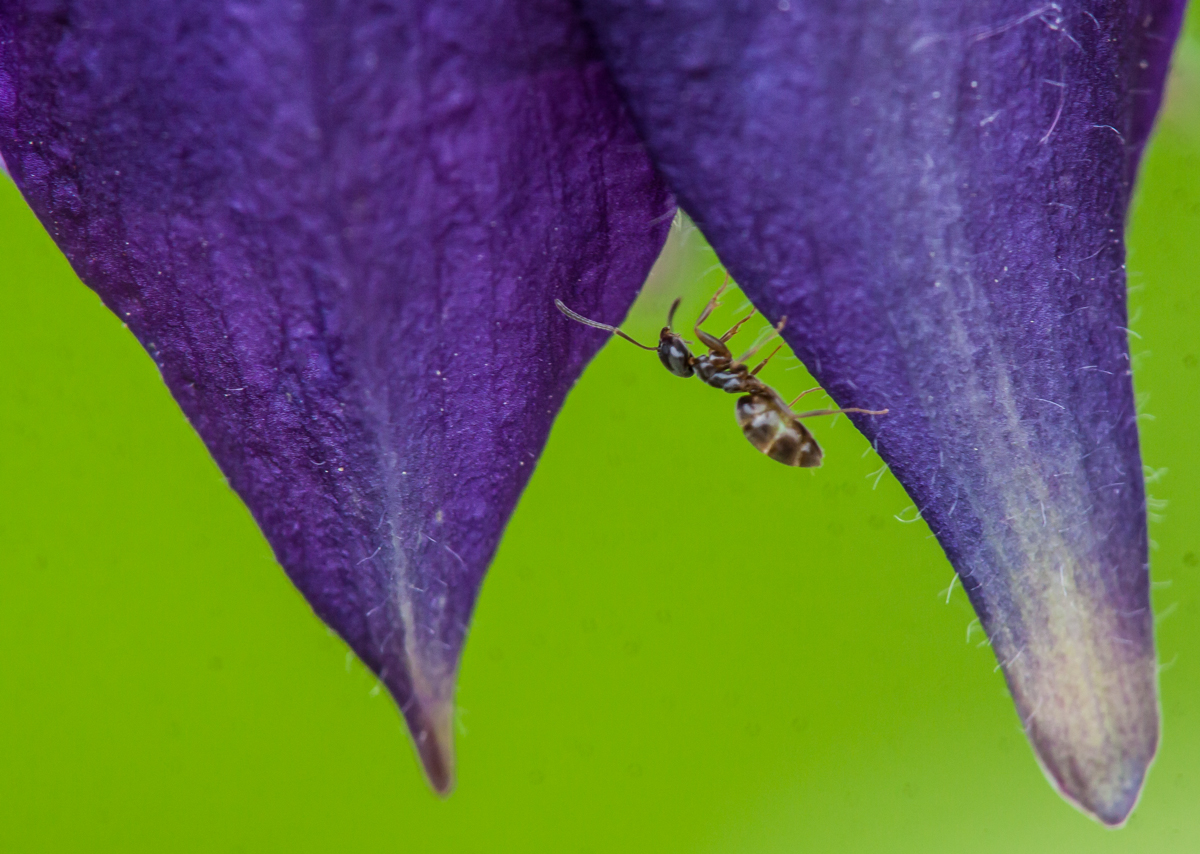
There were lots of flowers in bloom during a trip this past Friday to Green Spring Gardens, but not many insects. However, I did manage to find this intrepid ant testing his mountaineering skills as he climbed up and down the edges of a purple Columbine flower.
© Michael Q. Powell. All rights reserved.
Posted in Art, Flowers, Gardening, Macro Photography, Nature, Photography, spring, tagged Alexandria VA, Canon 50D, columbine, genus Aquilegia, green spring gardens, Tamron 180mm macro lens on May 2, 2015| 4 Comments »
One of my favorite spring flowers is the Columbine (genus Aquilegia), whose name comes from the Latin for “dove,” because the inverted flower is said to resemble five doves clustered together. Columbines come in many colors and color combinations and I am always fascinated by the shapes and colors of this unusual-looking flower.
I photographed this beautiful little Columbine on the first day of May at Green Spring Gardens in Alexandria, Virginia, a county-run historical garden that is one of my favorite places for photographing flowers.

© Michael Q. Powell. All rights reserved.
Posted in Butterflies, Insects, Macro Photography, Nature, Photography, tagged Alexandria VA, butterfly, Canon 50D, Clouded Sulphur butterfly, Colias philodice, Huntley Meadows Park, Tamron 180mm macro lens on April 28, 2015| 6 Comments »
Do you chase after butterflies? I do. There is a simple, uninhibited joy in running around a meadow in pursuit of a butterfly, waiting for it to perch, hoping to capture its beauty with my camera.
It’s still a little early for some of the larger, more colorful butterflies, but last week I was able to photograph this beautiful little Clouded Sulphur butterfly (Colias philodice).

© Michael Q. Powell. All rights reserved.
Posted in dragonfly, Insects, Macro Photography, Nature, Photography, spring, wildlife, tagged Alexandria VA, Canon 50D, Common Baskettail, Common Baskettail dragonfly, dragonfly, Epitheca cynosura, Huntley Meadows Park, Tamron 180mm macro lens on April 27, 2015| 13 Comments »
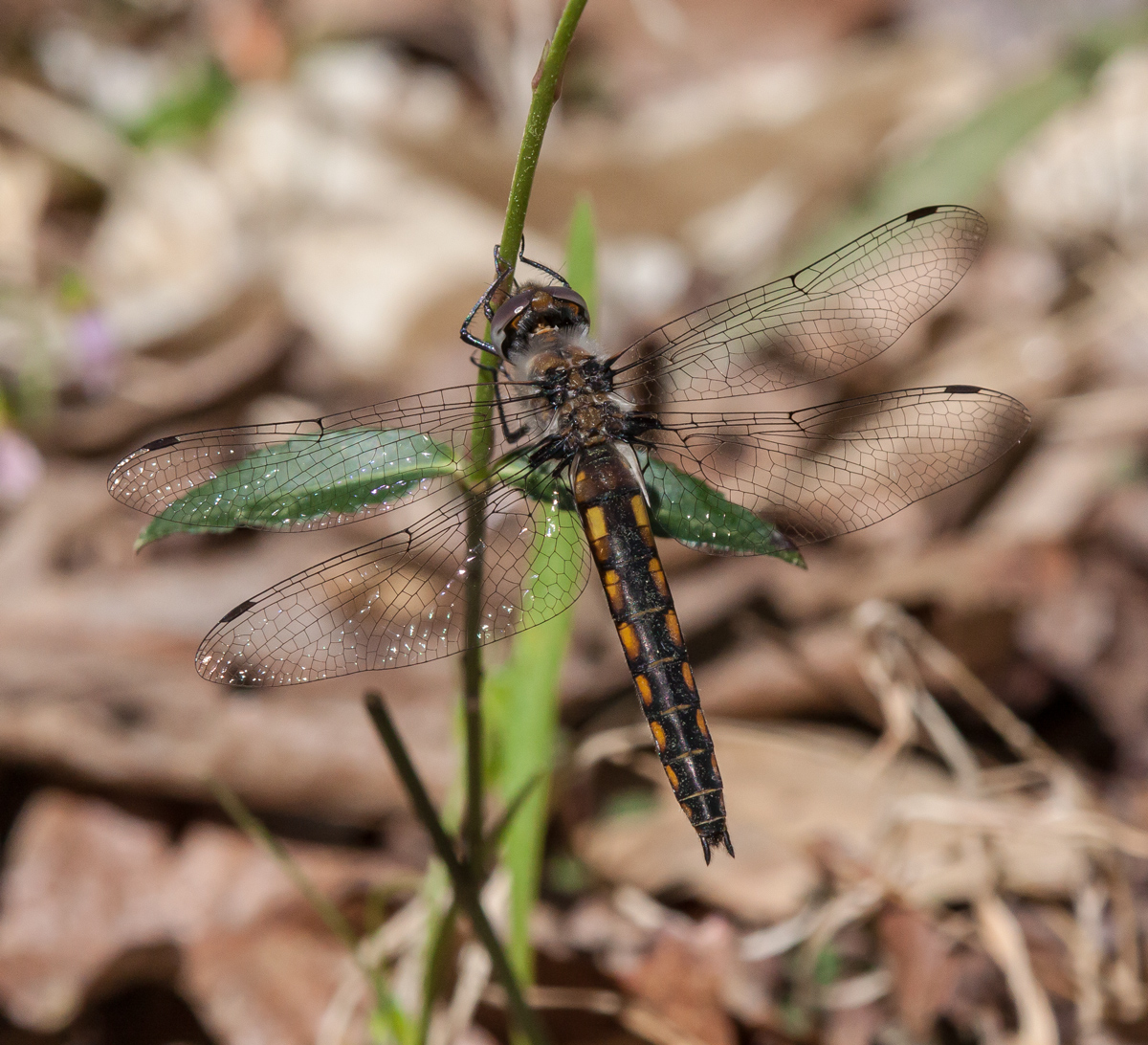
Despite its name, the Common Baskettail dragonfly (Epitheca cynosura), one of the first dragonflies of the spring, has been observed only infrequently at my local marshland park. Therefore I was pretty excited when sharp-eyed fellow blogger and photographer Walter Sanford spotted a Common Baskettail last week when we were out together searching for dragonflies.
Walter consulted with some experts and was able to confirm his initial identification of this dragonfly as a female. How do you tell the gender of a dragonfly? Check out Walter’s recent posting What was your first clue? to learn how he did it.
If you are more interested in photography than in dragonfly anatomy, check out Walter’s initial posting on the Common Baskettail dragonfly. We both photographed the dragonfly at the same time, but our angles of view and equipment were different, so the resulting images are similar, but not identical.
Personally i enjoy seeing how the creative choices that a photographer makes can influence their images. Walter and I have done several complementary postings in the past and will probably continue to do so in the future.
© Michael Q. Powell. All rights reserved.
Posted in Dragonflies, Insects, Macro Photography, Nature, Photography, spring, wildlife, tagged Alexandria VA, Canon 50D, Common Whitetail, Common Whitetail dragonfly, dragonfly, Huntley Meadows Park, Lydia plathemis, Tamron 180mm macro lens on April 27, 2015| 5 Comments »
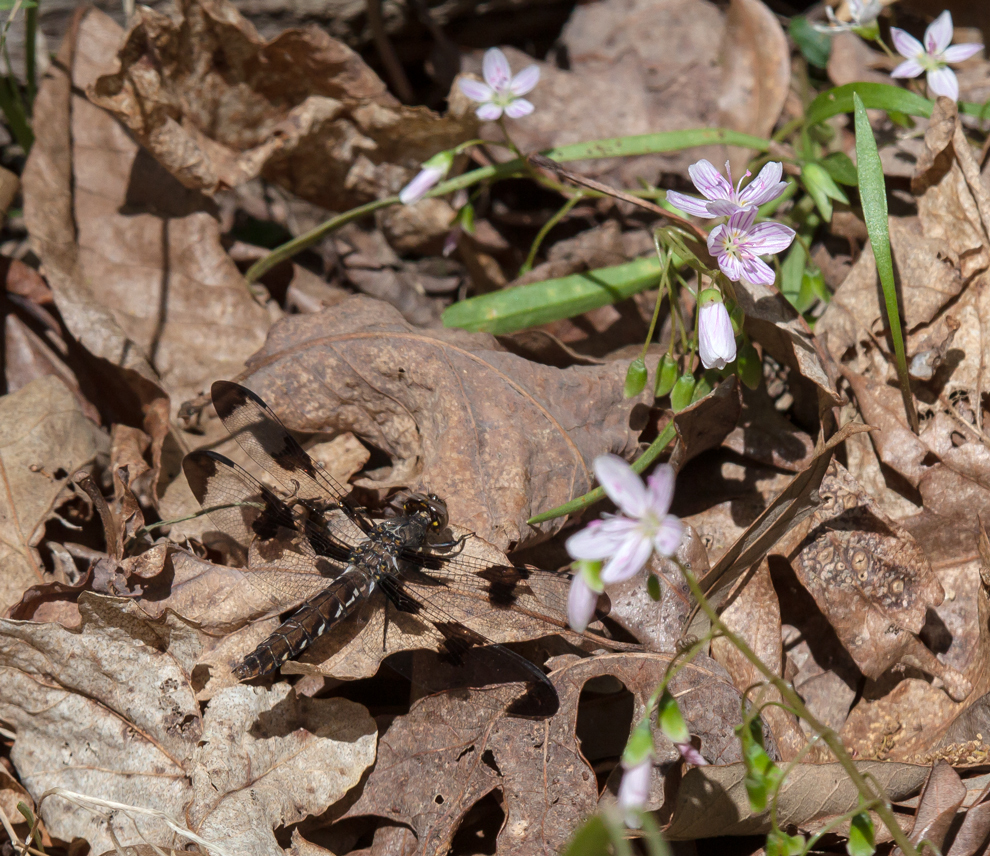
One of the earliest dragonflies to appear in our area is the Common Whitetail (Plathemis lydia) and it is also one of the last to be seen in the fall. During the summer months, these dragonflies can be seen flying all around the ponds at my local marshland. I spotted this one last Friday in a wooded area and initially had trouble seeing it as it flew made a series of short, hopping flights among the fallen leaves on the floor of the woods. As is usually the case, I tried to get as close as I could for the first shot below, but decided to also include a shot that gives you a better idea of the surroundings in which I found this little dragonfly.
Later in the seasons, the Common Whitetail will in fact be common, but this early in the spring, I am pleased with my uncommon find.

© Michael Q. Powell. All rights reserved.
Posted in Flowers, Macro Photography, Nature, Photography, spring, tagged Alexandria VA, Canon 50D, Claytonia virginica, Huntley Meadows Park, Spring Beauty, Spring Beauty wildflowers, Tamron 180mm macro lens on April 26, 2015| 4 Comments »
Tiny pink and white wildflowers carpeting the forest floor at this time of the year—how appropriate it is that they are actually called Spring Beauties (Claytonia virginica).


© Michael Q. Powell. All rights reserved.
Posted in Bugs, Insects, Macro Photography, Nature, Photography, spring, wildlife, tagged Alexandria VA, Canon 50D, Huntley Meadows Park, shield bug, stink bug, Tamron 180mm macro lens on April 25, 2015| 14 Comments »
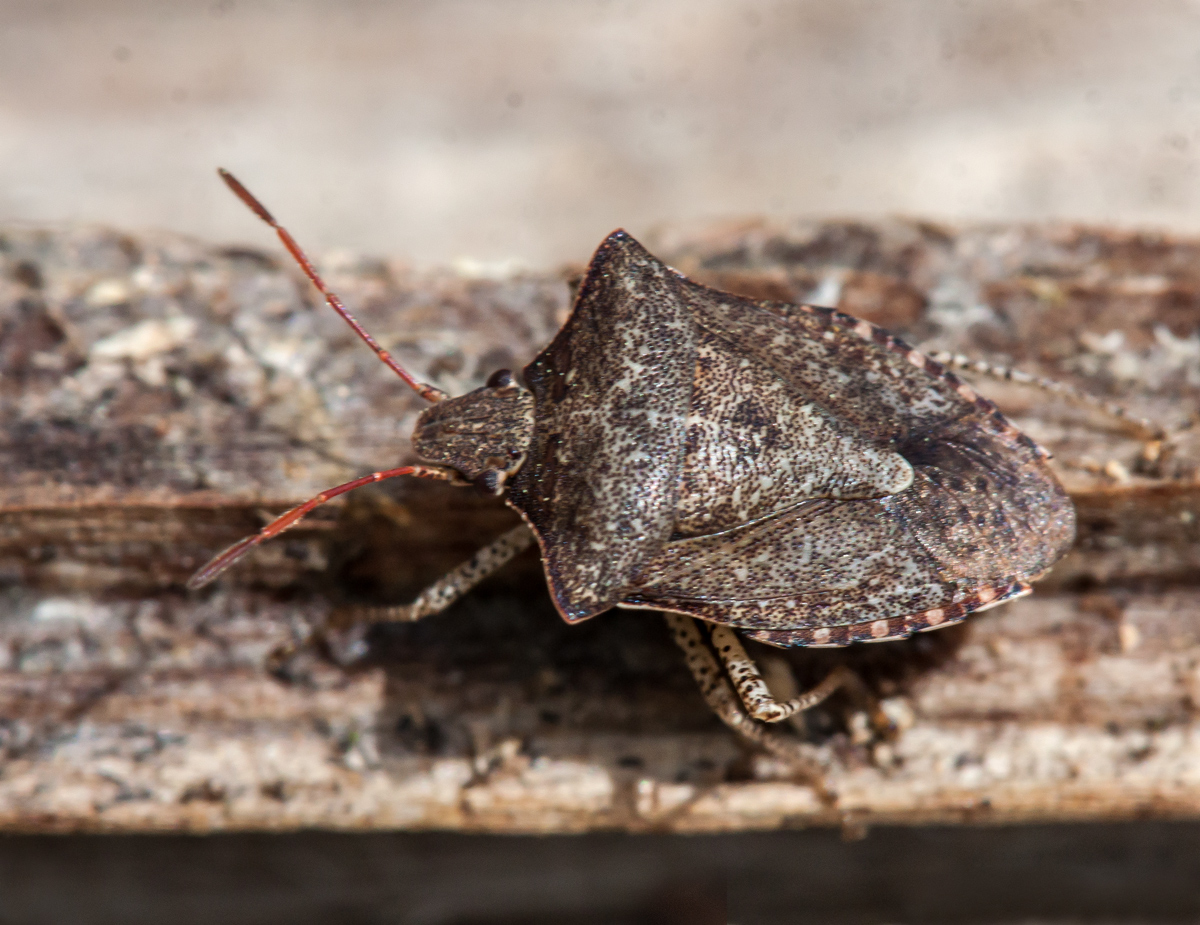
As we move deeper into spring, I am increasingly walking around with my macro lens on my camera and I view anything that moves (and some that don’t) as a potential subject. I recently captured some images of a shield bug that I spotted on a rotten bug. Most often people refer to these insects as “stink bugs,” but I figured I’d attract more readers with the word “shield” than with the word “stink.” There are a lot of different kinds of shield/stink bugs and I have not been able to identify the species of my little bug.
The bug was quite active and I remembered again how difficult it is to stop action when using a macro lens at close range. I am pretty happy with the shots I was able to get. The first one gives a good view of the shield shape and shows how well camouflaged this species is for the environment. The second images shows some of the details of the back and I can’t help but love the simple, smooth background. The final image shows the bug resting for a moment, having successfully made it to the top of an obstacle.
After a winter with few macro subjects to photograph, I am relearning a few techniques and rekindling my excitement for insects and other macro subjects. I’m pretty confident that you’ll be seeing a lot of macro shots in the upcoming weeks and months.


© Michael Q. Powell. All rights reserved.
Posted in Flowers, Gardening, Macro Photography, Nature, Photography, spring, tagged Alexandria VA, Canon 50D, Huntley Meadows Park, Tamron 180mm macro lens, violet, wildflower on April 24, 2015| 9 Comments »
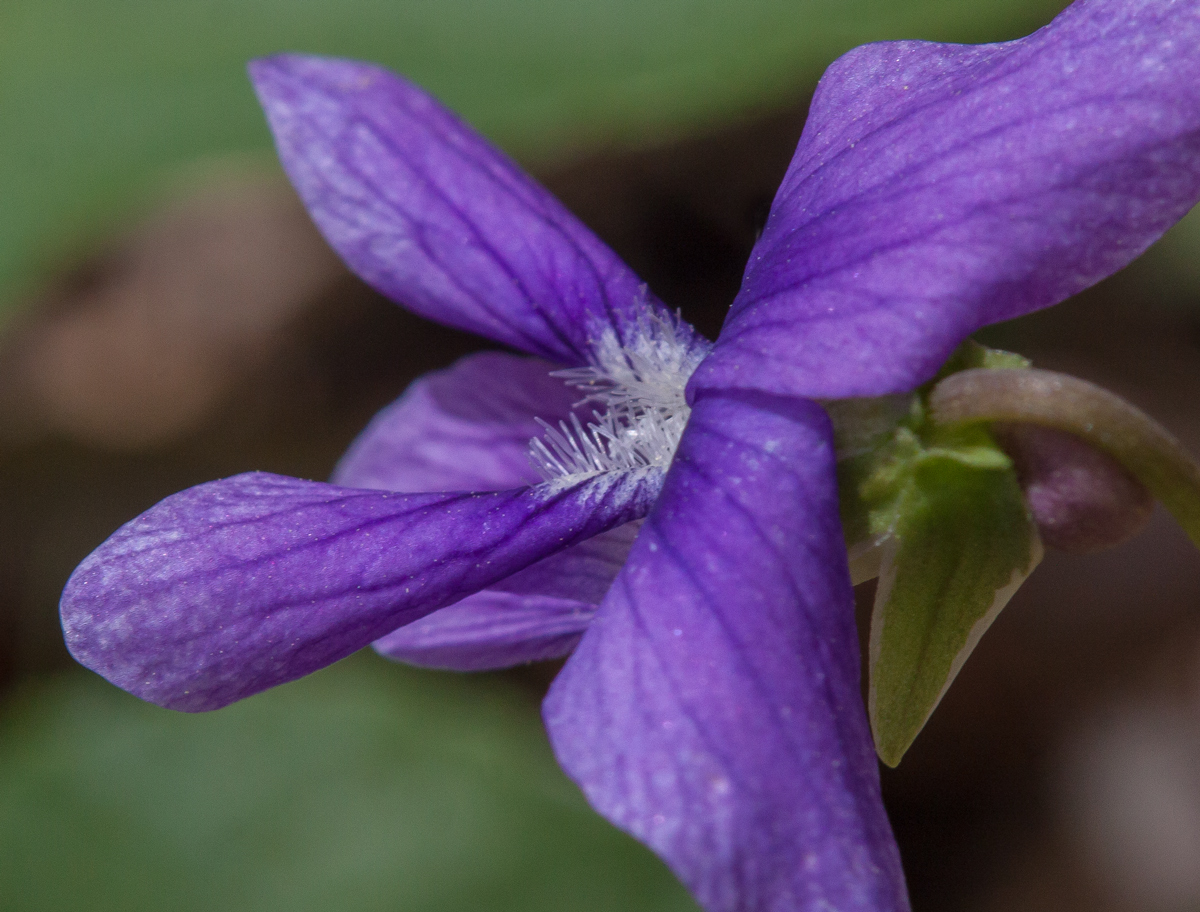
What is the best way to capture the beauty of the fragile wildflowers that carpet the forest floors at this time of the year? Should I try to photograph a single flower? Should I move in even closer and focus on only part of the flower (or crop away part of the flower)? Should the images be realistic or abstract?
These were some of the thoughts that went through my head as I took these shots of what I think is a kind of wild violet. As some of you can readily tell, I was in another one of my “artsy” moods. In case you didn’t notice, the first and last shots are actually variations of the same image that I cropped differently. I just couldn’t decide which one I liked better, so I included them both.


© Michael Q. Powell. All rights reserved.
Posted in Dragonflies, Insects, Macro Photography, Nature, Photography, spring, wildlife, tagged Alexandria VA, Canon 50D, damselfly, Fragile Forktail, Fragile Forktail damselfly, Huntley Meadows Park, Ischurna posita, Tamron 180mm macro lens on April 20, 2015| 4 Comments »
This past weekend I managed to get my first damselfly shot of the season of what appears to be a pretty little female Fragile Forktail (Ischurna posita). Like the Springtime Darner dragonfly that I featured in yesterday’s posting, this photo was taken at Huntley Meadows Park in Alexandria, Virginia. Fragile Forktail damselflies are only about one inch (25 mm) in length and it was my eagle-eyed fellow odonata enthusiast, Walter Sanford, who first spotted this tiny damselfly.

© Michael Q. Powell. All rights reserved.
Posted in Dragonflies, Insects, Macro Photography, Nature, Photography, spring, wildlife, tagged Alexandria VA, Basiaeschna janata, Canon 50D, Huntley Meadows Park, Springtime Darner, Springtime Darner dragonfly, Tamron 180mm macro lens on April 19, 2015| 9 Comments »
Local dragonflies are finally starting to emerge in Northern Virginia and yesterday I was thrilled to capture some images of the appropriately named Springtime Darner (Basiaeschna janata) at Huntley Meadows Park, the marshland where I spend a lot of my time exploring and taking photos.
This is the first time that I have seen this beautiful species, which will be gone by mid-June, according to information on the Dragonflies of Northern Virgina website, a wonderful resource put together by Kevin Munroe, a dragonfly expert and the manager of Huntley Meadows Park. If you want more information specifically about the Springtime Darner, you can go directly to this page, but I think it’s fascinating to poke about in the different areas of the site.
This is also the first documented sighting of a Springtime Darner in the park and I am pretty excited to be partially responsible for a new addition to the park’s species list. Yesterday I was trekking through the muddy back areas of the park with fellow blogger and photographer Walter Sanford, who is much more knowledgeable about dragonflies than I am. He knew precisely what dragonflies we could hope to see and the specific type of habitat where we should expect to see them. After several hours in the hot sun, our persistence was rewarded when Walter spotted this Springtime Darner. Check out Walter’s blog posting called Teamwork, and some take-aways for his observations about yesterday’s discovery.
With more new dragonflies soon to come, it won’t be long before I’ll be walking around primarily with my macro lens on my camera. Fortunately, I was prescient enough yesterday to have switched midday from my 150-600mm telephoto zoom, which would have had trouble capturing the dragonfly because of its minimum focusing distance of 107 inches (2.7 meters), to my 180mm macro lens, which was more suited to the situation we encountered.
I did, however, have to rely on manual focusing to get this shot, which I find to be challenging with a digital camera, especially when shooting handheld. The Springtime Darner likes to perch low on vegetation, so I was on hands and knees, hoping not to spook this specimen, which was the only dragonfly that I managed to photograph yesterday.
I think it’s safe to say that dragonfly season is officially open and I am pretty confident that there will be new blog postings in upcoming months as my adventures with dragonflies continue.

© Michael Q. Powell. All rights reserved.
Posted in Dragonflies, Insects, Macro Photography, Nature, Photography, spring, tagged Alexandria VA, Anax junius, Canon 50D, Common Green Darner, dragonfly, Huntley Meadows Park, Tamron 180mm macro lens on April 12, 2015| 6 Comments »
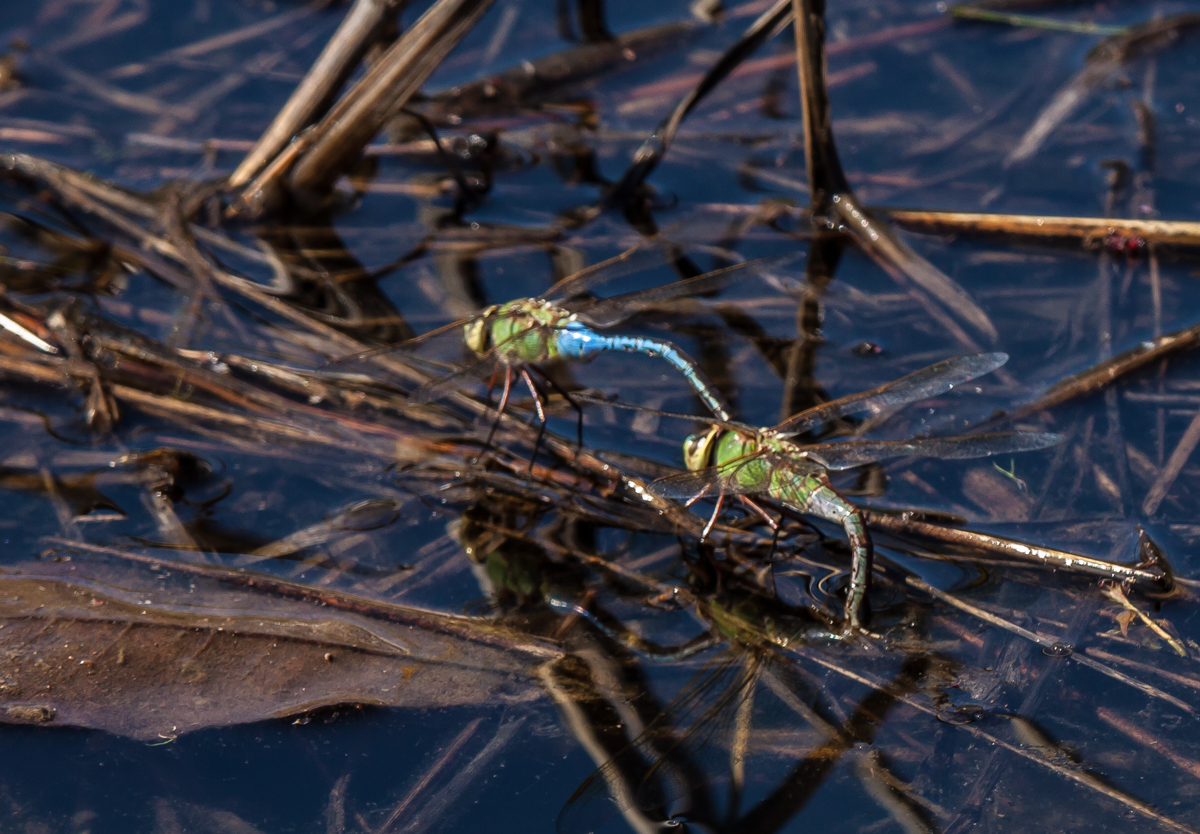
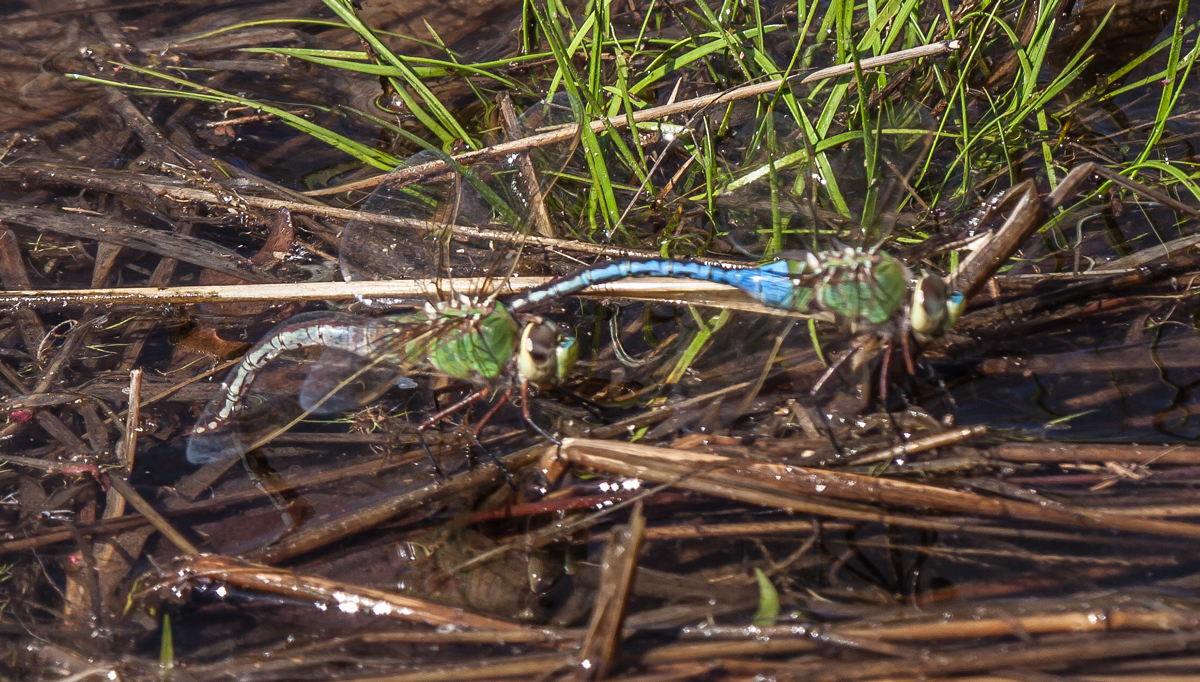
I have been seeing dragonflies at my local marshland park for a couple of weeks now and yesterday I finally got my first dragonfly shots of the spring. It’s still a little early for the emergence of the local dragonflies, so I was not at all surprised that the dragonflies that I captured were Common Green Darners (Anax junius), a migratory species.
Green Darners spend most of their time flying, rather than perching, so it is pretty tough to take photos of them. In this case, I captured the pair in tandem, as the female was ovipositing in the vegetation of a shallow vernal pool.
As luck would have it, after a day of walking around with my telephoto zoom lens on my camera, I had switched to a macro lens not long before I encountered these dragonflies. My macro lens is 180mm in focal length, but that really didn’t get me close enough to the dragonflies. I tried unsuccessfully to be stealthy in moving closer, but the Green Darners flew away as I drew nearer.
© Michael Q. Powell. All rights reserved.
Posted in Dragonflies, Insects, Macro Photography, Nature, Photography, spring, tagged Alexandria VA, Arigomphus villosipes, Canon 50D, Huntley Meadows Park, Tamron 180mm macro lens, Unicorn Clubtail on March 20, 2015| 5 Comments »
On a beautiful sunny day this past Monday I searched diligently for the first dragonflies of the spring at my local marshland park. I knew that it was probably too early for dragonflies, but somehow I hoped that the 65 degree temperatures (18 degrees C) would magically cause them to appear.
I traipsed through the mud and along the banks of several streams; I examined vernal pools where the frogs were already active; and I walked though fields where the dried-up vegetation was neck high. I looked and looked for half a day, but came up empty-handed.
Later in the week I was going over some photos from last June and came across this image of a Unicorn Clubtail dragonfly (Arigomphus villosipes). There was something about the image that really appealed to me.
So here is a memory of the past, with hopes for an equally successful dragonfly hunting season as we move into spring.

© Michael Q. Powell. All rights reserved.
Posted in Autumn, Dragonflies, Insects, Macro Photography, Nature, Photography, tagged Alexandria VA, Blue-faced Meadowhawk, Blue-faced Meadowhawk dragonfly, Canon 50D, female Blue-faced Meadowhawk, Huntley Meadows Park, Sympetrum ambiguum, Tamron 180mm macro lens on December 22, 2014| 7 Comments »
This past Saturday, I searched and searched for a straggler dragonfly which might have survived our recent cold spell, but I found none—dragonfly hunting season is officially over for me. That same day, however, fellow photographer and blogger (and local dragonfly expert) Walter Sanford did a blog posting with photos of a female Blue-faced Meadowhawk dragonfly (Sympetrum ambiguum) that both of us photographed on 17 October and suggested that I also post some shots.
Previously this year, Walter and I did companion postings, in which we each posted photos that showed our different photographic approaches to the same subject, which in that case was a pair of mating dragonflies. (If you are interested, check out Walter’s posting Two sides to every story and my posting My view of the mating dragonflies.)
I am fascinated by the way that two photographers shooting together consciously or unconsciously make a series of creative choices that can result in very different images. Some of the differences, of course, are attributable to the choice of photographic equipment, but many of the differences are caused by the “style” in which the photographer prefers to work.
I took these shots with a 180mm macro lens at fairly close range, which meant that I had to be thinking all of the time about depth of field. The three images I selected show how the amount of the dragonfly’s body in focus changed as I circled around the dragonfly and photographed it in various positions as it flew off and returned to the same general area.
I remember going once to an exhibition showing paintings side by side of a scene that had been rendered by two impressionist artists painting together—I think it was Monet and Renoir—and since that time I have periodically considered the question of whether or not there is an objective reality when it comes to taking (or painting) pictures. What is reality?
Be sure to visit Walter’s blog and his images of this dragonfly in his posting To All The Girls I’ve Loved Before (Part 2).


© Michael Q. Powell. All rights reserved.
Posted in Autumn, Dragonflies, Insects, Macro Photography, Nature, Photography, tagged Alexandria VA, Autumn Meadowhawk, Autumn Meadowhawk dragonfly, Blue-faced Meadowhawk, Blue-faced Meadowhawk dragonfly, Canon 50D, dragonflies mating, Huntley Meadows Park, mating dragonflies, Sympetrum ambiguum, Sympetrum vicinum, Tamron 180mm macro lens on November 21, 2014| 6 Comments »
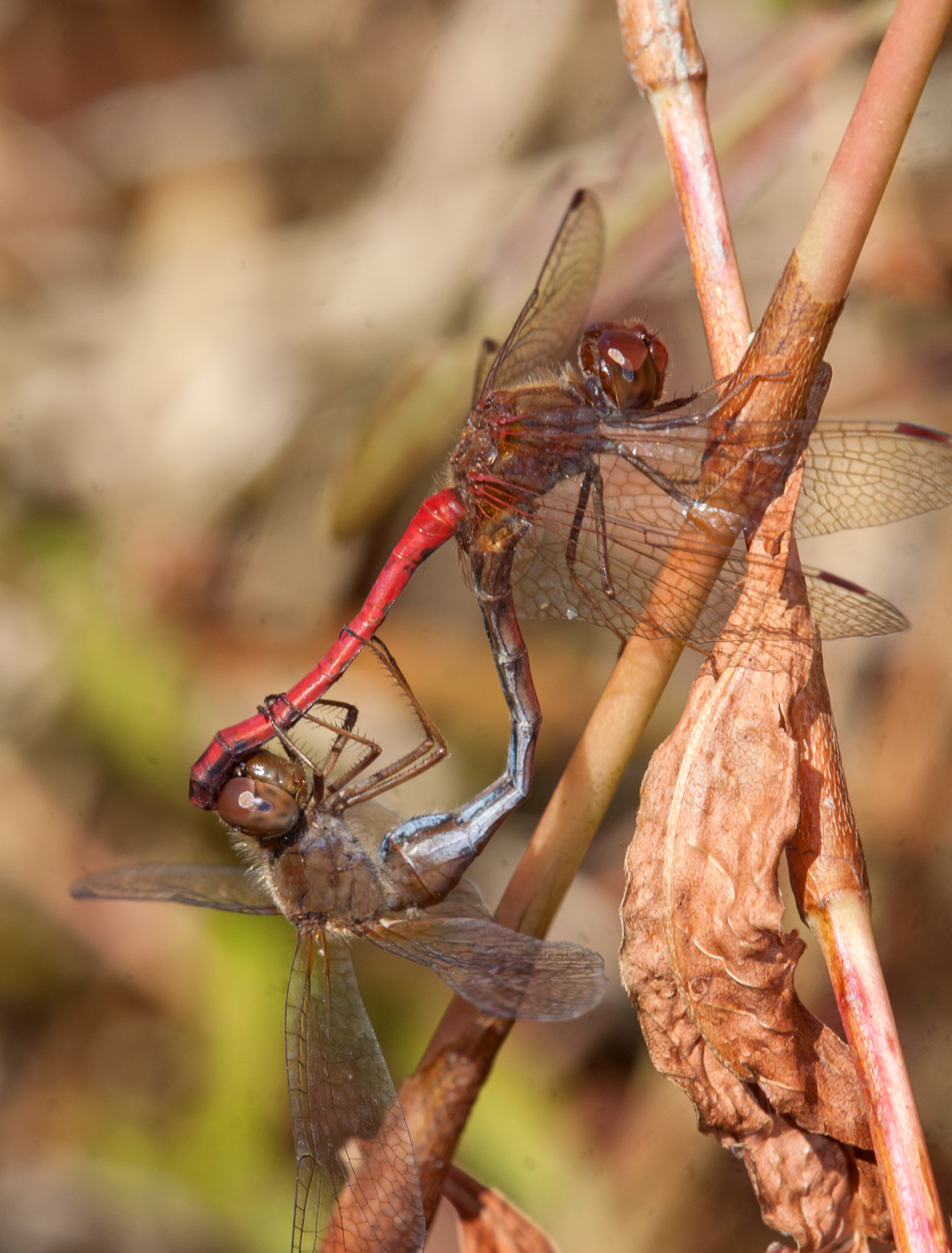
When I captured these two images of mating dragonflies on the 10th of November, I did not realize that their frantic efforts to perpetuate their species that day would mark an end to this year’s dragonfly season for me. There is a chance that some especially hardy Autumn Meadowhawks (Sympetrum vicinum) may have survived our recent spell of bitter cold, but realistically speaking, it’s time to put my macro lenses on the shelf and focus my photographic efforts and birds (and the occasional small mammal).
The Autumn Meadowhawks in the first image were a little higher off the ground that the Blue-faced Meadowhawks (Sympetrum ambiguum) in the second shot and I managed to get into a better shooting position to capture details and separate the dragonflies a bit from the background. In case of the Blue-faced Meadowhawks, I was so thrilled to see them so late into November that I was willing to settle for a lower angle shot with a more cluttered background.
Most of the time I feature only a single species of dragonflies in a posting and it’s a little hard to compare the featured dragonflies with others. It’s a whole lot easier to see the differences between the species when you compare the two photos here.
And so this year’s dragonfly season draws to a close, as the mating couples dance their last tango of the autumn.

© Michael Q. Powell. All rights reserved.
Posted in Autumn, Dragonflies, Macro Photography, Nature, Photography, tagged Alexandria VA, Blue-faced Meadowhawk, Blue-faced Meadowhawk dragonfly, camouflage, Canon 50D, Huntley Meadows Park, Sympetrum ambiguum, Tamron 180mm macro lens on November 16, 2014| 18 Comments »
During most of the year the bright red body of Blue-faced Meadowhawk dragonfly (Sympetrum ambiguum) would really stand out, but in the late autumn, it blends in pretty well with the vegetation. However, it is almost impossible to conceal this species’ stunning blue eyes and turquoise face, which cause it to stand out from even a very cluttered background.

© Michael Q. Powell. All rights reserved.
Posted in Autumn, Insects, Macro Photography, Nature, Photography, tagged Alexandria VA, Canon 50D, Conocephalus brevipennis, Huntley Meadows Park, katydid, Short-winged Meadow Katydid, Tamron 180mm macro lens on November 15, 2014| 8 Comments »
Although many summer dragonflies perch high on the vegetation, the autumn species seem to prefer the ground, so I have been spotting all kinds of cool-looking insects as I keep my eyes pointed down in my continuing search for dragonflies (and so far have not run into anything).
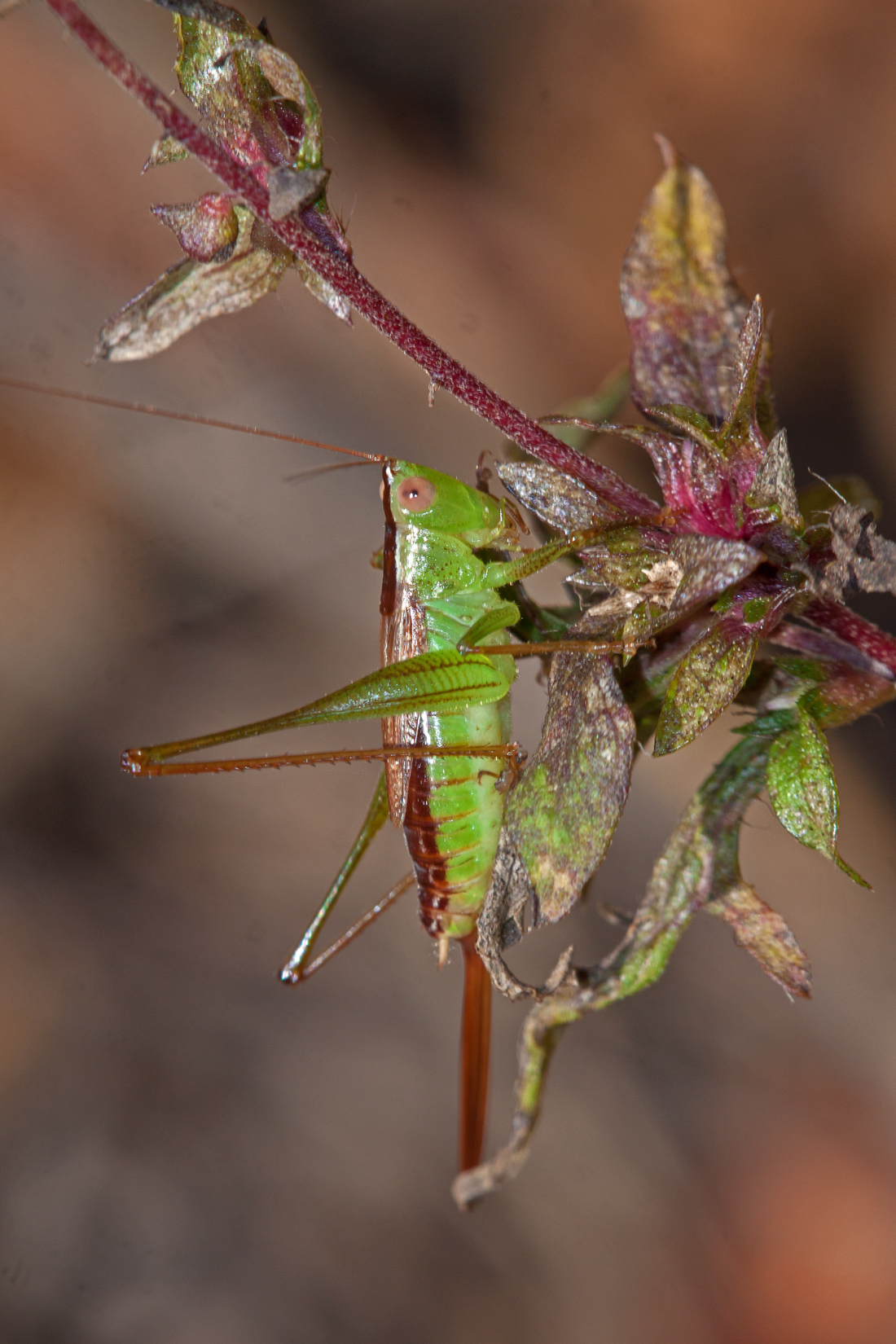
Earlier this week, I came across this beautiful grasshopper-like insect. It looks a bit like my all-time favorite insect, the Handsome Meadow Katydid (Orchelimum pulchellum) and has the same long antennae, but this katydid’s colors are drab by comparison. (Check out one of my previous blog postings called Rainbow Grasshopper to see my favorite insect.)
This insect’s wings are pretty short and it looks to have a long ovipositor. As a result, I’ve tentatively concluded that it might be a female Short-winged Meadow Katydid (Conocephalus brevipennis) and have put in a request to the helpful folks at BugGuide for assistance in confirming my identification.
© Michael Q. Powell. All rights reserved.
Posted in Autumn, Dragonflies, Insects, Macro Photography, Nature, Photography, tagged Alexandria VA, Autumn Meadowhawk, Autumn Meadowhawk dragonfly, Canon 50D, compound eyes, dragonfly eyes, Huntley Meadows Park, Sympetrum vicinum, Tamron 180mm macro lens on November 14, 2014| 9 Comments »
“Make sure the eyes are in focus.” I can’t even count the number of times that I have read or heard these words of advice, which I usually try to follow, even when taking extreme close-up macro shots.
These are the compound eyes of the Autumn Medowhawk dragonfly (Sympetrum vicinum), a close relative of the Blue-faced Meadowhawk that I have featured in several postings recently. I took this shot on a cool day when the dragonfly was perched on a tree, trying to warm itself in the warmth of the sun. The camera’s aperture setting was in a middle range at f/9.0, but with the subject this close, the depth of field was pretty shallow and the eyes are pretty much the only portions of the dragonfly in focus (in addition to small section of the wings and the front legs).

© Michael Q. Powell. All rights reserved.
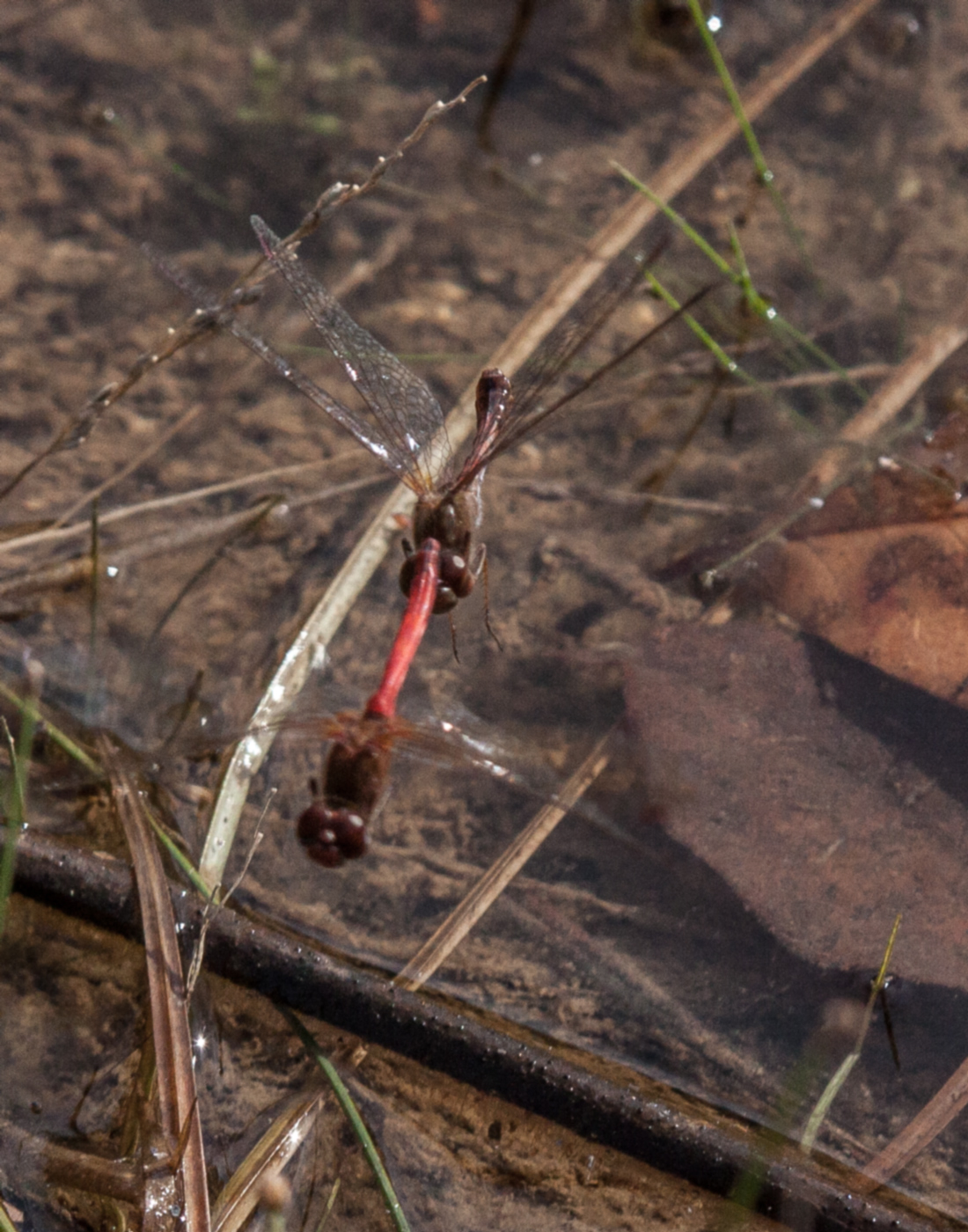
Posted in Autumn, Dragonflies, Insects, Macro Photography, Nature, Photography, tagged Alexandria VA, Autumn Meadowhawk, Autumn Meadowhawk dragonfly, Canon 50D, dragonflies mating, Huntley Meadows Park, ovipositing, Sympetrum vicinum, Tamron 180mm macro lens, tandem position on November 14, 2014| 7 Comments »
When Autumn Meadowhawk dragonflies (Sympetrum vicinum) have finished mating, the male does not release the female, but continues to clasp her head tightly with the tip of his abdomen. The pair flies off together in the “tandem” position and remains attached until the female has finished depositing her eggs, normally in the water.
A chivalrous interpretation of this behavior might be that the male is merely protecting his mate from clamoring suitors and allowing her to oviposit in peace. The reality, though, is that there is a fierce competition among males that can sometimes involve attempt to dislodge a rival’s sperm from a female and replace it with his own if the female has not yet laid her eggs. By holding onto the female, the male increases his odds of fathering some baby dragonflies.
Check out a 2006 National Georgraphic article called Dragonflies Strange Love for some other fascinating insights into the love life of dragonflies.
Earlier this month, I was at a small pool of water and I watched as a series of Autumn Meadowhawk couples in tandem went through the process of ovipositing and I attempted to get some in-flight shots of them. These dragonflies are really small and my success rate in keeping them in the frame was not high, but I did manage to get a few decent images.
Hopefully the practice in tracking a moving subject will carry over and help me as I move to photographing birds in flight, rather than dragonflies.

© Michael Q. Powell. All rights reserved.
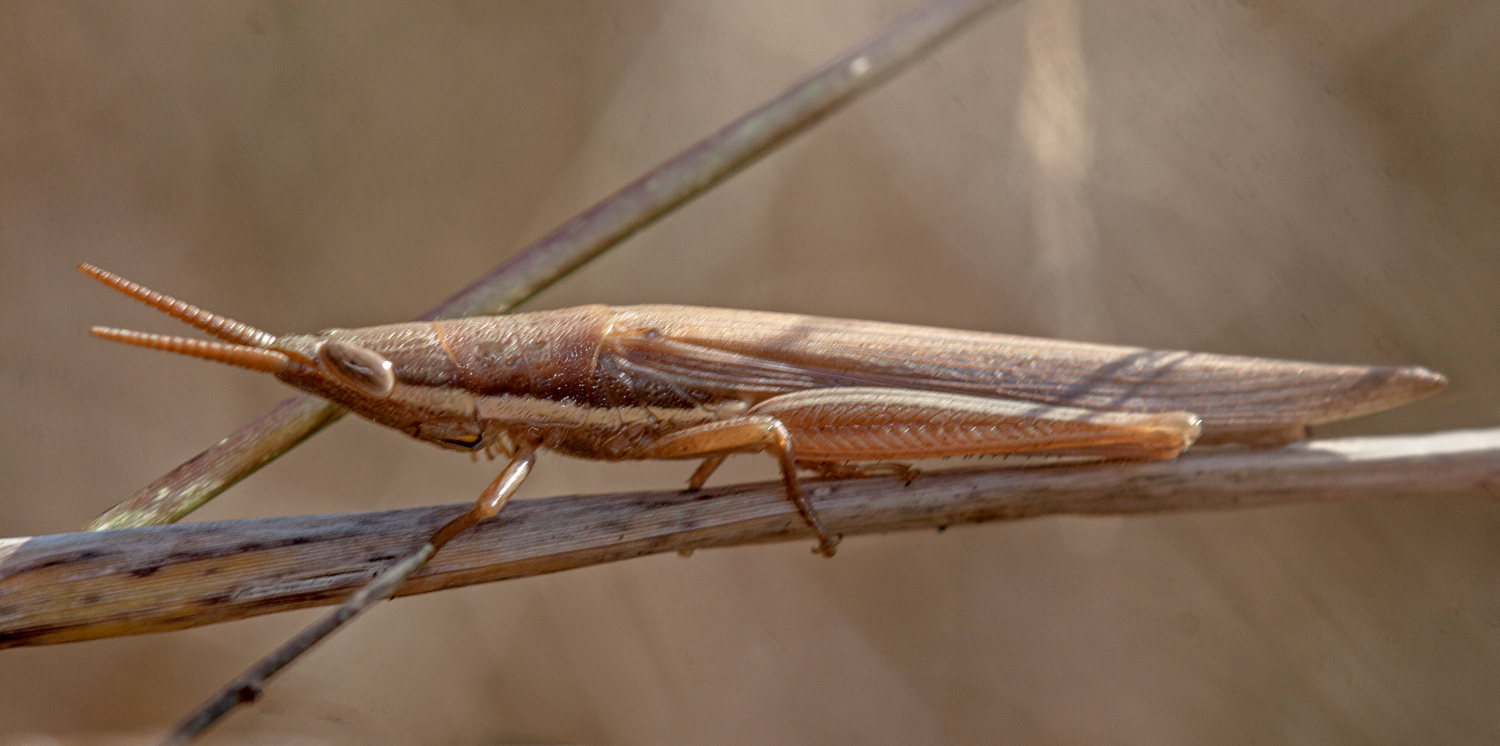
Posted in Humor, Insects, Macro Photography, Nature, Photography, tagged Alexandria VA, Canon 50D, charging bull, grasshopper, Huntley Meadows Park, matador, Slant-faced Grasshopper, subfamily Gomphocerinae, Tamron 180mm macro lens on November 13, 2014| 20 Comments »
As I looked through my macro lens, I felt for a moment like a matador. The grasshopper in my viewfinder had lowered its head and was preparing to charge me, trying its best to gore me with its fearsome fluted horns. I wasn’t dressed for the part and had no little red cape to bravely wave at the charging grasshopper.
In reality, I am not sure what kind of a grasshopper this is. It looks a little like a Slant-faced Grasshopper, but I have never before seen one with such unusual, horn-shaped antennae. This grasshopper hopped up onto this stalk of grass as I was searching for dragonflies this past weekend. I don’t know much about the developmental cycle of grasshoppers and wonder if this might be a nymph.
In the absence of any scientific information, I think I’ll informally call this the Dual-unicorn Grasshopper, because the shape and pattern of the antennae remind me of so many of the depictions I have seen of the mythical unicorn.

© Michael Q. Powell. All rights reserved.
Posted in Autumn, Dragonflies, Insects, Macro Photography, Nature, Photography, Portraits, Winter, tagged Alexandria VA, Blue-faced Meadowhawk, Blue-faced Meadowhawk dragonfly, Canon 50D, female Blue-faced Meadowhawk, Huntley Meadows Park, Sympetrum ambiguum, Tamron 180mm macro lens on November 12, 2014| 8 Comments »
My concerns about the potential demise of the Blue-faced Meadowhawk dragonflies (Sympetrum ambiguum) were greatly exaggerated and I saw a half-dozen or more yesterday on Veterans Day (Armistice Day).
Normally we stop seeing this species of dragonflies by the end of October, but we have not yet gone below freezing and perhaps that explains their unexpected longevity. Yesterday, for example, the temperatures soared to almost 70 degrees F (21 degrees C). I have to note too that I am searching for them more diligently and in more remote locations of my marshland park, so that may help explain why I am seeing them more frequently.
As is the case with birds, male dragonflies tend to be more brightly colored and visible. Many female dragonflies are brown in colored and harder to spot. I was thus very happy yesterday to be able to get this close-up shot of a female Blue-faced Meadowhawk. Her body coloration may be a little bit drab, but those blue eyes are simply stunning.
In case you are curious, these dragonflies are small in size, with a body length of approximately 1.5 inches (38 mm), so I had to move in awfully close to get this shot. Surprisingly (and happily), this female tolerated my close presence for long enough for me to take several shots before she flew off into the distance.

© Michael Q. Powell. All rights reserved.
Posted in Autumn, Dragonflies, Insects, Macro Photography, Nature, Photography, tagged Alex, autumn, Autumn Meadowhawk, Autumn Meadowhawk dragonfly, Canon 50D, Huntley Meadows Park, knee, mating dragonflies, Sympetrum vicinum, Tamron 180mm macro lens on November 10, 2014| 12 Comments »
Have you ever tried to photograph a living subject—or even worse, a pair of them—perched on one of your knees? Depth of field is a huge challenge and even trying to frame the subject is complicated, especially when you have a 180mm macro lens on your camera.
Autumn Meadowhawks (Sympetrum vicinum) are the most friendly dragonflies I have ever encountered. I don’t know what attracts them—perhaps it’s curiosity—but I found out last year that they are prone to perch on me.
Surprisingly, they will even perch as a pair when they are still in tandem, the position that this species uses when the female is ovipositing, i.e. placing her eggs in the water after mating. The male hangs on to the female by the head, presumably to keep other males from interfering with the process.
In my initial attempt to get a shot of the couple, I focused on the male, and the female is completely out of focus. For the second attempt, I tried to twist myself around to photograph them from the side and almost fell over in the process. The female is more in focus, but the male is now slightly out of focus.
As the season progresses, I’ll see if I can find some even more cooperative Autumn Meadowhawks and try to get a shot of one perched on one of my fingertips, as I did last year.

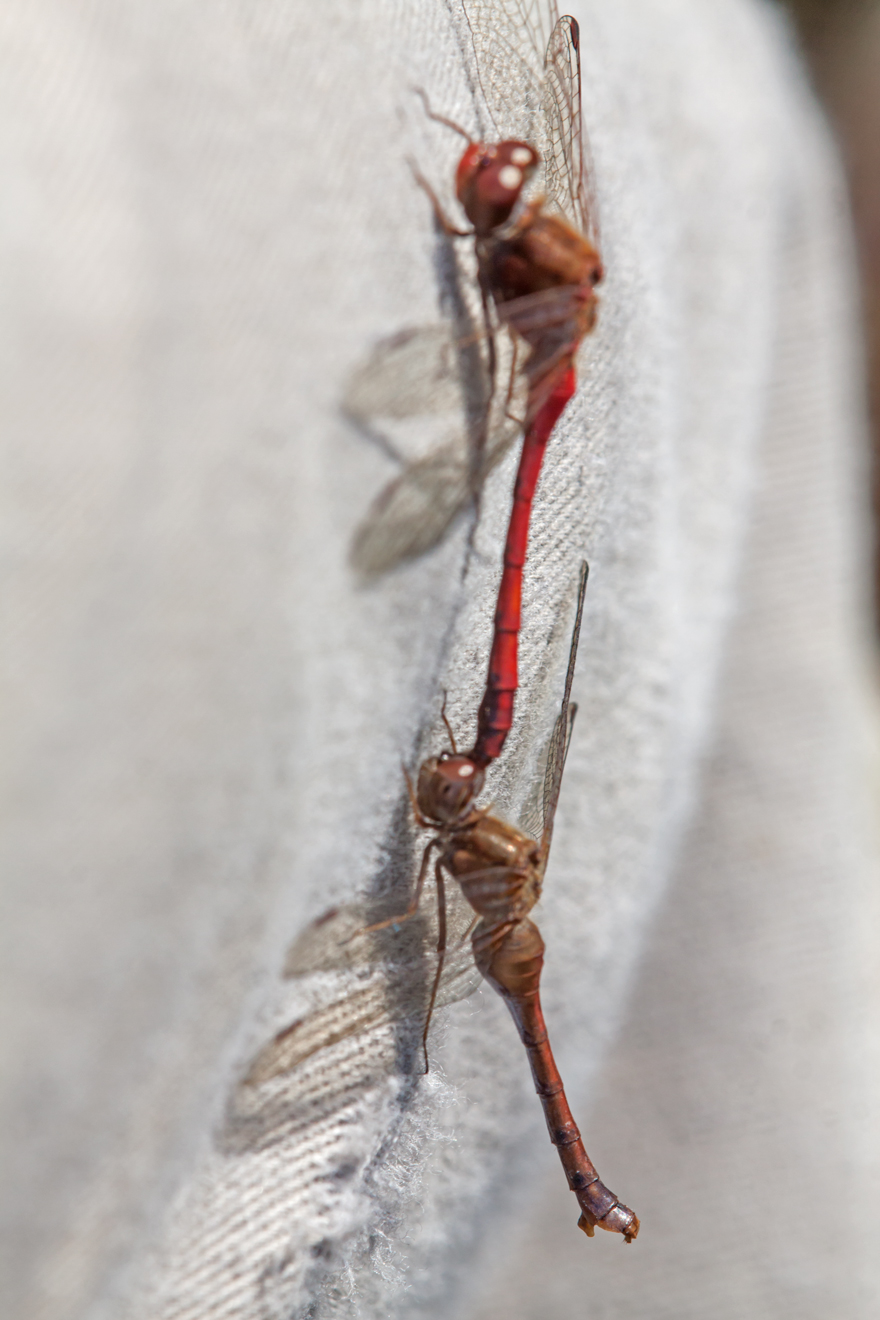
Later in the day, a male Autumn Meadowhawk landed on my leg and I had much better success in getting some clear shots. I used a similar approach, taking the first shot from above and the second one from the side. My pants are a solid tan color and it is interesting to see how it almost looks like I was wearing a seersucker suit.


© Michael Q. Powell. All rights reserved.
Posted in Autumn, Dragonflies, Insects, Macro Photography, Nature, Photography, tagged Blue-faced Meadowhawk, Blue-faced Meadowhawk dragonfly, Canon 50D, Huntley Meadows Park, Sympetrum ambiguum, Tamron 180mm macro lens on November 8, 2014| 8 Comments »
We’re almost at the end of the dragonfly season now in Northern Virginia and soon I’ll be seeing only the Autumn Meadowhawks (Sympetrum vicinum), historically the last dragonflies of the year to disappear. This past Monday, though, I managed to find a few Blue-faced Meadowhawk dragonflies (Sympetrum ambiguum), unusually hardy survivors this late in the season.
I really enjoy trying to get close-up shots of these colorful little dragonflies and my favorite shot is this close-up of one of them, perched on a fallen leaf.

When you pull back a little, you can see how tough the season has been for this dragonfly—portions of its wings are shredded. Somehow, however, it managed to fly about as though its wings were undamaged.

Temperatures last night dropped down into the upper 30’s F (3-4 degrees C) and I doubt that I will see any more Blue-faced Meadowhawks. I am resigned to the possibility that these may be my last shots of the year of these stunning little dragonflies, but that won’t keep me from searching really hard for them later today.

© Michael Q. Powell. All rights reserved.
Posted in Autumn, Dragonflies, Macro Photography, Nature, Photography, tagged Alexandria VA, Autumn Meadowhawk, Autumn Meadowhawk dragonfly, Canon 50D, dragonflies mating, Huntley Meadows Park, Sympetrum vicinum, Tamron 180mm macro lens, voyeur on November 7, 2014| 9 Comments »
It’s hard not to feel a little bit like a voyeur when I move in close to capture the details of an intimate encounter between two wild creatures. There is something especially intriguing about the acrobatic maneuvers of colorful mating dragonflies, like this pair of Autumn Meadowhawk dragonflies (Sympetrum vicinum) that I photographed in the “wheel” position at my local marshland park in late October.
Many times I have to assume equally acrobatic positions to capture the action. Fellow photographer and dragonfly enthusiast Walter Sanford photographed me in one such pose in an image that I included in a previous posting entitled “My view of the mating dragonflies.”
On this occasion, however, the dragonflies were much more accommodating and they perched at eye level on the top of some vegetation. The couple was back-lit, but a little fill flash helped to bring out the details and the colors.
In this case, at least, the brightly-colored dragonflies seemed to be exhibitionists and I felt less like a voyeur, though I must confess that I did not shield my eyes and turn away from the activity.

© Michael Q. Powell. All rights reserved.
Posted in Arachnids, Autumn, Macro Photography, Nature, Photography, tagged Alexandria VA, Canon 50D, green spider, Huntley Meadows Park, Tamron 180mm macro lens, tiny green spider on November 6, 2014| 9 Comments »
Continuing my quest to find and photograph the dwindling number of insects before winter sets in, I came upon this tiny green spider this past Monday as I was searching for dragonflies. It was almost hidden in the leaf litter, but made a slight motion as I happened to be looking at its direction.
It looks to be some kind of crab spider, though that is more a guess than an informed opinion. One thing that I do know, though, is that I am fascinated by its eyes, which you can see more closely if you click on the image.
I took this photo just about at the minimum focusing distance for my lens, which the manufacture says is 18.5 inches (47cm). I tried to get just a bit closer, but had to back off to keep the spider in focus. As you can probably tell, I was really low to the ground when I took this photo and was using my camera bag to stabilize the lens for the shot.
The weather has turned cooler and rainy, which does not bode well for the insect population. I’ll probably be out tomorrow looking for the survivors (and have a few more to post from Monday if I am unable to find new subjects).

© Michael Q. Powell. All rights reserved.
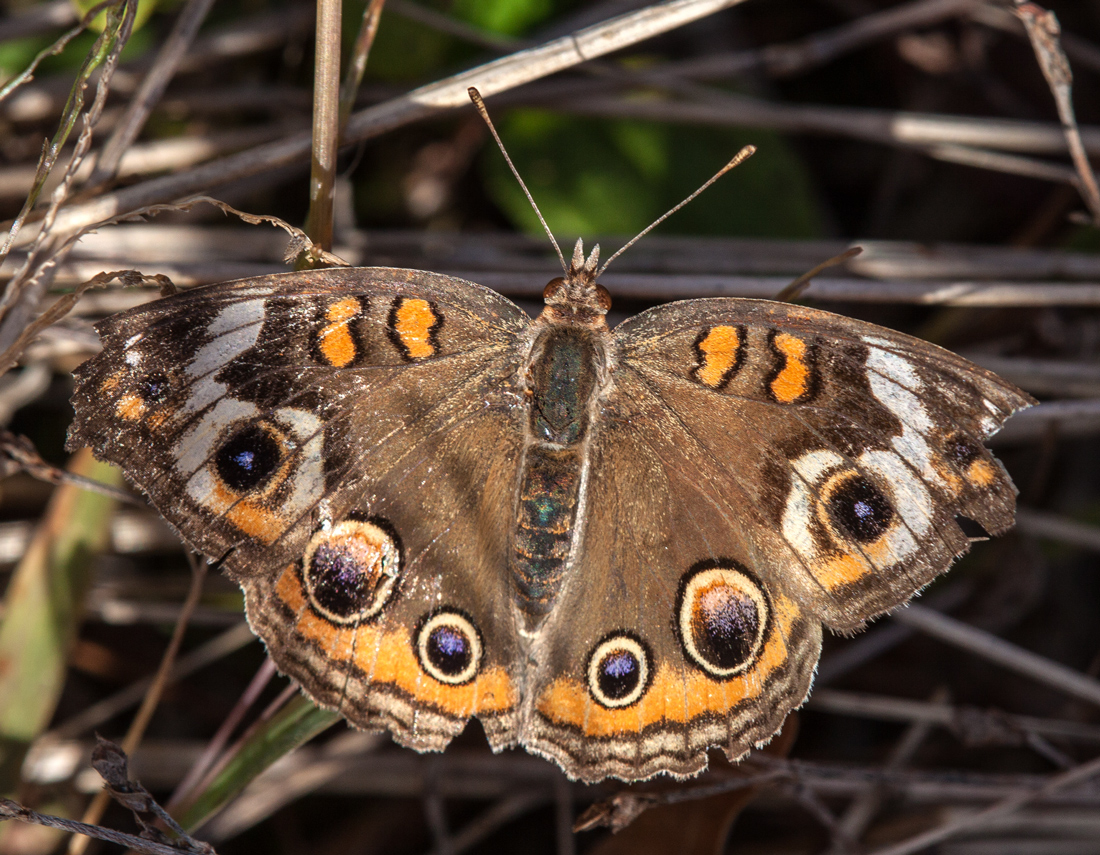
Posted in Autumn, Butterflies, Insects, Macro Photography, Nature, Photography, tagged Alexandria VA, butterfly, Canon 50D, Common Buckeye, Common Buckeye butterfly, Huntley Meadows Park, Junonia coenia, Tamron 180mm macro lens on November 5, 2014| 12 Comments »
Butterflies in November? I didn’t really expect to see any, so it was a pleasant surprise when I came upon this Common Buckeye (Junonia coenia) on Monday at my local marsh. The butterfly is beat-up and bedraggled, but its beauty beams brightly—uncommon beauty at an unexpected time.
© Michael Q. Powell. All rights reserved.
 Mike Powell