Feeds:
Posts
Comments

Posts Tagged ‘Tamron 18-400mm’

It is a fun challenge to try to photograph dragonflies in flight—I will usually try to meet this challenge at least a few times each dragonfly season. It requires a lot of patience and persistence, as you can probably imagine, and results are certainly not guaranteed.

I captured these shots of Prince Baskettail dragonflies (Epitheca cynosura) as they was flew more or less toward me on Tuesday at Jackson Miles Abbott Wetland Refuge. Normally I use manual focus for these kinds of shots when I am shooting with my Tamron 180mm macro lens because it is really slow in acquiring focus.

For these shots, though, I used my Tamron 18-400mm lens and the longer reach let me acquire and track my subjects when they were farther away. Amazingly I was able to use auto focus. The first two shots were taken with the zoom lens fully extended to 400mm and the lens was at 265mm for the final photo.

None of these photos will win any prizes, but they are kind of fun. As one of my friends commented in Facebook, the view is “kind of like being a tail gunner in a B17 over France during WWII.” More importantly for me, though, these shots provide an indication that I am not giving up too many capabilities if I choose to walk around with this lens alone. It will never fully replace my macro lens or my longer telephoto zoom lens, but the Tamron 18-400mm lens is continuing to impress me with its versatility.

Prince Baskettail

Prince Baskettail


Prince Baskettail

© Michael Q. Powell. All rights reserved.


Read Full Post »

I try to pay a lot of attention to the background when I am composing a photo. If it is too cluttered, the background can draw attention from the primary subject, but if it is too plain, it can remove all sense of the environment in which the shot was taken. Ideally, the background adds visual interest to an image without being distracting.

For most of my wildlife shots, I have only a very limited control over my physical environment. Birds and insects will choose their perches or their flight paths and I am the one who has to adapt. It is amazing, though, how a slight change in the angle of view can improve an image. Sometimes I am able to improve my shot by moving a little to one side or the other or by shooting a little higher or a little lower.

Camera settings can help a bit too—by making the depth of field more shallow, for example, I can blur out the background. I have to be careful, however, in using this technique, because important parts of my subject to be blurred as well if I do not pay attention to my relationship to my subject. There are a lot of creative choices to make in choosing camera settings. I remember feeling overwhelmed by the number of choices when I first started becoming more intentional in my photography—it is now second nature and I make my choices instinctively, knowing pretty well what the effect will be of changing a setting.

In the first photo, I tried to be sure that the plane of my camera sensor was parallel to the body of the male Slaty Skimmer dragonfly (Libellula incesta), which meant that most of the dragonfly was in focus, while the background was blurry. You can certainly tell that there were branches all around, but the blurry branches, I think, make this image a whole lot more interesting than the traditional “dragonfly on a stick” shot.

The second image shows a Big Bluet damselfly (Enallagma durum) perched on some vegetation. I really like this shot because of the way that the background gradually fades away, unlike in the first image in which there was a sharp distinction between the foreground and the background. I also like the linear nature of the stalks of vegetation and their varying angles.

I took both of these shots using my Tamron 18-400mm lens during a visit to Occoquan Bay National Wildlife Refuge last week. As I mentioned in some other recent posts, I am experimenting with this lens to see if it can serve as an all-in-one lens for those times when I want to travel light, while retaining the capability to photograph a variety of subjects. These two shots proved to me that with this lens I can capture images of some small creatures with a good amount of detail. So far I am quite happy with its performance and I will continue playing around with it to learn about its capabilities and limitations.

Slaty Skimmer

Big Bluet

© Michael Q. Powell. All rights reserved.


Read Full Post »

Every now and then one of my readers will ask me to post photos of Occoquan Bay National Wildlife Refuge, my favorite local wildlife photography spot. Usually I have either a telephoto or macro lens on my camera, neither of which is all that suitable for landscape-type shots. If I thought about it, I could switch to a wider lens and generally have one with me in my backpack, but it is kind of a hassle to do so.

This past week I have been finally shooting with my Tamron 18-400mm zoom lens, which I bought months and months ago, but had rarely used. This lens gives me good all-round capability in terms of focal length, but I wasn’t sure how it would handle the kinds of shots that I like to take. Could it handle macro-style shots of dragonflies? How would it handle birds, especially birds in flight?

I am still working on the answering those questions, but so far the results look promising. The dragonfly photos in my past two postings were taken with this lens, as were the landscape photos in this posting. One of the challenges of using this kind of all-in-one lens is that I have to retrain my eyes to look everywhere—when I have a long telephoto lens on my camera, I look mostly into the distance and when I use a macro lens, I look mostly at areas that are close to me.

As you can see in these photos, water is one of the features of this wildlife refuge. Sometimes I search for subjects near the ponds and streams and at other times I focus my attention on the wider waters of the bay. At this time of the year, the vegetation is green and lush. Fortunately the foliage on the trees provides some respite from the oppressive heat that is common here in the summers.

Occoquan Bay National Wildlife Refuge

Occoquan Bay National Wildlife Refuge

Occoquan Bay National Wildlife Refuge

© Michael Q. Powell. All rights reserved.

Read Full Post »

We are at a time of the summer, when it is unlikely that I will see any new dragonflies for the season. Several species will emerge towards the end of the summer, but for now I see the same familiar faces over and over again.

I really am content, though, with photographing the beauty of these wonderful aerial acrobats and never grow tired of photographing the same ones over and over. Each outing with my camera is an opportunity to capture images in a different way, in different environments, and in situations with different lighting.

Last  week I was delighted to capture these images of male Widow Skimmer dragonflies (Libellula luctuosa) during a visit to Occoquan Bay National Wildlife Refuge. I just love the brown and white patches on the wings of these dragonflies that make them really stand out from all other dragonflies in our area.

These shots also illustrate the fact that the shapes of the front wings of most dragonflies are different from the rear wings. I suspect that the different shapes play a role in enabling the amazing flight capabilities of dragonflies, although I confess that I do not understand very well the aerodynamics of dragonfly flight—their flight seems almost magical to me.

Widow Skimmer

Widow Skimmer

Widow Skimmer

© Michael Q. Powell. All rights reserved.

Read Full Post »

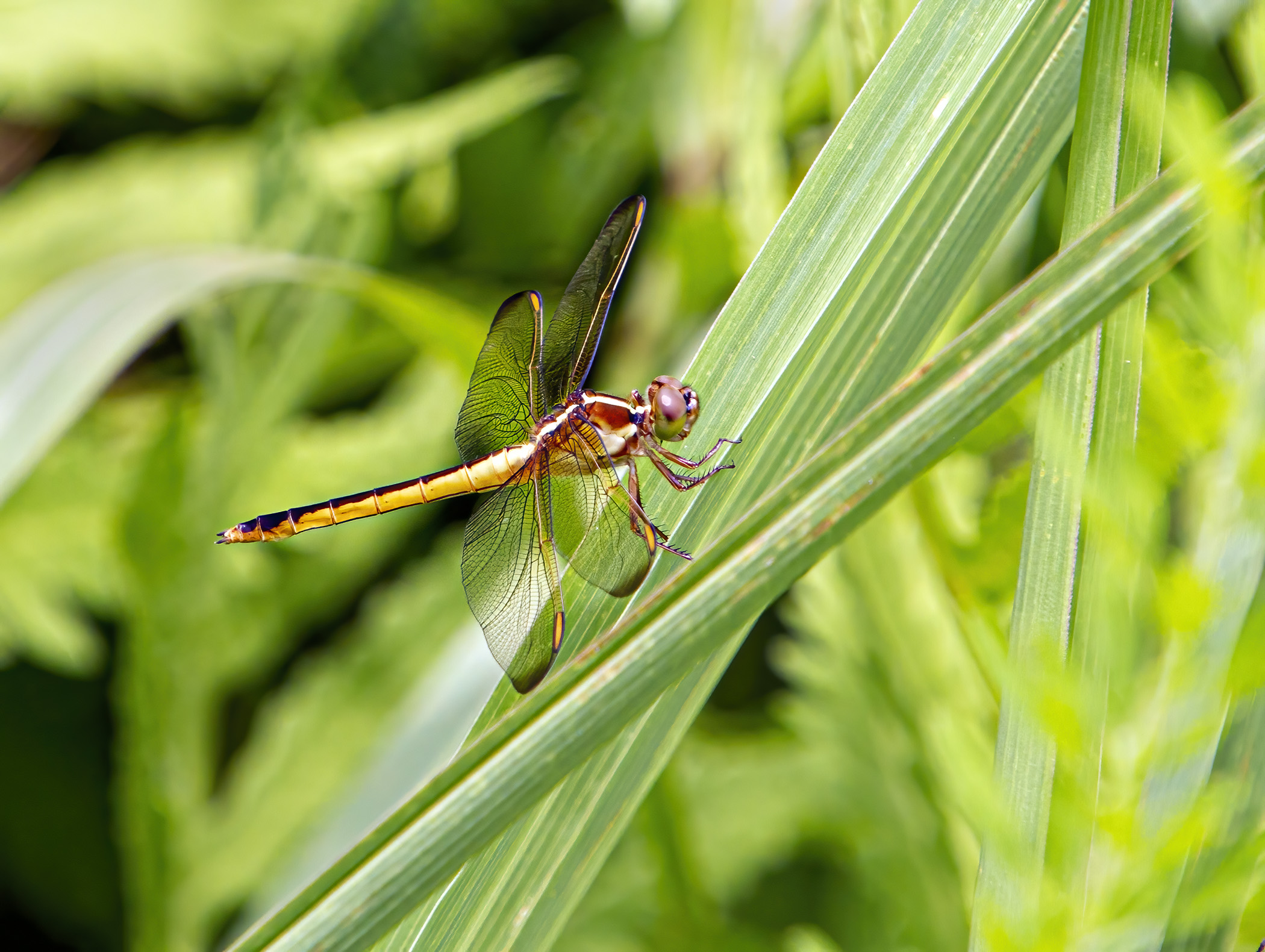
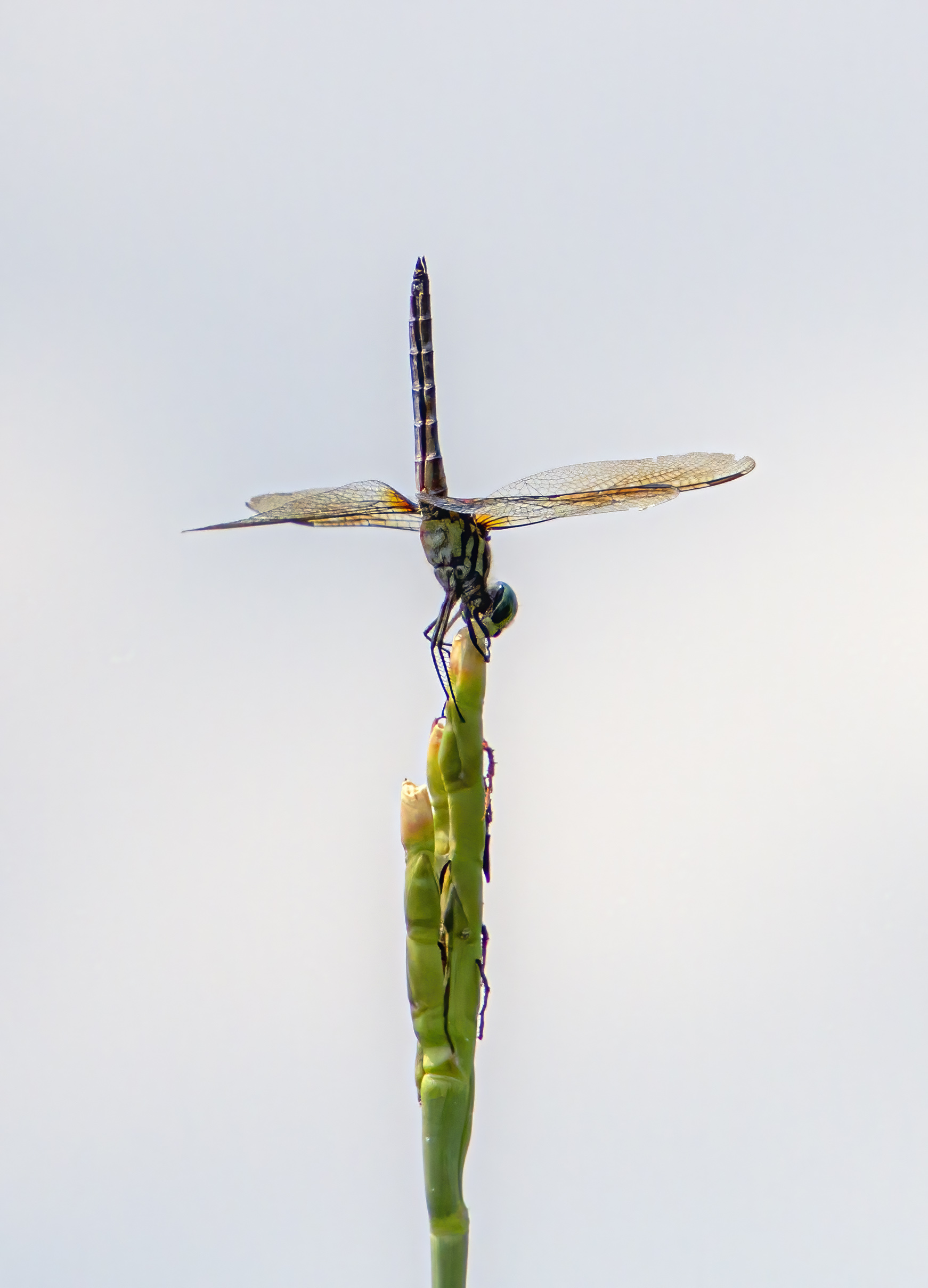
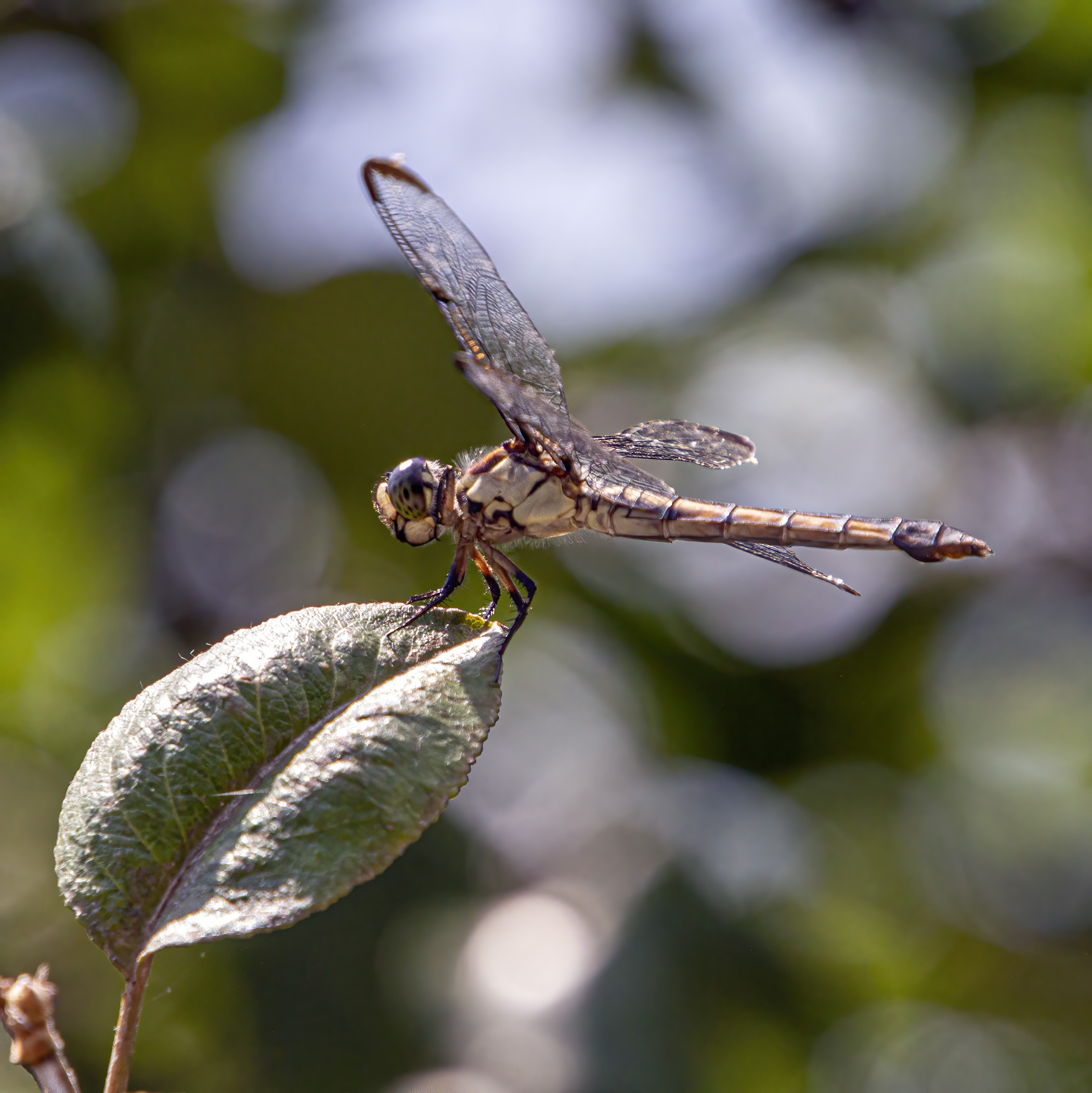
Dragonflies perch in many different ways and in many different places. Here are some simple shots of three dragonflies that I encountered last Thursday at Occoquan Bay National Wildlife Refuge.

The first one is a Needham’s Skimmer (Libellula needhami) and I love the way that its coloration contrasts so well with the sea of green vegetation in which it is perched. The dragonfly in the second photo, my personal favorite of the three images, is a Blue Dasher (Pachydiplax longipennis). When it’s hot outside, some dragonflies, like this one, like to assume a handstand-like pose, often called the “obelisk” position, to reduce their exposure to the direct sunlight. The final photo shows a Great Blue Skimmer (Libellula vibrans) perched on the tip of a leaf.

Each of these shots represents my efforts to isolate a dragonfly a bit from its surroundings and to highlight its beauty and its behavior. None of theme is spectacular or award-worthy, but they are pleasing little portraits of some of my summer companions.

Needham's Skimmer

Blue Dasher

Great Blue Skimmer

© Michael Q. Powell. All rights reserved.

Read Full Post »

It was hot and humid when I went trekking with my camera this past Wednesday and most of the wildlife seemed to be taking siestas in the shade at Occoquan Bay National Wildlife Refuge. I could hear the sounds of birds, but spotted only a few of them. Even the dragonfly activity seemed to be lower than normal.

Fortunately, a good number of butterflies were active. In fact they were so active, that I expended a lot of energy chasing after them. I noticed that several of them were showing some wear and tear, with visible damage to their wings.

The first and third photos show Black Swallowtail butterflies (Papilio polyxenes), while the butterfly in the middle shot is a Zebra Swallowtail butterfly (Eurytides marcellus). None of these images is spectacular, but I like the way that they work together as a set, with the green vegetation in the background of each of them serving as a unifying element.

Have a happy weekend and chase a few butterflies if you can find them—it will make you feel like a child again.

Black Swallowtail

Zebra Swallowtail

Zebra Swallowtail

© Michael Q. Powell. All rights reserved.


Read Full Post »

« Newer Posts