Feeds:
Posts
Comments

Posts Tagged ‘Tamron 150-600mm’

Whenever a vulture is circling overhead, I like to make sure I move about from time to time. This Turkey Vulture (Cathartes aura) at Huntley Meadows Park didn’t seem to be paying too much attention to me, but you can never be too cautious, especially if you have not taken a shower that morning.

Turkey Vulture

Turkey Vulture

© Michael Q. Powell. All rights reserved.

Read Full Post »

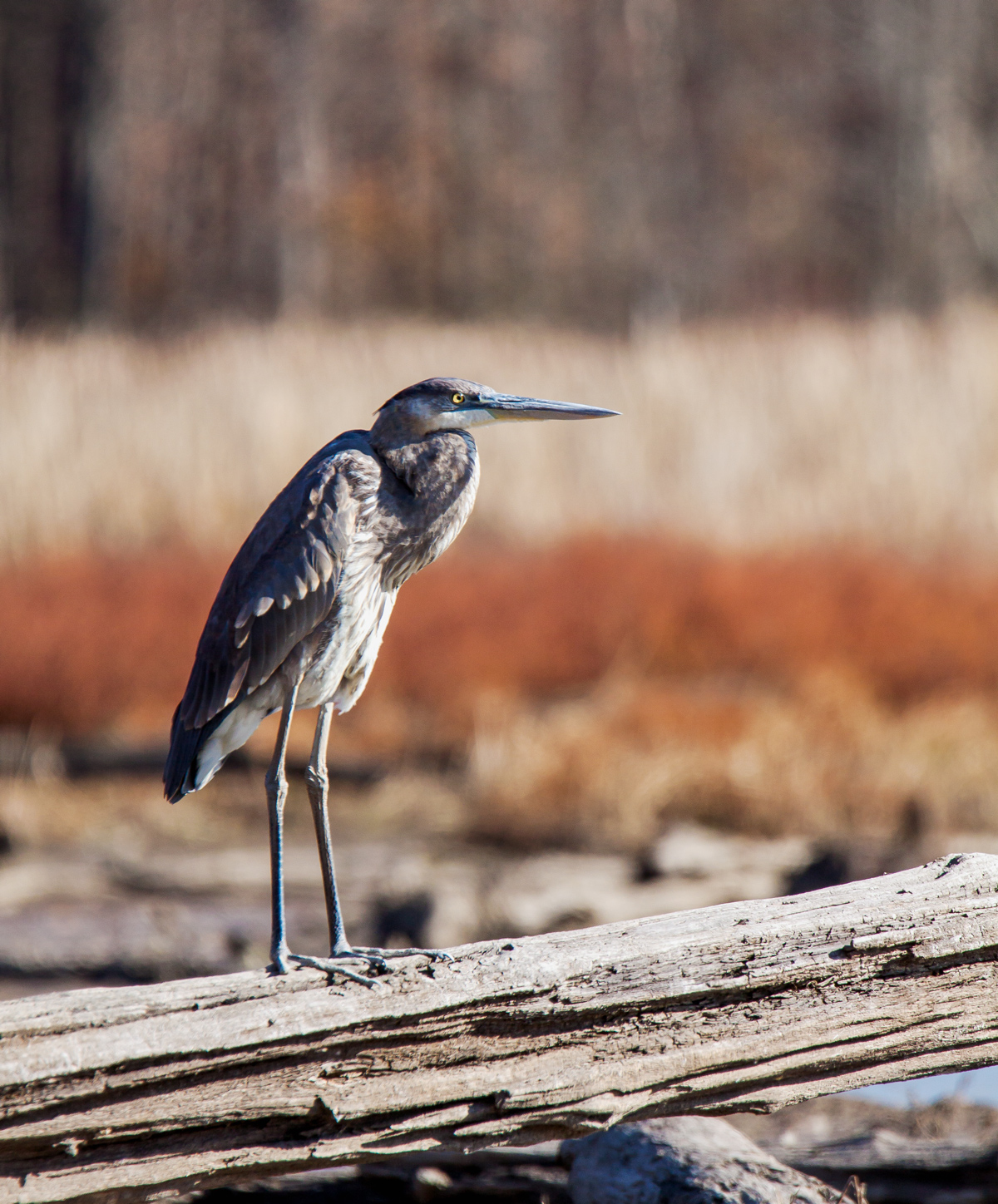
When it’s cold and windy, the Great Blue Herons (Ardea herodias) at Huntley Meadows Park often like to seek sheltered areas at the edge of the water. Unlike the heron, I stayed out in the open and was buffeted by the strong winds as I tried to capture this profile shot of the heron.

Great Blue Heron

© Michael Q. Powell. All rights reserved.

Read Full Post »

Some photographers like to stay in one spot and let the action come to them, but most of the time I prefer to keep on the move, opportunistically scanning for subjects to shoot. There is one place, however, at Huntley Meadows Park that I will sometimes visit and simply sit for extended periods of time. It is a beaver pond in a secluded area of the park and I feel a sense of peace surround me whenever I am there.

This past Monday I was sitting on a log at that spot and was struck  by the beauty of the elements of the scene in front of me. I tried to capture some of those elements of the landscape with they 150-600mm zoom lens that was on my camera at that moment. I like the way that the telephoto lens provides an intimate landscape view, unlike the wide-angle view that I typically associate with landscapes.

telephoto landscape

telephoto landscape

telephoto landscape

© Michael Q. Powell. All rights reserved.

Read Full Post »

The water levels are really low in many parts of Huntley Meadows Park and it seemed like this Great Blue Heron (Ardea herodias) was looking over mostly dry land as it surveyed the landscape this past weekend.

The banding of the colors in the background add some visual interest to the image, without being distracting. I was standing at the edge of a dried portion of the marsh and that permitted me to take this shot from a low angle, looking slightly up at the heron.

Great Blue Heron

© Michael Q. Powell. All rights reserved.

Read Full Post »

The subdued colors of the female Northern Cardinal (Cardinalis cardinalis) seem to be perfectly suited for the late autumn, when the muted shades of the fallen leaves seem to dominate the landscape.

female Northern Cardinal

© Michael Q. Powell. All rights reserved.

Read Full Post »

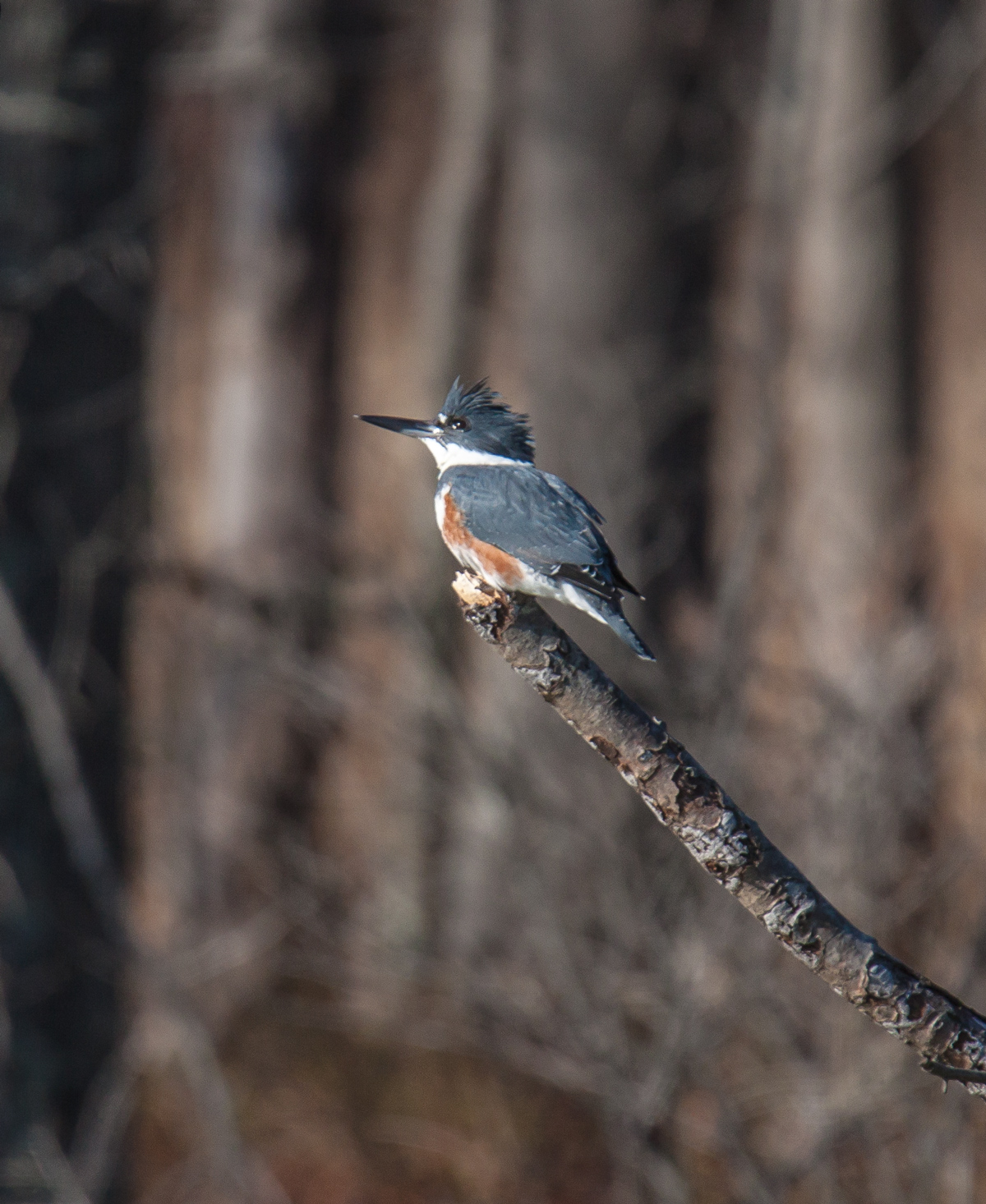
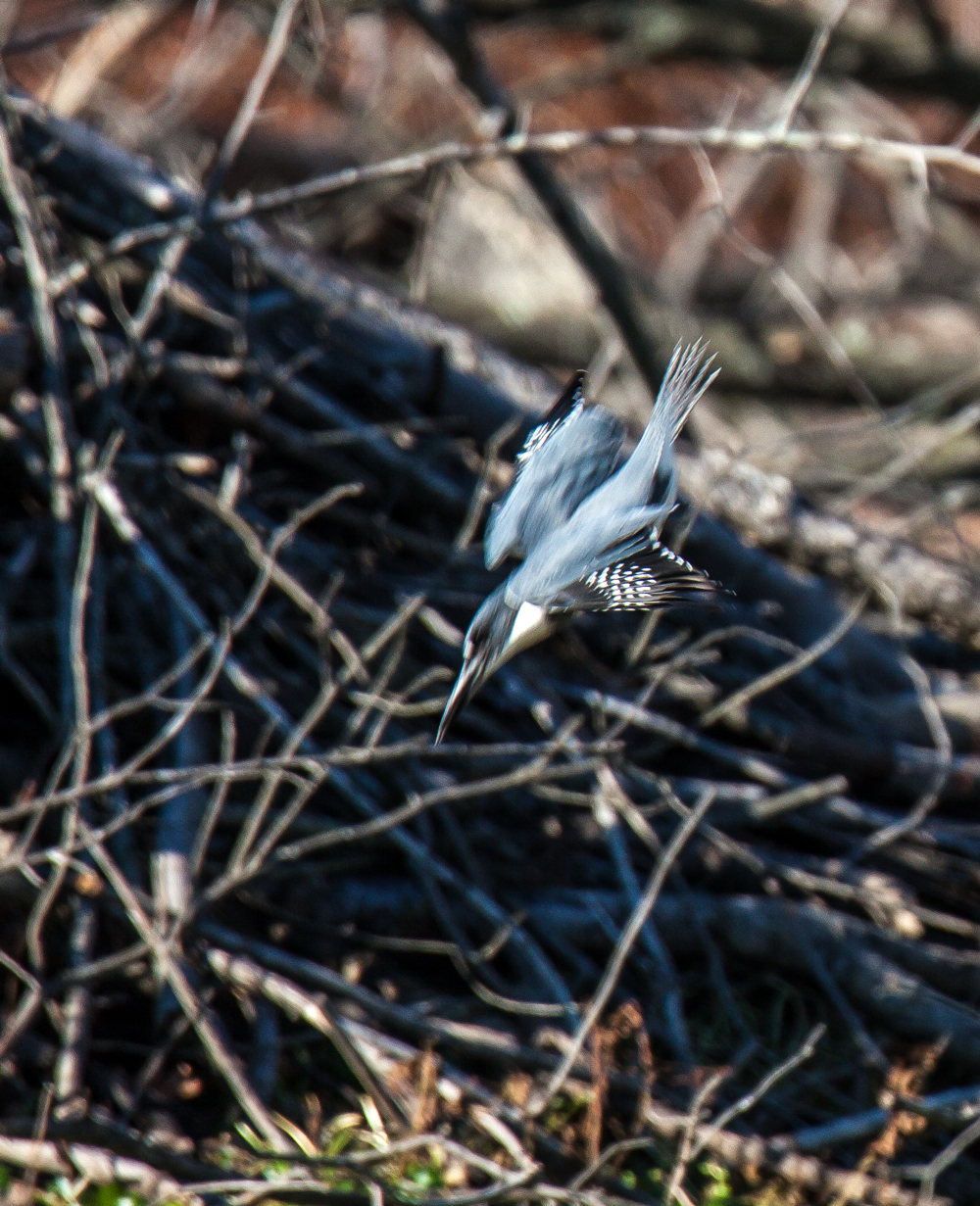
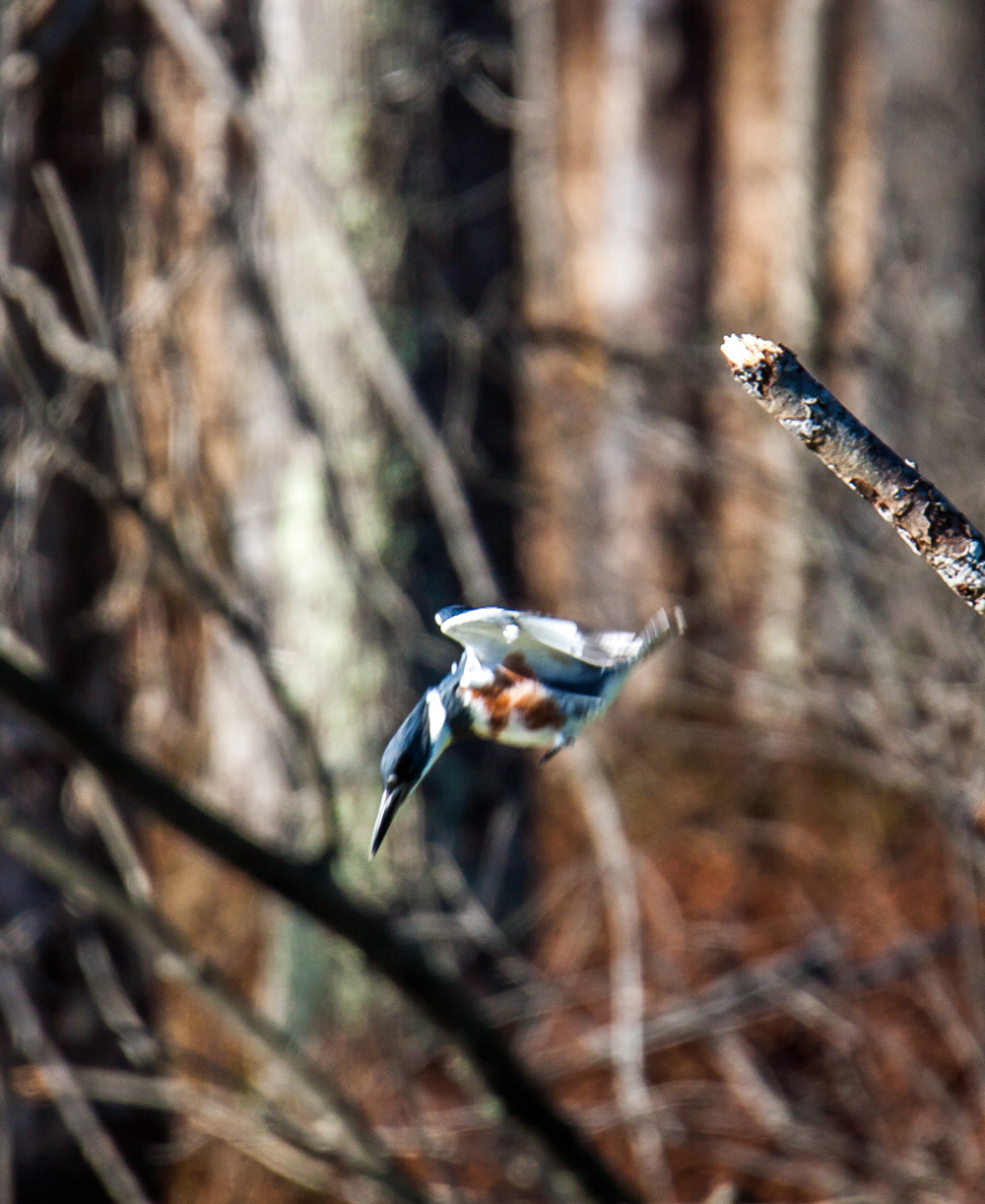
I spent a fair amount of time yesterday at Huntley Meadows Park watching a female Belted Kingfisher (Megaceryle alcyon), one of my favorite birds. She was perched on a broken-off tree a pretty good distance away and there was no way that I could get any closer, since there was water between the boardwalk on which I was standing and that tree.

The kingfisher remained perched for quite some time, so I had plenty of time to steady myself and adjust settings until I was relatively content with some of my shots. What I really wanted to do, though, was to capture the kingfisher. I knew that eventually the kingfisher would dive into the water and I waited. Kingfishers don’t give any real warning when they are ready to dive, so I tried to remain alert and ready, even though I knew the chances of me capturing this fast-moving bird in flight were slim.

The kingfisher dove several times and I did manage to capture a few ok images of her flight toward the water. My favorite shot, however, is the final one here in which she is flying out of the water with what looks to be a small fish.

It was a nice catch for both of us.

Belted Kingfisher

Belted Kingfisher

Belted Kingfisher

Belted Kingfisher

© Michael Q. Powell. All rights reserved.

Read Full Post »

I often think of this little bird as the “Santa bird,” because of its white “beard” and round belly. Technically speaking, it’s a White-throated Sparrow (Zonotrichia albicollis), but it’s often more fun to make up my own names for the creatures that I see and photograph.

White-throated Sparrow

© Michael Q. Powell. All rights reserved.

Read Full Post »

Late in the afternoon I was walking along a stream when I suddenly heard some splashing at the edge of the water. Full of curiosity I peered though the bushes to see what was going on. I was looking almost directly into the sun, so all I could see was the silhouette of a bird that was bathing in the shallow water. I knew that I would not be able to capture the details of the bird, but what I really wanted to do was to capture the mood of that intimate moment.

I hesitated a little to post this image, because its flaws are evident, but somehow it speaks to me emotionally through its simple color palette, through the shadowy unidentified bird, and through the concentric ripples in the water. My usual rule of thumb is to post the images that I like, so here it is. I realize that my views of the image are really subjective and are tied to my memories of the moment—you had to be there.

bird bath

© Michael Q. Powell. All rights reserved.

Read Full Post »

This energetic little Downy woodpecker (Picoides pubescens) seemed to be defying gravity on Monday as it leaned over backwards and pecked away at a small tree growing out of the water at Huntley Meadows Park.

Downy Woodpecker

© Michael Q. Powell. All rights reserved.

Read Full Post »

Yesterday the fields and forests of Huntley Meadows Park were alive with the sound of birds, lot of birds. I didn’t get a close enough look to identify the black birds, but they seem to be Rusty Blackbirds or Grackles. As they foraged, they moved from one spot to another in a great cloud of birds, all flying at the same time.

I tried to capture images of the birds with different backgrounds and especially like the first one below, which reminds me of some pf Escher’s pen-and-ink drawings of birds.

birds in flight

birds in flight

birds in flight

© Michael Q. Powell. All rights reserved.

Read Full Post »

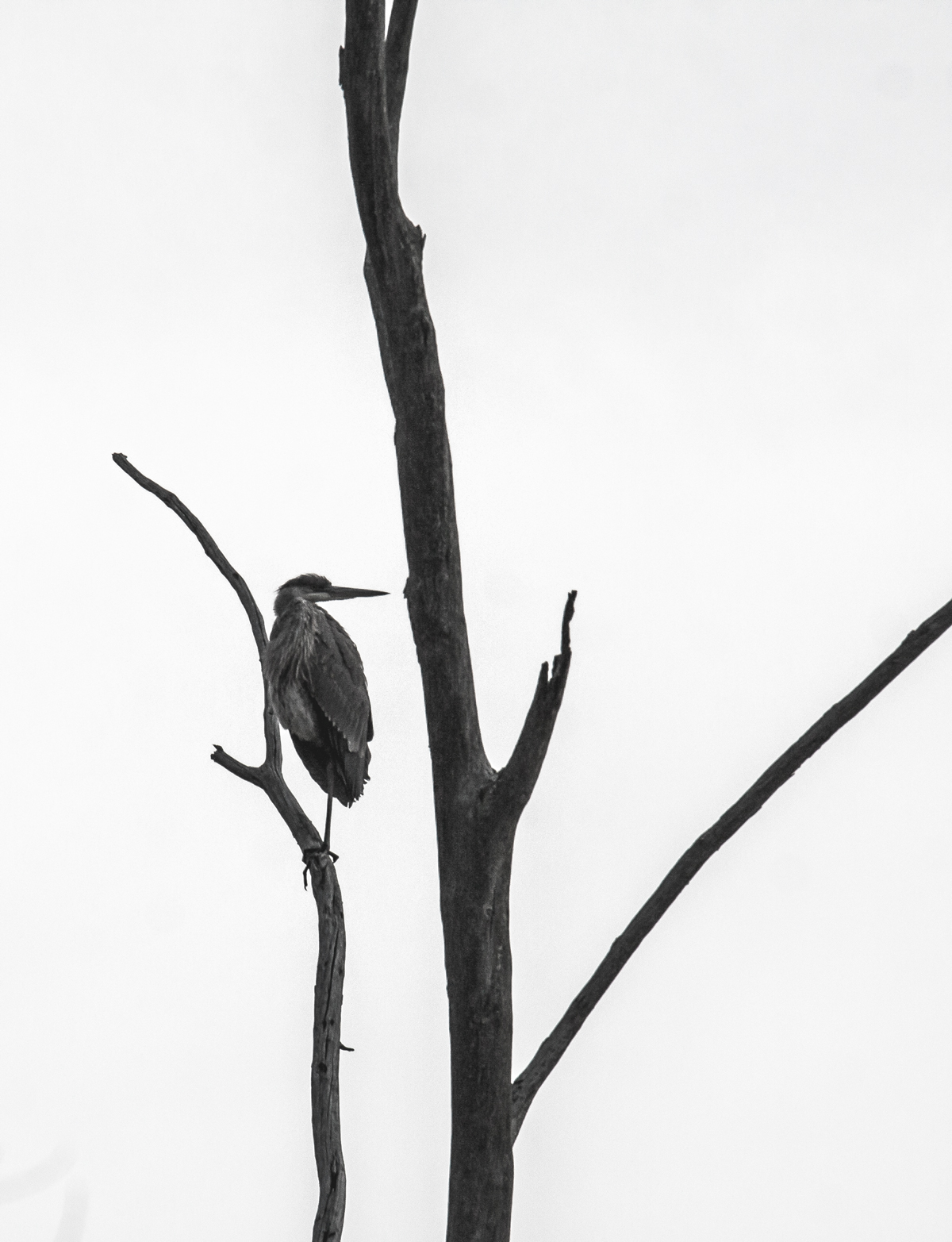
Generally when I see a Great Blue Heron (Ardea herodias) in a tree, it is roosting in a protected location and napping. Early one morning this past weekend at Huntley Meadows Park, however, I spotted this alert heron perched on an exposed dead tree, looking like it was playing the role of a sentinel.

I initially caught sight of the heron from a distance and followed a path in the treeline that let me get almost underneath the heron for some shots. The sky was overcast and there was not much light, causing the background to appear white and the images to be almost monochromatic.

Great Blue Heron


Great Blue Heron

Great Blue Heron

© Michael Q. Powell. All rights reserved.

Read Full Post »

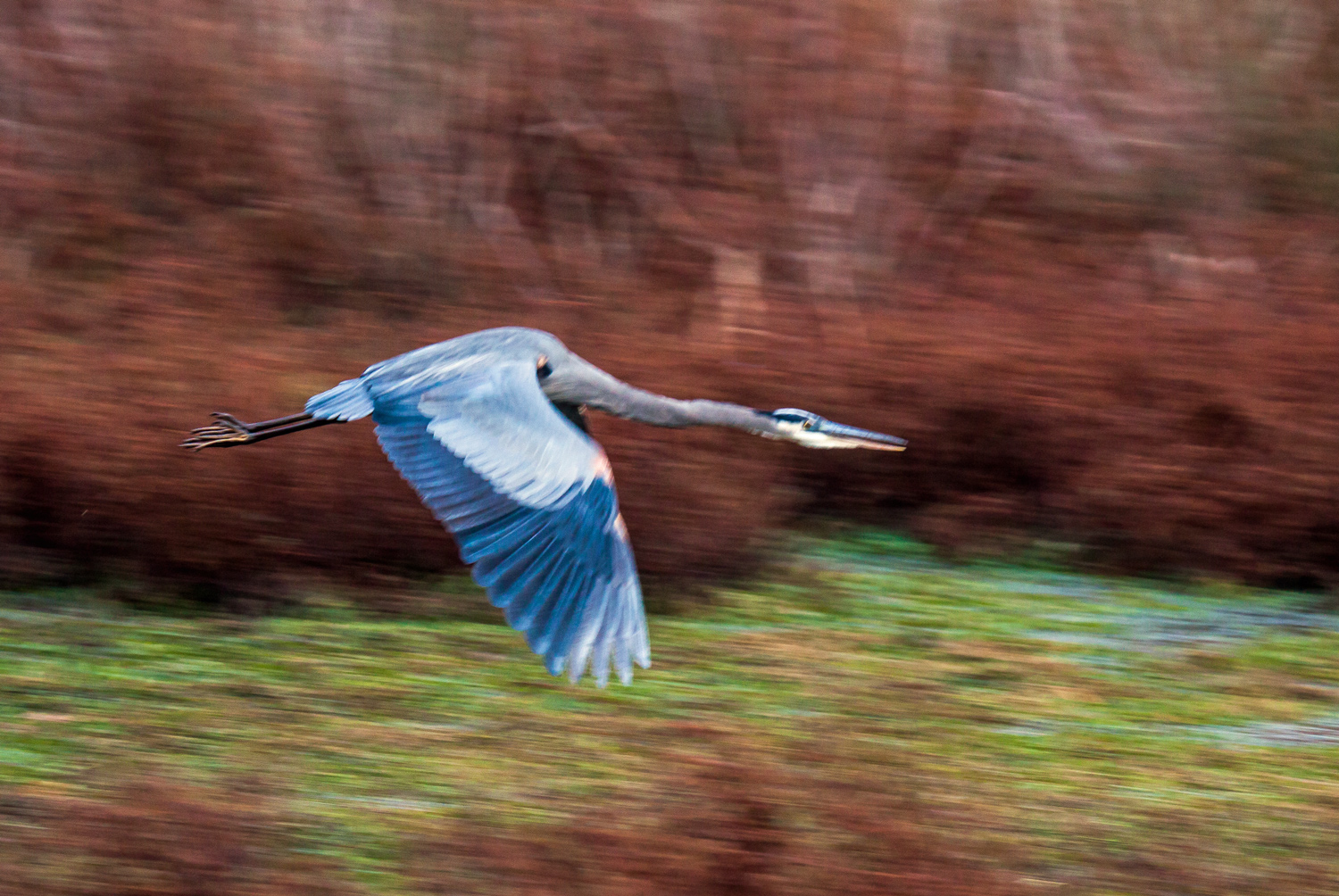
Sometimes I will intentionally use a slow shutter speed when I am panning a moving subject to blur the background and give a sense of motion, but that was not the case with these photos—I was shooting in aperture-priority mode and simply wasn’t paying attention to the shutter speed that the camera was giving me. In all three of these images, the shutter speed was 1/100 of a second, which is really too slow for handholding my 150-600mm zoom lens.

As the old saying goes, though, sometimes it is better to be lucky than good. I really like the way the background was rendered and am not at all bothered by the somewhat soft focus on parts of the moving heron.

Great Blue Heron

Great Blue Heron

Great Blue Heron

© Michael Q. Powell. All rights reserved.


Read Full Post »

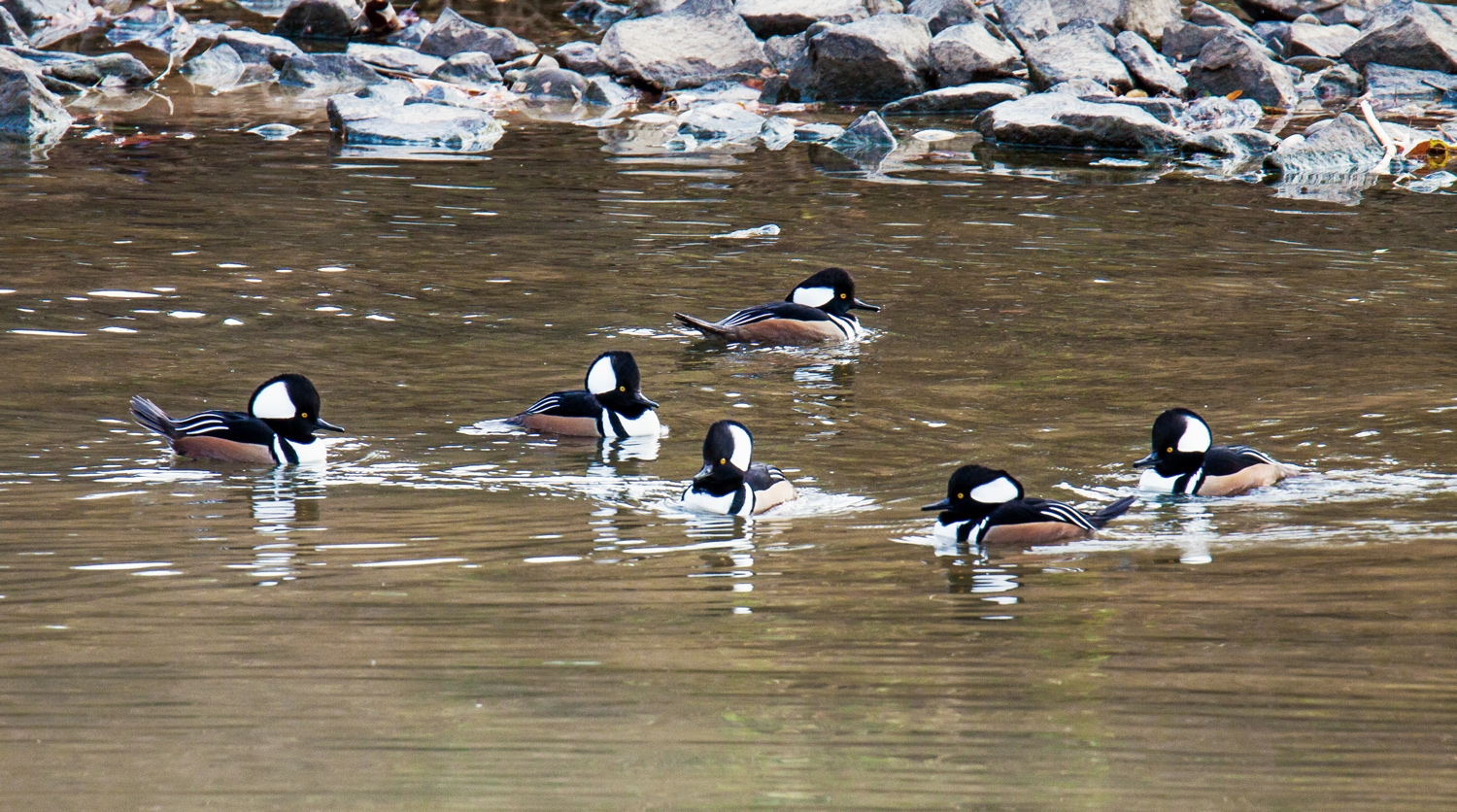
It’s Hoodie season—hooded sweatshirts for me and lots of Hooded Merganser ducks (Lophodytes cucullatus) at Cameron Run in Alexandria, Virginia.

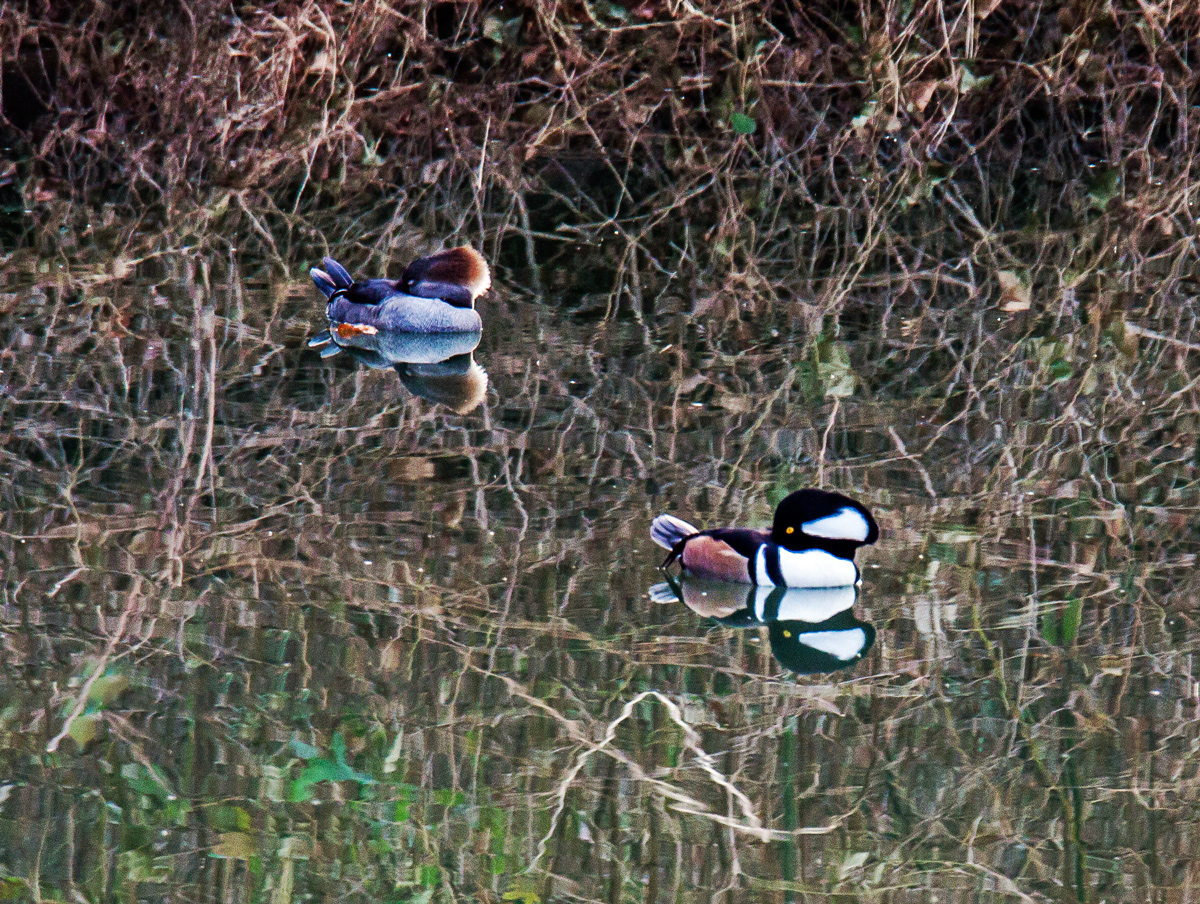
Yesterday I spotted this group of six males swimming around and hanging out together. Most of the time during the year when I see Hooded Mergansers, it is a couple or a mother with ducklings, so it was unusual for me to see such a large grouping. There were a few females too, but they seemed to ignore the males and for the most part kept to themselves.

Hooded Mergansers

While the single guys were burning off some energy, a couple found a quiet spot and decided to take a nap. I often see Canada Geese and Mallard ducks sleeping, but I am pretty sure that this is the first time that I have ever seen the little Hooded Mergansers doing so.

Hooded Mergansers

© Michael Q. Powell. All rights reserved.


Read Full Post »

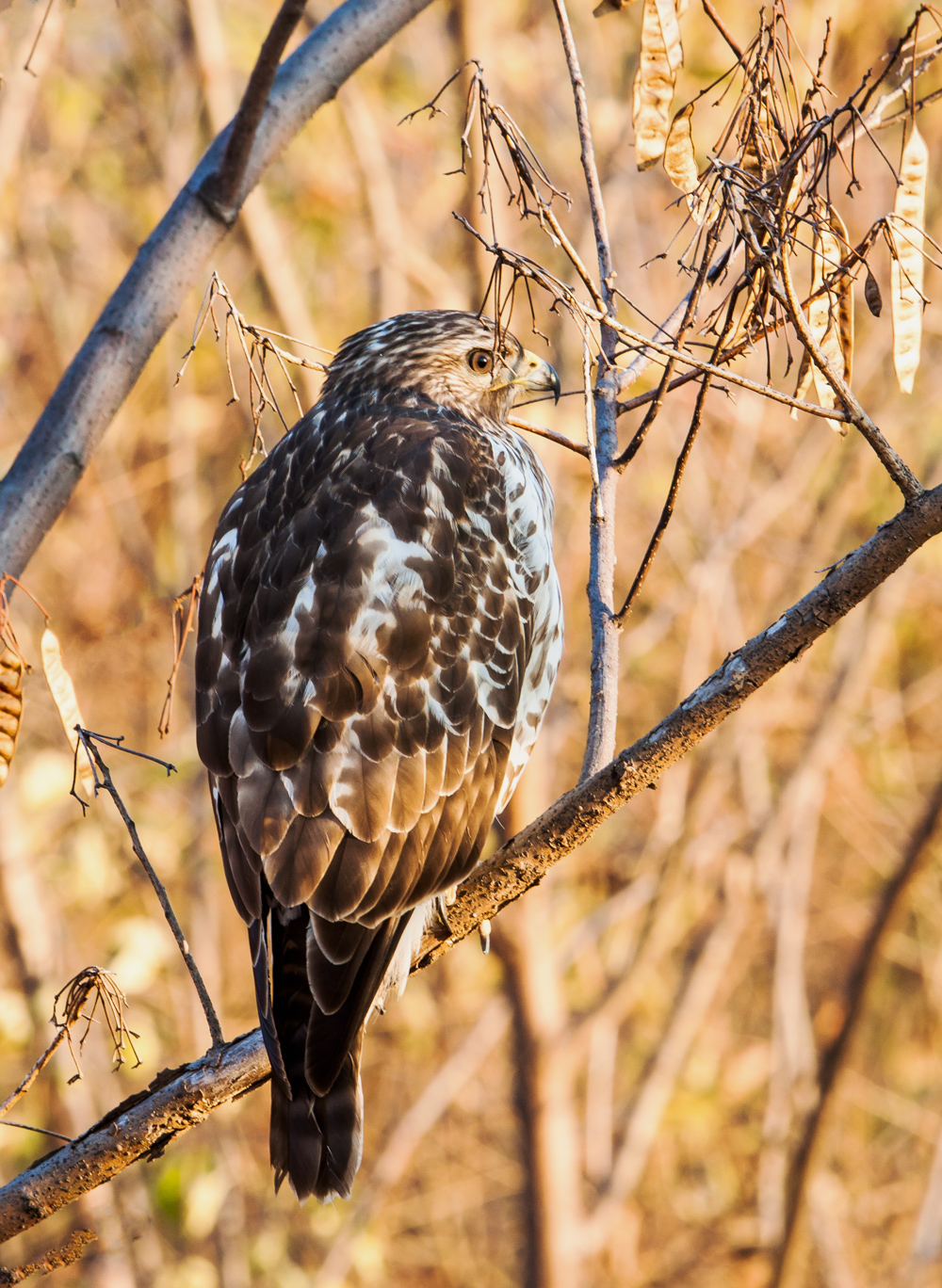
When I was walking yesterday along Cameron Run, a tributary of the Potomac River in Alexandria, Virginia, I was shocked to spot a hawk perched nearby in a small tree almost at eye level. I was on a paved bike trail that parallels the stream and there is a relatively steep embankment that slopes down to the water’s edge. The tree was located on that embankment.

When the hawk, which I think is a juvenile Red-shouldered Hawk (Buteo lineatus) eventually flew away and landed atop a building, it screamed out repeatedly at some circling crows. It makes me wonder if the hawk had previously been hiding from harassing crows and that is why it permitted me to get relatively close without initially taking off.

Red-shouldered Hawk

Red-shouldered Hawk

Red-shouldered Hawk

© Michael Q. Powell. All rights reserved.

Read Full Post »

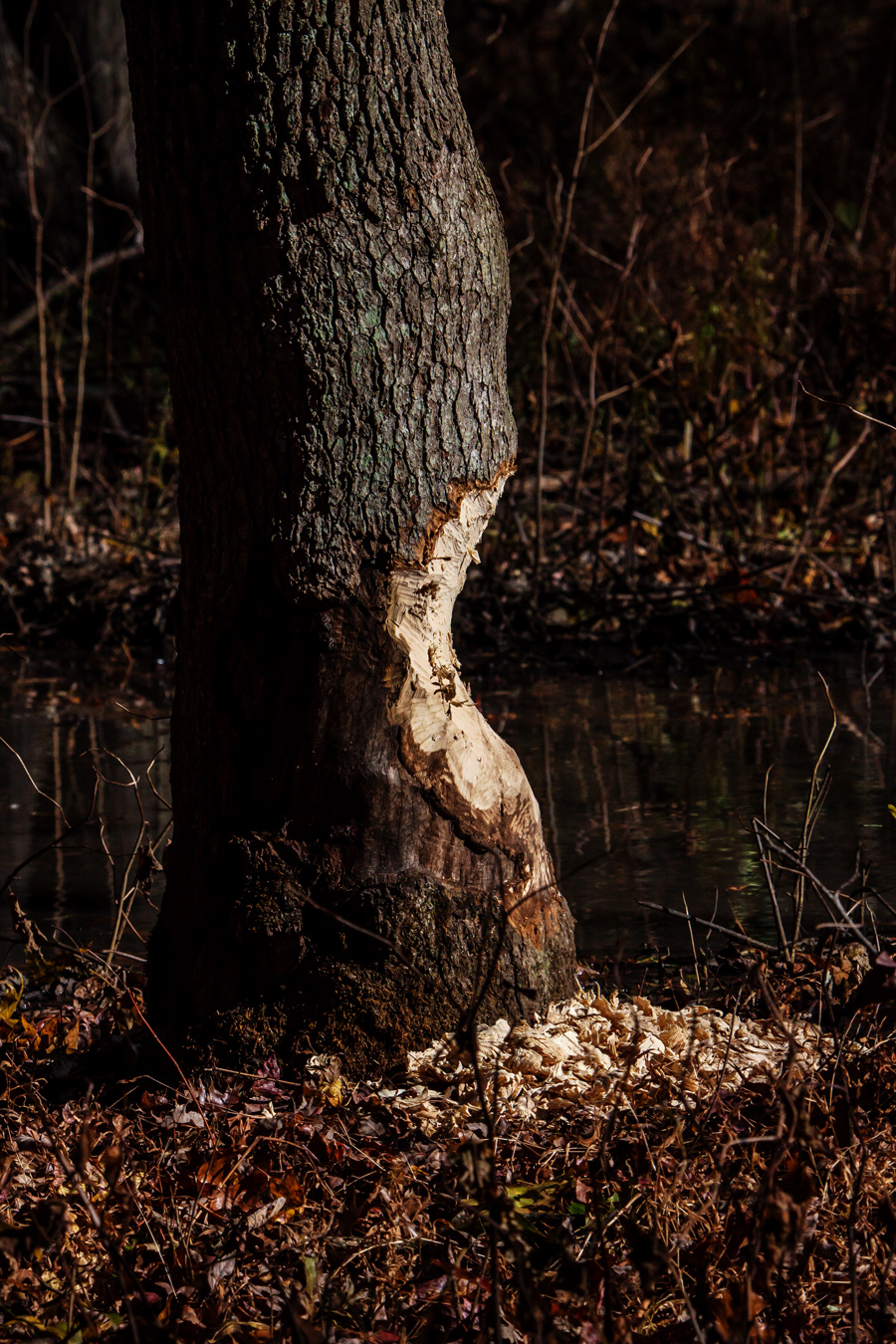
As I wander about in Huntley Meadows Park, I see lots of signs that winter is on its way, including this tree that I encountered in what seemed to be the middle of the woods. Clearly the beavers have been as busy as, well, beavers. I am hoping to be able to capture them in action in the upcoming months.

If you read this blog frequently, you probably noticed that this image is quite different from my “normal” wildlife close-ups. When I stumbled upon this tree on which a beaver had been gnawing, I was struck by the interplay of light and shadows. As I framed this shot, which is uncropped here, I was trying to capture the almost monochromatic look of the scene in a very simple composition. I’m pretty pleased by the different textures that I was also able to capture in the shot.

North American Beaver

© Michael Q. Powell. All rights reserved.

Read Full Post »

On a cool and blustery morning at Huntley Meadows Park, it seemed like most of the birds were in sheltered locations yesterday, protected from the biting wind. I did manage, though, to spot a Red-headed Woodpecker (Melanerpes erythrocephalus) busily at work high in the trees and was able to get shots from a number of different angles as the woodpecker moved about.

Red-headed Woodpecker

Red-headed Woodpecker

Red-headed Woodpecker

© Michael Q. Powell. All rights reserved.

Read Full Post »

It was a pleasant surprise to see this colorful Familiar Bluet damselfly (Enallagma civile) last Friday at Huntley Meadows Park. With the arrival of frigid weather, with temperatures at near-freezing levels at night, however, I fear that it will be my last damselfly sighting of the season.

When I first spotted this damselfly, I had my  Tamron 150-600mm zoom lens on my camera. I didn’t want to take my eyes off of the damselfly, for fear of losing sight of it in the underbrush, so I decided to make do with the long zoom lens. I quickly realized that I had a few obstacles to overcome. The minimum focusing distance of the lens is almost nine feet (2.7 meters), so I had to back up. At that distance the damselfly was so small that my autofocus did not want to lock onto it, so I was forced to focus manually, while handholding the lens at 600mm.

I ended up trying to do environmental portraits, rather then the close-ups that I generally prefer to take. I like the way that the seasonal coloration of the background helps the blue of the damselfly’s body really stand out, almost like it is an alien visitor in a foreign land.

Farewell, sweet damsels of the air, until we meet again in the spring.

Familiar Bluet

Familiar Bluet

© Michael Q. Powell. All rights reserved.

Read Full Post »

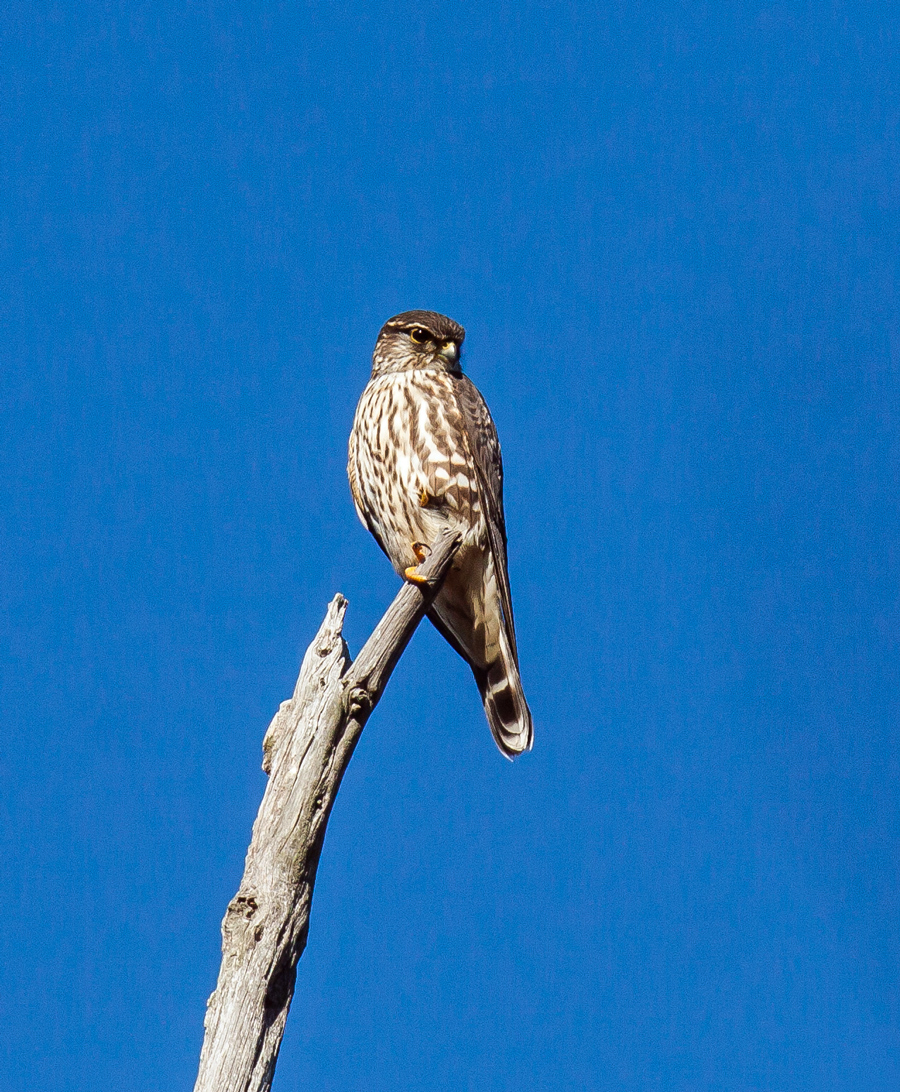
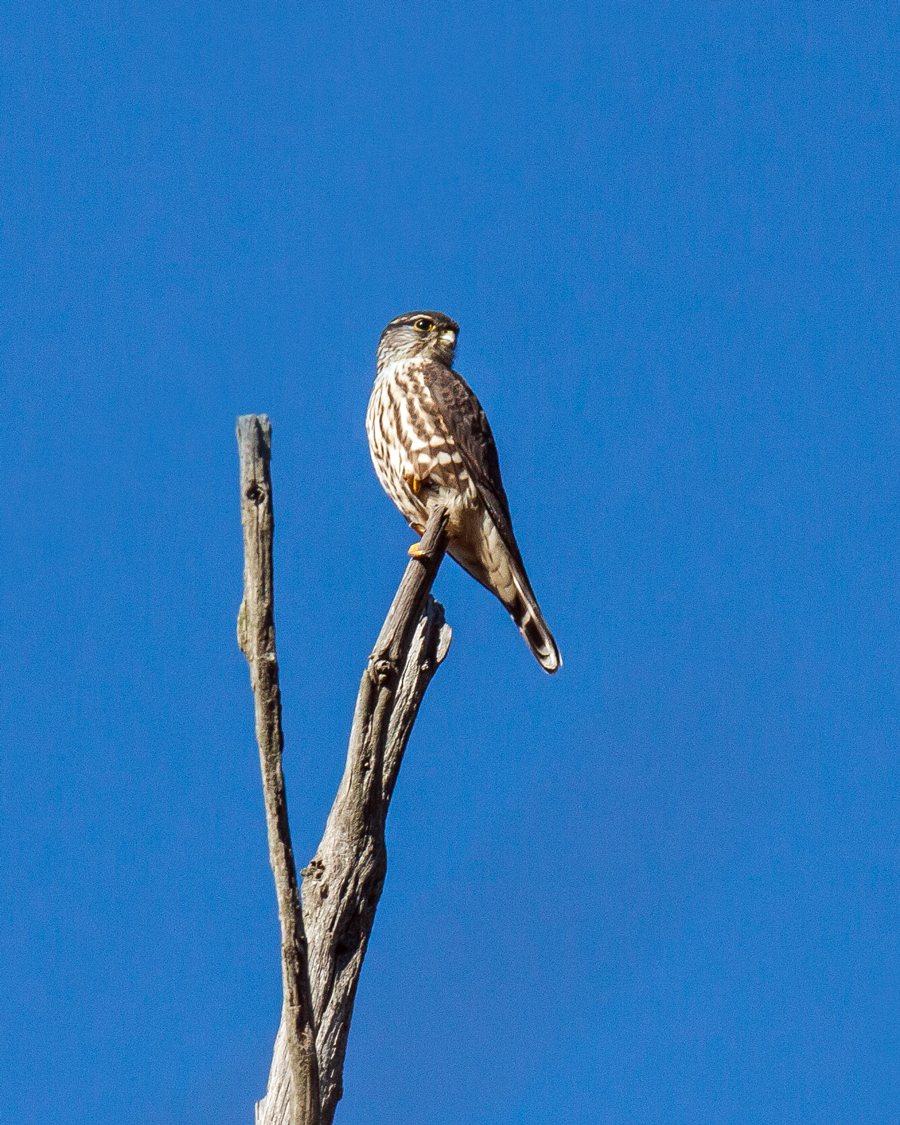
Yesterday I finally saw the merlin (Falco columbarius) that has been hanging out at Huntley Meadows Park the last month or so. Merlins are really cool-looking small falcons that generally are in our area only during periods of migration.

The merlin was perched at the very top of a slender dead tree. The Cornell Lab of Ornithology website notes that merlins spend long periods perched in open areas scanning for prey and I suspect that is what this bird was doing when I spotted it.

I was able to get relatively close to the tree, thanks to an adjacent path in the woods, but shooting upwards at such a steep angle handheld was a bit of a challenge. Fortunately the lighting was pretty good so I was able to get some decent shots, though they did requite quite a bit of cropping. You may also notice that I shot from several different angles as I tried to capture some images of this small, but powerful bird.

Merlin

Merlin

Merlin

Merlin

© Michael Q. Powell. All rights reserved.

Read Full Post »

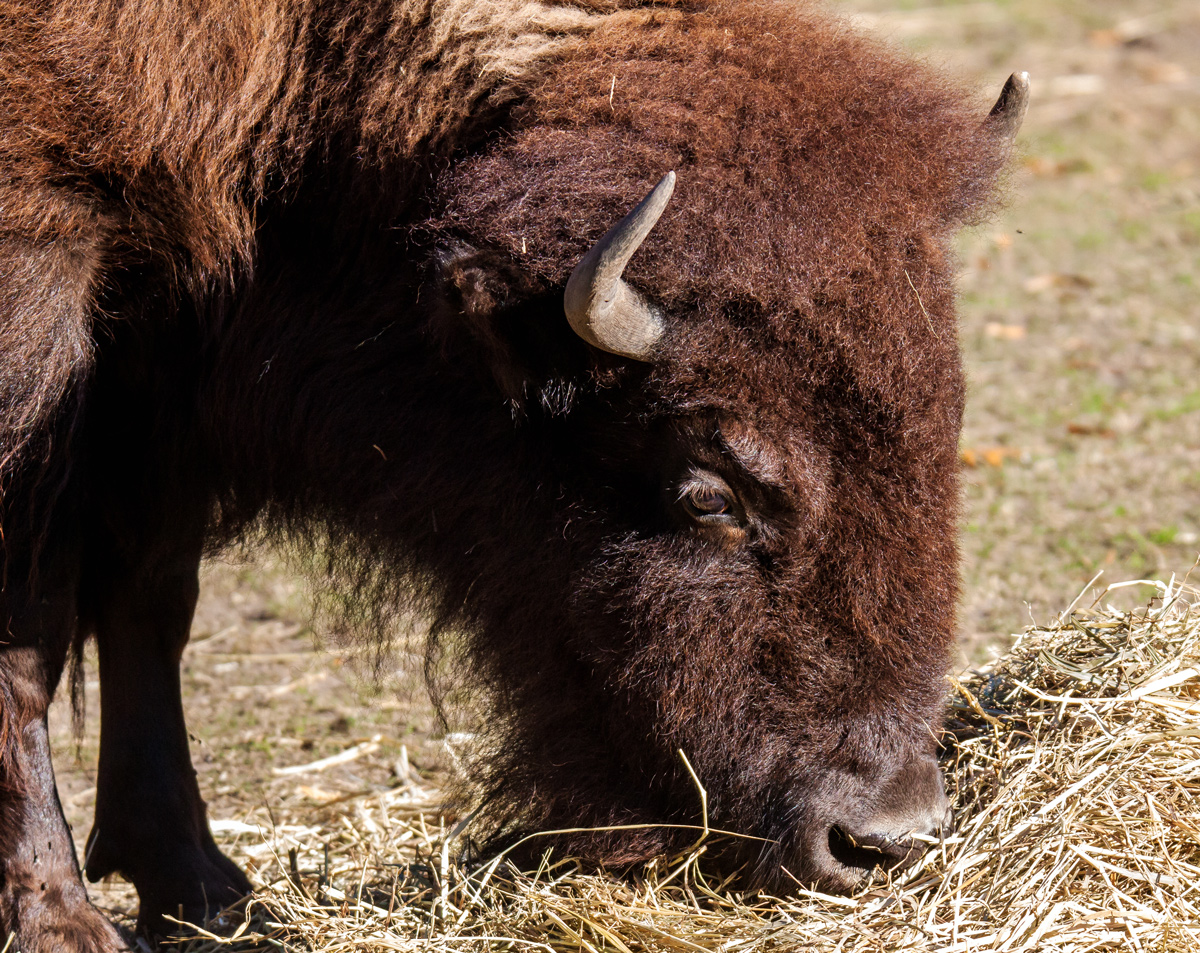
“Don’t mess with me while I am eating.” That seemed to be the message that an American Bison (Bison bison) was sending to me during a recent trip I made to the National Zoo. The bison had lifted its enormous head, twisted it violently in my direction, and looked right at me. It then returned to calmly munching on some hay.

Who knew that bisons had such flexible necks?

American Bison

American Bison

© Michael Q. Powell. All rights reserved.

Read Full Post »

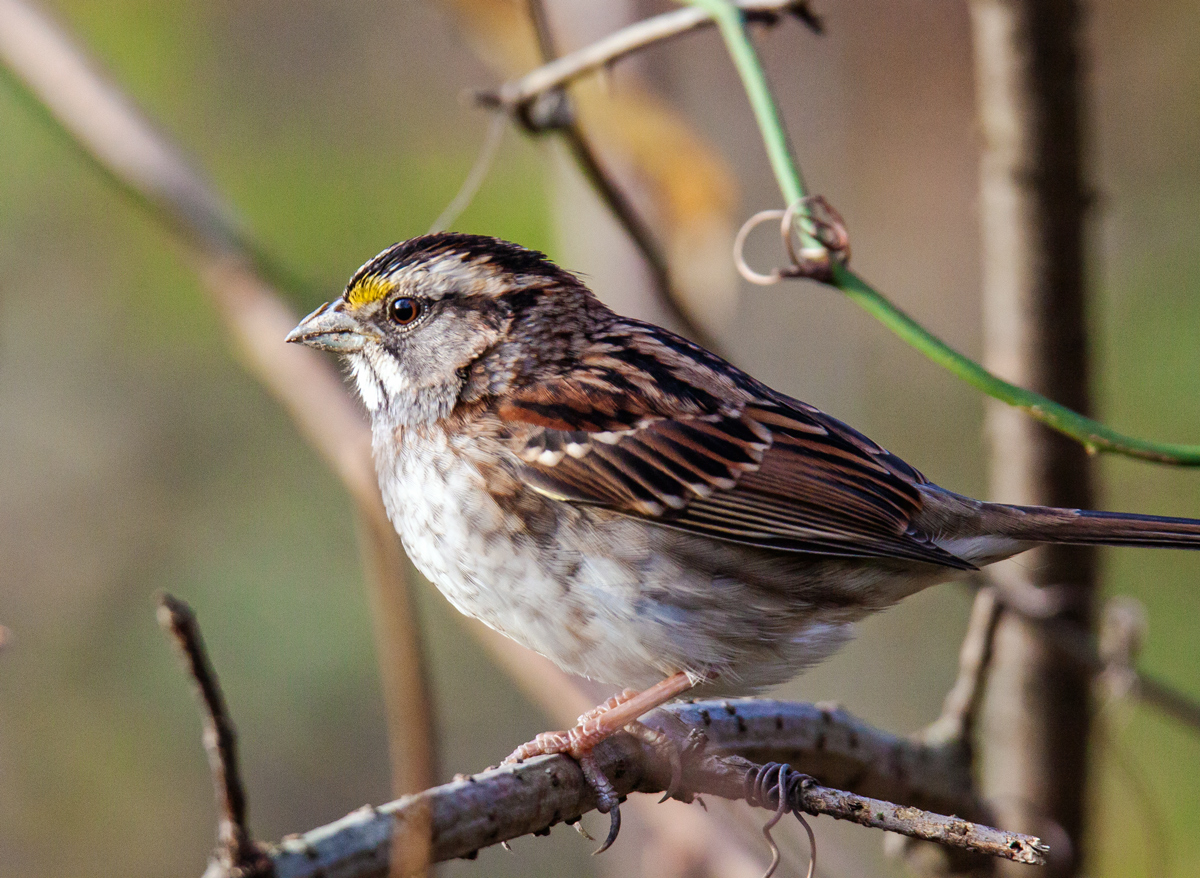
I used to think that all sparrows were simply nondescript little brown birds. Now I look more closely and can see how beautiful and distinctive they really are, like this White-throated Sparrow (Zonotrichia albicollis) that I spotted last week at Huntley Meadows Park.

I especially love the bright yellow stripe on its face (in an area technically called its “lore”) that really stands out amid the other, more subdued colors.

White-throated Sparrow

© Michael Q. Powell. All rights reserved.

Read Full Post »

I think that tonight is officially the “super moon,” but the weather forecasters predict that it will be cloudy. Knowing this, I went out last night (and again this morning) to get some shots of the almost super moon.

I learned a couple of things from this experience. First, it’s not too hard to get shots of the moon in the sky. If I am going to be shooting the moon with any regularity, I need to scout out some locations so that I can get shots of the moon rising over the mountains or over the water.

Secondly, I learned that the visible features on the moon change their apparent positions over the course of a single night. If I had had any basic lessons in astronomy, I would probably have known this already, but this revelation came to me when I was comparing the shots that I took last night with those that I took this morning. I took the first shot below at 8:02 pm (20:02 hrs) last night and the second shot at 5:38 this morning. When you compare the photos, you can see that distinctive land features are in different locations.

almost super moon

Moon at 8:02 in the evening of 13 November 2016

Moon 5:38 in the morning of 14 November 2016

Moon at 5:38 in the morning of 14 November 2016

© Michael Q. Powell. All rights reserved.

Read Full Post »

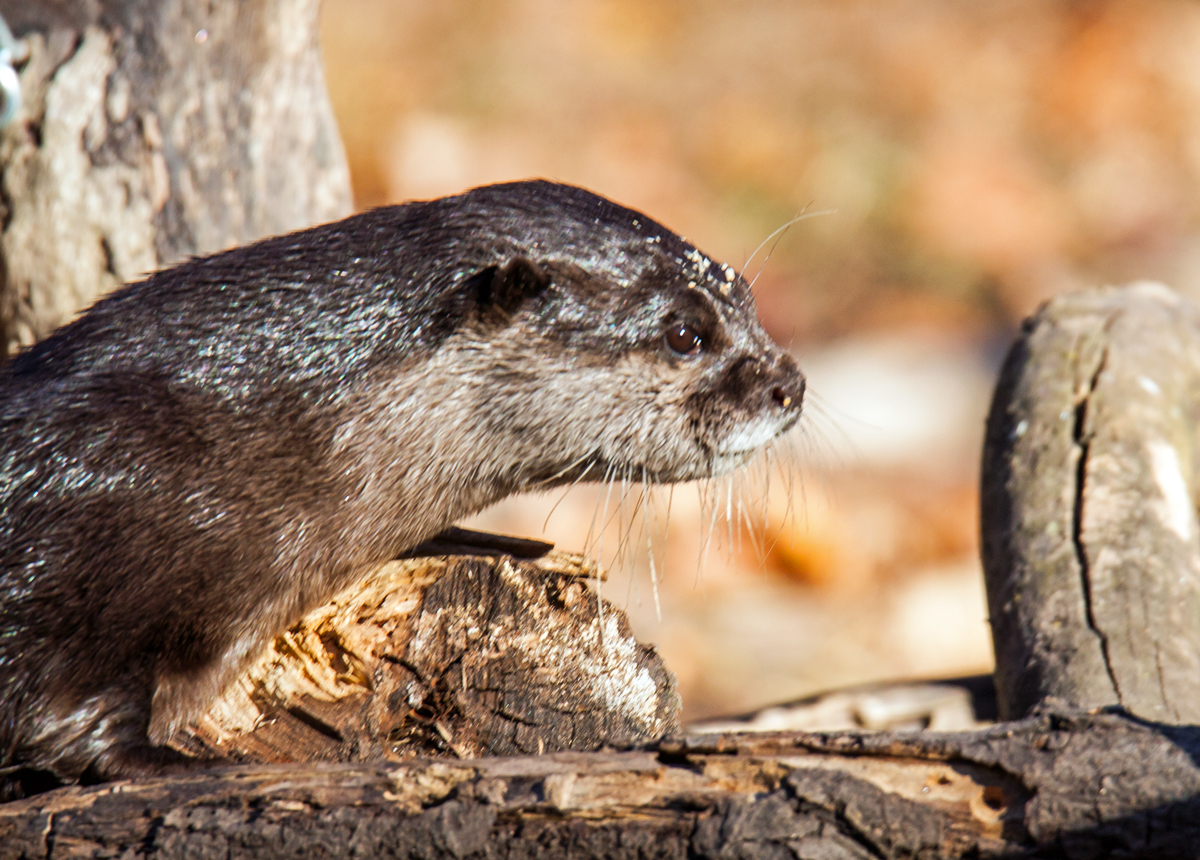
Otters are so much fun to watch. They seem to be very inquisitive and playful. One of their favorite pastimes appears to be chasing each other around.

I am familiar with the North American River Otter (Lontra canadensis) and have been lucky enough to see one in the wild at my local marshland park. These images, however, are of Asian Small-clawed Otters (Aonyx cinerea) that I observed at the National Zoo in Washington D.C. last Monday.

There is a large group of these otters in an enclosure on the Asia Trail and I spent quite a while watching their antics. They seem to be in almost constant motion in and out of the water, so it was a fun challenge trying to get some shots of them.

Asian Small-clawed Otter

Asian Small-clawed Otter

Asian Small-clawed Otter

© Michael Q. Powell. All rights reserved.

Read Full Post »

The skies over Huntley Meadows Park were amazing around 3:00 (15:00 hrs) yesterday afternoon when a cold front was blowing in. When certain clouds were illuminated by the sun they were transformed into pastel shades of the rainbow. At times there were varying shades of orange, green, aqua, and purple.

I suspected that moisture in the clouds was responsible for the colors, but I had never seen anything like it and did not know what it was called. After searching about on the internet, I learned that this diffraction phenomenon, known as cloud iridescence, is caused by small water droplets or ice crystals individually scattering light. According to Wikipedia, ” If parts of clouds have small droplets or crystals of similar size, their cumulative effect is seen as colors. The cloud must be optically thin, so that most rays encounter only a single droplet. Iridescence is therefore mostly seen at cloud edges or in semi-transparent clouds, and newly forming clouds produce the brightest and most colorful iridescence.”

cloud iridescence

cloud iridescence

© Michael Q. Powell. All rights reserved.

Read Full Post »
Most of the times that I have visited the National Zoo the Giant Pandas (Ailuropoda melanoleuca) have been indoors, but this past Monday I was thrilled to see that they were outdoors and active. There are two levels for viewing the pandas and I was on the upper level, giving me an unobstructed view and some relief from the large crowds.

Here are a couple of my favorite shots. The first one is of the youngest panda at the zoo, Bei Bei, who is a bit over a year old, and the second image shows him with an adult panda that I assume is his mother.

panda at the National Zoo

pandas at the National Zoo

© Michael Q. Powell. All rights reserved.

Read Full Post »

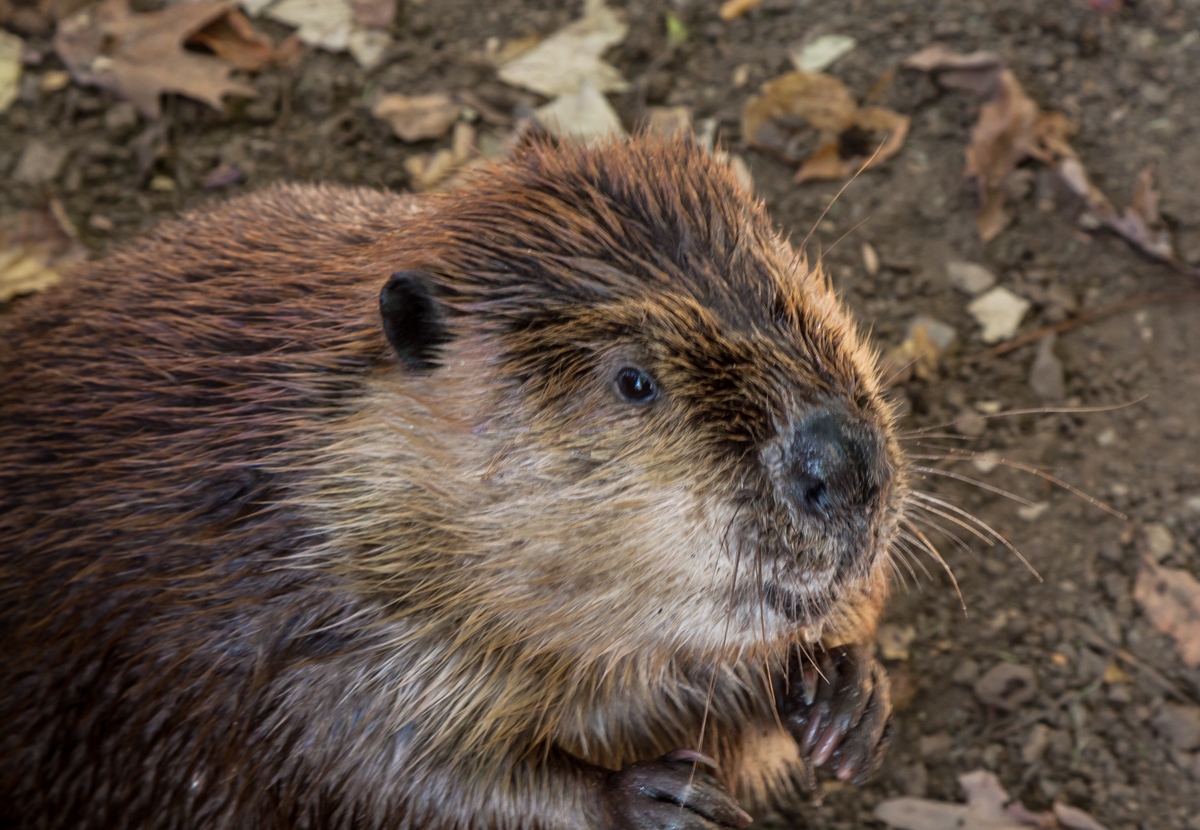
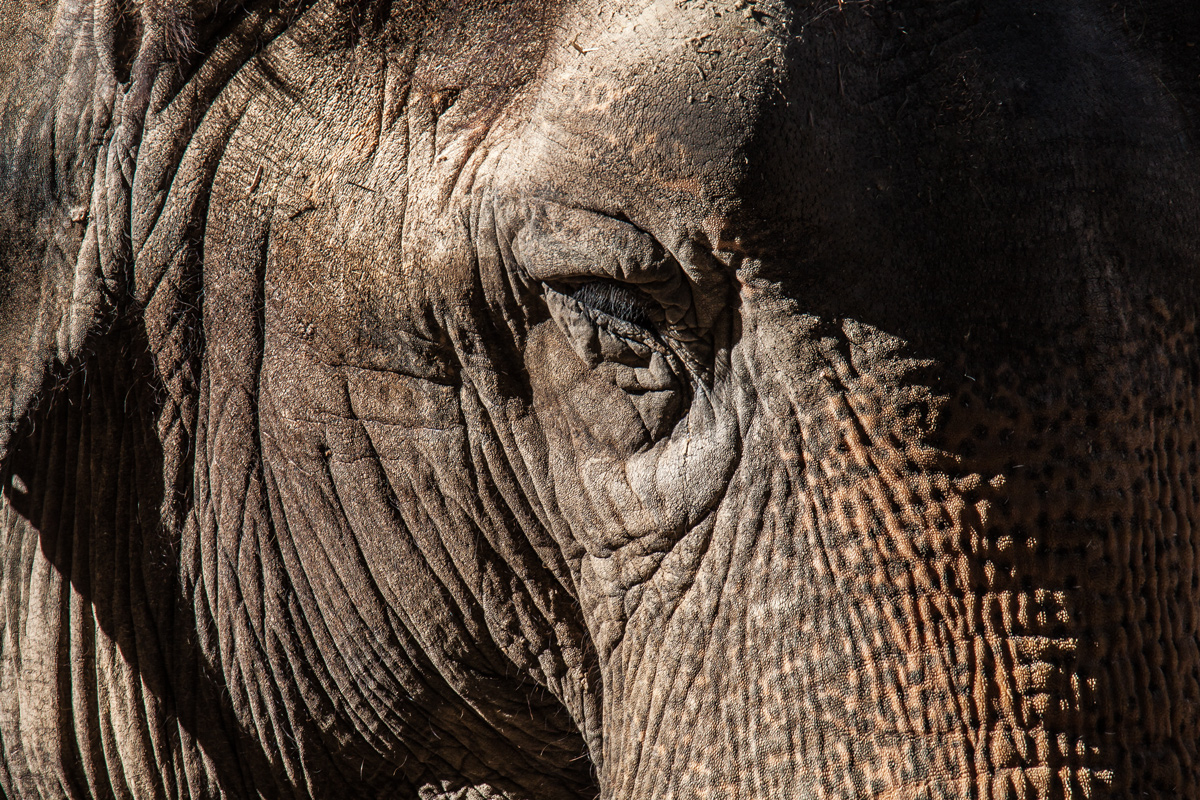
The National Zoo in Washington D.C. is a wonderful place to explore and has the added bonus of having no admission fee. On Monday I wandered around the zoo for several hours, visiting some of my favorite animals and taking a lot of photos.

Here are some of my initial favorite images: a lioness, a cheetah, a beaver, and an elephant.

lioness at National Zoo

cheetah at National Zoo

beaver at National Zoo

elephant at National Zoo

© Michael Q. Powell. All rights reserved.

Read Full Post »
Why were the Great Blue Herons (Ardea herodias) prancing about on Saturday with their heads tilted upward and their wings displayed? Surely this was some kind of elaborate courting ritual.

As Tina Turner famously sang, “What’s love got to do with it?” Apparently this is how these herons defend their feeding territories. Really? According to the Cornell Lab of Ornithology, one of my favorite sources of information on birds, “Great Blue Herons defend feeding territories from other herons with dramatic displays in which the birds approach intruders with their head thrown back, wings outstretched, and bill pointing skyward.”

If only we could be so dignified in expressing our differences instead of squawking loudly and aggressively at each other.

Great Blue Heron

Great Blue Heron

Great Blue Heron

Great Blue Heron

Great Blue Heron

© Michael Q. Powell. All rights reserved.

Read Full Post »
Some birds seem to explode out of the water when they are taking off, but Great Blue Herons (Ardea herodias) often seem to gently lift off with almost no splash at all. The Great Blue Heron at Huntley Meadows Park were really active early yesterday morning, frequently flying from one location to another. They seemed to be more intent on socializing with each other than with finding food. In a future post, I’ll look more closely at that behavior, which might be related to courting, but today I’m focusing on one heron’s gentle liftoff.

I’ve watched herons take off hundreds of times, but this is one of the first times that I have been able to capture the moment of liftoff from the water. In this little sequence of three images, you can see the heron rising up, leaving the water, and gradually gaining altitude. The stillness of the early morning helped create some wonderful reflections,  a nice bonus that adds some additional visual interest to the images.

heron liftoff

heron liftoff

heron liftoff

© Michael Q. Powell. All rights reserved.


Read Full Post »
I never get tired of watching the Great Blue Herons (Ardea herodias) at Huntley Meadows Park. Quite often they ignore me and focus intently on catching a fish. I marvel at their patience and persistence.

During one recent encounter, though, I had eye-to-eye contact with a heron. The heron looked right at me and seemed to be sending a distinct warning message that it was not going to share the small fish that it had just caught.

I backed off and let the heron enjoy his fish appetizer in peace. It was gone in a quick gulp and the heron went back to work and I moved on in search of more subjects.

Great Blue Heron

© Michael Q. Powell. All rights reserved.

Read Full Post »

How do you capture the beauty of autumn? If you live in a location where there are broad expanses of trees full of brightly colored leaves, it would be pretty easy, I think. In Northern Virginia where I live, the colors tend to be muted and isolated. There are patches of colors here and there, but it seems like many of the leaves go straight from green to brown.

On some recent trips to Huntley Meadows Park, my favorite shooting location, I tried to capture some glimpses of the changing season using my telephoto zoom lens. The colors and patterns of the fall foliage turned into abstract patterns when viewed through a telephoto lens.

Here are some of my favorite shots as I focused in on the autumn foliage. I am also including a final image that attempts to capture the feeling of walking down a trail in the crisp morning air with fallen leaves crunching underfoot.

fall foliage

fall foliage

fall foliage

fall foliage

fall foliage

autumn trail

© Michael Q. Powell. All rights reserved.

Read Full Post »

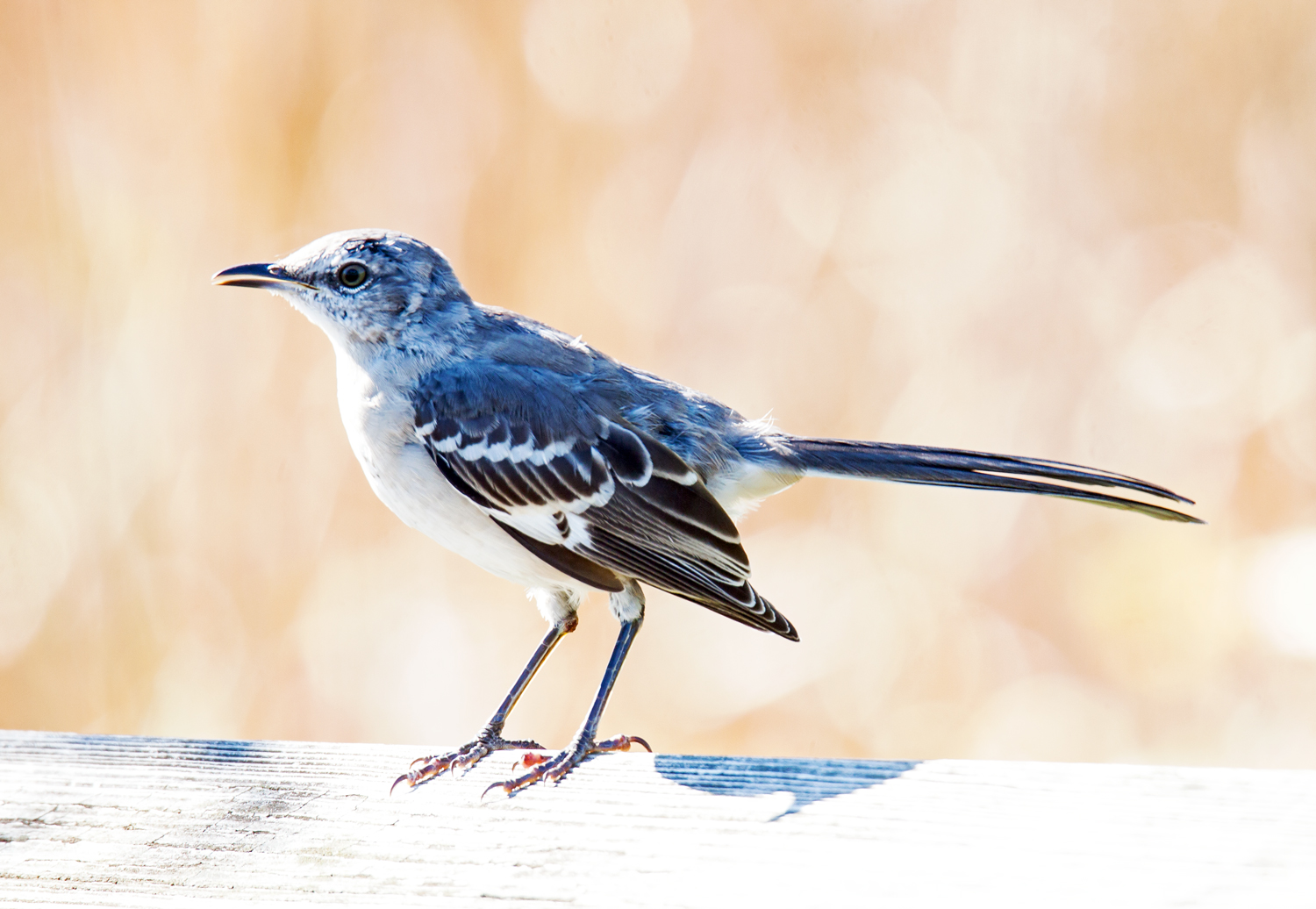
Common subjects like this Northern Mockingbird (Mimus polyglottos) have a special appeal and challenge for me. Can I photograph them in an unusual way?

The foreground and background in this image almost blend together and highlight the beauty and personality of the mockingbird. The background makes it look a bit like it was taken in a studio setting. Only the chipped paint gives away the fact that the curious bird was perched on the man-made railing of a boardwalk. I also really like the way that the color and pattern of the weathered wood almost perfectly match the bird’s feathers.

Northern Mockingbird


© Michael Q. Powell. All rights reserved.


Read Full Post »

Generally it’s best to have the sun behind you when taking photos, but sometimes you are forced to shoot almost directly into the sun. When the conditions are right you can sometimes get wonderful silhouettes, like these images of Double-crested Cormorants (Phalacrocorax auritus) that I spotted on the Potomac River near Dyke Marsh in Alexandria, Virginia this past Monday.

The shot of the perched cormorant was a conscious composition—I assessed the light and knew that I was shooting a silhouette. In the case of the flying cormorant, however, I was reacting to the movement of a bird taking off from the water and trying so hard to hard to capture focus and keep the bird in focus that I was not paying much conscious attention to the lighting.

Double-crested Cormorant

Double=crested Cormorant


Double-crested Cormorant

© Michael Q. Powell. All rights reserved.

Read Full Post »

« Newer Posts - Older Posts »