Feeds:
Posts
Comments

Posts Tagged ‘Tamron 150-600mm’

This majestic osprey (Pandion haliaetus) was keeping a close watch on a fellow photographer and me as we pointed our long lenses in its direction as it perched high in a tree early one morning this weekend at Huntley Meadows Park.

osprey

© Michael Q. Powell. All rights reserved

Read Full Post »

Early yesterday morning at Huntley Meadows Park, the Great Egrets (Ardea alba) were relaxing in the trees, awaiting the start of another beautiful day. When birds are as brilliantly white as egrets, it’s a challenge to get an exposure that retains the details in the feathers. I set the metering on my camera to spot metering and it seems to have worked pretty well. I even like the way that it darkened the background and made the egret stand out even more.

Great Egret

© Michael Q. Powell. All rights reserved

Read Full Post »

Last weekend I spotted a shorebird in the distance while exploring Huntley Meadows Park. It was sharing a log with several turtles. Initially the little bird stayed on the opposite end of the log from the turtles. Gradually the curious and energetic bird moved closer and closer to the turtles. I couldn’t tell for sure, but it looked like the bird came close to pecking one of the legs of a turtle. Perhaps the bird was surprised when the turtle reacted or the turtle made a threatening move, but in any case the bird flew off after the brief encounter.

I was pretty conftdent that the bird was some kind of sandpiper, but I have never seen one with these markings. I posted to a Facebook group and got a quick response. What was the sandpiper I had spotted? It turned out to be a Spotted Sandpiper (Actitis macularius).

Spotted Sandpiper


Spotted Sandpiper

© Michael Q. Powell. All rights reserved

Read Full Post »

Do you relax by hanging from a bar in the pull-up position? No, I don’t either, but this Mocha Emerald dragonfly (Somatochlora linearis) chose to do so on Monday when I spotted it at Huntley Meadows Park.

A couple of things really stand out whenever I am lucky enough to spot one of these beautiful dragonflies. Unlike many dragonflies, Mocha Emeralds don’t appear to like direct sunlight—they seem to hang out at small shaded streams, where the shadows and shade make photography difficult. Secondly, they often seem to hang vertically, which emphasizes their extraordinarily long slender bodies. Somehow they remind me of the super skinny young male models that many designers seem to favor, clothing them in garments that those of us with more normal physiques would never ever fit into—unlike those models, we have waists and hips.

Mocha Emerald

© Michael Q. Powell. All rights reserved

Read Full Post »

I was looking high and in the distance and the Bald Eagle (Haliaeetus leucocephalus) came in low and was almost on top of me before I saw it yesterday morning at Huntley Meadows Park. I had to scramble and pull back on my zoom lens to capture this image, which barely fit into the frame of the viewfinder. (The EXIF data for the shot indicate that it was shot at 309mm of my 150-600mm Tamron telephoto zoom lens.)

I feel like I should have been able to take better advantage of the situation that presented itself, but I am not disappointed. As I have noted repeatedly, any day with a bald eagle is a great day.

Bald Eagle

© Michael Q. Powell. All rights reserved

Read Full Post »

Cardinal flowers (Lobelia cardinalis) are now in bloom at Huntley Meadows Park. In addition to being beautiful, these vivid red flowers attract butterflies, like this Spicebush Swallowtail butterfly (Papilio troilus) that I spotted this past weekend at the park.

Spicebush Swallowtail

© Michael Q. Powell. All rights reserved

Read Full Post »

This female Ruby-throated Hummingbird (Archilochus colubris) must have been feeling tired or lazy yesterday afternoon at Huntley Meadows Park. Rather than going in through the opening in the trumpet vine flower and helping to pollinate it, she opted to drill in through the side of the flower to get to the nectar.

Ruby-throated Hummingbird

© Michael Q. Powell. All rights reserved

Read Full Post »

It looks like a massive amount of fluorescent Silly String has exploded onto parts of the marshland at Huntley Meadows Park, but I believe it is in reality a parasitic plant known as dodder. Early yesterday afternoon a White-tailed Deer (Odocoileus virginianus) found it to be so tasty that it was willing to ignore the people passing on the boardwalk less than ten feet away.

In taking this photo, I did something that I rarely do—I used the 150mm setting of my 150-600mm telephoto zoom lens. The deer was so close that I could capture only its head and shoulders, even with the lens at its widest setting.


deer and dodder

© Michael Q. Powell. All rights reserved

Read Full Post »

There is not denying that it is exciting to capture unusual moments, like a snake swallowing a catfish, or to photograph a new species, as I have done recently with dragonflies. For me, though, there is something equally satisfying about returning to a familiar location and observing ordinary subjects. It is a different kind of challenge to present the ordinary in an extraordinary way, in a way that makes people stop and realize that natural beauty surrounds them every single day.

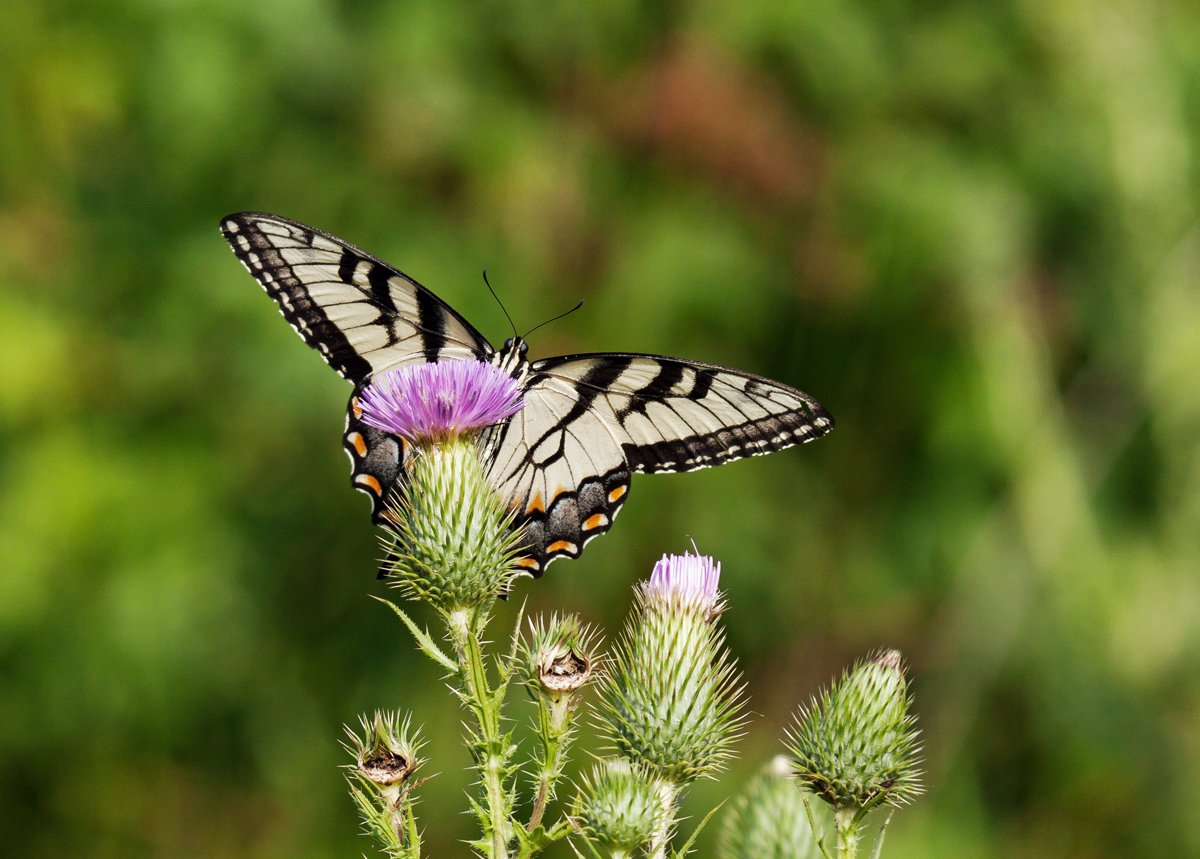
Last week, butterflies were really active at Huntley Meadows Park.  When I am in a garden, it is easier for me to guess where a butterfly will fly next, but in the wild, butterfly behavior is a little more unpredictable. When I noticed that a stand of what looks to be some kind of thistle was beginning to open, I hoped that the Eastern Tiger Swallowtail (Papilio glaucus) that was flying about would be attracted to it. Eventually it flew to the thistle and I was able to capture this image.

Spectacular? No, not really. Beautiful? I’d say so. The image works for me, because it has just enough stopping power to cause views to recall how beautiful ordinary butterflies can be, to rekindle the childhood memories of being excited by butterflies, and to remember how exciting it was abandon caution and simply and joyfully chase after butterflies.

Eastern Tiger Swallowtail

© Michael Q. Powell. All rights reserved

Read Full Post »

I have known for a while that hummingbirds are attracted to trumpet vines, so I keep my eyes open whenever I pass a stand of them near the observation tower at Huntley Meadows Park. Yesterday morning I finally lucked out and spotted a female Ruby-throated Hummingbird (Archilochus colubris) in the midst of the trumpet vines (Campsis radicansand managed to capture these images, including one in which the hummingbird was resting for a few seconds on a branch before resuming her energetic activity.

Ruby-throated Hummingbird

Ruby-throated Hummingbird

© Michael Q. Powell. All rights reserved

Read Full Post »

Green Herons (Butorides virescens) have so much personality packed into their small bodies. This one almost seemed to be smiling as it flew by me last weekend  at Huntley Meadows Park. Perhaps it was just my imagination running away with me.

Green Heron

© Michael Q. Powell. All rights reserved


Read Full Post »

Is it possible that I am sharing too many dragonfly images, that I am oversaturating the market and taxing the patience and tolerance of my readers? I realize that not everyone is as drawn as I am to these amazing little creatures and that some folks are repelled by insects of any variety or are simply not interested in them.

An old adage asserts that beauty is in the eyes of the beholder and to a certain extent I agree with that statement. However, I would counterargue that beauty is not entirely subjective, that there are cases in which the majority of people would agree that something is beautiful.

I somehow think that this might be the case for an image I captured this past Friday of a spectacular female Halloween Pennant dragonfly (Celithemis eponina) at Huntley Meadows Park. Most of the Halloween Pennants that I have photographed this year have been males, which tend to be more visible, since they are trying to attract females, so it was a treat to spot a female. In the dragonfly world, females usually are the ones that choose the partner for mating and they frequently remain in the treeline or in open fields until they are ready.

I had my 150-600mm lens mounted on my camera, because I was hoping that I might see a bald eagle or a hawk, so I was able to shoot this dragonfly from a distance without disturbing her. I focused manually and was able to capture some beautiful details of the dragonfly, such as the two-toned eyes and the long, two-toned legs. I love the organic shape and feel of the cool-looking perch that the dragonfly had chosen. The background dropped out of focus so much that it almost looks like a studio shot and draws the eyes of viewers to the subject.

When you first read the title, you might have scratched your head in puzzlement, because the color palette is more subdued than oversaturated. By now, it should be clear that I was not referring to the colors, but to the question of whether or not I am posting too many images of dragonflies. Fear not, not all of my postings will be about dragonflies, but we are in the prime period for dragonflies, so stay tuned for more images of these amazing aerial acrobats. When it comes to the quantity of my dragonfly images, I feel like some Southerners do about sugar in their sweet tea—you can never have too much of a good thing.

Halloween Pennant

© Michael Q. Powell. All rights reserved


Read Full Post »

Painted Skimmer dragonflies (Libellula semifasciata) have distinctive patterns on their wings that make them fairly easy to identify. Unlike the pennant dragonflies that I have featured recently, Painted Skimmers have chunkier bodies and tend to perch lower down on the stems of the vegetation. I spotted this slightly damaged female Painted Skimmer yesterday as I was exploring some of the back areas of Huntley Meadows Park. There were a lot of blackberry bushes nearby with plenty of sharp thorns, so I wonder if they were responsible for the damage to the dragonfly’s wings—I drew blood a few times when I got too close to the thorns, but fortunately I am not missing a chunk of me.

Painted Skimmer

© Michael Q. Powell. All rights reserved

Read Full Post »

I spotted several young Wood Ducks (Aix sponsa) this morning at Huntley Meadows Park, including these two who playfully posed for me. Actually, there were three young Wood Ducks grooming themselves on a long and one decided to jump into the water. After swimming around for a while, the duck in the water decided to dry its wings and I was able to capture the extended wings in this shot. In case you are curious, the third duck was just out of the frame to the right. Although it was well past the “golden hour,” the light was beautiful and I was happy to be able to capture a partial reflection of the duck with outstretched wings.

wood duck

© Michael Q. Powell. All rights reserved


Read Full Post »

Why do we like certain photos more than others? What makes a good image? These questions churn away in my brain every time that I have my camera in my hand and often even when my hands are empty. Sure, there are rules and guidelines and generally accepted norms, but often it comes down to personal, unexplainable preferences—I like what I like.

Last weekend I spent a lot of time observing Green Herons (Butorides virescens) at Huntley Meadows Park. I kept trying to capture action shots of the herons catching fish or flying through the air, but I pretty much came up empty-handed. Oh, I took a lot of shots and once I wade through them all there may be some decent images of the herons that I will choose to post, but none of those images really spoke to me during my initial review of the photos from that day.

I was drawn instead to some images from early in the day when a fellow photographer and I spotted a Green Heron in the trees in the distance. We were standing on a boardwalk, so there was only a limited freedom of movement to frame our shots. There was a lot of vegetation that partially obstructed our view of the heron. I searched in vain for a visual tunnel that afforded a clear view of the entire body of the heron. Still, the light was beautiful, so I kept shooting—when it comes to birds, expressions are so fleeting that it is best to shoot a lot of images.

I decided to post this shot and attempt to explain why. There are so many things that I like about this image that I am not really bothered by the leaves that blocked my view. What do I like? I love the tilted head as the heron looks to the sky and basks in the sun; I like the little head feathers that look like a cowlick; I really like the shapes and colors in the background; and I am happy that I was able to capture some details in the wing feathers.

Is it one of my best shots? No, it is not, but I choose to post images that I like and especially the ones that make me happy, like his image of a pensive, relaxed Green Heron in a tree.

green heron

© Michael Q. Powell. All rights reserved


Read Full Post »

As we move deeper into summer, I have been seeing fewer and fewer duck families at Huntley Meadows Park—maybe the ducklings have grown up or have succumbed to predators. Whatever the case, I was thrilled early yesterday morning to spot a Mama  Wood Duck (Aix sponsa) with five ducklings, relaxing and grooming themselves on a log in the water in one of the more remote areas of the park.

When they are first born, all of the ducklings seem to look the same to me, but gradually they seem to take on some of their adult markings. The duckling alone in the center, for example, seems to be acquiring some of the head markings of the adult Wood Duck, though he still lacks the spectacular colors of the adult male Wood Duck. (In case you don’t know what a male Wood Duck looks like, I am reprising below a photo from earlier this year of one sitting on a nesting box.)

wood duck

Wood Duck

© Michael Q. Powell. All rights reserved


Read Full Post »

Several folks have recently posted photos in Facebook of a juvenile Yellow-crowned Night-Heron (Nyctanassa violacea) that they spotted at Huntley Meadows Park, my favorite marshland for photography, so I kept my eyes open today as I explored the park. I came up empty-handed for this particular bird, a species that I had never seen before, but as I was getting ready to leave, a helpful photographer led me to a spot where he had seen the bird earlier in the day.

Amazingly the bird was in the same general location and I was able to get several long-distance shots of the gangly little bird, which seems to be bigger than the Green Herons in the park, but smaller than the Great Blue Herons. As far as I know, nobody has seen an adult Yellow-crowned Night-Heron in the park, so we don’t really know how this juvenile happens to be in this location.

Yellow-crowned Nigh-Heron

Yellow-crowned Night-Heron

© Michael Q. Powell. All rights reserved

Read Full Post »

The White-tailed Deer (Odocoileus virginianus) seemed alert but unafraid when they first sensed my presence early one recent morning at Huntley Meadows Park. I watched them graze for a while before they silently faded back into the tree line.

white-tailed deer

© Michael Q. Powell. All rights reserved

Read Full Post »

In the early morning hours at Huntley Meadows Park this past weekend, a tiny muskrat (Ondatra zibethicus) silently swam to the shore and began to forage for food in the vegetation at the water’s edge. It was a peaceful moment, a perfect start to a beautiful day.

muskrat

© Michael Q. Powell. All rights reserved

Read Full Post »

Great Egrets (Ardea alba) are so graceful in flight—it’s like watching an aerial ballet performance. I spotted this egret early this morning at Huntley Meadows Park and captured this image as it was taking off from atop a tree on which it was perched.

Great Egret

© Michael Q. Powell. All rights reserved.

Read Full Post »

Halloween in June? I spotted a beautiful female Halloween Pennant dragonfly (Celithemis eponina) this past Saturday in one of the back areas of Huntley Meadows Park.

Although it is now summer, the colors of this beautifully-patterned dragonfly bring to mind those of the autumn, which thankfully is still a long way off.

Halloween Pennant

Halloween Pennant

Halloween Pennant

© Michael Q. Powell. All rights reserved.

Read Full Post »

As I was wandering about in the woods early yesterday morning at Huntley Meadows Park, I inadvertently spooked a raccoon (Procyon lotor) that was stretched out high above me on a tree limb. The raccoon quickly climbed inside the tree, but it seems like it was overcome by curiosity and poked its head out to get a better look at me.

A sharp-eyed viewer of my posting of this image in Facebook noted that the raccoon seems to have a problem with ticks, with several of them visible in one of its ears. I know that raccoons are notorious for carrying rabies, so I kept a close eye on the raccoon and was ready to move away if it had made a move to climb down from the tree.

raccoon

© Michael Q. Powell. All rights reserved.

Read Full Post »

Last weekend when I was staying outside of Roanoke for a wedding, I had the chance to walk a few miles of the Appalachian Trail. It was pretty awesome—now I have only about 2178 more miles to go to complete it.

Like most people, I had heard about the Appalachian Trail, but didn’t know much about it. Somehow I imagined that it was about as wide as a jeep and relatively smooth. My brief hike on the trail dispelled those notions. The trail is narrow, muddy, and steep, at least in those parts where I was walking.

I encountered the trail in Troutville, Virginia, a small town that is designated as an Appalachian Trail Community, where hikers can resupply along the way. Troutville marks a point on the trail where thru-hikers, those trying to complete the entire trail in a single year, will have completed about a third of the trail, assuming they started in Georgia.

It’s pretty exciting to think about hiking a 2200 mile trail, but it requires a lot of planning, training, and commitment. Generally thru-hikers spent five to seven months hiking on the trail, and quite a few people drop out along the way for many different reasons.

Appalachian Trail

Appalachian Trail

Appalachian Trail

Appalachian Trail

As I climbed a hill and came to a meadow, I noticed this small tent. Apparently a hiker decided this was a good spot to spend the night. You can see part of the trail, which is marked with white “blazes,” like the one on the wooden post.

Appalachian Trail
This was the scenic view from the top of one of several hills that I climbed during my short stint on the trail.
Appalachian Trail
 © Michael Q. Powell. All rights reserved.

Read Full Post »

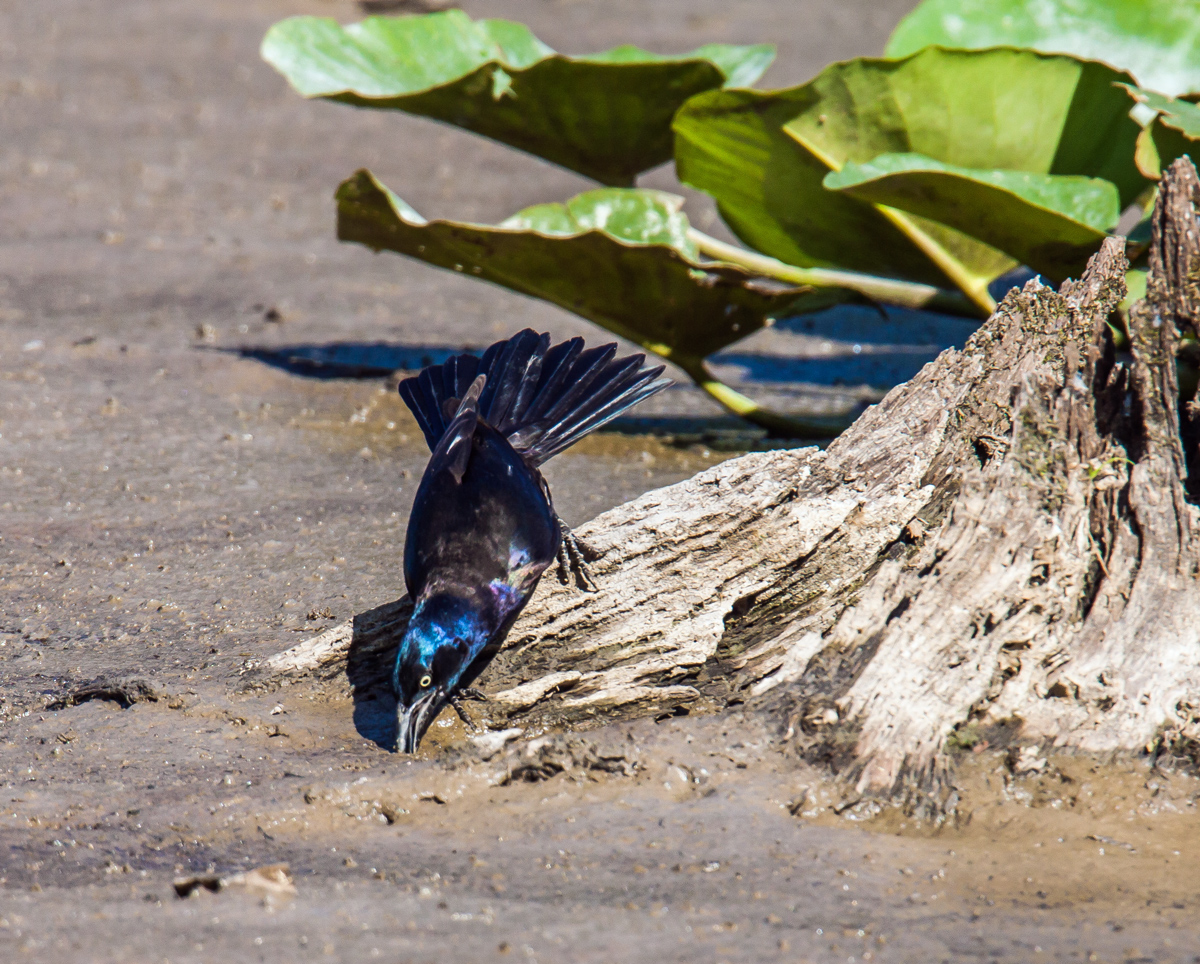
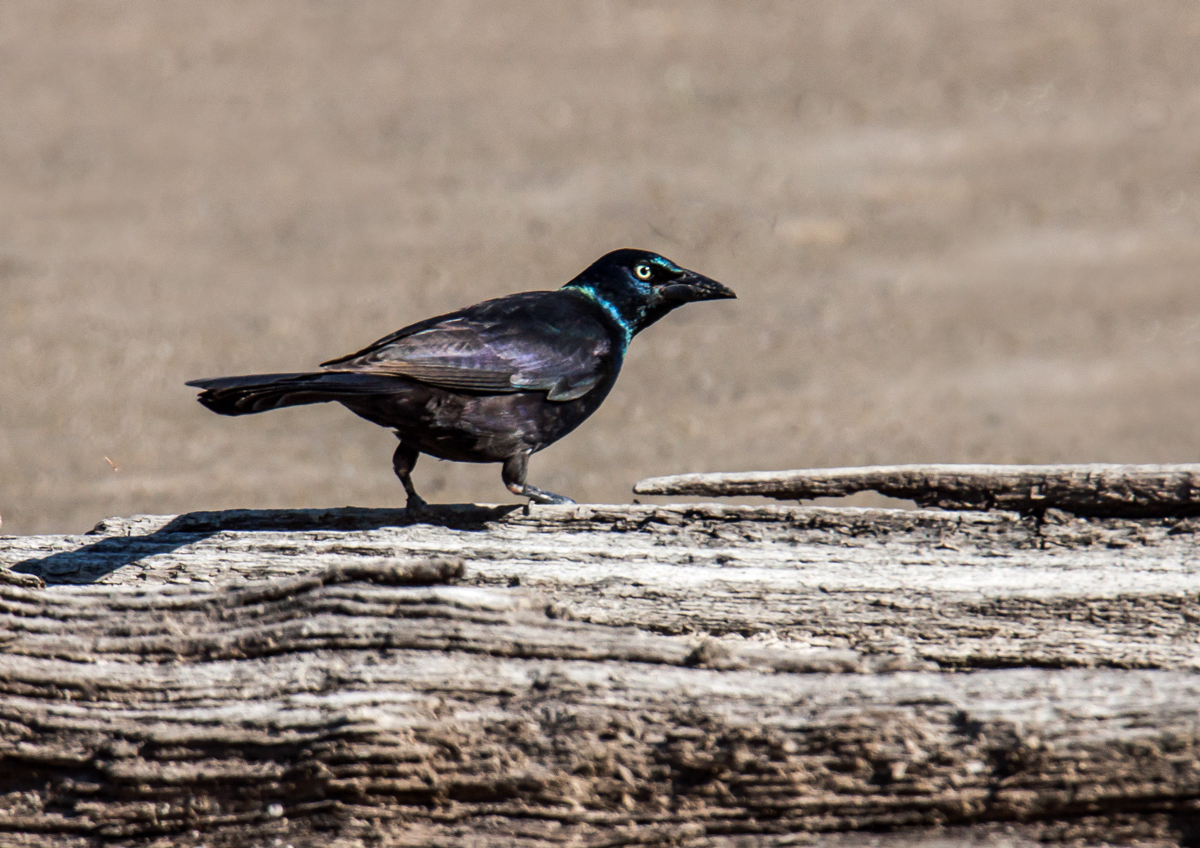
A small flock of large black-colored birds was noisily moving about the marsh at Huntley Meadows Park one morning last weekend and if I were better at identifying bird calls, I probably would have know what kind of birds they were—I considered the possibility that they might be crows or Red-winged Blackbirds or starlings or grackles. When I got closer and the sunlight illuminated their bodies, I realized that they were probably Common Grackles (Quiscalus quiscula), because of the way that their black color became iridescent, with colorful highlights.

I spent quite a while watching the grackles as they energetically pecked about, presumably looking for morsels of food. Their heads were pointed downwards most of the time, so it was a little tough to get good shots of them.

Here are a couple of my favorite shots that help show both the beauty and the personality of a grackle.


Common Grackle

Common Grackle

© Michael Q. Powell. All rights reserved

Read Full Post »

Great Egrets (Ardea alba) always seem to me to be a little vain and self-centered—maybe if comes from being so beautiful and graceful. This one did not like being ignored, so it decided to photobomb my shot of a deer this past weekend at Huntley Meadows Park .

Great Egret

© Michael Q. Powell. All rights reserved

Read Full Post »
A White-tailed Deer (Odocoileus virginianus) seemed curious about the Great Blue Heron (Ardea herodias) perched on a log, but the heron remained impassive and did not react as the deer passed behind it early Saturday morning at Huntley Meadows Park.

Peaceful co-existence—we could all use some more of that in our daily lives.

peaceful co-existence

© Michael Q. Powell. All rights reserved

Read Full Post »

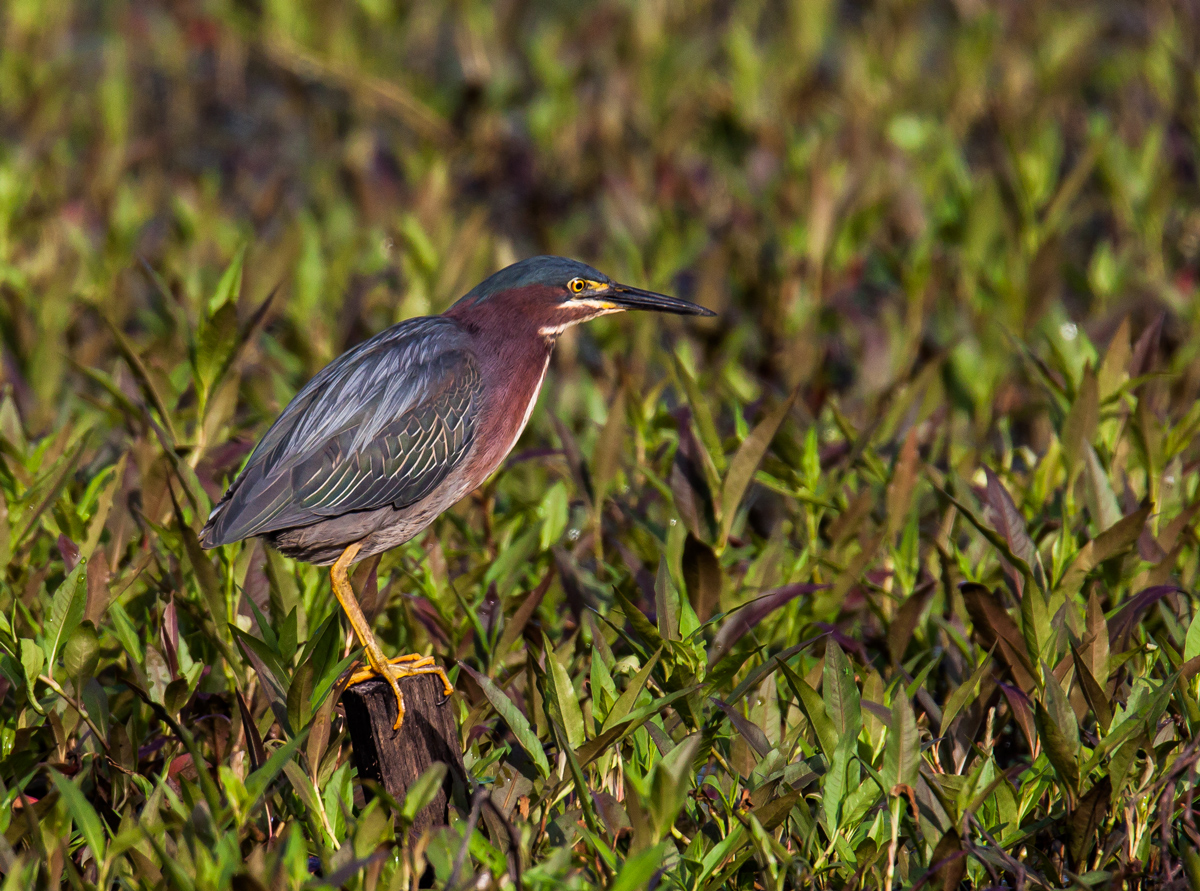
This little Green Heron (Butorides virescens) somehow managed to find a perch in the midst of the thick vegetation growing out of the water yesterday morning at Huntley Meadows Park. From this higher vantage point, the heron was able to scan the area better for potential prey, though I never saw it catch anything.

Was the Green Heron imagining how much easier it would be if it were as tall as a Great Blue Heron?

green heron

© Michael Q. Powell. All rights reserved

Read Full Post »

Female Wood Ducks (Aix sponsa) at Huntley Meadows Park have been caring for their ducklings alone, so I figured the males had all departed. This morning, however, I spotted this male Wood Duck when he climbed out of the water to groom himself.

I captured this image when he gently shook himself to dry off. The moisture flew easily into the air, like water off of a duck’s back.

wood duck

© Michael Q. Powell. All rights reserved

Read Full Post »

Every spring, Barn Swallows (Hirundo rustica) build a nest on the underside of a raised observation platform at Huntley Meadows Park. It is always  a lot of fun to watch these energetic little dynamos flying about, catching insects in mid-air. Fortunately this one came to rest for a moment on the metal railing of the platform and I was able to capture this image of a colorful Barn Swallow.


Barn Swallow

© Michael Q. Powell. All rights reserved

Read Full Post »

In the early morning light at Huntley Meadows Park last week, I was thrilled to catch a glimpse of an Eastern Kingbird (Tyrannus tyrannus). The colors and lighting were subdued, which helped to draw my attention to the details of the bird’s feathers when I captured these images.

Several other photographers had posted photos of a kingbird on the park’s Facebook page and I was hoping that I would see one when I set out that day. When I first saw this bird from a distance, I thought it might be some kind of swallow. Once I got a little closer, I changed my mind and considered the possibility that it might be an Eastern Phoebe. It was only when I got home and was able to look at my birding book that I realized the white-tipped tail of this bird meant that it was almost certainly an Eastern Kingbird.

I studied Latin for a couple of years in high school (a long time ago) and I am always curious about the origin of the Latin name for different species. This one—Tyrannus tyrannus—really caught my eye.  The Cornell Lab of Ornithology website explained the name in these words. “The scientific name Tyrannus means “tyrant, despot, or king,” referring to the aggression kingbirds exhibit with each other and with other species. When defending their nests they will attack much larger predators like hawks, crows, and squirrels. They have been known to knock unsuspecting Blue Jays out of trees.”

Eastern Kingbird


Eastern Kingbird


Eastern Kingbird

© Michael Q. Powell. All rights reserved

Read Full Post »

This Green Heron (Butorides virescens) picked a particularly precarious perch from which to focus on a potential prey this past Monday at Huntley Meadows Park in Alexandria, Virginia.

Green Heron

© Michael Q. Powell. All rights reserved


Read Full Post »

« Newer Posts - Older Posts »