Feeds:
Posts
Comments

Posts Tagged ‘Occoquan Bay National Wildlife Refuge’

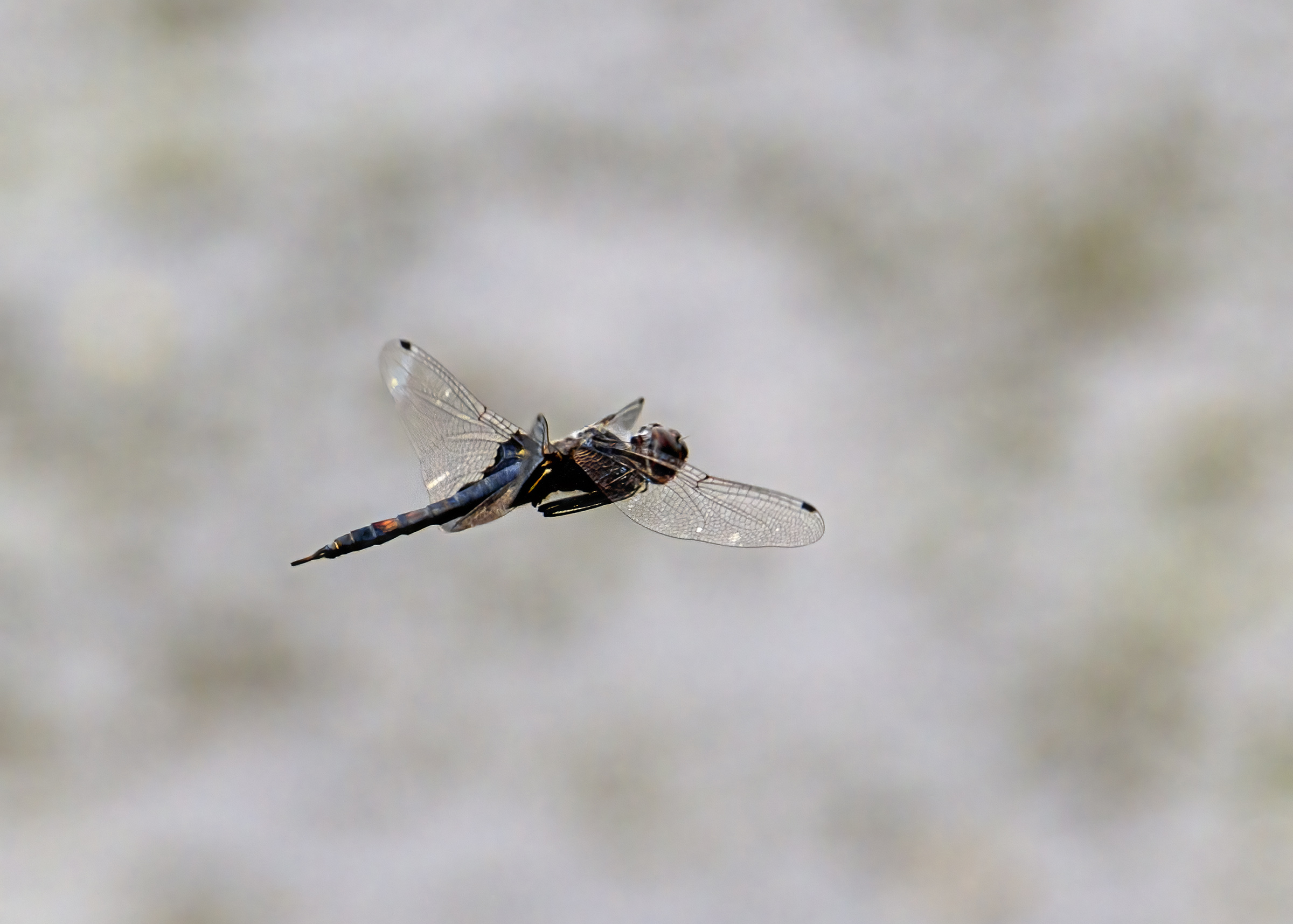
I do not tilt at windmills, but often find myself engaged in my personal quixotic quest of trying to photograph dragonflies in flight. It is such a challenging task that I titled a video that I posted on YouTube, “Impossible Shots? Dragonflies in flight.” Despite the almost overwhelming odds of getting a good shot of one of these aerial acrobats in flight, I feel irresistibly drawn to trying over and over again whenever I see a dragonfly in the air.

I spotted this Black Saddlebags dragonfly (Tramea lacerata) patrolling over the waters off of Occoquan Bay National Wildlife Refuge last Thursday and was thrilled to capture this shot of the dragonfly as it flew past me.Black Saddlebags dragonfly (Tramea lacerata). I love the way that you can see how the dragonfly had enhanced its aerodynamic profile by folding up its legs under its thorax, a bit like the way aircraft retract their landing gear after taking off.

In case you are curious, Black Saddlebags are only about 2 inches (52 mm) in length, so I have to be paying attention in order to even spot one. After years of pursuing my quest, though, my eyes are now calibrated to recognize the shape of a dragonfly pretty quickly and my hand-to-eye coordination has improved with practice, so that I am able to track these a lot better than when I started.
Black Saddlebags

© Michael Q. Powell. All rights reserved.

Read Full Post »

I love to look closely at dragonfly wings. I have a mental picture of the cells of a dragonfly wing as being made up of regularly-shaped squares, like those on a page of graph paper. When I examine them in real life, though, I am always delighted to see all of the different shapes and sizes of these tiny cells in intricate patterns that rival those of massive stained-glass windows.

I photographed this male Widow Skimmer dragonfly (Libellula luctuosa) last Thursday at Occoquan Bay National Wildlife Refuge. I love to see dragonflies with patterned wings and the males of this species have the added bonus of having both brown and white patterns on each wing.

This dragonfly was relatively cooperative and did not fly away as I moved slowly into a position that gave me a good view of the wings. I had to bend and crouch a little to get this shot that emphasizes the impressive wingspan of this handsome little dragonfly.

Widow Skimmer

© Michael Q. Powell. All rights reserved.

Read Full Post »

The main subject of one of my photos is usually pretty clear—I try to fill as much of the frame as possible with the insect or bird on which I am focusing at that moment with a telephoto or macro lens. Of course, it is often impossible to “fill the frame,” because my wildlife subjects frequently are skittish and are likely to depart if I move too suddenly or get too close to them.

As I was reviewing my photos from a visit to Occoquan Bay National Wildlife Refuge last week, I came across this shot of a Carolina Wren (Thryothorus ludovicianus). The wren was pretty far away and had its back to me. The only thing that saved this from being another “butt shot” was the slight turn of the wren’s head that provided me with a chance to get a profile shot.

The shot of the wren is ok, but it was the amazing background that took my breath away. I dabble with watercolor painting and I would be absolutely thrilled to be able to paint a background like this, with all of those different shades of green and the deliciously soft “bokeh ball.” Wow!

I decided that the main subject of the photo that I wanted to show you all was actually the background, not the Carolina Wren. Consequently I did not crop very tightly and left it to the viewers to focus their attention on the linear structure of the branches and on the wonderful background. I am not sure that a thumbnail view of the image will grab folks’ attention, but I am ok with that—the photos in my blog are intended to provide an interesting view of some aspect of the beauty of nature and not serve as click-bait to maximize the number of views.

Carolina Wren

© Michael Q. Powell. All rights reserved.


Read Full Post »

Earlier in the season, when the trees were bare, it was very easy to spot Ospreys (Pandion haliaetus) when they returned to our area from their wintering grounds. Now, though, the trees are covered in leaves and Ospreys are increasingly hard to see as they perch among the leaves, especially if they remain silent.

I was delighted to spot this vigilant osprey last week at Occoquan Bay National Wildlife Refuge. He was alert and focused—he seemed to be paying attention to something, though I am not sure of the subject of his surveillance.

The winds were kicking up periodically, causing a cowlick of feathers to stand up in the back of the osprey’s head. When I was a child, I had a similar problem and had to use a bit of Brylcreem to keep the unruly hair in place. (My Mom used to be able to accomplish the same thing with my hair using only a bit of her saliva and her fingers.)

Osprey

© Michael Q. Powell. All rights reserved.

Read Full Post »

On occasion I have noticed a dragonfly that seemed to be smiling a little at me. Last week, though, I encountered a female Widow Skimmer (Libellula luctuosa) at Occoquan Bay National Wildlife Refuge that seemed to have an exceptionally toothy grin—she seemed delighted to pose for me. I love the way that the background blurred out, allowing viewers to focus on the details of this smiling dragonfly and hopefully producing smiles on their faces in response.

Widow Skimmer

© Michael Q. Powell. All rights reserved.

Read Full Post »

When dragonflies mate, they usually assume a “wheel” position, in which the male grasps the female by the back of her head and she bends her abdomen towards his thorax. The position appears to be both awkward and acrobatic, but amazingly the dragonflies are able to fly while in this position.

I was searching for dragonflies last week at Occoquan Bay National Wildlife Refuge when a pair of mating Calico Pennant dragonflies (Celithemis elisa) flew by me and landed in some nearby vegetation. Calico Pennants are some of the most spectacular dragonflies in our area, with bright colors and distinctive patches on their wings.

Feeling a bit like a voyeur, I moved a little closer to them and slowly crouched a bit to get a better angle for my shot. In the image below, you can see how the female grasps the abdomen of the male during this process.

I was happy to be able to get most of the two dragonflies in focus, which is always a challenge in situations like this.

Calico Pennant

© Michael Q. Powell. All rights reserved.

Read Full Post »

The entire East Coast of the United States is in the midst of a heat wave. Yesterday here in the Washington D.C. area we had a record high temperature for 15 July of 102 degrees (39 degrees C) with the heat index even higher. Yikes.

Following recommendations of doctors and weather forecasters, I stayed indoors for most of the day and worked on a few images that I captured last week at Occoquan Bay National Wildlife Refuge, including this shot of a Halloween Pennant dragonfly (Celithemis eponina).

Many dragonflies perch with their wings held stationary, but Halloween Pennants seem to move their wings about quite a bit to maintain their balance as they perch precariously on the very tips of tall stalks of vegetation. It is very easy to isolate the dragonfly from the background, because they are perched above all of the ground clutter, but it is a bit of a challenge to focus on the dragonfly as it is buffeted to and fro by even the slightest of breezes.

Halloween Pennant

© Michael Q. Powell. All rights reserved.

Read Full Post »

I was delighted to see some Red-winged Blackbirds (Agelaius phoeniceus) last week at Occoquan Bay National Wildlife Refuge. In the first photo, a male  Red-winged Blackbird seemed to be showing off for me as he balanced himself on a single leg, glanced in my direction, and seemed to smile. Eventually he climbed to the tip of the small branch and appeared to be complaining about something that he observed.

A short distance away I captured the final image of a female Red-winged Blackbird. As you can she, she is not black nor does she have any red on her wings, so it feels a little strange to call her a Red-winged Blackbird. Although I was not able to get very close to her, I really like the overall composition of the image and the moment of action that I was able to capture as she called out.

Red-winged Blackbird

Red-winged Blackbird

Red-winged Blackbird

© Michael Q. Powell. All rights reserved.


Read Full Post »

We have a number of different dark swallowtail butterfly species in our area and sometimes I have trouble telling them apart. Recently I have seen Black Swallowtails fairly frequently and occasionally I will see a Pipevine Swallowtail. I know that there is also a dark morph version of the Eastern Tiger Swallowtail and a Red-spotted Purple butterfly sometimes looks almost like a swallowtail.

Are you confused yet? When I spotted this cool-looking butterfly on Wednesday at Occoquan Bay National Wildlife Refuge, I was not sure what it was. Rather than endlessly speculating while in the field, I follow what I call the “Law of the Wild West”—shoot first and ask questions later—and wait to identify my subjects until after I have loaded my images onto my computer.

I have grown accustomed to using a blog posting by the Louisiana Naturalist to help identify dark swallowtails—it provides side-by-side photos of four different species. On the basis of that posting and some other research, I have concluded that “my” butterfly is probably a Spicebush Swallowtail (Papilio troilus) butterfly, a species that I don’t recall seeing the past few years.

The background of the photo is not particularly interesting, but I was patient enough to wait for the butterfly to open its wings, so you get a good look at the wonderful markings of this Spicebush Swallowtail butterfly.

Spicebush Swallowtail

© Michael Q. Powell. All rights reserved.

Read Full Post »

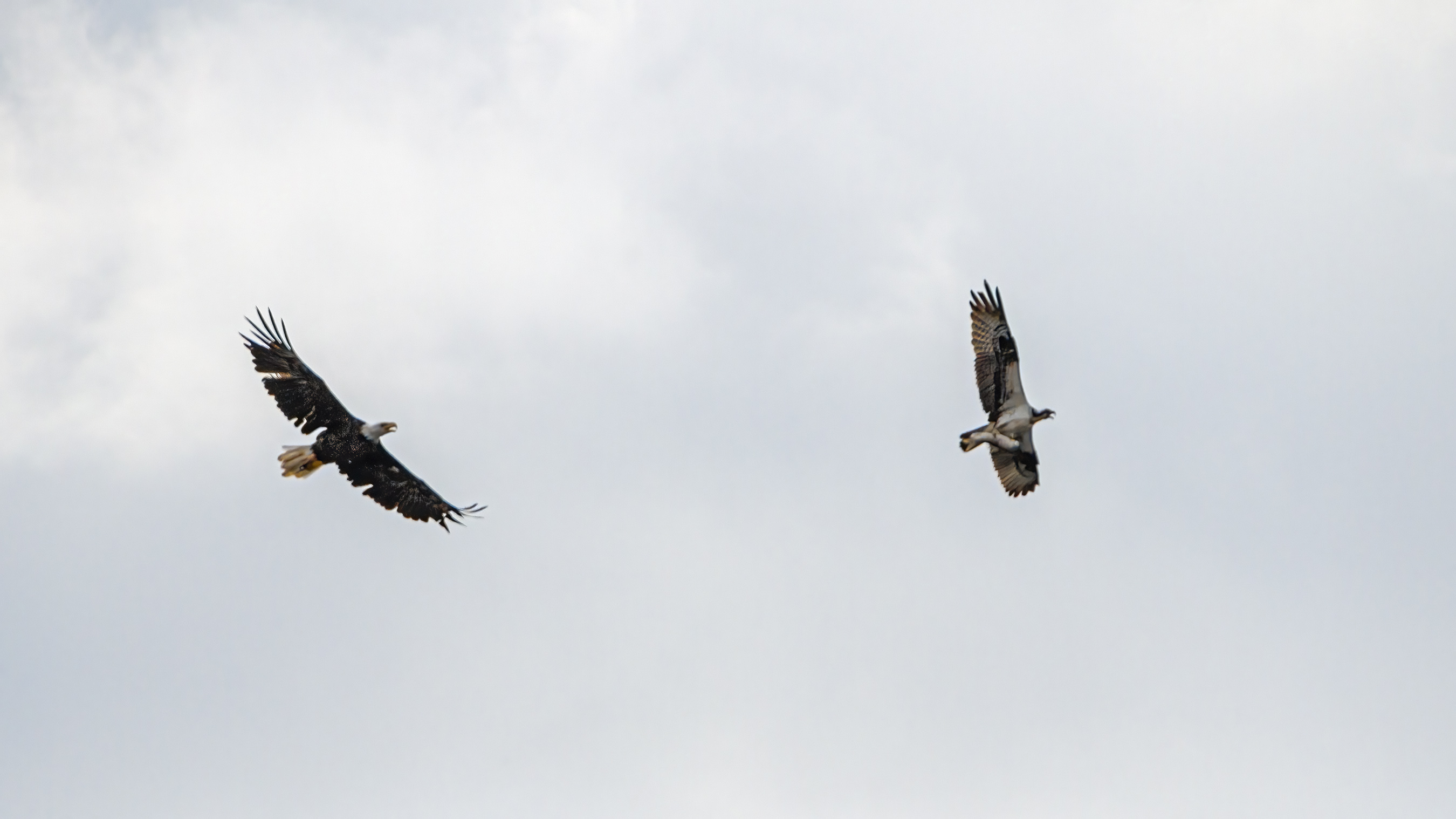
On Wednesday I watched as a Bald Eagle (Haliaeetus leucocephalus) chased an Osprey (Pandion haliaetus) high in the sky above the waters off of Occoquan Bay National Wildlife Refuge in a vain attempt to steal its freshly caught fish. I captured the second shot when the eagle flew past me after giving up on its chase.
It has been several months since I last photographed a Bald Eagle, so I was thrilled to capture these images. As most of you know, I concentrate most of my photographic attention on dragonflies and other insects during the warmer months. However, I am always alert to the possibility of photographing birds when I manage to spot them.
During the winter months I generally use a 150-600mm telephoto zoom lens that gives me a long reach, but in the summer I tend to rely on a 180mm macro lens or the 18-400mm zoom lens that I used for these shots. This lens gives me a good deal of versatility, allowing me to capture my close-in tiny subjects and some longer distance ones like these raptors in flight.
Eagle and Osprey
Bald Eagle
© Michael Q. Powell. All rights reserved.

Read Full Post »

I was a little shocked yesterday to see a Green Heron (Butorides virescens) while I was searching for dragonflies at a small pond at Occoquan Bay National Wildlife Refuge. In the past I have seen Green Herons at other locations at the refuge, but never before at this pond. Green Herons are smaller and squatter than the Great Blue Herons that I am more accustomed to seeing.

When I initially spooked the Green Heron, it flew to a mucky, shallow end of the pond, where I was able to capture the first two images. I am always amazed at the length of the neck of a Green Heron when it extends it fully—it looks so much taller and slimmer in the second shot. I also really like the floppy head feathers that sometime look like a Mohawk hairstyle.

The Green Heron eventually sensed my presence and flew to a nearby tree. The heron was partially hidden by the abundant foliage, but eventually I was able to capture the final image of it among the leaves.

It was hot and humid yesterday, so I limited my trekking to a couple of hours and drank plenty of water. Still, it was nice to get out in the wild with my camera after a week of spending most of my time indoors.

Green Heron

Green Heron

Green Heron

© Michael Q. Powell. All rights reserved.
Read Full Post »

Can dragonflies smile? Although I realize that it is probably an anatomical impossibility, this female Great Blue Skimmer dragonfly (Libellula vibrans) sure did look like she was smiling at me when she posed for this little portrait last week at Occoquan Bay National Wildlife Refuge.

Great Blue Skimmers are quite common in our area during the summer and are relatively easy to identify because of their white faces.

Great Blue Skimmer

© Michael Q. Powell. All rights reserved.


Read Full Post »

I do not see Carolina Saddlebags dragonflies (Tramea carolina) very often and when I am lucky enough to spot one, it is almost always in flight. According to the Dragonflies of Northern Virginia website, “Carolina Saddlebags appear to stick to shallow, thickly vegetated ponds and marshlands,” which is a pretty good description of the place where I spotted this one last Tuesday at Occoquan Bay National Wildlife Refuge. The same website described the Carolina Saddlebag’s flight tendencies as “Strong flier, often high, rarely perches.”

I spent some time that day watching several male Calico Pennant dragonflies, which are red and has patterned wings, as they flew around over the pond—check out yesterday’s posting to see a photo of a perched male Calico Pennant.  Suddenly a larger red dragonfly flew into view—Calico Pennants are approximately 1.3 inches (33 mm) in length, while Carolina Saddlebags are 2.0 inches (51 mm). I visually tracked the Carolina Saddlebags for a while and was able to follow it as it perched high on a stalk of vegetation in an adjacent field.

I was shooting into the light and at a sharp upward angle, which meant that I risked creating a silhouetted image of the back side of the dragonfly. I crouched a little to create a sky/trees background and waited for the dragonfly to give me a profile view. For a brief moment, my wishes came true and I captured the image below.

The image is far from perfect, but I like the way that it turned out. The focus on the dragonfly is a little soft, but I think it works well with the blurred background, creating an aesthetically pleasing little image.

Carolina Saddlebags

© Michael Q. Powell. All rights reserved.

Read Full Post »

When male Calico Pennant (Celithemis elisa) dragonflies are immature, they have yellow markings on their bodies similar to those of the females. As the males mature, those markings turn bright red. I was thrilled to spot several mature male Calico Pennants last week at Occoquan Bay National Wildlife, the first adult males of this species that I have encountered this year.

The bright body markings and the prominent wing patches really make this dragonfly stand out, although they are quite small, about 1.2 inches (30 mm) in length.

Calico Pennant

Calico Pennant

© Michael Q. Powell. All rights reserved.

Read Full Post »

I spotted quite a few beautiful Zebra Swallowtail butterflies this past Tuesday at Occoquan Bay National Wildlife Refuge. The all seemed to be in constant motion, rarely perching for more than a split second and flying in unpredictable patterns.

Eventually I was able to capture a shot of a distant Zebra Swallowtail when it stopped to sip from a milkweed plant. I really like the composition of the photo, despite the fact that the main subject occupies only a small portion of the frame.

I could not help but notice that the butterfly is looking a bit tattered, with its long swallowtails already gone. Later in the season, I am sure that I will see many more butterflies and dragonflies with damage to their wings from the wear-and-tear of daily life. I am always amazed by the way that they are able to compensate and continue to survive. As I get older and slow down a bit, I try to remind myself to focus on those things that I can do and not on the ones that may be becoming increasingly challenging for me.

Zebra Swallowtail

© Michael Q. Powell. All rights reserved.

Read Full Post »

There has been a recent explosion of dragonflies at Occoquan Bay National Wildlife Refuge, my favorite location for photographing these beautiful aerial acrobats. I spotted hundreds and hundreds of dragonflies this past Tuesday as I explored the trails at the refuge.

One of the species that I encountered most frequently that day was the Needham’s Skimmer (Libellula needhami). The Dragonflies of Northern Virginia website provided a wonderful description of the Needham’s Skimmer. “This dashing summer dragonfly, a member of the king skimmer genus, makes quite a splash at the shallow, marshy wetlands it prefers. Relatively skittish, it spends more time on the wing and less time perching than other king skimmers.”

At this time of the year the males and females have a similar coloration, but as they mature the males will turn reddish-orange. The dragonfly in this photo is a female—it is easy to tell from the terminal appendages at the end of the abdomen. I love the bright yellow vein on the wings of this dragonfly, a feature that is shared by the males as well as the females of the species.

Needham's Skimmer

© Michael Q. Powell. All rights reserved.

Read Full Post »

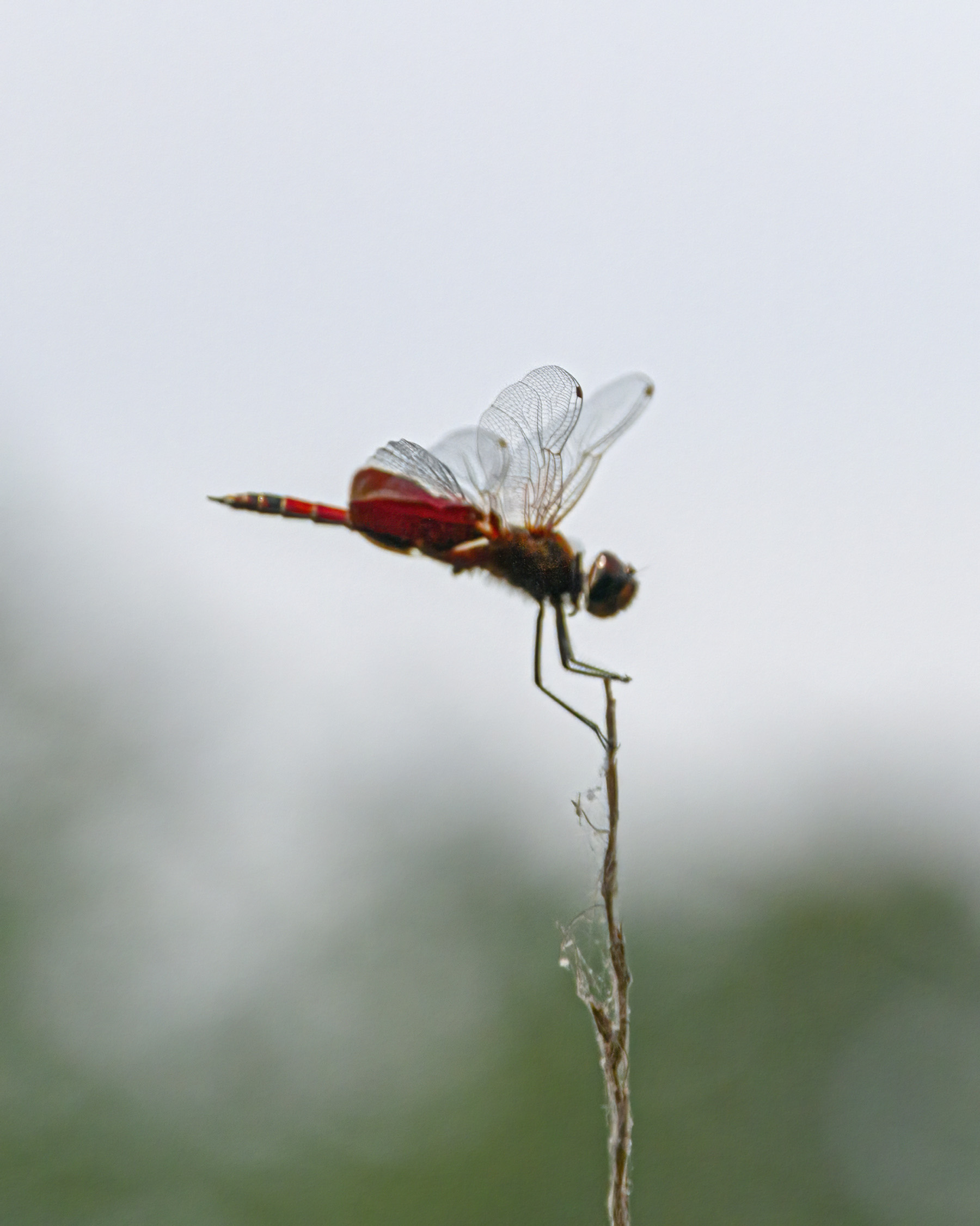
The breeze was kicking up a bit and this Halloween Pennant dragonfly seemed to be holding on for dear life when I spotted in on Tuesday at Occoquan Bay National Wildlife Refuge. It seems to be that it would be safer and more secure to grasp the stalk a bit lower, but, like other members of the pennant family of dragonflies, this Halloween Pennant is a bit of a thrill seeker.

As the old adage, often attributed to John A. Shedd, states, “A ship in harbor is safe, but that is not what ships are built for.” Sometimes, I think, it is good for us to step out of our comfort zones, which can turn into ruts if we are not careful, and take a risk by living life on the edge, like this Halloween Pennant dragonfly.

Halloween Pennant

© Michael Q. Powell. All rights reserved.
 

Read Full Post »

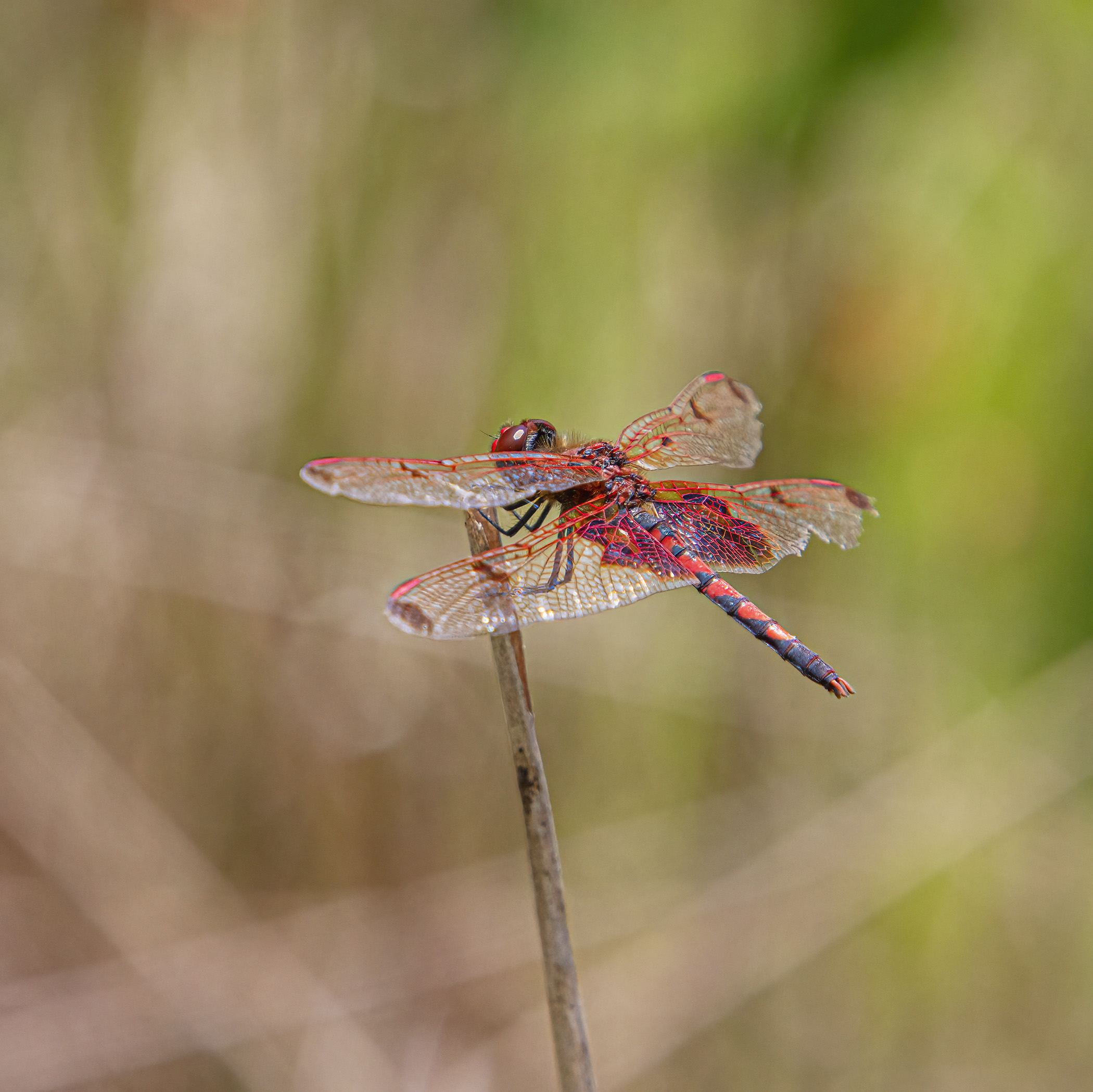
I was excited to spot this female Unicorn Clubtail dragonfly (Arigomphus villosipes) on Tuesday at Occoquan Bay Wildlife Refuge, one of the few times that I have seen a female of this species. I am not sure if the females hang out in different areas from the males, which perch prominently on low vegetation or logs at water’s edge, or if, like some human females, they are simply playing “hard to get” and wait to meet the males on their own terms.

As noted on the excellent Dragonflies of Northern Virginia website, Unicorn Clubtails are “the only clubtail in Northern VA that prefers ponds and marshes, over streams and rivers…our only clubtail that can be found in completely still, stagnant water.” I know that is true for the males that I have featured already a couple of time this season on this blog, but is it also true for female Unicorn Clubtails?

How do you explain the behavior of females? It is one of the mysteries of life.

Unicorn Clubtail

Unicorn Clubtail

© Michael Q. Powell. All rights reserved.
Read Full Post »

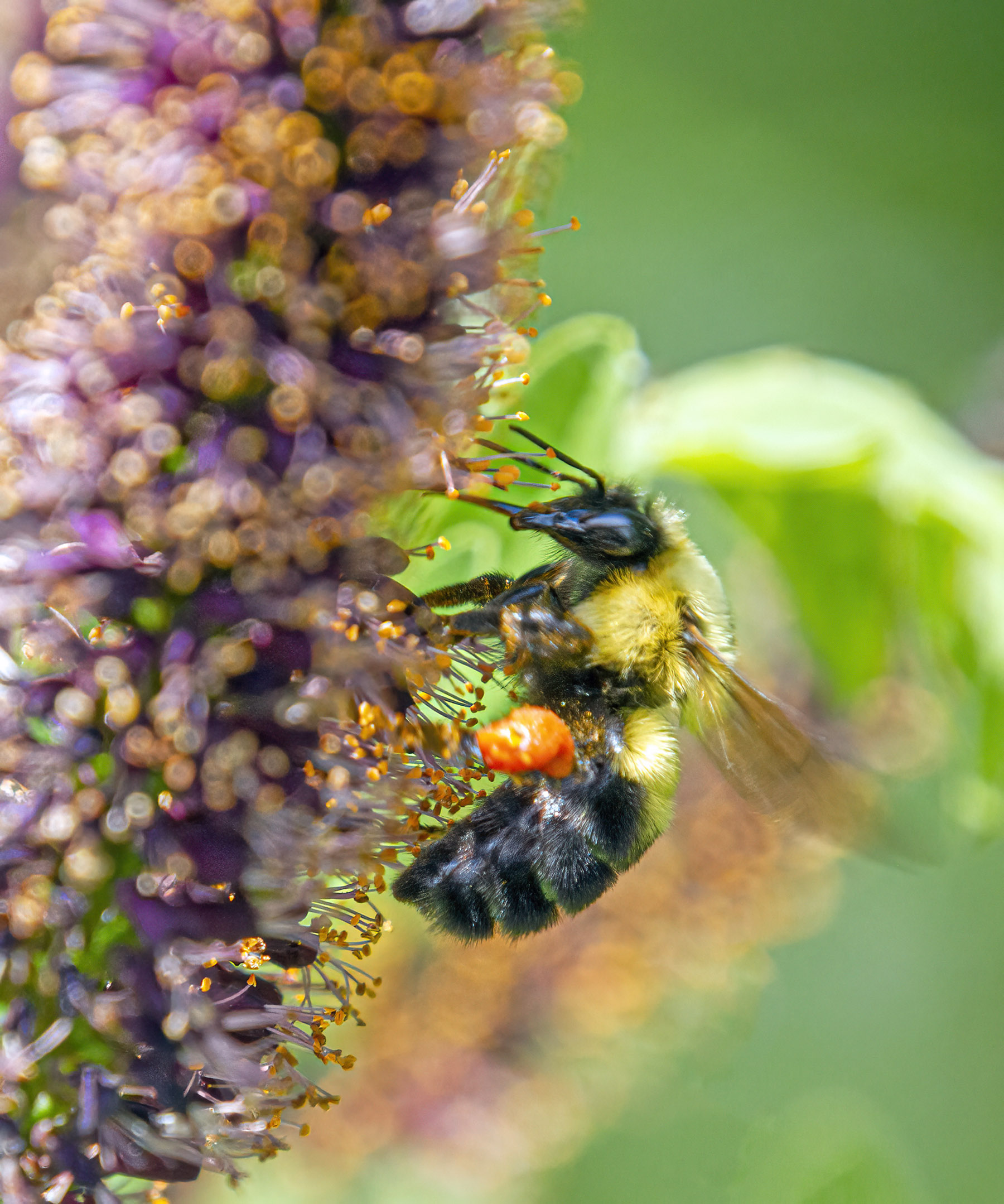
This bumble bee was busily filling its pollen sacs and sucking up nectar when I spotted it recently during a visit to Occoquan Bay National Wildlife Refuge. I cannot identify the plant on which the bee was feeding, but I love its beautiful colors and the blurry bokeh balls that were created in the out-of-focus areas of the plant.

As many of you know, when you move in close to a subject, the depth of field becomes really narrow, which means that only certain elements will be in sharp focus. My goal as a photographer is to try to make sure that the most critical areas, which usually include the eyes of the subject, are in focus. In this case, I was delighted that both the eye and the extended proboscis are relatively sharp.

bumble bee

© Michael Q. Powell. All rights reserved.

Read Full Post »

I love the light and delicate pose of this handsome male Calico Pennant dragonfly (Celithemis elisa) that I spotted during a recent visit to Occoquan Bay National Wildlife Refuge. Pennant dragonflies, like the Calico Pennant, usually perch on the very tips of vegetation where they sway in the slightest breeze—like a pennant.

The red of the dragonfly’s body and the green of the vegetation help the dragonfly to “pop,” because red and green are complementary colors, i.e. they are directly opposite each other on the traditional color wheel that artists use.

Callico Pennant

© Michael Q. Powell. All rights reserved.


Read Full Post »

I haven’t seen any Monarch butterflies yet this season, but I did spot this similar-looking Viceroy butterfly last week at Occoquan Bay National Wildlife Refuge. Viceroy butterflies are generally much smaller than Monarchs, so I can often tell them apart from a distance. When I get closer though, the most obvious distinguishing feature is that Viceroys nave a thin black line across their hind wings that Monarchs do not have.

Viceroy butterfly

© Michael Q. Powell. All rights reserved.


Read Full Post »

I spotted this beautiful Black Swallowtail butterfly (Papilio polyxenes) last week at Occoquan Bay National Wildlife Refuge. The orange circle with the black dot in between the wings helps to distinguish this species from several similar-looking dark butterflies in our area.

I chased this butterfly around for quite some time before it finally stopped for a moment on this vegetation—I often get a good workout when photographing butterflies. I am quite happy with the way that I was able to capture the varying shades of green surrounding the butterfly that add a lot of visual interest to this simple composition.

Black Swallowtail

© Michael Q. Powell. All rights reserved.


Read Full Post »

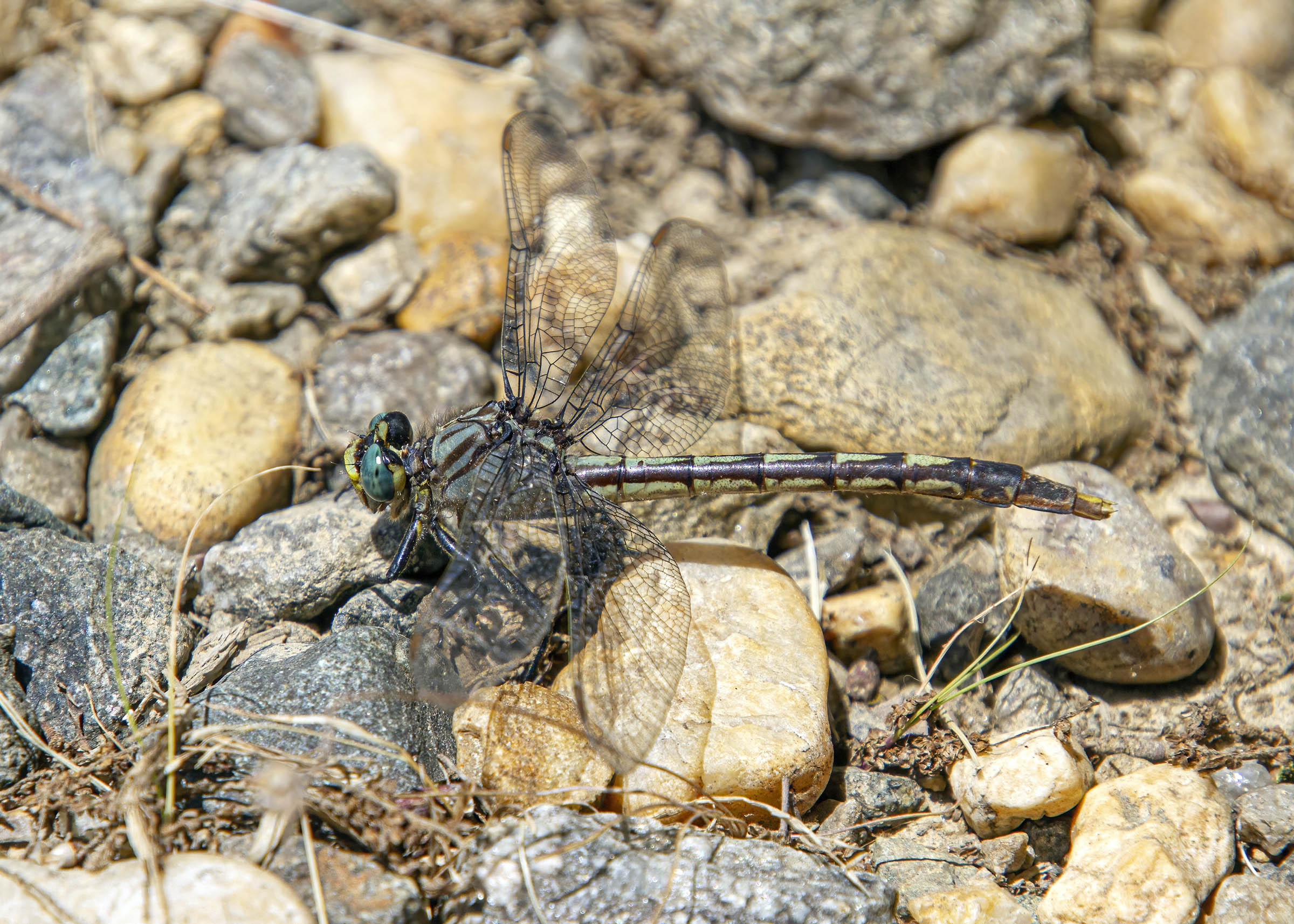
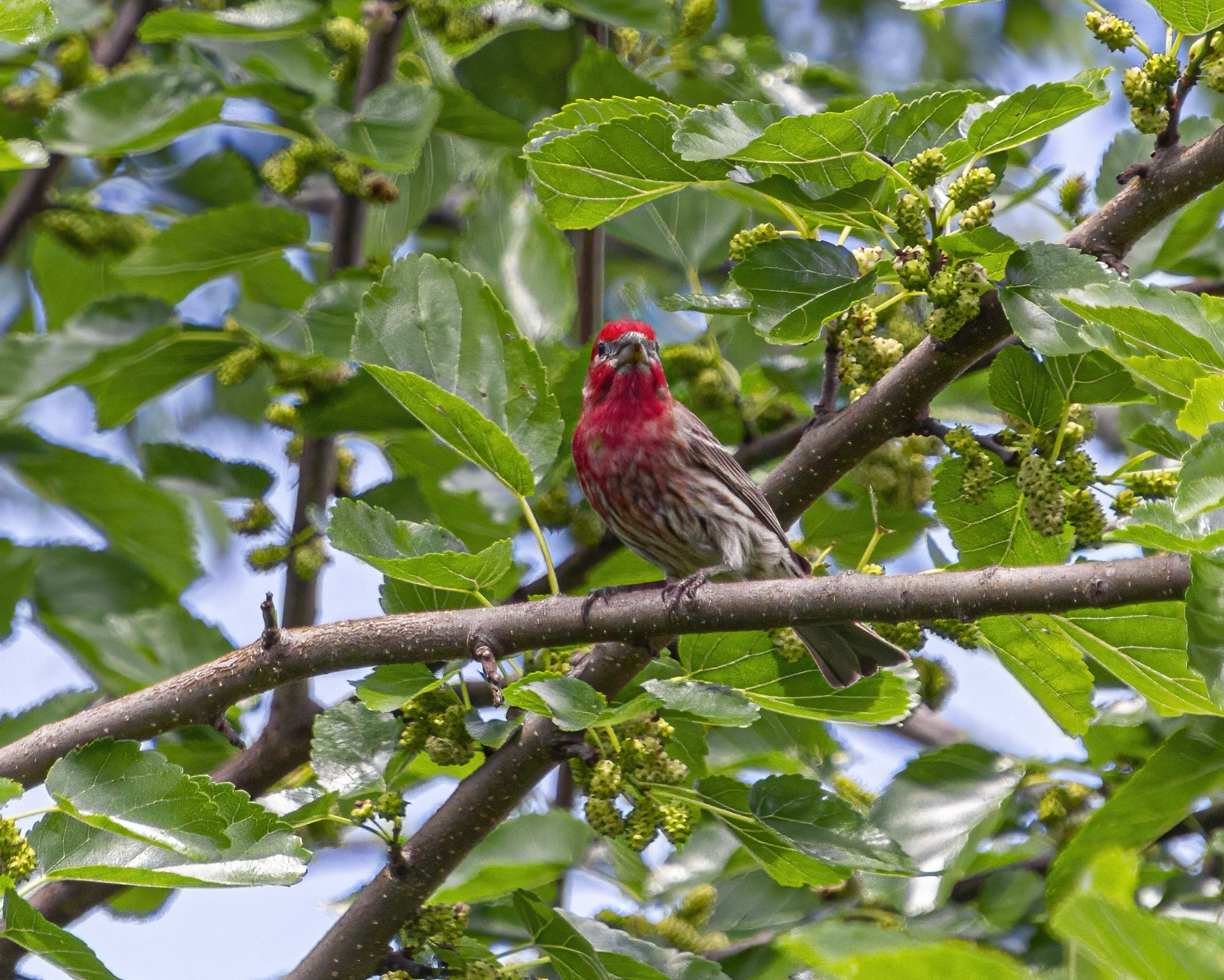
The bright red color of this male House Finch (Haemorhous mexicanus) really caught my eye last week at Occoquan Bay National Wildlife Refuge. For a split second I thought it was a cardinal until I looked more closely at the bird, it was clear that it was a different species.

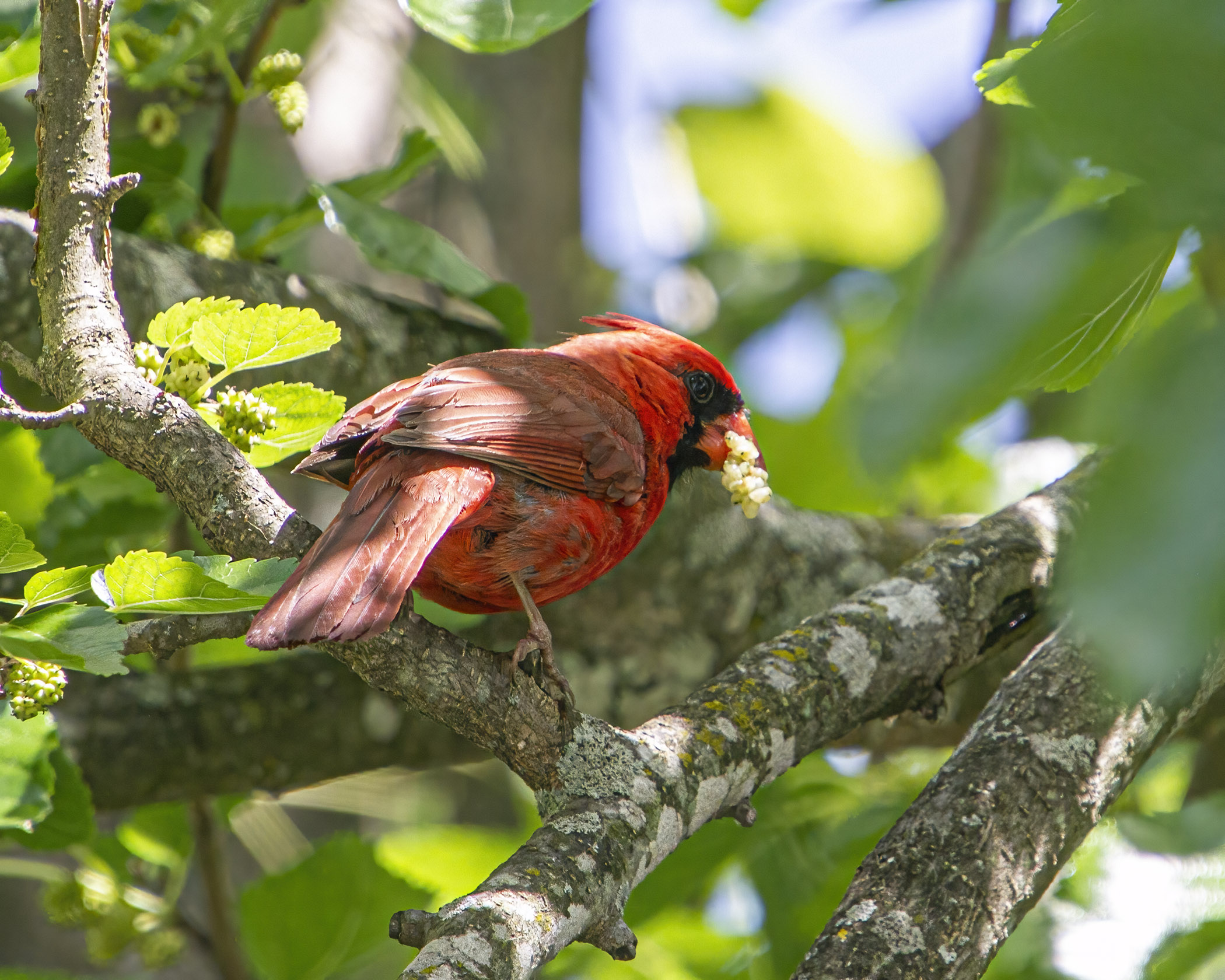
Later that same day I spotted an equally bright red male Northern Cardinal (Cardinalis cardinalis) that seemed quite pleased with whatever treat it had found. I think it may be plant material, but I can’t exclude the possibility that it is some kind of insect.

From a photography perspective, it is really helpful when a bird is this boldly colored and makes no effort to blend in with its surroundings, especially at this time of the year when there are so many leaves on the trees.

House Finch

Northern Cardinal

© Michael Q. Powell. All rights reserved.
Read Full Post »

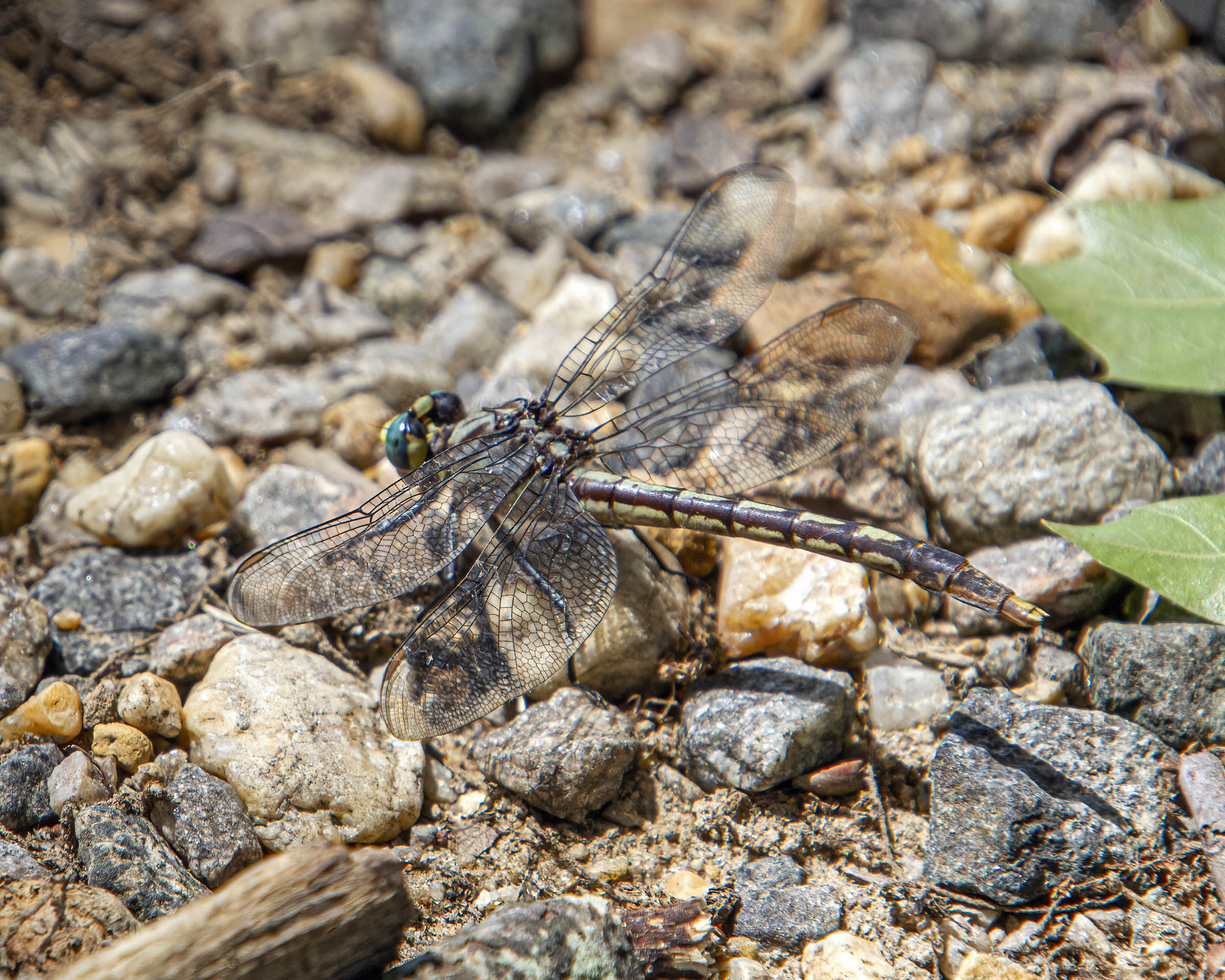
I love the sweet little face on this Southeastern Mud Turtle (Kinosternon subrubrum subrubrum) that I spotted last Thursday at Occoquan Bay National Wildlife Refuge. Most of the turtles that I encounter are Red-eared Sliders or Painted Turtles and they generally are in the water or perched on logs floating in the water. Occasionally I will spot a box turtle or a snapping turtle. When it comes to mud turtles, however, I normally see only one or two a year.

According to the Virginia Herpetological Society, “Kinosternon subrubrum occupies a wide variety of aquatic habitats, including ponds, lakes, creeks, swamps, freshwater and brackish marshes, ditches, and boggy areas. They avoid large, deep bodies of water and fast-moving water. Preferred habitat is shallow, slow-moving water, with aquatic or emergent vegetation and a soft organic substrate. This turtle is often seen on land, especially after rainstorms. Mud Turtles may spend a considerable portion of the year on land and often overwinter in shallow burrows.”

mud turtle

© Michael Q. Powell. All rights reserved.
 

Read Full Post »

Last week I photographed a female Swamp Darner dragonfly (Epiaeschna heros) depositing some eggs into a rotten log at the edge of a small pond at Occoquan Bay National Wildlife Refuge. Some dragonflies deposit a large number of eggs into the water or floating vegetation by tapping their abdomens rapidly and repeatedly at different locations, while others, like this Swamp Darner, deposit their larger eggs more slowly and deliberately by making a slit and inserting the eggs directly into wet wood and other debris with their blade-like ovipositors.

Swamp Darners are one of the largest dragonflies in our area, with a body length of about 3.4 inches (86 mm) in length. I love the description of this species on the Dragonflies of Northern Virginia website, “I often tell people on dragonfly walks that if they see a rhino with wings, it’s a swamp darner. Slight exaggeration, perhaps, but they are pretty impressive.” Some dragonflies are so nimble and acrobatic in their flight that they remind me of fighter aircraft, but the bulky size of the Swamp Darner makes me think more of bomber aircraft.

Swamp Darner

© Michael Q. Powell. All rights reserved.
Read Full Post »

Over the past week I have spotted Woodland Box Turtles (Terrapene carolina carolina) at two different locations in my local area. The red eyes of both turtles suggest that that they are males, though I have read that eye color is not always 100% accurate in determining the gender of a box turtle. The shell pattern for each box turtle is supposed to be unique, like a fingerprint, and you can definitely see differences in the patterns on the shells of these two turtles.

It is always a treat to spot one of these box turtles, because they are so cool-looking. Unlike many turtles, the box turtle is primarily terrestrial rather than aquatic, and most of the times that I have encountered them, they have been out in the open. According to the Virginia Department of Wildlife Resources (DWR), “The box turtle has a low reproductive rate and is long lived. It requires 10-20 years to reach sexual maturity. Box turtles may sometimes live to over 100 years.”

Virginia has special protections for this species. According to the DWR,  “it is illegal to keep one in your home in Virginia due to the significant number of wild caught animals found in captivity. This species is primarily threatened due to the thousands that are caught for the pet trade from the wild each year; although habitat fragmentation and urbanization also account for a fraction of the population’s drop of 32% over the last 100 years.”

Woodland Box Turtles

Woodland Box Turtle

© Michael Q. Powell. All rights reserved.


Read Full Post »

On Monday I finally spotted some mature male Calico Pennant dragonflies (Celithemis elisa) with red markings at Occoquan Bay National Wildlife Refuge. Heretofore all of the males that I had seen this year were immature and had yellow markings, like those of their female counterparts.

The first two photos show male Calico Pennants. I love the way that the red marking on the abdomen look like a series of tiny hearts. The dragonfly in the third photo is an immature male—you can tell that it is a male by looking at the shape of the tip of the abdomen (the “tail”).

For the sake of comparison, I have added a final photo of a female Calico Pennant from a posting I did in May 2020. You can readily see that the dragonflies in the last two photos are similar in coloration, but you have to look a bit closer at them to see that the wing patterns are slightly different and the shapes of the terminal appendages are quite different.

Most of us tend to rely on colors for identifying species of birds and insects, but I have learned over time that color is often not a reliable identification feature, especially for immature subjects, when the males and females are often similar in color and the color differentiation becomes apparent only when they mature.

Calico Pennant

Calico Pennant

Calico Pennant

Calico Pennant

© Michael Q. Powell. All rights reserved.

Read Full Post »

This dragonfly was perched on the ground on Monday at Occoquan Bay National Wildlife Refuge when I spotted it. I knew immediately that it was either a Lancet Clubtail (Phanogomphus exilis) or an Ashy Clubtail (Phanogomphus lividus), but these two species are so similar in appearance that it is tough for me to tell them apart.

I checked my identification guides and realized that I had to look at the dragonfly more closely and get a bit more geeky. The abdomen (the “tail”) of dragonflies  consists of ten segments traditionally numbered S1 through S10, starting from the point at which the thorax (the “chest”) meets the abdomen (S1) and going downward to the tip of the abdomen (S10).

The Dragonflies of Northern Virginia website notes that for Lancet Clubtails there is a “noticeable bright yellow flange on sides of S8 & S9 (male and female), while Ashy has almost no flange, and less bright yellow.” I knew about these differences, but couldn’t see them clearly enough when I was in the field.

The dragonfly was relatively cooperative and I was able to get a shot of it from almost directly overhead. The image is really cluttered, because of the vegetation, and  artistically is not a great photo, but it does provide the kind of details that are helpful for identification.

In the image I saw what appear to be yellow flanges on the sides of S8 and S9  and I could clearly see the appendages at the tip of the abdomen, which helps me identify the gender of the dragonfly. These elements suggested to me that it was a female Lancet Clubtail. I posted a photo in a Facebook group devoted to dragonflies and damselflies in Virginia and was delighted when one of the most experience members there agreed with my identification of this dragonfly.

I don’t expect most of my readers to delve this deeply into dragonfly anatomy, but I figured it might be interesting to learn about what some of the myriad considerations that swirl about in my mind as I seek to photograph and identify these beautiful little creatures. Sometimes I am successful in connecting the dots and coming to a conclusion, but at times the identities of my subjects remains a mystery.

Lancet Clubtail

© Michael Q. Powell. All rights reserved.


Read Full Post »

Most warblers nest either on the ground, in shrubs, or in trees, according to the Cornell Lab of Ornithology website, but the Prothonotary Warbler and the Lucy’s Warbler build their nests in holes in standing dead trees or may use nest boxes when available. On Monday I was delighted to spot a Prothonotary Warbler (Protonotaria citrea) at Occoquan Bay National Wildlife Refuge checking out a nest box from the outside and eventually from the inside too.

The nest box is old and may have a leaky roof, but the warbler seemed happy to have found it. The real estate market is tight in Northern Virginia right now and finding any place to live is difficult. After a short stay on the roof, the Prothonotary Warbler flew away and made an aerial approach from the front, perching at the entrance for a moment before entering the nest box.

I obviously could not see what was going on in the box, but periodically I could see flashes of yellow as the warbler moved about inside the box. Perhaps there are already eggs in the box. The warbler stayed inside the box for about five minutes before it poked its head out of the entrance and began to look around, as you can see in the final photo. I was hoping to capture a shot of the bird exiting the nest box, but it left more quickly and unexpectedly and I missed the shot.

I will be checking this spot out during my next visits to the wildlife refuge, hoping that I will be lucky enough to see some baby warblers.

Prothonotary Warbler

Prothonotary Warbler

Prothonotary Warbler

© Michael Q. Powell. All rights reserved.
Read Full Post »

This colorful bird was a long way away yesterday at Occoquan Bay National Wildlife Refuge and I assumed it was a Northern Cardinal, but I decided to photograph it anyways. When I was reviewing my photos, I was shocked to discover that it was an immature male Summer Tanager (Piranga rubra), a new species for me. Truth be told, I was not very certain what kind of bird it was, so I did some searching on-line and came up with the correct answer, as confirmed by some experts in a birding forum on Facebook.

I will take photos of anything that catches my eye, knowing that many of them will not be “keepers.” I will take photos of subjects that are really familiar and those that may be rare or unique. My general rule is to take a lot of photos, following what I call the Law of the Wild West, i.e. “Shoot first and ask questions later.”

Summer Tanager

© Michael Q. Powell. All rights reserved.
Read Full Post »

I don’t know how much longer the migrating warblers will be in my area, but this past few weeks I have been trying to get outside with my camera as often as I can, hoping to be able to photograph these colorful little birds.  On Tuesday I spotted a Prairie Warbler (Setophaga discolor) in the patient and patiently tracked it as it moved about.

The first photo was a bit of an anomaly, because the warbler momentarily gave me an unobstructed view when it jumped to a high branch. The second photo gives you a much better idea of the typical challenge I face, with the warbler barely showing itself from behind the wall of foliage. Fortunately, I reacted quick and got a shot that is one of my favorites of this warbler season, which has been my most successful one to date.

Prairie Warbler

Prairie Warbler

© Michael Q. Powell. All rights reserved.

Read Full Post »

« Newer Posts - Older Posts »