Feeds:
Posts
Comments

Posts Tagged ‘Canon SX50’

Do you ever get so obsessed with a single species that you return over and over again to the same location, seeking another glimpse (and hopefully more photos) of that species? Generally I describe myself as an “0pportunistic” shooter—I like to walk around and photograph whatever I happen to see—and only rarely do I have specific goals for a photo shoot.

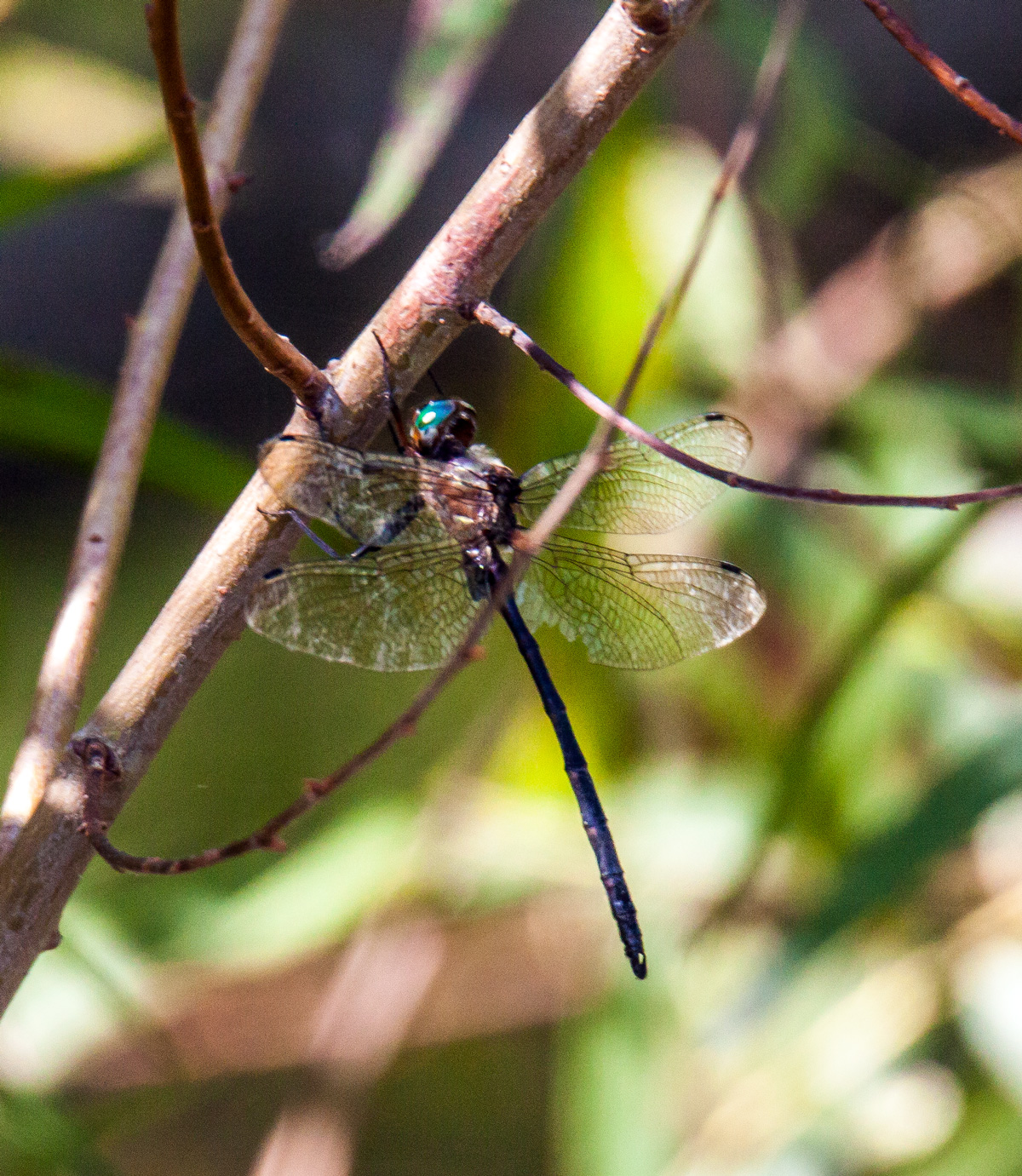
My normal approach changed this past month as I became somewhat obsessed with the Fine-lined Emerald dragonfly (Somatochlora filosa). My good friend and local dragonfly expert Walter Sanford encouraged me to seek out this rare species, which has been seen at only a single location, Occoquan Bay National Wildlife Refuge, in our area. I started spending most of my free time at this wildlife refuge, rather than at Huntley Meadows Park, my most frequent shooting location.

Mostly on my own, though occasionally shooting with Walter, I learned more and about this species, including its preferred perches and patrolling techniques. Over time, I learned to recognize Fine-lined Emeralds as they flew towards me at knee-level with their shiny green eyes glinting in the sunlight and spent endless hours chasing after them. Eventually I acquired a collection of shots of them perching and even managed to capture an image of one in flight and some shots of a couple mating.

I was painfully aware that, as the old saying indicates, all good things must come to an end. The excellent website Dragonflies of Northern Virginia showed the record late date for this species of 4 October in our area, so last Friday, 6 October, I went out to shoot with high hopes, but low expectations. I was thrilled to have multiple sightings of Fine-lined Emeralds during the day and the images below are among my favorites of the day.

We have now entered into a period of rain in our area and I fear that I may have seen my final Fine-lined Emerald dragonfly for the year. I am a bit stubborn and unusually persistent, though, so I may make a trip again on Friday, my next free day for shooting, hoping against the odds to see my Fine-lined friends one more time.

Fine-lined Emerald

Fine-lined Emerald

Fine-lined Emerald

© Michael Q. Powell. All rights reserved.
Read Full Post »

As October begins, I renew my search for red dragonflies. Autumn is quite naturally the season when Autumn Meadowhawks (Sympetrum vicinum) appear along with their more gaudily-colored brethren, the Blue-faced Meadowhawks (Sympetrum ambiguum). Both of these species have bright red bodies that should be easy to spot, but they like to perch low to the ground and sometimes even on fallen leaves, so you really have to pay attention.

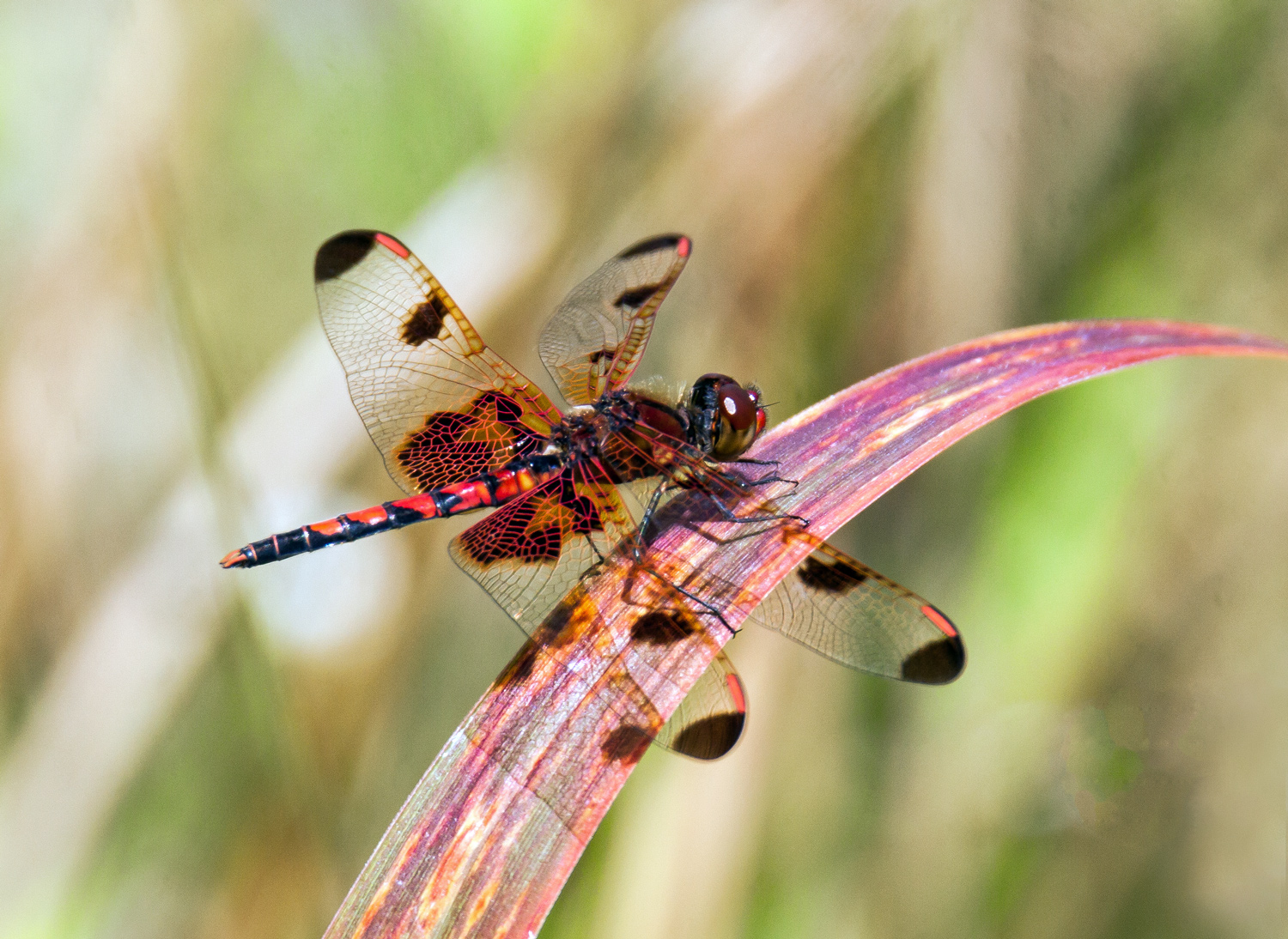
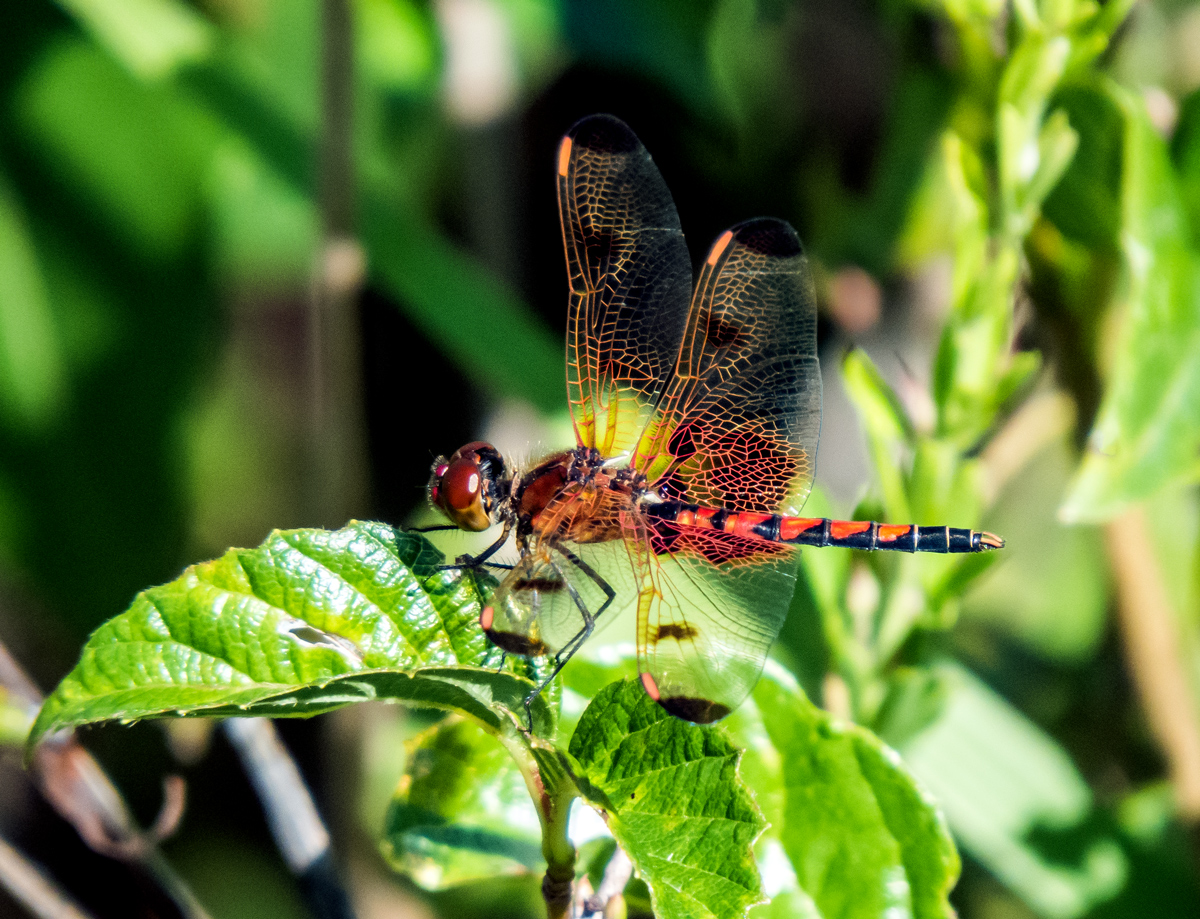
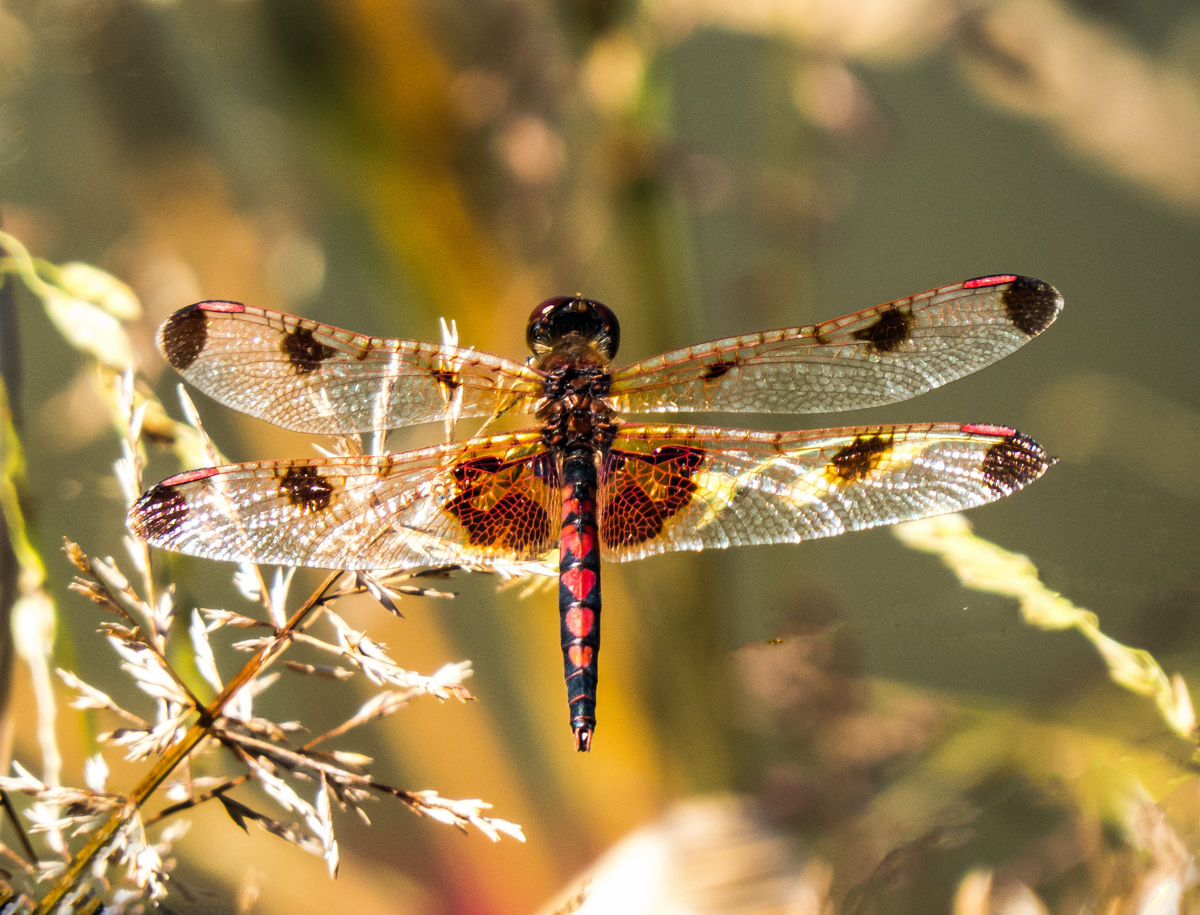
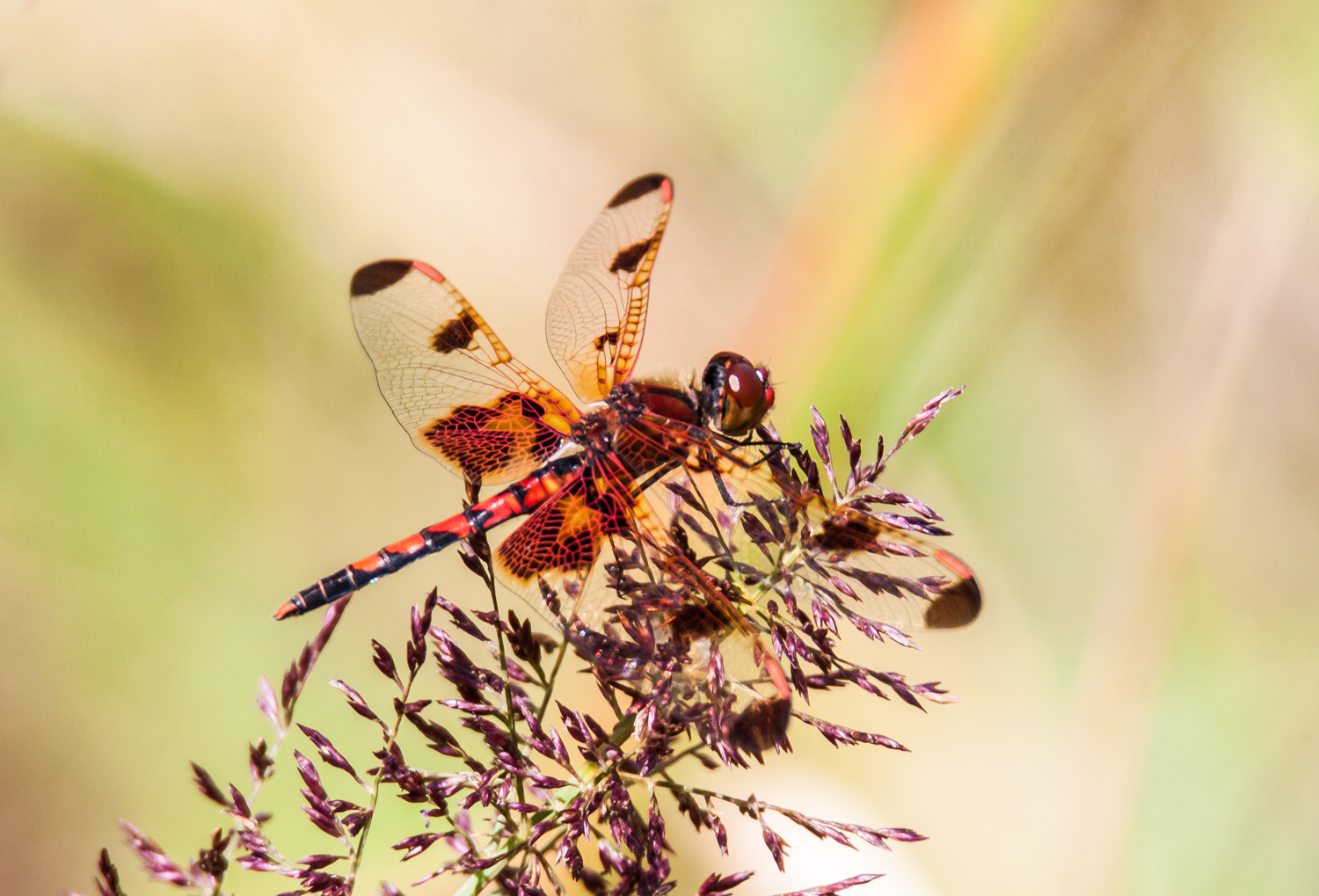
I was a bit shocked on Monday to see some other small red dragonflies—at least three male Calico Pennant dragonflies (Celithemis elisa) were active at a small pond at Occoquan Bay National Wildlife Refuge. Calico Pennants are generally a summer species and I have featured them a couple of times earlier this year in this blog. According to the Dragonflies of Northern Virginia website, their peak flight time is June to July and their late date is 23 September (I saw the one below on 2 October).

There are still other active dragonflies, but over time their numbers will continue to drop. Autumn Meadowhawks, though, usually stay with us into December and, if I remember correctly, occasionally even into January. I’ll be continuing my October hunt for red dragonflies into November and beyond.

Calico Pennant

Calico Pennant on 2 October at Occoquan Bay National Wildlife Refuge


Blue-faced Meadowhawk

Blue-faced Meadowhawk at Occoquan Bay National Wildlife Refuge


Autumn Meadowhawk

Autumn Meadowhawk at Occoquan Bay National Wildlife Refuge

© Michael Q. Powell. All rights reserved.

Read Full Post »

As we move inexorably deeper into autumn, more and more flowers and leaves are fading and falling. Many of the familiar dragonflies of the summer also are disappearing. I was heartened yesterday at Occoquan Bay National Wildlife Refuge to spot this Fine-lined Emerald dragonfly (Somatochlora filosa), a survivor that is tattered and torn, but is still flying in October.

I mentioned in a recent blog posting that I am experimenting with carrying two cameras with me when I go out shooting. The first photo was shot with my Canon SX50, a super-zoom camera and the second was taken with my Canon 50D DSLR. The depth of field is so shallow with the DSLR, normally shooting close to the 600mm end of my zoom lens, that it seems more ideal for shots like the second image where the subject is flatter. The SX50 gives me more depth of field and I love the way that it allowed me to capture the background as circles of color.

Fine-lined Emerald

Fine-lined Emerald

© Michael Q. Powell. All rights reserved.

Read Full Post »

This Black Saddlebags dragonfly (Tramea lacerata) chose a beautiful perch and posed briefly for a couple of autumn portraits on Friday at Occoquan Bay National Wildlife Refuge. Black Saddlebags usually spend a lot of time soaring high in the air, so it is a special joy for me when one lands and I am able to get some decent shots. I have never before managed to get a good look at their eyes and absolutely love the two-toned color combination.

black saddlebags

black saddlebags

© Michael Q. Powell. All rights reserved.

Read Full Post »

I am becoming convinced that dragonflies are rulebreakers. Yesterday I noted that dragonflies do not always follow the rules and can sometimes be found in habitats where they are not supposed to be. Apparently they also do not know how to follow a calendar and can sometimes be found earlier or later than the rules and records indicate they will be present.

This past Monday I was back at Occoquan Bay National Wildlife Refuge, searching again for the rare Fine-lined Emerald dragonflies that I had seen there previously. When I saw a dragonfly with bright green eyes perch in a distant tree, I naturally assumed that it was a Fine-lined Emerald. It is getting to be late in the dragonfly season, so many other species are no longer present. The dragonfly never got any closer, so I had to be content with my long-distance shots.

When I pulled up the images on my computer, something didn’t look quite right. The shape of the body seemed a little different from the Fine-lined Emeralds that I had seen previously and the tips of the abdomen (the “terminal appendages”) also looked different. I consulted with some dragonfly experts and they identified the dragonfly to me as a Mocha Emerald dragonfly (Somatochlora linearis). I have seen this species before, but in a totally different environment and much earlier in the year, so I had mentally removed it from consideration.

Now I don’t feel too bad about missing the identification, because the two species are part of the same genus Somatochlora, also known as Striped Emeralds. The website Dragonflies of Northern Virginia indicates that the flight records for the Mocha Emerald are from 16 June to 16 September—I guess that window can now be extended a little.

I am including two photos of the Mocha Emerald that may look almost identical, but were shot with two very different cameras. The settings for the cameras were almost the same with an aperture of f/7.1 and a shutter speed of around 1/400 of a second and both were handheld. The first shot was with my Canon 50D DSLR and Tamron 150-600mm lens. Taking into account the crop factor of the camera, the field of view was equivalent to 960mm. The second shot was with my Canon SX50 with a field of view that was equivalent to 1200mm.

The DSLR was a lot heavier and a lot more expensive, but produced a more out-of-focus background. The Canon SX50 was cheaper, lighter, and brought me in closer to the subject. It’s clear to me that equipment did not make a huge difference in this case and that there are advantages and disadvantages to each system. I am increasingly drawn to the idea of carrying both with me for the moment and continuing to experiment with them.

The other big lesson that I continue to learn is to expect the unexpected. As I am discovering, subjects may pop up in places and at times when you least expect them.

Mocha Emerald

Mocha Emerald

© Michael Q. Powell. All rights reserved.

Read Full Post »

For the last couple of weeks I have been chasing male Fine-lined Emerald dragonflies (Somatochlora filosa) around Occoquan Bay National Wildlife Refuge in Northern Virginia in a series of patrolling and perching encounters. One day this past weekend a couple flew by me in wheel position, i.e. they were locked together in a mating position and were still able to fly. I was able to get a few shots of them when they landed nearby. Eventually they changed positions and hung together in tandem. Unfortunately I lost sight of them for a second and I didn’t see them actually fly away

Readers of this blog have seen multiple shots of mating dragonflies, but this was a really special encounter for me. Why? This species of dragonflies is pretty rare, both locally and nationally. As Kevin Munroe described it on his wonderful Dragonflies of Northern Virginia website, “One of Northern Virginia’s most rare dragonflies, possibly our rarest, this species is seldom seen and little known throughout its range, from New Jersey to Florida, and west to Kentucky and Texas. Most field guides describe its breeding habitat as “unknown”.” It is reassuring to see this species breeding in our area, so there is a chance I will see them again next year and in the future.

In the section of his website dealing with the Fine-lined Emerald, Kevin included a photo from 2012 of a pair of these dragonflies mating with a caption that indicated it was “the only record of this species breeding in N VA.” I don’t know if others have captured images of mating Fine-lined Emeralds more recently, but it is cool to realize that I am part of a really small group of folks who have documented this behavior.

Early this week I went back to the same area, hoping to find another mating pair, but was unsuccessful. I’d like to be able to learn how and where the females lay their eggs. I was told by one dragonfly expert on a Facebook forum that egg-laying behavior for this species has been observed and documented only once. I tend to think of myself as more of an artist than a scientist. I am, however, motivated by an almost overwhelming sense of curiosity that pushes me outdoors more and more frequently with my camera, striving and hoping to capture more interesting subjects and situations that I can share with others. Who knows, maybe I will be able to find out where female Fine-lined Emeralds hang out and deposit their eggs.

Fine-lined Emerald

Fine-lined Emerald dragonflies in wheel position


Fine-lined Emerald

Fine-lined Emerald dragonflies in tandem position

© Michael Q. Powell. All rights reserved.

Read Full Post »

It is often said that springtime is a time for love, but so apparently is autumn, especially if you are a Blue-faced Meadowhawk dragonfly (Sympetrum ambiguum). This species appears most often during the latter part of the summer and in early autumn, so springtime is not really an option for them.

I spotted this couple in flagrante delicto during a recent trip to Huntley Meadows Park. It is hard to get a real sense of scale from this photo, so you will have to trust me that these brightly-colored dragonflies are really small, about an inch and a half in length (38 mm).

Blue-faced Meadowhawk

© Michael Q. Powell. All rights reserved.

Read Full Post »

On Monday at Occoquan Bay National Wildlife Refuge I was thrilled to spend some time hanging out with this Common Green Darner dragonfly (Anax junius). The range of colors on its body is so remarkable that I almost couldn’t believe my eyes when I zoomed in on it. An expert in a dragonfly forum on Facebook noted to me that the dragonfly is a teneral one, which means that it has only newly emerged. That would account for its relatively pale, almost pastel coloration and the perfect condition of its wings. If you click on the image, you can see even better some of the remarkable details of this dragonfly, like the colorful pattern on its “nose.”

The beautiful dragonfly was hanging vertically only a few inches above the ground, in a pretty safe location. I kept my distance as I took some photos and departed quietly, conscious of the fact that a dragonfly is fragile and vulnerable at this early stage of development. It remained in place as I slowly slipped away.

Green Darner

© Michael Q. Powell. All rights reserved.
Read Full Post »

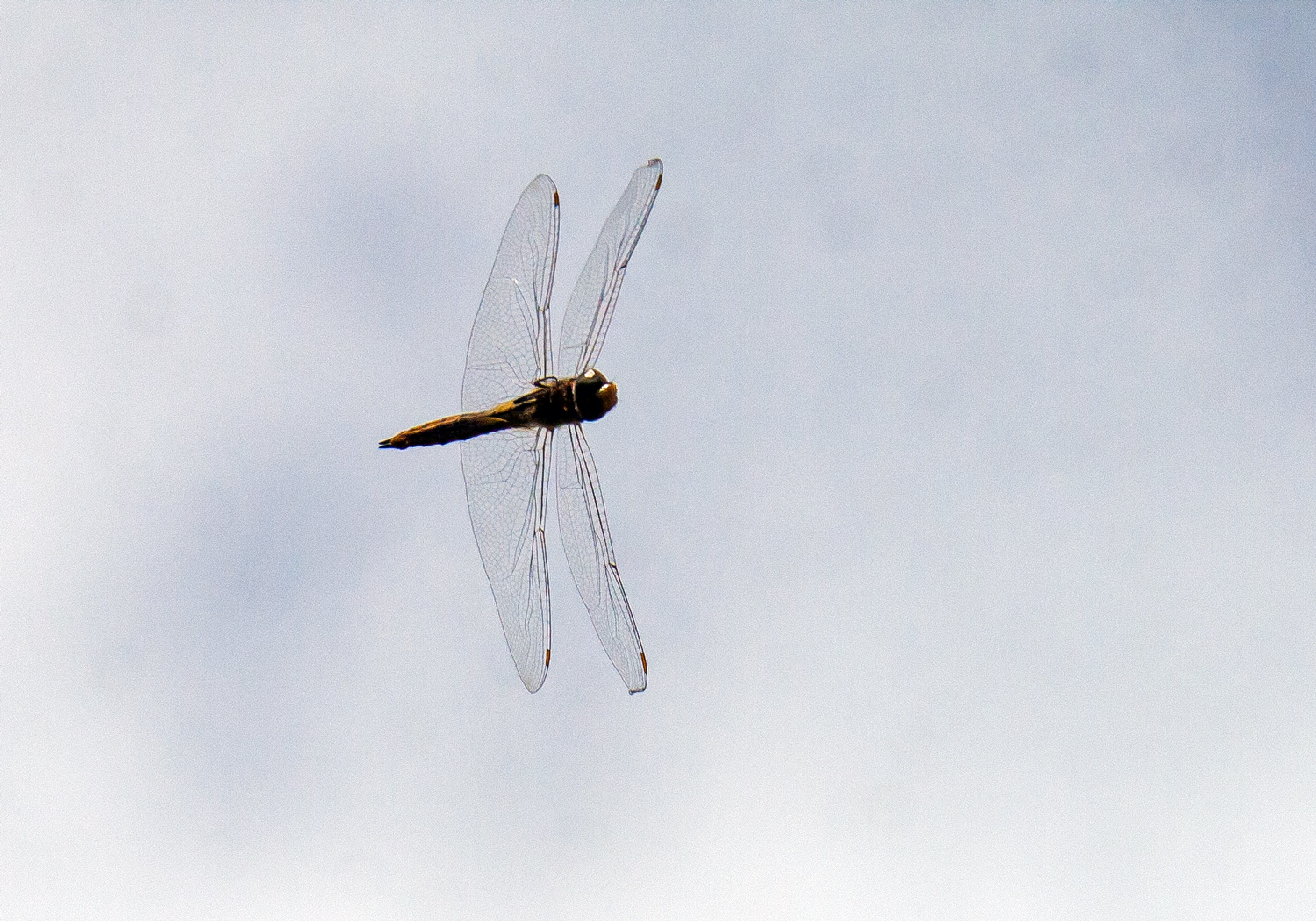
When I first saw this dragonfly land yesterday at Occoquan Bay National Wildlife Refuge, I had no idea what it was. Zooming in, I was shocked to see that it was a Wandering Glider (Pantala flavescens), a migratory species that almost never perches.

The Wandering Glider is considered to be the most widespread dragonfly in the world, found on every continent except Antarctica. According to odonatacentral.com, “It is a strong flier that is regularly encountered by ocean freighters and a well-known migratory species. Because of its ability to drift with the wind, feeding on aerial plankton, until it finally encounters a rain pool in which it breeds, it has been called “…the world’s most evolved dragonfly.” ”

After I got the initial shots of the dragonfly on two different perches, I decided to follow the dragonfly and wait for it to perch again. It wandered about through the air over my head for an extended period of time and never again came down to land. The last photo gives you an idea of my view during that period of waiting—note the long wings that help it to fly such long distances.

Wandering Glider

Wandering Glider

Wandering Glider

© Michael Q. Powell. All rights reserved

Read Full Post »

I was really happy to spot a couple of male Calico Pennant dragonflies (Celithemis elisa) during a visit today to Occoquan Bay National Wildlife Refuge in Woodbridge, Virginia. The weather was pretty cool when I set out early this morning, about 56 degrees (13 degrees C), so I was not certain that I would be able to find many dragonflies. Fortunately for me it warmed up a bit and a few dragonflies appeared.

The bright red color of this dragonfly helps a little in finding them, but Calico Pennants are pretty small and it is easy to lose them in the vegetation. I shot the first two shots with my Canon 50D DSLR and Tamron 150-600mm telephoto zoom lens and the third one with my Canon SX50 super zoom camera. The poses are not identical, but I think that you can see how much shallower the depth of field is when using the DSLR than the point-and-and-shoot—I think it is related to the difference in the size of the sensors in the cameras.

Calico Pennant

Calico Pennant

Calico Pennant

© Michael Q. Powell. All rights reserved


Read Full Post »

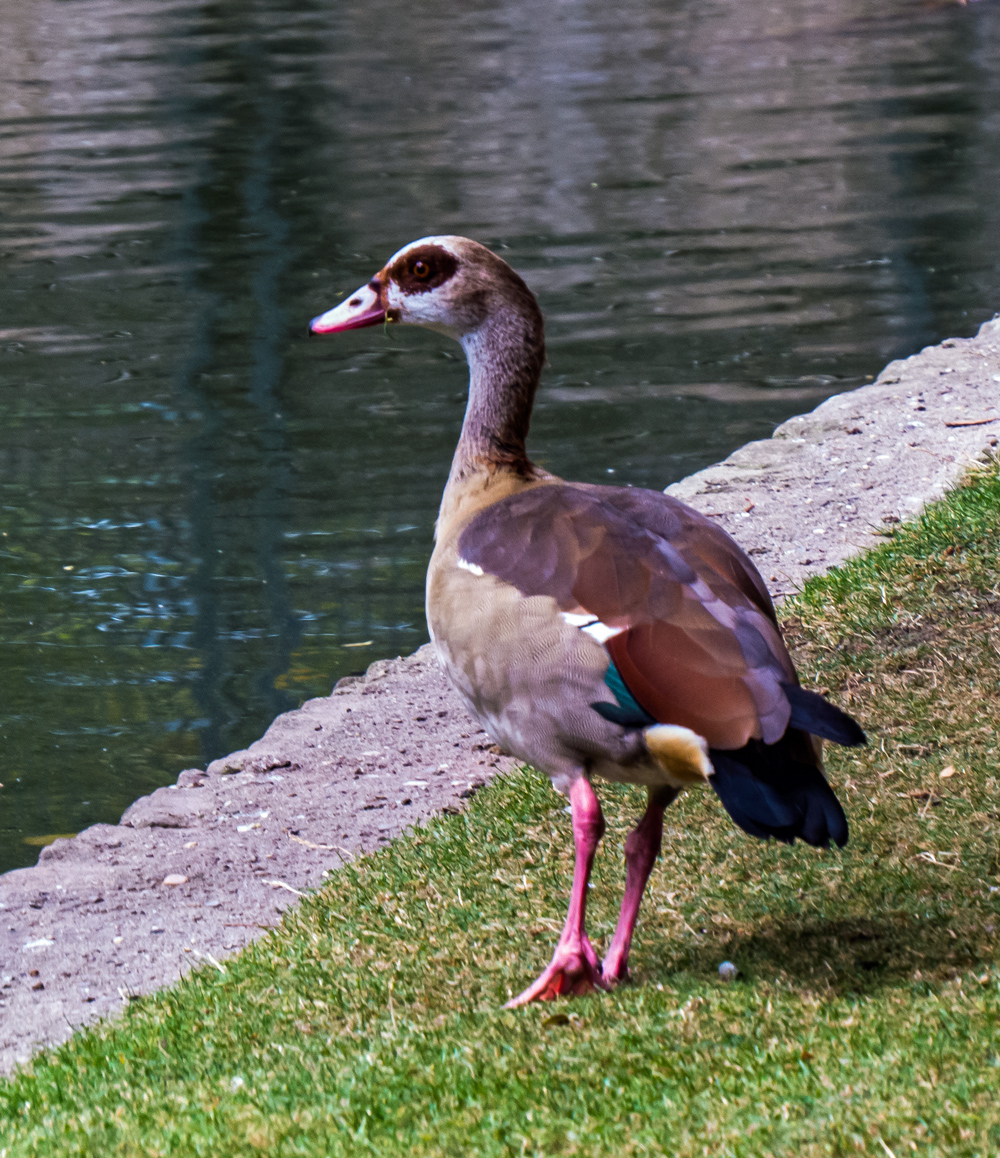
When I spotted this odd-looking bird yesterday at the Botanical Garden in Brussels, I couldn’t make my mind up if it was a duck or a goose. It seemed too big to be a duck, but its markings seemed too colorful for a goose.

After a lot of searching on the internet, I have concluded this is probably an Egyptian Goose (Alopochen aegyptiaca). As its name suggests, this species is native to Africa south of the Sahara and the Nile Valley and is an introduced species in Europe, according to Wikipedia. There are in excess of 250 breeding pairs in Belgium, primarily around Brussels and the Flanders area, according to a posting on birdforum.net.

This bird did not hang around for very long, so I did not have a chance to see if, as The Bangles famously sang, it walked like an Egyptian (https://www.youtube.com/watch?v=Cv6tuzHUuuk).

Egyptian Goose

Egyptian Goose

Egyptian Goose

© Michael Q. Powell. All rights reserved

Read Full Post »

Initially I did a double take when I saw the sign for a restaurant in Brussels called O’Tacos and I figured it was some kind of Irish-Mexican fusion cuisine. I almost burst out laughing, however, when I read the words, “Original French Tacos.” French tacos? Who knew?

I did some further investigation when I returned to my hotel and found out that O’Tacos is a chain that is now worldwide. OK, but what exactly is a French taco? A review on foodrepublic.com described it in these words—”Less like a taco and more like a pressed San Diego-style burrito, the French taco is stuffed with fries, a white creamy cheese sauce, a protein (choices include grilled chicken breast, nuggets, tenders, ground beef or sausage), an additional sauce (mustard, Tabasco, ketchup, mayonnaise, barbecue) and other ingredients (cheese, mushrooms, grilled veggies, an egg, bacon, ham and more) all wrapped up in a flour tortilla.”

original French tacos

© Michael Q. Powell. All rights reserved

Read Full Post »

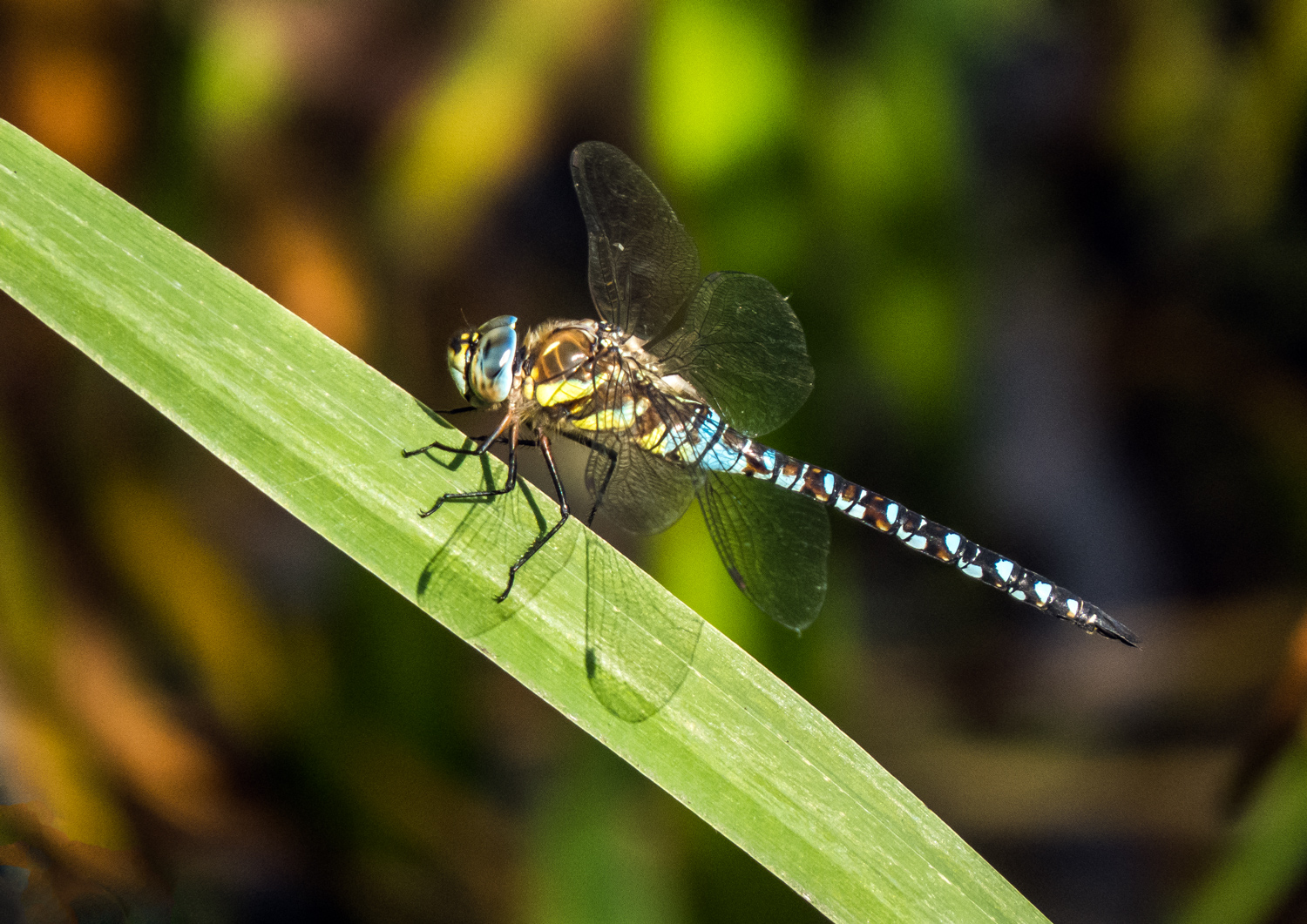
The most colorful dragonfly that I have spotted in Brussels during this trip has been a spectacular male Migrant Hawker dragonfly (Aeshna mixta) that was flying patrols over a small pond at the botanical garden.  It spent a lot of time in the air, but occasionally would perch for a short while. Every now it then it would hover over the water, which let me capture the second shot of the dragonfly in flight. My Canon SX50 is a little slow in acquiring focus, so I didn’t think that I would be able to capture any action shots of the dragonfly. However, I kept trying and eventually was able to get a reasonably sharp shot. When I checked out the shooting data for the image, I realized that the shutter speed had dropped to 1/100 second because of the dark water, so it’s almost a miracle that I stopped the action at all—I was shooting in aperture priority mode and was letting the camera choose the shutter speed.

Migrant Hawker

Migrant Hawker

 © Michael Q. Powell. All rights reserved

Read Full Post »

When I spotted a red dragonfly in flight while exploring the botanical garden in Brussels, I immediately gave chase. Unfortunately the dragonfly chose to perch on a weathered wooden fence a good distance away. Unable to get any closer to the dragonfly, I did my best to incorporate the fence into the composition.

I kept looking later in the day for the elusive red dragonfly, which looks a little like the Autumn Meadowhawk dragonfly that I see in my home area, but I never saw it again.

dragonfly in Brussels

dragonfly in Brussels


© Michael Q. Powell. All rights reserved

Read Full Post »

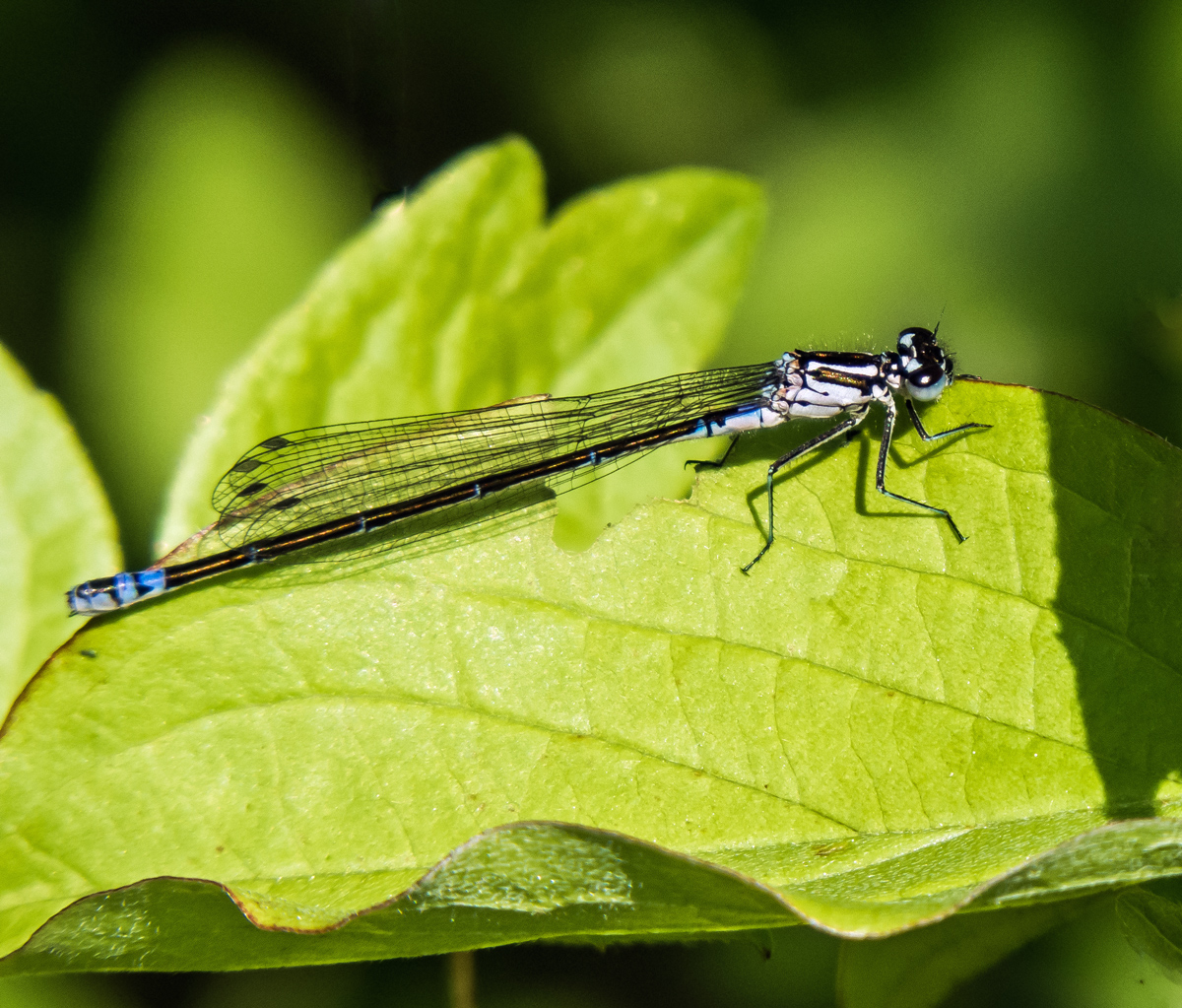
Over the last few years it has become traditional for me to be in Brussels over Labor Day weekend in early September for meetings. After I arrived today, I had some free time and captured these images of damselflies in the Botanical Gardens. Some of them are quite similar to those that I see at home, while others appear to be a bit different. As is often the case when I am traveling for work, I left my big camera at home and took these shots with my Canon SX50 HS superzoom camera.

damselfly in Brussels

damselfly in Brussels

mating damselflies in Brussels

© Michael Q. Powell. All rights reserved

Read Full Post »

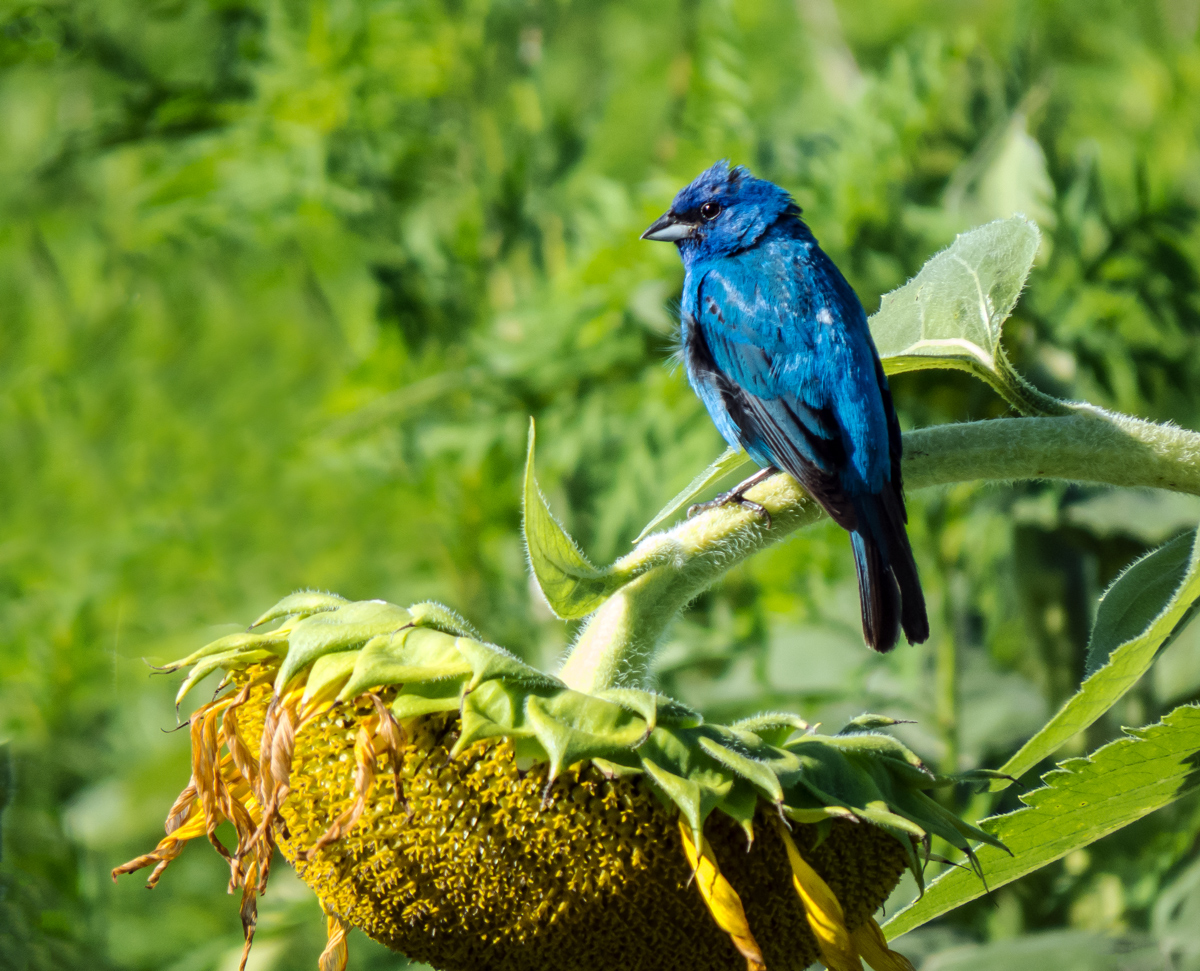
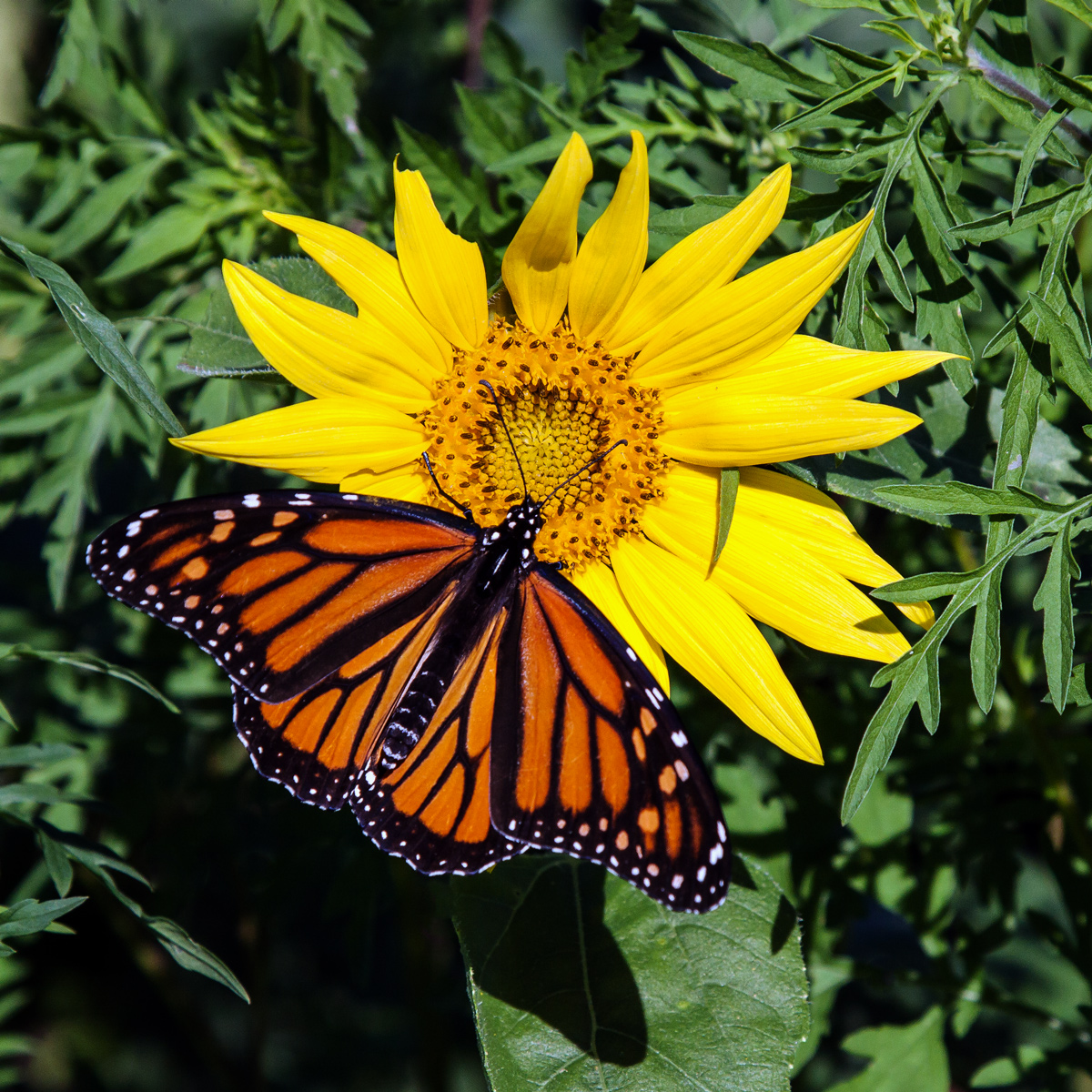
In the first sunflower field that we visited yesterday morning at McKee-Beshers Wildlife Management Area, many of the sunflowers were drooping because of the weight of their seeds. They may not have been very photogenic, but the birds and butterflies seemed to love them, like this Indigo Bunting (Passerina cyanea) and this Monarch butterfly (Danaus plexippus) that I spotted among the sunflowers.

Several photographer friends and I made the trip to the sunflower fields in Poolesville, Maryland, hoping to see endless rows of tall sunflowers. According to its website, McKee-Beshers has 30 acres of sunflowers planted in nine different fields. I think that the sunflowers may have been a little past their prime and appeared to be a little stunted in size, compared to some past years.

It was tricky to figure out what kind of gear to bring on a trek like this. I ended up using my super zoom Canon SX50 to photograph the Indigo Bunting, which was a first sighting for me of this beautiful bird, and my Canon 24-105mm lens on my normal Canon 50D DSLR for the butterfly. I had both of the cameras with me at all times, which gave me a pretty good amount of flexibility. I’ve seen some photographers walk around with two DSLR bodies, but that seems like a lot of weight to carry around, especially when you are moving through vegetation as I was doing as I waded through the rows of sunflowers.

I did take shot shots of the sunflowers  and I’ll post some of them eventually. Folks who know me, though, are probably not surprised that my first instinct was to post images of birds and butterflies, rather than ones of the flowers alone.

Indigo Bunting

Monarch butterfly

© Michael Q. Powell. All rights reserved

Read Full Post »

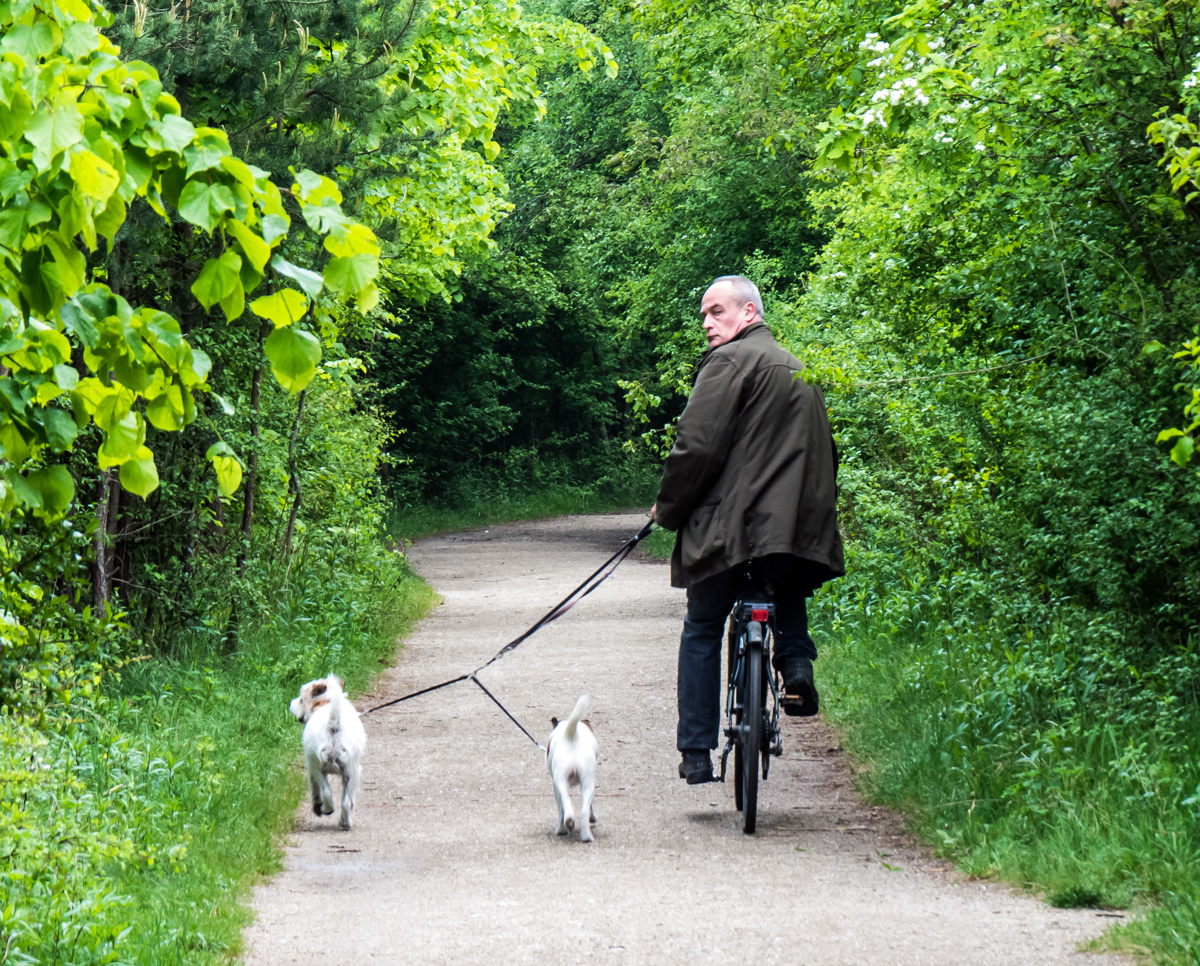
Walking two dogs simultaneously while riding a bicycle? I am not sure that I would try it, but this man in Vienna was somewhat successful in doing so.

dog walking in Vienna

© Michael Q. Powell. All rights reserved

Read Full Post »

I was hoping that I would be in Vienna at the right time of the year to see baby swans, but I guess my trip brought me here a bit too early. At the lake at Donau-Auen National Park, I could see one Mute Swan (Cygnus olor) swimming around and wondered if it was alone. When I walked further around the lake, I spotted what appears to be its mate, partially hidden by the vegetation, sitting on a nest.

Mute Swan

Mute Swan

Mute Swan

Mute Swan

© Michael Q. Powell. All rights reserved

Read Full Post »

As I wandered through the Donau-Auen National Park in Vienna, Austria this past weekend I did not see any large butterflies, but I did spend quite some time chasing several smaller ones.  The butterfly species appear to be somewhat similar to the ones that I see in Northern Virginia, but not identical, as was the case with the damselflies that I featured yesterday.

butterfly in Vienna

butterfly in Vienna

butterfly in Vienna

© Michael Q. Powell. All rights reserved

Read Full Post »

Nature photographers are a peculiar breed of people. How else could I explain why I headed off to the Donau-Auen National Park within hours of my arrival in Vienna, Austria. I am staying in the center of the city, virtually surrounded by historic buildings and monuments, yet I feel more drawn to explore nature than history.

Saturday was a warm, sunny day and I was hoping to encounter dragonflies as I explored some of the areas of the park that I have visited before. It may be a little early in the season or that I was simply not lucky, but in any case I did not encounter a single dragonfly. I was, however, quite fortunate and saw quite a few damselflies. These beautiful little creatures are tiny and elusive and like to hide perch on vegetation, so it is often challenging to get clear shots of them.

I was shooting with my Canon SX50, a superzoom point-and-shoot, which helped me sometimes to get shots without scaring off the damselflies. In some cases, though, it was really tough to get the camera’s focus to lock onto the target.

The shapes and colors of the damselflies are somewhat familiar and may be related to the species that I see at home, but I am not even going to try to identify them. I hope that you can enjoy the delicate beauty of these damselflies that I encountered during my most recent adventures in the national park here in Vienna.

damselfly in Vienna


damselfly in Vienna


damselfly in Vienna

damselfly in Vienna

© Michael Q. Powell. All rights reserved

Read Full Post »

I’d never before seen river barges, so it was pretty cool to watch these ones moving along the Ohio River in Wheeling, West Virginia during my brief trip there last month. I never realized that barges are pushed from behind rather than pulled from the front. How in the world are they able to steer?

barges

© Michael Q. Powell. All rights reserved.

Read Full Post »

During my recent trip to Wheeling, West Virginia, I repeatedly encountered symbols of the town’s glorious past. Trains no longer run to the historic Baltimore and Ohio train station. The beautiful building has now been converted for use by West Virginia Northern Community College.

B&O Railroad

A prominent sign indicates the availability of the buildings of Marsh Wheeling Stogies. Could this possibly be a reference to cigars? As I did a little research, I learned that Mifflin M. Marsh began producing cigars in Wheeling in 1840. His cheap cigars were favored by the drivers of the Conestoga wagons that carried pioneers West and “stogies” are a shortened version of the wagon’s name. According to the website Archiving Wheeling, in 1877 almost 24 million cigars were sold in Wheeling. In 2001, the plant was closed after Marsh Wheeling was bought by National Cigar.

Marsh Wheeling Stogies

I suppose that Verizon now owns the Bell Telephone building in Wheeling, but Verizon is definitely not know for having buildings as interesting and beautiful as this one.

Bell Telephone

© Michael Q. Powell. All rights reserved.

Read Full Post »

This past Thursday I made a quick trip to Wheeling, West Virginia and fell in love with the signs that had been painted long ago on the sides of some of the brick buildings in the downtown area. Here are a few of my favorite ones.

Wheeling

Wheeling

Wheeling

© Michael Q. Powell. All rights reserved.

Read Full Post »

My short trip to Vienna, Austria is rapidly coming to a close and I want to leave you with this image of the entrance to the outdoor Christmas market at the Rathaus (City Hall), the tall building in the background.

Best wishes to all for a “Frohe Weihnachten,” German for “Merry Christmas.”

Christmas 2016

© Michael Q. Powell. All rights reserved.

Read Full Post »

Nighttime in Vienna, Austria is incredible—there are so many beautiful buildings that are wonderfully illuminated. Capturing their beauty while hand holding my superzoom Canon SX50 is a bit of a challenge, but I try to stabilize myself by leaning against various poles, buildings, and other stationary objects.

This shot of a clock tower in one of the inner courtyards of the Hofburg Palace is my favorite image from yesterday evening while I was wandering around the city.

clock tower in Vienna, Austria

© Michael Q. Powell. All rights reserved.

Read Full Post »

It was not quite as elaborate as Tchaikovsky, but the Mute Swans (Cygnus olor) at the small lake at the Donau-Auen National Park in Vienna, Austria performed their own form of water ballet this past weekend. Here are a couple of shots of the acrobatic moves of one of the swans and an overall view of the “Swan Lake.”

Mute Swan

Mute Swan

Swan Lake

© Michael Q. Powell. All rights reserved.

Read Full Post »

Today I had some free time to wander about in the Donau-Auen National Park in Vienna, Austria.I am visiting Vienna for a few days on a business trip and decided that I did not want to fight the crowds at the numerous Christmas markets in the city.

It was cool and windy and I did not see as much wildlife as I did during a visit there last April. However I did manage to spot a family of Mute Swans (Cygnus olor). Two of them—one adult and one adolescent—landed on ice that had formed on the small lake and they struggled to walk across the slippery surface to reach open water. The adult, who was bright white in color, moved with much more confidence than the dusky-colored youngster, who moved in a cautious and tentative way. I suspect that it was the first time that the young swan had encountered ice.

Mute Swan

Mute Swan

Mute Swan

Mute Swans

© Michael Q. Powell. All rights reserved.


Read Full Post »

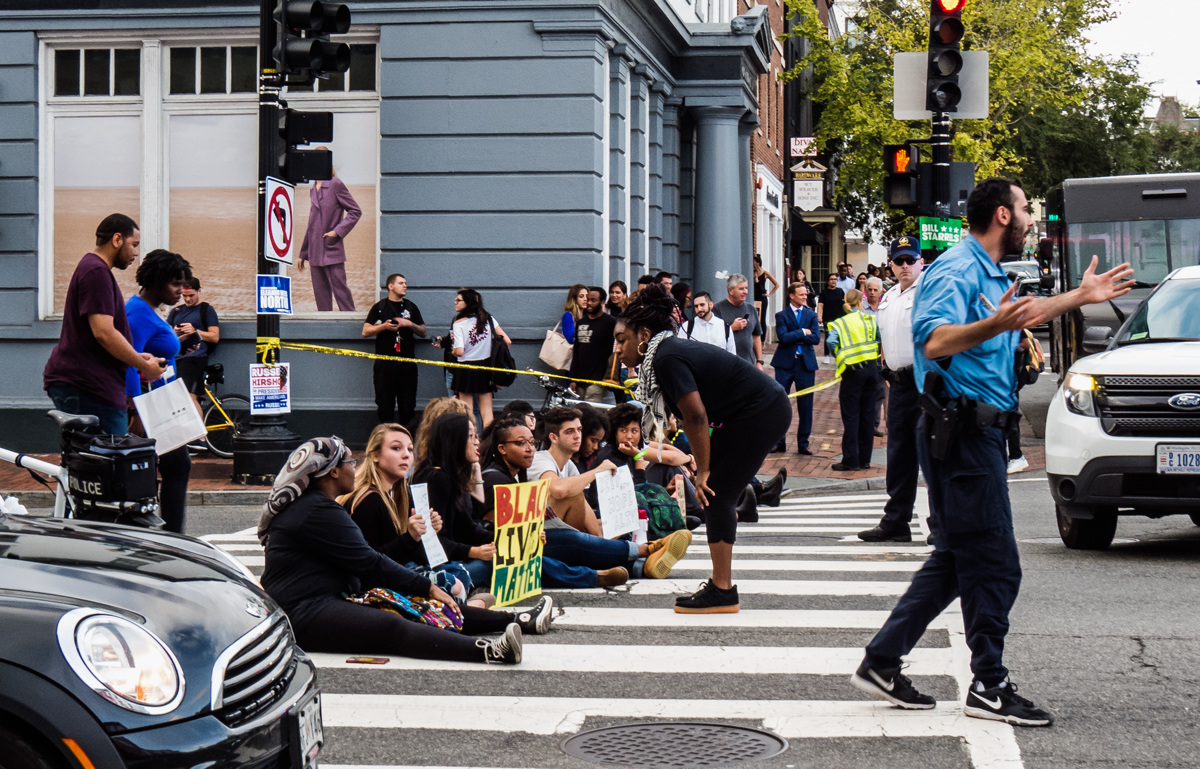
Last Friday about 5:30 pm I was in the Georgetown area of Washington D.C. right at the time when a small group of protesters caused M Street to be closed by sitting in middle of the lane heading toward Key Bridge, one of only a few bridges linking the capital city with Virginia. Here are a few shots of the protesters and the police.

Readers who follow my blog know that I am not used to this kind of photography and I wasn’t really sure how to approach the subject. Roads and intersections were blocked off with yellow tape, preventing me from getting good angles for the shots. It was a small group of protesters and they looked to be of college age, prompting me to wonder if they were from nearby Georgetown University. All varieties of policemen were present to control the crowd and direct traffic onto side streets—there were bicycle cops and motorcycle cops in addition to the expected police squad cars.

I was happy that I happened to have my Canon SX50 superzoom with me, because the zoomed allowed me to frame some shots differently without having to move around a lot. In the end I chose three shots to post that captured different aspects of protest, mostly focusing on the human element.

Protest in Georgetown

Protest in Georgetown

Protest in Georgetown

© Michael Q. Powell. All rights reserved.
Read Full Post »

This spooky spider image that I took late Friday afternoon while hiking along part the Potomac Heritage Trail is probably more suitable for later in the month, but I just couldn’t wait until Halloween to share it.

Normally when I use fill flash I try to be subtle, attempting to add a little pop without making it obvious that I used flash. In this case, you can’t help but notice my use of the popup flash. Normally I would take a shot of a spider like this with my macro lens, but I was travelling light with just my superzoom Canon SX50. The 50x zoom of this camera has helped to bring distant subjects closer, but I had never tried to use the camera’s macro mode. I quickly learned that you have to be really close to your subject, literally only a few inches away. I was pretty happy when I was able to get the second shot below, but wanted to add to the drama of the shot.

I dropped the exposure compensation in the camera down to a minus three stops and got my favorite shot. The darkened sky and the way that the flash illuminates the spider give the image a kind of creepy look that feels appropriate for a spider that was just about at eye level.

spooky spider

spooky spider

© Michael Q. Powell. All rights reserved.
Read Full Post »

Late Saturday afternoon I was exploring Cook Lake, a tiny urban fishing lake adjacent to a water park in Alexandria, Virginia. I accidently spooked a Great Blue Heron (Ardea herodias) that flew to a fallen tree on the shore. The lighting was beautiful and the heron struck a pose that I can only describe as heroic.

I never get tired of photographing Great Blue Herons.

Great Blue Heron

© Michael Q. Powell. All rights reserved

Read Full Post »

I have always been fascinated with frogs. As a child, I remember my amazement at seeing photos of colorful tropical frogs in National Geographic, especially the green tree frogs with big red eyes.  Growing older, I loved Kermit the Frog, especially his quirky sense of humor and his propensity for bursting out in song. Even now, one of my all-time favorite movie scenes is from the beginning of The Muppet Movie, where the view begins high above the trees and gradually zooms in on Kermit, who is sitting on a log playing the banjo and singing The Rainbow Connection. I try to hold on to the innocent, wide-eyed optimism of that song.

As a photographer, I have list of aspirational shots, made up of images, subjects, and situations that I would love to photograph. For a long time, I longed to capture a photo of a frog perched on a lily pad. After numerous unsuccessful attempts, I managed to capture such an image a couple of years ago. Despite that “success” I still keep my eyes open for frogs whenever I am in an area with lily pads.

This past weekend I hit the jackpot when I spotted three frogs on a single lily pad. I was exploring a small lake at Ben Brennan Park, a small suburban park in Alexandria, Virginia with a variety of recreational facilities. There is a small elevated bridge over one section of the lake and it was from this vantage point that I was able to capture this image. Initially the three frogs were all facing outwards, looking like they were defending their pad from outside intruders. Just before I took this shot, however, the frog in the back turned toward the middle and looked like he was trying to sneak up on his buddy.

Perhaps he simply wanted to play a game of leapfrog.

leapfrog

© Michael Q. Powell. All rights reserved

Read Full Post »

« Newer Posts - Older Posts »