Feeds:
Posts
Comments

Posts Tagged ‘Canon 50D’

As I drove back yesterday from Georgia to Northern Virginia, an almost 800 mile drive (1287 km),  I stopped at a rest area on I-95 in North Carolina. Noting that there was a small man-made pond, I decided to investigate for odes and spotted this damselfly. One of the experts in the Southeaster Odes Facebook Group helped to identify this beauty as a female Fragile Forktail damselfly (Ischnura posita).

It’s a whole lot cooler in Northern Virginia than it was in Georgia and North Carolina, so I suspect that I will have to wait a month or two for damselflies and dragonflies to emerge here. With this sneak preview, I can hardly wait.

fragile forktail

© Michael Q. Powell. All rights reserved.

Read Full Post »

It’s still a bit early for dragonflies in Northern Virginia, but when temperatures soared to almost 80 degrees (27 degrees C) yesterday in Columbus, Georgia, I decided to see if I could find some here. I had a wonderful time exploring some of the area of the Oxbow Meadows Environmental Learning Center that is not far from Fort Benning, where I was staying.

I came up empty-handed for dragonflies, but did spot some beautiful little damselflies. Later in the spring, these will be fairly common, but after a long period with no odonates, they seem rare and exotic.

The first one looks like a Fragile Forktail damselfly (Ischnura posita), but I am not sure about the others. Several of them flew so weakly that I wondered if they had only recently emerged.

Fragile Forktail

damselfly

damselfly

damselfly

damselfly

© Michael Q. Powell. All rights reserved.

Read Full Post »

I couldn’t help but do a double take when I saw this sign at Fort Benning, Georgia. I was filled with visions of dogs on automatic conveyor belts being sprayed with soap and slapped with moving towels. Was hot wax an option for dogs?

I did a little checking and learned that the dog wash is a separate facility adjacent to the car wash. It is the first of its kind on a US military installation and includes a coin-operated, do-it-yourself, climate-controlled booth that offers washing, drying and flea and tick bathing options. The booth is then automatically sterilized after each use.

dog wash

© Michael Q. Powell. All rights reserved.


Read Full Post »

From a distance, it looks almost like they are drilling for oil in the center of Fort Benning, Georgia. Those towers, however, are not oil derricks, but are used for training soldiers who will become airborne-qualified. There are a series of towers of varying heights and as soldiers master their equipment and techniques, they are literally taken to greater heights.

In 1980 I was at Fort Benning for US Army Officer Candidate School (OCS), and I remember running on a track around those towers. During my Army career, I did not go through airborne training and I am happy to say that I have a perfect record—I have landed safely aboard every aircraft on which I have taken off.

I am currently at Fort Benning to celebrate my son’s graduation from OCS. Yesterday I had a chance to walk around the field on which the towers are located and to capture a variety of shots. Here are some of my favorites.

jump towers

jump tower

tower3_blog

jump tower

jump tower

jump tower

© Michael Q. Powell. All rights reserved.

Read Full Post »

This tiny chickadee was energetically digging into a cattail last week at Huntley Meadows Park. Although it is usually recommended not to photograph subjects mid-bite (at least human ones), I like the way this shot turned out of the industrious little bird.

Judging from the range maps, this is probably a Carolina Chickadee (Poecile carolinensis), although we sometimes also get Black-capped Chickadees (Poecile atricapillus). These two types of chickadees look quite similar and I am not yet skilled in distinguishing between them.

chickadee

© Michael Q. Powell. All rights reserved.

Read Full Post »

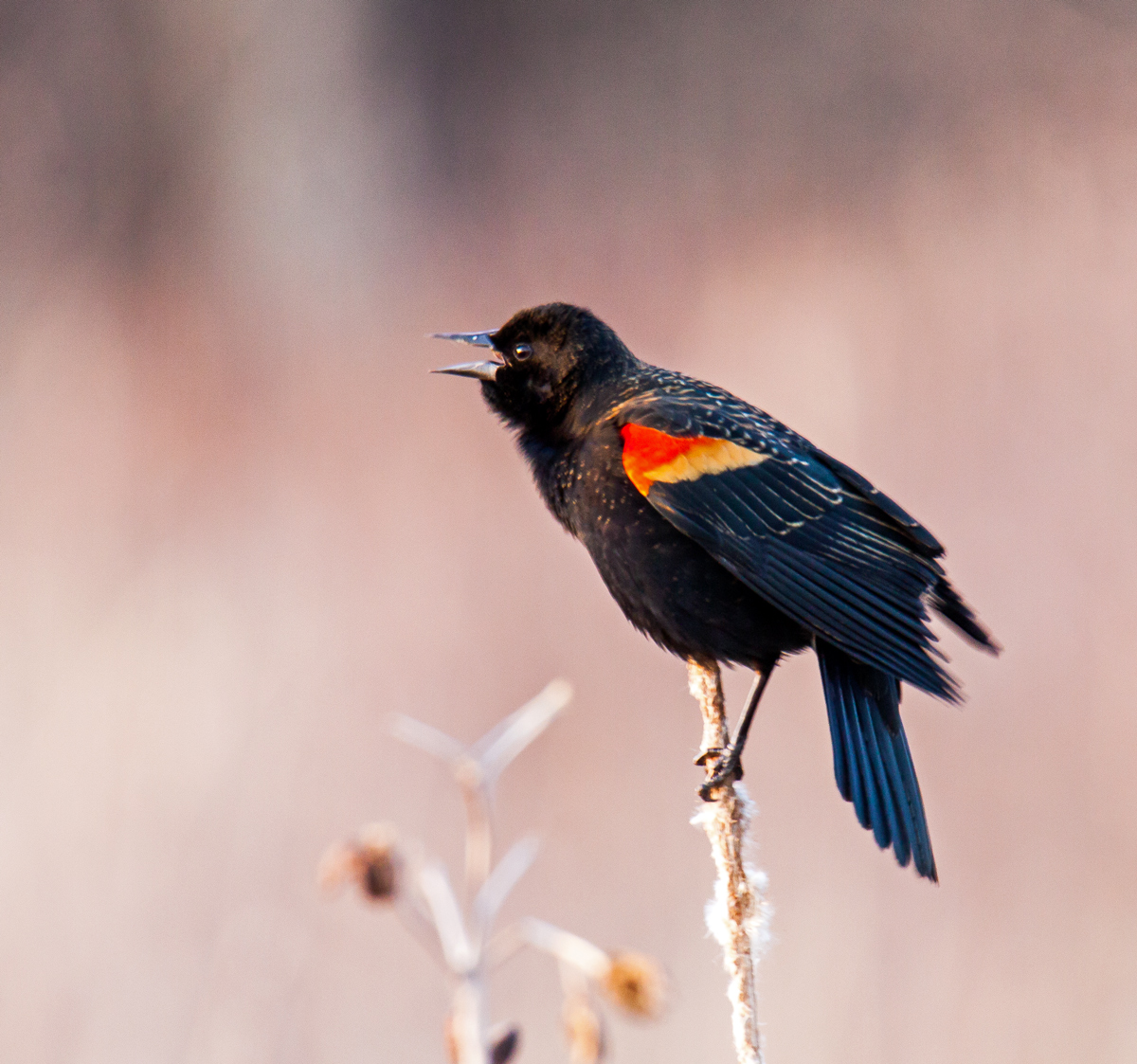
A large number of Red-winged Blackbirds (Agelaius phoeniceus) were in the trees and among the cattails yesterday afternoon at Huntley Meadows Park and their raucous calls resounded throughout the park. The males seemed to competing to see who could call out the loudest and longest, as if to say, “Can you hear me now?”

Red-winged Blackbird

Red-winged Blackbird

© Michael Q. Powell. All rights reserved.

Read Full Post »

It is hard to believe that there could possibly be any insects or other nourishment in the dried-up reeds and cattails, but this male Downy Woodpecker (Picoides pubescens) was feverishly pecking away this past Monday at Huntley Meadows Park. He was extremely focused and persistent—I hope that his efforts were eventually rewarded.

Downy Woodpecker

© Michael Q. Powell. All rights reserved.

Read Full Post »

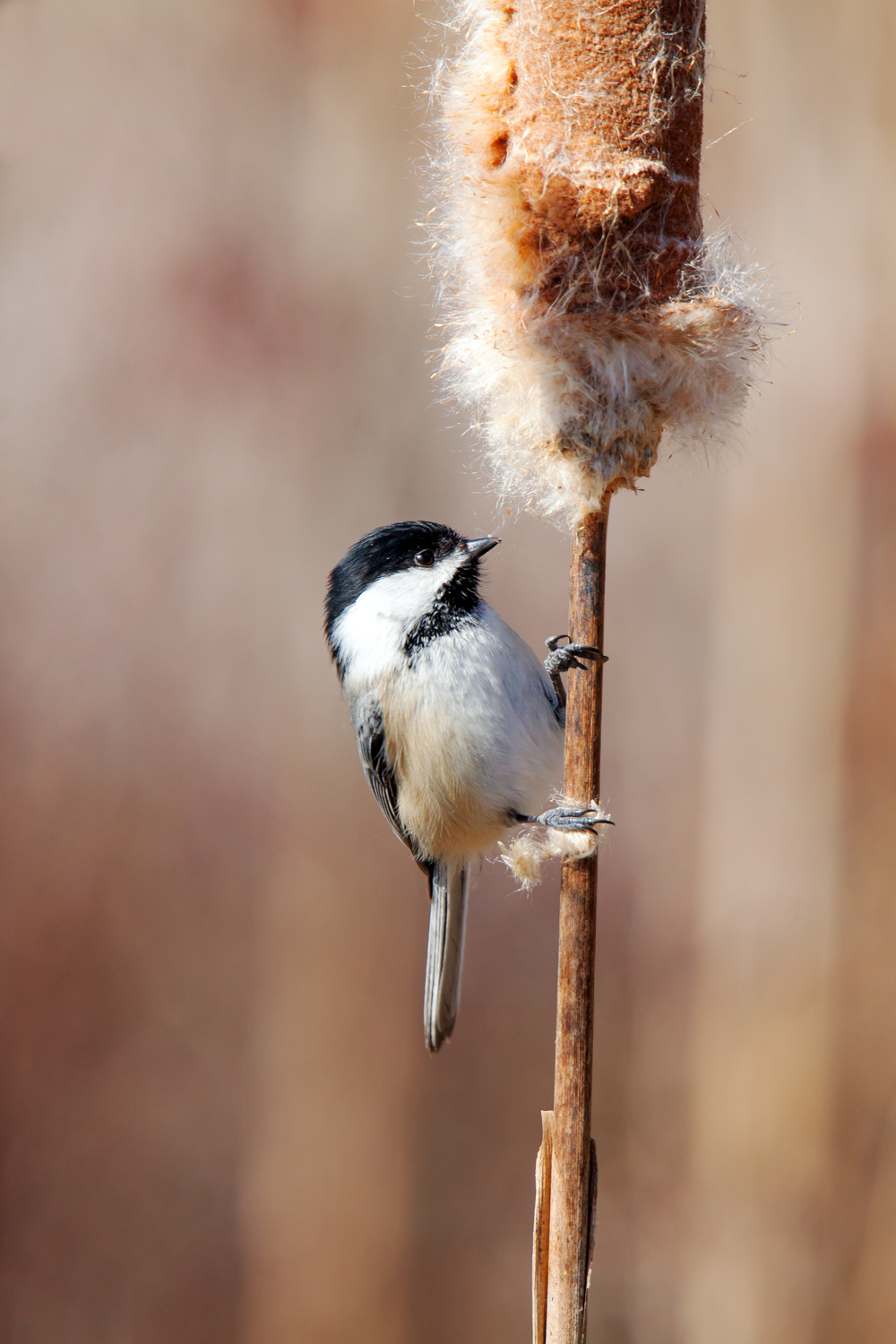
My little chickadee—spotted yesterday afternoon in the cattails at Huntley Meadows Park. In our area, most of the chickadees are Carolina Chickadees (Poecile carolinensis), but we do get some Black-capped Chickadees (Poecile atricapillus) too. The species are so similar that I am never completely sure which one I am looking at. This one, for example, looks like some of the images that I see of the Black-capped Chickadee.

When it came to presenting this image, I was a little bothered by the large amount of negative space on the left side. However, I really like the way that the image emphasizes the tallness of the cattail. The more I looked at the image, the more I grew to like the composition, so I ended up not cropping it at all.

chickadee

© Michael Q. Powell. All rights reserved.

Read Full Post »

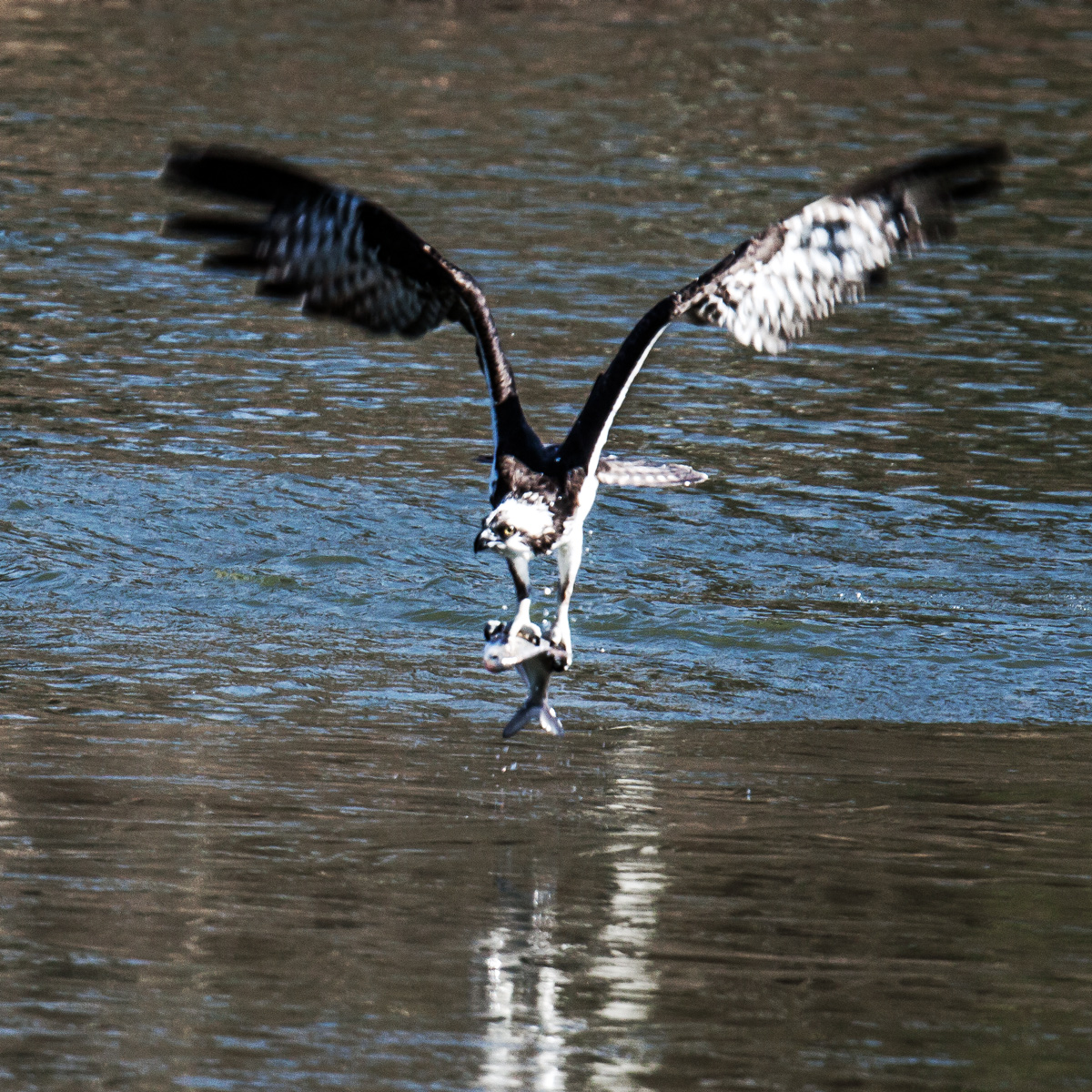
I was thrilled when I caught an Osprey (Pandion haliaetus) in action today at Lake Cook in Alexandria, Virginia. I had seen one there a little over a week ago, so I was somewhat ready when I saw one circling overhead this afternoon. It didn’t take long for the osprey to pull out a pretty good sized fish—I think the lake is stocked with trout, though I really don’t know fish well enough to know if that is the type of fish that the osprey caught.

Although I knew that the osprey would eventually dive for a fish, I was a little slow in reacting when it finally did. In particular, I had difficulty reacquiring focus after the big splash so images like the final image below are a bit soft in focus. I was fortunate that there was a lot of sunlight and I was able to get some sharper images when the osprey flew higher in the sky.

Osprey

Osprey

Osprey

© Michael Q. Powell. All rights reserved.

Read Full Post »

Recently I posted an image of a Pied-billed Grebe (Podilymbus podiceps) that prompted one reader to comment that the grebe looked like a “poorly drawn duck.” Now I’ll admit that the shape and proportions of a grebe are a bit unusual, but I was sure that with the right angle and lighting I could manage to take a beauty portrait of this little bird. I’m not sure that I succeeded fully, but I don’t feel at all uncomfortable characterizing the bird in this image as a “pretty grebe.”

Pied-billed Grebe

© Michael Q. Powell. All rights reserved.

Read Full Post »

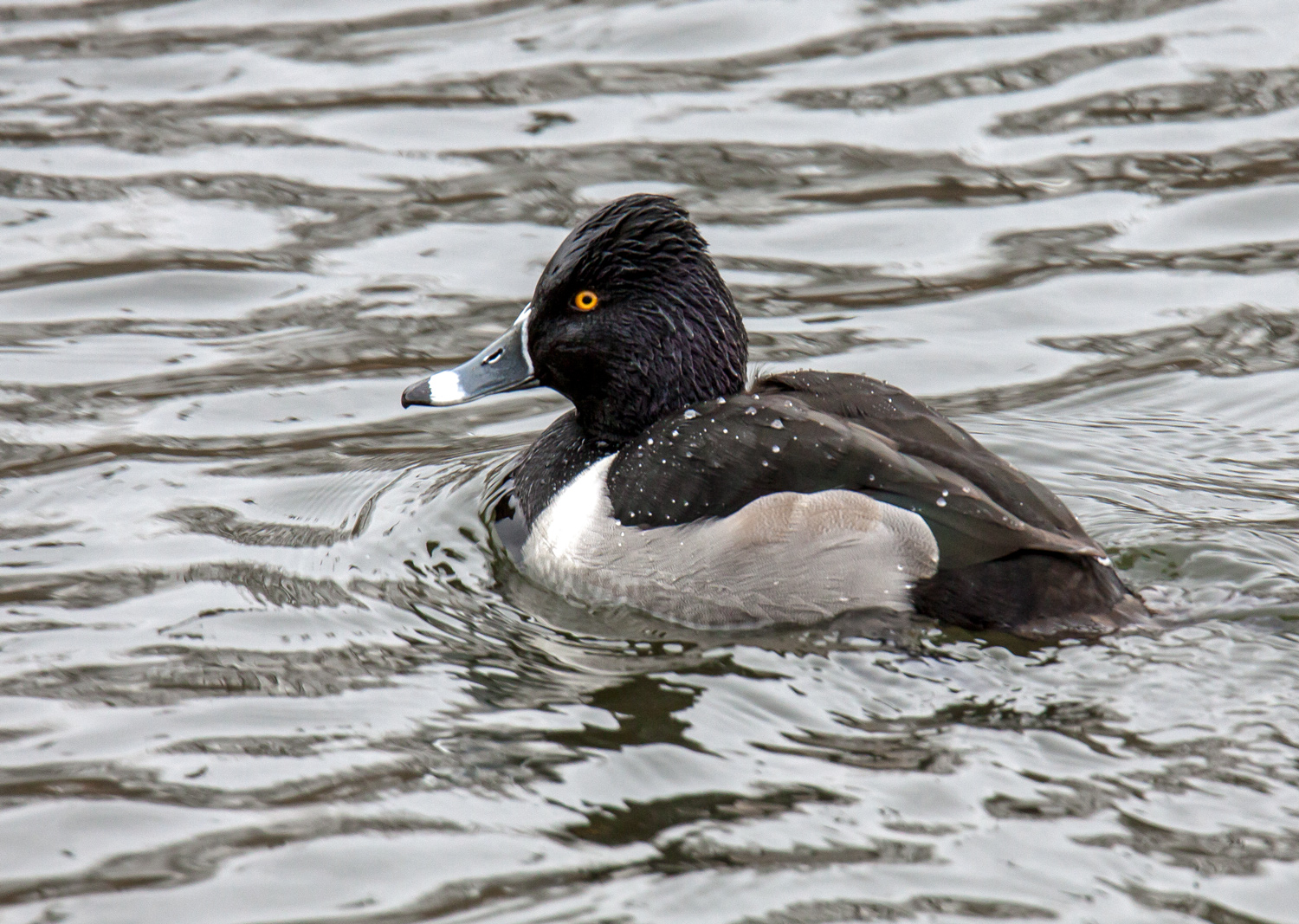
Experienced birders know that this is not an Indigo Cone-headed duck. In fact, there is no such bird—I simply made up the name because I was not really satisfied with calling this bird a Ring-necked duck (Aythya collaris). It is definitely a cool-looking bird, but where is the ring around its neck?

The Cornell Lab of Ornithology explained this conundrum with these words:

“This bird’s common name (and its scientific name “collaris,” too) refer to the Ring-necked Duck’s hard-to-see chestnut collar on its black neck. It’s not a good field mark to use for identifying the bird, but it jumped out to the nineteenth century biologists that described the species using dead specimens.”

I’m in favor of having practical names that are descriptive of live specimens that I might encounter. If Indigo Cone-headed duck doesn’t work for you, how about Ring-billed duck? I’d enjoying hearing any creative ideas you might have about renaming this handsome little duck.

Ring-necked duck

© Michael Q. Powell. All rights reserved.

Read Full Post »

As I looked across the pond at a group of ducks, I spotted a flash of red amidst the dark blue heads of the male Ring-necked ducks. Initially I was confused. The only bird that I had previously seen with a red head was a Red-headed woodpecker and I was pretty sure that a woodpecker was not swimming around in the water.

I maneuvered my way around the small pond and was able to capture some images of this odd duck. Imagine my shock when I checked my bird identification guide and learned that this duck is actually called a Redhead duck (Aythya americana). Frequent readers of this blog know that I sometimes complain about the seemingly inappropriate names that have been given to birds and insects, but in this case the name is simple and straightforward and fits.

As far as I can tell this Redhead is alone—I couldn’t spot any other male or female Redheads at the pond. He seems to like hanging out with a group of male Ring-necked ducks who also seem to be bachelors.

I don’t know how long this guy will stay at this location, but I am definitely going back soon to try to get some more shots of this spectacularly handsome Redhead.

Redhead

© Michael Q. Powell. All rights reserved.

Read Full Post »

Normally Hooded Mergansers (Lophodytes cucullatus) like to stay in deep water and it’s tough to get close-up photos. Yesterday, however, I came upon this male near the shore of a small pond  and I managed to snap off a couple of shots before he turned his back and swam away.

These little ducks have an amazing amount of personality, especially when seen up close.

Hooded Merganser

© Michael Q. Powell. All rights reserved.

Read Full Post »

Have you ever watched a Hooded Merganser duck dive? They will be swimming along and then suddenly they will arch their bodies and thrust slightly upwards before disappearing into the water.

As I watched a group of Hooded Megansers (Lophodytes cucullatus) diving in the deep water of a small pond, I decided to see if I could catch them mid-dive. It proved to be more difficult to accomplish than I realized and I ended up with lots of frames of tails sticking out of the water. Here’s the best shot of a female that I managed to capture as she prepared to go under the water. Her body position reminds me of a dolphin, though I have never seen a dolphin with that kind of a hairstyle.

Hooded Merganser

I was not quite as successful with the male ducks, but I did capture a fun two-image sequence.  The male Hooded Merganser did not seem to come out of the water as much as the female did. As a result, he created a much bigger splash—if this had been an Olympic diving competition, he would certainly have lost points for his sloppy entry into the water.

Hooded Merganser

Hooded Merganser

© Michael Q. Powell. All rights reserved.


Read Full Post »

A loud smack in the water yesterday afternoon at Lake Cook in Alexandria, Virginia caused me to turn my head and I was shocked when I saw an Osprey (Pandion haliaetus) pull a fish out of the water—I though that all of the osprey had gone south for the winter months ago.

This encounter was a real test of my ability to react quickly. I had been watching some small birds in the bushes at the edge of the water when I heard the osprey’s impact with the water. My brain went into overdrive as I tried to figure out what had caused the sound, but simultaneously I was raising my camera to my eye and pointing it in the direction from which the sound had come. I didn’t have time to change the settings on the camera and was fortunate that they were more or less ok. My focus was set for single shot and not continuous focus, so many of my shots were not in focus and my shutter speed ended up at 1/500 sec, a bit too slow to freeze the action. Still, I am thrilled that I got a couple of decent shots out of the encounter.

After I posted a photo in a birding forum in Facebook, several local birders noted that osprey often return to the area in mid-February, so this osprey is only a bit of an early bird.

osprey

osprey

© Michael Q. Powell. All rights reserved.

Read Full Post »

One of the most unusual-looking water birds that I occasionally see is the Pied-billed Grebe (Podilymbus podiceps), like this one that I spotted in a small, man-made pond yesterday in Kingstowne, a suburban community near where I like in Northern Virginia.

According to the Cornell Lab of Ornithology the Latin genus name for “grebe” means “feet at the buttocks.” And I thought “grebe” sounded funny just by itself—imagine having that Latin name as part of your name.

Pied-billed Grebe

Pied-billed Grebe

Pied-billed Grebe

© Michael Q. Powell. All rights reserved.

Read Full Post »

With stealth and patience I can get relatively close to some birds, but Belted Kingfishers (Megaceryle alcyon) remain elusive, skittish, and difficult to capture. I was fortunate to get some long distance shots of a handsome male kingfisher (males have no chestnut-colored stripe on their chests) last weekend in the trees overlooking Lake Cook in Alexandria, Virginia.

Belted Kingfisher

Belted Kingfisher

© Michael Q. Powell. All rights reserved.

Read Full Post »

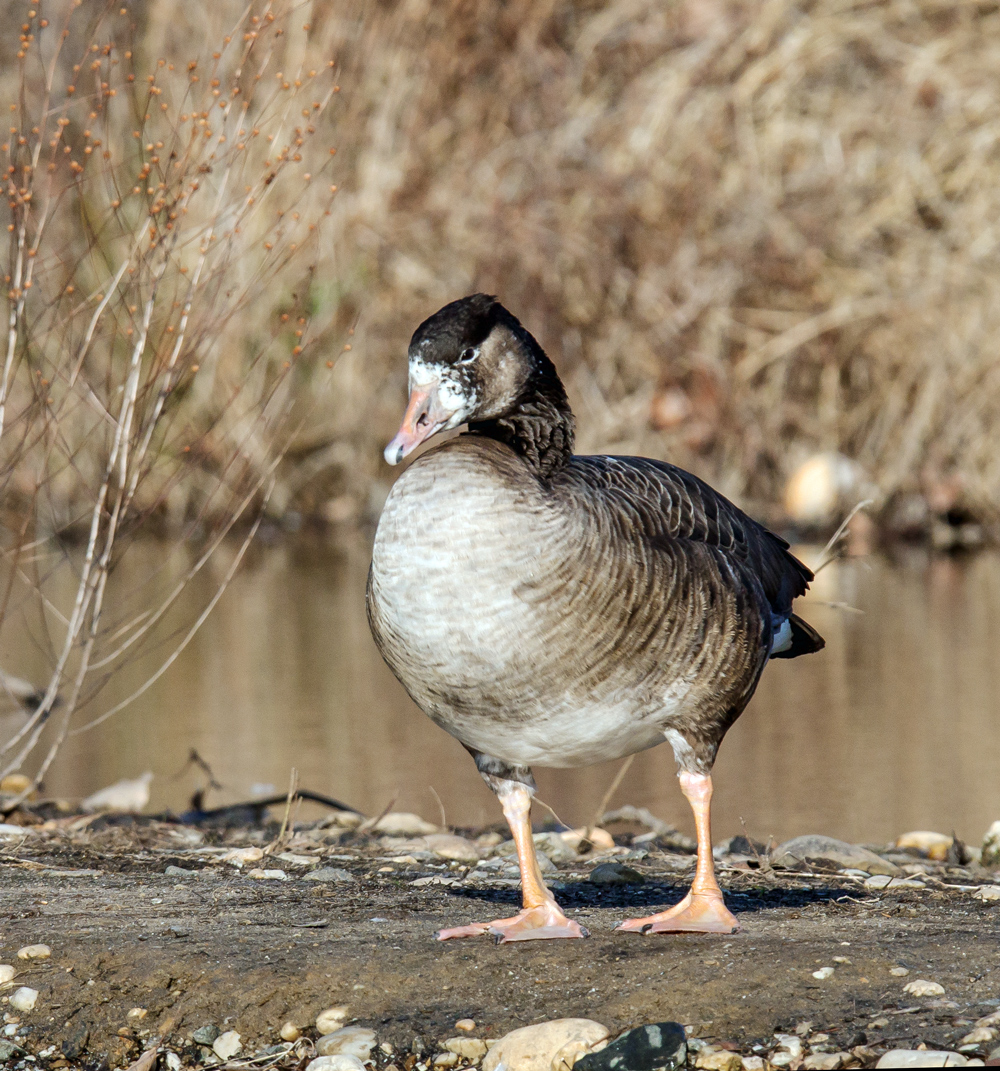
One of the first games that children often learn to play is called “one of these is not like the others” and I felt like I was playing that game this past weekend. As I surveyed the geese that dotted the surface of Lake Cook, a small, pond-sized body of water not far from where I live, it became clear that one of them was different, very different from the others. It had a pinkish bill and a white stripe on its head and pinkish orange legs and feet.

All of the other geese at the lake were Canada Geese (Branta canadensis). Was this possibly a French-speaking separatist Canada Goose? When I looked through my bird identification book, there was no such variant of the Canada Goose.

In fact, there were not very many geese from which to choose. “My” goose sort of looked like the images of the Greater White-fronted Goose (Anser albifrons), but not exactly. In an effort to get some help, I posted some photos to a Facebook birding page and received a range of responses. Most folks seemed to agree that this was a hybrid Canada Goose of some sort, but there was disagreement about the other part of the goose’s genetic makeup. Some thought there might have been a pairing of a Canada Goose with a domesticated goose, while others thought it might have been a Canada Goose and a Greater White-fronted Goose. I tend to be in the latter camp.

When I did a Google search on goose hybrids, I found there are an incredible number of hybrid variations. When it comes to bird identifications, I suppose I am going to have to be content with making my best guess—I refuse to take the next logical step of doing DNA testing of all of my subjects.

hybrid goose

hybrid goose

© Michael Q. Powell. All rights reserved.

Read Full Post »

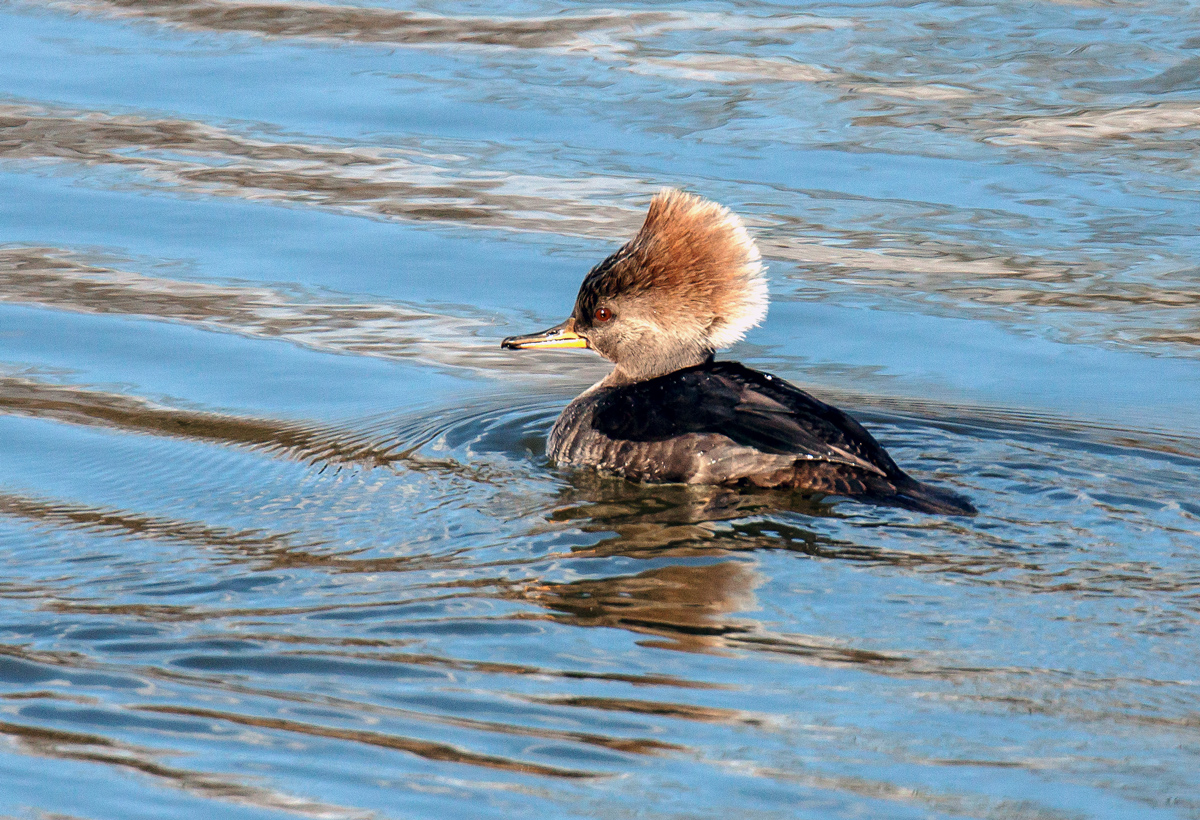
The hairstyle of this female Hooded Merganser duck (Lophodytes cucullatus) and the electric blue of the sky reflected on the water somehow brought back my memories of growing up in the 1960’s.

Hooded Merganser

Imagine my surprise a bit later when I learned that another one of the female Hooded Mergansers was a huge fan of Chubby Checker and she demonstrated for me her own version of The Twist.

Hooded Merganser

© Michael Q. Powell. All rights reserved.

Read Full Post »

I had hopes of capturing lots of images of birds perched on snow-flocked branches at Huntley Meadows Park  yesterday morning, but this happy little Carolina Wren (Thryothorus ludovicianus) was the only bird that cooperated. About an inch of light fluffy snow had fallen overnight and covered the trees and cars, but the streets were totally clear—it was what some local meteorologists like to call “conversation snow.” Traffic snarls easily in Northern Virginia, but fortunately this dusting of snow did not seem to create any serious problems on the road.

So far this winter, snow has been uncommon here, but I am sure we will be blasted before long and, conditions permitting, I’ll be out again trying to capture the snowy images that I have in my mind.

Carolina Wren


© Michael Q. Powell. All rights reserved.

Read Full Post »

As I was focusing on a bird across the water, I detected some motion out of the corner of my eye—a small bird was zooming fast and low over the surface of the water in a flight path parallel to the bank on which I was standing.

I reacted as quickly as I could to track the bird and fire off a few shots and was surprised that I managed to capture some relatively sharp images of a female Hooded Merganser (Lophodytes cucullatus). Although female Hoodies often have puffy hairstyles, this one had a more aerodynamic look while she was flying.

The angle at which I was shooting made the water the primary background for the images and somehow the water ended up looking like it had been painted by Monet. Luck and skill combined to help me capture these fun images.

Hooded Merganser

Hooded Merganser

Hooded Merganser

© Michael Q. Powell. All rights reserved.

Read Full Post »

I captured this image of a Double-crested Cormorant (Phalacrocorax auritus) as it lumbered across the water before taking to the air yesterday at Lake Cook in Alexandria, Virginia. Cormorants are so big and heavy that they have to build up a good deal of momentum to get airborne. As a consequence, cormorants tend to bounce across the water for a little  while before they actually are able to take off.

Double-crested Cormorant

© Michael Q. Powell. All rights reserved.


Read Full Post »

On a visit yesterday to Lake Cook, a tiny body of water not far from where I live in Northern Virginia, I was thrilled to spot an immature Double-crested Cormorant (Phalacrocorax auritus). These prehistoric-looking water birds have feathers that are not completely waterproof, so periodically they have to extend their impressively large wings to dry them out.

Most of the cormorants that I have seen in the past have been on the much larger Potomac River, but this solitary one seemed content to paddle about among the geese and ducks that had congregated on this small pond. It was nice finally to have a day with some sunshine and I spent a pretty long time observing the cormorant. One of the coolest things for me about these birds is their spectacular blue eyes, which you can just make out in the image below, especially if you double click it to view it at a higher resolution.

Double-crested Cormorant

© Michael Q. Powell. All rights reserved.

Read Full Post »

When I took this shot yesterday morning at Huntley Meadows Park, I assumed it was a female Red-winged Blackbird (Agelaius phoeniceus), because of its color and the pattern of the feathers. At home, though, it became clear that it was an image an immature male who is just starting to gain some of the markings of an adult male—you can just make out the beginnings of the colorful shoulder patch.

Red-winged Blackbird

© Michael Q. Powell. All rights reserved.

Read Full Post »

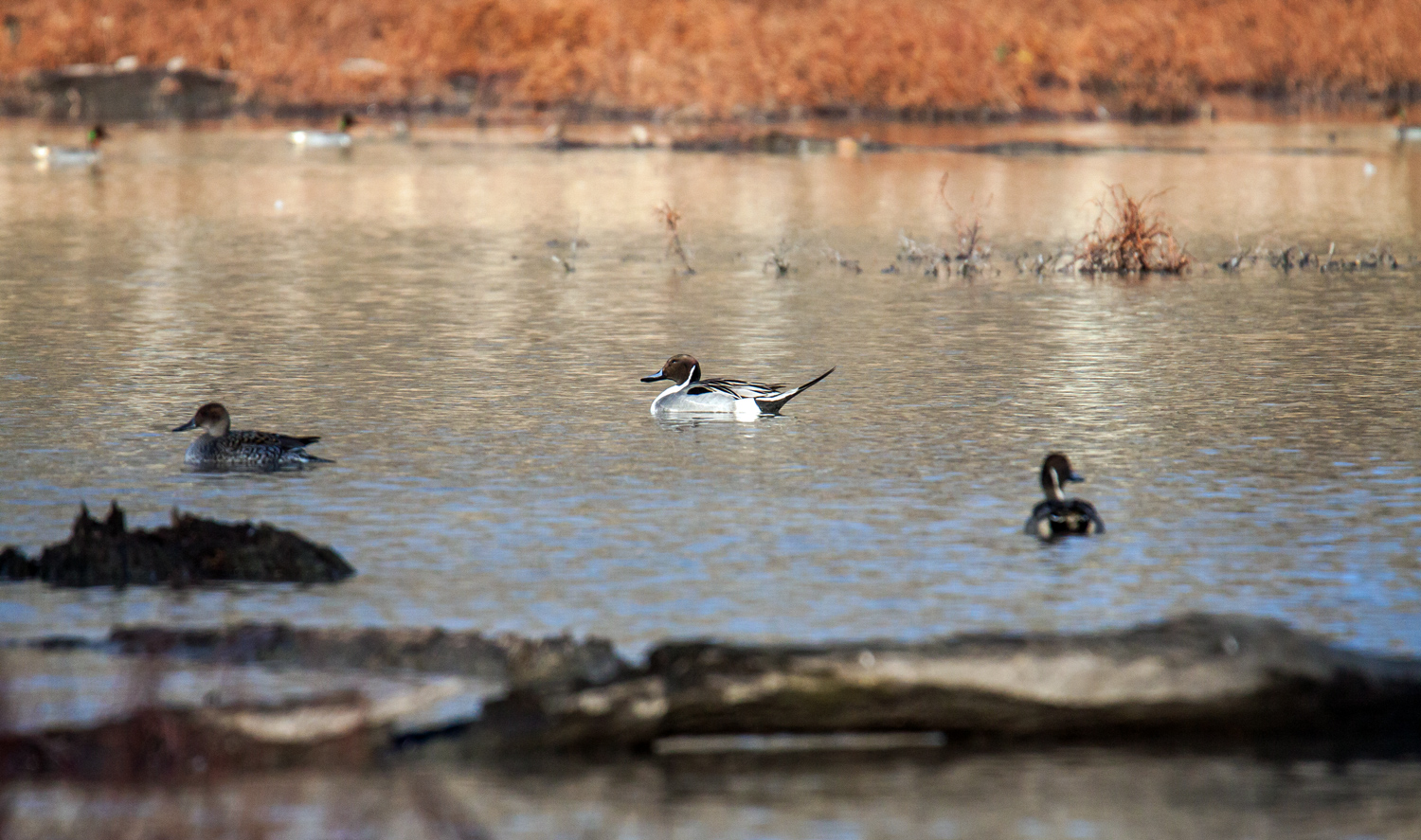
I love the mood of the early morning—there is such a sense of tranquility. Here is what what things looked like this morning at Huntley Meadows Park. The most obvious subject was a male Northern Pintail duck (Anas acuta), but I love the way that you can see other ducks and geese in the background.

Northern Pintail

Northern Pintail

© Michael Q. Powell. All rights reserved.

Read Full Post »

Does your appearance affect your attitude? Do you act differently when you are dressed formally than when dressed casually?

During the winter, I sometimes put on an utterly ridiculous looking bright red trapper hat with long floppy ears. No matter how I am feeling, I can’t help but smile when I am wearing the hat in public.

I wonder if a Northern Shoveler (Anas clypeata) feels the same way about its oversize bill. No matter when I see one, it always seems to have a goofy grin on its face. Now I admit that bills are pretty inflexible and probably don’t allow for much variation in the shoveler’s facial expressions, but the grin is contagious. In the same way that people smile back at me when I have on a goofy grin on my face when my red hat is on my head, I always smile back at the Northern Shovelers.

Wear a goofy grin today and see how other people react!

Northern Shoveler

© Michael Q. Powell. All rights reserved.

Read Full Post »

I could hear the call of Red-headed woodpeckers (Melanerpes erythrocephalus) all around my head on Saturday at Huntley Meadows Park, but they remained hidden in the trees. Finally one of them stepped out of its comfort zone and went out on a limb, and I was able to capture this image.

Red-headed woodpecker

© Michael Q. Powell. All rights reserved.

Read Full Post »

When the lighting was as dim as it was Saturday morning at Huntley Meadows Park, it felt like I was shooting in black and white. Fortunately there was a bit of color in the head and eyes of the little male Downy Woodpecker that I spotted high in the trees, framed wonderfully by the surrounding branches.

Downy Woodpecker

© Michael Q. Powell. All rights reserved.

Read Full Post »

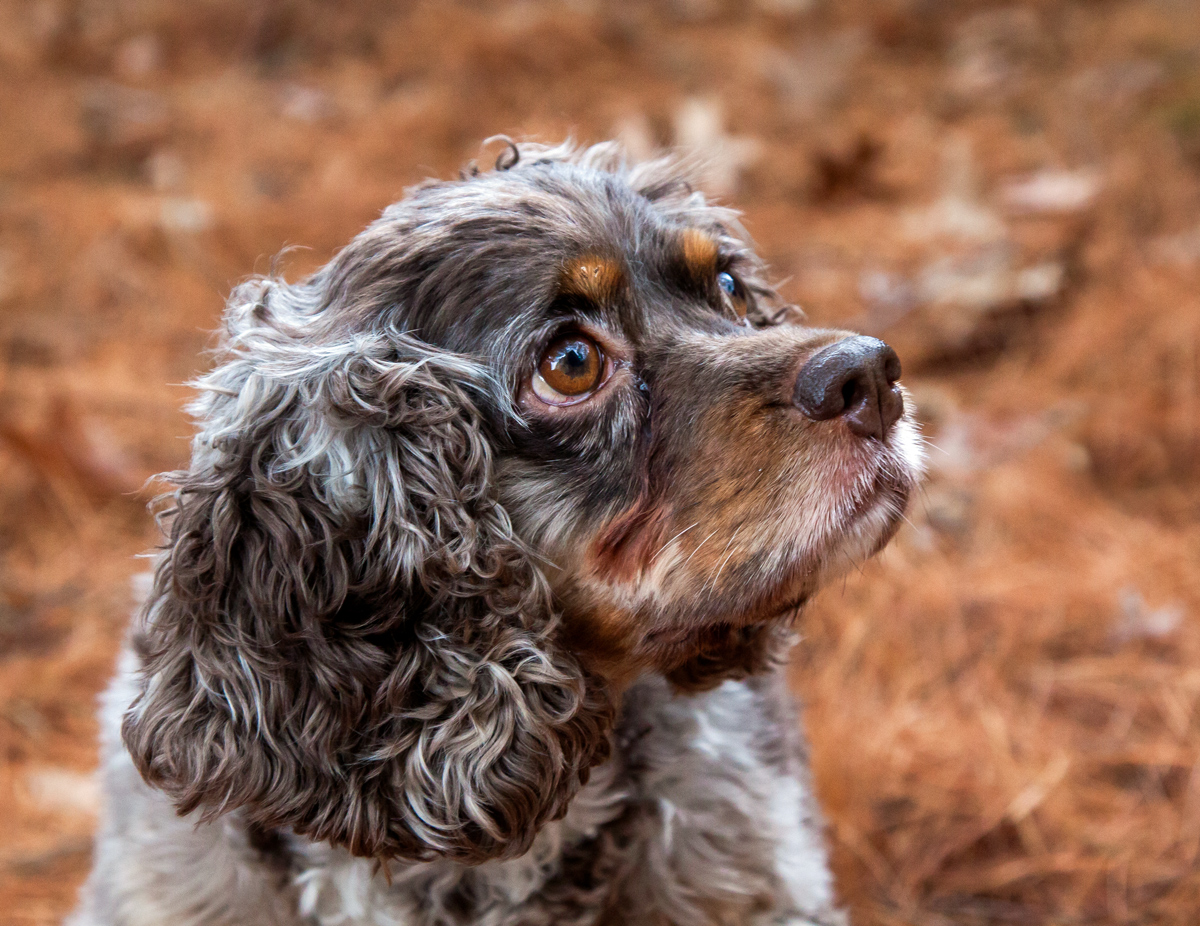
How do you find comfort when you are feeling agitated and anxious? I can always turn to religion or to nature or to my photography, but early this morning I realized how comforting it was to have Freckles, a small Cocker Spaniel, leaning into my leg as I sat on the couch reading the Washington Post. Her slow, steady breathing and the warmth of her body helped to counteract my rising emotions as I read the accounts and editorials about President Trump’s first full day in office.

Freckles is staying with me while her owners are out of town and she is really comfortable in my townhouse, which is not too surprising, given that she lived here for over a year before she moved to an apartment in Washington DC.  For her, a trip to the Virginia suburbs is like a vacation in the country, and she particularly likes to play around in the fallen pine needles of my small back yard.

Generally she is in constant motion, sniffing every square inch of the yard, but yesterday I got her to sit still for a moment so that I could take some shots of her. Here are a few of my favorites from our impromptu portrait session.

Freckles

Freckles

Freckles

© Michael Q. Powell. All rights reserved.

Read Full Post »

It was so dark and gray this morning that I initially couldn’t even see what was fluttering about in the underbrush not far from where I was standing. Finally it perched and eventually I was able identify it as a Golden-crowned Kinglet (Regulus satrapa), one of the few birds that I have encountered that is even smaller than a chickadee—a bit over three inches (8 cm) in length and a weight of .2 ounces (6 g).

Golden-crowned Kinglet

Golden-crowned Kinglet

© Michael Q. Powell. All rights reserved.

Read Full Post »

Periodically I will arrive at Huntley Meadows Park early in the morning, hoping to catch a glimpse of one of the local beavers, but I haven’t seen one in quite some time. It’s very obvious, though, that North American beavers (Castor canadensis) are present and active, because their lodge, built in part on the boardwalk, keeps getting bigger every time that I see it.

Gradually the beavers are taking over more and more of a bench on the boardwalk. I noticed this morning, when I took this photo, that there is barely room now to sit down on the end of the bench. In the past, park employees have had to remove some mud when the lodge extended too far across the boardwalk and it looks like that has been the case this  year too.

I’m fully expecting to see one of these days that the bench has been totally engulfed by the beavers and incorporated into their architectural plans. At that moment I will know for certain that the beavers have taken over.

beaver lodge

© Michael Q. Powell. All rights reserved.

Read Full Post »

« Newer Posts - Older Posts »