Feeds:
Posts
Comments

Posts Tagged ‘Alexandria VA’

You know that summer is coming to a close when the dragonflies that were in constant flight earlier in the season seem to be resting more often, like this Black Saddlebags dragonfly (Tramea lacerata) that one of my fellow photographers, Walter Sanford, pointed out this past weekend at my local marsh. This dragonfly kept flying back and forth between two perches that were tantalizingly just out of the range of the 180mm lens that I had on my camera. I didn’t dare to take the time to change my lens, knowing that the dragonfly would almost certainly fly away at the most inopportune moment, so I ended up cropping a lot, especially in the first image.

The only shots that I could get of Saddlebags dragonflies earlier in the summer were in-flight shots and I have already posted some shots of a Black Saddlebags in the air. I realized, though, that I had not posted an image of its more colorful counterpart, the Carolina Saddlebags (Tramea carolina) that I photographed during a visit to Lewis Ginter Botanical Gardens in Richmond, Virginia. I took that shot (the third one below) from a pretty long distance, but was able to achieve focus and capture some of the wonderful details of this beautiful red dragonfly.

Black Saddlebags dragonflyBlack Saddlebags dragonfly

Carolina Saddlebags dragonfly

© Michael Q. Powell. All rights reserved.

Read Full Post »

What’s a Mocha Emerald? No, it’s not the newest Seattle coffee craze—it’s a dragonfly.

I was thrilled this past Friday to spot a type of dragonfly at Huntley Meadows Park that I had never seen before—a Mocha Emerald (Somatochlora linearis). Fellow photographer and blogger, Walter Sanford, saw some in the park earlier in the summer, but I thought that it was probably too late for me to find one. It’s nice to be surprised.

Initially, I didn’t know what type of dragonfly I had photographed and knew only that its body shape was different from the ones that I had seen previously. Serendipitously, later in the day l ran into the manager of the park, Kevin Munroe, a noted dragonfly expert who runs the website Dragonflies of Northern Virginia, and he helped me make a tentative identification.

This one has somewhat tattered wings–it looks like he had a tough summer.

Mocha Emerald

© Michael Q. Powell. All rights reserved.

Read Full Post »

When I encountered this spider hanging on a branch just above eye-level, I knew I was going to have a problem getting a stable shooting position, so I decided to use my popup flash. It added some additional light and a little drama, though it is pretty obvious that I used it. Like the spider image that I posted earlier today, the image has a really narrow depth of field, a consequence of having to shoot hand held, and only a few of the spider’s legs are in focus.

spider2_small_blog

© Michael Q. Powell. All rights reserved.

Read Full Post »

This summer I haven’t been seeing any of the large orb-weaver spiders at my local marsh that I observed in previous years, but the small spiders can be equally beautiful.

I spotted this little spider when I was hiking through the woods. There wasn’t really enough room to set up my tripod, so I ended up taking the shot handheld with the available light, which meant my depth of field was pretty limited. Although my normal instinct is to move in really close, I decided to take some shots from a slight distance and I like one of the resulting images so much that I am presenting it with almost no cropping (which is unusual for my insect shots). I especially like the interplay of light and shadows on the different elements in the scene, which together produce a sense of drama.

spider1_small_blog

© Michael Q. Powell. All rights reserved.
Read Full Post »

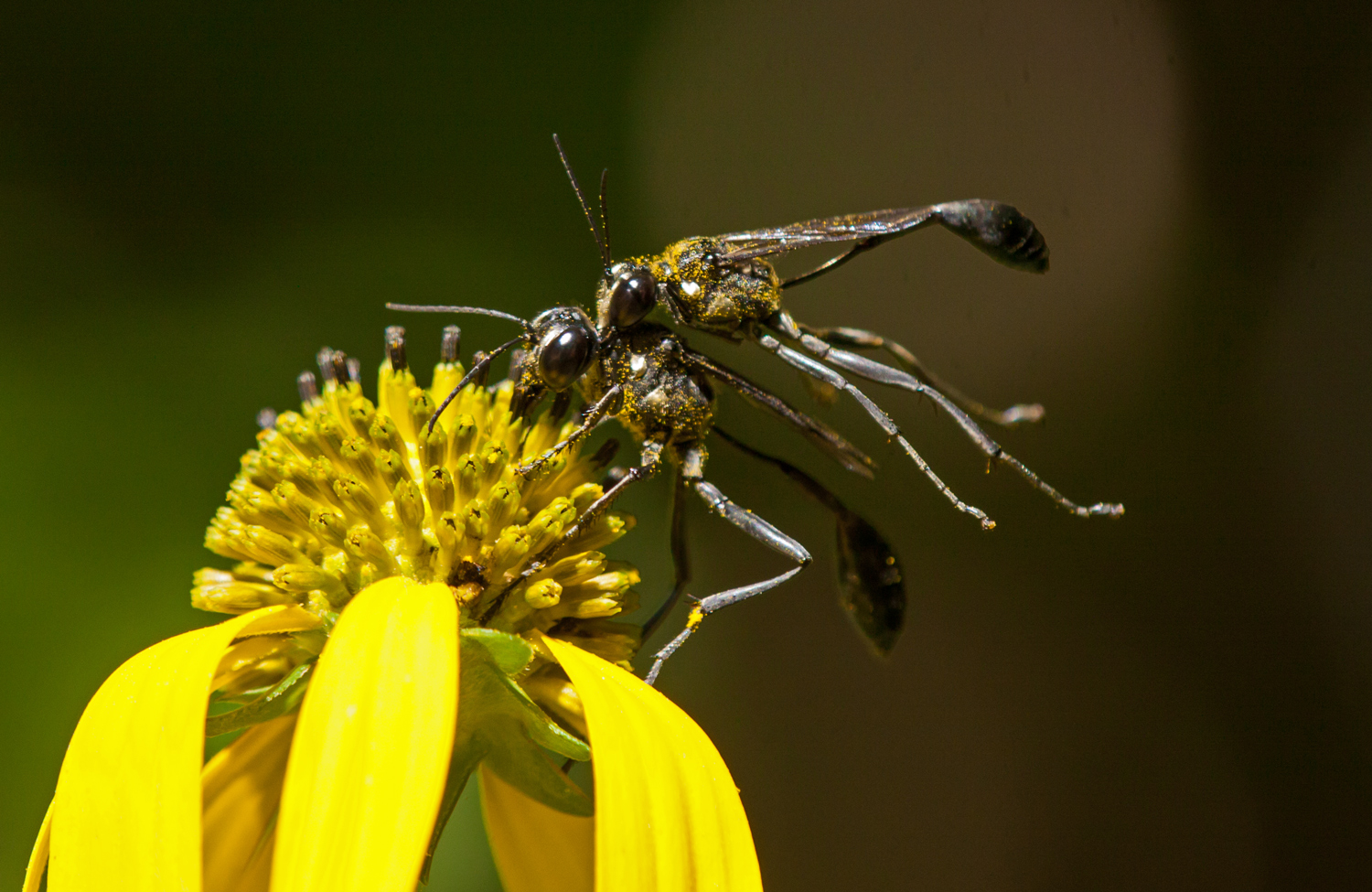
I don’t know much about the intimate life of wasps, but it sure looked to me like one of them is giving the other a loving nibble on the back of its neck. Both of them were covered in a lot of pollen, like they had just had a roll in the hay, figuratively speaking.

The two of them had flown to this flower in what appeared to be a mating position, though I can’t tell if the wasps are actually hooked up in this shot. My experience with dragonflies, however, has shown me that insects can mate in all kinds of unusual positions.

I am comfortable with moving in close for photos of bees, but I decided that in this case it was prudent to maintain a respectful distance from the wasps.

wasp kiss

© Michael Q. Powell. All rights reserved.
Read Full Post »

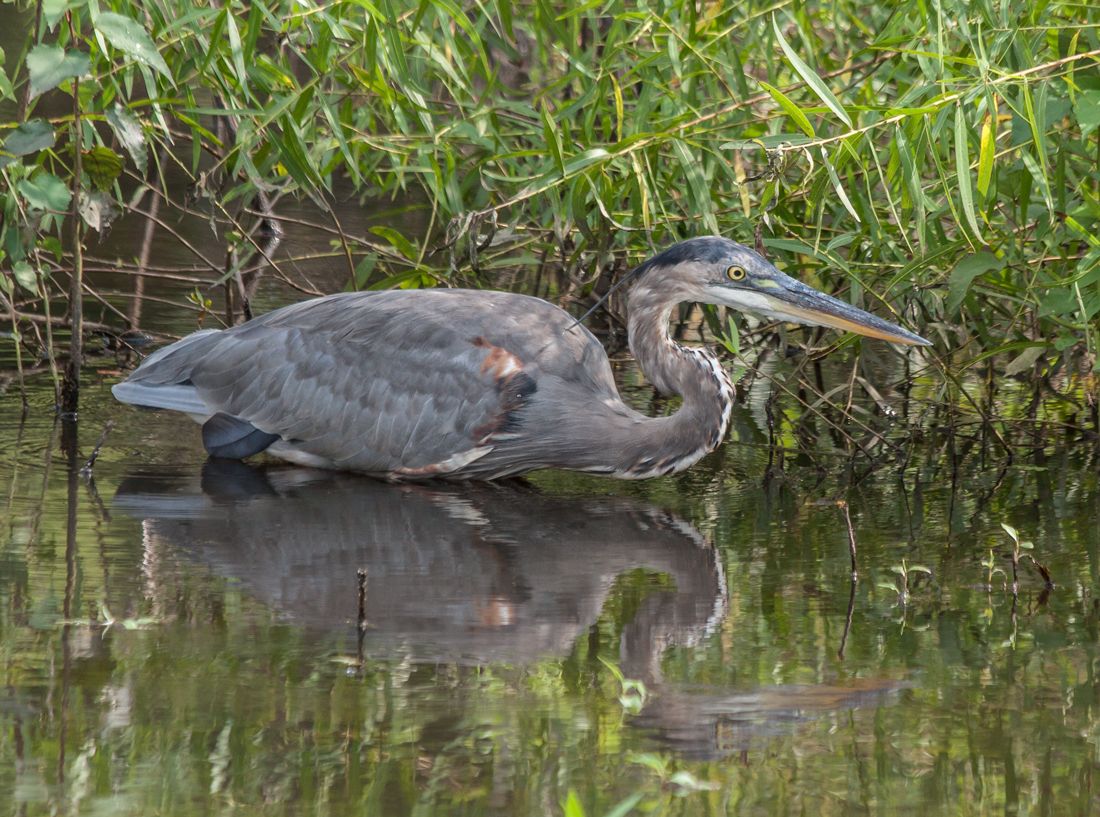
Why was this Great Blue Heron (Ardea herodias) crouching in the water? Was he playing hide-and-seek with his heron friends? Was he seeking shelter in the shade?

The more that I watched the heron fix his attention on the eye-level branches, the more I became convinced that he was stalking dragonflies. Several times he advanced forward slowly, never once looking down at the water, but I never saw him make the rapid thrust that he uses when catching fish. It seems to me that he would get a better reward for his efforts by catching fish and frogs, but maybe he simply wanted some variety in his diet.

When I departed, the heron was still crouching and the dragonflies remained hidden.

Great Blue Heron

© Michael Q. Powell. All rights reserved.

Read Full Post »

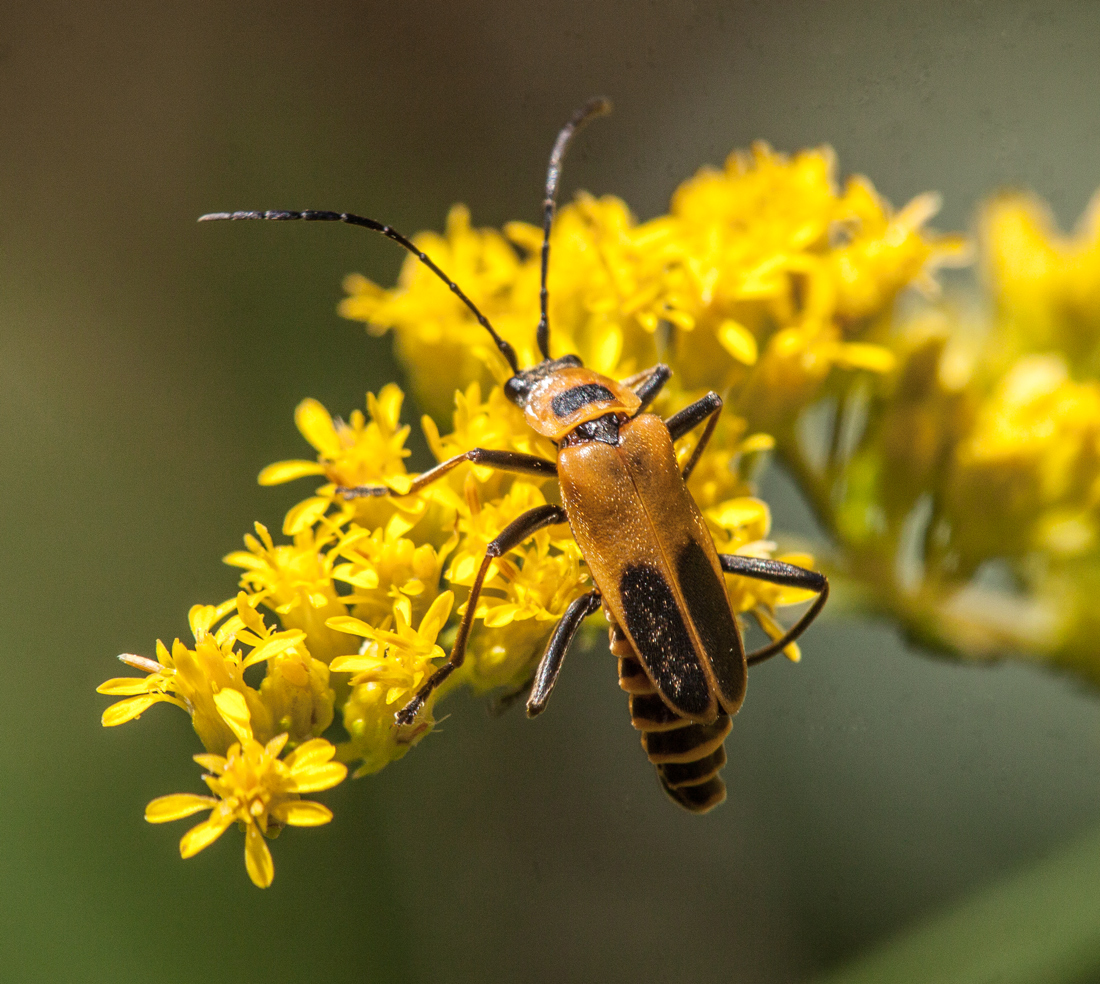
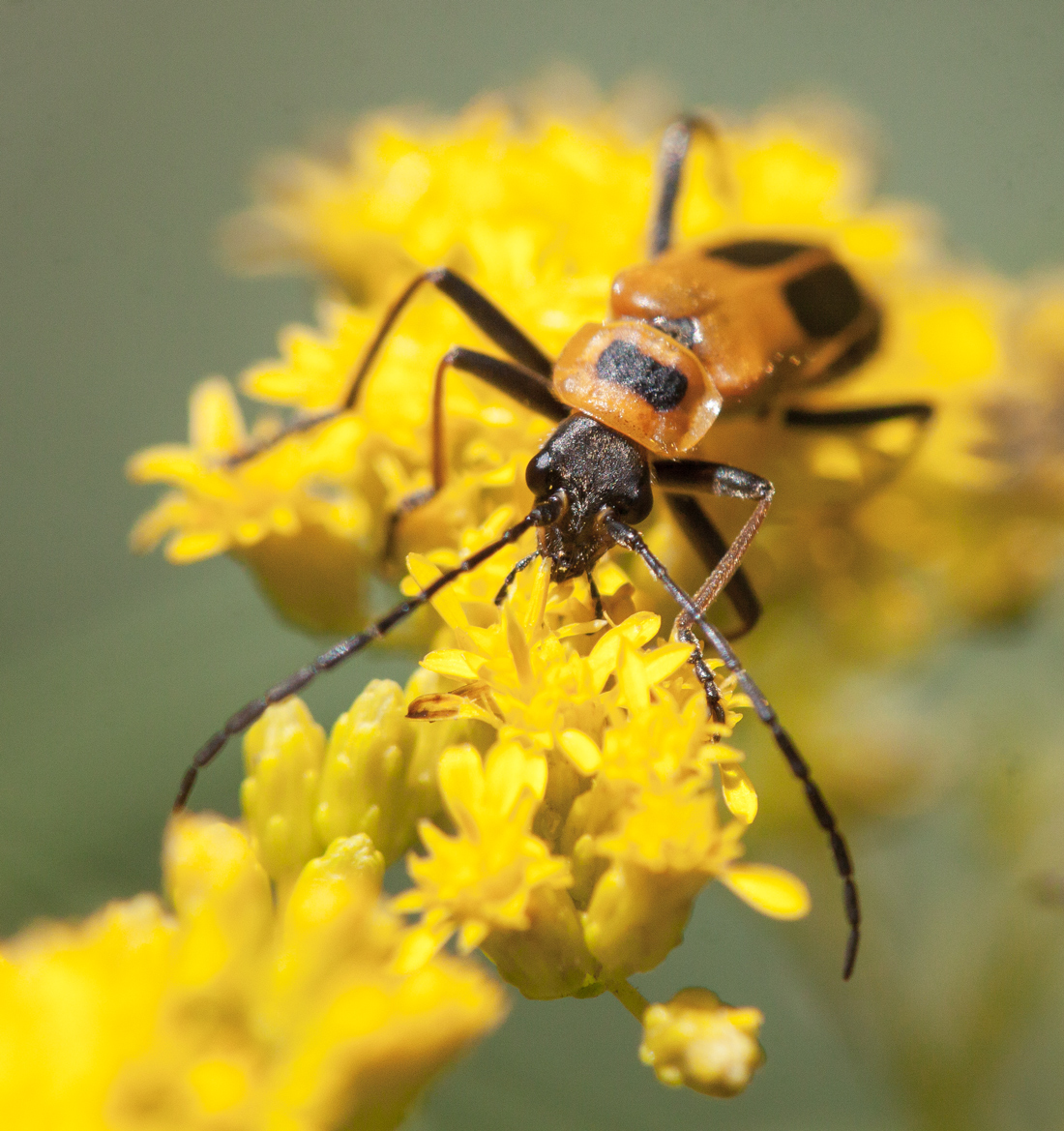
Goldenrod seems to act like a magnet for all kinds of flying and crawling insects and earlier this week I was fascinated by a large beetle crawling around and through the goldenrod. I haven’t yet been able to identify the beetle, but I had a lot of fun trying to move in close with my macro lens and capture its image from various angles.

lightning1_bloglightning4_bloglightning3_blog

© Michael Q. Powell. All rights reserved.
Read Full Post »

Dragonflies are so beautiful that I sometimes forget that they are also fierce predators. Last weekend at my local marsh, I captured this image of a female Eastern Pondhawk dragonfly (Erythemis simplicicollis) feeding on another dragonfly, which looks like it might be a female Blue Dasher (Pachydiplax longipennis).

The dragonfly is perched on the end of one of the slats of a railing that along the edge of an inclined section of the boardwalk. I cropped the image to focus viewers’ attention on the dragonfly, but I also like the second version of the same photo, which is close to the original view when I took the shot. Somehow those three slats remind me of a row of tombstones, a memorial to the predator’s prey.

Eastern Pondhawk

Eastern Pondhawk

© Michael Q. Powell. All rights reserved.
Read Full Post »

I never realized that I was surrounded by cannibals. No, I did not discover a pile of skulls or a string of shrunken heads, but almost every time recently that I have gone out into my local marsh, I have spotted Red-footed Cannibalflies (Promachus rufipes).

These insects are big and they buzz as they fly by me, so they are hard to miss. I have read that they are vicious predators, but I had never caught one red-handed with prey (or perhaps I should say red-footed) until yesterday. I can’t quite identify the prey, but it looks like it might be some kind of small bee. If so, it wouldn’t bee too surprising, given that one of the nicknames for this species in the “Bee Panther.”

I know that I shouldn’t be worried about these cannibals, but a slight chill went through me yesterday when one of these insects landed on the lenshood of my camera and looked up at me, looking very much like he was sizing me up

Red-footed Cannibalfly

© Michael Q. Powell. All rights reserved.

Read Full Post »

The Great Blue Herons (Ardea herodias) at my local marsh seem to have grown accustomed to the presence of people and some of them like to fish near the boardwalk. This one was so close that I had to lean backwards over the edge of the edge of the boardwalk to fit the entire heron into these shots—zooming was not an option, given that I was using a lens of a fixed focal length, a 180mm macro lens.

While I was observing the heron, it concentrated its activity around a rock that stuck out of the water, sometimes perching on it and sometimes circling around it. I hope the heron had better luck during the rest of the day, because it did not have any luck at all as I watched and waited in vain to capture a big catch.

Great Blue Heron Huntley Meadows Parkheron3_rocks_blog

© Michael Q. Powell. All rights reserved.

Read Full Post »

I know that damselflies come in many colors, but my brain wanted to cramp up when I was told that this stunning orange damselfly was a bluet. An orange bluet? Aren’t bluets blue?

Apparently that is not always the case, and this little beauty is in fact a male Orange Bluet damselfly (Enallagma signatum). This shot looks like it was done with flash, but I double checked the EXIF data and confirmed that it was simply an effect caused simply by using exposure compensation and metering carefully on the subject. Normally, I am not a big fan of a black background, which can be caused when the light from the flash overpowers the ambient light, but I think that it works well in this shot, which looks almost like it was shot in a studio.

In the second shot, the brown color of the muddy water shows through in a way that is a little more natural. I took this shot when the damselfly was farther away than in the first shot and I like the way that it shows a bit more of the environment than in the first image.

One of the advantages of shooting in bright light and on a tripod was that I was able to shoot at ISO 100 and at f/11, which gave me images that were a lot cleaner than I often get.

orange1_blogorange2_blog

© Michael Q. Powell. All rights reserved.


Read Full Post »

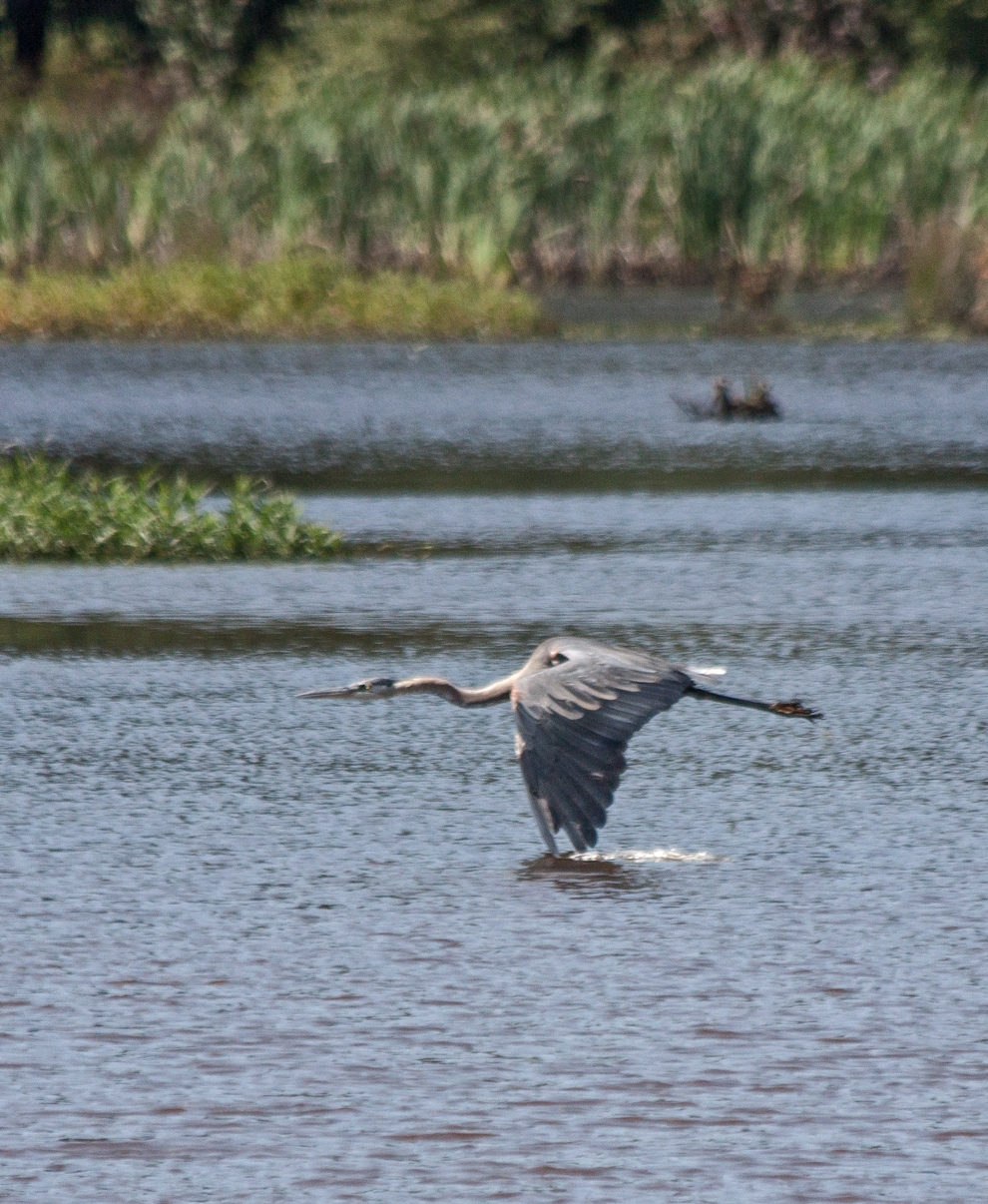
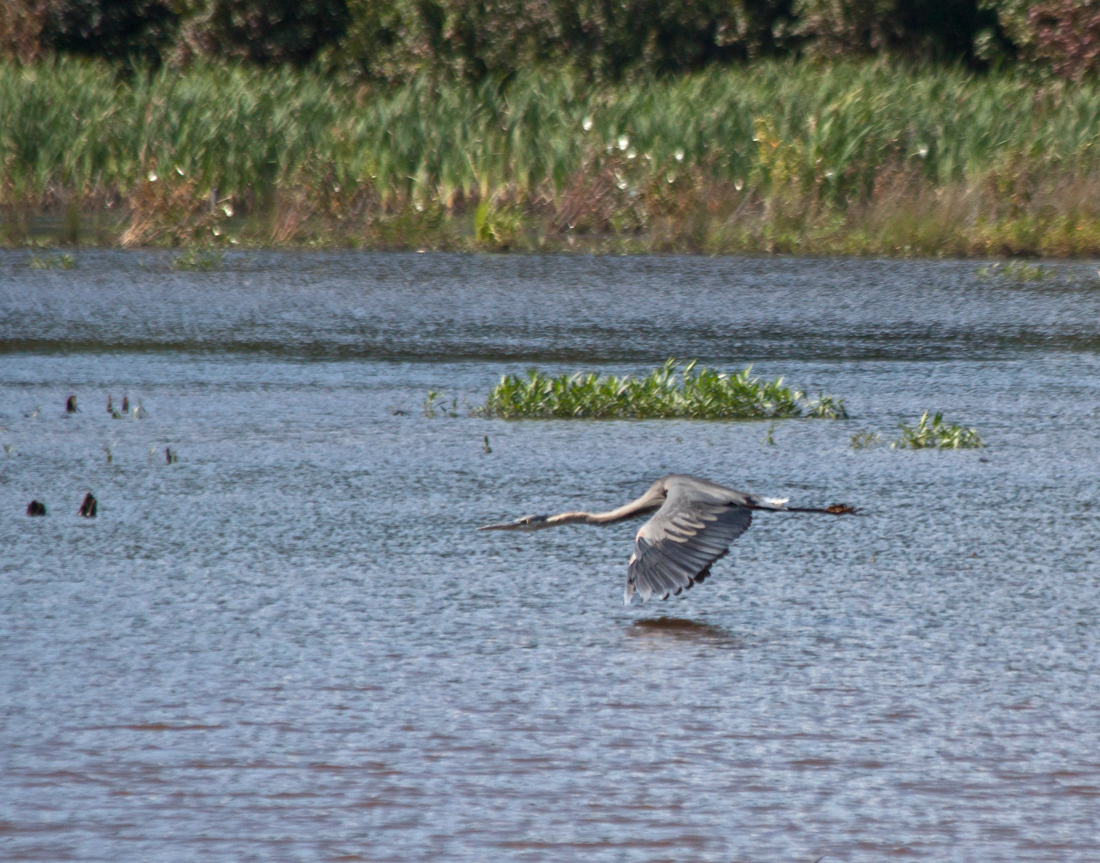
Most of time when I see Great Blue Herons (Ardea herodias) take off, they fly high into the air. This heron, however, decided to fly very low over the surface of the big pond at my local marsh—I think he was on his way to harass one of his fellow herons, because there was a lot of loud squawking shortly after I took these shots.

Generally, it’s not hard for me to decide if I want to crop a shot in landscape or portrait mode. This time, though, I vacillated and ultimately decided to do one each format.  Who says you have to choose? You can have it both ways.

heron2_low_blogheron_low_blog

© Michael Q. Powell. All rights reserved.

Read Full Post »

It’s hard to imagine a simpler composition—a tiny damselfly in the green growth of the marsh—but I find real beauty and power in this image.

Look closely at this damselfly, which I think is a female Fragile Forktail (Ischnura posita), and you will see some amazing colors and details, all packed into a body that is only about an inch long.

Click on the image to see a higher resolution view of the image.

Fragile Forktail

© Michael Q. Powell. All rights reserved.

Read Full Post »

As I was walking through my local marsh yesterday, I caught sight of a giant flying insect. Upon closer examination, it proved to be a pair of mating Red-footed Cannibalflies  (Promachus rufipes).

They eventually settled on a leaf, just above eye level. It was a heavily vegetated area and it was tough getting a clear line of sight and a good angle of view (and standing on my tiptoes probably is not an optimal shooting position). This first shot was the only one I got where both of these giant insects were in focus.

At a certain point of time, one of them, which I suspect was the female, tried to escape and I got the second shot, capturing an unusual moment in time. In the original version, the background was mostly light colored, but there were some ugly smudges of greenish gray.  I tried to remove them hastily in post processing to highlight better the subjects, but I noted that I didn’t do a very good job when, after the fact, I looked at the posting on a computer screen, vice my laptop, on which it was composed..

The second shot seems to be begging for a clever caption. Does anyone have a suggestion?


Mating Red-footed Cannibalflies

Matting Red-footed Cannibalflies

© Michael Q. Powell. All rights reserved.


Read Full Post »

The few Monarch butterflies (Danaus plexippus) that I observed earlier this season were all in gardens, so I was especially happy when I spotted one this past weekend in the wild, feeding on some Swamp Milkweed (Asclepias incarnata) at my local marsh.

The little patch of Swamp Milkweed was a pretty good distance away, so I had to use the long end of my 70-300mm zoom for these shots. It looks like many of the flowers of the milkweed had not yet opened, but the butterfly obviously found it to be attractive enough to stop for a moment.

Monarch Butterfly Huntley MeadowsMonarch Butterfly Swamp Milkweed

© Michael Q. Powell. All rights reserved.

Read Full Post »

Generally I prefer to have a natural background for wildlife shots, but when a Green Heron (Butorides virescens) that I was observing this past Friday at my local marsh took off, I ended up shooting it against the backdrop of the boardwalk. I really like the look of the resulting shot, which juxtaposes those natural and industrial elements in an unusual way.

If you enjoy photos with this type of contrast of the natural and the man-made, check out my posting from this past week of an “industrial” dragonfly.

Green Heron Huntley Meadows

© Michael Q. Powell. All rights reserved.
Read Full Post »

Several Great Blue Herons (Ardea herodias) were very active yesterday at my local marsh, chasing each other around and squawking loudly. One of them flew up into a tree near to where I was standing and perched for a little while. I got this shot shortly after the heron flew down from the tree into the water and extended its wings to arrest its momentum.

Great Blue Heron

© Michael Q. Powell. All rights reserved.
Read Full Post »

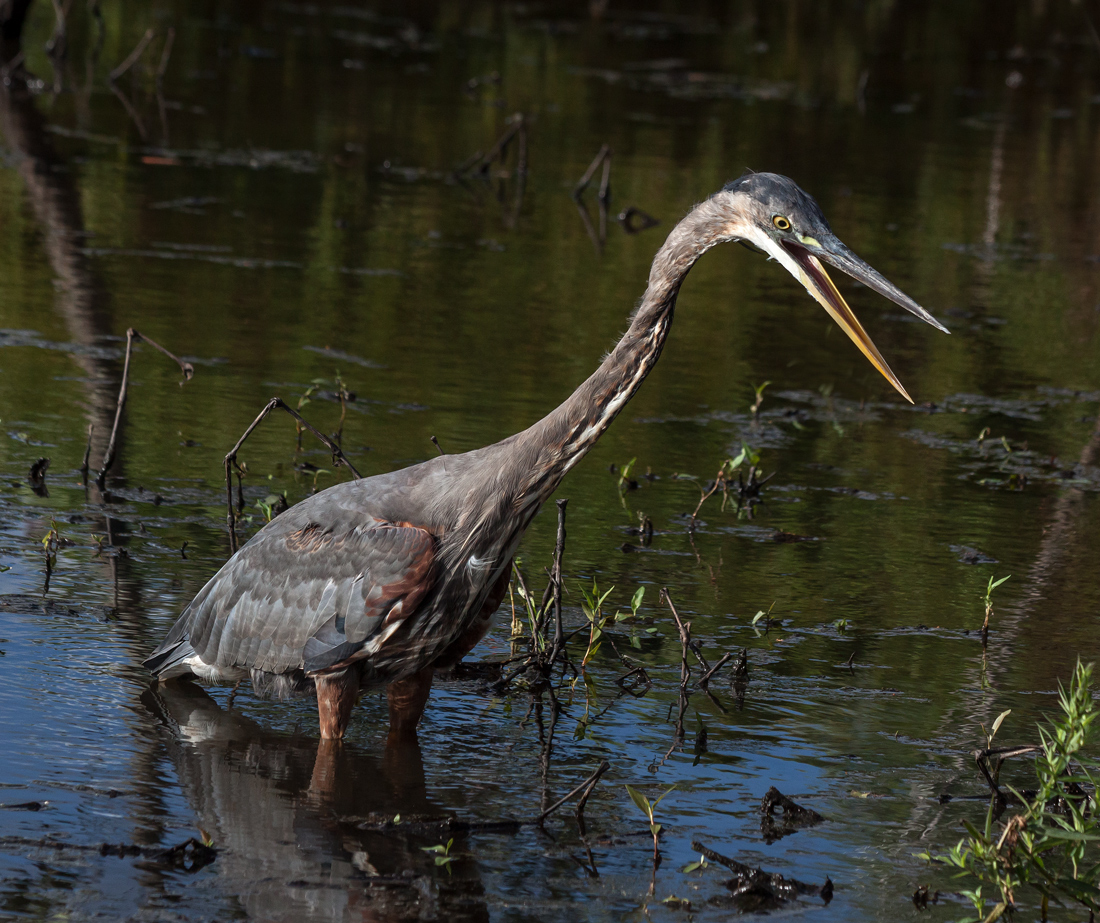
Do Great Blue Herons (Ardea herodias) laugh? I was intently watching this heron recently at my local marsh when he suddenly opened his mouth. It wasn’t really a yawn, and he certainly didn’t seem bored. It was more like something had struck him as funny—it might have been me.

For some reason, the words of a really old Bee Gee song came into my head, the one that begins with the words, “I started a joke.” I went searching on You Tube for the song and came across an old video of the very young Bee Gees singing the song on the Tom Jones show in 1969. If you are of my generation, you may enjoy a trip back to the 1960’s or it may be a new discovery for some younger readers—just click on this link.

As with many songs, I don’t quite understand the somewhat enigmatic lyrics—maybe you can discover their true meaning (lyrics from azlyrics.com):

“I started a joke, which started the whole world crying,
but I didn’t see that the joke was on me, oh no.

I started to cry, which started the whole world laughing,
oh, if I’d only seen that the joke was on me.

I looked at the skies, running my hands over my eyes,
and I fell out of bed, hurting my head from things that I’d said.

Til I finally died, which started the whole world living,
oh, if I’d only seen that the joke was on me.”

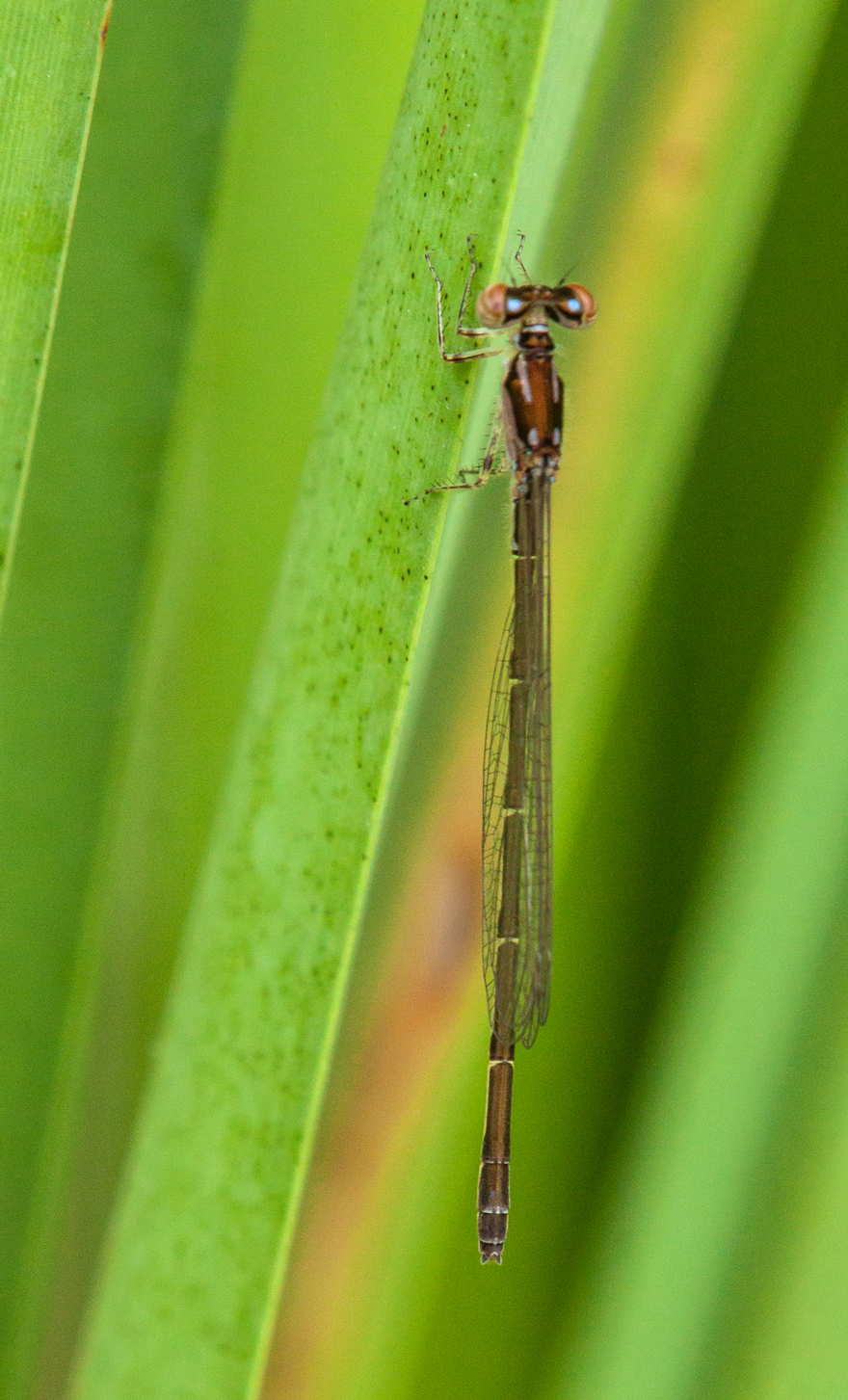
Great Blue Heron laughing

© Michael Q. Powell. All rights reserved.
Read Full Post »

I used to think that there were only one or two varieties of black-colored swallowtails, but as I learned there were more such species (some deliberating mimicking each other), I’d sometimes get confused and frustrated when trying to distinguish among them.

For example, I encountered this beautiful black swallowtail butterfly feeding on a Cardinal Flower (Lobelia cardinalis) this past weekend at my local marsh. It is definitely an unusual circumstance when I can identify a flower, but not the insect.

So, I asked myself, is this a female Eastern Tiger Swallowtail or a Pipevine Swallowtail or a Spicebush Swallowtail or a Black Swallowtail? How can you tell them apart, given they are all black and all have swallowtails?

While searching on the internet, I came across a wonderful blog posting on a site called Louisiana Naturalist that compared all four of these swallowtail species and pointed out clearly the distinguishing marks. Once I looked at the posting, it was pretty clear that “my” butterfly is a Spicebush Swallowtail (Papilio troilus). Why am I so confident? One of the identifying marks is the blue comet-like marking that interrupts the inner row of orange spots.

It’s interesting to see this butterfly feeding on the Cardinal Flower. The website of the Lady Bird Johnson Wildflower Center at the University of Texas states that the Cardinal Flower depends on hummingbirds for pollination, because most insects find its long tubular flowers difficult to navigate. I suspect that butterflies play a role in pollinating these plants, even if they are not as efficient as bees would be (or maybe even hummingbirds).

Spicebush Swallowtail

© Michael Q. Powell. All rights reserved.

Read Full Post »

I usually think of pollen as being bright yellow, but this past weekend I observed a small multi-colored bee covered in white pollen from what appears to be a chicory flower. Who knew that pollen could have different colors?

multi-colored bee

© Michael Q. Powell. All rights reserved.

Read Full Post »

This past Friday morning, as I was following one of the creeks at Huntley Meadows Park, I caught sight of a large bird perched on the trunk of a fallen tree almost right in front of me. I had a 180mm macro lens on my camera, which proved just enough for me to almost fill the frame with images of the bird.

After consultations with the naturalist staff, I believe this to be an adolescent Red-shouldered Hawk (Buteo lineatus). Note that the young hawk has a band on one of its legs, which was put on it at Patuxent Wildlife Research Center in Maryland.

The hawk looks pretty bedraggled and the naturalists hypothesized that perhaps it had been harassed by some other birds and was recovering on the ground. The hawk was aware of my presence and looked in my direction a couple of times, but I stayed at a distance, fearful of disturbing it in a potentially vulnerable moment. Although I would have liked to have moved in closer for some shots, I moved away quietly after capturing some images, leaving the young bird in this position on the log as I departed.

Red-shouldered Hawk

© Michael Q. Powell. All rights reserved.

Read Full Post »

There is something both creepy and compelling about the fearsomely-named Red-footed Cannibalfly (Promachus rufipes). I first spotted one last summer and noted in a posting that these insects, sometimes referred to as Bee Panthers, are reported to be capable of taking down a hummingbird.

I caught sight of this specimen earlier this week as I was making my way along a creek in the back area of my local marsh, searching for the equally fierce Dragonhunter dragonfly (Hagenius brevistylus). The Dragonhunter is a very large dragonfly that, as its name suggests, specializes in hunting other dragonflies (along with bees, wasps, and butterflies).

The Red-footed Cannibalfly is part of a larger group of giant robber flies of the genus Promachus, a name that in Greek means “who leads in battle,” according to Wikipedia. I am fairly confident of my identification, but would welcome any corrections from more experienced insect hunters.

Be sure to look carefully at the claws on the front legs in the image. I am sure that it’s almost impossible to escape when this predator sinks those claws into you and injects you with a toxin that paralyzes you and liquifies your insides.

As one blogger so eloquently put it, “Be thankful these insects aren’t the size of Sandhill Cranes.”

Red-footed Cannibalfly

© Michael Q. Powell. All rights reserved.

Read Full Post »

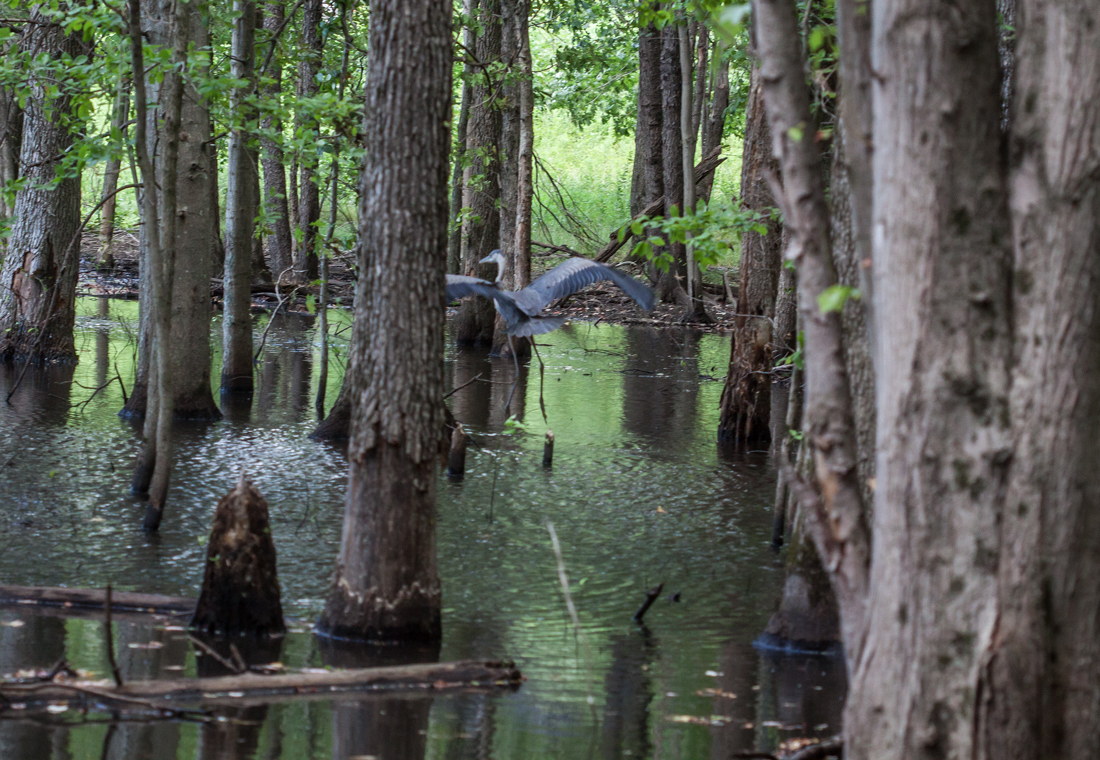
After a considerable amount of conservation construction at my local marsh, one wooded area is now flooded. It is cool and shaded and offered me respite from the hot sun on a recent summer afternoon.  Apparently a Great Blue Heron (Ardea herodias) had the same idea and I inadvertently flushed him from his calm repose.

In many ways, this is more of a landscape shot than a wildlife one, which is unusual for me. Normally I try to zoom in really close to the action, but at that moment I was simply enjoying the beautiful light that was coming into this scene. Besides, I had my 100mm macro lens on my camera, so zooming was not an option.

I really like the way the trees turned out in the image—it’s hard to explain why. In the foreground, you can see what I believe is some of the local beavers’ efforts. Last fall, the beavers felled a number of trees in this area and I wonder if they are the ones that stripped the bark off of part of one of the trees.

Click on the image if you want to see a higher resolution view of this shot.

takeoff_blog

© Michael Q. Powell. All rights reserved.


Read Full Post »

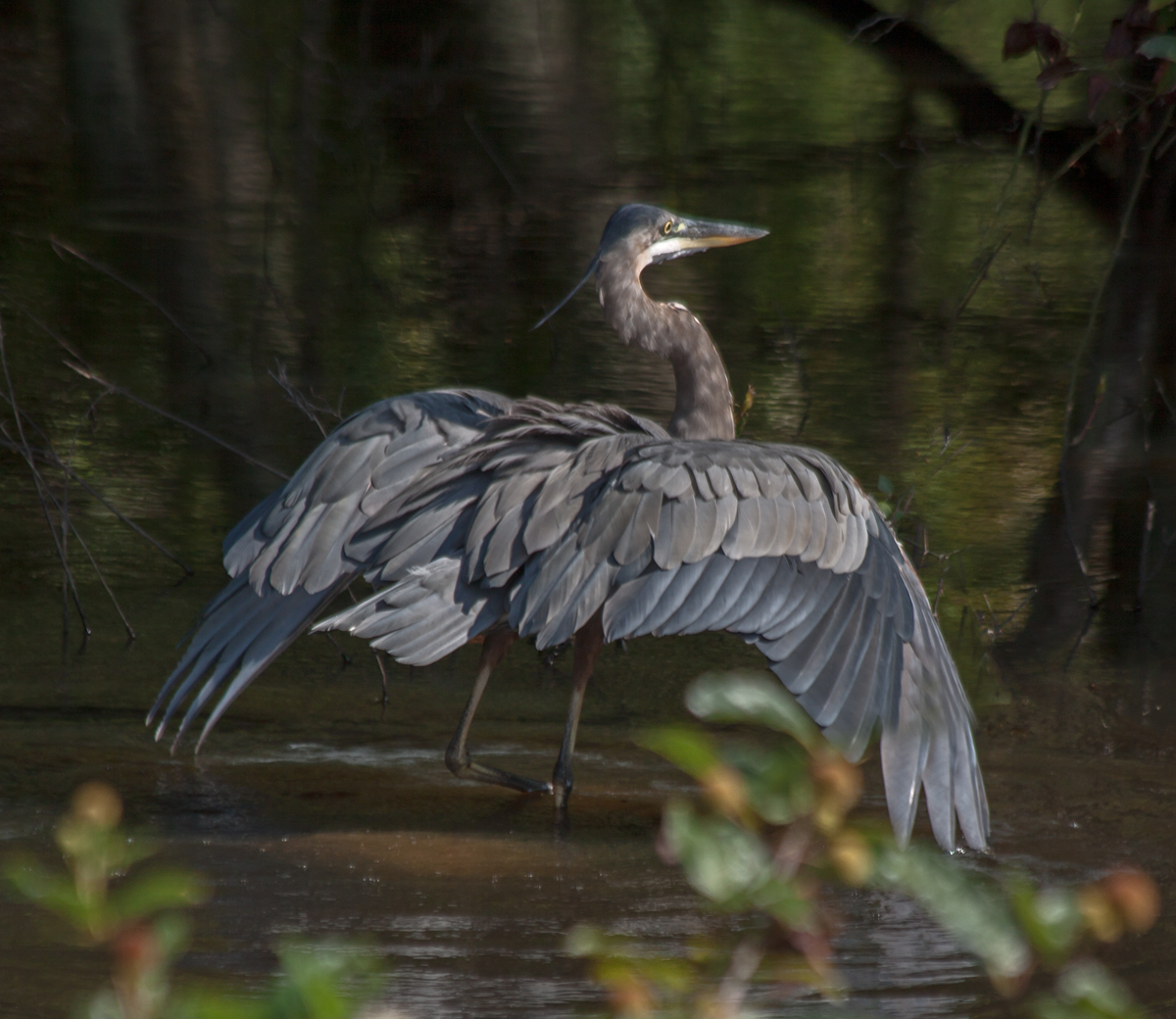
I watched and waited as the Great Blue Heron (Ardea herodias) watched and waited. When the crucial moment came, we both reacted and were rewarded—the heron got a fish and I got a photo. For a brief moment, each of us was satisfied.

Great Blue Heron Huntley Meadows Park

© Michael Q. Powell. All rights reserved.
Read Full Post »

The lighting was breathtakingly beautiful and the reflections were amazing when I caught sight of this Great Blue Heron (Ardea herodias) late last month at my local marsh. The heron was close enough that the 100mm macro lens that i had on my camera was the perfect lens for a portrait of this beautiful bird.

Great Blue Heron

© Michael Q. Powell. All rights reserved.
Read Full Post »

Chasing a nymph through the woods–it may sound like I was living out some fantasy as a character in Shakespeare’s A Midsummer Night’s Dream, but I was only running after a butterfly, a Common Wood Nymph (Cercyonis pegala).

As is usually the case, I had never seen this “Common” butterfly before, but the large, yellow-ringed eyespots on the forewings make it pretty distinctive and I had no trouble finding it in an on-line identification guide.

I chased after the butterfly for quite some time before it finally came to a stop and perched on a tree. I am not sure why, but the butterfly chose to perch upside down. When I processed my images, I couldn’t decided if I should flip the image 180 degrees or not. Ultimately I decided that the flipped image, which is the first one, looked more “normal.”

Which one do you think works better, the flipped image, i.e. the first one, or the one with the original perspective, i.e. the second one?

nymph1A_blognymph1_blog

© Michael Q. Powell. All rights reserved

Read Full Post »

How often do you find yourself taking a shot of a subject with the wrong lens? If you are an opportunistic wildlife shooter like I am, it happens pretty regularly.

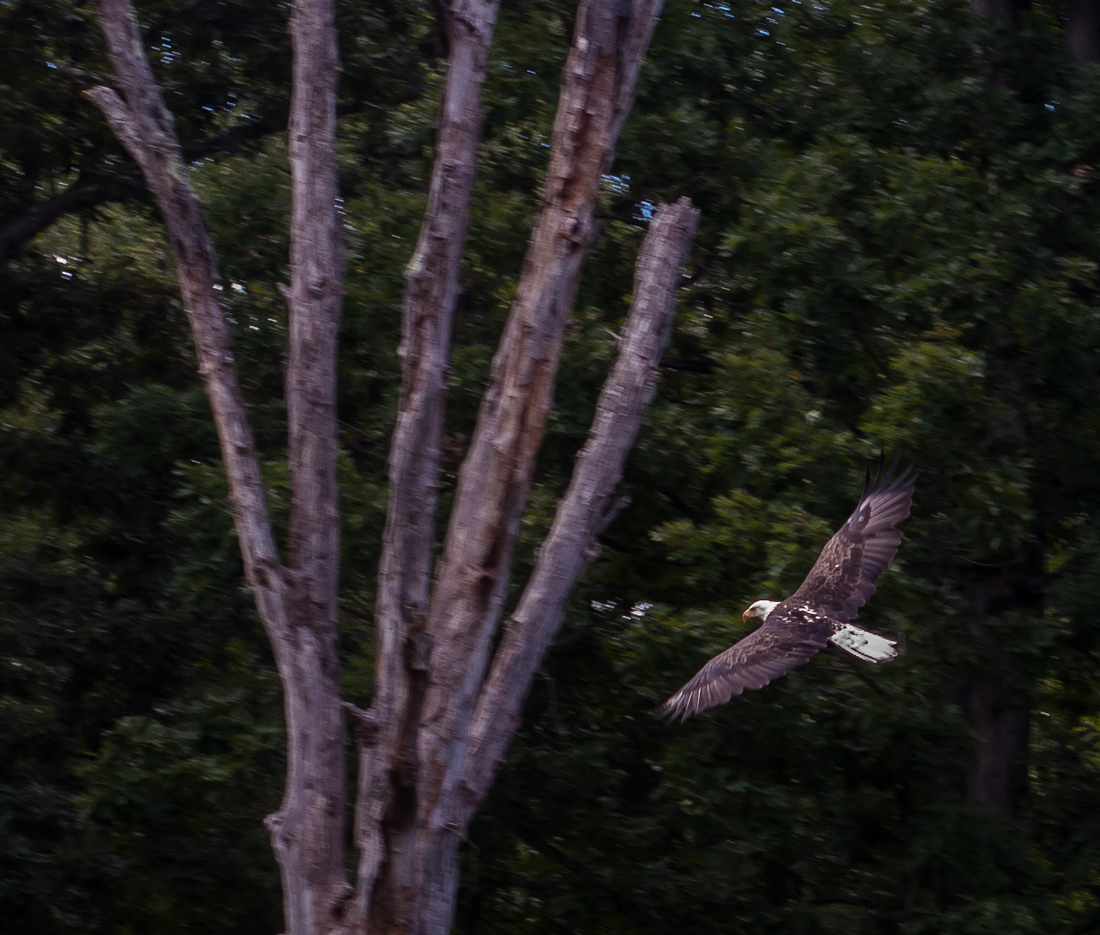
At this time of the year, most of the time I have a macro lens on my camera and I focus a lot on insects. Earlier this week, I was attempting to photograph a dragonfly with a 100mm macro lens when I heard the squawking on an approaching bird. Thinking perhaps that it was a hawk, I raised my camera and clicked off a series of shots as the bird flew by on the other side of a small pond.

Imagine my surprise when I looked at my images and realized that the bird was actually a Bald Eagle (Haliaeetus leucocephalus). There is something really special about Bald Eagles and I am thrilled every single time I see one.

Even with a crop sensor camera, a 100mm lens is not the right lens for shooting birds in flight at a distance, especially against a background of trees. I am posting a couple of shots simply to show that it is sometimes possible to get recognizable images of cool subjects even when the conditions and equipment are not optimal.

The images are also a reminder to myself to keep shooting and not wait for the perfect conditions to come together. If I wear out the camera, I can always get another one.

eagle1_blogeagle2_blog

© Michael Q. Powell. All rights reserved

Read Full Post »

Am I the only one who remembers a poster from the 1970’s featuring the slogan “Fly United” and depicting two ducks mating in mid-air?

That’s what immediately came to mind earlier this week when a pair of Great Blue Skimmer dragonflies (Libellula vibrans) flew by me at my local marsh. Anyone who has ever watched dragonflies mate knows that it is an acrobatic endeavor, requiring tremendous flexibility by both parties. Imagine trying to fly while still in the “wheel” position. Amazingly all of the wings seemed to able to move freely, though I didn’t notice if they were both using their wings for propulsion.

I was able to snap off these shots as the pair flew toward me over the water of a pond, which reflected wonderfully the blue sky and the clouds up above us.

wheel1_blogwheel2_blog

© Michael Q. Powell. All rights reserved

Read Full Post »

A handsome little skipper feeds on a gorgeous purple flower and the result is simply beautiful.

skipper_purple_blog

© Michael Q. Powell. All rights reserved

Read Full Post »

Normally when I think of saddlebags, I think of cowboys and the Pony Express, but there is also a species of skimmer dragonflies known as Black Saddlebags (Tramea lacerata). Someone obviously thought the dark patches on the hind wings looked like saddlebags.

Unlike many of the dragonflies that I often observe, Black Saddlebag dragonflies like to fly high in the air (and not low over the water) and some of them even migrate. I was alerted to their presence at my local marsh by a recent posting by a local dragonfly expert and fellow photographer Walter Sanford, so yesterday I kept one eye to the sky yesterday as I searched for subjects to photograph.

Black Saddlebags flew over me several times and I was fortunate to get some shots of one of them in flight. It might have been nice to have used a longer lens than the 100mm macro lens that I had on my camera at the time, but the shots turned out pretty well nonetheless. The first image is the sharpest image, but I like the entire sequence of the three images and the way in which they convey a sense of the environment in which I was shooting.

saddlebags1_blog The fi

saddlebags2_blogsaddlebags3_blog

© Michael Q. Powell. All rights reserved

Read Full Post »

The light reflecting off the water in the background was really bright, creating these disco ball highlights when I took these shots of a male Blue Dasher dragonfly (Pachydiplax longipennis) recently at Green Spring Gardens. Normally I try to avoid distinctive specular highlights, but in this case I decided to embrace them.

Why do I suddenly feel an irresistible urge to watch Saturday Night Fever?

disco1_blogdisco2_blog

© Michael Q. Powell. All rights reserved

Read Full Post »

« Newer Posts - Older Posts »