March 18, 2020 by Mike Powell
No matter how many times it happens, it is always exciting to see a Bald Eagle (Haliaeetus leucocephalus). Last week I spotted this one at Occoquan Bay National Wildlife Refuge and I was happy when it presented me with a chance to take this profile shot.
I had watched as the eagle flew to this tree and stealthily approached it. I was able to get relatively close, because the eagle was looking away from me and could not see me moving closer. However, the butt-first pose that it presented to me is not the most flattering for any creature, so I waited and hoped that the eagle would change its position. After what seemed like an eternity, the eagle moved its head to the side and I was finally able to get a few shots in which the eye was visible. Patience paid off one more time.

© Michael Q. Powell. All rights reserved.
Posted in Birds, Nature, Photography, spring, wildlife | Tagged Bald Eagle, Canon 50D, eagle, Haliaeetus leucocephalus, Occoquan Bay National Wildlife Refuge, Tamron 150-600mm, Woodbridge VA | 14 Comments »
March 17, 2020 by Mike Powell
Last Monday I was thrilled to spot this North American Beaver (Castor canadensis) slowly swimming by me in the early morning light at Occoquan Bay National Wildlife Refuge. I was able to follow the beaver along the shore for several minutes before it disappeared with a big splash, as you can see in the final photo that show the beaver’s distinctive tail, the last part of the beaver to enter the water.
The limited light caused me to shoot at slower shutter speeds than the situation actually demanded, but the slight blurriness somehow enhances the dreamlike feeling of the time around sunrise. I checked the data on the final shot and was a little shocked to see that I took it with a shutter speed of 1/50 of a second. Somehow I was able to capture a decent composition and an almost abstract-style image—the image that you see is also uncropped.
Happy St. Patrick’s Day to those of you who are celebrating the holiday. I grew up outside of Boston, Massachusetts, where St. Patrick’s Day is a big deal, including a large parade that, alas, had to be canceled this year.


© Michael Q. Powell. All rights reserved.
Posted in animals, beaver, Nature, Photography, spring, wildlife | Tagged beaver, Canon 50D, Castor canadensis, North American Beaver, Occoquan Bay National Wildlife Refuge, sunrise, Tamron 150-600mm, Woodbridge VA | 19 Comments »
March 16, 2020 by Mike Powell
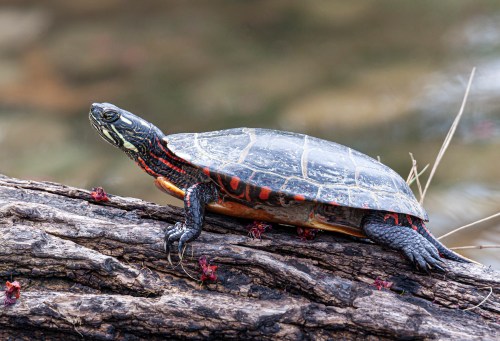
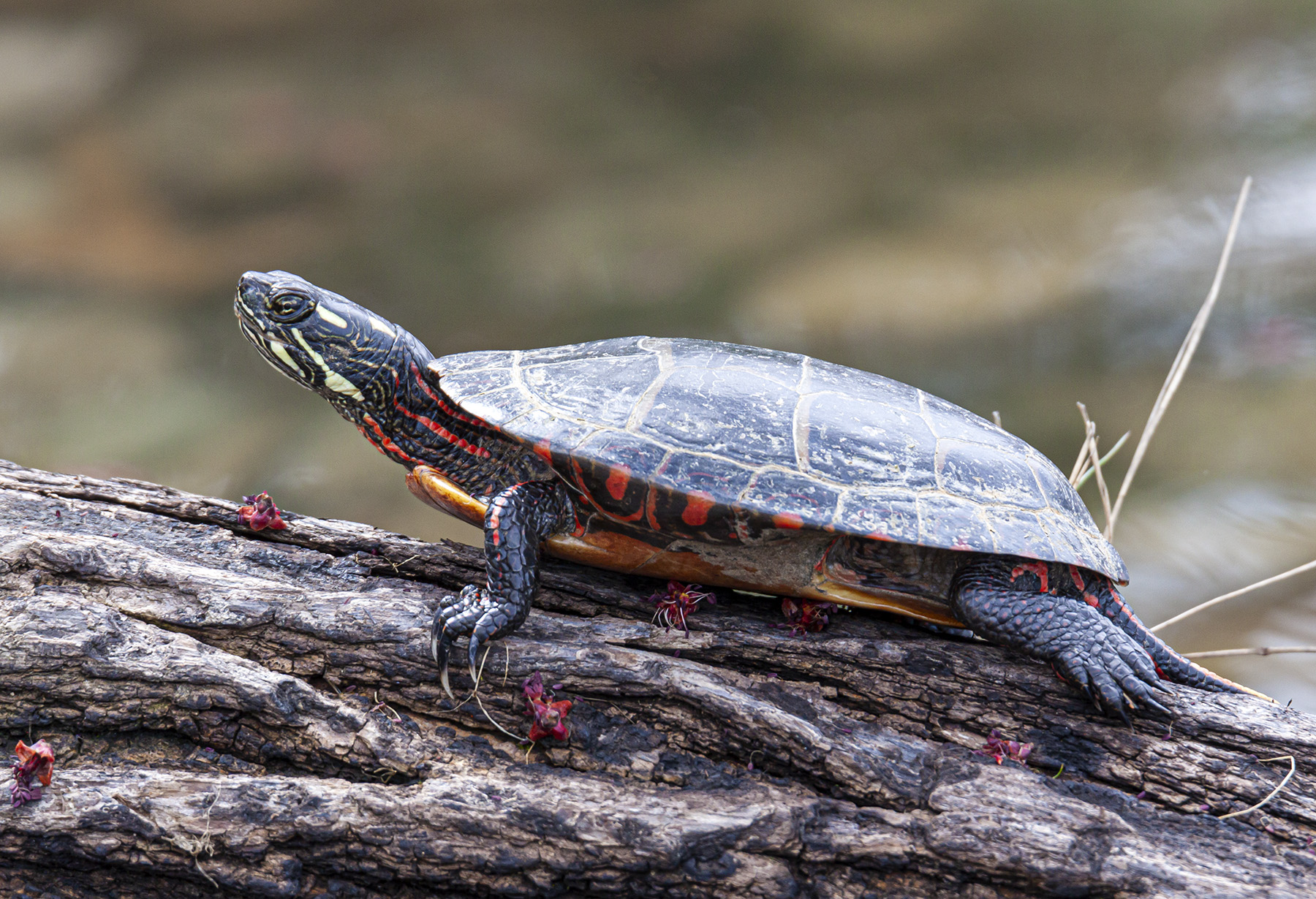
On Friday I encountered this basking Eastern Painted Turtle (Chrysemys picta picta) at the appropriately named Painted Turtle Pond at Occoquan Bay National Wildlife Refuge. Although painted turtles are common in the area in which I live, I am always happy to see their bright colors. In this case, the fallen flowers from a nearby tree added a nice accent to my little portrait of this colorful turtle.
© Michael Q. Powell. All rights reserved.
Posted in Nature, Photography, Reptiles, spring, turtle, wildlife | Tagged Canon 50D, Chrysemys picta, Chrysemys picta picta, Eastern Painted Turtle, Occoquan Bay National Wildlife Refuge, painted turtle, Painted Turtle Pond, Tamron 150-600mm, Woodbridge VA | 4 Comments »
March 15, 2020 by Mike Powell
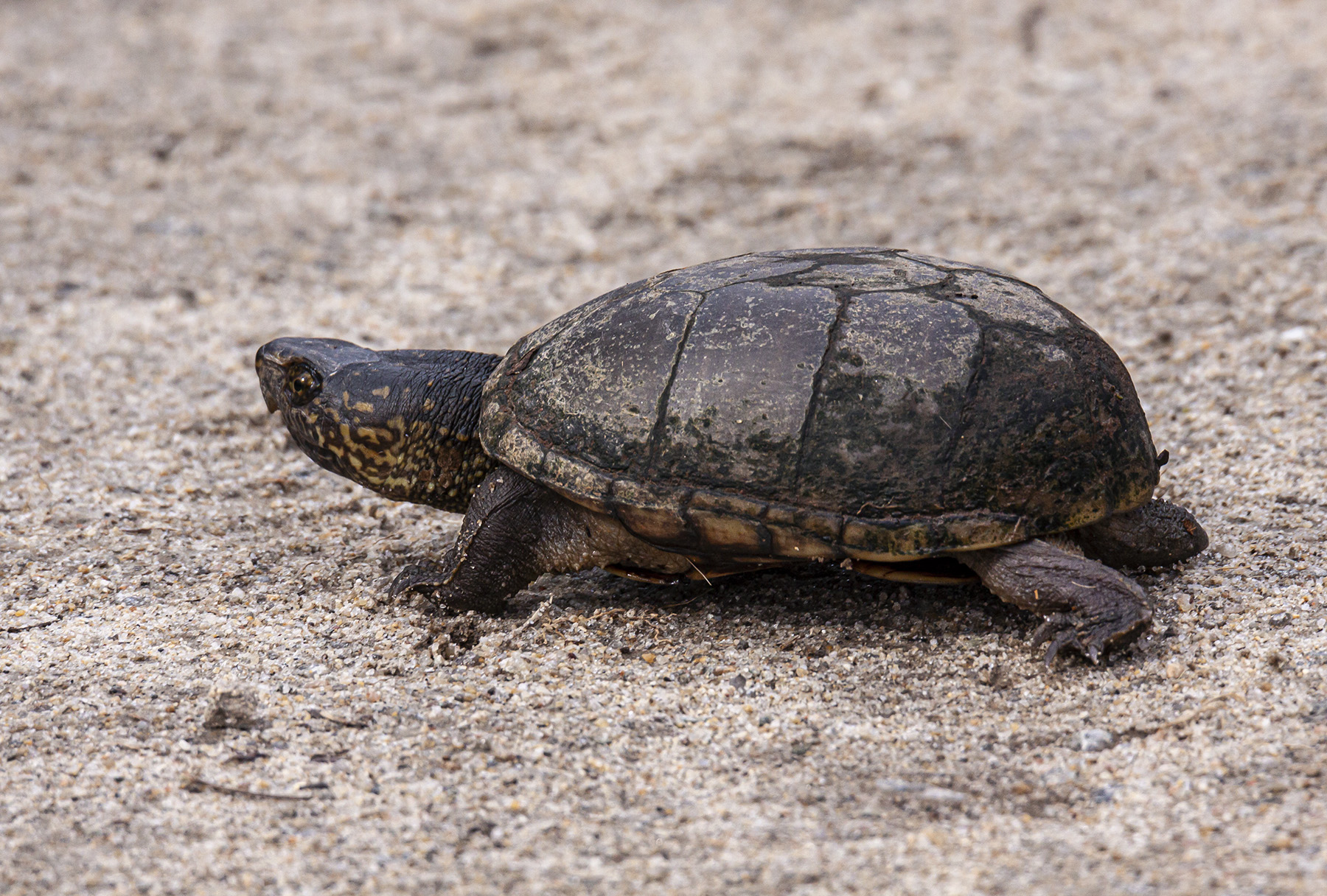
On Friday I spotted this small turtle as it was crossing one of the trails at Occoquan Bay National Wildlife Refuge. It is not a species that I see very often, but I think it is an Eastern Mud Turtle (Kinosternon subrubrum) Appropriately enough its back half appears to be covered in mud.
I generally think of turtles as being slow-moving, but this one was scrambling so quickly across the trail that it was a challenge to keep in within the camera’s viewfinder after I had zoomed in all the way with my telephoto lens. In case you are curious, Eastern Mud Turtles are only about four inches in length (10 cm).

© Michael Q. Powell. All rights reserved.
Posted in Nature, Photography, Reptiles, spring, turtle, Winter | Tagged Canon 50D, Eastern Mud Turtle, Kinosternon subrubrum, Kinosternon subrubrum subrubrum, mud turtle, Occoquan Bay National Wildlife Refuge, Southeastern Mud Turtle, Tamron 150-600mm, Woodbridge VA | 7 Comments »
March 14, 2020 by Mike Powell
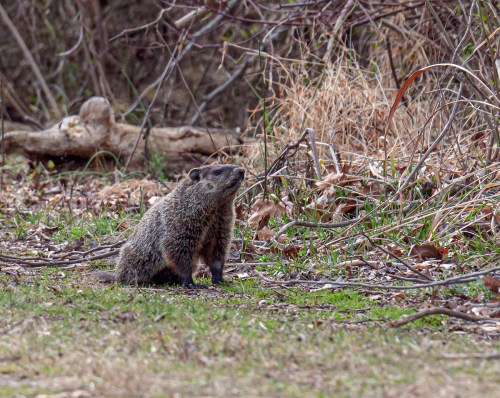
Yesterday, Friday the 13th, was also Groundhog Day for me—I spotted this Groundhog (Marmota monax) while exploring one of the trails at Occoquan Bay National Wildlife Refuge. At first I thought it might be a beaver or a muskrat, species that I am more used to seeing, but I got a good look at its tail and it was clearly not the flattened tail of a beaver nor the long rat-like tail of a muskrat.
When hearing of groundhogs, some Americans will immediately think of the annual celebration when a groundhog is taken out of its burrow and forecasts the length of the winter, depending on whether or not it can see its shadow. Others will think instead of the 1993 comedy movie Groundhog Day in which the actor Bill Murray is caught in a loop and repeats the same day over and over again. A few others might recall an ongoing GEICO insurance commercial in which woodchucks (another name for groundhogs) chuck wood.
It turns out that I actually know very little about these animals so I did a little research and learned that groundhogs are one of the few species that enter into true hibernation. According to Wikipedia, “they often build a separate “winter burrow” for this purpose. This burrow is usually in a wooded or brushy area and is dug below the frost line and remains at a stable temperature well above freezing during the winter months. In most areas, groundhogs hibernate from October to March or April, but in more temperate areas, they may hibernate as little as three months. To survive the winter, they are at their maximum weight shortly before entering hibernation. When the groundhog enters hibernation, there is a drop in body temperature to as low as 35 degrees Fahrenheit (2 degrees C), heart rate falls to 4–10 beats per minute and breathing rate falls to one breath every six minutes. During hibernation, they experience periods of torpor and arousal. Hibernating woodchucks lose as much as half their body weight by February.” (UPDATE: I later checked other sources and most of them suggest that the respiration rate drops to two per minute when the groundhog is hibernating as compared with a normal rate of 16 breaths per minute.)
Perhaps this groundhog had recently emerged from his winter sleep and was looking for things to eat when I spotted it. Fortunately all kinds of things are starting to grow and hopefully he will have few problems in filling his stomach.

© Michael Q. Powell. All rights reserved.
Posted in animals, Nature, Photography, spring, wildlife | Tagged Canon 50D, groundhog, Groundhog Day, marmota monax, Occoquan Bay National Wildlife Refuge, Tamron 150-600mm, Woodbridge VA, woodchuck | 21 Comments »
March 13, 2020 by Mike Powell
As our weather continues to warm up, more and more creatures are reappearing, like this Spotted Turtle (Clemmys guttata) that I spotted yesterday at Jackson Miles Abbott Wetland Refuge. As you can see from the photo, the turtle was on dry land, in a wooded area with pine trees, rather than in the water like most of the other turtles that I saw yesterday.
Spotted Turtles are relatively small, about 3.5 – 4.5 inches in length (9 – 11.5 cm), according to the Virginia Herpetological Society website. The website also notes that this species is seen primarily in the early spring, but seldom beyond the month of June. Spotted Turtles enter into a state of dormancy (technically it is “aestivation”) during the warmest months under vegetation and during the coldest months under mud. During those periods they are inactive and their metabolism rate is lower, but their physiological state can be rapidly reversed, and they can quickly return to a normal state.

© Michael Q. Powell. All rights reserved.
Posted in Nature, Photography, Reptiles, spring, turtle, wildlife | Tagged aestivation, Canon 50D, Clemmys guttata, Fort Belvoir VA, Jackson Miles Abbott Wetland Refuge, Spotted Turtle, Tamron 180mm | 9 Comments »
March 12, 2020 by Mike Powell
The world seems to have gone crazy recently, so I look for any signs of happiness and positivity that I can find, like this beautiful Eastern Bluebird (Sialia sialis) that I spotted on Monday at Occoquan Bay National Wildlife Refuge. The relatively subdued coloration of this bird suggests to me that this is a female bluebird.
Bluebirds are traditionally associated with happiness. It is my hope and prayer that somehow amidst the chaos of cancelled plans and possible quarantines, you will be able to pause and find a few moments to be thankful for what you do have.

© Michael Q. Powell. All rights reserved.
Posted in Birds, Nature, Photography, spring, wildlife | Tagged bluebird, bluebird of happiness, Canon 50D, Eastern Bluebird, Occoquan Bay National Wildlife Refuge, Sialia sialis, Tamron 150-600mm, Woodbridge VA | 18 Comments »
March 11, 2020 by Mike Powell
Nature photographers need to know their punctuation marks well. Last week I spotted an Eastern Comma butterfly (Polygonia comma) and this week on Monday I spotted its “cousin,” a Question Mark butterfly (Polygonia interrogationis) at Occoquan Bay National Wildlife Refuge.
I have always wondered what was going through the mind of the person that chose the official name of a given species. What caused them to focus on a particular characteristic in choosing the name? Was the person who named these butterflies a grammarian?
In the case of the Question Mark butterfly, the best identifying mark is visible only when the wings are closed. The Question Mark has white markings which more or less resemble a question mark (?) on the underside of its hindwings. (Check out the natureblog.org posting “A Question Mark, a Comma, and a Question of Origin,” to see examples of these markings.)
The good news is that there is also a way to identify a Question Mark when its wings are open—the Question Mark has four black spots in a line on each of its upper wings with the outermost spot somewhat elongated, as you can see in the first photo below.
For the sake of comparison, I am reprising a photo from last week of an Eastern Comma butterfly. I flipped it 180 degrees so it is easier to spot the differences. If you look at the butterfly in the second photo, you can see that there are only three spots on each of the upper wings, which makes it a Comma, rather than a Question Mark. (One sharp viewer last week suggested that they should have more appropriately named the butterfly with the three spots the “Ellipsis Butterfly” rather than the Eastern Comma Butterfly.) In case you are curious about the reasons for the “comma,” the butterfly has markings that look sort of like a comma (,) on the underside of its hindwings that are visible when the wings are closed.
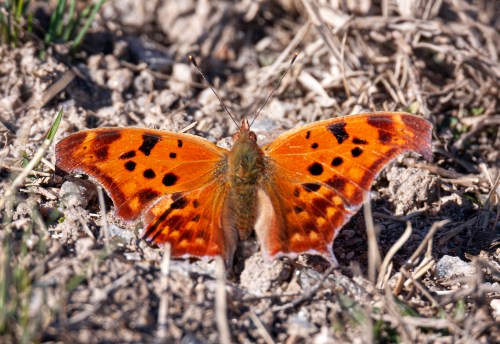
Question Mark butterfly

Eastern Comma butterfly
© Michael Q. Powell. All rights reserved.
Posted in Butterflies, Insects, Nature, Photography, spring, wildlife | Tagged Canon 50D, f, Occoquan Bay National Wildlife Refuge, Polygonia interrogationis, question mark, Question Mark butterfly, Tamron 150-600mm, Woodbridge VA | 13 Comments »
March 10, 2020 by Mike Powell
Yesterday morning I was excited to spot this handsome Red-shouldered Hawk (Buteo lineatus) perched rather low in a tree at Occoquan Bay National Wildlife Refuge. Rather than flying away immediately, as is usually the case, the hawk remained in place long enough for me to maneuver around to a good position to capture its portrait.


© Michael Q. Powell. All rights reserved.
Posted in Birds, Nature, Photography, spring, wildlife | Tagged Buteo lineatus, Canon 50D, Occoquan Bay National Wildlife Refuge, Red-Shouldered Hawk, Tamron 150-600mm, Woodbridge VA | 13 Comments »
March 9, 2020 by Mike Powell
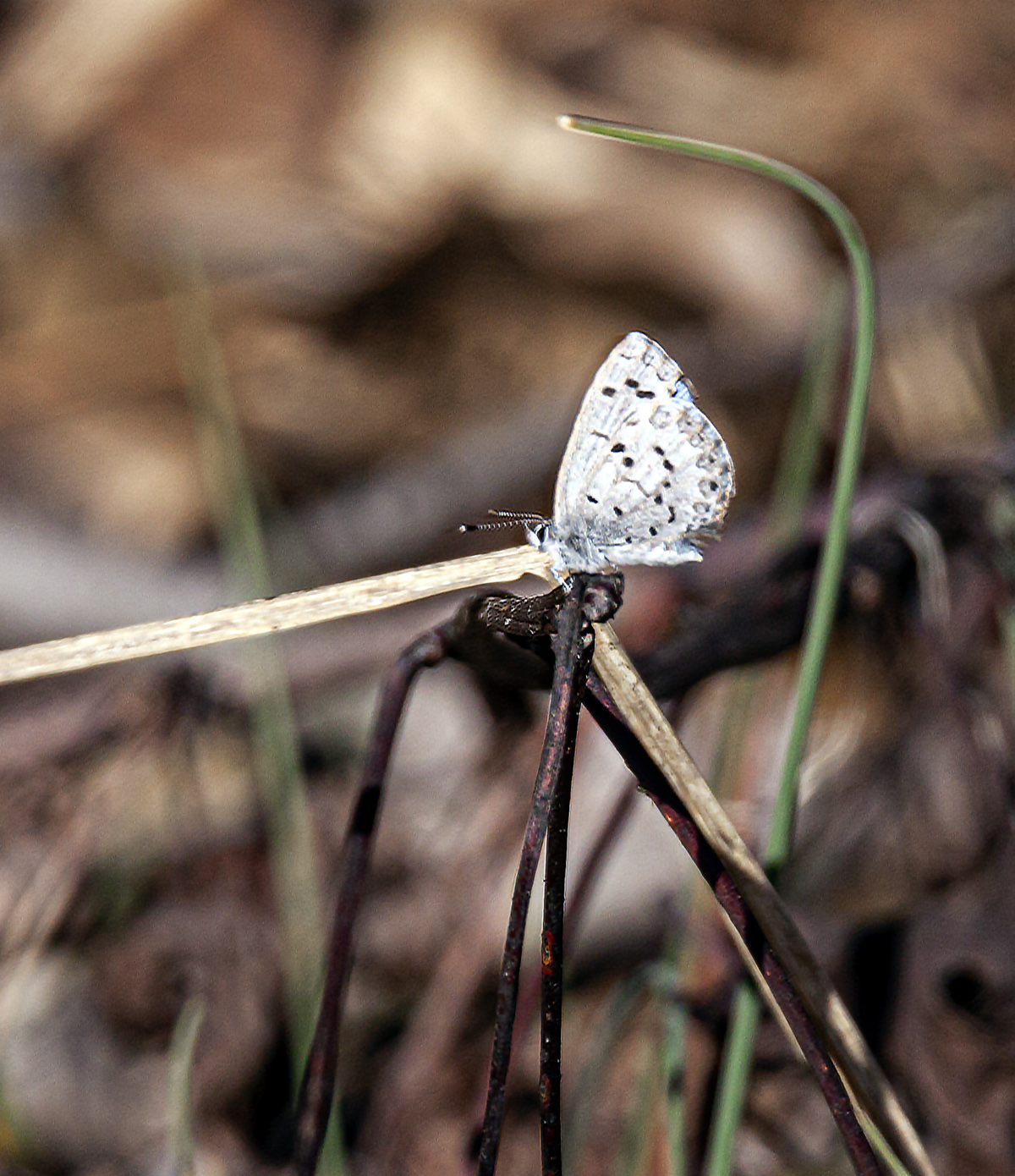
Today I was thrilled to spot another species of butterfly, the aptly named Spring Azure butterfly (Celastrina ladon), while exploring Occoquan Bay National Wildlife Refuge. This tiny butterfly is only about an inch (25 mm) in size and I was therefore a little surprised to be able to capture some of its details with my 150-600mm lens cranked all the way out to 600mm.
It shouldn’t be long before I see my first damselfly or dragonfly, given the spring-like weather and temperatures today forecast to reach over 70 degrees (21 degrees C).

© Michael Q. Powell. All rights reserved.
Posted in Butterflies, Insects, Nature, Photography, spring, wildlife | Tagged Canon 50D, Celastrina ladon, Occoquan Bay National Wildlife Refuge, Spring Azure, Spring Azure butterfly, Tamron 150-600mm, Woodbridge VA | 6 Comments »
March 8, 2020 by Mike Powell
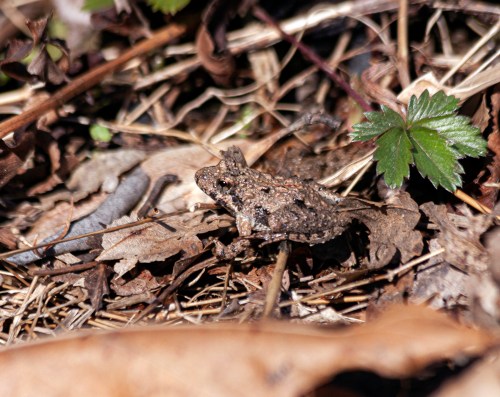
Frogs have begun to sing their springtime songs. Although they are loud, most of the frogs are small and well-hidden. I was happy to spot this tiny one, which I believe is an Eastern Cricket Frog (Acris crepitans), last Wednesday at Prince William Forest Park in Triangle, Virginia.
According to the Virginia Herpetological website, the Eastern Cricket Frog, which some other sources call the Northern Cricket Frog, is 5/8 to 1-3/8 inches in length (16-35 mm). I am pretty certain that I would not have been able to spot the little frog if it had not jumped into the air and landed at a spot that I could see. Even then, I had trouble finding it in the viewfinder of my extended telephoto lens.
The referenced website notes that the male mating call resembles the sound of two stones being hit together and a single call usually lasts through 20-30 beats. Is it music? You will have to answer that question for yourself, but I suspect that the call is music to the ears of lady frogs.
© Michael Q. Powell. All rights reserved.
Posted in Amphibians, frog, Nature, Photography, spring, wildlife | Tagged Acris crepitans, Canon 50D, Canon 70-300mm, Eastern Cricket Frog, Northern Cricket frog, Prince William Forest Park, Triangle VA | 10 Comments »
March 7, 2020 by Mike Powell
Male White-tailed Deer (Odocoileus virginianus) shed their antlers during the winter and start to grow a new set in early spring. When I first spotted the pointed white tips of deer antlers while exploring Prince William Forest Park this past Wednesday, I assumed that they were shed antlers. As I got closer, I was shocked to see that they were still attached to the skull of the now dead deer.
We have an overpopulation of White-tailed Deer in our area, in part because there are not many natural predators. I couldn’t help wondering how this large buck met his demise. Was it a coyote or fox? Was it disease, starvation, or old age? Whatever the cause of death, scavengers had done their part and the only other body parts that I spotted in the immediate area were several small spinal sections.
Later that day, I spotted a second set of antlers with the skull still attached. These antlers, shown in the second photo below, showed more damage and it is hard to tell how large they may have initially been. As was the case with the first deer, there were few parts of the deer carcass in the surrounding area—the only parts I saw in the surrounding area were the lower jaw bones.
I spend a good deal of time out in nature, but see only a small part of what really takes place in the areas that I visit. Spring often makes us think of new life as baby birds and animals are born and trees and flowers emerge with new growth. These antlers, however, are a sober reminder that death is also a part of the cycle of life for the wildlife that I enjoy observing and photographing.


© Michael Q. Powell. All rights reserved.
Posted in animals, Nature, Photography, spring, wildlife | Tagged antlers, Canon 50D, Canon 70-300mm, deer, Odocoileus virginianus, Prince William Forest Park, Triangle VA, white-tailed deer | 9 Comments »
March 6, 2020 by Mike Powell
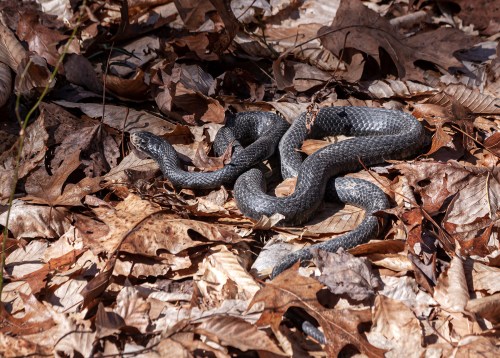
Our recent warm weather has caused all kinds of creatures to reappear, like this Eastern Ratsnake (Pantherophis alleghaniensis) that I spotted on Wednesday while hiking in Prince William Forest Park. I kept my distance and relied on a telephoto lens to zoom closer even though I knew that this snake was not poisonous. I am not sure how long the snake was, but as you can see in the second photo it looked to be quite long. According to the Virginia Herpetological Society website, the Eastern Ratsnake is the only snake in Virginia that can grow to be more than six feet (183 cm) in length.
UPDATE: A snake expert weighed in on my Facebook posting about this snake and noted that, “This is a Black Racer (Coluber constrictor constrictor). It’s harder to tell with the mud, but the dorsal scales are unkeeled, the skull shape too round, scale shape more rhombus-like, and eyes too big.” This just reinforces the notion that the more that I learn, the more I realize how little I know—that is why it is great to have experts around to help us identify what we see and photograph. The average size of a Northern Black Racer is “only” 36-60 inches (90-152 cm).

© Michael Q. Powell. All rights reserved.
Posted in Nature, Photography, Reptiles, snake, spring, wildlife | Tagged black racer, Canon 50D, Canon 70-300mm, Coluber constrictor constrictor, Eastern Ratsnake, Northern Black Racer, Northern Black Racer snake, Pantherophis alleghaniensis, Prince William Forest Park, rat snake, Triangle VA | 16 Comments »
March 5, 2020 by Mike Powell
Yesterday was a beautiful spring-like day and I went on a long hike at Prince William Forest Park, the largest protected natural area in the Washington, D.C. metropolitan region at over 16,000 acres. It felt like the perfect weather for finding dragonflies, but it is still a bit too early for them.
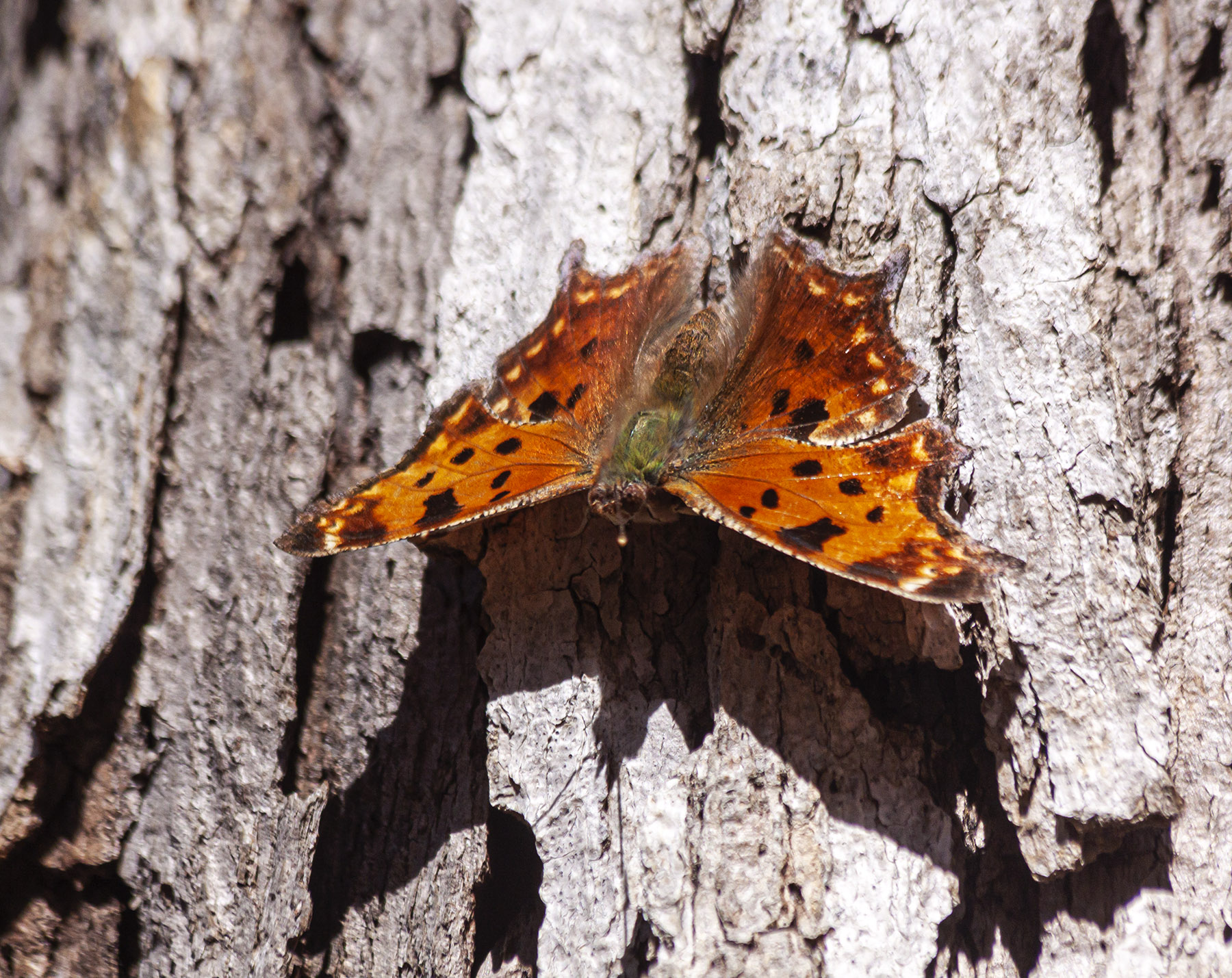
I was, however, quite excited to get my first shots this year of a butterfly, an Eastern Comma (Polygonia comma). I saw my first butterfly, which was probably of the same species, a couple of weeks ago, but was unable to react quickly enough to take its photo, so it did not “count.” During yesterday’s hike, I spotted six or seven of these little butterflies, but only the first one was cooperative enough to stay still for a portrait.
Eastern Comma butterflies are members a small group of butterflies in our area that emerge in the autumn and overwinter as adults. Other species in that group including the similar-looking Question Mark butterfly (Polygonia interrogationis) and the Mourning Cloak butterfly (Nymphalis antiopa). When its wings are open, like the one in the photo, it is easy to tell that a butterfly is an Eastern Comma if it has three dark spots in a row on each of its front wings, rather than the four spots found on a Question Mark. (For more information about the two similar species, I recommend a wonderful article at trekohio.com entitled “Butterflies That Punctuate: The Eastern Comma and the Question Mark.”)


© Michael Q. Powell. All rights reserved.
Posted in Butterflies, Insects, Nature, Photography, spring, wildlife | Tagged Canon 50D, Canon 70-, Eastern Comma, Eastern Comma butterfly, first spring butterfly, Polygonia comma, Polygonia interrogationis, Prince William Forest Park, Triangle VA | 20 Comments »
March 4, 2020 by Mike Powell
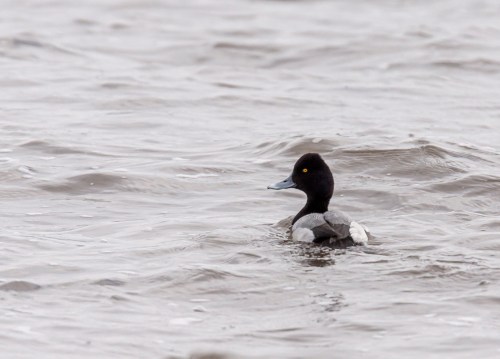
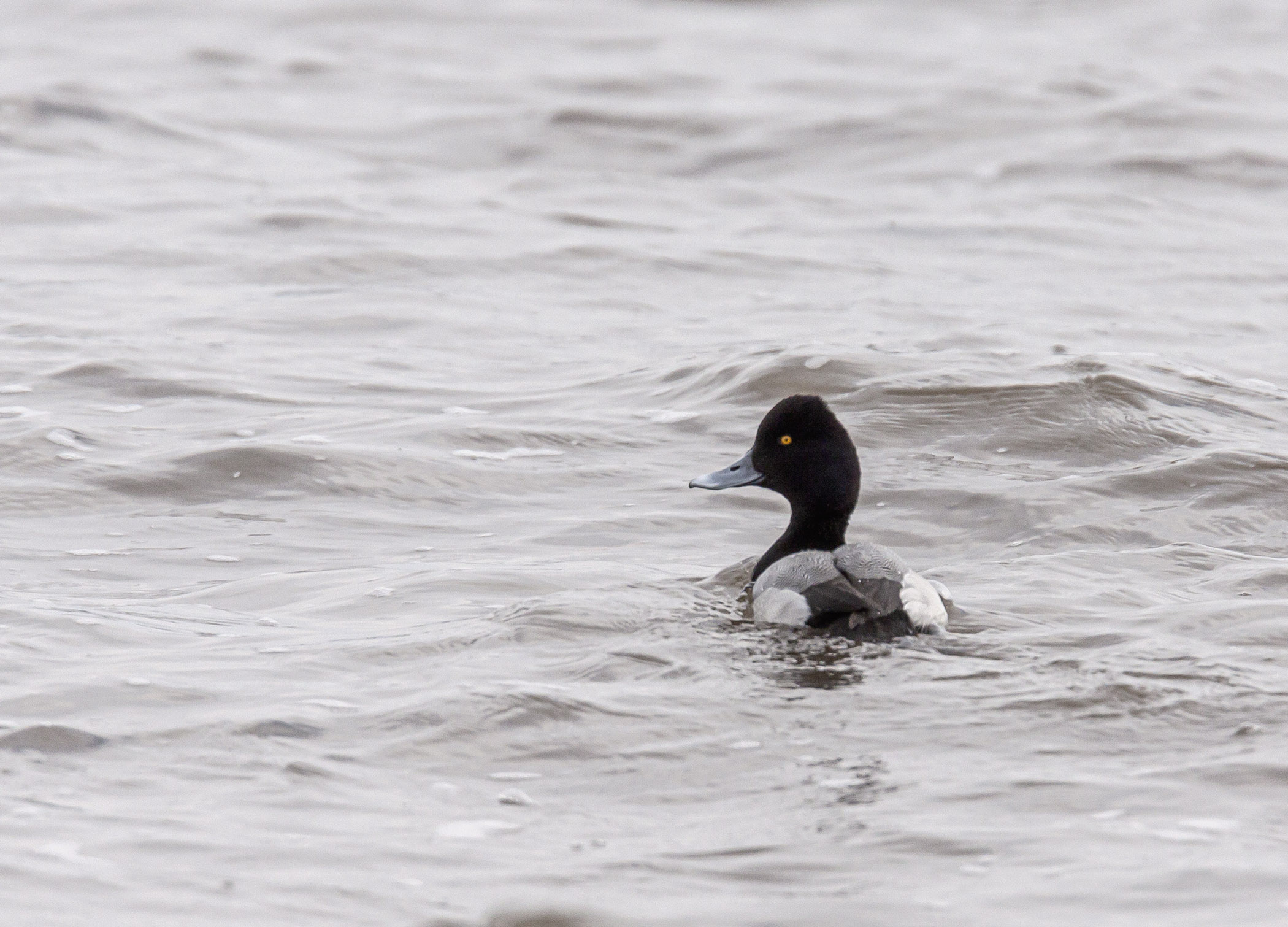
The wind was blowing strongly on Monday morning, kicking up lots of waves in the waters off of Occoquan Bay National Wildlife Refuge. In the deeper water I could see a small group of scaups bobbing up and down among the waves. Were they Greater Scaups (Aythya marila) or Lesser Scaups (Aythya affinis)?
I confess that I can’t tell the difference between the two species. I was content to get shots of both genders, especially the female with the distinctive white markings at the base of her bill.

© Michael Q. Powell. All rights reserved.
Posted in Birds, Nature, Photography, spring, wildlife | Tagged Aythya affinis, Aythya marila, Canon 50D, Greater Scaup, Lesser Scaup, Occoquan Bay National Wildlife Refuge, scaup, Tamron 150-600mm, Woodbridge VA | 1 Comment »
March 3, 2020 by Mike Powell
Yesterday morning I was delighted to spot this immature Bald Eagle (Haliaeetus leucocephalus) at Occoquan Bay National Wildlife Refuge. It takes approximately five years for a Bald Eagle to gets its classic white head and I estimate this one to be about three years old, judging from its coloration.
Initially I spotted the eagle when it flew into the midst of a group of trees. I moved around only a little, fearful of spooking the bird, and captured the second shot below when the eagle leaned forward a little and exposed its head. Moving as stealthily as I could, I maneuvered to a position from which I had a somewhat clearer shot and captured the third shot below. I noted that the eagle was crouching, which is often a prelude to taking off, but the eagle remained in place.
Eventually I reached a little opening and was able to capture the first image, which I think is the best of the group. The tree in which the eagle is perched is, I believe, a sycamore. Unlike the sweet gum trees with spiky seed balls that have appeared in many of my perched eagle shots, the seed balls of this tree appear to be much smoother.
If you are interested in the developmental stages of a Bald Eagle and how its appearance changes over time, I recommend that you check out a posting from onthewingphotography.com entitled “Bald Eagles – Age Progression from one to five years old” that features wonderful photographs of each stage.


© Michael Q. Powell. All rights reserved.
Posted in Birds, Nature, Photography, spring, Uncategorized, wildlife | Tagged Bald Eagle, Canon 50D, Haliaeetus leucocephalus, immature bald eagle, Occoquan Bay National Wildlife Refuge, Tamron 150-600mm, Woodbridge VA | 3 Comments »
March 2, 2020 by Mike Powell
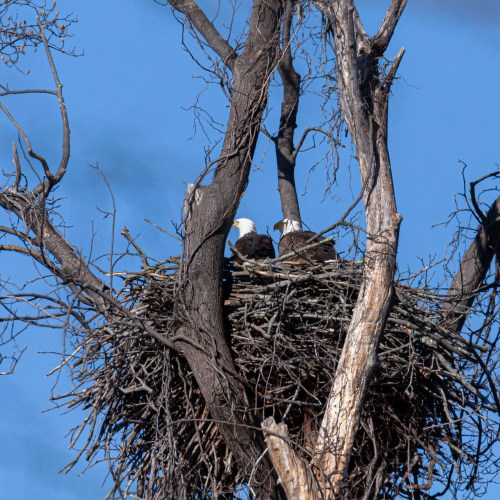
There are at least two Bald Eagle nests (Haliaeetus leucocephalus) at Occoquan Bay National Wildlife Refuge, the location where I take many of my wildlife photos. One of them is located adjacent to a popular trail and most years the authorities close nearby trails during eagle nesting season. There has been a lot of construction at the refuge over the past few months and, although I saw an eagle couple at that nesting site on several occasions, it looks like they may not have occupied that nest this year (and the trails have not been closed).
The second nest, pictured below, is in a more remote location—it is visible through the trees from one of the trails, but is surrounded by dense vegetation, so the eagles are more insulated from human activity. On a recent visit to the refuge, I was pleased to spot both members of an eagle couple in the nest. I am pretty sure that the eagle on the left is the male, because male eagles tend to be considerably smaller than their female counterparts.
With a bit of luck I hope to be able to spot some eaglets here in the upcoming months, although I noted last year that it is a real challenge to do so, because the wall of this large nest appear to be quite high and effectively hide the eagles from view.
© Michael Q. Powell. All rights reserved.
Posted in Birds, Nature, Photography, wildlife, Winter | Tagged Bald Eagle, Bald Eagle couple, bald eagle nest, Canon 50D, Haliaeetus leucocephalus, Occoquan Bay National Wildlife Refuge, Tamron 150-600mm, Woodbridge VA | 13 Comments »
March 1, 2020 by Mike Powell
Although the old proverb asserts that “birds of a feather flock together,” I have learned the value of examining groups of floating birds, because they often include multiple species. I was examining one such group last week in the waters off of Occoquan Bay National Wildlife Refuge when I spotted an obvious outlier, a duck that was larger and more brightly colored than the rest. I am pretty sure that this is a male Canvasback duck (Aythya valisineria), a species that I do not see very often and still have not seen at close range.

© Michael Q. Powell. All rights reserved.
Posted in Birds, Nature, Photography, wildlife, Winter | Tagged Aythya valisineria, Canon 50D, Canvasback, Canvasback duck, Occoquan Bay National Wildlife Refuge, Tamron 150-600mm, Woodbridge VA | 6 Comments »
February 29, 2020 by Mike Powell
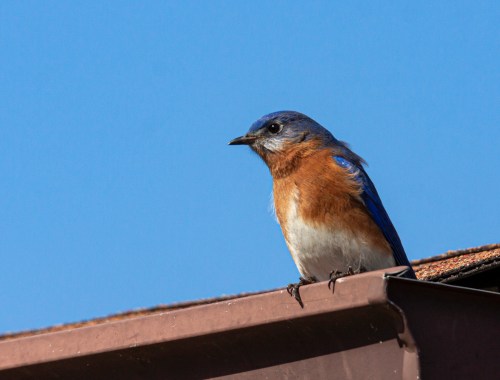
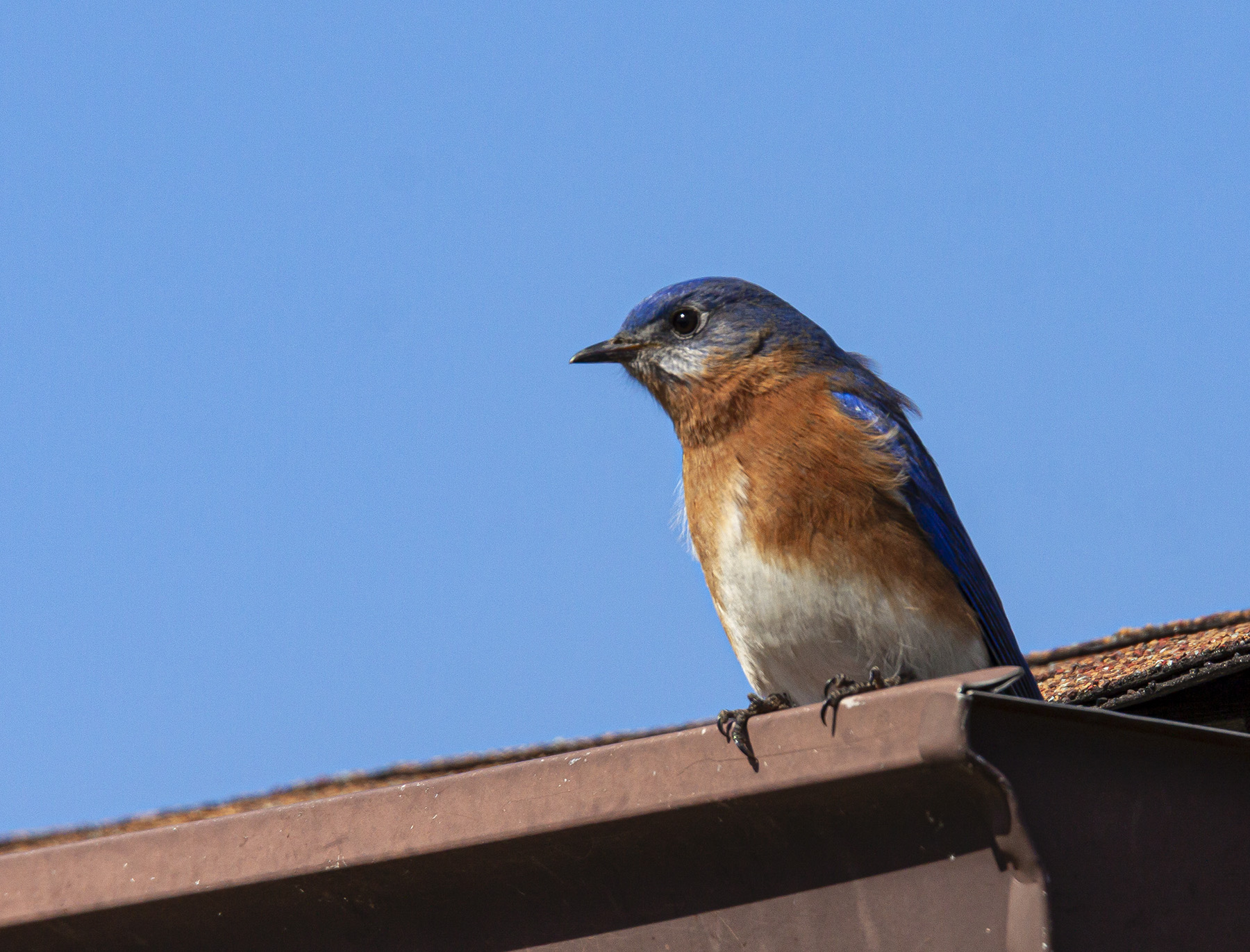
A strong wind was blowing last Thursday as I was exploring Occoquan Bay National Wildlife Refuge. Most of the birds that I usually observe were absent from view, probably using common sense to take shelter from the blustery wind. As I was returning almost empty-handed to my car, I spotted several Eastern Bluebirds (Sialia sialis) perched low on the roof of a covered picnic area.
Generally I try to avoid including manmade structures in my wildlife photos, but sometimes you just have to take what you can get. I really like the way that I was able to capture some of the feather details of this male Eastern Bluebird. If you look closely, you can see the bird’s windblown feathers, a look that is cultivated by some stylish humans, who often rely on “product” to achieve the effect rather than on the actual wind.
© Michael Q. Powell. All rights reserved.
Posted in Birds, Nature, Photography, wildlife, Winter | Tagged bluebird, Canon 50D, Eastern Bluebird, Occoquan Bay National Wildlife Refuge, Sialia sialis, Tamron 150-600mm, windblown, Woodbridge VA | 12 Comments »
February 28, 2020 by Mike Powell
I do not know much about fashion, but I am pretty sure that I could not pull off wearing an outfit that combined stripes and dots. Somehow, though, the combination works well for this male Northern Flicker (Colaptes auratus) that I spotted yesterday morning at Occoquan Bay National Wildlife Refuge. This Northern Flicker goes even further by adding a bright red crescent across the back of his head.
Unlike most other woodpeckers that are content to wear black and white and maybe a little bit of red, this Northern Flicker comes across as a bold, colorful, and stylish. I wonder why we don’t have similarly-colored penguins.

© Michael Q. Powell. All rights reserved.
Posted in Birds, Nature, Photography, wildlife, Winter | Tagged Canon 50D, Colaptes auratus, flicker, male Northern Flicker, Northern Flicker, Occoquan Bay National Wildlife Refuge, Tamron 150-600mm, Woodbridge VA | 15 Comments »
February 27, 2020 by Mike Powell
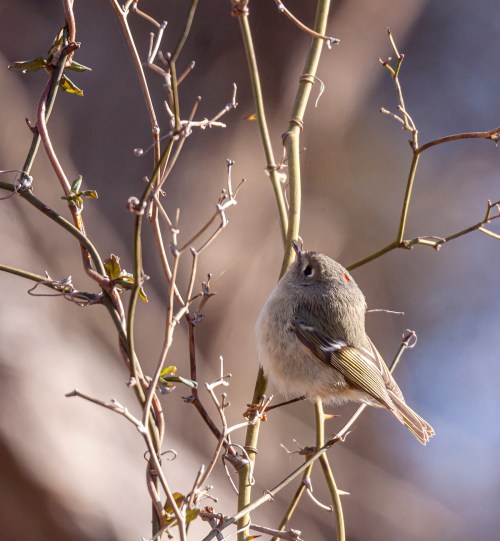
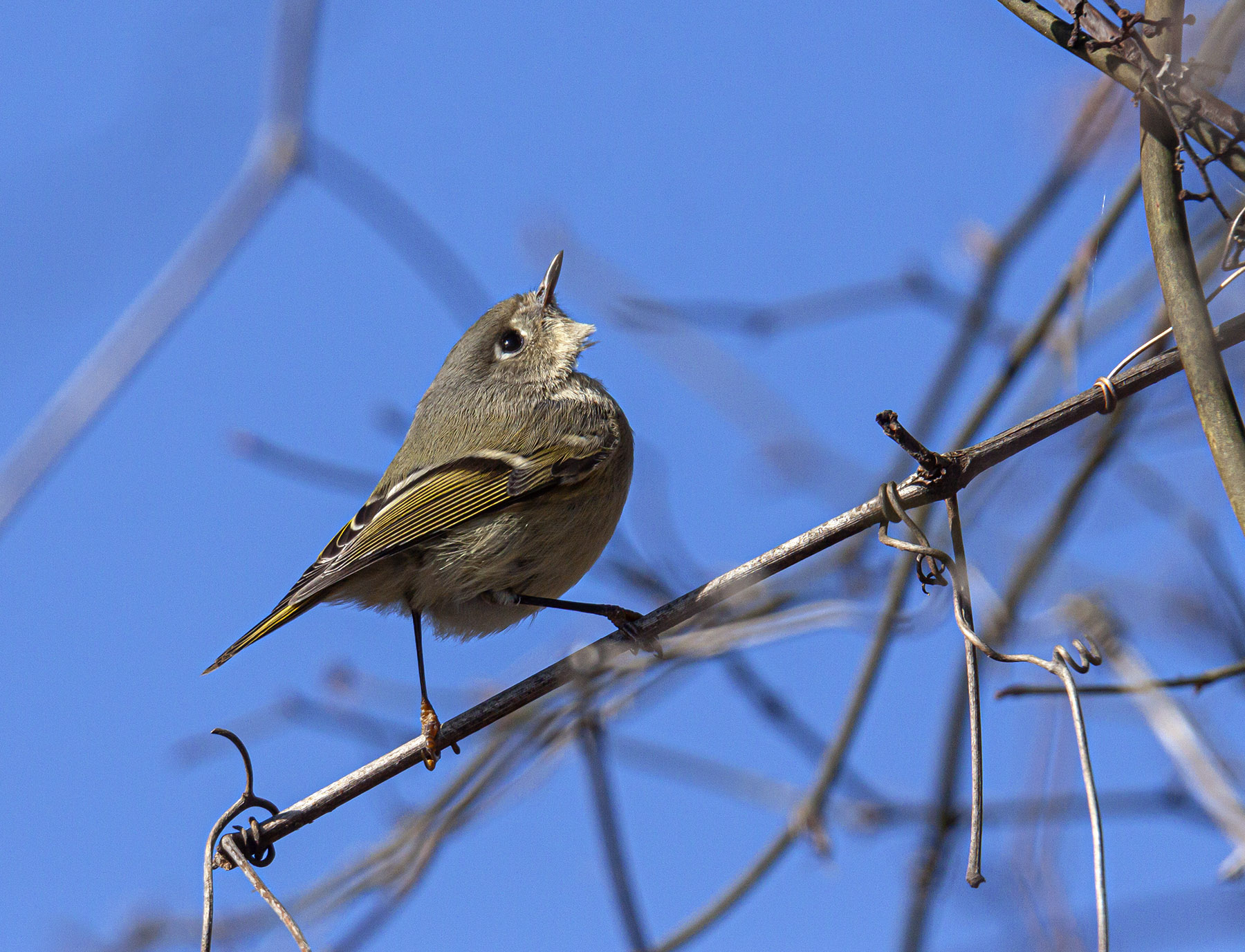
I feel lucky when I am able to capture an unobstructed shot of a Ruby-crowned Kinglet (Regulus calendula). I feel doubly fortunate when I manage to get a shot of the tiny red “crown” that is responsible for the bird’s name. Last week I spotted this Ruby-crowned Kinglet at Occoquan Bay National Wildlife Refuge.
According to the Cornell Lab of Ornithology, “the male’s brilliant ruby crown patch usually stays hidden—your best chance to see it is to find an excited male singing in spring or summer.” I have seen some photos of Ruby-crowned Kinglets with their red feathers standing on end like a Mohawk hairstyle, but I have not yet seen that phenomenon in person. Spring is almost here, though, and I will keep my eyes open to see if I can spot an excited male singing kinglet. (I recommend that you repeat the words “singing kinglet” several times and you will almost certainly end up with a smile on your face.)
© Michael Q. Powell. All rights reserved.
Posted in Birds, Nature, Photography, wildlife, Winter | Tagged Canon 50D, kinglet, Occoquan Bay National Wildlife Refuge, Regulus calendula, ruby-crowned kinglet, Tamron 150-600mm, Woodbridge VA | 11 Comments »
February 26, 2020 by Mike Powell
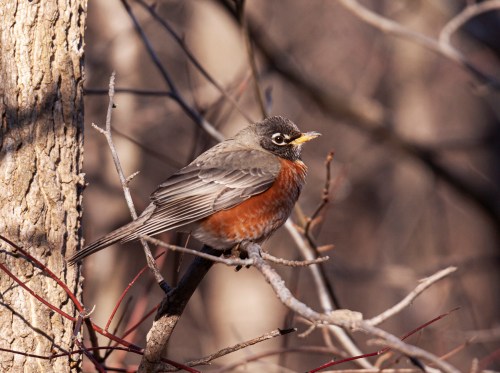
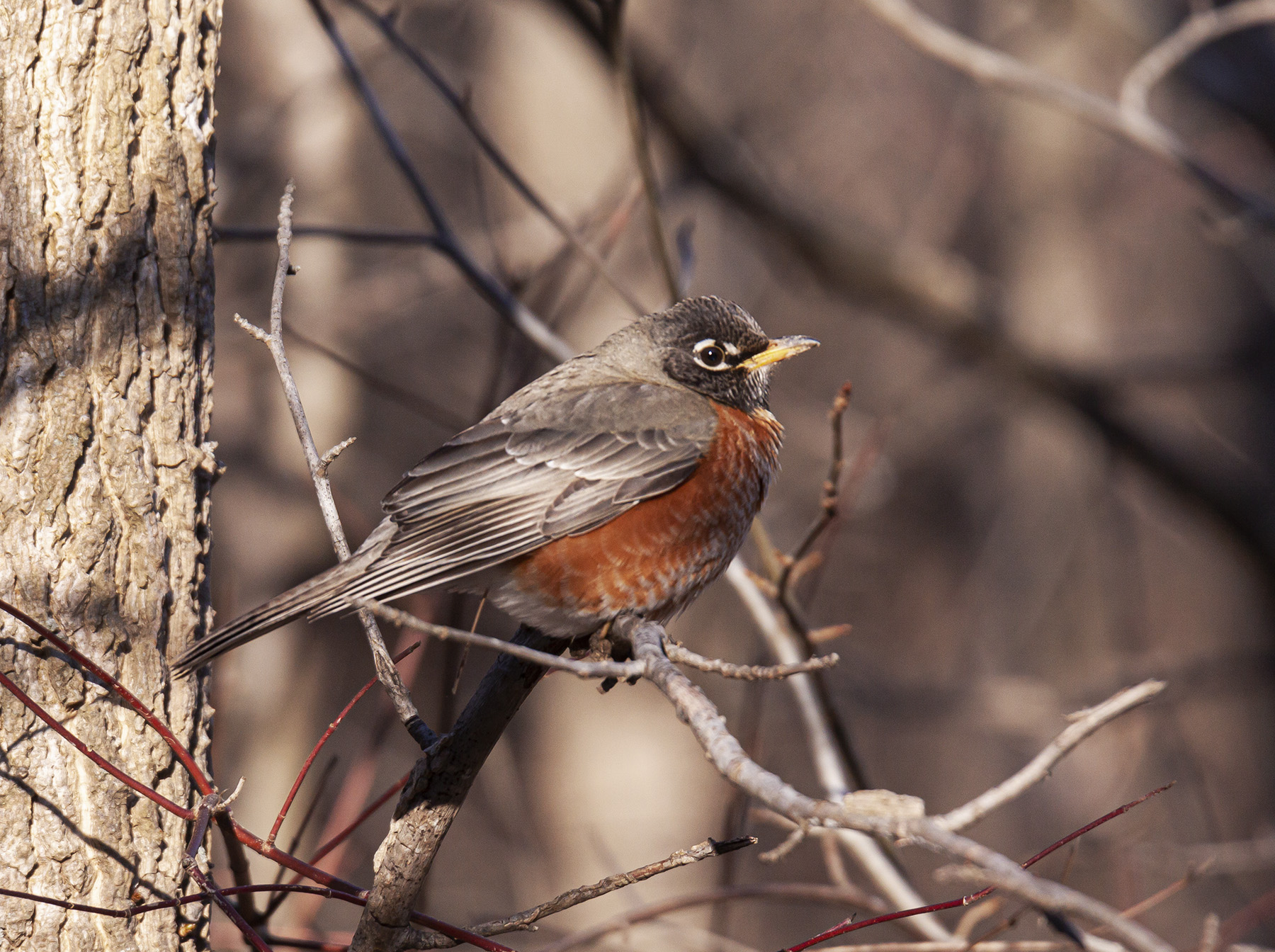
Where I live in Northern Virginia, American Robins (Turdus migratorius) stay with us throughout most of the year, but I am always happy to see them because they evoke memories of my childhood, when robins were viewed as a harbinger of spring. This robin was part of a small flock that I spotted last week at Occoquan Bay National Wildlife Refuge.
Robins also bring a smile to my face, because they invariably bring to mind the song “When the Red, Red Robin (Comes Bob, Bob, Bobbin’ Along)” that includes these catchy lyrics (as found on lyrics.com):
“When the Red, Red Robin Comes Bob-Bob Bobbin’ Along
When the red, red robin comes bob, bob, bobbin’ along, along
There’ll be no more sobbin’ when he starts throbbin’ his old sweet song
Wake up, wake up you sleepy head
Get up, get out of your bed
Cheer up, cheer up the sun is red
Live, love, laugh and be happy
What if I were blue,
Now I’m walking through
Fields of flowers
Rain may glisten but still I listen for hours and hours
I’m just a kid again doing what I did again, singing a song
When the red, red robin comes bob, bob, bobbin’ along.”
If you are unfamiliar with this song, check out this
link to Youtube to hear a wonderful version by Bing Crosby.
Readers from the United States may have noted that I initially called this bird an American Robin, rather than simply a Robin. Thanks to my occasional trips to Europe, I have been introduced to the European Robin (Erithacus rubecula), an equally beautiful but completely different bird. Here’s a link to a posting about a European Robin that I spotted in Paris last November.
© Michael Q. Powell. All rights reserved.
Posted in Birds, Nature, Photography, wildlife, Winter | Tagged American robin, Canon 50D, Occoquan Bay National Wildlife Refuge, robin, Tamron 150-600mm, Turdus migratorius, Woodbridge VA | 19 Comments »
February 25, 2020 by Mike Powell
Getting an unobstructed shot of small birds is frequently impossible, so I often have to twist, turn, and bend in order to get a clear shot of at least the bird’s head. That certainly was the case with this focused male Downy Woodpecker (Picoides pubescens) last week at Occoquan Bay National Wildlife Refuge.
If you look closely at the web of branches that surround and frame this woodpecker, you may notice that they are at varying degrees of sharpness, with some of them closer to the bird and some closer to me. My task was to find a visual tunnel through the branches that would somehow make them as undistracting as possible, even when they run right across the body of the main subject. Of course, the challenge is even greater with a subject like a Down Woodpecker that is hyperactive and in almost constant motion.

© Michael Q. Powell. All rights reserved.
Posted in Birds, Nature, Photography, wildlife, Winter | Tagged Canon 50D, Downy Woodpecker, male Downy Woodpecker, Occoquan Bay National Wildlife Refuge, Picoides pubescens, Tamron 150-600mm, Woodbridge VA | 15 Comments »
February 24, 2020 by Mike Powell
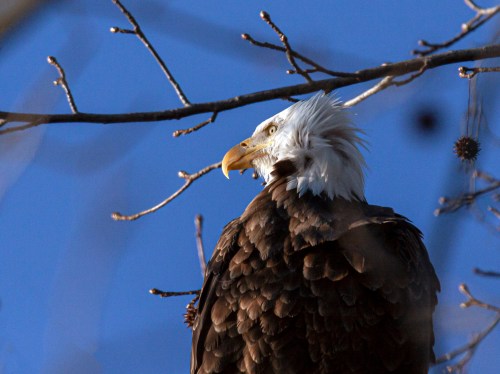
The wind was blowing strongly last Friday morning at Occoquan Bay National Wildlife Refuge, giving this Bald Eagle (Haliaeetus leucocephalus) a bad case of “bed head.” I think that the wind may also have distracted the eagle a little, which allowed me to move closer to the eagle that I might otherwise have been able to do.
© Michael Q. Powell. All rights reserved.
Posted in Birds, Nature, Photography, wildlife, Winter | Tagged Bald Eagle, Canon 50D, eagle, Haliaeetus leucocephalus, Occoquan Bay National Wildlife Refuge, ruffled feathers, Tamron 150-600mm, Woodbridge VA | 11 Comments »
February 23, 2020 by Mike Powell
During a frosty early morning February foray into Occoquan Bay National Wildlife Refuge, I spotted this handsome male Red-bellied Woodpecker (Melanerpes carolinus) with fluffed-up feathers. Undeterred by the wind and the cold, he was feverishly moving up and around this tree trunk, pecking along the way in search of a tasty tidbit for breakfast.

© Michael Q. Powell. All rights reserved.
Posted in Birds, Nature, Photography, wildlife, Winter | Tagged Canon 50D, Melanerpes carolinus, Occoquan Bay National Wildlife Refuge, Red-bellied Woodpecker, Tamron 150-600mm, Woodbridge VA, woodpecker | 9 Comments »
February 22, 2020 by Mike Powell
This Ruby-crowned Kinglet (Regulus calendula) had its eye on the prize, with the prize being a cluster of wizened poison ivy berries, yesterday morning at Occoquan Bay National Wildlife Refuge. These tiny songbirds rely on seeds and fruits to make it through the winter. I won’t be long, though, before they revert to a diet of primarily insects—I like to think of them as seasonal vegetarians.


© Michael Q. Powell. All rights reserved.
Posted in Birds, Nature, Photography, wildlife, Winter | Tagged Canon 50D, Occoquan Bay National Wildlife Refuge, poison ivy berries, Regulus calendula, ruby-crowned kinglet, Tamron 150-600mm, Woodbridge VA | 12 Comments »
February 21, 2020 by Mike Powell
It was sunny this morning, as forecast, but it was also windy and cold when I set out at 7 o’clock, about 25 degrees (minus 4 degrees C), according to the thermometer in my car. Most of the birds at Occoquan Bay National Wildlife Refuge seemed to have decided to sleep late, but eventually I started to see some of them, including this Great Blue Heron (Ardea herodias) that was wading out into the shallow waters of a low tide.

© Michael Q. Powell. All rights reserved.
Posted in Birds, Nature, Photography, wildlife, Winter | Tagged Ardea herodias, Canon 50D, Great Blue Heron, heron, Occoquan Bay National Wildlife Refuge, Tamron 150-600mm, Woodbridge VA | 11 Comments »
February 20, 2020 by Mike Powell
On some winter days it is tough to find birds to photograph—all of the birds that I do manage to see are either far away or hidden. On one of those kind of days last week, I was thrilled to spot this cute little Carolina Wren (Thryothorus ludovicianus) that was only half-hidden in a distant tree. My efforts were aided by the fact that Carolina Wrens are loud singers, especially considering their diminutive size, which allowed me to hear this bird well before I actually saw it.

© Michael Q. Powell. All rights reserved.
Posted in Birds, Nature, Photography, wildlife, Winter | Tagged Canon 50D, Carolina Wren, Occoquan Bay National Wildlife Refuge, Tamron 150-600mm, Thryothorus ludovicianus, Woodbridge VA | 10 Comments »
February 19, 2020 by Mike Powell
One of the highlights of my visit on Monday to Green Spring Gardens was photographing a blossoming Japanese Apricot tree (Prunus mume). It was a little strange to see a tree with blossoms during the winter, but apparently it is normal for this species to blossom in mid-winter and late winter. The flowers are commonly known as plum blossoms and are a frequent theme in traditional painting in China and in other East Asian countries—the blossoms were also a favorite with the honey bees.
According to Wikipedia, the plum blossom is “one of the most beloved flowers in China and has been frequently depicted in Chinese art and poetry for centuries. The plum blossom is seen as a symbol of winter and a harbinger of spring. The blossoms are so beloved because they are viewed as blooming most vibrantly amidst the winter snow, exuding an ethereal elegance, while their fragrance is noticed to still subtly pervade the air at even the coldest times of the year. Therefore, the plum blossom came to symbolize perseverance and hope, as well as beauty, purity, and the transitoriness of life.”
I do not use my macro lens very much during the winter months and usually leave it at home. However, the mild weather that we have been having made me suspect that some flowers would be in bloom, so I put the macro lens on my camera—the busy bees turned out to be a big bonus.
I especially admired the efforts of the bee in the first photo. This bee did not want to wait for the bud to open, but instead burrowed its way to the pollen-filled center of the blossom-to-be.


© Michael Q. Powell. All rights reserved.
Posted in Bees, Flowers, Gardening, Macro Photography, Nature, Photography, spring | Tagged Canon 50D, green spring gardens, honey bee, honeybee, Japanese Apricot tree, plum blossoms, Prunus mume, Tamron 180mm macro lens | 10 Comments »
February 18, 2020 by Mike Powell
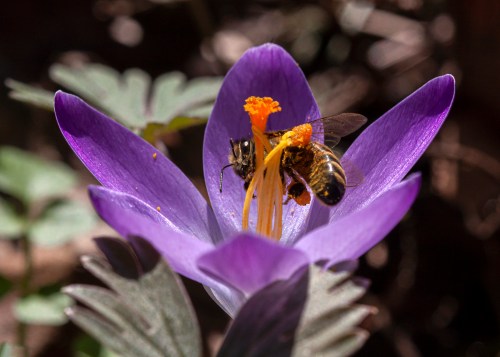
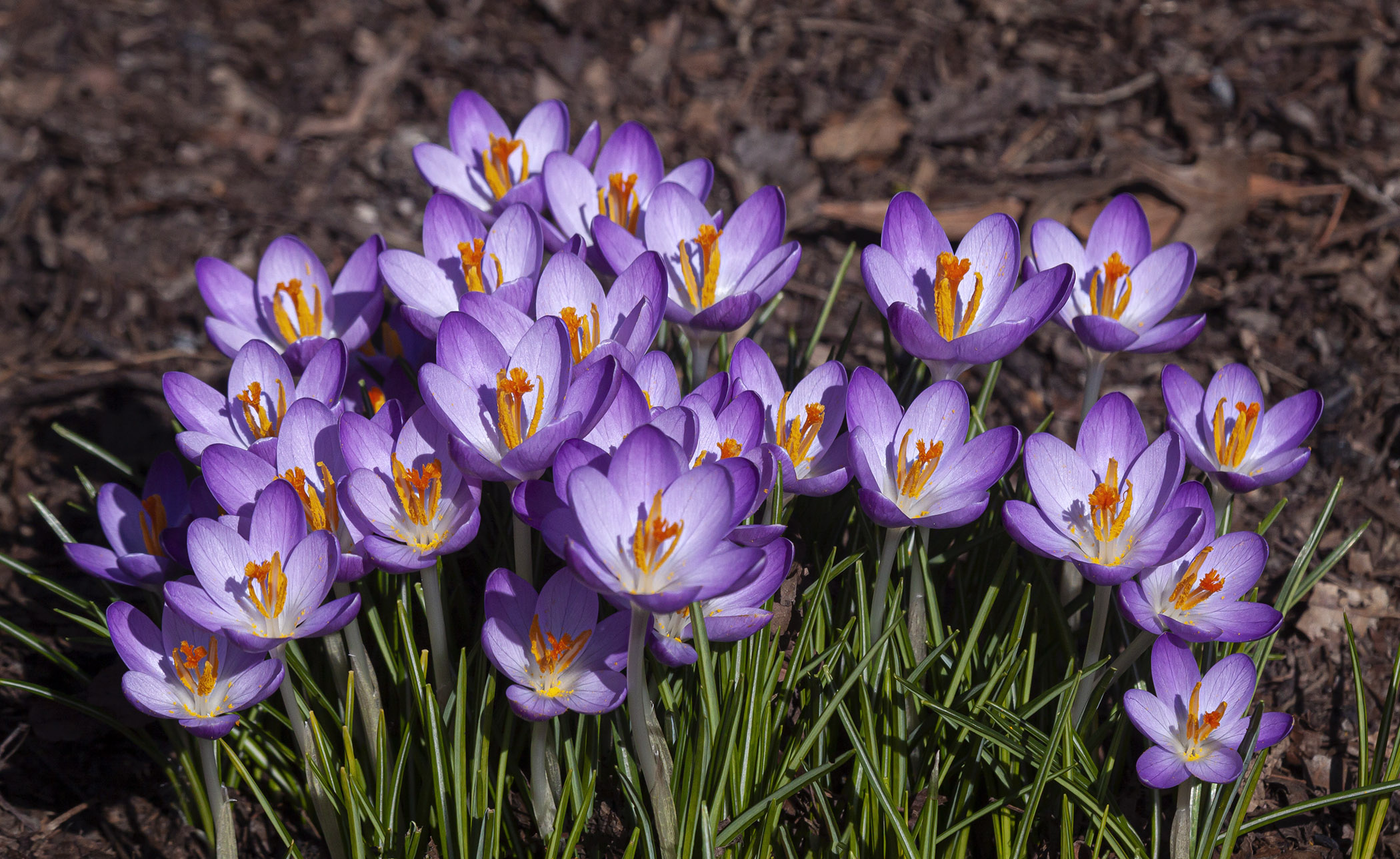
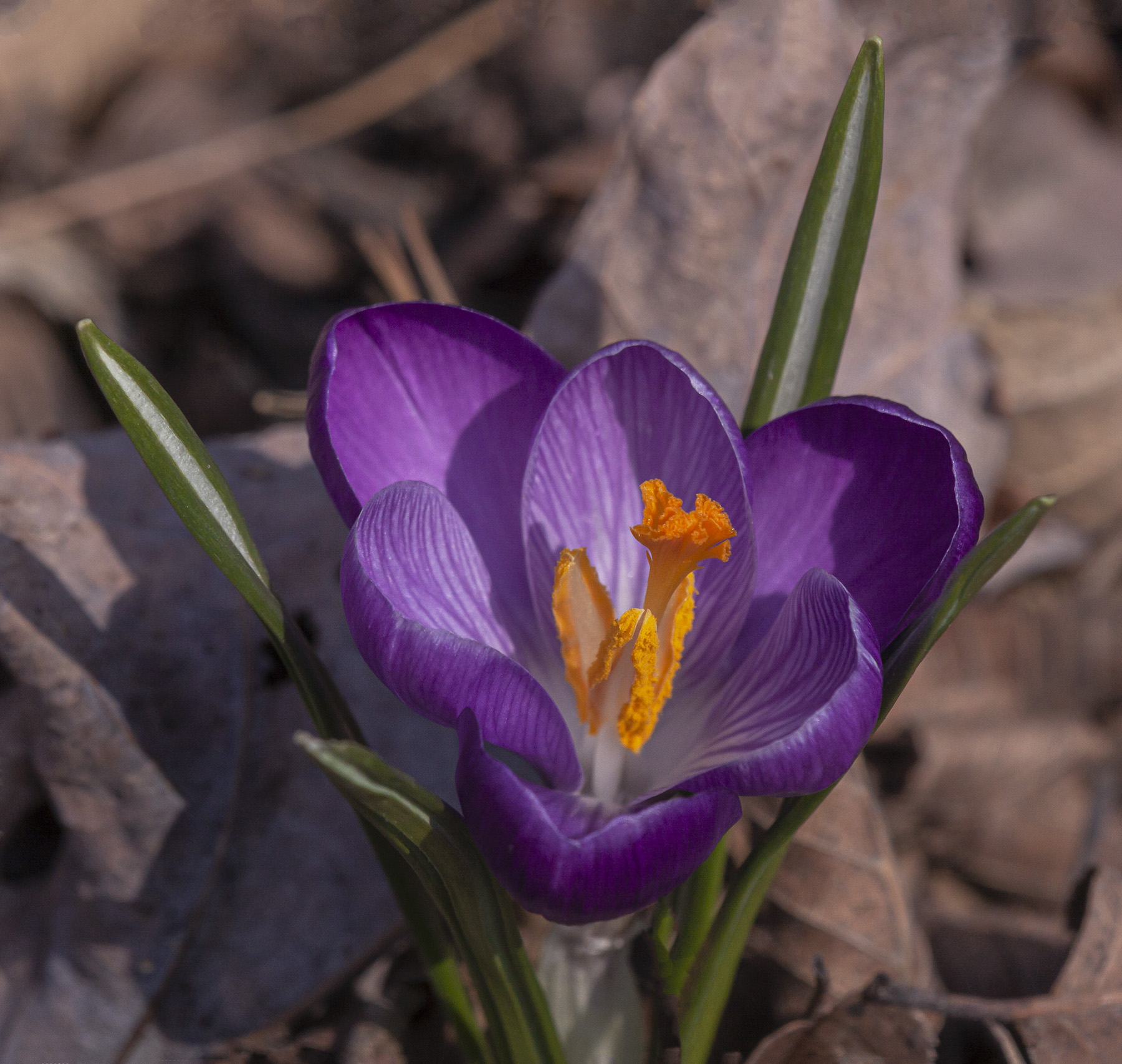
This winter has been usually mild and spring color is already starting to appear in our area. During a visit yesterday to Green Spring Gardens, a local county-run historical garden, I spotted crocuses in bloom at several locations. Finding crocuses was not too much of a surprise, since they are usually among the first flowers to appear each spring. However, it was an unexpected bonus to be able to photograph a honey bee collecting pollen inside of one of the crocuses.
In many ways yesterday’s photography was a return to my roots. When I started getting more serious about photography seven years ago, I did a lot of shooting with my friend and mentor, Cindy Dyer. One of her many areas of specialization is macro photography of flowers and some of her flower images have even appeared on US postage stamps. From her I learned a lot about the technical aspects of photography, like composition and depth of field, but more importantly she encouraged and inspired me back then and continues to do so to this day. Thanks, Cindy.
I started off photographing flowers with a few insects, but gradually realized that I was more interested in shooting insects with a few flowers. I can appreciate the beauty of the crocuses in the second and third images below, but the first shot is more representative of my desired shooting style.


© Michael Q. Powell. All rights reserved.
Posted in Bees, Flowers, Gardening, Macro Photography, Nature, Photography, spring | Tagged Alexandria VA, Canon 50D, crocuses, crocuses in bloom, green spring gardens, honey bee, honeybee, Tamron 180mm | 16 Comments »
February 17, 2020 by Mike Powell
I went searching through my archives yesterday for a photo from March 2016 that I wanted to have printed. I won’t dwell on my storage practices, but suffice it to say that I am not very well organized. The image in question, one of my all-time favorite shots, shows a Red-winged Blackbird (Agelaius phoeniceus) whose breath was visible in the cold morning air. I have posted the image a few times and have had some really positive response, but somehow I had never gotten around to having it printed.
I had forgotten that I had captured multiple shots that day and as I was going through them yesterday I came across the first shot below that I have never posted. I love the way that the image shows how the blackbird puts his whole body into producing his “visible song”—I remember my choir leaders instructing us on the importance of breathing from the diaphragm for better sound projection.
The second and third shots give you a better view of the bird’s breath as it was being expelled. I was playing around with image formats and decided to do a square crop that I think works pretty well with these images. One of the photo companies has a sale today on canvas prints and I may one or more of these shots printed to see how they look. A friend has also suggested that I consider having a metal print made of one of them.
The temperature, humidity, and lighting all have be perfect to be able to see this phenomenon shown here. I have not been lucky enough to see it again since that day almost four years ago, though others have taken similar shots at the same location in recent years.
If you are curious to read my blog posting about the initial encounter, check out my 8 March 2016 blog posting entitled “Visible Song.”


© Michael Q. Powell. All rights reserved.
Posted in Art, Birds, Nature, Photography, wildlife, Winter | Tagged Agelaius phoeniceus, Alexandria VA, Canon 50D, Huntley Meadows Park, male Red-winged Blackbird, red-winged blackbird, Tamron 150-600mm, visible song | 29 Comments »
« Newer Posts - Older Posts »


















 Mike Powell