Feeds:
Posts
Comments

Posts Tagged ‘rat snake’

As I was walking down a trail last Friday at Occoquan Bay National Wildlife Refuge, I noticed a large black snake preparing to cross the trail. I know that there are very few poisonous snakes in my area, so I was not worried about being bitten. Instead I stopped walking and focused my camera on an open area that the snake would be moving through.

The snake was moving quite slowly and was flicking its tongue a lot, which I thought was a little strange. Later, when I was reviewing the images on my computer, I noticed that the eyes of the snake were cloudy and bluish, a definite sign that the snake was getting ready to shed its skin, a process that generally takes about a week. Perhaps the snake’s vision was impaired and it was using its tongue to assist in navigation.

I believe that this is a Central  Ratsnake (Pantherophis alleghaniensis), a large snake that is quite common in Virginia. After I captured a few images and the snake finished crossing the trail and I continued along it, with my eyes and ears on alert to find my next subject to photograph.
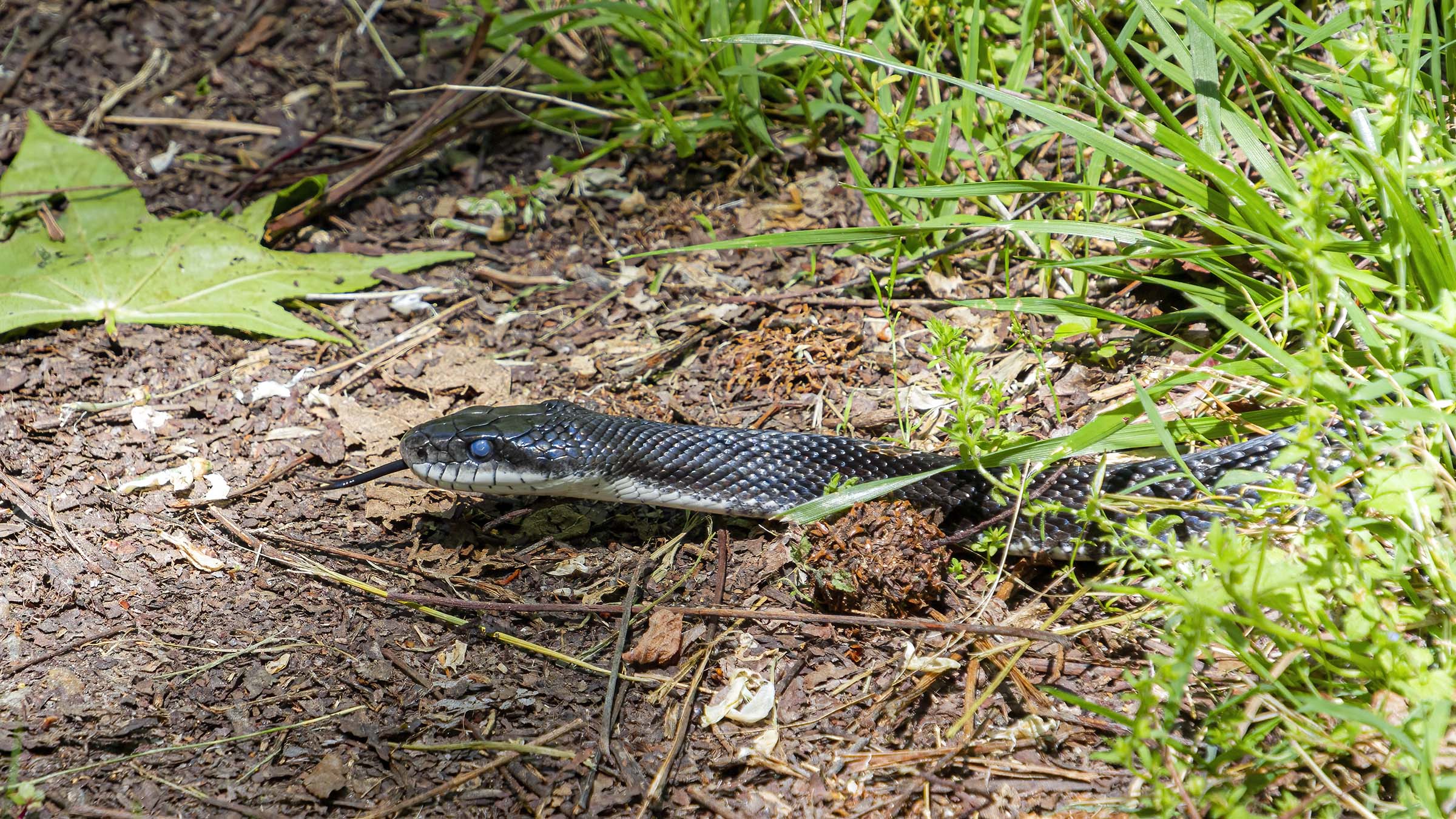
Eastern Ratsnake

© Michael Q. Powell. All rights reserved.

Read Full Post »

I never quite know what I will encounter when I am out wandering in the wild with my camera, like this rather large snake that I almost literally stumbled upon on Monday while exploring in Prince William County. I am fairly certain is an Eastern Rat Snake (Pantherophis alleghaniensis), the most commonly seen snake in the state of Virginia where I live, according to the Virginia Herpetological Society. On average, an Eastern Rat Snake in our state is 42 – 72 inches in length (107-183 cm) and I estimated that this one was at least four feet long (122 cm).

The snake was completely stretched out perpendicular to a stream and did not react as I initially approached, which shocked me a little. When I took my initial shots, in which I was not as close as it seems, I noticed that its eyes were somewhat cloudy, an indication that this snake may have been preparing to shed its skin. Knowing that snakes are vulnerable during this stage and more likely to be aggressive, I captured my shots quickly and backed away.

I decided to try something different to capture a view of the entire snake and created a panoramic image in Photoshop using three separate shots. The last image is the result of that little project and I encourage you to click on the image to get a look at the entire length of the snake. In case you are curious, the process is really easy and the software does most of the work aligning the images.

I was inspired to try the panorama by the work of Reed Andariese, an amazing photographer whose blog, Photo Art Flight, I follow. Over the years, Reed has done panoramic composite shots using a wide variety of cameras (including his iPhone) and lenses—check out his recent posting in which he featured multi-image composites taken with a fish-eye lens. Wow!

Eastern Rat Snake

Eastern Rat Snake

Eastern Rat Snake

© Michael Q. Powell. All rights reserved.

Read Full Post »

Our recent warm weather has caused all kinds of creatures to reappear, like this Eastern Ratsnake (Pantherophis alleghaniensis) that I spotted on Wednesday while hiking in Prince William Forest Park. I kept my distance and relied on a telephoto lens to zoom closer even though I knew that this snake was not poisonous. I am not sure how long the snake was, but as you can see in the second photo it looked to be quite long. According to the Virginia Herpetological Society website, the Eastern Ratsnake is the only snake in Virginia that can grow to be more than six feet (183 cm) in length.

UPDATE: A snake expert weighed in on my Facebook posting about this snake and noted that, “This is a Black Racer (Coluber constrictor constrictor). It’s harder to tell with the mud, but the dorsal scales are unkeeled, the skull shape too round, scale shape more rhombus-like, and eyes too big.” This just reinforces the notion that the more that I learn, the more I realize how little I know—that is why it is great to have experts around to help us identify what we see and photograph. The average size of a Northern Black Racer is “only” 36-60 inches (90-152 cm).


Eastern Ratsnake

Eastern Ratsnake

© Michael Q. Powell. All rights reserved.

Read Full Post »