October 13, 2025 by Mike Powell
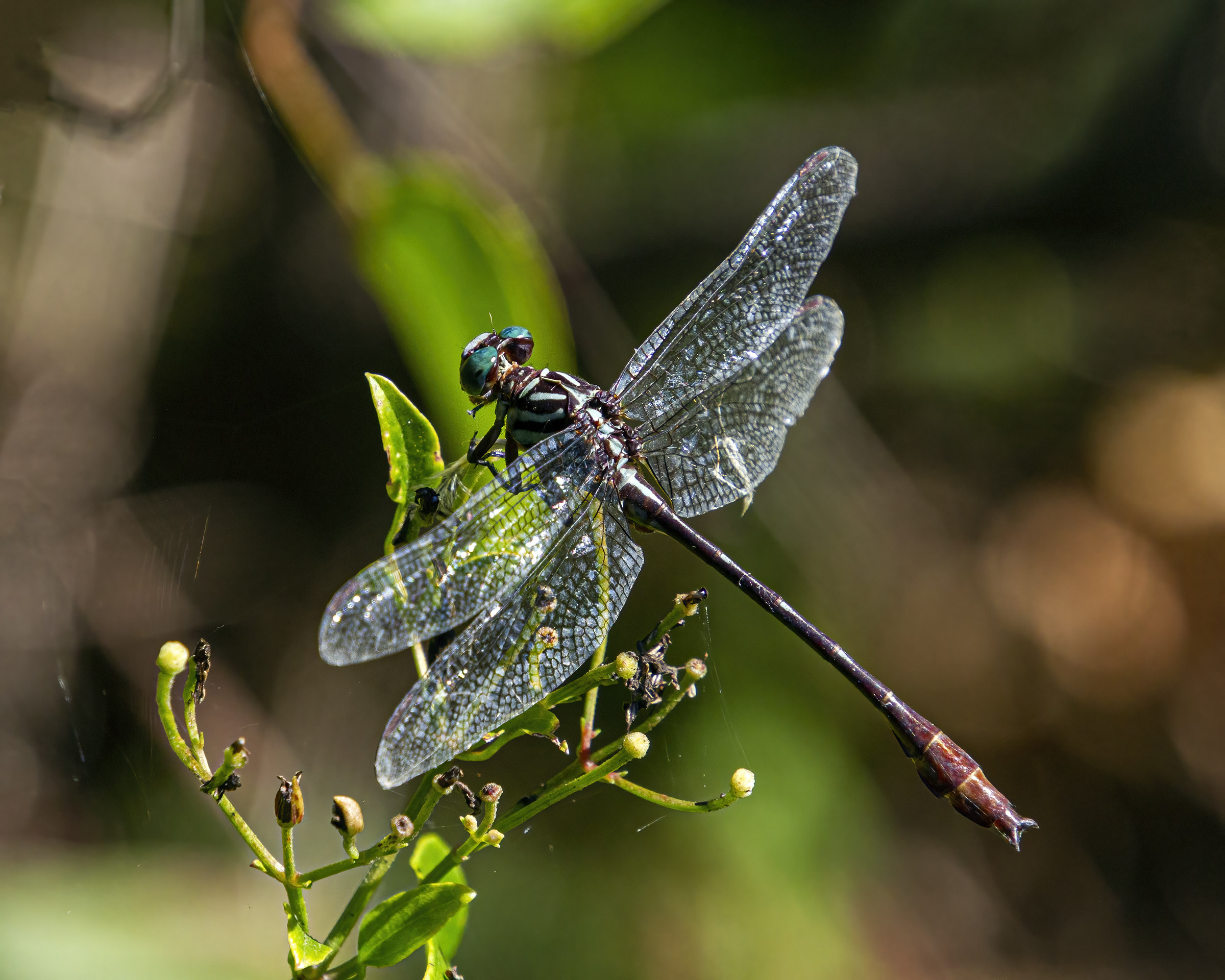
I was absolutely thrilled last Friday to photograph a Russet-tipped Clubtail dragonfly (Stylurus plagiatus) at Occoquan Bay National Wildlife Refuge, a somewhat surprising find this late in the dragonfly season. As I was walking along one of the trails, I encountered a fellow dragonfly enthusiast who was part of a group conducting a survey of butterflies and dragonflies at the refuge. After a brief conversation, we both continued on our way, heading in opposite directions.
A short time later I heard a voice calling out from a distance. I could not understand what was being said, but hurried back down the trail and was delighted to see that my friend had spotted a Russet-tipped Clubtail perched in the vegetation. Russet-tipped Clubtails are a late season species and are seen most often in August and September in my area. Unlike many of the dragonflies that I see regularly that seem to prefer pole-like perches or perch flat on the ground, Russet-tipped Clubtails like to hang from the leaves of vegetation at an angle or almost vertically—members of the genus Stylurus are sometimes called “Hanging Clubtails.”
The dragonfly was cooperative and remained perched as I took photos from several different angles. Before long, the dragonfly took off and our brief encounter ended. I continued on my way, content to know that the end of the dragonfly season, although near, is not here yet.


© Michael Q. Powell. All rights reserved.
Posted in Autumn, Dragonflies, dragonfly, Insects, Nature, Photography, wildlife | Tagged Canon 7D, Occoquan Bay National Wildlife Refuge, Russet-tipped Clubtail, Russet-tipped Clubtail dragonfly, Stylurus plagiatus, Tamron 18-400mm, Woodbridge VA | 2 Comments »
October 9, 2025 by Mike Powell
The countdown continues as we gradually move towards the end of the dragonfly season in my area. The Blue Dasher dragonfly (Pachydiplax longipennis) is one of the first dragonflies to appear in the spring and one of the last dragonflies to disappear in the autumn.
I spotted this tattered male Blue Dasher dragonfly during a recent visit to Jackson Miles Abbott Wetland Refuge. This was one of only a handful of dragonflies that I saw that day. The end is nearing, but I am not ready to call it quits quite yet for my dragonfly photography.

© Michael Q. Powell. All rights reserved.
Posted in Autumn, Dragonflies, dragonfly, Insects, Nature, Photography, wildlife | Tagged Blue Dasher, Blue Dasher dragonfly, Canon 7D, Fort Belvoir VA, Jackson Miles Abbott Wetland Refuge, Pachydiplax longipennis, Tamron 18-400mm | 4 Comments »
October 6, 2025 by Mike Powell
Its wings are a bit tattered and its colors have faded, but this male Slaty Skimmer dragonfly (Libellula incesta) was still hanging in there at the end of September, when I spotted it at Jackson Miles Wetland Refuge at nearby Fort Belvoir, Virginia. The nights have become considerably cooler the past week and I am anxious to get out in the wild with my camera to see which hardy surviving dragonflies are still flying.

© Michael Q. Powell. All rights reserved.
Posted in Autumn, Dragonflies, dragonfly, Insects, Nature, Photography, wildlife | Tagged Canon 7D, Fort Belvoir VA, Jackson Miles Abbott Wetland Refuge, Libellula incesta, male Slaty Skimmer, Slaty Skimmer, Slaty Skimmer dragonfly, Tamron 18-400mm | 4 Comments »
October 5, 2025 by Mike Powell
Our weather has definitely turned cooler, and the number of insects is definitely decreasing. I therefore treasure each encounter that I have, knowing that it could be the last one of the season.
I spotted this beautiful Red-spotted Purple butterfly (Limenitis arthemis astyanax) during a recent visit to Jackson Miles Abbott Wetland Refuge. It seems to have suffered a bit of wing damaged, which did little to damage its beautiful colors. I believe that this butterfly species has two broods, one in the spring and one in late summer, which may help to explain why this butterfly’s colors are still so vibrant—some of the other butterflies that I see have colors that are worn and faded.

© Michael Q. Powell. All rights reserved.
Posted in Autumn, Butterflies, Insects, Nature, Photography, wildlife | Tagged Canon 7D, Fort Belvoir VA, Jackson Miles Abbott Wetland Refuge, Limenitis arthemis astyanax, Red-spotted Purple, Red-spotted Purple butterfly, Tamron 18-400mm | 6 Comments »
October 1, 2025 by Mike Powell
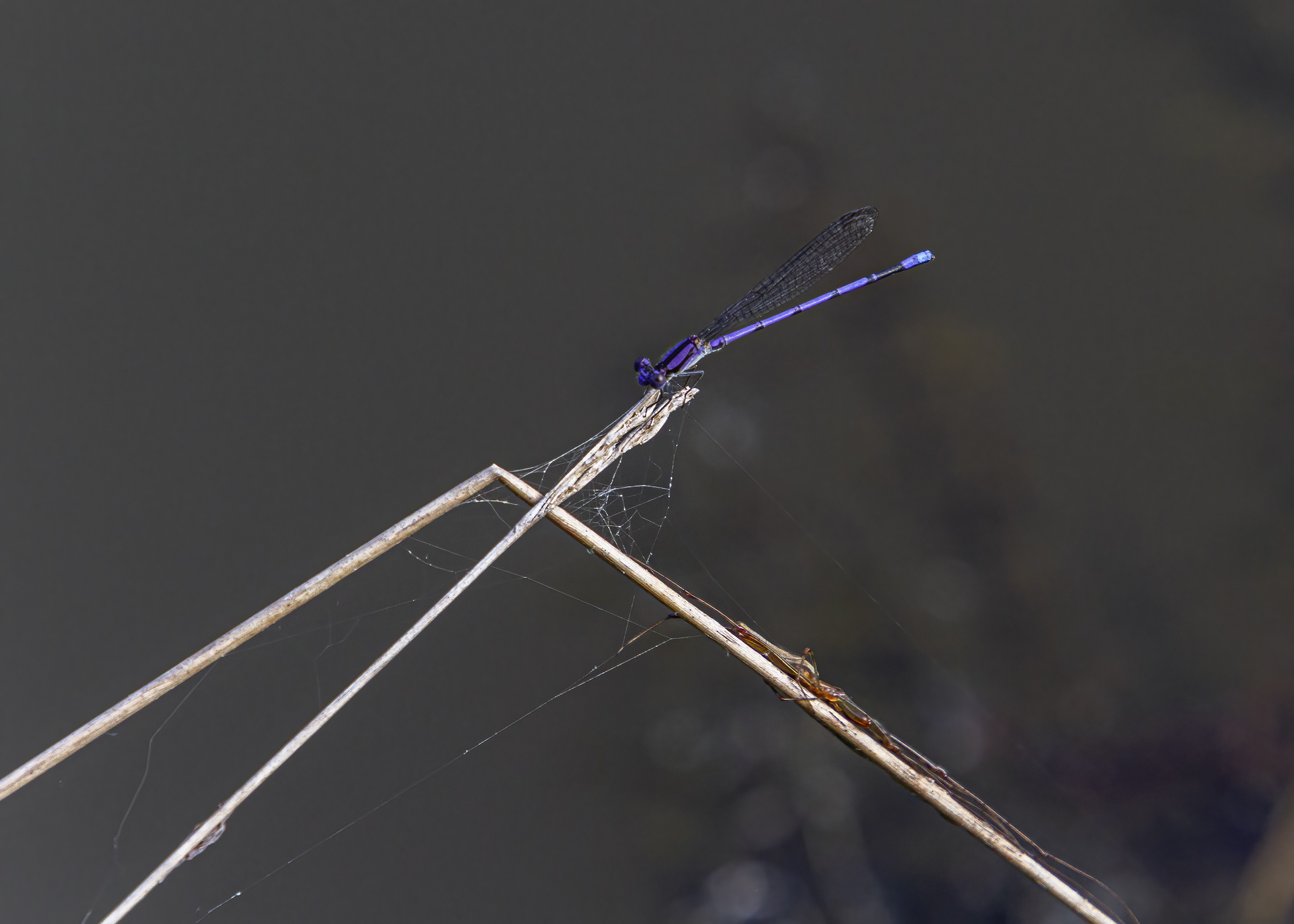
Do you have a favorite damselfly? I have had the opportunity to photograph some pretty spectacular damselflies, but I am irresistibly attracted to the unique coloration of the Violet Dancer damselfly (Argia fumipennis violacea), a subspecies of the Variable Dancer damselfly (Argia fumipennis). In fact the banner photo for my blog page includes a photo of a beautiful Violet Dancer, so my fondness for this species is not exactly a secret.
Maybe I am a little weird for having a favorite damselfly. If that is what you think, perhaps you have forgotten what it is like to view the world as a child as I try to do. Years ago I remember reading a Reader’s Digest article that included the following Tweet, “I like having conversations with kids. Grown-ups never ask me what my third favorite reptile is.” That Tweet (or whatever they are called now) captured my feelings really well
I spotted this colorful little damselfly last Friday (26 September) as I was exploring a small pond at Jackson Miles Abbott Wetland Refuge. I was a little surprised, but very much delighted to see the Violet Dancer so late in the season.
I did not dare lean over the edge of the pond for fear of falling in, but I really like the long distance shot that I was able to capture. The simple lines of the vegetation and the dark pond waters help to draw the viewer’s eyes to the Violet Dancer, even though it occupies only a small portion of the frame.
As I get older I find that I care less and less about what others think about me. Dare to be weird today!
© Michael Q. Powell. All rights reserved.
Posted in Autumn, damselfly, Insects, Nature, Photography, wildlife | Tagged Argia fumipennis, Argia fumipennis violacea, Canon 7D, Fort Belvoir VA, geometry, Jackson Miles Abbott Wetland Refuge, Tamron 18-400mm, Variable Dancer, Variable Dancr damselfly, Violet Dancer | 10 Comments »
September 30, 2025 by Mike Powell
It was wonderful to see so many butterflies still active last week at Occoquan Bay National Wildlife Refuge, including this spectacular Common Buckeye butterfly (Junonia coenia). This butterfly was so feverishly feeding on these flowers that it scarcely seemed aware of my presence, which made it possible to capture shots of this magical creature from various angles. The challenge for me was to time those shots to capture the spectacular colors and patterns of the butterfly when its wings were fully opened.


© Michael Q. Powell. All rights reserved.
Posted in Autumn, Butterflies, Insects, Nature, Photography, wildlife | Tagged Canon 7D, Common Buckeye, Common Buckeye butterfly, Junonia coenia, Occoquan Bay National Wildlife Refuge, Tamron 18-400mm, Woodbridge VA | 2 Comments »
September 26, 2025 by Mike Powell
Many of the trails at Occoquan Bay National Wildlife Refuge are now littered with fallen leaves as we move deeper into autumn. In my area the colors are not as bright and intense as in New England, where I grew up, but the muted colors here are a sign nonetheless that the seasons are changing.
Every year I try to get shots of dragonflies and damselflies perched on the colorful foliage. It is tough, though, to get these beautiful little creatures to cooperate, even though I try to communicate my desires to them telepathically. I doubt it was because of my weak attempts at communication, but on Monday a Big Bluet damselfly (Enallagma durum) perched momentarily on one of the brown, crunchy leaves on the ground and I managed to capture this shot.
I really like the way that the bright blue of the damselfly make it really “pop” in an environment of mostly muted colors. In a simple, uncomplicated way, this modest photo is a symbol to me of the arrival of autumn. For the record, there is no damselflies species called “Autumn bluet,” but I thought the title was a little more punchy as “Autumn bluet,” rather than “Bluet in autumn.” I apologize if I caused anyone to search frantically in their identification guides for a new species.

© Michael Q. Powell. All rights reserved.
Posted in Autumn, damselfly, Insects, Nature, Photography, wildlife | Tagged Autumn 2025, Big Bluet, Big Bluet damselfly, Canon 7D, Enallagma durum, fallen leaves, Occoquan Bay National Wildlife Refuge, Tamron 18-400mm, Woodbridge VA | 2 Comments »
September 24, 2025 by Mike Powell
I spotted this Black Saddlebags dragonfly (Tramea lacerata) on Monday (22 September) at Occoquan Bay National Wildlife Refuge. Normally I see members of this species flying overhead, but this one cooperated by perching low in the vegetation. Black Saddlebags dragonflies, as you can see in the photo below, have distinctive dark blotches on their rear wings that some scientist decided looked like saddlebags.
Black Saddlebags are among the few North American dragonfly species that undertake migrations—other migratory species include Wandering (and Spot-winged) Gliders and Common Green Darners. Specifically, the offspring of the Black Saddlebag dragonflies migrate south in the fall, while some return north in the spring to breed. Did this one begin its journey at some location in the north and was stopping in as it heads south? It is hard to know for sure, but that is certainly a possibility.
One thing I do know for sure is that Black Saddlebags spend a lot of their time in the air, patrolling back and forth over an area, so it was nice to have a chance to capture a shot of one on the ground. Unlike some other skimmer species, Black Saddlebags do not like to perch high up in the vegetation, so it is a challenge to find an unobstructed shooting angle when they are nestled low in the vegetation close to the ground.

© Michael Q. Powell. All rights reserved.
Posted in Autumn, Dragonflies, dragonfly, Insects, Nature, Photography, wildlife | Tagged Black Saddlebags, Black Saddlebags dragonfly, Canon 7D, migratory dragonflies, Occoquan Bay National Wildlife Refuge, Tamron 18-400mm, Tramea lacerata, Woodbridge VA | 4 Comments »
September 22, 2025 by Mike Powell
I was thrilled last Friday at Occoquan Bay National Wildlife Refuge to capture some images of Fine-lined Emerald dragonflies (Somatochlora filosa), a species for which I have been searching repeatedly this past month. Fine-lined Emeralds are one of several species that appear in the autumn, just as the number of most species of dragonflies is beginning to drop precipitously. I had spotted what I think were Fine-lined Emeralds several times earlier in September, but for me the sighting does not really “count” if I am not able to take a photograph.
Fine-lined Emeralds like to spend a lot of time patrolling, and a lesser amount of time perching. Unlike many of species that fly about high in the air, this species often flies at at somewhere between knee and eye-level, and that is how I usually first identify this species.
The dragonfly in the first photo appeared to be flying a patrol back-and-forth along a long stretch of one of the trails at the wildlife refuge. I stayed more or less in the same spot and over the course of a half hour or so, I watched and waited as the dragonfly zoomed by me. I was fortunate to track the dragonfly when it was flying and captured some shots when it occasionally perched vertically for a moment or two. The big challenge for me was focusing on the dragonfly’s thin body—my camera’s auto-focus had trouble acquiring focus, so I had to rely on manual focusing, which is a bit difficult with a digital camera.
Later in the day I spotted the dragonfly in the second photo, what appears to be a different male Fine-lined Emerald. It perched in the same, hanging from the vegetation in the same way as the earlier dragonfly. This dragonfly’s abdomen seemed to be a bit scuffed for reasons that were not readily apparent.
I encourage you to click on the photos to get a closer look at this elusive dragonfly species that the Dragonflies of Northern Virginia website describes as, “One of Northern Virginia’s most rare dragonflies, possibly our rarest, this species is seldom seen and little known throughout its range, from New Jersey to Florida, and west to Kentucky and Texas.”


© Michael Q. Powell. All rights reserved.
Posted in Autumn, Dragonflies, dragonfly, Insects, Nature, Photography, wildlife | Tagged Canon 7D, Fine-lined Emerald, Fine-lined Emerald dragonfly, Occoquan Bay National Wildlife Refuge, Somatochlora filosa, Tamron 18-400mm, Woodbridge VA | 4 Comments »
September 20, 2025 by Mike Powell
When I first began taking photos of insects, I figured that every black and yellow insect flying around flowers was a bee. I was naive, of course, and over time I came to realize that there was another whole family of insects called hover flies (or flower flies or syrphids) that are bee mimics and nectar on flowers. Although their name may suggest that they feed while hovering, like hummingbirds, the hovering seems to be primarily a means for finding a food source.
Last week I spotted some hover flies during a visit to Occoquan Bay National Wildlife Refuge that were feeding on the wild flowers in bloom. I think that they may be American Hover Flies (Eupeodes americanus), but I confess that I am not really familiar with the different species of hover flies. According to Wikipedia about 6000 species of hover flies have been described in 200 genera and hover flies can be found on every continent in the world except for Antarctica.
I did not have a macro lens on my camera, so I was pleasantly surprised to capture such a detailed shot of the tiny hover fly. If you click on the image, you will get a closer view of some of those details of the hoverfly that was intently at work, as “busy as a bee.”

© Michael Q. Powell. All rights reserved.
Posted in Autumn, Insects, Nature, Photography, wildlife | Tagged American Hover Fly, Canon 7D, Eupeodes americanus, hoverfly, Occoquan Bay National Wildlife Refuge, Tamron 18-400mm, Woodbridge VA | 2 Comments »
September 17, 2025 by Mike Powell
During my visit to Occoquan Bay National Wildlife Refuge last week I noted that some species of damselflies were still active, notably Big Bluet damselflies (Enallagma durum). Several couples were busily engaged in activities to ensure the perpetuation of their species.
The damselflies in the photo below were in the “tandem” position in which the male continues to clasp the head of the female. Often this position is assumed after the pair has mated and the male holds on while the female deposits the fertilized eggs. I think that may be what was going on when I captured the image, although it is possible that the pair was simply resting before flying to the actual spot where the eggs will be deposited.

© Michael Q. Powell. All rights reserved.
Posted in Autumn, damselfly, Insects, Nature, Photography, wildlife | Tagged Big Bluet, Big Bluet damselfly, Canon 7D, Enallagma durum, mating damselflies, Occoquan Bay National Wildlife Refuge, Tamron 18-400mm, Woodbridge VA | 3 Comments »
September 16, 2025 by Mike Powell
During the last few months I have been cross stitching a lot, spending time that in previous years I might have spent in the wild with my camera. The hot, humid weather is one factor that has kept me indoors, but I have also rediscovered my love for counted cross stitch. I haven’t yet figured out how I will frame or otherwise finish these pieces, but I thought I would show you some of the autumn-themed ones that I have finished stitching.
The first one is from a pattern that appeared in the Halloween 2025 edition of Just Cross Stitch magazine. It is called Tiny Pumpkins and was designed by Sara Louise Greer of Wickham Cottage. In the past I really enjoyed stitching on black fabric and decided to give it a try again. My eyes are older and require more light than when I was young, but the project turned out pretty well.
The second piece also appeared in the Halloween 2025 edition of Just Cross Stitch magazine. It is called Hallows’ Eve Sampler and was designed by Tracy Richards of Wrought Iron Stitching. I love the vintage autumn vibe of this piece that the designer was able to achieve using only four colors.
The final two pieces were designed by TheCozyDH, a Canadian independent cross stitcher, designer, and content creator on You Tube and Twitch. They have an Etsy shop where you can purchase downloadable cross stitch patterns that are “a lil cute, a lil cozy, a lil spooky” and also a Ko-fi shop, which tends to have lower prices because the platform has lower fees than Etsy.
The two skeleton guys, known as the Bobs, are described by the designer as follows: “Once there were two large skeleton brothers, separated by season and preference of caffeinated beverage. Now, in this tiny adorable form, the brothers are together again. Tiny Cozy Bob sips his Pumpkin Spice Latte while Tiny Sweaty Bob enjoys a chill boba milk tea.”
I suspect that in the coming months I will continue to balance my wildlife photography with my cross stitching. Two two hobbies allow me to express myself creatively in different ways.


© Michael Q. Powell. All rights reserved.
Posted in Autumn, counted cross stitch, cross stitch, Inspiration, Photography | Tagged Autumn 2025, counted cross stitch, Cozy Bob, Hallows' Eve Sampler, Just Cross Stitch magazine, Sweaty Bob, The Cozy DH, Tiny Pumpkins | 8 Comments »
September 15, 2025 by Mike Powell
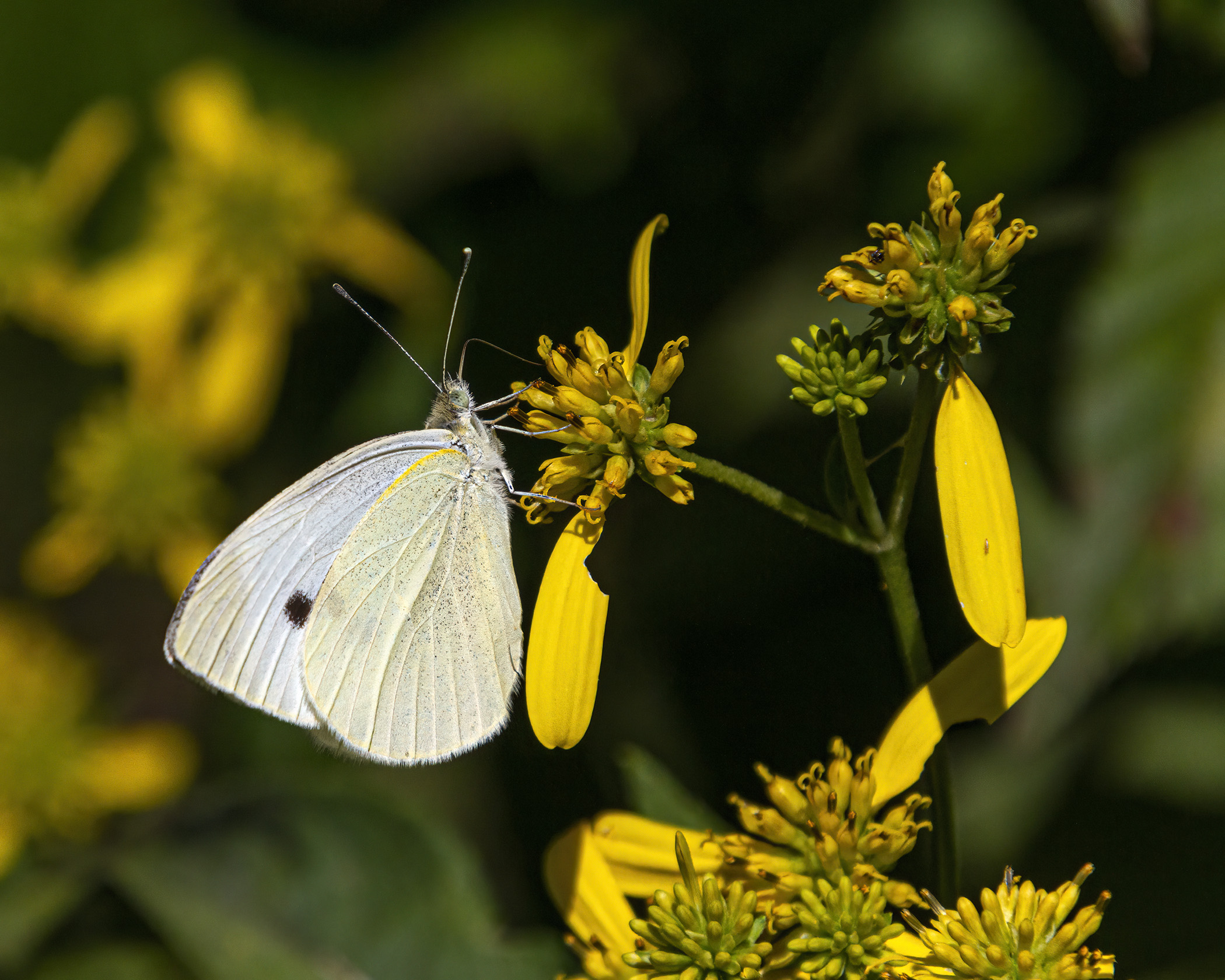
Flowers are slowing giving up their colors and fewer insects will flying as we move deeper into September. It lifts my spirits to see the survivors, like this Cabbage White butterfly (Pieris rapae) that I spotted during a a visit last week to Occoquan Bay National Wildlife Refuge. The Cabbage White, which gardeners consider to be a pest, may appear to be completely monochromatic, but if you double-click on the image, you can get a look at its beautiful speckled green eyes.
© Michael Q. Powell. All rights reserved.
Posted in Autumn, Butterflies, Insects, Nature, Photography, wildlife | Tagged Cabbage White, Cabbage White butterfly, Canon 7D, Occoquan Bay National Wildlife Refuge, Pieris rapae, Tamron 18-400mm, Woodbridge VA | Leave a Comment »
September 14, 2025 by Mike Powell
Skipper butterflies received their name because of their quick, darting flight habits. Many species look very much alike and I invariably have trouble identifying them.
Last week I spotted this little skipper butterfly as it was feeding on some wildflowers at Occoquan Bay National Wildlife Refuge. I was really happy to capture this image of the butterfly with its proboscis extended, sucking up the nectar from a flower. What species is it? If I had to guess, I’d say it might be a Fiery Skipper butterfly (Hylephila phyleus), but my eye is not as attuned to the subtle differences in skippers as it is to dragonflies, so this is really just a guess.
Even it I can’t identify the butterfly, I can enjoy and celebrate its beauty. I encourage you all to slow down and take in the beauties of nature whenever you can.

© Michael Q. Powell. All rights reserved.
Posted in Autumn, Butterflies, Flowers, Nature, Photography, wildlife | Tagged Canon 7D, Fiery Skipper, Fiery Skipper butterfly, Hylephila phyleus, Occoquan Bay National Wildlife Refuge, skipper, skipper butterfly, Tamron 18-400mm | 5 Comments »
September 13, 2025 by Mike Powell
Seasons are noticeably changing as summer releases its hold on us (for those of us in the Northern Hemisphere). Children in my area have returned to school and the weather has cooled off quite a bit.
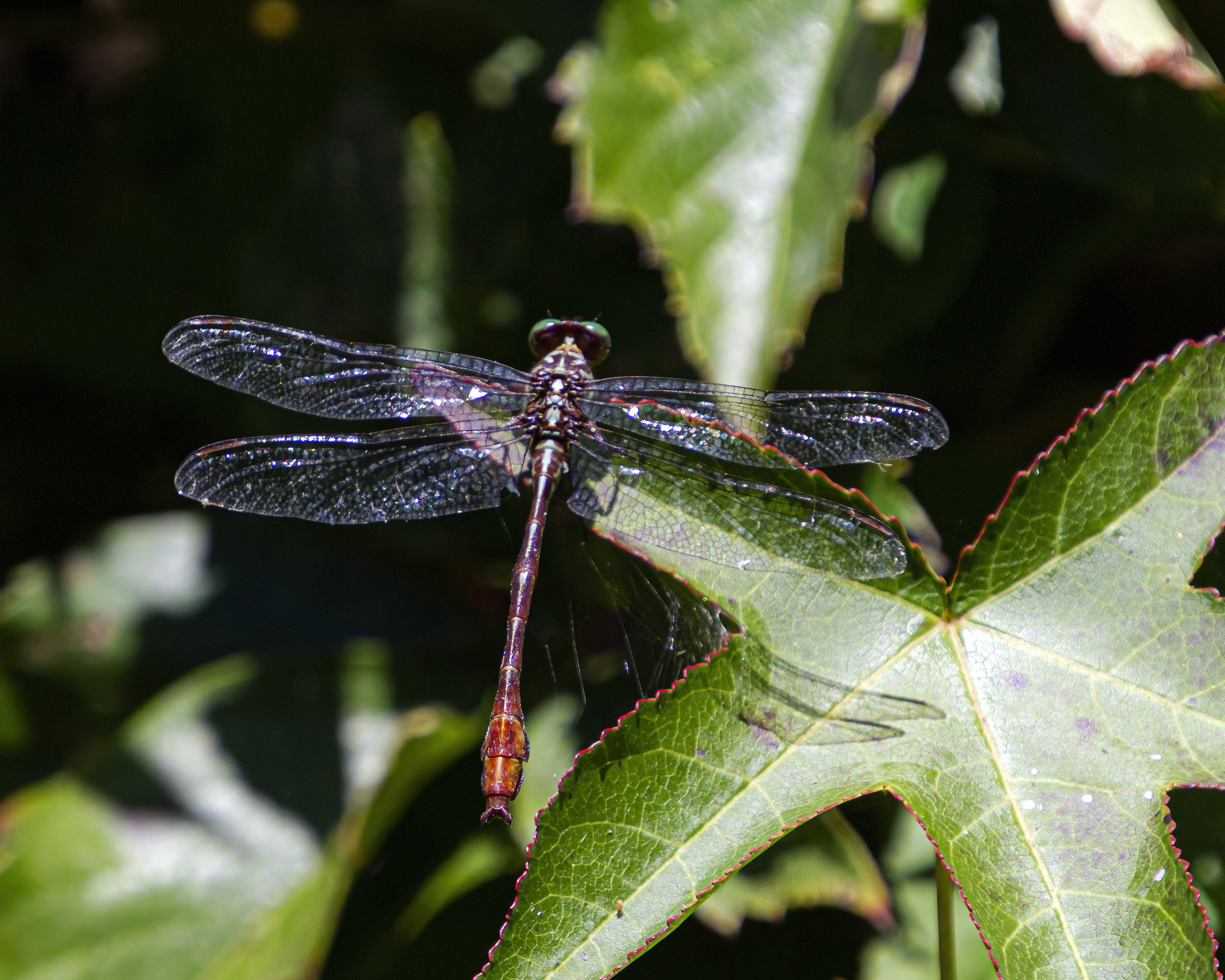
Many summer dragonfly species are starting to disappear or decrease in numbers. Fortunately, some new species appear late in the season to take their places, like this handsome Russet-tipped Clubtail dragonfly (Stylurus plagiatus) that I spotted on Monday at Occoquan Bay National Wildlife Refuge.
Russet-tipped Clubtails are a late season species and are seen most often in August and September in my area. Unlike many of the dragonflies that I see regularly that seem to prefer pole-like perches or perch flat on the ground, Russet-tipped Clubtails like to hang from the leaves of vegetation at an angle or almost vertically—members of the genus Stylurus are sometimes called “Hanging Clubtails.”
I am not quite ready to welcome “autumn,” but there are signs everywhere that the seasons are inexorably changing. Autumn is probably my favorite season of the year, but I am still holding on to the remnants of summer—this year autumn begins on 22 September.
© Michael Q. Powell. All rights reserved.
Posted in Autumn, Dragonflies, dragonfly, Insects, Nature, Photography, wildlife | Tagged Canon 7D, hanging clubtail, Occoquan Bay National Wildlife Refuge, Russet-tipped Clubtail, Russet-tipped Clubtail dragonfly, Stylurus plagiatus, Tamron 18-400mm, Woodbridge VA | Leave a Comment »
September 12, 2025 by Mike Powell
What does “common” mean to you? For many of us, the descriptor “common” is used for ordinary, everyday things to which we tend to pay little attention. Their purposes tend to be functional and utilitarian and beauty is often of secondary importance, assuming that it is considered at all.
I rebel against the use of “common” in the name of many wildlife species. Even if “common” is meant to suggest the likelihood of encountering a species, it is usually related to geography—what is “common” in one area may well be “uncommon” in another area. I think that the folks who name species should be a bit more creative in choosing names for species.
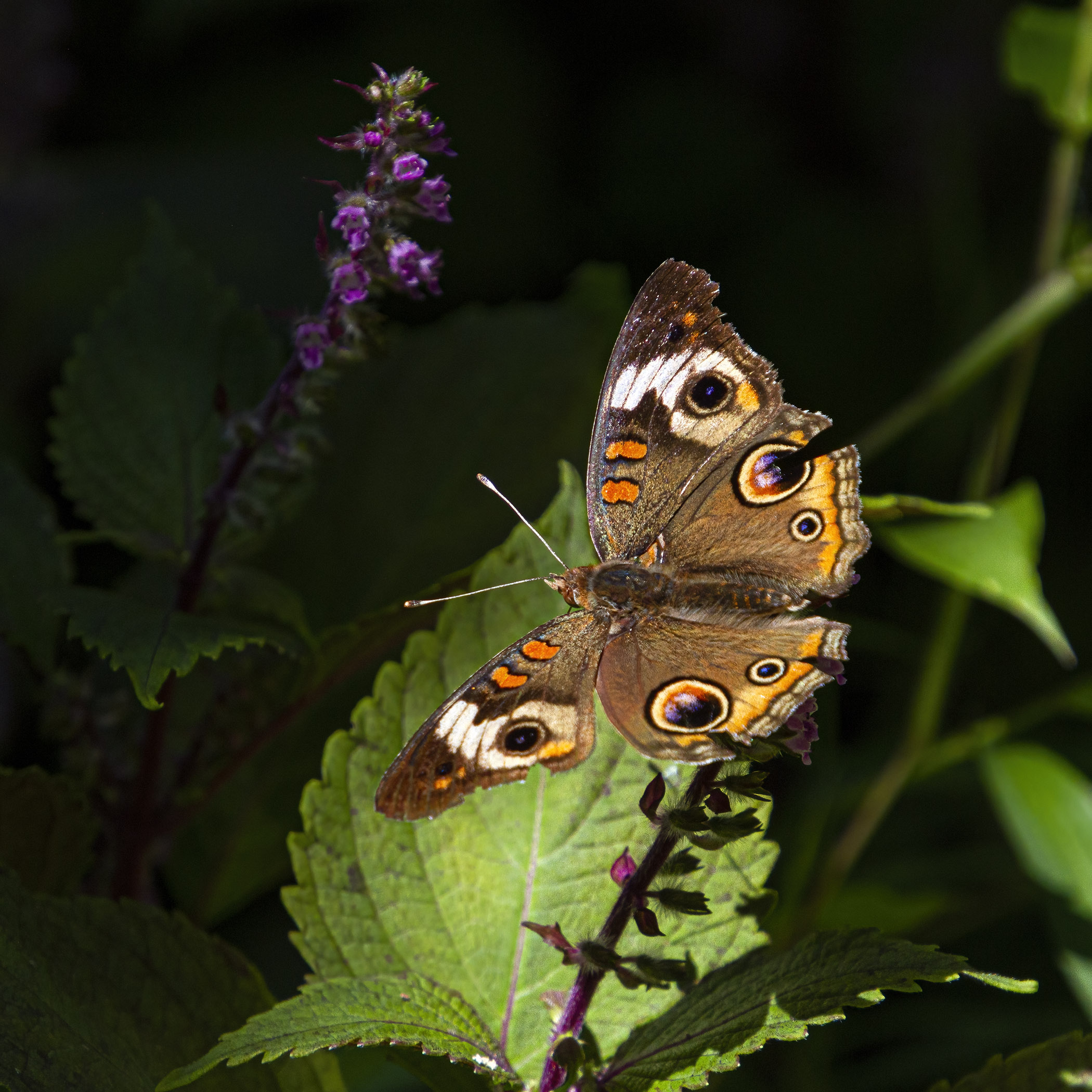
On Monday I encountered this Common Buckeye butterfly (Junonia coenia) during a visit to Occoquan Bay National Wildlife Refuge. Take a close look at the colors and markings on this little butterfly and I’m sure that you will agree that it is uncommonly beautiful.
© Michael Q. Powell. All rights reserved.
Posted in Autumn, Butterflies, Insects, Nature, Photography, wildlife | Tagged Canon 7D, Common Buckeye, Common Buckeye butterfly, Junonia coenia, Occoquan Bay National Wildlife Refuge, Tamron 18-400mm, Woodbridge VA | 14 Comments »
September 11, 2025 by Mike Powell
I spotted this gorgeous Twelve-spotted Skimmer dragonfly (Libellula pulchella) on Monday (8 September) at Occoquan Bay National Wildlife Refuge. I don’t see this species very often and think this might be the first one that I had photographed this season. The white spots in between the darker patches on the wings indicate that this is a male—females of this species have only the darker spots.
Most of the time when I am photographing dragonflies I have to shoot quickly before the dragonfly flies away. In this case, I had the luxury of being able to move around a bit to find a shooting angle that captured the details of the beautiful wings and the blooming wildflowers in the background. Why? When male Twelve-spotted Skimmers are flying, their patterned wings make them look almost like butterflies and I was able to track this dragonfly to the spot where he landed—most other dragonflies have transparent wings and therefore appear smaller when they are in flight.

© Michael Q. Powell. All rights reserved.
Posted in Autumn, Dragonflies, dragonfly, Insects, Nature, Photography, wildlife | Tagged Canon 7D, Libellula pulchella, male Twelve-spotted Skimmer, Occoquan Bay National Wildlife Refuge, Tamron 18-400mm, Twelve-spotted Skimmer, Twelve-spotted Skimmer dragonfly, Woodbridge VA | 6 Comments »
September 10, 2025 by Mike Powell
I was thrilled to spot this stunning male Calico Pennant dragonfly (Celithemis elisa) on Monday at Occoquan Bay National Wildlife Refuge. At this time of the year I am eager to search for the survivors of the summer species. The number of dragonflies continues to dwindle as we move deeper into September and I never know for sure when an encounter with one of the species will turn out to be the last one of the season.
I absolutely love the look of male Calico Pennant dragonflies. The beautiful patterning on their wings and the red heart-shaped markings on their abdomens really make them stand out. I guess that I am a bit romantic when it comes to those red hearts and I managed to find a shooting angle that allowed me to capture that detail really well in the image below.
Alas, this male was the only Calico Pennant that I spotted that day. Dragonflies spent a lot of their time looking for a mate and then doing their part to ensure the preservation of their species. Perhaps this solitary dragonfly will find a mate or maybe it is too late in the season for that. As I said, I am somewhat of a romantic and I choose to hope that love will find a way for him.

© Michael Q. Powell. All rights reserved.
Posted in Autumn, Dragonflies, dragonfly, Insects, Nature, Photography, wildlife | Tagged Calico Pennant, Calico Pennant dragonfly, Canon 7D, Celithemis elisa, male Calico Pennant, Occoquan Bay National Wildlife Refuge, Tamron 18-400mm, Woodbridge VA | 5 Comments »
September 8, 2025 by Mike Powell
During a recent visit to Occoquan Bay National Wildlife Refuge I noticed that the thistle plants were attracting a lot of butterflies. I managed to photograph what I think was a Spicebush Swallowtail butterfly (Papilio troilus) as it was feverishly feeding on the thistles.
The butterfly had sustained a significant amount of damage to its wings, which made identification of its species a little difficult—it is possible that this is actually a Black Swallowtail or one of the other dark swallowtails in my area. Whatever the case, I was once again amazed that, despite the damage to its wings, the butterfly seemed to be able to fly and feed without any obvious limitations.


© Michael Q. Powell. All rights reserved.
Posted in Autumn, Butterflies, Insects, Nature, Photography, wildlife | Tagged Canon 7D, Occoquan Bay National Wildlife Refuge, Papilio troilus, Spicebush Swallowtail, Spicebush Swallowtail butterfly, Tamron 18-400mm, Woodbridge VA | 3 Comments »
September 6, 2025 by Mike Powell
It has been a long, hot summer and I welcome the cooler temperatures and lower humidity of the autumn. For me, this is part of a cycle of nature that is repeated each year. For dragonflies, though, the autumn signals that their lives are drawing near to the end. Dragonflies begin their lives as water-dwelling nymphs and when they emerge and are transformed into the incredible aerial acrobats that we see, their days are numbered in weeks and months.
Earlier this week I spotted this Halloween Pennant dragonfly (Celithemis eponina) that appeared to have survived several encounters with predators. Its wings were shredded, but somehow the dragonfly was still able to fly. It’s probably my imagination, but the Halloween Pennant seemed to be smiling, enjoying every minute of its remaining days, happy to be alive. As I get older, I feel like that sometimes.

© Michael Q. Powell. All rights reserved.
Posted in Autumn, Dragonflies, dragonfly, Insects, Nature, Photography, wildlife | Tagged Canon 7D, Celithemis eponina, Halloween, halloween pennant, Halloween Pennant dragonfly, Occoquan Bay National Wildlife Refuge, Tamron 18-400mm, Woodbridge VA | 6 Comments »
September 4, 2025 by Mike Powell
Throughout the summer I have did not spot very many butterflies—maybe they were as uncomfortable in the midday heat and humidity as I was. Now that we are in September I seem to see them all of the time. One of my favorites that I managed to photograph on Monday at Occoquan Bay National Wildlife Refuge was this beautiful Eastern Comma butterfly (Polygonia comma).
As many of you know, the Eastern Comma is one of the two “punctuation” butterflies in my area—the other is the Question Mark butterfly (Polygonia interrogationis). The two species are quite similar in appearance, with the arrangement of spots on the wings being the chief means of distinguishing between them.
I love the beautiful orange color of this butterfly, a color that seems to be a perfect match for the autumn season that is either imminent or already upon us, depending on whether you use the astrological calendar or the meteorological calendar. Meteorological autumn begins on September 1 and ends on November 30, providing a consistent three month period for data analysis. Astrologically the autumn season begins at the Autumn Equinox (in the Northern Hemisphere) that is between September 21 and September 24—in 2025 it falls on September 22.

© Michael Q. Powell. All rights reserved.
Posted in Autumn, Butterflies, Insects, Nature, Photography, wildlife | Tagged Canon 7D, Eastern Comma, Eastern Comma butterfly, Occoquan Bay National Wildlife Refuge, Polygonia comma, Tamron 18-400mm, Woodbridge VA | 3 Comments »
September 3, 2025 by Mike Powell
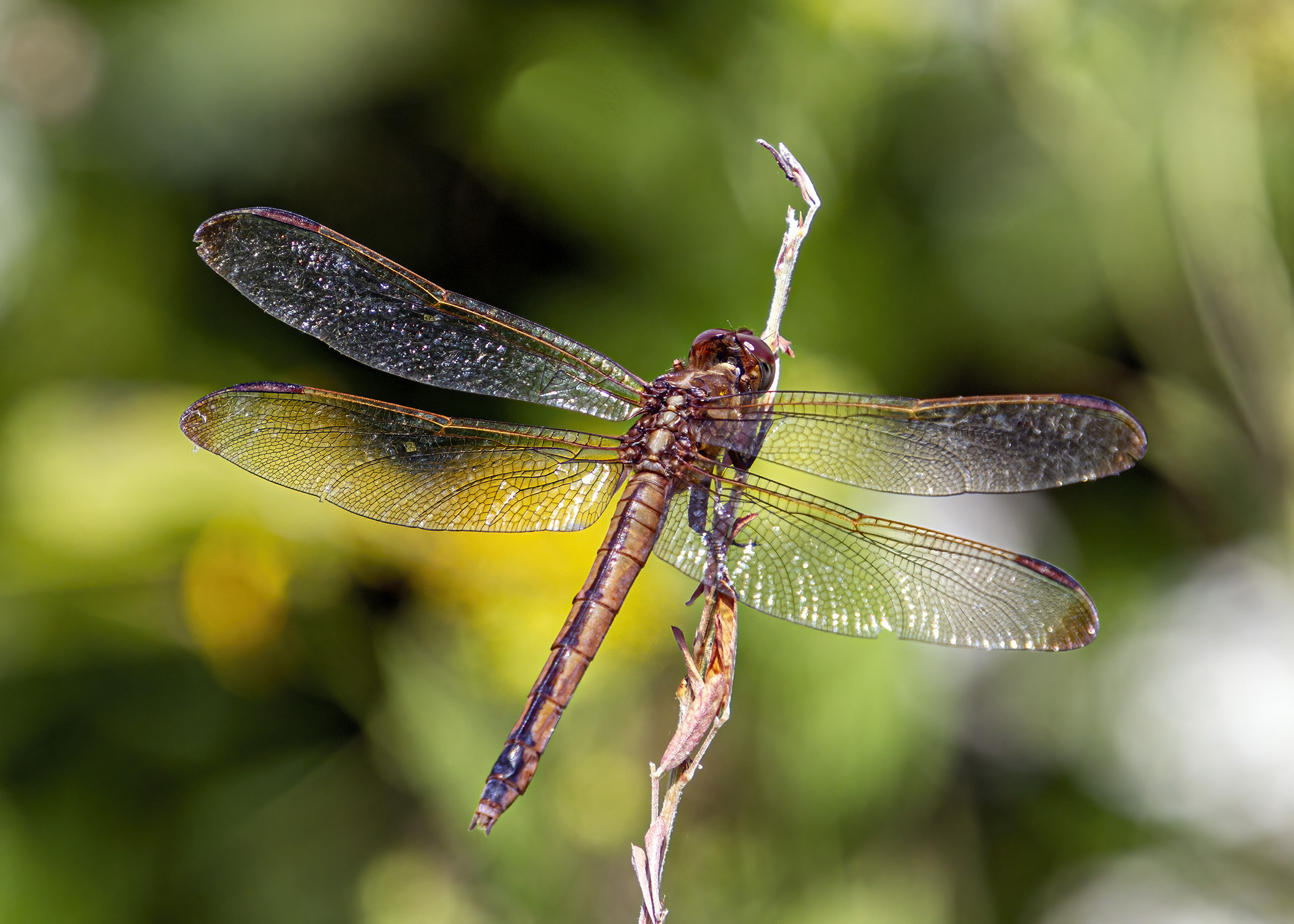
Earlier in the summer Needham’s Skimmers (Libellula needhami) were one of the most common dragonflies that I would encounter at Occoquan Bay National Wildlife Refuge, but over the past month their numbers have dropped significantly as their flight season draws to a close. I was therefore quite pleased to spot this mature female Needham’s Skimmer on Monday at the wildlife refuge.
The dragonfly’s colors seemed a bit faded, but otherwise she appeared to be in good shape. I am not sure if the stalk of vegetation on which she was perching was comfortable, but it helped me to isolate her from the background and its pointy protrusions add visual interest to the image.
© Michael Q. Powell. All rights reserved.
Posted in Autumn, Dragonflies, dragonfly, Insects, Nature, Photography, wildlife | Tagged Canon 7D, female Needham's Skimmer, Libellula needhami, Needham's Skimmer, Needham's Skimmer dragonfly, Occoquan Bay National Wildlife Refuge, Tamron 18-400mm, Woodbridge VA | 3 Comments »
September 1, 2025 by Mike Powell
Surprisingly I have seen more Monarch butterflies this year than Viceroy Butterflies (Limenitis archippus), so I was delighted last week to spot this Viceroy last week at Occoquan Bay National Wildlife Refuge when it spread its wings. When an orange blur first moves across my sight line, I can’t tell the species apart. However, when the butterfly lands and I am able to look closely at the wing patterns, I can usually see the thin black stripe across the hindwings of Viceroys that is absent in Monarchs.

© Michael Q. Powell. All rights reserved.
Posted in Butterflies, Insects, Nature, Photography, Summer, wildlife | Tagged Canon 7D, Limenitis archippus, Occoquan Bay National Wildlife Refuge, Tamron 18-400mm, Viceroy, Viceroy butterfly, Woodbridge VA | 2 Comments »
August 31, 2025 by Mike Powell
This insect looks a bit like a dragonfly at first glance, but if you look more closely you may notice that the wings and eyes are different from those of a dragonfly and this insect’s body is a lot hairier. This is a robber fly and I am pretty sure that it is a variety known as a Red-footed Cannibalfly (Promachus rufipes).
Red-footed Cannibalflies are among the coolest and creepiest insects that you may encounter in the wild. As their macabre moniker suggests, Red-footed cannibalflies usually feed on other insects, but they reportedly are capable of taking down a hummingbird.
Robber flies in general are predators that wait for their prey to fly by and then attack it. Wikipedia describes their attack in this way, “The fly attacks its prey by stabbing it with its short, strong proboscis injecting the victim with saliva containing neurotoxic and proteolytic enzymes which very rapidly paralyze the victim and soon digest the insides; the fly then sucks the liquefied material through the proboscis.” Yikes!
I have a personal special attachment to Red-footed Cannibalflies. In 2013 I captured an image of one of these insects and for years it was my most popular photo on-line, with over 3700 views to date. Since then, a few other of my photos have jumped ahead of this cool-looking predator, which continues to get views a dozen years after it appeared in my blog.
I captured this image last Monday at Occoquan Bay National Wildlife Refuge. I spotted this cannibalfly perched on a branch that was partially in direct sunlight. To keep from blowing out the highlights on its body, I deliberately underexposed the shot, which meant that the background became really dark. Normally I don’t like that kind of starkness and prefer a more natural background, but in this case it seems to work well with my creepy subject, giving it a spooky, Halloween-style vibe.

© Michael Q. Powell. All rights reserved.
Posted in Insects, Nature, Photography, Summer, wildlife | Tagged Canon 7D, Occoquan Bay National Wildlife Refuge, Promachus rufipes, Red-footed Cannibalfly, robber fly, Tamron 18-400mm, Woodbridge VA | 3 Comments »
August 29, 2025 by Mike Powell
A simple composition and an ordinary subject—sometimes that is all that it takes to capture a beautiful image. I spotted this little Common Buckeye butterfly (Junonia coenia) on Monday at Occoquan Bay National Wildlife Refuge. The Common Buckeye kept perching on the ground and would fly away a short distance every time that I approached it.
Eventually it perched in the vegetation at the edge of the trail and I was able to capture this image. Although the background is a bit cluttered, it was far enough away that it blurred into a series of shapes that do not distract from the central subject. Yes, the subject is mostly a dull brown in color that most viewers may not find to be very visually pleasing. However, the eyes are really drawn to the orange stripes on the butterfly’s body and then to the interesting shadow that the legs of the butterfly are casting.
For me, there is a real beauty in the simplicity of this photo and I like it a lot. Photography does not always have to be complicated to be effective.

© Michael Q. Powell. All rights reserved.
Posted in Butterflies, Insects, Nature, Photography, Summer, wildlife | Tagged Canon 7D, Common Buckeye, Common Buckeye butterfly, Junonia coenia, Occoquan Bay National Wildlife Refuge, Tamron 18-400mm, Woodbridge VA | 4 Comments »
August 28, 2025 by Mike Powell
When I try to take photographs of a butterfly, I usually have multiple objectives. First, of course, I’d like to be able to capture some images that are more or less in focus. Ideally, I like to get an interesting wing position, which often means that I try to catch the butterfly with its wings open. Finally, I love to catch the butterfly in a visually attractive habitat or doing something interesting, though these variables are the ones over which I have the least amount of control.
On Monday I chased after this Eastern Tiger Swallowtail butterfly (Papilio glaucus) when I spotted it in flight and tracked it when it landed in some nearby vegetation. There did not seem to be any flowers there, so I was a little surprised that the butterfly had chosen to perch at that spot. I carefully chose my shooting angle and was pretty pleased that I was able to capture a lot of the habitat. Although there is still a lot of greenery, the dried-up leaves help to give the image an interesting autumn vibe.
© Michael Q. Powell. All rights reserved.
Posted in Butterflies, Insects, Nature, Photography, Summer, wild horses | Tagged Canon 7D, Eastern Tiger Swallowtail, Eastern Tiger Swallowtail butterfly, Occoquan Bay National Wildlife Refuge, Papilio glaucus, Tamron 18-400mm, Woodbridge VA | 3 Comments »
August 27, 2025 by Mike Powell
On Monday I managed to photograph this elusive Zebra Swallowtail butterfly (Eurytides marcellus) during a visit to Occoquan Bay National Wildlife Refuge. When the butterfly was in motion, I had no idea that it was damaged, but when it paused for a moment, it was immediately obvious that it was missing its tails.
Somehow the butterfly was able to compensate for their loss by adjusting its flight and its feeding behavior did not appear to be adversely affected. As we get older, we often worry about the things that we can no longer do as well as when we were younger, instead of adjusting our behavior to focus instead on all of the things that we are still possible.
Maybe we should take a cue from this damaged butterfly and live our lives positively, rather that wallow in our “what ifs…” or “if only…” mindsets.


© Michael Q. Powell. All rights reserved.
Posted in Butterflies, Insects, Nature, Photography, Summer, wildlife | Tagged Canon 7D, Eurytides marcellus, Occoquan Bay National Wildlife Refuge, Tamron 18-400mm, Woodbridge VA, Zebra Swallowtail, Zebra Swallowtail butterfly | 10 Comments »
August 26, 2025 by Mike Powell
I was delighted to spot this Eastern Box Turtle (Terrapene carolina carolina) yesterday alongside one of the trails at Occoquan Bay National Wildlife Refuge. These beautiful land-dwelling turtles, also known as Woodland Box Turtles, are extremely long-lived and are capable of living over 100 years in captivity, though in the wild they often live much shorter lives due to disease and predation.
The brown eyes of this turtle suggest that that it is a female, though I have read that eye color is not always 100% accurate in determining the gender of a box turtle—males of this species often have red eyes. The shell pattern for each box turtle is supposed to be unique, like a fingerprint, which makes the wonderful patterns of this turtle’s shell especially intriguing.


© Michael Q. Powell. All rights reserved.
Posted in Nature, Photography, Reptiles, turtle, wildlife | Tagged Canon 7D, Eastern Box Turtle, Occoquan Bay National Wildlife Refuge, Tamron 18-400mm, Terrapene carolina carolina, Woodbridge VA | 3 Comments »
August 25, 2025 by Mike Powell
As we approach the end of August, some of the more common dragonfly species are becoming much less common. Some autumn species will soon take their places. At the moment the Common Whitetail dragonfly (Plathemis lydia) is the species that I see most often. During a recent visit to Huntley Meadows Park, I spotted this young male Common Whitetail perched vertically on some vegetation.
How do I know that it is a young male? Females of this species have a different pattern of dark patches on their wings, as you can see in the second image below from earlier in the season, and different terminal appendages. Males start out with a darker coloration like that of their female counterparts and as they age they develop a white powdery substance on their abdomens called pruinosity. The dragonfly in the first photo is currently a bluish white and some of the markings are still showing through—eventually he will turn a bright white in color.


© Michael Q. Powell. All rights reserved.
Posted in Dragonflies, dragonfly, Insects, Nature, Photography, Summer, wildlife | Tagged Alexandria VA, Canon 7D, Common Whitetail, Common Whitetail dragonfly, Huntley Meadows Park, male Common Whitetail, Plathemis lydia, Tamron 18-400mm | Leave a Comment »
August 23, 2025 by Mike Powell
I was thrilled to spot this pristine Eastern Tiger Swallowtail butterfly (Papilio glaucus) last week at Occoquan Bay National Wildlife Refuge. Many of the butterflies that I see this late in the season are tattered and damaged, but this one appeared to be in a perfect condition as it hungrily fed on some blooming wildflowers.

© Michael Q. Powell. All rights reserved.
Posted in Butterflies, Insects, Nature, Photography, Summer, wildlife | Tagged Canon 7D, Eastern Tiger Swallowtail, Eastern Tiger Swallowtail butterfly, Occoquan Bay National Wildlife Refuge, Papilio glaucus, Tamron 18-400mm, Woodbridge VA | 10 Comments »
August 22, 2025 by Mike Powell
As we near the end of August, I am seeing more and more reminders that Halloween is drawing near. Although we still have a couple of months before the 31st of October, store displays of candy and costumes and all other sorts of spooky merchandise have popped up everywhere.
Even when I was walking the trails of Occoquan Bay National Wildlife Refuge recently, I was reminded of the upcoming holiday when I spotted this Halloween Pennant dragonfly (Celithemis eponina) perched at the highest point of a patch of vegetation. Halloween Pennants have very distinctive markings on their wings that make then easy to identify. Unlike some other dragonfly species that perch on the ground and are therefore hard to spot amidst the fallen leaves, Halloween Pennants always seem to perch high above the ground and consequently are easy to spot. These perches often sway in the slightest of winds, causing the dragonflies to flutter in the wind, like pennants.

© Michael Q. Powell. All rights reserved.
Posted in Dragonflies, dragonfly, Insects, Nature, Photography, Summer, wildlife | Tagged Canon 7D, Celithemis eponina, halloween pennant, Halloween Pennant dragonfly, Occoquan Bay National Wildlife Refuge, Tamron 18-400mm, Woodbridge VA | 1 Comment »
« Newer Posts - Older Posts »
 Mike Powell