May 18, 2026 by Mike Powell
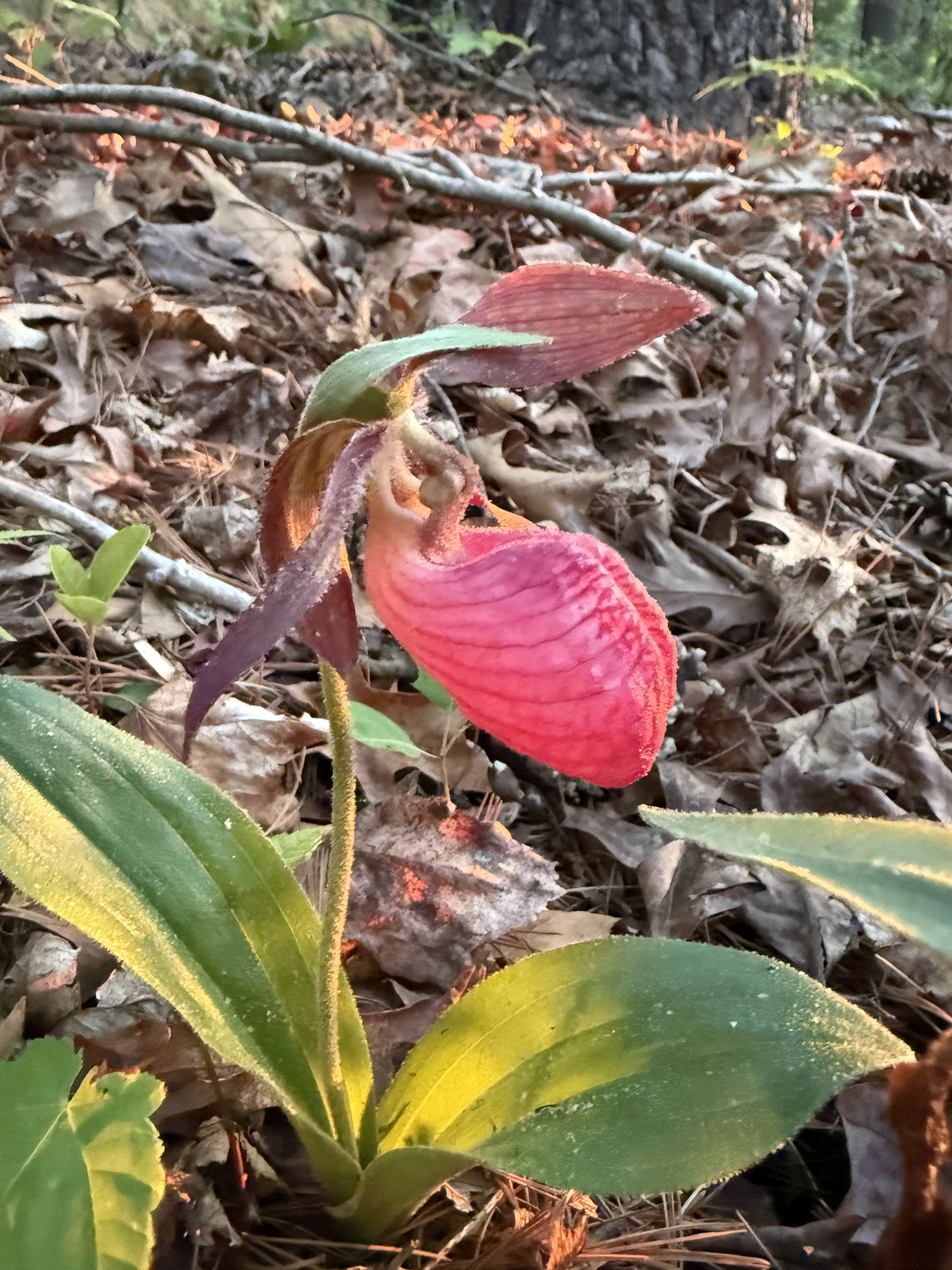
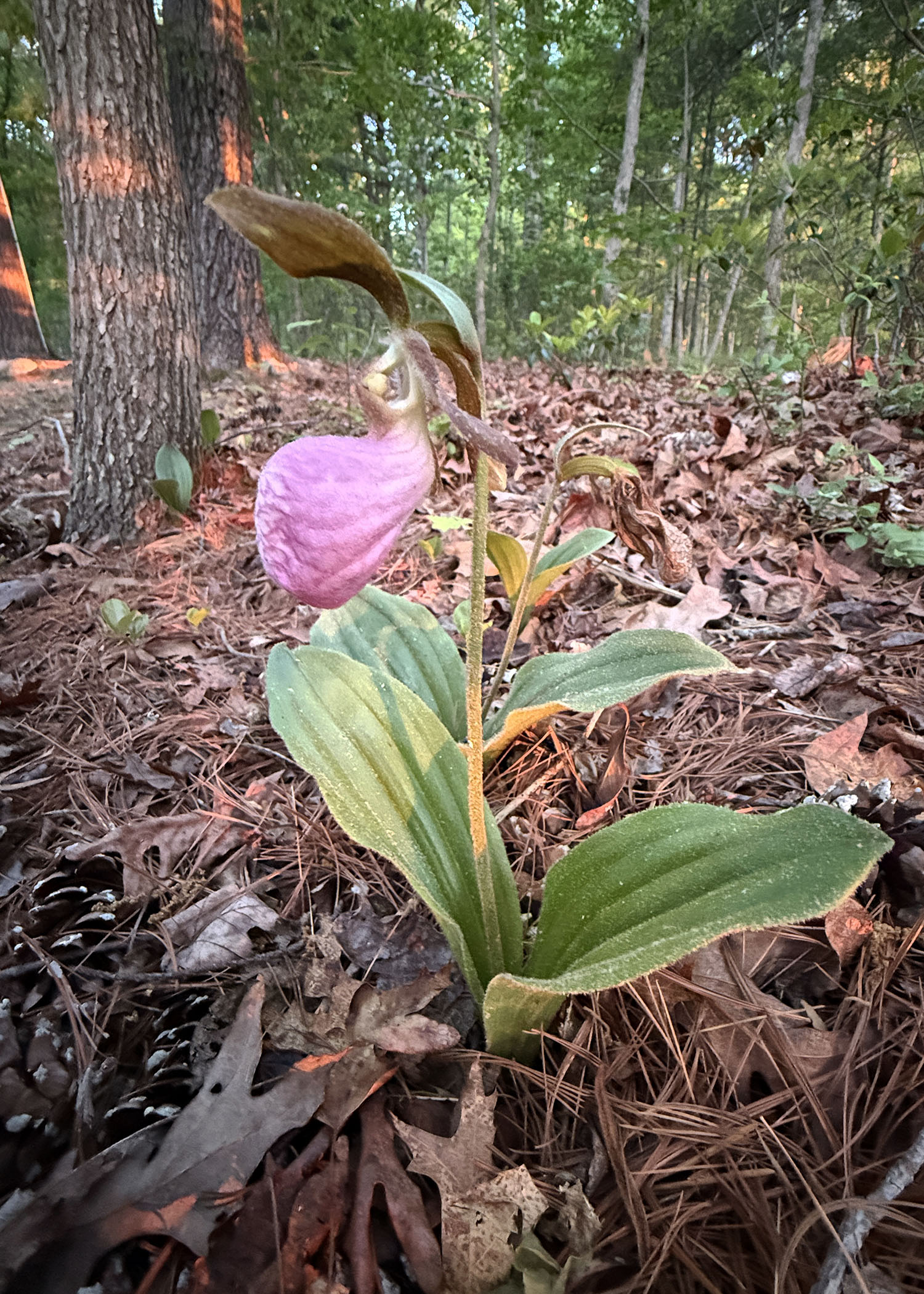
I am back from a weekend church retreat at Shrinemont, a retreat center of the Episcopal Diocese of Virginia, in the mountain village of Orkney Springs, where I was thrilled to spot some beautiful Pink Lady’s Slipper native orchids (Cypripedium acaule) in bloom at the edge of the forest during an early morning walk, just after the sun had risen.
The rays of soft golden light made the moments when I was capturing these images with my iPhone seem almost magical. So often we associate the beauty of flowers with manmade, cultivated garden, but these little beauties spring up from the forest floor when the conditions are right. My understanding is the soil requirements for these flowers are so specific that they cannot survive being dug up transplanted to new locations (and in some places it is illegal to remove them).
© Michael Q. Powell. All rights reserved.
Posted in Flowers, Nature, Photography, spring, sunrise, wildlife | Tagged Cypripedium acaule, iPhone 16 Pro Max, Orkney Springs VA, Pink Lady's Slipper, Shrine Mont Retreat Center, Shrinemont | 2 Comments »
May 13, 2026 by Mike Powell
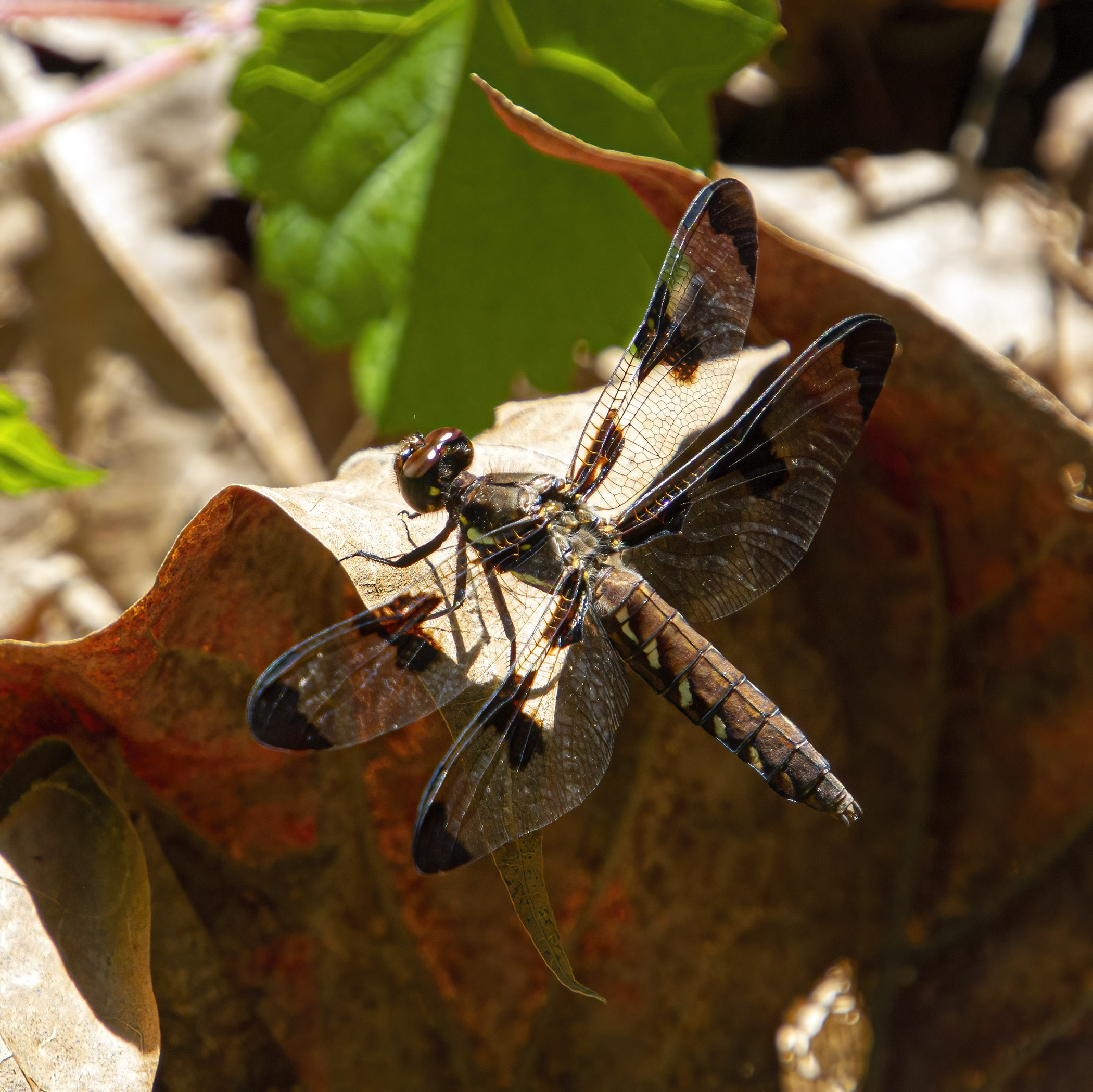
Some of the familiar summer dragonflies have started to appear, including this female Common Whitetail (Plathemis lydia) that I spotted earlier this month during a visit to Occoquan Regional Park in nearby Lorton, Virginia. Common Whitetail dragonflies have a long flight period that begins in the spring and extends well into the autumn months.
Females of this species, despite their name, are brownish in color with the markings that you can see in the photo below. Immature males start off with a similar coloration, but relatively quickly their bodies become white. How do I know that this one is a female? Males and females have different markings on their wings. Males have a larger dark patch in the middle of each wing and the tips of the wings remain clear, while the females have a smaller patch in the middle of each wing and a second dark patch at the tip of each wing.
Common Whitetails are in fact quite common in this area and can be found in a variety of habitats. I nonetheless enjoy taking photos of them that highlight various aspects of this behavior. This photo, for example, shows how light in weight these dragonflies are, capable of perching on the edge of a dry, fallen leaf.
© Michael Q. Powell. All rights reserved.
Posted in Dragonflies, dragonfly, Insects, Nature, Photography, wildlife | Tagged Canon 7D, Common Whitetail, Common Whitetail dragonfly, female Common Whitetail, Lorton VA, Occoquan Regional Park, Plathemis lydia, Tamron 18-400mm | 4 Comments »
May 12, 2026 by Mike Powell
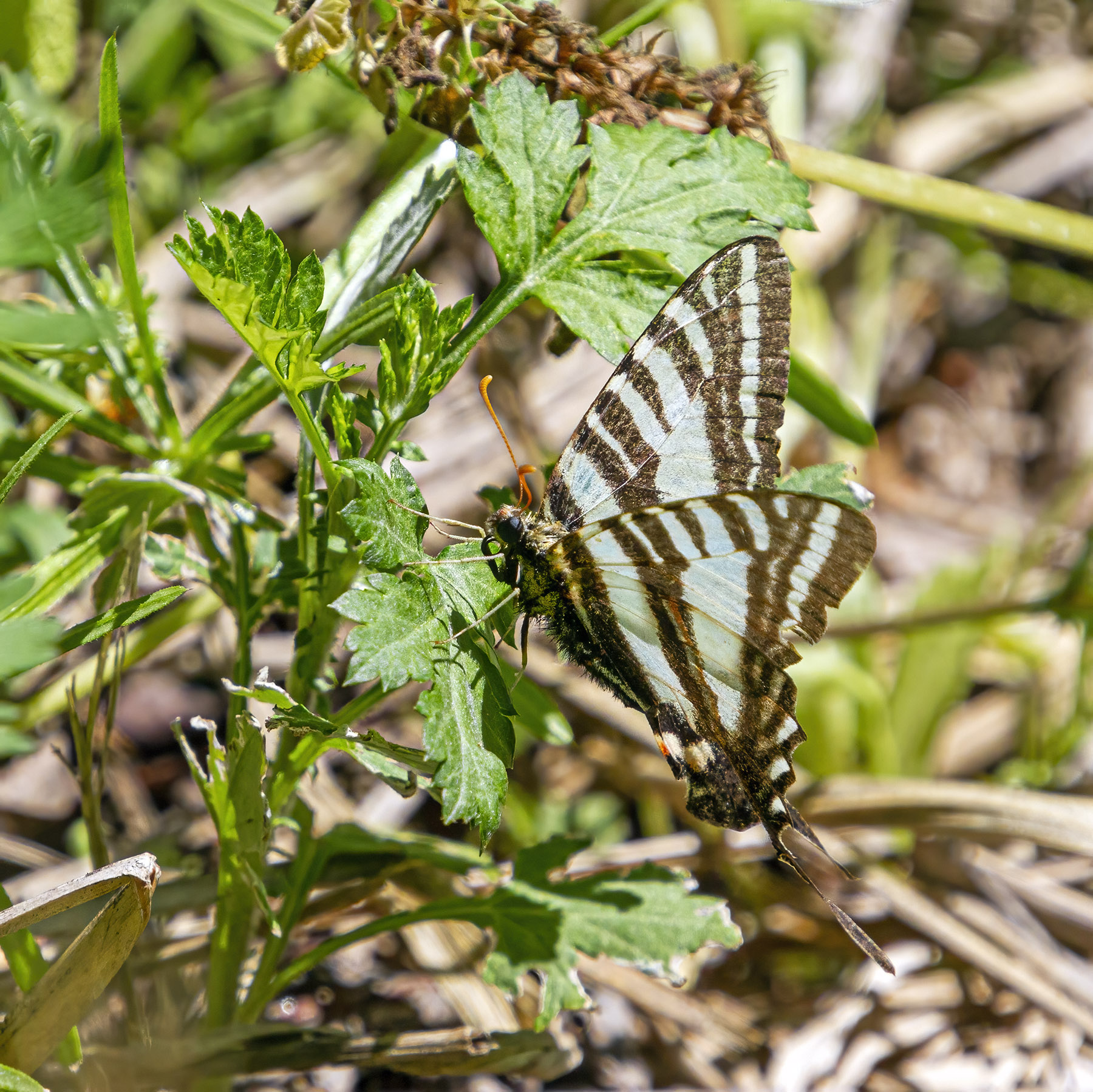
I love trying to get photographs of Zebra Swallowtail butterflies (Eurytides marcellus). There is an understated elegance to their monochromatic coloration (with pops of blue and red) and they are so hyperactive that I have to chase after them to have a chance to get a shot when they perch momentarily. Earlier this month I captured this image of one that highlights its long tails and colorful antennae.
There is something almost magical about chasing butterflies that makes me feel like a child again. I hope I never lose that energy, enthusiasm, and boundless curiosity.
© Michael Q. Powell. All rights reserved.
Posted in Butterflies, Insects, Nature, Photography, spring, wildlife | Tagged Canon 7D, Eurytides marcellus, Occoquan Bay National Wildlife Refuge, Tamron 18-400mm, Woodbridge VA, Zebra Swallowtail, Zebra Swallowtail butterfly | Leave a Comment »
May 9, 2026 by Mike Powell
As I was exploring Occoquan Regional Park in nearby Lorton, Virginia last week, a large dark bird caught my attention. I tracked the bird in the air and watched as it landed atop a broken-off tree in the distance. I could see the bird’s grayish-black head and immediately identified it as a Black Vulture (Coragyps atratus). In my area, Turkey Vultures, which have a reddish head, are much more common, but from time to time I also see Black Vultures, sometimes in a mixed group.
According to the Cornell Lab of Ornithology, “Turkey Vultures have an excellent sense of smell, but Black Vultures aren’t nearly as accomplished sniffers. To find food they soar high in the sky and keep an eye on the lower-soaring Turkey Vultures. When a Turkey Vulture’s nose detects the delicious aroma of decaying flesh and descends on a carcass, the Black Vulture follows close behind.”
On this day, the Black Vulture seems to be on its own, content to bask for a little while in the warmth of the sun. After capturing a few images, I quietly departed, leaving the culture on its solitary perch.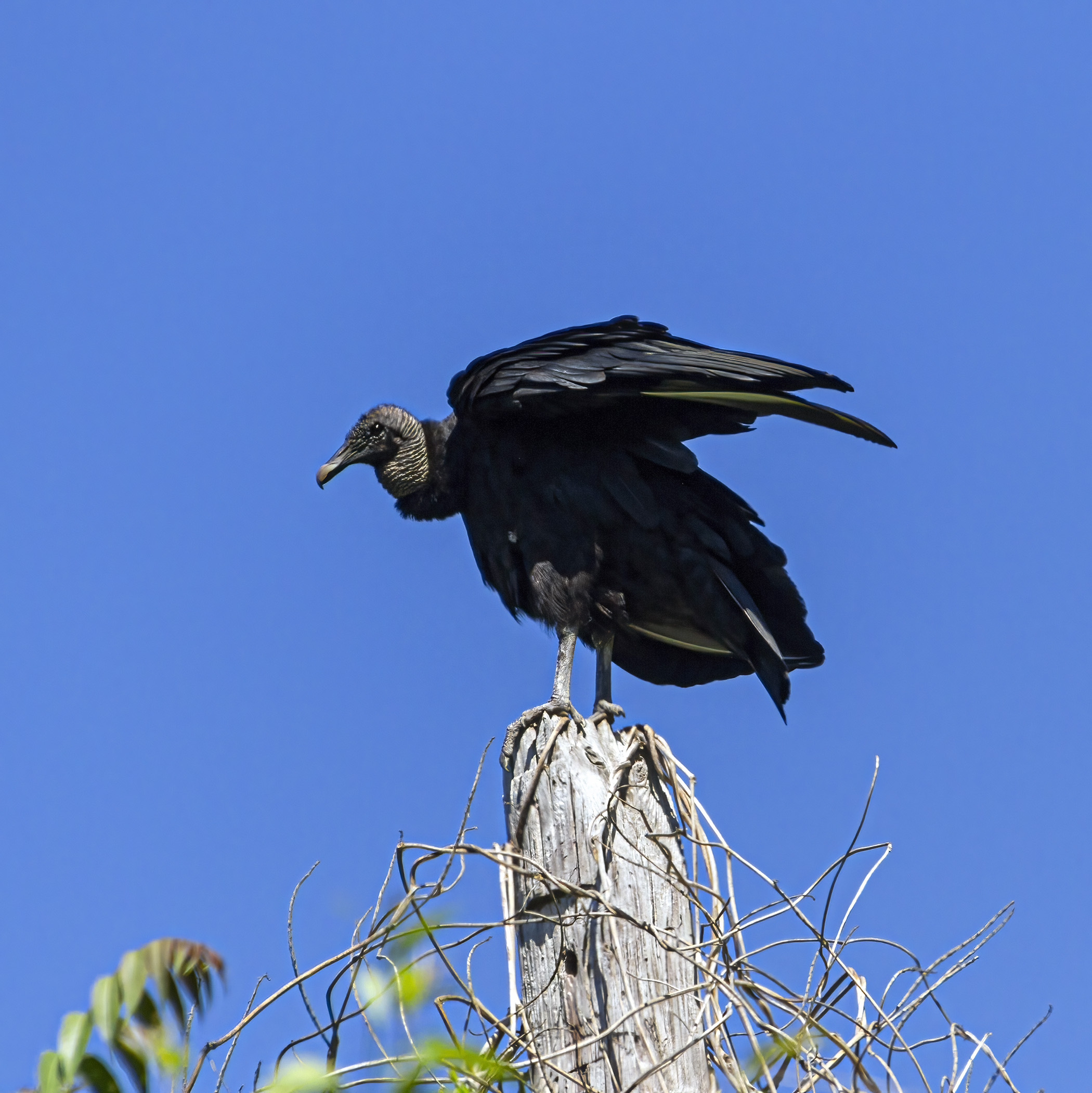
© Michael Q. Powell. All rights reserved.
Posted in Birds, Nature, Photography, wildlife | Tagged Black Vulture, Canon 7D, Coragyps atratus, Lorton VA, Occoquan Regional Park, Tamron 18-400mm, vulture | 1 Comment »
May 6, 2026 by Mike Powell
Each spring (and fall) migrating warblers move through our area. This period is particularly frustrating for me, because I can often hear the warblers singing and calling, but I only rarely catch a glimpse of one.
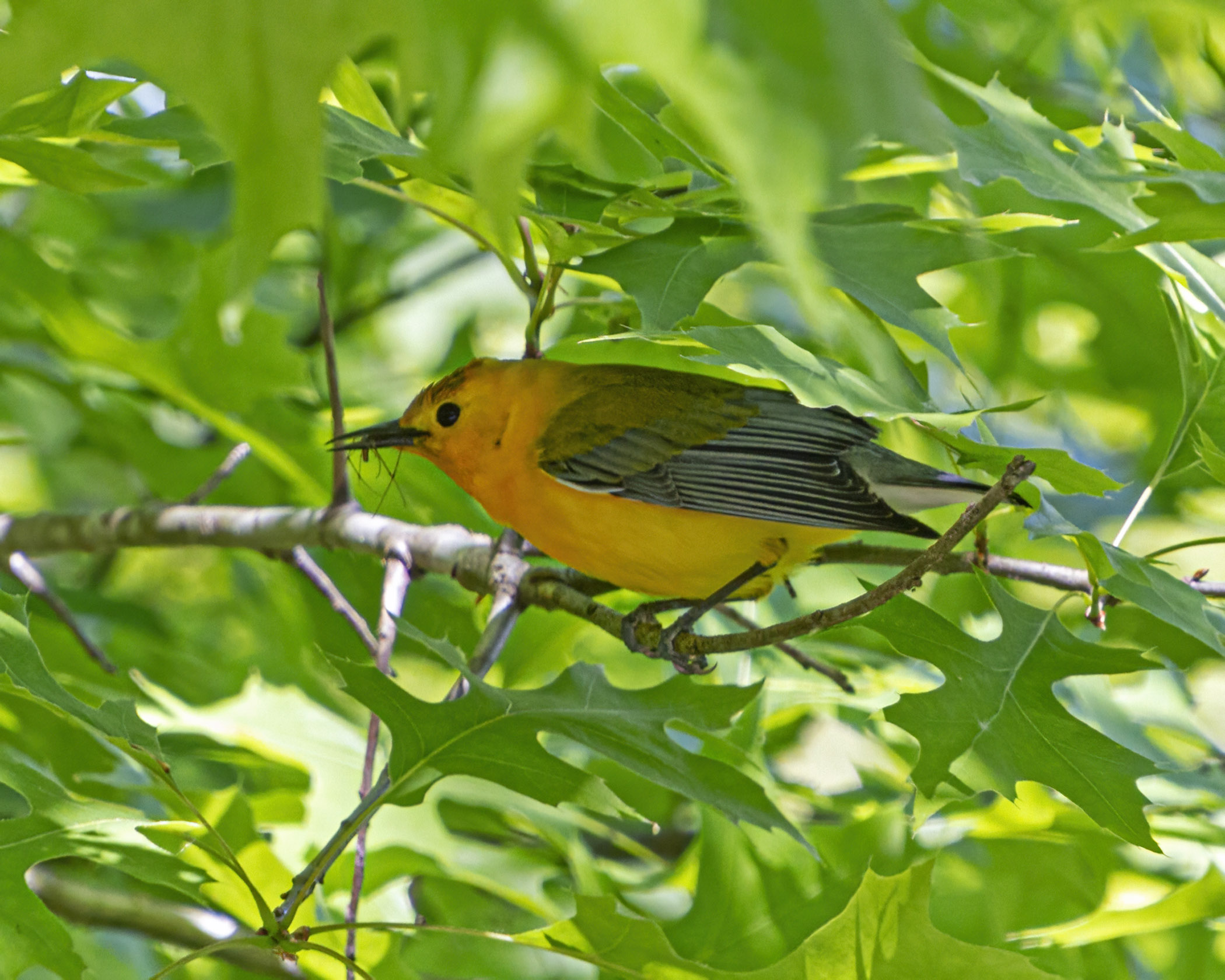
Last week, though, I heard a warbler and was able to track it as it moved feverishly in and out of the foliage at Occoquan Bay National Wildlife Refuge. I was definitely helped by the bright yellow plumage of the bird, that turned out to be a Prothonotary Warbler (Protonotaria citrea). Prothonotary Warblers are almost completely covered in yellow feathers and therefore can’t completely hide themselves. In case you are curious, the bird’s names comes from its plumage that resembles the yellow robes once worn by papal clerks in the Roman Catholic Church, known as prothonotaries.
© Michael Q. Powell. All rights reserved.
Posted in Birds, Nature, Photography, spring, wildlife | Tagged Canon 7D, Occoquan Bay National Wildlife Refuge, Prothonotary Warbler, Protonotaria citrea, Tamron 18-400mm, warbler, Woodbridge VA | 4 Comments »
May 4, 2026 by Mike Powell
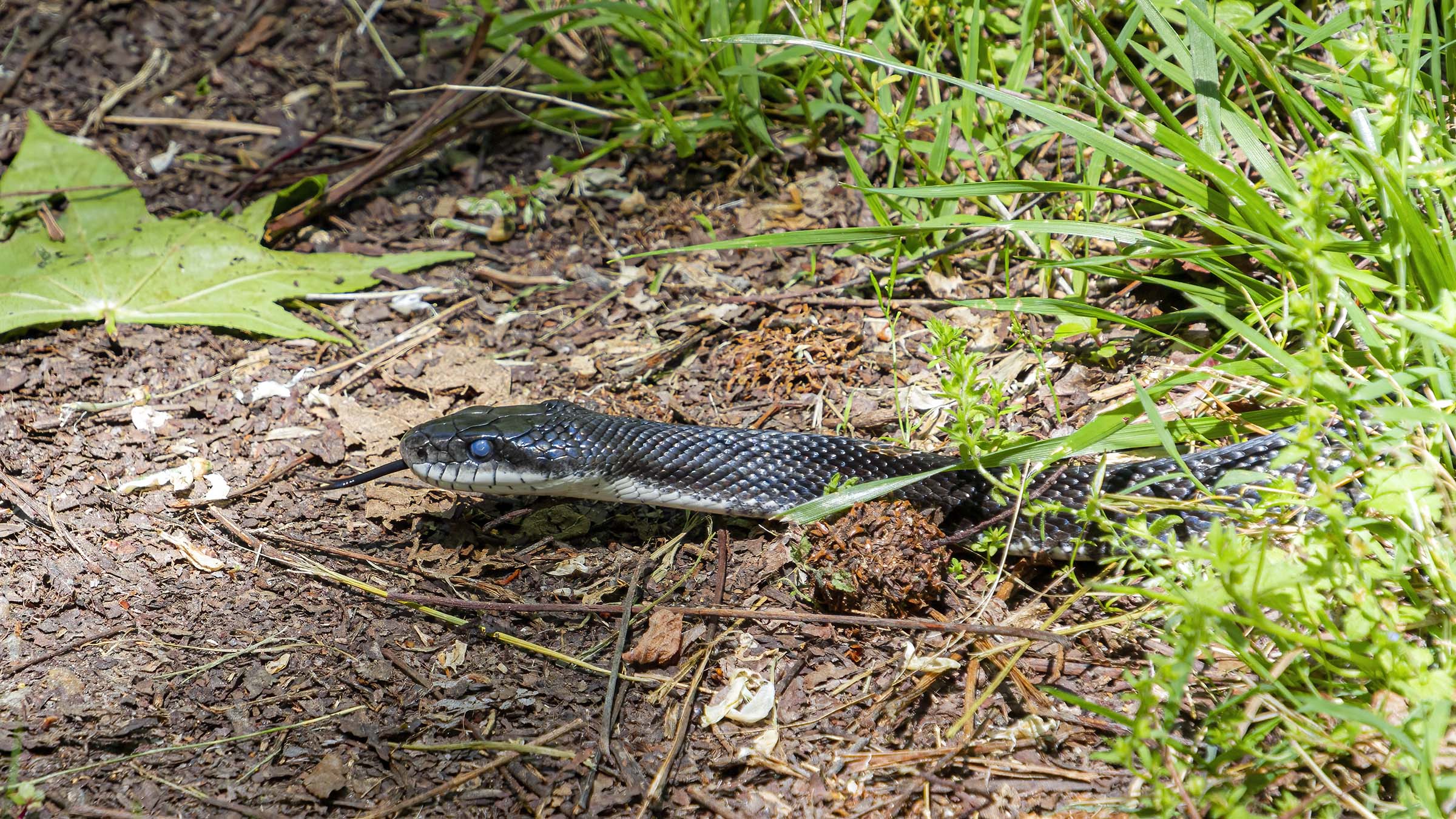
As I was walking down a trail last Friday at Occoquan Bay National Wildlife Refuge, I noticed a large black snake preparing to cross the trail. I know that there are very few poisonous snakes in my area, so I was not worried about being bitten. Instead I stopped walking and focused my camera on an open area that the snake would be moving through.
The snake was moving quite slowly and was flicking its tongue a lot, which I thought was a little strange. Later, when I was reviewing the images on my computer, I noticed that the eyes of the snake were cloudy and bluish, a definite sign that the snake was getting ready to shed its skin, a process that generally takes about a week. Perhaps the snake’s vision was impaired and it was using its tongue to assist in navigation.
I believe that this is a Central Ratsnake (Pantherophis alleghaniensis), a large snake that is quite common in Virginia. After I captured a few images and the snake finished crossing the trail and I continued along it, with my eyes and ears on alert to find my next subject to photograph.
© Michael Q. Powell. All rights reserved.
Posted in Nature, Photography, Reptiles, spring, wildlife | Tagged blue-eyed snake, Canon 7D, Central Ratsnake, Occoquan Bay National Wildlife Refuge, Pantherophis alleghaniensis, rat snake, Tamron 18-400mm, Woodbridge VA | 4 Comments »
April 29, 2026 by Mike Powell
Earlier this week I spotted this striking Six-spotted Tiger Beetle (Cicindela sexguttata) while I was exploring a local nature park. When the sun is shining, the metallic bodies of these beetles absolutely sparkle and look like pieces of high-fashion jewelry. This particular beetle was quite cooperative and did not move as I circled it in pursuit of a good shooting angle.
I was particularly happy with this shot, because of the way that it shows the shadow, the mouth parts, and the detailed wood grain of the stump on which the beetle was crawling. Normally these beetles, as their name suggests, have six spots, but I think that this one had eight little white spots. Apparently the number of spots is somewhat variable.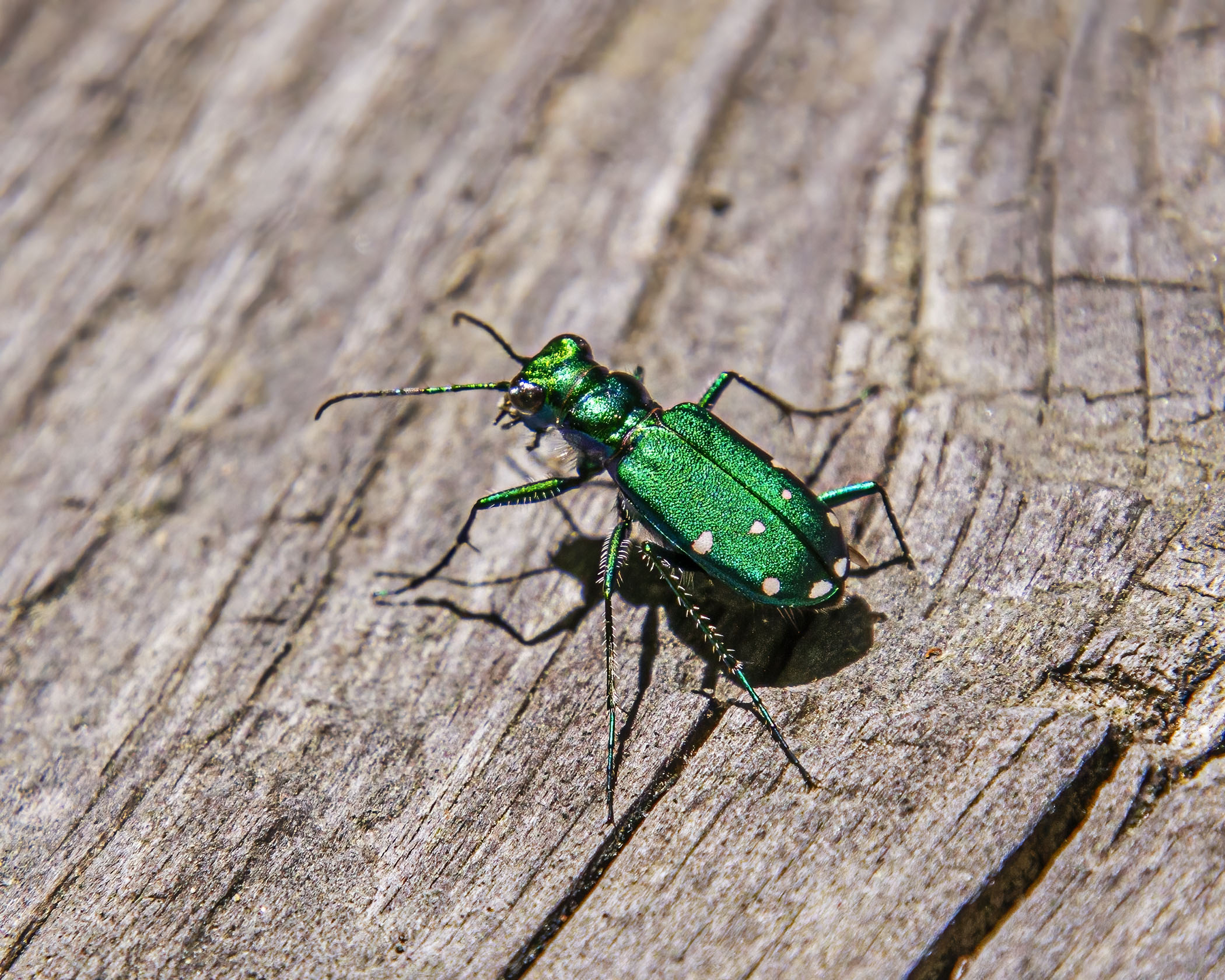
© Michael Q. Powell. All rights reserved.
Posted in Insects, Macro Photography, Nature, Photography, spring, wildlife | Tagged Canon 7D, Cicindela sexguttata, Lorton VA, Occoquan Regional Park, Six-spotted Tiger Beetle, Tamron 18-400mm | 9 Comments »
April 28, 2026 by Mike Powell
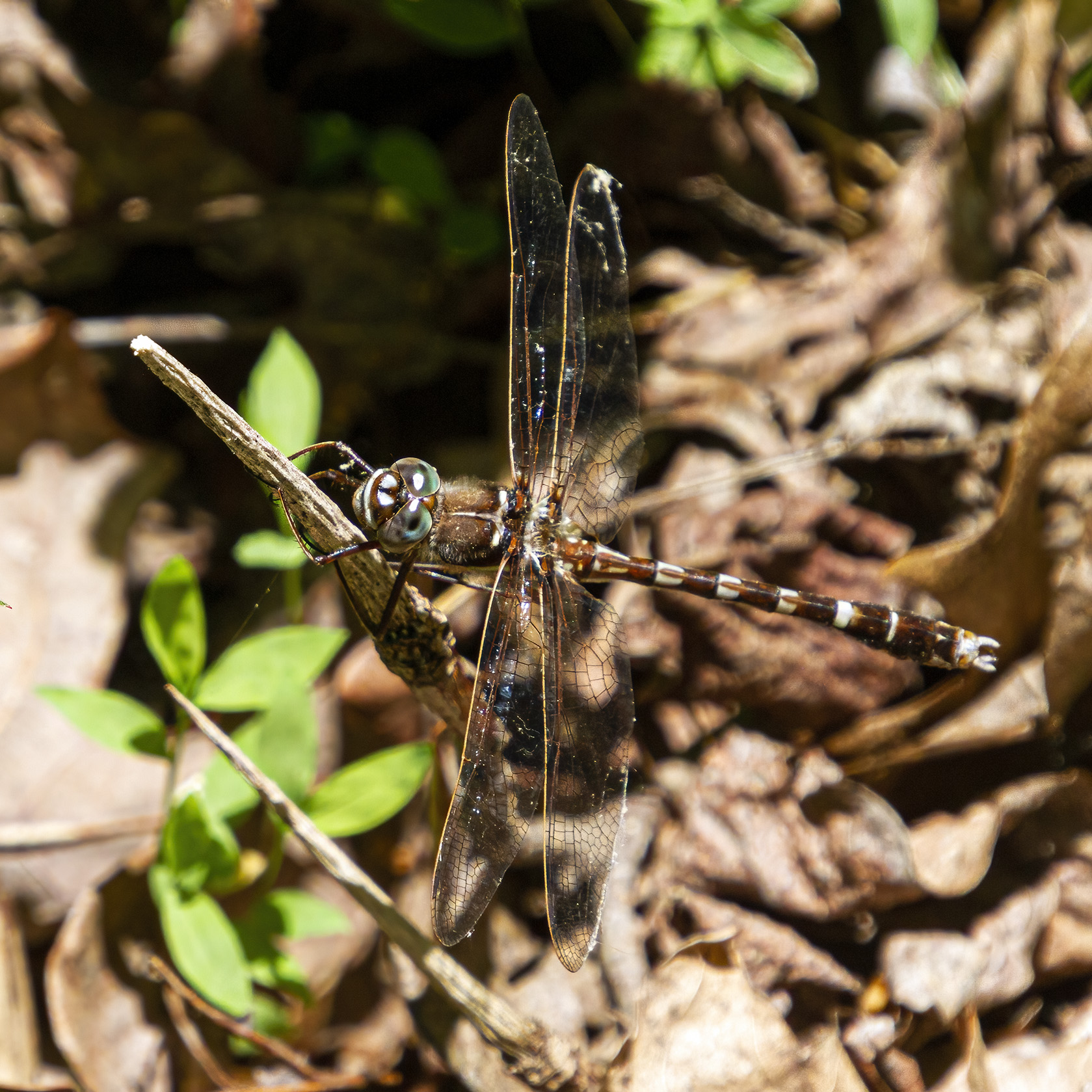
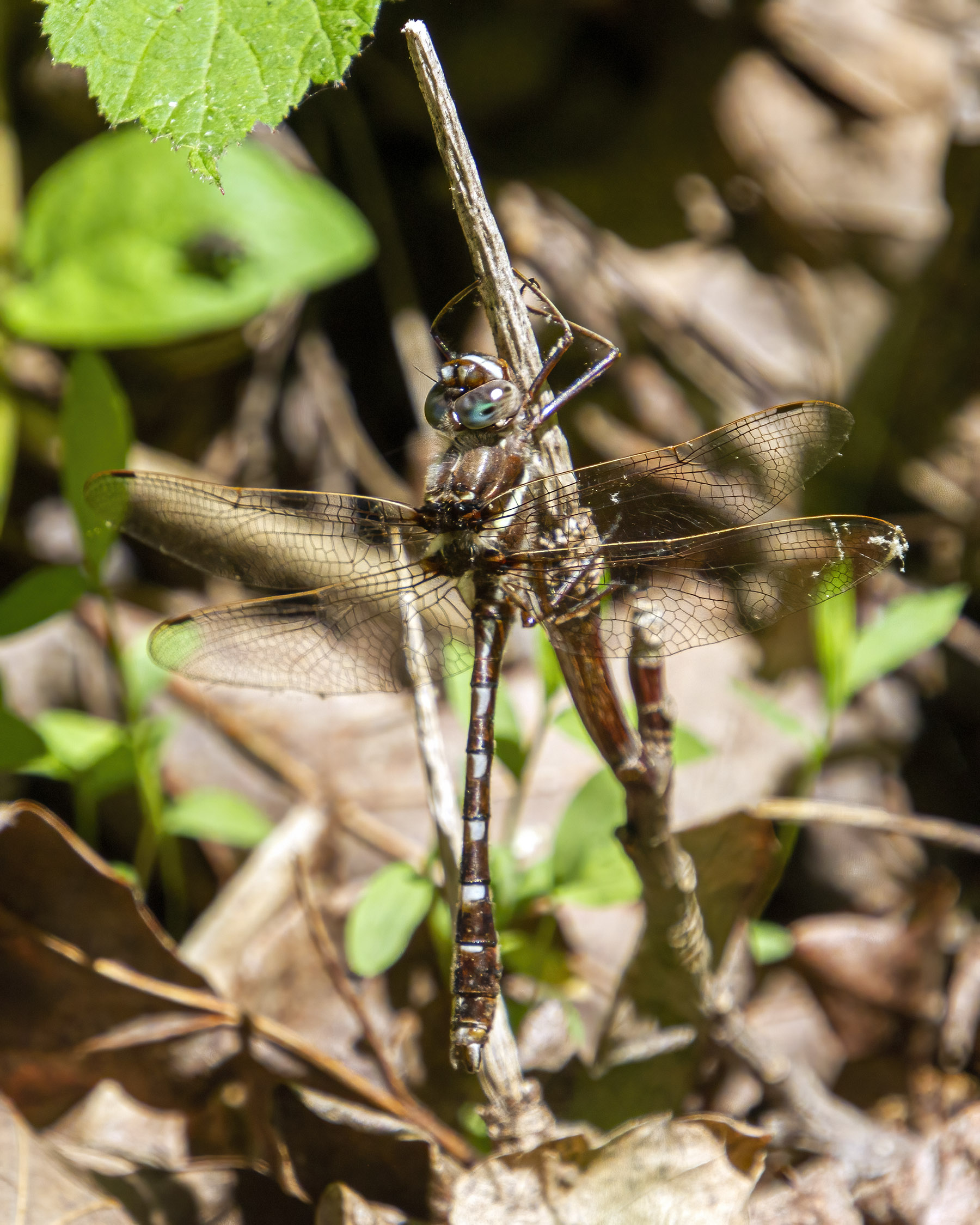
Yesterday I went for a “walk on the wild side” with my camera at one of my local nature parks and captured this shot of a handsome male Stream Cruiser dragonfly (Didymops transversa), my first spotting of this species in 2026. I was actually looking for spiketail dragonflies and encountered several other dragonfly enthusiasts who were similarly searching for those elusive species. I recall asking one of them if it was too early to see Stream Cruisers, because I vaguely remember photographing them at this location in the past, and amazingly I spotted one later in the day after we had gone our separate ways.
Although I did not findt any spiketails yesterday despite my efforts, this image testifies to the value of persistence. In my area, the density of these early spring species is pretty low, so you have to be patient, persistent, and quick-reacting when you do encounter one if you want to get a photo.
I love how this dragonfly seems to be looking right up at me with his stunning two-toned eyes and I am equally delighted by the “milk mustache” that he seems to have on his “upper lip.” Got milk?
© Michael Q. Powell. All rights reserved.
Posted in Dragonflies, dragonfly, Insects, Nature, Photography, spring, wildlife | Tagged Canon 7D, Didymops transversa, got milk?, Lorton VA, milk mustache, Occoquan Regional Park, Stream Cruiser, Stream Cruiser dragonfly, Tamron 18-400mm | Leave a Comment »
April 24, 2026 by Mike Powell
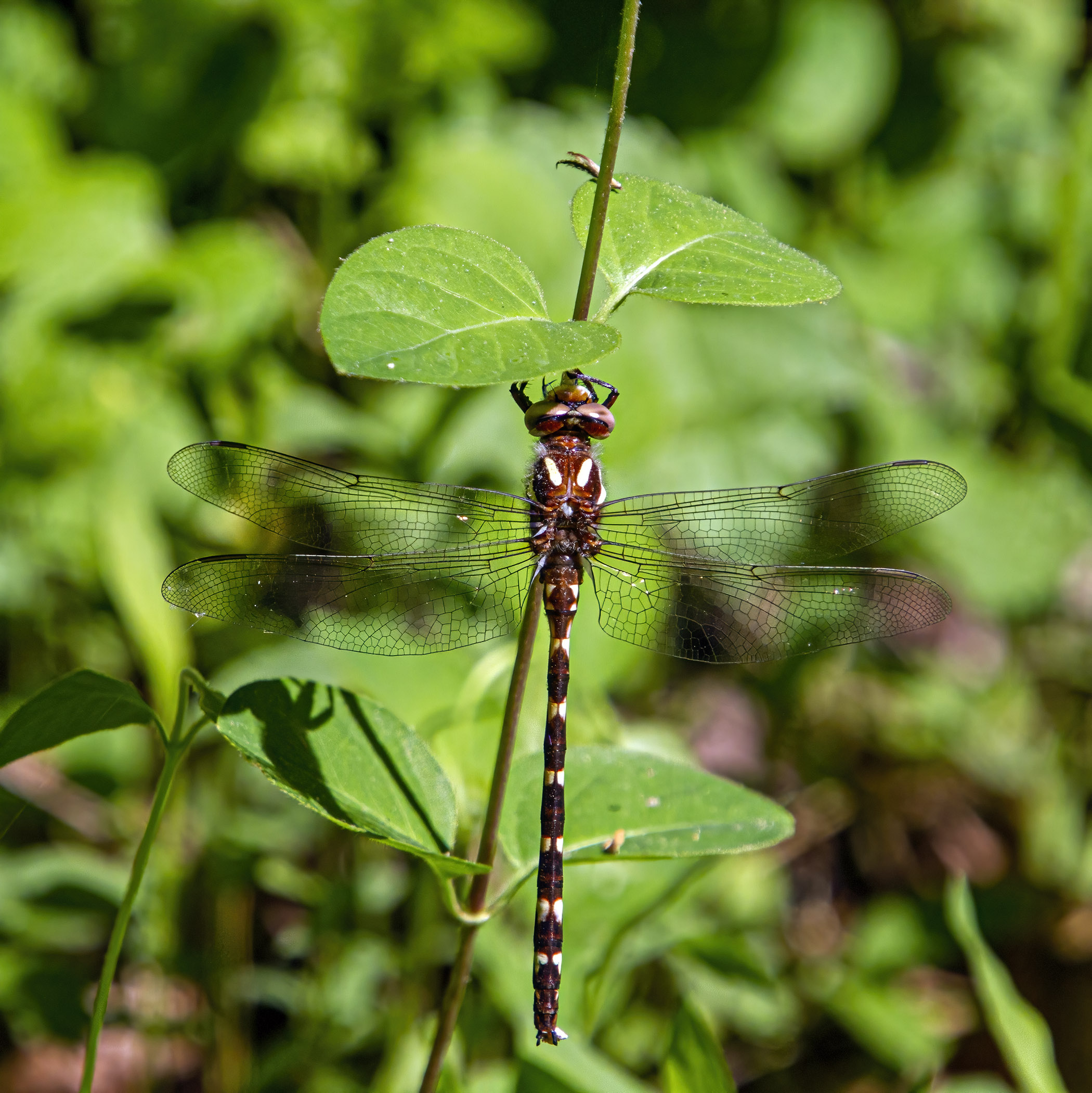
Yesterday, 23 April, I spotted my first spiketail dragonfly of the season while I was exploring a regional park in my county. Dragonflies are divided up into a number of different families and some of the less common ones are named for their “tails,” including spiketails, petaltails, and clubtails. Most of the familiar dragonflies that we see during the summer are from the skimmer family.
Spiketail dragonflies are relatively uncommon where I live and I was delighted to spot capture this shot of what I believe is a Brown Spiketail (Cordulegaster bilineata). As described on the Dragonflies of Northern Virginia website, “These uncommon, elusive dragonflies have, in my opinion a magical, almost elven quality and are usually found in isolated corners of mature woodlands.”
I never know for sure what creatures I will encounter when I go out in the wild with my camera, but this was not exactly a random encounter. In the past I have sometimes found spiketails at this time of the year in this location. In wildlife photography there are no guarantees, but a bit of knowledge and skill and a lot of persistence can increase the odds in my favor of encountering some of these beautiful creatures—it is more than just pure luck.
© Michael Q. Powell. All rights reserved.
Posted in Dragonflies, dragonfly, Insects, Nature, Photography, spring, wildlife | Tagged Brown Spiketail, Brown Spiketail dragonfly, Canon 7D, Cordulegaster bilineata, Lorton VA, Occoquan Regional Park, spiketail dragonfly, Tamron 18-400mm | 7 Comments »
April 20, 2026 by Mike Powell
Photography seems to be easy. Nowadays anyone with a cell phone can capture images. Many people do so every day and all of the social media filled with those images. Is that really photography? That’s a huge question and your response to it is significantly influenced by the way that you look at the purpose of photography.
Is photography simply about recording and documenting a moment in time? If so, a simple box camera of the past or almost any modern camera or cell phone can easily fulfill that role. Underlying that view is the assumption that somehow reality is objective. Police interviews of eyewitnesses, however, have repeatedly shown each person has an individual perception of reality. In essence, we all have built-in filters that alter and shape our perceptions and interpretations of what our eyes are seeing.
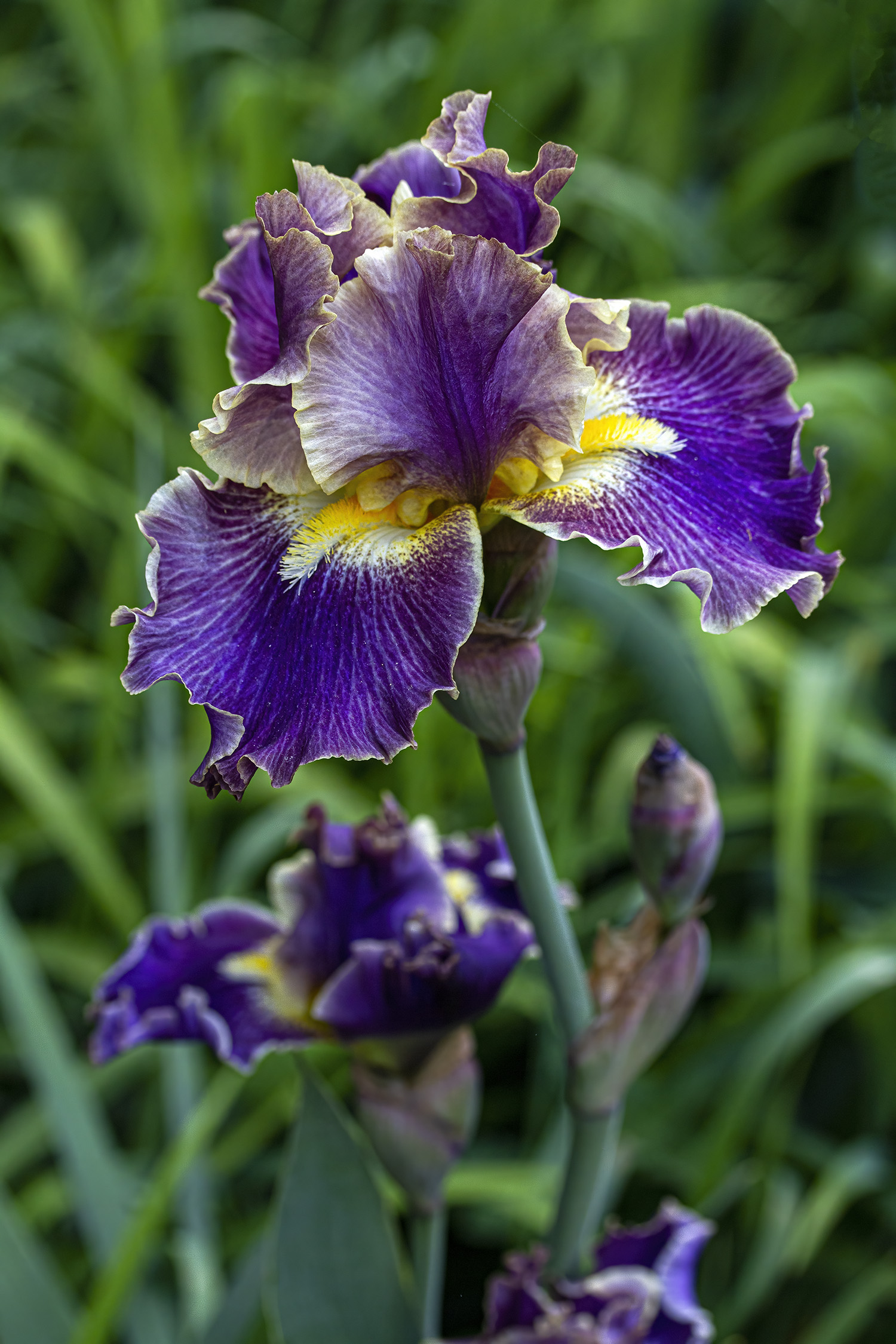
In my personal view, photographers are trying to shape your perceptions of a subject through a series of creative choices they make. As I was reviewing some recent photos I took of irises in a neighbor’s garden, I really liked the one below and thought about what was going on in my mind when I took the shot.
When I first looked through the camera’s viewfinder, I realized the background was really cluttered, which I knew would distract the viewer’s focus from the flower and therefore changed the camera’s aperture setting to f/5.0 and moved closer to the flower to provide a more blurred background. I wanted to be sure that I did not get any motion blur, because I was shooting at an awkward angle, so I settled on a shutter speed of 1/400 sec (at an ISO setting of 400). The sunshine was a bit bright and I used exposure compensation of minus 2/3 of a stop to darken the image a bit from what the camera wanted to use.
The final, and arguably most important, step was composing the shot. With a static subject like this, I try to compose the shot in the camera, so minimal cropping is necessary when processing the image on my computer. In this case, the image below was not cropped at all. (With wildlife subjects, I do not have the luxury of carefully composing the shot, so cropping is often necessary.)
I wanted to draw the viewer’s full attention to the fully open iris flower, so I focused on its yellow beards. However, I also wanted the viewer to get a sense of the partially opened blooms and buds and chose to include them in the composition. When I saw them with my own eyes, all of the flowers were equally in focus, but as you can see in the photo, I used the camera settings to ensure that deliberately chosen elements were in focus, while others elements remained visible, albeit blurred.
Over a dozen years ago, when I was first starting to get serious about my photography, I had to consciously make the kinds of decisions I have tried to describe above. Now I am familiar enough with my camera’s settings and know what effect they will have on the photos that I make many of these decisions simultaneously and instinctively. I usually have an idea in my head of the kind of image I want to produce and use most of my conscious mind to think about the composition.
So, is photography hard? Taking a picture is easy, but bringing a vision to life is harder. It may not be possible for another person to walk in your shoes, but photography can help another person to see with your eyes (or at a minimum to experience the world in a way in which you want them to.)
© Michael Q. Powell. All rights reserved.
Posted in Art, Flowers, Gardening, Nature, Photography | Tagged Bearded Iris, Canon 60mm, Canon 7D, creative choices, iris | 18 Comments »
April 18, 2026 by Mike Powell
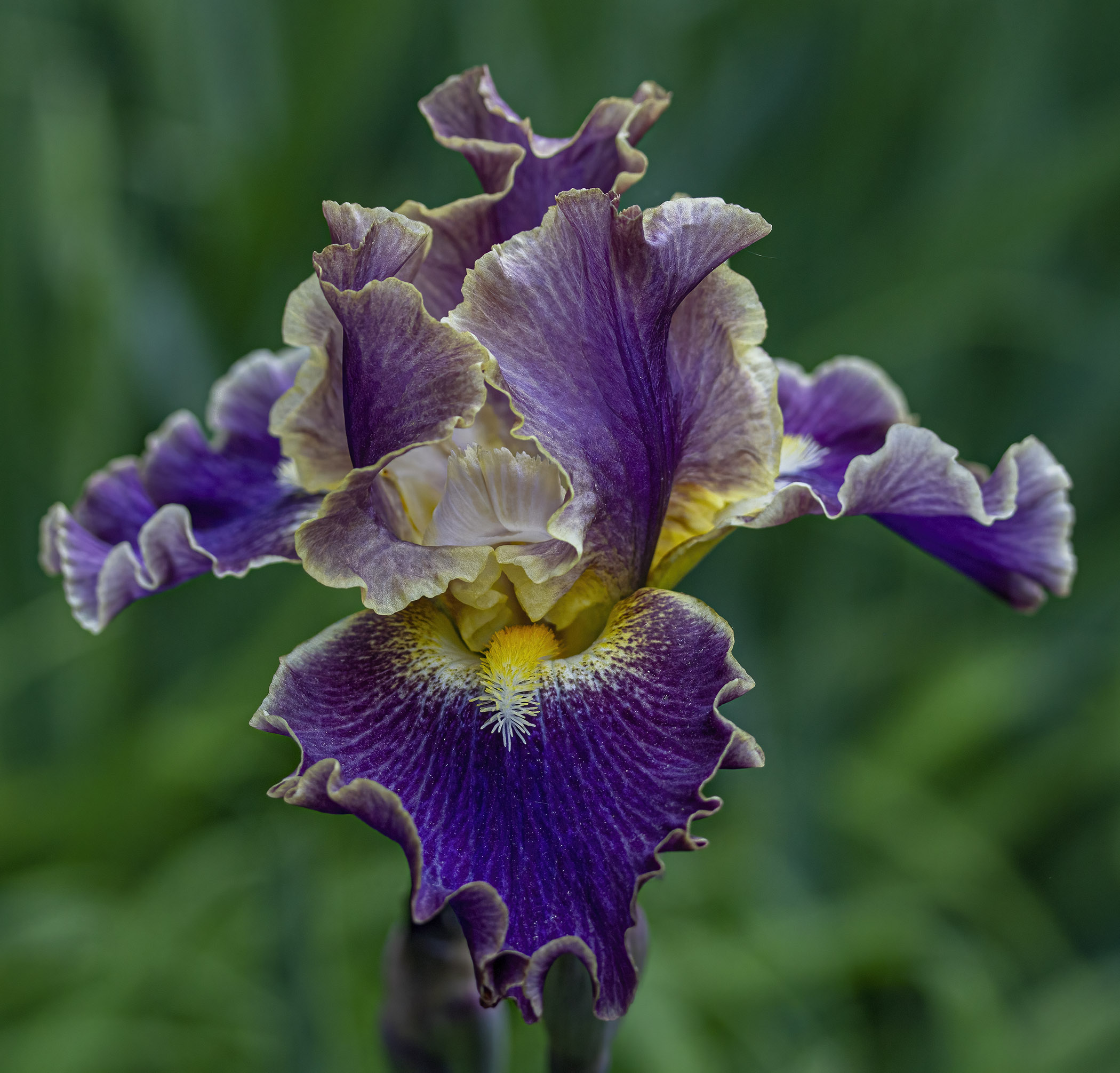
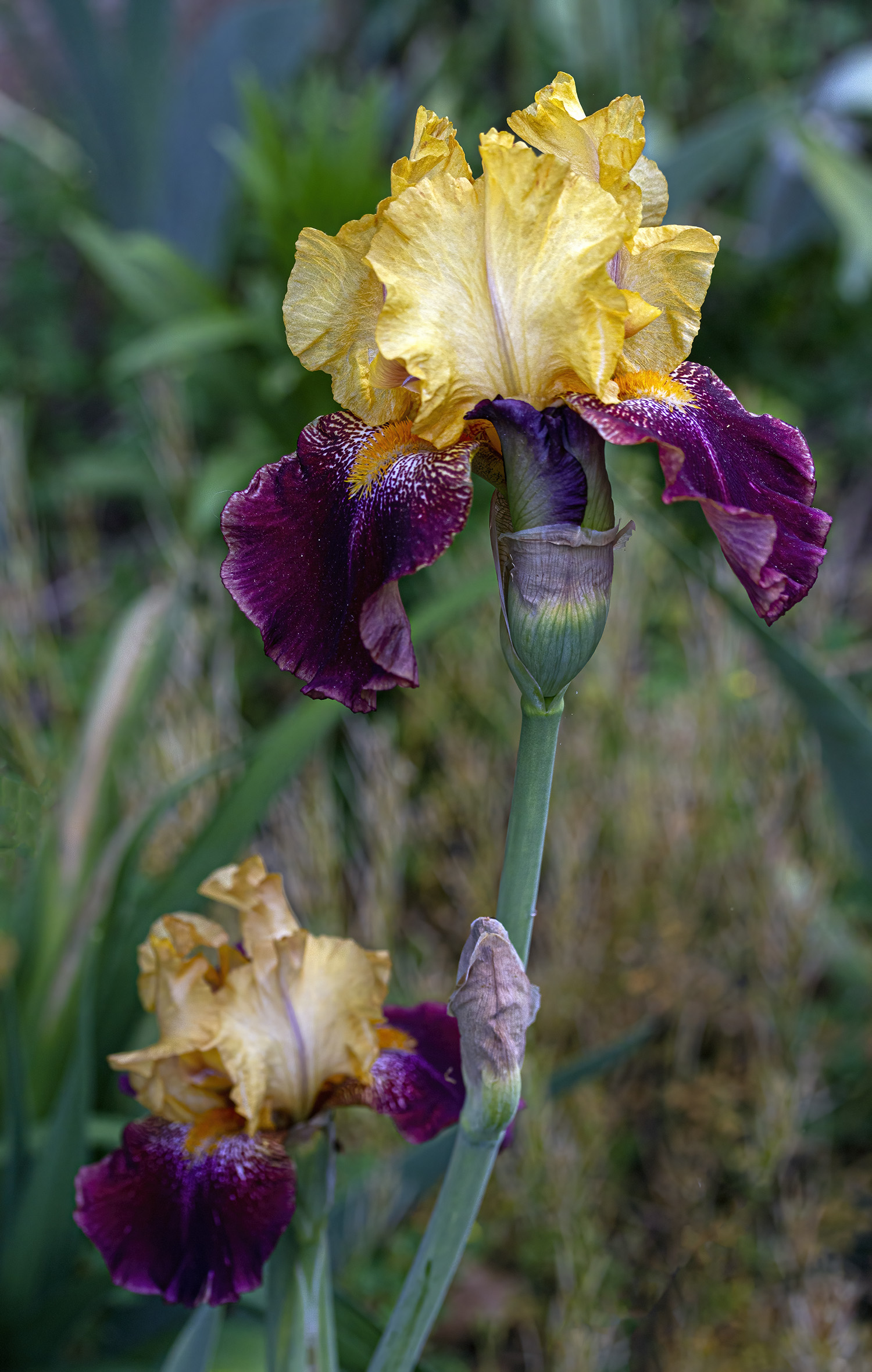
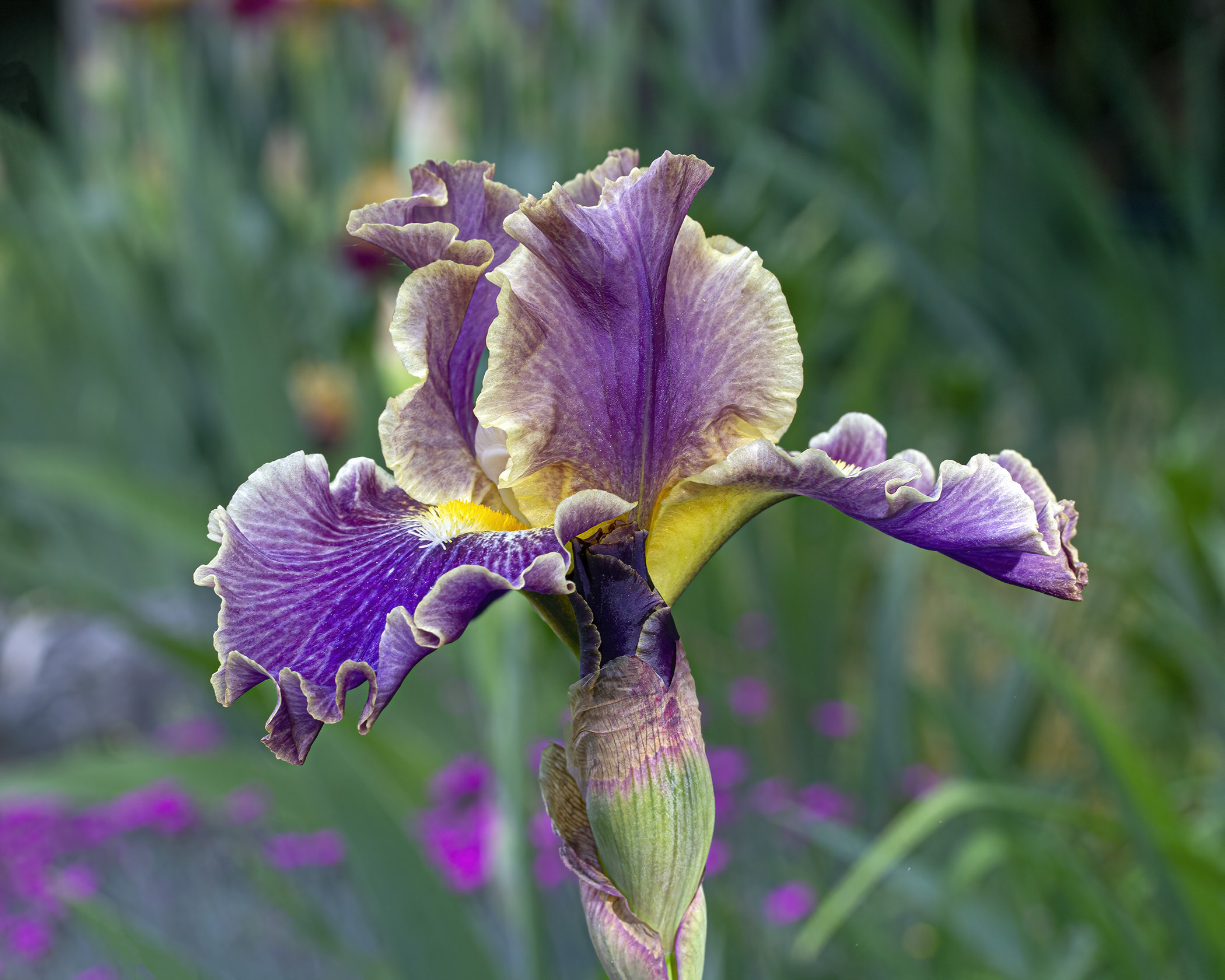
Bearded irises are now starting to bloom in the garden of my dear friend Cindy Dyer, so I walked over yesterday morning and grabbed a few shots of them. Spring is a beautiful time of the year.
© Michael Q. Powell. All rights reserved.
Posted in Flowers, Gardening, iris, Photography, spring | Tagged Bearded Iris, bearded irises, Canon 60mm, Canon 7D, Cindy Dyer, Cindy's garden, spring flowers | 6 Comments »
April 16, 2026 by Mike Powell
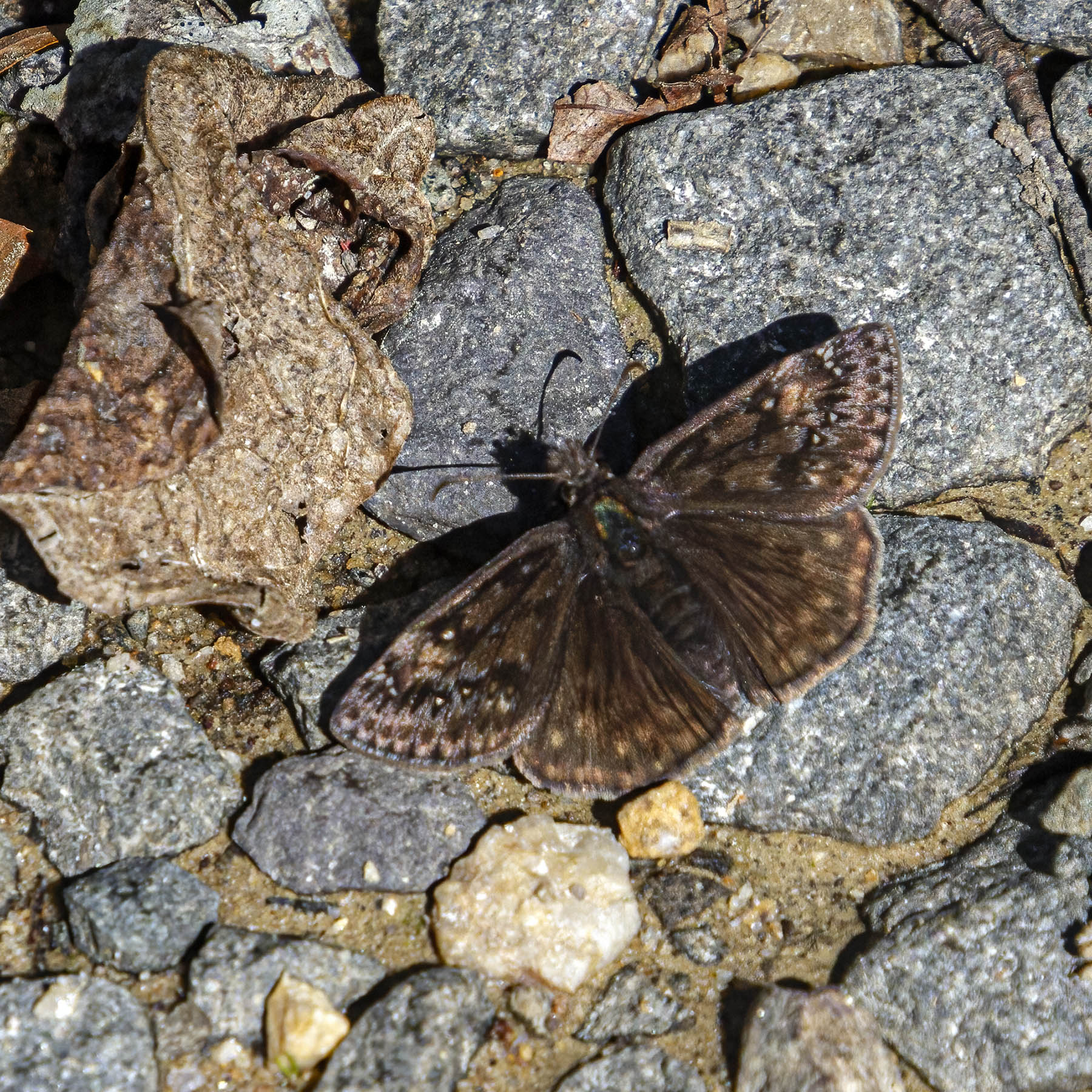
Not all of the spring butterflies are colorful. During a recent hike in a forested area of Prince William County in Northern Virginia, I spotted numerous duskywing butterflies. These small butterflies are part of the skipper family (Hesperiidae) and are considered to be “spread-wing” skippers, because they typically perch with their wings held flat open rather than closed over their backs.
There are several different duskywing species that are differentiated by the patterns on their wings. I am not certain of this identification, but I believe that this may be a Juvenal’s Duskywing butterfly (Erynnis juvenalis). I encourage you to click on the image to get a closer look at this small butterfly’s beautiful colors and patterns,
© Michael Q. Powell. All rights reserved.
Posted in Butterflies, Insects, Nature, Photography, spring, wildlife | Tagged Canon 7D, duskywing, Erynnis juvenalis, Juvenal's Duskywing, Prince William County VA, Tamron 18-400mm, Triangle VA | Leave a Comment »
April 15, 2026 by Mike Powell
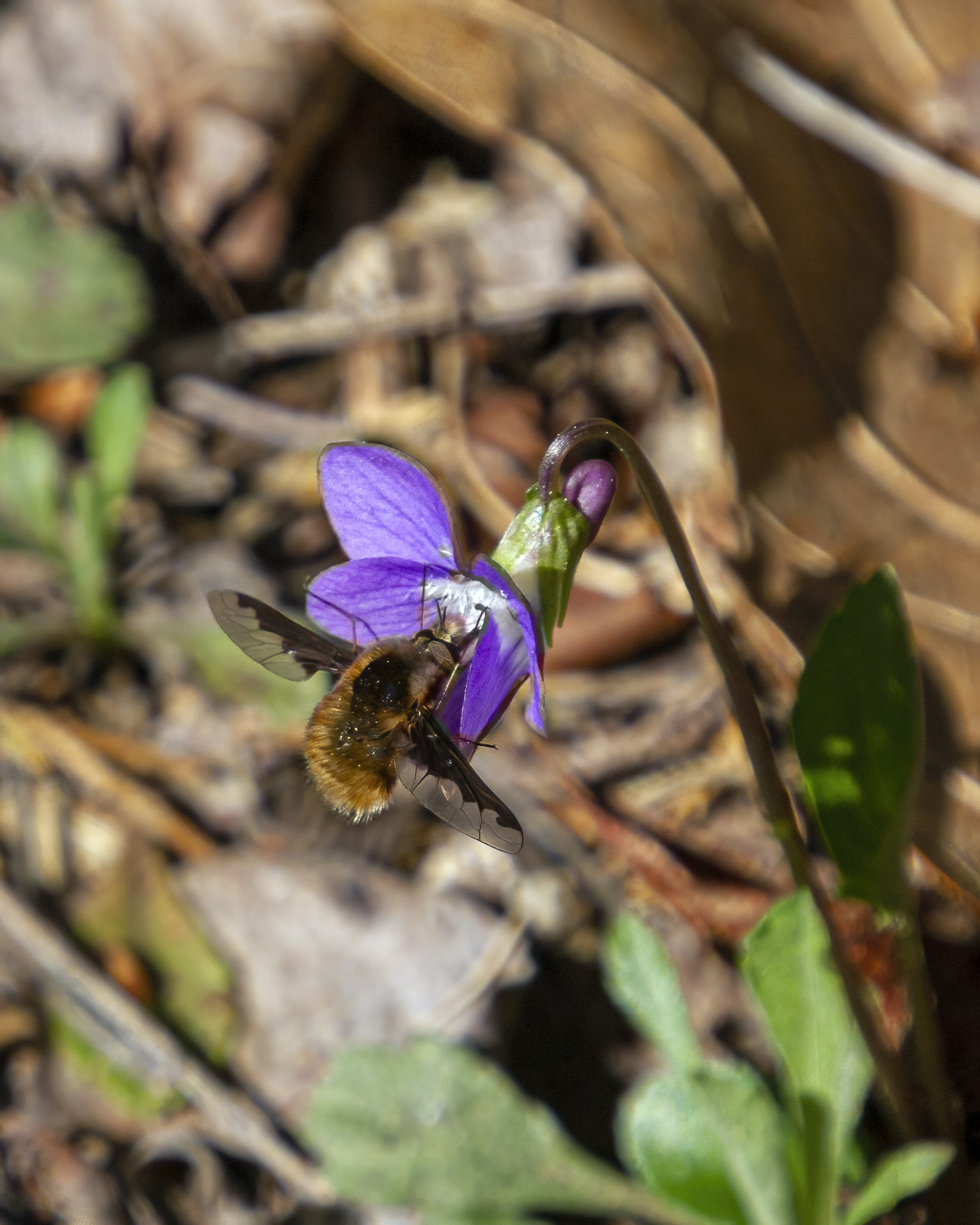
Is it a bee? Is it a fly? Well, it has a fuzzy body like a bumblebee and has a long, rigid proboscis that looks like a stinger, but its patterned wings and long legs look more like those of a fly. In actuality, it is a Greater Bee Fly (Bombylius major), a parasitic bee mimic that is one of the earliest spring pollinators of wildflowers. In this case, I think the little flower was some kind of wild violet, a vital early spring nectar source for many pollinators, like bee flies.
I photographed this bee fly in early April while searching for dragonflies in Prince William County in Northern Virginia. I was quite happy to be able to capture so many of the details of this curious creature, including its long proboscis, spindly legs, patterned wings, and fuzzy body. In case you are curious, the body of one of these bee flies is about six-tenths of an inch (15mm) in length and its wing span is about one inch (25mm).
If you would like to learn more about these fascinating little bee flies, including their parasitic behavior, check out this article on the US Forest Service website by Beatriz Moisset entitled “A Pollinator with a Bad Reputation.”
© Michael Q. Powell. All rights reserved.
Posted in Insects, Macro Photography, Nature, Photography, wildlife | Tagged bee fly, bee mimic, Bombylius major, Canon 7D, Greater Bee Fly, Kleptoparasitic bees, Prince William County VA, Tamron 18-400mm | Leave a Comment »
April 13, 2026 by Mike Powell
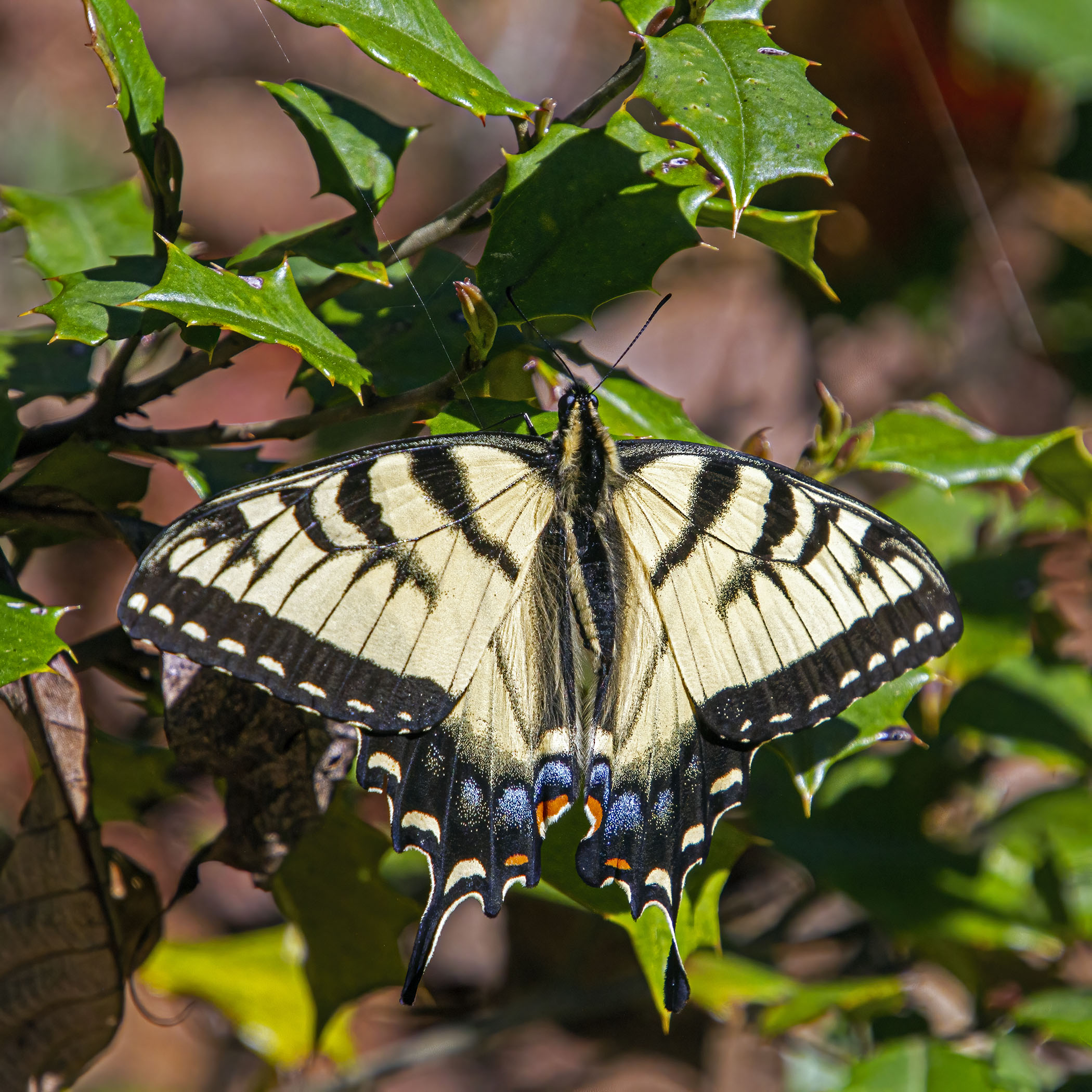
Last week I spotted multiple Eastern Tiger Swallowtail butterflies (Papilio glaucus) as I was hiking along forested trails in Prince William County, Virginia, searching primarily for dragonflies. For some reason, I tend to associate these butterflies, which happen to be the state insect for Virginia, with gardens more than forests.
However, according to the Prince William Conservation Alliance website, “Tiger Swallowtails are commonly found in deciduous woodlands and along their borders, including parks and neighborhoods, where they feed on the nectar of wild and garden flowers from Spring through Fall.”
Eastern Tiger Swallowtails are quite common in my area, but I am always delighted to see their bright colors as they flutter through the air. April is a kind of transitional month here weatherwise, with wildly variable temperatures. Later this week, for example, the forecast predicts high temperatures of up to 93 degrees (34 degrees C). Yikes!
© Michael Q. Powell. All rights reserved.
Posted in Insects, Nature, Photography, spring, wildlife | Tagged Canon 7D, Eastern Tiger Swallowtail, Eastern Tiger Swallowtail butterfly, Papilio glaucus, Prince William Forest Park, Tamron 18-400mm | 1 Comment »
April 12, 2026 by Mike Powell
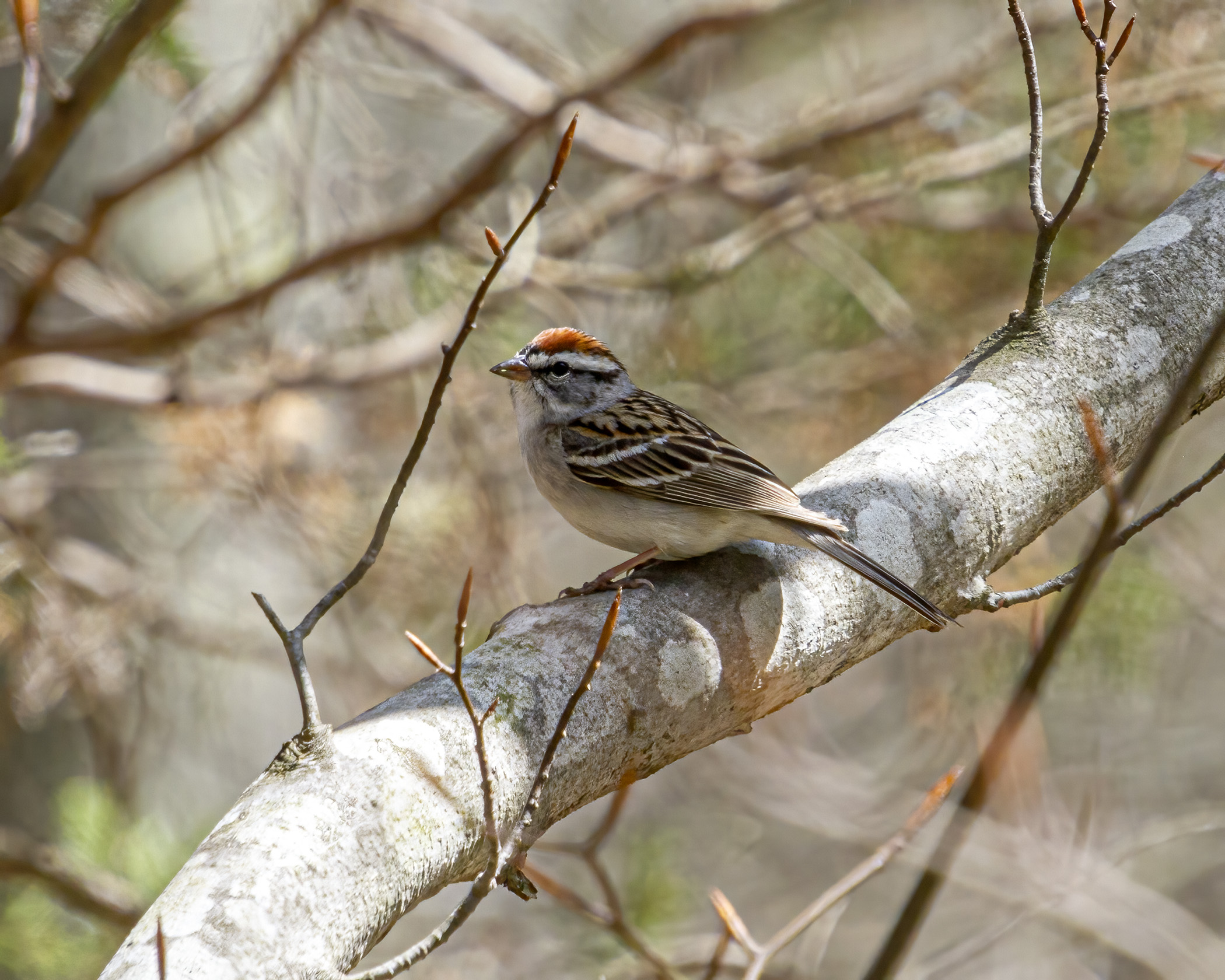
While I was out searching for dragonflies last week, I was delighted to spot this colorful Chipping Sparrow (Spizella passerina) and was even more thrilled to get a shot of it. Compared with many other birds, sparrows tend to be somewhat drab in coloration. I think it was the bright red on the top of this bird’s head that caught my eye.
This is the season when colorful warblers pass through my area on their way northward, so my first thought was that this bird might be some kind of warbler. When I got home and looked through my bird identification guide, I realized that it was a sparrow species that I had not previously encountered.
This shot is not quite as sharp as I would have preferred, because I was shooting with a shorter telephoto lens (a Tamron 18-400mm) that I tend to use during the winter months (a Tamron 150-600mm). I can shoot at a lot closer range with the shorter lens, which has a minimum focusing distance of about 18 inches (45 cm) versus almost 9 feet (2.7 m) for the 150-600mm lens. For that reason, I prefer using the shorter telephoto lens or my 180mm macro lens when attempting to photograph insects like dragonflies.
© Michael Q. Powell. All rights reserved.
Posted in Birds, Nature, Photography, spring, wildlife | Tagged Canon 7D, Chipping Sparrow, Prince William County VA, Spizella passerina, Tamron 18-400mm | 2 Comments »
April 9, 2026 by Mike Powell
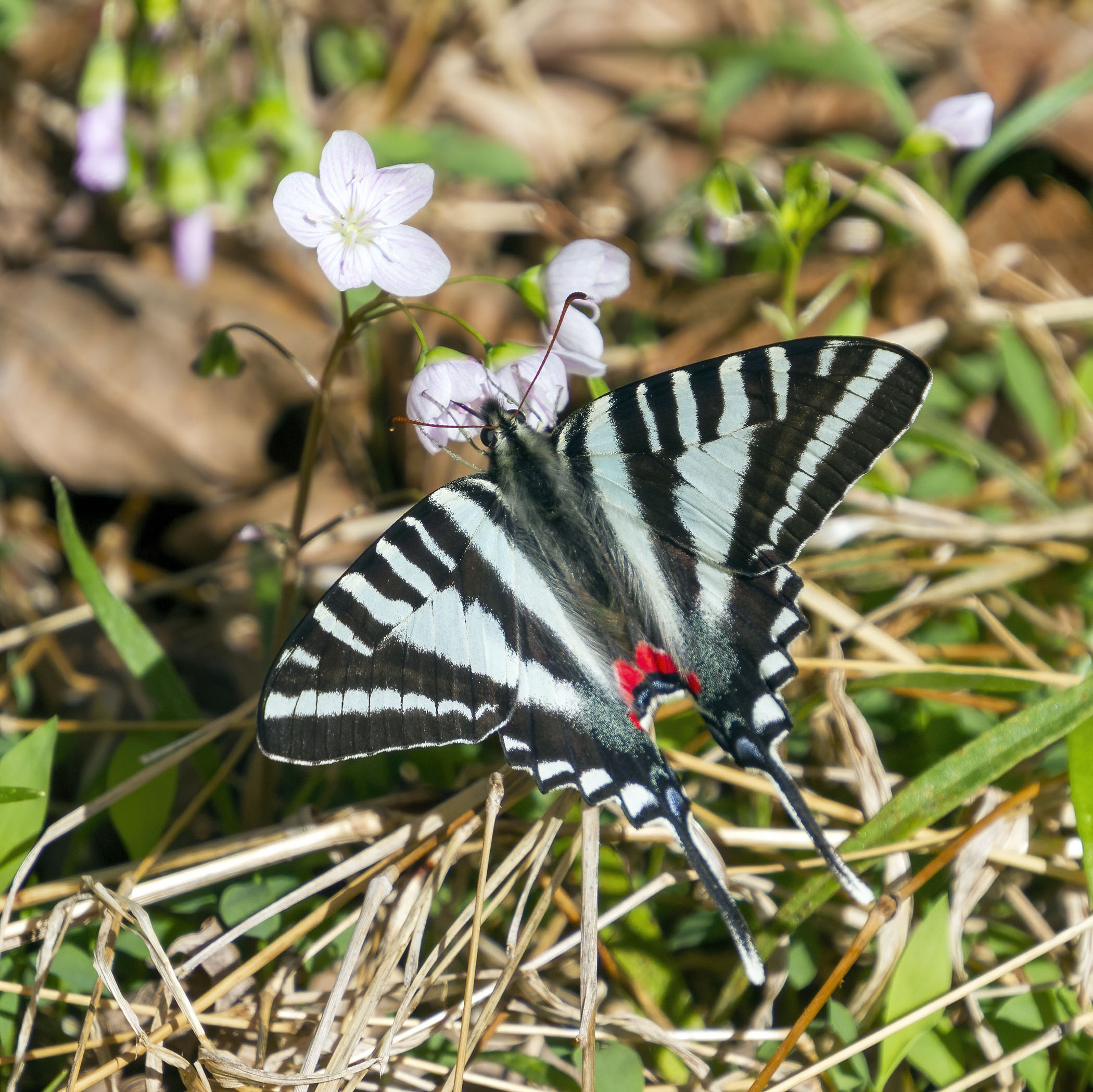
This early in the season, not many flowers are in bloom, so this Zebra Swallowtail butterfly (Eurytides marcellus) was content on Monday to feed on the tiny Spring Beauty (Claytonia virginica) wildflowers on the forest floor.
I had to get really low to capture this image and was delighted by the way that it shows the colors of this beautiful butterfly that was in pristine condition. Later in the season, many of the Zebra Swallowtails that I see have portions of their really long “tails” missing.
© Michael Q. Powell. All rights reserved.
Posted in Butterflies, Flowers, Nature, Photography, spring, wildlife | Tagged Canon 7D, Claytonia virginica, Eurytides marcellus, Prince William Forest Park, Spring Beauty, Tamron 18-400mm, Triangle VA, Virginia Spring Beauty, Zebra Swallowtail, Zebra Swallowtail butterfly | 3 Comments »
April 8, 2026 by Mike Powell
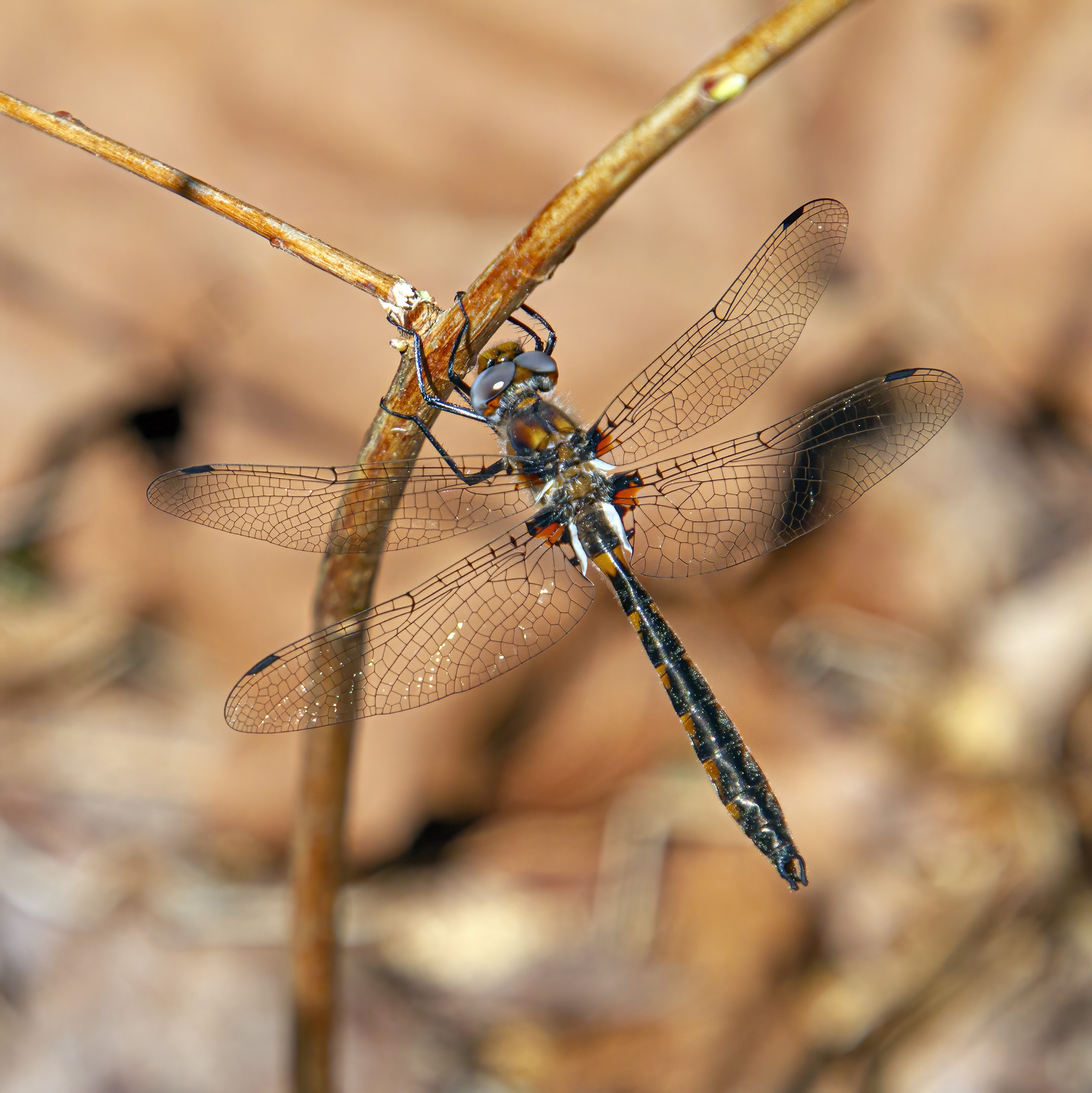
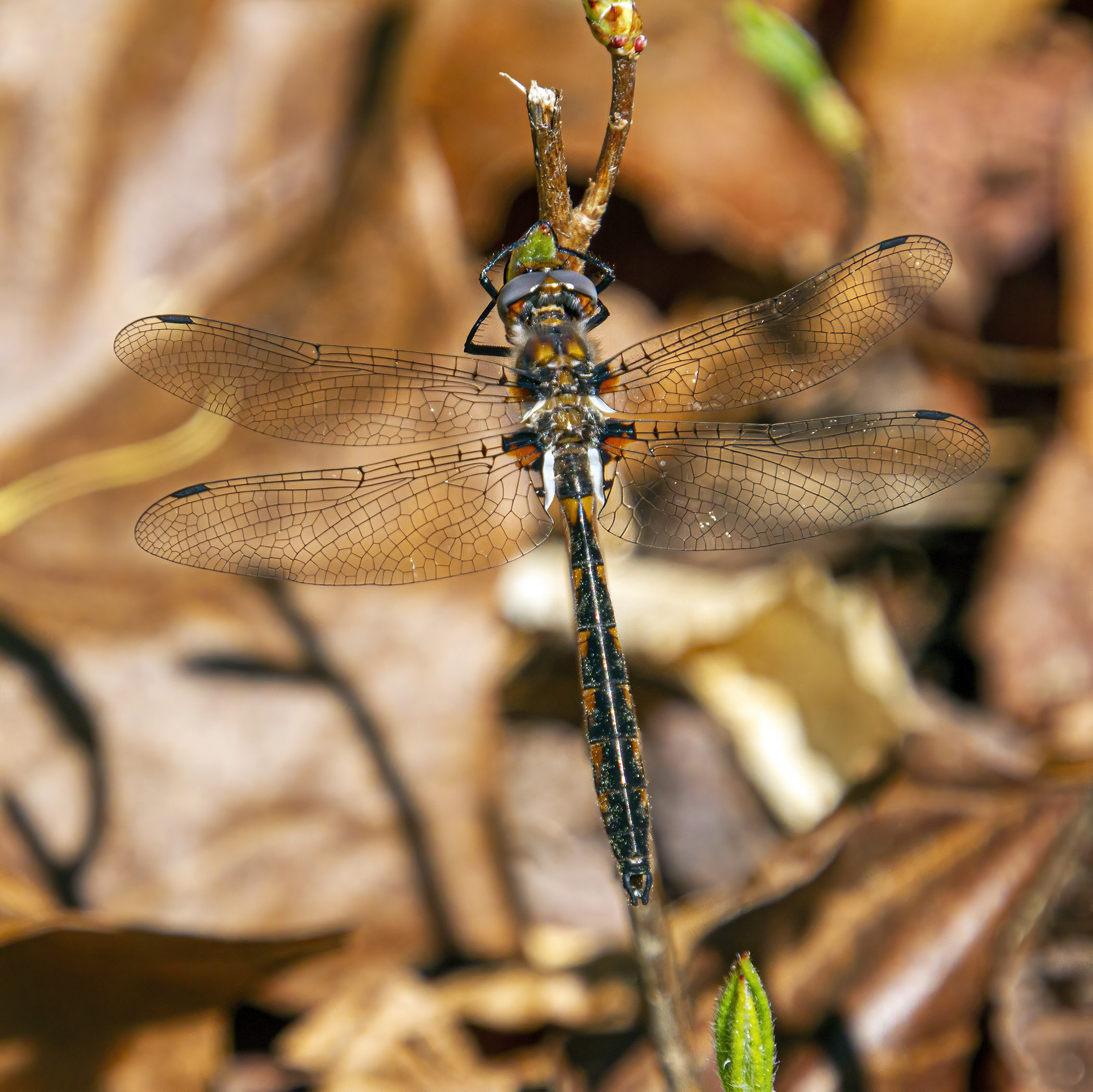
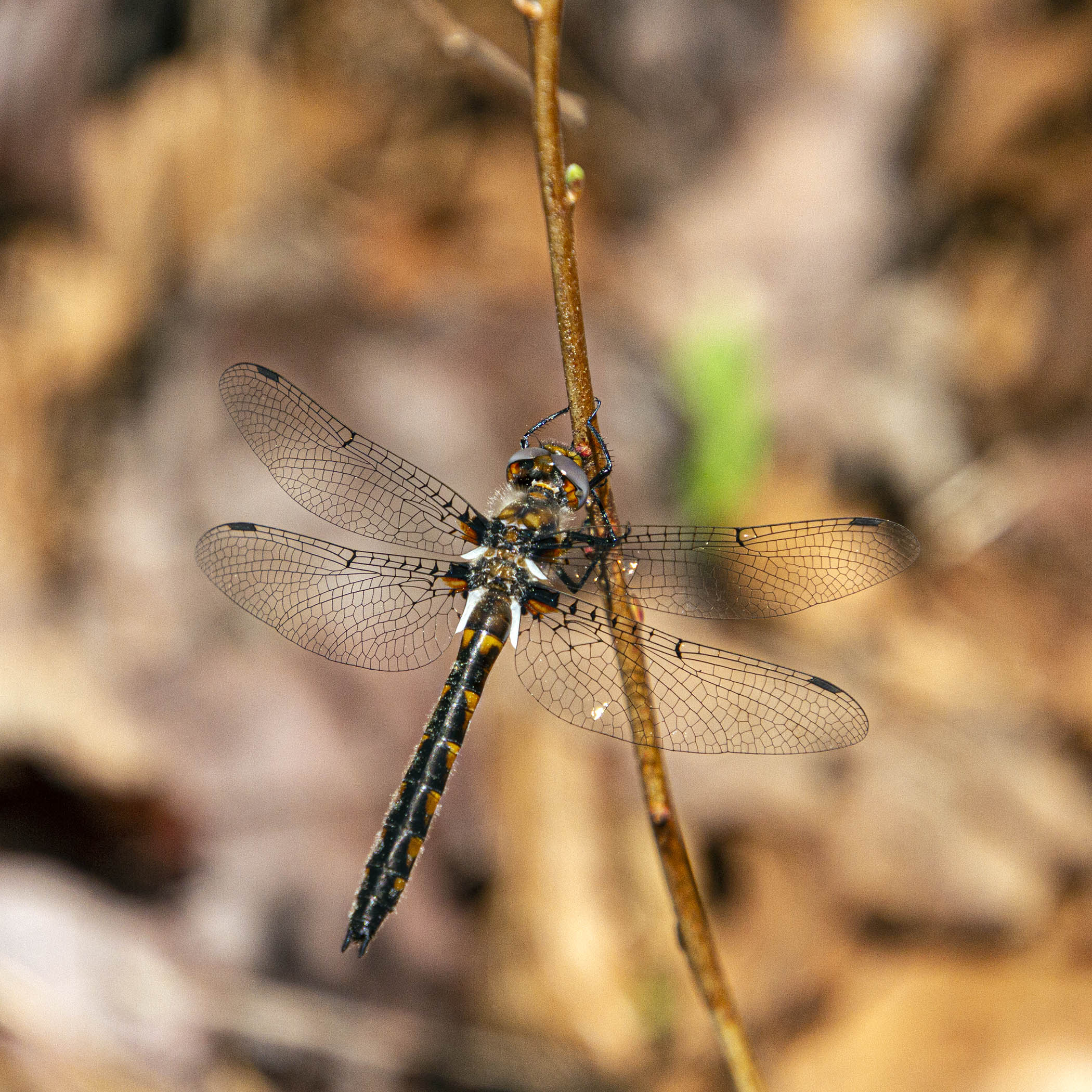
Each spring I head out in search of Uhler’s Sundragons (Helocordulia uhleri), one of the earliest dragonflies in my area to emerge. Unlike many of the dragonflies that I commonly see during the summer days, this species is a “scarce and seldom seen member of the emerald family” and is a “habitat specialist with a brief and early flight period,” according to the Dragonflies of Northern Virginia website. The species requires a clean, sandy or gravelly forest stream with mix of riffles and pools.
Fortunately, I know of a creek where I have regularly seen them over the last few years, and I visited that location on Monday and spotted multiple Uhler’s Sundragons. As you can see in the photos below, this species likes to hang vertically or at an angle. The amber markings at the base of the wings help to distinguish Uhler’s Sundragons from the similar Selys’s Sundragons that have no such markings.
© Michael Q. Powell. All rights reserved.
Posted in Dragonflies, dragonfly, Insects, Nature, Photography, spring, wildlife | Tagged Canon 7D, female Uhler's Sundragon, Helocordulia uhleri, male Uhler's Sundragon, Prince William County VA, Tamron 18-400mm, Uhler's Sundragon, Uhler's Sundragon dragonfly | 6 Comments »
April 7, 2026 by Mike Powell
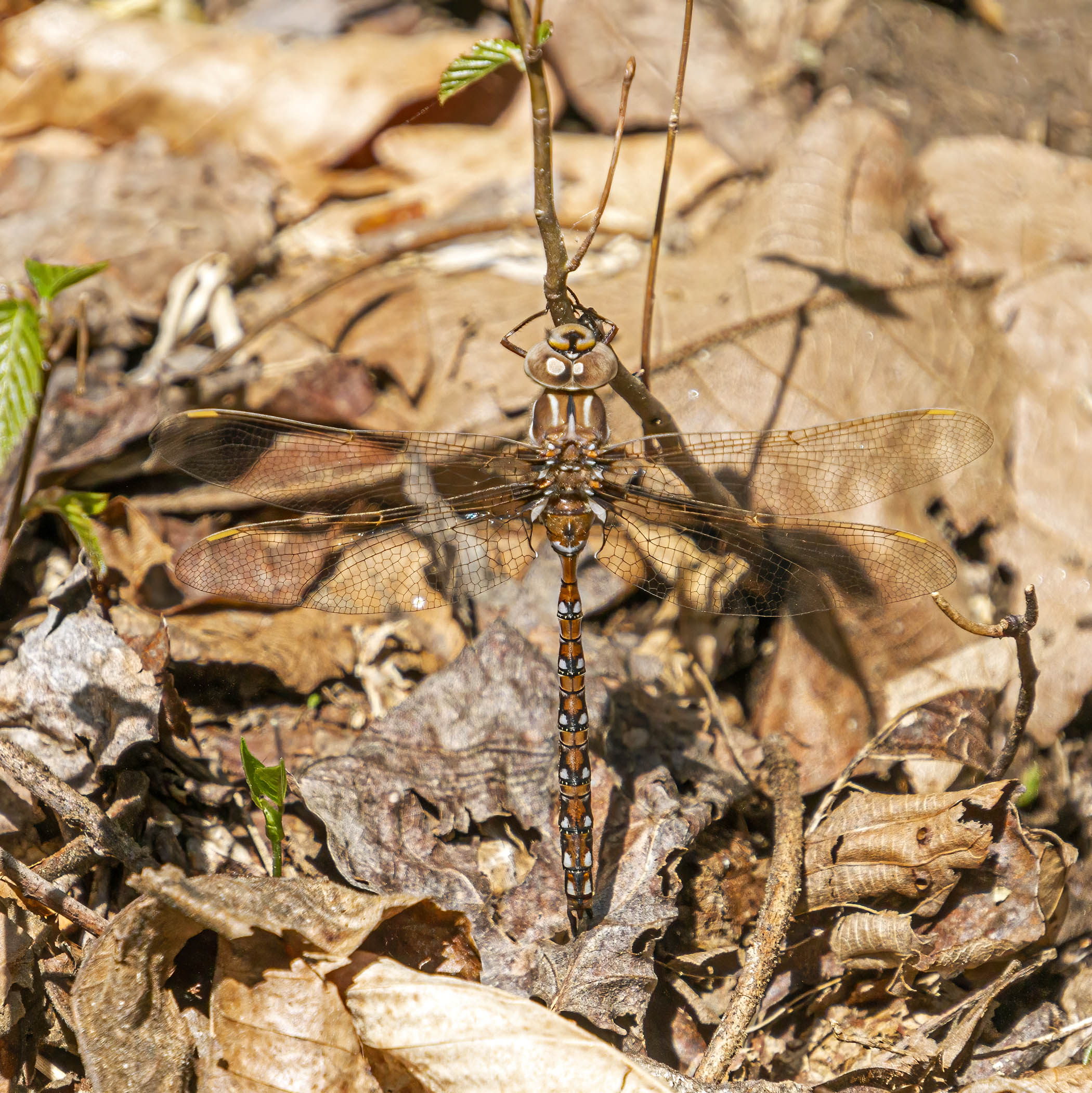
I was delighted to photograph this beautiful Springtime Darner dragonfly (Basiaeschna janata) yesterday (6 April) while I was exploring a creek in the forests of Prince William County, Virginia. I had seen some recent postings on Facebook showing dragonflies that others had seen in other parts of Virginia, so I decided to search for them.
I found several other dragonfly species too and plan to post some photos of them in the next few days, but I really wanted to post this one immediately. It’s been several years since I have seen a Springtime Darner and I was really excited when I looked through my telephoto zoom lens and realized what it was. The dragonfly was flying back and forth low over a patch of vegetation and I tracked it for a little while until if perched, hanging vertically low to the ground. It was so low that the tip of its abdomen was almost touching the dried leaves on the forest floor.
I was pretty far away and had to manually focus the lens–the cluttered background kept wanting to grab the focus when I tried to use auto focus and the dragonfly’s body was pretty thin. I was really happy to be able to capture the wonderful pattern on the body of this dragonfly, whose coloration helped it to blend in so well with its surroundings.
© Michael Q. Powell. All rights reserved.
Posted in Dragonflies, dragonfly, Insects, Nature, Photography, spring, wildlife | Tagged Basiaeschna janata, Canon 7D, Prince William County VA, Springtime Darner, Springtime Darner dragonfly, Tamron 18-400mm | 6 Comments »
March 29, 2026 by Mike Powell
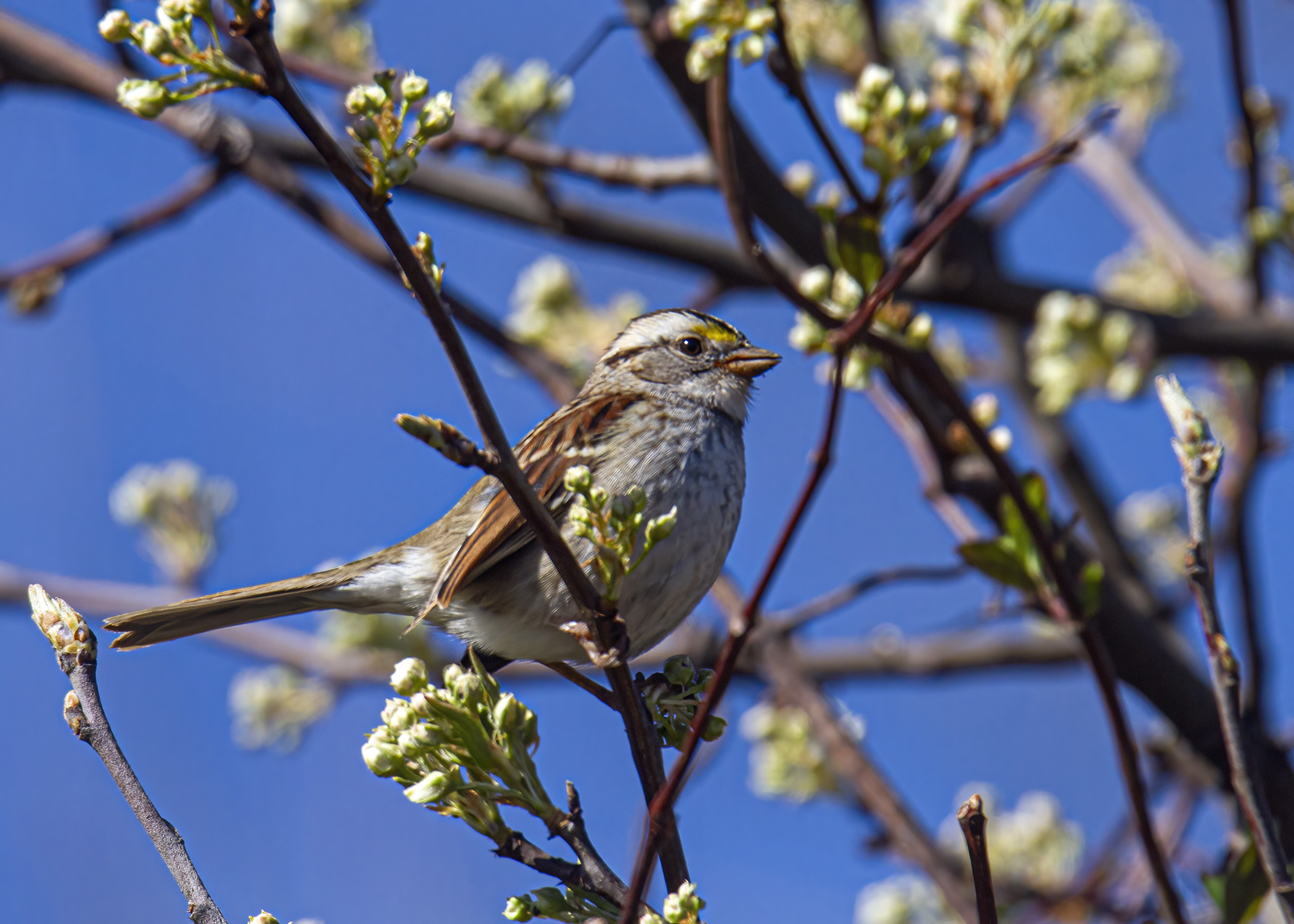
The trees are definitely starting to blossom, providing a nice backdrop for this White-throated Sparrow (Zonotrichia albicollis) that I photographed a little over a week ago at Occoquan Bay National Wildlife Refuge. These sparrows overwinter in our area and will be departing soon for more northern regions for breeding.
© Michael Q. Powell. All rights reserved.
Posted in Birds, Nature, Photography, spring, wildlife | Tagged Canon 7D, Occoquan Bay National Wildlife Refuge, Tamron 150-600mm, white-throated sparrow, Woodbridge VA, Zonotrichia albicollis | 2 Comments »
March 28, 2026 by Mike Powell
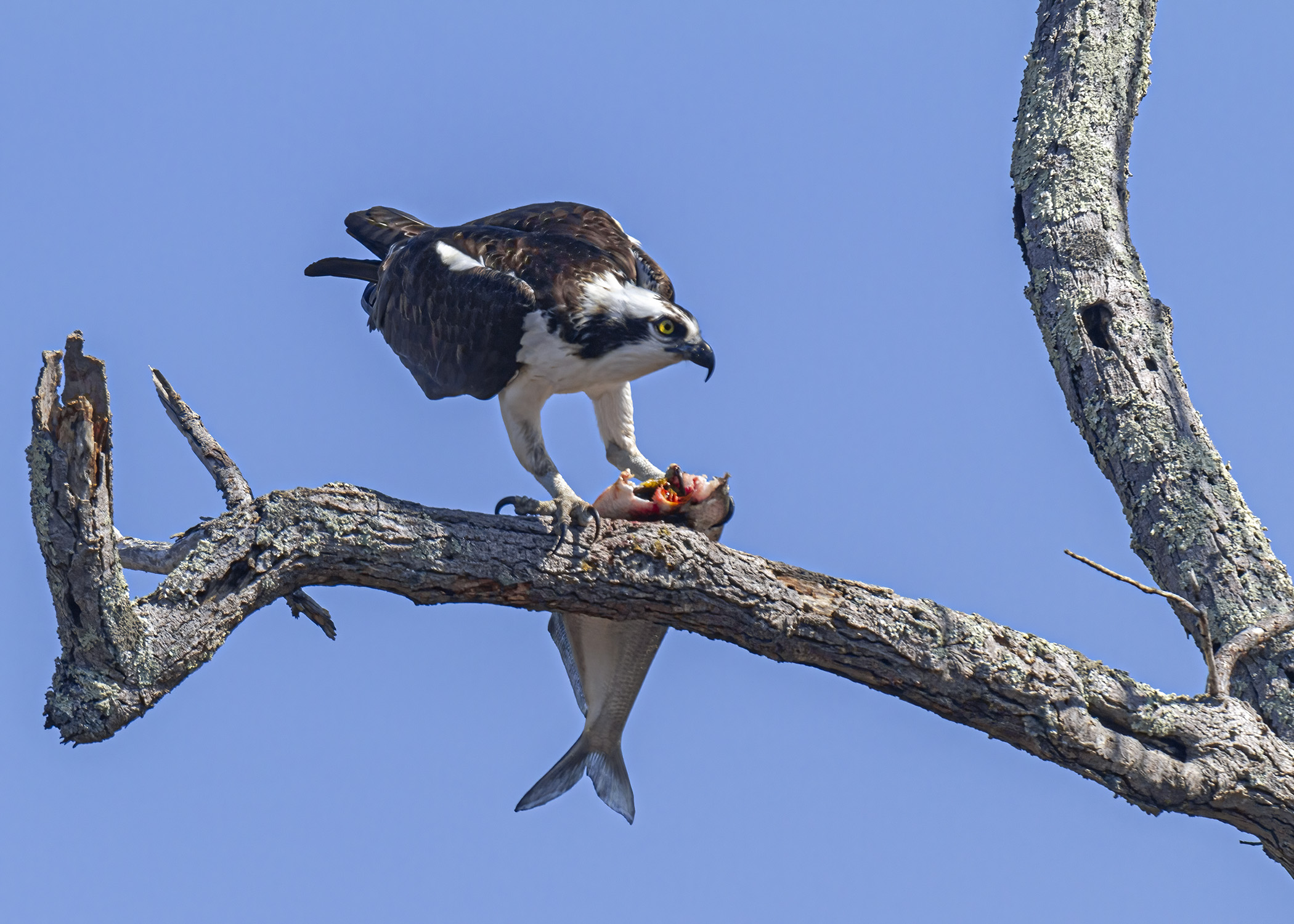
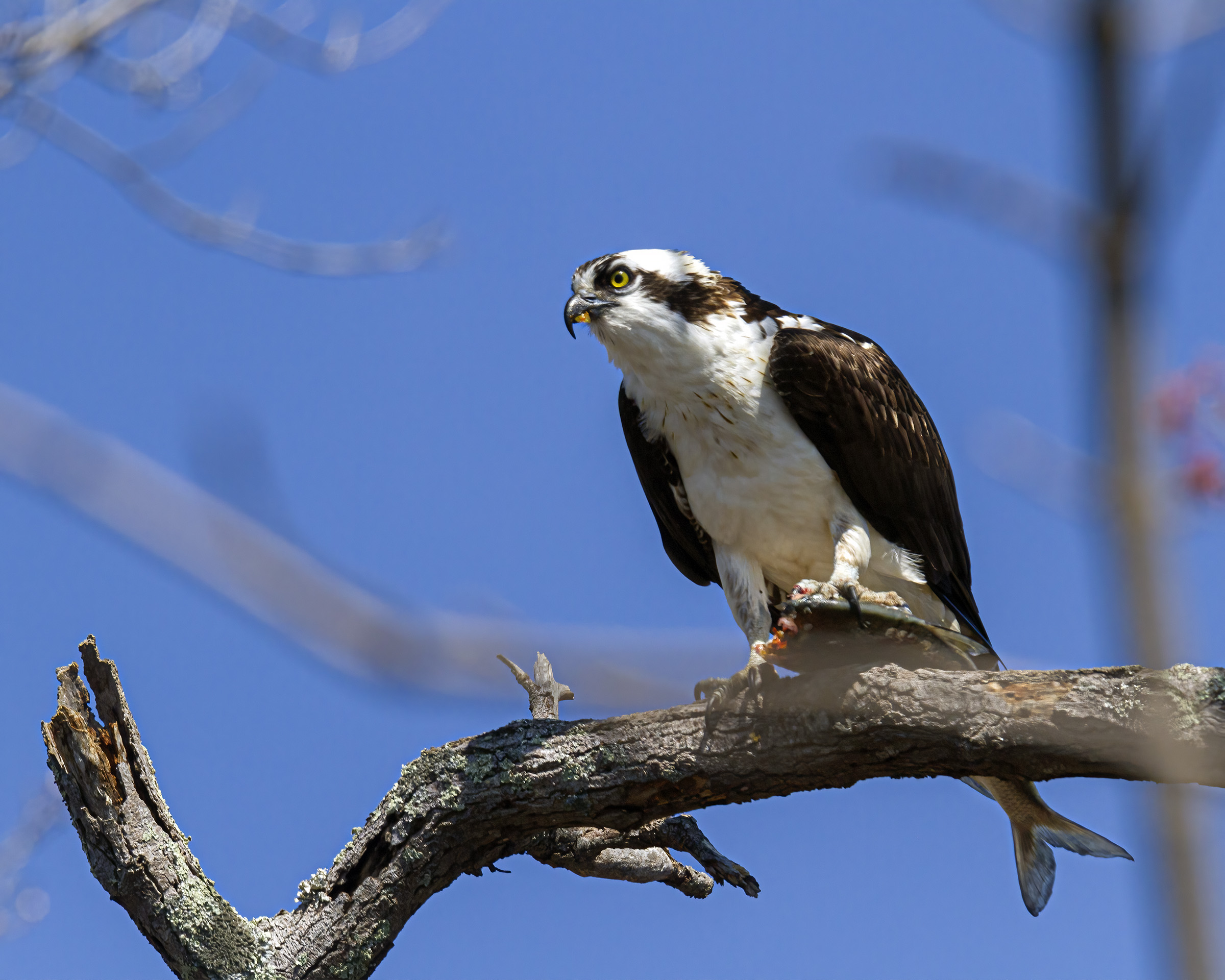
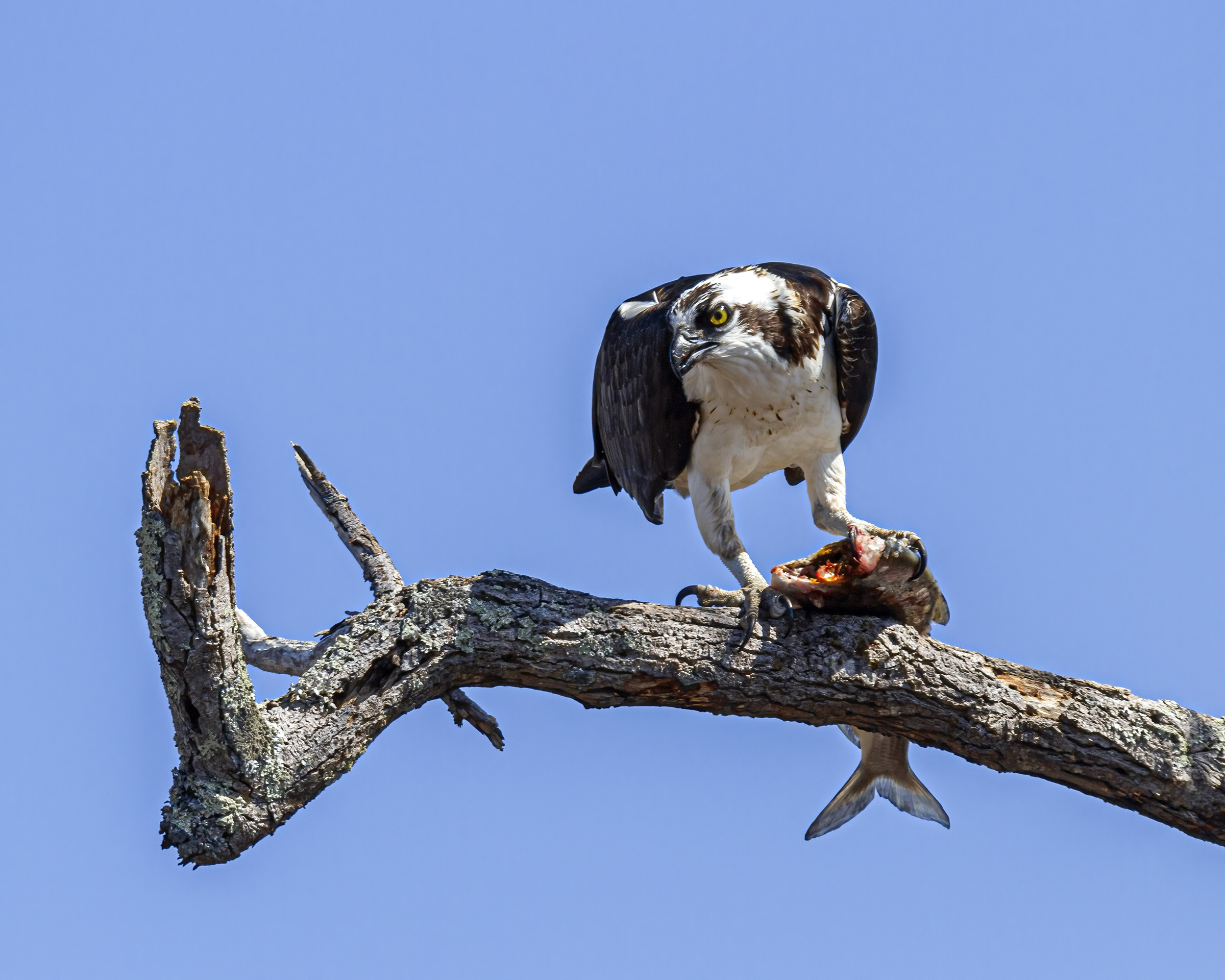
The ospreys (Pandion haliaetus) are definitely back at Occoquan Bay National Wildlife Refuge after spending the winter in warmer locations. I captured these images last week of an osprey as it was enjoying a freshly caught fish. I tried to vary the angles a bit for the individual shots, but moved slowly and carefully so that I did not disturb the osprey during its breakfast.
© Michael Q. Powell. All rights reserved.
Posted in Birds, Nature, Photography, spring, wildlife | Tagged Canon 7D, Occoquan Bay National Wildlife Refuge, Osprey, Pandion haliaetus, Tamron 150-600mm, Woodbridge VA | 7 Comments »
March 25, 2026 by Mike Powell
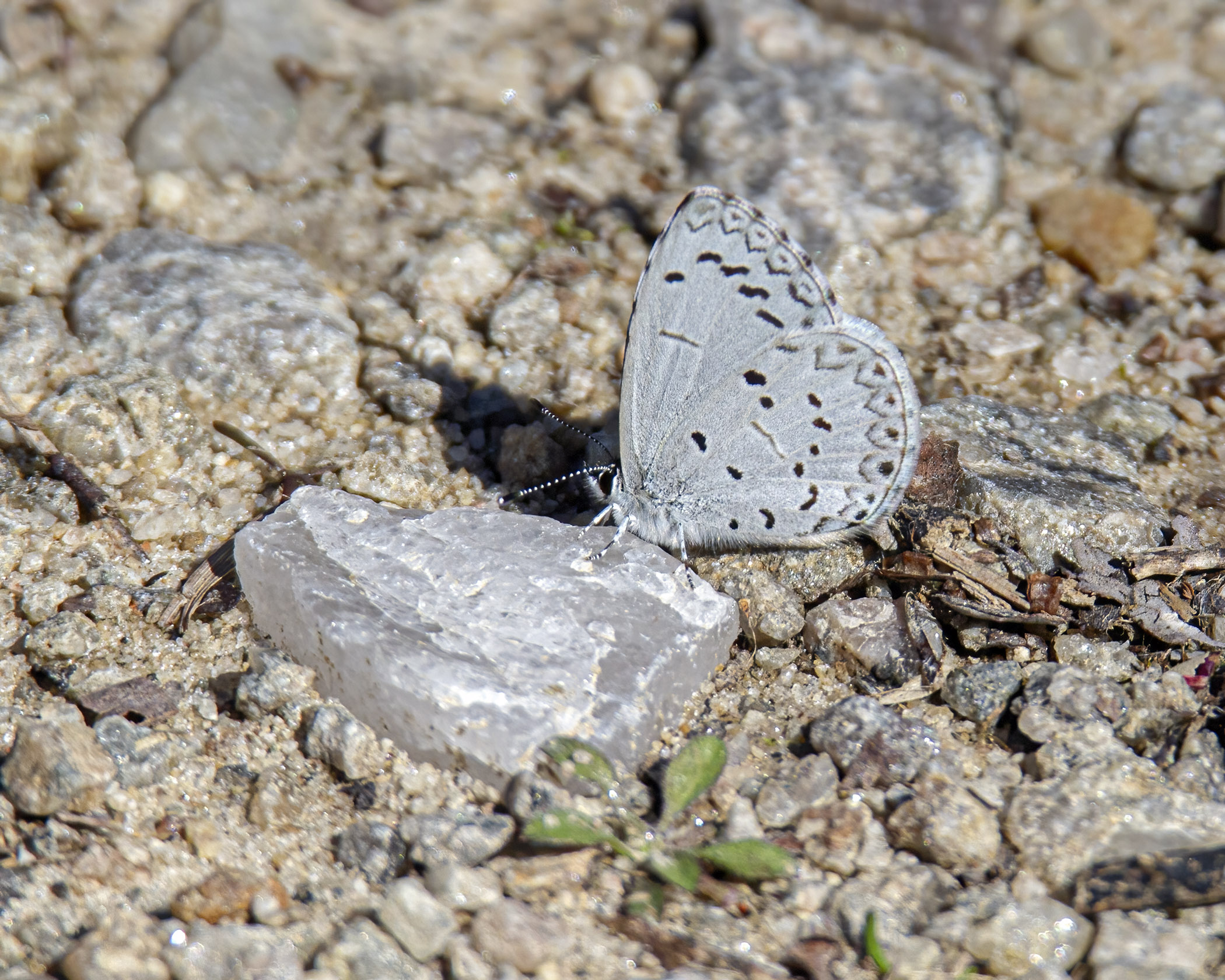
Butterflies are already starting appear at Occoquan Bay National Wildlife Refuge, including this tiny Spring Azure butterfly (Celestrina ladon) that I photographed there on 20 March. These little butterflies look pretty nondescript when their wings are close, but when they are flying, you can see the beautiful blue coloration of their inner wings.
Spring Azure butterflies are almost always the first butterflies that I see in the spring. A few other species, like Mourning Cloaks, overwinter as adults, but Spring Azure butterflies spend the winter in the pupal stage in a chrysalis and emerge as adults in the early spring.
© Michael Q. Powell. All rights reserved.
Posted in Butterflies, Insects, Nature, Photography, spring, wildlife | Tagged Canon7D, Celastrina ladon, Occoquan Bay National Wildlife Refuge, Spring Azure, Spring Azure butterfly, Tamron 150-600mm, Woodbridge VA | 3 Comments »
March 24, 2026 by Mike Powell
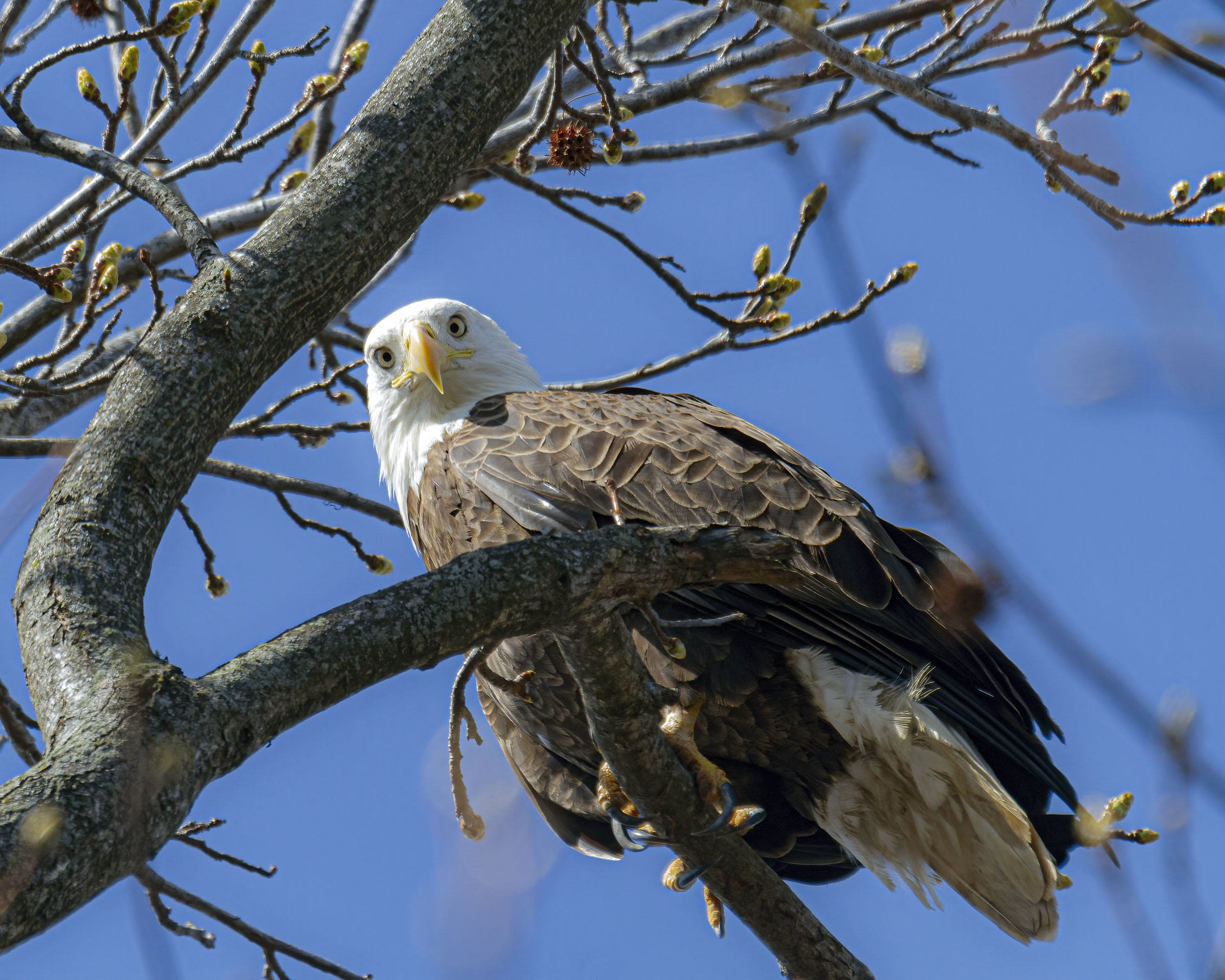
I got involved in a little staring contest with a Bald Eagle (Haliaeetus leucocephalus) last Friday at Occoquan Bay National Wildlife Refuge. I moved slowly and deliberately to get some photos and then departed silently, leaving the eagle in peace on its perch.
Most of the time my first indication that there is an eagle in the area is when it takes off in response to my presence. In this case, however, the eagle looked right at me and seemed to decide that I did not represent a threat, so it stayed in place.
I like that kind of peaceful coexistence.
© Michael Q. Powell. All rights reserved.
Posted in Birds, Nature, Photography, spring, wildlife | Tagged Bald Eagle, Canon 7D, eagle, Haliaeetus leucocephalus, Occoquan Bay National Wildlife Refuge, staring contest, Tamron 150-600mm, Woodbridge VA | 12 Comments »
March 19, 2026 by Mike Powell
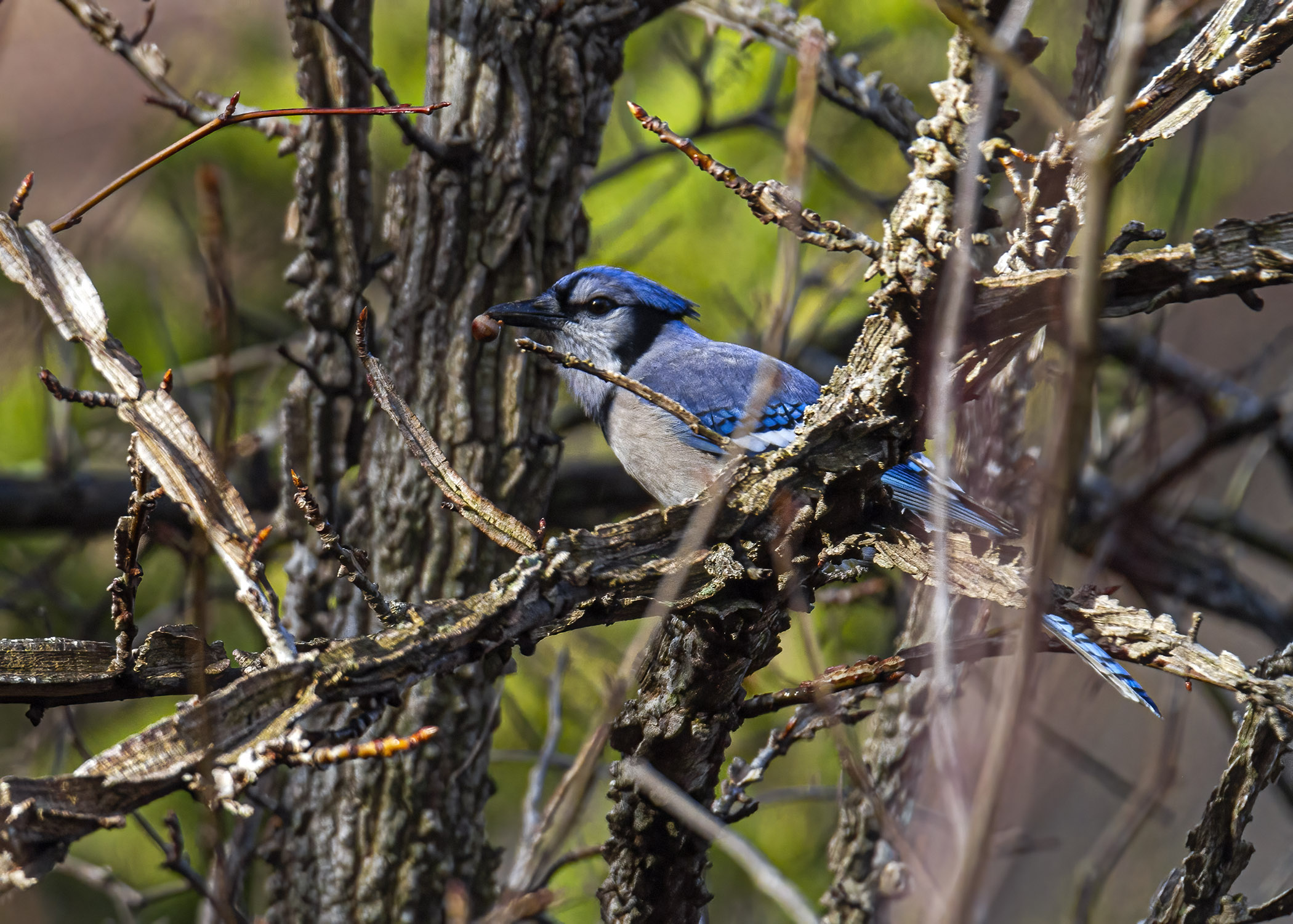
When it’s this early in the spring, I try to photograph as many of the birds that I encounter as I can. Blue Jays (Cyanocitta cristata) are pretty common where I live, but I rarely have the chance to photograph one. Earlier this month I was thrilled to hear and see this Blue Jay during a visit to Occoquan Bay National Wildlife Refuge.
The Blue Jay was busily foraging in the trees, rarely stopping in any one place for very long. I was thrilled to capture this shot of the jay when it paused momentarily with some kind of berry that it had just snagged. It is not a great photo, but I like the overall feel of the photo, with the blues and greens working well together to create a pleasant image.
© Michael Q. Powell. All rights reserved.
Posted in Birds, Nature, Photography, wildlife | Tagged Blue Jay, Canon 7D, Cyanocitta cristata, Occoquan Bay National Wildlife Refuge, Tamron 150-600mm, Woodbridge VA | 4 Comments »
March 17, 2026 by Mike Powell
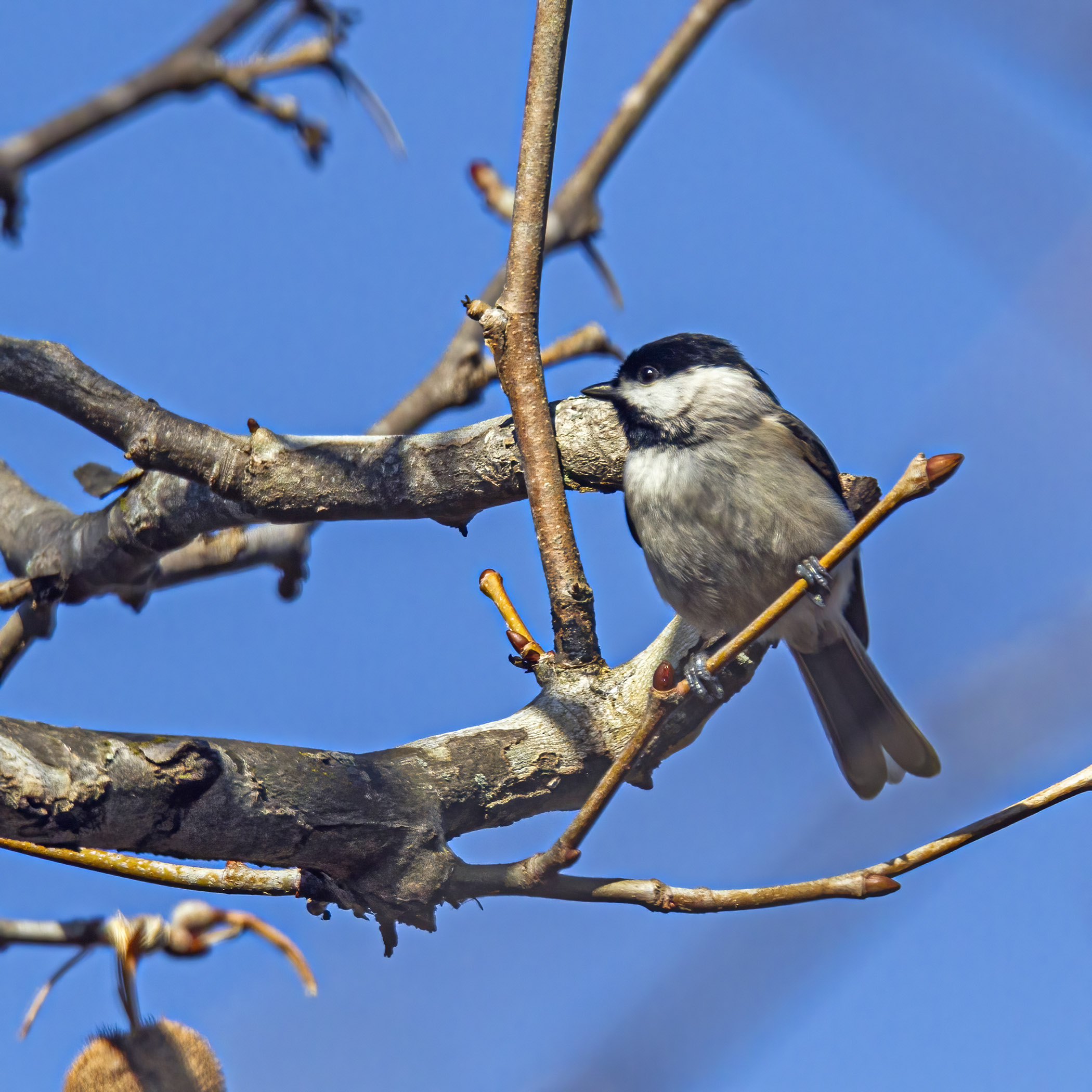
I couldn’t help but notice the sight and sounds of little birds last week at Occoquan Bay National Wildlife Refuge—they were really active. Of course, being aware of their presence did not magically result in photographs of them. As many of you know, one of the “secrets” of my wildlife photography is that I am unusually patient and persistent.
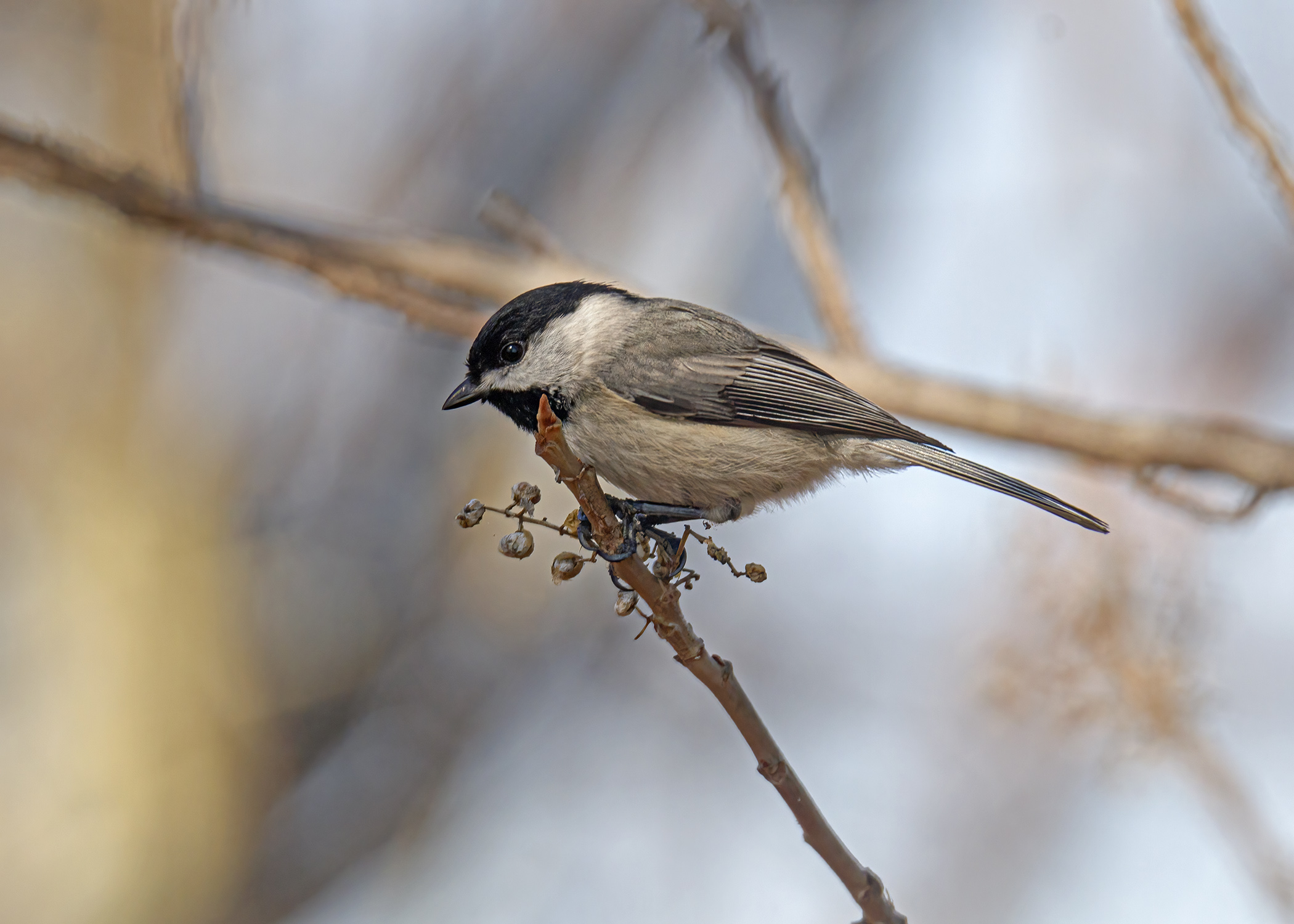
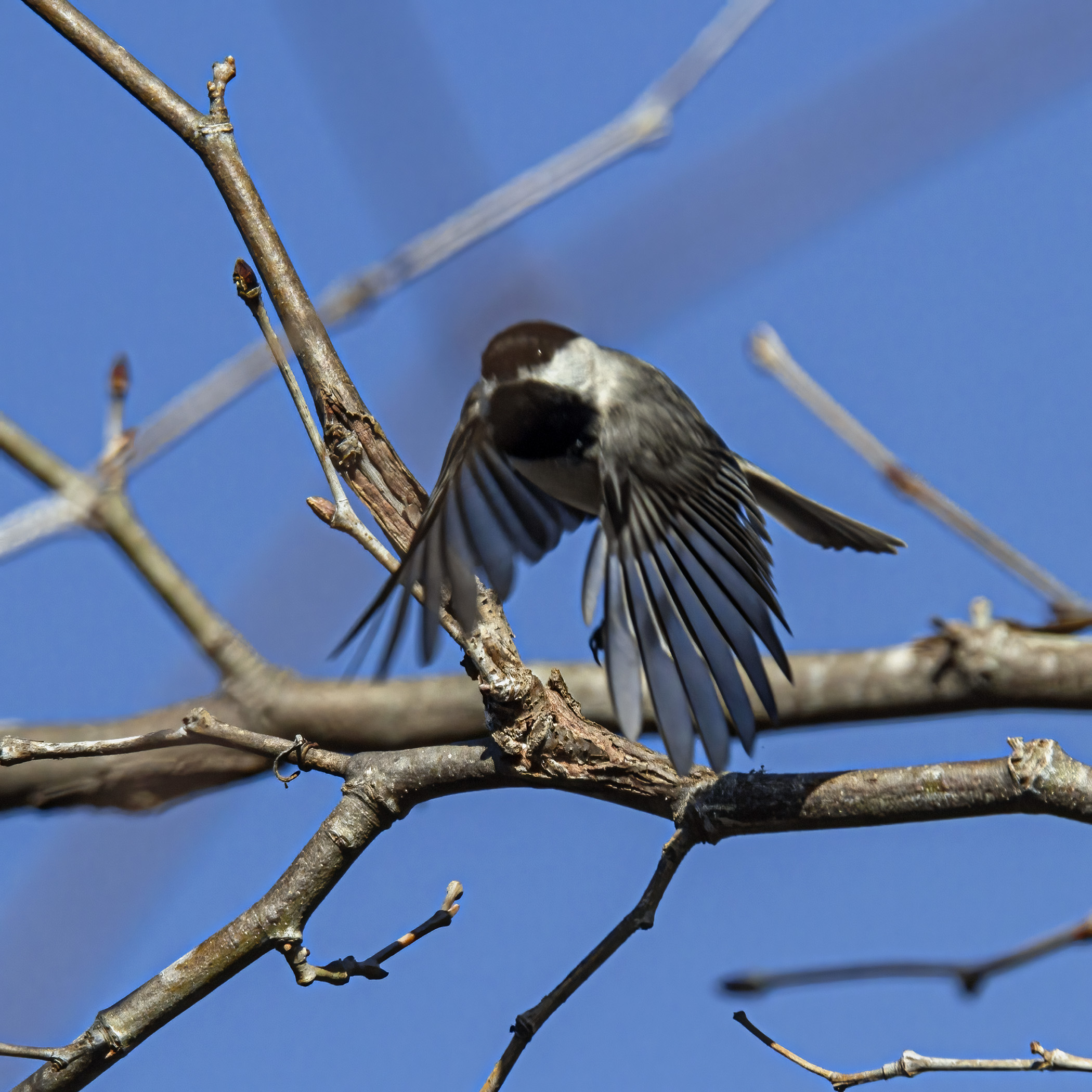
So I watched and waited and eventually managed to capture images of Carolina Chickadees (Poecile carolinensis), some of the smallest birds in our area. Here are a few of my favorites. In the first one, I managed to isolate the little bird from its cluttered background, which was a bit tricky, considering that the chickadee was perched on a small branch in the midst of a tangled group of branches.
The second photo was a little easier to take, because the bird was perched at the end of a branch in a more open area. The final photo was an unplanned one. As I was focusing on the chickadee, it took off and I instinctively pressed the shutter release. The photo is far from perfect, but I really like it.
I’m sure I’ll be taking more (and hopefully better) bird photos as we move deeper into spring and I’m looking forward to seeing a few dragonflies appearing in the next month or so.
© Michael Q. Powell. All rights reserved.
Posted in Birds, Nature, Photography, spring, wildlife | Tagged Canon 7D, Carolina Chickadee, chickadee, Occoquan Bay National Wildlife Refuge, Poecile carolinensis, Tamron 150-600mm, Woodbridge VA | 2 Comments »
March 14, 2026 by Mike Powell
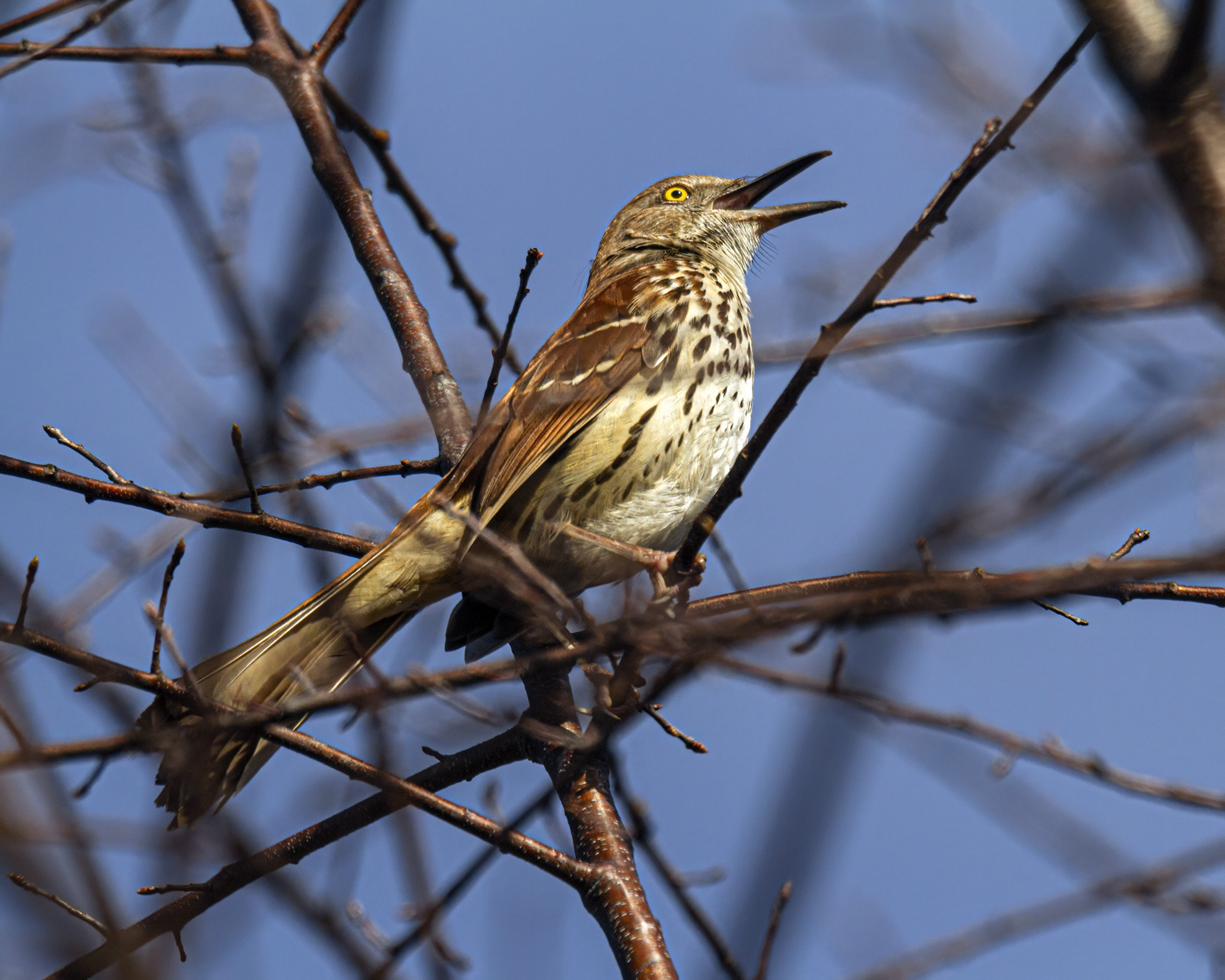
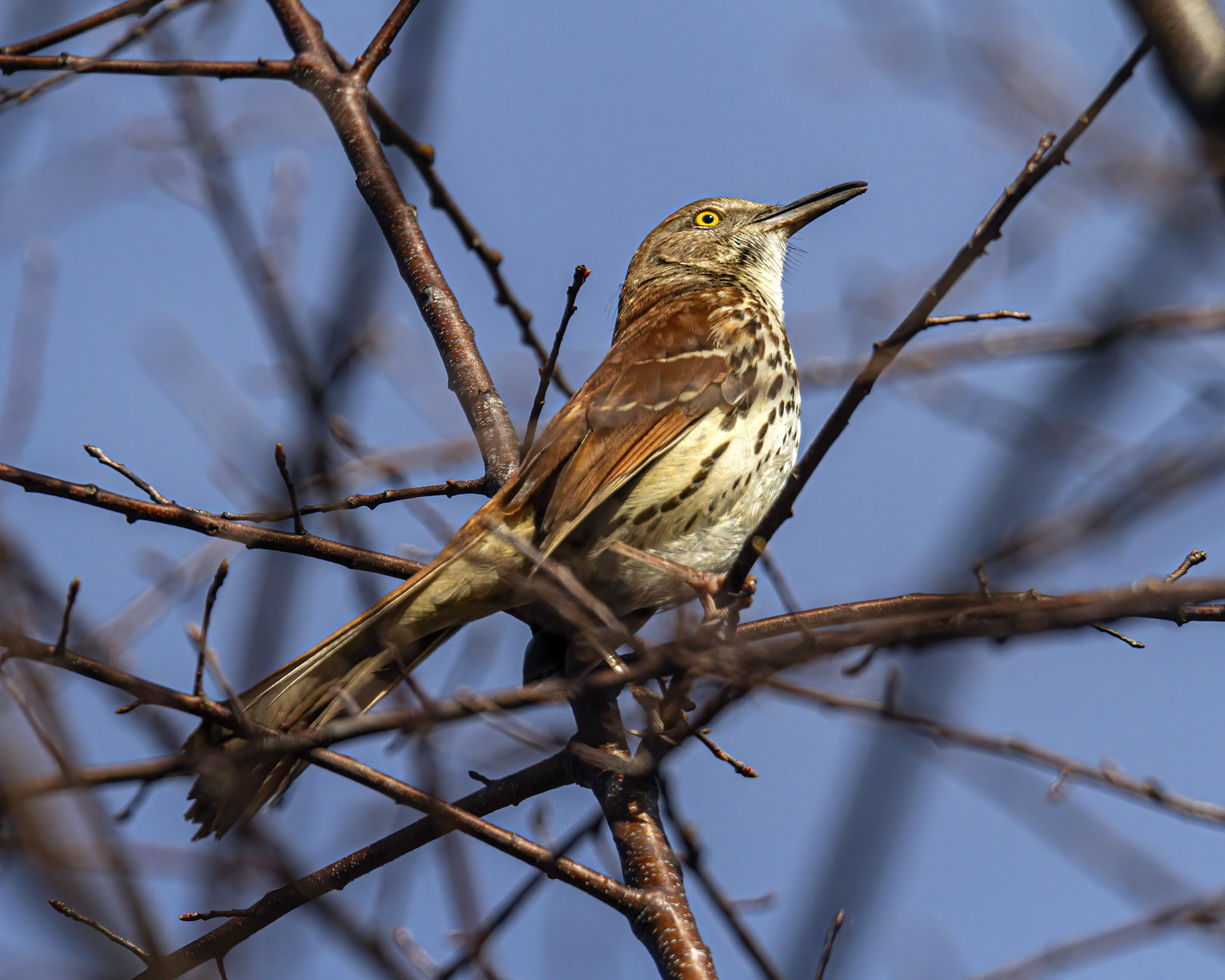
I could easily hear this Brown Thrasher (Toxostoma rufum) singing high in the trees this past Tuesday at Occoquan Bay National Wildlife Refuge, but I had a hard time getting an obstructed view of it because it was hidden in the branches. I waited and waited and eventually the Thrasher moved to a more open spot. I was delighted when I managed to capture a shot when it started singing again.
According to some naturalists cited on the Cornell Lab of Ornithology website, “It is the opinion of many ornithologists that the song (of the Brown Thrasher)… is richer, fuller, and definitely more melodious than that of polyglottis” (the Northern Mockingbird).” I was also happy that I was able to get some good shots of the striking yellow eyes of the Brown Thrasher. Wow!
© Michael Q. Powell. All rights reserved.
Posted in Birds, Nature, Photography, spring, wildlife | Tagged brown thrasher, Canon 7D, Occoquan Bay National Wildlife Refuge, Tamron 150-600mm, thrasher, Toxostoma rufum, Woodbridge VA | 5 Comments »
March 13, 2026 by Mike Powell
At this time of the year, the skies are often filled with migratory birds. I live in Northern Virginia, which seems to be a kind of midpoint in the journeys of birds that spend their winters in warmer places and then fly northward for breeding.
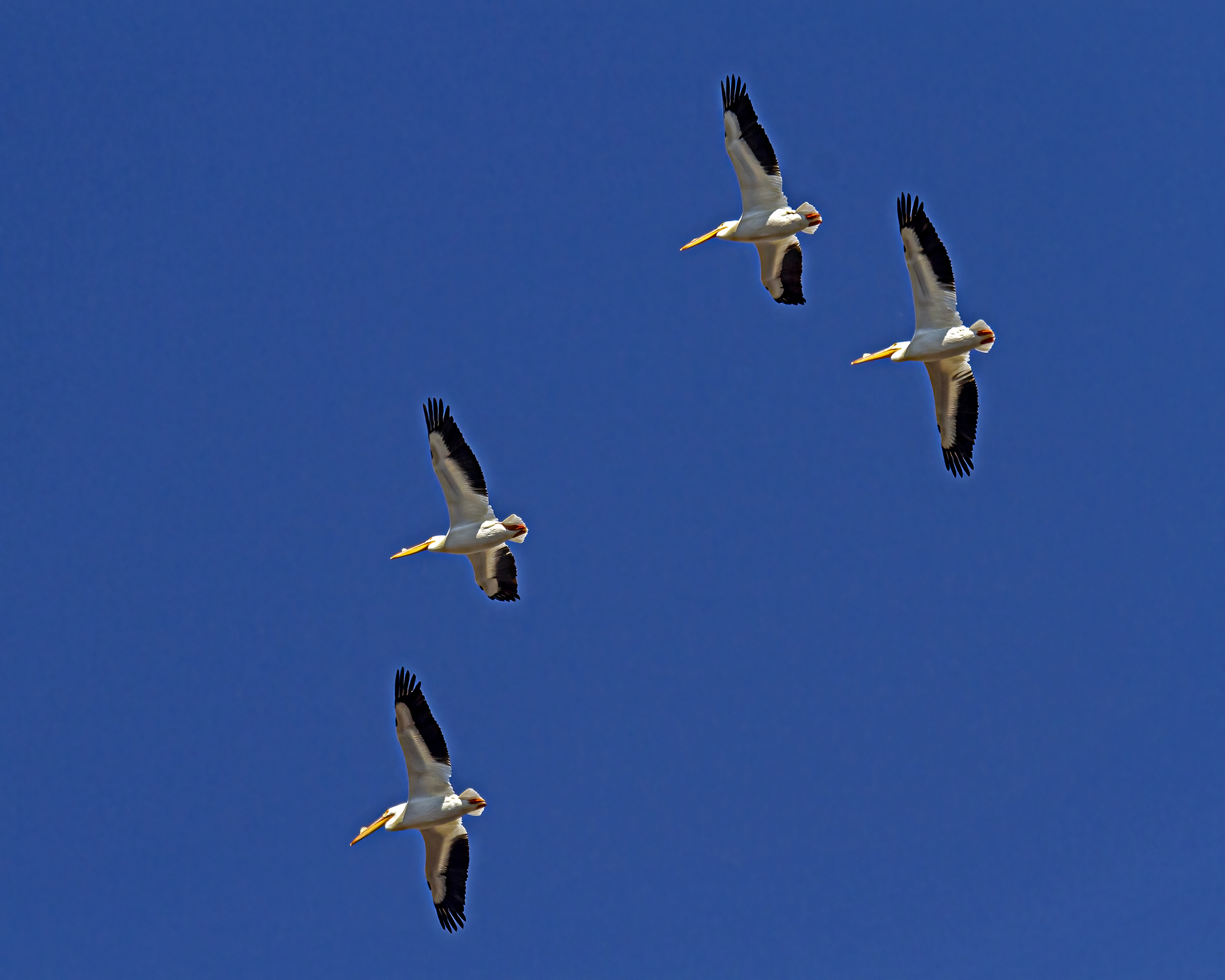
The most common birds that I see are Canada Geese, but this past Tuesday I was delighted to spot a couple of less common Species. In the first photo are some members of a large flock of American White Pelicans (Pelecanus erythrorhynchos). Although the photo makes it look like the birds were flying in a military-like formation, the grouping was often quite disorganized and was slow-moving. I couldn’t help but notice the “horn” on the upper bill of several of the pelicans that they will eventually shed after the birds mate and lay their eggs.
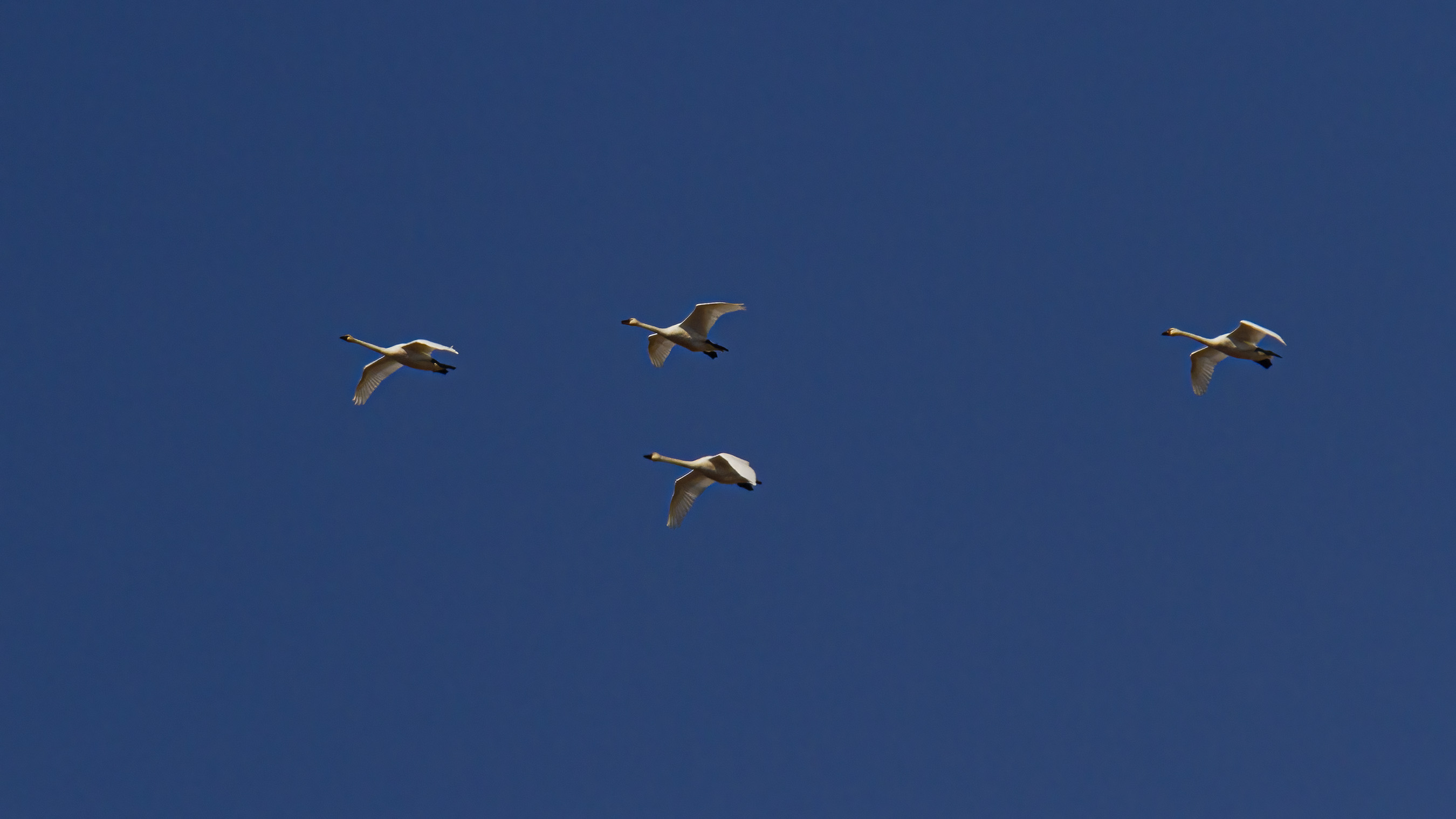
A short while later, I spotted a small group of Tundra Swans (Pelecanus erythrorhynchos), as shown in the second photo below. I noted that these swans fly with their necks fully extended, unlike the herons and egrets that I am more used to seeing that fly with their necks tucked in, creating an S-shape.
Tuesday was a warm, beautiful spring day and I managed to spot some additional birds in the trees and in the underbrush that I will feature in blog postings in the next few days.
© Michael Q. Powell. All rights reserved.
Posted in Birds, Nature, Photography, spring, wildlife | Tagged Canon 7D, Cygnus columbianus, Occoquan Bay National Wildlife Refuge, Pelecanus erythrorhynchos, pelicans, Tamron 150-600mm, Tundra Swan, White American Pelicans, Woodbridge VA | 4 Comments »
March 7, 2026 by Mike Powell
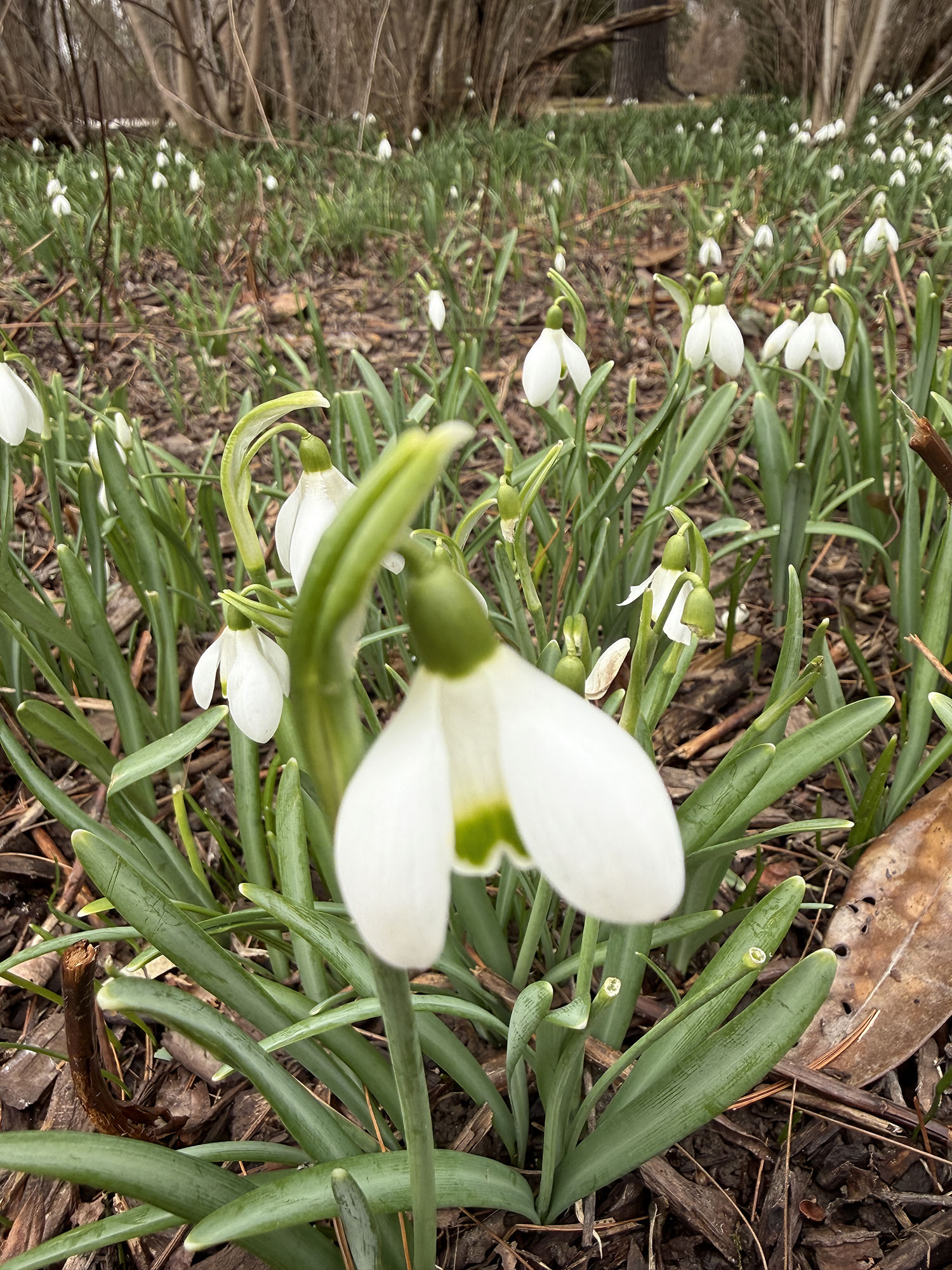
I was delighted yesterday to spot my first spring flowers of the year during a visit to Woodlawn Plantation in Alexandria, Virginia. Woodlawn is a 126-acre estate that was originally part of George Washington’s Mount Vernon. The main Federal-style house was designed by the architect of the U.S. Capitol, Dr. William Thornton, and constructed between 1800 and 1805 as the plantation house for Washington’s nephew, Major Lawrence Lewis, and his wife, Eleanor “Nelly” Custis Lewis, according to the website savingplaces.org.
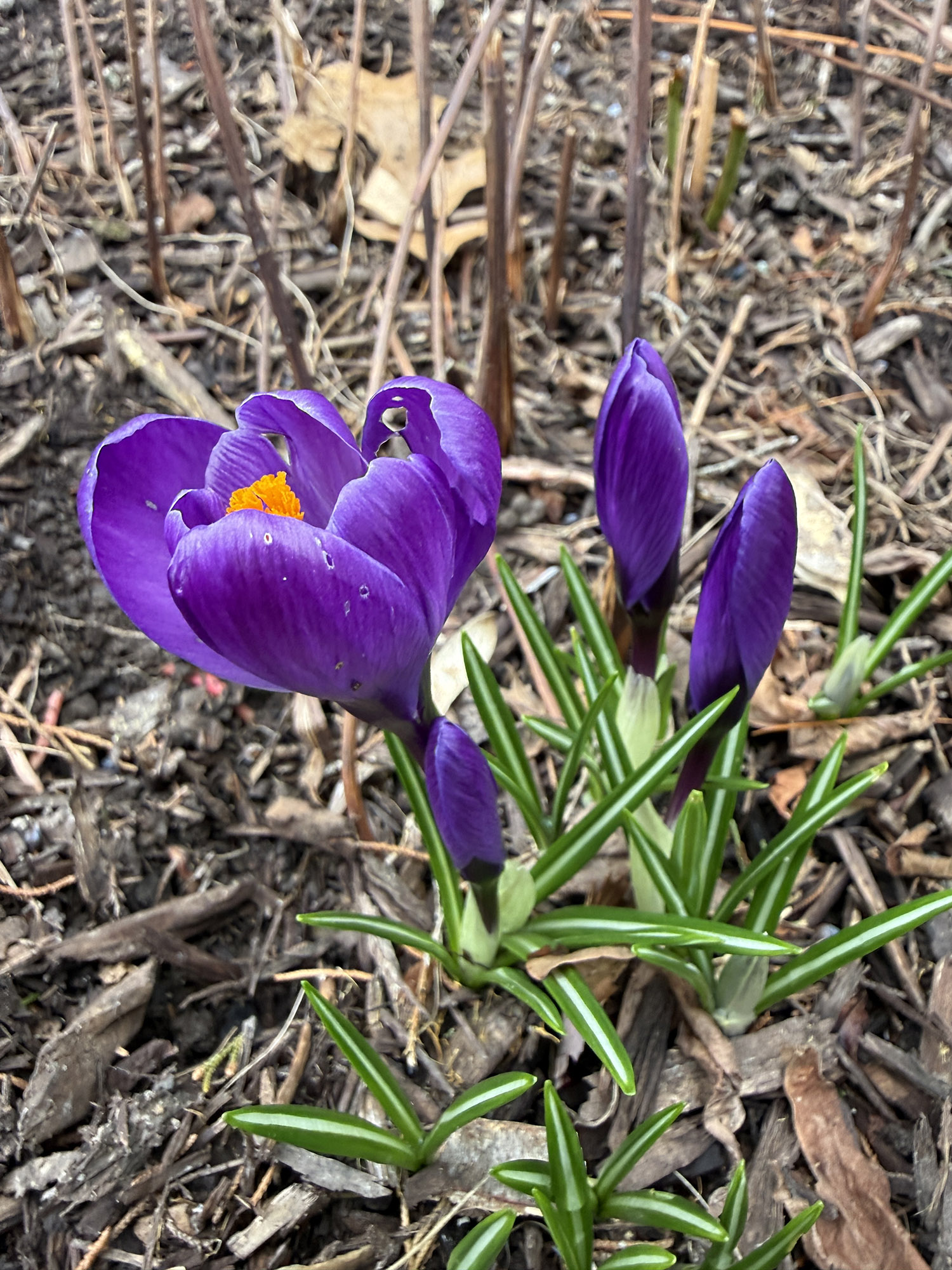
During the month of March, 63rd Annual Woodlawn Needlework Show is taking place at this location, reportedly the largest judged needle arts show in the nation, featuring hundreds of embroidered works by artists from around the world. As I was walking from the parking lot to the main building, I spotted a patch of snowdrops (g. Galanthus) and a few purple crocuses (g. Crocus) already in bloom. I did not have my “real” camera with me, but managed to capture these images with my iPhone.
Winter may not be completely over, but the weather forecast for the upcoming weather indicates that the high temperatures may reach the upper 70’s (25 degrees C). I hope to be outdoors as much as I can, soaking up the warmth of those days. Within a month, I hope to start seeing dragonflies again, one of my favorite subjects to photograph.
© Michael Q. Powell. All rights reserved.
Posted in Flowers, Nature, Photography, spring | Tagged Alexandria VA, crocuses, g. Crocus, g. Galanthus, iPhone 16 Pro Max, Needlework Show, snowdrops, Woodlawn Plantation | 12 Comments »
March 5, 2026 by Mike Powell
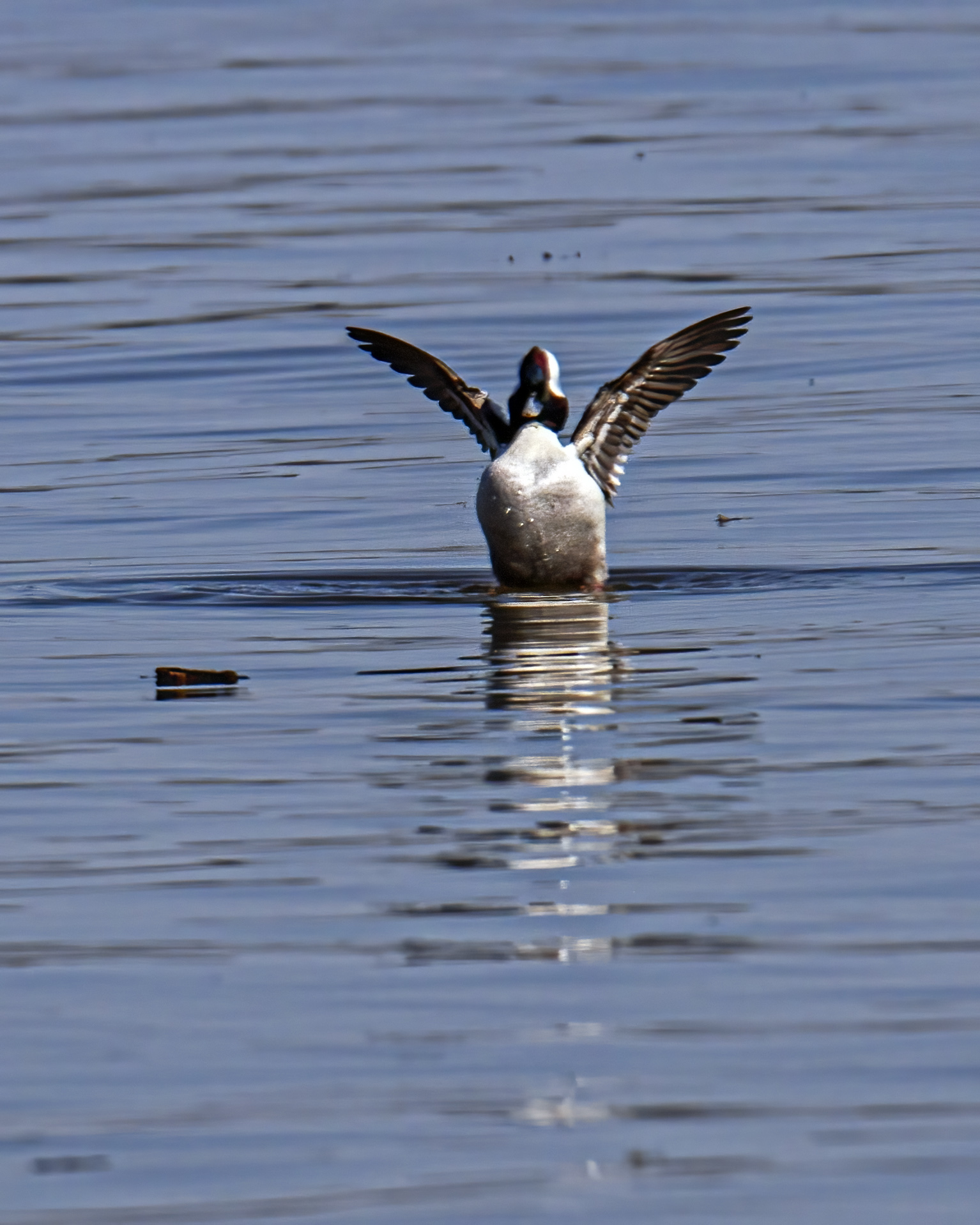
Buffleheads (Bucephala albeola) are small sea ducks that I sometimes observe during the winter in the waters off of Occoquan Bay National Wildlife Refuge. The males have a large white patch on their heads that makes them relatively easy to identify. From a distance these males often look to be black and white. When the sun is shining from the right directions, as it was last week when I captured this image, you can see that their heads are actually a glossy green and purple that really helps to set off their distinctive white patches.
In addition to being able to see the colors, the straight-on angle of this shot shows the odd shape of the head of this bufflehead’s head. It may be a bit of an optical illusion, but it looks to me like the lower portion of its head is considerably bigger than the upper part.
© Michael Q. Powell. All rights reserved.
Posted in Birds, Nature, Photography, spring, wildlife | Tagged Bucephala albeola, bufflehead, Canon 7D, Occoquan Bay National Wildlife Refuge, Tamron 150-600mm, Woodbridge VA | Leave a Comment »
March 4, 2026 by Mike Powell
Do you remember learning grammar in school? My memories are a bit hazy, because it was a long time ago, but I remember learning that the imperative mood is used to express direct commands, instructions, or advice and the subject is understood to be “you.”
I always think of today, March 4th in the imperative form of “March Forth.” Sometimes it takes a lot of courage (or faith) to take that first step. It can be really scary, especially when heading off for an unknown destination or trying something you have never done before.
As many of you know I’ve been doing a lot of counted cross stitch over the past few months. Some of the designs have been really simple and some have been a bit complicated, but they have all been made up of a series of x’s done on a flat piece of fabric. I have long been intrigued, however, by the three dimensional objects that some people have made with their finished cross stitch pieces.
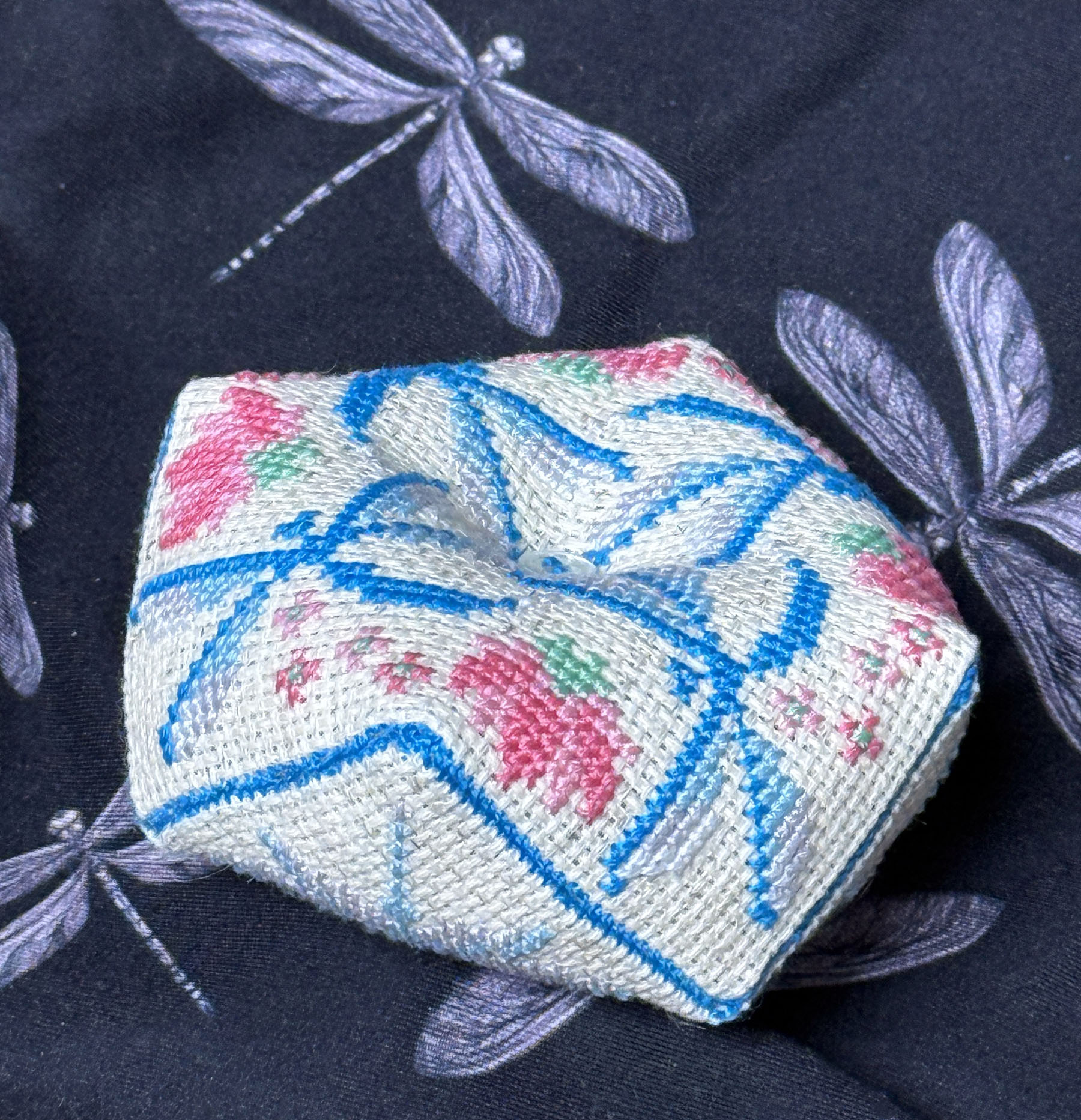
I can understand pretty well how folks make pillows, although personally my sewing skills are somewhat lacking. Sometimes, though, people will make geometric-shaped objects known as “biscornus.” What is a biscornu? According to Wikipedia, “A biscornu is a small, octagonal, stuffed ornamental pincushion. It is usually made using evenweave fabric, such as Aida cloth, cotton, or linen. The technique involves joining two embroidered squares framed with a backstitch border with a whip stitch in such a way that each corner of one square is attached to the middle of the side of the other. The term comes from the French adjective biscornu, which means irregular, skewed, or odd.”
In theory, it is easy to sew together the two panels and I watched numerous You Tube instructional videos. In practice it was difficult, but I forced myself to push on through—I was determined to “march forth” until the end. The first photo shows my finished biscornu. It is a little wonky and some of the stitches that hold it together are uneven, but I am happy that I pushed through to finish it.
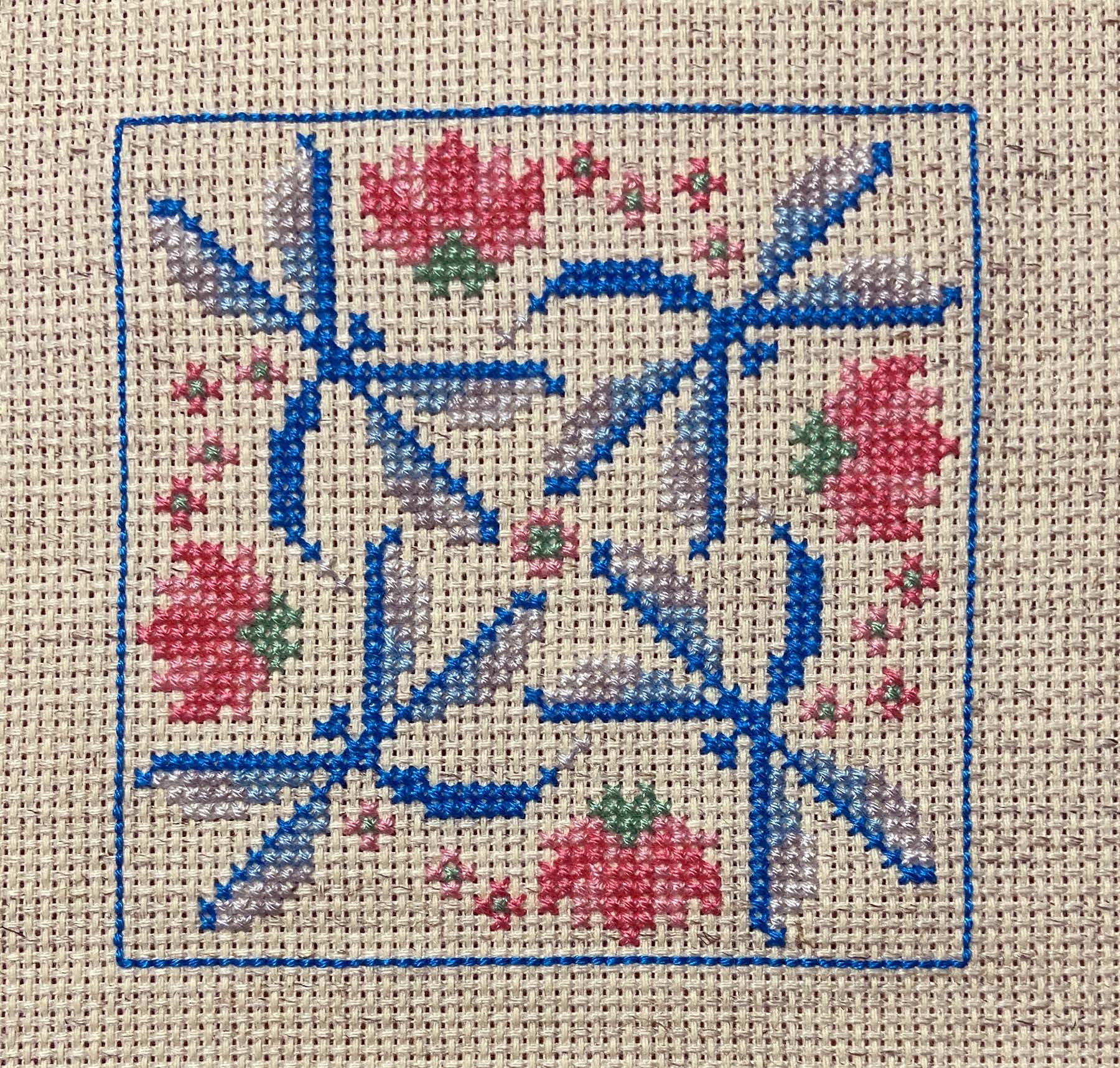
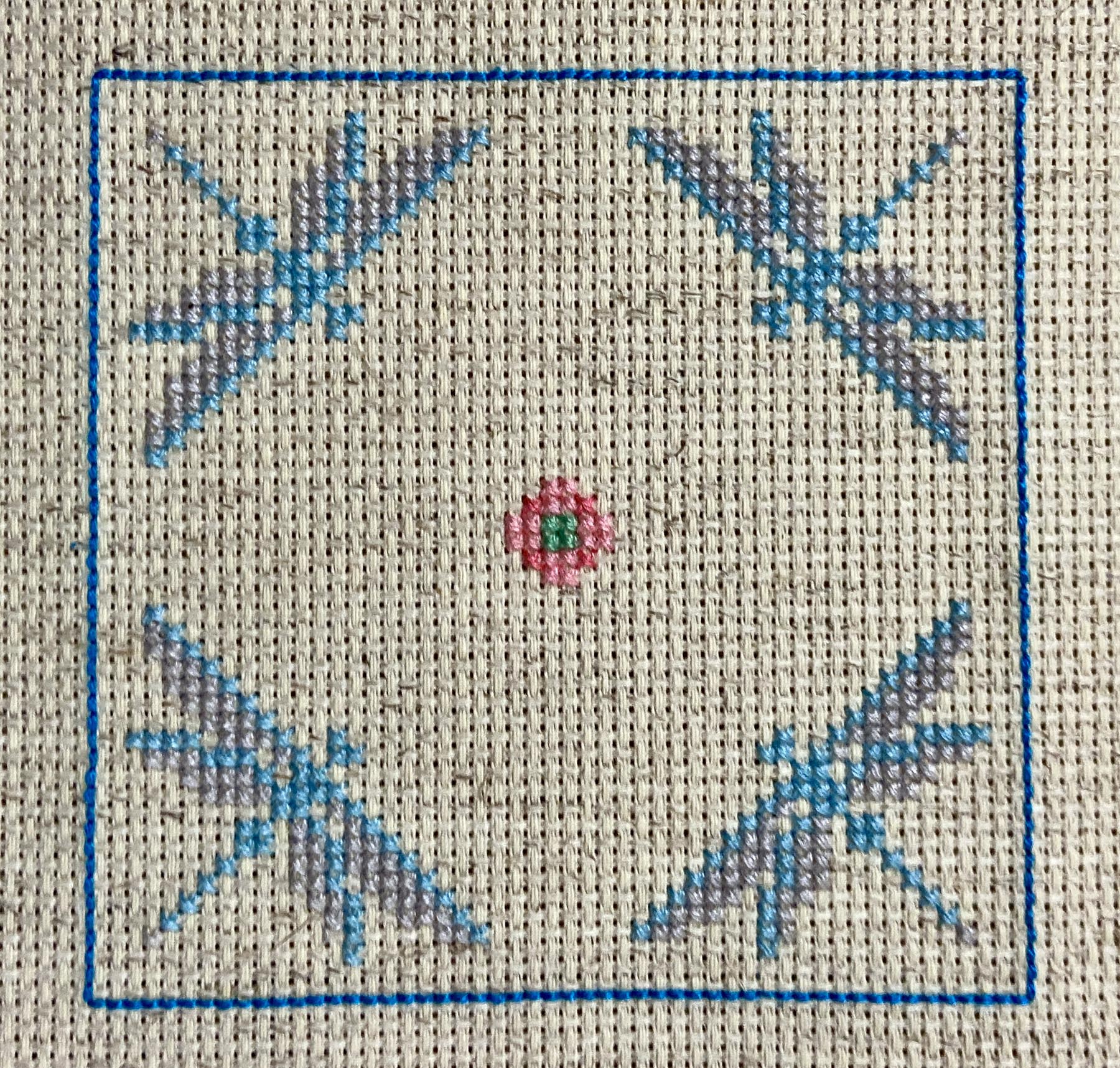
The final two photos show the two panels of my version of the New Beginnings Biscornu that was designed by DH, a talented cross stitch designer and streamer @TheCozyDH.com. As soon as I saw the pattern I knew that I wanted to stitch it, because it features dragonflies, one of my favorite creatures.
So what about you? Are you willing to step out of your comfort zone and “march forth” into unknown territories to try something new? I’d like to say that I followed the Star Trek mission statement “to boldly go where no one has gone before,” but my initial step was more “hesitant” than “bold.”
Success, of course, is not guaranteed, but I really do think that it is worth the risk. Who knows, you might end up with something really cool, like my little biscornu (and, yes, I am definitely biased in my views).
“March forth!”
© Michael Q. Powell. All rights reserved.
Posted in counted cross stitch, cross stitch, Dragonflies, dragonfly, Inspiration, Photography, Water Lilies | Tagged counted cross stitch, cross stitch, dragonflies, imperative day, march forth, new beginnings, TheCozyDH | 7 Comments »
March 2, 2026 by Mike Powell
Yesterday, 1 March, marked the start of meteorological spring for those of us who live in the Northern Hemisphere. Meteorologists divide the seasons into three month increments for easier data tracking, although in the United States we generally use the astronomical calendar that ties the start of spring to the vernal equinox, which is on March 20 in 2026. No matter how you calculate the start of spring, there are definite signs that the seasons are changing.
After a brutally cold period of weather in most of February, we had an unusually warm day on Saturday, the last day of the month. The sun was shining brightly throughout the day and temperatures soared to over 60 degrees (15.5 degrees C). I generally don’t go out with my camera on the weekends to avoid the inevitable crowds, but I couldn’t resist the pull of the beautiful weather and headed off to Occoquan Bay National Wildlife Refuge.
There were quite a few people at the refuge and most of the wildlife that I encountered was out of camera range, but that didn’t really matter. Like the turtles that had risen up from the bottom of the ponds, I enjoyed simply basking in the warmth of the sun.
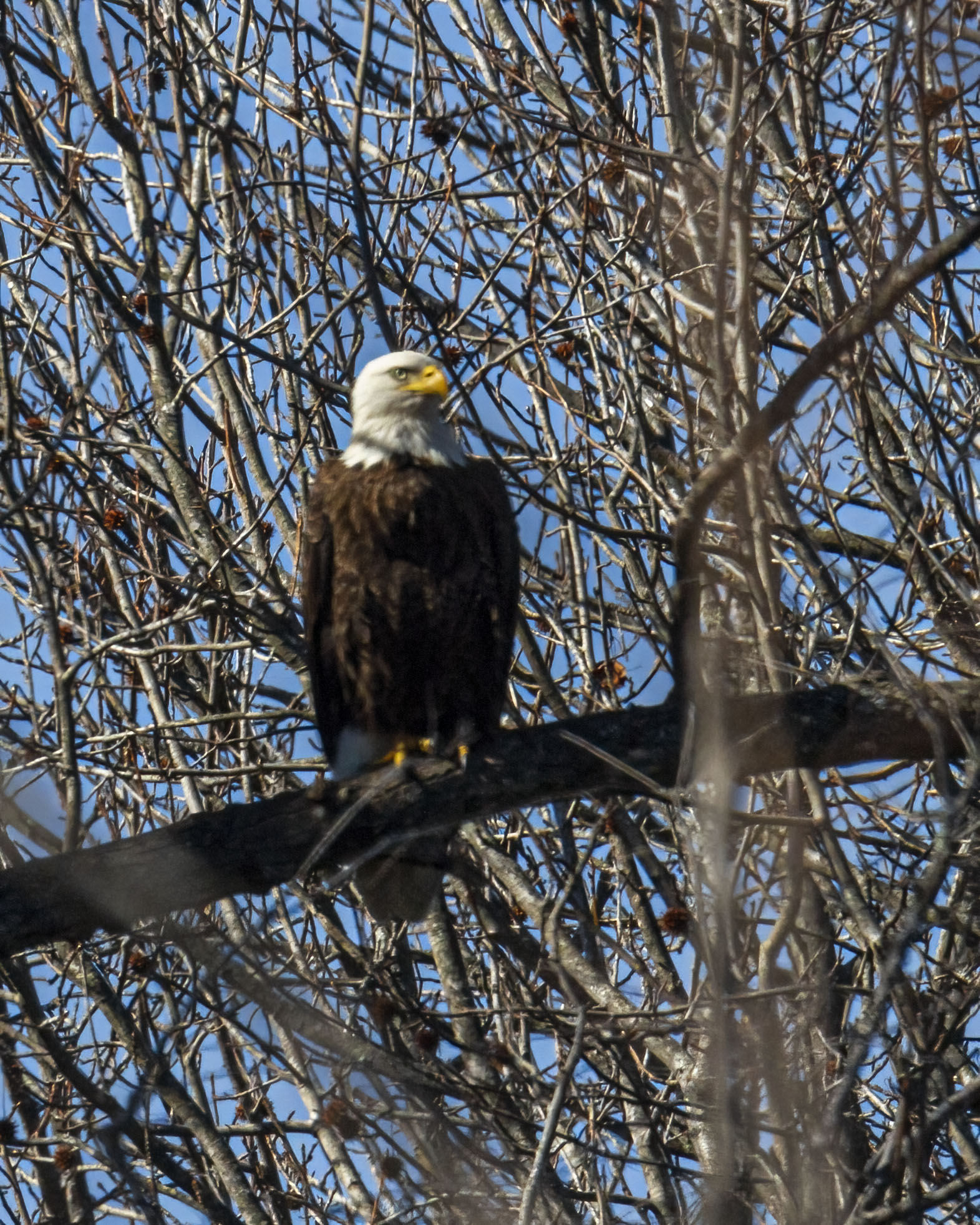
I did manage to capture a shot of a distant Bald Eagle (Haliaeetus leucocephalus). Many of you know that I rarely pass up an opportunity to photograph an eagle, even when they are far away. As you can see from the blurry branches in the foreground, I had to bend and twist my body to get a clear view of the eagle through the thicket of branches that mostly blocked my view.
It will soon be nesting season for the eagles, so I’ll be checking out several locations at the wildlife refuge this month for signs of eagle activity.
© Michael Q. Powell. All rights reserved.
Posted in Birds, Nature, Photography, spring, wildlife | Tagged astronomical spring, Bald Eagle, Canon 7D, Haliaeetus leucocephalus, meteorological spring, Occoquan Bay National Wildlife Refuge, Tamron 150-600mm, Woodbridge VA | 4 Comments »
February 19, 2026 by Mike Powell
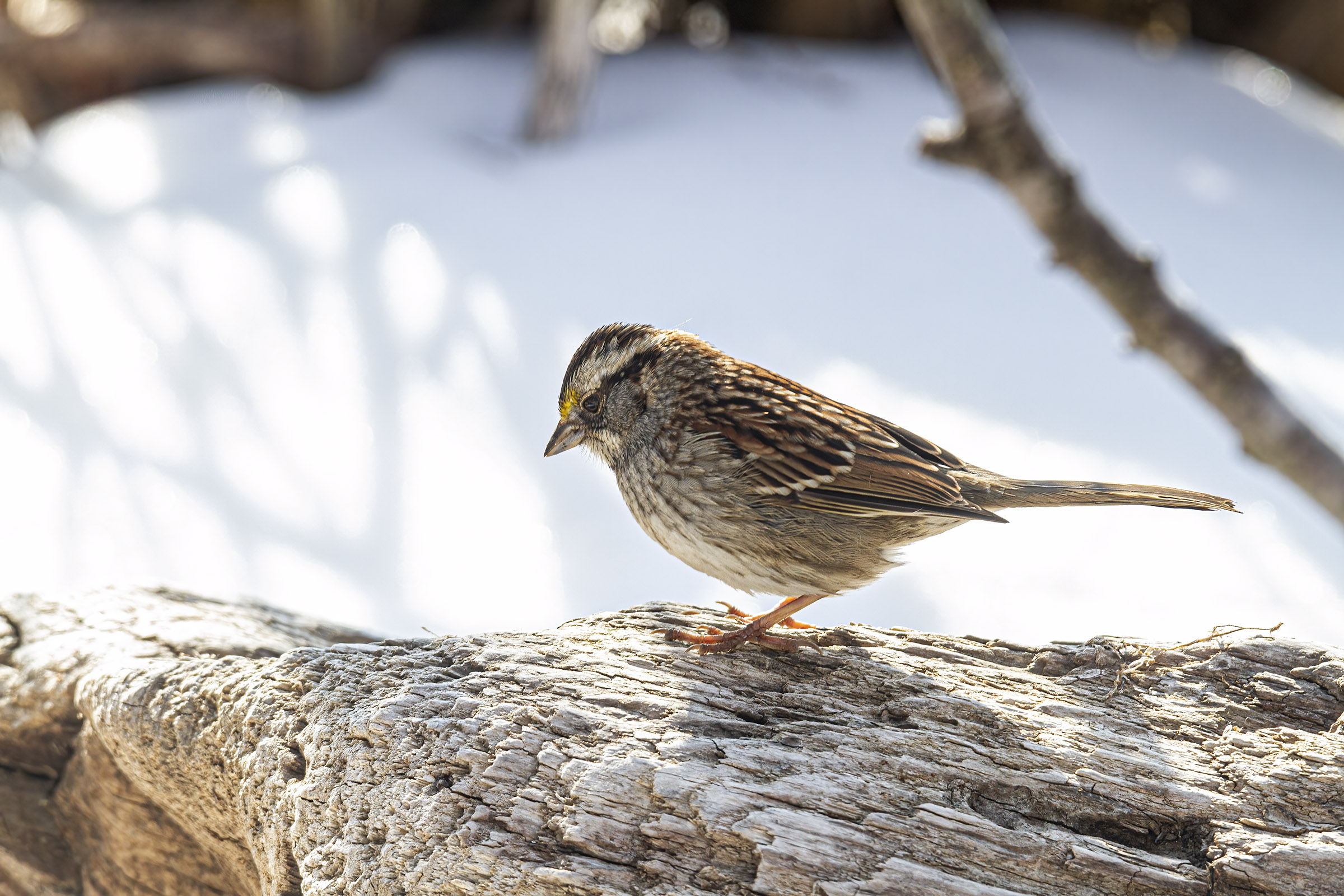
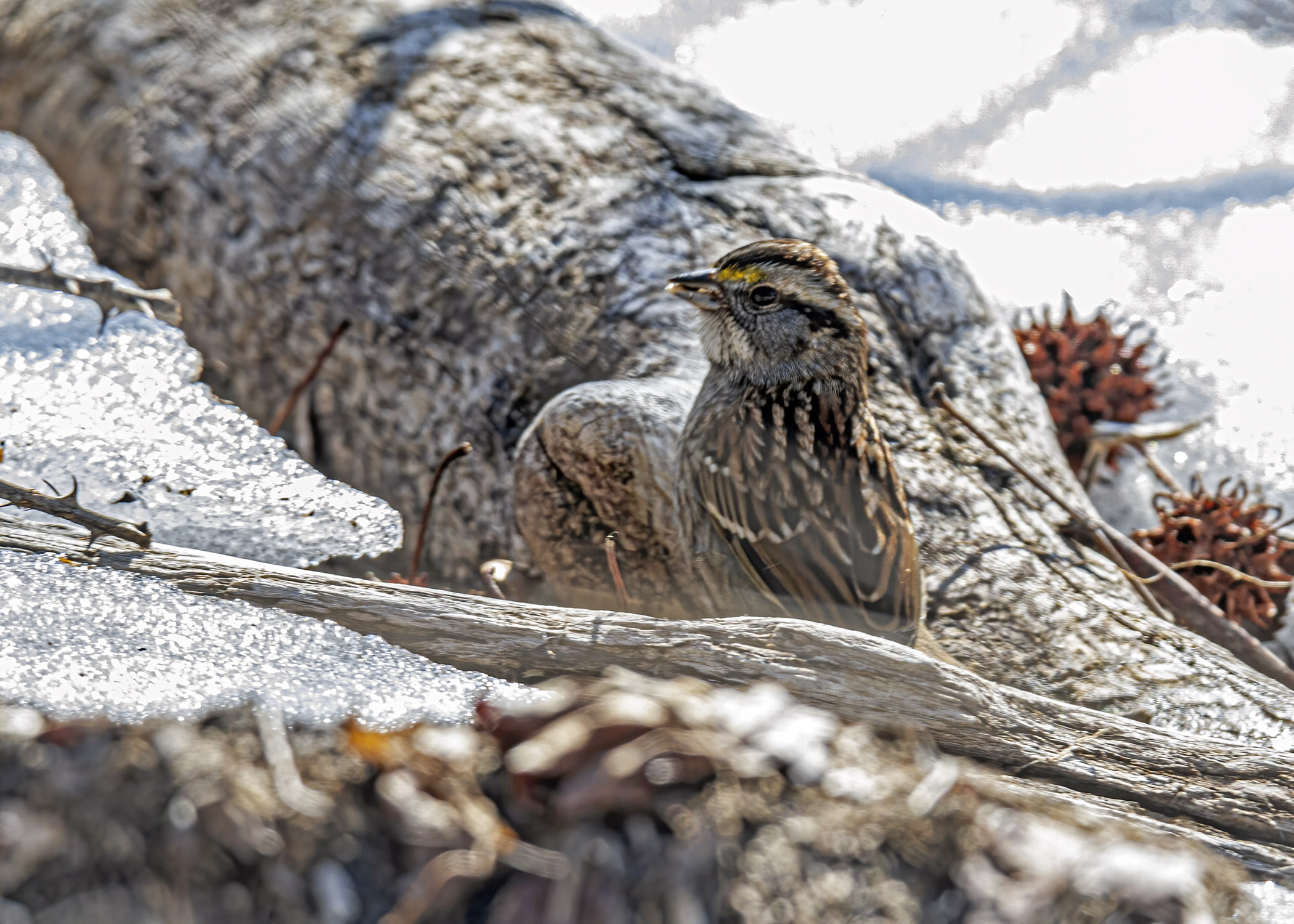
When birds are perched in the trees during the winter, you often do not have a sense of their environment when you look at photos of them. Some sparrow species, however, like to poke about on the ground and when I manage to capture some shots of them, you get much better sense of the harshness of their environment, as was the case with this White-throated Sparrow (Zonotrichia albicollis) last week at Occoquan Bay National Wildlife Refuge.
White-throated Sparrow overwinter with us, but disappear during the warmer months when they fly north to breed. One of my favorite identification features for this species is the bright yellow stripe in their lores (the area between their eyes and their bills). This particular sparrow was feverishly poking about in the snow as if foraged for food and I was particularly pleased when it hopped up onto a log and gave me a chance to capture an unobstructed shot of it.
© Michael Q. Powell. All rights reserved.
Posted in Birds, Nature, Photography, wildlife, Winter | Tagged Canon 7D, Occoquan Bay National Wildlife Refuge, sparrow, Tamron 150-600mm, white-throated sparrow, Woodbridge VA, Zonotrichia albicollis | 2 Comments »
« Newer Posts - Older Posts »