Feeds:
Posts
Comments

Archive for the ‘wildlife’ Category

I have not yet seen any large spiders this spring, but I have run across a few long-jawed spiders. The bodies of long-jawed orb weaver spiders of the Tetragnathidae family tend to be thin and they have extremely long legs of varying lengths. Most often I find them on vegetation overhanging the water, which in this case was a small pond at Jackson Miles Abbott Wetland Refuge.

long-jawed spider

© Michael Q. Powell. All rights reserved.


Read Full Post »

It is still really early in the dragonfly season in my area, so each one that I am fortunate enough to spot is special to me. I was therefore thrilled to photograph this male Common Baskettail dragonfly (Epitheca cynosura) on Monday as it was hanging vertically from the leaves of a small tree at Occoquan Bay National Wildlife Refuge. If you double-click on the image, you can see the dragonfly’s tiny feet with which it is clinging to the leaf.

Most of the times in the past when I have seen members of this species, they have been flying out of reach of my camera. According to the Dragonflies of Northern Virginia website, Common Baskettails are hard to spot because they are small with mostly clear wings and spend much of their time hovering high over clearings, making them “probably our least seen “common” dragonfly.”

Common Baskettail

© Michael Q. Powell. All rights reserved.


Read Full Post »

I felt like I had hit the jackpot last Friday when I finally spotted several Uhler’s Sundragon dragonflies (Helocordulia uhleri) while exploring a stream in Prince William County, Virginia. Uhler’s Sundragons are a scarce and seldom seen dragonfly species with a brief and early flight period. There is a very active Virginia dragonfly group in Facebook that posts sightings and photos and it appears that my sightings of this species were the first in our state for 2020.

Last year I was able to do some reconnaissance of an area where this species had been spotted in previous years using information shared with me by fellow dragonfly fanatic and blogger Walter Sanford. Eventually I found and photographed some Uhler’s Sanddragons and he and I were able to spot them again several times.

This species generally is found in a specific type of habitat—”Clean, sandy or gravely forest streams with a mix of riffles and pools,” according to the excellent Dragonflies of Northern Virginia website. So Friday I scoured the locations where had spotted them last year and it was in one such location that I spotted the Ashy Clubtail and Common Green Darner that I featured recently in my posting First dragonflies of the season. I looked for Uhler’s Sundragons there but came up empty-handed.

It was at a second spot that I finally spotted one as it flew through the air and landed on a piece of vegetation. There is not much flying this early in the season and I could tell from the way that it perched that it was probably my target species. I think I was shaking a little bit and certainly my heart rate had accelerated, but I managed to get a shot of that one (the middle shot below), before it flew away. A few minutes later, I had another spotting and captured the last shot below—it might have been the same dragonfly or a different one.

Part of my long walk back took me along another stretch of the same stream and I was absolutely thrilled when I spotted yet another Uhler’s Sundragon and captured my favorite shot of the day, the first one below. It turns out that all of the Uhler’s Sundragons that I photographed were females. I am not sure if the males were all out patrolling or were simply in other locations.

Many of the locations where I might normally search for dragonflies are closed and some of the others are potentially crowded, so I am not willing to go there. As you can see from my recent postings, I am staying really close to home most of the time, with trips like this one to remote locations being a rare exception.

Uhler's Sundragon

Uhler's Sundragon

Uhler's Sundragon

© Michael Q. Powell. All rights reserved.

Read Full Post »

Last Friday I photographed my first dragonflies of the spring, a male Common Green Darner (Anax junius) and a female Ashy Clubtail (Phanogomphus lividus). The Common Green Darner is probably a migratory dragonfly that is just passing through as it heads north—we do have local-born members of this species, but it is too early for them to have emerged.

The Ashy Clubtail, which was actually the first dragonfly that I photographed, almost certainly emerged locally. When a dragonfly emerges, its wings are really shiny and the wings of this Ashy Clubtail were definitely sparkling in the sunlight. According to the local flight calendar, the Ashy Clubtail is one of the earliest dragonflies in our area to emerge, but I have never seen one this early before.

As you can see, I captured the images of both of these dragonflies when they were perched flat on the ground. There were dry leaves all around, which made a stealthy approach almost impossible and focusing on the dragonfly was a bit of a challenge.

Common Green Darner

Ashy Clubtail

© Michael Q. Powell. All rights reserved.

Read Full Post »

Whenever I have my macro lens on my camera, I tend to scan small areas very carefully, looking for variations of color and patterns or signs of movement. The colorful markings permitted me to spot the tiny cricket frog that I featured in yesterday’s posting. Not far from the frog’s habitat, it was movement that allowed me to spot this cool-looking wolf spider (Tigrosa georgicola) on Monday. The spider was slowly crawling through some leaf litter and I was able to grab this shot when it paused for a second in an open area.

I believe that this is the first wolf spider that I have ever photographed. Fortunately I was able to get help in identifying it in a Facebook group devoted to spider identification. I know that some people are totally creeped out by spiders, while others are fascinated by them. I apologize to those in the former group, but hope that exposure to these spiders through my photos will help you appreciate their beauty—they truly are amazing creatures.

If you are at all interested in or curious about wolf spiders (and there are a lot of different species), you should check out Pete Hillman’s blog that just yesterday featured a photo of a wolf spider basking in the sun. Those who really like spiders will love a posting that Pete did earlier in the month entitled Not One For The Squeamish that shows a female wolf spider with a group of little spiderlings on her back—be sure to double-click on that image.


wolf spider

© Michael Q. Powell. All rights reserved.

Read Full Post »

Yesterday I captured this shot of an Eastern Cricket Frog (Acris crepitans) while exploring a seepy area in Prince William County, Virginia. The frog was tiny, only an inch or so (25 mm) in length. I was thankful for the green markings or I might otherwise have missed seeing the frog. The markings look very much like an arrow point towards the frog’s head. They also gave me something on which to focus since the rest of the frog’s body was pretty well camouflaged.

Eastern Cricket Frog

© Michael Q. Powell. All rights reserved.

Read Full Post »

Sometimes Ospreys (Pandion haliaetus) will renovate preexisting nests, but often they have to build one from scratch. This osprey couple that I spotted recently at Occoquan Bay National Wildlife Refuge was trying to build one in what seemed to be a rather precarious location.

I learned about the location of the nest only when I spotted an osprey flying by me with a stick in its talons. In my zeal to track the osprey, I neglected to pull back on my zoom lens, so I ended up cutting off its wing tips in the first image in which the osprey is delivering the stick. In the second image, you can see the nest-to-be as the osprey attempts to arrange the sticks. The final shot shows the osprey arriving at the nesting site with another stick. I like the way that the osprey almost hovered in order to land softly with its delivery.

I don’t know it the osprey couple will manage to jam enough sticks in the crook of the tree to be able to form a stable nest, but I will be sure to check their progress in future visits, as long as the wildlife refuge continues to stay open.

Osprey

Osprey

Osprey

© Michael Q. Powell. All rights reserved.

Read Full Post »

“Oh what a beautiful morning, oh what a beautiful day, I’ve got a beautiful feeling everything’s going my way.” I started my Thursday morning at Occoquan Bay National Wildlife Refuge with this handsome Great Blue Heron (Ardea herodias) who seemed to be serenading me.

If you have ever heard the squawk of a Great Blue Heron, you know why it is best that there is no soundtrack. Instead, I recommend that you click on this link to a YouTube video of the song that I cited in my opening sentence from the classic 1955 movie “Oklahoma”—it is guaranteed to brighten your day.

Great Blue Heron

© Michael Q. Powell. All rights reserved.

Read Full Post »

Land prices are so high here in Northern Virginia that you have to be creative. Yesterday I spotted this Osprey (Pandion haliaetus) couple building their tiny house on one of the boundary channel markers off of Occoquan Bay National Wildlife Refuge.

The osprey perched in the back, which I believe is the female, remained in place while the other osprey flew off to forage for building materials. Sometimes they were only small twigs, but occasional the male osprey would return with a fairly long branch, as in the second photo. In the third shot, the male osprey has successfully landed with the long branch, but has not yet let go of it.

Multiple osprey couples are busily constructing nests all of “my” wildlife refuge and I hope to be able to share some images of their constructions sites.


Osprey

Osprey

Osprey

© Michael Q. Powell. All rights reserved.

Read Full Post »

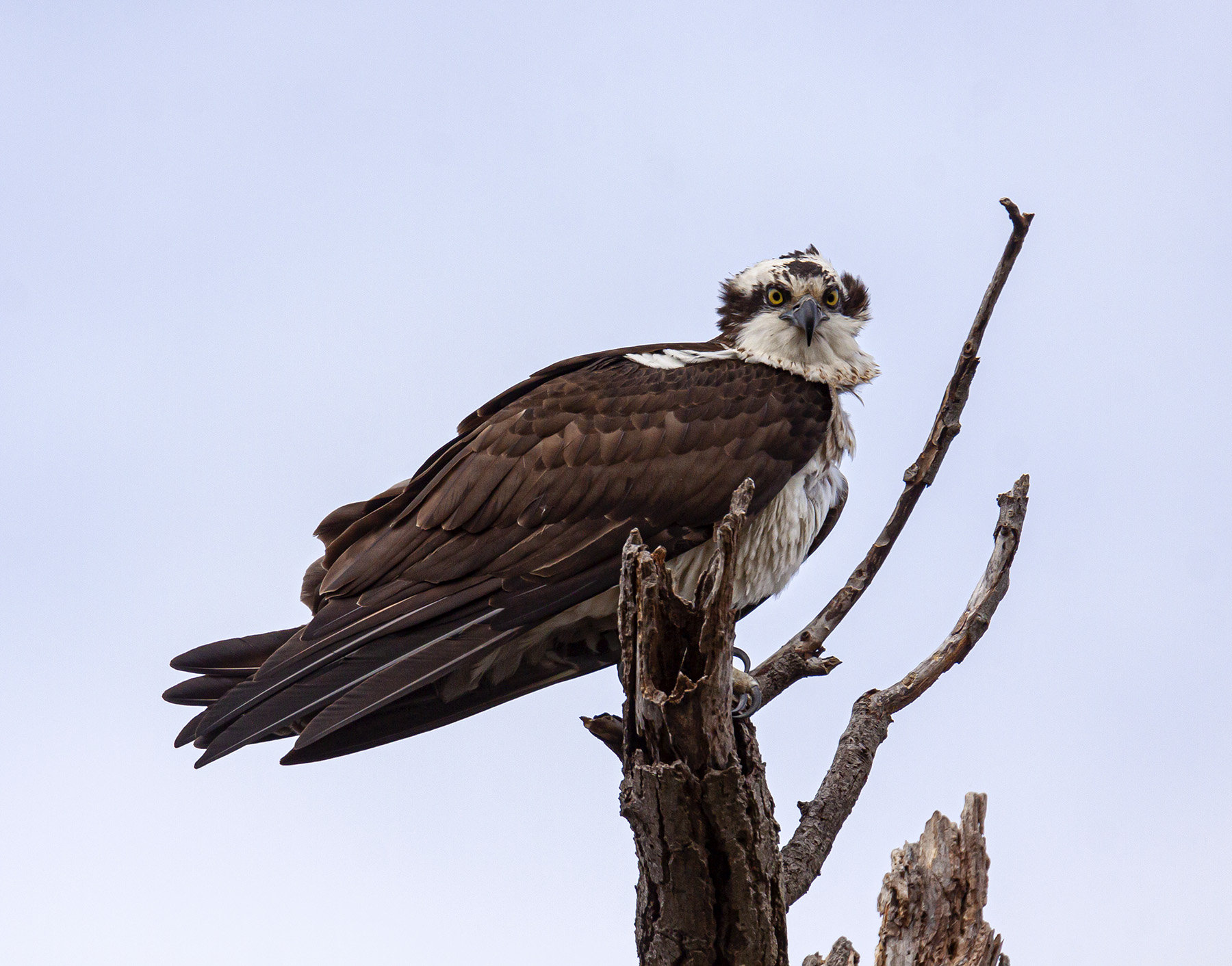
Even though we were at more than an acceptable social distance, this Osprey (Pandion haliaetus) seemed to be communicating a message to me with its direct eye contact on Saturday at Occoquan Bay National Wildlife Refuge—something like, “Please leave so I can continue working on my nest.”

Most of the time I will try to avoid photographing a bird head-on, because it has the potential to distort its features a lot. With this osprey, though, I think it worked out pretty well, perhaps because of the size and shape of its head.

osprey

© Michael Q. Powell. All rights reserved.

Read Full Post »

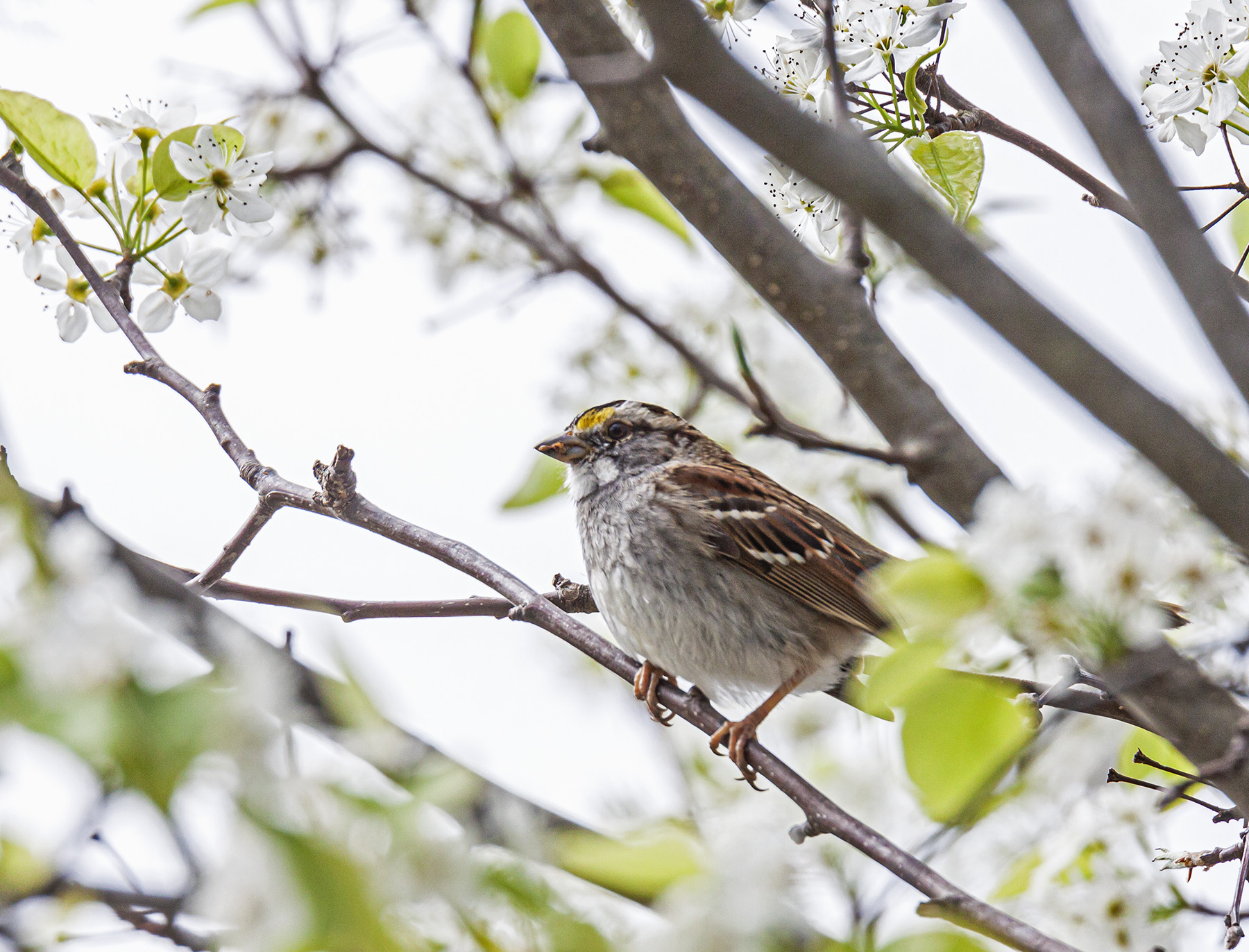
Each spring I try to get shots of birds perching in blossoming trees, but the birds rarely cooperate with me—they all seem more interested in foraging for food than in posing for me. On Saturday, though, a White-throated Sparrow (Zonotrichia albicollis) at Occoquan Bay National Wildlife Refuge paused for a moment and I was able to capture this image.

I chose not to crop this image any closer in order to give you a better view of the delicate white blossoms of a tree that I am not able to immediately identify.

White-throated Sparrow

© Michael Q. Powell. All rights reserved.

Read Full Post »

I am more of a liberal arts guy than a scientist, so the details of bird identification often escape me. Sue of the Back Yard Biology blog, on the other hand, is a self-avowed “geeky science nerd.” She decided to do some work to find out how to tell the age of a wild turkey. I suspect that many of you will find her posting as fascinating as I did, so be sure to click on the View Original Post in order to see her entire posting.

Be sure also to check out other postings on her wonderful blog. Sue is one of my most faithful followers and was one of the first to comment on my earliest postings more than seven years ago.

Sue's avatarBack Yard Biology

It’s that time again, when tom Turkeys begin to strut their stuff in the backyard.  The other day, a FB friend/fellow wildlife photographer posted a shot of a tom turkey (https://michaelqpowell.com/2020/03/22/panic-or-calm/) that looked quite a bit different than the one I have been seeing in my backyard.  I thought it looked younger, but I wondered how one can tell the age of male wild Turkey.  So, I googled that thought, and it turns out it’s not a hard thing to do (assuming you can judge lengths somewhat accurately).

The key things to look for are the length of the beard (the hair-like structures — which are modified feathers) hanging down from its breast), the color of the tip of the beard, and the length of the spurs on the back of the lower-most part of its leg next to the foot (the tarsometatarsus to be exact).

It’s still early in…

View original post 399 more words

Read Full Post »

Wild Turkeys (Meleagris gallopavo) reacted in different ways yesterday at Occoquan Bay National Wildlife Refuge when they detected my presence. One turkey seemed to panic, put down its head, and sprinted to the other side, while the other calmly strode across the trail. Both reached the other side safely. Was this the turkey version of social distancing?

How do you react in the face of a perceived threat? These days, this question is not merely an academic one—it is part of our daily lives. I think we all experience moments of panic, but we can choose not to let those feelings overwhelm us. Stay safe and healthy within the limits imposed on you by the current crisis and be sure to take care of yourselves.

Wild Turkey

Wild Turkey

© Michael Q. Powell. All rights reserved.


Read Full Post »

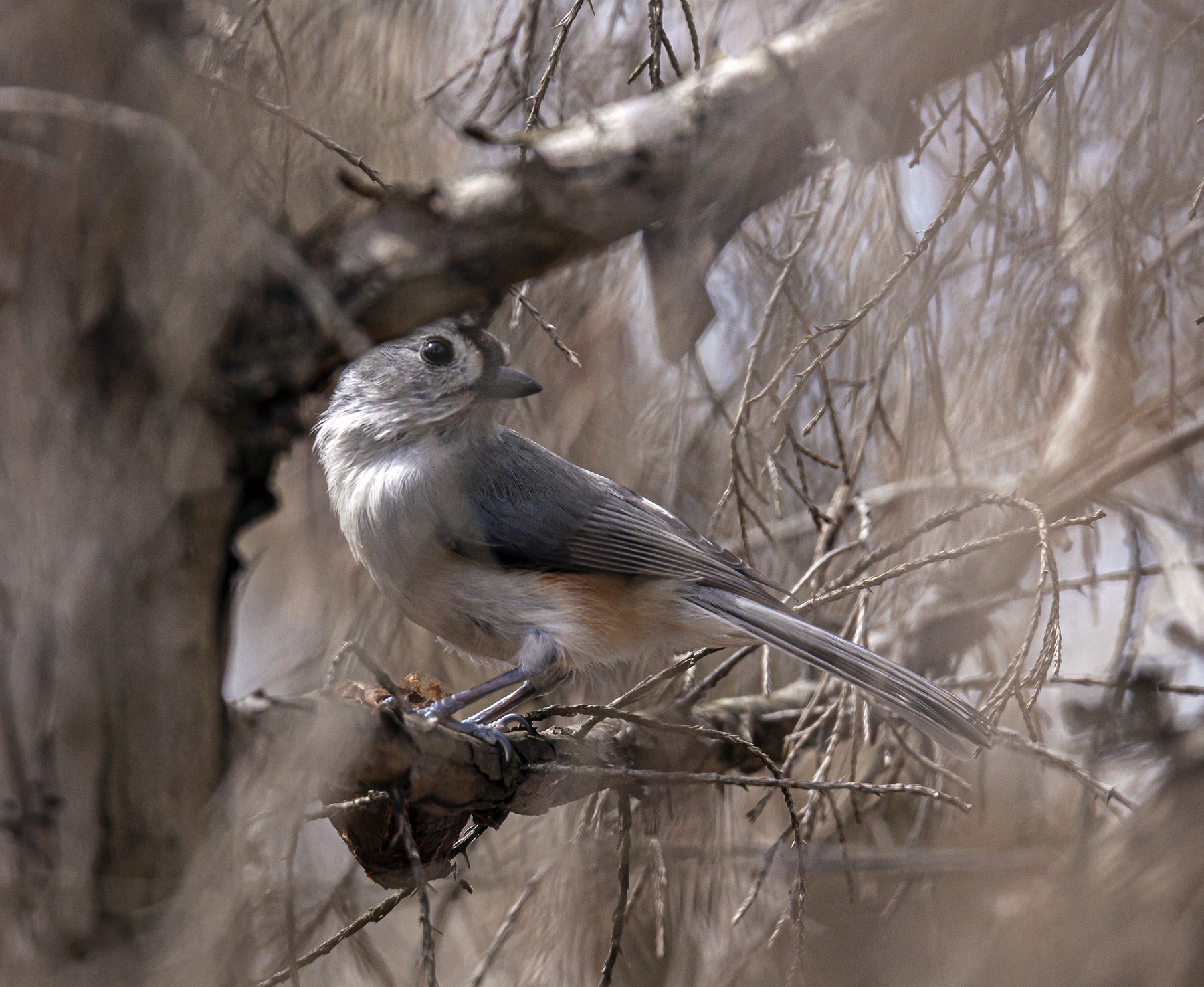
The early bird gets the worm, they say, but this mid-morning Tufted Titmouse (Baeolophus bicolor) was eating something different when I spotted it through the trees last Friday at Occoquan Bay National Wildlife Refuge.

It is always a challenge to get shots of birds as small as this one (approximately 5.5-6.3 inches (14-16 cm) in length), but I have found that my chances of success increase when a subject stops to eat. I could see the little titmouse clearly, but there was a lot of vegetation between us.  As a result, I had to move from side to side, trying to find a clear visual tunnel. I am happy with what I was able to get, even if the bird’s distinctive pointed crest did end up being blocked from view by a tree.

Tufted Titmouse

Tufted Titmouse

© Michael Q. Powell. All rights reserved.

Read Full Post »

On Tuesday I could hear a pair of screaming hawks overhead at Accotink Bay Wildlife Refuge and eventually I saw one of them land on a broken-off tree. As I focused on that hawk, which I think is a Red-shouldered Hawk (Buteo lineatus), the other hawk zoomed into the frame and continued the fight.

In the first image, the perched hawk appeared to sense the approach of the “enemy” and was preparing itself for battle. I didn’t realize that the other hawk was approaching I saw it through the viewfinder of my camera as you can see in the second shot. At that moment, the stationary hawk was preparing to take off. In the final shot, the flying hawk had closed the gap and the two raptors were engaged in what looked to be a fierce struggle.

Why were they fighting? My guess is that it was some kind of territorial dispute, but there is no way for me to be sure. When I first saw the two hawks chasing each other, I thought it might be love, but the final frame suggests that was not the reason.

Red-shouldered Hawk

Red-shouldered Hawk

Red-shouldered Hawk

© Michael Q. Powell. All rights reserved.

Read Full Post »

No matter how many times it happens, it is always exciting to see a Bald Eagle (Haliaeetus leucocephalus). Last week I spotted this one at Occoquan Bay National Wildlife Refuge and I was happy when it presented me with a chance to take this profile shot.

I had watched as the eagle flew to this tree and stealthily approached it. I was able to get relatively close, because the eagle was looking away from me and could not see me moving closer. However, the butt-first pose that it presented to me is not the most flattering for any creature, so I waited and hoped that the eagle would change its position. After what seemed like an eternity, the eagle moved its head to the side and I was finally able to get a few shots in which the eye was visible. Patience paid off one more time.


Bald Eagle

© Michael Q. Powell. All rights reserved.

Read Full Post »

Last Monday I was thrilled to spot this North American Beaver (Castor canadensis) slowly swimming by me in the early morning light at Occoquan Bay National Wildlife Refuge. I was able to follow the beaver along the shore for several minutes before it disappeared with a big splash, as you can see in the final photo that show the beaver’s distinctive tail, the last part of the beaver to enter the water.

The limited light caused me to shoot at slower shutter speeds than the situation actually demanded, but the slight blurriness somehow enhances the dreamlike feeling of the time around sunrise. I checked the data on the final shot and was a little shocked to see that I took it with a shutter speed of 1/50 of a second. Somehow I was able to capture a decent composition and an almost abstract-style image—the image that you see is also uncropped.

Happy St. Patrick’s Day to those of you who are celebrating the holiday. I grew up outside of Boston, Massachusetts, where St. Patrick’s Day is a big deal, including a large parade that, alas, had to be canceled this year.

beaver

beaver

beaver

© Michael Q. Powell. All rights reserved.

Read Full Post »

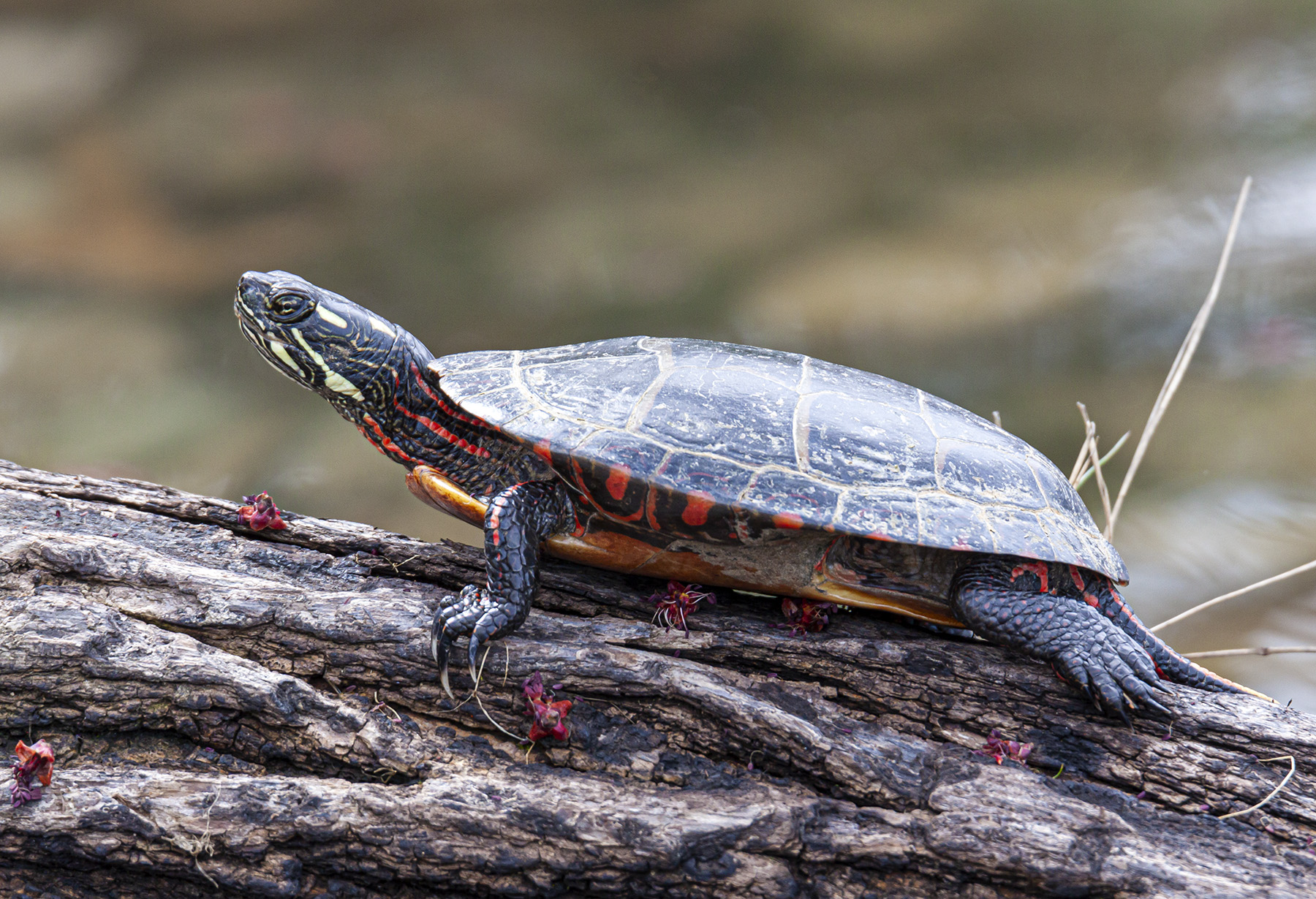
On Friday I encountered this basking Eastern Painted Turtle (Chrysemys picta picta) at the appropriately named Painted Turtle Pond at Occoquan Bay National Wildlife Refuge. Although painted turtles are common in the area in which I live, I am always happy to see their bright colors. In this case, the fallen flowers from a nearby tree added a nice accent to my little portrait of this colorful turtle.

Painted Turtle

© Michael Q. Powell. All rights reserved.


Read Full Post »

Yesterday, Friday the 13th, was also Groundhog Day for me—I spotted this Groundhog (Marmota monax) while exploring one of the trails at Occoquan Bay National Wildlife Refuge. At first I thought it might be a beaver or a muskrat, species that I am more used to seeing, but I got a good look at its tail and it was clearly not the flattened tail of a beaver nor the long rat-like tail of a muskrat.

When hearing of groundhogs, some Americans will immediately think of the annual celebration when a groundhog is taken out of its burrow and forecasts the length of the winter, depending on whether or not it can see its shadow. Others will think instead of the 1993 comedy movie Groundhog Day in which the actor Bill Murray is caught in a loop and repeats the same day over and over again. A few others might recall an ongoing GEICO insurance commercial in which woodchucks (another name for groundhogs) chuck wood.

It turns out that I actually know very little about these animals so I did a little research and learned that groundhogs are one of the few species that enter into true hibernation. According to Wikipedia, “they often build a separate “winter burrow” for this purpose. This burrow is usually in a wooded or brushy area and is dug below the frost line and remains at a stable temperature well above freezing during the winter months. In most areas, groundhogs hibernate from October to March or April, but in more temperate areas, they may hibernate as little as three months. To survive the winter, they are at their maximum weight shortly before entering hibernation. When the groundhog enters hibernation, there is a drop in body temperature to as low as 35 degrees Fahrenheit (2 degrees C), heart rate falls to 4–10 beats per minute and breathing rate falls to one breath every six minutes. During hibernation, they experience periods of torpor and arousal. Hibernating woodchucks lose as much as half their body weight by February.” (UPDATE: I later checked other sources and most of them suggest that the respiration rate drops to two per minute when the groundhog is hibernating as compared with a normal rate of 16 breaths per minute.)

Perhaps this groundhog had recently emerged from his winter sleep and was looking for things to eat when I spotted it. Fortunately all kinds of things are starting to grow and hopefully he will have few problems in filling his stomach.

groundhog

groundhog

© Michael Q. Powell. All rights reserved.

Read Full Post »

As our weather continues to warm up, more and more creatures are reappearing, like this Spotted Turtle (Clemmys guttata) that I spotted yesterday at Jackson Miles Abbott Wetland Refuge. As you can see from the photo, the turtle was on dry land, in a wooded area with pine trees, rather than in the water like most of the other turtles that I saw yesterday.

Spotted Turtles are relatively small, about 3.5 – 4.5 inches in length (9 – 11.5 cm), according to the Virginia Herpetological Society website. The website also notes that this species is seen primarily in the early spring, but seldom beyond the month of June. Spotted Turtles enter into a state of dormancy (technically it is “aestivation”) during the warmest months under vegetation and during the coldest months under mud. During those periods they are inactive and their metabolism rate is lower, but their physiological state can be rapidly reversed, and they can quickly return to a normal state.

Spotted Turtle

© Michael Q. Powell. All rights reserved.


Read Full Post »
The world seems to have gone crazy recently, so I look for any signs of happiness and positivity that I can find, like this beautiful Eastern Bluebird (Sialia sialis) that I spotted on Monday at Occoquan Bay National Wildlife Refuge. The relatively subdued coloration of this bird suggests to me that this is a female bluebird.

Bluebirds are traditionally associated with happiness. It is my hope and prayer that somehow amidst the chaos of cancelled plans and possible quarantines, you will be able to pause and find a few moments to be thankful for what you do have.

Eastern Bluebird

© Michael Q. Powell. All rights reserved.

Read Full Post »
Nature photographers need to know their punctuation marks well. Last week I spotted an Eastern Comma butterfly (Polygonia comma) and this week on Monday I spotted its “cousin,” a Question Mark butterfly (Polygonia interrogationis) at Occoquan Bay National Wildlife Refuge.

I have always wondered what was going through the mind of the person that chose the official name of a given species. What caused them to focus on a particular characteristic in choosing the name? Was the person who named these butterflies a grammarian?

In the case of the Question Mark butterfly, the best identifying mark is visible only when the wings are closed. The Question Mark has white markings which more or less resemble a question mark (?) on the underside of its hindwings. (Check out the natureblog.org posting “A Question Mark, a Comma, and a Question of Origin,” to see examples of these markings.)

The good news is that there is also a way to identify a Question Mark when its wings are open—the Question Mark has four black spots in a line on each of its upper wings with the outermost spot somewhat elongated, as you can see in the first photo below.

For the sake of comparison, I am reprising a photo from last week of an Eastern Comma butterfly. I flipped it 180 degrees so it is easier to spot the differences. If you look at the butterfly in the second photo, you can see that there are only three spots on each of the upper wings, which makes it a Comma, rather than a Question Mark. (One sharp viewer last week suggested that they should have more appropriately named the butterfly with the three spots the “Ellipsis Butterfly” rather than the Eastern Comma Butterfly.) In case you are curious about the reasons for the “comma,” the butterfly has markings that look sort of like a comma (,) on the underside of its hindwings that are visible when the wings are closed.


Question Mark butterfly

Question Mark butterfly


Eastern Comma butterflyy

Eastern Comma butterfly

© Michael Q. Powell. All rights reserved.


Read Full Post »

Yesterday morning I was excited to spot this handsome Red-shouldered Hawk (Buteo lineatus) perched rather low in a tree at Occoquan Bay National Wildlife Refuge. Rather than flying away immediately, as is usually the case, the hawk remained in place long enough for me to maneuver around to a good position to capture its portrait.

Red-shouldered Hawk

Red-shouldered Hawk

© Michael Q. Powell. All rights reserved.

Read Full Post »

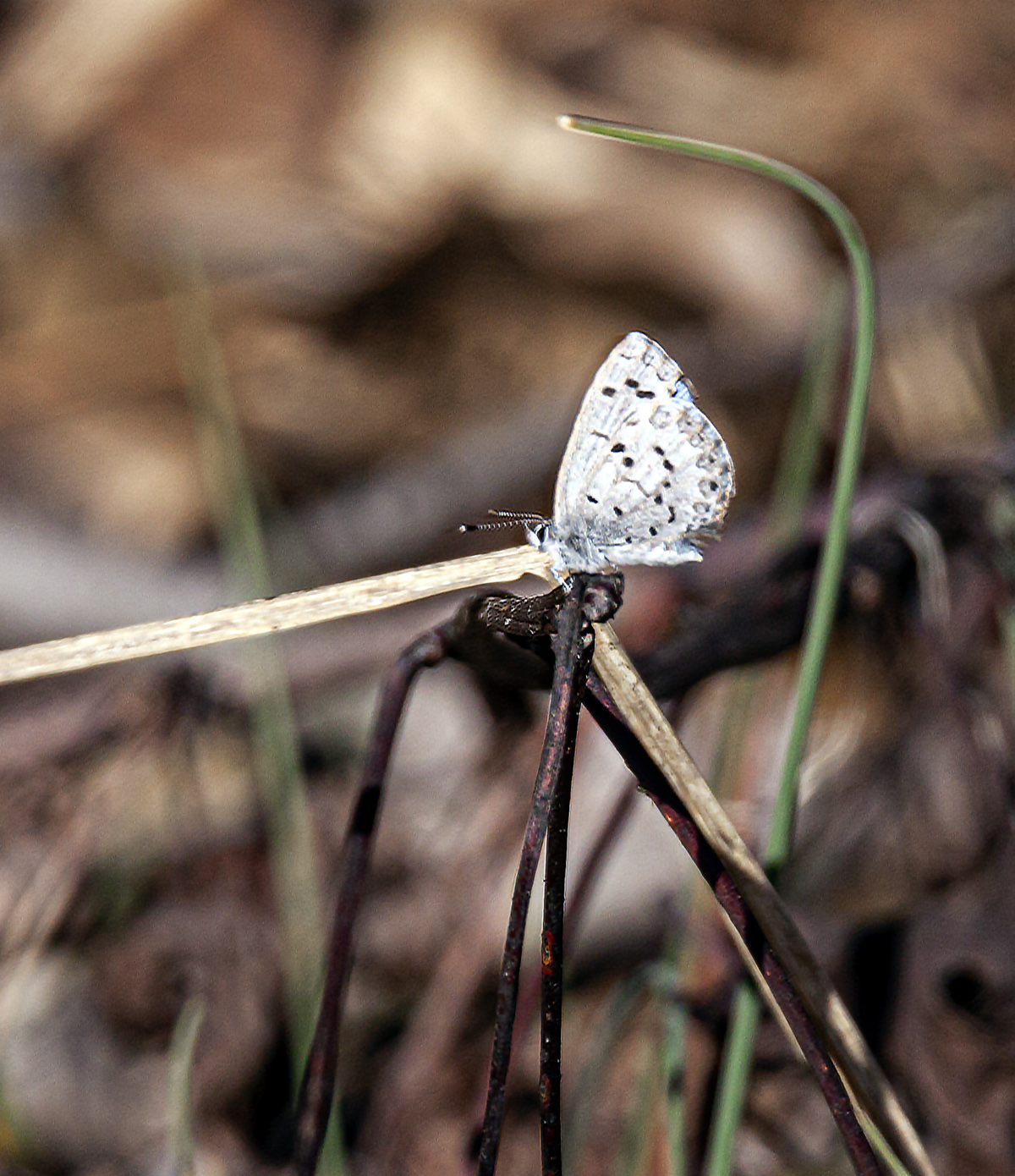
Today I was thrilled to spot another species of butterfly, the aptly named Spring Azure butterfly (Celastrina ladon), while exploring Occoquan Bay National Wildlife Refuge. This tiny butterfly is only about an inch (25 mm) in size and I was therefore a little surprised to be able to capture some of its details with my 150-600mm lens cranked all the way out to 600mm.

It shouldn’t be long before I see my first damselfly or dragonfly, given the spring-like weather and temperatures today forecast to reach over 70 degrees (21 degrees C).


Spring Azure butterfly

© Michael Q. Powell. All rights reserved.

Read Full Post »

Frogs have begun to sing their springtime songs. Although they are loud, most of the frogs are small and well-hidden. I was happy to spot this tiny one, which I believe is an Eastern Cricket Frog (Acris crepitans), last Wednesday at Prince William Forest Park in Triangle, Virginia.

According to the Virginia Herpetological website, the Eastern Cricket Frog, which some other sources call the Northern Cricket Frog, is 5/8 to 1-3/8 inches  in length (16-35 mm). I am pretty certain that I would not have been able to spot the little frog if it had not jumped into the air and landed at a spot that I could see. Even then, I had trouble finding it in the viewfinder of my extended telephoto lens.

The referenced website notes that the male mating call resembles the sound of two stones being hit together and a single call usually lasts through 20-30 beats. Is it music? You will have to answer that question for yourself, but I suspect that the call is music to the ears of lady frogs.

Eastern Cricket Frog

© Michael Q. Powell. All rights reserved.

Read Full Post »

Male White-tailed Deer (Odocoileus virginianus) shed their antlers during the winter and start to grow a new set in early spring. When I first spotted the pointed white tips of deer antlers while exploring Prince William Forest Park this past Wednesday, I assumed that they were shed antlers. As I got closer, I was shocked to see that they were still attached to the skull of the now dead deer.

We have an overpopulation of White-tailed Deer in our area, in part because there are not many natural predators. I couldn’t help wondering how this large buck met his demise. Was it a coyote or fox? Was it disease, starvation, or old age? Whatever the cause of death, scavengers had done their part and the only other body parts that I spotted in the immediate area were several small spinal sections.

Later that day, I spotted a second set of antlers with the skull still attached. These antlers, shown in the second photo below, showed more damage and it is hard to tell how large they may have initially been. As was the case with the first deer, there were few parts of the deer carcass in the surrounding area—the only parts I saw in the surrounding area were the lower jaw bones.

I spend a good deal of time out in nature, but see only a small part of what really takes place in the areas that I visit. Spring often makes us think of new life as baby birds and animals are born and trees and flowers emerge with new growth. These antlers, however, are a sober reminder that death is also a part of the cycle of life for the wildlife that I enjoy observing and photographing.


White-tailed Deer

White-tailed Deer

© Michael Q. Powell. All rights reserved.

Read Full Post »

Our recent warm weather has caused all kinds of creatures to reappear, like this Eastern Ratsnake (Pantherophis alleghaniensis) that I spotted on Wednesday while hiking in Prince William Forest Park. I kept my distance and relied on a telephoto lens to zoom closer even though I knew that this snake was not poisonous. I am not sure how long the snake was, but as you can see in the second photo it looked to be quite long. According to the Virginia Herpetological Society website, the Eastern Ratsnake is the only snake in Virginia that can grow to be more than six feet (183 cm) in length.

UPDATE: A snake expert weighed in on my Facebook posting about this snake and noted that, “This is a Black Racer (Coluber constrictor constrictor). It’s harder to tell with the mud, but the dorsal scales are unkeeled, the skull shape too round, scale shape more rhombus-like, and eyes too big.” This just reinforces the notion that the more that I learn, the more I realize how little I know—that is why it is great to have experts around to help us identify what we see and photograph. The average size of a Northern Black Racer is “only” 36-60 inches (90-152 cm).


Eastern Ratsnake

Eastern Ratsnake

© Michael Q. Powell. All rights reserved.

Read Full Post »
Yesterday was a beautiful spring-like day and I went on a long hike at Prince William Forest Park, the largest protected natural area in the Washington, D.C. metropolitan region at over 16,000 acres. It felt like the perfect weather for finding dragonflies, but it is still a bit too early for them.

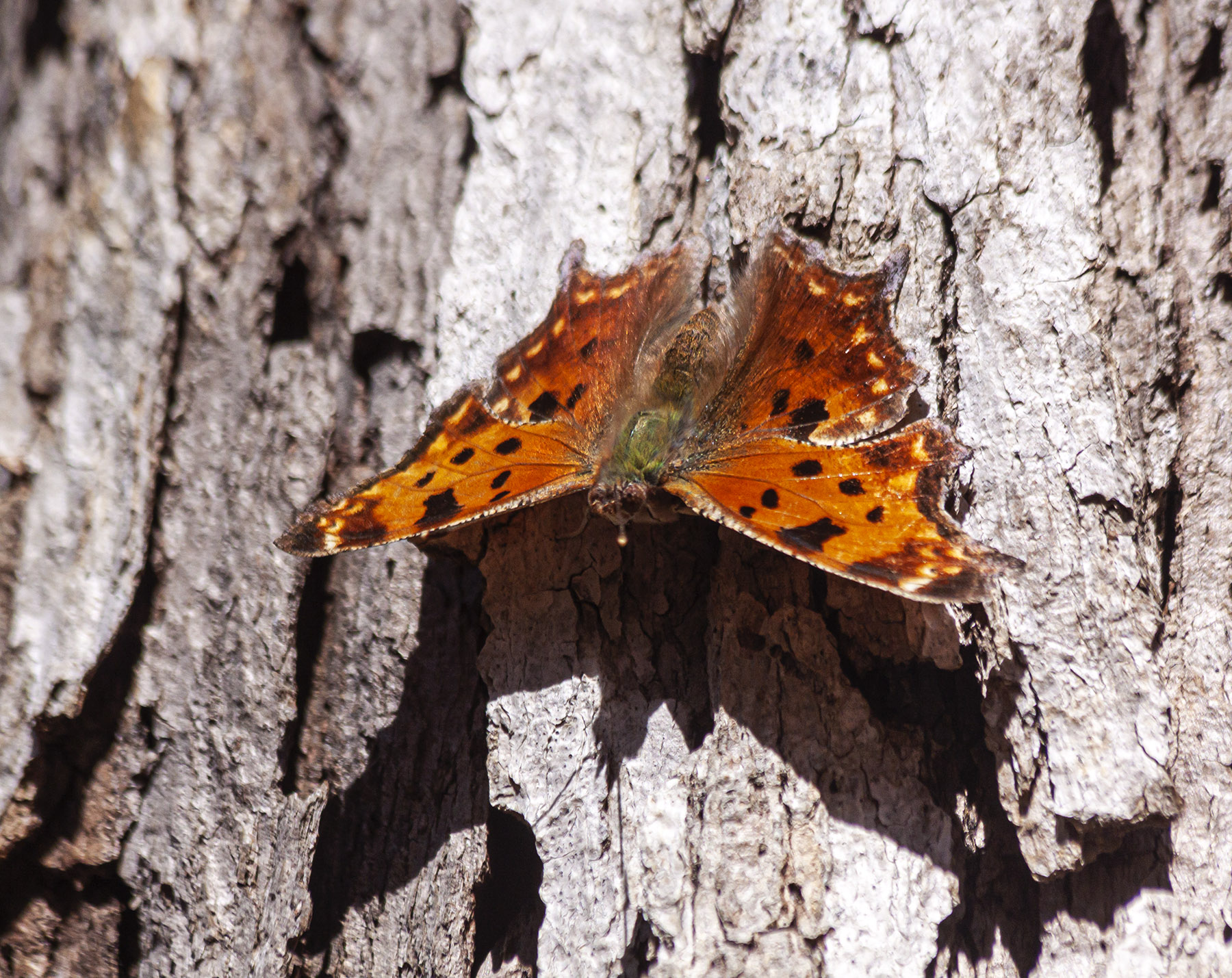
I was, however, quite excited to get my first shots this year of a butterfly, an Eastern Comma (Polygonia comma). I saw my first butterfly, which was probably of the same species, a couple of weeks ago, but was unable to react quickly enough to take its photo, so it did not “count.” During yesterday’s hike, I spotted six or seven of these little butterflies, but only the first one was cooperative enough to stay still for a portrait.

Eastern Comma butterflies are members a small group of butterflies in our area that emerge in the autumn and overwinter as adults. Other species in that group including the similar-looking Question Mark butterfly (Polygonia interrogationis) and the Mourning Cloak butterfly (Nymphalis antiopa). When its wings are open, like the one in the photo, it is easy to tell that a butterfly is an Eastern Comma if it has three dark spots in a row on each of its front wings, rather than the four spots found on a Question Mark. (For more information about the two similar species, I recommend a wonderful article at trekohio.com entitled “Butterflies That Punctuate: The Eastern Comma and the Question Mark.”)

Eastern Comma

Eastern Comma

© Michael Q. Powell. All rights reserved.

Read Full Post »

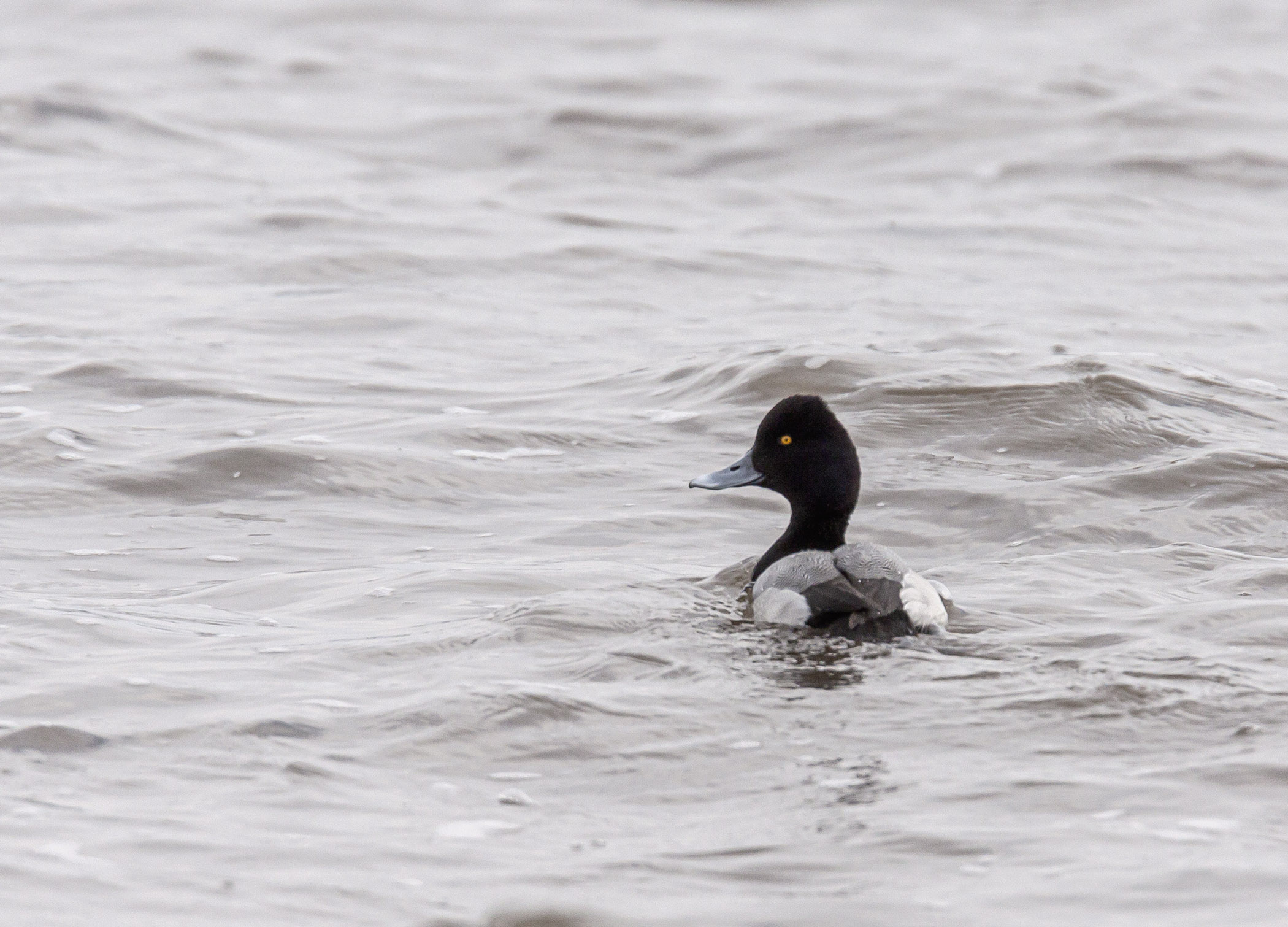
The wind was blowing strongly on Monday morning, kicking up lots of waves in the waters off of Occoquan Bay National Wildlife Refuge. In the deeper water I could see a small group of scaups bobbing up and down among the waves. Were they Greater Scaups (Aythya marila) or Lesser Scaups (Aythya affinis)?

I confess that I can’t tell the difference between the two species. I was content to get shots of both genders, especially the female with the distinctive white markings at the base of her bill.

scaup


scaup

© Michael Q. Powell. All rights reserved.


Read Full Post »

Yesterday morning I was delighted to spot this immature Bald Eagle (Haliaeetus leucocephalus) at Occoquan Bay National Wildlife Refuge. It takes approximately five years for a Bald Eagle to gets its classic white head and I estimate this one to be about three years old, judging from its coloration.

Initially I spotted the eagle when it flew into the midst of a group of trees. I moved around only a little, fearful of spooking the bird, and captured the second shot below when the eagle leaned forward a little and exposed its head. Moving as stealthily as I could, I maneuvered to a position from which I had a somewhat clearer shot and captured the third shot below. I noted that the eagle was crouching, which is often a prelude to taking off, but the eagle remained in place.

Eventually I reached a little opening and was able to capture the first image, which I think is the best of the group. The tree in which the eagle is perched is, I believe, a sycamore. Unlike the sweet gum trees with spiky seed balls that have appeared in many of my perched eagle shots, the seed balls of this tree appear to be much smoother.

If you are interested in the developmental stages of a Bald Eagle and how its appearance changes over time, I recommend that you check out a posting from onthewingphotography.com entitled “Bald Eagles – Age Progression from one to five years old” that features wonderful photographs of each stage.

Bald Eagle

Bald Eagle

Bald Eagle

© Michael Q. Powell. All rights reserved.


Read Full Post »

There are at least two Bald Eagle nests (Haliaeetus leucocephalus) at Occoquan Bay National Wildlife Refuge, the location where I take many of my wildlife photos. One of them is located adjacent to a popular trail and most years the authorities close nearby trails during eagle nesting season. There has been a lot of construction at the refuge over the past few months and, although I saw an eagle couple at that nesting site on several occasions, it looks like they may not have occupied that nest this year (and the trails have not been closed).

The second nest, pictured below, is in a more remote location—it is visible through the trees from one of the trails, but is surrounded by dense vegetation, so the eagles are more insulated from human activity. On a recent visit to the refuge, I was pleased to spot both members of an eagle couple in the nest. I am pretty sure that the eagle on the left is the male, because male eagles tend to be considerably smaller than their female counterparts.

With a bit of luck I hope to be able to spot some eaglets here in the upcoming months, although I noted last year that it is a real challenge to do so, because the wall of this large nest appear to be quite high and effectively hide the eagles from view.

Bald Eagle

© Michael Q. Powell. All rights reserved.


Read Full Post »

« Newer Posts - Older Posts »