Feeds:
Posts
Comments

Archive for the ‘wildlife’ Category

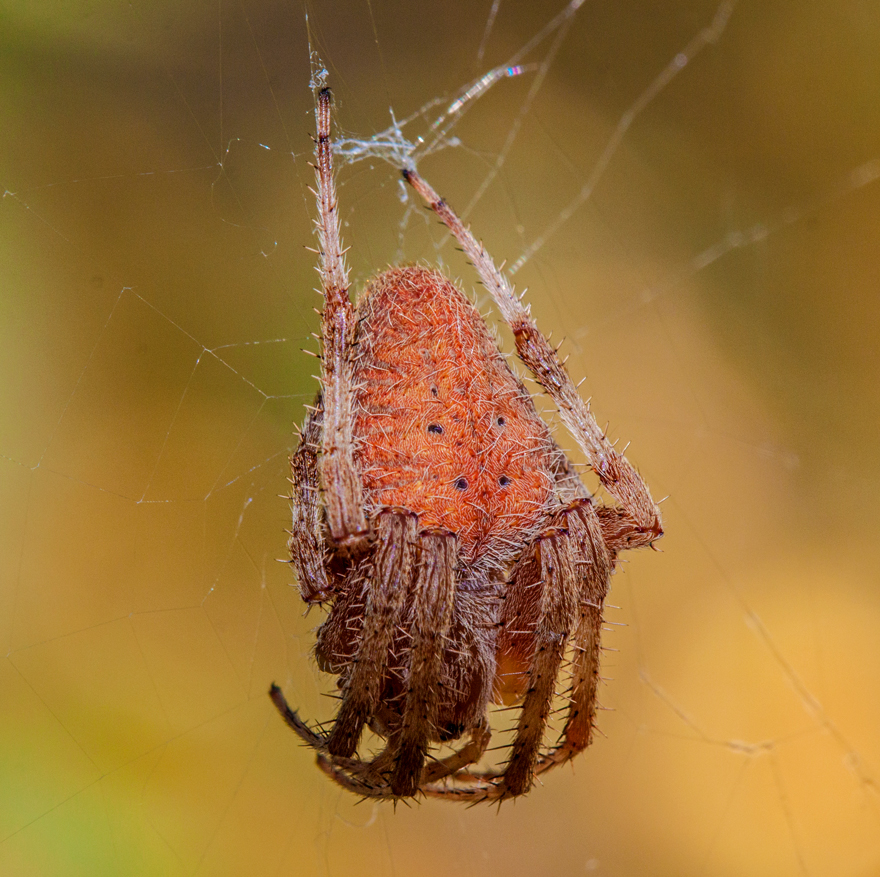
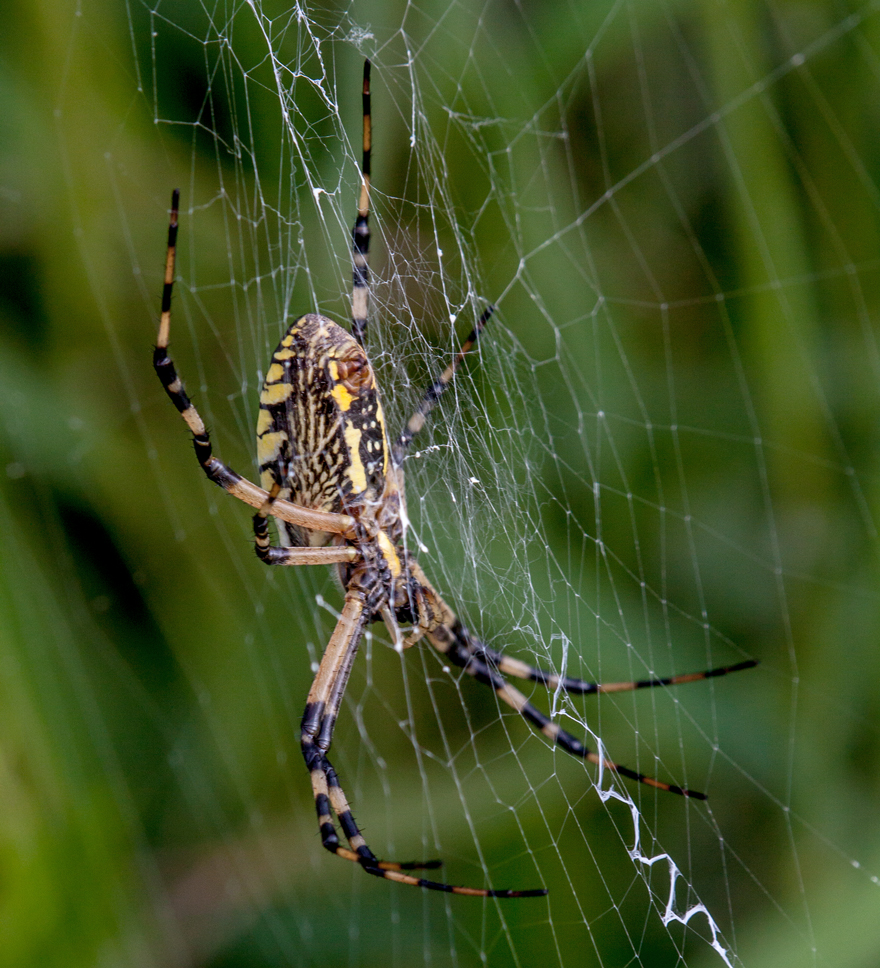
I seem to be seeing spiders everywhere recently, so I thought I’d feature photos of three of them to represent the wide diversity of the population that I have observed.

The first one was very small and appeared to be hiding at the bottom of this leaf, waiting for its prey to come along. It did not appear to have made a web.

The second one had a web suspended over the water and is, I believe, a kind of long-jawed orb weaver of the Tetragnathidae family. It has awfully long legs compared to most other spiders. I usually see them making webs late in the day as the sun is beginning to go down.

The final one is a kind of spider that I see pretty regularly, though I don’t know what kind it is. It appears to have captured some prey, perhaps a grasshopper.

spider_leaf_blogjaw_blogspot2_blog

© Michael Q. Powell. All rights reserved

Read Full Post »

Who makes up these crazy names? Freddy Krueger? Jason? Believe it or not, this colorful little caterpillar is called a Smeared Dagger Moth caterpillar (Acronicta oblinita). Someone obviously had been been watching too many slasher or horror films.

Fortunately, it has another name—it is also called a smartweed caterpillar.

colorful_blog

© Michael Q. Powell. All rights reserved

Read Full Post »

I probably should have come up with a more creative title for this posting than the name of the featured insect. I mean, really, how many readers will be enticed to read a posting about a Dusky Stink Bug (Euschistus tristigmus)?  I word “stink” is enough to turn off some people.

Stink bugs are pretty much all shaped the same, but they come in different colors and patterns, many of which are similar, so identification is not always easy. In this case, for example, I had to determine if the shoulders were rounded or pointed to distinguish between two brown stink bugs—they look pointed to me.

The stink bug was hanging upside down, feeding on a plant that I can’t identify, when I encountered him. He seemed to be feeding, although I never did get a look at his face in order to verify my assumption. The upside down perspective is a little odd and I thought about rotating the image, but ultimately decided to leave it with its original orientation.

shield_blog

© Michael Q. Powell. All rights reserved

Read Full Post »

When it started to rain yesterday, I pulled out my umbrella and kept shooting for a while, permitting me to get this close-up shot of a Great Blue Heron (Ardea herodias).

The heron was stoically enduring the rainfall, as drops of water began to bead up on its shoulders. The wind started to kick up a little too, ruffling some of the feathers on the heron’s chest. I was afraid that my white and green umbrella would spook the heron, but I was able to get pretty close to the heron to get this shot at the far end of my 55-250mm zoom lens. If you click on the photo, you can see these (and other) details in a higher resolution image.

There are many flowers blooming in my local marshland park right now and I really like the little splashes of yellow in the background of this image.

heron_closeup1_blog

© Michael Q. Powell. All rights reserved

Read Full Post »

Have you ever seen a Great Blue Heron (Ardea herodias) attempt to do a vertical takeoff from the water? Most of the time, blue herons gain altitude with a few thrusts of their powerful wings as they move forward into the air.

This heron, however, looked like he was initially trying to levitate straight up into the air, like a Harrier jet, a jet that is capable of taking off vertically. It looked like the heron could not perform a normal takeoff because his feet were tangled in the weeds at the bottom of the little pond.  Before he could take off, he had to untangle his feet and his initial upward wing movements were intended to accomplish that task. Only then was he cleared for takeoff.

You’ll probably noted that I posted the images in reverse chronological order, so if you want to follow the takeoff process, you should start at the bottom. The first two images are more impressive as photographs, because I was able to capture the heron in the air, with the wings in interesting positions, despite the fact that I was using “only” a 180mm lens. (Some of the bird photographers that I encounter have 500mm or longer lenses.) The last two images are interesting and a little whimsical, because of the heron’s actions and the angle at which we are viewing the heron. Did you notice how skinny his face and neck look when shot from a head-on position?

flying2_blog

Click on the image for a higher-resolution view.

flying1_blog

flying4_blog

Before you can take off, you have to untangle your feet.

Before you can take off, you have to untangle your feet.

© Michael Q. Powell. All rights reserved

Read Full Post »

It’s not hard to see where this dragonfly gets its name—the Halloween Pennant (Celithemis eponina)—when it is perched on the very tip of a stalk of grass and is blown about by even the slightest wind.

I took this shot from a very low angle to try to show the sky and I am pretty happy with the way in which I was able to separate the dragonfly from the background.

blowing_blog

© Michael Q. Powell. All rights reserved

Read Full Post »

Growing up in the suburbs of Boston, I was never exposed to muskrats and my first impression of them may well have come from the Captain and Tennille version of the song “Muskrat Love.” So every time I see one now, that song comes into my head and I think of Muskrat Susie and Muskrat Sam doing the jitterbug out in muskrat land.

This past Monday I came upon this little muskrat (Ondatra zibethicus) at my local marsh as I was trying to get some shots of a Green Heron. I was on the boardwalk, maybe 18 inches (about 45 cm) or so above the level of the land and the muskrat was close enough that I was able to get this shot with my 180mm macro lens. Once it became aware of our presence, the muskrat slipped into the water and swam away, perhaps returning to Muskrat Susie.

One interesting note about “Muskrat Love” is that the Captain and Tennille chose to sing that song at the White House in 1976 at a bicentennial dinner that included Queen Elizabeth as a guest, according to Wikipedia. If you have never heard the song (or if you want to relive memories of your childhood), here’s a link to a YouTube version. In the introduction to the song, Toni Tennille describes an impassive Henry Kissinger during the performance at the White House (http://www.youtube.com/watch?v=xBYV_7a0FQs).

muskrat_sam_blog

© Michael Q. Powell. All rights reserved

Read Full Post »

As the light was starting to fade this past Monday, I made one final trip along the boardwalk at my local marshland park and suddenly heard some loud chewing sounds coming from the cattails. Although I couldn’t immediately locate the source of the noise, I suspected that one or more of the beavers was out and about.

Slowly I crept forward until finally I caught sight of a North American Beaver (Castor canadensis), vigorously chewing on cattail stalks. My camera was already attached to my tripod, which was a good thing, because the shutter speed was pretty slow, even when I cranked up the ISO. I didn’t have a really clear line of sight to the beaver and the best that I could manage was the second shot below.

After a short while, some other folks came walking by on the boardwalk and spooked the beaver. The beaver stopped what it was doing, grabbed a piece of a stalk in its mouth, and began to swim in my direction. I did not have much time to react, because there was not much distance between the beaver and me.

The third image shows the beaver as it was headed toward me. I decided not to crop the photo to give you an idea of how close I actually was to the beaver. I was shooting with my Tamron 180mm macro lens for these shots, so I had a moderate amount of telephoto capability.

The first image, which is also uncropped, shows my final view of the beaver before it dove and swam away under the boardwalk. Those of us of a certain generation can’t help but think of the Drifters’ song when we hear those words “under the boardwalk,” sparking memories of the days of summers past.

beaver1a_blogbeaver3_blogbeaver2_blog© Michael Q. Powell. All rights reserved

Read Full Post »

Until I got a really close-up shot, I never realized that the body of a grasshopper had so many amazing textures. Previously, I had naively assumed that the body parts were relatively smooth. Click on the image to see a higher-resolution view of the details of the “shoulders,” legs, wings, and antennae.

I hope that no one opened this posting thinking that it was a culinary one. I’ve never tasted a grasshopper, but assume that it would have a crunchy texture. Who knows, maybe it tastes like chicken, which seems to be the default flavor for exotic animal protein sources.

grasshopper_texture_blog© Michael Q. Powell. All rights reserved

Read Full Post »

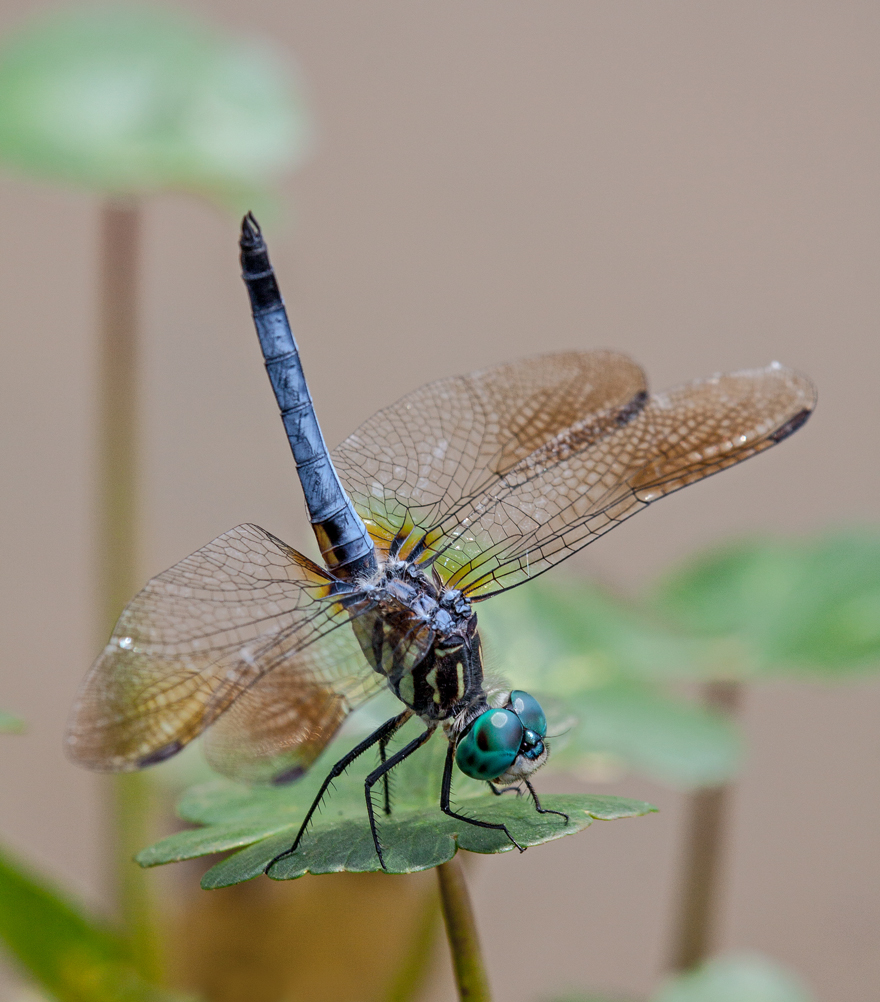
As I noted in an earlier posting today, some of my favorite images are almost minimalist in their approach. This recent image of a male Blue Dasher dragonfly (Pachydiplax longipennis) fits into that category.

Once again, the composition is simple, the color palette is fairly limited, and there is a good amount of negative space. The brown-colored background is the water in one of the areas of my local marshland park.

I like the position of the dragonfly—I think he was trying to cool off on a hot day by raising his abdomen—and the viewer’s eyes are drawn to the dragonfly, because it is the most colorful and the most sharply-focused object in the photo.

This image reminds me a little of a painting in which the artist has arranged the elements to make a pleasing composition. In this case, though, nature did the arranging.

dasher_leaves_blog

© Michael Q. Powell. All rights reserved

Read Full Post »
Some of my favorite images are almost minimalist in their approach, like this shot of a male Common Whitetail dragonfly (Plathemis lydia).

The composition is simple, the color palette is limited, and there is a pretty good amount of negative space. The subject is not unique and unusual—its name even indicates that it is “common.”

I managed to capture some of the details of the dragonfly, though, like the “hairs” on the legs (click on the image to see a higher resolution view), though the image is not super sharp. The shadow of the wings on the green leaf adds an additional touch of visual interest to the image.

The photo is not spectacular and showy, but I find a real beauty in its quiet simplicity.

whitetail_A_blog

© Michael Q. Powell. All rights reserved

Read Full Post »
It had been years (and maybe even decades) since I had last seen a toad and somehow I had forgotten that they have lots of warts and bumps, unlike the smooth-skinned frogs that I am used to seeing.

I encountered this brown toad, which I think is an Eastern American Toad (Anaxyrus americanus americanus), at a garden in Maryland. According to Maryland’s Department of Natural Resources, there are only two types of true toads in the state, so my changes of being correct are pretty good. The other toad is a Fowler’s Toad.

Apparently, you can distinguish between the two types by the number of warts per dark spot on their backs. Maybe you can tell them apart—I wouldn’t even know where to start counting.

toad_blog

© Michael Q. Powell. All rights reserved

Read Full Post »
I am in awe of photographers who can capture amazing shots of birds in flight and I continue my quest to improve my own skills. So many things have to come together to get such shots including the timing, location, lighting, and focusing.

Here is one of my most recent efforts, a shot of a Great Egret (Ardea alba) in flight. The focus is a little soft, but I really like the position of the egret that I managed to capture, with a beautiful sweep of the wings.

flying_egret1_blog

© Michael Q. Powell. All rights reserved

Read Full Post »
One of the many reasons why I love dragonflies is their amazing wings, which are so delicate and yet so powerful, like those of this male Blue Dasher dragonfly (Pachydiplax longipennis). In this shot, I tried to capture some of the intricate detail of the structure of the wings of the dragonfly. They remind me a bit of the leaded glass windows that I sometimes see in old homes, with each small piece of glass outlined in black.

dragonfly_wings_blog

© Michael Q. Powell. All rights reserved

Read Full Post »

Usually it is hard for me to find frogs, because they blend in so well with their surroundings, but that certainly was not the case with this bright green frog. Doesn’t he realize how much he stands out in that environment? I was able to spot him from quite a distance away.

camouflage_blog

© Michael Q. Powell. All rights reserved

Read Full Post »

When I first caught sight of this male Blue Dasher dragonfly (Pachydiplax longipennis) in the air, I thought that he had captured some sort of prey. I was wrong, yet I was also right.

The male dragonfly’s prey was a female dragonfly and they were in a mating position that I later learned is known as the wheel. The sheer flexibility and athleticism involved seems worthy of the Cirque de Soleil. Apparently it starts when the male grabs the female’s head with special claspers at the tip of his abdomen.

I came across a fascinating article by Jennifer Ackerman in National Geographic Magazine entitled Dragonflies Strange Love that provides some amazing insights into the mating habits of dragonflies. One sentence really sums up the process, “Grab, shake, bite, puncture, punch—that’s just the courtship ritual of these dazzling aerobats.”

The male dragonfly seems to be driven by an incredibly strong biological drive. I can almost hear one of them repeating the words of the Tina Turner song, “What’s love got to do with it?”

wheel_blog

© Michael Q. Powell. All rights reserved

Read Full Post »
It was just starting to rain when some fellow photographers and I encountered a very strange-looking caterpillar. I couldn’t believe my eyes and was immediately reminded of the dogs in my neighborhood that sometimes wear colorful raincoats in inclement weather.

It turns out that this is a Saddleback caterpillar (Sibine stimulea), the larva of a type of moth. Once you get past the green “saddle,” it’s hard to miss all of the spines, which happen to be venomous. According to Wikepedia, stings by this caterpillar can cause swelling, nausea, and leave a rash that can last for days. Yikes! If I had known that in advance, I might not have leaned in to get a close-up shot of the head, though fortunately my 180mm macro lens allowed me to stay at a safe distance.

I can safely say that this is the most bizarre caterpillar I have ever seen. It’s hard to imagine that I can possibly encounter anything stranger than this, but my local marsh continues to surprise and amaze me.

saddleback_catterpillar1_blogsaddleback_caterpillar2_blog

© Michael Q. Powell. All rights reserved

Read Full Post »

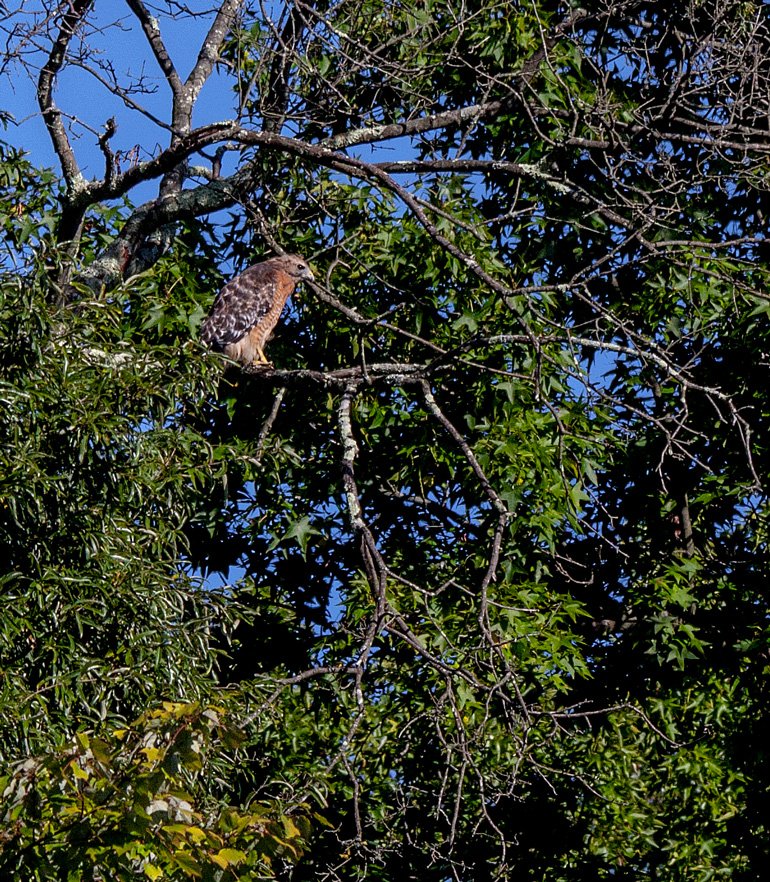
The water has gone down in some parts of my local marsh and I encountered this Green Heron (Butorides virescens) in a little tree that overlooked one of the dried out areas.

I am not sure if the heron was hunting or resting, although it looked more like the former than the latter, because he seemed to be looking from side to side. Perhaps he was searching for frogs or some other terrestrial prey.

I did not have my longest telephoto lens on my camera, but I was happy that to get some several decent shot of the little heron in a number of different poses.

limb1_bloglimb3_bloglimb2_blog

© Michael Q. Powell. All rights reserved

Read Full Post »

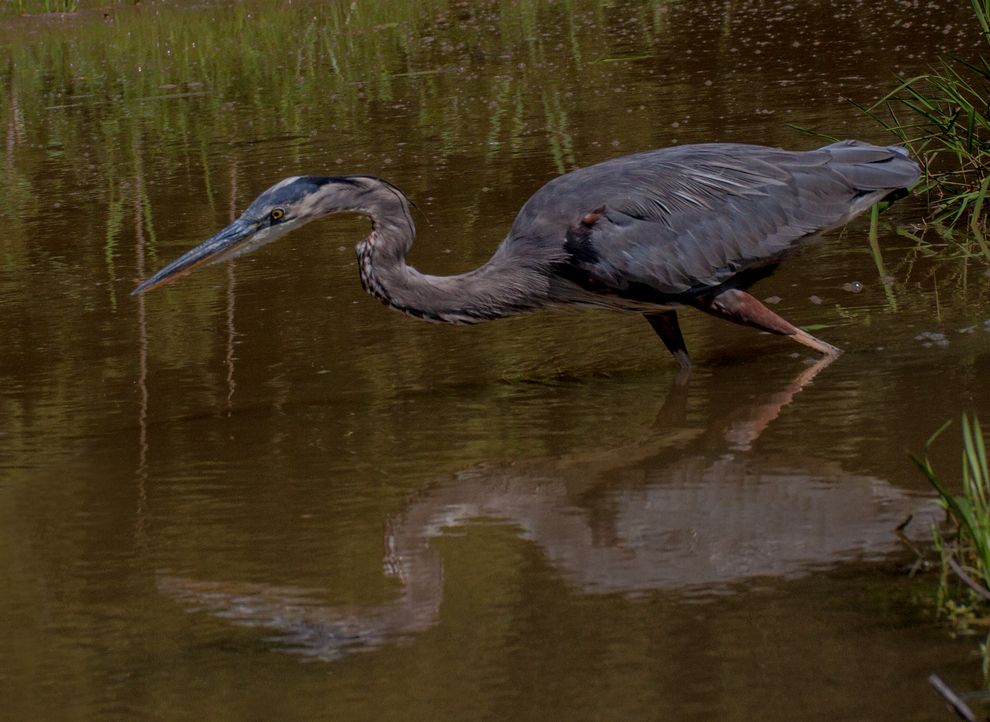
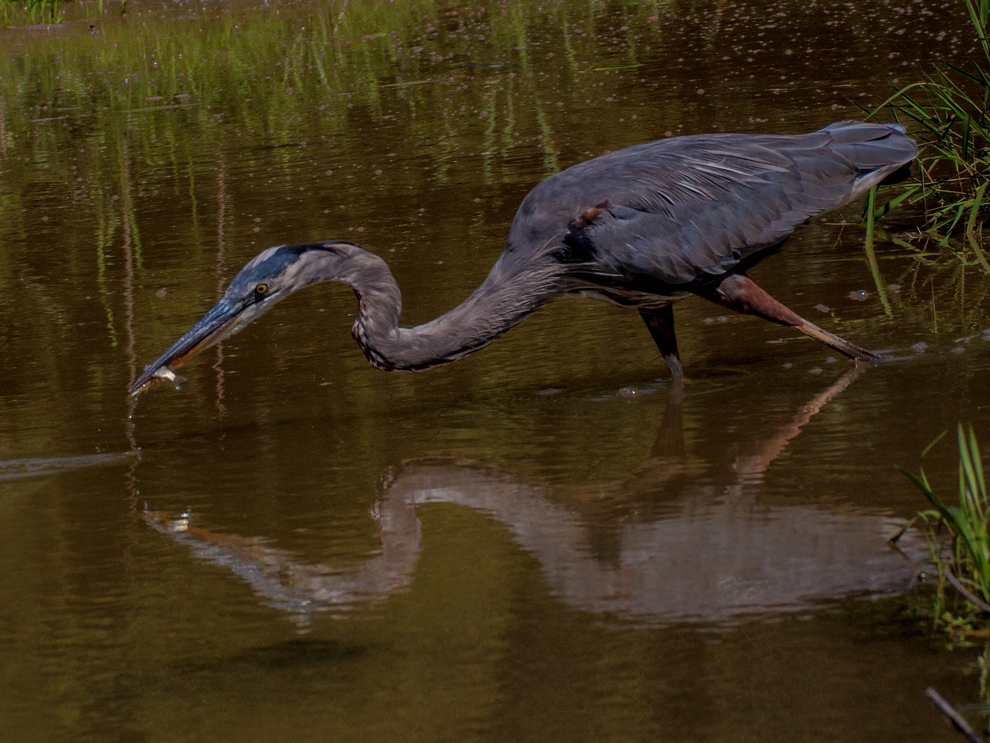
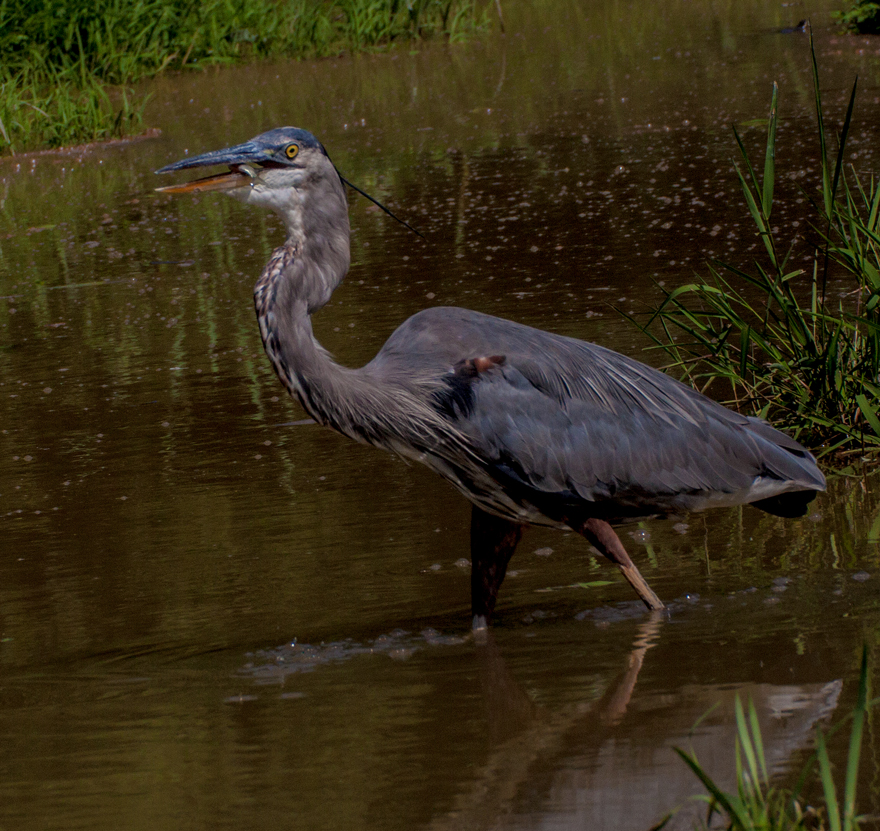
I had zoomed all the way in on this Great Blue Heron (Ardea herodias), when suddenly he took a big stride, a stride that almost took him out of the frame.

Something must have caught his attention, because he started moving quickly after having been still for quite some time. Normally when a blue heron moves, he is striking, reaching down to pull (or spear) some hapless prey out of the water. His lateral movement caught me a little by surprise.

One of the challenges of taking photos of wildlife is to be ready for the unexpected. I’m learning that the more I study subjects like this blue heron, the more I can anticipate some of their action. It’s a whole lot easier to be ready for the expected than for the unexpected.

stride_blog

© Michael Q. Powell. All rights reserved

Read Full Post »

I don’t usually think of photographing birds with a macro lens, but that’s exactly what I did when I encountered this Barn Swallow (Hirundo rustica) perched on a small branch, with a beautiful blue sky in the background.

Of course, I probably should note that the macro lens in question is 180mm in focal length, so it has good telephoto capability—I had just never tried to use it in that way. My experience photographing birds this past winter suggests that this lens does not have enough reach for most birds.  I was really happy, though, with the detail it was able to capture in this situation, when I was standing almost directly below the bird.

Mentally it was an adjustment to be shooting with a prime lens and I had to keep reminding myself that if I wanted to adjust the composition, I had to change my position and move closer or farther away. That’s probably a good thing to remember when I am using a zoom lens, which has a tendency to make me a little lazy.

swallow2_blogswallow1_blog

© Michael Q. Powell. All rights reserved

Read Full Post »

It has been a while since I featured a mammal in my blog, so I thought that I would post a photo of this little muskrat (Ondatra zibethicus) that I encountered this past weekend at my local marsh. I observes muskrats there fairly often, but most of the time they are swimming away or are submerging themselves by the time my camera is ready.

This muskrat was poking about at the edge of a formerly inhabited beaver lodge when I first caught sight of him. He did not immediately perceive my presence, so I was able to creep close enough to him to get this shot using my 55-250mm zoom lens.

Unlike the beavers, which sleep during daylight hours, muskrats are active when it its light—in theory it should be easy to get a good shot of a muskrat. The reality, though, is that muskrats are small, fast, and elusive, so I have not yet been able to get many good shots of them.

muskrat1_blog

© Michael Q. Powell. All rights reserved

Read Full Post »

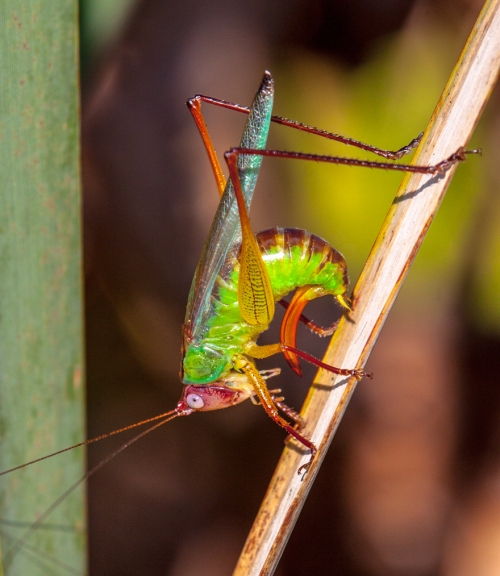
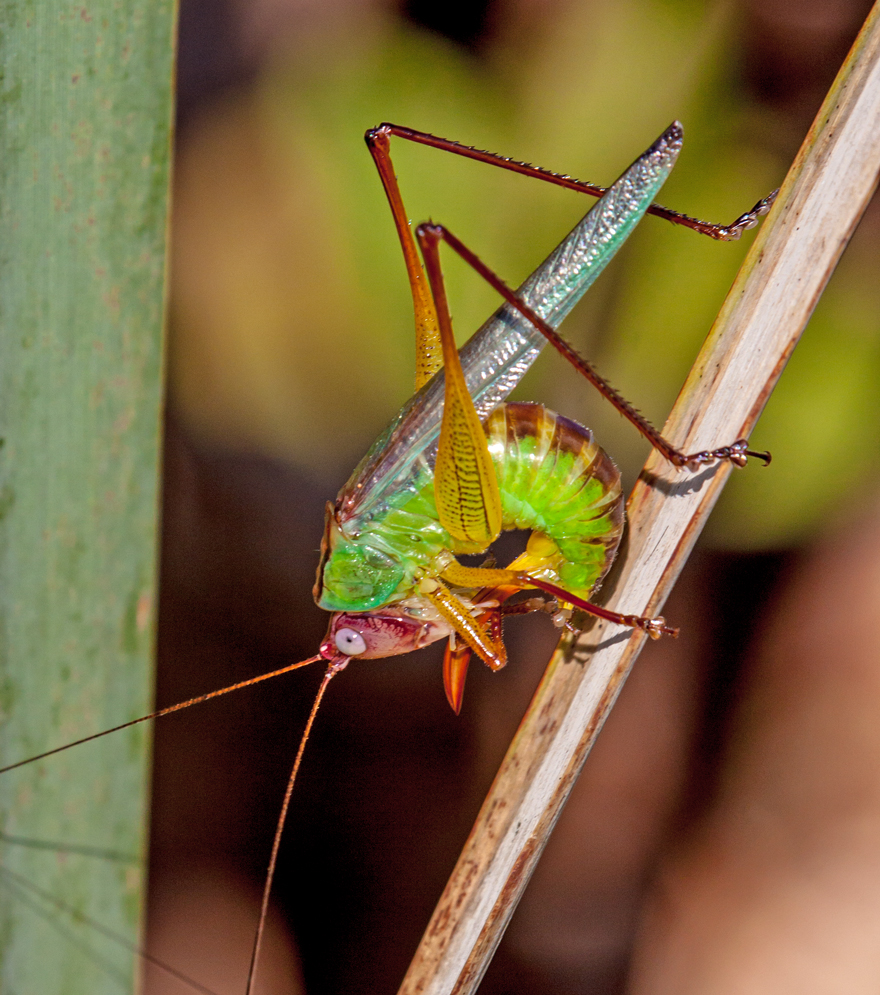
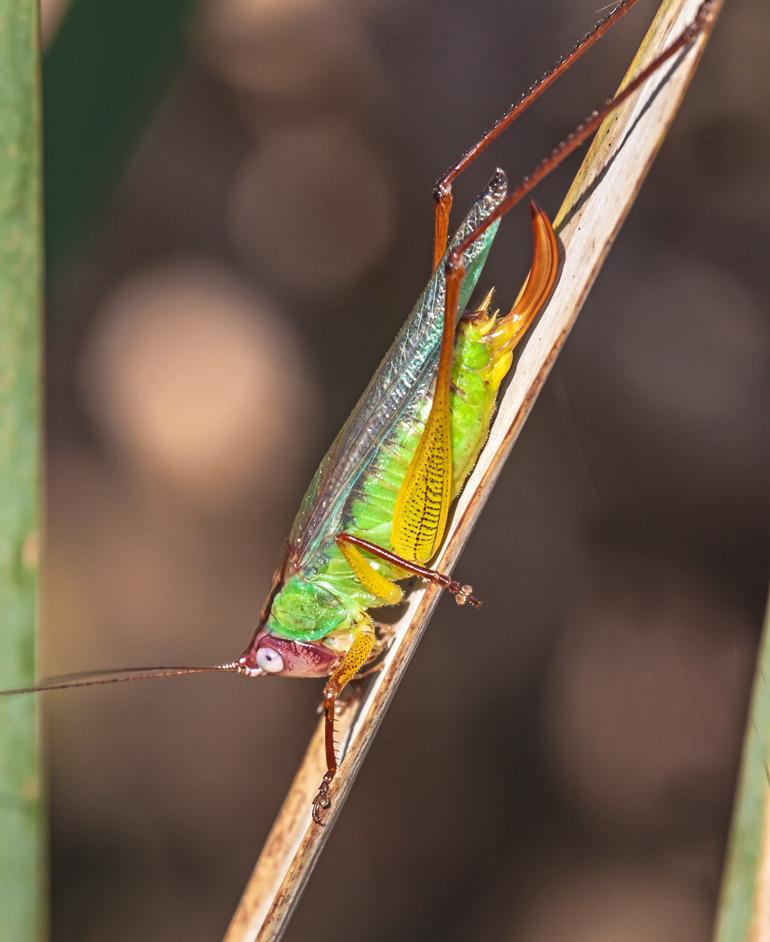
Let me introduce you to the coolest-looking insect I have ever encountered, the Handsome Meadow Katydid (Orchelimum pulchellum), an insect that I photographed this past weekend at my local marsh. The name just seems to fit the insect perfectly, unlike so many other insects that seem to have been named almost randomly.

I still recall the first time that I encountered a Handsome Meadow Katydid last summer and the resulting double take—I could not believe what my eyes were seeing. The bright colors of the body were astonishing and seemed so unreal that one of my friends wondered if I had colorized the photo.

It’s the eyes, though, that make this insect so attractive for me. There is just something so alluring about those blue eyes, eyes that I don’t expect to see in an insect.

I got some pretty good shots of Handsome Meadow Katydids last year, but was growing concerned that I would not see many this year (you can tell it’s a katydid, in part, because of the length of the antennae). I actually heard this katydid before I saw it. I was passing by a small bush and hear a kind of vibrating sound. I put my ear closer and closer to the plant and finally spotted the source.

I had to go pretty wide in cropping the shot, because the katydid was stretched out along the small branch. Click on the image if you want see a higher resolution view of the photo, including those amazing eyes.

rainbow1_blog

© Michael Q. Powell. All rights reserved

Read Full Post »

Yesterday I was happy to get some shots of my favorite dragonfly, the Halloween Pennant dragonfly (Celithemis eponina), at Meadowlark Botanical Gardens in Vienna, Virginia.

I don’t see this dragonfly at all at most of the usual places where I take photographs, so I was really excited when I caught sight of a couple of them yesterday. I chased them around for well over an hour and attempted to take a couple of hundred shots using a wide range of camera settings.

Why did I take so many photos? The dragonfly gets the “pennant”  part of its name because it likes to perch on the very tip of a weed stalk and waves in the breeze like a pennant. Yesterday, in fact, was breezy and it was quite an adventure trying to keep the dragonfly in focus, particularly because I was trying to fill the frame with the dragonfly.

The dragonflies that I photographed were reasonably cooperative and I was able to attempt shots from the side, from above, and even from below (fortunately the insects in the grass did not bite very often).

I have not been able to go through the shot to pick the best ones, but thought it would be nice to post one now, especially for those readers who may not be familiar with this beautiful dragonfly. I suspect that I will eventually post at least a couple more images in future postings.

Halloween1_blog

© Michael Q. Powell. All rights reserved

Read Full Post »

I haven’t seen many grasshoppers this summer, so I was happy to get a few shots of this one before he hopped off the leafy stalk for a new destination. I especially like the details of the eyes and the mouth.

Grasshoppers are special to me, in part because “grasshopper” is the term that my photograph mentor, Cindy Dyer, uses for me, her student. Some of you may be old enough to remember the television series Kung Fu from the 1970’s, in which Master Po, the blind monk, called his young pupil “grasshopper.”

I often wondered why he used that particular word and today I came across an explanation in Wikipedia. Apparently it stemmed from an exchange between the Master Po and the student, Caine, in the pilot episode of the series.  There is a lot of wisdom in that final response.

Master Po: Close your eyes. What do you hear?
Young Caine: I hear the water, I hear the birds.
Po: Do you hear your own heartbeat?
Caine: No.
Po: Do you hear the grasshopper which is at your feet?
Caine: Old man, how is it that you hear these things?
Po: Young man, how is it that you do not?

grasshopper1_blog

© Michael Q. Powell. All rights reserved

Read Full Post »

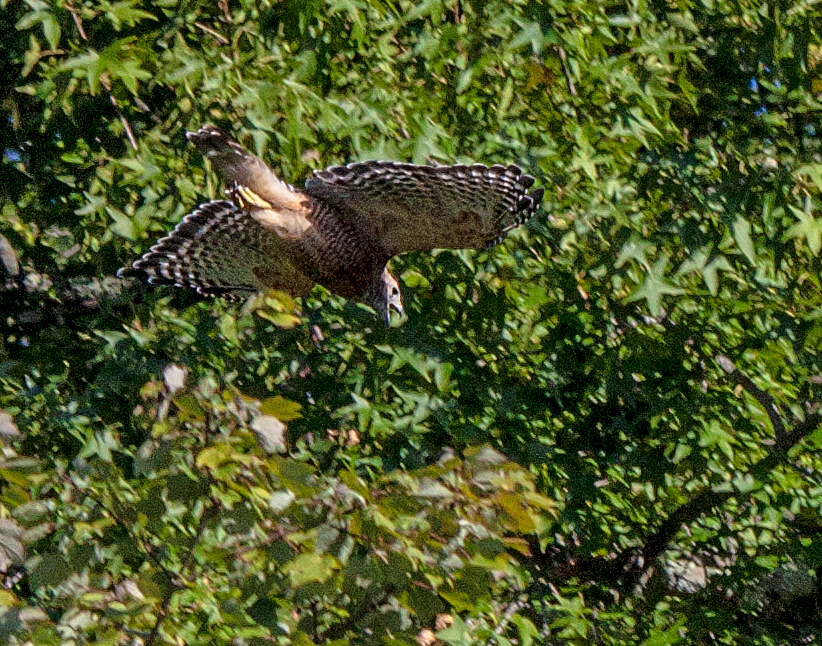
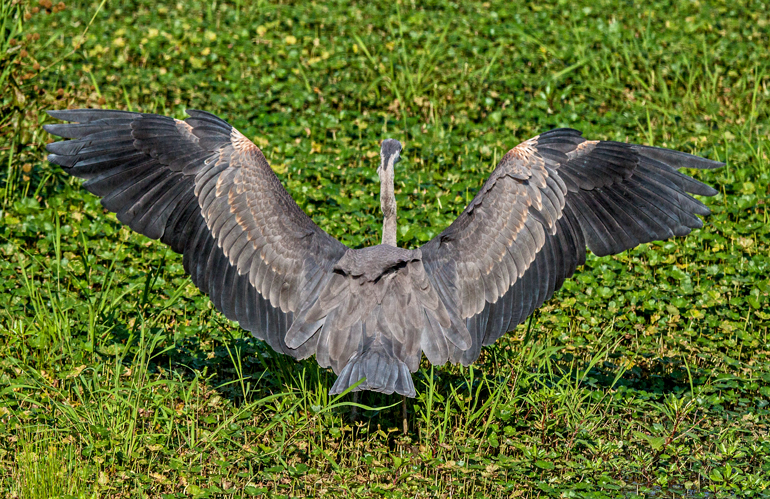
I have always thought that Great Blue Herons (Ardea herodias) look a bit awkward on the ground, tall and gangly, but they are exceptionally beautiful in the air.

As I approached this blue heron yesterday at my local marshland park, it decided to take off. I often try to capture photos of birds in flight, though generally I’ve had only limited success.

I was pretty happy with this shot, taken shortly after the heron had taken to the air. The shaded woods make a decent backdrop and I like the blooming mallow flowers in the foreground. The focusing is a little soft, but I was able to capture some of the magnificent details of the visible wing.

heron_flying_blog

© Michael Q. Powell. All rights reserved

Read Full Post »

Can you spot the heron in this photo?

I think that you probably can pick out the Green Heron (Butorides virescens), which blends in pretty well with the vegetation, a little easier than I was able to do, when I visited my local marshland yesterday. The heron, which I think might be a young one, was foraging about in the marsh plants, unlike other Green Herons that I have seen in the past, which tended to stand near the edge of the water awaiting prey. If the heron had not moved, I might not have seen him, because it was so close to the ground.

I really like the colors of the Green Heron and its distinctive yellow eyes. The Green Heron may not be as big in size as a Great Blue Heron, but it has its own beauty—maybe I should begin a campaign to change its name to Great Green Heron.

heron_grass1_blog

© Michael Q. Powell. All rights reserved

Read Full Post »

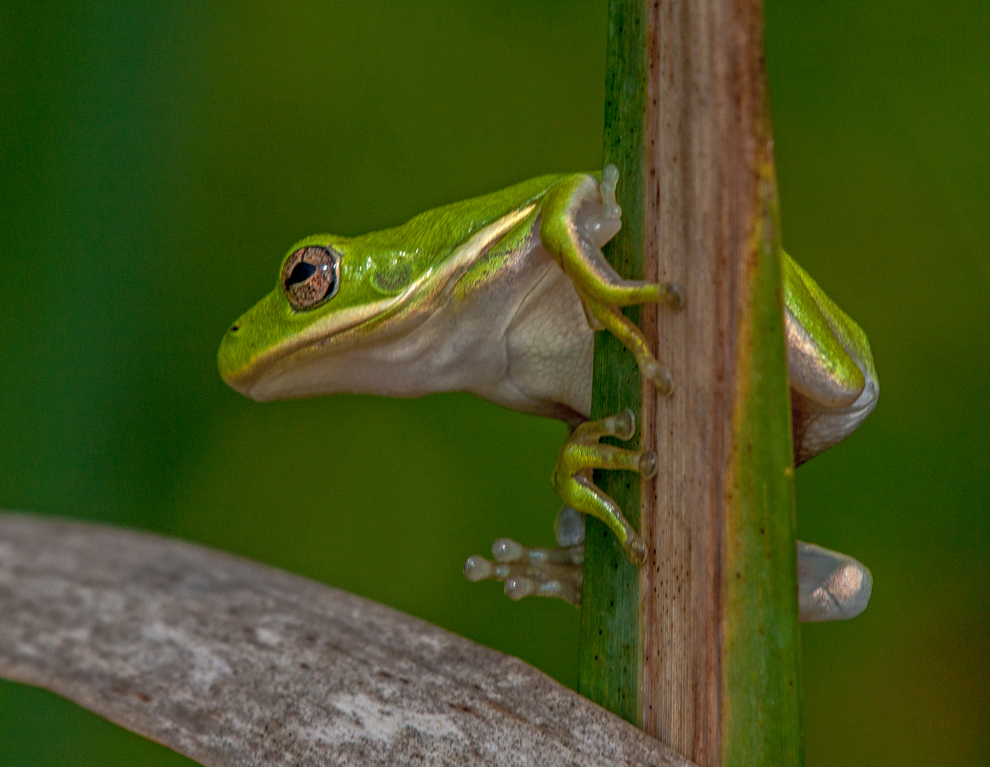
I spotted this little Green Treefrog (Hyla cinerea) in the cattails in the marsh at my local marshland park this past weekend and was pretty excited, because I had never before seen an adult tree frog up close.

I was amazed by its long toes with sticky pads, but it was the golden eyes that won my heart. I observed it for quite some time and managed to get some shots of it in different poses as it changed its position on the green leaves of the cattail.

Normally I think of tree frogs, I think of the ones with big red eyes that have been featured in National Geographic and other publications. It would be really cool some day to be able to photograph those tree frogs—for now I am content to explore the wildlife in my local area.

little_green_frog1_bloglittle_green_frog3_bloglittle_green_frog2_bloglittle_green_frog4_blog

© Michael Q. Powell. All rights reserved

Read Full Post »

Although I tend to use either my macro or my shorter telephoto zoom lens most at this time of the year, yesterday I decided to walk around with my longest zoom (135-400mm) and was happy about that decision when I encountered this juvenile Hooded Merganser duck (Lophodytes cucullatus).

When I first saw it, the duck was sitting on a semi-submerged log  in the beaver pond of my local marshland pond, basking in the sun. I expected for the duck to be part of a group, but it appeared to be alone.

Merganser1_blog

I guess that I got a little too close, because the juvenile duck then slipped quietly off the log into the brown, muddy water of the pond and swam away a short distance. I like the concentric ripples in this shot of the duck slowly paddling away.

Merganser2_blog

I backed off and continued to observe the young duck, which decided to take advantage of being in the water to do a little grooming. After submerging itself, the duck rose up out of the water to dry off. The duck flapped its wings and I clicked my shutter and got this shot.

Merganser3_blog

There is a kind of playful feel to this shot that I really like. Somehow the duck reminds me of a friendly little dragon in this shot, with its feathers looking almost like scales and its wings and tail in an unusual position. I almost expected it to breathe a tiny burst of fire.

Maybe I should name the little duck “Puff.”

© Michael Q. Powell. All rights reserved

Read Full Post »

To conclude my mini-series on the three local beavers who were temporarily flooded out of their lodge, I am posting an extreme close-up of one of them sleeping and a shot in which I zoomed out enough to show the entire body of a sleeping beaver.

This first shot is probably my favorite of the entire series. The beaver, of course, is really cute, but the slightly open mouth gives it an extra little whimsical touch of personality.

The second shot shows one of the beavers sound asleep, curled up in a ball, leaning against a stump. At the moment of the shot, the beavers were not snuggling as much as they would do a bit later (as in the first photo). I like the way in which you can see the beaver’s feet and tail in this image.

If you missed the earlier postings on my amazing close-up encounter with the three sleeping North American Beavers (Castor canadensis), check out my earlier postings—Snuggling beaver and Restive beaver. If you want to see a higher resolution view of the images (the first one has lots of fine details), click on the photos.

beaver5_blogbeaver3_blog

© Michael Q. Powell. All rights reserved

Read Full Post »

Have you ever watched an animal sleep? I used to watch my dog sleep. He slept soundly, but sometimes a sound or a smell or a dream would wake him up. He would look around a little to reassure himself that all was well and then would put down his head and go back to sleep.

Yesterday, I did a posting on a trio of North American beavers (Castor canadensis) that had been temporarily flooded out of their lodge and were sleeping on dry land a short distance from their home. The general response to the photo in that posting was that the beaver seemed peaceful and content (and cute!) when sleeping.

Today, I am posting a few photos of the occasions when one of the beavers woke up and looked around, much like my dog used to do.  This is actually not the same beaver that was featured yesterday, although part of this beaver was visible in the photo yesterday. This beaver was the one on which the other beaver was leaning as it snuggled.

The first photo shows a pretty alert beaver, leaning on a stump around which the beavers were sleeping. I like the details that you can see of the fur and of the front paw. I was on a boardwalk at my local marshland park when I took these photos and was looking slightly down at the beavers. I was so close that I did not even have to use the full length of my zoom lens and, for example, shot the first photo with my lens at a focal length of 135mm.

beaver1_blog

The second shot is somewhat similar to the first, but it shows part of the beaver’s tail. It was interesting to see how the beaver’s tail was tucked under the beaver when it was sleeping. I somehow had always assumed the tail was rigid—it seems to be reasonably flexible.

beaver2_blog

The final image today is not quite as sharp as the first two, but I like it because of the way that it shows both a front and back paw, as well as the tail. The beaver also has a tousled look and somehow unfocused eyes, looking a lot like most of us do when we first wake up.

beaver4_blog

I am still going over my photos and may post a few more, so stay tuned. I feel really lucky that I was able to see these beavers in this kind of situation in the wild and managed to capture it well enough in photos to be able to share part of the experience with all of you.

© Michael Q. Powell. All rights reserved

Read Full Post »

Last Friday, after some violent thunderstorms, I visited my local marshland park, where the staff alerted me that three beavers were sleeping on a patch of dry land near their lodge, which apparently had flooded. The three North American Beavers (Castor canadensis) were all snuggled together and reminded me a little of puppies. I am working up some more images, but thought that I would give a sneak preview of coming attractions.

beaver6_blog

© Michael Q. Powell. All rights reserved

Read Full Post »

« Newer Posts - Older Posts »