Feeds:
Posts
Comments

Archive for the ‘Portraits’ Category

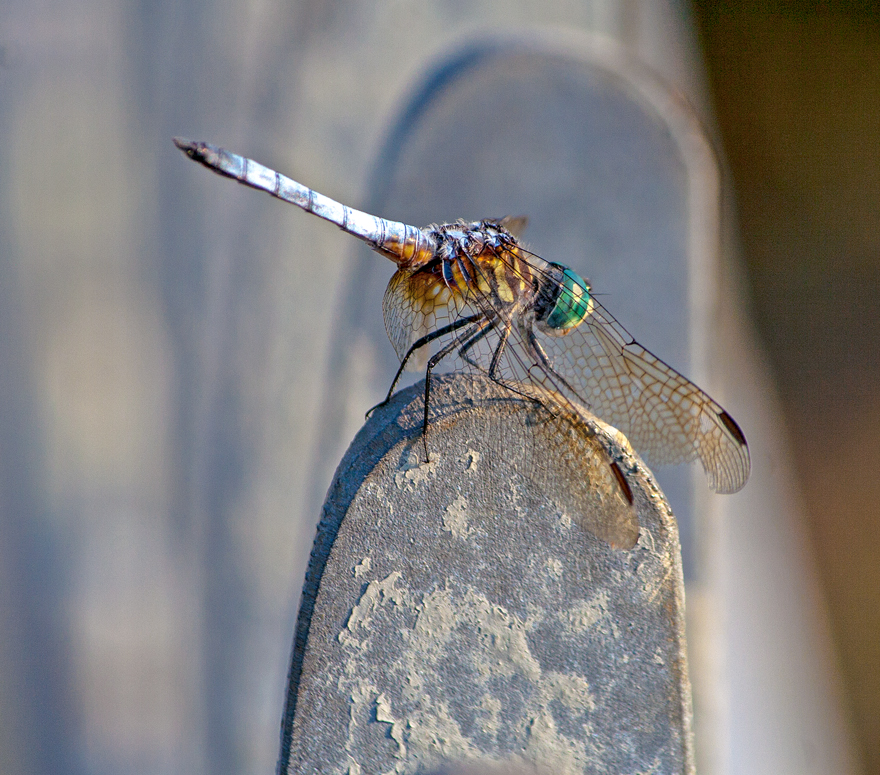
What do you do when the wildlife subject that you are attempting to photograph puts itself in a man-made setting, rather than a more natural environment? That was my dilemma when a Blue Dasher dragonfly (Pachydiplax longipennis) landed on one of the slats of a railing surrounding part of the boardwalk at Huntley Meadows Park, the local marshland where I take a lot of my photographs.

As I looked down the railing at the dragonfly, my eye was attracted to the repeating pattern of the slats, and I decided to try a creative approach to an image using that pattern. I chose camera settings that would give me a relatively shallow depth of field. Then I carefully composed the shot so that some other slats would appear in the background in a blurry form, but the one on which the dragonfly perched would be in sharp focus.

Although I generally prefer a more natural setting for my wildlife subjects, I think I managed to achieve a pretty cool effect that was relatively close to what I had in mind. I especially like the detail that I was able to capture of the weathered metal slat in the foreground (click on the photo to see a higher resolution view).
railing_blog

© Michael Q. Powell. All rights reserved

Read Full Post »

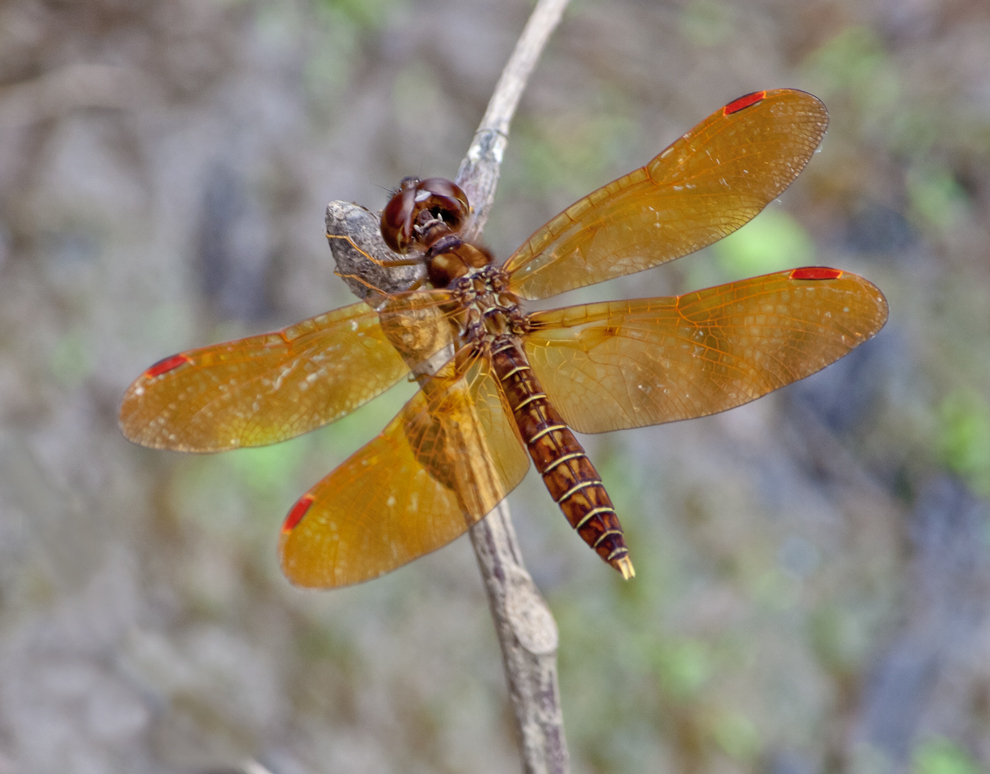
Only a tiny, lightweight dragonfly, like this Eastern Amberwing (Perithemis tenera), could assume this pose and hold it for an extended period of time. I have watched other dragonflies land near the end of a leaf like this, but gravity forced them to quickly give up their perch.

I was able to take a lot of photos of this dragonfly and this is one of my favorites, because its abdomen is raised, its wings are spread, and its head is cocked a little to the side—a near perfect pose.

amber_grass_blog

© Michael Q. Powell. All rights reserved

Read Full Post »

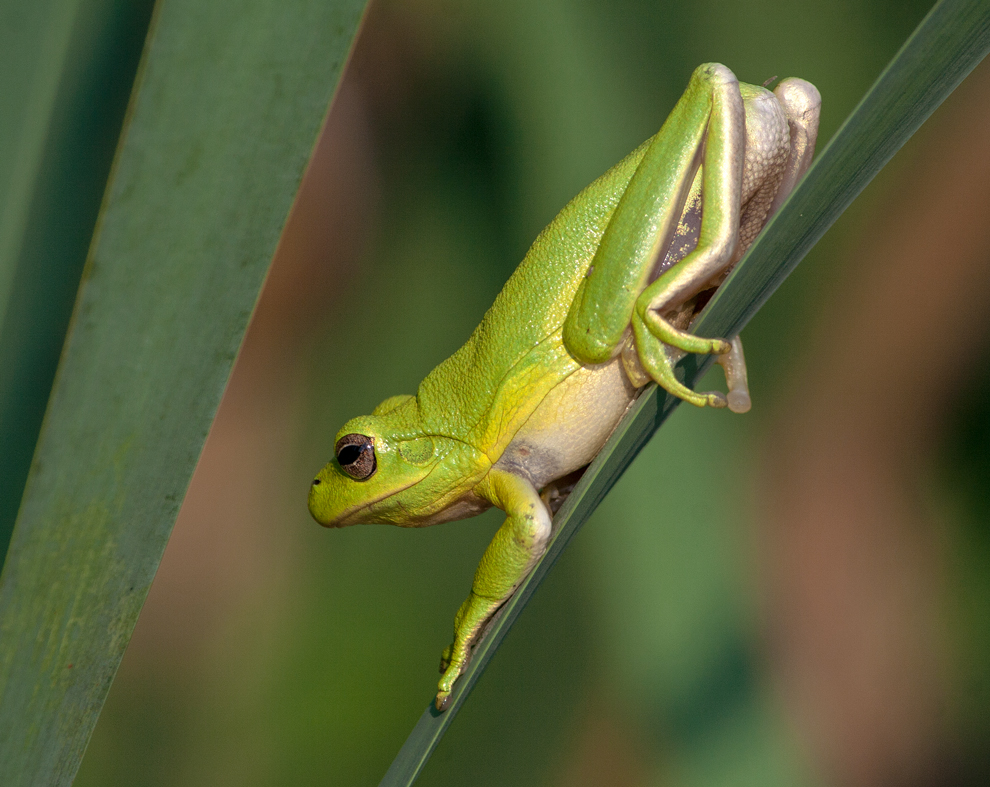
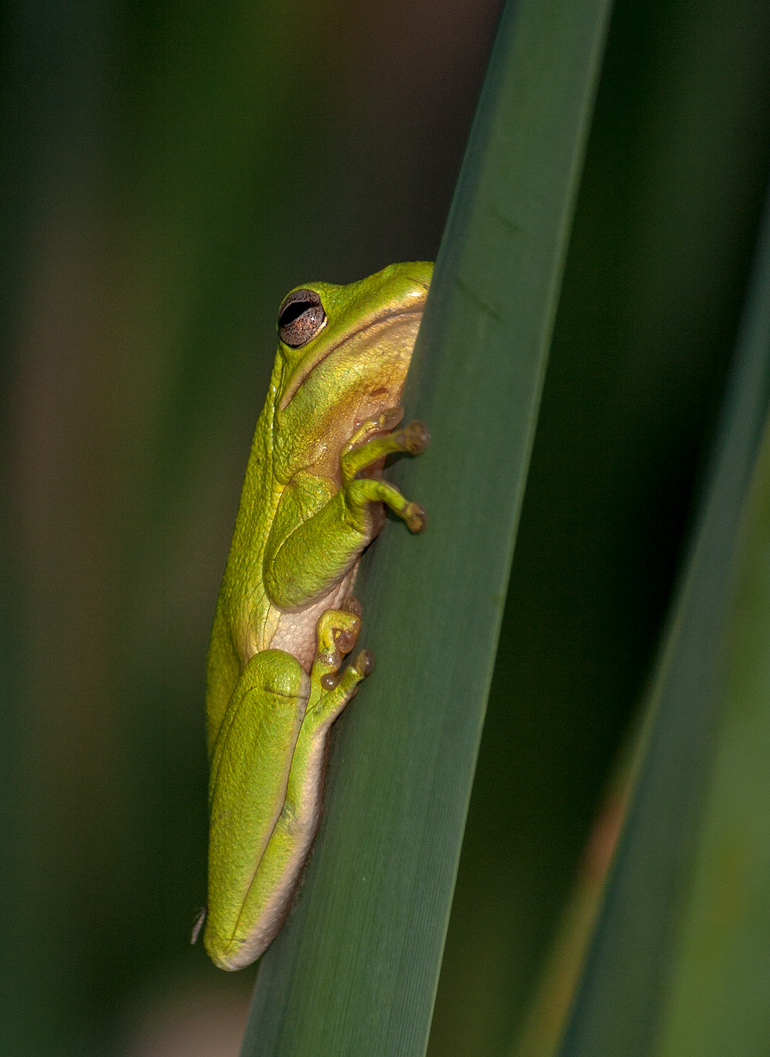
I spotted this little Green Treefrog (Hyla cinerea) in the cattails in the marsh at my local marshland park this past weekend and was pretty excited, because I had never before seen an adult tree frog up close.

I was amazed by its long toes with sticky pads, but it was the golden eyes that won my heart. I observed it for quite some time and managed to get some shots of it in different poses as it changed its position on the green leaves of the cattail.

Normally I think of tree frogs, I think of the ones with big red eyes that have been featured in National Geographic and other publications. It would be really cool some day to be able to photograph those tree frogs—for now I am content to explore the wildlife in my local area.

little_green_frog1_bloglittle_green_frog3_bloglittle_green_frog2_bloglittle_green_frog4_blog

© Michael Q. Powell. All rights reserved

Read Full Post »

Although I tend to use either my macro or my shorter telephoto zoom lens most at this time of the year, yesterday I decided to walk around with my longest zoom (135-400mm) and was happy about that decision when I encountered this juvenile Hooded Merganser duck (Lophodytes cucullatus).

When I first saw it, the duck was sitting on a semi-submerged log  in the beaver pond of my local marshland pond, basking in the sun. I expected for the duck to be part of a group, but it appeared to be alone.

Merganser1_blog

I guess that I got a little too close, because the juvenile duck then slipped quietly off the log into the brown, muddy water of the pond and swam away a short distance. I like the concentric ripples in this shot of the duck slowly paddling away.

Merganser2_blog

I backed off and continued to observe the young duck, which decided to take advantage of being in the water to do a little grooming. After submerging itself, the duck rose up out of the water to dry off. The duck flapped its wings and I clicked my shutter and got this shot.

Merganser3_blog

There is a kind of playful feel to this shot that I really like. Somehow the duck reminds me of a friendly little dragon in this shot, with its feathers looking almost like scales and its wings and tail in an unusual position. I almost expected it to breathe a tiny burst of fire.

Maybe I should name the little duck “Puff.”

© Michael Q. Powell. All rights reserved
Read Full Post »

Earlier this week I posted some images of the Eastern Amberwing dragonfly (Perithemis tenera) in flight, but you can see the details of this tiny dragonfly better in this shot of one perched on a branch. It’s always a treat for me to get shots of these beautiful little dragonflies, because they are so small (less than one inch (25mm) and very active.

amberwing_branch© Michael Q. Powell. All rights reserved
Read Full Post »

It’s tough enough to try to photograph any dragonfly in flight, but this past weekend I chased after some of the smallest ones, the Eastern Amberwing dragonflies (Perithemis tenera).

According to Bugguide, these dragonflies are typically 21-24mm in length, which is less than one inch. There were lots of Eastern Amberwings buzzing around the edges of a small pond at one of the local gardens that I like to visit. They were within range of the 100mm macro lens that I was using, but focusing was my big problem. Even though they tended to hover a bit, it was tough to get them in focus when focusing manually and impossible to do so with auto-focus.

The amber wings of this dragonfly are distinctive and I was happy to get some images that showcase the wings. The shots are not quite as sharp as they might have been if I had captured the dragonflies perched, but they seemed to be in constant motion and never posed for me. Focusing manually is still an adventure for me when the subject is moving, but it is a fun challenge.

amber1_blog

amber2_blog

© Michael Q. Powell. All rights reserved

Read Full Post »

Continuing my quixotic quest to photograph dragonflies in flight, I went boldly out into the wild, armed with my trusty 100mm macro lens, and managed to capture this cool image of a dragonfly as it hovered over the water.

In previous attempts, I used longer telephoto zoom lenses, which increased the number of potential subjects but gave only mixed results. Using a shorter, fixed focal-length lens, I had to change my strategy a little and try to get closer to the subject.

I noticed this dragonfly hovering about the water to the side of the boardwalk on which I was walking. I crept as close as I could and tried to shoot as close to straight down as I could (the boardwalk was at least a foot (30 cm) above the level of the water and it looked like the dragonfly was hovering almost level with the boards of the boardwalk). I was really sensitive to my shadow, because I have learned that nothing scares away an insect faster than casting a shadow on it.

I used autofocus and was a little surprised to see that my dragonfly is in pretty clear focus, although the shutter speed was not fast enough to stop the action of  the wings. I shot this handheld and really tried to pay attention to my technique, because my macro lens does not have any built-in image stabilization. As I thought about it afterwards, I realized that the auto focusing on the macro lens (using what Canon calls an ultrasonic motor) is much faster and better than the focusing on my Canon 55-250 or my Sigma 135-400mm zoom lens.

I have been having some difficulties identifying this dragonfly. The coloration of the tail looks a little like a female Blue Dasher, but the beautiful blue eyes do not seem right for the female. The tip of the tail should be a help, but I can’t seem to find one that matches it.

Although I can’t identify the dragonfly, it’s my best shot to date of a dragonfly in flight and I’m pretty content with it today, though my quixotic quest is likely to continue this weekend.

hover1_blog

Michael Q. Powell. All rights reserved

Read Full Post »

Generally when I encounter Great Blue Herons (Ardea herodias), they are very focused. They seem willing to stand in one place for a long period of time, staring intently at the water, waiting for the optimal moment to strike.

In contrast, this heron seemed to be almost daydreaming as he gazed off into the distance. Had something caught his attention there? Was he merely taking a break? Was he thinking about something else, or imagining he was somewhere else?

I’ll never know the answer to those question, but I can be happy that he was willing to stay in one place long enough for me to get this shot.

pensive_heron_blog

Michael Q. Powell. All rights reserved

Read Full Post »

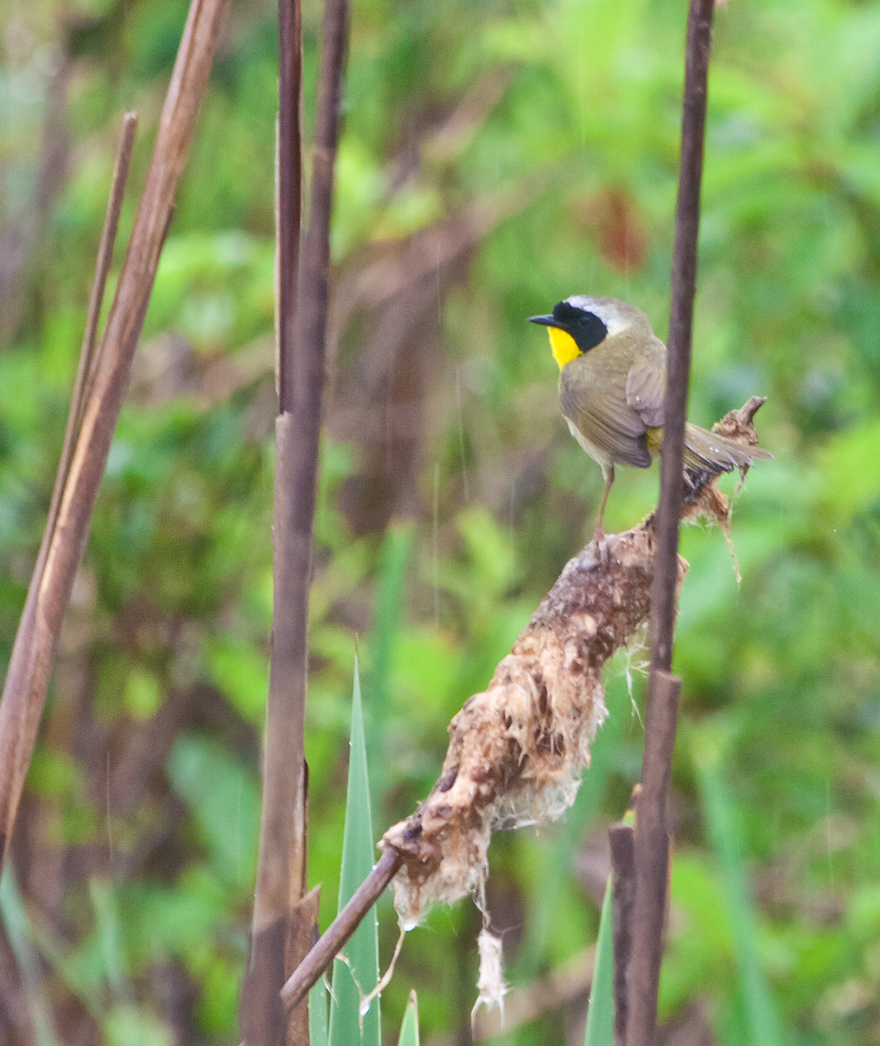
Normally I see (or hear) CommonYellowthroat warblers (Geothlypis trichas) in the upper reaches of trees, generally obscured by leaves.

I was really happy when I spotted this male yellowthroat perched on cattails, in an area in which I normally see only red-winged blackbirds. As a result, I was able to get a relatively unobstructed shot of this beautiful little bird.

yellowthroat_cattail_blog

Michael Q. Powell. All rights reserved
Read Full Post »

As I was searching for dragonflies and butterflies in the vegetation overlooking a small pond this past weekend, I spotted this little patch of yellow on the leaf of a small tree, which turned out to be a tiny tree frog.

The frog appears to still be in a developmental stage, with indistinct feature and a substantial amount of the tail that it had as a tadpole. The frog was yellowish in color and it is a little tough for me to figure out what kind of a frog it is.

I should note that this it the first tree frog that I have ever seen and I was amazed at how small it was. It is not much bigger than some of the insects that I have been photographing, but it is definitely a whole lot cuter.

little_frog1_bloglittle_frog2_blog

Michael Q. Powell. All rights reserved

Read Full Post »

Thanks to Tropical Storm Andrea, it rained all day this past Friday, and this juvenile Tree Swallow (Tachycineta bicolor) was wet and hungry and decided to express its unhappiness in a very vocal way.  Shooting from under an umbrella, I was able to capture this moment of pique.

Swallows eat flying insects and I have to believe that the rainy weather made foraging tough for them. Fortunately, the continuous rain last for only a single day and this little bird probably was able to survive its day of reduced rations.

wetbird1_blog

Michael Q. Powell. All rights reserved

Read Full Post »

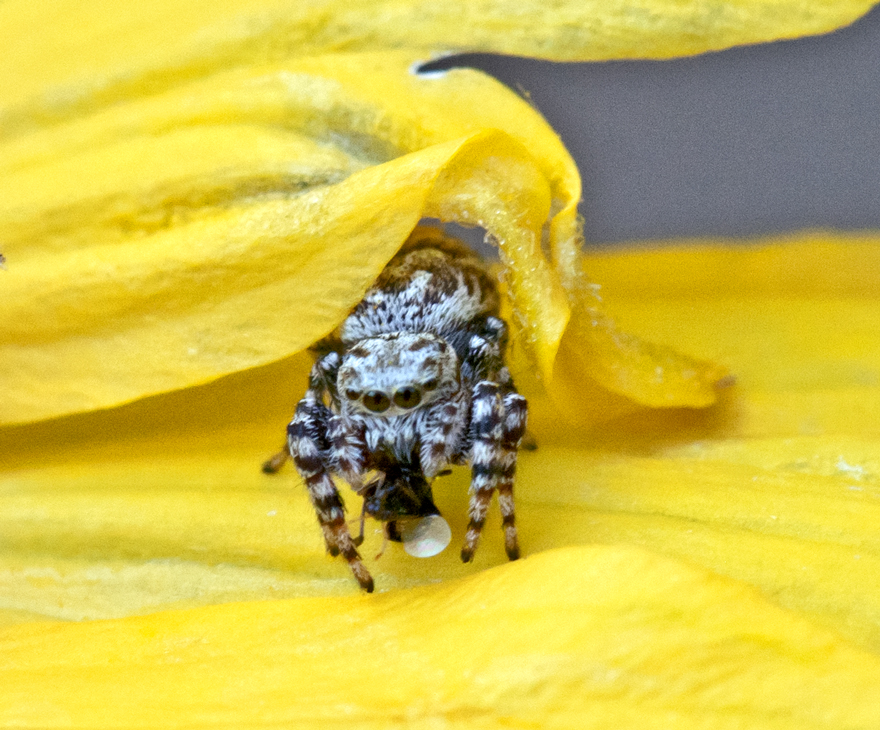
As I was checking out the flowers in my neighbors’ garden yesterday afternoon, I came across this little spider, sitting on top of a flower. There was no web anywhere in the vicinity, so I suspected that I might have a jumping spider.

Last month, I encountered a tiny, fuzzy spider that turned out to me a jumping spider, so I am a little more attuned to looking for them now. This one is definitely not the same kind, though, with completely different colors and markings. You can compare the two by checking out the photos in my previous posting.you

When I first saw the spider, it had just captured some kind of insect as you can see in the second photo. It then moved under the shade of a petal of the flower to enjoy its freshly caught dinner. I showed this moment in the first and third shots. The first one was taken a little closer and shows a lot of detail, but I really like the context that the third one provides and it is probably my favorite one. The final shot gives you an overall view of the spider.

I love the color and pattern of the spider and was happy that I was able to capture some of the details. The spider was not very big and I had trouble placing my tripod on the uneven ground to get a sharp shot. I am really happy with the results, however, and will definitely keep looking for these spiders with eyes that I find to be simply irresistible.

jumping3_blog

jumping2_blogjumping1_blogjumping4_blog

Michael Q. Powell. All rights reserved

Read Full Post »

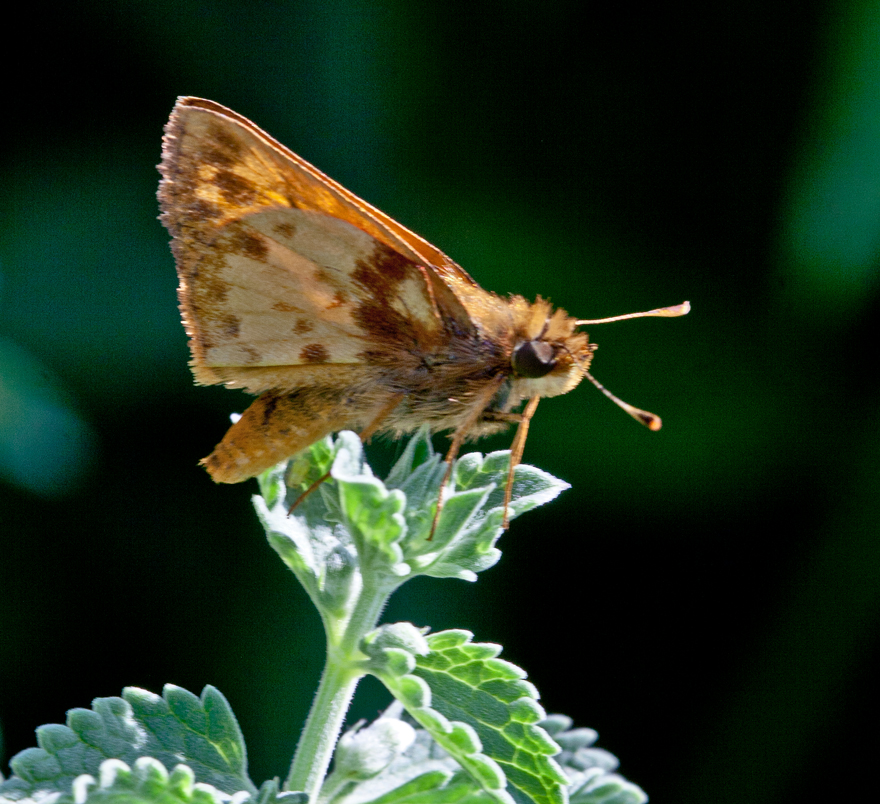
I have trouble identifying a lot of my photographic subjects, but skipper butterflies are among the toughest. Wikipedia says that are more than 3500 recognized species of skippers worldwide, so I don’t feel too bad about my difficulties.

As I perused photos on the internet, I came across a few shot of butterflies that looked at lot like the one that I photographed, and on that basis I am going to tentatively identify it as a Fiery Skipper (Hylephila phyleus).

I like the way in which the skipper was lit and he stayed perched long enough to permit to use my macro lens.

skipper_blog

Michael Q. Powell. All rights reserved

Read Full Post »

What happened to this swallow to cause it to be so drab looking? That was my first thought when I looked at these images.

The bird was perched at a location where I had previously seen a lot of Barn Swallows (Hirundo rustica), but it looked more like a Tree Swallow (Tachycineta bicolor). However, all of the Tree Swallows that I have seen before have been a shiny bluish-green in color. Was this a different kind of sparrow?

It turns out that the answer to my mini-mystery is quite simple—juvenile Tree Sparrows are not the same color as the adults. I guess that I had been assuming that the young Tree Sparrows would be miniature versions of their parents.

The little swallow seemed quite content to pose for me and allowed me to get profile shots and head-on shots without any instructions. Perhaps a modeling career is in its future.

swallow1_blogswallow2_blog

Michael Q. Powell. All rights reserved
Read Full Post »

When I was a boy, I had hair that would stand up in a cowlick and refuse to lie flat, and that’s what I immediately thought of when I saw this Tree Swallow (Tachycineta bicolor) with frizzy feathers.

My Mom’s solution to my hair problem was a little saliva on her fingers that she would apply to my hair and smooth it down.

I thought of doing the same to this little bird, but I am not sure that it would appreciate my efforts.

frizzy_blog

Michael Q. Powell. All rights reserved

Read Full Post »

Spotting the camera around my neck, an attractive young lady excitedly pointed out this frog to me, calling it a “Hollywood Frog,” because it reminded her of the ones in the movies.

I couldn’t resist asking her if she was going to kiss the frog to see if it would turn out to be a prince. She smiled a little, shook her head, and responded, “No, I’ve already kissed my fair share of frogs.”

greenfrog_blog

Michael Q. Powell. All rights reserved

Read Full Post »

I captured this close-up image of a Barn Swallow (Hirundo rustica) as it rested on a perch a short distance from the location of its nest, underneath a raised portion of the boardwalk at my local marshland park.

I have posted a number of close-up shots of Barn Swallows in the last few weeks (including one that I entitled Too Close), but this one is distinctive for a couple of reasons. The swallow is in the midst of working on its nest, and the mud and twigs in its bill show clearly its primary building materials. Most of my other photos have showed a swallow posing as it took a break from chasing insects.

The other notable feature of this image that I really like is its narrow depth of field. Although I included the sparrow’s entire body in the shot, only a small part of it is in sharp focus, essentially the forward half of its head, including the one visible eye. I think that the limited area of sharp focus really helps to draw attention to the eye and to the muddy bill.

closer_blog

Michael Q. Powell. All rights reserved

Read Full Post »

Although I never saw the Tree Swallow (Tachycineta bicolor) enter the nesting box, she poked her head inside of it and was checking it out as a prospective home.

box1_blog

Michael Q. Powell. All rights reserved
Read Full Post »

As I was looking in my neighbors’ garden for flowers to photograph, I came across this cool-looking little spider, which I have not yet been able to identify.

The spider was really small, maybe a half-inch (a little over 1 cm) in size and didn’t sit still too much, so it was quite a challenge to photograph him. I really like his eyes and his hairy legs, which look almost like they are transparent.

One of the things that I especially like about spring is that insects reappear and give me photo opportunities like this one.

spider2_blogspider3_blog

Michael Q. Powell. All rights reserved

Read Full Post »

This tiny shorebird cooperated for me by posing on the boardwalk, allowing me to determine that it is a Least Sandpiper (Calidris minutilla), the smallest shorebird in the world.

Shorebirds are notoriously hard to identify, because so many of them are similar in coloration and relative size is a tough measure when a bird is not in a group. For small sandpipers, the color of the  legs is one of the key distinguishing characteristics. In this case, the yellow legs help to identify it as a Least Sandpiper and not a Western or Semipalmated Sandpiper, which have black legs. I am definitely no expert on this subject (and have no clue what Semipalmated means), but the articles on the Cornell Lab of Ornithology website are full of fascinating information about birds.

Eventually the sandpiper jumped into the water, but remained close to the shore, as if it knew that I wanted to get a few shots before it flew away. I can’t overemphasize how small this bird is at about 6 inches (15 cm), especially compared to something like a Greater Yellowlegs at 14 inches (36 cm), so I was glad it was not immediately spooked by my presence.

As someone who pays a lot of attention to grammar, I must confess that I find the name of this bird a little troubling. There seems to be be a missing adjective to go with the superlative “least.” However, I have given up trying to understand the reasoning behind the names of birds—the names are a hodgepodge of approaches, certainly not a scientific method.

The correctness of the name is the least of my worries when trying to photograph these small birds.

least2a_blogleast1a_blog

Michael Q. Powell. All rights reserved

Read Full Post »

Although it is usually best not to take head-on shots of birds, I can’t help but post this image of a Barn Swallow (Hirundo rustica) looking at me with angry eyes. I don’t know if the swallow qualifies as an Angry Bird, but there is no denying the intensity of the stare.

I grew up with the music of Loggins and Messina and one of their popular songs entitled “Angry Eyes”  opens with these words:

Time, time and again
I see you staring down at me
Now, then and again
I wonder what it is that you see

With those angry eyes
Well, I bet you wish you could cut me down
With those angry eyes

(Lyrics from www.elyrics.net)

What does go on in the minds of barn swallows when they encounter us?

eyes_blog

Michael Q. Powell. All rights reserved

Read Full Post »

I hadn’t intended to do a head-and-shoulders portrait of this Barn Swallow (Hirundo rustica), but my telephoto zoom was near the far end when I carefully placed my tripod on the boardwalk and focused on the swallow.

Sensing that the bird was not going to remain perched for very long, I quickly snapped off a few exposures. My left hand was adjusting the ballhead of my tripod and my right hand was pressing the shutter, so zooming out was not really an option at that moment. The image that you see is as much of the bird as I was able to capture.

I did manage to get some good detail in the eye (and I recommend clicking on the photo for a higher resolution view) and I am happy with the background, which once again looks like a studio setting—it may not be very exciting, but it sure is uncluttered.

I suppose that the lesson for me is to have my camera fully adjusted as I am sneaking up on birds, but sometimes “mistakes” turn out pretty well too.

headandshoulders_blog

Michael Q. Powell. All rights reserved
Read Full Post »

With the arrival of blue skies, I was finally able to a close-up shot of a Barn Swallow (Hirundo rustica) with a natural backdrop (vice the white background of the overcast days).

The lighting was beautiful and the swallow cooperated by turning its head slightly, enabling me to capture the catch light in its eye. The shadows are pretty minimal, but help to keep the image from being too flat.

I even like the serious expression on the swallow’s face, as though he had decided that this was a formal portrait.

barn_sky_blog

Michael Q. Powell. All rights reserved

Read Full Post »

This portrait of a Tree Swallow (Tachycineta bicolor) looks almost like it was shot in a studio, but I am pretty sure that if it had been, I would have chosen a more attractive item on which to have her perch.

The green rusted metal post holds up a nesting box and this swallow may be building a nest in it or in one of the other nearby boxes, because she had a long piece of grass in her mouth when I started shooting. I think it might be a female, but it’s hard to tell, because males and females look a lot alike, though, according to my Peterson bird guide, the female is “slightly duller” than the male.

This was another shot that I took this past Monday, when the sky was heavily overcast. I made an effort to frame this shot with the swallow up against the sky and I think that I used my pop-up flash to add a little light. I probably will continue to experiment with the technique, especially when it’s really cloudy,  for I like the result that I got here. It does looks a little sterile and unnatural, but so often the background gets really cluttered and distracting.

treesparrow_post_blog

Michael Q. Powell. All rights reserved

Read Full Post »

On Monday, I watched a family of Canada Geese (Branta canadensis), the parents and five little goslings, as they made their way from a little pond to forage in a field of cattails nearby. It was raining at the time, as you can see in the first photo, where two of the babies are swimming along (there was one parent to the front and one to the rear in the little convoy).

Once they made it to drier land, the little geese vigorously munched on small bits of vegetation. In the second photo, there is a little piece of a plant hanging out of the mouth of the baby goose. When they were in the water, the goslings looked like round balls of fluff, but they look more gangly and awkward on land.

I noticed a couple of geese sitting on what appeared to be nests. If so, I suspect I will be taking more photos of cute little baby geese.

goslings_rain1_bloggosling_wet_blog

Michael Q. Powell. All rights reserved

Read Full Post »

Here’s a photo of the Barn Swallow (Hirundo rustica) that I took today just prior to the confrontation that I featured in my previous blog entry. The sky was almost completely white, because the day was heavily overcast, and it totally disappeared when I was adjusting the RAW image.

This was one of the first times that I used flash to add a little light and bring out the colores and it seems to have worked out pretty well. Some of the more dedicated bird photographers that I see use a Fresnel lens attachment for their external flash units to give more reach to the flash—I am not sure that I am ready to go that far yet.

I managed to get a pretty good amount of detail in this shot, even capturing some of the raindrops on the swallow’s wing.

swallow1_tree_blog

Michael Q. Powell. All rights reserved

Read Full Post »

I was thrilled this past Saturday when I caught sight of this Green Heron (Butorides virescens), because green herons have only recently returned to the area after spending their winter in warmer locations.

The lighting situation, however, was really problematic. There was beautiful dappled sunlight in the background, but the heron was mostly in heavy shade and his back was illuminated with harsh sunlight. I played around with a number of different settings and this was one of the better images.  I still had to make some adjustments in post-processing to pull some of the details out of the shadows, which made the final image a bit grainy.

I really like the Green Heron’s pose, as he looks off into the distance. I don’t think that he was actively fishing, but was merely relaxing in the shade of the tree.

greenheron1_blog

Michael Q. Powell. All rights reserved

Read Full Post »

The Great Blue Heron was too far away for me to capture many details, but the light early yesterday morning was especially beautiful, so I decided to pull back and try to capture the landscape, something that I don’t do very often.

I love the rich bands of color that I managed to capture in this shot and the gorgeous reflections in the water at my local marshland park. The red color, I believe, is from buds that were stripped from the trees by winds and rain this past week.

heron_blog

Michael Q. Powell. All rights reserved

Read Full Post »

Snake eyes are often cold and menacing, but somehow this snake that I encountered yesterday seems to have warm brown eyes that look almost like he is smiling.

This snake, which I think is a Common Garter Snake (Thamnophis sirtalis), was curled up in some underbrush near the edge of the marsh. It was a real challenge getting a clear view of his head, the more so because I was using my 135-400mm lens that has a minimum focusing distance of almost seven feet (two meters).

For this shot, I used my tripod so that I could get an exposure of 1/30 second at f/9, with the lens zoomed out to about 350mm. I like the fact that I was able to capture some of the beautiful texture of the scales on his skin. You can easily see how I had to look for little sight windows through the brush, which is mostly blurred and hopefully is not too distracting. Finally, I am happy that I managed to capture some of the sinuous curves that help to guide the viewer’s eye to the snake’s head.

snake1_blog

Michael Q. Powell. All rights reserved

Read Full Post »

Although most people probably associate the descriptor “whitetail” with deer, it’s also part of the name of this dragonfly that I photographed yesterday, an immature male Common Whitetail dragonfly (Plathemis lydia).

I remember seeing the adult male Whitetail a lot last summer, and its body is a chalky white in color, as its name suggests. Males start out looking a lot like the female, which has a brown body with some white or yellow markings, according to Bugguide. However, it’s relatively easy to tell the immature males from the females, because their wing patterns are different. Males have wider bands of brown and clear wingtips (no, they are not wearing dress shoes—I am talking about the literal tips of the wings).

I am sure that I’ll get lots more photos of Common Whitetail dragonflies this summer, including some in much better light, but it was nice to see them appearing already in April.

dragonfly1_blog

Michael Q. Powell. All rights reserved

Read Full Post »

It’s hard to imagine anything cuter than this tiny little Canada Goose that climbed into the water at my local marsh for a swim along with his siblings and his parents. They were close enough to me that I was able to frame the shot pretty much like you see it.

I really like the expression of the gosling as he seemed to turn his head to look at me and also like the contrast between the bright colors of the gosling and the more muted tones of the full-grown geese.

I just missed the drop of 15 Hooded Merganser ducklings from the nesting box this morning by about twenty minutes. Hopefully I will have the chance to celebrate more new lives like this little goose in the coming weeks.

gosling1_blog

Michael Q. Powell. All rights reserved

Read Full Post »

« Newer Posts - Older Posts »