Feeds:
Posts
Comments

Archive for the ‘Photography’ Category

It is finally beginning to hit me that my stay here in Paris will soon be coming to a close. Will this shot from yesterday evening be my final image of Notre Dame de Paris in the fading light of the day? Perhaps I will have a chance again tomorrow.

We’ll always have Paris.

Notre Dame de Paris

© Michael Q. Powell. All rights reserved.

Read Full Post »

I love the view of Paris from the steps of the Sacre Coeur Basilica in Montmartre and have tried repeatedly, with varying degrees of success, to capture panoramic images with both my Canon DSLR and my iPhone 11.  One lesson that I have learned from this experience is that it is hard to judge how they will turn out when I am actually shooting them.

I was pleasantly surprised when reviewing yesterday’s images to see that I had captured some flying pigeons as I panned across the sky with my iPhone The placement of the birds was lucky too, given that the left part of the sky did not have the orange tinge present on the right side of the image.

panorama from Montmartre

© Michael Q. Powell. All rights reserved.


Read Full Post »

Yesterday, 23 November, I stumbled upon a very large and vocal march through the streets of Paris that was directed against domestic violence towards women. What really struck me were the handmade signs carried by many men and women of all ages expressing anger and sorrow at the lack of action in this area by the French government, which many see as deliberately turning a blind eye to the problem.

These are images straight out of my camera, with no attempts made to make them pretty. I have done a loose translation in the captions of the main signs that you see in each photo. If you want more details about the march, check out this BBC report.

Male executioner (Note: In French this word combination sounds a lot like Marlboro). To be born a woman kills. (Note: the wording of this warning matches that on cigarette packaging.)

Sexism kills. Feminism saves.


We teach our boys about consent and what happens if the state does it? No is no!


Red smoke. (I am not sure of the symbolism here.)

My body belongs to me. In France 2019 there is a rape every 7 minutes. We are all concerned.

Not a single one more. The state is not protecting us.


Four out of five handicapped women are victims of violence. The state is complicit.

© Michael Q. Powell. All rights reserved.

Read Full Post »

It is Saturday night in the Paris, the City of Light. I took this photo a short while ago as I was crossing one of the many bridges over the Seine River.

I hope that your Saturday night is as colorful and filled with light.

city of light

© Michael Q. Powell. All rights reserved.

Read Full Post »

Before this trip, most readers could identity my “style” of photography. It is not that all my images looked the same, but many of them contained the same or similar subjects and were photographed in similar ways with the same gear. My photography here in Paris may have confused some people, because I have photographed lots of different things. There have been buildings and people, close-ups and extreme wide angle shots, and touristy and artsy images.

Today I would like to confuse things a little more with an abstract architectural shot that I took earlier this week. The image is a shot of a ramp that is part of the Passerelle Léopold Sédar Senghor, a footbridge over the Seine River that I photographed from close to the ground looking upwards using a mini tripod. If I were to ask you what the French word for “bridge” is, many of you could correctly answer “pont.” Maybe you grew up singing “Sur le pont d’Avignon” or know the word from some incidental contact with France.  So what exactly is a “passerelle?” It is the word that the French use for a footbridge, a gangplank, or a catwalk.

This bridge is pretty cool for several reasons. It crosses the Seine in a single span with no piers in the middle. Its deck is made of ipe, a kind of exotic wood from Brazil. Finally, this bridge is really new, especially by Parisian standards—it was built between 1997 and 1999.

So what is my style? “Eclectic” might be the right word now.

Passerelle Léopold Sédar Senghor

© Michael Q. Powell. All rights reserved.

Read Full Post »

When I was a college student majoring in French literature, which brought me to Paris for an academic year from 1974-1975, we spent quite some time studying the works of René Descartes, the French philosopher, mathematician, and scientist. Most of us are familiar with the quote “I think, therefore I am,” (“je pense, donc je suis” in French), but I was surprised to learn that a better English translation might well be “I am thinking, therefore I am.” Why? Those who deeply study Descartes’ work believe that Descartes was trying to express the idea that it is in the very act of thinking that he proved his own existence. I admit this is pretty esoteric and geeky, but it is part of my memories of Paris.

Yesterday I visited the Musée Rodin that is housed in a beautiful building, the Hôtel Biron, where noted French sculptor Auguste Rodin worked and lived. The French government bought the building in 1911 and was going to evict Rodin, but he made a deal with the government, pledging to donate his works to the state if it turned the building into a museum and let him remain their for the remaining years of this life. The museum and its surrounding gardens house and amazing collection of Rodin’s works, along with paintings by Monet, Van Gogh, and other artists.

I consider myself to be a thinking man and Rodin’s famous statue, Le Penseur (The Thinker) has always been my favorites. Yes, the statue has been overly commercialized and there are multiple castings of the statue throughout the world. It is difficult to say which one is “the” original, since a smaller version of the stature was designed to be part of Rodin’s large work Gates of Hell. Emplaced outdoors in Rodin’s world, surrounded by countless other works by Rodin, the version of statue at the Musée Rodin feels authentic—it is the one that was donated to the people of Paris in 1906.

One of the coolest thing for me about sculpture, especially when it is outdoors, is that you can examine it from multiple angles and the feel of the statue changes as the light and weather changes. I spent a lot of time with The Thinker yesterday and even spent some time seated on a bench with two others as the three of us silently worked on our sketches of the well-known sculpture. As the final photo shows, my skills have not yet improved, but my confidence has definitely increased. I did not feel ill at ease or self-conscious when sketching.

Two things really struck me about Rodin’s work as I was sketching. The first impression was a sense of wonder and amazement at Rodin’s ability to capture the human physiques. My rudimentary drawing skills kept rendering the body with straight lines— ended up with skinny arms and legs—while Rodin expressed so well the muscular curves of the men he sculpted. Secondly, I concluded that it is near impossible to sketch hands and feet, especially when they are twisted or contorted. There are just two many moving parts in hands and feet, which makes knees and elbows seem easy by comparison.

The Thinker in Paris

The Thinker in Paris

The Thinker in Paris

© Michael Q. Powell. All rights reserved.


Read Full Post »

When you are staying in the center of Paris and walking almost everywhere, you don’t really need to plan to see cool things—they surround you all of the time. Late yesterday afternoon, as the sun was getting low on the horizon, I had to cross the Place de la Concorde to head towards home and captured this shot of the Luxor Obelisk in the center of the square.

As I was doing a little research on the obelisk, mostly relying on Wikipedia, I learned that it is a granite column, 75 feet (23 meters) high, including the base, and weighs over 276 tons (250 metric tons). Even today, transporting and erecting something this big would be an engineering challenge. Imagine what it was like trying to do so in 1833.

For some reason I thought the obelisk had been stolen, but the Archaeology Travel website provides the following details of the transaction.

“Initially both the obelisks from the Luxor Temple were promised to England. Following diplomatic negotiations they were both gifted to France by Pasha Muhammed Ali. In return,  King Louis Philippe gave the Pasha a large clock. The clock is still in place in the clock tower of the mosque at the summit of the Citadel of Cairo.”

The Wikipedia article referenced above wryly notes that after the obelisk had left Egypt, the large mechanical clock provided in exchange turned out to be faulty, probably because of damage during transport.  “The worthless clock still exists to this day in a clocktower in Egypt, and is still not working.”

Place de la Concorde

© Michael Q. Powell. All rights reserved.

Read Full Post »

Those of you who know me well are probably surprised that I have not yet posted an insect photo from Paris. I have chased after a few hornets and flies, but came up pretty much empty-handed. Yesterday, however, I came upon this cool little ladybug on top of a pole blocking off a pedestrian zone and finally captured an urban insect photo worth posting.

All things considered, the ladybug was quite cooperative. She—the ladybug might be a male, but the name causes me to assume it is a female—crawled around the spherical surface on the top of the pole, giving me a number of different views. I do not have a true macro lens with me, but I do have a 24mm lens that is sharp and lets me get pretty close.

I initially tried shooting downward at the ladybug, but the results were not very exciting. When I bent down so I was at eye-level or maybe slightly lower, I got a cool, out of focus street background that I really like.

I do not know enough about ladybugs in France to know if this is a domestic one or is a foreign visitor—there are certainly plenty of those in Paris, present company included.


ladybug in Paris

© Michael Q. Powell. All rights reserved.

Read Full Post »

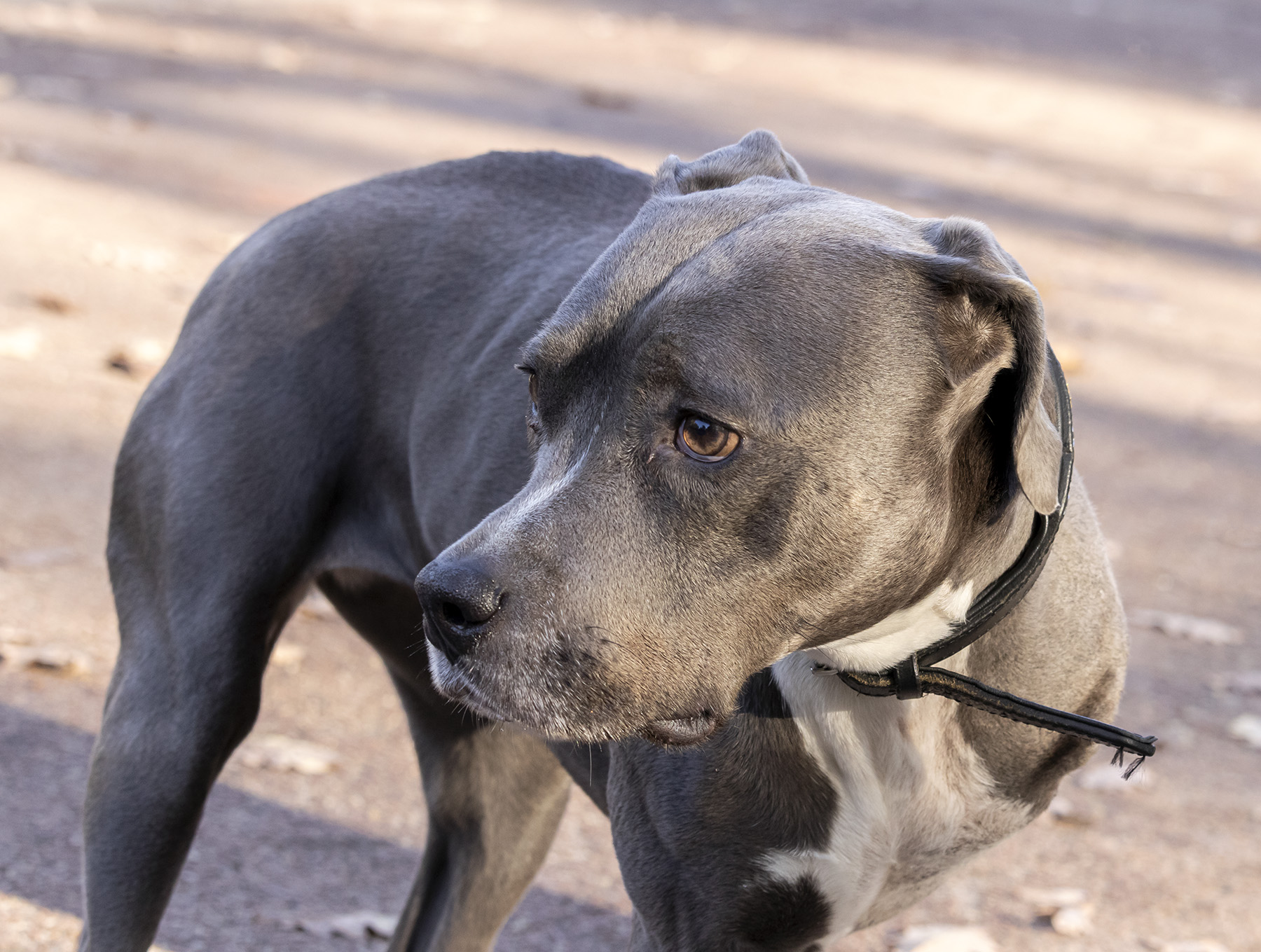
There were dogs everywhere yesterday at the Bois de Boulogne, most of them off leash, exploring all parts of the extensive wooded area on the outskirts of Paris. This seems to be a favorite dog walking spot for Parisians and maybe for doggie daycare/training, because, as you can see in the final photo, there were some big groups of dogs.

Most of the dogs and the people ignored me, though a pair of Chihuahuas with matching bright red sweaters barked ferociously as I passed. My path crossed with one large dog and I was struck by its gentle eyes and friendly disposition. I got down to eye level with the dog and petted him a bit, with the owner’s permission. He seemed so sweet.

After engaging with the owner and dog for a few short minutes, I watched them walk away. Only then did I realize that the dog was missing one of its front legs.

Dog in Bois de Boulogne

Dog at Bois de Boulogne

Dogs at the Bois de Boulogne

© Michael Q. Powell. All rights reserved.

Read Full Post »

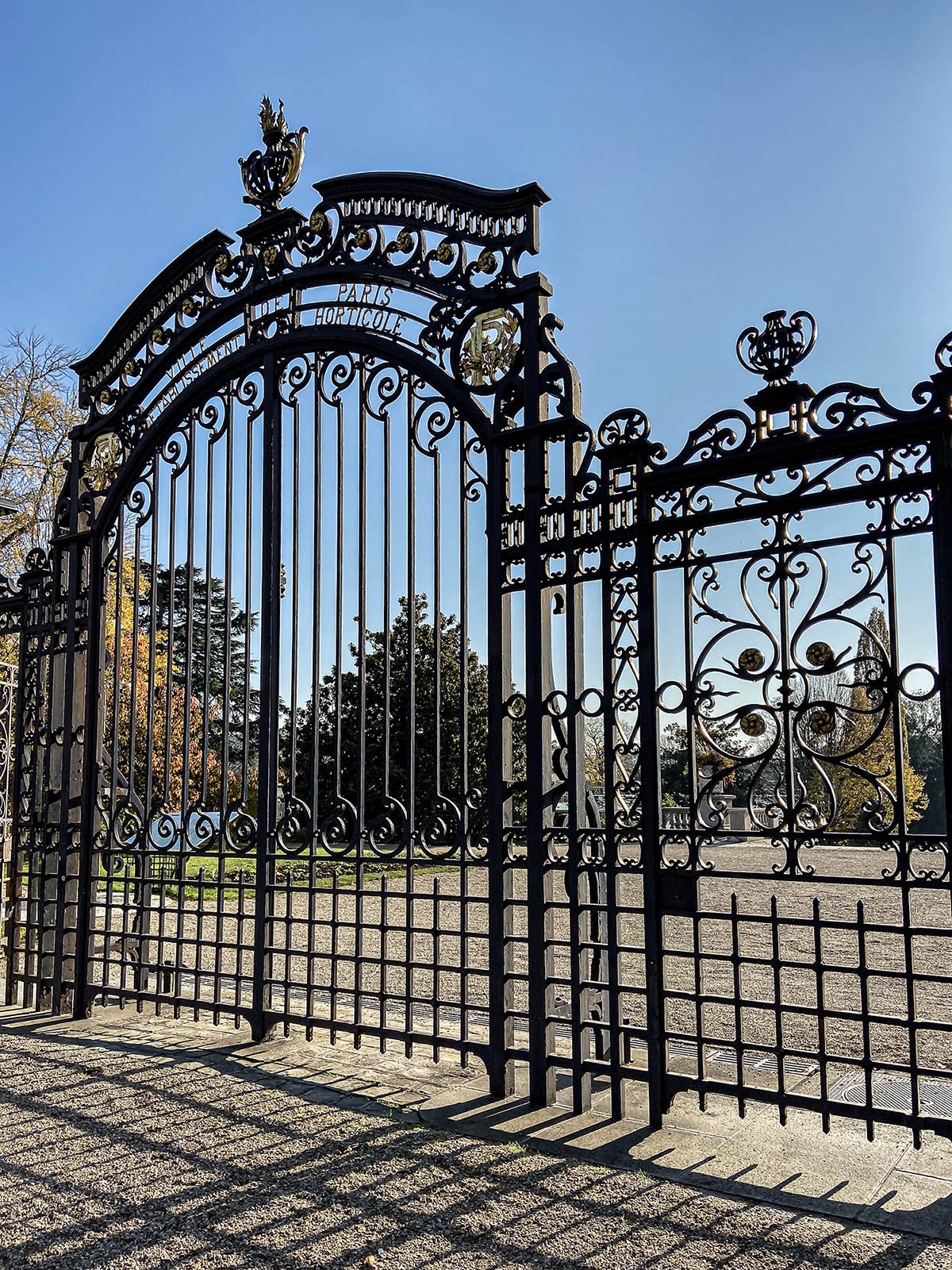
Some of you know that I struggle to find ways to use the camera on my new iPhone 11. Yesterday when I was visiting the large greenhouse complex at Le Jardin des Serres d’Auteuil in Paris, however, I captured these shots with that camera. (FYI, “serre” is the French word for a greenhouse.) I think the issue is that I am used to shooting mostly dynamic moving subjects and I don’t find myself able to track action the way that I would like with a camera phone or make quick adjustment to my settings on the fly. The greenhouse complex was not going anywhere, so it was easy to remember I could use my phone.

The wide angle capabilities of the iPhone, bordering on fisheye, allowed me to take some cool shots as I wandered through multiple greenhouses. The tropical greenhouse, though, fogged the lens on my DSLR because of the extreme warmth and humidity, so I didn’t even bother to try with my iPhone.

The garden is located on the edge of the Bois de Boulogne in the city’s 16th arrondissement, in the extreme southwest corner. It is in an interesting area, because while I was wandering about I walked past Roland Garros Stadium, where the French Open tennis championships are held and Longchamp Racecourse, where a series of well-known horse races are run.

I could not help but smile at all of the signs that I passed for the horse track, because the French word of it is “hippodrome.” Now I realize that this French word is based on some perfectly good ancient Greek words, but I can’t help but imagine a group of racing hippopotamuses, or should I say “hippopotami” if I want to be classical. After all, maybe “river horses” like to compete against each other too.

Jardin des Serres d'Auteuil

Jardin des Serres d'Auteuil

Entrance gate to Jardin des Serres d'Auteuil

© Michael Q. Powell. All rights reserved.

Read Full Post »

What does it mean to be rare? It seems to me that rarity, like beauty, is in the eyes of the beholder and is often hard to quantify objectively. When I went for a walk yesterday in the Bois de Boulogne in Paris, I was hoping that I might see some birds. I already did a posting on a European Robin, arguably the most beautiful bird that I spotted during the day.

Did I see any rare birds? All of the birds that I saw were undoubtedly “common” for the locals, but they seemed rare and exotic to me, because they were new to my experience. One of the joys of traveling is having the chance to see new creatures that may share a common heritage with more familiar ones or may be totally different. For me, it is simpler to treat them all as special rather than focusing exclusively on the uncommon ones. I attempt to highlight the beauty and behavior of them all no matter how many times I may have seen them previously. Unlike some birders I know, I do not have a life list that says that I should move on to new species once I have seen a particular one—each new encounter is unique.

So what did I see? I think that I have correctly identified these species, but would welcome corrections if I am wrong. The first one was the hardest for me to identify and I learned that it is a Eurasian Jay (Garrulus glandarius)—I love the combination of colors on its body.

The second one, a Eurasian Magpie (Pica pica) seemed somewhat familiar because, even though we do not have magpies where I live, I had spotted a similar-looking American Magpie (Pica hudsonia) during a trip to Denver, Colorado a few years ago. In this encounter, I was thrilled that I was able to capture some of the iridescent shine and color on the tail feathers.

The final photo shows an energetic little Great Tit (Parus major) pecking away in all of the crevices of a tree, seeking whatever tiny morsels of food that it can find.

I will probably return to more urban subjects after a day of respite in the woods of Paris. My feet definitely enjoyed the break from the cobblestone streets and I feel refreshed from my return to nature.


Eurasian Jay

Eurasian Magpie

Great Tit

© Michael Q. Powell. All rights reserved.

Read Full Post »

Age is a relative thing. I chuckled a little yesterday when I read a sign next to this spectacular Gingko tree (Gingko biloba) that characterized it as a “young man,” despite the fact that it was planted in 1895. Putting aside the fact that there are male gingko trees and female gingko trees, a concept that blows my mind, gingko trees, which originated in China, can live to be 1200 years old and are “potentially immortal.”

I spotted this tree while visiting the Jardin des Serres d’Auteil. This botanical garden, located near the Bois de Boulogne on the edge of Paris, dates back to 1761 and has an immense complex of different greenhouses, some with groupings based on botanical species and some geographically based. I was particularly struck by the ones ones focused on the Sahara desert and one focused on tropical South America. In the latter case, I had to keep wiping off the lens of my camera, because it was fogging up in the steaming heat of the greenhouse. Unfortunately, some of the greenhouses with the most spectacular plants were only open when gardeners were physically present, so I was not able, for example, to see their collection of orchids.

The leaves of the gingko tree were mostly faded and fallen this late in the year, but I still  marveled at the size of the tree and the golden carpet that surrounded it. A sign noted that in 2011 this tree was 82 feet (25 meters) in height and its trunk had a circumference of 13 feet (395 cm).

I think that this gingko tree was the only one of its species at the garden. Somehow I felt like a personal ad, “Young male gingko tree in Paris seeks companion.” I wonder if there is a special category for its type on dating apps.Gingko tree in Paris

Gingko tree in Paris

Gingko tree in Paris

© Michael Q. Powell. All rights reserved.

Read Full Post »

Today I decided to give my feet a break from the cobblestone streets and instead went for a walk on some of the wooded trails of the Bois de Boulogne in the outskirts of Paris. The highlight of the day for me was getting this shot of a European Robin (Erithacus rubecula), known in French as a Rouge-gorge (Redbreast). There are different birds around the world that share the name “robin” and it was nice to finally have a chance to see the European one.

European Robin

© Michael Q. Powell. All rights reserved.

Read Full Post »

Happy Beaujolais Nouveau Day. Today at one minute after midnight was the official release of the 2019 Beaujolais Nouveau wine. It is a made up holiday to push sales of this wine, but I like it because it is almost like the wine was designed to offend wine snobs. Beaujolais Nouvea is freshly pressed, it is cheap, and has a relatively uncomplicated fruity taste.

Here is the bottle that I purchased and I am accompanying it with some raw milk goat cheese and a whole grain baguette. The white of the plate threw my exposure out of whack, so when I made adjustments, the baguette looks like it was overcooked. Let me reassure you that it was wonderful.

Life is good.

Beaujolais Nouveau 2019

Beaujolais Nouveau 2019

Beaujolais Nouveau 2019

© Michael Q. Powell. All rights reserved.

Read Full Post »

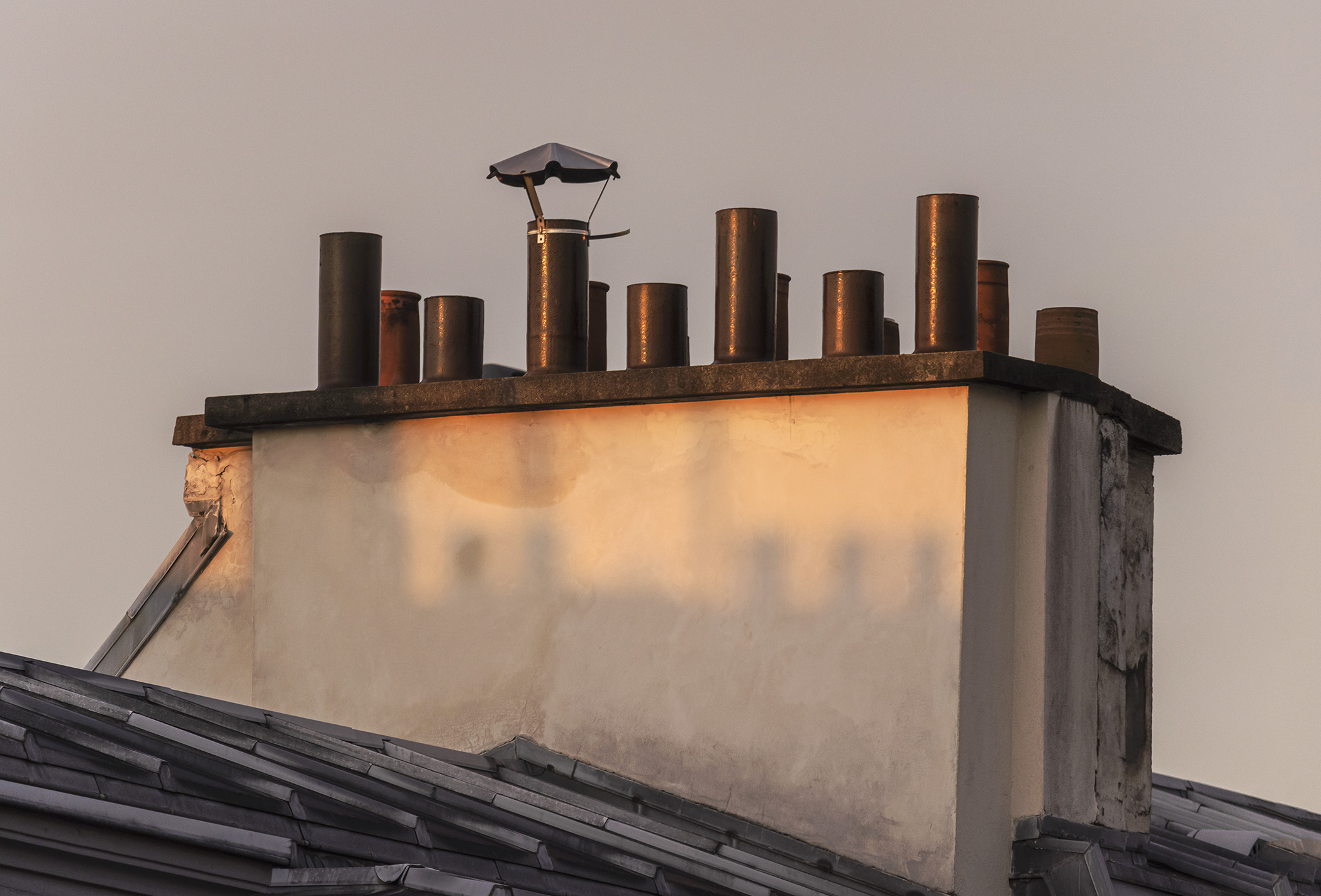
What do you see when you look out your window? As I sit in front of the laptop and glance slightly to the left, I have a wonderful view through the full-length balcony door of the rooftop of the buildings on a side street perpendicular to the one on which I am living. I love being on the top floor and I spend countless hours gazing out the window, marveling at the architectural details, daydreaming from time to time—Paris has that effect on me.

I am particularly intrigued by all of the little reddish pipes of various heights sticking out of the larger chimneys. Are they vent pipes or are they chimneys too? Why do a small number of them have little metallic chapeaux?

Yesterday I captured these images when the sunlight was shining from a particular angle and cast some beautiful shadows from one chimney onto another. As I worked on my photos, I thought I was most interested in a shot in which I was able to isolate the details of one of the larger chimneys, which is the second shot below. After deciding that I should provide a wider view to give context, I started working on another image and decided that I liked this view even more. What do you think?

My pace of life here in Paris is slow. I am not pressed by time constraints (other than my departure date) and I have few responsibilities. I am free to daydream, free to wander, free to contemplate, and free to ponder. Life is simple and life is good. Maybe I can apply some of this thinking to my daily life upon my return to Northern Virginia.

Paris chimneys

chimneys of Paris

© Michael Q. Powell. All rights reserved.


Read Full Post »

This may sound a little crazy, but I sometimes forget that I can take photographs with my brand new iPhone 11. Let me explain. For most of my working years, I worked in buildings in which cellphones were not permitted, so I never got used to having one with me all of the time. I used (and use) a landline telephone as my primary means of communication, relying on an answering machine if I was not there.

Eventually I did get a cellphone, but it was a cheap Android phone and I used TracFone as my provider. It is a pay-as-you go system and I would buy minutes annually. Being somewhat frugal, I would turn on the phone when I wanted to use it and then turn it off. The phone was for my convenience. The only exceptions I made were when I was taking photos in really remote locations or when traveling in the USA.

Recently I decided to dive deeper into the Apple ecosystem (I am writing this on a MacBook Pro) and purchased my iPhone and a T-Mobile plan that gives me unlimited talk, text, and data. More importantly, it allows me to text and use data in many foreign countries without additional charges, which has proven to be quite handy here in Paris.

So why don’t I use it to take photos? Well, first of all, I have to remember to take it with me when I go out. Twice already this trip, I left the apartment without my phone and only realized it much later. Unlike many people, I felt absolutely no sense of panic when I realized that I was separated from my phone nor any obsessive compulsion to return to the apartment and reunite with my iPhone.

More importantly, I find the position for taking photos with a smart phone to be somewhat unnatural—there is something comfortable and secure about putting my eye to a viewfinder rather than holding my arms out in front of me. One of the consequences of my cataract surgery a few years ago is that I no longer need glasses most of the time. My distance vision is now 20/20. After a lifetime of being significantly near-sighted, I am now slightly far-sighted, and it just happens that the distance at which I hold my iPhone is one at which my vision is not quite sharp without reading glasses. (My DSLRs have diopter adjustments, which lets me see thought the viewfinder perfectly, although I sometimes have issues seeing sharp details on the LCD screen on the back of the camera.)

Here are a couple of shots that I took on Sunday with my iPhone. I took the first shot from the steps of Sacre Coeur Basilica in Montmartre and the second shot later in the evening from a bridge over the Seine River. I am impressed by the details, the color, and the quality of the images.

Change is hard, but maybe it is possible to teach an old dog new tricks.

Paris panorama

Seine River at night

© Michael Q. Powell. All rights reserved.


Read Full Post »

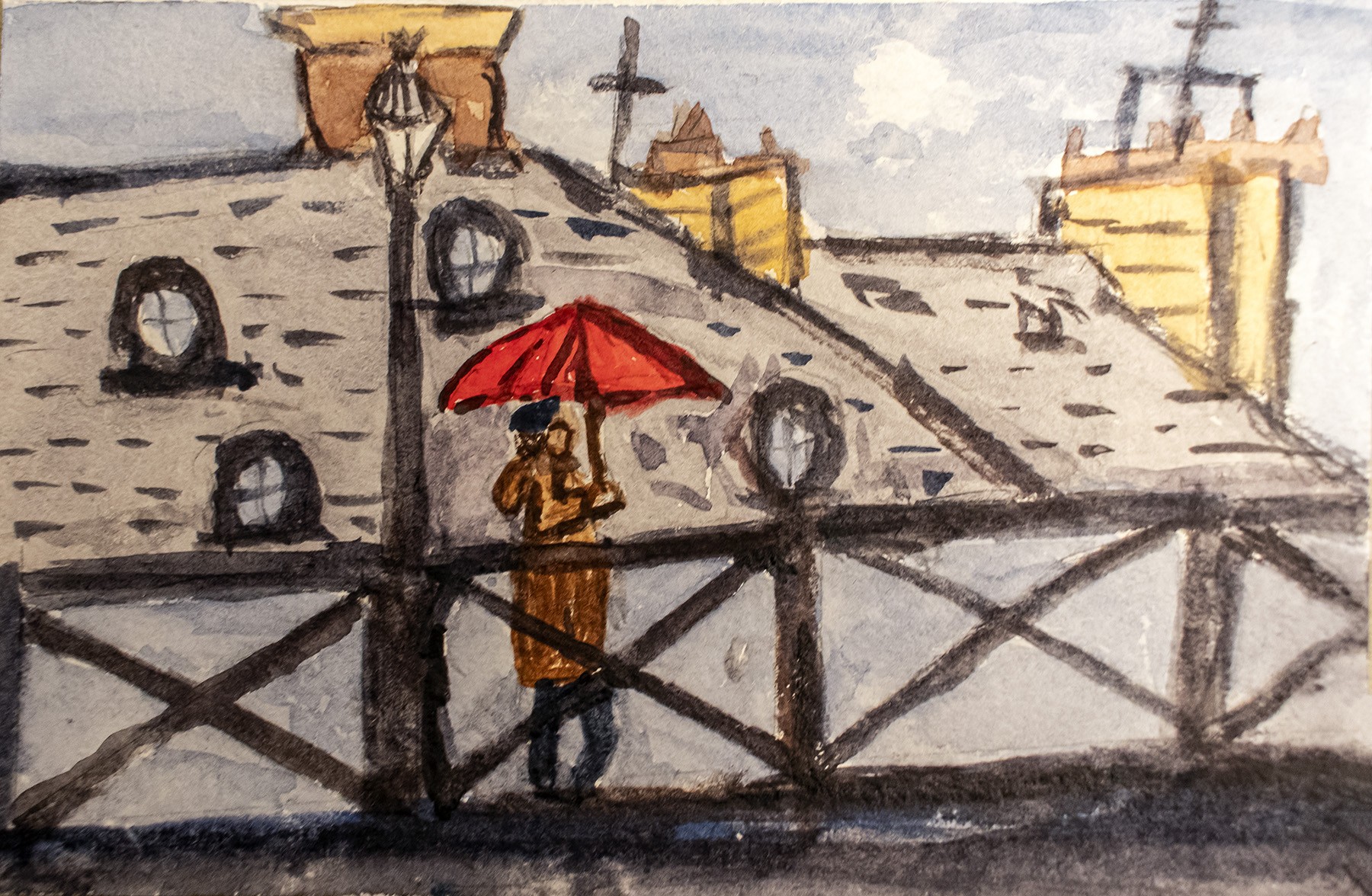
How comfortable are you in doing something that you know you are not good at and then publicly showing the results? I have tried watercolors a few time and brought some watercolor stuff with me to Paris. My trip is over half over, so I decided last night to play a bit, using some of my recent photos for reference. I definitely need lots of practice, but it was incredibly enjoyable.

I think “primitive” would a positive spin on my watercolor “style”.  I’m finding water control and brush control to be my biggest challenges at the moment. Those two issues make it hard for me to put in details, because the lines expand really quickly if there is too much water. Of course, it helps to be able to draw, which I don’t do well, so proportions can quickly get skewed.

Here are a few geeky details for those of you who paint with watercolors. I used a twelve color DaVinci full pan watercolor set in a metal tin. DaVinci is a small company in California that makes its own paints and they are a higher quality than the student grade paints I have used before. For paper, I used several brands, but they are all 140 lbs (300 gsm) in weight and are cold press. The first painting was done on a 4×6 inch (10×15 cm) Fluid 100 block that is 100% cotton; the second one on a 5×7 inch (12×18 cm) Fabriano Artistico extra white block that is also 100% cotton; and the final one on a 4×6 inch (10×15 cm) Strathmore postcard that is made of wood pulp.

As I worked and played with the watercolors, I thought of a Sidney Sheldon quotation that I came across recently, “A blank piece of paper is God’s way of telling us how hard it is to be God.” There is something really special about the creative process, making something with your own hands.

Later today I am going on a three hour sketching tour in Montmartre, as long as the weather holds. That will be the real test for me, seeing how well I can overcome insecurities and fears while literally in public view.

Watercolor Painting in Paris

Watercolor Painting in Paris

Watercolor Painting in Paris

© Michael Q. Powell. All rights reserved.

Read Full Post »

Although I have posted a number of “artsy” shots recently, periodically I slip into the role of a tourist to capture images of well-know Parisian landmarks. Yesterday during a few brief moments of sunshine, I photographed Sacré Cœur Basilica at the top of the hill in Montmartre.

I have taken a lot of photos of Sacré Cœur during this trip, but they have all been gray and gloomy and so I have not posted them. One other thing I noticed was that the perspective was always somewhat skewed in earlier images, because I was forced to shoot so severely upwards. Yesterday I decided to walk down several levels and shoot from “ground level” rather than from one of the upper levels that provides such a nice panoramic view of the city.

During one of my visits to Sacré Cœur earlier this trip, I went inside the basilica and took a few interior shots. The first one here shows a painting just above the central altar area. The final shot shows one of the many stained glass panels that I saw. When I am inside a church, I tend to limit my movements and adopt a reverent attitude, so I generally don’t get a lot of interior shots.

Sacre Coeur

Sacre Coeur Paris

Sacre Coeur Paris

© Michael Q. Powell. All rights reserved.

Read Full Post »

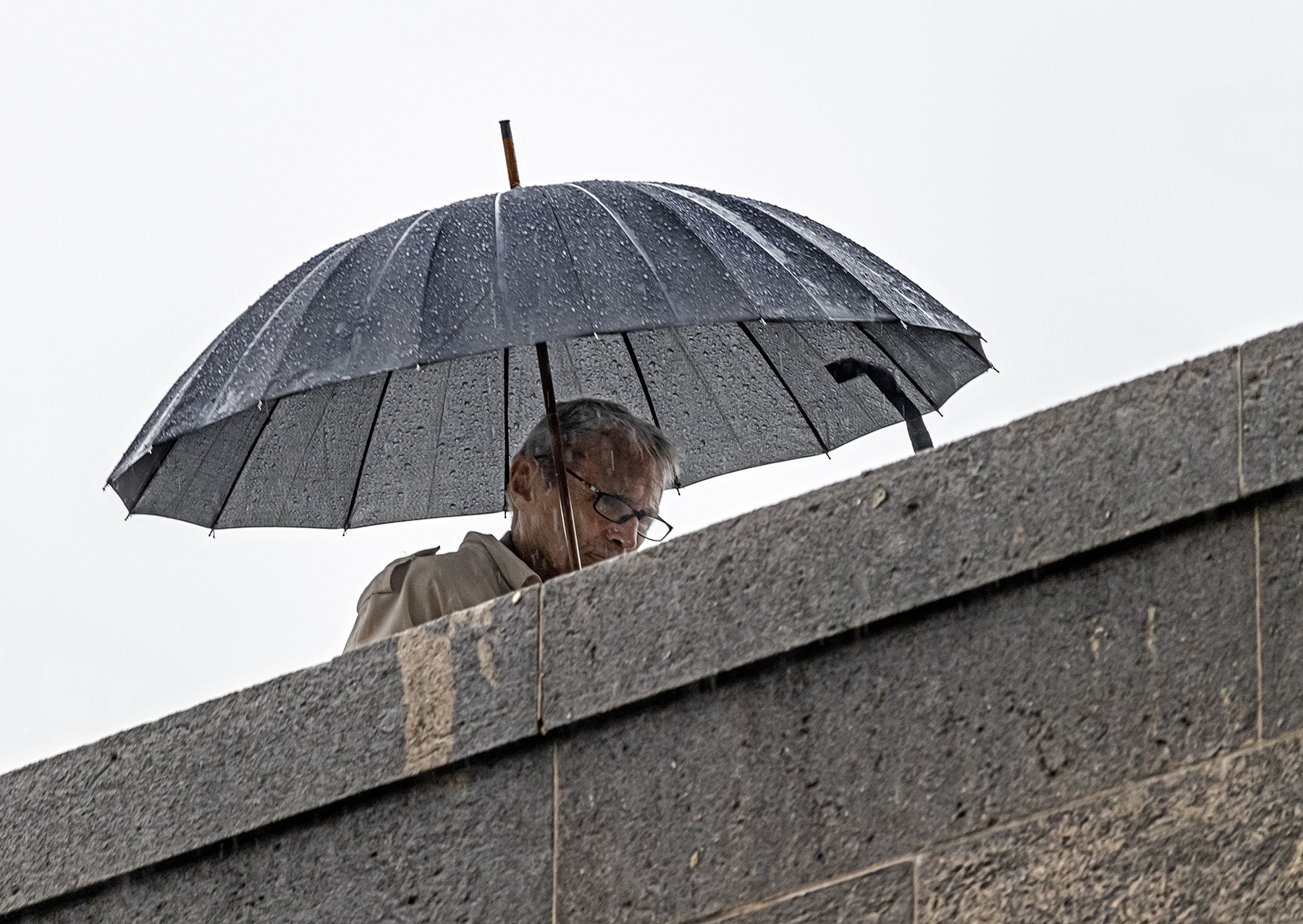
I don’t know why, but last week during a day in which it rained continuously, I went snap happy photographing umbrellas. The umbrella images that I posted already were pretty straightforward depictions, albeit somewhat artistic. Here are a few images in which I loosed my creative impulses to capture something a little different.

The red umbrella in the first image really stands out, but there are a few other details that caught my eye. The normally transparent panels on the Pont des Arts have become a bit translucent because of the rain drops, adding a nice effect. You may also notice the cluster of locks on the lamppost.

The two last facts that I mentioned are related. Years ago someone came up with the way that lovers should get locks with their engraved names and affix them to a Parisian bridge as they declare their eternal love. This has turned into a huge problem—there are now locks everywhere in Paris—and there has been a partial collapse of a bridge caused by the additional weight of the locks. According to an article by the group No Love Locks, Parisian authorities decided in 2014 to replace the mesh grates on the Pont des Arts, covered with locks estimated to weigh 60 metric tonnes, with the transparent panels. Obviously that has not deterred people from finding new locations for the locks—the organization I mentioned has a slogan that grabbed my attention, “Free your love. Save our bridges.”

When I took the second photo, just as was the case with the first one, I was standing on one of the paths along the Seine River and shooting at an upward angle. We often use our umbrellas as protection, from the rain as well as from others, and this shot up under the umbrella has an unusual, almost intimate feel to it.

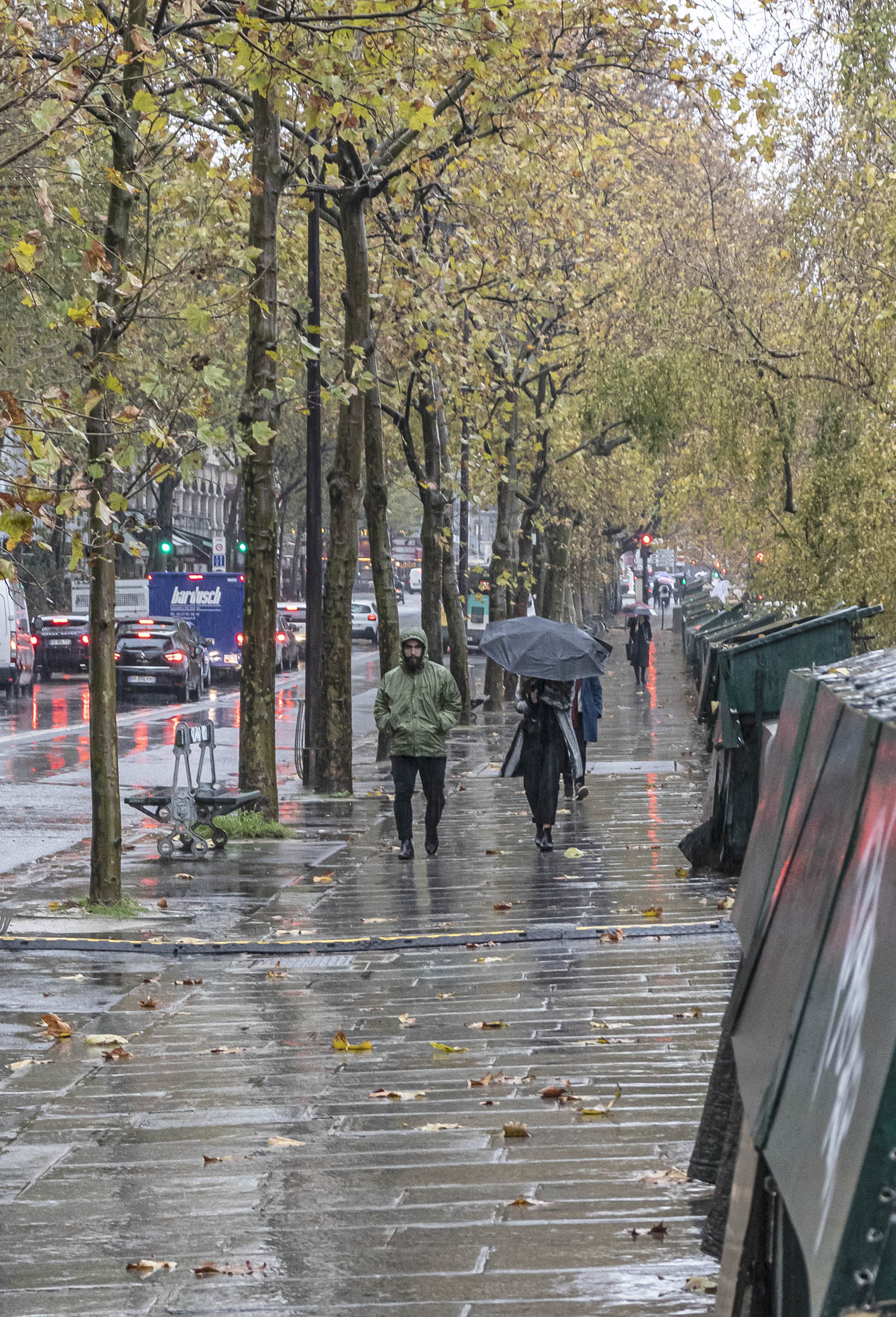
It is hard to explain why I like the final shot. Maybe it is because of the reflected lights on the wet pavement, or the fallen leaves, or the people walking, bounded on one side by the row of trees and on the other by the covered green stalls of the bouquinists (booksellers). It is the kind of image that I could imagine turning into a painting.

So there you have it, a curious mix of images. Before I set out on this trip to Paris, I remember warning readers my postings would be atypical, and possibly a bit strange during my time here. I think this posting is the result of consciously trying to express myself “outside of the box” in a way that is fun and yet a little scary.

Red umbrella in Paris

Under the umbrella

Alongside the Seine

© Michael Q. Powell. All rights reserved.


Read Full Post »

When I traveled overseas for work, which I tended to do at least a few times a year, we generally stayed in U.S. chain hotels, most often run by Marriott. Those hotels are predictable and easily identifiable—from a distance you know immediately that they are hotels.

The dark green door in the center of this image is the entrance to the apartment where I am spending the three weeks that I am in Paris. The entrance is so nondescript that it doesn’t even have a street number indicated and you might think at first that it is associated with one of the adjacent stores.

For the last 25 years I have lived in a townhouse community in one of the Virginia suburbs of Washington D.C. and essentially nothing is in walkable distance. Here in Paris, once I descent the 96 stairs that I profiled earlier, I am in the midst of the action. Rue Montorgueil, the street on which the apartment is located, is a bustling pedestrian area in the center of the city with lots of shops, cafés, and restaurants. It can get a little noisy, but from the sixth floor, the sound levels are tolerable.

Who are my neighbors? On one side, there is a wine store called Le Repaire de Bacchus (The Den of Bacchus) and on the other side there is a gourmet tea store called Mariage Frères (Mariage Brothers). I was initially confused by the name, because the two words don’t seem to go together. Was the store founded to celebrate the individual nuptials of the brothers or were they married to each other? As it turns out, “Mariage” was the family name of the founders. According to Wikipedia, Mariage Frères Tea Company was founded on 1 June 1854 by brothers Henri and Edouard Mariage.

As for the photo, I am pleased with the way that I was able to capture the light and, in particular, the reflections on the wet pavement. The image has a part of the urban vibe that I have been enjoying so much here in Paris. It makes me wonder what it would be like to live in a place like Paris long-term.


Rue Montorgueil

© Michael Q. Powell. All rights reserved.

Read Full Post »

Montmartre is the small hill with the highest point in Paris where the stunningly white Sacré-Cœur basilica is located. Previously I have posted panoramic views of the city that I took from the stairs of Sacré-Cœur.

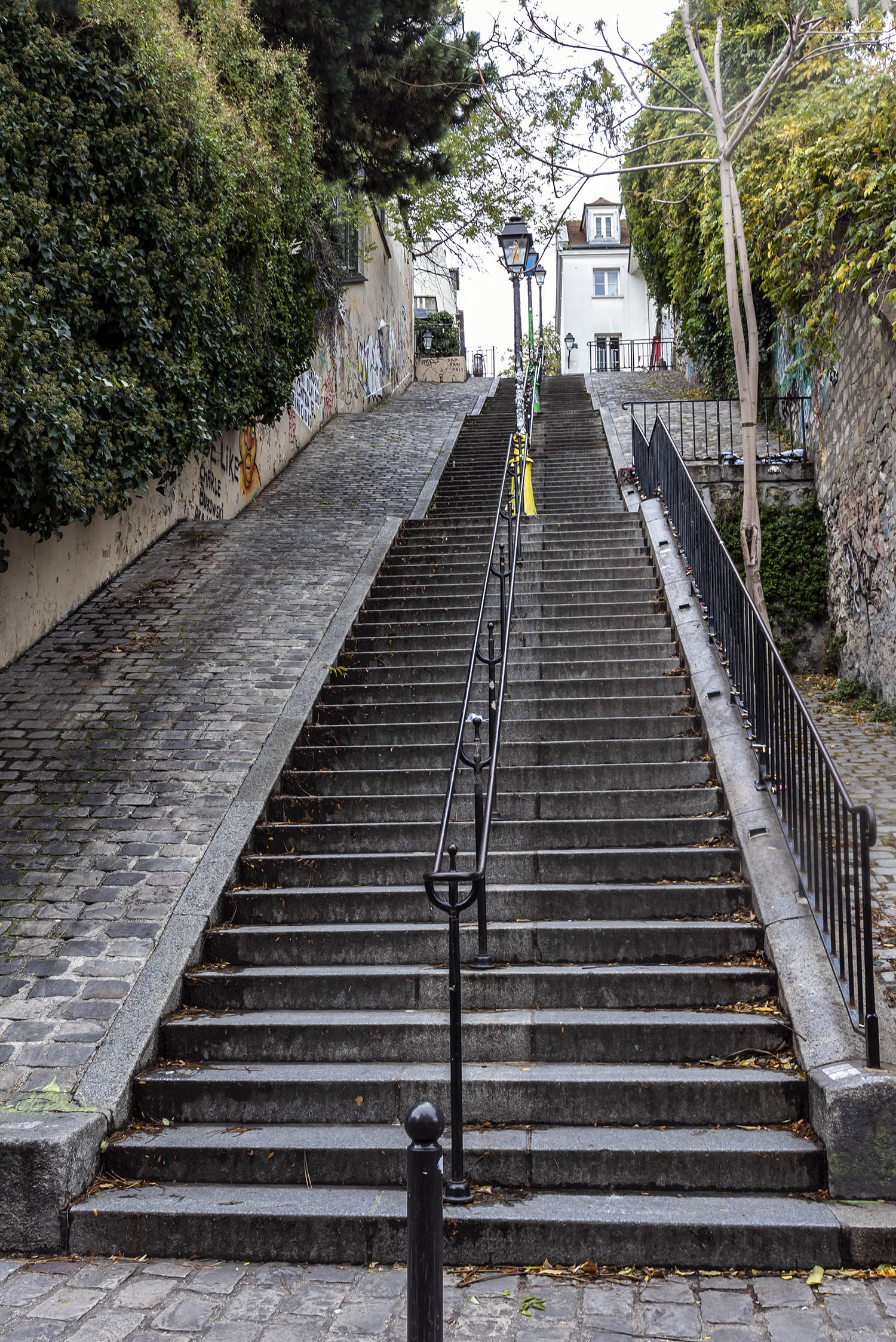
How do you get there? There is a little funicular train that will take you up the hill, but I have always elected to walk. Multiple sets of stairs approach the summit from different directions and I have climbed up a lot of different ones. Some of them are decorated with colorful patterns, but all are steep and long.

Montmartre has become one of my favorite locations to visit and I think I have walked there every other day on average. Here are images of a few of the sets of steps that I have successfully encounterd over that period of time.

stairs to Montmartre

Stairs to Montmartre

stairs to Montmartre

© Michael Q. Powell. All rights reserved.

Read Full Post »

I decided to go for a late night stroll on Saturday and ended up at Place Saint-Michel in the student district not far from Notre Dame. Where else could I have been able to order a crêpe with Nutella and bananas after midnight? For the record, the crêpe was amazing.

Along the way I captured this image of the Pont Saint-Michel (Saint-Michel Bridge), one of 37 bridges over the Seine River in Paris. Those bridges come in all shapes in sizes, with several of them pedestrian only. This particular bridge links the left bank of the Seine with  Île de la Cité, one of only two remaining natural islands in Paris. The island, on which the Notre Dame de Paris cathedral is located, is historically viewed as the center of Paris.

The Pont Saint-Michel, which was built in 1857, is quite distinctive in appearance. If you look closely you will see two large N’s, each surrounded by a laurel wreath. These are symbols of Napoleon III’s Second Empire that lasted from 1852 to 1870. In the right hand side of the photo you can see the lights of the embankment on the Seine and above them the lights at street level.


Pont Saint-Michel
© Michael Q. Powell. All rights reserved.

Read Full Post »

One of the coolest thing about digital photography is the way that software allows you to change the look and feel of an image. This evening I played around with some different presets in Luminar 3 and got a look to one of my recent umbrella shots that I really like—almost like an antique photograph.

I tend to be somewhat of a minimalist when processing my wildlife photographs. I shoot in RAW, so I normally will tweak things like contrast, exposure, clarity, highlights and shadows, but except for cropping that is pretty much it. Shortly before leaving for this trip I downloaded Luminar 3 as part of a special deal in a pre-sale of Luminar 4.

I haven’t really used it much, but I decided to experiment with it during this trip. I tried some different looks with a recent photo that I really like. There are dozens and dozens of presets and all are adjustable, but none of the color ones satisfied me with the images.

I really like black and white and there are a whole range of options in the Tonality group of presets, including one that covers Toning. I liked the Sepia preset a lot, but settled on one called Gold and Selenium. After I made a few adjustments I got this look.

What do you think? Do you miss the bright colors of the umbrellas and the foliage in the altered version? Although I published the original shot recently, I decided to reprise it here for ease of comparison.

I like both versions a lot, though I must admit that the “feel” and “vibe” of the separate images are quite different.

Umbrellas in Paris

Umbrellas along the Seine

© Michael Q. Powell. All rights reserved.


Read Full Post »

With the recent onset of cold and rainy weather here in Paris, it is hard to remember that we had a bit of sunshine earlier in the week. As I was walking along the banks of the Seine River during one such sunny period, I grew entranced by the shadows that trees were casting onto the embankment walls. People passing by me must have wondered what I was photographing, given that I was facing a seemingly blank wall and had my back to the river.

The images show mostly skeletal tree forms, but some show evidence of hardy leaves persistently clinging to the branches, not yet ready to fall. If you examine the photos carefully, you can see some of the details and textures of the materials used to build these embankments. Just a few yards above, there is busy world, full of cars and people hurrying about, but here, life moves at a slower pace.

I love too seeing the giant iron rings intermittently embedded in the embankment walls.  These, I believe, are a legacy of past commerce along this river, places where barges would tie up, perhaps for safety or sleep, or simply to silently surveil the scenic surroundings. There are times in our lives when we could all use spots like that.

shadow tree

Shadow Trees on Seine River

© Michael Q. Powell. All rights reserved.


Read Full Post »

When I spotted this bird as I was walking along the Seine River yesterday morning, I knew immediately that it was some kind of cormorant. Unlike most water birds that float on the surface of the water, cormorants sit really low in the water with their bodies barely visible. Their long necks always make me think of a periscope coming out of a semi-submerged submarine.

Although this bird looks a lot like the Double-crested Cormorant (Phalacrocorax auritus) that I am used to seeing at home, I have determined that it is most likely a Great Cormorant (Phalacrocorax carbo). This cormorant followed a familiar pattern of behavior—it would be swimming along when without warning it would dive deeply into the water and remain underwater for a long time. It was a fun challenge trying to figure out when and where the cormorant would reappear.

Most of the time the cormorant stayed far from the banks of the river, but on one occasion it popped up right in front of me and I was able to capture this image. It was nice to be able to capture some of the orange coloration around the cormorant’s mouth, but the real prize for me was getting a clear view of its spectacular blue eyes. It is definitely worthwhile to click on the image to get a closer look at that amazing shade of blue. If you look closely at the water, you will also notice some small concentric ripples created by the falling raindrops.

When I went walking in the rain yesterday, I knew there was a good chance that I would see ducks and gulls and maybe a swan or two. Who knew there were Great Cormorants on the Seine RIver? No matter where I am, I am always thrilled by the joy of the unexpected, by those little surprises that add so much texture to life. So I choose to live my life in hopeful expectation as I scan the world for marvelous subjects to photograph, confident that they will present themselves if I keep my eyes and my heart open,

Great Cormorant

© Michael Q. Powell. All rights reserved.

Read Full Post »

When it is pouring rain all day in Paris, what can you possibly photograph? Like wildflowers in the spring, colorful umbrellas have sprung up all over the city and they make cool subjects.

I captured the first little scene along the Seine River this morning. I envisioned the possibility of the photo and hung around the location as the group of three people approached. I took multiple photos as the moved toward and under the bridge. The biggest challenge I had was a distractingly bright orange bicycle parked in the middle of the pathway beyond the exit. Fortunately the green umbrella was large enough in this shot to hide the offending bicycle.

I semi-stalked the next group of three young ladies as they walked through the Tuileries Garden toward the pyramid entrance to the Louvre. It was a little frustration because they kept stopping for selfies, but I finally got a shot when they moved together for a moment. I love the way that the three subjects had complementary shades of umbrellas and stylishly distinctive backpacks.

The final photo highlights the umbrellas themselves and not the owners. Although it was still raining, the owners had carefully placed their umbrellas to the side so that they could take photos of themselves with the Louvre pyramid in the background. I like the angle at which the umbrellas are placed, which, along with their black color, emphasizes the form of the umbrellas. The shadows on the wet cobblestones add additional visual interest to the image.

It was cold throughout the day today, about 34 degrees right now (one degree C) and the possibility of snow is forecast for this evening. Yikes! Fortunately I have warm clothes with me and most importantly my camera bag has proven to be as waterproof as advertised. I don’t exclude the possibility of an after dark adventure a bit later.

Umbrellas along the Seine

Umbrellas in Paris

Umbrellas in Paris

© Michael Q. Powell. All rights reserved.

Read Full Post »

Place du Tertre, a small square in the center of Montmartre, is a special place where artists of all varieties set up their easels every day and work in the open air, surrounded by the milling public. Many of them are portrait artists, who gently try to convince you to sit for a portrait.

I watched several of those artists at work and they are amazing talented, creating true-to-life drawings over an extended period of time. This is in sharp contrast with the large number of quick sketch “artists” who aggressively pursue you in the streets, trying to convince you to stand for a “portrait,” which is often a mere caricature that barely resembles the subject.

A number of other artists worked on small canvases with oil paint using palette knives. I had the impression that some of them were working in almost assembly line fashion, cranking out the same limited number of scenes of Paris suitable for souvenirs.

After circling the square, I returned to the only artist who was working in watercolor. He would sketch out his detailed paintings in India ink using a pointed fragment of bamboo as a drawing instrument. After the ink had dried, he would carefully apply multiple washes of color. Some of you know that I have dabbled with watercolor and I was absolutely enthralled as I watched this artist at work, mixing and applying the colors from a watercolor set not all that different than ones that I have.

Watercolor painting is time-consuming and unforgiving—you really cannot hide your mistakes. Supplies are relatively expensive, compared to oil and acrylic painting. Why would an artist choose this style of painting? It does not seem like an economically rational decision.

I did not want to interfere with the artist’s efforts, so I watched from a respectful distance and discreetly took a few photos. When he reached a certain stage when he needed to let a layer dry, he stopped for a smoke break. As he lit up an unfiltered, hand-rolled cigarette, I started to talk with him.

At first I asked him about the materials that he uses. He paints on high quality Arches 100% cotton paper, using a mix of artist quality paints from Winsor and Newton, Sennelier, and others. For brushes, he uses several rather large natural hair brushes. He pointed to one of them and noted that it had cost over 80 Euros (about $100), but he had used it for close to ten years.

He said that he had been painting from a young age and preferred painting in public like this and had done so for almost 40 years. Based on some comments he made about other painters, he seemed to reject the almost elitist idea of painting in seclusion in a studio, with works hanging in high-priced galleries.

He obviously loved what he was doing, but somewhat wistfully talked of eventually retiring to a place in the country. As he puffed on the final fragments of his cigarette, he announced that it was time to get back to work. I thanked him for talking with me—we spoke exclusively in French—and sharing his experience and perceptions. He graciously agreed to let me take a quick portrait shot and that photo, the last one below, is one of my favorite remembrances of this trip to Paris.

The first photo below gives you an overall sense of the environment at the Place du Tertre. Note the assemblage of easels and the passing tourists and compare that with the focus of the painter, who appears to be in his own little world.

The second image provides a slightly closer view of the work in progress. Note the large size of the brush that he is using and the initial delicate washes of color that he has applied.

The final shot, as noted above, is a quick portrait of the artist. It’s a candid pose from where he was standing. I really like the way that it turned out, capturing in part the unique personality of this awesome artist that I was happy to encounter, a man content with doing what he loves outdoors in all kinds of weather (except, he noted, in the rain, which obviously is bad for watercolor paintings).

Painter at Place du Tertre

Painter at Place du Tertre

Painter at Place du Tertre

© Michael Q. Powell. All rights reserved.

Read Full Post »

When I first spotted a police zodiac boat yesterday morning as I was walking along the Seine River, it was moving really slowly and seemed to be doubling back periodically. I wondered if someone had jumped off one of the many bridges over the Seine. Then I spotted a floating body, or at least I thought initially that it was floating.

As I zoomed in with my telephoto lens, I could see that the body was moving rhythmically and then I spotted an orange-tipped snorkel. It was a diver in a wet suit who appeared to be getting in his morning training—from what I could see he had flippers and was using a short blue board rather than performing swimming strokes.

The driver of the boat that was marked “Prefecture de Police” also appeared to be in a wet suit. I don’t know if he was bored, but from time to time he would speed ahead and make a sharp u-turn in order to zoom through the arches of a bridge, as you can see in the second image.

When the diver I was following neared what looked to be his destination, I suddenly realize that there were a total of three divers in the water—maybe the other two divers had been waiting for their slower colleague. In the third photo, the divers were getting ready to turn to the left, to an area where I believe the police/firefighting boats are docked. If you look closely at that final image, you can see a small flock of ducks in the background that did not appear to be surprised or disturbed to see humans swimming in the Seine River.

swimming in the Seine

© Michael Q. Powell. All rights reserved.

Read Full Post »

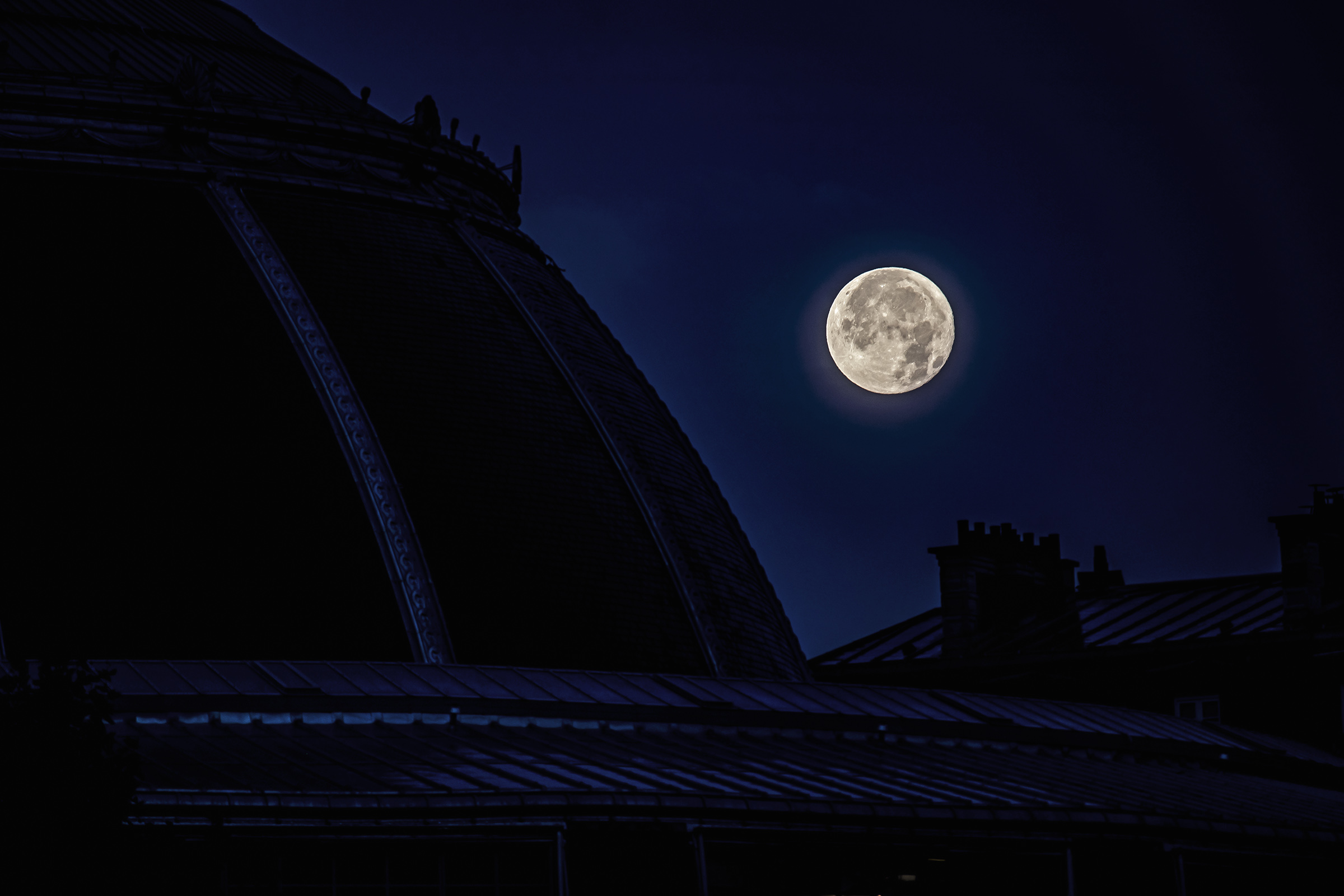
I got up early yesterday morning to try to capture a sunrise here in Paris. The sunrise was pretty much a bust, but on the way to my location, I captured this image of a full moon over some shadowy Parisian roofs.

It is always tricky to take a shot of a full moon—the camera wants to overexpose the moon, leaving a glowing white circle. In order to get the moon looking right. I usually have to underexpose the image by a couple of stops, which leaves the content of the rest of the subject barely visible. I hope that you can just see the curve of the domed roof to the left of the moon and a roof with some chimney pipes just below the moon.

I was hoping to have more time to take additional photos, but as I made adjustments to my camera, the moon disappeared in the clouds and quickly dropped lower on the horizon.

moon in Paris

© Michael Q. Powell. All rights reserved.


Read Full Post »

So much of Paris merges together when viewed from the step of Sacre-Coeur in Montmartre, in part because new construction in Paris was limited to 121 feet (37 meters) as of 1977. One notable exception is the Montparnasse Tower at 689 feet (210 meters), which is quite visible in this photo from yesterday evening—the height limitation was imposed in reaction to the construction of this building in 1973, whose size and appearance were loudly criticised. (By comparison, the Eiffel Tower is 1,063 feet tall (324 meters.)

In case you are curious, the giant ferris wheel is a temporary structure in the Tuileries Garden for what I think is a Christmas market. When I first arrived in Paris, the circular portion of the wheel was only partially completed. Since that time, the wheel was completed, cabins were added, and, as of yesterday, the wheel was moving, probably in test mode.

In recent years, the rules on construction have been relaxed and some taller buildings are planned, primarily on the outer edges of the Paris. I highly recommend an article at newweek.com entitled “Will Skyscrapers Ruin Paris?” that argues, in part, that the traditional architecture of the city is part of what sets the city apart from others in the world.

Here is one thought-provoking paragraph from the article:

“When a dense area has low buildings, it forces residents to interact and puts more life out on the streets—a large part of what gives Paris its character. According to Swiss writer and philosopher Alain de Botton, five stories is the ideal height of a city building because anything higher begins to make us feel “insignificant, small, and trivial”—all words rarely used to describe life in the City of Lights. It’s no wonder artists and scholars have flocked to Paris for years for inspiration. Would the same be true if the spirit of Paris were essentially locked away in modern towers?”

In the 1942 classic movie Casablanca (my all-time favorite movie), Rick (Humphrey Bogart) famously told his ex-lover Ilsa (Ingrid Bergman), “We’ll alway have Paris.” Will we?

Montparnasse Tower

© Michael Q. Powell. All rights reserved.


Read Full Post »

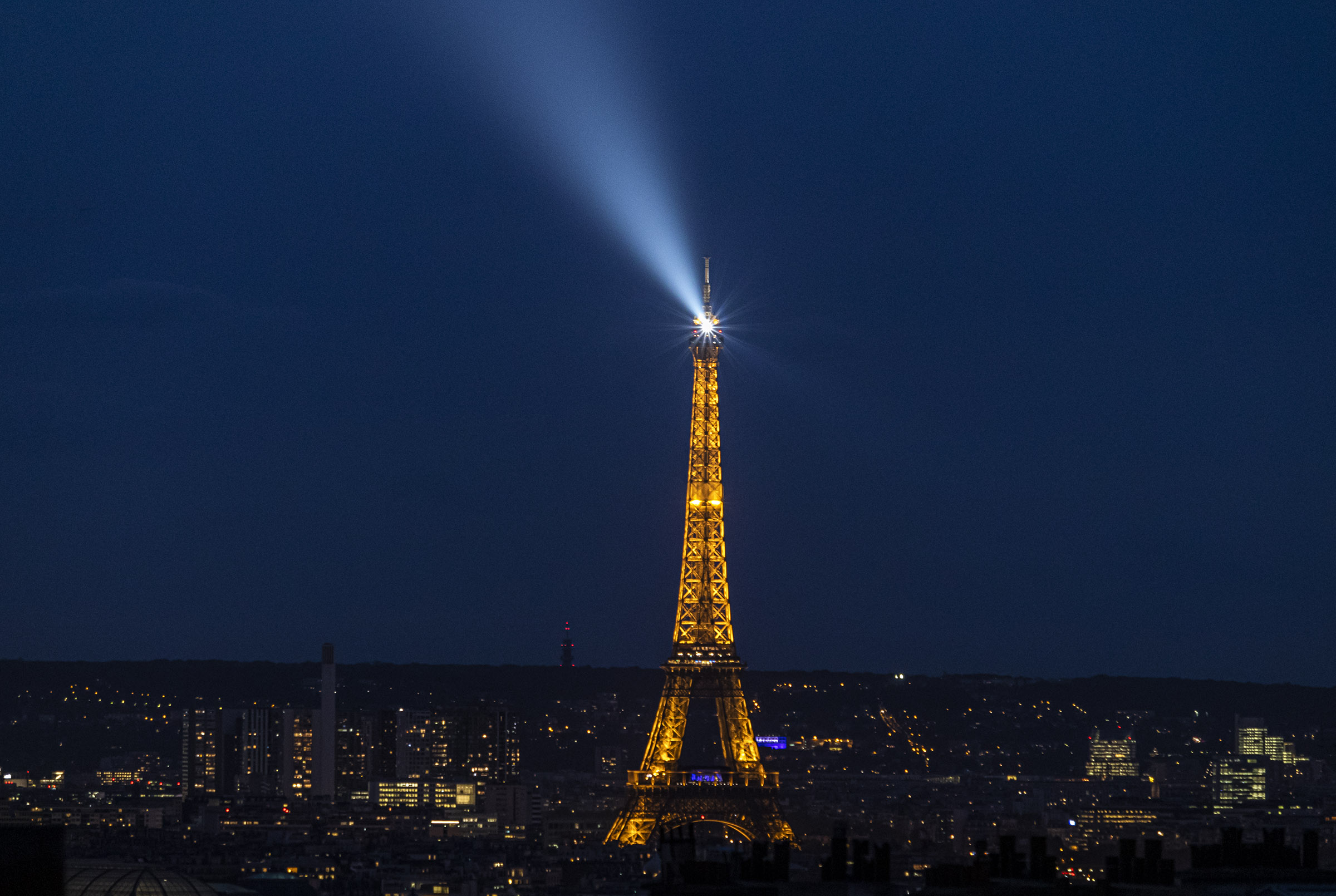
I finally figured out a way to get an unobscured view of the Eiffel Tower from the hills in Montmartre. Yesterday evening was relatively clear and I managed to get a few cool shots just after sunset. There was a small group of tourists that jostled me a little as they tried to get similar shots with their cell phones but my monopod and longish telephoto lens (55-250mm) almost certainly helped me to get better shots.

However, it turns out that the night lighting of the Eiffel Tower is covered under a copyright, so please don’t use my shot for commercial purposes. I have a friend who reviews photos of a stock company and she unsurprisingly was well aware of this reality. Copyrights in the European Union, including France, are good for the lifetime of the artist plus 70 years. So, in 1993, the Eiffel Tower entered into the public domain (and a legal replica was later made in Las Vegas).

Here is a link to an article from PetaPixel that explains this whole issue and includes an informative video. The bottom line is that the night lighting was installed in 1985 and is considered an artistic work, covered by a separate copyright law. As many of you know, I spend most of my time photographing wildlife, not buildings, so I have never really thought about problems like this.

In the end, though, I’ve decided to post these photos, because my blog is not a commercial endeavor. If at some time I were to decide to do this professionally, these photos, no matter how much I like them, would not be part of my portfolio.

Eiffel Tower

Eiffel Tower

© Michael Q. Powell. All rights reserved.


Read Full Post »

« Newer Posts - Older Posts »