Feeds:
Posts
Comments

Archive for the ‘Photography’ Category

Generally it’s best to have the sun behind you when taking photos, but sometimes you are forced to shoot almost directly into the sun. When the conditions are right you can sometimes get wonderful silhouettes, like these images of Double-crested Cormorants (Phalacrocorax auritus) that I spotted on the Potomac River near Dyke Marsh in Alexandria, Virginia this past Monday.

The shot of the perched cormorant was a conscious composition—I assessed the light and knew that I was shooting a silhouette. In the case of the flying cormorant, however, I was reacting to the movement of a bird taking off from the water and trying so hard to hard to capture focus and keep the bird in focus that I was not paying much conscious attention to the lighting.

Double-crested Cormorant

Double=crested Cormorant


Double-crested Cormorant

© Michael Q. Powell. All rights reserved.

Read Full Post »

Periodically I’d catch a glimpse of a warbler in the trees of Huntley Meadows Park last Friday, but they mostly remained hidden deep within the branches. This Yellow-rumped Warbler (Setophaga coronata), however, ventured out of the shadows just enough that I was able to get this long-distance shot of it.

Yellow-rumped Warbler

© Michael Q. Powell. All rights reserved.

Read Full Post »

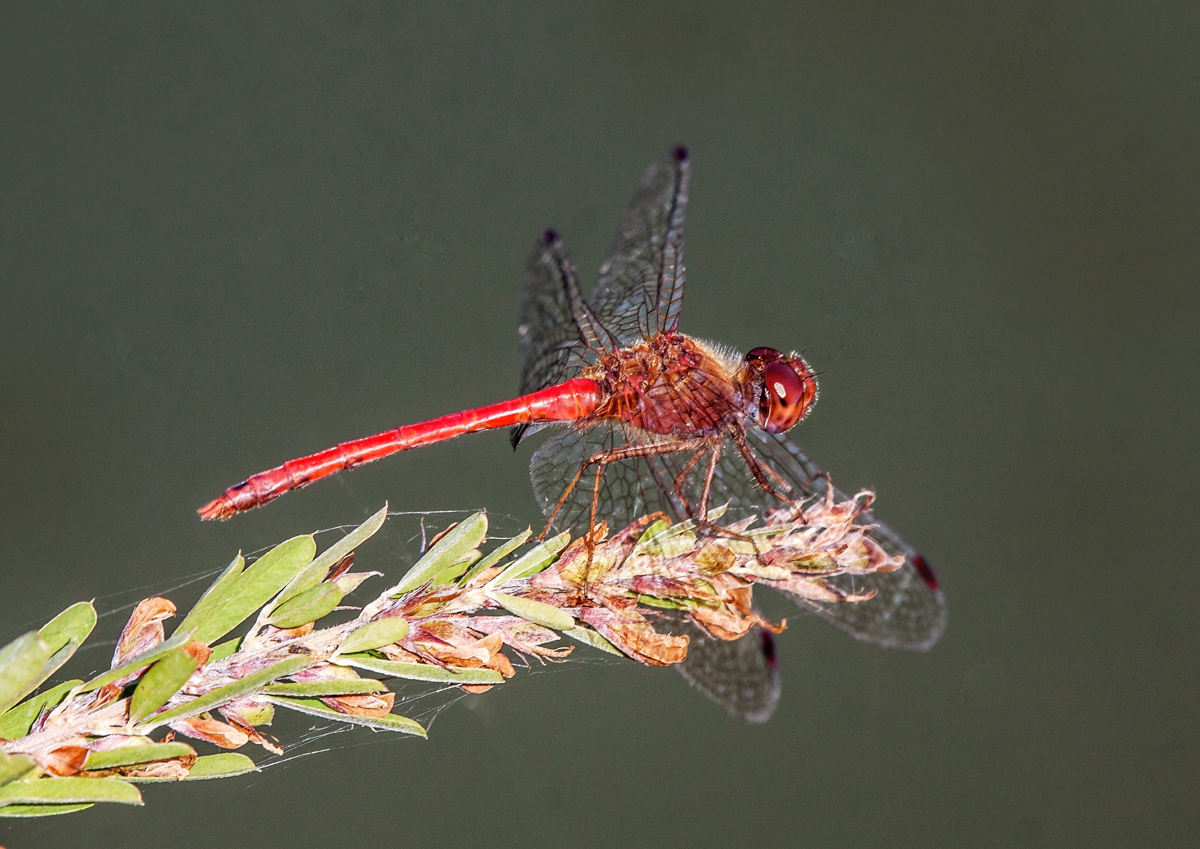
I am not about to make a sign proclaiming that “The End is Near,” but I couldn’t help feeling a slight sense of impending doom when I spotted an Autumn Meadowhawk dragonfly (Sympetrum vicinum) this past weekend. In our area, Autumn Meadowhawks are the ultimate survivors of the dragonfly season and they can usually be found well into December and occasionally into January.

This pretty red and brown dragonfly is a harbinger of doom—inexorably  winter is approaching and dragonflies will eventually cease to fly until the spring.  For now, though, I’ll continue to search for these spectacular aerial acrobats and enjoy their beauty and skill when I am lucky enough to find one.

Autumn Meadowhawk

© Michael Q. Powell. All rights reserved.

Read Full Post »

Yesterday I spotted this beautiful Double-crested Cormorant (Phalacrocorax auritus) in the vegetation along the shore of the Potomac River as I explored Dyke Marsh Wildlife Preserve in Alexandria, Virginia. Although “heavy-boned” is a euphemism sometimes used for large people, it is literally true for cormorants and is one of the reasons why they ride so low in the water. Additionally, their feathers don’t shed water like those of ducks and can get waterlogged, which makes it easier to dive deeper, but requires them to dry them out periodically.

I hoped to catch a cormorant with its wings extended for drying, but none of the cormorants I saw were accommodating in that regard yesterday. I’m no psychic, but I foresee a return trip to that area in the near future.

Double-crested Cormorant

© Michael Q. Powell. All rights reserved.

Read Full Post »

At first glance I thought that this Great Blue Heron (Ardea herodias) was getting ready to swallow a flying bird, but then I realized it was “only” a small, freshly caught fish that the heron had tossed into the air last week at Huntley Meadows Park.

A split-second later, the fish had disappeared.

Great Blue Heron

© Michael Q. Powell. All rights reserved.

Read Full Post »

I am not sure if it is the cooler autumn weather or the impending winter, but all of the sudden the trees are alive with the sounds of woodpeckers. I can hear them pecking away  and calling out to each other high in the trees. Unfortunately there are still a lot of leaves on the trees, making it hard to spot these busy birds.

On Friday at Huntley Meadows Park, I did manage to get a clear view of a beautiful little Red-bellied Woodpecker (Melanerpes carolinus) feverishly  foraging in a tree. Suddenly the woodpecker turned its head in my direction as though it wanted to proudly show me the bright red fruit that it had discovered.  With the fruit firmly in its bill and a slight smile on its face, the woodpecker flew away, perhaps to cache its find for another day.

Red-bellied Woodpecker

Red-bellied Woodpecker

Red-bellied Woodpecker

© Michael Q. Powell. All rights reserved.

Read Full Post »

Bluebirds are often considered to be a symbol of happiness and I was definitely happy to spot this beautiful Eastern Bluebird (Sialia sialis) yesterday at Huntley Meadows Park. I saw bluebirds a number of times during my walk around the park on a sunny autumn day, but this was one of the only ones that was within range of my camera.

Eastern Bluebird

© Michael Q. Powell. All rights reserved.

Read Full Post »

Many dragonflies are very skittish and will fly away as you get close. Blue-faced Meadowhawks (Sympetrum ambiguum), however, appear to be unusually inquisitive, like this one that perched on my knee Monday at Huntley Meadows Park as I was trying to photograph another dragonfly.

He seemed to want to check me out at close range and I returned the favor.

Blue-faced Meadowhawk

© Michael Q. Powell. All rights reserved.

Read Full Post »

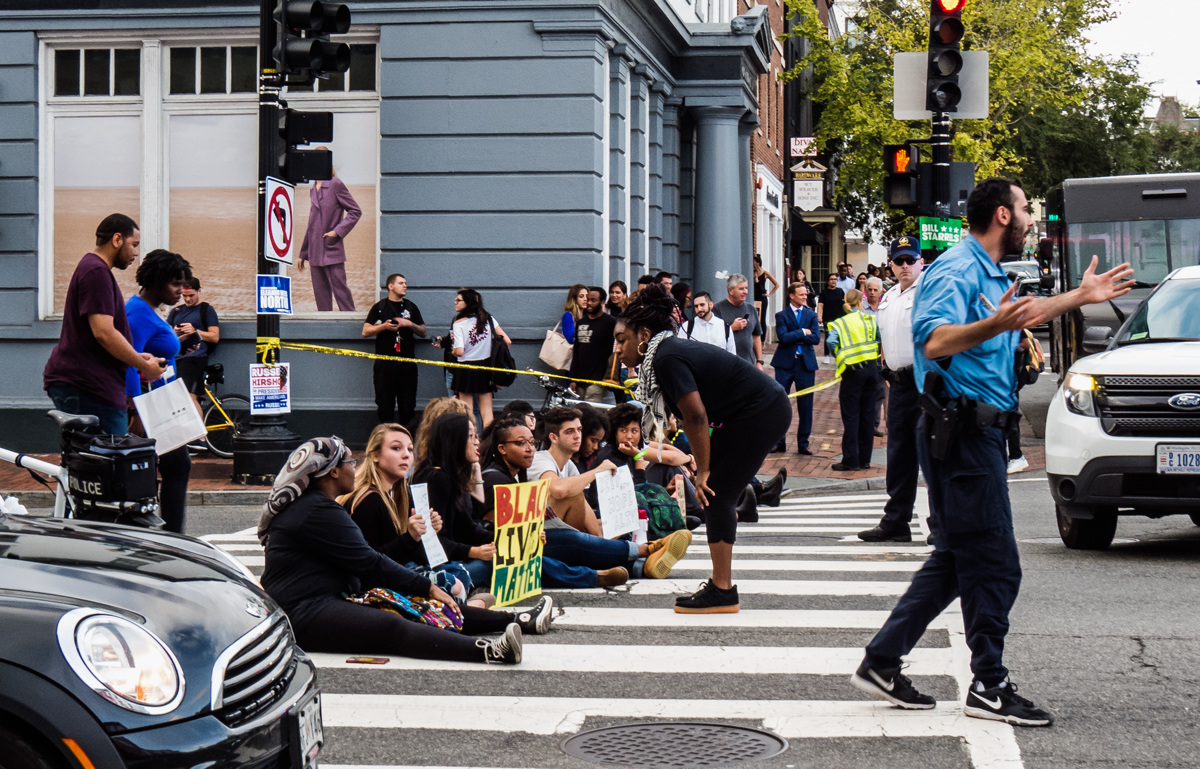
Last Friday about 5:30 pm I was in the Georgetown area of Washington D.C. right at the time when a small group of protesters caused M Street to be closed by sitting in middle of the lane heading toward Key Bridge, one of only a few bridges linking the capital city with Virginia. Here are a few shots of the protesters and the police.

Readers who follow my blog know that I am not used to this kind of photography and I wasn’t really sure how to approach the subject. Roads and intersections were blocked off with yellow tape, preventing me from getting good angles for the shots. It was a small group of protesters and they looked to be of college age, prompting me to wonder if they were from nearby Georgetown University. All varieties of policemen were present to control the crowd and direct traffic onto side streets—there were bicycle cops and motorcycle cops in addition to the expected police squad cars.

I was happy that I happened to have my Canon SX50 superzoom with me, because the zoomed allowed me to frame some shots differently without having to move around a lot. In the end I chose three shots to post that captured different aspects of protest, mostly focusing on the human element.

Protest in Georgetown

Protest in Georgetown

Protest in Georgetown

© Michael Q. Powell. All rights reserved.

Read Full Post »

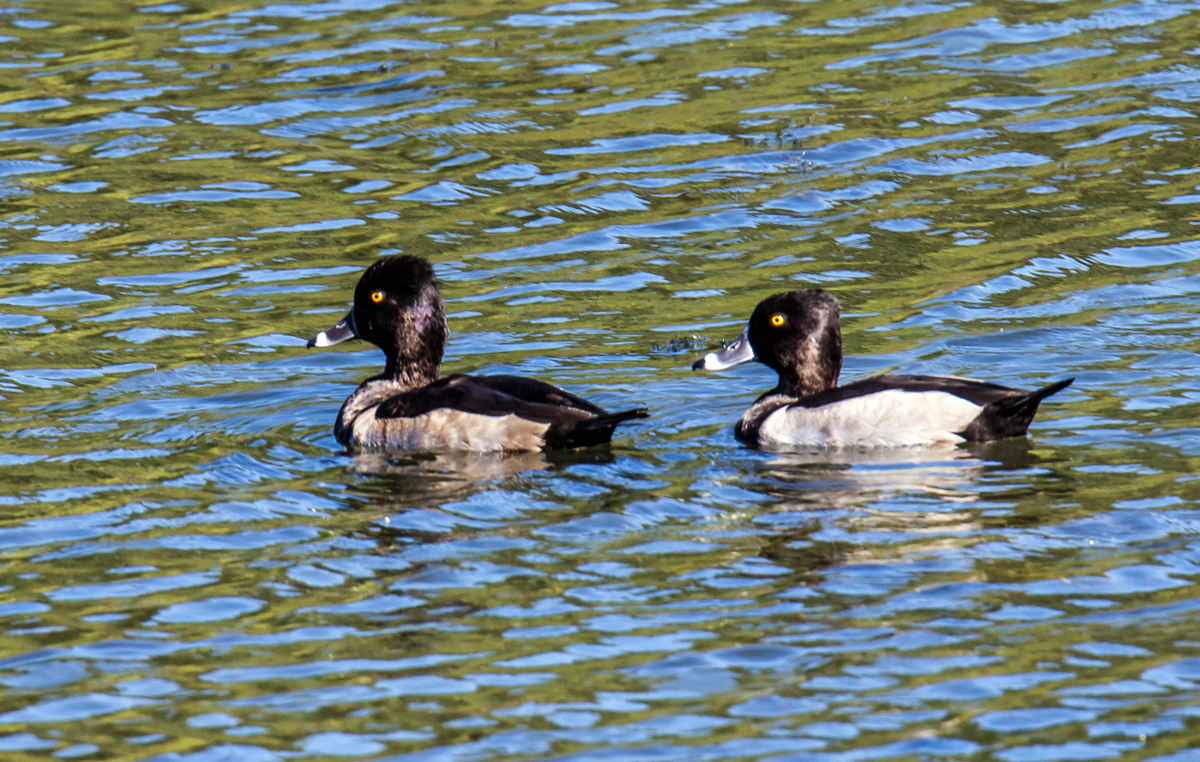
As we move deeper into fall we will be seeing more and more migrating birds in Northern Virginia, where I live . Some will just be passing through the area, but others will probably overwinter here, like these Ring-necked ducks (Aythya collaris) that I spotted yesterday at a small suburban pond less than a mile from my townhouse.

Unlike most of the ducks that I see, Ring-necked ducks are diving ducks, not dabbling ducks. As a consequence, they spend most of the time in the middle of the pond, making them a bit tough to photograph. Fortunately the sun was shining brightly yesterday, so that I was able to capture the ducks’ golden eyes even when shooting at a distance.

Ring-necked duck


© Michael Q. Powell. All rights reserved.

Read Full Post »

The beautiful orange and brown colors of this Eastern Comma butterfly (Polygonia comma) that I recently spotted at Huntley Meadows Park make it a perfect symbol of this autumn season. This species seems to like to perch on trees, sometimes facing downward, as was the case this time.

Not long ago I did a posting that featured a Question Mark butterflya species that closely resembles this one, but the relatively clear white marking on the hind wing make me think this is an Eastern Comma butterfly. My recent record in correctly identifying butterflies has not been great, however, so I welcome a correction if my identification is incorrect.

It is not immediately apparent from this image, but Eastern Comma butterflies blend in really well with the bark of the trees. The sun was shining through the wings from behind, making the orange color of the inner wings much more prominent than usual, allowing us to see both the colors and the shape of this beautiful butterfly.

Eastern Comma

© Michael Q. Powell. All rights reserved.

Read Full Post »

This spooky spider image that I took late Friday afternoon while hiking along part the Potomac Heritage Trail is probably more suitable for later in the month, but I just couldn’t wait until Halloween to share it.

Normally when I use fill flash I try to be subtle, attempting to add a little pop without making it obvious that I used flash. In this case, you can’t help but notice my use of the popup flash. Normally I would take a shot of a spider like this with my macro lens, but I was travelling light with just my superzoom Canon SX50. The 50x zoom of this camera has helped to bring distant subjects closer, but I had never tried to use the camera’s macro mode. I quickly learned that you have to be really close to your subject, literally only a few inches away. I was pretty happy when I was able to get the second shot below, but wanted to add to the drama of the shot.

I dropped the exposure compensation in the camera down to a minus three stops and got my favorite shot. The darkened sky and the way that the flash illuminates the spider give the image a kind of creepy look that feels appropriate for a spider that was just about at eye level.

spooky spider

spooky spider

© Michael Q. Powell. All rights reserved.

Read Full Post »

Earlier this week I chased after this beautiful little butterfly at Green Spring Gardens, in Alexandria, Virginia. I am pretty sure that it’s a Clouded Sulphur butterfly (Colias philodice), but have no idea of the identity of the flower on which it is feeding. Although at first glance it may look like I used flash for this image, a close examination of the shadows shows the direction of the bright sunlight. I was using spot metering for this light-colored subject, which meant that the background was significantly underexposed when getting a proper exposure of the primary subject.

Clouded Sulphur

© Michael Q. Powell. All rights reserved.

Read Full Post »

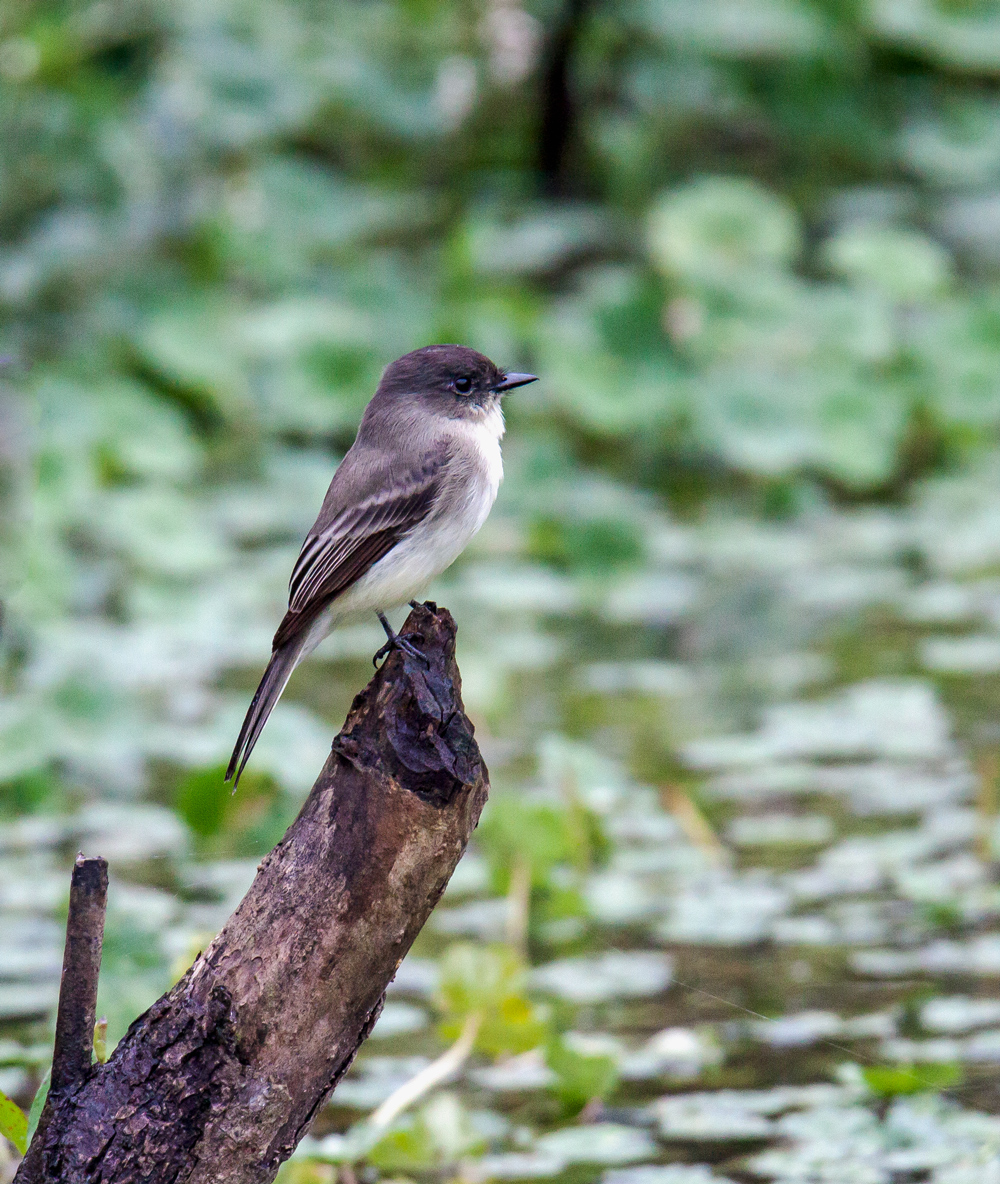
I love trying to capture images of fierce raptors and other large birds, but there is something equally gratifying about getting a glimpse of gentle little birds, like this Eastern Phoebe (Sayornis phoebe) that I spotted recently at Huntley Meadows Park. Most of the time birds like this are invisible to me, hidden among the leaves high in the trees. On the day I took this shot, however, the phoebe was perched in a sheltered area, perhaps because of the intermittent rain, and I was able to capture this simple little portrait.

Eastern Phoebe

© Michael Q. Powell. All rights reserved.

Read Full Post »

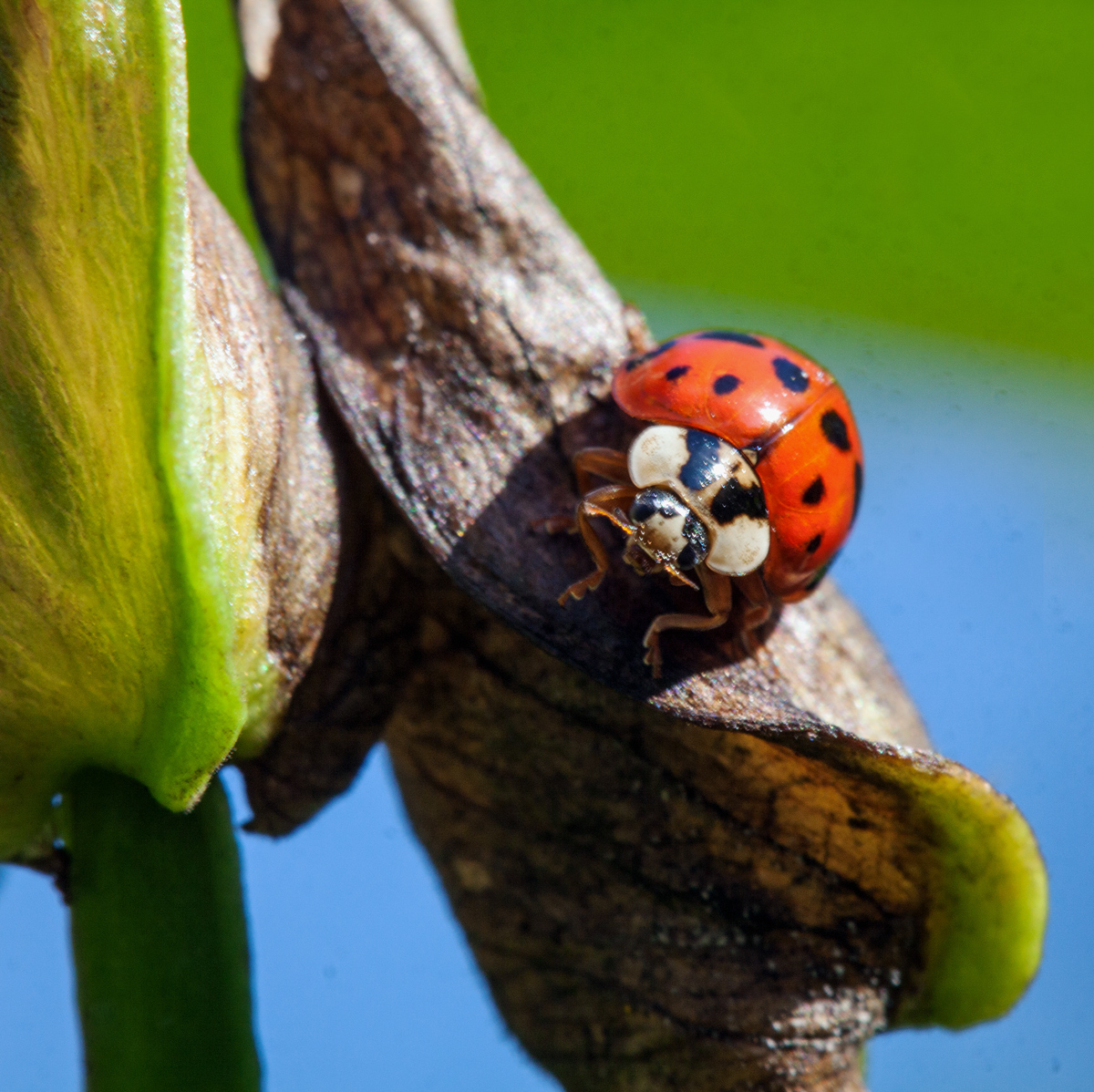
I love ladybugs but don’t see them very often.  I was therefore pretty happy on Monday when I spotted this one crawling around in the vegetation at Jackson Miles Abbott Wetlands Refuge. So often a ladybug will keep its head so close to the vegetation that it’s hard to see it, but this one cooperated by raising its head, almost like it was posing for me.

ladybug

© Michael Q. Powell. All rights reserved.

Read Full Post »

There are a lot of fallen leaves scattered all about my neighborhood and at first I thought this butterfly was merely one of them. Then it opened its wings, revealing its inner beauty. Wow!

I am pretty sure this is a Question Mark butterfly (Polygonia interrogationis), though there is also a chance that it might be an Eastern Comma butterfly (Polygonia comma). Yes, there are butterflies named after punctuation marks.

How do you tell them apart? Well. there is a little white marking on the wings and if it has a single part, it’s a comma, and if it has two parts, it’s a question mark. My challenge in this case was that the marking was not very distinctive. I looked through a lot of material and photos on the internet and the wing shape and coloration started to push me toward the Question Mark, but I still had questions. I came across a posting by TrekOhio.com that illustrated the differences in the spots on the inner wings and I convinced myself the spots in the second photo look like those of a Question Mark.

Whatever the case, the butterfly’s resemblance to a fallen leaf and its beautiful orange color are reminders to me that autumn is surely here, my favorite time of the year.

Question Mark butterfly

Question Mark butterfly

© Michael Q. Powell. All rights reserved.

Read Full Post »

I am not sure what this Great Blue Heron (Ardea herodias) was doing when I spotted it this past weekend at Huntley Meadows Park, but it looked to be admiring its most recent manicure.

Great Blue Heron

© Michael Q. Powell. All rights reserved.

Read Full Post »

It’s probably good for the ego to have “great” in your name, like Great Blue Herons and Great Egrets. Hopefully this little bird’s self-esteem is not damaged by being called a Least Sandpiper (Calidris minutilla). I spotted this diminutive beauty last week at Huntley Meadows Park before the start of all of the recent rain. The extremely dry weather had made the water very shallow in some portions of the marsh and had attracted tiny shore birds like this one.

Least Sandpiper

© Michael Q. Powell. All rights reserved.

Read Full Post »

On a cloudy, misty afternoon yesterday at Huntley Meadows Park, this female Belted Kingfisher ( Megaceryle alcyon) couldn’t make up her mind where to perch, flying from one rotted tree to another in the marshland. I was thrilled to get this shot when she took off from one of her perches.

Belted Kingfisher

© Michael Q. Powell. All rights reserved.

Read Full Post »

“How can you just leave me standing? Alone in a world that’s so cold?…Why do we scream at each other? This is what it sounds like when hawks cry.” (Apologies to Prince for changing the words of the song “When Doves Cry.”)

On a gray, gloomy day at Huntley Meadows Park,  hawks were crying out all afternoon. One hawk would start to scream and its call would be echoed back from somewhere in the distance. Sometimes I would hear a cry from the cloud-covered sky, but I never got a glimpse of the passing hawks.

I was fortunate to be in the right place when one hawk started crying. From the cry, I knew that the hawk was nearby, but I had trouble locating it as I scanned the trees. Finally I spotted it, a juvenile Red-shouldered Hawk (Buteo lineatus). I snapped off a couple of images and then started to adjust the camera’s settings. I had barely taken the camera from my eye when the hawk took off.

The moment was gone and for a short period of time the marsh was silent.

Red-shouldered Hawk

© Michael Q. Powell. All rights reserved.

Read Full Post »

The leaves are speckled with blemishes and the Red-spotted Purple butterfly (Limenitis arthemis) is faded and tattered, but there is real beauty in the imperfection of autumn. Photographed this past weekend at Jackson Miles Abbott Wetlands Refuge in Fort Belvoir, Virginia.

Red-spotted Purple

© Michael Q. Powell. All rights reserved.

Read Full Post »

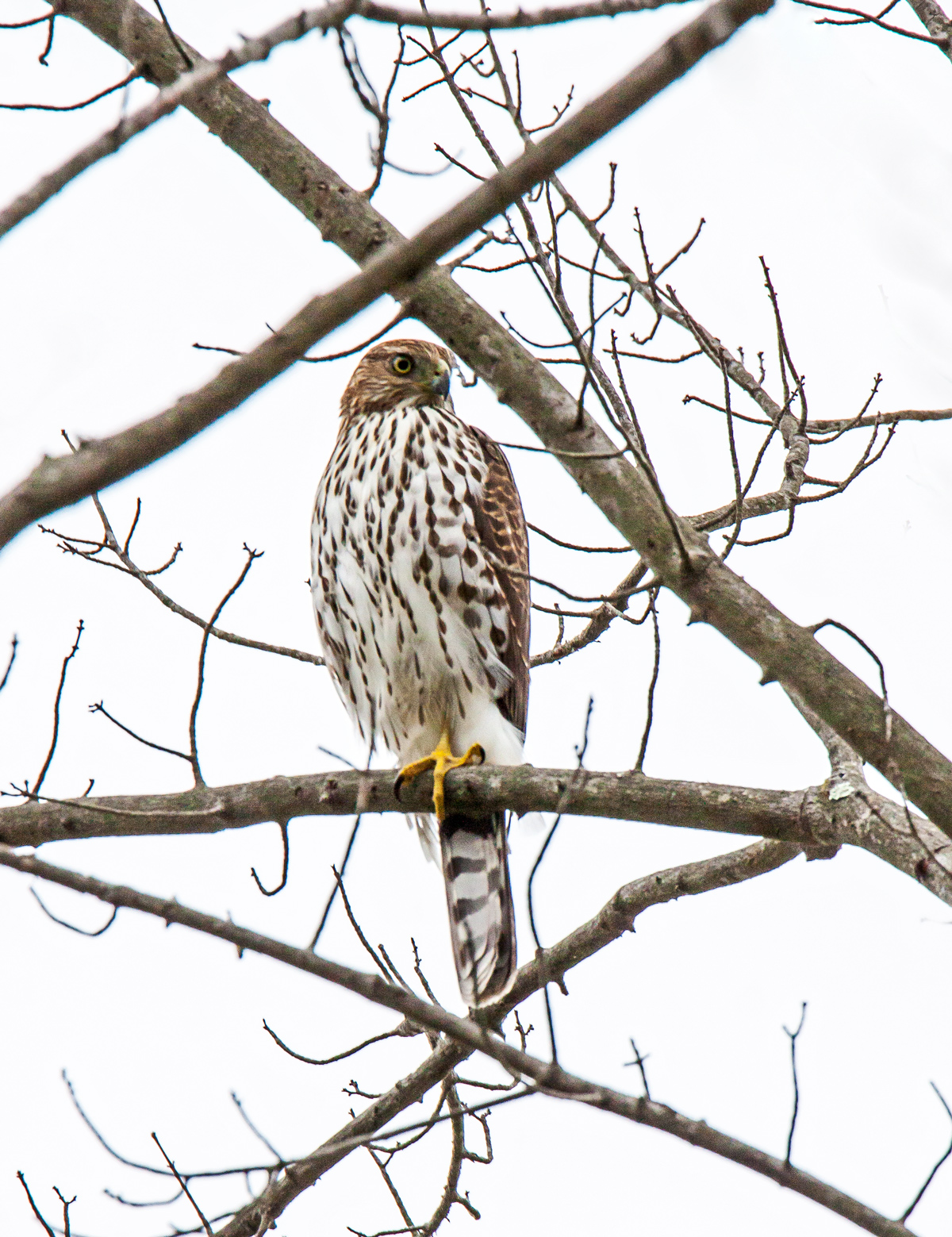
On Monday I spent a good amount of time watching this hawk in a distant tree at Huntley Meadows Park (and, alas, missed the shot when it flew away). There is something simultaneously beautiful and fierce about hawks and eagles that never fails to attract me. Clouds covered the sky for the entire day and there just wasn’t a whole lot of light to work with. That’s why this image has an almost monochromatic look, which makes the yellow color of the talons and the eye stand out even more prominently.
I think this is a Red-shouldered Hawk (Buteo  lineatus), but would welcome a correction to my identification.
Update: A Facebook friend, who is a much more experience birder than I am, has suggested that this may be a juvenile Sharp-shinned Hawk (Accipiter striatus), while others say it is probably a juvenile Cooper’s Hawk (Accipiter cooperii ). Again I am proving to be identification-challenged.
Red-shouldered Hawk

© Michael Q. Powell. All rights reserved.

Read Full Post »

I’m always happy to see a black and yellow garden spider (Argiope aurantia). I love its colorful patterns and its intricate web (and apologies to readers who are totally creeped out by spiders). I spotted this beauty this past weekend in a patch of goldenrod at Jackson Miles Abbott Wetlands Refuge.

Argiope aurantia

© Michael Q. Powell. All rights reserved.

Read Full Post »

Fog hung over the wetlands at Huntley Meadows Park early Friday morning, making the walk on the boardwalk a little eerie. When a spooked Great Blue Heron (Ardea herodias) took off right in front of me I was scared almost witless, but had the presence of mind to get this shot.

Great Blue Heron

Here’s a shot that I took shortly after the first one that gives you a sense of what the boardwalk looks like as it makes it way through the wetlands of my favorite marshland park.

fog2_blog

© Michael Q. Powell. All rights reserved.

Read Full Post »

Water levels are pretty low in some areas of the wetlands at my favorite marshland park, providing a perfect habitat for some visiting shore birds. On Friday at Huntley Meadows Park I spotted a number of tiny shore birds including this one that I am pretty sure is a Semipalmated Plover (Charadrius semipalmatus).

Semipalmated Plover

© Michael Q. Powell. All rights reserved.

Read Full Post »

On Friday I had a close encounter with one of my favorite dragonflies, a spectacular Blue-faced Meadowhawk (Sympetrum ambiguum). This species is a sign for me each year of the arrival of autumn and I eagerly await its appearance. I find the blue eyes to be mesmerizing and simply love the way that they contrast with the bold red color of its body.

I could go on and on about the beauty of this dragonfly until I too was blue in the face, but I will simply let you enjoy a glimpse of its beauty.

Blue-faced Meadowhawk

© Michael Q. Powell. All rights reserved


Read Full Post »

The rays of sunshine illuminated her face and our eyes met and Katy and I shared a moment when time seemed to stand still. Alas, the spell was soon broken and she abandoned me. Yes, Katy did.

I took this shot last weekend at Jackson Miles Abbott Wetlands Refuge at Fort Belvoir, Virginia. I believe that “Katy” is a Handsome Meadow Katydid (Orchelimum pulchellum), although much of the katydid’s body remained in the shadows so I am not one hundred percent sure of the species identification, though the length of the antennae makes me confident that it is a katydid and not a grasshopper.

It was a fun challenge to get this shot, which I decided to post uncropped. I was sprawled on the ground, trying to get at eye level with the katydid and move in as closely as I could without disturbing the stalks of grass. For a shot like this, my 180mm macro lens was perfect, though I really have to focus on technique to make sure that my shooting position is steady, given that the lens does not have any built-in image stabilization (VR for Nikon folks).

Handsome Meadow Katydid

© Michael Q. Powell. All rights reserved

Read Full Post »

Despite the “common” in their name, I don’t see Common Wood Nymphs (Cercyonis pegala) very often. I was therefore pretty excited to spot one this past weekend at Huntley Meadows Park.
I’m pretty sure, though, that my excitement does not qualify as nymphomania.
Common Wood Nymph

© Michael Q. Powell. All rights reserved

Read Full Post »

I can identify most of the large butterflies here in Northern Virginia, but the tiny ones continue to confound me. This past weekend I was able to get some shots of some tiny beauties with my macro lens, but I am not really confident in my identification of any of them.

The first image, I think, may be an Eastern Tailed-blue butterfly (Blue Everes comyntas) or it could be some kind of hairstreak butterfly. The second one looks to be a sulphur, but I can’t decide if it is clouded, cloudless, or some other kind of sulphur butterfly. As for the final shot, I don’t even have a guess.

Despite my confusion about identification, I can’t help but be overwhelmed by the delicate beauty of this tiny creatures.

Eastern Tailed-blue

sulphur butterfly

tiny butterfly

© Michael Q. Powell. All rights reserved

Read Full Post »

Late Saturday afternoon I was exploring Cook Lake, a tiny urban fishing lake adjacent to a water park in Alexandria, Virginia. I accidently spooked a Great Blue Heron (Ardea herodias) that flew to a fallen tree on the shore. The lighting was beautiful and the heron struck a pose that I can only describe as heroic.

I never get tired of photographing Great Blue Herons.

Great Blue Heron

© Michael Q. Powell. All rights reserved

Read Full Post »

I have always been fascinated with frogs. As a child, I remember my amazement at seeing photos of colorful tropical frogs in National Geographic, especially the green tree frogs with big red eyes.  Growing older, I loved Kermit the Frog, especially his quirky sense of humor and his propensity for bursting out in song. Even now, one of my all-time favorite movie scenes is from the beginning of The Muppet Movie, where the view begins high above the trees and gradually zooms in on Kermit, who is sitting on a log playing the banjo and singing The Rainbow Connection. I try to hold on to the innocent, wide-eyed optimism of that song.

As a photographer, I have list of aspirational shots, made up of images, subjects, and situations that I would love to photograph. For a long time, I longed to capture a photo of a frog perched on a lily pad. After numerous unsuccessful attempts, I managed to capture such an image a couple of years ago. Despite that “success” I still keep my eyes open for frogs whenever I am in an area with lily pads.

This past weekend I hit the jackpot when I spotted three frogs on a single lily pad. I was exploring a small lake at Ben Brennan Park, a small suburban park in Alexandria, Virginia with a variety of recreational facilities. There is a small elevated bridge over one section of the lake and it was from this vantage point that I was able to capture this image. Initially the three frogs were all facing outwards, looking like they were defending their pad from outside intruders. Just before I took this shot, however, the frog in the back turned toward the middle and looked like he was trying to sneak up on his buddy.

Perhaps he simply wanted to play a game of leapfrog.

leapfrog

© Michael Q. Powell. All rights reserved

Read Full Post »

« Newer Posts - Older Posts »