Feeds:
Posts
Comments

Archive for the ‘Nature’ Category

At this time of the year I often hear the distinctive singing of Blue-gray Gnatcatchers (Polioptila caerulea), but I rarely get a clear view of these tiny birds. I like the way the Cornell Lab of Ornithology website describes these birds, “The nasal, wheezy, rambling song and insistent, squeaky calls are great first clues to finding them, particularly as these tiny birds can get lost in the generally taller habitats used in the eastern part of their range.” If you are interested in hearing samples of the different calls and songs of Blue-gray Gnatcatchers, click this link to another part of the same website.

Once I have heard the singing, I begin to scan the foliage near the top of top of a tree and if I am lucky I will detect some motion. Blue-gray Gnatcatchers like to flick their tails from side to side to scare up insects and then the gnatcatchers chase after them. Strangely, though, gnats do not form a significant part of their diet. So, in addition to being small (about 4 inches (10 cm) in length), they are almost always moving—that makes it quite a challenge to photograph one.

I was therefore quite thrilled to capture this image last Friday of a Blue-gray Gnatcatcher at Occoquan Bay National Wildlife Refuge. I had been tracking this bird for a while as it moved about from one patch of leaves to another and was more or less ready when it popped out of the foliage onto this small branch.

Blue-gray Gnatcatcher

© Michael Q. Powell. All rights reserved.

Read Full Post »

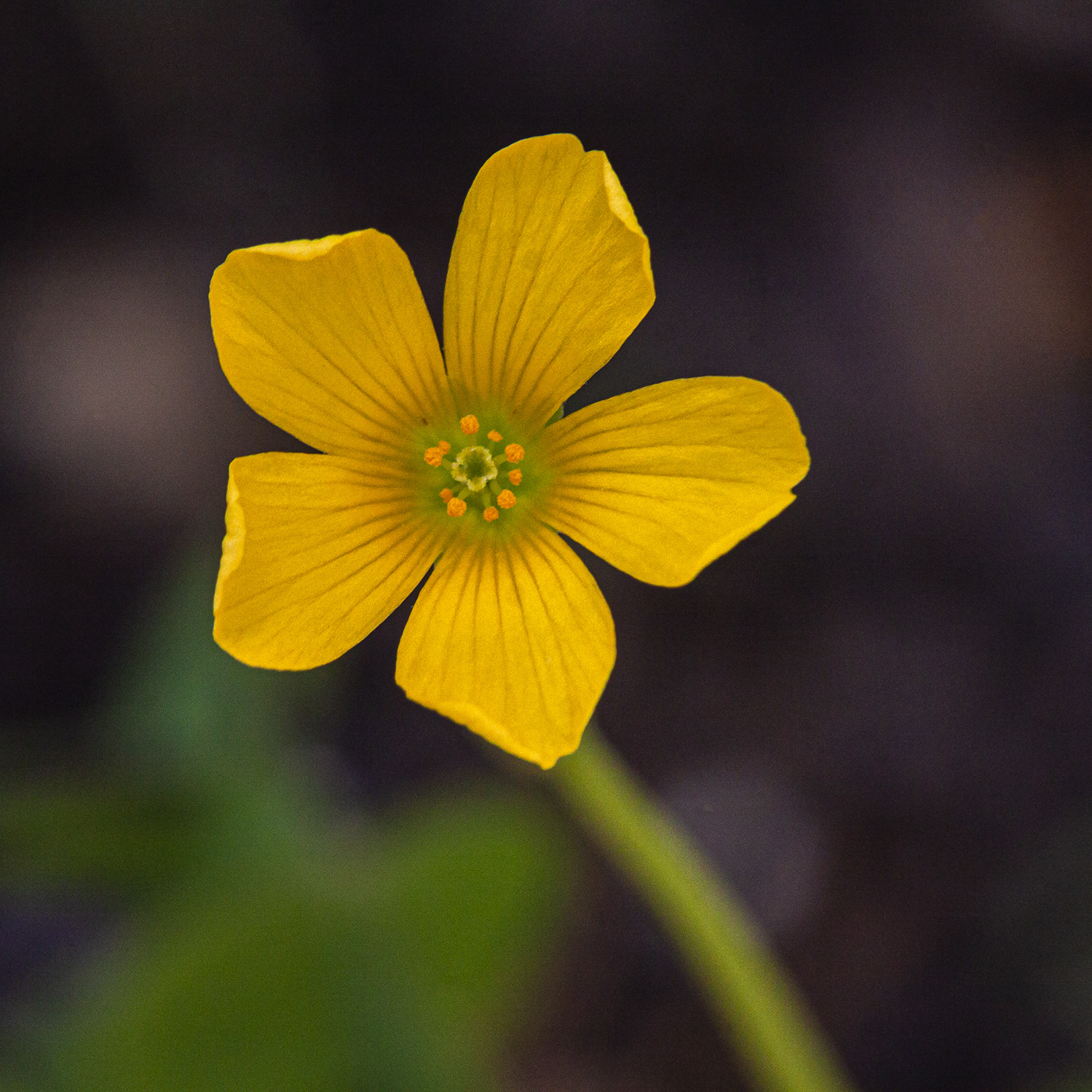
Most of the irises in the garden of my neighbor and photography mentor Cindy Dyer have not yet bloomed, but this one beautiful yellow bearded iris decided to jump ahead of the others. Most of the iris buds are on stems several feet high, but this blossom is only a few inches off of the ground—perhaps that is why it was an early bloomer.

If you look closely at the two shots, you will immediately notice that I took them on separate days. The light was quite different on each those days and there were raindrops present on the petals when I took the second shot. Additionally, I chose a very different shooting angle for each image and processed them to emphasize different aspects of the photo. I have a slight preference for the overall feel of the first shot, but love the raindrops in the second shot—I think the pair of images work well together in tandem.


yellow iris

yellow iris

© Michael Q. Powell. All rights reserved.

Read Full Post »

I never fail to be entranced by the striking blue eyes of a Double-crested Cormorant (Phalacrocorax auritus), like this one that I spotted last week at Occoquan Bay National Wildlife Refuge. Most of the time when I spot cormorants, they are in the deep waters and their eyes are too far away to be seen. Even when they are a bit closer, the eyes are often hidden by shadows.

On this occasion, however, the cormorant was in a small pond, so I was able to track it easily after I spotted it. On one of its dives the cormorant popped up within range of my camera and turned into the light for a moment before it submerged itself again, allowing me to get this shot with a clear view of its sparkling blue eyes.

Double-crested Cormorant

© Michael Q. Powell. All rights reserved.

Read Full Post »

It has been almost a month since I last checked in on the Ospreys (Pandion haliaetus) at Occoquan Bay National Wildlife Refuge. Last month they were busy collecting materials to build or repair their nests. Last Friday I spotted several nests that had grown considerably in size and the ospreys in the nests appeared to be sitting on their eggs.

I captured this image when one of the sitting ospreys had lifted her head to the sky, looking with hopeful expectation for her mate to return. Maybe he would be bringing her a fresh fish or perhaps he would be spelling her a bit from her maternal duties or could it be that she simply longer for his presence.

osprey

© Michael Q. Powell. All rights reserved.


Read Full Post »

Does the pressure of confinement/isolation/social distancing weigh you down? I know that I definitely feel that way at times. What I found on Friday morning, though, was that I felt totally free and uninhibited when I was chasing after this Zebra Swallowtail butterfly (Protographium marcellus). From a distance I must have looked like a madman as I ran back and forth and in circles trying to stay close to this butterfly.

It was more than just hoping and passively waiting—I put all of my energy into my childlike desire to to get a closer look at this beautiful butterfly. Maybe one of the secrets to handling the stresses inherent in today’s crises is to seek pleasure in simple joyful activities, like chasing a butterfly.

Zebra Swallowtail

© Michael Q. Powell. All rights reserved.

Read Full Post »

On Friday morning, the temperature was only 38 degrees F (3 degrees C), so I abandoned my macro lens, assuming that insects would not be active, and switched back to my telephoto zoom lens. I returned to my favorite location, Occoquan Bay National Wildlife Refuge (OBNWR), to look for birds. This location is relatively remote and has few amenities, which means that it is rarely crowded—there have been times in the past when my car was the only one in the parking lot. Unlike many parks in our area, OBNWR remains open and it has become my place of refuge.

It has been almost a month or so since my last visit, so I was not sure which birds would be active. As you may have seen in yesterday’s posting, some warblers are now passing through our area. While it is nice to welcome these colorful visitors, I was perhaps even happier to spot some of my favorite year-round residents, the Bald Eagles (Haliaeetus leucocephalus). There are at least two active eagle nests in the refuge and one of the volunteers there told me that there is already an eaglet in one of the nests.

I captured these two images not far from the nest with the eaglet, so it is quite possible that at least one of these eagles is a parent. The early morning sunshine was quite beautiful and I love the way that it illuminated the side of the eagle’s face in the first image. The second image gives you an idea of the amount of leaves now on the trees, which makes it difficult to spot birds, especially the smaller ones. Fortunately the white coloration of the bald eagles and ospreys and their large size makes it hard for them to hide completely.

It is reassuring to see that the cycle of life is continuing normally in nature even when our lives have been completely disrupted and most of us are confined and/or in isolation.

Bald Eagle

Bald Eagle

© Michael Q. Powell. All rights reserved.

Read Full Post »

When I saw this insect sipping nectar from a Spring Beauty wildflower on Tuesday, I was sure that it was some kind of wasp or hornet. Bees, I thought, do not have such narrow waists. I was wrong. Some of the experts at bugguide.net identified my insect as a male Nomad Bee (genus Nomada).

Nomad Bees are the largest genus of kleptoparasitic “cuckoo bees,” according to Wikipedia. “Kleptoparasitic bees are so named because they enter the nests of a host and lay eggs there, stealing resources that the host has already collected.” Nomad bees do sip nectar like other bees, as you can see in my photos, but do not collect pollen to feed their offspring.

I remember being shocked the first time that I read about cuckoos and cowbirds deliberating laying their eggs in the nests of other birds to avoid having to build their own nests and raise their own babies. I guess I can add nomad bees to the list of deliberately delinquent parents.


nomad bee

nomad bee

© Michael Q. Powell. All rights reserved.

Read Full Post »

It is warbler season now where I live. This can be a frustrating time of the year for me, because the arrival of these colorful migrating birds coincides with the re-leafing of the trees. I can hear the warblers and occasionally get a glimpse of their bright colors through the leaves, but it is rare for me to get a clear shot of one.

Yesterday, I was thrilled to capture this image of a Yellow-rumped Warbler (Setophaga coronata) at Occoquan Bay National Wildlife Refuge. I started to track this bird as it was moving about in the foliage and was fortunate to be ready when it paused for a split second in the open. I did not plan this particular composition, but it worked out really nicely with the shapes of the branches on the right side of the image and the mostly out of focus leaves on the left.

This image speaks of spring to me. Happy Spring to those in the Northern Hemisphere and hopefully those experiencing autumn in the Southern Hemisphere will also enjoy the bright springtime colors.


Yellow-rumped Warbler

© Michael Q. Powell. All rights reserved.

Read Full Post »

I love the beautiful curves a fiddlehead forms as it gradually unfurls into a full-fledged fern frond. I have no idea how long this entire process takes, but it was amazing to see the various stages of development of the many fiddleheads that I spotted on Tuesday while exploring in Prince William County.

The clouds in the sky and the unseasonably cold temperatures seemed to have prompted all of the dragonflies to remain in secluded spots and I did not spot a single one that day.

fiddlehead fern

fiddlehead fern

fiddlehead fern

© Michael Q. Powell. All rights reserved.

Read Full Post »

Most of the time when I see spiders, it is because I spot their webs first.  Some spiders, though, rely exclusively on speed to capture unsuspecting prey, like this Six-spotted Fishing Spider (Dolomedes triton) that I spotted on Monday at Jackson Miles Abbott Wetland Refuge.

Fishing spiders sit at the edge of the water with some of their long legs fully extended. When they sense vibrations of a potential prey on the surface of the water, fishing spiders can walk on the water to seize insects, vertebrates, tadpoles and occasionally small fish or even dive underwater up to 7.1 inches (18 cm), according to Wikipedia.

When I first spotted this fishing spider, it was perched on a semi-submerged log, as shown in the second image below. The spider somehow sensed my presence and ran towards some vegetation at the edge of the water. I was able to maneuver to a position from which I was looking almost directly down at the spider and captured the first image which makes the spider look rather large and menacing, which is why I selected the photo as the featured image.

six-spotted fishing spider


six-spotted fishing spider

© Michael Q. Powell. All rights reserved.

Read Full Post »

I love ladybugs and was thrilled to spot this one on Monday at Jackson Miles Abbott Wetland Refuge. When I posted this photo on Facebook, one viewer noted that this is a Multicolored Asian Lady Beetle (Harmonia axyridis), a non-native species that has become the most common species in the United States since it was deliberately introduced into the country in 1916 in an attempt to control the spread of aphids.

How can you tell a native ladybug from the Asian ladybug? Several sources on-line note that the Asian ladybug has a white marking behind its head in the openings of what looks like a black M, as you can see on the ladybug in my photo. If you are interested in learning more about the differences, check out this fascinating article at thespruce.com, The Differences Between Ladybugs and Asian Lady Beetles.

Whether native or not, this ladybug in my eyes is beautiful. If you want to see something really cool, click on the photo and check out the details on the ladybug’s front foot. I never knew that ladybugs have two tiny toes.


ladybug

© Michael Q. Powell. All rights reserved.

Read Full Post »

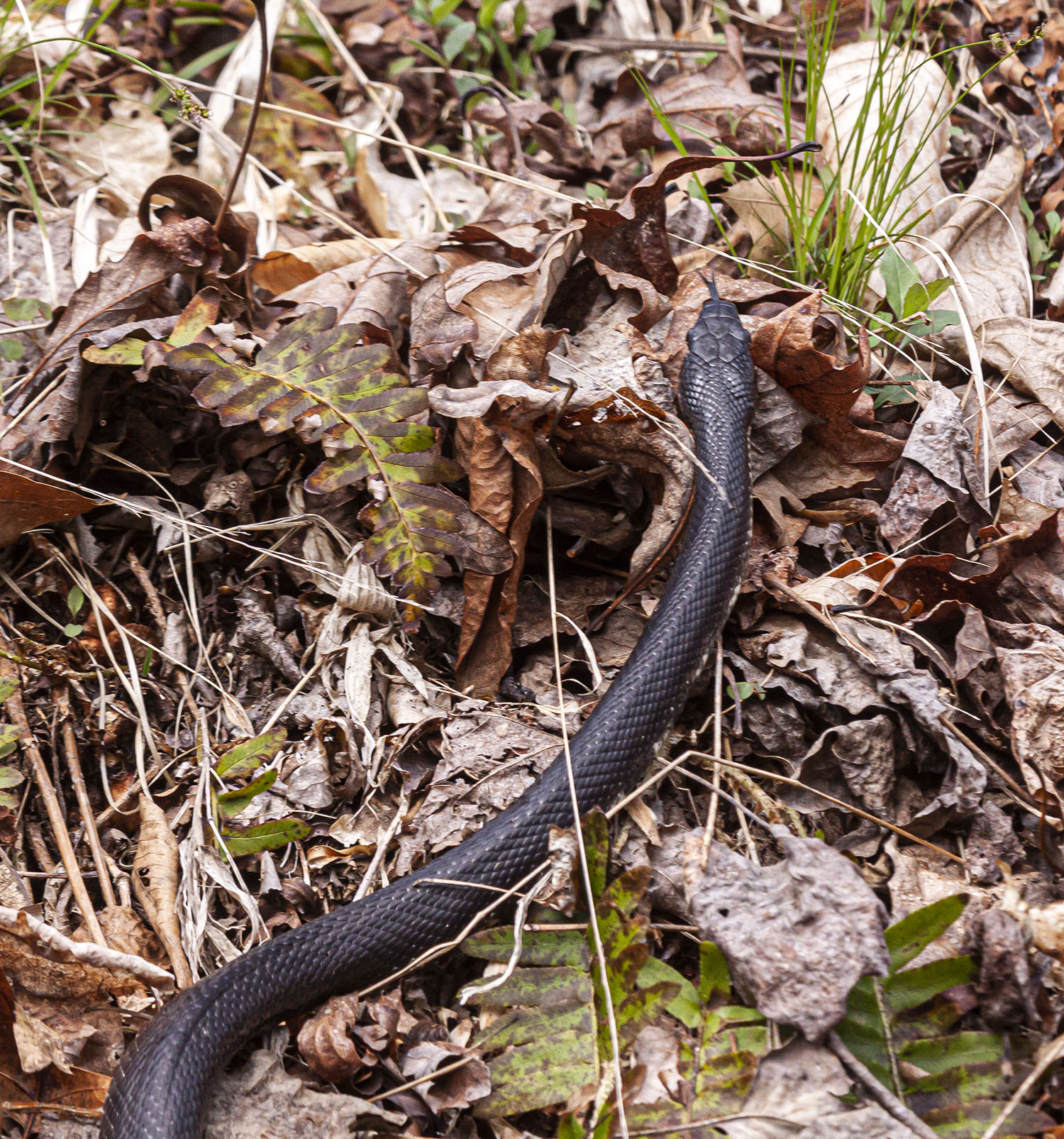
So many of the creatures that I encounter blend in so well with their environments, that I detect them only when they move. That was the case with this Eastern Ratsnake (Pantherophis alleghaniensis) last week that I spotted while I was exploring in Prince William County, Virginia.

I was a bit startled when the leaves started to rustle almost directly beneath my feet and my eyes detected the form of a large black snake slowly slithering away from me. The snake apparently had been sunning itself before I inadvertently disturbed it.

After the snake had moved some distance up the side of a small hill covered with fallen leaves and vegetation, it paused and turned to the side, allowing me to capture the first shot below. As those of you who know me might suspect, I too had been making my way up the hill parallel to the snake, waiting for such an opportunity to arise to get a shot of the snake’s head, which explains why I was able to take the shot from relatively close range.

Eastern Ratsnake

Eastern Ratsnake

© Michael Q. Powell. All rights reserved.

Read Full Post »

When they are mating, many dragonflies adopt a very conspicuous heart-shaped “wheel” position, like this pair of Common Green Darner dragonflies (Anax junius) that I spotted last week at Occoquan Bay National Wildlife Refuge. The process begins when the male, in this case the dragonfly with the blue abdomen, grabs a female by the back of her neck with claspers at the end of his abdomen that fit into species-specific grooves in the female. The two dragonflies are then hooked together, often for extended periods of time.

I couldn’t help but notice the sharp thorns on the branch that these dragonflies had selected for their encounter. Yikes—that is living life on the edge. After I took some photos, feeling a little like a voyeur, I decided to give the couple some privacy. When I circled back a short time time later, the dragonflies were gone, presumably having done their part to perpetuate the species.

common green darner

© Michael Q. Powell. All rights reserved.


Read Full Post »

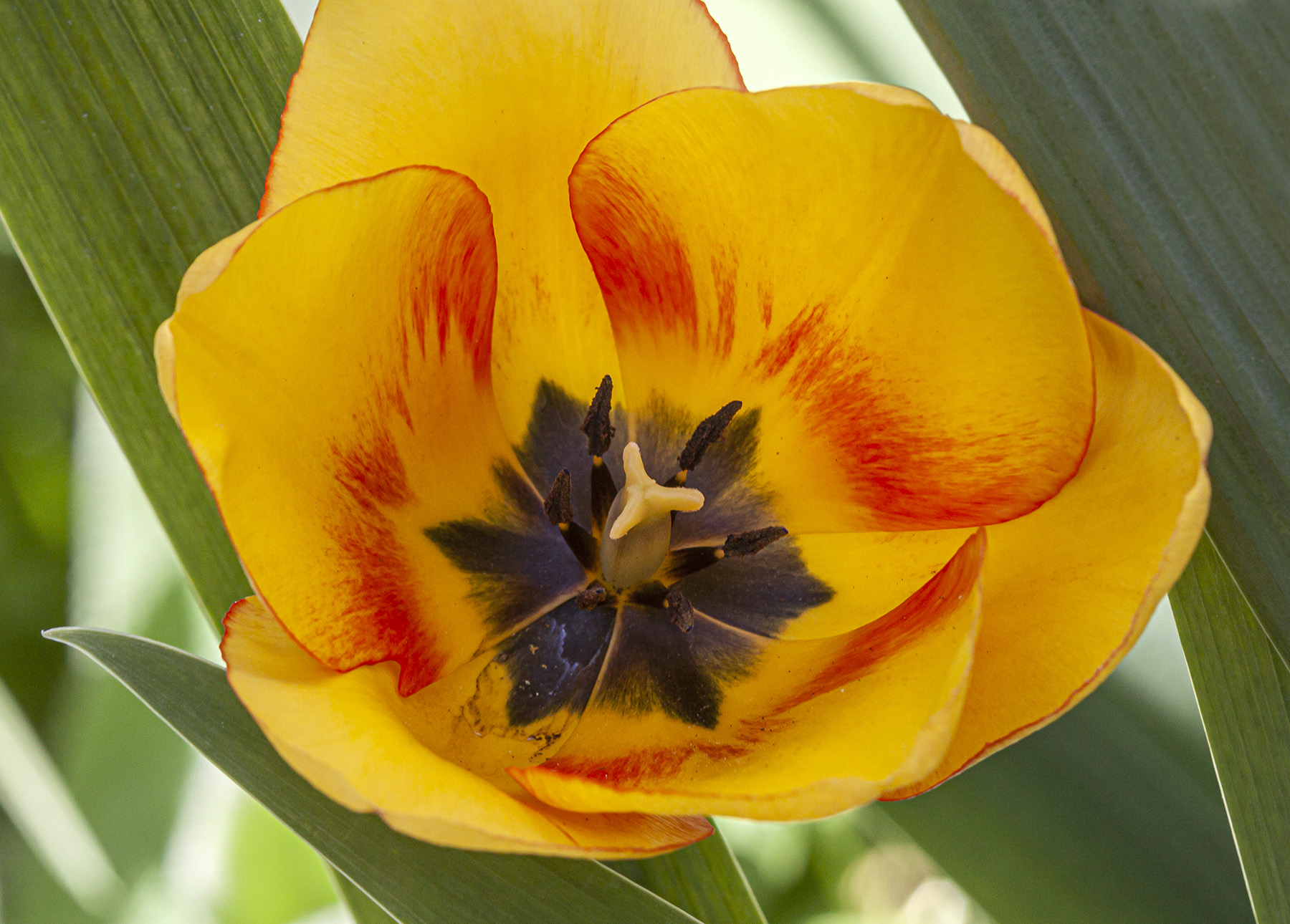
Here are some bright colors to kickstart your day as you look into the center of one of the spectacular tulips in the garden of my friend and neighbor Cindy Dyer. Have a wonderful day!

tulip

© Michael Q. Powell. All rights reserved.

Read Full Post »

Many Easter traditions will be put to the side this year. No boisterous crowds filling the churches, no special clothes or big hats, no joyful greeting of  “Alleluia. Christ is risen” to all we meet and the equally joyful response of “The Lord is risen indeed. Alleluia.” A good number of us instead will celebrate alone in front of a computer screen.

Yes, Easter will be celebrated differently this year, but for many of us there will be even greater beauty and meaning in our more simple celebrations. At a time when most of the world news is full of doom and despair, today is a joyful reminder that God loves us and will have the final victory.

So what do we do? I recall some words from a sermon that I heard on Good Friday—the priest cited the opening line of a prayer by Pierre Teilhard de Chardin, “Above all, trust in the slow work of God.” It will take time for things to return to any sense of normalcy, but we should never give up hope.

My hope and prayer for all today, whether you celebrate Easter or not, is that you can put aside at least some of your incessant worries and seek to find joy in whatever way you can. For me, joy and beauty can be found in small things, like this tiny flower that I photographed recently in the garden of my neighbor. I have no idea what it is, but I know that it sparked joy in me the moment I spotted it.

Happy Easter.

flower

flower

© Michael Q. Powell. All rights reserved.


Read Full Post »

The frog in the photo does have a few spots, but the spots on the leaves are what really draw my attention to this image—they provide an almost visually perfect background for the main subject. I spotted this little frog earlier this week while hunting for dragonflies in Prince William County, Virginia.

I believe that this is an Eastern Cricket Frog (Acris crepitans crepitans), but was a little confused when I saw repeated references to a Northern Cricket Frog.  I think I finally sorted it out in my mind and if I understand it correctly the Eastern Cricket Frog is one of the subspecies of the Northern Cricket Frog (Acris crepitans). Logically it seems odd that east would be a subset of north, but that seems to be the case here.

Eastern Cricket Frog

© Michael Q. Powell. All rights reserved.

Read Full Post »

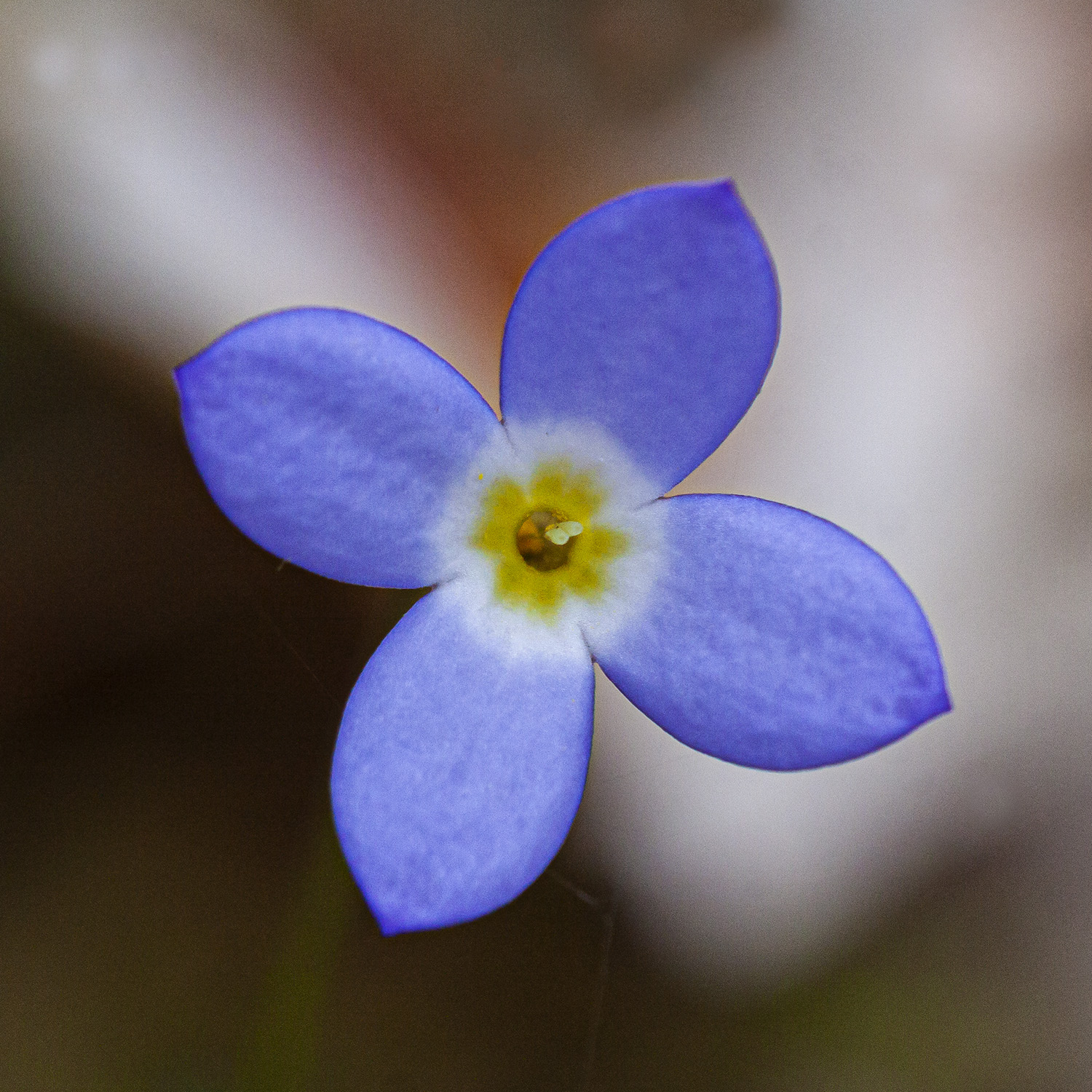
I featured some tiny white forest wildflowers in a recent posting. Here now as a companion to that posting are a few images of colorful forest wildflowers that I have seen when exploring recently in Prince William County.

The first shot is a small wildflower known simply as a Bluet (Houstonia caerulea). The flower in the second image is the appropriately named Spring Beauty (Claytonia virginica), known also as the Eastern Spring Beauty, because there is also a similar Western Spring Beauty (Claytonia lanceolata). I do not know for sure the name of third flower, but I believe that it is some kind of wild violet.

As always, I welcome assistance in identifying my subjects, particularly if I have misidentified one. Thanks.

bluet

spring beauty

wild violet

© Michael Q. Powell. All rights reserved.

Read Full Post »

I have not yet seen any large spiders this spring, but I have run across a few long-jawed spiders. The bodies of long-jawed orb weaver spiders of the Tetragnathidae family tend to be thin and they have extremely long legs of varying lengths. Most often I find them on vegetation overhanging the water, which in this case was a small pond at Jackson Miles Abbott Wetland Refuge.

long-jawed spider

© Michael Q. Powell. All rights reserved.
 

Read Full Post »

It is still really early in the dragonfly season in my area, so each one that I am fortunate enough to spot is special to me. I was therefore thrilled to photograph this male Common Baskettail dragonfly (Epitheca cynosura) on Monday as it was hanging vertically from the leaves of a small tree at Occoquan Bay National Wildlife Refuge. If you double-click on the image, you can see the dragonfly’s tiny feet with which it is clinging to the leaf.

Most of the times in the past when I have seen members of this species, they have been flying out of reach of my camera. According to the Dragonflies of Northern Virginia website, Common Baskettails are hard to spot because they are small with mostly clear wings and spend much of their time hovering high over clearings, making them “probably our least seen “common” dragonfly.”

Common Baskettail

© Michael Q. Powell. All rights reserved.


Read Full Post »

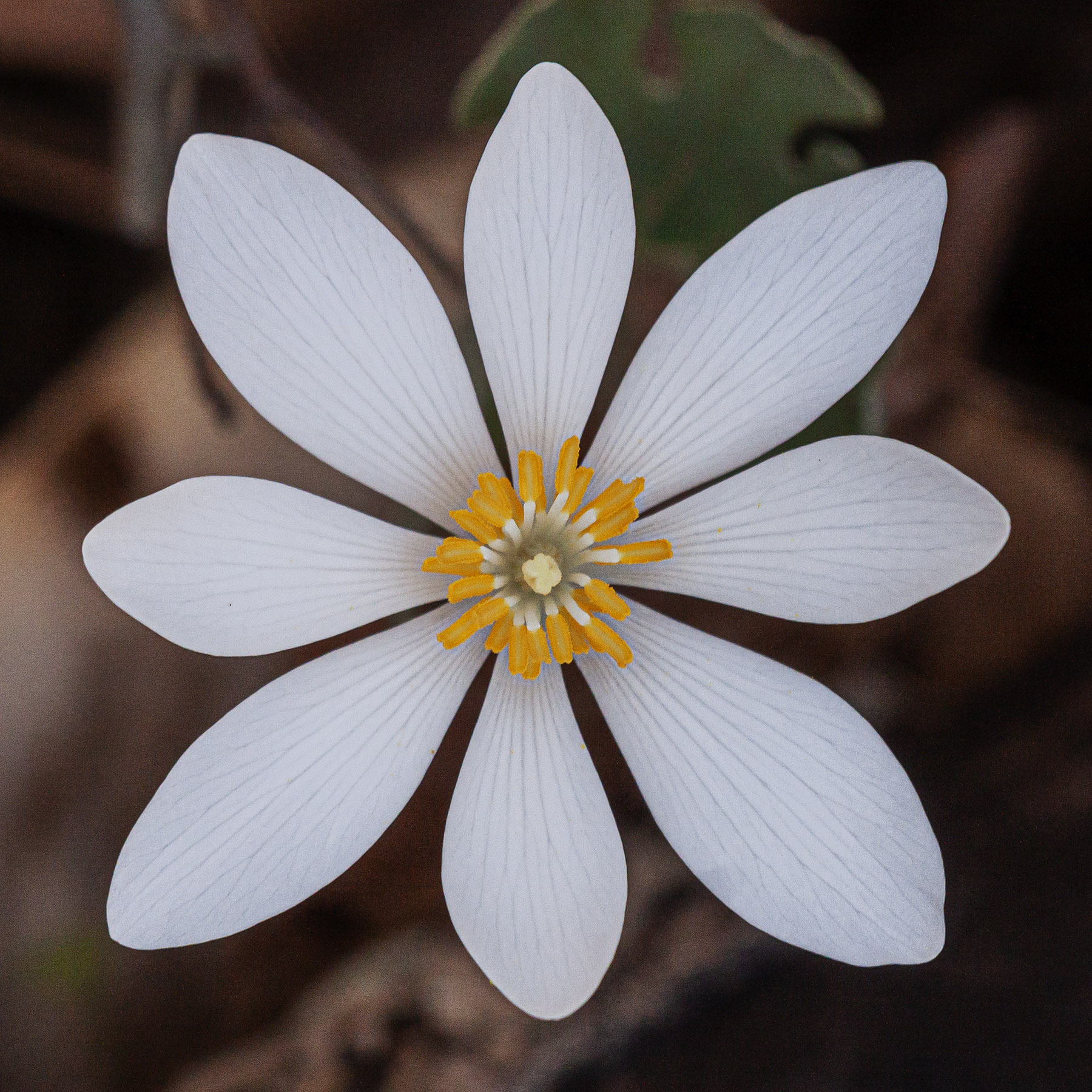
For a short time each spring, tiny wildflowers spring up from the forest floor, giving the forest a magical feel. Many of the forest flowers are white and at first glance they all look the same. When I looked more closely, though, I discovered a wide variety of petal shapes and patterns.

Within this group of three flowers, I can identify only the middle one, which I am pretty sure is a Star Chickweed (Stellaria pubera). If you happen to recognize the others, I would appreciate your help in identifying them. Thanks.

UPDATE:  Steve Gingold has identified the first flower as Bloodroot and the third one as Wood Anemone. Thanks, Steve.

forest flower

forest flower

forest flower

© Michael Q. Powell. All rights reserved.

Read Full Post »

The color and texture of this tulip reminded me of a ripe peach when I first saw it yesterday morning. Alas, it will be months before peaches will be in season and the canned cling peaches that I remember from my childhood can’t compare to the fresh ones.

Like so many of the wonderfully colorful flowers that I have featured recently, this beauty is from the garden of my neighbor and photography mentor Cindy Dyer. Thanks again, Cindy.

At this time of the year, I tend to shoot most often with my 180mm macro lens. With my APS-C crop sensor camera, I get an equivalent field of view of almost 300mm, which gives me some standoff distance for shooting live subjects like dragonflies. However, for shooting subjects like flowers, I found it difficult to frame the images because I was shooting from so far away. For this shot, I switched to a 60mm macro lens and shot with the aperture wide-open at f/2.8.

tulip

© Michael Q. Powell. All rights reserved.

Read Full Post »

I felt like I had hit the jackpot last Friday when I finally spotted several Uhler’s Sundragon dragonflies (Helocordulia uhleri) while exploring a stream in Prince William County, Virginia. Uhler’s Sundragons are a scarce and seldom seen dragonfly species with a brief and early flight period. There is a very active Virginia dragonfly group in Facebook that posts sightings and photos and it appears that my sightings of this species were the first in our state for 2020.

Last year I was able to do some reconnaissance of an area where this species had been spotted in previous years using information shared with me by fellow dragonfly fanatic and blogger Walter Sanford. Eventually I found and photographed some Uhler’s Sanddragons and he and I were able to spot them again several times.

This species generally is found in a specific type of habitat—”Clean, sandy or gravely forest streams with a mix of riffles and pools,” according to the excellent Dragonflies of Northern Virginia website. So Friday I scoured the locations where had spotted them last year and it was in one such location that I spotted the Ashy Clubtail and Common Green Darner that I featured recently in my posting First dragonflies of the season. I looked for Uhler’s Sundragons there but came up empty-handed.

It was at a second spot that I finally spotted one as it flew through the air and landed on a piece of vegetation. There is not much flying this early in the season and I could tell from the way that it perched that it was probably my target species. I think I was shaking a little bit and certainly my heart rate had accelerated, but I managed to get a shot of that one (the middle shot below), before it flew away. A few minutes later, I had another spotting and captured the last shot below—it might have been the same dragonfly or a different one.

Part of my long walk back took me along another stretch of the same stream and I was absolutely thrilled when I spotted yet another Uhler’s Sundragon and captured my favorite shot of the day, the first one below. It turns out that all of the Uhler’s Sundragons that I photographed were females. I am not sure if the males were all out patrolling or were simply in other locations.

Many of the locations where I might normally search for dragonflies are closed and some of the others are potentially crowded, so I am not willing to go there. As you can see from my recent postings, I am staying really close to home most of the time, with trips like this one to remote locations being a rare exception.

Uhler's Sundragon

Uhler's Sundragon

Uhler's Sundragon

© Michael Q. Powell. All rights reserved.
Read Full Post »

What do you call a group of butterflies? I have always been fascinated by the collective nouns that we use in English for groups of creatures. I was delighted to learn that one of the collective nouns used for butterflies is a kaleidoscope.

“A kaleidoscope of butterflies” seems to be the perfect descriptor for this group of beautiful Eastern Tiger Swallowtail butterflies (Papilio glaucus) that I spotted yesterday. They appeared to be engaged in a behavior known as “puddling,” during which the butterflies, most often the males, gather minerals and other nutrients from the soil or other organic material.


Eastern Tiger Swallowtails

© Michael Q. Powell. All rights reserved.

Read Full Post »

Did you look up at the moon last night? I think that technically the full moon is tonight, but the moon was bright and spectacular around 8:30 in the evening when I took two steps out of my house and captured this image from my front landing.

I have been particularly pensive this week, a Holy Week that is unlike any other that I have experienced. It is a time when we commemorate suffering and sacrifice done on our behalf out of love. There is a lot of that same suffering and sacrifice taking place  all around us right now as collectively we try to deal with this virus. The challenges seem immense, but I felt reassurance when I looked up at that almost full moon last night and thought of some verses from the Psalms (Psalm 8: 3-4 (NIV)).

“When I consider your heavens,
    the work of your fingers,
the moon and the stars,
    which you have set in place,
 what is mankind that you are mindful of them,
    human beings that you care for them?”

Stay safe and healthy, all of you.

full moon

© Michael Q. Powell. All rights reserved.
Read Full Post »

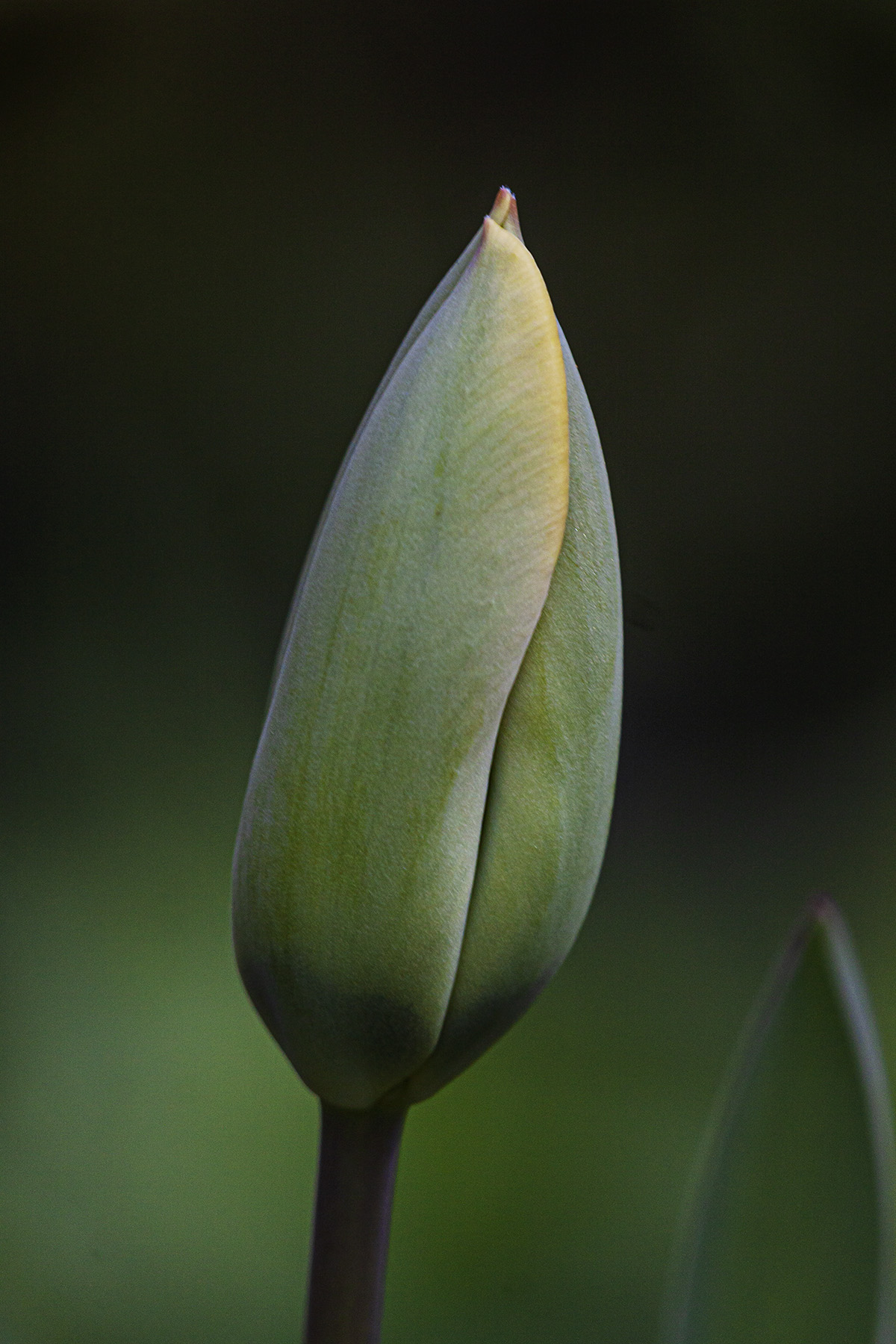
What are your feelings about the future? For me, they are like this tulip bud, full of the promise of new life and beauty that is yet to come. The challenge for us all is to be patient and wait with joyful expectation.

As with all of my other recent tulip shots, I photographed this bud in the garden of my neighbor and friend Cindy Dyer. Thanks, Cindy.

tulip bud

© Michael Q. Powell. All rights reserved.


Read Full Post »

Last Friday I photographed my first dragonflies of the spring, a male Common Green Darner (Anax junius) and a female Ashy Clubtail (Phanogomphus lividus). The Common Green Darner is probably a migratory dragonfly that is just passing through as it heads north—we do have local-born members of this species, but it is too early for them to have emerged.

The Ashy Clubtail, which was actually the first dragonfly that I photographed, almost certainly emerged locally. When a dragonfly emerges, its wings are really shiny and the wings of this Ashy Clubtail were definitely sparkling in the sunlight. According to the local flight calendar, the Ashy Clubtail is one of the earliest dragonflies in our area to emerge, but I have never seen one this early before.

As you can see, I captured the images of both of these dragonflies when they were perched flat on the ground. There were dry leaves all around, which made a stealthy approach almost impossible and focusing on the dragonfly was a bit of a challenge.

Common Green Darner

Ashy Clubtail

© Michael Q. Powell. All rights reserved.

Read Full Post »

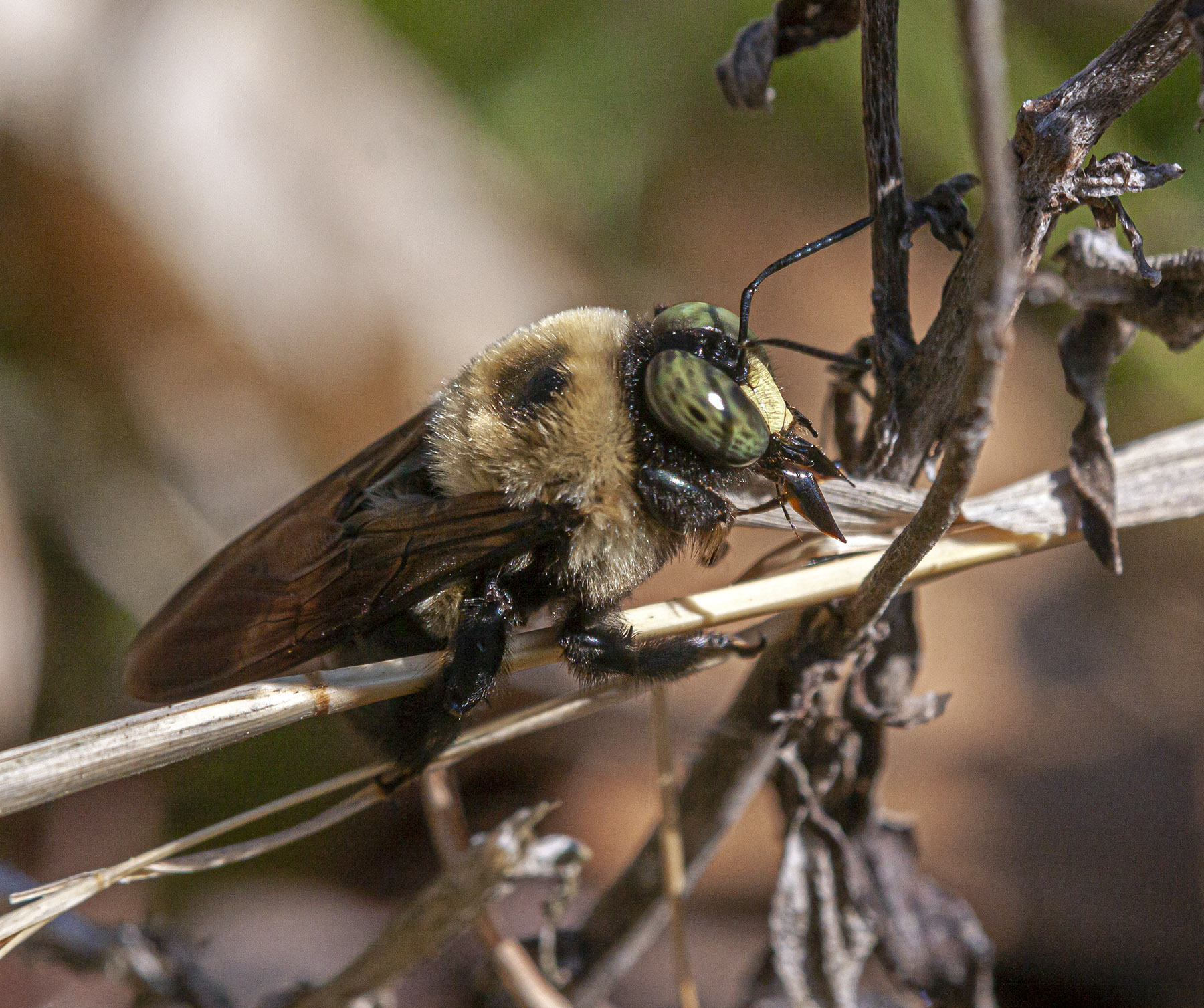
Did you know that some bees have green speckled eyes? I was really startled by the brightness of this bee’s eyes as I was taking its photo last Monday while exploring in Prince William County, Virginia. Some research on-line revealed that this is a male Eastern Carpenter Bee (Xylocopa virginica).

I was pretty sure that I had never before seen a bee like this, but I was wrong. As I was preparing this posting, I discovered that I had seen a similar bee in October 2012 and published a posting entitled “Green-eyed Eastern Carpenter bee.” Wow. It’s been a long time between sightings, so maybe I can be forgiven for having forgotten about the previous time, though at my age I can simply claim that I had a “senior moment.” Ages has its privileges.

Eastern Carpenter Bee

© Michael Q. Powell. All rights reserved.

Read Full Post »

Beauty is everywhere, including in the abstract patterns of nature. Last week my eyes were drawn to the interplay of light and shadows in the leaves of some iris plants that have not yet bloomed in the garden of my neighbor Cindy Dyer. I love the series of triangles and straight lines in the resulting image and there is something soothing and peaceful about the various shades of green.

When I posted this image in Facebook, my pastor noted that these leaves reminded her of the palms that we would normally be waving in a procession to begin the celebration of Palm Sunday. In a few hours we will be celebrating in a different way, via Zoom teleconferencing software, but we have been asked to gather some branches or colorful pieces of cloth to wave in front of our cameras as we say, “Blessed is he that cometh in the name of the Lord; Hosanna in the highest.” This pandemic has changed some of the outward aspects of our worship, but we continue on.

Whether you are Christian or not, my prayer is that this Sunday finds you feeling thankfulness in the midst of this crisis for what you still have and not merely lamenting that which you have lost. I also pray that you are filled with the joyful hope that we will eventually make it through this difficult time. If there is one thing we have certainly learned, it is that we are truly all in this together.

leaves

© Michael Q. Powell. All rights reserved.

Read Full Post »

This week I did a pair of postings in a single day that I called “beauty and the beast” that was so well received that I thought I would do it again. Earlier this morning I did the “beauty” part with a shot of some crabapple blossoms in my front yard. For the “beast” part, I decided to feature this shot of a little orchard spider (Leucauge venusta) in the garden of my neighbor, fellow photographer and blogger Cindy Dyer. The spider was hanging in the midst of a group of irises that have not yet bloomed and I was happy to be able to be able to frame the shot so you have a sense of the spider’s environment.

As always, I offer my apologies to those who are creeped out by spiders, and recommend that you check out the crabapple posting if you have not seen it yet. As for me, I find spiders to be always fascinating and often beautiful.

orchard orbweaver spider

© Michael Q. Powell. All rights reserved.
Read Full Post »

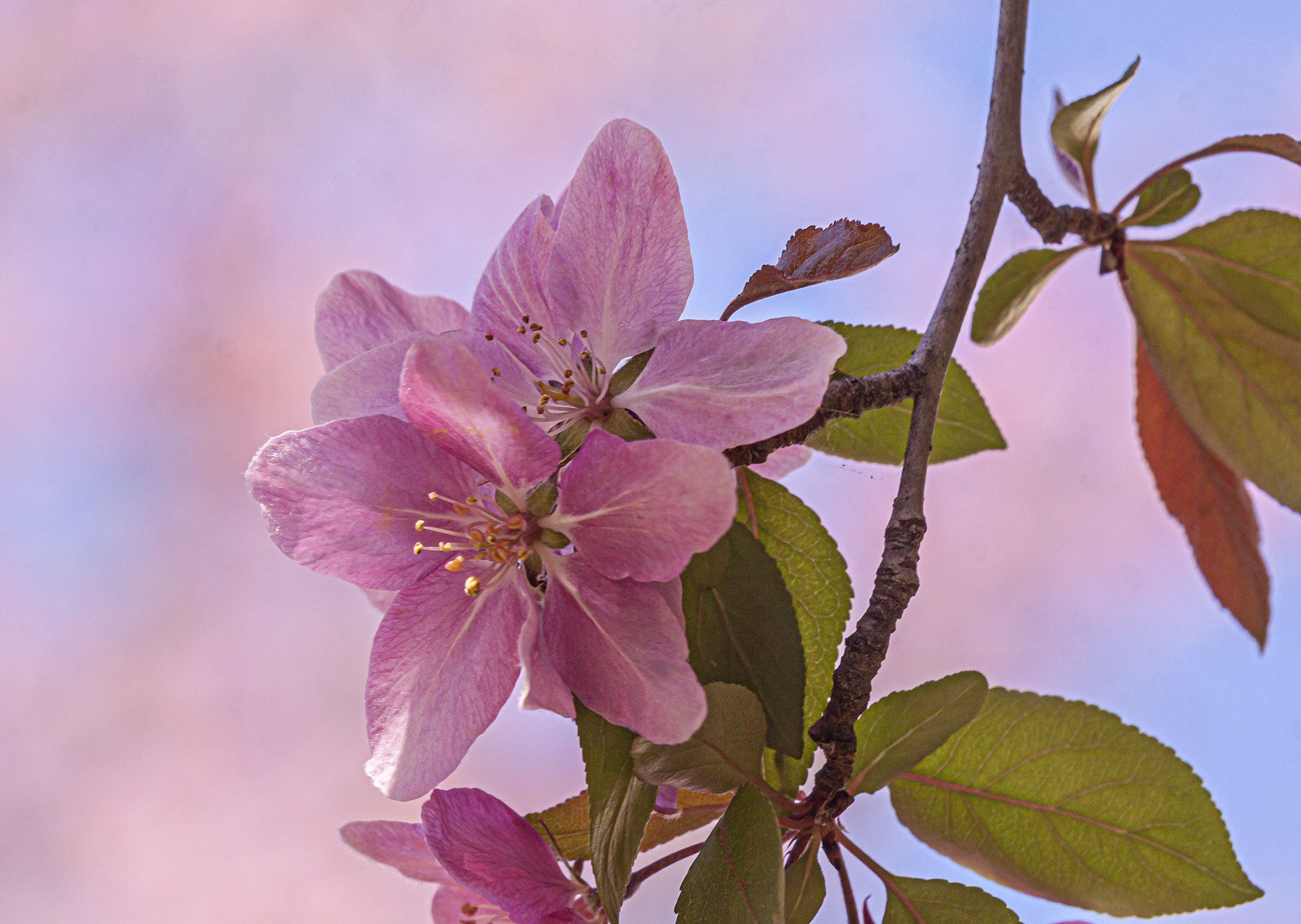
Beauty is everywhere. Thursday afternoon as I walked out of my suburban townhouse, I glanced at the crabapple tree in my front yard, now covered with blossoms. Realizing how beautiful it is, I captured this simple image.

You don’t always have to go to distant locations to find beauty—you can often find it in your back yard or, in my case, in your front yard.

crabapple

© Michael Q. Powell. All rights reserved.


Read Full Post »

The two-colored tulips in the garden of my neighbor and friend Cindy Dyer were open yesterday and they are awesome. The first macro shot makes the tulip look almost like a little pinwheel. The second shot gives you a greater sense of the colors and patterns in these beautiful tulips—the delicate feathering of the red on the yellow petals is simply breathtaking.

tulip

tulip

© Michael Q. Powell. All rights reserved.

Read Full Post »

« Newer Posts - Older Posts »