Feeds:
Posts
Comments

Archive for the ‘Insects’ Category

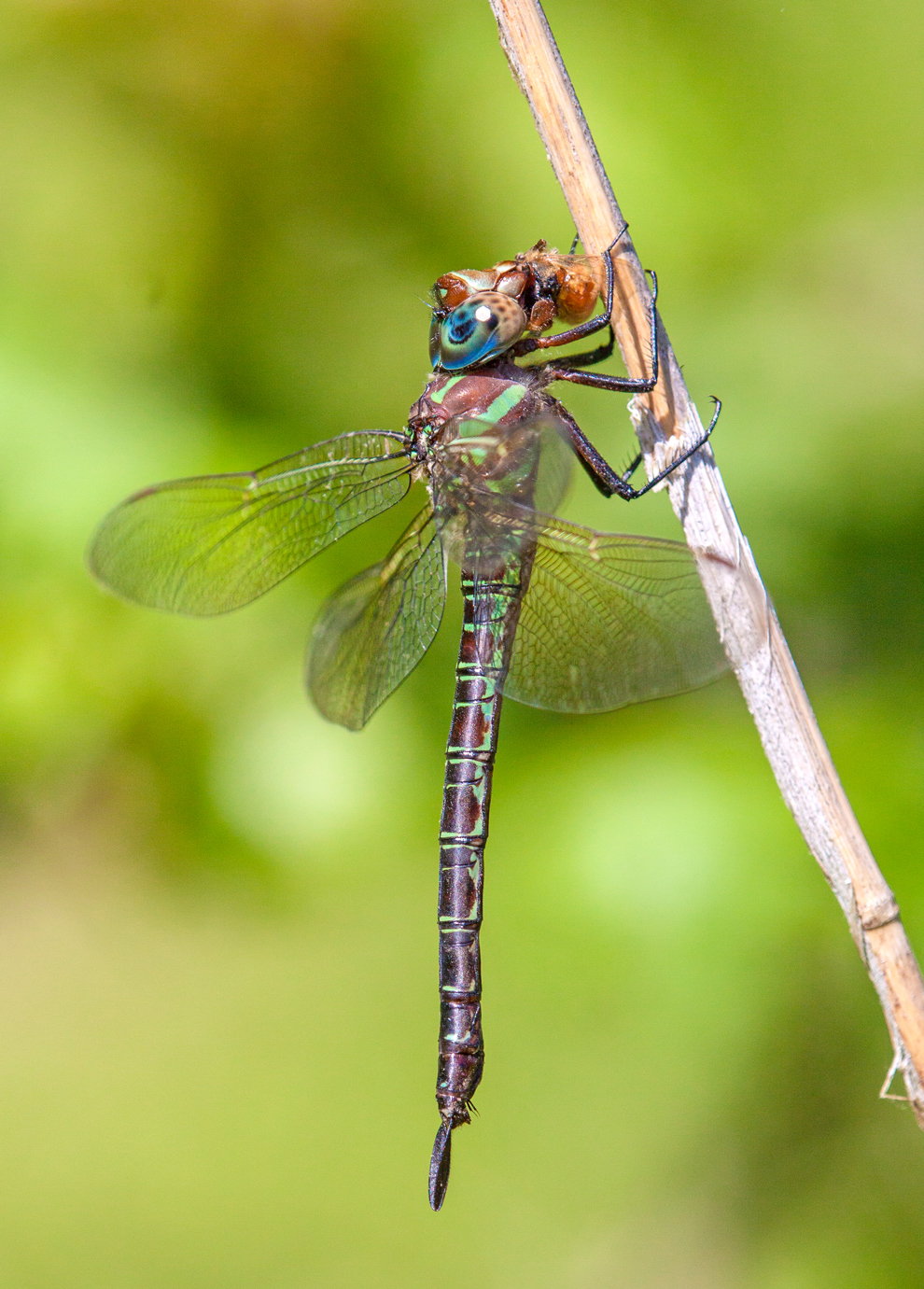
Do you want to learn patience? If so, try photographing dragonflies in flight, those speedy little flyers that patrol the edge of a pond without ever seeming to need a rest.

Several readers commented that I must have lots of patience after they saw the photos of dragonflies and damselflies that I recently posted. Comparatively speaking, however, it is a whole lot easier to photograph these insects when they are perched on a stationary object than when they are in constant motion.

My fellow blogger and photographer, Walter Sanford, a true dragonfly stalker, emphasized to me recently that many of the early spring dragonflies are found only in limited locations for very short periods of time. (Check out his blog for lots of wonderful shots of dragonflies and other wildlife creatures.) I decided to return to Hidden Pond Nature Center, a county-run park in Springfield, Virginia that is only a few miles from where I live. Last year I spotted a few common dragonflies there, and it seemed to be a good place to broaden my search for spring dragonflies.

Sure enough, I caught sight of a few dragonflies, flying low over the surface of the small pond. They seemed to have fairly well defined patrol areas and tended to move about in large, lazy circles. I tried tracking several of them using my camera’s autofocus, but that proved to be impossible, so I switched to manual focusing, which was merely difficult.

I took a few breaks to get some shots of the more cooperative damselflies, but persisted in my quixotic efforts to capture the dragonflies in flight. Over the course of a couple of hours, I managed to fewer than a dozen images that are more or less in focus. I think that my subjects for this shoot might be Common Baskettail dragonflies (Epitheca cynosura), but I’m not very confident in that identification.

My adventures with dragonflies (and wildlife photography in general) continue teach important lessons about the value of patience and persistence.


flying5_blog

flying4_blogflying3_blogflying2_blogflying1_blog

© Michael Q. Powell. All rights reserved.


Read Full Post »
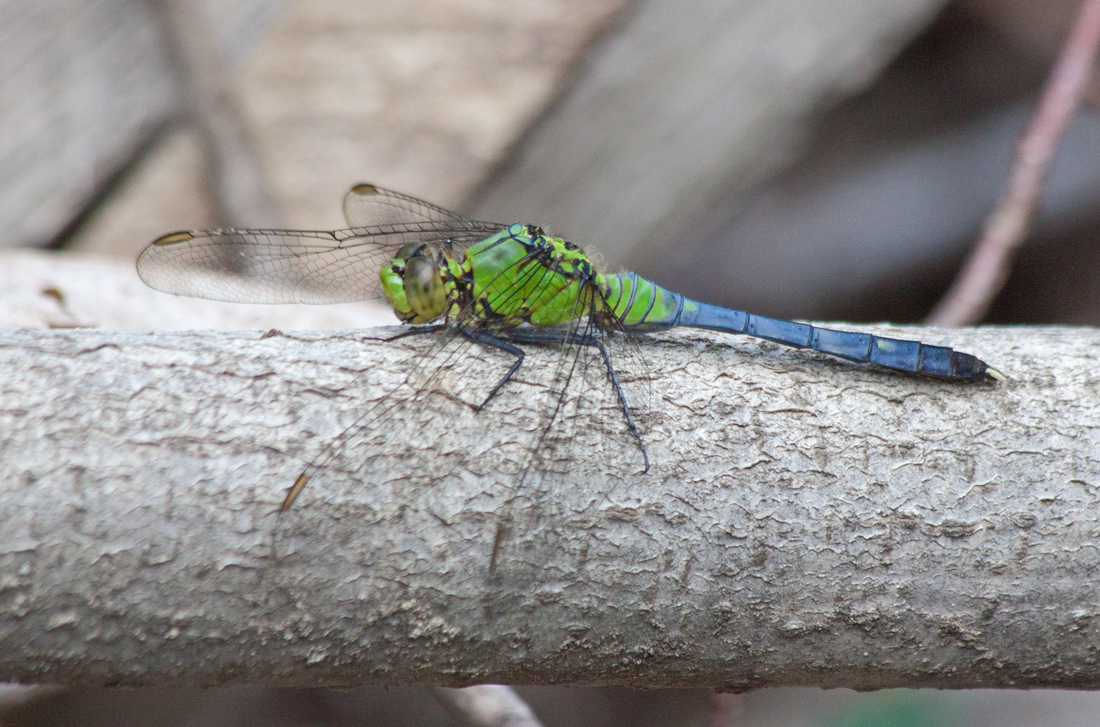
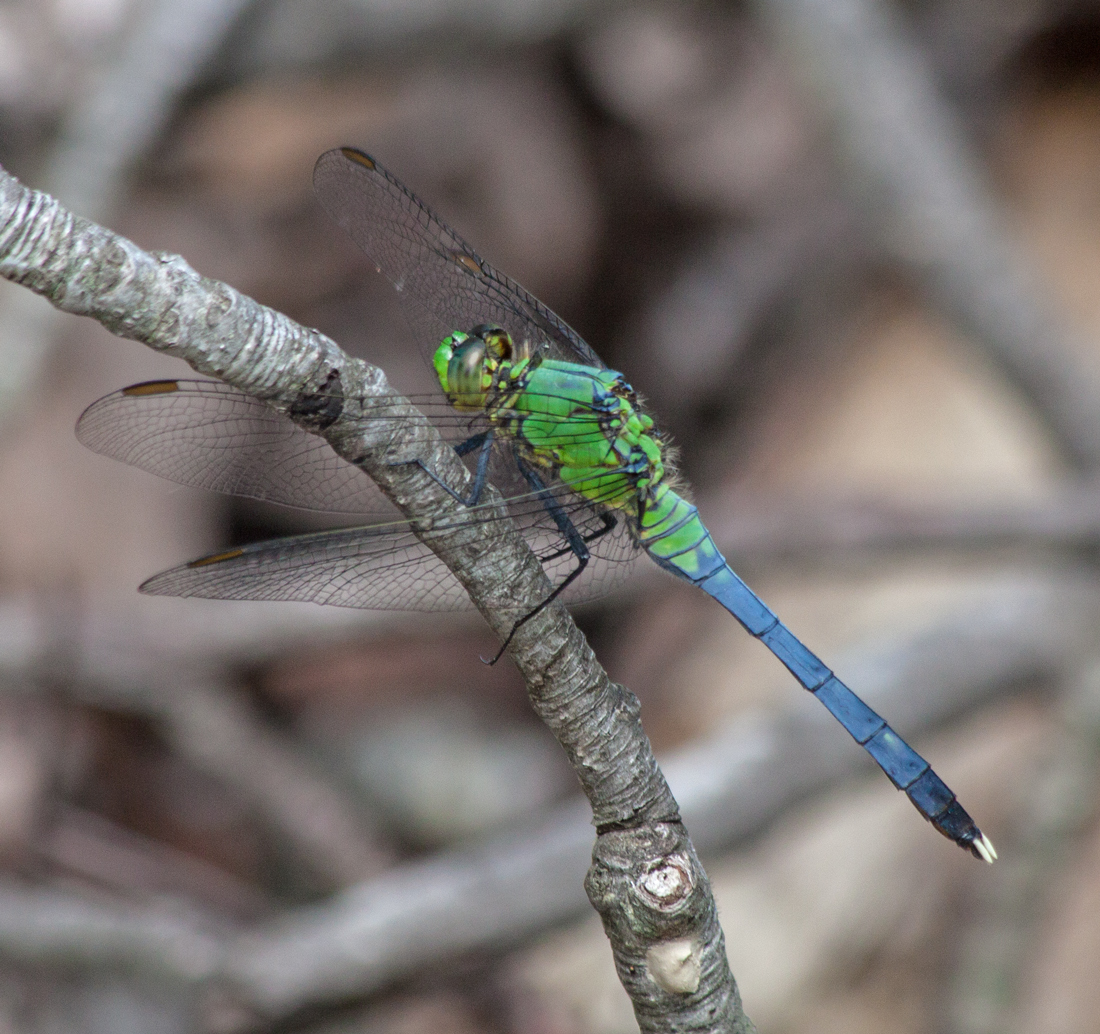
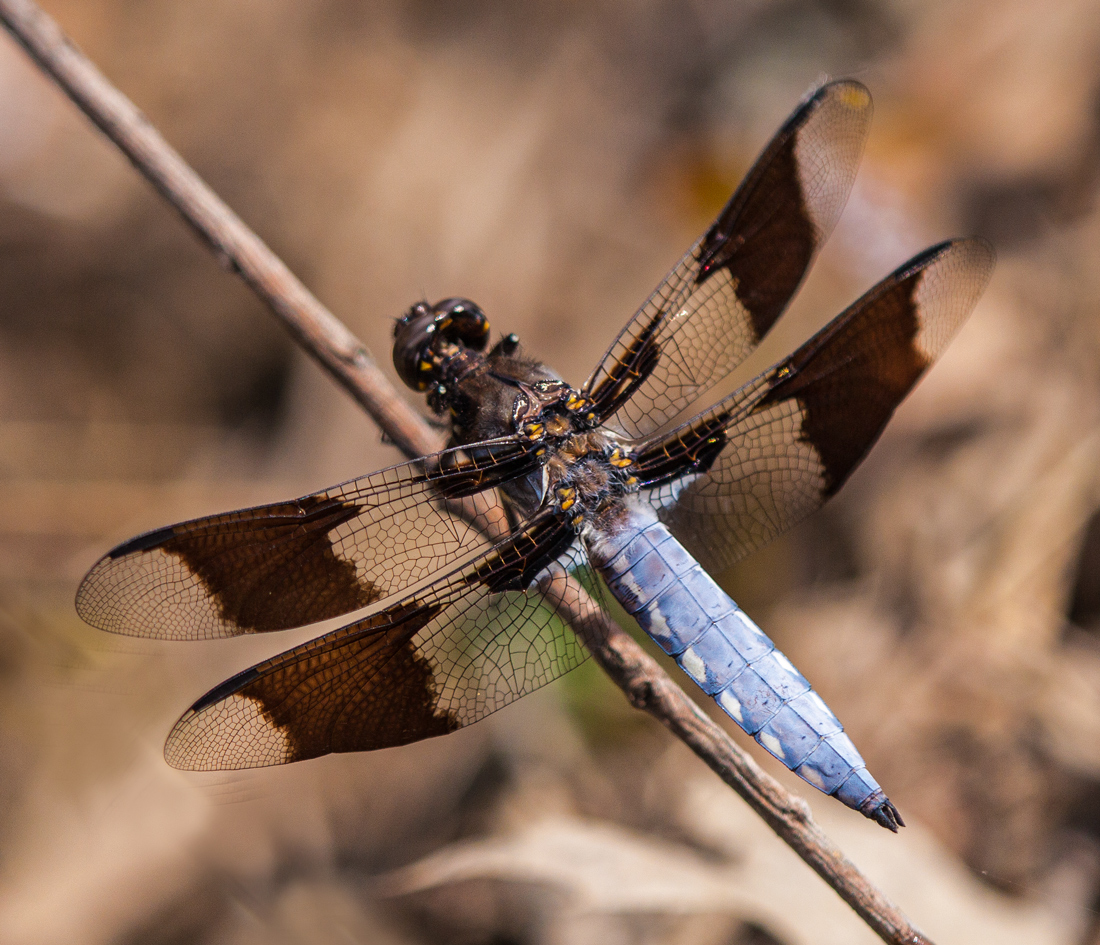
As we move deeper into spring, dragonfly nymphs are emerging from the water and starting their transformed lives as acrobatic flyers. This past weekend I spotted some young male Common Whitetail dragonflies (Plathemis lydia) in different stages of development.

Not surprisingly, adult male Common Whitetail dragonflies have white tails—it seems like most species are named after the characteristics of the male. Check out one of my postings from last year to see what a mature adult male looks like. When they first emerge, however, the males have the same body colors and patterns as the females. Fortunately, it’s easy to tell them apart, because the wing patterns are different in the male and female whitetails. (For more information about these dragonflies, take a look at the pages at bugguide.net.)

The dragonfly in the first shot is well on his way to becoming an adult and was bold enough to be flying over the water. The one in the second shot is younger, and seemed to content to remain in the vegetation at a distance from the open water.

A "tween" male--the abdomen is beginning to turn blue, but the adolescent body pattern still shows

A “tween” male–the abdomen is beginning to turn blue, but the adolescent body pattern still shows

An immature male, with the body pattern of a female and the wing pattern of an adult male

An immature male, with the body pattern of a female and the wing pattern of an adult male

© Michael Q. Powell. All rights reserved.

Read Full Post »
I was on my hands and knees last Friday, trying to get a shot of a small wildflower growing on the forest floor, when a bee landed on the very flower on which I was focusing. What are the odds of that happening at the moment when my eye was glued to the viewfinder and I was focusing manually?

The flower was only about four inches (10 cm) tall, which gives you an idea of the low angle from which I was shooting. After a second or two on the first flower (shown in the second shot), the bee moved to an adjacent flower, and I took the image I presented first. It’s interesting to note the narrowness of the depth of field—in the first shot below, I managed to focus on the bee’s head, whereas in the second shot, the focus point was more on the center of its body. I like each of the images for somewhat different reasons, but I am still shocked that I managed to get them.

Sometimes it’s better to be lucky than skilled.

bee2_flower_blogbee_flower_blog

© Michael Q. Powell. All rights reserved

Read Full Post »

This is the last image in my mini-series on insect eyes from this past Friday—a close-up of a beautiful little damselfly at Huntley Meadows Park, the local marshland where I take many of my nature photographs. 

Photographing damselflies is particularly challenging for me, because they are so long and skinny (not to mention the fact that they are really small in size). About the only way to get their bodies completely in focus is to be absolutely perpendicular to them. When I took this image, I couldn’t get into the optimal position, thanks to a sharp, thorny bush, so the lower half of the body was out of focus. That is one of the reasons why I chose to crop this image as I did, though the main reason was to focus viewers’ attention on the eyes.

This image shows the wide separation of the damselfly’s eyes, which is one of the ways to tell them apart from dragonflies, the other members of the Odonata family. Dragonflies have eyes that are very close together or even touching each other.

If you missed the earlier postings on insect eyes, check out the images of a fly’s eyes and a dragonfly’s eyes. In all three cases, click on the images, if you want to get a higher resolution view of the insects’ beautiful eyes.

damsel_eyes_blog

© Michael Q. Powell. All rights reserved

Read Full Post »

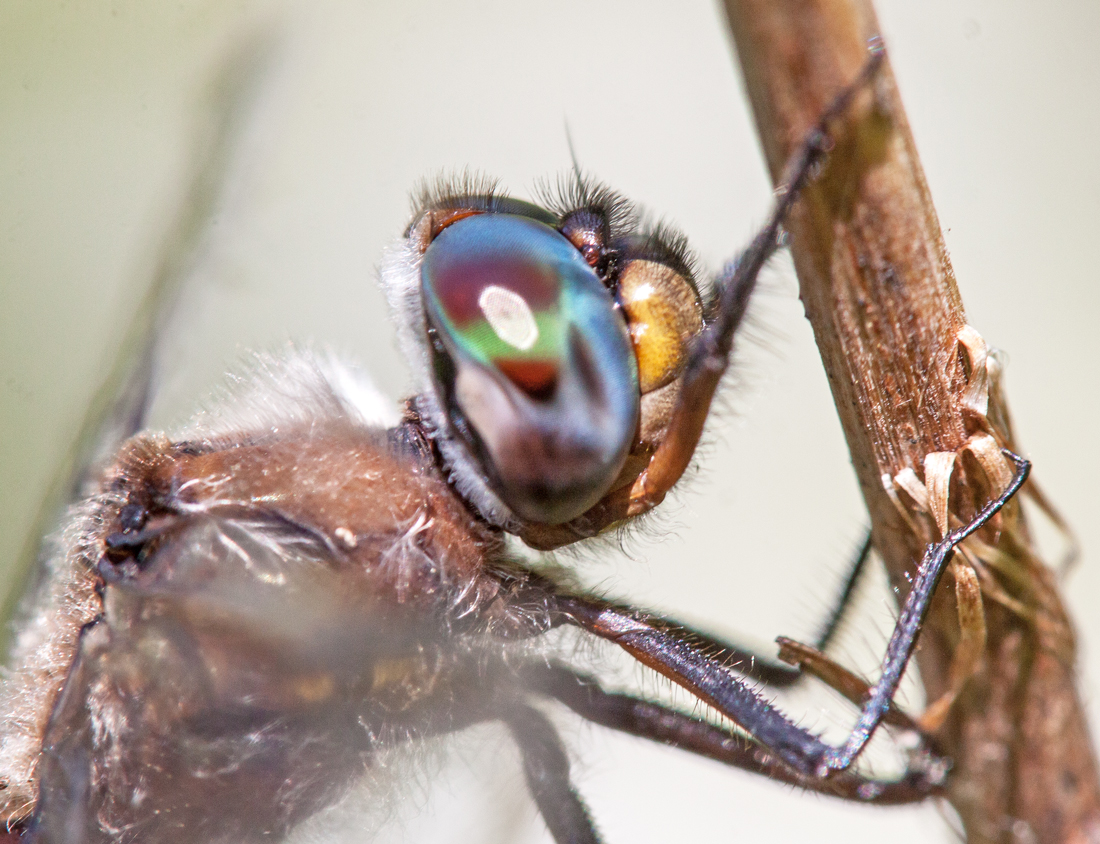
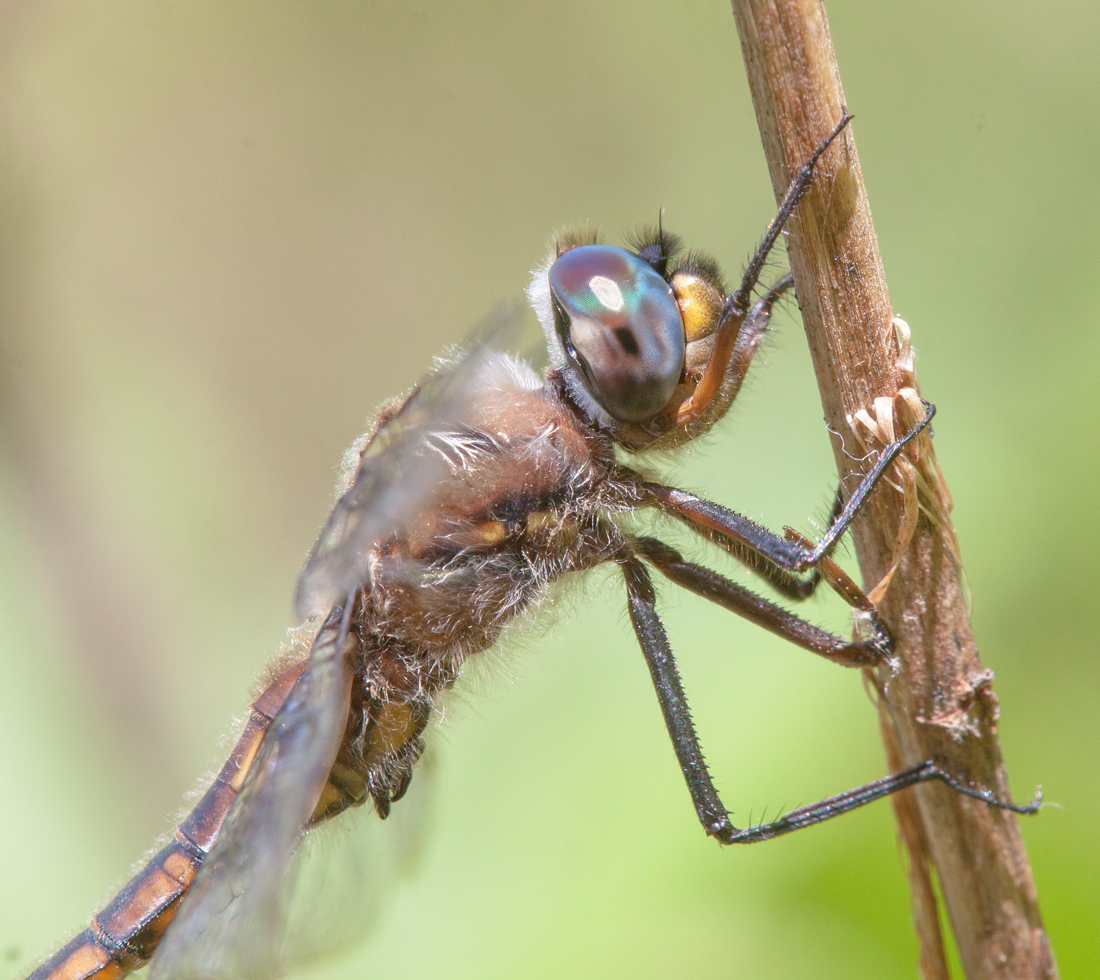
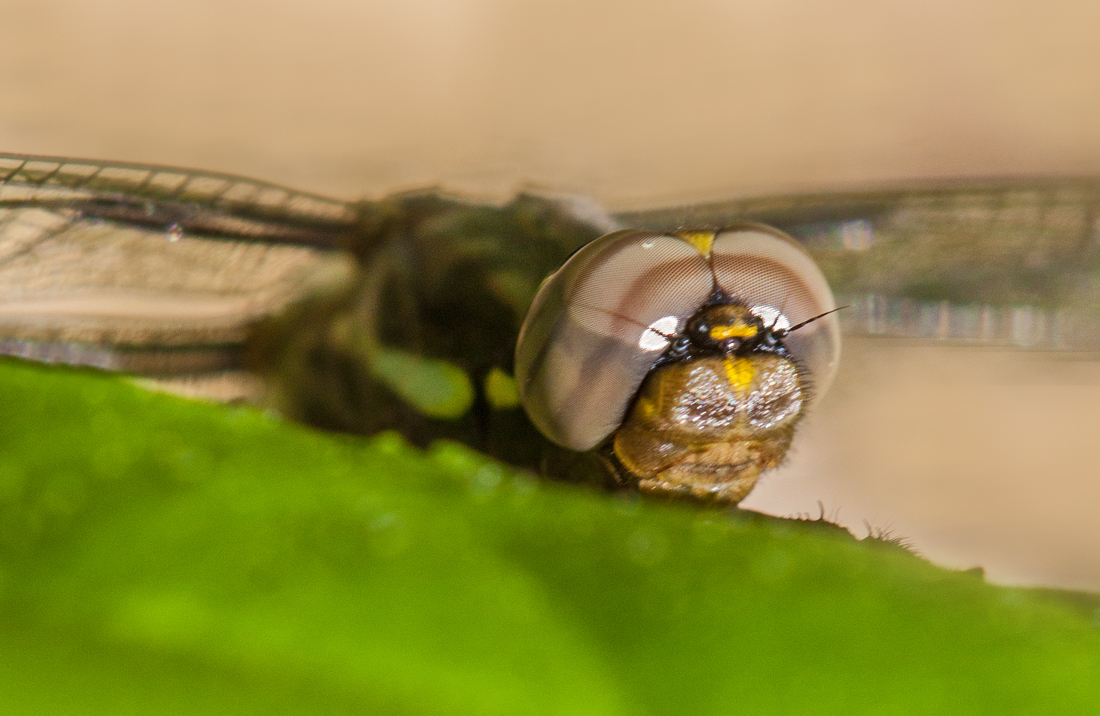
Yesterday, I seemed to be particularly fascinated by insect eyes and did a posting on a fly, whose compound eyes were pretty amazing. However, dragonflies have the largest compound eyes of any insect and I was thrilled to be able to capture this face-to-face shot of a Common Whitetail dragonfly (Plathemis lydia), peering right at me over the edge of a leaf.

A dragonfly’s eyes can have as many as 30,000 facets, known as ommatidia, that contain light-sensitive proteins, according to an article in ScienceBlogs. Although, humans also have these kind of proteins, called opsins, we have only three (red, green, and blue), whereas a dragonfly has four or five, giving it the capability to see colors beyond human visual capabilities. A dragonfly’s eyes also wrap around its head, giving it an incredible field of view. For more information and a more scientific explanation, check out a posting entitled “Super-predators” that Sue did last June in her Backyard Biology blog.

I took this shot in a wooded grassy area adjacent to a pond. It seems that the Common Whitetail dragonflies are hanging out there early in the season and not too many of them are patrolling over the water, as I commonly saw them do last summer. The fact that the dragonfly was not perched on a branch coming out of the water proved to and advantage as I was able to approach pretty closely to it in order to take this shot.

dragonfly_eyes_blog

© Michael Q. Powell. All rights reserved

Read Full Post »

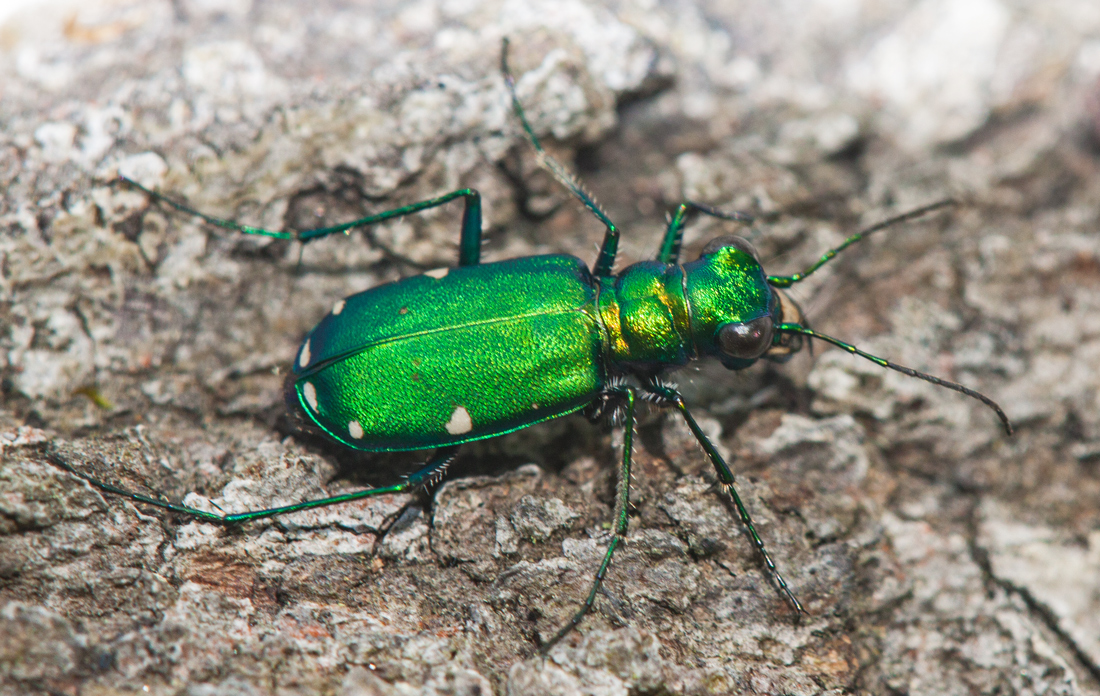
Some insects blend in so perfectly with their environments that they are difficult to spot. That is clearly not the case with this Six-spotted Tiger Beetle (Cicindela sexguttata) that I spotted yesterday at my local marsh.

The beetle’s metallic green body glistened in the sun and made it stand out against the bark of the fallen tree on which it was perched. It flew away several times when I got close to it, but kept returning, eventually remaining in place long enough for me to get this shot. Click on the image to get a higher resolution view of the beetle, including its textured body and multi-segment antennae.

emerald1_blog

© Michael Q. Powell. All rights reserved

Read Full Post »

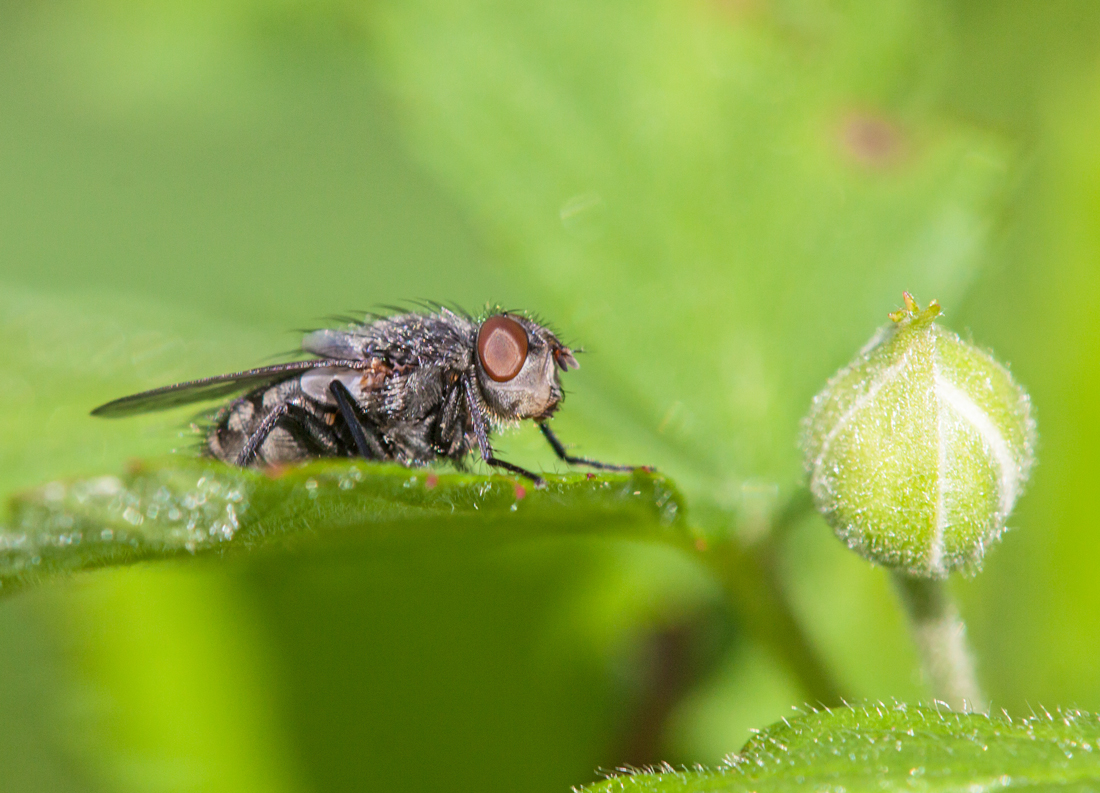
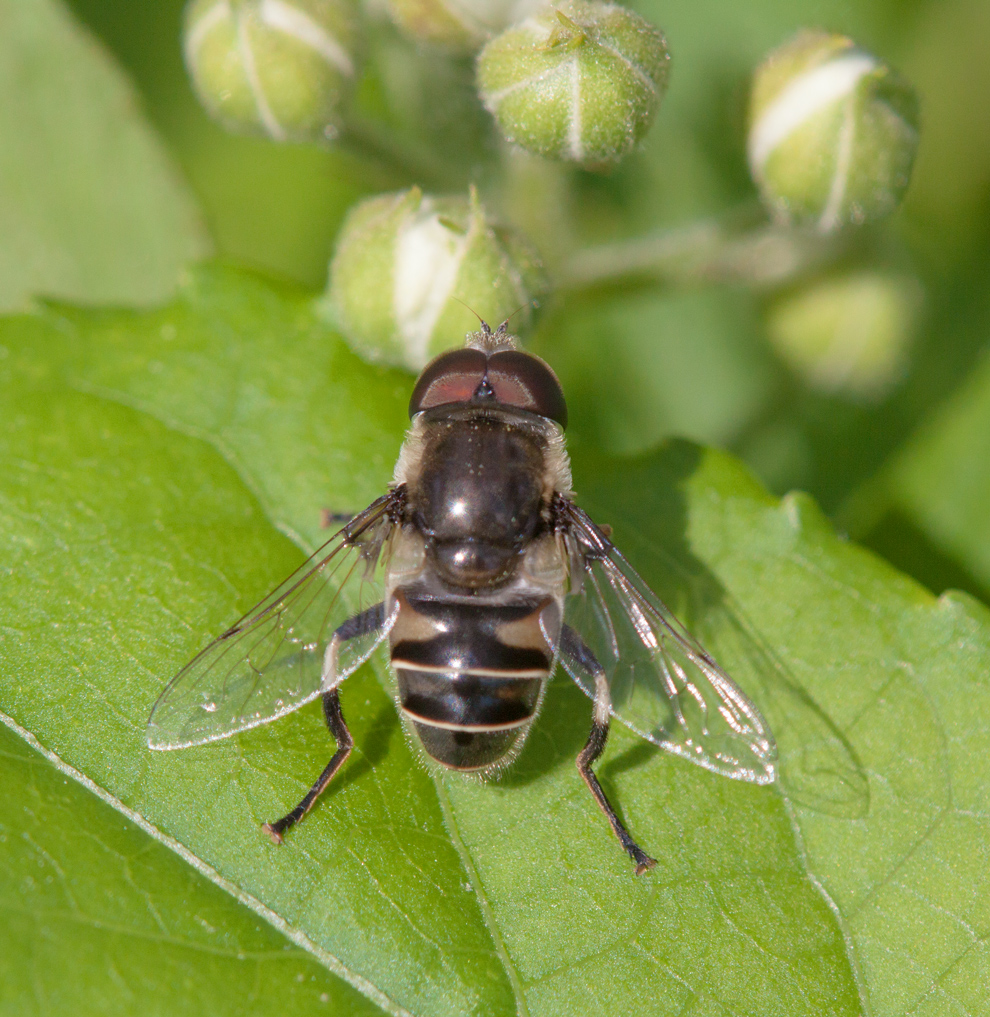
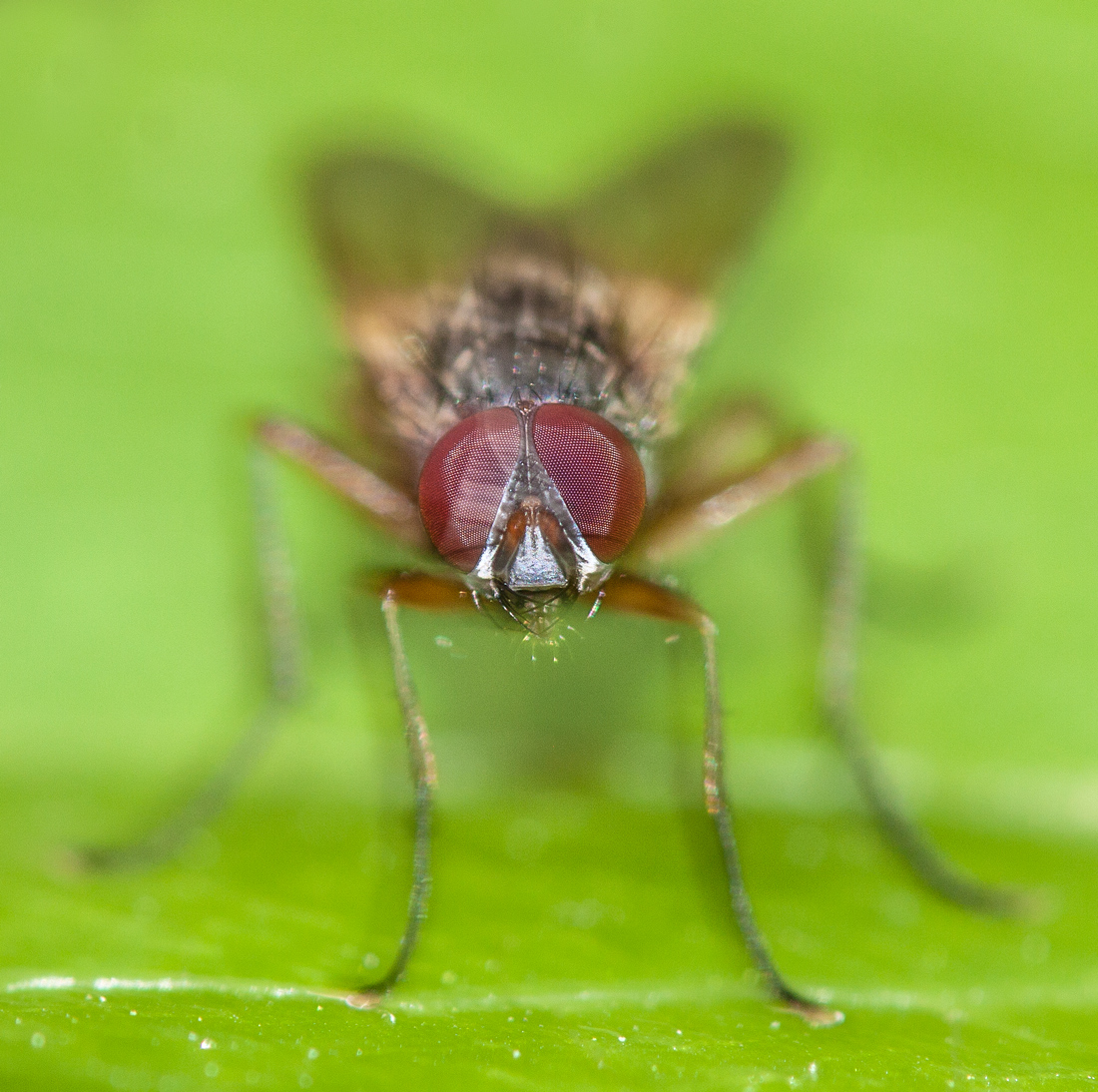
After a week in an urban setting with only a point-and-shoot, I couldn’t wait to get back to my marsh with my trusty Canon 50D in my hands. I kept my macro lens on my camera for most of the time, because the insects seemed much more active than they were only a week ago. Even flies seemed to be good subjects. I photographed this fly hand-held at really close range, which gave me a very narrow depth of field.

The first image is cropped, in order to give you a good look at the fly’s eyes—the second photo is the same image with a much less severe crop.

fly_eyes2_blogfly_eyes1_blog

© Michael Q. Powell. All rights reserved

Read Full Post »

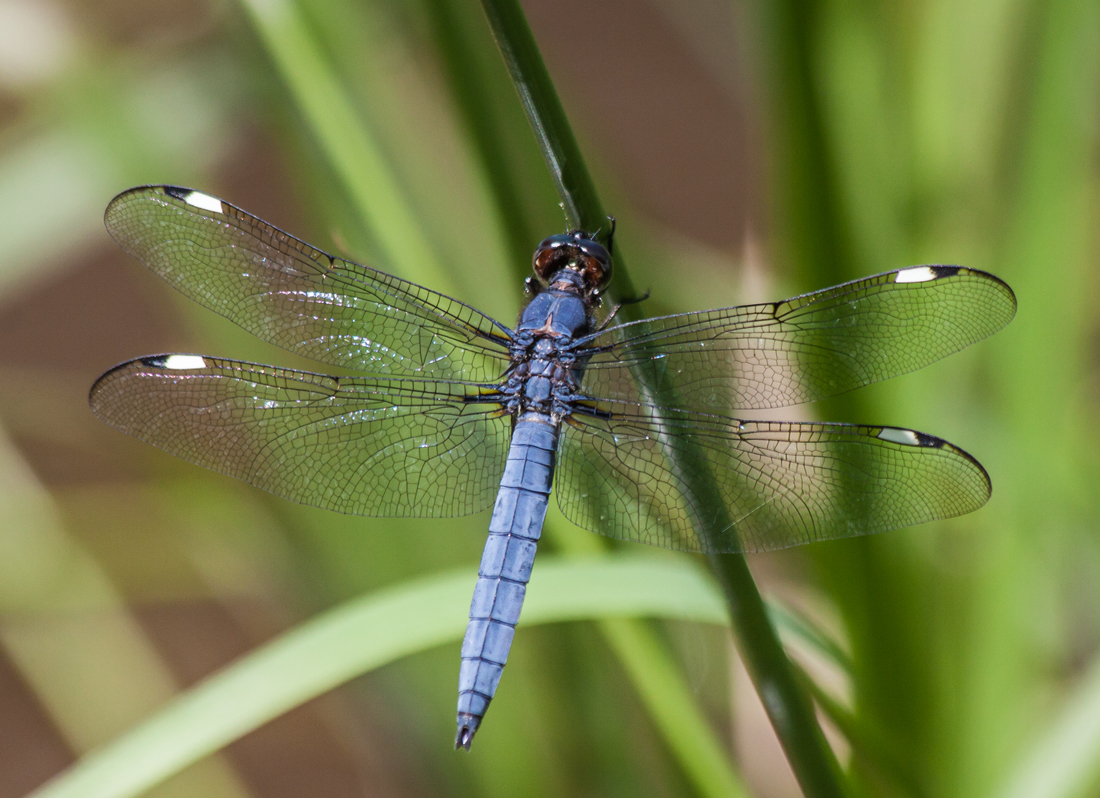
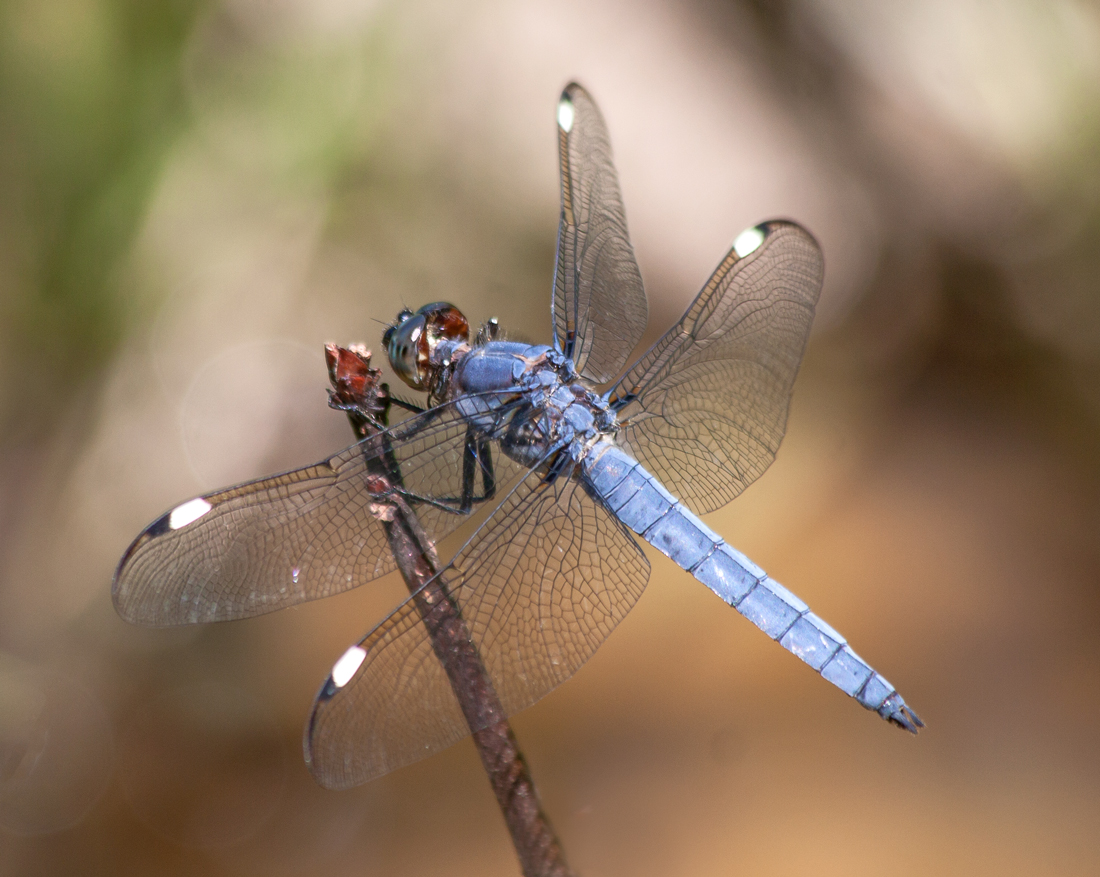
Some of the common species of dragonflies are around throughout much of the summer. Other dragonflies, sometimes referred to as “spring ephemeral” dragonflies,  are around for only brief periods of time in the early spring, like this male Blue Corporal dragonfly (Ladona deplanata) that I spotted last week on the boardwalk at my local marsh.

I had never seen this species before, but fortunately my fellow blogger and local dragonfly expert, Walter Sanford, was able to assist me with the identification. Check out his blog to see some awesome shots of dragonflies and other nature subjects.

I would love to be able to photograph this species the next time in a more natural environment, but I am pretty excited any time I have the chance to get a recognizable photo of a new species.

dragonfly2_may_blogdragonfly_may_blog

© Michael Q. Powell. All rights reserved

Read Full Post »

Damselflies are beautiful, delicate insects that are often hard to see and photograph. I captured this image of my first damselfly of the year at Huntley Meadows Park this past Friday. I am not very good at identifying these tiny insects, but think this might be a Fragile Forktail (Ischnura posita).

I was standing my the edge of my favorite beaver pond when I saw the damselfly in flight. I followed it with my eyes and was delighted when it landed on a nearby stalk of grass. I didn’t have a lot of maneuver, because much of the area at the pond’s edge is covered with thorny bushes, and I had to pull back a bit to get within the minimum focusing distance of my 70-300mm telephoto lens , i.e. 4.9 feet (1.5 meters). At that range, the dragonfly filled a reasonable amount of the frame.

Lighting was a bit of a challenge and I tried a couple of different settings as the damselfly lifted its tail from time to time. Eventually, it climbed to the end of the stalk and I changed position too and tried a couple of shots (including the final shot) using my pop-up flash.

Most of the time the first shot below is my favorite, but sometimes I like the others as well or more. In any case, I am happy that I was able to get some good shots of my first damselfly of the spring.

damselfly2a_blogdamselfly1a_blogdamselfly3_blog

© Michael Q. Powell. All rights reserved

Read Full Post »

Within minutes of seeing the elegant honey bee that I featured in a recent posting, I encountered this Eastern carpenter bee (Xylocopa virginica), which is built more like a sumo wrestler than a dancer, especially when viewed face-to-face, as in the second image below.


carpenter1_blog

carpenter2_blog

© Michael Q. Powell. All rights reserved


Read Full Post »

While visiting a garden during an event advertised as “A Million Blooms” I looked hard, but didn’t find any bees among the many tulips and other spring flowers. It was a bit ironic that I discovered this honey bee on a bush while waiting for my fellow photographers outside the gift shop of the Lewis Ginter Botanical Garden in Richmond, Virginia after seeing lots and lots of flowers.

I was hand-holding my 180mm macro lens for these shots, so I couldn’t close down the lens too far. In some of the shots, therefore, you can see that the depth of field was pretty narrow. Still, I am happy that I was able to capture some of the beautiful details of this honey bee, one of the first bees that I have observed this spring.

honeybee1_bloghoneybee2a_bloghoneybee3_blog

© Michael Q. Powell. All rights reserved

Read Full Post »

Isn’t “beautiful wasp” an oxymoron? Can a wasp really be considered to be beautiful? I may be insect-deprived after a long winter and my perceptions may be skewed, but I find the wasp in these two images to be exceptionally beautiful.

The rich reddish-brown of its upper body, with a pattern that looks like some exotic wood, and the bluish-purple of its wings make for a stunning combination, and the holly leaf provides a perfect backdrop.

I took this shot during a visit Lewis Ginter Botanical Garden in Richmond, VA this past weekend, a garden that featured thousands of tulips and other spring flowers in bloom, but almost no insects. I actually was not inside the garden, but was waiting outside the gift shop for some fellow photographers when I spotted this wasp sprawled out on the leaf, as shown in the second image. The nice thing about my 180mm macro is that I didn’t have to get right on top of the insect to capture some good detail. When I moved in a little closer, the wasp slowly climbed up the leaf, as captured in the first shot, before it flew away.

It was nice to see insects start to reappear and I suspect that I will start using my macro lens more and more as we move deeper into spring and into summer.

wasp1_blogwasp2_blog

© Michael Q. Powell. All rights reserved

Read Full Post »

Spring is here and I am once again chasing dragonflies, on a quest to capture images of these beautiful insects. Common Green Darners (Anax junius) rarely seem to perch, so I was forced to try to photograph them in flight.

This early in the spring, there aren’t yet a lot of dragonflies, so my patience was tested as I waited for one to fly by. I tried a lot of different approaches and the one that worked best on this day was to focus manually, which is a bit of a challenge at 300mm when the subject is moving pretty fast.

I hope I’ll get some better shots later this season—this is my best one so far.

dragonfly_flight_blog

© Michael Q. Powell. All rights reserved

Read Full Post »

The world changed for me when I put my macro lens back on my camera, simultaneous becoming smaller and bigger. Instead of looking in the distance for birds, I switched my focus to the world immediately in from of me, searching for tiny objects that I can photograph.

In vain I long for colorful butterflies and dragonflies, but it is too early in the spring for them to appear. As soon as a fly buzzed by me, I was seized with an irresistible urge to capture its image. It’s only a fly (a Green Bottle Fly, I think), but it is symbolic of the joys to come, the time when I will spend endless hours chasing after insects, trying to capture the detailed beauty of their colors and patterns.

fly_march_blog

© Michael Q. Powell. All rights reserved

Read Full Post »

I never expected to encounter a dragonfly when I went walking in the snow in my neighborhood yesterday.

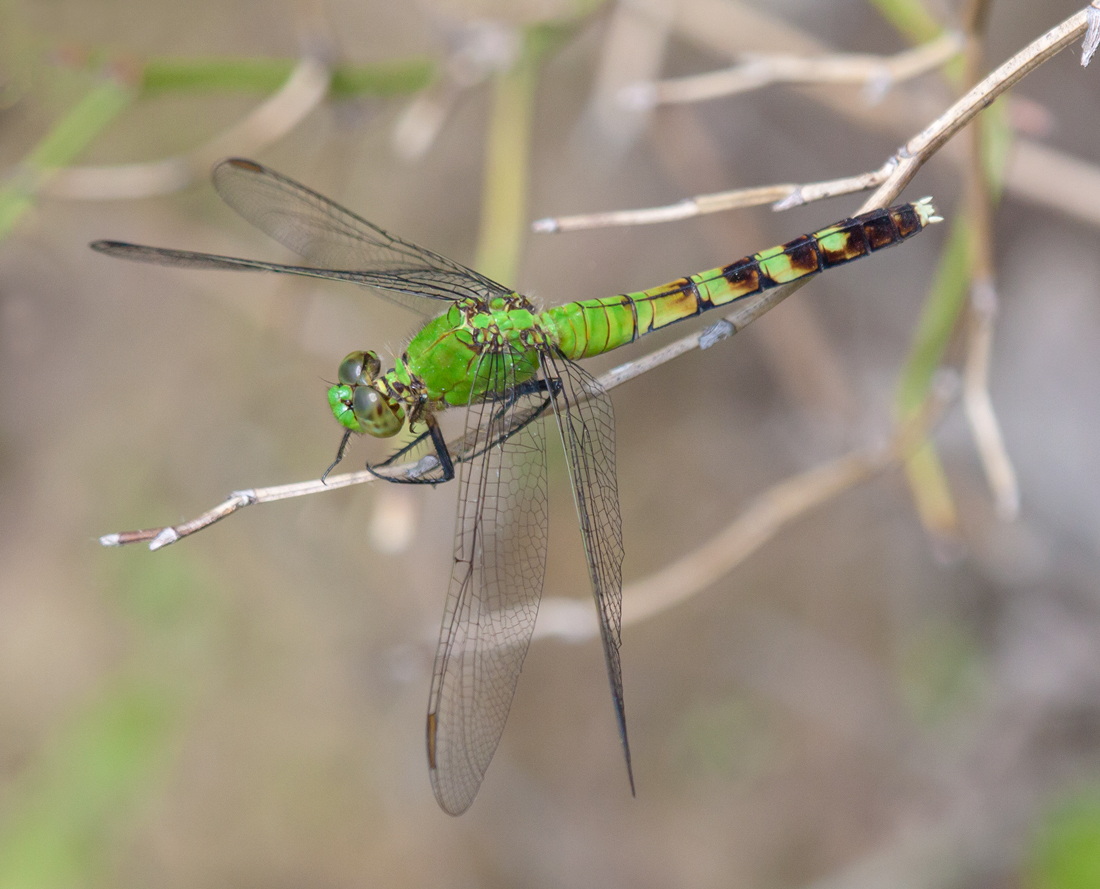
My eyes were scanning the trees for birds,  when right it front of me I detected the unmistakable shape of a dragonfly, a giant green dragonfly perched on a tree. I approached it quietly and was able to get this shot, my first shot of a dragonfly in a long time.

With snow still covering the ground and the temperatures below freezing, it’s hard to imagine that the real dragonflies will be appearing in a few short months.

dragonfly_winter_blog

© Michael Q. Powell. All rights reserved

Read Full Post »

It is pretty cool that a website (cracked.com) chose to use one of my photos in an article entitled “6 Insanely Colored Versions of Normally Boring Animals.” It is this photo that I took during the summer of my favorite insect, the Handsome Meadow Katydid and I featured in a posting called Rainbow Grasshopper.

rainbow1_blog

Check out the article at http://www.cracked.com/article_20811_6-insanely-colored-versions-normally-boring-animals.html .

© Michael Q. Powell. All rights reserved.

Read Full Post »
When a dragonfly landed on a sign at my local marshland park, one of my favorite places for photography and reflection, it seemed to be sharing reminders with me and with fellow photographer and blogger Walter Sanford about the proper approach to observing wildlife (and life in general).

waltersanford's avatarwalter sanford's photoblog

Sometimes I jokingly refer to myself as a “Dragonfly Whisperer.” Well, as it turns out, the roles were reversed recently when a mature male Autumn Meadowhawk dragonfly (Sympetrum vicinum) whispered some words of wisdom about wildlife watching at Huntley Meadows Park. Here’s what the old-timer had to say …

Food for thought on the traditional day when we give thanks for our many blessings. I am especially thankful for the opportunity to be a frequent and careful observer of the natural beauty of the hemi-marsh at Huntley Meadows Park, and for many good friends with whom I share the experience. And thanks to WordPress.com for the free blog that enables me to share my sightings with others!

Copyright © 2013 Walter Sanford. All rights reserved.

View original post

Read Full Post »

Could this be the mascot for a new line of clothing or shoes? Dragonfly photographer extraordinaire Walter Sanford took these shots of a beautiful female Autumn Meadowhawk perched on my hand as I tried to move it closer to the messenger bag in which I carry my camera gear.

waltersanford's avatarwalter sanford's photoblog

The preceding gallery shows a female Autumn Meadowhawk dragonfly (Sympetrum vicinum), spotted at Huntley Meadows Park on 15 November 2013. She is perching on the hand of Mike Powell, fellow wildlife photographer and blogger. This individual is not the female featured in my last post, “Champion dragonfly.”

Copyright © 2013 Walter Sanford. All rights reserved.

View original post

Read Full Post »

Fellow photographer and blogger, Walter Sanford, has an incredible talent for capturing photos of dragonflies, in this case one that was perched on the sleeve of my sweatshirt.

waltersanford's avatarwalter sanford's photoblog

The following gallery features photos of the undisputed champion dragonfly!

This individual is a female Autumn Meadowhawk dragonfly (Sympetrum vicinum), spotted at Huntley Meadows Park on 15 November 2013. She is perching on the sleeve of Mike Powell’sChampion USA sweatshirt.

Hey Champion, how ’bout a little something, you know, for the product placement in my photos?

Copyright © 2013 Walter Sanford. All rights reserved.

View original post

Read Full Post »

When an Autumn Meadowhawk dragonfly (Sympetrum vicinum) landed on my thigh last Friday, my first thought was to get a photograph of him. Fortunately, my 100mm macro lens was already on my camera—in anticipation of a shot like this—and I was able to capture a close-up, eye-to-eye portrait of the dragonfly by contorting my body and attempting to stabilize my shooting position.

My blue jeans were broken in and their texture, color, and pattern made a pretty cool backdrop for this colorful dragonfly. It may be my imagination, but he seemed to be looking up at me with a mixture of curiosity and amusement.

For whatever reason, many of these dragonflies, which I was able to observe as recently as yesterday, do not seem fearful of people. The classic Drifters song from the 1960’s may talk of spending time with your sweetheart under the boardwalk, but these Autumn Meadowhawks seem to spend most of their time warming up on (and not under) the boardwalk, with periodic mating forays into the bushes.

dragonfly1_denim_tight_crop_blog

Click on the photo to see it in higher resolution.

© Michael Q. Powell. All rights reserved.

Read Full Post »
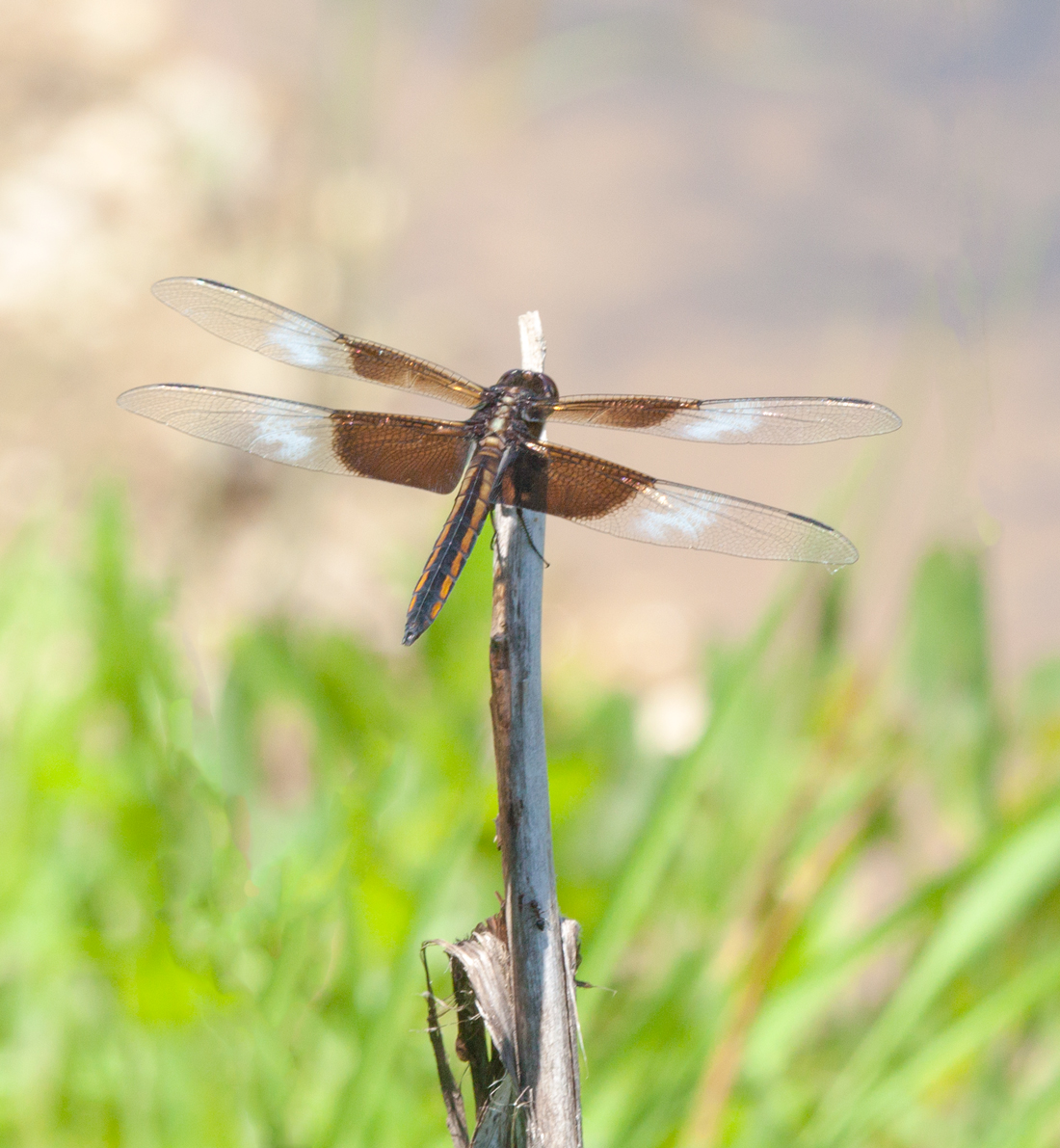
It may be mid-November, but one hardy dragonfly species is still around here in Northern Virginia—the Autumn Meadowhawk (Sympetrum vicinum).

The dragonflies were unusually friendly today, perching on my sweatshirt and jeans numerous times, though they spent most of the time trying to warm themselves in the sun on the boardwalk. Here is a close-up shot of a male Autumn Meadowawk that I coaxed onto my fingertip yesterday at Huntley Meadows Park. All I had to do was slowly move my finger forward and several times a dragonfly accommodated by crawling onto the finger.

Needless to say, it was an interesting challenge trying to hold one finger out as far as I could and then focus and shoot my DSLR with the other hand. Fortunately I had switched to my macro lens—my arms would not have been long enough to get within the minimum focusing distance of the telephoto zoom lens that I had been using earlier in the day. Click on the photos to get a higher-resolution look at the details of the dragonfly’s compound eyes.

dragonfly_finger2_blogdragonfly_finger1_blog

© Michael Q. Powell. All rights reserved.

Read Full Post »

We’re starting to get down to the last insects of the season, and fuzzy brown caterpillars are among the few insects that I still see. Some of these are Banded Wooly Bear caterpillars (Pyrrharctia isabella) that supposedly help tell how severe the winter will be, though I confess that I can never remember how you are supposed to judge, i.e. does a wide middle section mean a short winter or a long one?

When I first took this shot, I thought the subject was a wooly bear caterpillar, but the more I look at it the less certain I feel. There seems to be a black tip on only one end of the caterpillar rather than at both ends. Despite the uncertainty about identification, I really like the shot and the way that I was able to isolate the caterpillar from the background.

fuzzy_brown_final_blog

© Michael Q. Powell. All rights reserved.

Read Full Post »
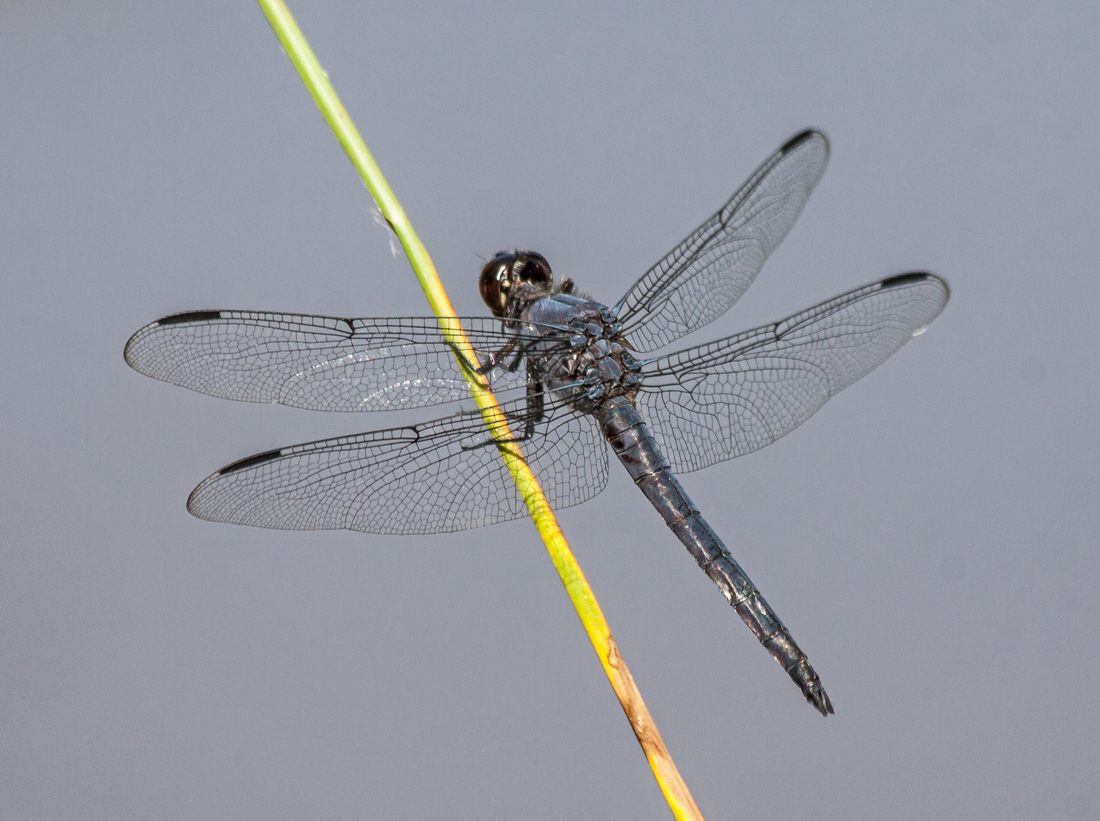
Turnabout is fair play. In one of my earlier posts entitled “Dragonflies mating on a calf” I featured Walter Sanford, a fellow photographer and blogger. Today, in a posting called “The natives are friendly.” he featured my arm and finger as I tried to charm a couple of different dragonflies to perch on my index finger.

waltersanford's avatarwalter sanford's photoblog

Most dragonflies are skittish. Some dragonflies are “friendly,” such as Blue Corporal dragonflies (Ladona deplanata). Autumn Meadowhawk dragonflies (Sympetrum vicinum) are friendly; sometimes very friendly!

Mike Powell and I visited Huntley Meadows Park recently. We stopped to “charm” dragonflies a couple of times during our photowalk. The following gallery shows two different male Autumn Meadowhawk dragonflies perching on Mike: Photos 1-2 show Mike coaxing a dragonfly onto his finger; Photos 3-4 show another dragonfly perching on Mike’s arm.

Tech Tip: Either mouse-over or tap photos to see captions.

Copyright © 2013 Walter Sanford. All rights reserved.

View original post

Read Full Post »

When this praying mantis began to straddle a hapless grasshopper, I wasn’t sure what was going to happen, but suspect that the grasshopper may have been the one that began to pray.

Was the mantis looking at the grasshopper as a potential mate or a potential meal? With praying mantises, the question of mate or meal is a little complicated, because some females reportedly bite off the heads of the males after mating.

As it turned out, the praying mantis ignored the grasshopper and simply climbed over him and the grasshopper’s prayer undoubtedly turned into one of giving thanks.

mantis_grasshopper_blog

© Michael Q. Powell. All rights reserved.

Read Full Post »

There is something a little wistful about searching for the last dragonfly of the year. Most of the familiar dragonflies from the summer have disappeared and it looks like the sole remaining dragonfly in our area is the Autumn Meadowhawk dragonfly (Sympetrum vicinum).

Yesterday I spent some time trying to photograph this dragonfly along with fellow photographer and blogger Walter Sanford, who has an amazing collection of photographs of dragonflies on his blog site, including a world-class series on the Blue-faced Meadowhawk. I was willing to try to capture photos of any dragonfly that I could spot, but Walter noted that he had taken enough photos of the male Autumn Meadowhawk and was really interested in photographing females or, even better, mating pairs.

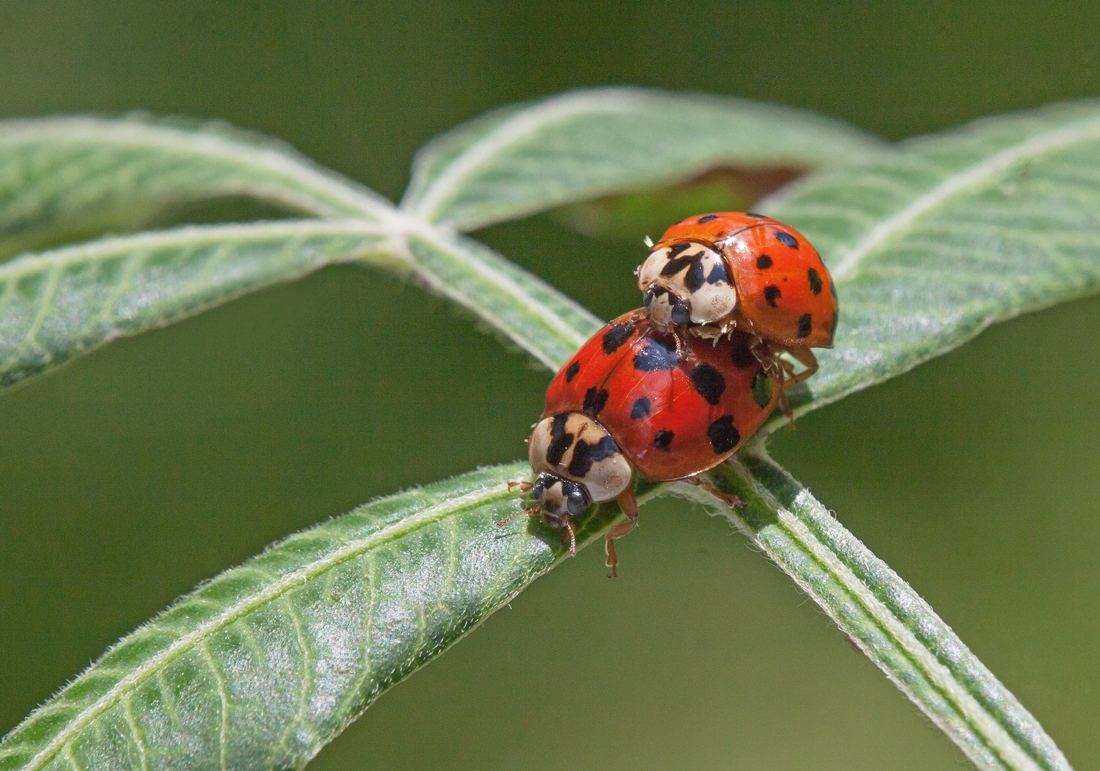
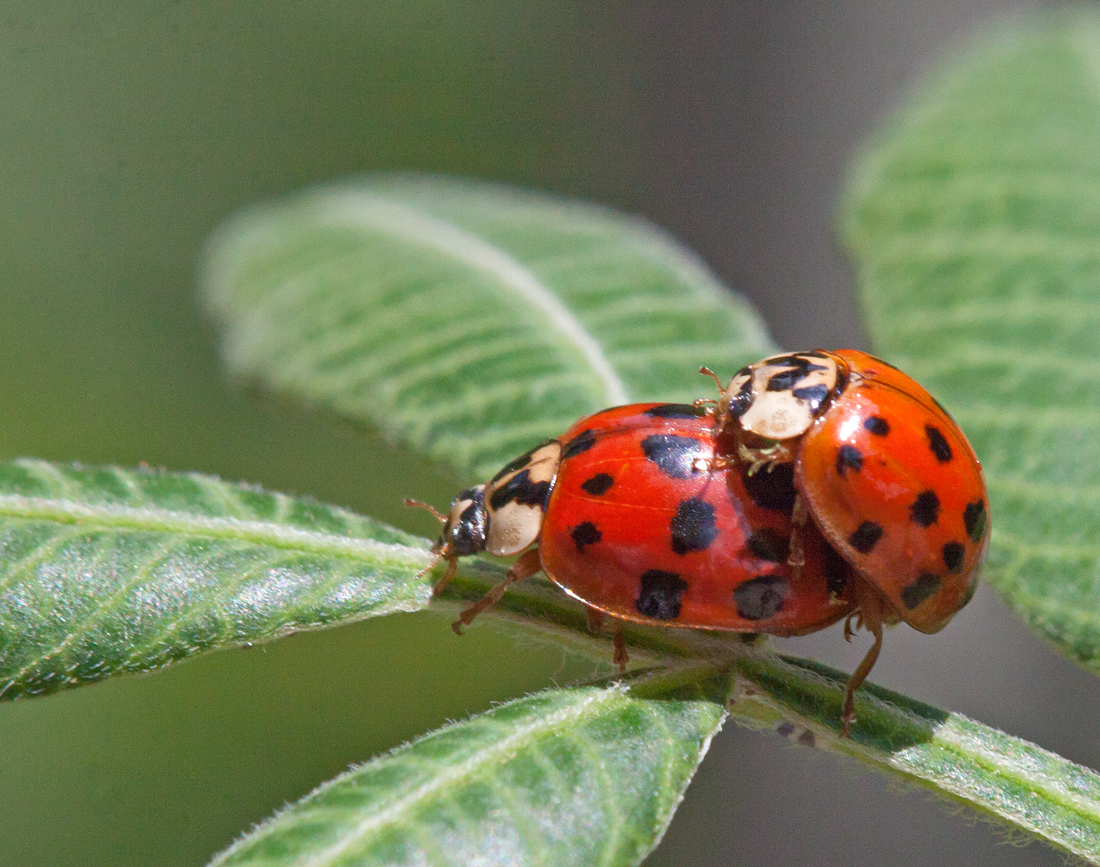
The mating pairs tended to elude him most of the day, until suddenly a pair in the “wheel” position circled around us and landed on his bare calf—talk about unprotected sex. There was no way that he could twist himself around to get a good photo, but I manage to get this shot of the two dragonflies in action.

Temperatures are supposed to continue to drop this week, so there is always a chance that these will be the last dragonflies that I see this year, though I will be out searching for them for weeks to come before I bid my final adieu to them.

wheel_leg_blog

© Michael Q. Powell. All rights reserved.

Read Full Post »

Perhaps the old adage that “opposites attract” applies to grasshoppers too. When I photographed this intimate moment on a leaf, I couldn’t figure out for sure what was going on.

Perhaps the grasshopper was attracted by the bright colors of the Handsome Meadow Katydid and was trying to start a conversation.  Maybe this was a blind date set up by some well-intentioned friends. Is it possible they matched on a lot of points in the insect version of Match.com?

I have photographed grasshoppers and katydids separately, but this is the first time I have them both in a single image. It is fascinating to be able to compare the bodies of the two species and note the differences in the eyes, the legs, and many other parts.

The striking colors of the Handsome Meadow Katydid have always drawn my attention, but I am left with one question to ponder. Do grasshoppers even see in color or only in shades of gray?

grasshopper_encounter_blog

© Michael Q. Powell. All rights reserved.

Read Full Post »
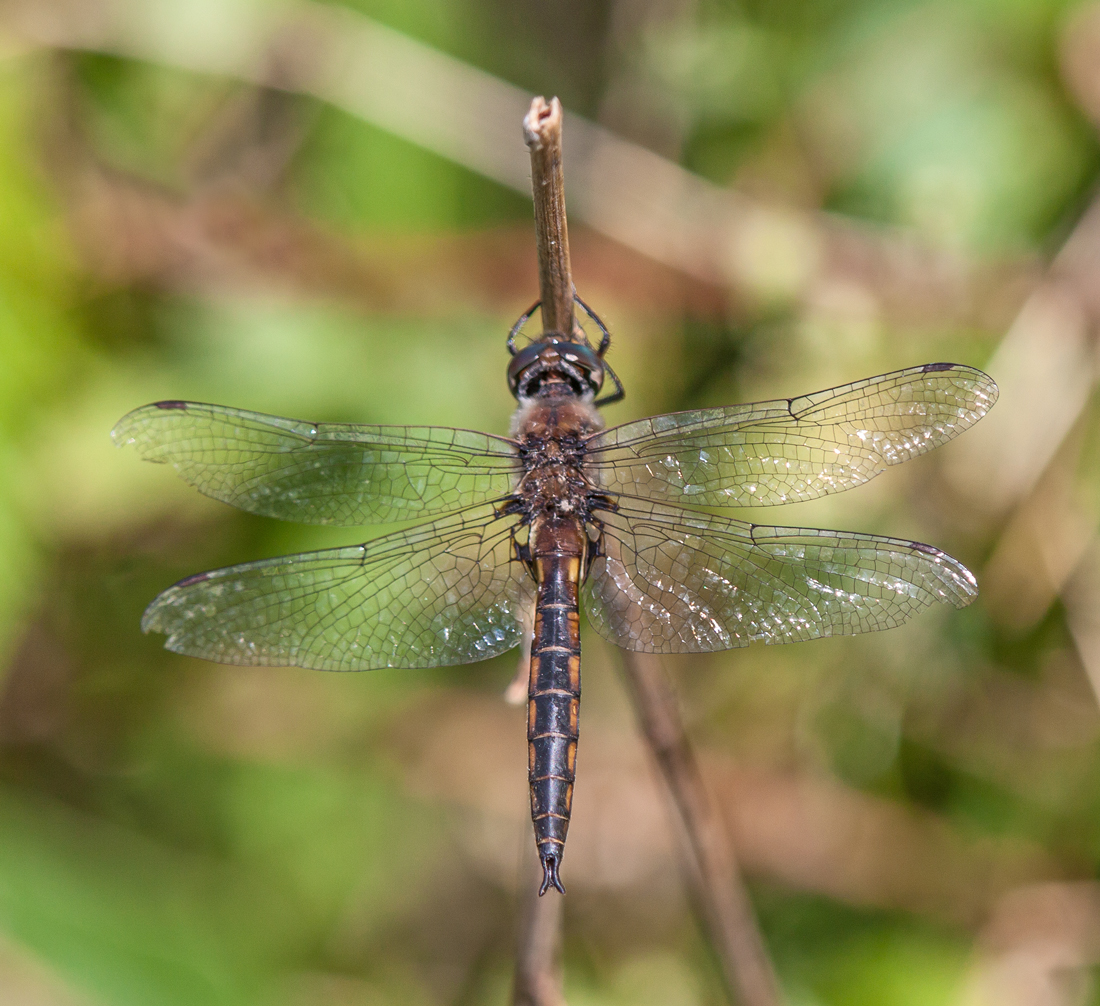
I don’t expect to see new species of dragonflies at this time of the year, but one of my fellow photographers, Walter Sanford, has been stalking the Blue-faced Meadowhawk (Sympetrum ambiguum) almost daily and I joined him for a few hours one late September day and got this shot.

I learned quickly that these dragonflies are hard to spot, despite their conspicuous coloration. They seem to like to remain perched down low in the vegetation and wait for their prey, rather than fly around when they are hunting.

I love the combination of colors on the Blue-faced Meadowhawk and I was happy to get a decent shot that shows its blue face. If you want to see more shots of this beautiful dragonfly, check out Walter’s blog posting from yesterday.

I am now in search of the Autumn Meadowhawk, the last dragonfly that I observed last fall. Normally they should be here already, but none of my fellow dragonfly followers has observed any of them yeat.

blue-faced1_blog

© Michael Q. Powell. All rights reserved

Read Full Post »
” Do you want to get some shots of a wasp nest?” I was at a loss for words when a fellow photographer excitedly posed that question to me this past weekend. I had visions of an enormous cluster of very large and angry insects and I hesitated for a long moment before finally agreeing.

What had I gotten myself into? It turns out that my fears were greatly exaggerated and the nest was a very modest one, not much bigger than the wasps themselves. My fellow photographer had been told that they are paper wasps and it looks to me like they may be brown paper wasps, judging from some of the photos that I have seen on-line.

I am hoping that the nest doesn’t get too big, because it is near a path that I regularly use. There were not a lot of wasps present yet, but they looked pretty fierce and I kept my distance and used my telephoto zoom at the far end of its range.

wasp_nest_blog

© Michael Q. Powell. All rights reserved

Read Full Post »
I featured this Slender Spreadwing damselfly (Lestes rectangularis) in an earlier posting in a series of action shots, but thought this more formal portrait deserved a posting of its own.

As I stalked this beautiful little dragonfly, it moved to a number of different perches and it is interesting to see how the background shifted in terms of color palette and clutteredness (I think I may have just created a new word). In the gymnastics shots of this damselfly, the background was bright and colorful and a little busy, whereas the background here is darker and a bit more moody, with just a hint of colors. Be sure to click on the image to see a higher resolution view of this little damselfly that was probably less than 2 inches ( 50 mm) long.

Those of you who like to observe damselflies know that this species is an exception to the general rule that damselflies, unlike dragonflies, hold their wing close into and parallel to their bodies when at rest. My fellow photographer and blogger, Walter Sanford, an expert on dragonflies, was the one who first spotted this damselfly and you should check out his blog for lots of wonderful wildlife photos, including a recent image of a perched Wandering Glider dragonfly, a species that never seems to land.damsel_spread_blog

© Michael Q. Powell. All rights reserved

Read Full Post »
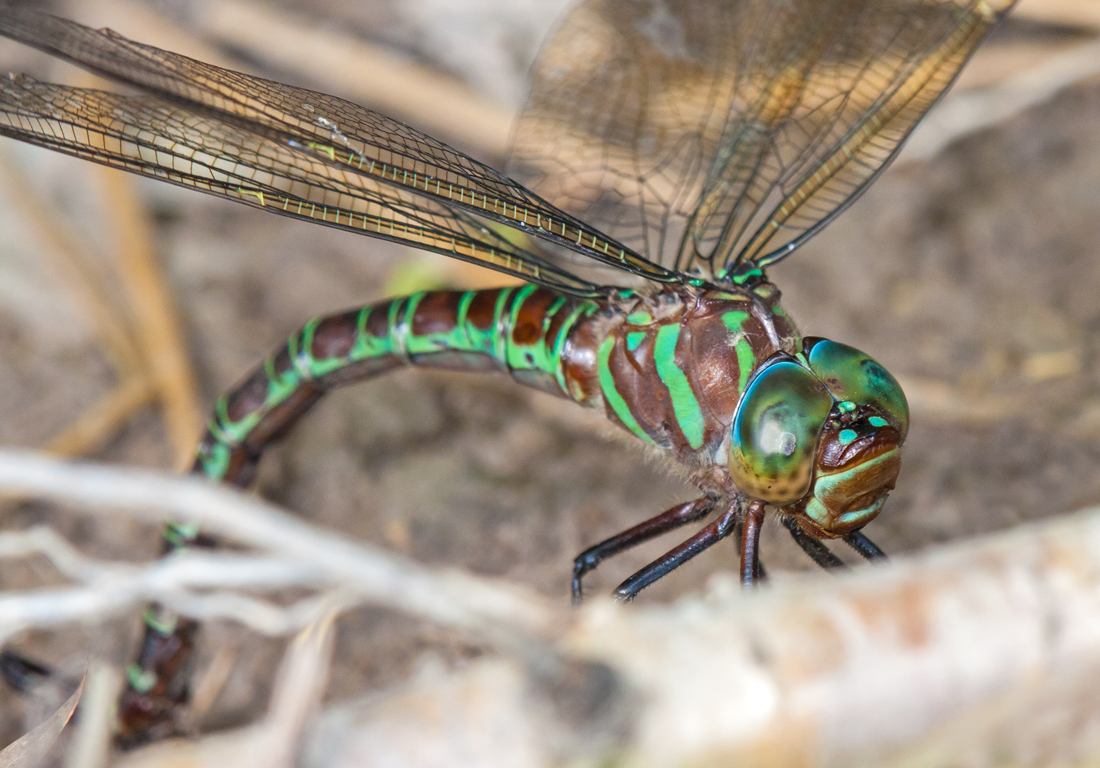
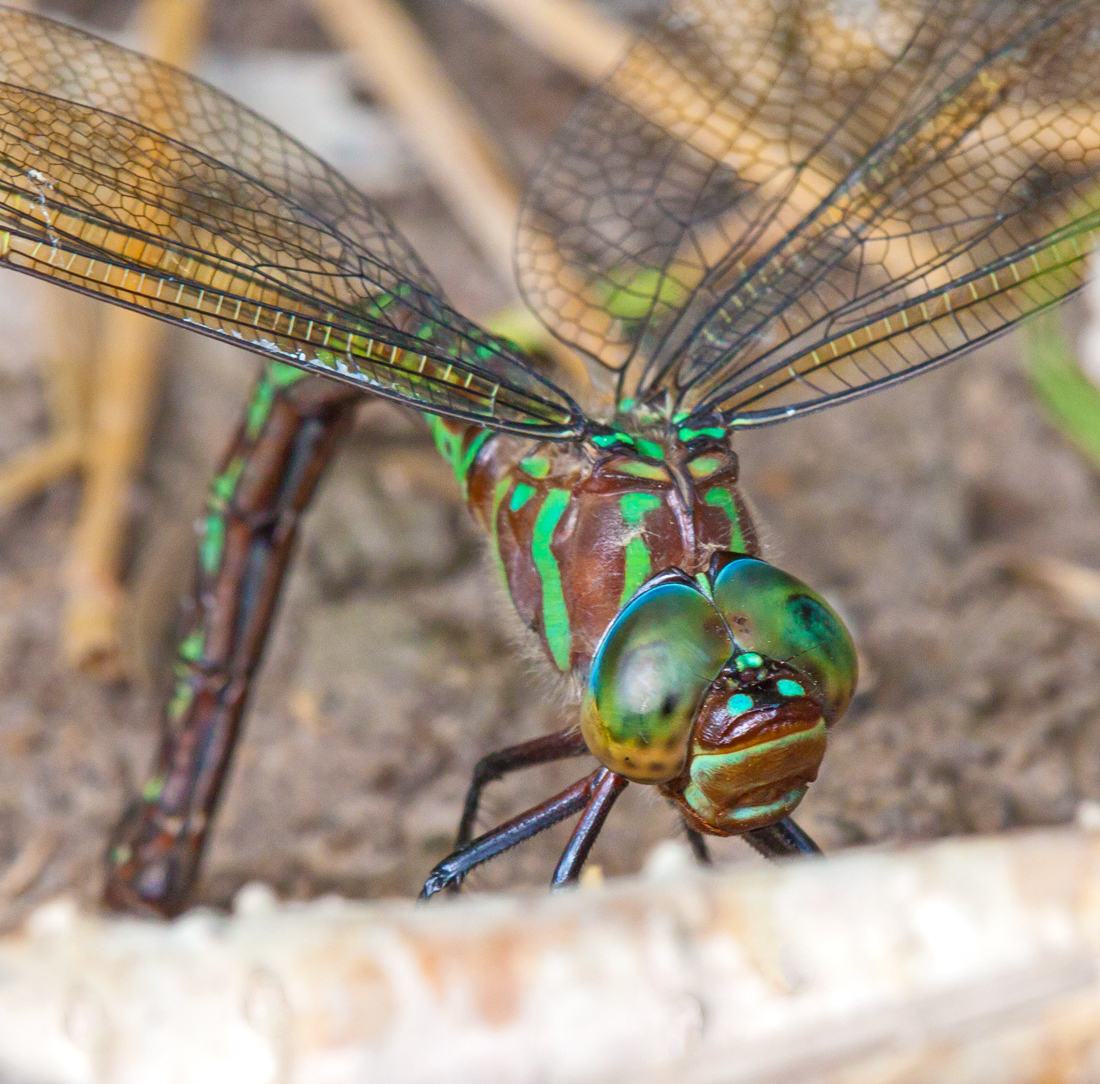
As I was observing this Slender Spreadwing damselfly (Lestes rectangularis) earlier this week, it suddenly launched into a series of acrobatic maneuvers worthy of an Olympic gymnast on the high bar. I captured several action shots of the routine, possibly related to laying eggs, although I managed my clearest shot when the damselfly returned to its starting position and waited for the scores from the judges.

Pointing the toes for maximum extension

Pointing the toes for maximum extension

damsel_spread2_blog

Swinging back to generate greater velocity for the next trick

Finishing up the routine

Finishing up the routine

Waiting for the scores from the judges

Waiting for the scores from the judges

© Michael Q. Powell. All rights reserved

Read Full Post »
A familiar subject can look quite different when viewed from an unusual angle. It’s a lesson that every photographer is taught early on, but I need constant reminders to vary my approach.

I took this shot of a Viceroy butterfly (Limenitis archippus) yesterday while lying on the ground and pointing my telephoto lens up toward the sky. The perspective caused the shape of the wings to be different and permitted me to see the butterfly’s legs in a way that was completely new.

Not all such experiments are successful, of course, but I think that this one worked out pretty well.

looking_up_blog

Click on the photo to see a higher resolution view.

© Michael Q. Powell. All rights reserved

Read Full Post »

« Newer Posts - Older Posts »