As this Great Spangled Fritillary butterfly (Speyeria cybele) moved about on a flower, the light hit it in different ways, beautifully illuminating its colorful wings.


© Michael Q. Powell. All rights reserved.
Posted in Butterflies, Flowers, Insects, Macro Photography, Nature, Photography, tagged Alexandria VA, butterfly, Canon 50D, Great Spangled Fritillary, Great Spangled Fritillary butterfly, Huntley Meadows Park, Speyeria cybele, Tamron 180mm macro lens on September 15, 2014| 10 Comments »
As this Great Spangled Fritillary butterfly (Speyeria cybele) moved about on a flower, the light hit it in different ways, beautifully illuminating its colorful wings.
© Michael Q. Powell. All rights reserved.
Posted in Dragonflies, Insects, Macro Photography, Nature, Photography, wildlife, tagged Alexandria VA, Canon 50D, Huntley Meadows Park, Mocha Emerald, Mocha Emerald dragonfly, Somatochlora linearis, Tamron 180mm macro lens on September 14, 2014| 6 Comments »
When you photograph something really cool, do you return to the same location with the hope of finding your subject again? In late August, I spotted a Mocha Emerald dragonfly (Somatochlora linearis) for the first time and was really excited, but I wanted to get some better shots.
Over the course of this summer, I have learned that some dragonflies are very habitat-specific—you can only find them in places where the water or vegetation have certain characteristics. So I returned on the 5th of September and followed the same shallow stream and was thrilled to find another Mocha Emerald. Initially I caught sight of the dragonfly in flight and wasn’t sure that it was a Mocha Emerald until it landed. Only them could I see the really narrow abdomen and unusual terminal appendage that are characteristic of this species.
Getting a shot was a bit of a technical challenge. The area was heavily shaded, but there was some light coming in from directly behind the dragonfly, creating a silhouette. I cranked up the ISO to 1250 and underexposed a bit and got the second image below after a bit of post processing. I decided to use my pop-up flash to try to balance the light coming from the back and got the first image, my favorite one.
However, I really wanted to get more of the wings into the photo and I started to circle around the perched dragonfly. Unfortunately, one foot slid into the water of the shallow stream and I composed the third shot with one foot in the water and one on the bank, not exactly an optimal shooting position.
When I tried to continue my movement to frame the dragonfly from a different angle, it flew away. I suspect that the Mocha Emeralds are now gone from the season, but I may return one last time to that location to see if there are any stragglers. I might get lucky again.


© Michael Q. Powell. All rights reserved.
Posted in Flowers, Insects, Macro Photography, Nature, Photography, tagged Alexandria VA, bee, Canon 50D, Huntley Meadows Park, pollen, Tamron 180mm macro lens on September 13, 2014| 16 Comments »
During these last few days of summer, the bees seem especially busy. I love the sight of bees covered in pollen, especially unusual ones like this striped bee (I think it is a bee, but would welcome corrections to my identification).

© Michael Q. Powell. All rights reserved.
Posted in Dragonflies, Insects, Macro Photography, Nature, Photography, tagged Alexandria VA, Canon 50D, female Great Blue Skimmer, Great Blue Skimmer, Huntley Meadows Park, Libellula vibrans, Tamron 180mm macro lens on September 9, 2014| 9 Comments »
One of the dangers of shooting with a macro lens is that I am often so focused on shooting close-up that I forget to step back and look at the bigger picture.
A couple of days ago, I posted a photo of a dragonfly basking in the sun and felt pretty content that I had been able to capture a detailed shot of its eyes and face. I had instantly gravitated to several close-up images to the point that I temporarily forgot that my initial shots had been from a greater distance. As a result, I made my preliminary identification on the basis of the facial shot alone.
After I posted the image on Facebook, one of my fellow photographers, Walter Sanford, who is much more of an expert on dragonflies than I am, asked me if I had any shots of the dragonfly’s entire body, probably with a desire to check my identification. When I reviewed my more distant shots of the dragonfly, I was immediately struck by how tattered the wings were of this female Great Blue Skimmer (Libellula vibrans). Sure, I’ve seen lots of dragonflies with minor damage to the wings, but these are seriously tattered.
When I posted these follow-up images on Facebook, Walter replied, “Definitely an old female Great Blue Skimmer dragonfly, as indicated by its tattered wings, coloration, and flanges beneath the eighth abdominal segment. The flanges are used to scoop and hold a few drops of water when laying eggs (oviposition), hence the family name “skimmer.” ”
Be sure to check out Walter’s blog for his wonderful shots of dragonflies and his more scientific descriptions of his subjects. My background was more in the liberal arts area rather than in science, and my writing in my blog tends to be a reflection of that background.
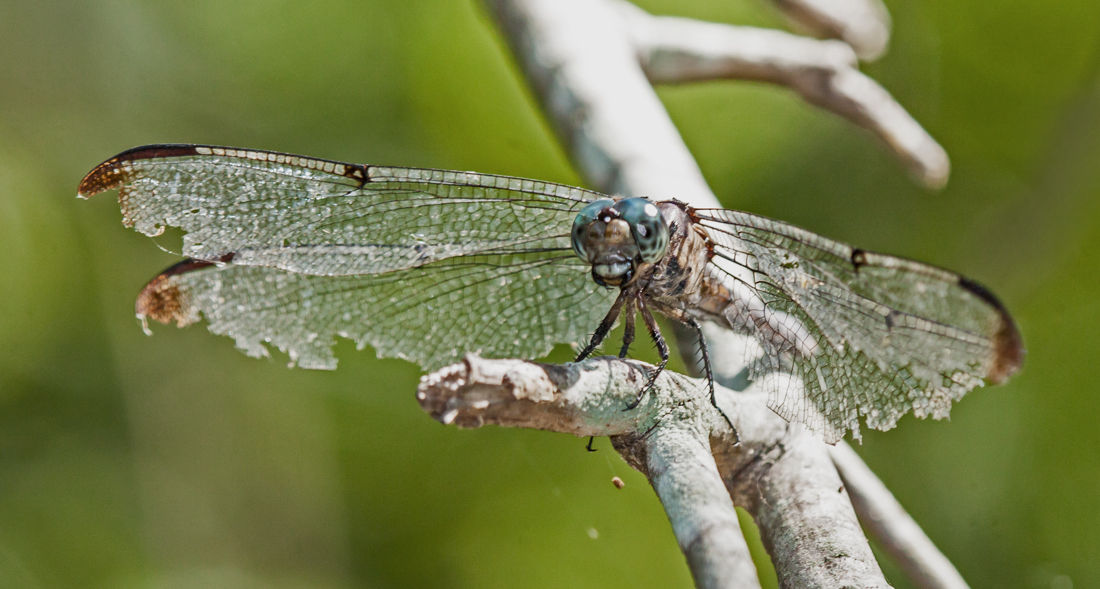
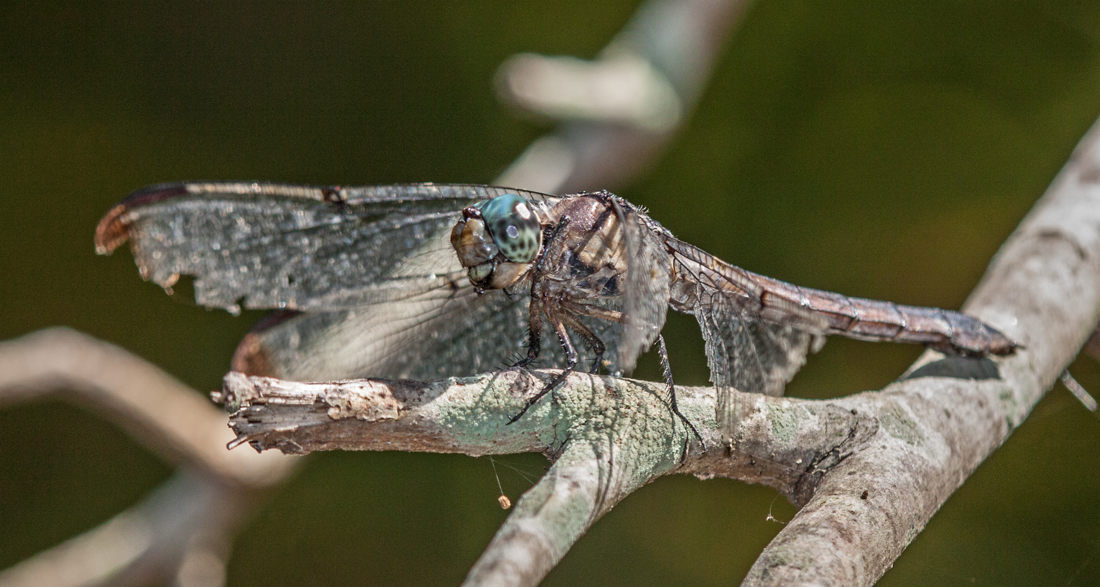
© Michael Q. Powell. All rights reserved.
Posted in Dragonflies, Insects, Macro Photography, Nature, Photography, Portraits, tagged Alexandria VA, basking dragonfly, Canon 50D, dragonfly, female Great Blue Skimmer, Great Blue Skimmer, Great Blue Skimmer dragonfly, Huntley Meadows Park, Libellula vibrans, Tamron 180mm macro lens on September 7, 2014| 8 Comments »
I was suffering in the heat and humidity on Friday, but this dragonfly, which I think is a female Great Blue Skimmer (Libellula vibrans), seemed to enjoy basking in the sunlight and let me get really close for this shot.
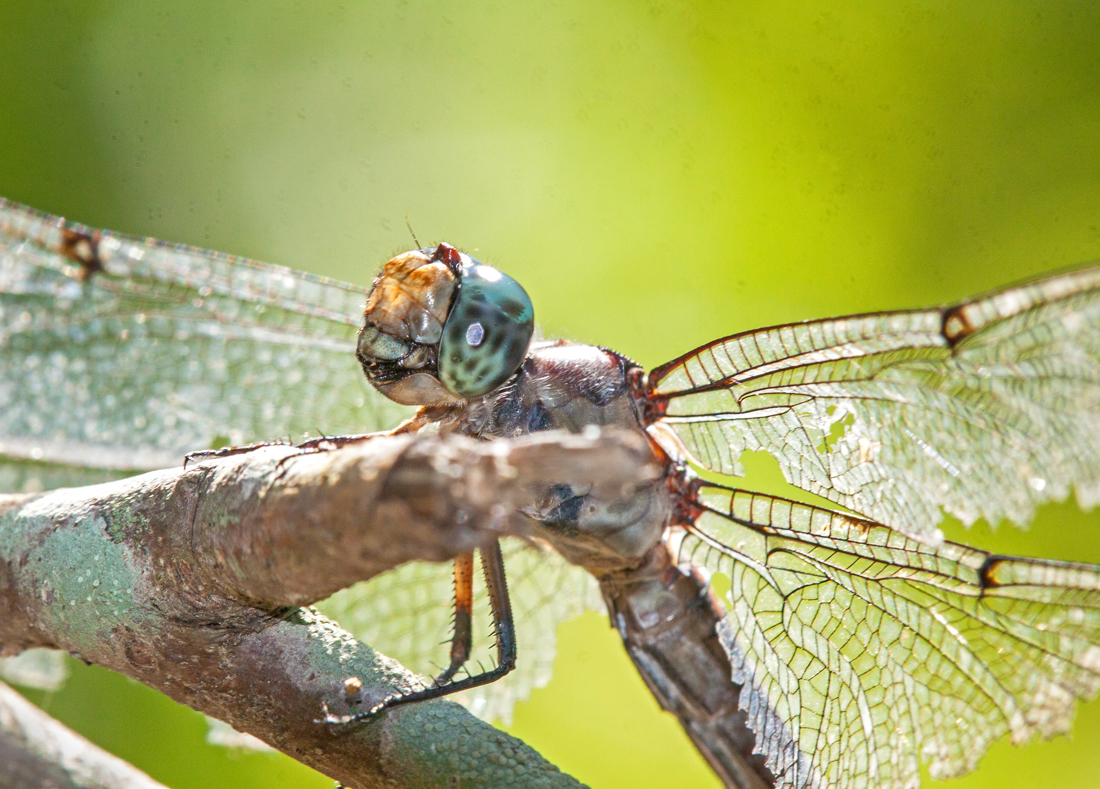
© Michael Q. Powell. All rights reserved.
Posted in Arachnids, Insects, Macro Photography, Nature, Photography, wildlife, tagged Alexandria VA, Canon 50D, Huntley Meadows Park, Neoscona crucifera, Spotted Orbweaver, Spotted Orbweaver spider, Tamron 180mm macro lens on September 6, 2014| 7 Comments »
As I gazed across the little creek that I was following, I spotted a spider hanging in midair. The spider scrambled up one of its silken threads as I approached and stopped just short of the branch from which it had been hanging. It was pretty dark in the shade, so I cranked up the ISO to 1250, popped up the built-in flash, and propped the camera against another tree for stability.
Of the images that I attempted, this is the best one I managed of what I believe is a Spotted Orbweaver spider (Neoscona crucifera).

© Michael Q. Powell. All rights reserved.
Posted in Art, Butterflies, Flowers, Insects, Macro Photography, Nature, Photography, Summer, tagged Alexandria VA, Canon 50D, Great Spangled Fritillary, Great Spangled Fritillary butterfly, Huntley Meadows Park, Speyeria cybele, Tamron 180mm macro lens, thistle on September 4, 2014| 16 Comments »
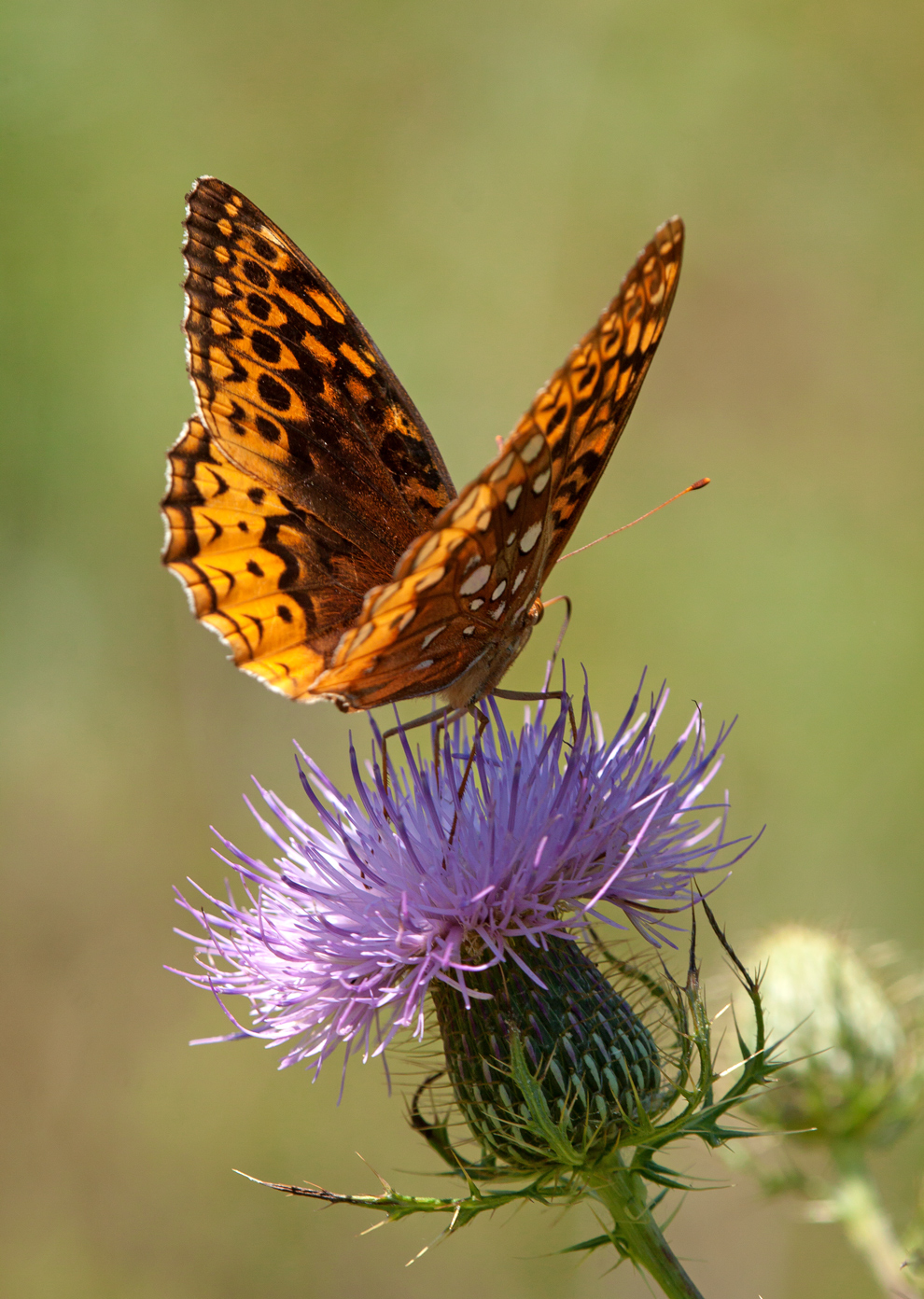
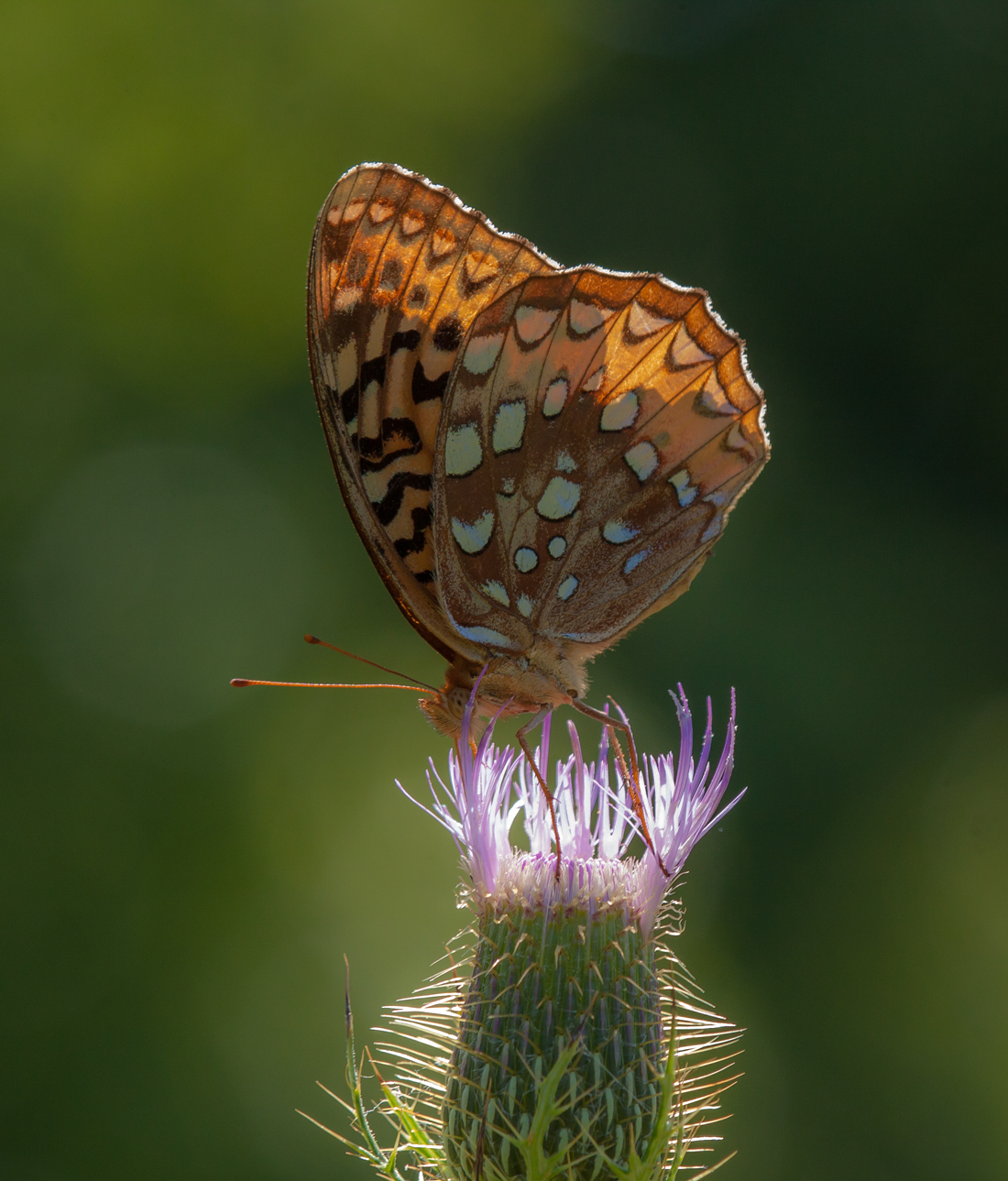
As I came out of the woods into a meadow at my local marshland park, I caught sight of some bright orange butterflies, which I could immediately identify as Great Spangled Fritillary butterflies (Speyeria cybele). The butterflies were concentrating their attention on a small cluster of plants which looked to be some kind of thistle.
I moved closer to get some shots, wading through the vegetation, which by this time of the summer is chest-high. I’ve already learned the hard way about the “joys” of chiggers and ticks, but I tossed my concerns to the side and boldly stepped forward. Fortunately for me, the butterflies were distracted with their feeding activity and did not fly away at my approach.
The sunlight was pretty strong and the look of the photo changed a lot as I circled around the butterflies, as you can see from the images below. I took a lot of shots, some of which I have not yet processed, but I was so happy with the images that I captured that I figured I better post some while it is still summer. Don’t be surprised if you see a few more images like this in the near future.
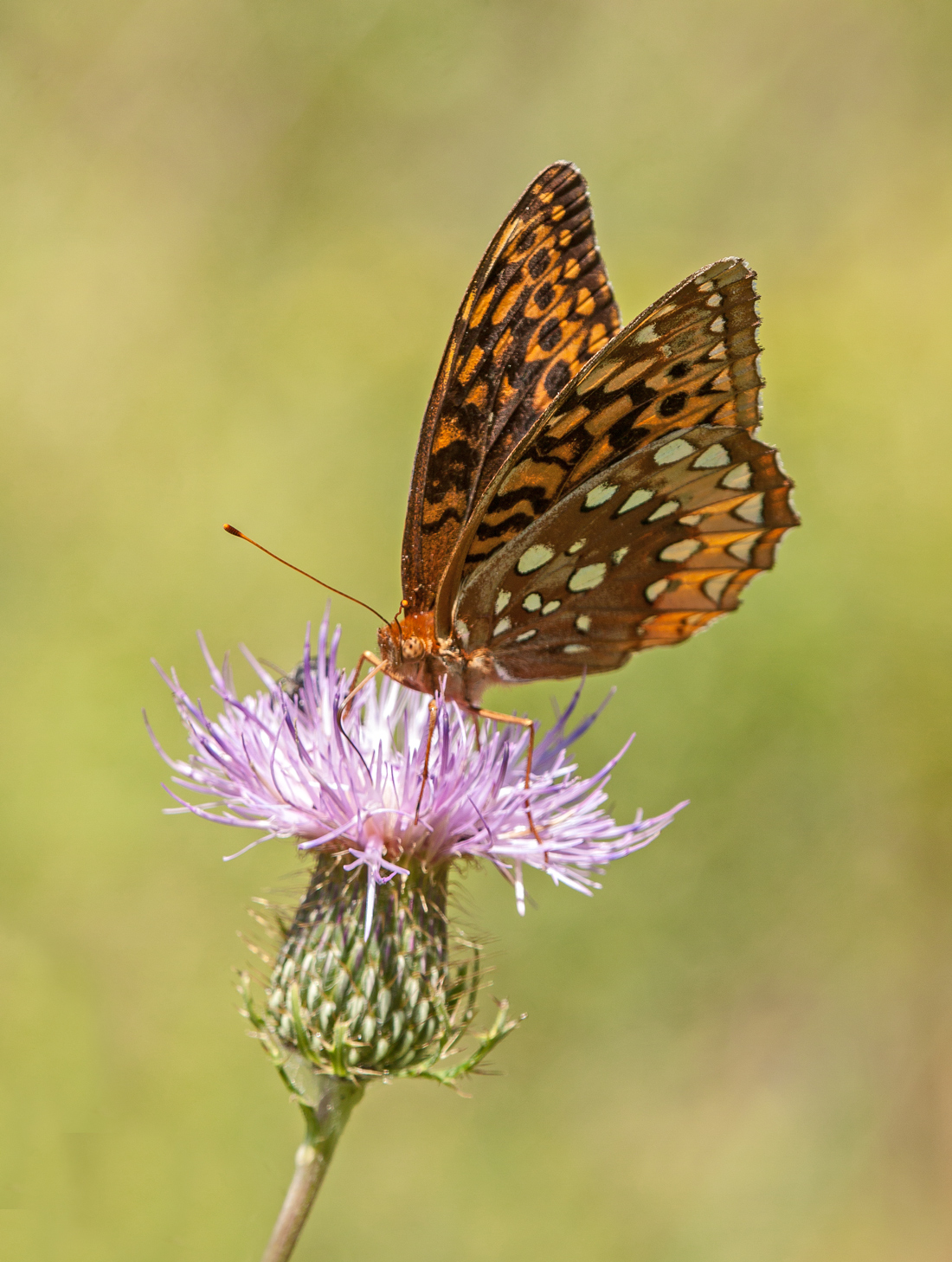
© Michael Q. Powell. All rights reserved.
Posted in Butterflies, Insects, Macro Photography, Nature, Photography, Summer, tagged Canon 50D, Limenitis arthemis, Red-spotted Purple, Red-spotted Purple butterfly, Tamron 180mm macro lens on September 3, 2014| 9 Comments »
Summer is not over yet. Sure, Labor Day has come and gone and school buses now clog my morning commute. In the elevator yesterday, I heard two ladies discussing whether they could still wear a white skirt to work. Leaves are starting to fall from the trees and are changing colors.
Despite these signs, I still defiantly proclaim that summer is not finished as long as I continue to see beautiful butterflies, like this Red-spotted Purple butterfly (Limenitis arthemis) that I spotted last Friday at my local marsh. The wooden board on which it is perched is not exactly photogenic, but I can’t complain too much, since these butterflies also have a fondness for rotting fruit and animal dung.


© Michael Q. Powell. All rights reserved.
Posted in Dragonflies, Insects, Macro Photography, Nature, Photography, Summer, tagged Alexandria VA, Black Saddlebags, Black Saddlebags dragonfly, Canon 50D, Carolina Saddlebags, dragonfly in flight, Huntley Meadows Park, Lewis Ginter Botanical Garden, Richmond VA, Tamron 180mm macro lens, Tramea carolina, Tramea lacerata on September 2, 2014| 6 Comments »
You know that summer is coming to a close when the dragonflies that were in constant flight earlier in the season seem to be resting more often, like this Black Saddlebags dragonfly (Tramea lacerata) that one of my fellow photographers, Walter Sanford, pointed out this past weekend at my local marsh. This dragonfly kept flying back and forth between two perches that were tantalizingly just out of the range of the 180mm lens that I had on my camera. I didn’t dare to take the time to change my lens, knowing that the dragonfly would almost certainly fly away at the most inopportune moment, so I ended up cropping a lot, especially in the first image.
The only shots that I could get of Saddlebags dragonflies earlier in the summer were in-flight shots and I have already posted some shots of a Black Saddlebags in the air. I realized, though, that I had not posted an image of its more colorful counterpart, the Carolina Saddlebags (Tramea carolina) that I photographed during a visit to Lewis Ginter Botanical Gardens in Richmond, Virginia. I took that shot (the third one below) from a pretty long distance, but was able to achieve focus and capture some of the wonderful details of this beautiful red dragonfly.


© Michael Q. Powell. All rights reserved.
Posted in Dragonflies, Insects, Macro Photography, Nature, Photography, tagged Alexandria VA, Canon 50D, Huntley Meadows Park, Mocha Emerald, Mocha Emerald dragonfly, Somatochlora linearis, Tamron 180mm macro lens on September 1, 2014| 14 Comments »
What’s a Mocha Emerald? No, it’s not the newest Seattle coffee craze—it’s a dragonfly.
I was thrilled this past Friday to spot a type of dragonfly at Huntley Meadows Park that I had never seen before—a Mocha Emerald (Somatochlora linearis). Fellow photographer and blogger, Walter Sanford, saw some in the park earlier in the summer, but I thought that it was probably too late for me to find one. It’s nice to be surprised.
Initially, I didn’t know what type of dragonfly I had photographed and knew only that its body shape was different from the ones that I had seen previously. Serendipitously, later in the day l ran into the manager of the park, Kevin Munroe, a noted dragonfly expert who runs the website Dragonflies of Northern Virginia, and he helped me make a tentative identification.
This one has somewhat tattered wings–it looks like he had a tough summer.

© Michael Q. Powell. All rights reserved.
Posted in Flowers, Insects, Macro Photography, Nature, Photography, Summer, tagged Alexandria VA, Canon 50D, Huntley Meadows Park, kissing wasps, mating wasps, Tamron 180mm macro lens, wasp on August 30, 2014| 17 Comments »
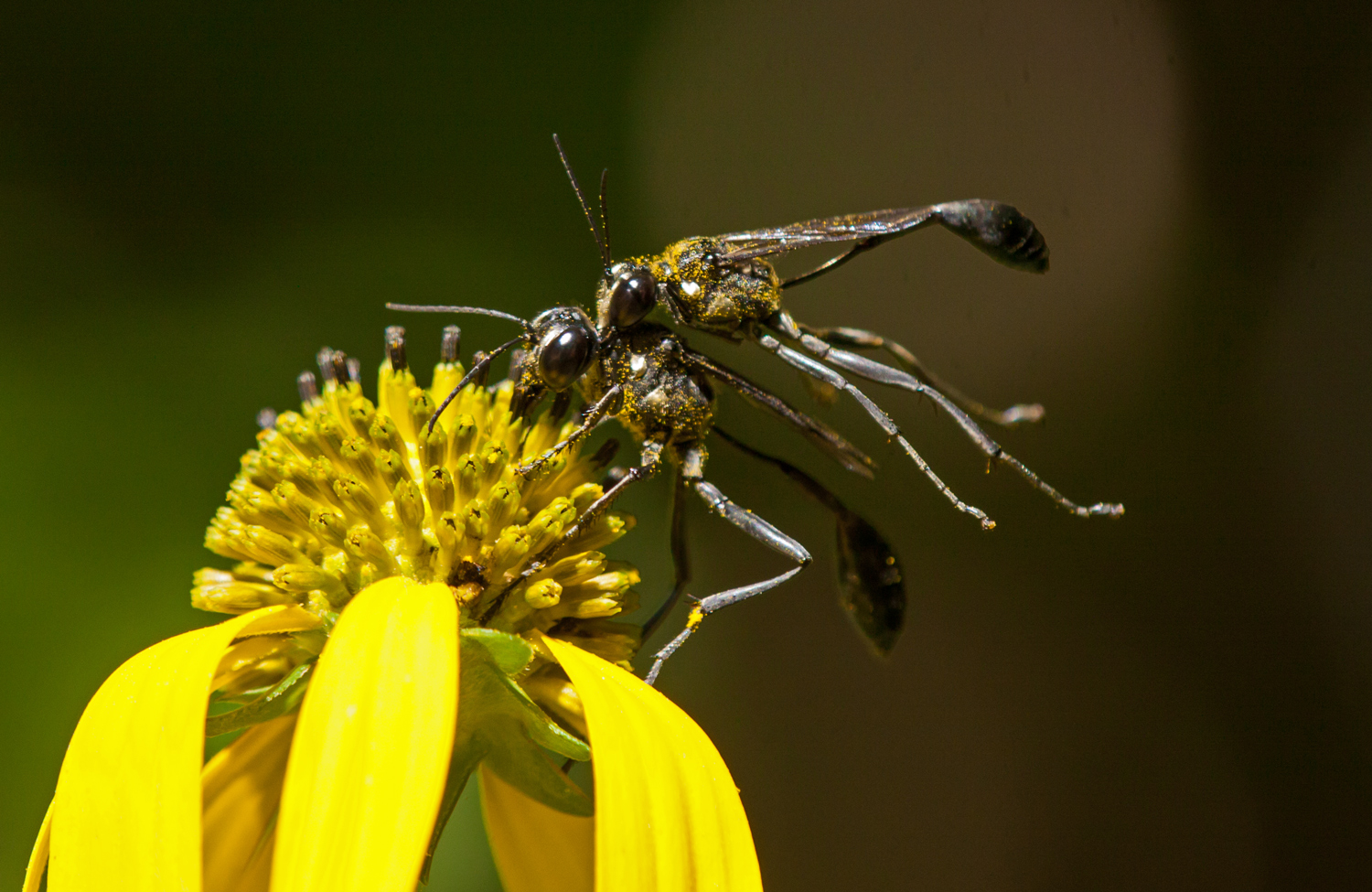
I don’t know much about the intimate life of wasps, but it sure looked to me like one of them is giving the other a loving nibble on the back of its neck. Both of them were covered in a lot of pollen, like they had just had a roll in the hay, figuratively speaking.
The two of them had flown to this flower in what appeared to be a mating position, though I can’t tell if the wasps are actually hooked up in this shot. My experience with dragonflies, however, has shown me that insects can mate in all kinds of unusual positions.
I am comfortable with moving in close for photos of bees, but I decided that in this case it was prudent to maintain a respectful distance from the wasps.
© Michael Q. Powell. All rights reserved.
Posted in Insects, Macro Photography, Nature, Photography, tagged Alexandria VA, beetle, Canon 50D, goldenrod, Huntley Meadows Park, Tamron 180mm macro lens on August 28, 2014| 12 Comments »
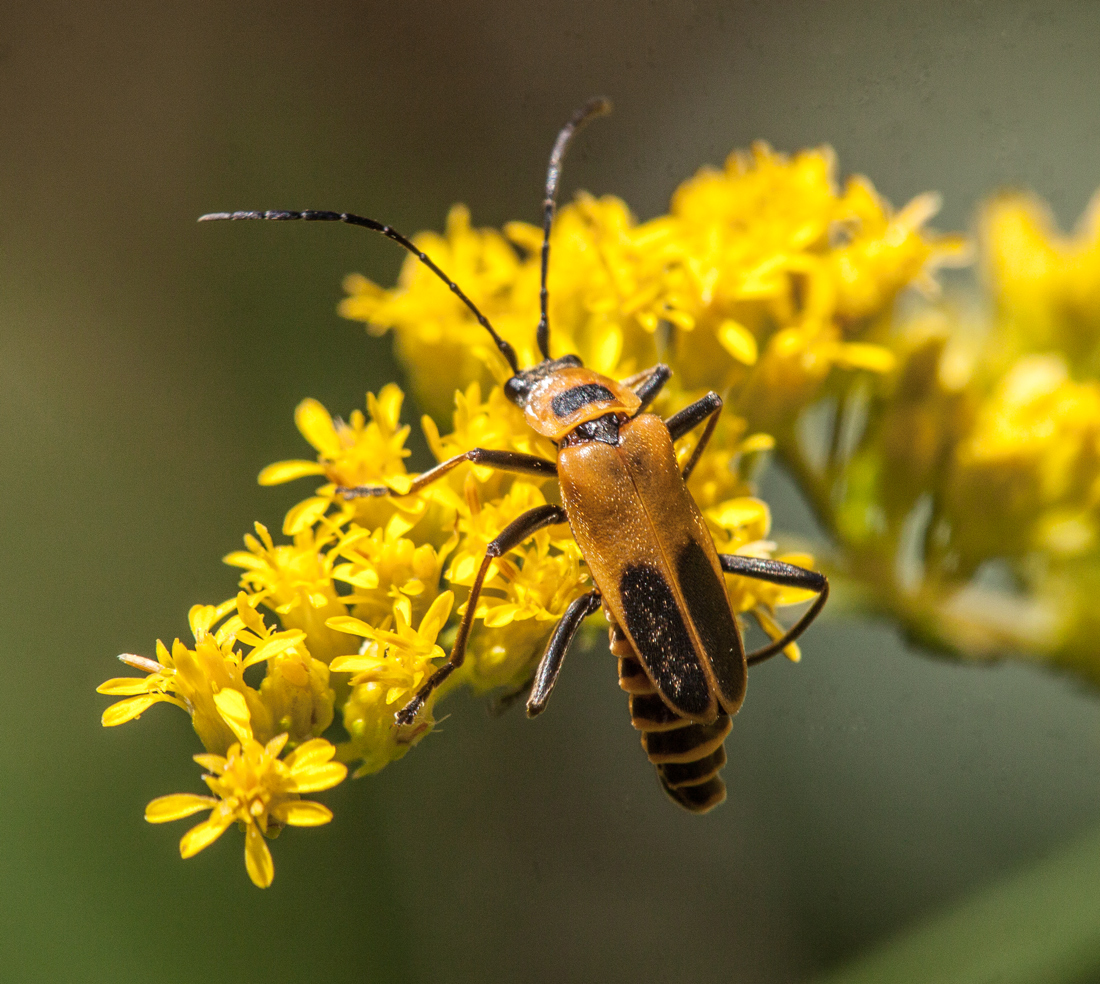
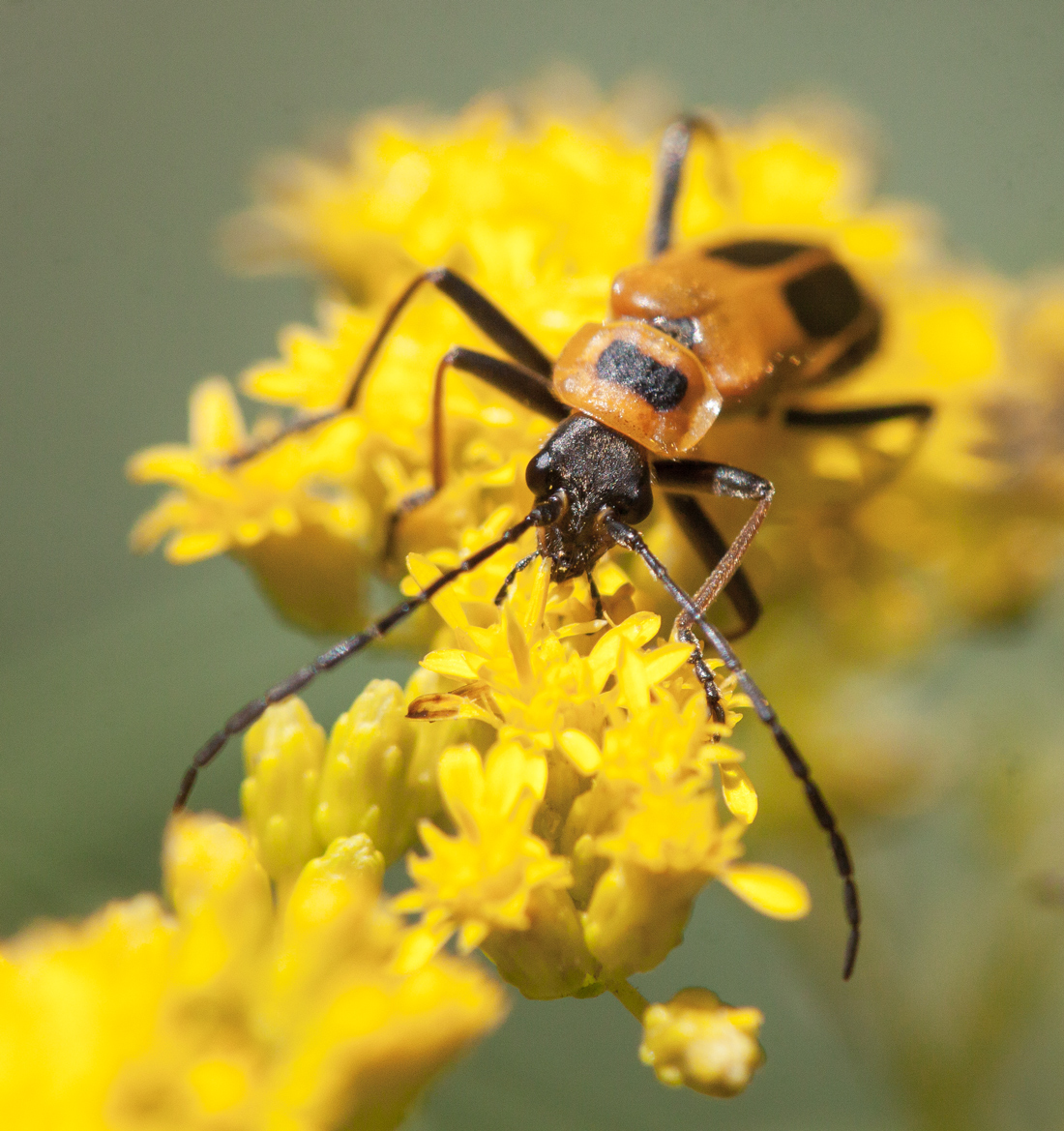
Goldenrod seems to act like a magnet for all kinds of flying and crawling insects and earlier this week I was fascinated by a large beetle crawling around and through the goldenrod. I haven’t yet been able to identify the beetle, but I had a lot of fun trying to move in close with my macro lens and capture its image from various angles.

© Michael Q. Powell. All rights reserved.
Posted in Dragonflies, Insects, Macro Photography, Nature, Photography, tagged Alexandria VA, Canon 50D, Canon 70-300mm telephoto zoom lens, Eastern Pondhawk, Eastern Pondhawk dragonfly, Erythemis simplicicollis, Huntley Meadows Park, predator, prey on August 27, 2014| 13 Comments »
Dragonflies are so beautiful that I sometimes forget that they are also fierce predators. Last weekend at my local marsh, I captured this image of a female Eastern Pondhawk dragonfly (Erythemis simplicicollis) feeding on another dragonfly, which looks like it might be a female Blue Dasher (Pachydiplax longipennis).
The dragonfly is perched on the end of one of the slats of a railing that along the edge of an inclined section of the boardwalk. I cropped the image to focus viewers’ attention on the dragonfly, but I also like the second version of the same photo, which is close to the original view when I took the shot. Somehow those three slats remind me of a row of tombstones, a memorial to the predator’s prey.


© Michael Q. Powell. All rights reserved.
Posted in Humor, Insects, Macro Photography, Nature, Photography, Uncategorized, tagged Alexandria VA, cannibal, cannibalfly, Canon 50D, Huntley Meadows Park, Promachus rufipes, Red-footed Cannibalfly, Tamron 180mm macro lens on August 26, 2014| 10 Comments »
I never realized that I was surrounded by cannibals. No, I did not discover a pile of skulls or a string of shrunken heads, but almost every time recently that I have gone out into my local marsh, I have spotted Red-footed Cannibalflies (Promachus rufipes).
These insects are big and they buzz as they fly by me, so they are hard to miss. I have read that they are vicious predators, but I had never caught one red-handed with prey (or perhaps I should say red-footed) until yesterday. I can’t quite identify the prey, but it looks like it might be some kind of small bee. If so, it wouldn’t bee too surprising, given that one of the nicknames for this species in the “Bee Panther.”
I know that I shouldn’t be worried about these cannibals, but a slight chill went through me yesterday when one of these insects landed on the lenshood of my camera and looked up at me, looking very much like he was sizing me up

© Michael Q. Powell. All rights reserved.
Posted in Dragonflies, Insects, Macro Photography, Nature, Photography, Uncategorized, wildlife, tagged Canon 50D, Celithemis eponina, halloween pennant, Halloween Pennant dragonfly, Lewis Ginter Botanical Garden, Richmond VA, Tamron 180mm macro lens on August 25, 2014| 13 Comments »
It’s not hard to figure out the source of its name when you spot a colorful Halloween Pennant dragonfly (Celithemis eponina) waving in the breeze. These dragonflies also remind me of pole vaulters, attempting to thrust their bodies over a crossbar while holding on to the very end of a long pole.
I have not seen one yet at Huntley Meadows Park, the place where I take the majority of my photos, though earlier this summer one of my fellow photographers, Walter Sanford, spotted one in the park for the first time in years. I shot this image at edge of a small pond during a recent trip to Lewis Ginter Botanical Garden in Richmond, Virginia.

© Michael Q. Powell. All rights reserved.
Posted in Dragonflies, Humor, Insects, Macro Photography, Nature, Photography, Uncategorized, tagged Alexandria VA, Canon 50D, Canon 70-300mm telephoto zoom lens, Enallagma signatum, Huntley Meadows Park, Orange Bluet, Orange Bluet damselfly on August 23, 2014| 12 Comments »
I know that damselflies come in many colors, but my brain wanted to cramp up when I was told that this stunning orange damselfly was a bluet. An orange bluet? Aren’t bluets blue?
Apparently that is not always the case, and this little beauty is in fact a male Orange Bluet damselfly (Enallagma signatum). This shot looks like it was done with flash, but I double checked the EXIF data and confirmed that it was simply an effect caused simply by using exposure compensation and metering carefully on the subject. Normally, I am not a big fan of a black background, which can be caused when the light from the flash overpowers the ambient light, but I think that it works well in this shot, which looks almost like it was shot in a studio.
In the second shot, the brown color of the muddy water shows through in a way that is a little more natural. I took this shot when the damselfly was farther away than in the first shot and I like the way that it shows a bit more of the environment than in the first image.
One of the advantages of shooting in bright light and on a tripod was that I was able to shoot at ISO 100 and at f/11, which gave me images that were a lot cleaner than I often get.


© Michael Q. Powell. All rights reserved.
Posted in Butterflies, Insects, Macro Photography, Nature, Photography, tagged butterflies, Butterfly House, Canon 50D, colorful butterflies, exotic butterflies, Lewis Ginter Botanical Garden, Richmond VA, Tamron 180mm macro lens on August 22, 2014| 19 Comments »
While at Lewis Ginter Botanical Gardens in Richmond,Virginia last weekend, I visited the butterfly house. It was hot and really humid inside of the glassed-in conservatory, but it was worth it to be surrounded by all of the colorful, exotic butterflies. Normally, I try to identify the species that I photograph, but in this case I neglected to photograph the placards inside the butterfly house. My brain is full enough trying to remember the species indigenous to my area, so perhaps viewers can forgive me and simply enjoy the delicate beauty of these amazing creatures.
Click on any of the tile to see all of the shots in slide show format.


© Michael Q. Powell. All rights reserved.
Posted in Dragonflies, Insects, Macro Photography, Nature, Photography, Summer, tagged Alexandria VA, Canon 50D, Fragile Forktail, Fragile Forktail damselfly, Huntley Meadows Park, Ischnura posita, Tamron 180mm macro lens on August 20, 2014| 8 Comments »
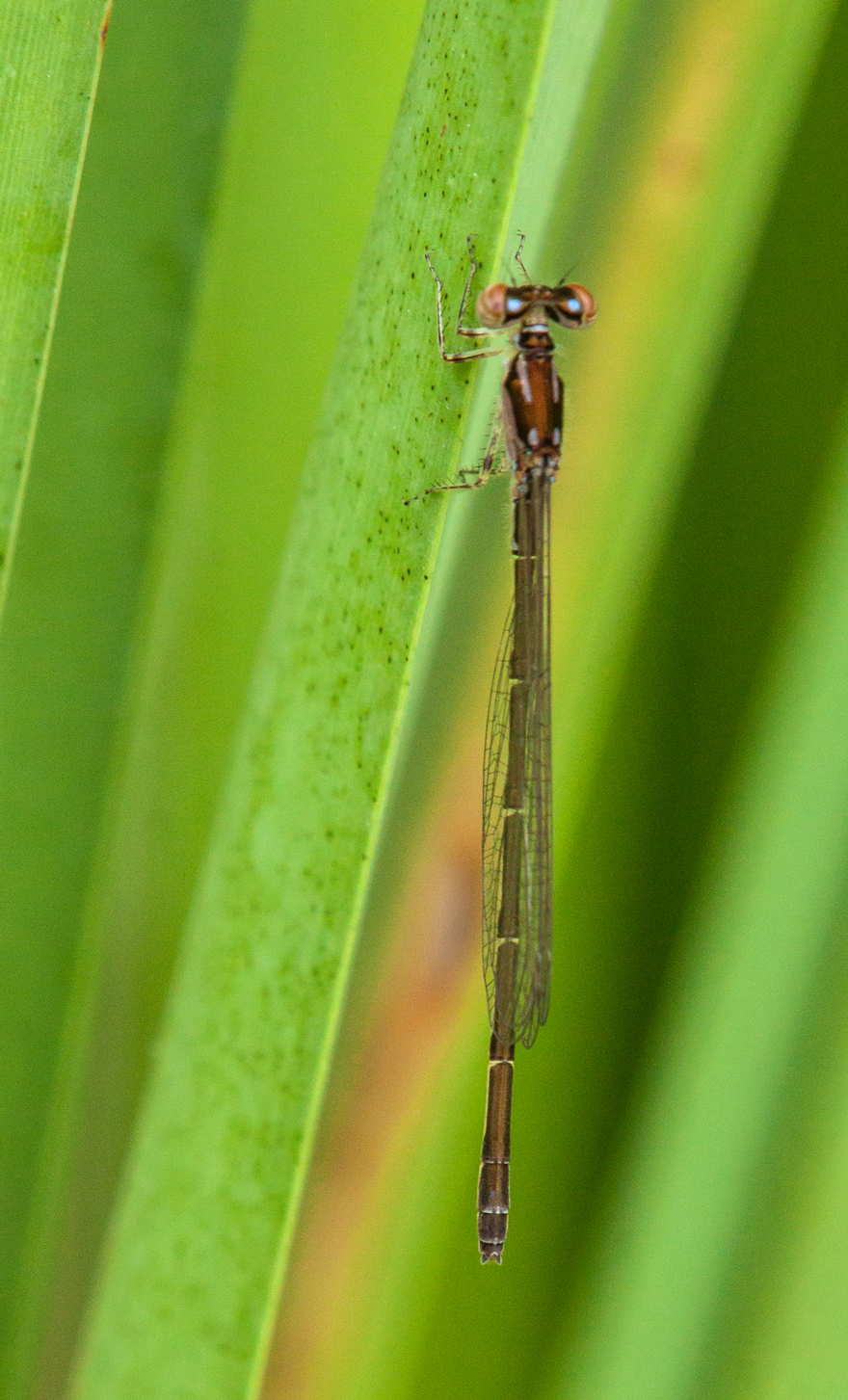
It’s hard to imagine a simpler composition—a tiny damselfly in the green growth of the marsh—but I find real beauty and power in this image.
Look closely at this damselfly, which I think is a female Fragile Forktail (Ischnura posita), and you will see some amazing colors and details, all packed into a body that is only about an inch long.
Click on the image to see a higher resolution view of the image.
© Michael Q. Powell. All rights reserved.
Posted in Insects, Macro Photography, Nature, Photography, wildlife, tagged Alexandria VA, Canon 50D, Huntley Meadows Park, mating Red-footed Cannibalflies, mating robber flies, Promachus rufipes, Red-footed Cannibalfly, robber fly, Tamron 180mm macro lens on August 19, 2014| 10 Comments »
As I was walking through my local marsh yesterday, I caught sight of a giant flying insect. Upon closer examination, it proved to be a pair of mating Red-footed Cannibalflies (Promachus rufipes).
They eventually settled on a leaf, just above eye level. It was a heavily vegetated area and it was tough getting a clear line of sight and a good angle of view (and standing on my tiptoes probably is not an optimal shooting position). This first shot was the only one I got where both of these giant insects were in focus.
At a certain point of time, one of them, which I suspect was the female, tried to escape and I got the second shot, capturing an unusual moment in time. In the original version, the background was mostly light colored, but there were some ugly smudges of greenish gray. I tried to remove them hastily in post processing to highlight better the subjects, but I noted that I didn’t do a very good job when, after the fact, I looked at the posting on a computer screen, vice my laptop, on which it was composed..
The second shot seems to be begging for a clever caption. Does anyone have a suggestion?


© Michael Q. Powell. All rights reserved.
Posted in Butterflies, Flowers, Insects, Nature, Photography, tagged Alexandria VA, Asclepias incarnata, Canon 50D, Canon 70-300mm telephoto zoom lens, Danaus plexippus, Huntley Meadows Park, milkweed, monarch butterfly, swamp milkweed on August 18, 2014| 5 Comments »
The few Monarch butterflies (Danaus plexippus) that I observed earlier this season were all in gardens, so I was especially happy when I spotted one this past weekend in the wild, feeding on some Swamp Milkweed (Asclepias incarnata) at my local marsh.
The little patch of Swamp Milkweed was a pretty good distance away, so I had to use the long end of my 70-300mm zoom for these shots. It looks like many of the flowers of the milkweed had not yet opened, but the butterfly obviously found it to be attractive enough to stop for a moment.


© Michael Q. Powell. All rights reserved.
Posted in Dragonflies, Insects, Macro Photography, Nature, Photography, tagged Alexandria, damselflies mating, Enallagma signatum, Huntley Meadows Park, Orange Bluet, Walter Sanford on August 17, 2014| 3 Comments »
I spend a lot of time chasing dragonflies and damselflies, but my efforts pale in comparison with those of fellow blogger and photographer Walter Sanford. He has so much experience with them that he focuses much of his attention on photographing females and mating pairs. This posting contains some amazing shots of mating damselflies in a mating position that looks like a heart, a position that I doubt exists in the Kama Sutra.
I was looking for mating pairs of Eastern Pondhawk dragonflies (Erythemis simplicicollis) during a photowalk at Huntley Meadows Park on 10 August 2014. Meanwhile my friend Mark Jette spotted a mating pair of damselflies.
The Orange Bluet damselflies (Enallagma signatum) shown in the following photographs are “in wheel,” in which the male uses “claspers” (terminal appendages) at the end of his abdomen to hold the female by her neck/thorax while they are joined at their abdomens. The male, orange and black in color, is on top; the female, green and black in color, is on the bottom.
The copulatory, or wheel, position is unique to the Odonata, as is the distant separation of the male’s genital opening and copulatory organs. Source Credit: Paulson, Dennis (2011-12-19). Dragonflies and Damselflies of the East (Princeton Field Guides) (Kindle Locations 377-378). Princeton University Press. Kindle Edition.
The wheel position is…
View original post 149 more words
Posted in Dragonflies, Insects, Macro Photography, Nature, Photography, tagged Argia fumipennis, Argia fumipennis violacea, Canon 50D, Lewis Ginter Botanical Garden, Richmond VA, Tamron 180mm macro lens, Variable Dancer, Variable Dancr damselfly, Violet Dancer, Violet Dancer damselfly on August 17, 2014| 7 Comments »
Yesterday on a photo expedition with some friends to Lewis Ginter Botanical Garden in Richmond, Virginia, I encountered a stunningly beautiful purple damselfly with gorgeous violet eyes that rival those of the late Elizabeth Taylor. I don’t think that I had ever seen a purple damselfly or dragonfly before and the striking purple color is wonderfully set off by its black markings and blue band at the end of its abdomen.
Fellow blogger and local dragonfly expert Walter Sanford has identified this for me as a Violet Dancer damselfly (Argia fumipennis violacea), a subspecies of the Variable Dancer (Argia fumipennis).

© Michael Q. Powell. All rights reserved.
Posted in Dragonflies, Insects, Macro Photography, Nature, Photography, Summer, tagged brookside gardens, Canon 100mm macro lens, Canon 50D, Common Whitetail, Common Whitetail dragonfly, Wheaton MD on August 14, 2014| 7 Comments »
Generally I like to photograph wildlife subjects in a natural environment. When this female Common Whitetail dragonfly (Plathemis lydia) landed on a metal sprinkler cover, though, I couldn’t help but like the contrast between the natural subject and the industrial background.

© Michael Q. Powell. All rights reserved.
Posted in Butterflies, Flowers, Insects, Nature, Photography, Summer, tagged Alexandria VA, Canon 50D, cardinal flower, Huntley Meadows Park, Lobelia cardinalis, Papilio troilus, Spicebush Swallowtail, Spicebush Swallowtail butterfly, Tamron 180mm macro lens on August 12, 2014| 17 Comments »
I used to think that there were only one or two varieties of black-colored swallowtails, but as I learned there were more such species (some deliberating mimicking each other), I’d sometimes get confused and frustrated when trying to distinguish among them.
For example, I encountered this beautiful black swallowtail butterfly feeding on a Cardinal Flower (Lobelia cardinalis) this past weekend at my local marsh. It is definitely an unusual circumstance when I can identify a flower, but not the insect.
So, I asked myself, is this a female Eastern Tiger Swallowtail or a Pipevine Swallowtail or a Spicebush Swallowtail or a Black Swallowtail? How can you tell them apart, given they are all black and all have swallowtails?
While searching on the internet, I came across a wonderful blog posting on a site called Louisiana Naturalist that compared all four of these swallowtail species and pointed out clearly the distinguishing marks. Once I looked at the posting, it was pretty clear that “my” butterfly is a Spicebush Swallowtail (Papilio troilus). Why am I so confident? One of the identifying marks is the blue comet-like marking that interrupts the inner row of orange spots.
It’s interesting to see this butterfly feeding on the Cardinal Flower. The website of the Lady Bird Johnson Wildflower Center at the University of Texas states that the Cardinal Flower depends on hummingbirds for pollination, because most insects find its long tubular flowers difficult to navigate. I suspect that butterflies play a role in pollinating these plants, even if they are not as efficient as bees would be (or maybe even hummingbirds).

© Michael Q. Powell. All rights reserved.
Posted in Flowers, Insects, Macro Photography, Nature, Photography, tagged Alexandria VA, bee, Canon 50D, chicory, Huntley Meadows Park, pollen, Tamron 180mm macro lens, white pollen on August 11, 2014| 18 Comments »
I usually think of pollen as being bright yellow, but this past weekend I observed a small multi-colored bee covered in white pollen from what appears to be a chicory flower. Who knew that pollen could have different colors?

© Michael Q. Powell. All rights reserved.
Posted in Butterflies, Flowers, Insects, Macro Photography, Nature, Photography, Summer, tagged brookside gardens, Canon 100mm macro lens, Canon 50D, Epargyreus clarus, Silver-spotted Skipper, Silver-spotted Skipper butterfly, skipper, Wheaton MD on August 9, 2014| 4 Comments »
Can you name the most recognized Skipper butterfly in North America? According to Wikipedia, it’s the Silver-spotted Skipper butterfly (Epargyreus clarus), like this one that I photographed recently at Brookside Gardens in Wheaton, Maryland.
I have been seeing a lot of skippers this month and many of them look so much alike that it is difficult for me to identify them The Silver-spotted Skipper’s colors may be a little drab, but I am happy that it is easy to identify it, which makes me happy, given that there are over 3500 different species of skippers worldwide, according to a separate article in Wikipedia.


© Michael Q. Powell. All rights reserved.
Posted in Flowers, Insects, Macro Photography, Nature, Photography, tagged Canon 100mm macro lens, Canon 50D, carpenter bee, coneflower, Eastern Carpenter Bee, Echinacea purpurea, Meadowlark Botanical Gardens, purple cone flower, Vienna VA, Xylocopa virginica on August 8, 2014| 8 Comments »
Sometimes, simple compositions of familiar subjects result in the best images, like this recent shot of an Eastern Carpenter Bee (Xylocopa virginica) on a purple coneflower (Echinacea purpurea).
It came out just as I imagined when I was looking through the viewfinder of my camera and required a minimum amount of tweaking and no cropping.
At times, it’s not complicated.

© Michael Q. Powell. All rights reserved.
Posted in Dragonflies, Insects, Macro Photography, Nature, Photography, wildlife, tagged Alexandria VA, Canon 100mm macro lens, Canon 50D, dragonhunter dragonfly, Hagenius brevistylus, Huntley Meadows Park, Promachus rufipes, Red-footed Cannibalfly, robber fly on August 8, 2014| 7 Comments »
There is something both creepy and compelling about the fearsomely-named Red-footed Cannibalfly (Promachus rufipes). I first spotted one last summer and noted in a posting that these insects, sometimes referred to as Bee Panthers, are reported to be capable of taking down a hummingbird.
I caught sight of this specimen earlier this week as I was making my way along a creek in the back area of my local marsh, searching for the equally fierce Dragonhunter dragonfly (Hagenius brevistylus). The Dragonhunter is a very large dragonfly that, as its name suggests, specializes in hunting other dragonflies (along with bees, wasps, and butterflies).
The Red-footed Cannibalfly is part of a larger group of giant robber flies of the genus Promachus, a name that in Greek means “who leads in battle,” according to Wikipedia. I am fairly confident of my identification, but would welcome any corrections from more experienced insect hunters.
Be sure to look carefully at the claws on the front legs in the image. I am sure that it’s almost impossible to escape when this predator sinks those claws into you and injects you with a toxin that paralyzes you and liquifies your insides.
As one blogger so eloquently put it, “Be thankful these insects aren’t the size of Sandhill Cranes.”

© Michael Q. Powell. All rights reserved.
Posted in Butterflies, Insects, Macro Photography, Nature, Photography, Summer, tagged Canon 100mm macro lens, Canon 50D, Eastern Tiger Swallowtail, Eastern Tiger Swallowtail butterfly, Meadowlark Botanical Gardens, Papilio glaucus, Vienna VA on August 6, 2014| 18 Comments »
Last week I turned 60, but I am happy to confess that I still chase butterflies with much of the exuberance (if not quite the energy) of a child. There is something really special about the delicate beauty of butterflies that draws me in and the idea of their metamorphosis inspires me.
During a recent trip to Meadowlark Botanical Gardens in Vienna, Virginia, I was thrilled to spot this female Eastern Tiger Swallowtail butterfly (Papilio glaucus). She was feeding on an identified plant that must have been tasty, because she kept moving from spot to spot on the plant, offering me multiple opportunities to get some shots.
I especially like the fact that I was able to get the sky into some of the images, reinforcing for me the idea of butterflies flying freely and lightly through the open air. Now that’s the way to live a life.


© Michael Q. Powell. All rights reserved.
Posted in Dragonflies, Insects, Macro Photography, Nature, Photography, tagged Canon 100mm macro lens, Canon 50D, damselflies, mating damselflies, Meadowlark Botanical Gardens, Vienna VA on August 5, 2014| 10 Comments »
Watching insects is sometimes like watching a Cirque du Soleil production, very colorful and incredibly acrobatic, like these mating damselflies that I photographed recently at Meadowlark Botanical Gardens in Vienna, VA.


© Michael Q. Powell. All rights reserved.
Posted in Insects, Macro Photography, Nature, Photography, Summer, tagged brookside gardens, Canon 100mm macro lens, Canon 50D, family Syrphidae, flower fly, hover fly, hoverfly, Wheaton MD on August 2, 2014| 12 Comments »
I used to think that all black-and-yellow insects circling around flowers were bees, but quickly learned that many of them are flower flies (also known as hoverflies). There are a lot of different varieties of flower flies, but I think that they all belong to the Syrphidae family.
Yesterday when I was visiting Brookside Gardens in Wheaton, Maryland, I managed to capture this image of a flower fly just as it had inserted its head into a small purple flower. It’s a pretty simple composition, but I really like the way that it turned out, with a good amount of detail on the fly’s body.

© Michael Q. Powell. All rights reserved.


