Feeds:
Posts
Comments

Archive for the ‘Insects’ Category

Where can you find dragonflies? You can find them almost anywhere where there is some kind of water nearby, but different species have preferred habitats. Some dragonflies can be found at lakes or ponds or streams or in sunlit meadows or in the margins of the forest.

Some of my favorites, including the Gray Petaltail dragonfly (Tachopteryx thoreyi) are creatures of the seeps, those mucky forest areas where skunk cabbages are likely to grow. Most of the photos that I have published of Gray Petaltails have shown them perching vertically on sunlit trees near those seeps. That is where they are found most often, although they will sometimes perch on people with gray shirts, perhaps mistaking them for trees. I have had it happen to me on multiple occasions and, even though I love dragonflies, it is a little disconcerting when one of these large dragonflies flies by your head with an audible whir and lands on you.

As I was exploring a seepy area in Occoquan Regional Park on Wednesday, I was thrilled to be able to capture a shot of a Gray Petaltail perched horizontally on some skunk cabbage. What was he doing there? My first thought was that maybe he had just emerged and was waiting for his wings to harden. Unlike many other dragonfly larvae that live in the water, Gray Petaltail larvae live in the moist leaves in and around the seeps, so that is were they undergo their amazing metamorphosis from larvae into dragonflies.

When the dragonfly flew to a nearby tree, as shown in the second shot, it appeared to be a full-grown adult. I am still at a loss to explain why he was previously perched on skunk cabbage. Who knows? However, I do like the way that way that the background of this image is diagonally broken up into a kind of yin-yang pattern, a wonderful backdrop for this dragonfly’s muted colors.

The final photo is a quick shot to give you a visual impression some of the elements in a sun-lit forest seep, the preferred habitat for a Gray Petaltail dragonfly. This seep is on the side of a hill, so the water is not stagnant, but instead slowly oozes its way into a stream. If you want to find a Gray Petaltail on your own, this is the kind of place where you need to search.

Gray Petaltail

Gray Petaltail

seep

© Michael Q. Powell. All rights reserved.


Read Full Post »

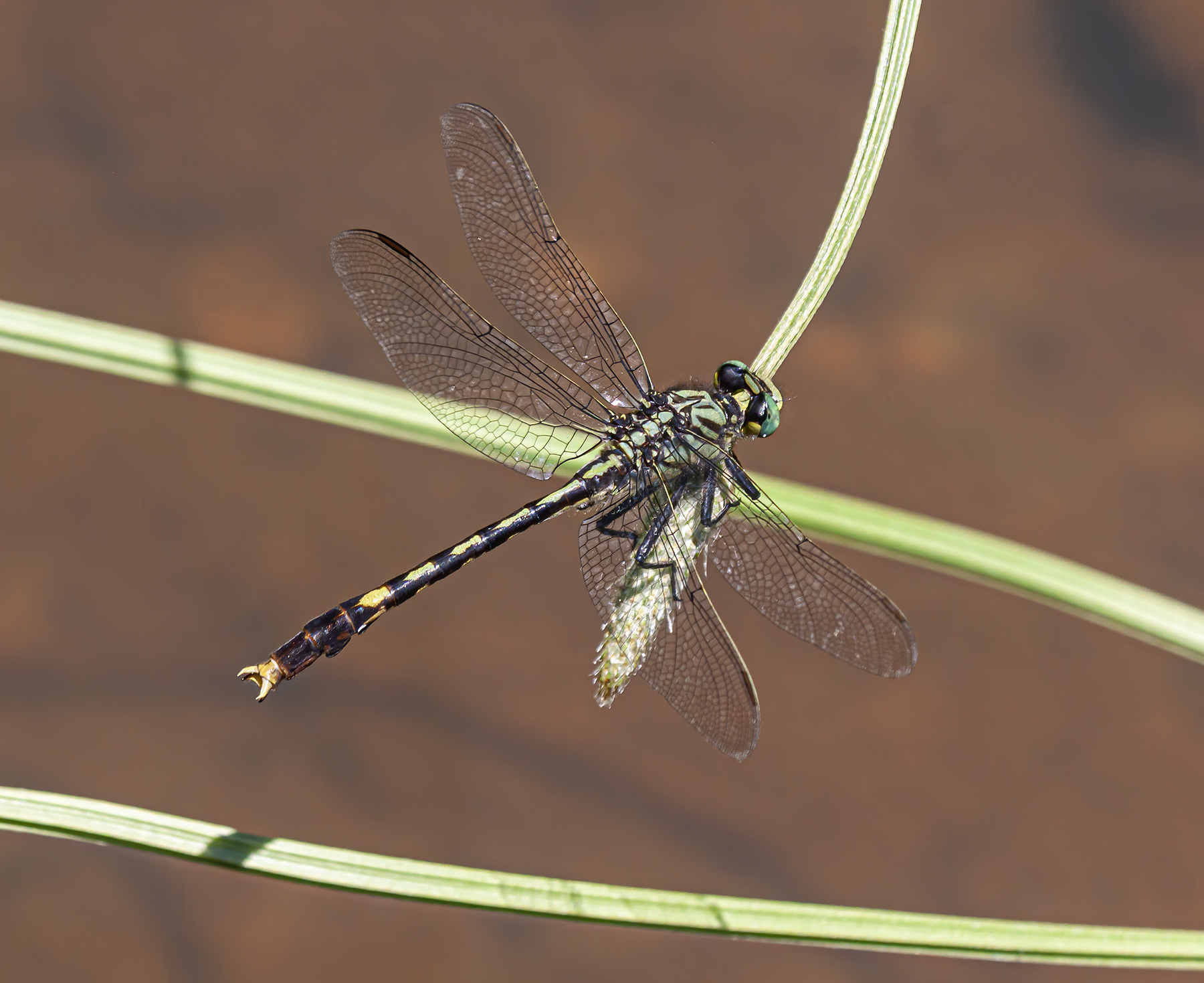
I was happy on Tuesday to spot this male Lancet Clubtail dragonfly (Phanogomphus exilis) perched in the vegetation overhanging the small pond at Jackson Miles Abbott Wetland Refuge. I would like to have gotten a closer shot, but the bank was steep and the water in the pond appears to be deep at that spot. Staying dry, I was content to capture this environmental portrait of the handsome little dragonfly with such striking blue eyes.

lancet clubtail

© Michael Q. Powell. All rights reserved.

Read Full Post »

If you are lucky and persistent, it is not hard to photograph a perched dragonfly. Some of them are amazingly tolerant of the presence of a human and will let you get really close to them. Even when they do fly away, many of them will return to the very same perch.

If you want to really challenge your skills as a photographer and perhaps even your sanity, you attempt to photograph members of dragonfly species that fly almost constantly and rarely perch, like this male Prince Baskettail dragonfly (Epitheca princeps) that I spotted late in June at Jackson Miles Abbott Wetland Refuge. This dragonfly was flying irregular patrols low over the waters of a small pond at the refuge—sometimes he would fly relatively close to the shore, but often his flight path was unpredictable.

So how do I do it? I generally use the same 180mm macro lens that I use for close-up shots of dragonflies. However, I know that the lens tends to focus slowly and autofocus simply can’t acquire the subject, because it fills such a small part of the frame, so I switch to manual focus. I pre-focus on a general area and then as I track the dragonfly, I adjust the focus on the fly as he zooms by and fire away in burst mode. As dragonflies go, a Prince Baskettail is relatively large, almost 3 inches in length (75 mm), but it is really tough to get an in focus shot of one while he is flying.

On a second occasion when I was visiting the same refuge, I got a chance to try a variation of the technique. The dragonflies were patrolling  high overhead as I stood in a grassy area at one end of the pond. The second shot was the best that I could manage—the wing pattern suggests that it is also a Prince Baskettail, but the eye coloration and the terminal appendages at the tip of the abdomen make me wonder if this one is a female. What I discovered is that it is actually a lot harder to focus on a dragonfly when I am looking straight up than when looking down at the water and my arms get tired a lot quicker when holding my camera up hight for an extended period of time.

Prince Baskettail

Prince Baskettail

© Michael Q. Powell. All rights reserved.


Read Full Post »

I spotted this mating pair of Halloween Pennant dragonflies (Celithemis eponina) last Thursday during a brief visit to Meadowlark Botanical Gardens in Vienna, Virginia with my dear friend and photography mentor Cindy Dyer. The wing patterns and coloration of Halloween Pennants have always attracted me, making them one of my favorites. As most of you know, however, I tend to have lots of favorites when it comes to dragonflies.

I was in stealth mode as I slowly moved closer to this couple and attempted to frame the image in a way that was interesting and creative, while trying not to feel too much like a voyeur. Yes, I will boldly assert that this is art, and not insect porn.

Halloween Pennant

© Michael Q. Powell. All rights reserved.


Read Full Post »

Cabbage White butterflies (Pieris rapae) are so small and plain that many people mistakenly believe they are moths. I find real elegance in their simplicity, especially when I am able to see their striking speckled green eyes. I spotted this little beauty during a brief visit yesterday to Meadowlark Botanical Gardens in Vienna, Virginia with my friend and photography mentor Cindy Dyer.

Cabbage Whites are always hyperactive, in constant motion as they flit about from flower to flower, stopping only momentarily for a short sip. Consequently they are hard to track and you have to be quick on the trigger to have a chance of getting a shot. In the first photo I was lucky enough to capture a “bonus bug,” a hoverfly that was in action below the much larger butterfly. Cindy coined the term “bonus bug” to refer to insects that are in the frame that you never even noticed when you were taking the shot.

Be sure to double-click on each image to get a more detailed view of this beautiful butterfly, including its mesmerizing eyes.

Cabbage White

Cabbage White

© Michael Q. Powell. All rights reserved.


Read Full Post »

Most dragonflies are slender and acrobatic, prompting one of my friends recently to call them “dainty.” There is absolutely nothing dainty, however, about Dragonhunter dragonflies (Hagenius brevistylus)—with their massive upper bodies and powerful legs, they remind me of powerlifters. Dragonhunters, unlike some other large dragonflies, do not fly patrols overhead in their search for food. Instead, they are patient hunters who perch, waiting for passing prey, and then use their powerful back legs to snag their victims, which are often other dragonflies.

One thing that always strikes me when I spot perched Dragonhunters is that they seem uncomfortable. Their back legs are so long and ungainly that Dragonhunters’ poses look awkward, bringing to mind gawky teenage males who have undergone recent growth spurts and have not yet gotten used to their longer limbs.

I was thrilled to spot this Dragonhunter last week while exploring a stream in Fairfax County with my friend and fellow dragonfly enthusiast Walter Sanford. It was a hot, humid day and we did not have any success in finding Eastern Least Clubtails, our main focus for the day. In fact, during the day we did not see many dragonflies at all. Walter had been at this location repeatedly and at the start of the day had commented to me that he had often seen Dragonhunters perched on branches overhanging the stream. In fact, we spotted Dragonhunters several times during the day, but did not manage to get good shots of them.

As the skies began to darken, signaling an approaching rainstorm, I knew our time was drawing to an end. I decided to return to a fallen tree where we had seen a Dragonhunter earlier in the day and was pleasantly surprised to see a Dragonhunter holding on to the very tip of a branch. I waded into the stream and moved a little closer to the dragonfly, slowly making my way across the slick, uneven rocks. I called out loudly to Walter, who was a good distance downstream from me, and eventually I heard his response.

I became the patient hunter now as I stood in the calf-high waters of the stream, trying to minimize my movements as I struggled to get a decent shot without disturbing the dragonfly, waiting for the arrival of my friend and hoping that the dragonfly would stay in place. Well, Walter arrived and we both managed to get some shots. I then felt free to move a bit more and crouched low to get a better angle for a shot. Lost in the moment, I did not initially notice that my backside was getting wetter and wetter as I squatted lower and lower. Fortunately I had moved my wallet and keys to my backpack which remained dry.

Eventually the Dragonhunter flew away from its initial perch, but the flights were short and relatively direct and we were able to track the dragonfly to its subsequent positions. The Dragonhunter looked a bit more comfortable at its new perches, but I was not. The rocks underfoot were getting bigger and more uneven and navigation through the water was increasingly difficult. At one moment I encountered an unexpected small drop (maybe 6 inches or so) and I slipped and momentarily lost my balance, but somehow managed to stay dry.

I was tired and wet when we began the uphill trudge back to the parking area, but I was feeling happy about our encounter with this Dragonhunter, one of the powerful giants of the dragonfly world. If you would like to see Walter’s photos and commentary on our Dragonhunter adventure, be sure to check out his blog posting today entitled “Dragonhunter dragonfly (male).” While you are there, be sure to poke around on his site—he has lots of cool images and fascinating information on all kinds of dragonflies and other creatures too.

Dragonhunter

Dragonhunter

Dragonhunter

© Michael Q. Powell. All rights reserved.

Read Full Post »

How much does the  background matter in a wildlife photograph? Is it merely a potentially distracting element or should it help convey a sense of the environment? Like many photographers, I often obsess over the background when I compose my images, trying to frame the shot and to adjust the camera settings to produce a certain effect. I suspect that my mindset is frequently more like that of a portrait photographer, who wants to draw your attention to the main subject, than that of a landscape photographer, who wants everything in the viewfinder to be in focus.

During the month of June I have been blessed to spot Gray Petaltail dragonflies (Tachopteryx thoreyi) on multiple occasions at several locations. I have taken lots of photos of them and the majority of those photos show the dragonfly perched vertically on the trunk of a tree—that is what petaltails do most of the time. My personal challenge has been to capture some images of Gray Petaltails doing something a bit different.

In the first image, the Gray Petaltail was perched horizontally, a position that I have rarely seen. The background in this shot is completely blurred—you don’t know for sure what is behind the dragonfly, though the colors suggest that it is vegetation. The blurred background forces you to focus on the main subject and to a limited extent on its perch. It is the type of portrait image that I strive to capture most often, though rarely am I this successful in doing so.

The second image uses a different approach. I visually separated the dragonfly from its perch by shooting from the side so that the details of its body are not lost in the shadows of the tree. The background is slightly blurred, but it lets you know that the dragonfly was perched in a sea of interrupted ferns. I like the way that you can see the patterns and color of those ferns. I took the shot from a lot farther away than I did with the first image, so the dragonfly occupies a much smaller part of the frame. As a result, the details of the perch grow in importance and in many ways the tree shares the spotlight with the dragonfly. This is the kind of environmental portrait that I really like, but often forget to take. Too often I am so driven to fill the frame with my subject that I forget to try different approaches.

The final shot is a kind of compromise shot, taken from a medium distance with a background that is more suggestive of the environment than in the first image, but not as detailed as in the second one. The perch has some details, but is intended to play a supporting role, rather than be the co-star as in the the second image. The dragonfly fills less of the frame than in the first image, but more than in the second.

In the story of Goldilocks and the three bears, she repeatedly tried two extremes, before setting on one that was “just right.” Is that the moral of the story here? Au contraire, mes amis. You can come to your own conclusions as you look at these three images, but for me it is clear that there is no single solution to the question of backgrounds. Blurry backgrounds can be good, but not always. Close-up shots are great, but may come with a cost. Showing some details in the background can enhance an image, except when it doesn’t.

What is best? Some folks may be unhappy with the lack of clarity, but the best answer seems to be, “it depends.” With backgrounds, as with so much in photography, we are left in an ambiguous situation in which “rules” are at best general guidelines, intended to be broken as the situation dictates or as the photographer decides. That gives me unlimited possibilities and a maximum amount of freedom to create more cool images.

Gray Petaltail

Gray Petaltail

Gray Petaltail

© Michael Q. Powell. All rights reserved.

Read Full Post »

Bright, saturated colors can be wonderful, but in large doses they can overwhelm the senses and confuse a viewer’s eyes. I am often drawn to simple scenes with a limited palette of colors, scenes in which light and shadows and shapes and textures play a more prominent role than colors.

Those were my thoughts when I started to review my images of this male Powdered Dancer damselfly (Argia moesta) that I spotted on Thursday while exploring a stream in Fairfax County with fellow dragonfly enthusiast Walter Sanford. The Powdered Dancer is the closest that we come to having a monochromatic dragonfly or damselfly—the thorax and tip of the abdomen of males becomes increasingly white as they age.

I love the way that the coolness of the white on the body contrasts with the brownish-red warmth of the branch, the leaves, and the out-of-focus rocks in the background of the initial image. I like too the texture in the images, particularly in the bark in the first photo and in the rock in the second one. Shadows help to add some additional visual interest to both of these images, drawing a viewer’s attention to the damselfly’s head in the first image and to the details of its entire body in the second.

Powdered Dancer

Powdered Dancer

© Michael Q. Powell. All rights reserved.

Read Full Post »
In some of the locations that I visit, Blue Dasher dragonflies (Pachydiplax longipennis) are the most common species that I encounter. They are pretty easy to photograph, because they hunt by perching and waiting for suitable prey to come within range. When it does, they dart from their position to catch it and often return to the same perch.

Over the years, I am sure that I have taken hundreds of photos of Blue Dashers, but I still enjoy trying to capture new and potentially better images of these beautiful little dragonflies. Blue Dashers have a special place in my heart in part because my very first posting on this blog almost eight years ago featured a photo of one. My gear has changed over those eight years, but my approach has remained pretty consistent. If you are curious about the kind of images I was capturing way back then, check out the posting that was entitle simply “Blue Dasher dragonfly.”

One thing that has changed, though, is that I now have a greater appreciation for female dragonflies, which are generally less colorful than their male counterparts. Some might see the females as drab and uninteresting, but I often find a special beauty in them that is more subtle and refined than the garish males.

The images below are shots of female Blue Dashers that I have taken during the month of June. The final photo shows a younger female with brighter colors and a more distinct pattern on her abdomen. The first two images feature a more mature female—both sexes of Blues Dashers develop a waxy, frosted color with age, a phenomenon known as “pruinescence.” One of the coolest features of these females is their two-toned eyes, with a prominent red color on the top half of the large compound eyes.


Blue Dasher

Blue Dasher

Blue Dasher

© Michael Q. Powell. All rights reserved.


Read Full Post »

When I was photographing bees on Monday at Green Spring Gardens, I had no idea that it was the start of Pollinator Week (22-28 June 2020), “an international celebration of the valuable ecosystem services provided by bees, birds, butterflies, bats and beetles,” according to the pollinator.org website. All I knew was that I love bees and enjoy trying to photograph them.

I was reminded of this week’s celebration yesterday in an e-mail from Benjamin, a knowledgeable budding naturalist who is almost certainly the youngest reader of my blog, and his grandmother Ellen (Gem). The two of them were busily making special honey treats to celebrate the week.

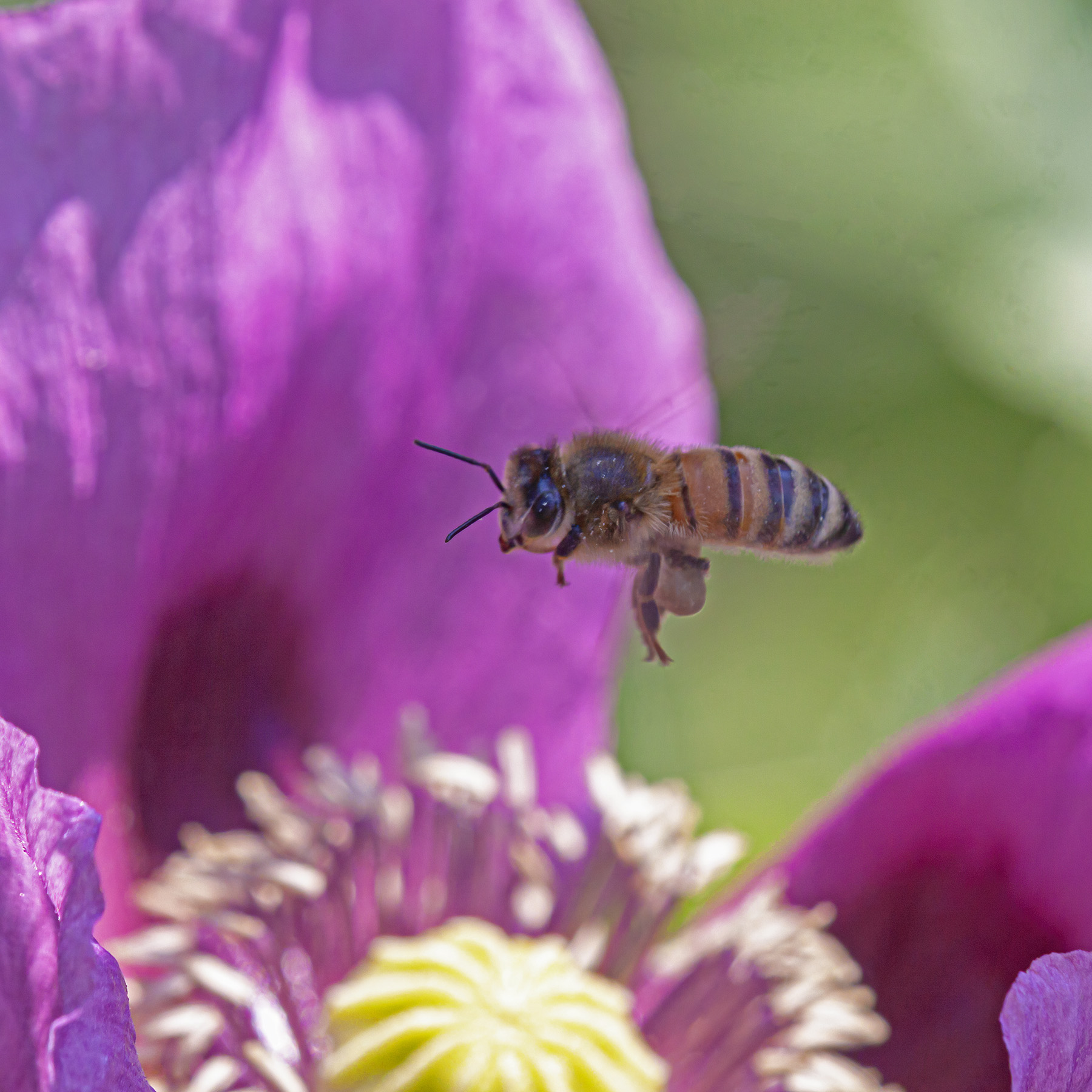
A honeybee came buzzing by me as I was attempting to photograph a poppy on Monday. Although the poppy was quite beautiful, I quickly abandoned it and decided that it was more fun to focus on the bee. The bee seemed to have been quite successful in gathering pollen and, as you can see in the first two photos, one of its pollen sacs seemed to be filled to its maximum capacity.

The final photo shows a honeybee at work in a Stokes’ Aster flower (Stokesia laevis) that I spotted in another part of the gardens. If you double-click on the image, you will see little white grains of pollen covering different many parts of the bee’s body.


honeybee

honeybee

© Michael Q. Powell. All rights reserved.


Read Full Post »
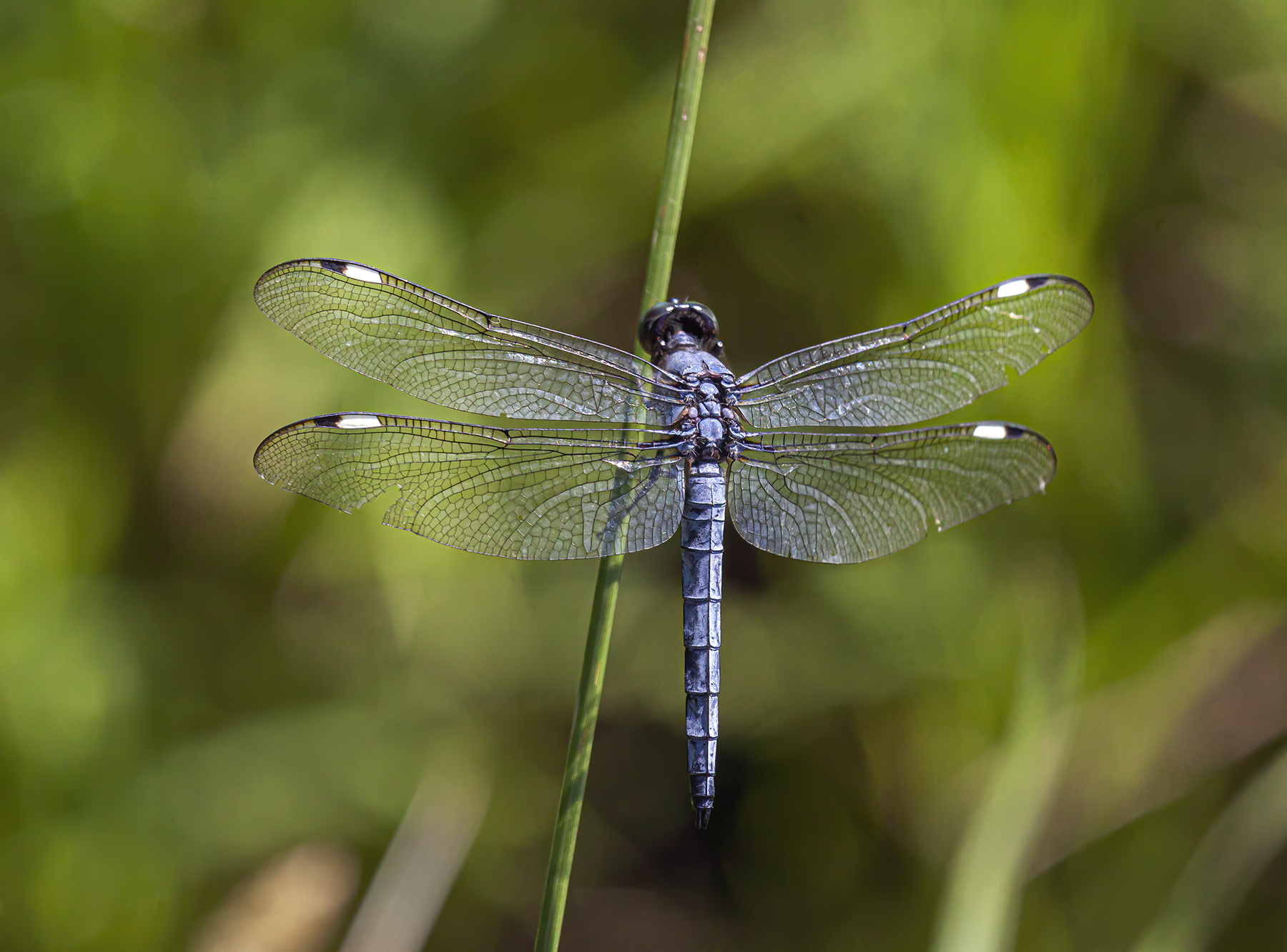
Can dragonflies smile? It sure looked like this male Great Blue Skimmer dragonfly (Libellula vibrans) was flashing me a toothy grin when I spotted him last Friday at Occoquan Bay National Wildlife Refuge. Perhaps it was just my imagination, running away with me.

smiling dragonfly

© Michael Q. Powell. All rights reserved.


Read Full Post »

Although Calico Pennant dragonflies (Celithemis elisa) are quite small, about 1.3 inches (33 mm) in length, they pack a lot of color into their tiny bodies and wings. Adult females have bright yellow markings, as shown in the first photo, and wonderful designs on their wings that appear to be outlined in gold when the sun hits them from the right angle. Adult males have bright red markings that look almost like little hearts and have similarly detailed patches on their wings, although the pattern and colors are different from those of the females.

What about the dragonfly in the third photo? Its coloration is similar to that of the adult female, but it is in fact a juvenile male that will eventually turn red. How can I tell it is a male? If you look closely at the tips of the abdomen (the “tail”) in all three images, you will note that the terminal appendages are similar in the final two photos and are different from those in the first photo. Normally I will try to rely on those anatomical features when trying to tell the gender of a subject, because in quite a large number of dragonfly species, juvenile males and females have the same coloration.

I spotted all three of these Calico Pennant dragonflies during a visit last Friday to Occoquan Bay National Wildlife Refuge, one of my favorite places to spend time with my camera. This refuge was one of the few facilities in our area to remain open during the stay-home period and got a bit too crowded for my taste. Now that other parks have reopened, the number of visitors has dropped to much lower levels and I am able to enjoy the solitude of nature once again.

Calico Pennant

Calico Pennant

Calico Pennant

© Michael Q. Powell. All rights reserved.

Read Full Post »

Do you believe in unicorns? I am always happy when I manage to spot a Unicorn Clubtail (Arigomphus villosipes), a beautiful dragonfly species in which both sexes have a small hornlike projection between their eyes that gives rise to their common name. I recently spotted the dragonflies in this posting while exploring a small pond in Fairfax County, where I live.

This is the only clubtail species in our area that prefers ponds and marshes over streams and rivers, according to the Dragonflies of Northern Virginia website. It is fairly easy to identify this species, because of the rusty-edged club at the bottom portion of the dragonfly’s abdomen and the very visible bright tip. Male Unicorn Clubtails tend to fly short patrols and perch quite often on low vegetation, so it is not hard for me to spot them if I am in the appropriate environment.  The third photo below shows a male in a typical perching pose.

Female Unicorn Clubtails, on the other hand, are hard to find—I do not know where they hang out, but it seems that they come to the water only when they are ready to mate. The only two times that I have ever seen a female Unicorn Clubtail dragonfly was when when she was ovipositing, like this one in the first two photos that I spotted this past Thursday. I captured these shots as she hovered momentarily in the air, getting ready to tap the water again with the tip of her abdomen to release more eggs.

Chasing unicorns? Yes, that is how I enjoy spending my time in the wild.


Unicorn Clubtail

Unicorn Clubtail

Unicorn Clubtail

© Michael Q. Powell. All rights reserved.

Read Full Post »
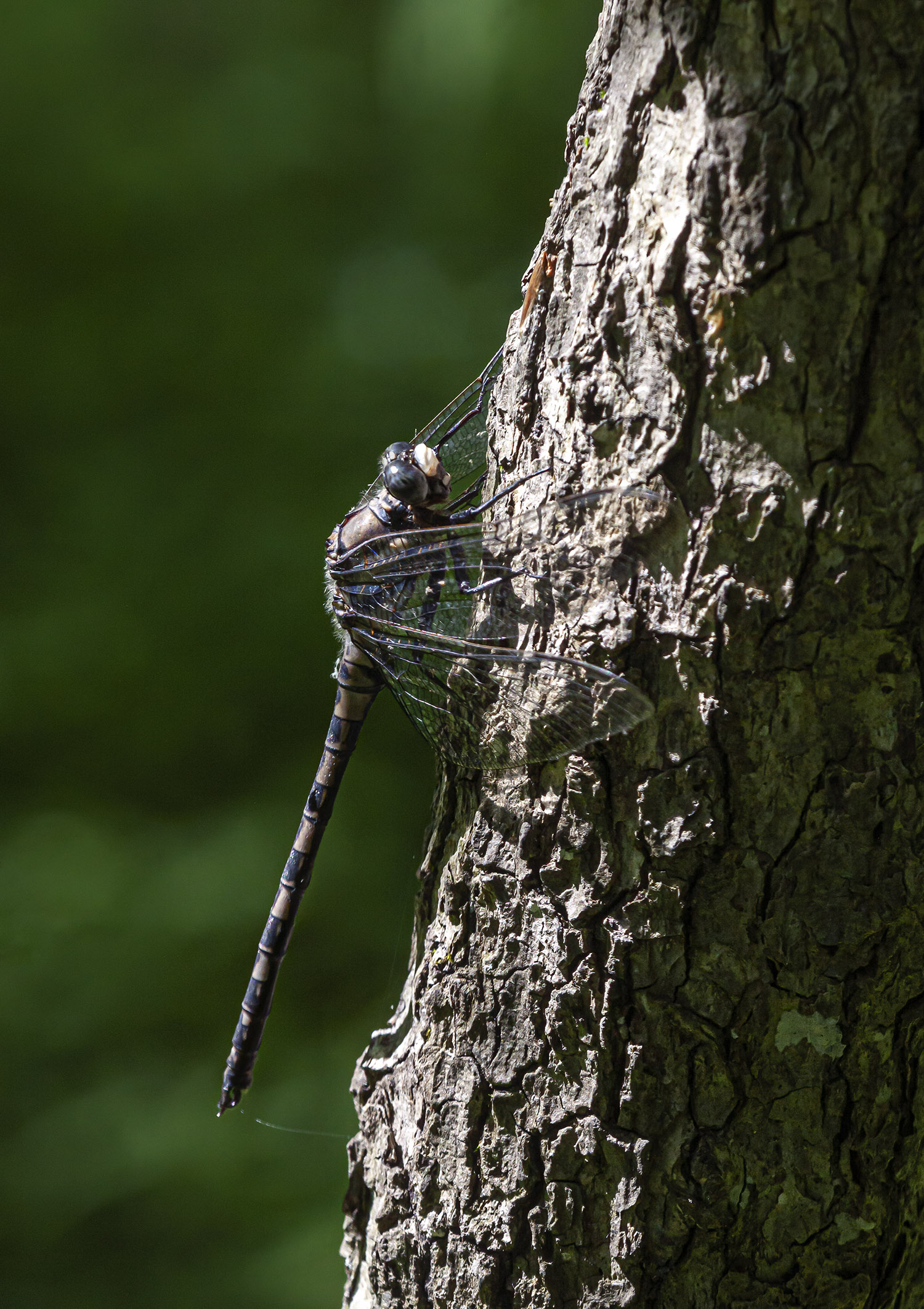
I was really happy that I was able to track this Swamp Darner dragonfly (Epiaeschna heros) after it zoomed by me yesterday afternoon at Occoquan Bay National Wildlife Refuge. When I finally caught up to it, the large dragonfly was hanging vertically, high in a tree among the leaves, leisurely munching on its bee lunch in the shade.

Yes, I recognize that bees play an important role as pollinators and highlighted that in yesterday’s posting. Bees, however, also serve as a food source for other creatures higher up on the food chain—they are all part of the circle of life.

Swamp Darners are among the largest dragonflies in our area, about 3.4 inches (86 mm) in length. I really like the description that Kevin Munroe provided of Swamp Darners on the wonderful Dragonflies of Northern Virginia website. “I often tell people on dragonfly walks that if they see a rhino with wings, it’s a swamp darner. Slight exaggeration, perhaps, but they are pretty impressive. June is their month and the best time to see them, as they cruise, slow and purposefully, over shallow, swampy pools, or hunt high over nearby meadows.”


Swamp Darner

© Michael Q. Powell. All rights reserved.


Read Full Post »

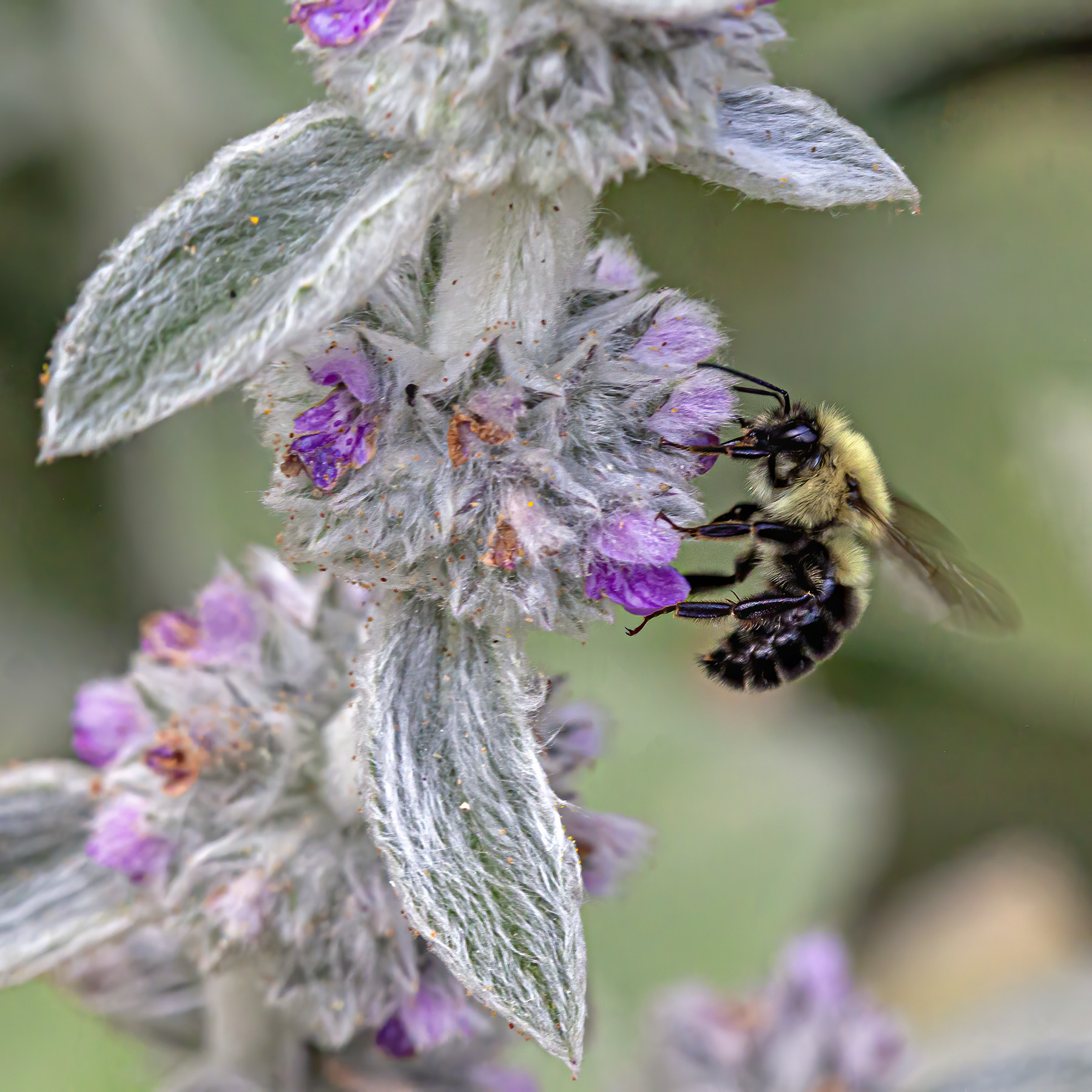
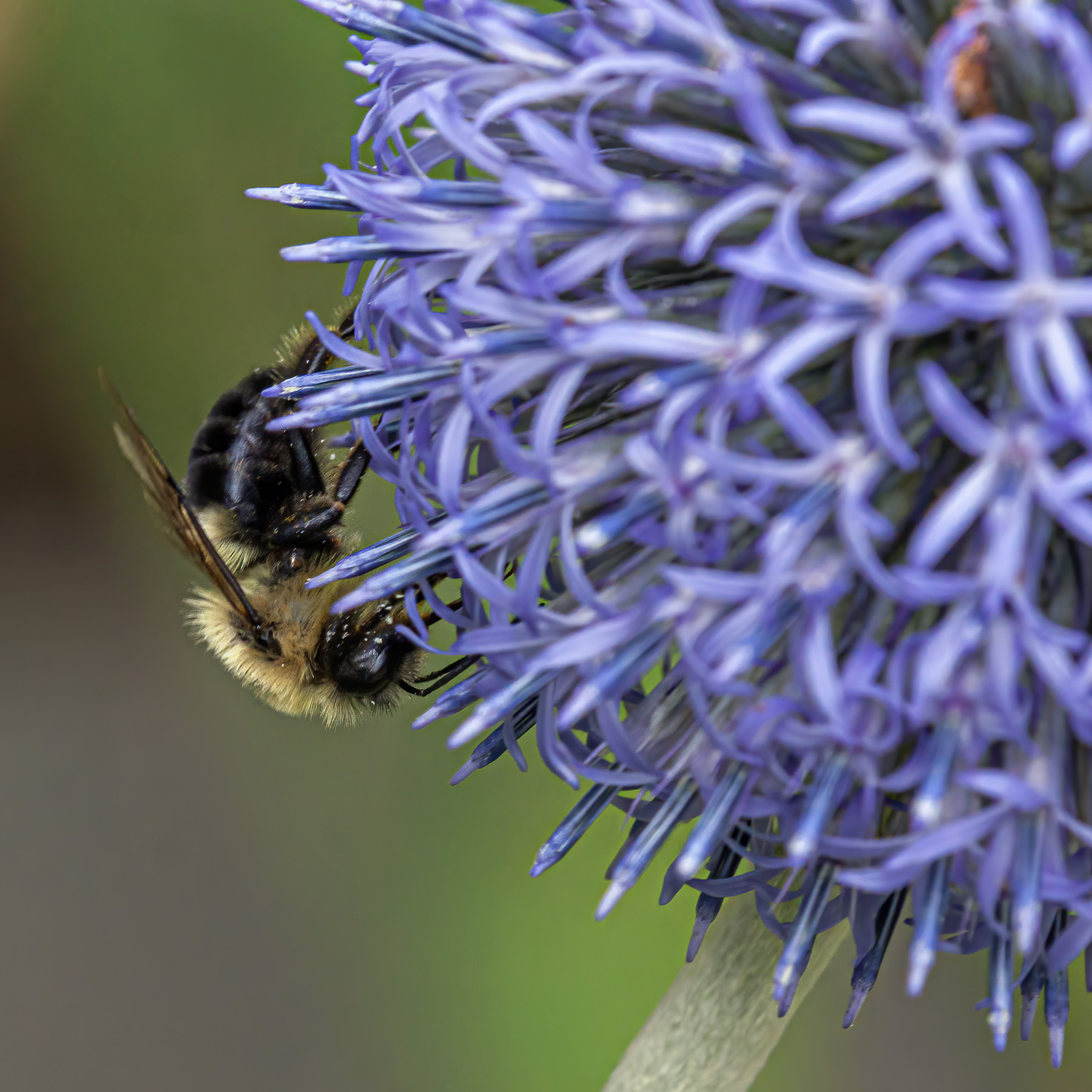
I love bees and spent quite a while on Monday in the garden of my friend and neighbor Cindy Dyer observing them and trying to photograph them. I had no idea that lamb’s ear plants produce flowers, but the bee in the first photo certainly was aware of that fact when I spotted it busily at work. The bee in the second shot decided to try an acrobatic move to gain access to the nectar in the lavender plant that swung wildly each time the bee landed on it. In the final shot, I captured the bee as it was crawling all over a flower of a cool-looking globe thistle plant.

I am not very good at identifying bees, but I think these bees are all Eastern  Carpenter Bees (Xylocopa virginica). Unlike bumblebees that have fuzzy abdomens, carpenter bees have shiny, relatively hairless abdomens.


lamb's ear

lavender

globe thistle

© Michael Q. Powell. All rights reserved.


Read Full Post »

Gray Petaltail dragonflies (Tachopteryx thoreyi) are one of the friendliest and tamest dragonfly species that I have encountered. If you hang around with them often enough, they are almost certain to land on you, particularly if you are wearing gray clothing that somehow reminds them of a tree. It is a little hard not to flinch when one of these relatively large dragonflies (3 inches (75 mm) in length) perches on your head or shoulder.

Gray Petaltails will also let you get pretty close to them when they are perched on trees. Quite frequently, though, they are perched above eye level, so being that close does not allow you to capture close-up images. This past Saturday when I was hunting for dragonflies with my friend Walter Sanford, we spotted a Gray Petaltail perched on a fallen branch that was at knee level. After we had both taken some shots, Walter challenged me to see how close I could get to the dragonfly to capture images with my macro lens.

The first shot shows one of my attempts to get a head-on shot. It is very cool to look another creature straight in the eyes, but it is rare that one will permit you to do so, especially at such close range. It seemed clear to me that the dragonfly was quite aware of my presence, but did not consider me to be a threat.

I took the second shot from the side as I moved even closer to my subject. I was trying my best to capture some of the details of the dragonfly’s eye that was nearest to me and was not concerned that most of the rest of its head was out of focus. If you double-click on the image, you can see some of the ommatidia, the individual optical units that make up a dragonfly’s amazing multi-faceted compound eyes.

If you want to learn more about dragonfly eyes, check out a wonderful article at medium.com entitled  “30,000 Facets Give Dragonflies A Different Perspective: The Big Compound Eye In The Sky“. Scientists, for example, know that the thousands of ommatidia produce a mosaic of “pictures,” but how exactly this visual mosaic is integrated in the insect brain is still not known.

Gray Petaltail

Gray Petaltail

© Michael Q. Powell. All rights reserved.

Read Full Post »

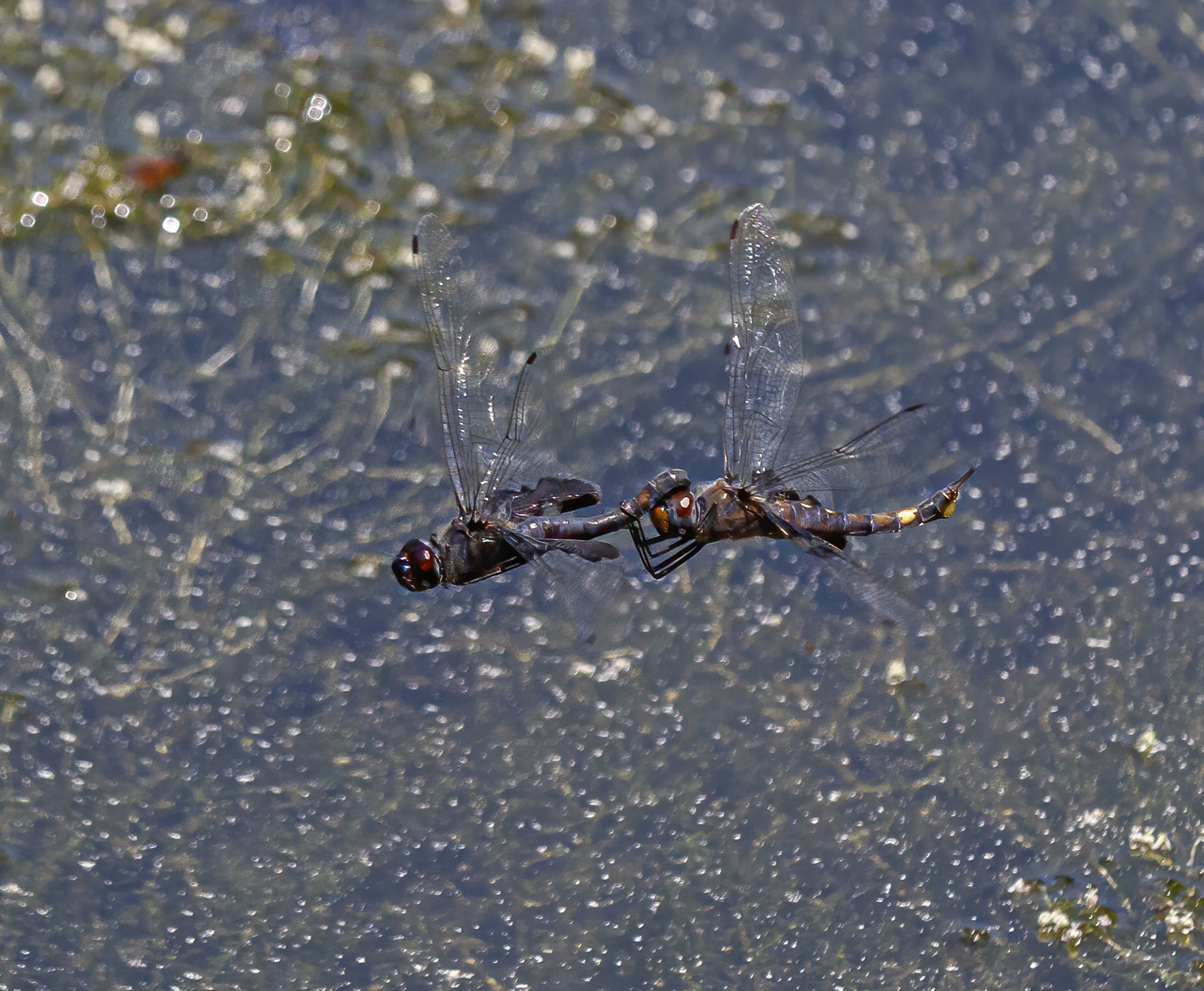
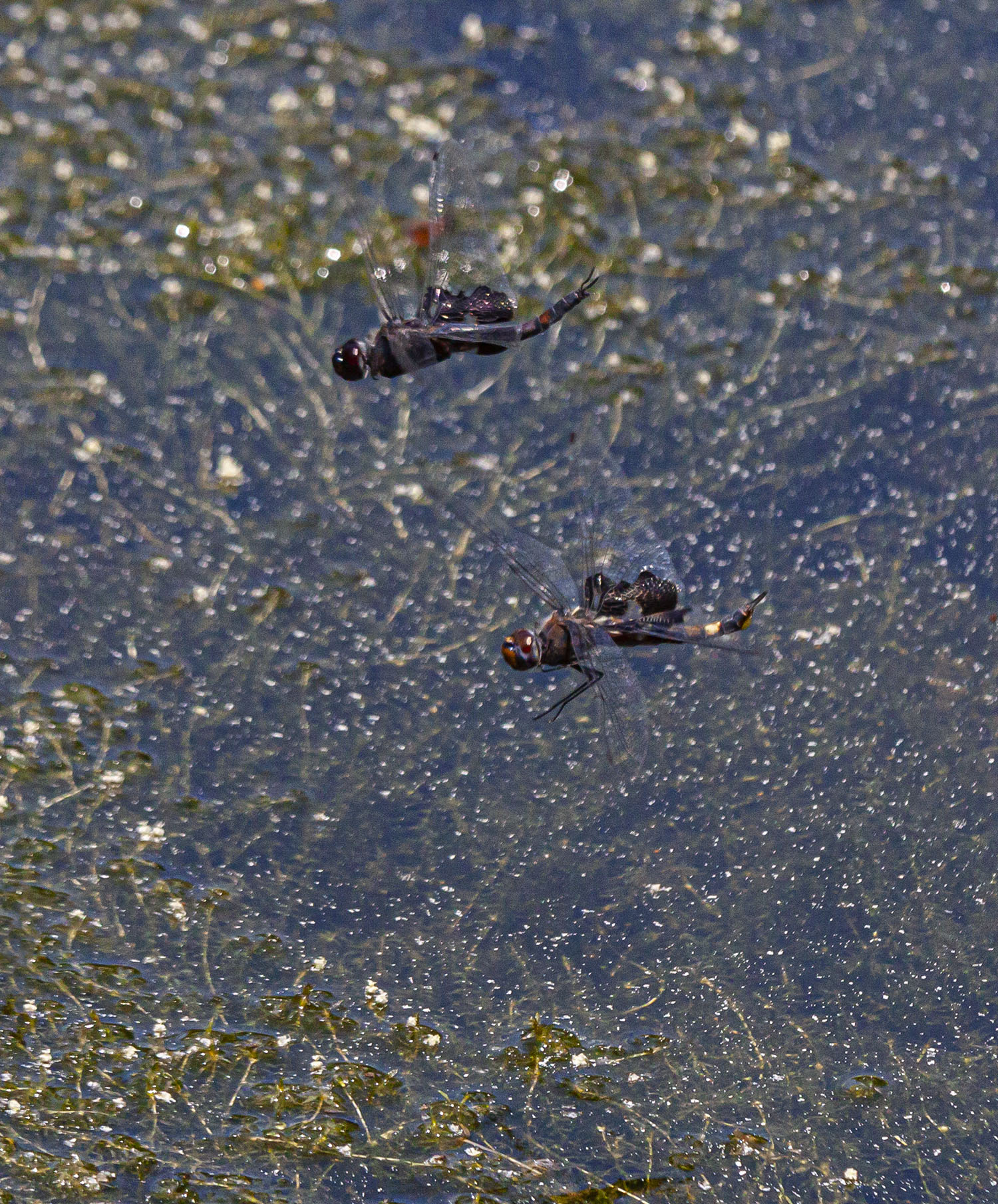
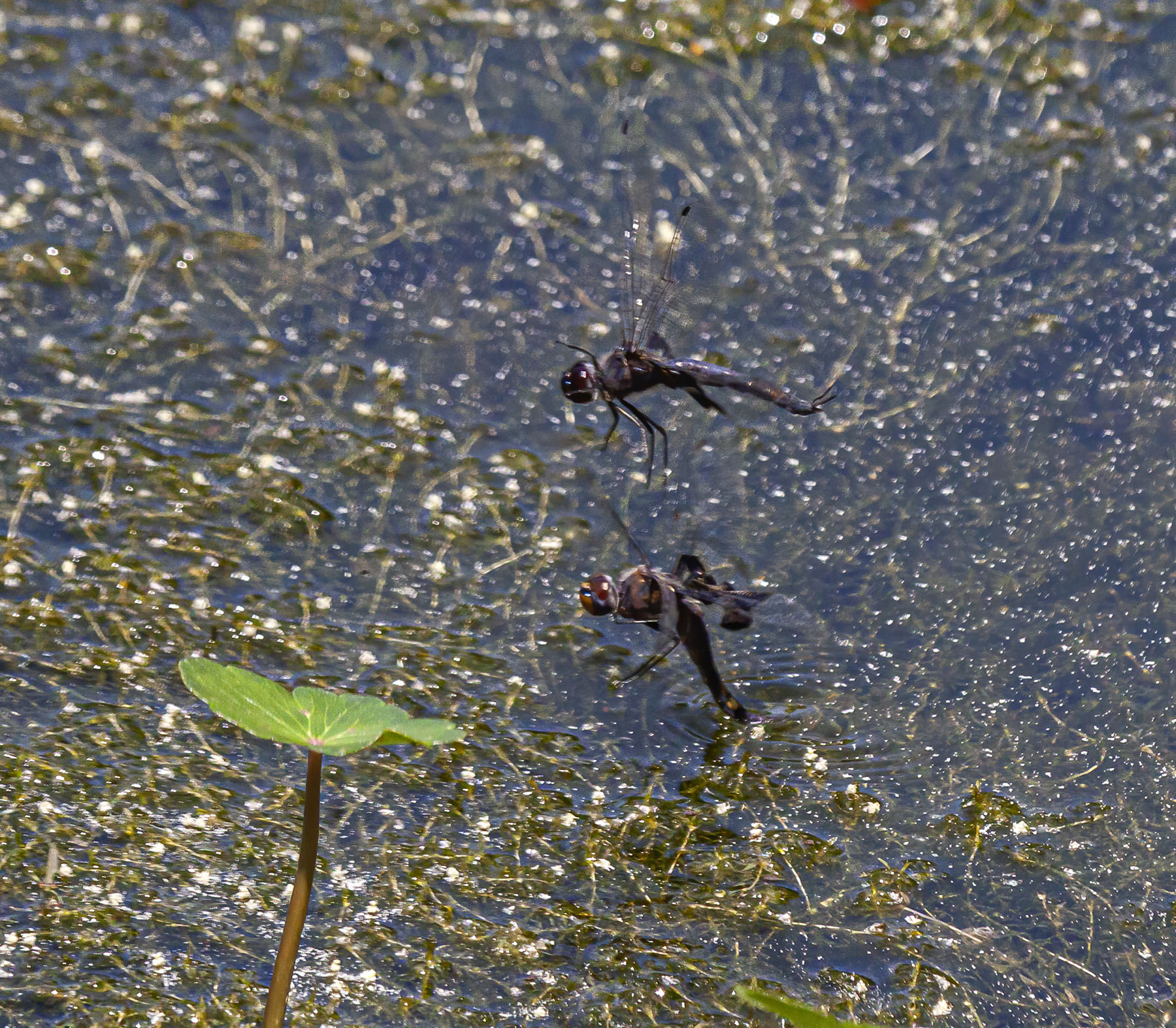
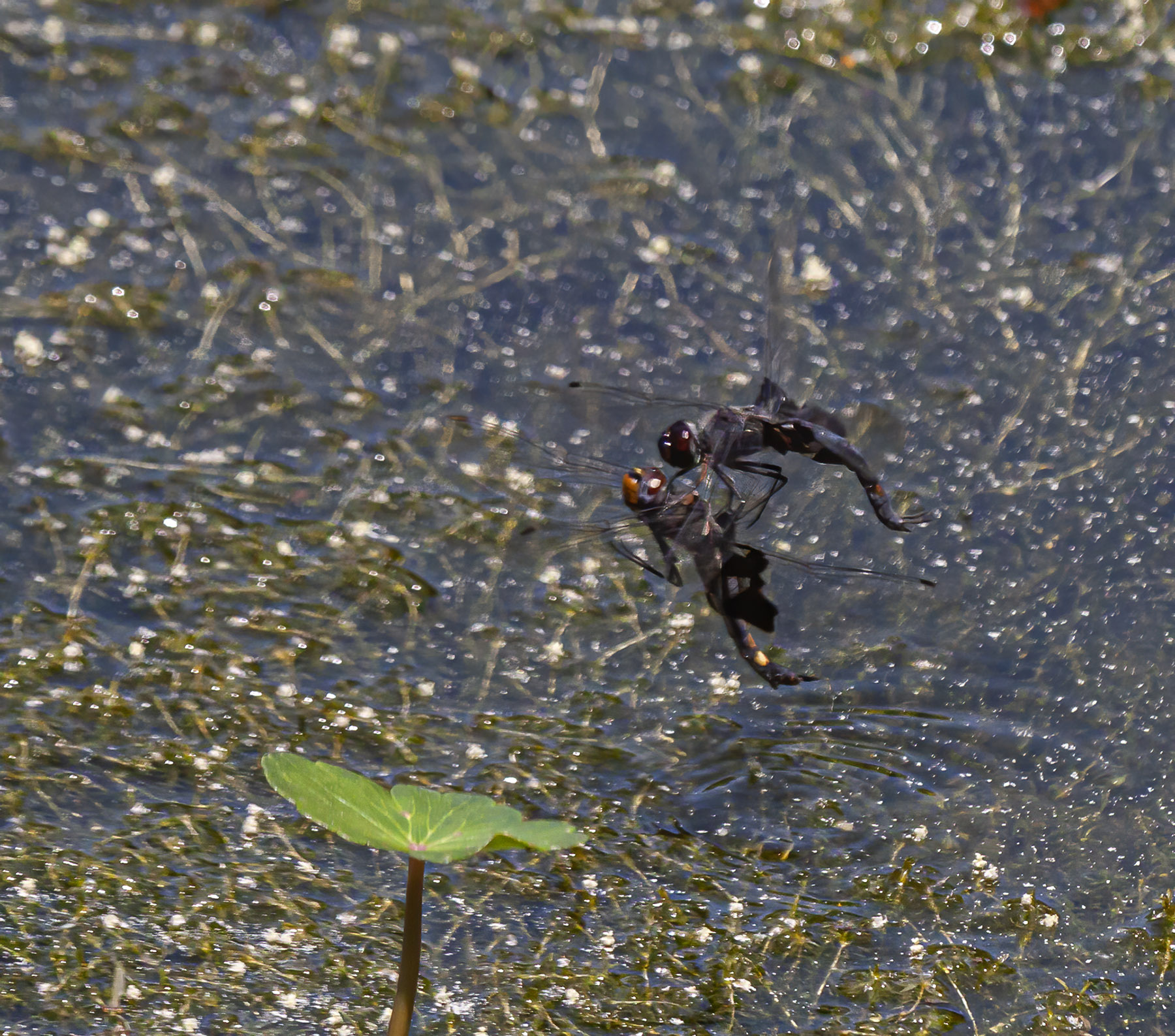
Yesterday I posted a photo of a male Common Whitetail dragonfly that was hovering in the air to fight off rivals and protect the female with which he had mated as she deposited her eggs in the water, a practice know as hover guarding. In some dragonfly species, the male will remain attached to the female throughout the entire process of oviposition, a process known as contact guarding. In other dragonfly species, the female is entirely on her own to deposit the eggs.

Black Saddlebags dragonflies (Tramea lacerata) use a different technique for guarding that I like to call “release and catch.” After mating is completed, the male and female Black Saddlebags fly together over the water in a tandem position, with the male in the front. At certain moments, for reasons that I cannot determine, the male releases the female and she drops down to the water and taps it to release one or more eggs. As she rises up out of the water, the male catches the female and reattaches the tip of his abdomen to the back of her head. They continue to fly in tandem and repeat this cycle multiple times.

On Saturday I was fortunate to be able to capture this sequence of shots that documents the entire process. Most of the time these dragonflies chose spots that were too far away for me to photograph them, but in this case they flew a bit closer to the edge of the pond where I was standing. As you probably suspect, I had to crop in a good amount to highlight the action for you, given that I was shooting with my trusty 180mm macro lens, which has a more limited reach than the lens that I use when photographing birds.

Black Saddlebags

Black Saddlebags

Black Saddlebags

Black Saddlebags

Black Saddlebags

© Michael Q. Powell. All rights reserved.

Read Full Post »

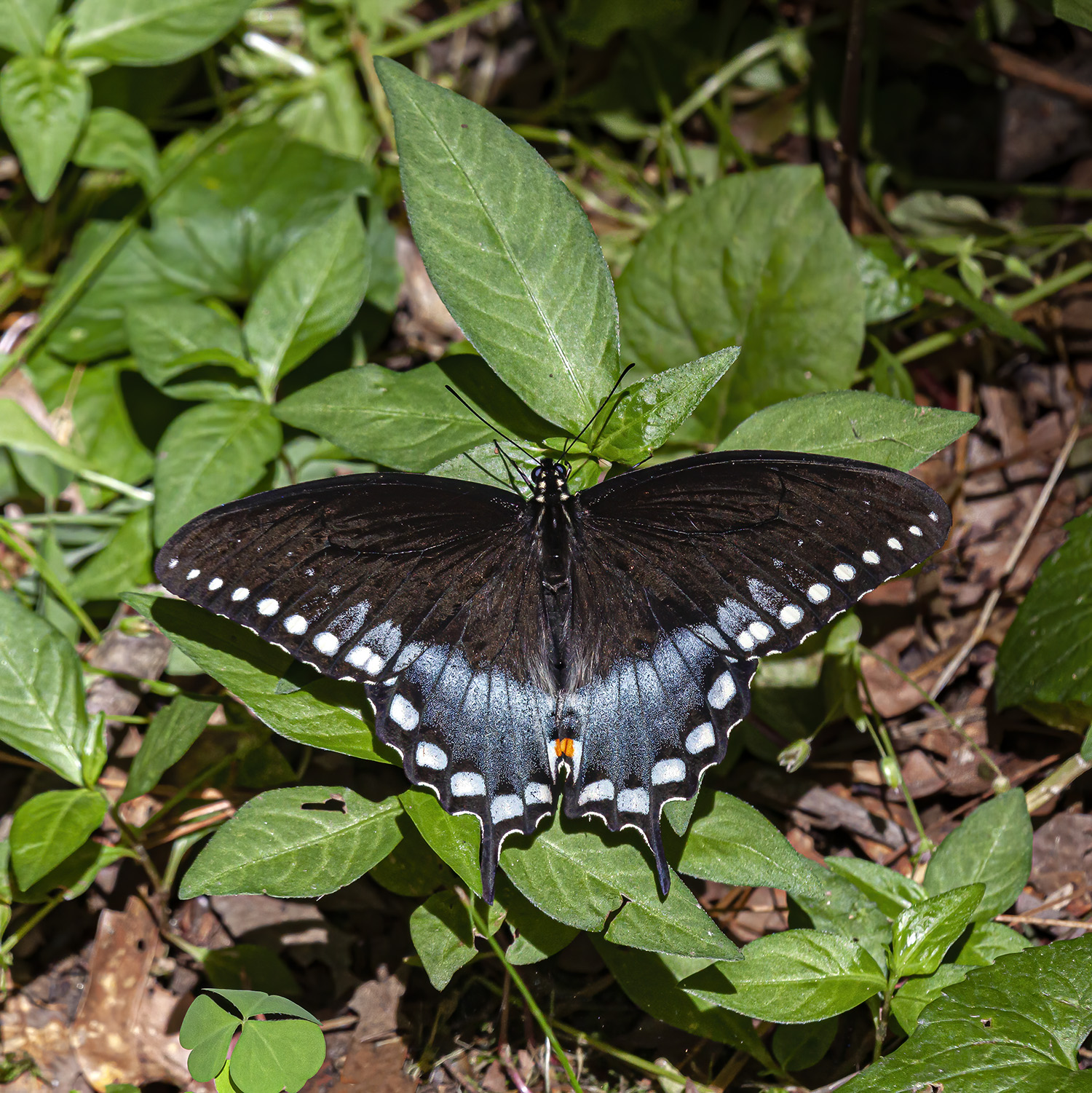
We have a number of different dark swallowtail butterflies in the area in which I live, which can make identification a little tricky. I spotted this beautiful butterfly last Friday at Jackson Miles Abbott Wetland Refuge and believe that it is a Spicebush Swallowtail butterfly (Papilio troilus). The perfect condition of its wings suggest to me that it has emerged quite recently—as we move deeper into summer, I often spot butterflies with tattered wings.

Spicebush Swallowtail

© Michael Q. Powell. All rights reserved.


Read Full Post »

Last week I spotted my first Eastern Amberwing dragonflies (Perithemis tenera) of the season at Jackson Miles Abbott Wetland Refuge. These distinctively colored dragonflies are a frequent sight throughout the summer as they buzz about over the waters of ponds. Eastern Amberwings are small, even by dragonfly standards, with a total length of less than an inch (25 mm) and are considered to be a wasp mimic. According to Wikipedia, “The Eastern Amberwing dragonfly is one of the only types of dragonfly that actively mimics a wasp. The yellow and brown stripes on its abdomen encourage predators to stay away. When perched, they will wiggle their abdomen and wings in a wasp-like fashion to deter other animals from eating it.”

My second and third shots are portraits of perched male Eastern Amberwing dragonflies that were carefully composed and sharp, but my favorite image of the day is the dynamic shot of two dragonflies in flight. It may not be obvious what is going on in the photo, so let me explain. After mating, the female in the upper left corner is getting ready to deposit her eggs in the water, while the male in the lower right corner hovers in the air, ready to keep any rivals from interfering with the process.

Eastern Amberwing

Eastern Amberwing

Eastern Amberwing

© Michael Q. Powell. All rights reserved.

Read Full Post »

Dragonflies have been around for a long time, with fossils showing dragonfly-like creatures that date back to the Jurassic period, more than 150 million years ago. It is generally believed that dragonflies of the Petaluridae family, including the Gray Petaltail (Tachopteryx thoreyi) most closely resemble those ancient species.

I was thrilled to find several Gray Petaltails this past Monday at Occoquan Regional Park, about 20 miles (32 km) from where I live. Most of the time Gray Petaltails perch vertically, flat against tree trunks at eye level or higher. The first photo is a little deceptive, because it makes it look like it is easy to spot these rather large dragonflies (three inches (76 mm) in length). However, in my experience it is rare to see a Gray Petaltail on a smooth-barked tree. When they perch on trees with coarser bark, these dragonflies almost melt into the trees. You get a hint of how this camouflage works in the second image below.

The final image shows a more typical scenario. From a distance, I saw a Gray Petaltail land on a tree. When I snapped the photo, though, I could not see the dragonfly, even though I knew exactly where it was. Can you see the Gray Petaltail in the final photo? I think that my post processing may have made it a little easier to spot, but the dull color and pattern of the dragonfly help it to blend in with the light and shadows on the tree trunk.

Gray Petaltail

Gray Petaltail

Gray Petaltail

© Michael Q. Powell. All rights reserved.

Read Full Post »

I was thrilled on Monday to see lots of butterflies as I was exploring Occoquan Regional Park. Many of them were small skippers that skittishly flew away whenever I approached them. Only a few were large and colorful, like the Red-spotted Purple butterfly (Limenitis arthemis) in the first photo. When it first landed on the plant, its wings were closed, but I waited and eventually the butterfly opened its wings. The damage to one of those wings this early in the season really emphasizes the fragility of these beautiful little creatures.

I also saw some brown woodland butterflies and I chased after several of them. I was out of breath but finally managed to catch up to one. Identification of this type of butterfly is always problematic, because there are quite a few similarly-colored species that vary only in the number and placement of the the eyespots. I think that the butterfly in the second shot is a Little Wood Satyr butterfly (Megisto cymela). I contemplated cropping closer, but decided I liked the little plant on the right side of the image and kept it. With this framing, I am able to create the illusion that the butterfly is staring at the plant.

Red-spotted Purple

Little Wood Satyr

© Michael Q. Powell. All rights reserved.

Read Full Post »

Names can sometimes be misleading. There is a genus of damselflies, consisting of 35 species, called American bluets. As the common name “bluet” suggests, most members of the genus are primarily blue in color. One notable exception is the adult male Orange Bluet (Enallagma signatum) that often does not appear to have even a speck of blue on its body.

I spotted this little guy last Friday at Jackson Miles Abbott Wetland Refuge and was a bit shocked by his bright red eyes when I looked through the viewfinder of the camera. The male Orange Bluet was perched at the extreme end of some vegetation overhanging a pond.

I would have liked to have gotten a shot in which more of its body was in focus, but I did not want to risk falling in the water, which looked to be pretty deep at that spot. As I look at the photo now, I realize that the soft focus of the body may actually be a good thing, because it draws a viewer’s attention even more to the eyes of the handsome little damselfly.

orange bluet

© Michael Q. Powell. All rights reserved.

Read Full Post »

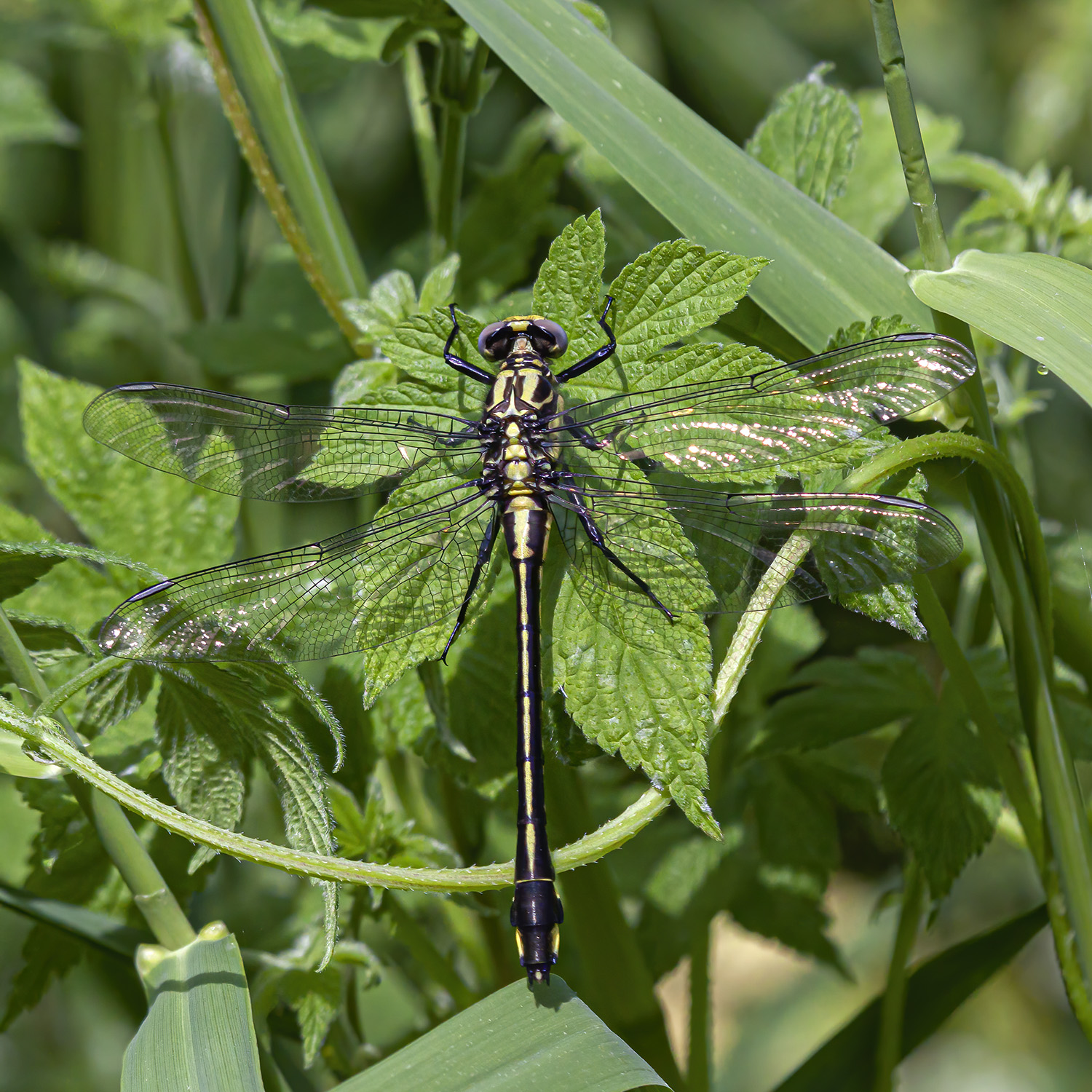
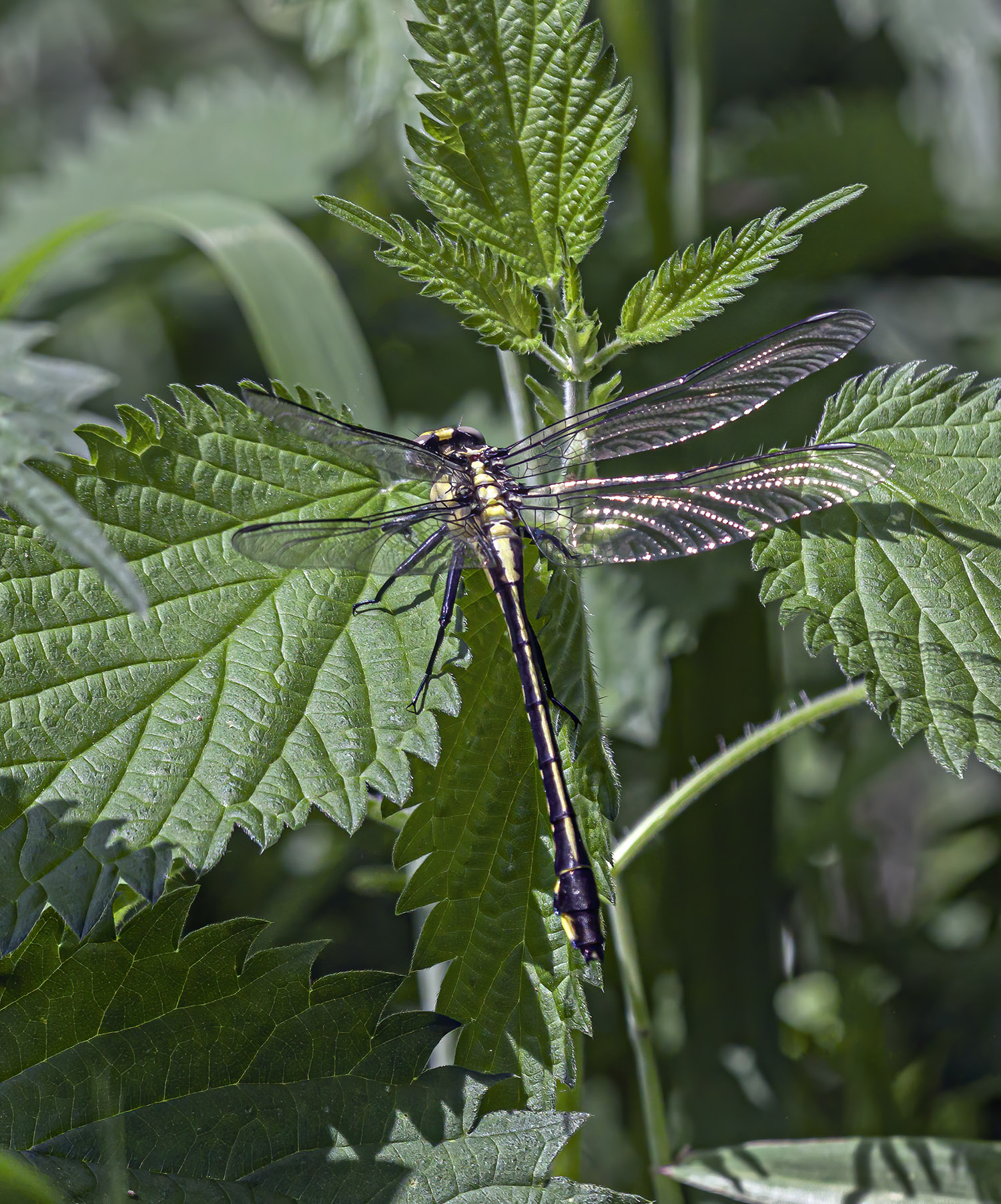
UPDATE: Some experts have looked at the photos that Walter took of and it appears that the dragonfly in the first photo (and possibly all of the ones in this posting) is a Splendid Clubtail (Gomphurus lineatifrons), a new species for me. The differences between the two species are subtle enough that I am definitely relying on the expertise of others in making this identification.

I spent most of this past Tuesday exploring wild areas in Fairfax County, Virginia, hunting for dragonflies with my friend and fellow dragonfly enthusiast Walter Sanford. It is still a little early for many species, so we had to work really hard for each one that we were able to find.  I was really excited when we spotted several Cobra Clubtail dragonflies (Gomphorus vastus) during the day, all of which turned out to be females.

As you can see from these photos, the Cobra Clubtails were hanging vertically with their abdomens pointing downwards, which made them hard to spot when they landed in the abundant green vegetation. In one nearby location, there is an annual mass emergence of Cobra Clubtails, with dozens emerging at the same time. We made a brief stop there, hoping to see more Cobra Clubtails, but learned from employees there that the Cobra Clubtails have not yet arrived this year—we may make another try sometime fairly soon.

If you would like to see Walter’s posting on our adventures with the Cobra Clubtails, click on this link to his blog.

Cobra Clubtail

Cobra Clubtail

Cobra Clubtail

© Michael Q. Powell. All rights reserved.

Read Full Post »

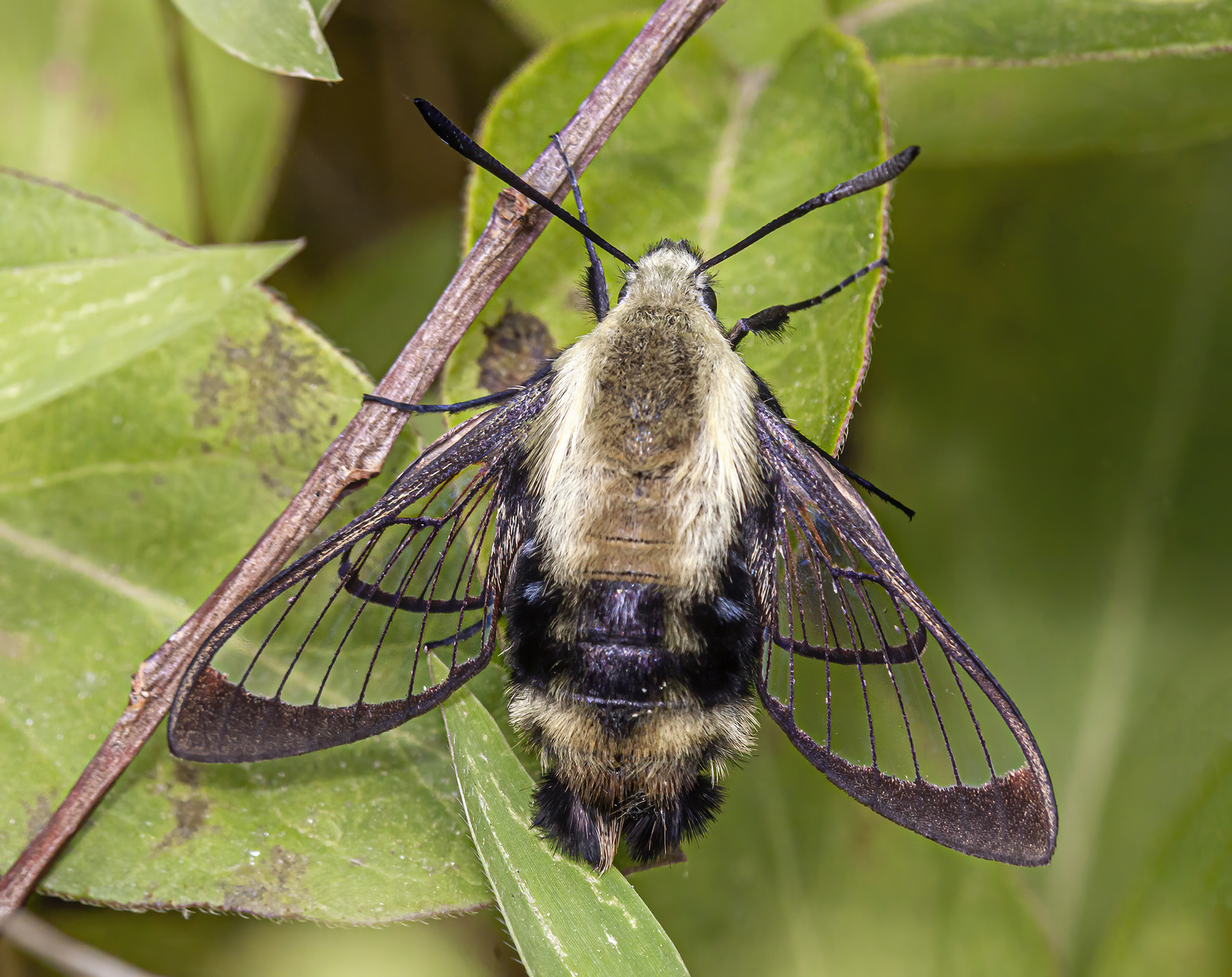
When I first spotted this insect last Thursday at Occoquan Regional Park, it looked like a large bumblebee. I tracked it visually as it buzzed about and when it landed, I could see from its distinctive wings that it was definitely not a bee. In our area we have two species of clear wing moths that are similar in appearance and behavior, the Snowberry Clearwing Moth (Hemaris diffinis) and the Hummingbird Clearwing Moth (Hemaris thysbe). Identification guides warn that both species are variable in color, which complicates identification, but the Hummingbird Clearwing Moth has light-colored legs, so I am pretty confident that this one is a Snowberry Clearwing Moth.

Most of the time when I see clearwing moths they are beating their wings rapidly and hovering in the air as they collect nectar from a variety of flowers, which causes some people to think they are hummingbirds. I do not know why this one was perched in the low vegetation—perhaps it was taking a break—but its static position allowed me to get a detailed look at its wings and the rest of its body.

Snowberry Clearwing moth

© Michael Q. Powell. All rights reserved.

Read Full Post »

Generally when I spot a Black Saddlebags dragonfly (Tramea lacerata), it is flying. The distinctive dark blotches, which some scientist decided look like saddlebags, are visible even when the dragonfly is in the air. Some dragonflies spend most of their time perching, while others spend most of their time flying—the Black Saddlebags is in the latter category. I was therefore quite excited when I saw this one land in the low vegetation last Thursday at Occoquan Regional Park.

When a subject is this close to the ground, the background is almost inevitably going to be cluttered. In an effort to soften the potential distraction, I opened up the aperture to f/6.3 and tried to shoot almost directly down on the subject. I like the resulting image that has most of the dragonfly in sharp focus and most of the background a bit blurry.


Black Saddlebags

© Michael Q. Powell. All rights reserved.

Read Full Post »

On Tuesday I spotted this beautiful female Calico Pennant dragonfly (Celithemis elisa) during a visit to Occoquan Bay National Wildlife Refuge.  I always love to see the wonderfully patterned wings of this dragonfly species and the first shot provides a good view of the wing details, especially if you click on the image to enlarge it.

In the second image, I focused primarily on the dragonfly’s head and body and the wings are mostly out of focus. I love the way that you can see the dragonfly’s tiny feet and the tenuous grasp they have on the fuzzy plant stem from which the dragonfly is hanging.

Calico Pennant

calico pennant

© Michael Q. Powell. All rights reserved.

Read Full Post »

I wasn’t sure if Uhler’s Sundragon dragonflies (Helocordulia uhleri) would still be around when I set out exploring in Prince William County earlier this month. This species of dragonfly is one of the first to appear in the spring and generally is flying for only a month or so. I had spotted several females on the third of April—see my posting Female Uhler’s Sundragons for details and photos—so I knew that the clock was ticking.

I scoured all of the locations where I had seen them in the past and was about to give up hope when some movement low in the vegetation caught my eye. I was excited to see that it was a Uhler’s Sundragon, my target species. As I tried to control my racing heart and slow down my breathing, I maneuvered into position and was able to capture this image of a handsome male Uhler’s Sundragon. As it turned out,  this dragonfly was the only one of its species that I would see that day and I have not seen one since. In this case, though, one was more than enough.

Uhler's Sundragon

© Michael Q. Powell. All rights reserved.

Read Full Post »

On Friday, temperatures in my area soared to 84 degrees (29 degrees C), which I thought might trigger the emergence of new dragonflies. However, when I arrived at Jackson Miles Abbott Wetland Refuge, a nearby park with a small pond, the only dragonflies that I could find were a half-dozen Common Baskettail dragonflies (Epitheca cynosura) patrolling over various parts of the pond.

I walked around the perimeter of the pond multiple times, searching in vain in the undergrowth and in the vegetation at water’s edge. Periodically I stopped and attempted to photograph the dragonflies in flight. Their flight paths were somewhat predictable, which gave me hope, but the dragonflies varied their distances from the shore and changed their altitude unexpectedly.

Here are a few of my favorite shots from the photo excursion. As a frame of reference, Common Baskettail dragonflies are about 1.6 inches (41 mm) in length, so I think you can appreciate the challenge of photographing one on the fly.

Common Baskettail

Common Baskettail

Common Baskettail

© Michael Q. Powell. All rights reserved.

Read Full Post »

Many beetles are dark-colored and go about their business in the underbrush, unseen by human eyes. Six-spotted Tiger Beetles (Cicindela sexguttata), on the other hand, are hard to miss—their metallic-green bodies sparkle as they perch in the middle of the sun-lit forest trails on which I have been hiking in recent weeks.

The beetle’s common name refer to the six small white spots on the beetle’s metallic-green elytra (the beetle’s hardened wing cases), although the number of spots is somewhat variable—I think I count eight spots on this individual. As I was doing a bit of research, I stumbled upon the fact that elytra is the plural form of elytron—I think that I have almost always seen the word used in the plural form and the spell-check highlights elytron as an unknown word.

It is often hard to get a shot of one of these beetles, because they are skittish and often fly away as I bend down to photograph them. For this photo, I was fortunate that the beetle chose to perch on a trunk of a tree at eye-level and no contortions were therefore required on my part.

Six-spotted Tiger Beetle

© Michael Q. Powell. All rights reserved.

Read Full Post »

During a recent dragonfly hunting trip with my friend and fellow dragonfly enthusiast Walter Sanford, I was thrilled when we stumbled upon several Springtime Darner dragonflies (Basiaeschna janata). As their name suggests, they are in flight early in the dragonfly season and are gone well before many of the summer dragonfly species arrive.

I first spotted one flying low over the vegetation in an overgrown field. It dropped down into the vegetation, but I was fortunately to be able to find where it was perched. As you can see in the first photo, Springtime Darners perch vertically, making it hard to see them amid all of the nearby stalks and stems. The female in the first photo was relatively cooperative and I was able to position myself well enough to have most of her body in focus. I encourage you to click on the image to see all of the wonderful details and colors of this beautiful dragonfly.

Although we had several more encounters with Springtimes Darners, all of those individuals were very skittish and it was tough to get any good shots. I included the second shot below because it shows really well the body of a male Springtime Darner, although the head is a bit out of focus because of the way he was perched.

Walter also did a blog posting on our encounter with these beautiful dragonflies. Be sure to check it out at this link and you will find more information about this dragonfly species and his photos and “take” on our dragonfly adventure.


Springtime Darner

Springtime Darner

© Michael Q. Powell. All rights reserved.

Read Full Post »

On Thursday I was excited to spot these two Stream Cruiser dragonflies (Didymops transversa), one female and one male, in a sunny area adjacent to a creek that I was exploring in Prince William County, Virginia. Authorities have closed the park that I was visiting to vehicular traffic, so I had to hike in to reach my target area, which took over an hour and a half each way.

It was the end of a long and tiring day and I had already begun the trek back to my car. By 4:00 in the afternoon, much of the trail along the creek was in the shade. Periodically, though, I would pass patches of sunlit vegetation and I stopped to explore them, knowing that many dragonflies like to bask in the sunlight. I was searching one such spot when my eyes detected a dragonfly in flight. I was able to track the dragonfly in the air and to see it land. The male Stream Cruiser (shown in the second photo below) perched at an odd angle on some low-hanging vegetation, but I managed to get a shot of it before it took off again.

I decided to stay in that spot and wait and after a while another dragonfly flew by, landing this time much higher in the vegetation. Initially I thought that it might be the same dragonfly that I had already photographed, but when I got closer, I could see that the second one (shown in the first photo below) was a female. The female Stream Cruiser chose to perch about chest-high, so I was able to get a much better angle for this shot than for the first one and compose the image more carefully.

This experience is a good reminder for me to stay alert at all times when I have my camera in my hands until I am actually back to my car. I had not even been thinking of Stream Cruisers, a species that I have seen only a couple of times previously, when I decided to make this trip. However, I was ready when this opportunity unexpectedly presented itself to me.

I cringe a little sometimes when well-meaning folks see my photos and say, “You are so lucky.” Yes, I have more than my share of good fortune, but it often takes hours and hours of effort for a decisive moment to arrive and even then I have to be quick enough and skillful enough to get a shot. Rather than going to the trouble to explain all of that, though, I will usually nod my head and agree that I was lucky to get my shots.


Stream Cruiser

Stream Cruiser

© Michael Q. Powell. All rights reserved.


Read Full Post »

« Newer Posts - Older Posts »