Feeds:
Posts
Comments

Archive for the ‘Dragonflies’ Category

How does a jumping spider, a spider that does not build a web, manage to capture a dragonfly? I don’t know how this Bold Jumping Spider (Phidippus audax) snagged an Eastern Pondhawk dragonfly (Erythemis simplicicollis), but I came upon the two of them after the capture had been completed and managed to snap a series of photographs of the action.

I am still working on the images and plan to do a longer posting, but wanted to give you a sneak preview.

dragon8_spider_blogdragon11_spider_blog

© Michael Q. Powell. All rights reserved.

Read Full Post »

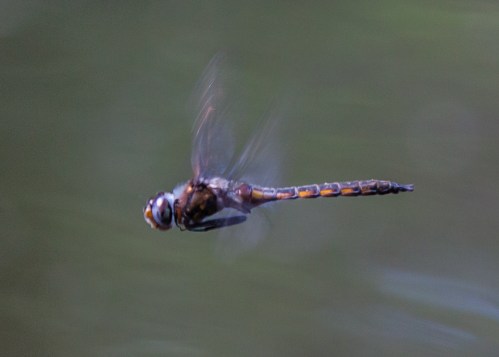
Do you want to learn patience? If so, try photographing dragonflies in flight, those speedy little flyers that patrol the edge of a pond without ever seeming to need a rest.

Several readers commented that I must have lots of patience after they saw the photos of dragonflies and damselflies that I recently posted. Comparatively speaking, however, it is a whole lot easier to photograph these insects when they are perched on a stationary object than when they are in constant motion.

My fellow blogger and photographer, Walter Sanford, a true dragonfly stalker, emphasized to me recently that many of the early spring dragonflies are found only in limited locations for very short periods of time. (Check out his blog for lots of wonderful shots of dragonflies and other wildlife creatures.) I decided to return to Hidden Pond Nature Center, a county-run park in Springfield, Virginia that is only a few miles from where I live. Last year I spotted a few common dragonflies there, and it seemed to be a good place to broaden my search for spring dragonflies.

Sure enough, I caught sight of a few dragonflies, flying low over the surface of the small pond. They seemed to have fairly well defined patrol areas and tended to move about in large, lazy circles. I tried tracking several of them using my camera’s autofocus, but that proved to be impossible, so I switched to manual focusing, which was merely difficult.

I took a few breaks to get some shots of the more cooperative damselflies, but persisted in my quixotic efforts to capture the dragonflies in flight. Over the course of a couple of hours, I managed to fewer than a dozen images that are more or less in focus. I think that my subjects for this shoot might be Common Baskettail dragonflies (Epitheca cynosura), but I’m not very confident in that identification.

My adventures with dragonflies (and wildlife photography in general) continue teach important lessons about the value of patience and persistence.


flying5_blog

flying4_blogflying3_blogflying2_blogflying1_blog

© Michael Q. Powell. All rights reserved.


Read Full Post »

As we move deeper into spring, dragonfly nymphs are emerging from the water and starting their transformed lives as acrobatic flyers. This past weekend I spotted some young male Common Whitetail dragonflies (Plathemis lydia) in different stages of development.

Not surprisingly, adult male Common Whitetail dragonflies have white tails—it seems like most species are named after the characteristics of the male. Check out one of my postings from last year to see what a mature adult male looks like. When they first emerge, however, the males have the same body colors and patterns as the females. Fortunately, it’s easy to tell them apart, because the wing patterns are different in the male and female whitetails. (For more information about these dragonflies, take a look at the pages at bugguide.net.)

The dragonfly in the first shot is well on his way to becoming an adult and was bold enough to be flying over the water. The one in the second shot is younger, and seemed to content to remain in the vegetation at a distance from the open water.

A "tween" male--the abdomen is beginning to turn blue, but the adolescent body pattern still shows

A “tween” male–the abdomen is beginning to turn blue, but the adolescent body pattern still shows

An immature male, with the body pattern of a female and the wing pattern of an adult male

An immature male, with the body pattern of a female and the wing pattern of an adult male

© Michael Q. Powell. All rights reserved.

Read Full Post »

This is the last image in my mini-series on insect eyes from this past Friday—a close-up of a beautiful little damselfly at Huntley Meadows Park, the local marshland where I take many of my nature photographs. 

Photographing damselflies is particularly challenging for me, because they are so long and skinny (not to mention the fact that they are really small in size). About the only way to get their bodies completely in focus is to be absolutely perpendicular to them. When I took this image, I couldn’t get into the optimal position, thanks to a sharp, thorny bush, so the lower half of the body was out of focus. That is one of the reasons why I chose to crop this image as I did, though the main reason was to focus viewers’ attention on the eyes.

This image shows the wide separation of the damselfly’s eyes, which is one of the ways to tell them apart from dragonflies, the other members of the Odonata family. Dragonflies have eyes that are very close together or even touching each other.

If you missed the earlier postings on insect eyes, check out the images of a fly’s eyes and a dragonfly’s eyes. In all three cases, click on the images, if you want to get a higher resolution view of the insects’ beautiful eyes.

damsel_eyes_blog

© Michael Q. Powell. All rights reserved

Read Full Post »

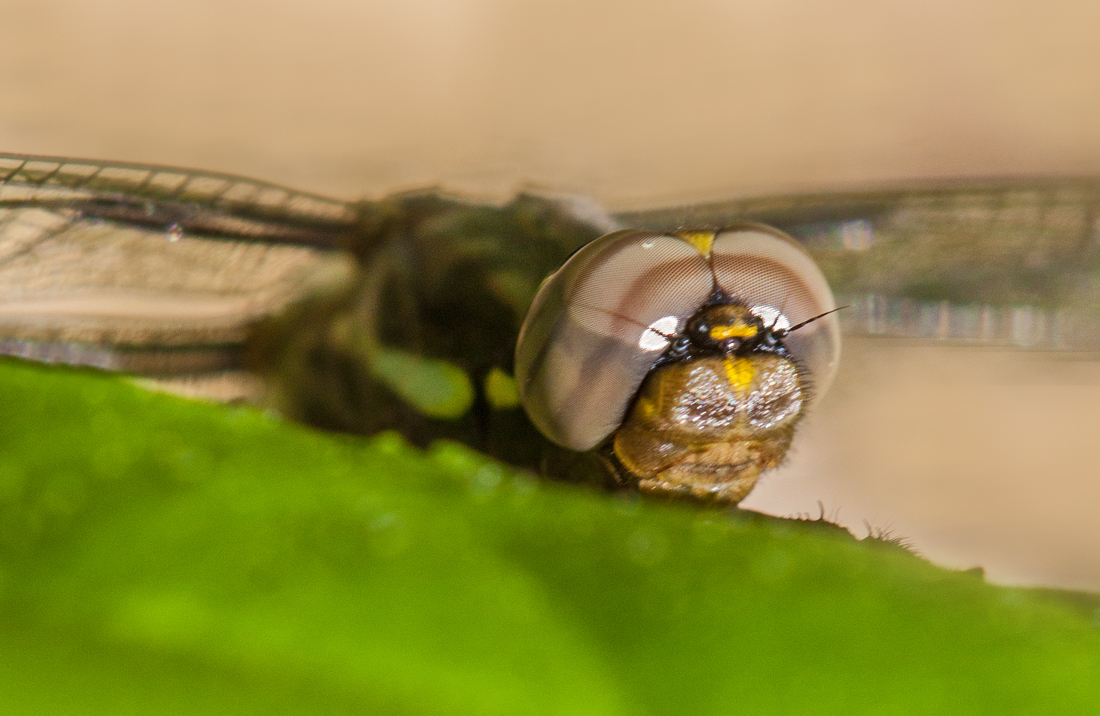
Yesterday, I seemed to be particularly fascinated by insect eyes and did a posting on a fly, whose compound eyes were pretty amazing. However, dragonflies have the largest compound eyes of any insect and I was thrilled to be able to capture this face-to-face shot of a Common Whitetail dragonfly (Plathemis lydia), peering right at me over the edge of a leaf.

A dragonfly’s eyes can have as many as 30,000 facets, known as ommatidia, that contain light-sensitive proteins, according to an article in ScienceBlogs. Although, humans also have these kind of proteins, called opsins, we have only three (red, green, and blue), whereas a dragonfly has four or five, giving it the capability to see colors beyond human visual capabilities. A dragonfly’s eyes also wrap around its head, giving it an incredible field of view. For more information and a more scientific explanation, check out a posting entitled “Super-predators” that Sue did last June in her Backyard Biology blog.

I took this shot in a wooded grassy area adjacent to a pond. It seems that the Common Whitetail dragonflies are hanging out there early in the season and not too many of them are patrolling over the water, as I commonly saw them do last summer. The fact that the dragonfly was not perched on a branch coming out of the water proved to and advantage as I was able to approach pretty closely to it in order to take this shot.

dragonfly_eyes_blog

© Michael Q. Powell. All rights reserved

Read Full Post »

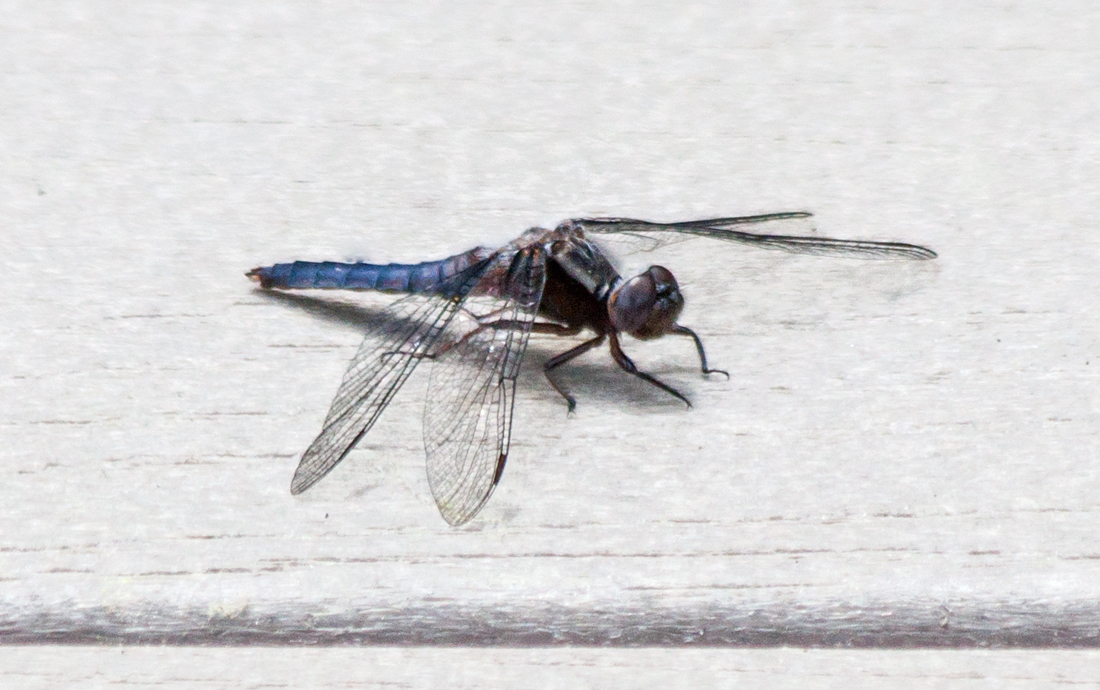
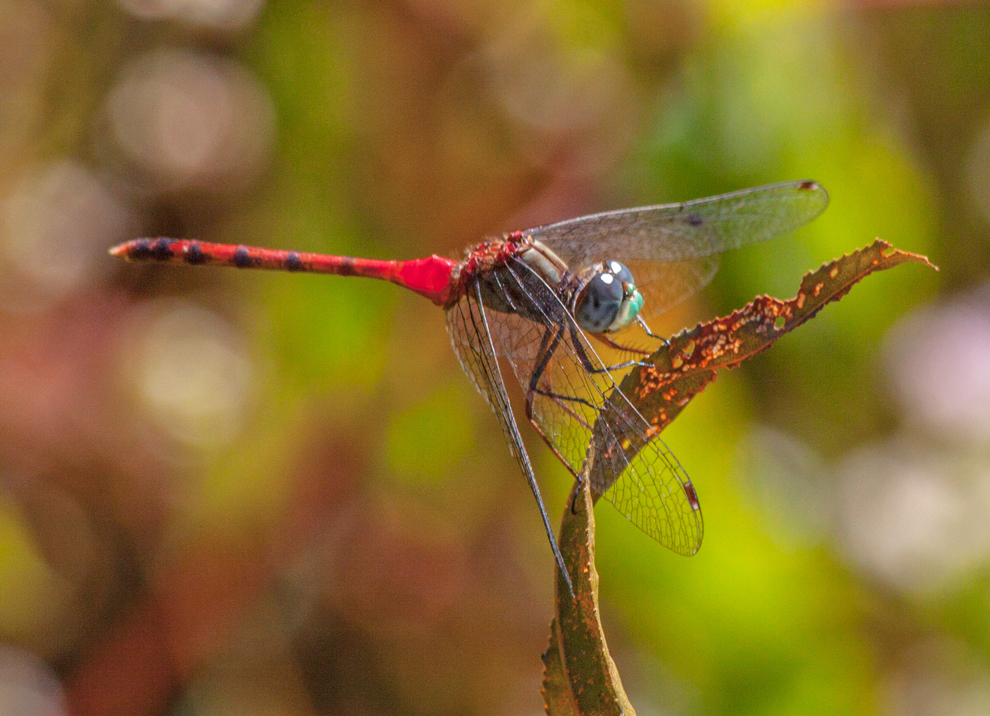
Some of the common species of dragonflies are around throughout much of the summer. Other dragonflies, sometimes referred to as “spring ephemeral” dragonflies,  are around for only brief periods of time in the early spring, like this male Blue Corporal dragonfly (Ladona deplanata) that I spotted last week on the boardwalk at my local marsh.

I had never seen this species before, but fortunately my fellow blogger and local dragonfly expert, Walter Sanford, was able to assist me with the identification. Check out his blog to see some awesome shots of dragonflies and other nature subjects.

I would love to be able to photograph this species the next time in a more natural environment, but I am pretty excited any time I have the chance to get a recognizable photo of a new species.

dragonfly2_may_blogdragonfly_may_blog

© Michael Q. Powell. All rights reserved

Read Full Post »

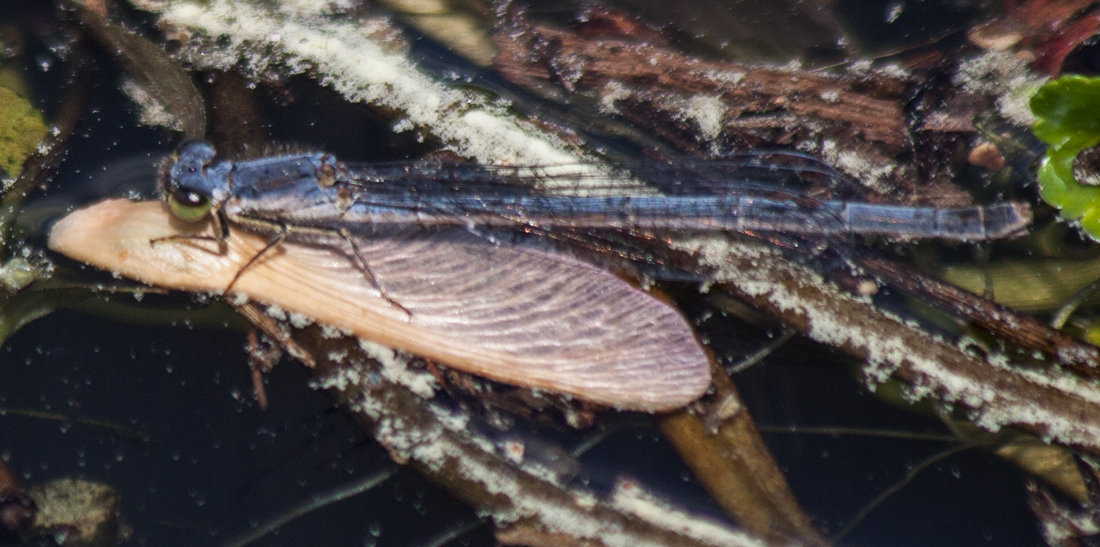
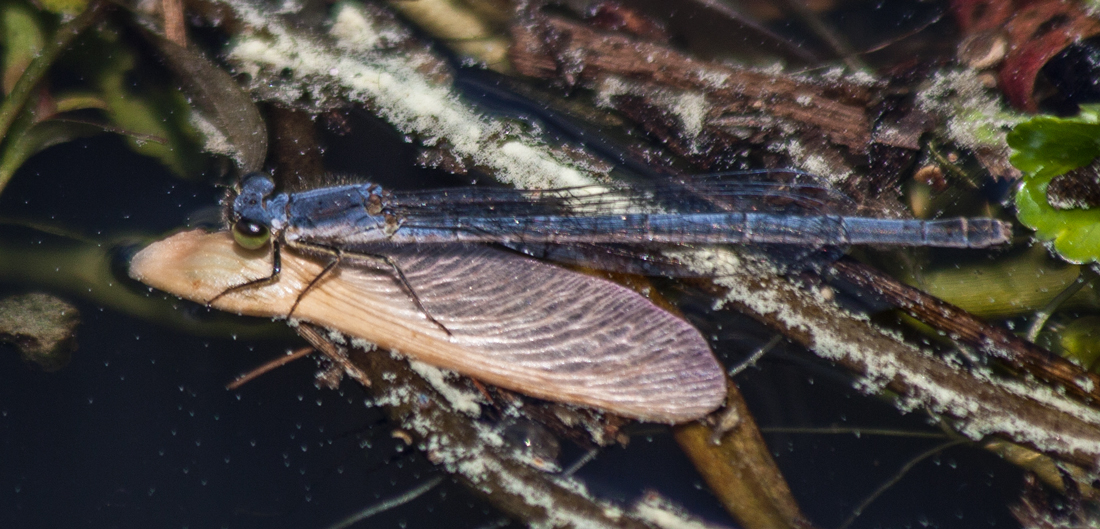
Most folks are familiar with dragonflies, but damselflies, the smaller members of the Odonata family, are equally impressive. I spotted this little beauty yesterday in the pond debris at Huntley Meadows Park, the local marshland area where I take many of my nature photographs.

I don’t know damselfly behavior very well, but noted that the very end of the damselfly’s tail is in different positions in this series of photos. In the first image, the tip is curved upward and then gradually returns to a more straight position in the final shot. Sometimes movements like this indicate that the damselfly could be laying eggs, but I haven’t been able to determine yet the gender or species of the damselfly. There seem to be a lot of different species of damselflies that are blue. (If I had to guess, I’d say that it looks like a female Eastern Forktail (Ischnura verticalis), because of the color, the forked end of the tail, and the two-tone eyes).

Although this looks like a macro shot (and the subject was really small), this is another case in which I was able to use my telephoto zoom lens to get macro-like results. Click on any of the photos to get a higher-resolution view of the damselfly and you may be surprised to see how many of the details the telephoto lens was able to capture.

damselfly1_may_blogdamselfly2_may_blogdamselfly3_may_blog

© Michael Q. Powell. All rights reserved

Read Full Post »

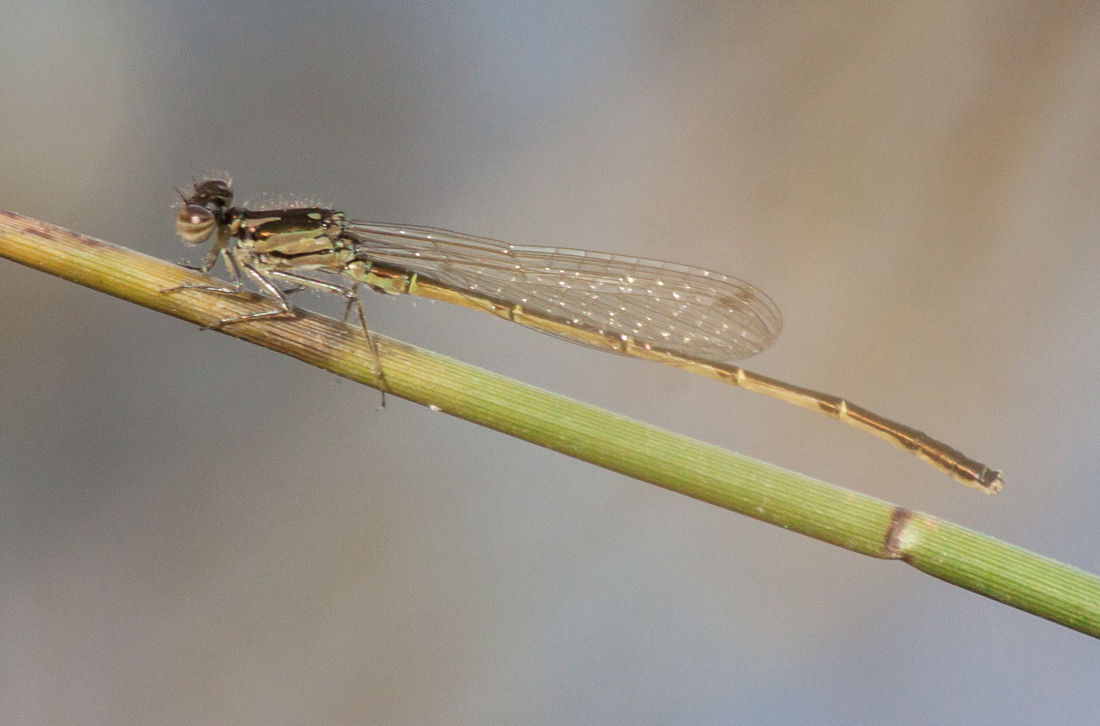
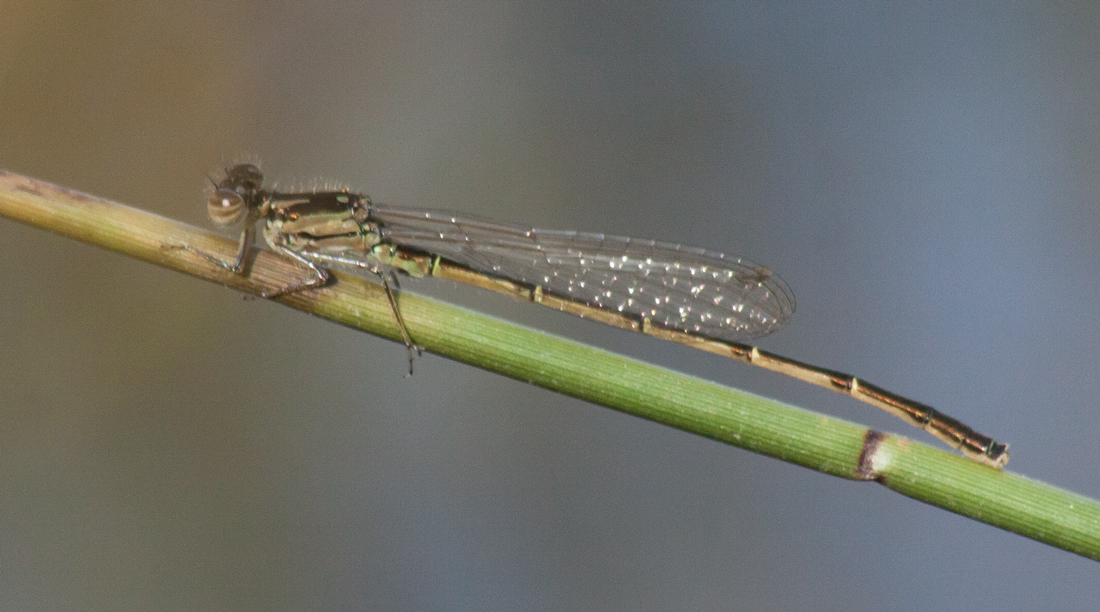
Damselflies are beautiful, delicate insects that are often hard to see and photograph. I captured this image of my first damselfly of the year at Huntley Meadows Park this past Friday. I am not very good at identifying these tiny insects, but think this might be a Fragile Forktail (Ischnura posita).

I was standing my the edge of my favorite beaver pond when I saw the damselfly in flight. I followed it with my eyes and was delighted when it landed on a nearby stalk of grass. I didn’t have a lot of maneuver, because much of the area at the pond’s edge is covered with thorny bushes, and I had to pull back a bit to get within the minimum focusing distance of my 70-300mm telephoto lens , i.e. 4.9 feet (1.5 meters). At that range, the dragonfly filled a reasonable amount of the frame.

Lighting was a bit of a challenge and I tried a couple of different settings as the damselfly lifted its tail from time to time. Eventually, it climbed to the end of the stalk and I changed position too and tried a couple of shots (including the final shot) using my pop-up flash.

Most of the time the first shot below is my favorite, but sometimes I like the others as well or more. In any case, I am happy that I was able to get some good shots of my first damselfly of the spring.

damselfly2a_blogdamselfly1a_blogdamselfly3_blog

© Michael Q. Powell. All rights reserved

Read Full Post »

Spring is here and I am once again chasing dragonflies, on a quest to capture images of these beautiful insects. Common Green Darners (Anax junius) rarely seem to perch, so I was forced to try to photograph them in flight.

This early in the spring, there aren’t yet a lot of dragonflies, so my patience was tested as I waited for one to fly by. I tried a lot of different approaches and the one that worked best on this day was to focus manually, which is a bit of a challenge at 300mm when the subject is moving pretty fast.

I hope I’ll get some better shots later this season—this is my best one so far.

dragonfly_flight_blog

© Michael Q. Powell. All rights reserved

Read Full Post »

The weather has gotten warmer, but I was still a bit surprised when I saw my first dragonfly of the year yesterday at Huntley Meadows Park, my local marsh. I think that it is a female Common Green Darner dragonfly (Anax junius), one of the species that migrates north after spending the winter in warmer places. This is the only dragonfly that I saw yesterday and I was able to squeeze off a couple of shots before it disappeared. I’m hoping that it won’t be long before I see more dragonflies and butterflies, some of my favorite photographic subjects.

dragonfly_april_blog

© Michael Q. Powell. All rights reserved

Read Full Post »

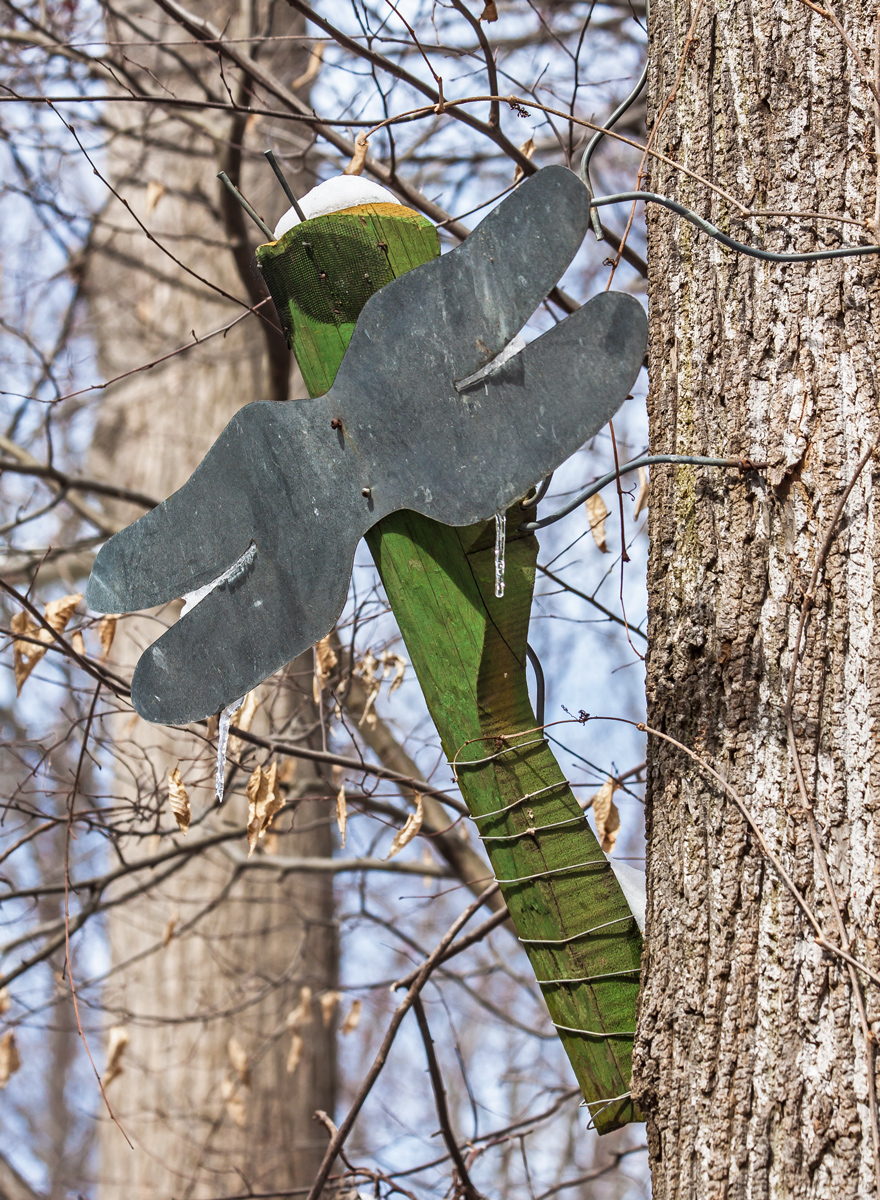
I never expected to encounter a dragonfly when I went walking in the snow in my neighborhood yesterday.

My eyes were scanning the trees for birds,  when right it front of me I detected the unmistakable shape of a dragonfly, a giant green dragonfly perched on a tree. I approached it quietly and was able to get this shot, my first shot of a dragonfly in a long time.

With snow still covering the ground and the temperatures below freezing, it’s hard to imagine that the real dragonflies will be appearing in a few short months.

dragonfly_winter_blog

© Michael Q. Powell. All rights reserved

Read Full Post »

I don’t know what it was about Autumn Meadowhawk dragonflies, but they really seemed to like to perch on me during several sessions when I was stalking them with fellow photographer and blogger Walter Sanford, who was able to capture shots of them (including mating pairs) on various parts of my clothing and body. His shots are wonderful and provide some great views of these colorful dragonflies, which seem to have disappeared with the arrival of frigid weather in our area.

waltersanford's avatarwalter sanford's photoblog

Autumn Meadowhawk dragonflies (Sympetrum vicinum) like Mike! Mike Powell, that is, a.k.a. “Meadowhawk Mike.” The following photos were taken at Huntley Meadows Park on 15 November 2013. Each set of images, or individual image, features a different dragonfly (or dragonflies) perching on Mike at various times during the day. Disclaimer: No dragonflies were either injured or killed in the making of these photos.

Now you see it; now you don’t! A male dragonfly perching on Mike’s shoulder, that is. Or was.


A time-series of images showing a mating pair in tandem. Mating pairs are usually more skittish than this male and female.


Sometimes the same dragonfly — or more than one dragonfly — perched in different places.


Another male, testing a couple of perching places.


A male on Mike’s arm.


This isn’t an optical illusion — a male dragonfly actually is…

View original post 133 more words

Read Full Post »

When a dragonfly landed on a sign at my local marshland park, one of my favorite places for photography and reflection, it seemed to be sharing reminders with me and with fellow photographer and blogger Walter Sanford about the proper approach to observing wildlife (and life in general).

waltersanford's avatarwalter sanford's photoblog

Sometimes I jokingly refer to myself as a “Dragonfly Whisperer.” Well, as it turns out, the roles were reversed recently when a mature male Autumn Meadowhawk dragonfly (Sympetrum vicinum) whispered some words of wisdom about wildlife watching at Huntley Meadows Park. Here’s what the old-timer had to say …

Food for thought on the traditional day when we give thanks for our many blessings. I am especially thankful for the opportunity to be a frequent and careful observer of the natural beauty of the hemi-marsh at Huntley Meadows Park, and for many good friends with whom I share the experience. And thanks to WordPress.com for the free blog that enables me to share my sightings with others!

Copyright © 2013 Walter Sanford. All rights reserved.

View original post

Read Full Post »

Could this be the mascot for a new line of clothing or shoes? Dragonfly photographer extraordinaire Walter Sanford took these shots of a beautiful female Autumn Meadowhawk perched on my hand as I tried to move it closer to the messenger bag in which I carry my camera gear.

waltersanford's avatarwalter sanford's photoblog

The preceding gallery shows a female Autumn Meadowhawk dragonfly (Sympetrum vicinum), spotted at Huntley Meadows Park on 15 November 2013. She is perching on the hand of Mike Powell, fellow wildlife photographer and blogger. This individual is not the female featured in my last post, “Champion dragonfly.”

Copyright © 2013 Walter Sanford. All rights reserved.

View original post

Read Full Post »

Fellow photographer and blogger, Walter Sanford, has an incredible talent for capturing photos of dragonflies, in this case one that was perched on the sleeve of my sweatshirt.

waltersanford's avatarwalter sanford's photoblog

The following gallery features photos of the undisputed champion dragonfly!

This individual is a female Autumn Meadowhawk dragonfly (Sympetrum vicinum), spotted at Huntley Meadows Park on 15 November 2013. She is perching on the sleeve of Mike Powell’sChampion USA sweatshirt.

Hey Champion, how ’bout a little something, you know, for the product placement in my photos?

Copyright © 2013 Walter Sanford. All rights reserved.

View original post

Read Full Post »

When an Autumn Meadowhawk dragonfly (Sympetrum vicinum) landed on my thigh last Friday, my first thought was to get a photograph of him. Fortunately, my 100mm macro lens was already on my camera—in anticipation of a shot like this—and I was able to capture a close-up, eye-to-eye portrait of the dragonfly by contorting my body and attempting to stabilize my shooting position.

My blue jeans were broken in and their texture, color, and pattern made a pretty cool backdrop for this colorful dragonfly. It may be my imagination, but he seemed to be looking up at me with a mixture of curiosity and amusement.

For whatever reason, many of these dragonflies, which I was able to observe as recently as yesterday, do not seem fearful of people. The classic Drifters song from the 1960’s may talk of spending time with your sweetheart under the boardwalk, but these Autumn Meadowhawks seem to spend most of their time warming up on (and not under) the boardwalk, with periodic mating forays into the bushes.

dragonfly1_denim_tight_crop_blog

Click on the photo to see it in higher resolution.

© Michael Q. Powell. All rights reserved.

Read Full Post »

It may be mid-November, but one hardy dragonfly species is still around here in Northern Virginia—the Autumn Meadowhawk (Sympetrum vicinum).

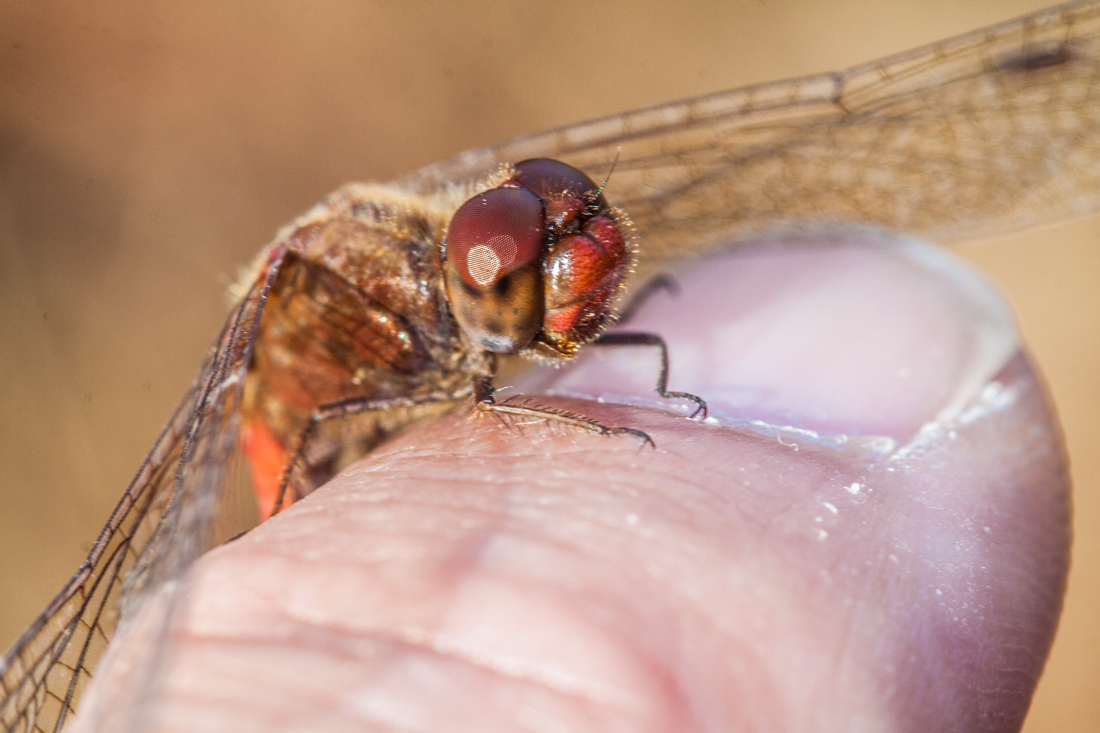
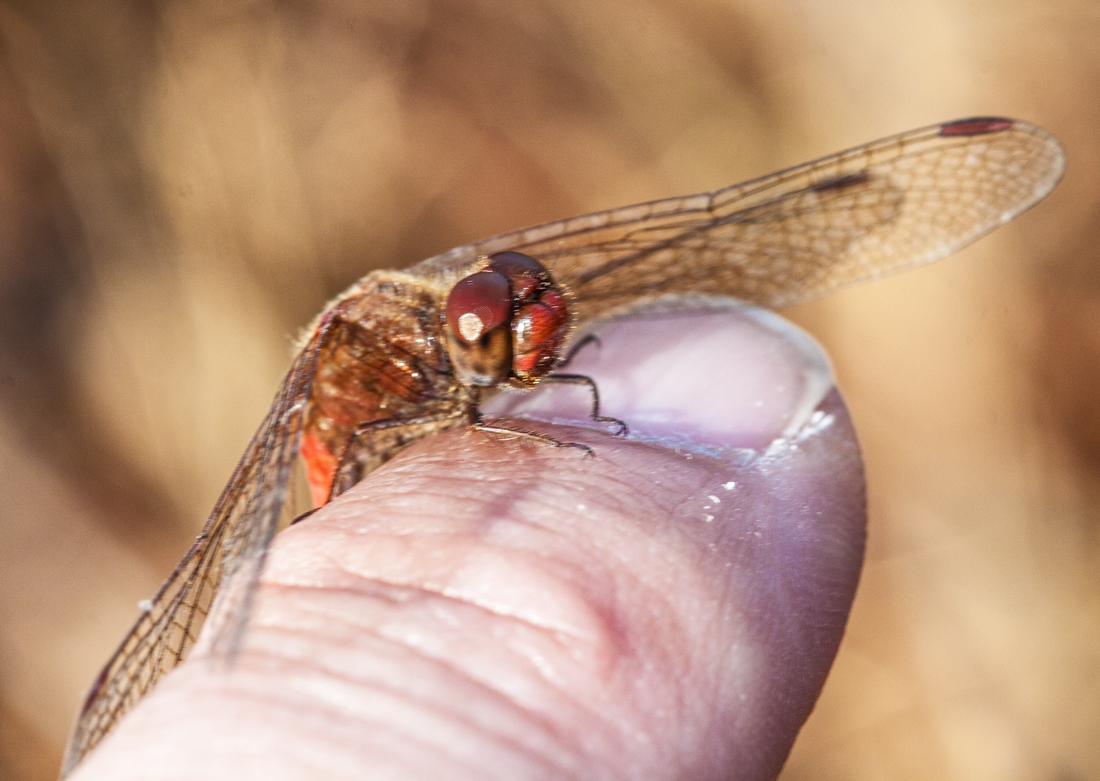
The dragonflies were unusually friendly today, perching on my sweatshirt and jeans numerous times, though they spent most of the time trying to warm themselves in the sun on the boardwalk. Here is a close-up shot of a male Autumn Meadowawk that I coaxed onto my fingertip yesterday at Huntley Meadows Park. All I had to do was slowly move my finger forward and several times a dragonfly accommodated by crawling onto the finger.

Needless to say, it was an interesting challenge trying to hold one finger out as far as I could and then focus and shoot my DSLR with the other hand. Fortunately I had switched to my macro lens—my arms would not have been long enough to get within the minimum focusing distance of the telephoto zoom lens that I had been using earlier in the day. Click on the photos to get a higher-resolution look at the details of the dragonfly’s compound eyes.

dragonfly_finger2_blogdragonfly_finger1_blog

© Michael Q. Powell. All rights reserved.

Read Full Post »

Turnabout is fair play. In one of my earlier posts entitled “Dragonflies mating on a calf” I featured Walter Sanford, a fellow photographer and blogger. Today, in a posting called “The natives are friendly.” he featured my arm and finger as I tried to charm a couple of different dragonflies to perch on my index finger.

waltersanford's avatarwalter sanford's photoblog

Most dragonflies are skittish. Some dragonflies are “friendly,” such as Blue Corporal dragonflies (Ladona deplanata). Autumn Meadowhawk dragonflies (Sympetrum vicinum) are friendly; sometimes very friendly!

Mike Powell and I visited Huntley Meadows Park recently. We stopped to “charm” dragonflies a couple of times during our photowalk. The following gallery shows two different male Autumn Meadowhawk dragonflies perching on Mike: Photos 1-2 show Mike coaxing a dragonfly onto his finger; Photos 3-4 show another dragonfly perching on Mike’s arm.

Tech Tip: Either mouse-over or tap photos to see captions.

Copyright © 2013 Walter Sanford. All rights reserved.

View original post

Read Full Post »

When this bright red male Autumn Meadowhawk dragonfly landed briefly on my fellow photographer’s white sneaker yesterday, it suddenly struck me that we might have hit on a potential fall fashion fad. Why not accessorize plain shoes with colorful dragonflies in seasonal colors? We could start with the Autumn Meadowhawk for fall and perhaps move on to the Common Whitetail as the snow begins to fall. Spring could bring on the Green Darner and summer could feature the Blue Dasher.

Of course, we couldn’t use real dragonflies, but they could serve as models for pin-on or clip-on dragonflies. Size-wise, it looks like this Autumn Meadowhawk is about the right size.

Now that I have a marketing idea, all I need is investors.

dragonfly_sneaker_blog

© Michael Q. Powell. All rights reserved.

Read Full Post »

There is something a little wistful about searching for the last dragonfly of the year. Most of the familiar dragonflies from the summer have disappeared and it looks like the sole remaining dragonfly in our area is the Autumn Meadowhawk dragonfly (Sympetrum vicinum).

Yesterday I spent some time trying to photograph this dragonfly along with fellow photographer and blogger Walter Sanford, who has an amazing collection of photographs of dragonflies on his blog site, including a world-class series on the Blue-faced Meadowhawk. I was willing to try to capture photos of any dragonfly that I could spot, but Walter noted that he had taken enough photos of the male Autumn Meadowhawk and was really interested in photographing females or, even better, mating pairs.

The mating pairs tended to elude him most of the day, until suddenly a pair in the “wheel” position circled around us and landed on his bare calf—talk about unprotected sex. There was no way that he could twist himself around to get a good photo, but I manage to get this shot of the two dragonflies in action.

Temperatures are supposed to continue to drop this week, so there is always a chance that these will be the last dragonflies that I see this year, though I will be out searching for them for weeks to come before I bid my final adieu to them.

wheel_leg_blog

© Michael Q. Powell. All rights reserved.

Read Full Post »

I don’t expect to see new species of dragonflies at this time of the year, but one of my fellow photographers, Walter Sanford, has been stalking the Blue-faced Meadowhawk (Sympetrum ambiguum) almost daily and I joined him for a few hours one late September day and got this shot.

I learned quickly that these dragonflies are hard to spot, despite their conspicuous coloration. They seem to like to remain perched down low in the vegetation and wait for their prey, rather than fly around when they are hunting.

I love the combination of colors on the Blue-faced Meadowhawk and I was happy to get a decent shot that shows its blue face. If you want to see more shots of this beautiful dragonfly, check out Walter’s blog posting from yesterday.

I am now in search of the Autumn Meadowhawk, the last dragonfly that I observed last fall. Normally they should be here already, but none of my fellow dragonfly followers has observed any of them yeat.

blue-faced1_blog

© Michael Q. Powell. All rights reserved

Read Full Post »

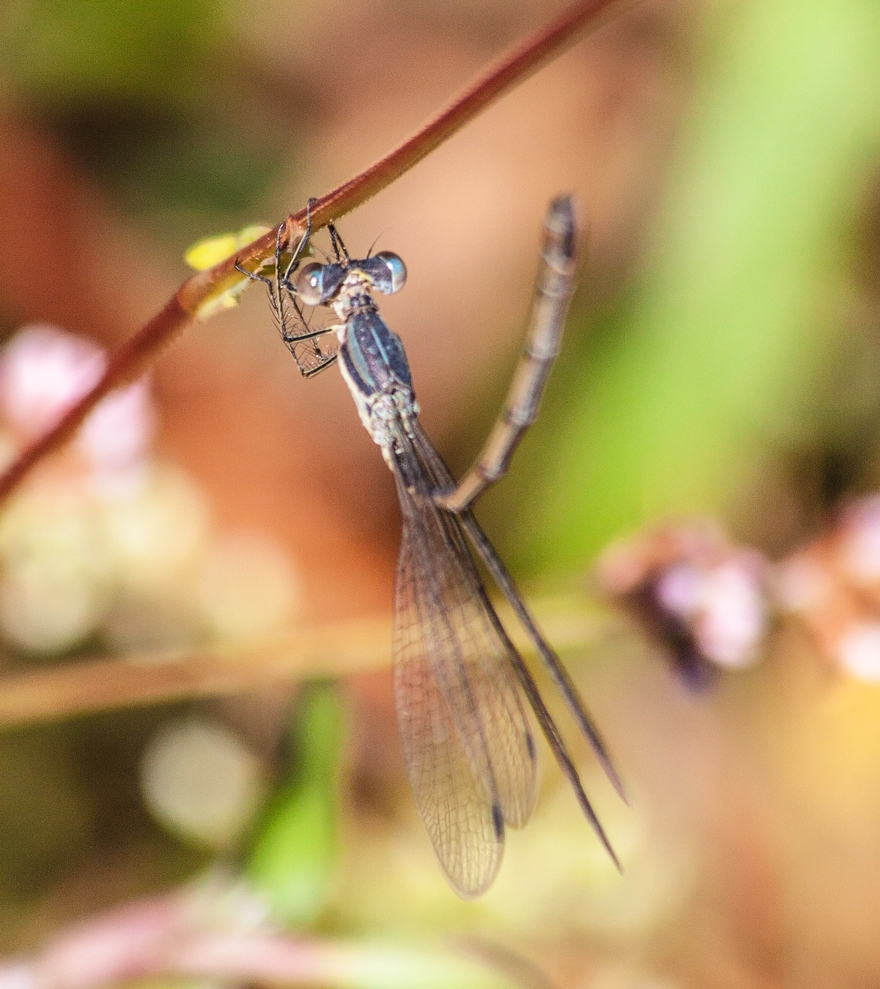
I featured this Slender Spreadwing damselfly (Lestes rectangularis) in an earlier posting in a series of action shots, but thought this more formal portrait deserved a posting of its own.

As I stalked this beautiful little dragonfly, it moved to a number of different perches and it is interesting to see how the background shifted in terms of color palette and clutteredness (I think I may have just created a new word). In the gymnastics shots of this damselfly, the background was bright and colorful and a little busy, whereas the background here is darker and a bit more moody, with just a hint of colors. Be sure to click on the image to see a higher resolution view of this little damselfly that was probably less than 2 inches ( 50 mm) long.

Those of you who like to observe damselflies know that this species is an exception to the general rule that damselflies, unlike dragonflies, hold their wing close into and parallel to their bodies when at rest. My fellow photographer and blogger, Walter Sanford, an expert on dragonflies, was the one who first spotted this damselfly and you should check out his blog for lots of wonderful wildlife photos, including a recent image of a perched Wandering Glider dragonfly, a species that never seems to land.damsel_spread_blog

© Michael Q. Powell. All rights reserved

Read Full Post »

As I was observing this Slender Spreadwing damselfly (Lestes rectangularis) earlier this week, it suddenly launched into a series of acrobatic maneuvers worthy of an Olympic gymnast on the high bar. I captured several action shots of the routine, possibly related to laying eggs, although I managed my clearest shot when the damselfly returned to its starting position and waited for the scores from the judges.

Pointing the toes for maximum extension

Pointing the toes for maximum extension

damsel_spread2_blog

Swinging back to generate greater velocity for the next trick

Finishing up the routine

Finishing up the routine

Waiting for the scores from the judges

Waiting for the scores from the judges

© Michael Q. Powell. All rights reserved

Read Full Post »

Yesterday at my local marsh, I noticed some large dragonflies flying over the cattails and realized that it was migrating season for Green Darner dragonflies (Anax junius). I don’t usually think of dragonflies as migratory creatures, but I recall from early spring that Green Darner dragonflies spend their winters in the south and migrate north in the spring (or at least their offspring fly north).

Green Darners are pretty big dragonflies, with bodies up to 3 inches (75mm), so I decided to try to photograph one in mid-flight. Another photographer and I spent almost an hour trying to track and photograph the dragonflies. Unlike other times, when I photographed dragonflies when they were hovering, I was attempting to capture these dragonflies as they were flying at a normal speed, which greatly complicated the task.

I knew that there was no way that I could isolate a flying dragonfly against the green plants of the marsh, so I concentrated on the dragonflies in areas in which I would have the sky as a backdrop. I used my 180mm macro lens and would try to follow a dragonfly in the viewfinder and track it, hoping it would fly close enough for me to attempt a shot. As I was tracking the dragonfly, I would focus manually. Needless to say, my success rate was really low, but I am happy that I managed to get the shot below of what I believe to be a female Green Darner. My fellow photographer, who was using a 70-200 telephoto zoom lens used a different approach and pre-focused on an area and took a shot when a dragonfly entered that capture zone.

It was a beautiful, sunny fall day and I enjoyed this challenge, which gave me a greater appreciation for the aerial skills of dragonflies—they are really tough to track. This practice, though, should help me later in the fall when I start to take more photographs of birds.

flying_dragonfly_blog

© Michael Q. Powell. All rights reserved.

Read Full Post »

As summer fades, I have been seeing fewer and fewer dragonflies, so I decided to attempt some in-flight shots and managed to capture these images of a female Great Blue Skimmer dragonfly (Libellula vibrans).

Photographing dragonflies in flight is one of my toughest photographic challenges, but I have learned a few tricks about capturing these kinds of shots. One way is to find a favorite perch of a dragonfly and try to photograph the dragonfly arriving and departing from that perch, given that dragonflies often return to the same perches. That was not the approach that I used this time.

The approach I used is to capture the dragonfly while it is hovering and is therefore in the same spot for a few seconds. I  watched as two blue skimmers mated quickly and I knew that I had a target of opportunity, because the female would soon deposit the eggs in the water. She hovered in the air and then dipped her tail end down to the water to deposit some eggs and returned to the hover position and repeated the process. It was during this process that I got these shots.

I am always struck by the beautiful blue eyes of the Great Blue Skimmer, particularly in the female. The male is all blue, so his eyes don’t provide the same visual contrast as the drabber colored body of the female.

The dwindling dragonfly population is yet another sign of the changing of the seasons—it won’t be long before I begin to focus my camera lens more frequently on birds than on insects, but I am not giving up on my insects quite yet.

skimmer_air2_blogskimmer_air_blog

© Michael Q. Powell. All rights reserved.

Read Full Post »
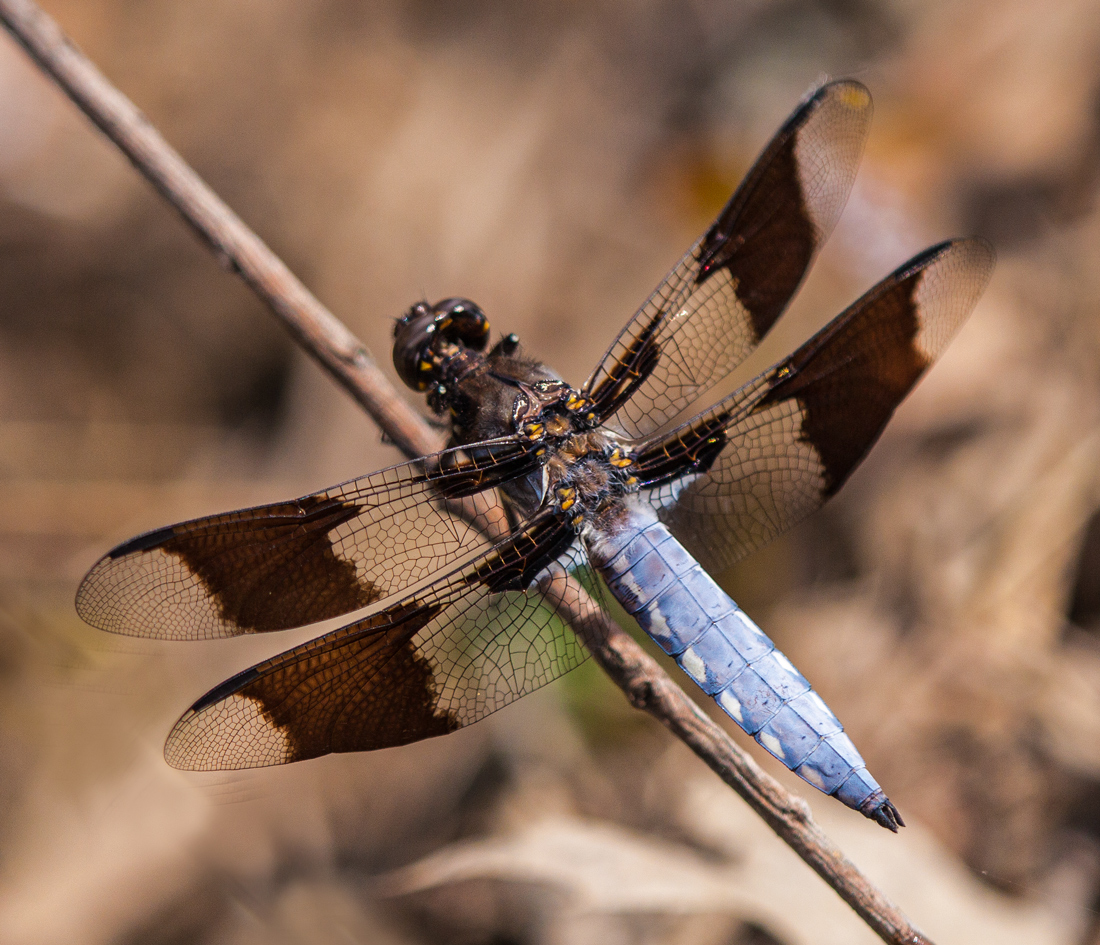
I love the mix of colors that resulted when a male Blue Dasher dragonfly (Pachydiplax longipennis) that I was observing chose to perch on a plant with red leaves.red_obelisk_blog

© Michael Q. Powell. All rights reserved.

Read Full Post »

Do you ever take shots and find that you like the way that the background turned out even more than the way the subject looked?  That was the case with this image of a male Great Blue Skimmer dragonfly (Libellula vibrans) that I photographed this past weekend.

The lighting was a bit harsh and the pose is pretty ordinary, but I love the two-tone background, caused in part by the use of my 135-400mm telephoto zoom at its full extension.

blue_skimmer2_blog

© Michael Q. Powell. All rights reserved

Read Full Post »

It’s hard to imagine an odder couple than this dragonfly and this turtle, sunbathing together on a log in the beaver pond. What do they see in each other? How do they communicate? Love seems to find a way to overcome obstacles like these.

One thing is clear—they are happy together, sharing this special moment in the warmth of the sun. If you don’t believe me, check out the smile on the turtle’s face.

fun_blog

© Michael Q. Powell. All rights reserved

Read Full Post »

Most dragonflies choose perches high in the air, but this male Blue Dasher (Pachydiplax longipennis) decided to land on a little plant just inches above the surface of the water at my local marsh, creating a photographic challenge for me.

Hanging over the edge of the boardwalk, I tried to get at eye level with the dragonfly and simultaneously sought an uncluttered background.  In the first image, I was successful in shapes of the leafs, achieving a kind of three-dimensional effect. The water turned into an almost even gray, totally lacking in details. The second image gives you a better sense of the context, with the ghostly plants in the background.

The Blue Dasher dragonfly is the most common one that I see and it’s always a challenge to come up with creative new ways to show off its beauty. For this one day, I feel like I successfully met that challenge.

dasher_leaf_blogdasher_leaf_2_blog

© Michael Q. Powell. All rights reserved

Read Full Post »
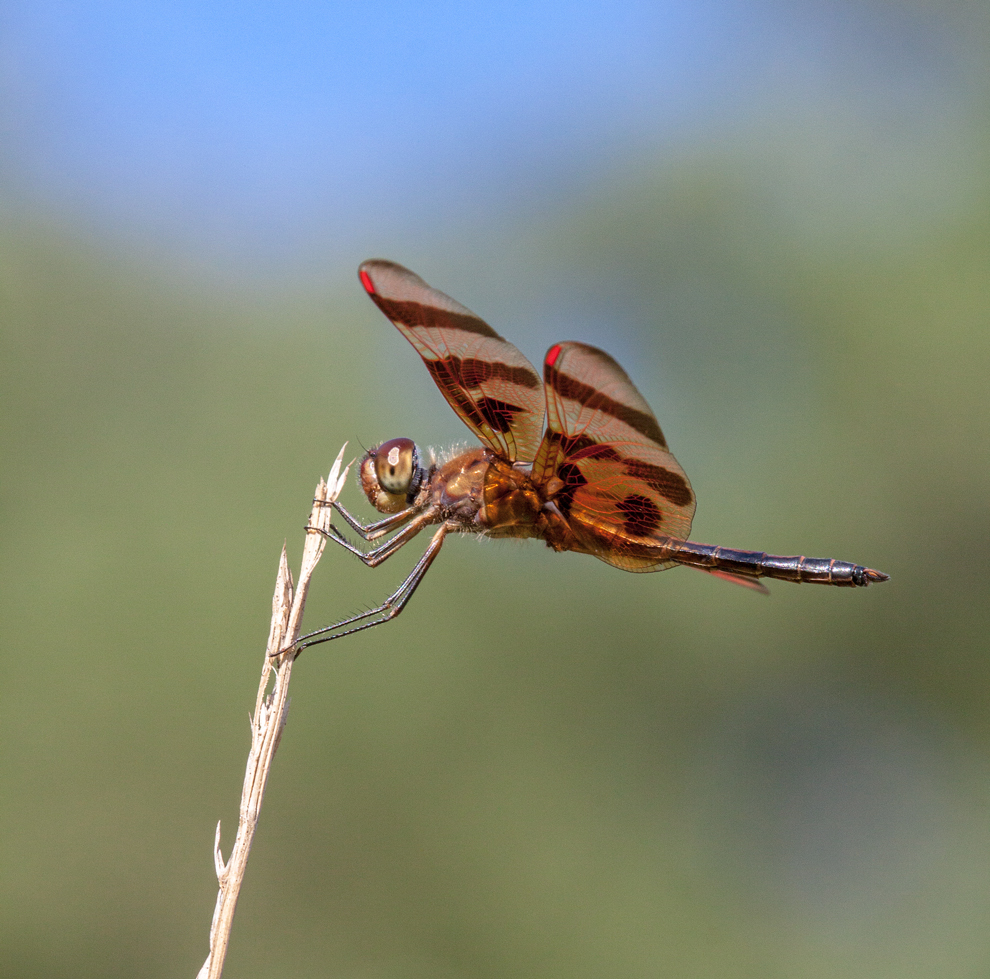
It’s not hard to see where this dragonfly gets its name—the Halloween Pennant (Celithemis eponina)—when it is perched on the very tip of a stalk of grass and is blown about by even the slightest wind.

I took this shot from a very low angle to try to show the sky and I am pretty happy with the way in which I was able to separate the dragonfly from the background.

blowing_blog

© Michael Q. Powell. All rights reserved

Read Full Post »
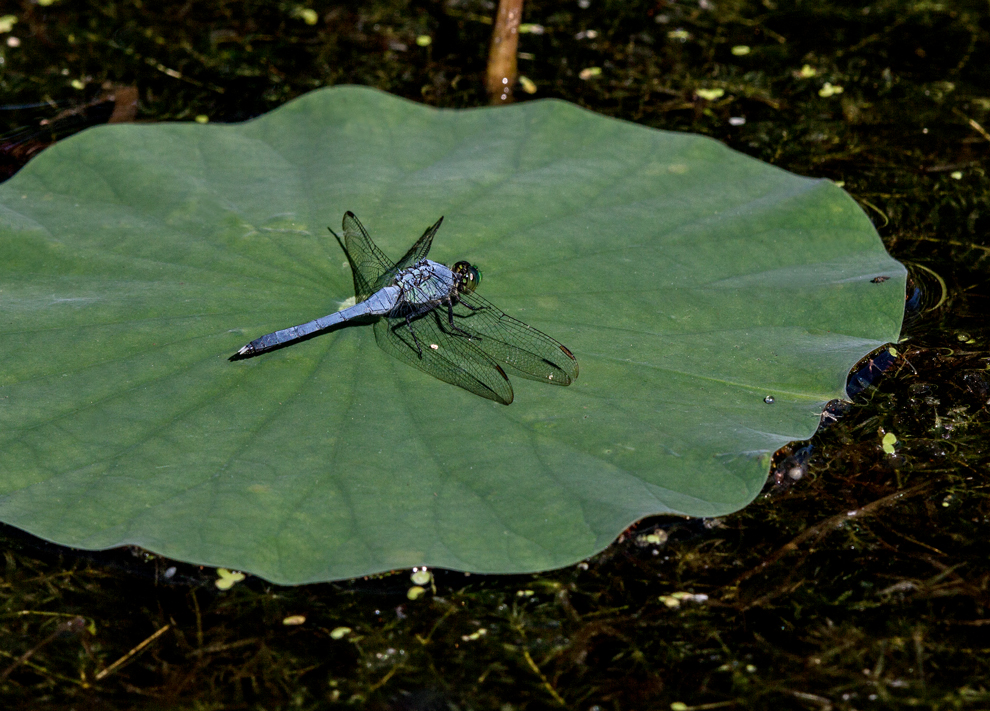
In most of my dragonfly shots the dragonfly is perched on an upright object, so, for variety, I decided to post this shot of a male Eastern Pondhawk dragonfly (Erythemis simplicicollis) in a different position—posing on a lily pad.

The dragonfly made multiple touch-and-go landings on this lily pad, sometimes landing near the edge, as in the first image, and sometimes in the middle, as in the second image. I couldn’t tell if he was using the lily pad as a platform for hunting insects or was merely resting. (It seems to me that it would be more advantageous for hunting to be higher up, unless you are hunting aquatic insects, which didn’t seem to be the case here.)

pad2_blogpad1_blog

© Michael Q. Powell. All rights reserved

Read Full Post »

« Newer Posts - Older Posts »