Feeds:
Posts
Comments

Archive for the ‘Art’ Category

Normally I aim for extreme realism when taking photos. Sometimes, however, I like to try an “artsy” approach, like in this image of a flower (a zinnia, I believe) from this past weekend at Meadlowlark Botanical Gardens.

In this case, I deliberately tried to distort perceptions and make it look like the grass and the sky had switched places. In reality, the blue is not from the sky, but is a gravel path.

I like to try to vary the angle at which I am shooting and the results can often be fun and different. I never know when I will find myself sprawled on the ground or standing in the mud, so I tend to wear clothes that are rugged and often ragged.

zinnia

© Michael Q. Powell. All rights reserved.

Read Full Post »

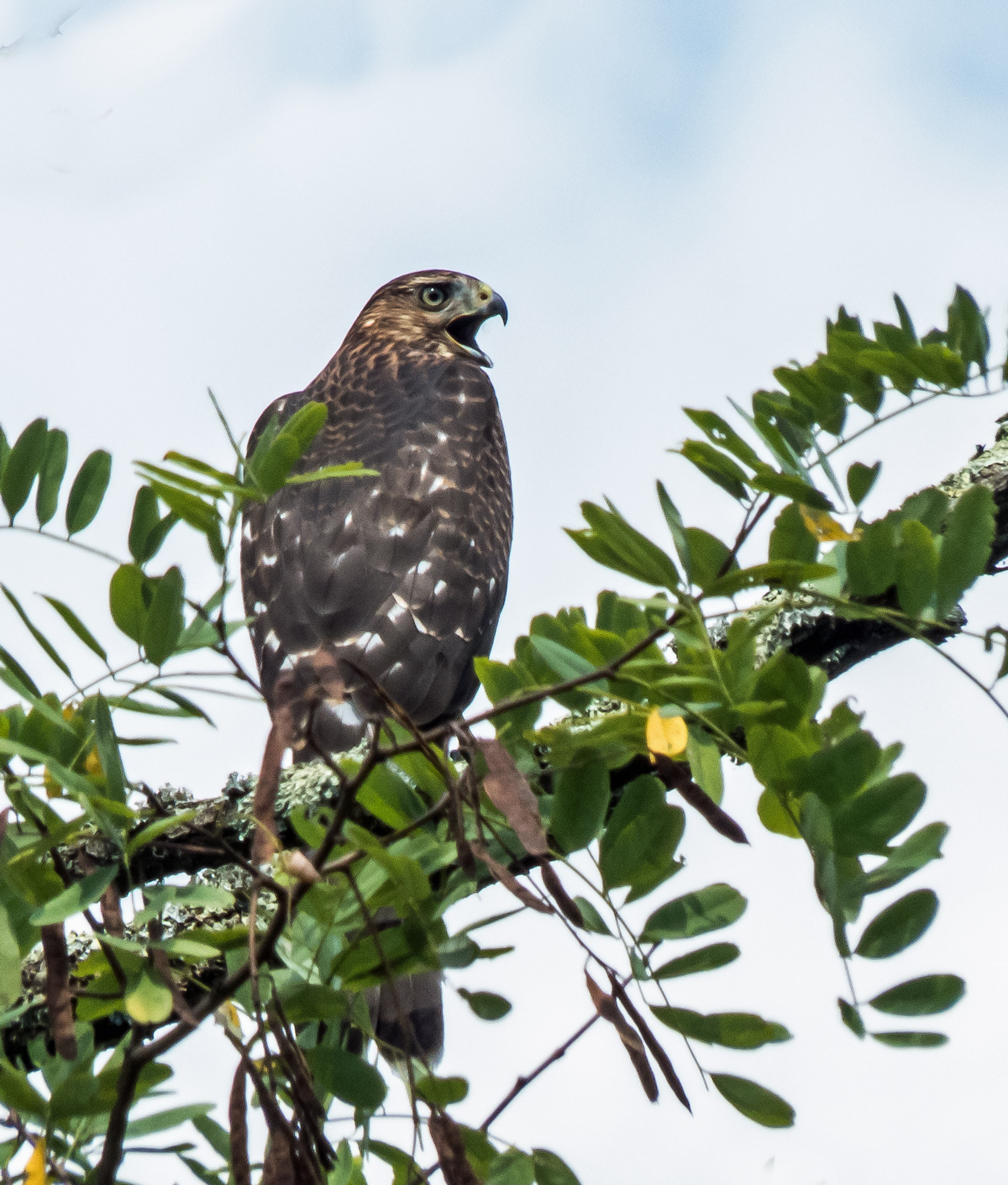
I’m a real beginner in watercolors and probably should stick to exercises and simple subjects, but that is not what I want to paint. I’ll look at some of my wildlife photos and think, “I’d like to try to paint that,” knowing full well that I don’t really have the skills to do so. I figure, though, that I’ll learn as I go along, seeing what works and doesn’t work. So yesterday evening I decided to have a go at painting an immature Cooper’s Hawk (Accipiter cooperii) that I photographed recently.

I figured the best chance I had at making something recognizable was to simplify things, especially smaller, less important elements, like the leaves in the branches surrounding the hawk. I decided that I was not going to worry about making them realistic. I also realized that it would be tough for me to capture the fine details of the feathers, so I went for a more stylized approach. I decided to simplify my color palette too and used only three colors—lemon yellow, ultramarine blue, and burnt sienna.

So what happened? You can see and judge the results yourself. Some parts of the painting came out pretty well and other parts could use a lot of improvement.

I learned a lot in the process of doing this painting, most notably that I really enjoy mixing colors. It was rare that I used one of the three colors straight out of the pan, with one exception being the yellow eye. I paid a lot of attention to trying to vary my colors, especially in areas like the feathers.

I realize now that painting details is really tough—I’m hoping that practice will help me improve my control of the brushes. The biggest thing, perhaps, that I need to work on is controlling the amount of water that is on the brush and on the paper. I was blindsided a couple of times when the result I was expecting did not happen, most often when I had too much water in my brush. (I also need a whole lot of practice with sketching.)

I didn’t really try to copy my photo, but thought you might enjoy seeing the photograph that served as a general reference for me as I painted.

Thanks to the many readers who have encouraged me to keep painting. It is a little humbling to see how crude my initial efforts are, but it really is a lot of fun creating something from scratch—there is definitely something therapeutic about playing with paints.

watercolor hawk

Cooper's Hawk

© Michael Q. Powell. All rights reserved.


Read Full Post »

I spotted this beautiful butterfly this past weekend at Jackson Miles Abbott Wetland Refuge. I am pretty sure that it is a Question Mark butterfly (Polygonia interrogationis), judging from the pattern of its wing spots.

While I may not be absolutely certain that it is a Question Mark butterfly, its beauty is unquestionable.

Question Mark butterfly

© Michael Q. Powell. All rights reserved.

Read Full Post »

This Prince Baskettail dragonfly (Epitheca princeps) almost looks like it was flying at an airplane’s cruising altitude and was looking down at a landscape with rivers, mountains, and lakes. I spotted this dragonfly last weekend at Occoquan Bay National Wildlife Refuge and spent quite a while trying to get a shot of it in flight.

The dragonfly, however, never ventured close enough to shore for me to get a detailed shot of it. I was a little disappointed until I opened up the image on my computer and discovered that I had managed to capture a wonderful, fanciful background. Sometimes I try to document the reality that I see and other times it seems like it is just my imagination running away with me.

Prince Baskettail

© Michael Q. Powell. All rights reserved.

Read Full Post »

I love photographing the nondescript butterflies that are so common that they fly by virtually unnoticed, like this beautiful little sulphur butterfly that I spotted last week at Occoquan Bay National Wildlife Refuge. I believe it is an Orange Sulphur butterfly (Colias eurytheme), though it is often hard to distinguish that species from the Clouded Sulphur (Colias philodice), so I am a little uncertain of the identification.

What I am certain of, however, is the delicate beauty of this butterfly and I am happy that I was able to capture some of that beauty in this image. As I gaze at this photo, I am reminded of the moment when I took it, a moment when I was enveloped by a sense of deep tranquility as the gorgeous sunlight illuminated the wings of the butterfly. Quite often when I am pursuing a subject, I can feel my heart racing a little as adrenaline kicks in.  This was one of the rare circumstances when I had the opposite physical reaction.

It is hard to describe in words what I was feeling, though it was definitely cool to experience. I hope that some of you will get a sense of that tranquility from this image. Iam becoming more and more convinced of the value of taking life a little more slowly, of opening myself up to experiencing the beauty that surrounds us every day.

sulphur butterfly

© Michael Q. Powell. All rights reserved.

Read Full Post »

Do you consider yourself to be artistic? All of my life I have been in awe of people who can draw and paint and create art, but have never considered myself to be artistic. Increasingly, though, my photography has opened up a creative side that I am trying to nurture.

As some of you know, I decided that I want to try my hand at watercolor painting and did a posting not long ago on my first efforts at doing a landscape. I don’t usually shoot landscapes with my camera, so I thought that I would try a more familiar subject for my second project—I decided to try to paint a dragonfly. In retrospect, I probably should have chosen an easier subject, but I am so inexperienced in art that I didn’t realize what I was getting myself into.

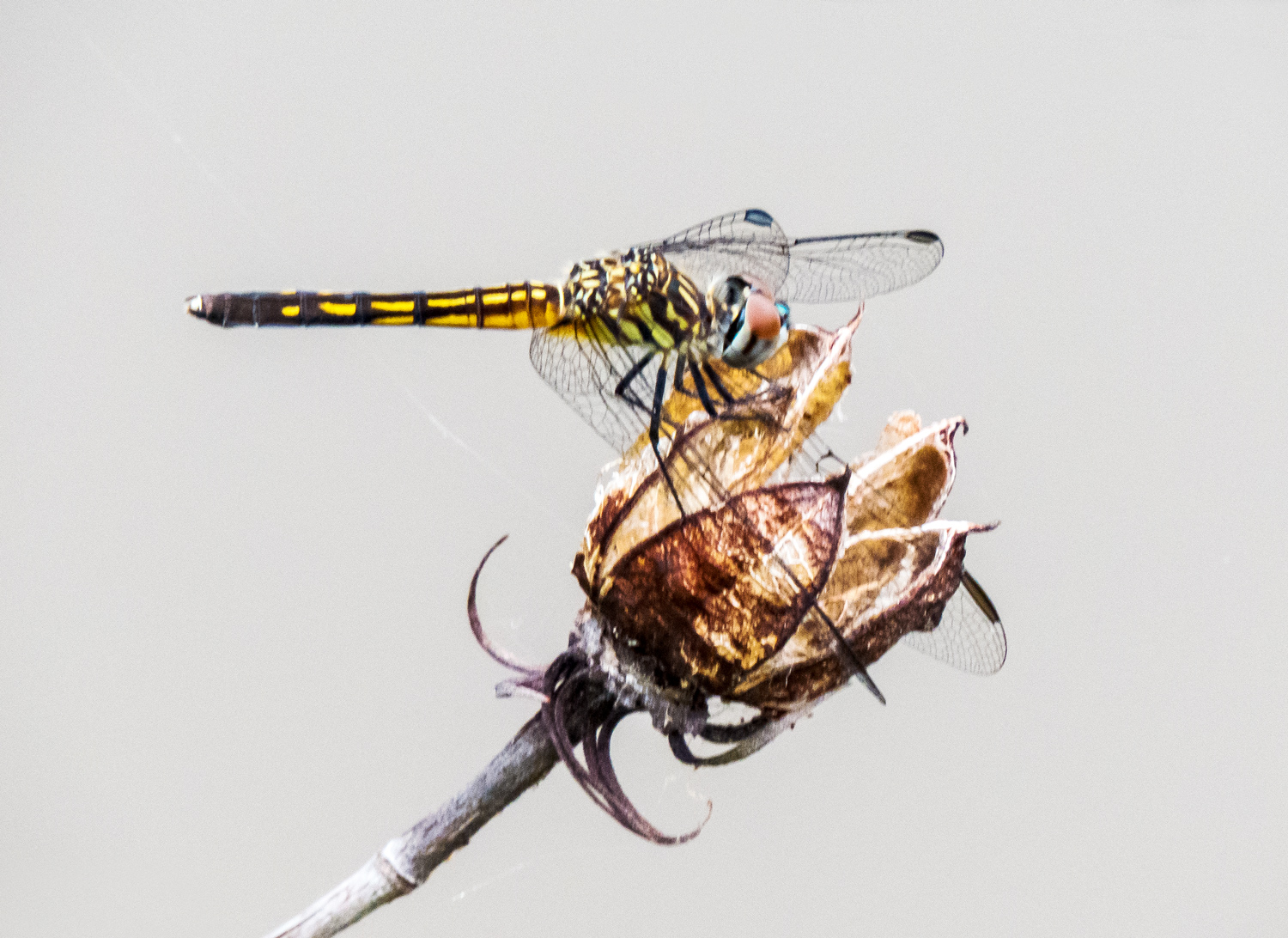
For inspiration, I used a recent photo that I took of a female Eastern Amberwing (Perithemis tenera). I have already included it in a blog posting, but am reprising it as the final photo, so you’ll know what my artistic efforts were supposed to look like.

I tried a couple of different approaches to my subject. First I tried sketching the dragonfly. I didn’t have a pencil handy, so I used a Bic ballpoint pen. My observation skills and sense of proportion are definitely lacking, but it was surprisingly fun to try. Without an eraser to correct my errors, I felt a bit like I was walking on a tightrope without a net.

Then I tried to draw with Crayola crayons? Why? I happened to be at Walmart yesterday and picked up a pack of 24 for only 50 cents at a back-to-school sale. My drawing looks a bit like a cartoon to me.

Finally I was ready to try watercolor. I decided that I would do the painting without bothering to sketch it out. Oops. I was using some inexpensive paper and it started to buckle a bit when I tried to cover the entire area with an overly wet wash of light green. I think I then attempted to put on the next layer before the first one was fully dry. I still feel like a second-grader in my watercolor skills, but it still was enjoyable trying to see what worked and what didn’t.

I did my final attempt in a sketchbook that is not intended for watercolor. I sketched out the dragonfly with a mechanical pencil and then colored the sketch with my watercolor paints. Out of all of my attempts, this is the one that I like the most. I felt a bit more confident in using the paints and in some of my strokes.

So what did I learn? Most significantly I learned that it’s worth taking a risk of feeling embarrassed; that it’s ok to try something new and achieve only a limited amount of success;, and that the amount of enjoyment that I can derive from a creative pursuit is not directly tied to any specific outcome.

dragonfly sketch

dragonfly crayon drawing

#worldwatercolormonth

#worldwatercolormonth

Eastern Amberwing

© Michael Q. Powell. All rights reserved.


Read Full Post »

I love the dark, slate-blue tones of the male Slaty Skimmer (Libellula incesta), one of the most common dragonflies in our area.  The beauty of this handsome Slaty Skimmer was further enhanced by the colorful backdrop that I managed to capture this past Friday at Occoquan Bay National Wildlife Refuge.

It is hard to come up with a composition that is more basic—beauty can often be found in simplicity.

Slaty Skimmer

© Michael Q. Powell. All rights reserved.

Read Full Post »

This past week we have had an amazing amount of rain. It has not been a single, prolonged storm, but instead has been a series of bands of heavy rain.

The rain slowed down a little yesterday morning, so I popped over to the garden of my neighbor and fellow photographer Cindy Dyer to see what was in bloom. My eye was immediately drawn to a gorgeous pinkish lily in her side garden and to some pear-shaped tomatoes on her front landing. The raindrops still glistening on both of the subjects seemed to add to their beauty and interest.

Thanks, Cindy for planting such photogenic species.

pink lily

tomatoes

© Michael Q. Powell. All rights reserved.


Read Full Post »

July is World Watercolor Month. Ever since the beginning of the year I have wanted to try watercolor painting, so this should be the perfect time. I have watched countless YouTube videos, bought all kinds of art supplies, and even purchased some books. Despite all of this, I have not been able to overcome my fears and actually put paint on paper. In my job, we sometimes talk about “the paralysis of analysis.” I have been stuck in place, unable to take my first step as I try to figure out how best to start.

I think that I am supposed to do practice exercises and learn about color mixing by swatching my paints or perhaps even take a class. I don’t really know how to sketch and probably should learn to do that first. Maybe then I would be ready.

Well, today I decided that, ready or not, I am jumping into the deep end and that I will learn about watercolor painting by actually trying it. What a novel concept!

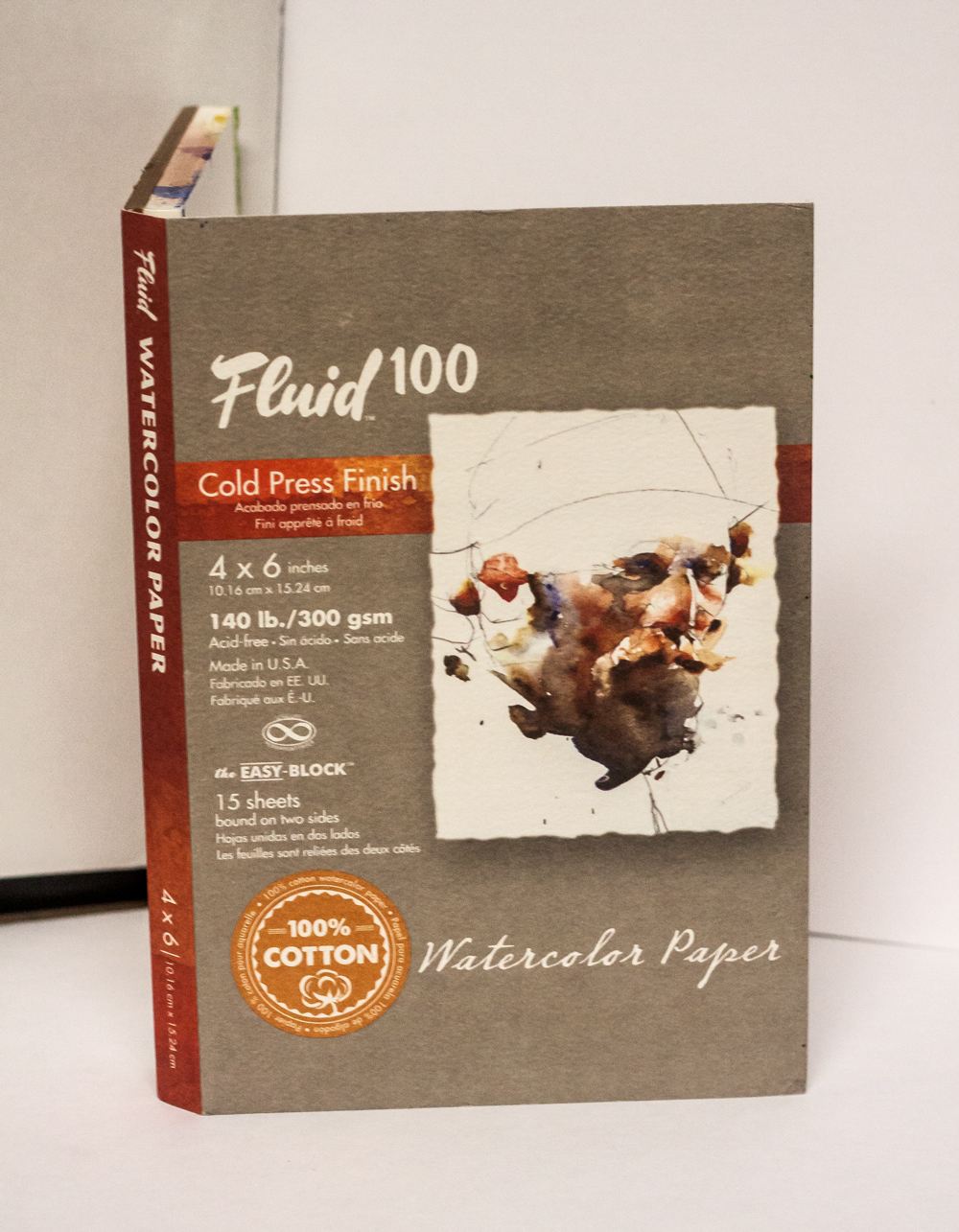
I decided to use some pretty basic supplies—a Winsor & Newton Cotman Sketcher’s Pocket Box; some Derwent water brushes; and a little block of 4 inch by 6 inch 140 lb cold press paper by Fluid 100. For the subject, I drew inspiration from a landscape photo taken by one of my friends (who is a real painter) that depicts a little house on the prairie, with grass in the foreground and mountains in the background.

The second image below was my first attempt. Things got out of control pretty quickly and I felt like I was hurrying myself. The first image below is my second attempt and is somewhat of an improvement. I felt more comfortable and a slight bit more in control of what I was doing.

I am pretty excited to play some more soon, perhaps in a more systematic way or maybe not. I think that most of all I need to work towards letting go of my inhibitions and becoming more like a child.


#worldwatercolormonth

#worldwatercolormonth

watercolor box

watercolor paper

© Michael Q. Powell. All rights reserved.

Read Full Post »
While they have been out of town, I have been watering the flowers in my neighbors’ garden and watching (and feeding) their three cats. The garden was planted by my photography mentor, Cindy Dyer, who always selects particularly photogenic species. She asked me document some of the flowers as they bloomed in case she does not return in time to see them herself.

Yesterday I was particularly struck by the beauty of the different lilies that are now blooming. Some of them probably qualify as day lilies, but there is another cool variety that has blooms that face downward. The big star of the show, though, is undoubtedly an enormous cream-colored lily that just opened and is the one that is featured in the first photo.

Many of you know that I am generally in ceaseless pursuit of animate subjects, but it is good to periodically stop and take the time to smell the lilies.

lily

lily

lily

© Michael Q. Powell. All rights reserved.


Read Full Post »

Blue Dasher dragonflies (Pachydiplax longipennis) are one of the most common and widespread dragonfly species in my area. You can get so used to their presence that you stop paying attention to them, which I think is a mistake, for in doing so you will miss their amazing beauty. The colors and patterns of this little dragonfly are stunning.

Here are a couple of shots of Blue Dashers that I captured this past weekend at Jackson Miles Abbot Wetland Refuge. This early in the season, when the dragonflies are newly emerged, the colors seem really saturated and fresh—later in the season the colors tend to become duller and more faded. I was shooting at the edge of a small pond and the water in the background turned into a neutral gray that gives the images an artistic feel, almost like they were shot in a studio environment. The uncluttered background helps to draw your attention to the dragonflies themselves and especially to those wonderful two-toned eyes. (The male’s eyes will eventually turn into a more uniform turquoise blue shade.)

In case you are curious, the Blue Dasher in the first shot looks to be a female and the one in the second image appears to be an immature male.

Blue Dasher

Blue Dasher

© Michael Q. Powell. All rights reserved.

Read Full Post »

I have spotted Common Yellowthroats (Geothlypis trichas) repeatedly this spring, but, despite my best efforts, have not been able to get a close-up shot of one. They seem to like to perch in the middle of a particular field at Occoquan Bay National Wildlife Refuge and seem to taunt me from a distance with their sweet songs.

I love the distinctive black Lone Ranger-style mask of the male Common Yellowthroat that contrasts wonderfully with sunny hues of its eponymous throat. Even though I recently couldn’t get close to this yellowthroat, I managed to capture this image that has a painterly feel to it.

I’ll still be trying for a close-up of this species, but for now I am quite content with this environmental portrait of this beautiful bird.

Common Yellowthroat

© Michael Q. Powell. All rights reserved.

Read Full Post »

On the last day of April I spotted a Blue Corporal dragonfly (Ladona deplanata) that was newly emerged and was not yet blue. This past Friday I went back to the same location at Occoquan Bay National Wildlife Refuge and found a young male Blue Corporal that had already gained his blue coloration.

Additionally, he was now perching on some vegetation rather than on the ground, which allowed me to get a more artistic shot—I really like the arc of the vegetation and how it helped make for an interesting composition.

Blue Corporal

© Michael Q. Powell. All rights reserved.


Read Full Post »

Early this morning I spotted a Great Blue Heron (Ardea herodias) in a distant part of a pond that I was exploring. I was worried about blowing out the highlights of the heron’s face and bill, so I deliberately underexposed the image. As a result the background became a bit darker than it was in real life and gave it a dramatic quality that I really like. The reflections of the heron and some of the background elements add a lot to the “artsy” feel of the photo.

Great Blue Heron

© Michael Q. Powell. All rights reserved.

Read Full Post »

One of the youngest viewers of my blog is a boy named Benjamin. His grandmother likes to share my photos with him and he especially likes bluebirds. Upon viewing some images of them and seeing their colors, he innocently asked why they aren’t called Orange Bluebirds. Why not indeed? This post is especially for him.

I too love Eastern Bluebirds (Sialia sialis) and am happy anytime I am able to catch a glimpse of their bright colors. Here are a couple of images of bluebirds that I spotted this past Monday at Occoquan Bay National Wildlife Refuge (and there is plenty of orange to be seen).

Eastern Bluebird

Eastern Bluebird

© Michael Q. Powell. All rights reserved.

Read Full Post »

We don’t often have daytime fog where I live—most of the time it burns off shortly after sunrise. Yesterday, however, it hung around all morning and visibility was very limited at Occoquan Bay National Wildlife Refuge. Except for a lot of gulls and a few geese, the birds seemed to have decided to stay sheltered until the fog dissipated.

It was a nice challenge for me to try to capture a sense of the moment in the indistinct shapes that were visible as I looked out into the water of the bay. Here are a couple of images that have a kind of abstract, impressionist feel that I really like.

foggy impressions

foggy impressions

© Michael Q. Powell. All rights reserved.


Read Full Post »

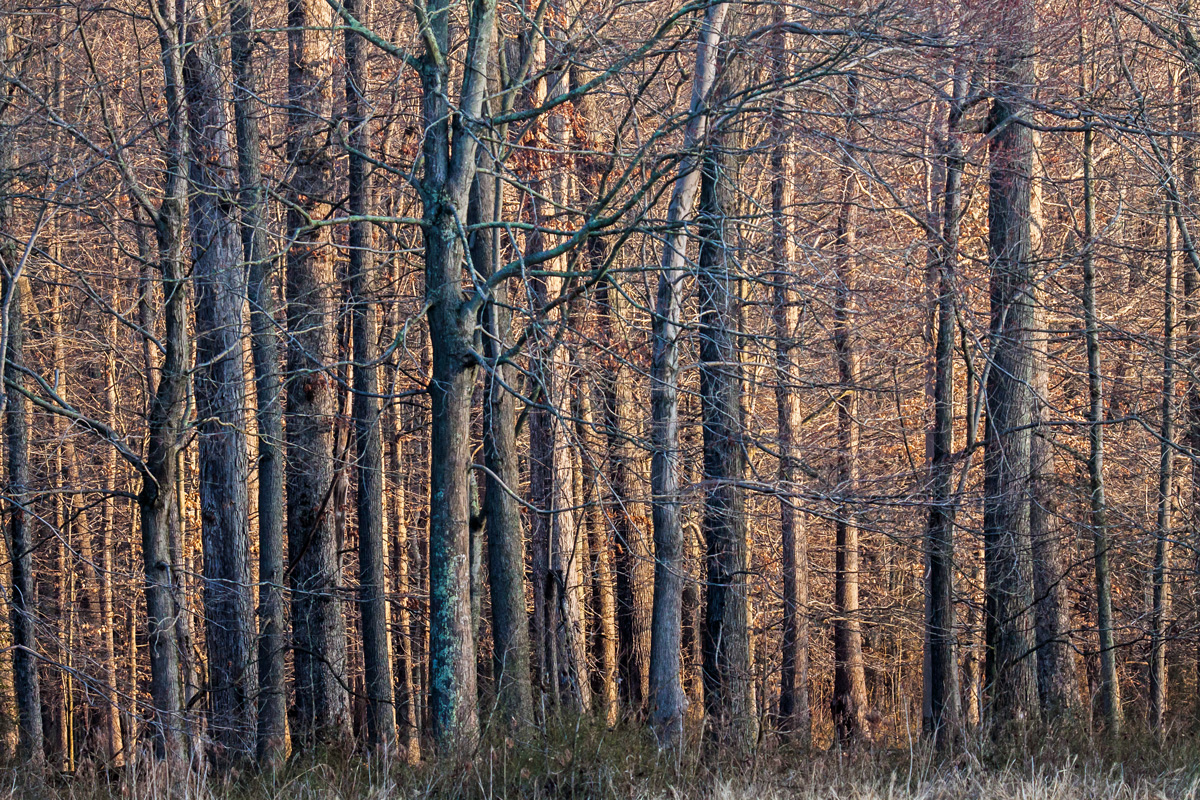
The early morning sunlight was spectacular yesterday as it streamed through the trees at Huntley Meadows Park. I tried to capture this phenomenon as a kind of mini-landscape by using my telephoto lens and framing it just as you see in this image. It is a little unusual for me not to crop an image at all, but by composing it this way, I was able to include those elements that I found the most interesting, the light and shadows of the trees, and left out the things that I found less interesting such as the sky. I did include a little strip of grass in the foreground so that the image is not completely abstract.

early morning trees

When I first arrived at the park, the sun had barely risen and there was a lot of ground fog, which made the woods look really mysterious and a little spooky. One of my viewers on Facebook said the image looked like it could be the setting for the witches in Macbeth. The second image was a lot tougher to capture, because of the lack of light and my desire to capture a sense of the fog that was clinging to the ground. There is a slight blur to the image, which would normally be a shortcoming in a photo, but I think it works ok with an image like this one.

early morning trees

© Michael Q. Powell. All rights reserved.


Read Full Post »

Yesterday I took a break from bird photography and visited Green Spring Gardens, a county-run historic garden, with a macro lens on my camera rather than my long telephoto zoom lens. It is still a bit early for most flowers, so I was happy to spot these little purple flowers that had pushed their way to the surface. I think they may be crocuses, though I really don’t know flowers very well.

I got really low to get an interesting background and almost got stepped on by a runner—maybe it’s best not to wear a camouflage jacket when lying on the ground.

purple buds

© Michael Q. Powell. All rights reserved.

Read Full Post »

Composition does not get much more simple than this—a single subject with its reflection against an uncluttered, almost monochromatic background.

The skies were heavily overcast this past Friday and rain fell intermittently on me as I walked along the trails at Occoquan Bay National Wildlife Refuge. Most of the birds seem to have taken shelter from the inclement weather. One hardy heron, however, had waded out into the shallow waters of the bay and I was thrilled to be able to capture this image of it. I see Great Blue Herons (Ardea herodias) pretty often, but will always stop to observe them. Sometimes I am patient enough to see one catch a fish, but most of the time the heron’s patience exceeds mine.

Recently I have been watching a lot of videos on pencil sketching and watercolors and it struck me that the shadowy reflection of the bird in this photo could have been rendered using one of those techniques.

Great Blue Heron

© Michael Q. Powell. All rights reserved.


Read Full Post »

The light was so beautiful early this morning at Occoquan Bay National Wildlife Refuge that it looked like this male Bufflehead duck (Bucephala albeola) was swimming in the clouds rather than in the water, giving this image an almost surreal feel that I really enjoy.

bufflehead

© Michael Q. Powell. All rights reserved.

Read Full Post »

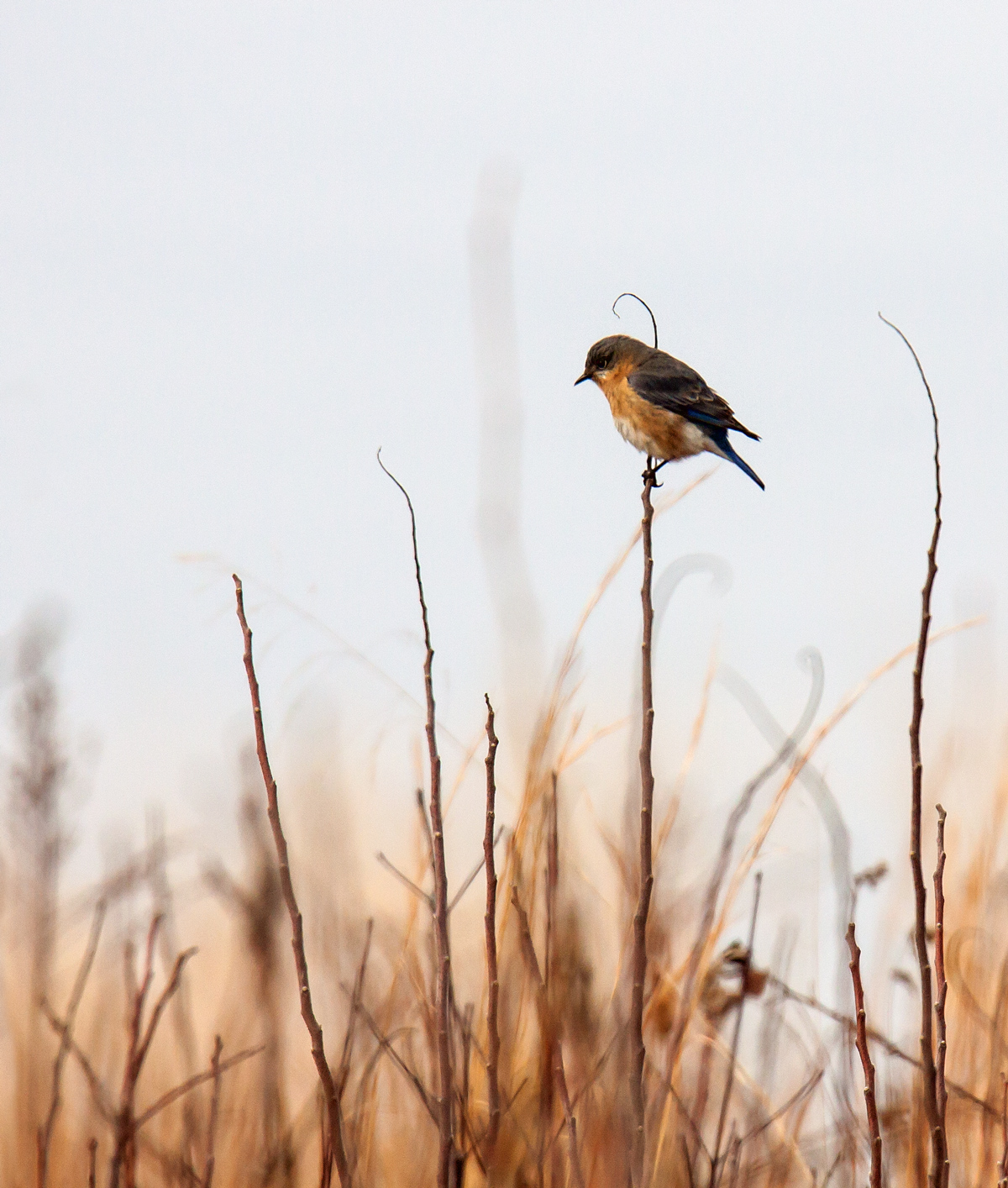
Sometimes I am content to capture a sense of the moment rather than a detailed image of my subject. That was certainly the case this past Friday at Occoquan Bay National Wildlife Refuge, when I experienced an overwhelming feeling of tranquility upon spotting this solitary Eastern Bluebird (Sialia sialis) peacefully perched in middle of a large field.

We were alone, but somehow together, as we each enjoyed the moment on our own terms.

Eastern Bluebird

© Michael Q. Powell. All rights reserved.

Read Full Post »

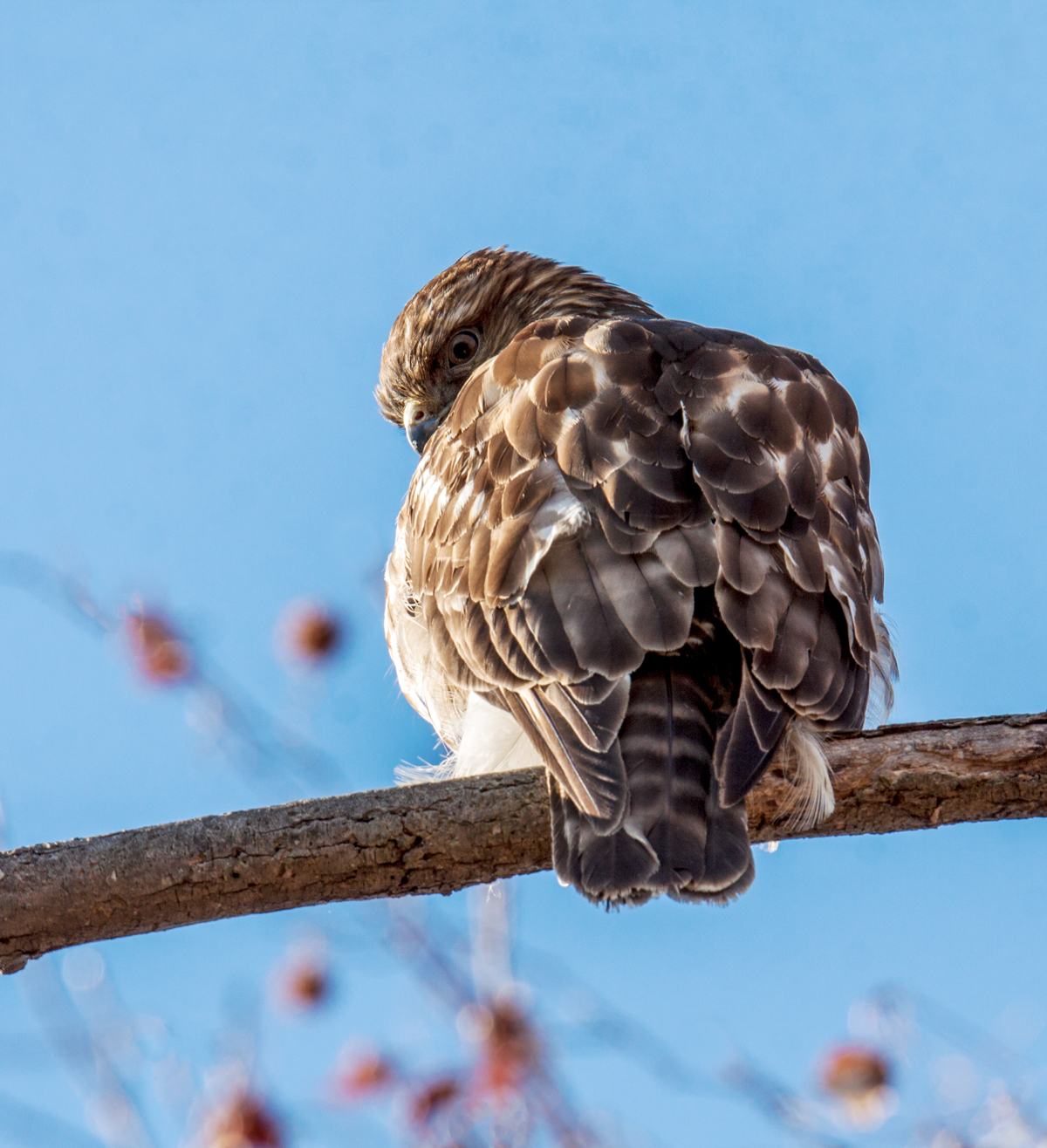
I have already featured a frontal image of this young Red-shouldered Hawk (Buteo lineatus) that I spotted last Friday at Occoquan Bay National Wildlife Refuge, but I decided I also really like this shot in which it is looking over its shoulder.  The hawk definitely was keeping an eye on me after I had passed almost directly underneath it and was walking further down the path away from it.

In a strange way the hawk seemed to be simultaneously intensely focused and quite relaxed and was quite content to remain on its perch.

Red-shouldered Hawk

© Michael Q. Powell. All rights reserved.

Read Full Post »

Reduced to its essence, photography is all about light and shadows. Sometimes details are not even necessary to evoke a mood, a sense of the moment, as in this image of a Double-crested Cormorant (Phalacrocorax auritus) that I captured this past Friday at Occoquan Bay National Wildlife Refuge.

Double-crested Cormorant

© Michael Q. Powell. All rights reserved.

Read Full Post »

One of my fellow bloggers, Jodi of The Creative Life In Between, saw a recent photo I took of a Yellow-rumped Warbler and asked if I minded if she used it for inspiration for a painting. Check out the wonderful watercolor she painted and the other cool postings on her blog.  Thanks, Jodi.

Jodi's avatarthe creative life in between

Yellow (rumped) Warbler in Winter Watercolor 11×14 140 lb cold press

A Winter Warbler Watercolor

I was looking at some beautiful photos on Mike Powell’s Photography Blog the other day of a fluffy little yellow-rumped warbler he spotted eating berries in the frigid winter weather at the Occoquan Bay National Wildlife Reserve in Virginia this month.

He was so cute, I asked Mike if I could paint one of his photos.  He kindly obliged.  My watercolor doesn’t do justice to the beauty of the bird or the magnificent shot Mike caught, but it was fun to do.  It’s been a while since I painted a bird.  And this little guy had his fluffiest coat on in the frigid temperatures we’ve been experiencing in the Northeast part of the United States lately, which made him just too irresistible for me to resist.

Thanks for giving me a shot at him Mike…

View original post 74 more words

Read Full Post »

I don’t often shoot landscape images, but I was so taken with the stark beauty of the ice-covered world that I encountered on New Year’s Day at Occoquan Bay National Wildlife Refuge that I decided that I should attempt to capture a sense of the moment. I used the wide-angle capabilities of my Canon SX50 superzoom camera in the first two images below and shot the third one with the Tamron 150-600mm lens, the lens that I use on my Canon 50D for a significant number of my the photos featured on this blog.

icescape

icescape

icescape

© Michael Q. Powell. All rights reserved.

Read Full Post »
Some birds may seek shelter when the weather is inhospitable, but sparrows seem to be active and busy all of the time, like this White-throated Sparrow (Zonotrichia albicollis) that I spotted in the snow this past Friday at Occoquan Bay National Wildlife Refuge.

It is a bit of a challenge to get a proper exposure when so much of the frame is filled with white snow. As I understand it, the camera would like to render everything to a neutral gray, so it is necessary to overexpose the image or adjust it in post-processing.  In my initial RAW image, the sparrow was very much in the shadows and the snow had a grayish-blue tinge to it. I cranked up the exposure to the point that most of the snow turned almost pure white and I was left with soft bluish shadows that I really like. I am also pretty pleased with the sparrow’s pose as it paused for a moment to survey the landscape.

White-throated Sparrow

© Michael Q. Powell. All rights reserved.

Read Full Post »

As we move inexorably deeper into autumn, more and more flowers and leaves are fading and falling. Many of the familiar dragonflies of the summer also are disappearing. I was heartened yesterday at Occoquan Bay National Wildlife Refuge to spot this Fine-lined Emerald dragonfly (Somatochlora filosa), a survivor that is tattered and torn, but is still flying in October.

I mentioned in a recent blog posting that I am experimenting with carrying two cameras with me when I go out shooting. The first photo was shot with my Canon SX50, a super-zoom camera and the second was taken with my Canon 50D DSLR. The depth of field is so shallow with the DSLR, normally shooting close to the 600mm end of my zoom lens, that it seems more ideal for shots like the second image where the subject is flatter. The SX50 gives me more depth of field and I love the way that it allowed me to capture the background as circles of color.

Fine-lined Emerald

Fine-lined Emerald

© Michael Q. Powell. All rights reserved.

Read Full Post »

The early morning light was soft and beautiful, allowing me to capture these images of a young Turkey Vulture (Cathartes aura) on Saturday at Occoquan Bay National Wildlife Refuge. I am not sure I have ever seen a vulture look so handsome (and maybe even a little cute in the second photo).

Turkey Vulture

Turkey Vulture

© Michael Q. Powell. All rights reserved.

Read Full Post »

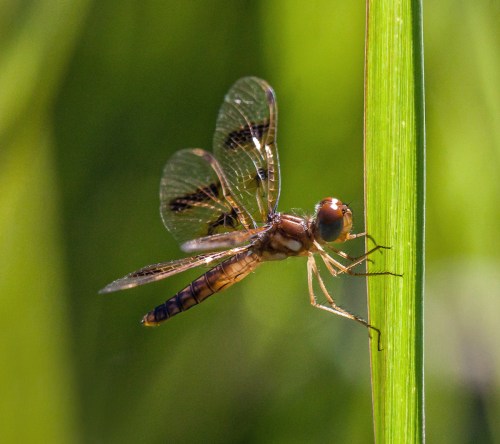
Black Saddlebags dragonflies (Tramea lacerata) spend most of their time flying, so it was a rare treat to spot this beautiful female perching recently at Occoquan Bay National Wildlife Refuge. In the second image you can see the distinctive blotches on the dragonfly’s wings that make it look like it is wearing saddlebags, but the first image is my overwhelming favorite—the unique pose, the delicate coloration of the eyes, and the “artsy” overall feel of the first shot produce an emotional reaction in me than the more clinical second shot.

Do you prefer one image more than the other?


Black Saddlebags

Black Saddlebags

© Michael Q. Powell. All rights reserved.

Read Full Post »
It seems a little late in the season for Calico Pennant dragonflies (Celithemis elisa) to be mating, but I nevertheless spotted this couple in action this past Saturday at Occoquan Bay National Wildlife Refuge in Woodbridge, Virginia. In case you are curious, the male is the red one near the top of the image that is clasping the female by its head. I like the way that the soft background and simple composition draw our eyes to the shapes, colors, and patterns of the dragonflies, rendering the subject in a beautifully abstract way.

calico pennant dragonflies

© Michael Q. Powell. All rights reserved.

Read Full Post »

Although some folks find spiders to be creepy, I look at them as wonderfully creative architects and artists and I was thrilled to capture this image of one in its web that I spotted early yesterday morning at Occoquan Bay National Wildlife Refuge. I have found that early morning is the best time to get shots of spider webs and they tend to show up best in shots that are backlit, which is to say that light is shining from the front. In this case I tried to frame the shot carefully for maximum effect and did not have to crop the image at all.

web art

© Michael Q. Powell. All rights reserved.

Read Full Post »

« Newer Posts - Older Posts »