Feeds:
Posts
Comments

Archive for August, 2020

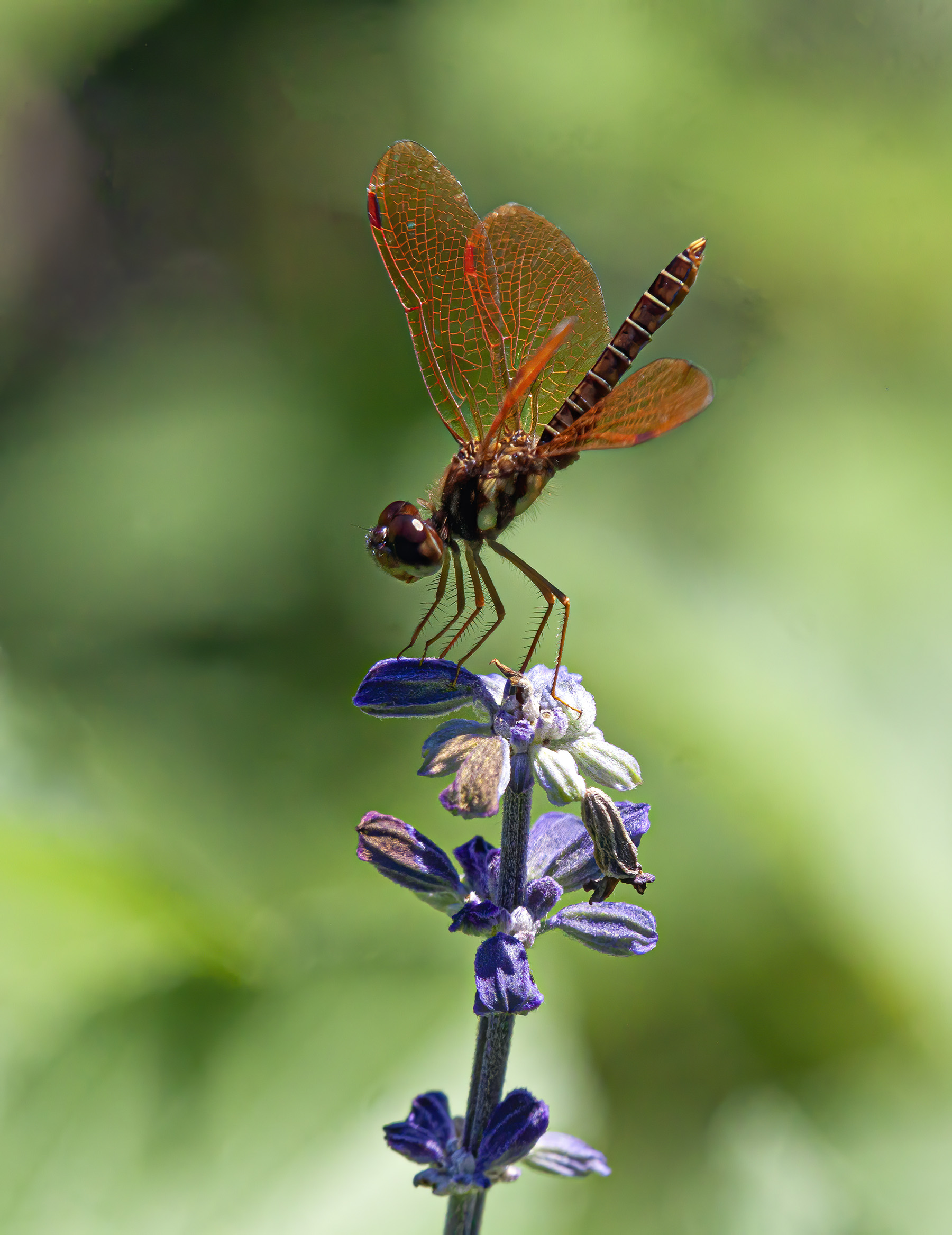
What do you do to cope on a hot sunny day? Most of us stay indoors in an air-conditioned space, possibly with a cold beverage. Dragonflies do not have those options, so many of them assume a pose, often known as the obelisk posture, in an attempt to regulate their temperature by reducing exposure to the direct sunlight.

You may seen dragonflies in a handstand-like pose, looking like gymnasts in training—that is the obelisk posture. The dragonfly lifts its abdomen until its tip points to the sun, thereby minimizing the amount of surface area exposed to solar radiation. At noontime, the vertical position of the dragonfly’s body suggest an obelisk, which in my area immediately brings to mind the Washington Monument. According to Wikipedia, scientists have tested this phenomenon in a laboratory by heating Blue Dasher dragonflies with a lamp, which caused them to raise their abdomens and has been shown to be effective in stopping or slowly the rise in their body temperature.

While visiting Green Spring Gardens last week on a hot humid day, I observed obelisking behavior in a male Blue Dasher (Pachydiplax longipennis) and a male Eastern Amberwing (Perithemis tenera). I have always been intrigued by this pose and would love to try it out to see if it works for thermoregulation in humans too. Alas, I lack both the upper-body strength and the lower body flexibility to make a go of it, so I’ll continue to be merely a spectator of these beautiful little acrobats.

Blue Dasher

Eastern Amberwing

© Michael Q. Powell. All rights reserved.


Read Full Post »

Most folks who live in the Eastern part of the United States can probably identify an Eastern Tiger Swallowtail butterfly (Papilio glaucus) when they see one. Eastern Tiger Swallowtails are large and have a distinctive pattern of bright yellow and black on their wings. However, not all Eastern Tiger Swallowtail butterflies are yellow—females come in two distinctly different variants, black and yellow.

The yellow morph looks a lot like a male, but with a conspicuous band of blue spots along the hindwings that the males do not have. The dark morph female has similar markings, but most of its body color is black, like the one below that I spotted last week at Green Spring Gardens. The perfect condition of its wings this late in the season suggests to me that this is a newly emerged butterfly.

So why do the females come in two colors? I read an interesting on-line article about this subject entitled “Why are you that color? The strange case of the dark phase tiger swallowtail.” The author speculates that the dark morph is an evolutionary attempt to mimic a similar-looking Pipevine Swallowtail butterfly that predators know is toxic, a practice known as Batesian mimicry. So, in theory the dark morph would have a better chance of survival. For unknown reasons, however, the males do not seem to be as attracted to the dark morph females, “These guys are apparently traditionalists and prefer the good ol’ yellow and black that their species is known for.” So the genes that might benefit species survival are not always passed on.

Eastern Tiger Swallowtail

© Michael Q. Powell. All rights reserved.


Read Full Post »

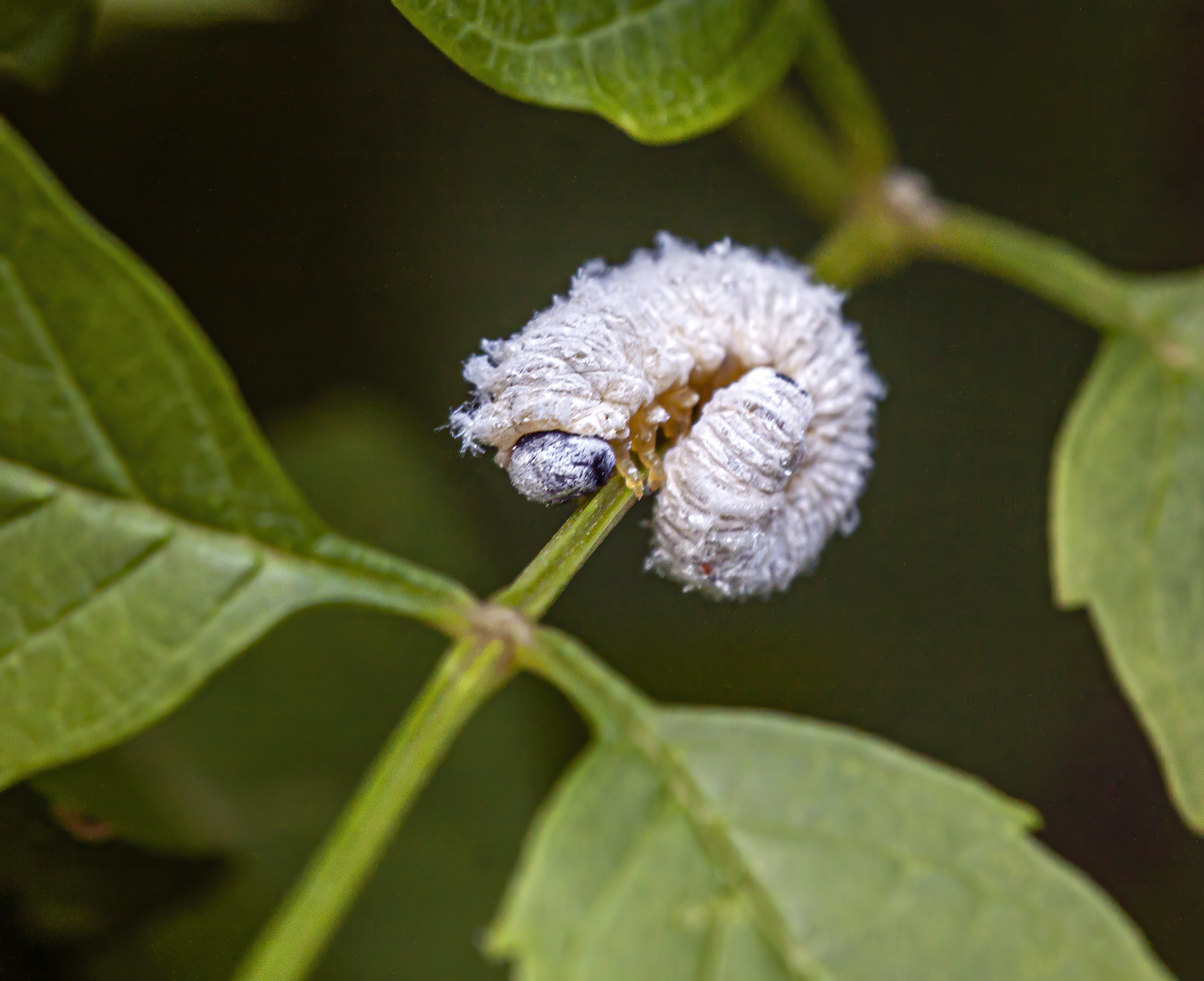
Last week when I was exploring Jackson Miles Abbott Wetland Refuge, I spotted this very strange looking caterpillar in one of the trees. It was quite small and was in motion, so getting a photo was somewhat of a challenge. As I was doing research, I was a little shocked to discover that this is actual the larval stage of a Dogwood Sawfly (Macremphytus tarsatus), a wasp-like insect. The larvae go through a number of different phases of development and this looks to middle-instar stage.

No matter how many times I return to a location, there always seems to be something new and different to see, as long as I take the time to look slowly and carefully.


Dogwood Sawfly larva

© Michael Q. Powell. All rights reserved.

Read Full Post »

This butterfly had its choice of flowers as I chased after it last week at Green Spring Gardens, but it chose instead to grab some nectar from a lowly clover plant. Still, I can’t complain—it was my first sighting of a Monarch Butterfly (Danaus plexippus) this season.

Monarch Butterfly

© Michael Q. Powell. All rights reserved.

Read Full Post »

I am catching up on some photos and thought I’d post this image that I captured in mid-July of a cool-looking fishing spider that Walter Sanford spotted while we were hunting for dragonflies at a creek in Fairfax County. I am not sure of the specific species of the spider, but I am pretty confident that it is of the genus Dolomedes. Most of the times in the past when I have spotted similar spiders, they have actually been in the water, but this one seemed to be hunting from a crevice in the rocks at the edge of the water.

I love the texture of the rocks and especially the lichen that add a lot of visual interest to this image. If you would like to see Walter’s take on our encounter with this spider, check out his post ‘Fishing spider Friday.’ Walter noted that he sees “a mean monkey face on the front half of the spider and a baboon face on the back half.” Be sure to click on the image to see the spider more closely, if you dare and let me know what you think.


fishing spider

© Michael Q. Powell. All rights reserved.


Read Full Post »

July was a crazy month no matter how you look at it. Who knows what the new month will hold for us all? When I checked the garden of my friend and neighbor Cindy Dyer a few days ago, I was thrilled to see that some of her gladiolas are now in bloom, symbolic of the new life and growth that is still possible in our own lives, even in these troubled times.

gladiolas

© Michael Q. Powell. All rights reserved.

Read Full Post »

I had forgotten how small Fragile Forktail damselflies (Ischnura posita) are until I spotted one perched in some vegetation last week while I was exploring at Jackson Miles Abbott Wetland Refuge. Even by damselfly standards, Fragile Forktails are tiny at only .8 to 1.1 inches (21-29 mm) in length. The good news is that they are relatively easy to identify, because they have pale interrupted shoulder stripes that look like exclamation points.

I love how the green of the damselfly’s thorax and in its eyes match the soft green palette of the rest of the image. For me, there is something really soothing about this simple portrait of a tiny damselfly.

Fragile Forktail

© Michael Q. Powell. All rights reserved.

Read Full Post »

I have now successfully completed the World Watercolor Month challenge of doing some kind of watercolor painting each day of July. I have had a tremendous amount of fun and improved my skills and confidence. Thank you all for your support and encouragement for my painting efforts throughout this month.

If you want to see the first four installments of my painting efforts this month, check out my previous postings ‘More fun with watercolor‘, ‘World Watercolor Month 2020—part 2 ,’ ‘World Watercolor Month 2020—part 3,’ and Word Watercolor Month—part 4. This final installment highlights my painting efforts over the past nine days in reverse chronological order.

Day 31 and the prompt was “do-over,” so I had another go at painting a scene that I painted last November while in Paris of a lady with a red umbrella crossing a pedestrian bridge over the Seine that I had photographed. Here is a link to the postingPlaying with watercolor in Paris‘ that shows the November version of the painting, and a link to the post ‘A few more umbrellas in Paris‘ that shows the photo on which the paintings were based.

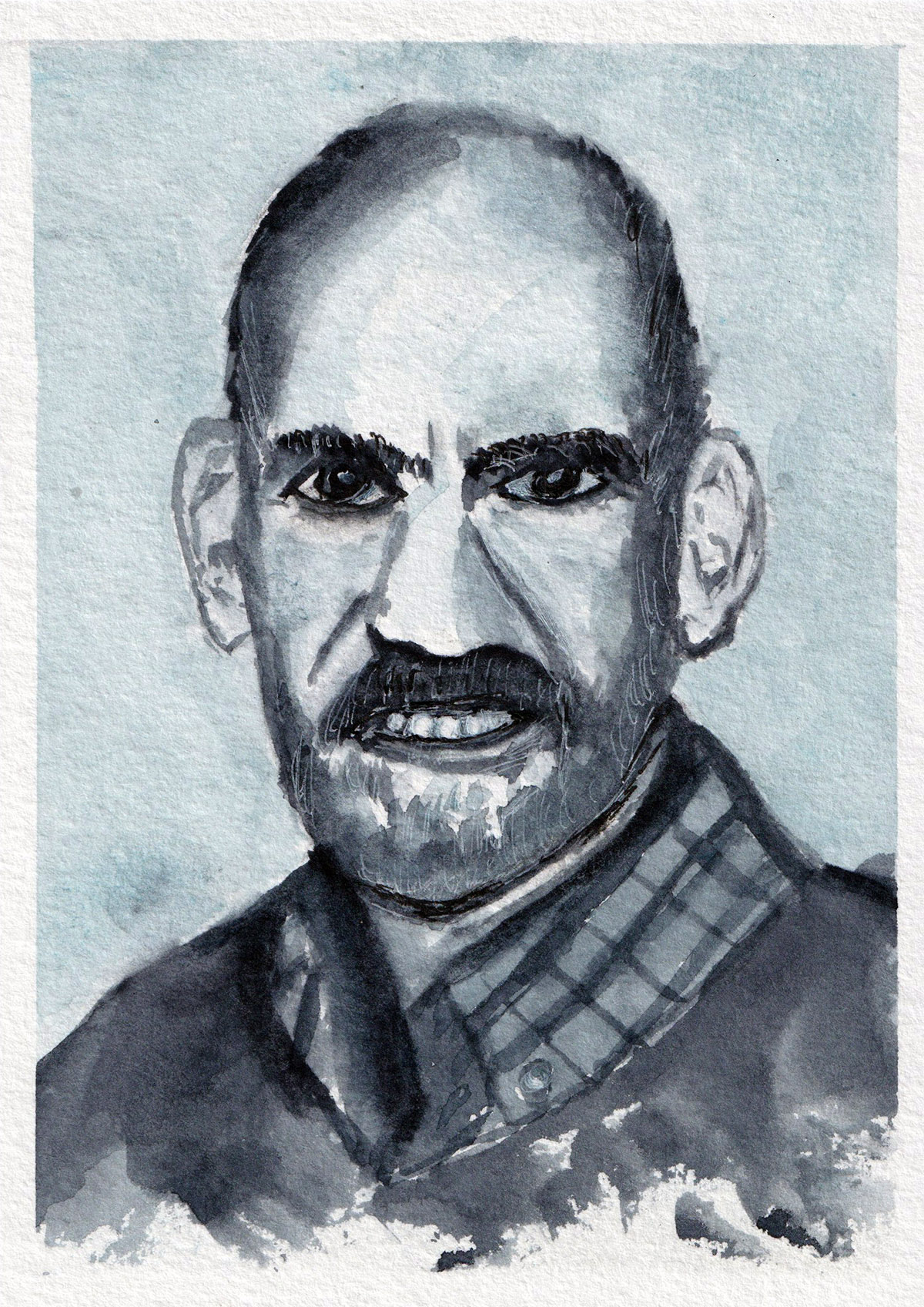
Day 30 and the prompt was “pose.” I decided to be my own model and painted a version of the photo that has been my profile image for a while. Thanks to my friend, Cindy Dyer, for taking such a good photo of me.

Day 29 and the prompt was “yesterday.” Immediately thinking of the Beatle song by that name, I was flooded with memories of growing up in the 1960’s, so I did a colorful little painting reminiscent of a tie-dyed t-shirt as a kind of homage to that period in my life.

Day 28 and the prompt was “complementary.” Purple and yellow are complementary colors, so I decided to paint a field of imaginary wildflowers in those colors. I made no attempt at realism or nuance in the painting—I just wanted to play with the paint.

Day 27 and the prompt was “shine,” so I painted a little landscape with the moon shining down on a grove of shadowy trees.

Day 26 and the prompt was “favorite song.”  I remembered that one of my parents’ favorite hymns was “His Eye is on the Sparrow,” so I painted a little sparrow. The final line of the wonderful hymn is, “His eye is on the sparrow and I know He watches me.”

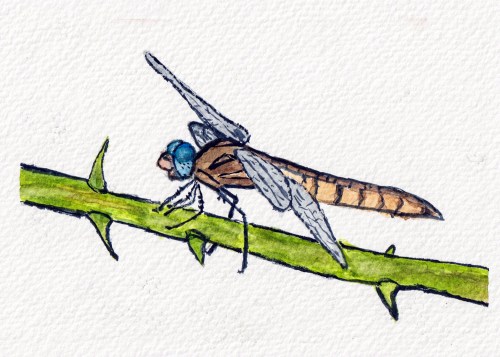
Day 25 and the prompt was “sharp.”  I decided to paint a version of a photo I had previously taken of a dragonfly that had chosen a precarious perch on a thorny vine.

Day 24 and the prompt was “abundance,” so I did a tiny painting (3×3 in/76 x 76 mm) of a field full of bright red poppies following a YouTube tutorial by Ellen Crimi-Trent (https://www.youtube.com/watch?v=IUDC7Aojxm4&t=83s). It’s fun to paint something so small, where details are only suggested.

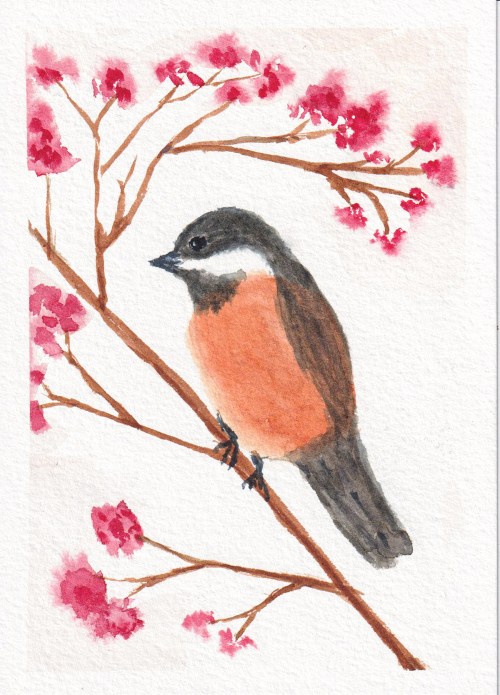
Day 23 and the prompt was “alone,” so I painted a solitary bird perched amidst some blossoms. It kind of looks like a cross between a chickadee and an American Robin. I later learned that the bird looks to be a Varied Tit, a bird found in the Far East. I had loosely followed a YouTube tutorial that did not identify the bird  (https://www.youtube.com/watch?v=BtlLzgfnQxw&t=1222s).

I plan to continue with my watercolor painting, having seen that frequent practice really helps, but it will probably be a while before I post any paintings here on the blog. Thanks again for your support and indulgence as I have veered off my normal creative path.

We should be back to my regularly scheduled nature photography, though you have probably noticed that the photography continued without any discernible pause in July.

Paris Umbrella

self portrait

tie dye

wildflowers

shine

sparrow

dragonfly

poppy field

Variable Tit

© Michael Q. Powell. All rights reserved.


Read Full Post »

« Newer Posts