Feeds:
Posts
Comments

Archive for October, 2012

As the weather has cooled off, there have been fewer and fewer dragonflies buzzing around in the marsh area. Occasionally I see a Common Whitetail dragonfly, but that has been pretty much it. This past weekend, however, I encountered some new, colorful dragonflies that I am pretty sure are Autumn Meadowhawk dragonflies (Sympetrum vicinum).

It was relatively early in the morning when some fellow photographers pointed out an orange-colored dragonfly perched on some leaves. According to their information, the dragonfly was unlikely to move until the temperature rose to about 70 degrees. I wasn’t so sure about their calculations and so I hastened to take some shots with my 55-250mm zoom lens. Here is an overall shot to give you an idea what an Autumn Meadhawk looks like (the sun was a bright and I couldn’t shield it so there are some unfortunate hot spots).

Autumn Meadowhawk dragonfly

Once I had a record shot, I became a bit bolder and decided to try my 100mm macro lens. The major problem I had was that the dragonfly was about a foot below me and about two feet away from me (I was on a raised boardwalk), so holding the lens steady was a problem. I did get a couple of close-up shots, like this one. I am always amazed when you can see the little hairs on a dragonfly’s “face.”

Close-up shot of Autumn Meadowhawk dragonfly

There were still some harsh shadows and hotspots, so I decided to use my collapsible diffuser to soften the light. Unfortunately, the dragonfly must have thought I was a predator, because it flew away as soon as I cast a shadow on it with the diffuser. Later that day, however, I encountered the Autumn Meadowhawks several times, but they refused to perch on plants, preferring to land on the boardwalk. Feeling a little frustrated, I took some shots of them on the boardwalk and ended up with the following image that I like, even if it’s not exactly a “natural” environment.

Autumn Meadowhawk dragonfly on the boardwalk

I am not sure how long these dragonflies will hang around, but it is nice seeing some new species as the seasons change, an unexpected bonus for me this past weekend.

© Michael Q. Powell. All rights reserved.

.

Read Full Post »

It’s the middle of October and grasshoppers are still hopping, though it seems that there are fewer of them than a month ago. This grasshopper was willing to stay still long enough to pose for this informal portrait. The sunlight was coming from the side and the back, helping to illuminate the underside of the grasshopper that is usually in the shadows and there is a nice glow to the grasshopper. I like the effect.

Illuminated fall grasshopper

© Michael Q. Powell. All rights reserved.

Read Full Post »

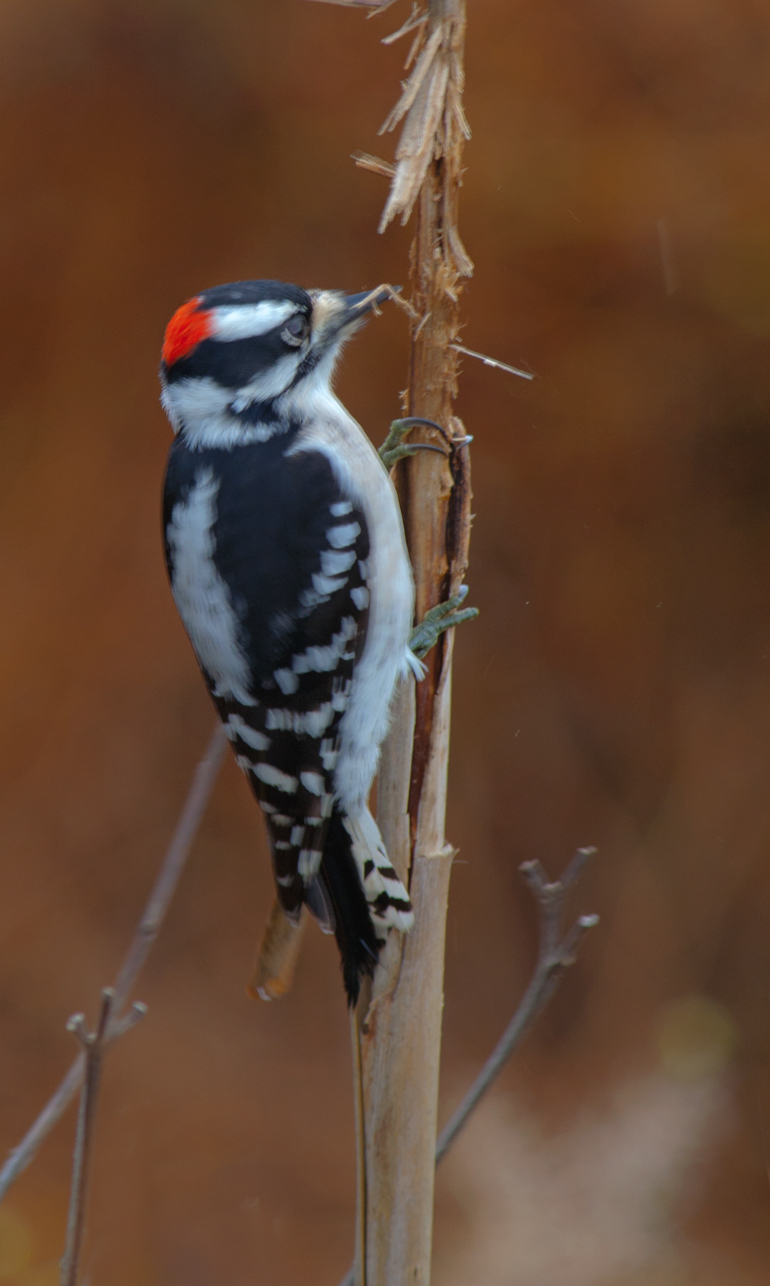
This weekend I learned some new things about woodpeckers. I always thought that woodpeckers were found exclusively in the trees. Isn’t it logical that woodpeckers need wood to peck? (It reminds me of the response attributed to Willie Sutton on why he robbed banks—”Because that’s where the money is.”) Well, I saw a woodpecker pecking at the stalks of cattails and other similar vegetation that clearly were not made of solid wood.

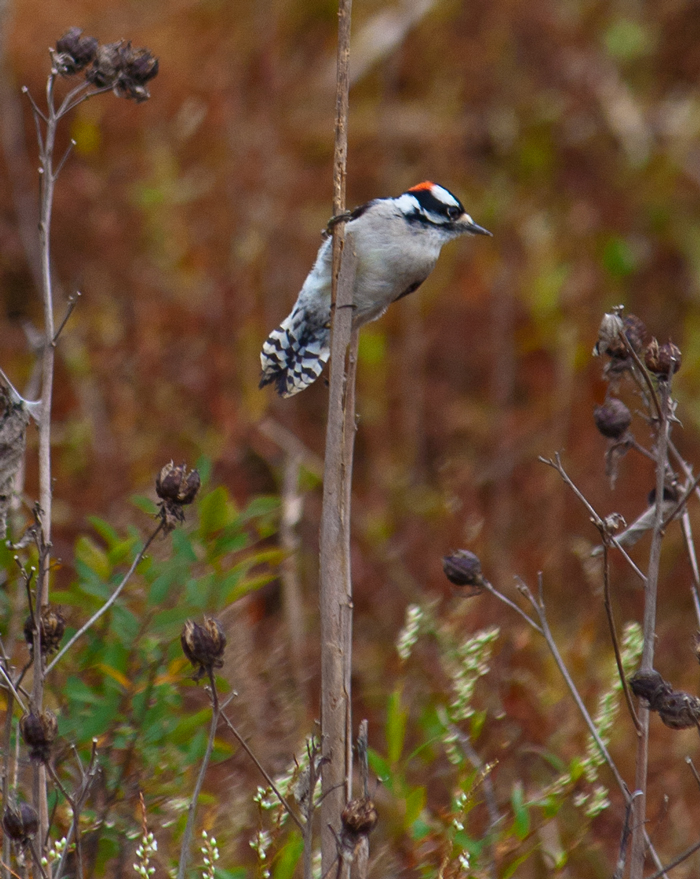
Secondly I learned that the woodpecker that had a big red spot on the back of his head was not a Red-Headed Woodpecker. Fortunately, it was not too hard to determine that the little woodpecker that I saw and photographed was a male Downy Woodpecker (Picoides pubescens). He was very active climbing up and down the stalks of a whole series of plants in the middle of a marsh and was a lot of fun to watch.

Here are a couple of photos of that beautiful bird. I am not sure that I did full justice to the blazing red color on his head that initially attracted my attention or to the wonderful black and white pattern of his feathers. I hope that I have another chance soon to see more woodpeckers and learn even more new things about them.

Male Downy Woodpecker in the field

Downy Woodpecker looks to the side

© Michael Q. Powell. All rights reserved.

Read Full Post »

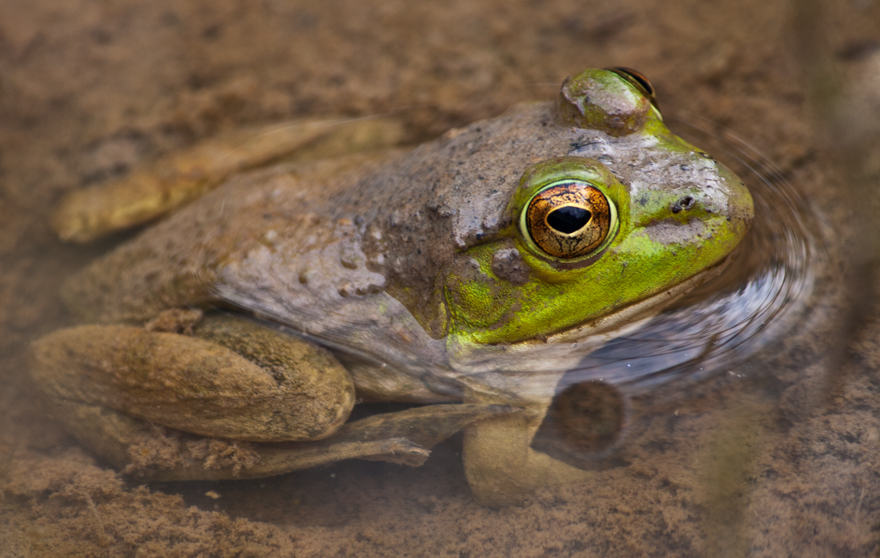
I have a confession to make—I really like to photograph little green frogs. Maybe it’s the influence of Kermit the Frog on my perceptions, but, whatever the reason, there seems to be something whimsical about frogs. Like this little frog that I photographed yesterday, they appear to have a perpetual half-smile, as though they find this world to be unceasingly amusing.

It brings to mind one of my favorite movies scenes, the opening sequence of The Muppet Movie, in which the camera gradually zooms in on Kermit, sitting on a log in the swamp and playing the banjo. The words of the song he is singing express the kind of eternal optimism to which I aspire, “Someday we’ll find it, the Rainbow Connection, the lovers, the dreamers and me.” (Here’s a link to the video of that scene on YouTube—I highly recommend that you take a couple of moments to relax with it, especially if you’ve never seen it before.) With all of the cares of everyday life, it’s hard to be a dreamer, it’s tough to see hope in rainbows, it’s not easy to see whimsey in frogs. It’s my hope, though, that we all can maintain (or rediscover) that child-like optimism about our world.

Fall frog

© Michael Q. Powell. All rights reserved.

Read Full Post »

It was just after 5:00 in the afternoon and storm clouds were gathering for rain showers that eventually came. I headed back to my car and just as I reached the parking lot I looked up. Beautiful late-afternoon light was shining on the tops of the trees with dark clouds in the background and I snapped a few shots. I decided to fight my temptation to tweak the image (for fear of messing up what I had) and didn’t crop at all.I did just a little sharpening and a slight increase in saturation. I don’t know if the image adequately (and accurately) captured the wonderful light, but it gives you an idea of what the scene looked like to me.

Stormy light

© Michael Q. Powell. All rights reserved.

Read Full Post »

Have you ever woken up on a fall morning and noticed the dewy grass and bushes littered with spider webs? I don’t mean the beautiful geometric-patterned webs of the orb-weaving spiders, but webs that appear to be nothing more than loosely woven sheets of spider silk. Normally I don’t give them a second glance, but one morning this weekend I stopped and looked at one of them more closely.

Close-up of web in the grass

I discovered a beautiful little world, filled with tiny beads of water, captured by the threads of the web. I think the spider is a grass spider of the genus Agelenopsis. Wikipedia notes that the webs of grass spiders are not sticky, but the spiders makes up for that by being able to run really quickly.

Here is a view of an entire web through a telephoto lens. I was on a walkway several feet above ground-level when I took the shots, so I was not able to get actual close-up shots. The photo is not a very good one, but it gives you an idea of how nondescript the web looked at first glance.

Web in the grass

© Michael Q. Powell. All rights reserved.

Read Full Post »

Early morning sunlight illuminates the cattails (and the webs in between them) in the marsh at Huntley Meadows Park in Alexandria, VA. Low hanging mist/fog that morning added a special beauty and mystery to the quietness of that fall morning.

(click on photo to see a higher resolution view)

© Michael Q. Powell. All rights reserved.

Read Full Post »

I arrived early at the marsh on a cool fall morning. The dew was heavy on the vegetation and the warmth of the rising sun was creating a fog-like list that hung over the field of cattails. Looking toward the west, I could see trees in the distance that were starting to show their glorious fall foliage and there was a soft illumination from the sun (as shown in the first photo). Looking in another direction, I could see darker shadows of the tress and a heavier mist (as shown in the second photo). You can see some golden light in the upper branches of the tree.

I am not sure that I was able to capture completely the inner peace I felt as I watched interplay of the light and the water on the cattails in the foreground and on the trees in the background. For a few moments, nothing else seemed to matter as I was caught up in the beauty of nature.

Morning mist and fall foliage

Morning mist and shadows

© Michael Q. Powell. All rights reserved.

Read Full Post »

The large yellow-and-black spiders (Argiope aurantia) that I have observed throughout the summer seem to have disappeared. I was hoping to see the egg sacs that they produce in the fall, but I guess I’ll have to wait until next year.

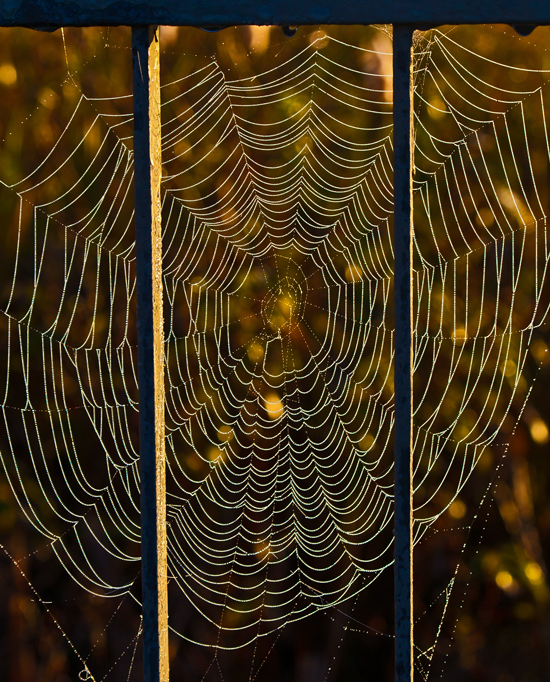
However, there must be spiders still around, because early yesterday morning there were quite a few dew-covered spider webs. Last month I did a couple of postings about webs at the same location at Huntley Meadows Park (see Amazing Spider Webs and More Spider Art), but I am so fascinated by the individuality of the webs that I thought I’d post one from yesterday (and I think there might be a few more shots coming). I do not know how the spiders figure out the designs of the webs, but it seems that there is creativity involved in fitting a web into a specific spot, even if there is a “standard” pattern for different varieties of spiders.

This web was located behind the railing of a little bridge that crosses part of the marsh land and joins two sections of a boardwalk. I was shooting into the sun that was still very low in the sky. The sunlight reflecting on one side of the railing suggests that I was not facing directly east. but was angled a little. Behind the web is a field of cattails, though you can’t really see any details.

Spider webs are like snowflakes for me (and it won’t be too long before we see them again). At first they all may seem to be the same, but when you take the time to look more closely at them, you realize each is unique. People are like that too.

Early morning spider web

© Michael Q. Powell. All rights reserved.

Read Full Post »

There was a lot of bird activity early yesterday morning as I walked through the cattail-filled marshy area of Huntley Meadows Park in Alexandria, Virginia. Many of the birds were in groups, it seemed, including large flocks of noisy black birds that several  of my fellow bloggers have helped me identify as grackles.

Most of the birds seemed to be be passing through and perched high in trees or landed too far away for me to capture them individually with my modest telephoto zoom. (Another photographer I saw had a massive 600mm telephoto lens with a 1.4x teleconverter attached and seemed to have greater success.)

However, I was able to take this photo of bird on a cattail stalk and amazingly I can identify it—it’s a male Red-winged Blackbird (Agelaius phoeniceus).  I realize that the Red-winged Blackbird is probably one of the easiest birds to identify (along with the robin, bluejay, and cardinal), but I have had so many problems recently identifying the birds in my photos that it is satisfying to be able get one right.

There were flocks of birders present too, equipped with telescopes and binoculars, and some of them were almost as loud as the grackles. I heard lots of interesting debates, like whether a large bird soaring in the distance was a red-shouldered hawk or a redtail hawk (and I had no idea previously that there was a bird called a Coopers hawk). Most of the bird people were so intense that I didn’t dare to attempt to engage them in conversation.  One gentlemen, however, talked with me at length, periodically referring to a tattered guide that he had with him (it was a Peterson’s guide to birds east of the Rockies and he recommended it for a beginner like me). I think that I may have to break down and buy a little guide like that to start to learn more about birds.

For now, I’m happy that I can identify a Red-winged Blackbird most of the time, especially a male one!

Red-winged Blackbird on a cattail

© Michael Q. Powell. All rights reserved.

Read Full Post »

As I was walking through the marsh land early this morning, a flock of very loud black birds flew overhead. I was surprised at how many there were and how noisy they were. I think they may be some kind of blackbird and that they are in the process of migrating. I managed to snap a few photos of some of the birds as they were flying. It is fun to look at all of the different body positions of the individual birds when I took the shots.

I especially like this first photo. It looks to me like the bird who is lagging behind is calling out to the other birds, requesting that they slow the pace a bit so that he does not fall behind. The birds look almost cartoonish and the photo just makes me smile.

“Please slow down.”

The second photo shows an even greater number of different positions. You may want to click on the photo for a higher resolution view so that you can appreciate the uniqueness of the individual birds.

Unsynchronized flying

© Michael Q. Powell. All rights reserved.

Read Full Post »

A little over a week ago I posted a photo of a brown pelican at the National Zoo in Washington, D.C. that was full of vivid colors in the pelican and in the reflections of light on the water. Today, I want to show the same pelican in a different way. I changed the angle of the camera and captured a background that was more somber and simple.  In post-processing I desaturated the colors a bit to place the emphasis on the textures of the feathers, the branch on which the pelican is perched, and the rock in the right hand corner. I toyed with the idea of going completely to black and white, but decided I liked the hint of a color in the beak and part of the pelican’s head, as well as on the branches. The overall look is more somber and perhaps a bit more formal.

I haven’t made my mind up yet whether I like this presentation of the brown pelican more than the previous one, but it certainly was fun experimenting with various settings in Photoshop Elements with the intent of making the colors less bright (usually I am moving in the opposite direction).

Somber brown pelican at the National Zoo

© Michael Q. Powell. All rights reserved.

Read Full Post »

Reflections often look much better than the original objects that are being reflected. The water (and the objects in the water, like the rocks in this photo) can distort the “reality” and add a different tonality and texture to the reflection. As I was walking along the edge of the water, I was happy to finally find a patch of foliage with the fall colors of my childhood, but the beauty was marred by the utility poles and traffic signs of my suburban area. The reflection seems to have cleansed the image of those blemishes and shows a purer, more beautiful view, a view closer to what my heart was seeing.

Fall reflection

© Michael Q. Powell. All rights reserved.

Read Full Post »

When it comes to photographing birds, it doesn’t take much to make me happy. If I can get a clear shot of a bird with a relatively uncluttered background, that constitutes a good photograph for me.  By that low standard, this image that I took a week ago is a successful one. My bird identification skills are still so weak that I won’t even hazard a guess at what kind of bird it is, but I like this modest image of this little bird.

Little bird feeding in the wild

© Michael Q. Powell. All rights reserved.

Read Full Post »

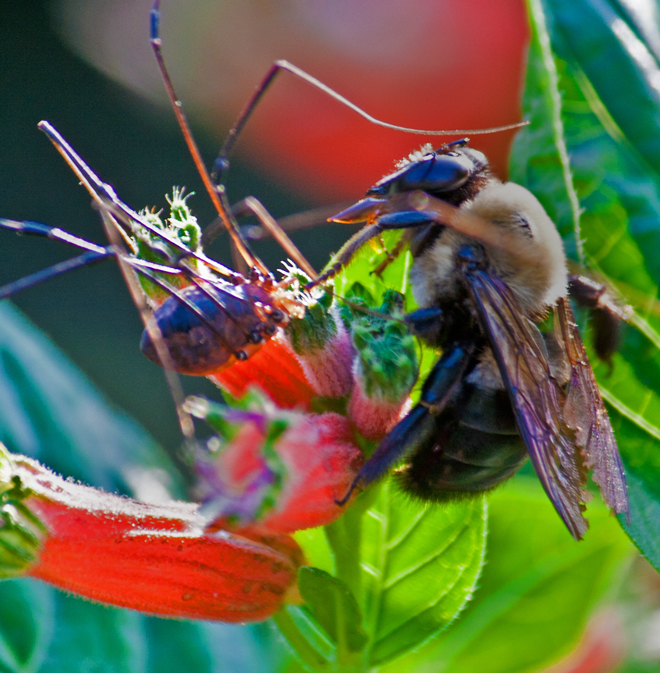
I am always fascinated whenever I happen to capture two different insects in a single image, especially when they appear to be interacting. A bee flew onto a flowering plant and appears to be having a conversation with a daddy longlegs (aka harvestman) that was already there. Does one of them look at the other as a potential prey? Are they sharing information? Is one asking the other out on a date?

Can you hear me now?

Insect interaction

© Michael Q. Powell. All rights reserved.

Read Full Post »

It was early in the morning and I was walking almost directly east along a stream. The sun had already risen and was in my eyes, but I spotted a Great Blue Heron in the water. I was able to get a shot that I knew would turn out as a silhouette, but the heron was standing in such a way that I was pretty confident that his silhouette would be immediately recognizable. The glare caused the color to wash out almost entirely and there are all kinds of artifacts from the light, but I like the overall effect.

Great Blue Heron Silhouette

© Michael Q. Powell. All rights reserved.

Read Full Post »

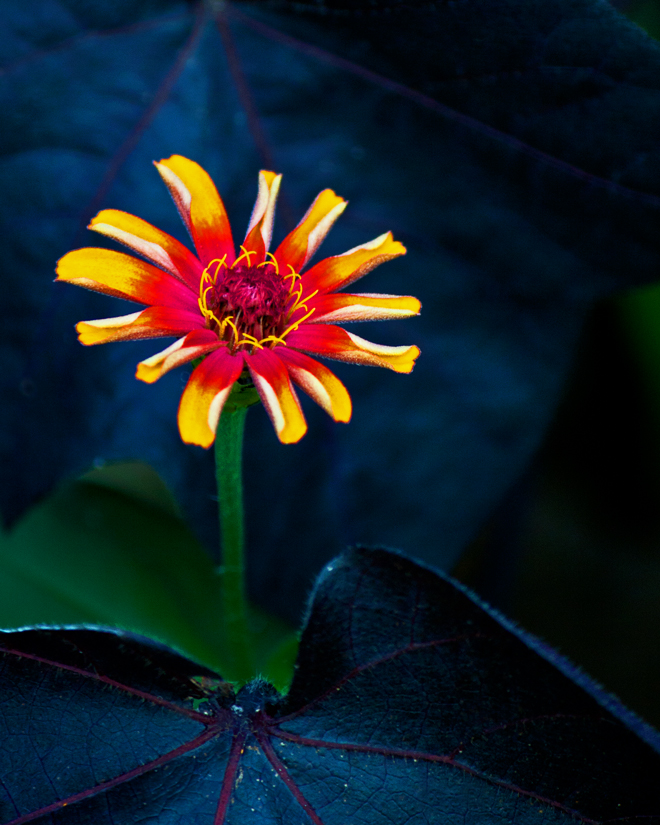
Some words are just fun to say out loud. How can you not smile when you repeat the words “Zowie Zinnia?”

I think that is the correct name for this colorful little flower, which helps to brighten up the gloomy weather that has descended on us the last few days. Zowies usually have much more showy displays, but I like the way that the colors and shape of this young plant are set off against the backdrop of the dark green leaves.

“Zowie!”—it sounds like something Robin would say to Batman (and of course it would need to be punctuated with an exclamation point).

Zowie Zinnia

© Michael Q. Powell. All rights reserved.

Read Full Post »

This is another shot of the Great Blue Heron (Ardea herodias) who was so cooperative today in permitting me to get close to him. In this shot, his eyes are fixed intently on the water, which unfortunately was covered with some combination of algae and duckweed. There was virtually no way for him to spot any potential prey below the surface of the water. His body seems coiled, ready to strike at a moment’s notice. He remained in this position for quite some time, but eventually he relaxed and gave up the hunt. Later, he moved to the other small pond and was equally unsuccessful there.

Focused blue heron (click for a higher resolution view)

© Michael Q. Powell. All rights reserved.

Read Full Post »

I was lucky today. Normally when I have tried to photograph Great Blue Herons (Ardea herodias), I have had to do so at the maximum range of my telephoto zoom lens and even then would have to crop the image significantly. The result has been that my photos have not been as sharp or detailed as I would have liked.

Today was different. I was walking around the little ponds at Green Spring Gardens, a county-run historical park where I had previously taken photos of a green heron, when I startled a Great Blue Heron who had been perched in a tree. He flew off high into a tree across the pond and remained there as I followed him and tried to take some photos. I have not yet looked at those photos, but suspect that they are a little distorted, given that I was shooting almost straight up.

It started to drizzle a bit. When all of the other visitors left, the heron flew down from the tree and landed no more than 30 feet from me. He wandered along the water’s edge, periodically entering the water and staring intently at its surface, probably searching for something to eat. I cautiously approached him and he let me get with fifteen feet or so of him and I even circled around him trying to get a decent angle and background for a shot. How close was I? At times I could not use the full range of my 55-250mm lens if I wanted to capture his whole body.

Here is one of my initial favorite shots. I shot it with the lens extended to 194mm with settings of f9.0, 1/200 sec, ISO 400, and an exposure compensation of -.67. Other than a little sharpening and a little cropping, this is the way the image came out of the camera.

Indeed, I was lucky today to encounter an unusually cooperative Great Blue Heron.

Cooperative Great Blue Heron

© Michael Q. Powell. All rights reserved.

Read Full Post »

I became engrossed watching some little shorebirds (or wading birds) this past weekend as I was attempting to photograph herons and egrets at Cameron Run, a stream tributary of the Potomac River. These small birds (there was a little group of them) would zigzag through the shallow water and periodically bob down to peck at some tasty morsel of food. They seemed to be aware of my presence and would move away whenever I tried to approach them, although they would not fly completely away.

I was unable to get any clear close-up photos of these unidentified birds, but I did manage to produce this image that I really like. There is a kind of graphic quality to the photo and the light and the reflections are nice, even though it is obviously no technical masterpiece.

Wading bird at Cameron Run

© Michael Q. Powell. All rights reserved.

Read Full Post »

Some of my friends of Facebook think that I make up the name of some of the insects whose pictures I post. After all, can there really be an insect called the Handsome Meadow Katydid? Normally, the official names are so strange that there is no need to invent new ones.

Today, however, I decided to  make up a name for a caterpillar that my friend Cindy Dyer helped me identify earlier in the summer, when I did a posting entitled Patterned Caterpillar. The caterpillar’s real name is a Cattail caterpillar (Simyra insularis) and I photographed it this weekend at Huntley Meadows Park in Alexandria, VA.

This caterpillar’s black-and-white patterns are such a perfect match for those ubiquitous markings found on all products that I want to rename it as the Barcode caterpillar.  What would register if you scanned this caterpillar at the checkout counter at a store?

Cattail caterpillar (Simyra insularis)

© Michael Q. Powell. All rights reserved.

Read Full Post »

The day was winding down as I retraced my steps back to entrance of Green Spring Gardens, when I caught a glimpse of a Spotted Cucumber beetle (Diabrotica undecimpunctata). My initial instinct was to switch from my 55-250mm telephoto zoom lens  to my 100mm macro lens so that I could fill the frame with this colorful little insect on a single flower.

I was tired and a little impatient, so I decided to photograph the beetle with the “wrong” lens. In retrospect, I am happy that I made that decision, because I ended up with an image that I really like. Yes, the beetle is still there, but the shape and positions of individual buds of the flower are what make this image stand out for me.

What did I learn? I realize that I need to consciously question my initial instincts and consider shooting a usual subject in an unusual way. I can’t always rely on fatigue to be the causative factor for a good result.

Spotted Cucumber beetle on red flower

© Michael Q. Powell. All rights reserved.

Read Full Post »

Over the past month I have complained repeatedly about the lack of bright color in the fall foliage here in the Washington, D.C. area. The muted color changes just do not match up to my childhood memories of spectacular displays of red, orange, and yellow leaves in the trees of New England. As a result, I have not felt inspired to take up my camera and capture the changing season.

My attitude changed, though, when I read an article by Sparky Stensaas in The Photonaturalist entitled 10 Reasons NOT to Take Fall Leaf Photos. I encourage you to read the article (by following the link above) if you keep coming up with excuses, as I did, why you cannot photograph the leaves of the fall. The author summarized the article in this concluding paragraph:

“There you have it…A bunch of reasons NOT to shoot this fall’s gorgeous leaves…And a bunch of solutions to these common excuses. Now let’s get out there and shoot like crazy before all the leaves are gone!”

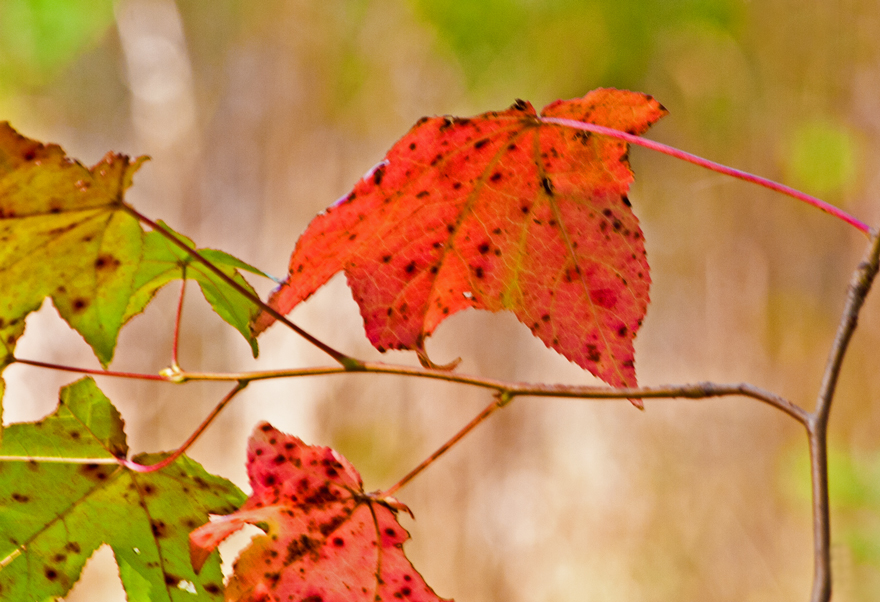
Feeling a bit more motivated, I set out yesterday determined to take some shots, among other things, of the autumn leaves. I tried a number of different approaches and am still sorting through my photos, but thought I’d post this one that caught my attention.

Fall leaves before they fall

I was walking through a path in the woods when I came into a small area where the sunlight was shining directly in my eyes, providing some backlighting for these leaves that were almost at eye-level. The leaves themselves are far from being perfect specimens, speckled as they are with brown spots. For the moment, the leaves remain attached to the tree, but inevitably they will drop to the ground to join the ranks of the fallen.  The colors, shapes, and textures of these leaves, however, serve as visual reminders for me of the beauty of the changing seasons, a beauty that may proclaim itself in bold swaths of spectacular color or speak with a quieter, more intimate voice.

© Michael Q. Powell. All rights reserved.

Read Full Post »

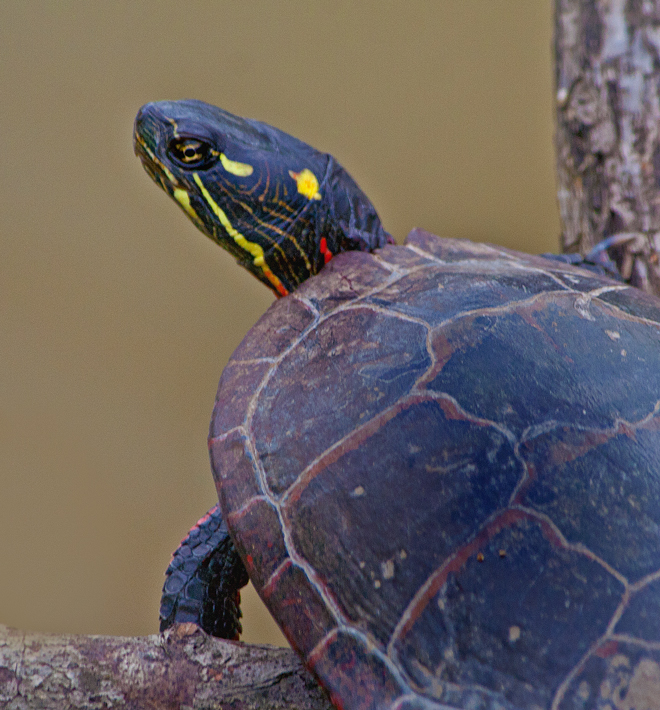
What do turtles think about? When I came upon this red-eared slider turtle (Trachemys scripta elegans), that was my first thought. Perched at an angle on a branch, the turtle seemed to be lost in contemplation. His eyes looked out over the expanse of brown, muddy march water, but he seemed inwardly focused.

Maybe this is a form of turtle yoga.

Pensive turtle

© Michael Q. Powell. All rights reserved.

Read Full Post »

Great Blue Herons (Ardea herodias) look graceful when they are flying or when they are wading, but they sure look awkward and gawky when on dry land. This heron seemed to be taking a break in the shade on a sunny, fall day. I took this photograph yesterday at Cameron Run, a tributary stream of the Potomac River, where I often see both egrets and heron. I do not know if they will remain here through the winter, but I hope that they do.

Great Blue Heron in the underbrush

© Michael Q. Powell. All rights reserved.

Read Full Post »

We continue to fade to brown, with only muted color changes as the leaves begin to fall from the tree. As if to compensate for the lack of spectacular foliage, brightly colored flowers are still blooming. I managed to get some shots of equally colorful insects interacting with yellow flowers. When I see Monarch butterflies (Danaus plexxipus), they are usually in the midst of blooming flowers, but I was surprised to also see a shiny red ladybug near the center of a yellow flower.

Monarch butterfly on yellow flower

Ladybug on yellow flower

© Michael Q. Powell. All rights reserved.

Read Full Post »

As many of you know, periodically I try to take photographs of the Great Egrets (Ardea alba) that are often present in the waters or the trees of Cameron Run, a tributary stream of the Potomac River. Usually I am frustrated, because the bright white bodies of the egrets caused my images to be overexposed and the highlights are almost always blown out.

Today, the light was a little more forgiving and I was able to capture an image of an egret with the light coming from the side. There is a dramatic glow surrounding part of its body and a nice reflection in the water. It is certainly not a perfect photo, but I like the way that it turned out.

Egret with dramatic lighting

© Michael Q. Powell. All rights reserved.

Read Full Post »

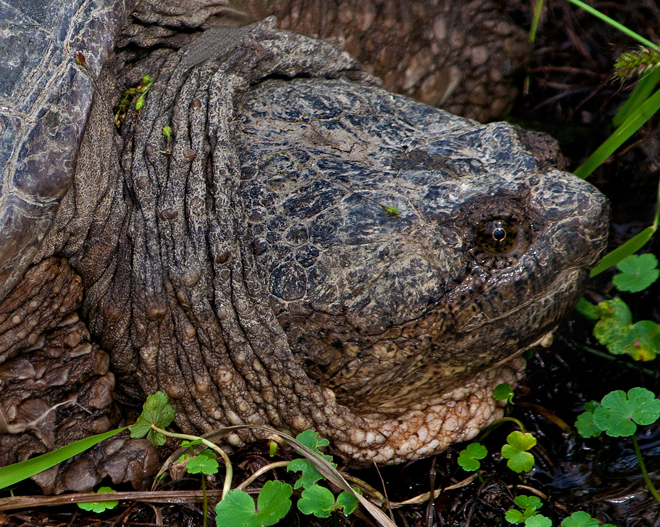
This summer has been a dry one and the recent fall rains have not done much to replenish the water in the local marshes. Recently I came across this snapping turtle in a sunny area relatively far from the water. The turtle looked like he was starting to dry out a little and I feared that he might be trouble. Fortunately, when I came back a little later, he had disappeared, presumably to another location with water, or at least shade.

I love the amazing texture of the neck area and even the head of the snapping turtle. I considered doing this photo in black and white to emphasize that texture, but would have lost the beautiful gold circles in his eyes and the green of the plants that make a semi-circle around his face.

When I gaze into the eyes of this snapping turtle, I am reminded of Yoda, the wizened sage of Star Wars, who had seen a lot during his nine hundred years. The turtle also seems to have the bemused, yet sad expression on his face that Yoda displayed when he was trying to train the young, impatient Luke Skywalker and said these words:

“Ready are you? What know you of ready? For eight hundred years have I trained Jedi. My own counsel will I keep on who is to be trained. A Jedi must have the deepest commitment, the most serious mind. This one a long time have I watched. All his life has he looked away… to the future, to the horizon. Never his mind on where he was. Hmm? What he was doing. Hmph. Adventure. Heh. Excitement. Heh. A Jedi craves not these things. You are reckless.”  (quote from imbd.com)

Snapping turtle on dry land

© Michael Q. Powell. All rights reserved.

Read Full Post »

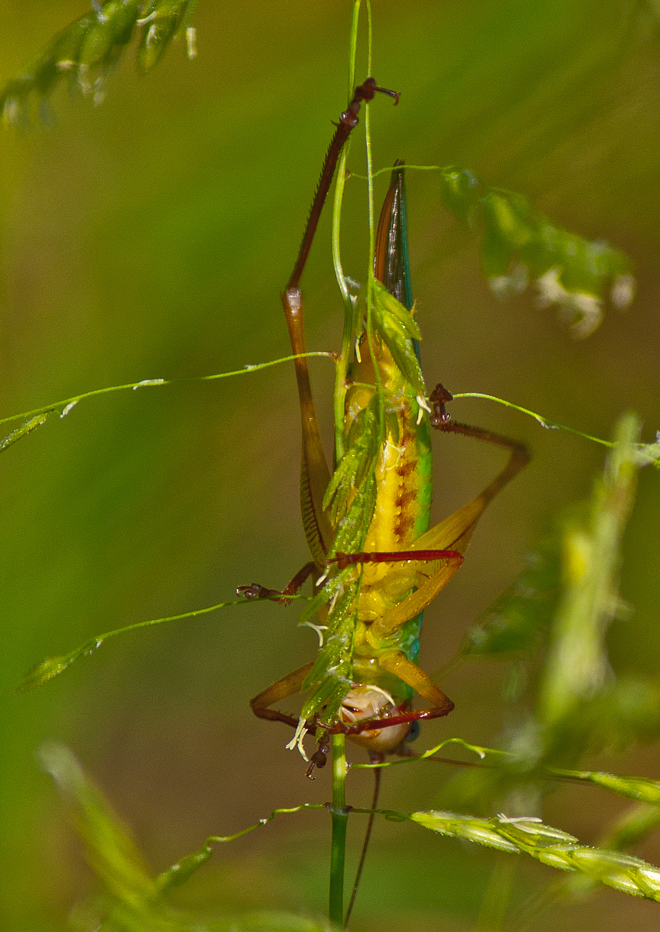
Several years ago I saw one of the Cirque du Soleil productions, an event full of dazzling costumes and amazing acrobatic feats. Memories of that unforgettable experience were triggered when I first viewed this photo of another Handsome Meadow Katydid (Orchelimum pulchellum) at Huntley Meadows Park. I have previously posted a number of different images of this very photogenic insect, but this one shows my beautiful friend in action, rather than in a static pose.

Acrobatic Handsome Meadow Katydid

I recall how the acrobats of the Cirque du Soleil were suspended high in mid-air, holding on (often with what seemed to be a single toe) to a trapeze or to a slender rope. My little katydid is not risking his life in that way, but I do find it amazing how he is clinging to the single stalk of grass. His brilliant colors continue to amaze me and the red blotches on his face accentuate the circus-like effect, as you can see in this close-up view of his face.

Close-up view of a Handsome Meadow Katydid

I will be a little sad when I stop seeing my colorful little friends at Huntley Meadows Park, but the memories will remain. Perhaps  in the future, some brightly colored object or acrobatic pose will trigger memories of these katydids, nature’s own Cirque du Soleil.

© Michael Q. Powell. All rights reserved.

Read Full Post »

As I was reaching down one recent morning to pick up my newspaper from the small concrete stoop of my townhouse, I happened to look up and saw a beautiful spider web reflected in the early morning sun. In the center of the web was a small, fuzzy brown spider with what appeared to be short legs.

The spider was positioned in such a way that I could use my macro lens to get some close-up shots, but he was too high in the air for me to use a tripod or to brace my arms for optimal steadiness.  I also did not have a choice of too many angles, because the spider was suspended over a large bush that impeded my access. I took a lot of photos, many of which came out really out of focus.

Here are my favorite shots, two of which show the underside of the spider and two show a side view. I really like the markings and texture of this little spider, though I am not at all sure what kind he is. The unidentified spider is living proof, however, that the most interesting things are sometimes literally just outside our front door—all we have to do is open our eyes as we open the door.

© Michael Q. Powell. All rights reserved.

Read Full Post »

I was observing three cheetahs at the National Zoo for quite some time when one of them decided to enter the dug out area of their habitat where two cheetahs were already lying down. Just before he entered it, he turned in my direction and stuck out his tongue. I have no idea what he might have been trying to communicate to me. Perhaps he was no longer interested in my antics and was trying to tell me so or maybe it was his way of saying goodnight. Whatever his intention, it makes for an interesting photo.

Cheetah sticking out his tongue

© Michael Q. Powell. All rights reserved.

Read Full Post »

« Newer Posts - Older Posts »