Feeds:
Posts
Comments

Posts Tagged ‘Woodbridge VA’

Many of you are aware that I have been keeping track of a Bald Eagle (Haliaeetus leucocephalus) nest at Occoquan Bay National Wildlife Refuge. When the eagle couple occupied the nest earlier this spring, the authorities set up barriers to keep the eagles from being disturbed, because the tree with the nest is close to the intersection of several trails.

I have checked the nest several times in the past month and there has always been an eagle sitting in the middle of the nest. As I looked through my telephoto zoom lens this past Friday from one of the barriers, I could see that an adult eagle was sitting at one side of the nest, leading me to believe there might be babies. I waited and eventually was rewarded with a view of one eaglet.

Last year there were two eaglets born at this nest. Perhaps there is a second eaglet this year too, but at a minimum I am thrilled to know that there is at least one new eaglet birth to celebrate.

Bald Eagle

© Michael Q. Powell. All rights reserved.

Read Full Post »

Last Friday I spotted this Common Loon (Gavia immer) in the waters off of Occoquan Bay National Willdife Refuge.  I don’t think that I have ever actually seen a loon before, but this bird pretty much matches the image of a Common Loon in breeding plumage in my bird identification guide. The range maps indicate that Northern Virginia, where I live, is in a migratory area for this species. I am guessing that this loon stopped for a while on his journey northward.

Common Loon

© Michael Q. Powell. All rights reserved.

Read Full Post »

Most of the warblers that I am fortunate enough to see are partially hidden by branches. Although hope is usually not an effective technique for taking photos, essentially that is what I do when I spot a hidden warbler—I start shooting and hope that the little bird will reveal itself enough for me to capture a clear shot of at least its head.

That was the case on Friday when I shot numerous photos in an attempt to capture an image of this Prothonotary Warbler (Protonotaria citrea) at Occoquan Bay Naational Wildlife Refuge. Unlike many warblers that are found bushes and in trees in more open area, Prothonotary Warblers are creatures of the swamp. I initially spotted one of these beautiful birds in a marshy area and was thrilled when one of them eventually made its way into some vegetation overlooking the water.

According to the Cornell Lab of Ornithology, the Prothonotary Warbler got its name from the bright yellow robes worn by papal clerks, known as prothonotaries, in the Roman Catholic church. This background information is fascinating, though I must confess that it is hard to find an opportunity to inject the word “prothonotary” into an everyday conversation unless I am talking about this bright yellow bird.

Prothonotary Warbler

© Michael Q. Powell. All rights reserved.

Read Full Post »

Yesterday at Occoquan Bay National Wildlife Refuge I was excited to spot a colorful little bird that was new to me. A search through my bird identification guide and some help from my Faceboook friends helped me to determine that it is a Prairie Warbler (Setophaga discolor).

I am hoping to be able to spot some more warblers this spring while their plumage is particularly colorful. I observed a few warblers last fall and noted that their coloration was a lot more subdued than it is now.

Prairie Warbler

Prairie Warbler

Prairie Warbler

© Michael Q. Powell. All rights reserved.

Read Full Post »

What is your first thought when you see these three turtles together? Are they just friends or more than friends? The turtles seem to be pretty comfortable sharing a confined space and there is plenty of space in our minds for varied interpretations on the nature of their relationship. According to the old saying, “two’s a couple and three’s a crowd”—is that always true?

Whatever the case, the turtles at Occoquan Bay National Wildlife Refuge have been definitely been enjoying our recent sunny days. My turtle identification skills are not very good, but I think these all may be Eastern Painted Turtles (Chrysemys picta picta), though there is a chance that they might be Red-eared Sliders (Trachemys scripta elegans).

I love images like this one that allow viewers to use their creativity to interpret what they see and to generate in their minds their own mini-narrative of what is going on. Ménage à trois or just friends—you make the call.

red-eared sliders

© Michael Q. Powell. All rights reserved.

Read Full Post »

When it comes to choosing a nesting site, Ospreys (Pandion haliaetus) at Occoquan Bay National Wildlife Refuge seem to be opportunistic. Some lucky couples are able to snag pre-existing nesting sites that require only minor improvements, while others are forced to build entirely new nests.

This past Thursday I photographed a nest that is annually built on top of one of the duck hunting blinds in the waters off of the wildlife refuge. Earlier in the season, the ospreys would fly away as I walked by on a trail, but now that the trees are leafing out, the ospreys have a bit more privacy.

The nest in the second image is a new nest, built in the last couple of weeks and probably still under construction. It is adjacent to the location where the nest in the third shot used to be. For reasons that are not clear to me, that nesting platform has disappeared and only a part of the post remains. I believe that the new nest may have been built by  the couple that occupied that nesting platform earlier in the season.

Osprey

Osprey

Osprey

© Michael Q. Powell. All rights reserved.

Read Full Post »

I was a little surprised and quite happy this past weekend to spot a Pileated Woodpecker (Dryocopus pileatus) poking about on the ground at Occoquan Regional Park. Most of the time I have to settle for high-angle shots when I am lucky enough to spot one of these giant woodpeckers. I have been told that these woodpeckers regularly probe fallen trees, but this was a first for me.

After I inadvertently spooked the woodpecker, it flew to a nearby tree. The light was coming from the side and the front when I took the second shot and it made the woodpecker red crest look like it was on fire. Somehow it seemed appropriate, given that most redheads I have known have tended to be quite fiery.

Pileated Woodpecker

Pileated Woodpecker

© Michael Q. Powell. All rights reserved.

Read Full Post »

I’ve noticed that recently I have been really sensitive to lighting and moods and not just to specific subjects. It’s problematic for me, because it is so difficult to figure out how to capture a feeling.

That is part of what was going through my head when I took this photo early in the morning this past Wednesday at Occoquan Bay National Wildlife Refuge. The sun had already risen, but it was still low in the sky. I loved the way that shafts of light were visible coming through the trees. It was a cold morning and mist was hanging over the still water of a small pond. Could I possiblycapture the details that took my breath away?

So what do you think, or more importantly, what do you feel?

sunrise

© Michael Q. Powell. All rights reserved.

Read Full Post »

Ospreys (Pandion haliaetus) in my area have been building nests in all kinds of places, including on some channel markers in the Potomac River off of Occoquan Bay National Wildlife Refuge. I personally don’t really think that there is enough space there for a nest, but the ospreys seem to think otherwise.

I am amused by the “No wake” sign that they have chosen. During busy periods, I would think that “No sleep” would be more appropriate.

Have a wonderful weekend. 🙂

osprey

© Michael Q. Powell. All rights reserved.


Read Full Post »

There is no doubt that I love photographing majestic raptors, like the bald eagles that I regularly feature. Yet there is something equally special about capturing images of tiny songbirds, like this perky little Blue-gray Gnatcatcher (Polioptila caerulea) that I spotted earlier this week at Occoquan Bay National Wildlife Refuge.

How small are these birds? According to the Cornell Lab of Ornithology, Blue-gray Gnatcatchers are 3.9-4.3 inches in length (10-11 cm) and weigh 0.2-0.3 ounces (5-9 grams), just slightly larger than a hummingbird. The same source notes that, despite the bird’s name, gnats do not form a significant part of a Blue-gray Gnatcatcher’s diet.

Who comes up with these names?


Blue-gray Gnatcatcher

© Michael Q. Powell. All rights reserved.

Read Full Post »

A Bald Eagle (Haliaeetus leucocephalus) paused for a moment to check on its catch as it flew away on Monday at Occoquan Bay National Wildlife Refuge. Occasionally I will see an eagle flying with a fish in its talons, but it is quite rare for me to see an eagle actually catch the fish.

In this case, I was fortunate enough to spot an eagle circling low over the water and I captured a few images just after the eagle snagged the fish. In the second shot, which chronologically speaking was the first shot, you can just make out the fish. In the third shot, the eagle appears to be adjusting itself to the additional weight and is starting to increase its speed and altitude.

These are the kind of action shots that I love to capture. I never know when such situations will arise, so I always try to remain ready to react.

Bald Eagle

Bald Eagle

Bald Eagle

© Michael Q. Powell. All rights reserved.


Read Full Post »

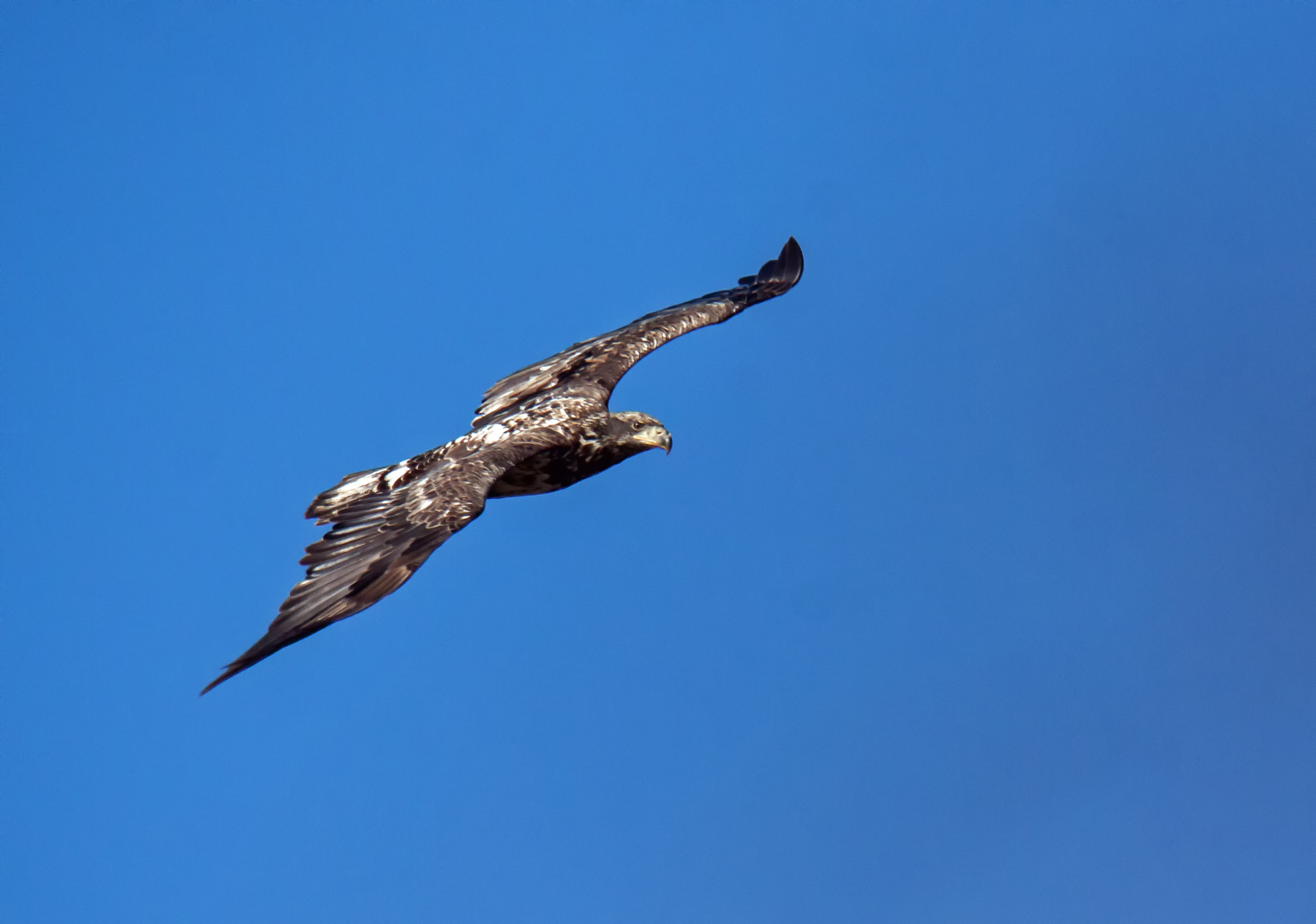
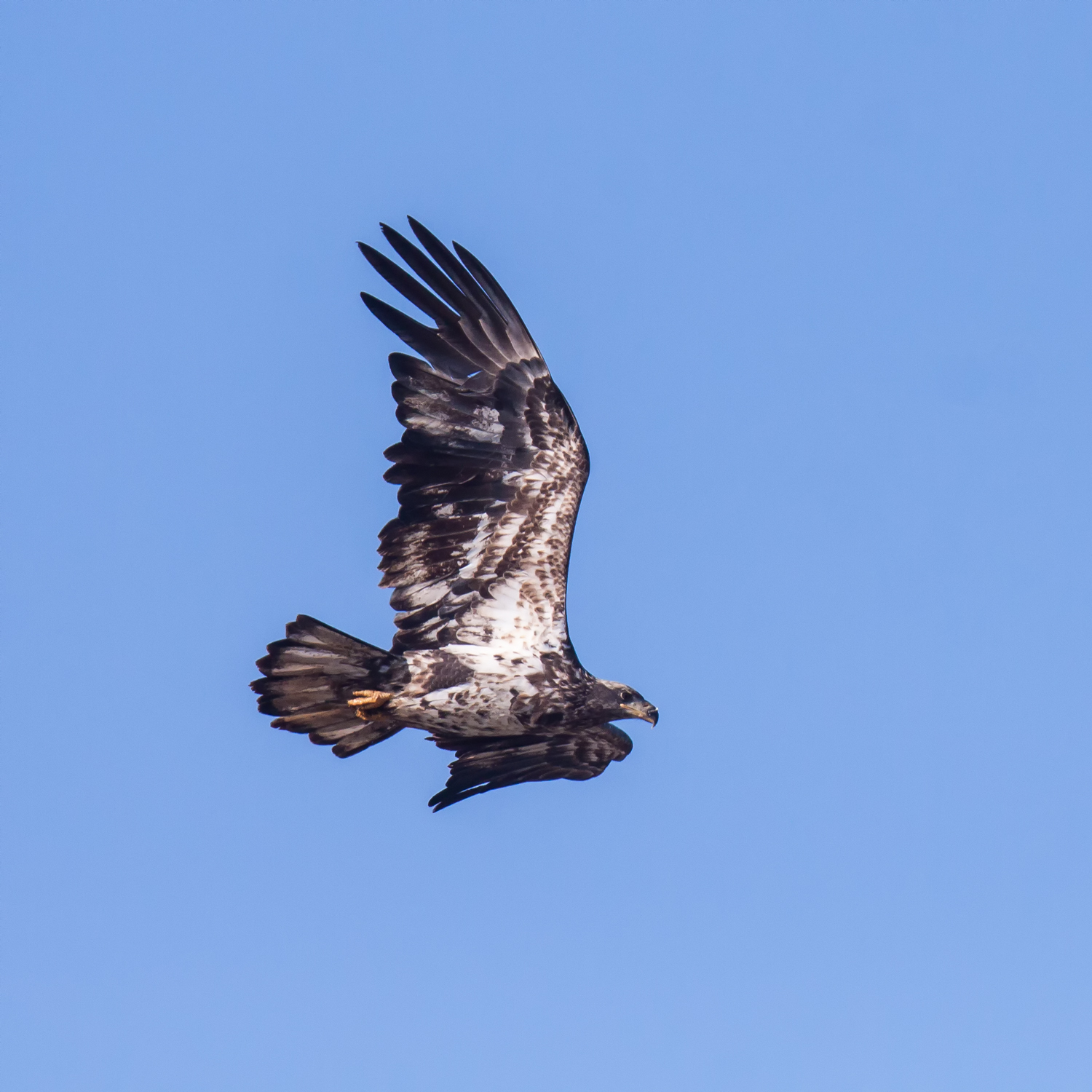
On Monday it was cool and windy and I didn’t expect to see many birds at Occoquan Bay National Wildlife Refuge. I was pleasantly surprised to spot several Bald Eagles (Haliaeetus leucocephalus) flying about. The wind seemed to slow them down a little and gave me a slightly better chance of capturing images of them in flight.

My favorite subject was this juvenile eagle. Sometimes juveniles can look somewhat bedraggled with their multi-colored feathers, but I thought that this one looked quite handsome, especially when the light hit it from a good angle and illuminated its body. One unexpected benefit was that it was easier to get a proper exposure with the juvenile because it does not have the extreme contrasts of the dark body and white head of the adults. In many of my shots of adult eagles, the body ends up underexposed and/or the head ends up overexposed.

juvenile bald eagle

juvenile bald eagle

juvenile bald eagle

© Michael Q. Powell. All rights reserved.

Read Full Post »

Yesterday at Occoquan Bay National Wildlife Refuge I spotted my first warbler of the spring, a Palm Warbler (Setophaga palmarum). For several weeks, I have been diligently searching the ground and the trees for warblers, whose appearance marks the beginning of spring for some birders. It was not surprising that the first one I saw was a Palm Warbler, because they are traditionally one of the earliest species to arrive, but I was a little surprised to find several of them at water’s edge, poking about in the rocks and the debris. In the past, I have most often spotted them on the grassy trails.

I was not able to get close to these little warblers, so my normal temptation was to crop my images, as I did in the first one, in order to highlight the bird. As I was working on the second image, I decided I liked the idea of including more of the environment, even though it is a bit cluttered. What do you think?

Palm Warbler

Palm Warbler

© Michael Q. Powell. All rights reserved.


Read Full Post »

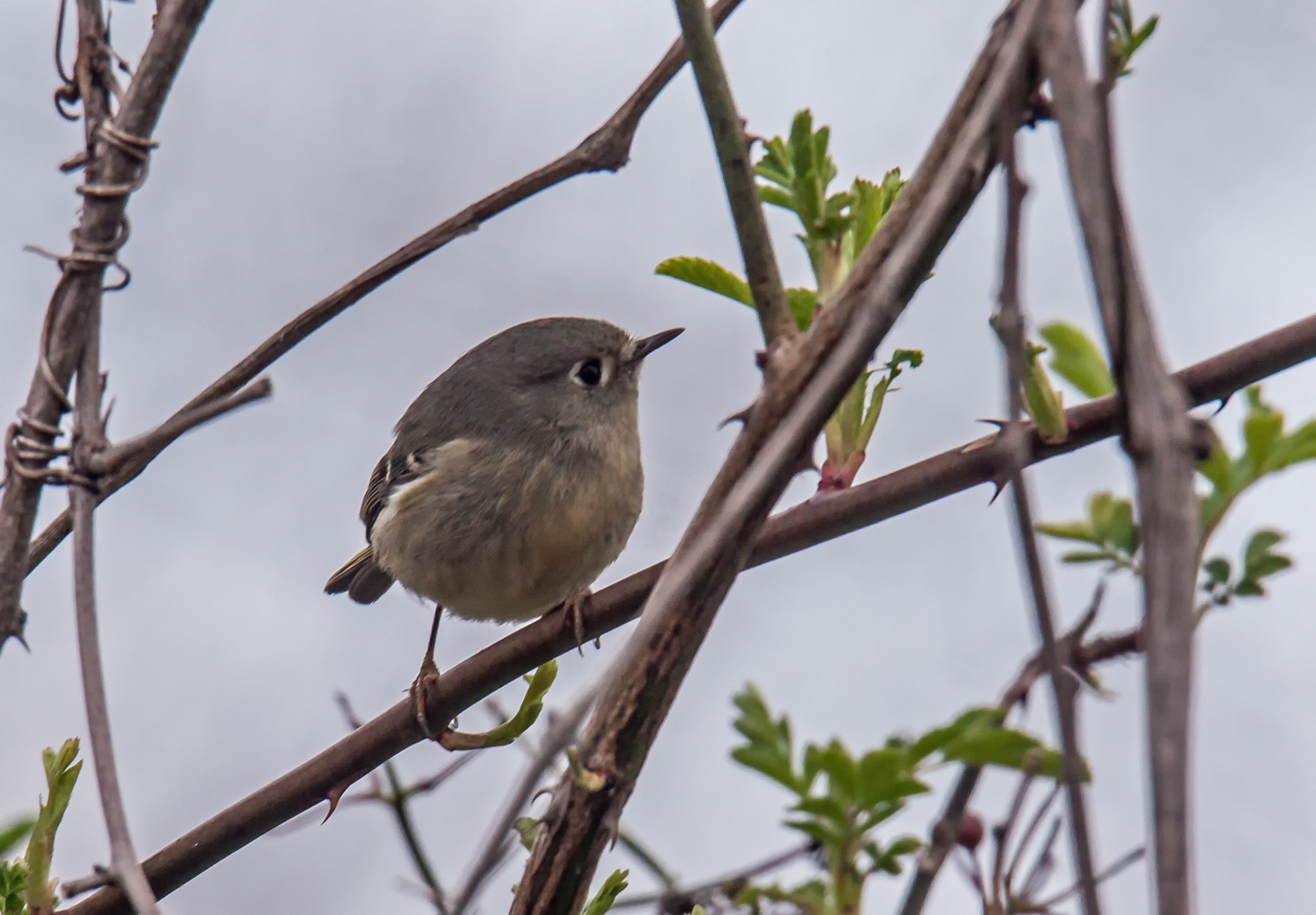
Some birds are so round in appearance that they look more like cartoons than real birds. That was certainly the case with this tiny Ruby-crowned Kinglet (Regulus calendula) that I spotted last week at Occoquan Bay National Wildlife Refuge.

Ruby-crowned Kinglet

© Michael Q. Powell. All rights reserved.

Read Full Post »

Yesterday I spotted this pair of Eastern Bluebirds (Sialia sialis) perched on a nesting box at Occoquan Bay National Wildlife Refuge. The female appeared to have nesting materials in her bill and seemed ready to build a nest. The only problem is that this nesting box, I believe, is currently being used by some Tree Swallows.

I don’t know for sure if this is the place where the bluebirds plan to make their nest and I never did see either of the bluebirds enter the nesting box. However, a short time later I spotted the male bluebird with nesting material in his bill, so it is quite likely that they are determined to construct a nest somewhere nearby.

Eastern Bluebirds

Eastern Bluebird

© Michael Q. Powell. All rights reserved.

Read Full Post »

Normally when I see a Northern Mockingbird (Mimus polyglottos), it is perched in a tree. This past Wednesday at Occoquan Bay National WIidlife Refuge, I spotted one foraging in a field. The mockingbird was perched on the stalks of the vegetation and periodically would bend down and grab a few seeds.

I love the way that the cooler tones of the bird contrast with the warmer shades of the vegetation and the background. That contrast makes this fairly common bird really stand out and shine.

Northern Mockingbird

© Michael Q. Powell. All rights reserved.


Read Full Post »

During one of my recent early morning forays to Occoquan Bay National Wildlife Refuge, I was thrilled to spot several beavers. I had seen plenty of gnawed off trees in the area around this pond, so I knew that there had to be some beavers nearby. You generally have to be really lucky to see one, because they are mostly nocturnal creatures.

There were three beavers when I initially spotted them swimming towards me. Two of them seemed to sense my presence as they got a little closer and dove underwater. One kept approaching and I was able to capture the first image, a head shot  of a handsome North American Beaver (Castor canadensis). The second image shows the beaver as it was swimming and gives you a better sense of the environment in which it was found.

beaver

beaver

© Michael Q. Powell. All rights reserved.

Read Full Post »

I love the sweet sounds of a Carolina Wren (Thryothorus ludovicianus), like this little beauty that I spotted on Wednesday at Occoquan Bay National Wildlife Refuge.  Most of the times when I see a Carolina Wren, it is hopping about in the underbrush, but sometimes when they are going to sing, they choose a higher, more visible perch.

Carolina Wren

© Michael Q. Powell. All rights reserved.
Read Full Post »

I love the feeling of the early morning, when the sun is just beginning to rise. Some mornings begin with fog hanging over the fields, giving the scene an eerie feeling. On other mornings, the sun adds color to the sky and produces beautiful reflected light in the clouds. I never know what the sunrise will bring when I set out in the dark, but I love to start the way watching darkness give way to light.

I captured these images on separate mornings during this past week at Occoquan Bay National Wildlife Refuge.


early morning

sunrise

© Michael Q. Powell. All rights reserved.
Read Full Post »

This past Monday I spotted this juvenile Cooper’s Hawk (Accipiter cooperii) high in a tree at Occoquan Bay National Wildlife Refuge. Initially there were a lot of branches between us, but I was able to move slowly and stealthily closer to the little hawk and get a relatively clear shot of it.

Cooper's Hawk

© Michael Q. Powell. All rights reserved.

Read Full Post »

This past week at Occoquan Bay National Wildlife Refuge I observed two large birds consuming large fish using very different techniques. The first, a Great Blue Heron (Ardea herodias), carefully positioned the fish and then swallowed it in a single big gulp.

An Osprey (Pandion haliaetus), pictured below, used a much slower and methodical approach, tearing small chunks off of the fish. It takes a lot of bites to finish off a fish in this way. In between bites, the osprey would often look around to make sure no other bird was approaching and attempting to steal its catch.

When it needed to tug extra hard on the fish, the osprey would sometimes extend its wings in what I assume was an effort to stay balanced and keep from falling out of the tree. I believe that is what was going on at the moment when I captured this image.

Osprey

© Michael Q. Powell. All rights reserved.

Read Full Post »

Insects are becoming more active now as the weather warms up a bit, like this tiny Spring Azure butterfly (Celastrina ladon) that I spotted yesterday at Occoquan Bay National Wildlife Refuge.

There is something about chasing after a butterfly that makes me feel like a child again. I am sure that I would have looked ridiculous to an outside observer, who would have wondered what it the world I was doing.

Try it yourself. Chase a butterfly today or, if you can’t find one, let go of your inhibitions and do something equally childlike, like coloring with crayons. I think that most of us take ourselves too seriously too often.

Spring Azure

© Michael Q. Powell. All rights reserved.


Read Full Post »

This Bald Eagle (Haliaeetus leucocephalus) dropped more quickly than I anticipated when it took off last Friday at Occoquan Bay National Wildlife Refuge, but somehow I managed to keep most of it within the frame.

Whenever I see an eagle perched in a tree, my mind starts to go into overdrive and my fingers get twitchy. Should I take an immediate shot or should I try to get closer? If I manage to get closer, should I zoom in all the way to capture the perched eagle or leave room in the frame if the eagle decided to take off? I try to anticipate what is going to happen, knowing that I will most likely will have to react to a scenario that I hadn’t predicted.

This eagle, for example, did something unusual—it initially flew towards me. In my experience, eagles almost always fly away from me when they take off. A bird flying right at you is a real challenge to photograph. My focus on the eagle’s eye was off a little bit, but I was very happy to capture an image in which I am looking straight at the eagle’s face from in between the wings.

Growing up, I was a member of the Boy Scouts and the Scout motto of “Be Prepared” serves me well when I am trying to photograph wild creatures like this bald eagle.

bald eagle

© Michael Q. Powell. All rights reserved.
 

Read Full Post »

When I accidentally flushed this enormous Pileated Woodpecker (Dryocopus pileatus) last week at Occoquan Bay National Wildlife Refuge, it flew to another tree and tried to hide from me.

Note to woodpecker—you need to find a much bigger tree if you want to avoid being seen.

Pileated Woodpecker

© Michael Q. Powell. All rights reserved.

Read Full Post »

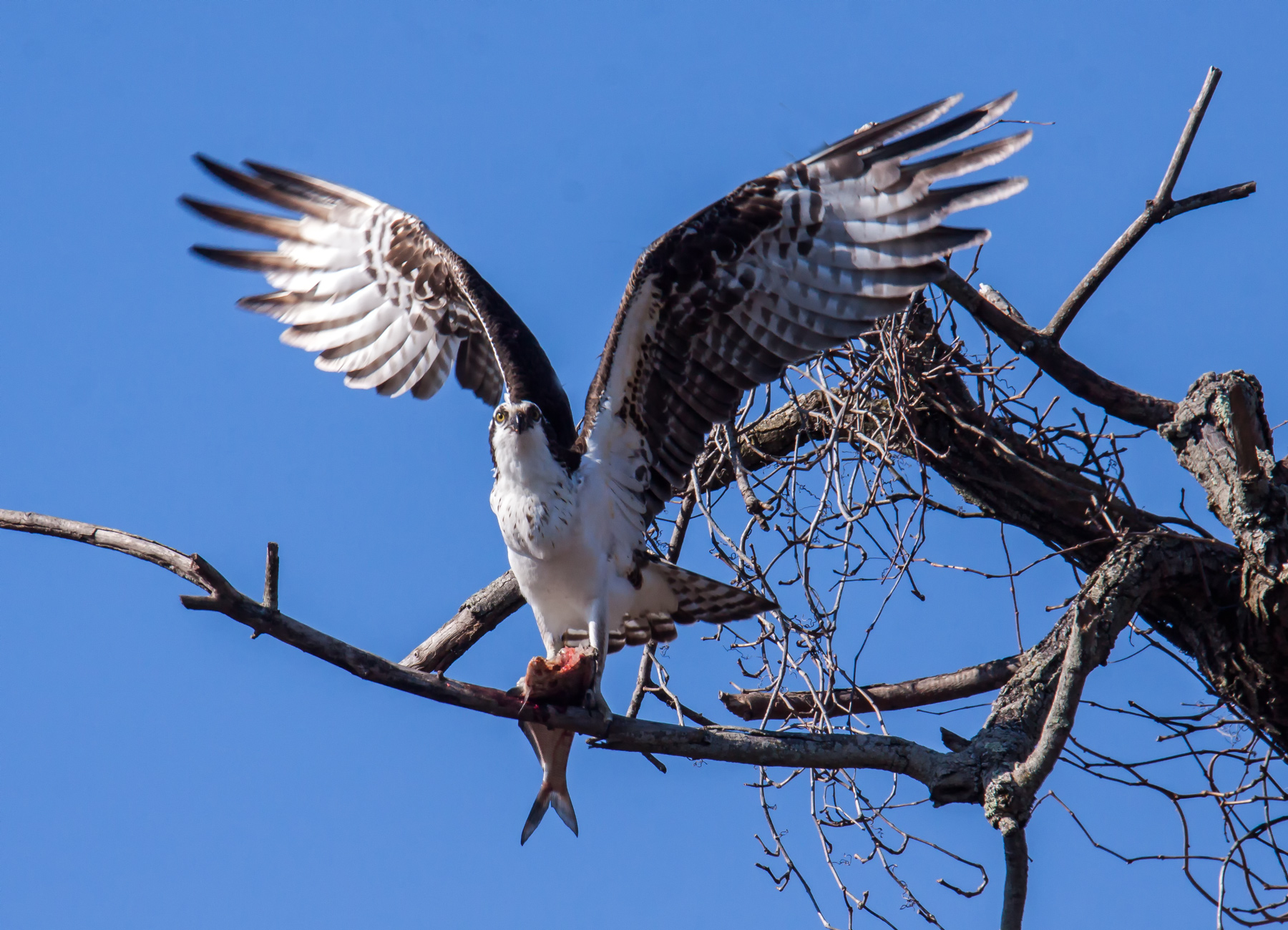
I captured this image this past Tuesday morning at Occoquan Bay National Wildlife Refuge as an Osprey (Pandion haliaetus) was starting to take off from its perch high in a tree with a partially eaten fish firmly in its grasp. I had watched the osprey consume the top portion of the fish and hope that it was carrying the remainder to its mate.

I am somewhat romantic, so I want to believe that this is a story about love and sharing and caring—and maybe it is. It is also possible that the osprey is selfish and fearful and is seeking a more secluded, secure perch when it can enjoy the rest of its catch without having to worry about it being stolen by eagles or potential predators like me.

Whatever the reality of the actual situation, I love the way that this image shows off the osprey’s impressive wingspan and how the v-shape of the wings is repeated in some of the branches and in the tail of the fish.

osprey

© Michael Q. Powell. All rights reserved.


Read Full Post »

Why did the Snapping Turtle (Chelydra serpentina) cross the road? It sounds like the opening line of a joke, but I asked myself that question yesterday when I spotted a snapping turtle lumbering its way across one of the trails at Occoquan Bay National Wildlife Refuge. The turtle’s back was covered with mud, suggesting it had only recently emerged from its winter sleep. In the past I have sometimes seen snapping turtles out of the water when they were getting ready to lay eggs, though it seems a little early for that to be taking place.

I have always thought that snapping turtle look like dinosaurs. What do you think?

Snapping Turtle

Snapping Turtle

© Michael Q. Powell. All rights reserved.

Read Full Post »

Wednesday I saw my first two Great Egrets (Ardea alba) of the year at Occoquan Bay National Wildlife Refuge. I had the sense that they were just passing through. They were resting in the distance and I was able to capture this image of one of them.  An hour later when I passed the same area, they were gone.

Unlike Great Blue Herons, many of which overwinter with us, Great Egrets spent the colder months in warmer locations and return in the spring.

Great Egret

© Michael Q. Powell. All rights reserved.


Read Full Post »

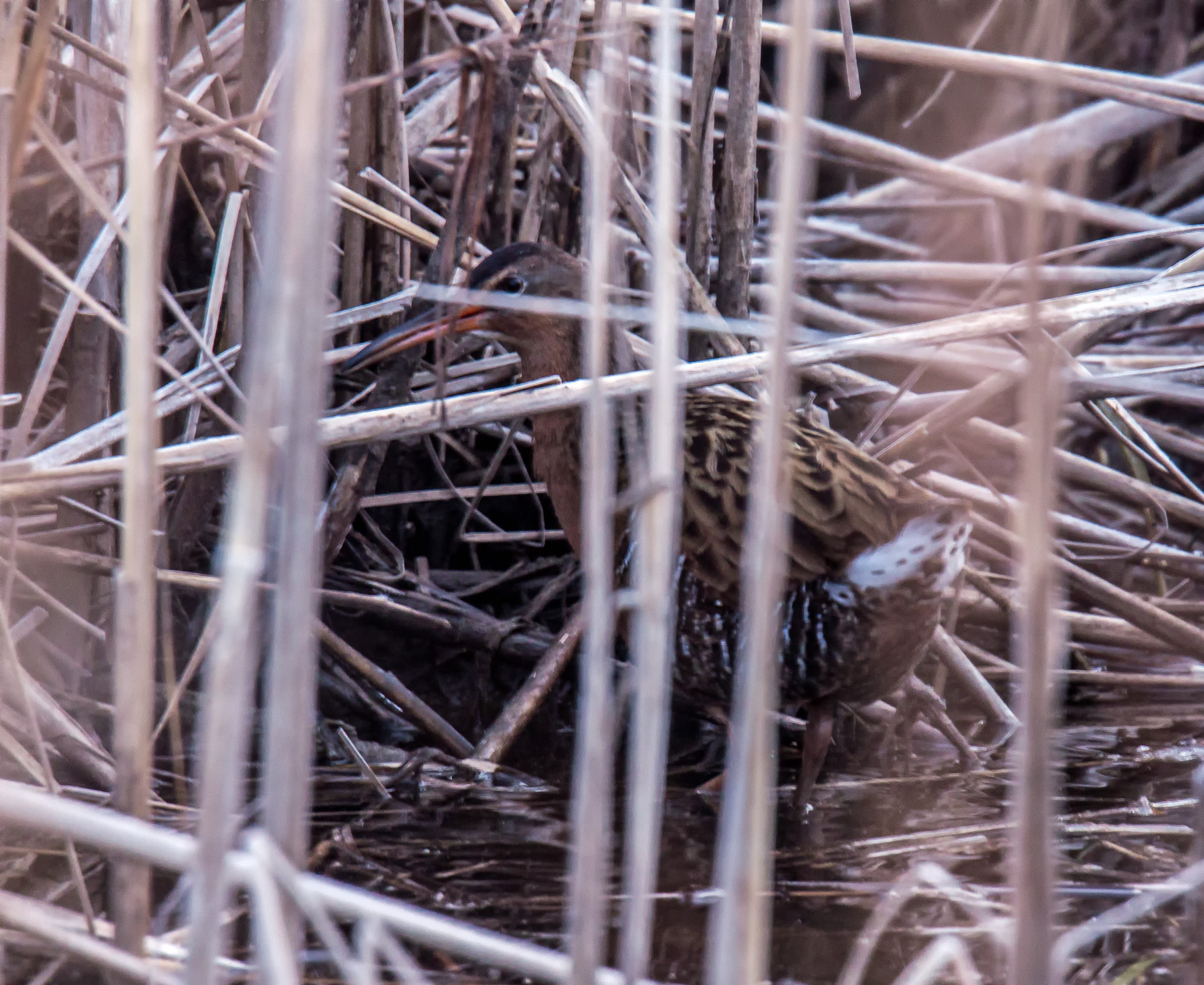
For several weeks I have been hearing a distinctive clicking sound coming from some patches of heavy vegetation within the marshes at Occoquan Bay National Wildlife Refuge. Some experienced birders told me that it was the sound of several King Rails (Rallus elegans). I have repeatedly waited at these locations, hoping in vain that one of these elusive birds would come into view.

Wednesday morning I finally got a glimpse of one of these chicken-like marsh birds. The King Rail did not come out into the open, but I was able to track it by its sounds. I was ready when it made its way to a place where the vegetation was not quite so dense and managed to capture these images.

My birding book describes King Rails as “uncommon, secretive,” so I am happy to get any shots at all. Nonetheless, like all wildlife photographers, I’m never quite satisfied and I’ll be trying to get some additional, better shots in the upcoming days if these birds continue to hang around in our area.

King Rail

King Rail

King Rail

© Michael Q. Powell. All rights reserved.

Read Full Post »

Earlier this week at Occoquan Bay National Wildlife Refuge I captured this image of what I an pretty sure is a Horned Grebe (Podiceps auritus). The subject was significantly backlit and is a bit dark, but even the most casual view will note that the bird has no horns. Well, only breeding adults have golden head tufts that someone decided look like horns.

Horned Grebes are diving ducks and most of the time that I see one it is in deep water in the distance. I was fortunate to be at the right place at the right time when this grebe surfaced closer than normally with a small fish in its mouth. I posted this photo to a Facebook forum, but so far the identity of the fish remains a mystery. The best response I received when I asked if anyone knew what kind of fish it was— “a slow one.”

In any case, I really like how the warm orange of the skinny little fish contrasts with the overall bluish tones of the image. Needless to say, the fish was gone a few seconds later.


Horned Grebe

© Michael Q. Powell. All rights reserved.

Read Full Post »

When I first spotted these Mourning Doves (Zenaida macroura) perched closely together on a branch yesterday morning, I immediately assumed that they were a couple. Are these really doves in love?

I have trouble figuring out the relationships among birds, because I have to judge solely on the basis of outward appearances. Come to think of it, I have the same problem with humans.

Friends or lovers? Who knows?

mourning doves

© Michael Q. Powell. All rights reserved.

Read Full Post »

This Brown Creeper (Certhia americana) blended in so perfectly with the tree bark yesterday morning at Occoquan Bay National Wildlife Refuge that I don’t think I would have spotted it if it had not been moving. Brown Creepers are small in size, 4.7-5.5 inches in length (12-14 cm) and 0.2-0.3 ounces in weight (10-15 grams, and are in motion almost continuously, which makes them pretty tough to photograph.

If you click on the photos below, you can see some of the cool details of this little bird, like its large feet that aid stability and its slender, curved bill used to probe for bugs in and under the bark.


Brown Creeper

Brown Creeper

© Michael Q. Powell. All rights reserved.

Read Full Post »

« Newer Posts - Older Posts »