Feeds:
Posts
Comments

Posts Tagged ‘Woodbridge VA’

This has been a crazy year in so many different ways, including for dragonfly hunting. I post images almost every day, so I may provide the mistaken impression that I am out shooting every day. In fact, I have been staying at home a lot more and have been generally limiting my photography forays to a couple of times a week, supplemented by periodic trips to my neighbor’s garden to photograph flowers.

As a result, I have not seen some of “the usual suspects,” i.e. the dragonflies that I am used to seeing every year. I was quite excited when I spotted this female Painted Skimmer dragonfly (Libellula semifasciata) during a visit to Occoquan Bay National Wildlife Refuge, because I had not seen this species this season. You may have noticed that I really like dragonflies with patterned wings—I think that those patterns at an extra dimension to their beauty.

Dragonflies tend to be distracted when they are eating, which sometimes lets me get a little closer for a photograph. You can’t help but notice that this Painted Skimmer is feeding on some kind of insect with a bright red body. It looks a little like some kind of wasp or similar insect, though I really am not sure what it is.

I had no idea that “The Usual Suspects” was the name of a 1995 movie starring Stephen Baldwin and Kevin Spacey, so folks of a younger generation may associate those words with that movie. For me, however, “the usual suspects” will forever be a reference to a line in Casablanca, my absolutely favorite movie. If you are unfamiliar with the movie and would like to see the full line “round up the usual suspects” in its original context or simply want to relive that movie moment, check out this short clip from YouTube.

Painted Skimmer

© Michael Q. Powell. All rights reserved.


Read Full Post »

As the pandemic continues, I encounter signs everywhere reminding me of the importance of social distancing. Most of them are quite straightforward, but some of them attempt to convey the message creatively, like this large banner that I encountered last week at Occoquan Bay National Wildlife Refuge.

This photo shows only the text in the top one-third of the banner and does not include the image of a Great Blue Heron that filled the bottom two-thirds of the banner. The bottom line message is simple—Be like the Great Blue Heron and practice social distancing, but the literal bottom line that made me laugh. You may need to double-click on the image to read the text in fine print, but I am sure that it will put at least a smile on your face if you do so.

Have a wonderful Wednesday.

social distancing

© Michael Q. Powell. All rights reserved.

Read Full Post »

Is today the first day of a new season? It depends. If you use the meteorological calendar, today is the first day of autumn (or spring if you live in the Southern Hemisphere). If you use the astronomical calendar, however, you have to wait until the equinox on 22 September for summer (or winter) to end.

No matter how you calculate the seasons, we are already starting to see signs of transition. The weather is marginally cooler and some vegetation is dying off. It won’t be long before the leaves on the trees begin to change colors or, as is often the case, simply fall from the trees.

Many of the dragonflies and butterflies that I see are showing signs of wear and tear, with scratches on their bodies and tattered wings. While exploring Occoquan Bay National Wildlife Refuge last week, I spotted several butterflies with somewhat unusual damage to their wings. The wings of the Eastern Tiger Swallowtail (Papilio glaucus) in the first photo seem to be in almost pristine condition, except for the fact that one of the tails and a portion of the wing is gone. What could have caused that kind of damage?

The Common Wood Nymph (Cercyonis pegala) in the second image had similar damage, but it appears that the damage affected both of its wings. I can’t help but notice the straight lines and almost right angles of the edges of the missing wing sections of both of these butterflies. Could a bird have caused that damage? It is a bit of a mystery to me and I would welcome any insights that you might have about the cause of the injuries to these butterflies, which nonetheless seemed flying capable of flying.

Happy change of seasons—fall or spring, as applicable—if you live a place that uses the meteorological calendar.

Eastern Tiger Swallowtail

Common Wood-Nymph

© Michael Q. Powell. All rights reserved.


Read Full Post »

I do not recall seeing a single Russet-tipped Clubtail dragonfly (Stylurus plagiatus) last year, but I am more than making up for it this year. I have already done postings this month of female and male Russet-tipped Clubtails that I spotted during trips to Jackson Miles Abbott Wetland Refuge and was pleased to spot some more last week at a different location.

The first time that I see a species each year, I am extremely happy to capture any shot at all. If I am fortunate enough to have additional sightings, I will work to get a better shot, even though I know that I risk scaring the subject away. I traveled to Occoquan Bay National Wildlife Refuge twice last week and was delighted to spot a male Russet-tipped Clubtail each time.

My subjects last week chose very different perches—one flew up into a tree and one was in some vegetation lower to the ground—so I used different approaches for each one. When the dragonfly in the first photo initially landed in the tree, I was facing into the light and the details of the dragonfly were lost in the shadows. I was able to circle around so that the sun was to my back and managed to find a shooting angle that allowed me to avoid other branches and have the blue sky as the background.

My second subject was hanging vertically and was facing away from me. My initial shots captured the beautiful details of the wings, but the background was so close that I could not blur it out and it was somewhat cluttered in the images. I moved to the side and was able to compose the second shot below that eliminated the problem with the background. Yes, I sacrificed some wing detail, but in return I got a pose that is much more pleasing. We now have a better view of the eyes and the dragonfly has some personality—he almost looks like he is talking to me.

In photography, as in many other areas, it is the results that count. I could have simply shown you the photos and left it at that. However, I thought some of you might enjoy a brief peek inside of my head, a sense of my mental process as I was shooting. Quite often I opportunistically shoot whatever presents itself to me, but in situations like this I made some conscious decisions to improve my situation. In both cases I was able to get some better shots, which is why you see some more Russet-tipped Clubtails today.

Russet-tipped Clubtail

Russet-tipped Clubtail

© Michael Q. Powell. All rights reserved.

Read Full Post »

I spotted this Black Swallowtail butterfly (Papilio polyxenes) last Thursday at Occoquan Bay National Wildlife Refuge. In our area black-colored swallowtails also include dark morph Eastern Tiger Swallowtails, Spicebush Swallowtails, and Pipevine Swallowtails, so identification can be a bit tricky.

I can tell, however, that this butterfly is a Black Swallowtail because it is the only one of the dark swallowtails with a black dot inside of an orange dot on the edge of the wings near the body, a characteristic that you can see in the photo below. Unlike most of the butterflies that I have photographed, this one is not actively feeding, so its proboscis is curled up, rather being extended. If you double-click on the image, you can get a closer look at the curled-up proboscis and other wonderful details of this beautiful Black Swallowtail butterfly.

Black Swallowtail

© Michael Q. Powell. All rights reserved.

Read Full Post »

Almost all of the male Calico Pennant dragonflies (Celithemis elisa) that I have seen this season have been immature. How can I tell? When male Calico Pennants are young their abdomens are bright yellow, like those of the females. As they mature their abdomens turn a beautiful shade of red, like the male Calico Pennant in the image below that I captured on Monday at Occoquan Bay National Wildlife Refuge.

You might think that it would be easy to spot a dragonfly with such gaudy colors, but Calico Pennants are small and elusive. I usually manage to find them in the waist high vegetation in a field at the edge of a small pond at the refuge.

If you would like to compare the coloration of this male Calico Pennant with that of an immature male, check out the my posting from a couple of weeks ago entitled “Immature Calico Pennant dragonfly.”

Calico Pennant

© Michael Q. Powell. All rights reserved.


Read Full Post »

I will always try to get a photograph whenever I see a Monarch Butterfly, as I noted in a recent post, so I immediately set out after this orange and black butterfly when I spotted it on Monday at Occoquan Bay National Wildlife Refuge. When the butterfly landed and I got a closer look, I discovered that it was a Viceroy butterfly (Limenitis archippus), a species considered to be a mimic of the Monarch. The two species share similar color schemes, but the Viceroy is smaller and has a black line across its hind wings that in not present on Monarch wings.

I had learned long ago that Viceroys used a type of defensive behavior, known as Batesian mimicry, in which a palatable species, the Viceroy, closely resembles unpalatable or toxic species, like the Monarch, to avoid predation. However, some research suggests that the Viceroy is also unpalatable, which would make the Viceroys and Monarchs co-mimics of each other, a phenomenon known as Müllerian mimicry, in which two or more noxious species develop similar appearances as a shared protective device.

In the abstract of his article entitled “Comparative unpalatability of mimetic viceroy butterflies (Limenitis archippus) from four south-eastern United States populations” David Ritland stated, “Viceroy butterflies (Limenitis archippus), long considered palatable mimics of distasteful danaine butterflies, have been shown in studies involving laboratory-reared specimens to be moderately unpalatable to avian predators. This implies that some viceroys are Müllerian co-mimics, rather than defenseless Batesian mimics, of danaines.” (Monarch butterflies (Danaus plexippus) are part of the Daniadae sub-family (“danaine”) that Ritland mentioned.) Ritland tested his hypothesis with wild-caught butterflies and red-winged blackbirds and the results supported his hypothesis that Viceroys are unpalatable.

I have no idea what scientists have concluded about the mimicry question regarding the Viceroy butterfly, but it is fascinating to see the interrelatedness of different species that share this planet. We are all in this together.


Viceroy

© Michael Q. Powell. All rights reserved.

Read Full Post »

Have you ever tried to wrap a present that is large and awkwardly shaped? I have childhood memories of helping my parents wrap tricycles and wagons for my younger siblings on Christmas Eve. No matter how much wrapping paper I used, it was pretty obvious what was underneath the wrapping.

I have watched Black and Yellow Garden Spiders (Argiope aurantia) capture prey multiple times. After the initial capture, the spider wraps up its prey in a special kind of silk that looks like a long gauze bandage. (Check out my 2014 posting called “Wrapping up a meal” for a more detailed explanation and some close-up shots of the wrapping process.)

When I spotted this Black and Yellow Garden Spider on Monday at Occoquan Bay National Wildlife Refuge, I could see from a distance that the spider had captured something that was as large as it was, but I could not determine what it was. Once I got closer, I could see that the spider had awkwardly wrapped up what appeared to be a large cicada—it was impossible to hide the shape of the cicada’s large wings.

At some point in this process the spider injects venom into the prey, killing it and liquefying its internal organs for consumption. I cannot tell for sure if that is what the spider was doing at the moment I captured this image, but the position of the spider’s body suggests that possibility.

Spider and cicada

© Michael Q. Powell. All rights reserved.

Read Full Post »

At this time of the year it is hard to spot Bald Eagles (Haliaeetus leucocephalus) when they are almost hidden by the vegetation. I was really excited to get a tiny peek at this one yesterday at Occoquan Bay National Wildlife Refuge, my first eagle sighting in months. The eagle spotted me when I tried to move in for a closer shot and flew off. It is tough get a good shot when your subject has sharper vision and quicker reactions than you do.

As I mentioned in a post a few days ago, however, eagles have “stopping power” for me—I will invariably try to photograph a bald eagle when I see one, even if it is far away and almost hidden. Besides, I figured that some of you might like a momentary respite from an almost steady diet of insect photos recently.

Bald Eagle

© Michael Q. Powell. All rights reserved.


Read Full Post »

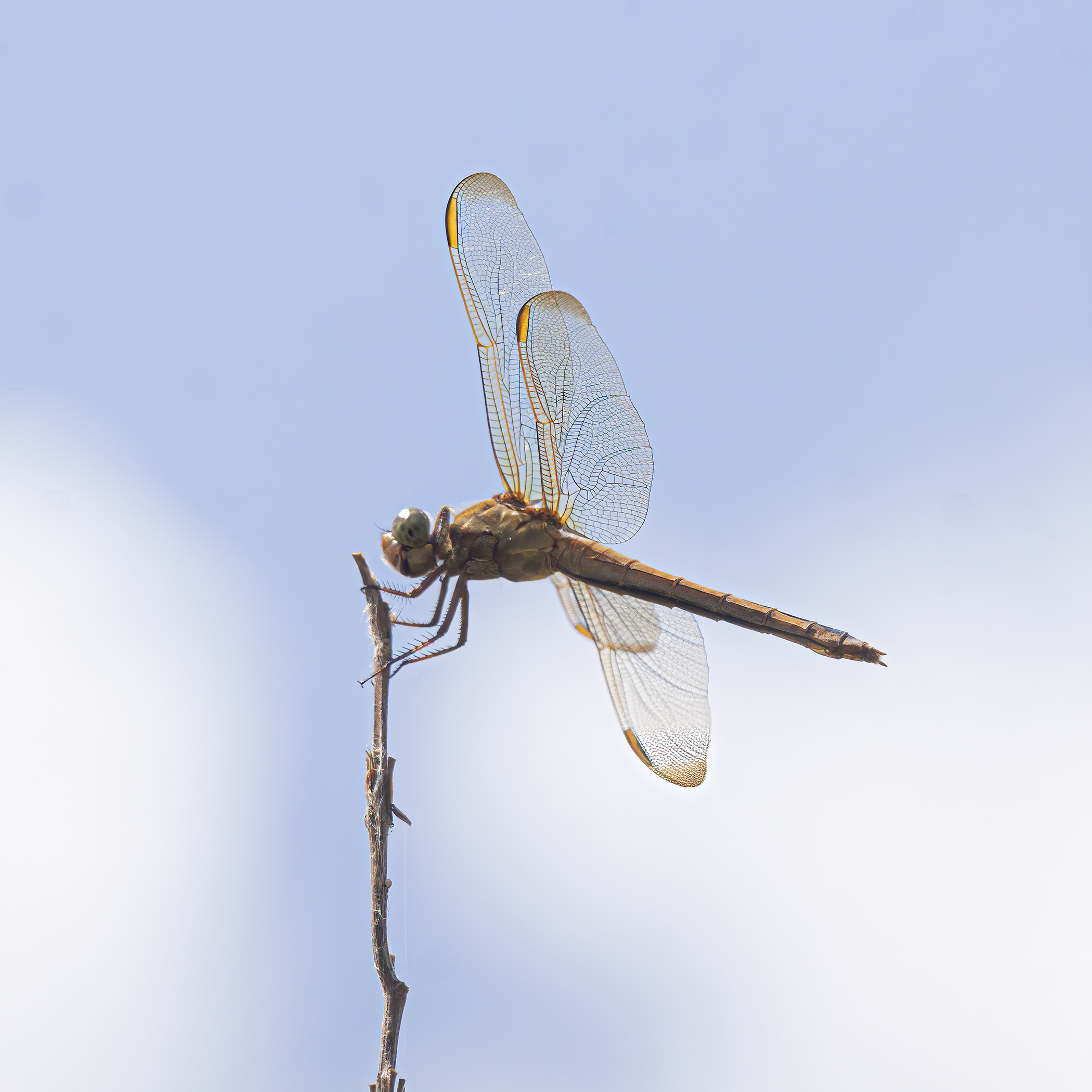
Some dragonflies seems to seek the highest possible perch and I love photographing them with the sky and the clouds as the simple backdrop.  I spotted this female Needham’s Skimmer dragonfly (Libellula needhami) last week at Occoquan Bay National Wildlife Refuge.

I was thrilled that I was able to maneuver myself into a shooting position almost directly below the dragonfly and shoot upwards at a sharp angle. I was also happy to capture the beautiful golden markings near the leading edges of the wings, one of the most distinctive characteristics of this species that is quite common where I live.


Needham's Skimmer

© Michael Q. Powell. All rights reserved.

Read Full Post »

Some of the dragonfly species that I search for are around for only a few weeks, while other species have a flight season of multiple months. Calico Pennants (Celithemis elisa) are in the latter category. I photographed some Calico Pennants in the middle of June and spotted this colorful immature male this past Tuesday—I am happy to see that they are still around.

Calico Pennants are so small—about 1.3 inches (33 mm) in length—that many viewers have probably never seen one. I love their bright colors and multi-colored wing markings. Adult males are red while females and immature males, like this one, are yellow. I can tell that this one is a male because of the distinctive appendages at the tip of the abdomen.

If you want to see photos of a female Calico Pennant and an adult male, be sure to check out the earlier posting entitled “Calico Pennant dragonflies in June.”


Calico Pennant

© Michael Q. Powell. All rights reserved.
Read Full Post »

It has obviously been a rough summer for this female Halloween Pennant dragonfly (Celithemis eponina). Her tattered wings are testaments to her struggle to survive. We can only speculate about what caused all of that damage, for only she truly knows what experiences led to those ragged edges. Somehow it seems appropriate that the perch that she chose is equally full of rough and jagged edges.

This summer has been difficult for many of us too and I suspect that a lot of us feel as frazzled and beat-up as this beautiful little dragonfly, even though we may not show it on the outside. Be gentle with yourself and with others that you encounter. You never know how fragile they may be or what struggles they are going though—we all have ragged edges.

Halloween Pennant


© Michael Q. Powell. All rights reserved.

Read Full Post »

We are definitely in the summer doldrums, with day after day of oppressive heat and humidity. This week has been a bit different only because we have had some violent thunder storms. In terms of dragonflies, the common skimmer species are flying about in great numbers. In my area, that means that on a trip Tuesday to Occoquan Bay National Wildlife Refuge, I saw lots of Common Whitetails, Eastern Pondhawks, Needham’s Skimmers, Blue Dashers, and Great Blue Skimmers.

Although I have photographed these species many times, I still chase after them, trying to capture new behavior or interesting portraits, perches, or backgrounds. That is why I was able to capture this image of this smiling female Great Blue Skimmer dragonfly (Libellula vibrans) as she perched on some stalks of Eastern Gammagrass (Tripsacum dactyloides). I do not know vegetation very well, but I remember my friend Walter Sanford identifying this type of grass to me a few years ago and somehow the name has stuck with me.

In many ways, this photograph is indicative of my favorite approach to wildlife photography. Although I will sometimes look for rare species to photograph, I especially enjoy photographing common species and highlighting their uncommon beauty. Beauty is everywhere.

Great Blue Skimmer

© Michael Q. Powell. All rights reserved.


Read Full Post »

I ventured out into the heat for a couple of hours yesterday and was rewarded for my efforts by this beautiful female Halloween Pennant dragonfly (Celithemis eponina) that I spotted at Occoquan Bay National Wildlife Refuge.

What makes a portrait perfect? For me, an optimal portrait captures an interesting subject in a dynamic pose with good lighting and a complementary background. I think that this images ticks all of those boxes. Why, then, do I call it “almost” perfect in the title? I guess that there is a part of me that is never completely satisfied, that is steadfastly convinced that I can do better. That is why I was out walking the trails yesterday when temperatures soared above 95 degrees (35 degrees C). Don’t worry, I stayed in the shade, carried lots of water, and took it slowly. The good news was that social distancing was a breeze—I saw only one other crazy person walking about in the midday heat.

Halloween Pennant

© Michael Q. Powell. All rights reserved.


Read Full Post »

Can dragonflies smile? It sure looked like this male Great Blue Skimmer dragonfly (Libellula vibrans) was flashing me a toothy grin when I spotted him last Friday at Occoquan Bay National Wildlife Refuge. Perhaps it was just my imagination, running away with me.

smiling dragonfly

© Michael Q. Powell. All rights reserved.


Read Full Post »

There was only a single water lily in bloom at a pond at Occoquan Bay National Wildlife Refuge last week, but its beauty brightened the entire area and brought a smile to my face. Water lilies are one of the reasons why Claude Monet is one of my favorite painters.

Monet did some 250 oil paintings of water lilies (“Nymphéas” in French), many depicting the garden at his home in Giverny, and they were the main focus of his artistic production during the last thirty years of his like, according to Wikipedia.


water lily

© Michael Q. Powell. All rights reserved.

Read Full Post »

Skipper butterflies are common and Black-eyed Susans (Rudbeckia hirta) are common too, but what a lovely combination they made when I spotted them together on Friday at Occoquan Bay National Wildlife Refuge.

skipper and susan

© Michael Q. Powell. All rights reserved.

Read Full Post »

I was really happy that I was able to track this Swamp Darner dragonfly (Epiaeschna heros) after it zoomed by me yesterday afternoon at Occoquan Bay National Wildlife Refuge. When I finally caught up to it, the large dragonfly was hanging vertically, high in a tree among the leaves, leisurely munching on its bee lunch in the shade.

Yes, I recognize that bees play an important role as pollinators and highlighted that in yesterday’s posting. Bees, however, also serve as a food source for other creatures higher up on the food chain—they are all part of the circle of life.

Swamp Darners are among the largest dragonflies in our area, about 3.4 inches (86 mm) in length. I really like the description that Kevin Munroe provided of Swamp Darners on the wonderful Dragonflies of Northern Virginia website. “I often tell people on dragonfly walks that if they see a rhino with wings, it’s a swamp darner. Slight exaggeration, perhaps, but they are pretty impressive. June is their month and the best time to see them, as they cruise, slow and purposefully, over shallow, swampy pools, or hunt high over nearby meadows.”


Swamp Darner

© Michael Q. Powell. All rights reserved.


Read Full Post »

It has been a month since I visited the Bald Eagle (Haliaeetus leucocephalus) nest at Occoquan Bay National Wildlife Refuge, where I spotted an eaglet on 19 May and wrote a posting entitled “One little eaglet.” Yesterday I traveled to the refuge to check on the baby eagle and was a little surprised to find that the authorities had removed the barriers that had blocked access to the nesting area, which is adjacent to a trail. Did this mean that the eaglet had fledged and the family had left the nest?

I was happy to discover that the eaglet was still there, has grown considerably in size over the past month, and was sitting tall at one edge of the nest. The leaf coverage has also grown, making it pretty tough to get an unobstructed view of the little eagle. The vegetation also hid the presence of one of the parent eagles that flew away to a nearby grove of trees when I approached.

It is somehow reassuring to see that the cycle of life has continued undisturbed as our lives have been turned upside down by the global pandemic. I celebrate the new life of this young eagle and all of the other creatures who have begun their lives this spring and wish them success as they learn to navigate the challenges of their lives.


Bald Eagle eaglet

© Michael Q. Powell. All rights reserved.

Read Full Post »

This is the time of the year when warblers are moving through the area in which I live and bird photographers have been congregating at Occoquan Bay National Wildlife Refuge, a local hotspot for warblers and other birds that, unlike many other parks, has been open during this shutdown. Not wanting to risk contact with so many people, I have been avoiding this refuge for the most part, even though it is my favorite place to take photos.

Last week, though, I made a trip to the wildlife refuge on a weekday morning when the weather was less than optimal. As I had hoped, the weather kept most of the other photographers away and I was able to visit some of my favorite spots. I checked out several osprey nests, hoping to see some baby ospreys. The ospreys were no longer sitting on any of the nests, but I could not tell if there were baby ospreys in them or not.

Peering through the branches near one nest, I spotted this perched Osprey (Pandion haliaetus) with a fish in its talons. The osprey was at the stage of consumption when quite often it will take the remaining portion to its mate. I never did see its mate, but was happy to capture this shot before the osprey flew away.

Osprey

© Michael Q. Powell. All rights reserved.


Read Full Post »

Last week I featured an actual mud turtle, but today’s muddy turtles  are actually Painted Turtles (Chrysemys picta) that appear to have been painted with a coating of mud. The last few months we have had a lot of unusually cool weather, and I think the turtles have been spending a lot of time in the mud at the bottom of the ponds. Last week the weather improve  and there were turtles in all kinds of places at Occoquan Bay National Wildlife Refuge trying to absorb the warmth of the sun.

The pose of the first two turtles brings to mind a well-known scene from the movie Titanic in which Jack and Rose (Leonardo DiCaprio and Kate Winslet) were standing at the railing at the prow of the ship. I must confess that I spent 4+ hours watching the movie on television last Sunday night, which may be why the scene is so fresh in my mind. Yeah, I’m a bit of a romantic.

I encountered the second Painted Turtle as it was slowly making its way across a trail at the wildlife refuge. In addition to noting the large amount of fresh mud still on its shell, I was delighted by the way the two little leaf fragments on its shell matched the yellow markings on its neck.
Painted Turtle

Painted Turtle

© Michael Q. Powell. All rights reserved.

Read Full Post »

Last Tuesday I spotted these rather scruffy-looking non-breeding male Indigo Buntings (Passerina cyanea) at Occoquan Bay National Wildlife Refuge. One viewer in a birding forum on Facebook commented, “He won’t get a date looking like that.”

I sort of expected all male Indigo Buntings to have a color that rivals or surpasses that of a male Eastern Bluebird—I had never before encountered the mottled coloration of a non-breeding male. For the sake of comparison, I have included as a final photograph an image that I captured in August 2017 of a breeding male Indigo Bunting on a sunflower. Click this link if you would like to see the final photo in the context of the original posting in which it was one of the featured images.


Indigo Bunting

Indigo Bunting

Indigo Bunting

© Michael Q. Powell. All rights reserved.

Read Full Post »

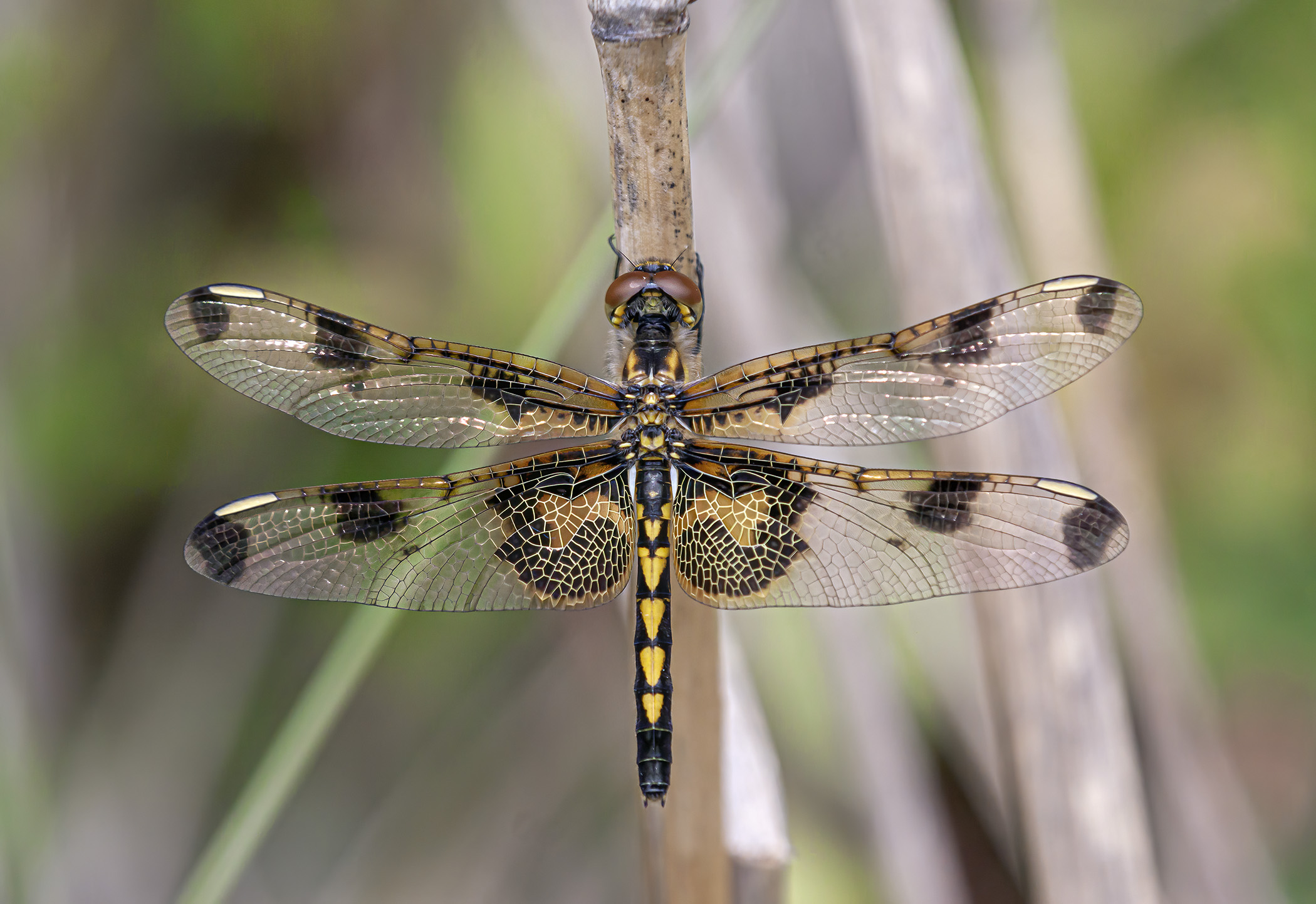
On Tuesday I spotted this beautiful female Calico Pennant dragonfly (Celithemis elisa) during a visit to Occoquan Bay National Wildlife Refuge.  I always love to see the wonderfully patterned wings of this dragonfly species and the first shot provides a good view of the wing details, especially if you click on the image to enlarge it.

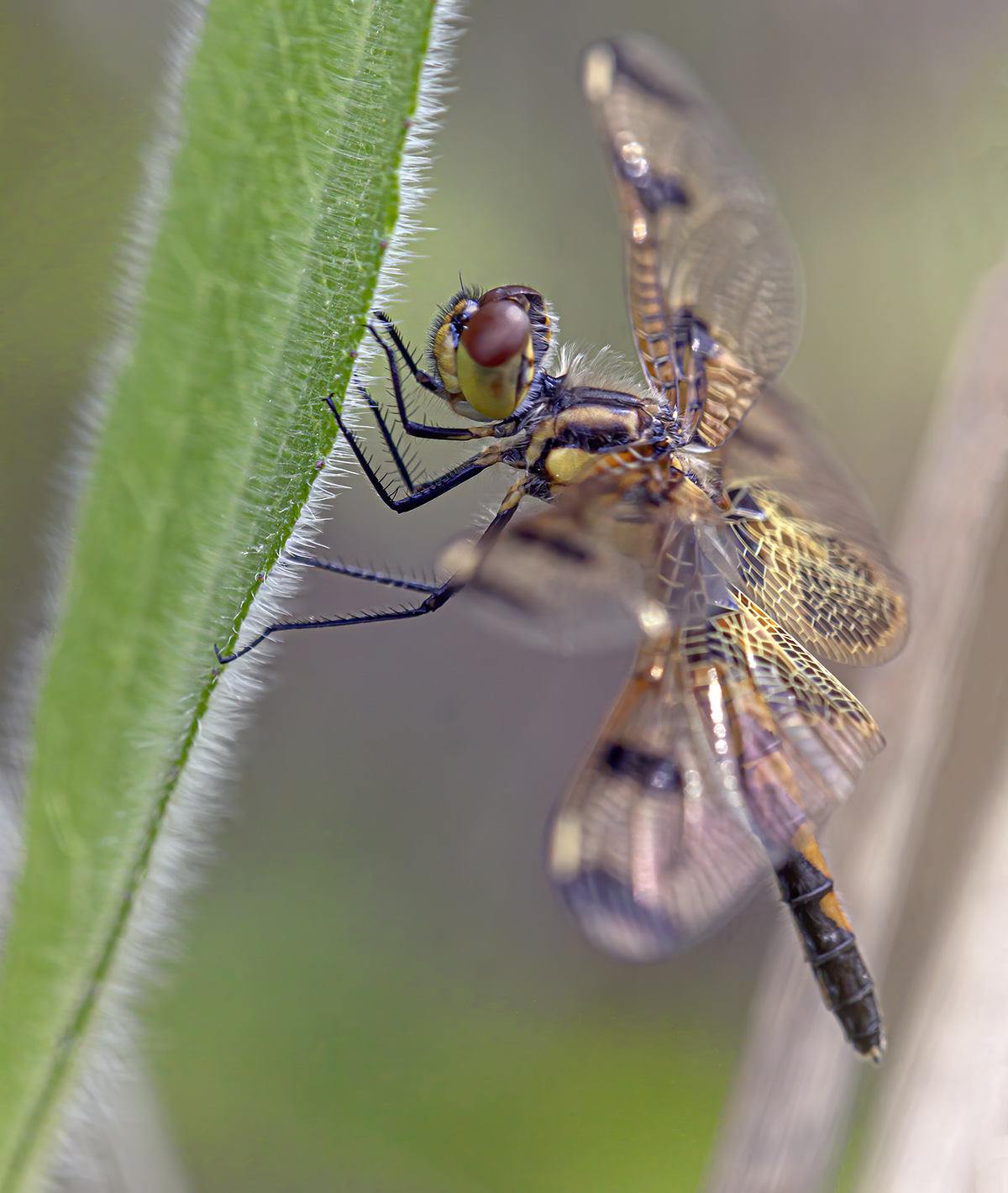
In the second image, I focused primarily on the dragonfly’s head and body and the wings are mostly out of focus. I love the way that you can see the dragonfly’s tiny feet and the tenuous grasp they have on the fuzzy plant stem from which the dragonfly is hanging.

Calico Pennant

calico pennant

© Michael Q. Powell. All rights reserved.

Read Full Post »

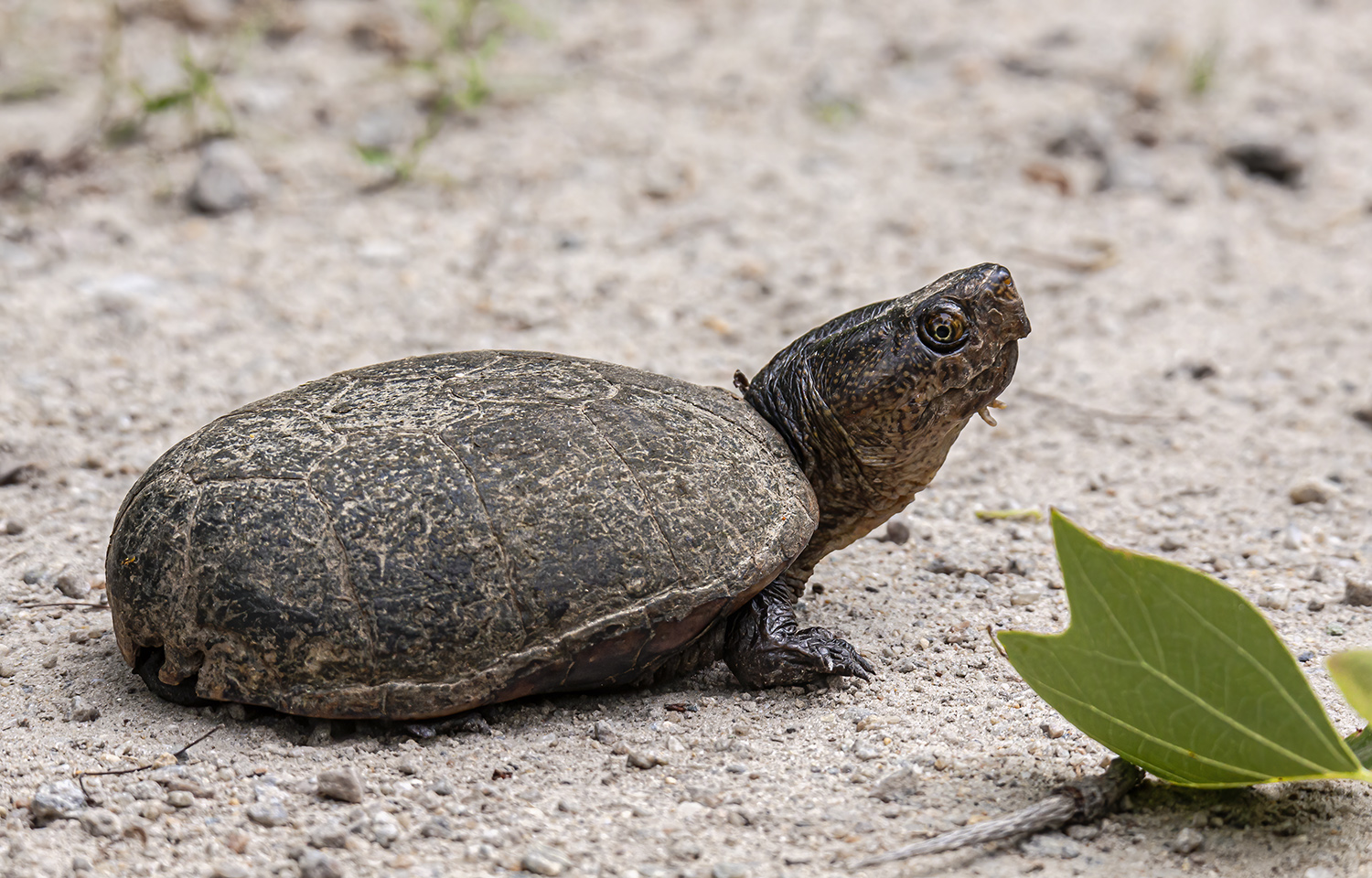
No matter how many times that I see an Eastern Mud Turtle (Kinosternon subrubrum), I am always shocked by the disproportionately large size of its head. When I spotted this one on Tuesday at Occoquan Bay National Wildlife Refuge, I remember wondering if it was physically possible for the turtle to withdraw its head into its shell. The turtle was standing in the middle of a wide trail, apparently in the process of crossing the trail. Although the mud turtle seemed to be fully aware of my presence, it appeared to be totally unfazed and merely gave me a sidewards glance as it waited for me to pass.

Given the circumstances in which we now live, I think we all could use some of the patience and imperturbability of this little creature.


Eastern Mud Turtle

© Michael Q. Powell. All rights reserved.

Read Full Post »

The Bald Eagles (Haliaeetus leucocephalus) at a prominent nesting site at Occoquan Bay National Wildlife Refuge were late this year in nesting and I feared that they might not have any babies. I was therefore thrilled yesterday to discover that there is now an eaglet in the nest when I returned to that part of the refuge for the first time in a couple of months.

Authorities at the refuge set up barriers to keep the nesting eagles from being disturbed, so I had to observe the nest from a long way off. When I first arrived at the barrier yesterday, I could not tell if there were any eaglets. However, I noted that one of the parent eagles was perched on a limb above and to the right of the nest. In the past, I learned that when eaglets start to grow, there is no longer any room for a parent in the nest, so having one parent keeping guard near the nest was a positive sign.

I waited and waited and eventually the other parent eagle flew in and perched on a limb above and to the left of the nest. I was peering though my fully-extended telephoto zoom lens and noticed a dark shape pop up in the middle of the nest shortly after the second parent arrived. When I looked at my shots afterwards, I confirmed that there was an eaglet in the nest.

In the first shot, it looks like the eaglet was calling to its parent, although I did not hear a sound, or maybe was indicating it was hungry. I pulled back my zoom lens to its widest setting for the second shot, in which you can see both eagle parents and the eaglet in the nest in the center (you may want to click on the image to see more details).

I think that there is only one eaglet this year, though I can’t be absolutely certain. In past years there have been either one of two eaglets in this nest. Now that I know that there is a new little eaglet, I will probably try to return to the site to monitor its progress over the upcoming weeks and months.

Bald Eagle

Bald Eagle

© Michael Q. Powell. All rights reserved.

Read Full Post »

At this time of the year there are still so few dragonflies around that I will try to photograph almost every single one that I see. Sometimes that involves photographing them when they are flying, as I showed in a posting earlier today. At other times, I am forced to shoot them when they are a long way away, as was this case with the male Common Whitetail dragonfly (Plathemis lydia) in the photo below.

I had already made one loop around Occoquan Bay National Wildlife Refuge looking primarily for insects and decided to switch to my telephoto zoom lens and focus on looking for birds during a second loop. When I was walking past a small pond, however, I spotted the dragonfly flying over the water. I could tell that it was a Common Whitetail, a species that perches fairly often, so I decided to see if it would land.

Eventually the dragonfly perched atop some thick vegetation not far from the water’s edge. Unfortunately the area between the two of us was marshy and there was no way that I could get any closer. Even with the lens cranked out to its longest length (600mm), the dragonfly filled only a small portion of the frame.

I decided to try to treat the shot like a landscape and include the water of the pond in the background and the curling stem on which the dragonfly was perched in the foreground. I am pretty happy with the way the shot turned out, a kind of environmental portrait of the Common Whitetail dragonfly.

Common Whitetail

© Michael Q. Powell. All rights reserved.


Read Full Post »

Do you like to challenge yourself? I like to try to photograph moving subjects. It is not easy, even when it is a large bird like a Great Blue Heron (Ardea herodias), but it is even more difficult when it is a small dragonfly, like this Common Baskettail (Epitheca cynosura) that I photographed last Wednesday at Ococoquan Bay National Wildlife Refuge.

The dragonfly was patrolling over a small pond and at certain moments would hover for a split second before continuing. It took quite a few attempts, but eventually I was able to capture this image, which is cropped from a much larger image that came out of my camera.

Different photographers use different techniques to capture shots of flying dragonflies. I personally use my 180mm macro lens and focus manually, because the autofocus on the lens is notoriously slow and has trouble achieving focus with such a small subject. Every year I try this same challenge, often multiple times, so with a little luck and a lot of patience and persistence, I hope to be able to do more postings of dragonflies in flight in the upcoming months.

Common Baskettail

© Michael Q. Powell. All rights reserved.
Read Full Post »

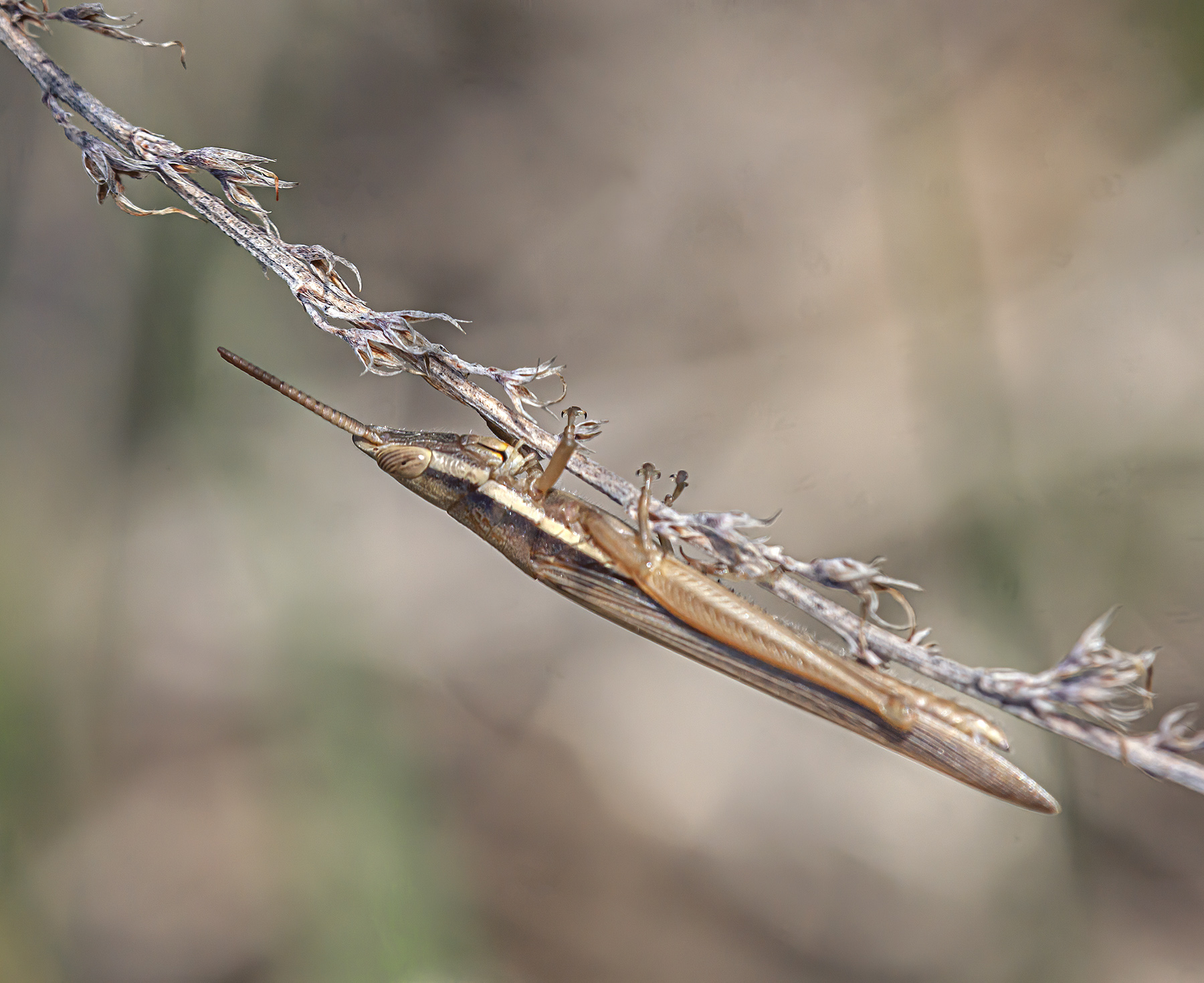
Have you ever stopped to look closely at grasshoppers? They come in all shapes, sizes, and colors. I spotted this elongated one with fluted, unicorn-like antennae this past week at Occoquan Bay National Wildlife Refuge. I knew that I had seen one like this before, but could not recall its name. After some research, I rediscovered that it is the colorfully-named Cattail Toothpick Grasshopper (Leptysma marginicollis).

If you try chasing grasshoppers, you will discover that they often stay in place after the first hop, giving you a chance to examine them for a moment before they hop away.

So whether you are in your backyard or in a park, be sure to check out the grasshoppers. You might be surprised by what you discover.

Cattail Toothpick Grasshopper

© Michael Q. Powell. All rights reserved.
Read Full Post »

One of the earliest dragonflies to emerge in the spring in our area is the Blue Corporal (Ladona deplanata). Adult males are bluish in color and both the male and the female have two white stripes on their thoraxes in an area that you might think of as their shoulders. In the military of the United States, the rank insignia for corporals is two stripes, which accounts for that portion of the common name for the species.

The dragonfly in the first photo is a female Blue Corporal. She will remain that tan color for her entire life. If you look closely at the very tip of her abdomen (the “tail”) and compare it with the same area of the dragonfly in the second image, you can probably see some physiological differences. This is often the best way to tell the gender of a dragonfly.

The dragonfly in the second photo is a newly emerged male Blue Corporal, a stage known as teneral. During this stage, the wings are very clear and shiny and are very fragile. As the male matures, he will gradually turn bluish in color. His corporal stripes may turn light blue and eventually fade away.

You probably noted that the male Blue Corporal is perched flat on the ground—this is the most frequent perching position for this species. I was a little surprised that the female in the first photo was perching vertically a few inches above the ground, but I am not complaining, because it gave me a better chance to get a photo of her wings.

It is still a bit early in the season for dragonflies, so I was really happy to spot these two on Wednesday at Occoquan Bay National Wildlife Refuge. The refuge is still open and there were a number of other cars in the parking lot when I arrived. All of the other visitors, though, seemed to be either birding or walking in other areas of the refuge, leaving me the chance to muck about at the edge of a small pond all by myself, safely distanced from human contact.

Blue Corporal

Blue Corporal

© Michael Q. Powell. All rights reserved.
 

Read Full Post »

I am not sure what kind of insect this male Eastern Bluebird (Sialia sialis) had caught, but he seemed pretty proud of himself yesterday at Occoquan Bay National Wildlife Refuge. When I first spotted him, the bluebird was perched on the roof of a nesting box. I suspect that there may be a female and possibly babies inside the nesting box and the male was serving as a deliveryman. 

As I moved slightly to try to get a better angle, the bluebird flew to a nearby tree, still holding the worm/caterpillar in its mouth. I quickly realized that he did not like me being around , so I took a quick shot of him in the tree and left him in peace to complete his delivery.

Eastern Bluebird

Eastern Bluebird

© Michael Q. Powell. All rights reserved.

Read Full Post »

When I first got interested in photographing birds, Great Blue Herons (Ardea herodias) were one of my favorites. They were large, easy to find, and cooperative subjects. Rather than fly away when they sensed my presence, they would often remain in place. That tendency, I learned, was both a blessing and a curse. It is easier to photograph a bird when it is stationary, but eventually I wanted to capture action and Great Blue Herons, I learned, have endless patience—they can stay motionless for a really long time before they strike, often longer than I was willing to wait.

I still love to see Great Blue Herons and spotted this one earlier this month during a trip to Occoquan Bay National Wildlife Refuge. The heron seemed restless and was slowly slogging its way through the vegetation. Perhaps it was hunting or maybe it was just relocating to another spot. In any case, it was wonderful to see and photograph one of my old familiar favorites.

Great Blue Heron

Great Blue Heron

© Michael Q. Powell. All rights reserved.

Read Full Post »

« Newer Posts - Older Posts »