Feeds:
Posts
Comments

Posts Tagged ‘Tamron 180mm macro lens’

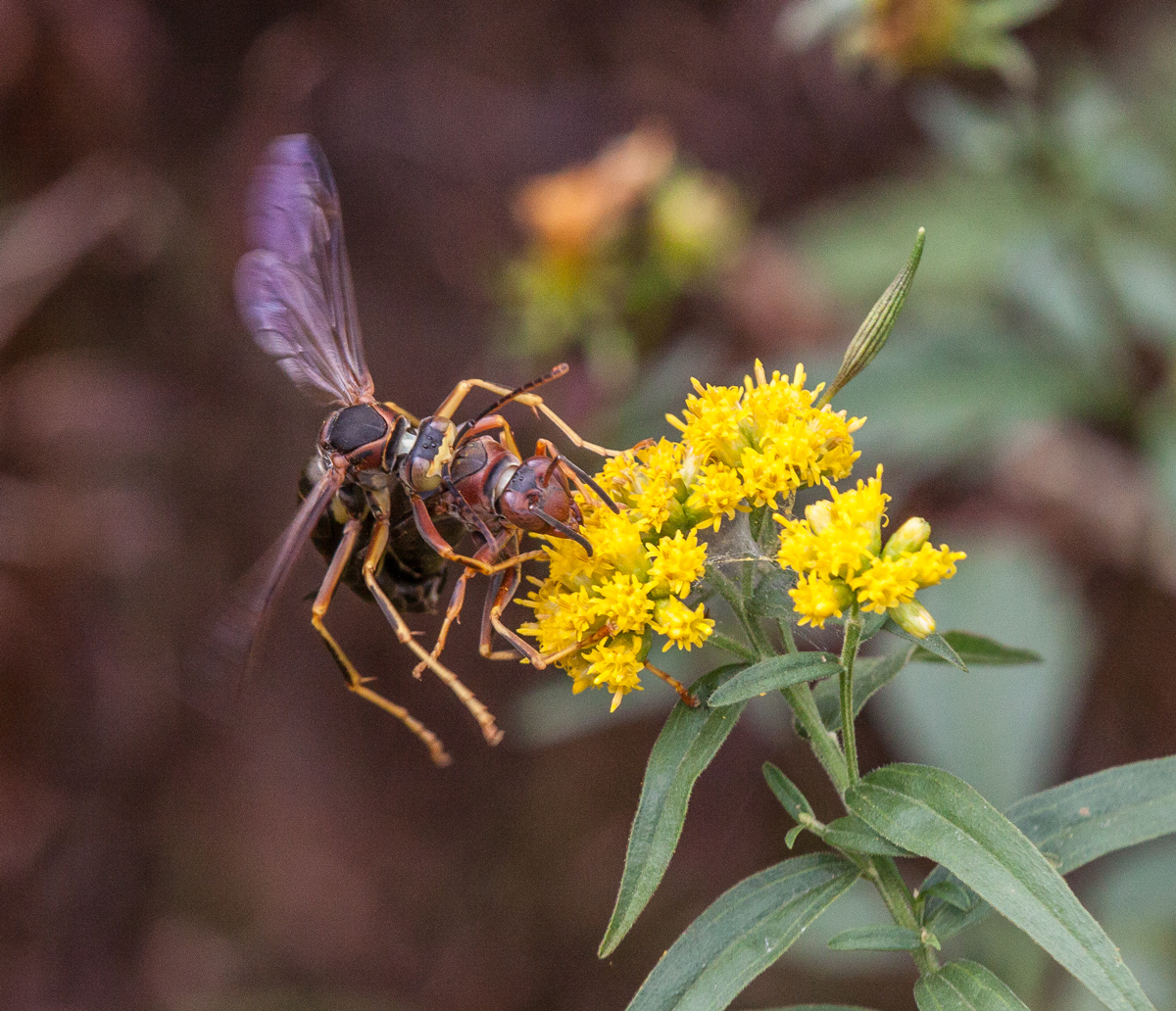
Cole Porter famously wrote that, “Birds do it, bees do it, even educated fleas do it…”  Apparently he could have included wasps, judging from this shot I took on Monday of mating wasps at Huntley Meadows Park.

I had my macro lens on my camera and was checking out a yellow flowering plant, which I think is goldenrod, when I heard the buzzing of an insect. I assumed that it was a bee, but when it landed, I realized it was a wasp. As I looked through my viewfinder and focused more closely on the subject, it became apparent that it was not one wasp—it was a mating pair.

They didn’t stay long, but I was able to get a reasonably clear shot of the couple as they “do it.”

If you are not familiar with the Cole Porter song that I referenced, “Let’s Do It (Let’s Fall in Love), check out a YouTube video of Ella Fitzgerald singing a jazzy version or a more traditional arrangement by Conal Fowkes.

mating wasps

© Michael Q. Powell. All rights reserved.

Read Full Post »

The dragonfly population continues to decrease as we move deeper into autumn, but my little winged friends seem to have been replaced by grasshoppers. Whenever I walk through the fields of my favorite marshland park, I am preceded by mini explosions of insects. Most of the grasshoppers hop far away, but yesterday one of them chose a nearby stalk of grass and posed for me.

grasshopper

© Michael Q. Powell. All rights reserved.

Read Full Post »

“Blue eyes
Baby’s got blue eyes
Like a deep blue sea
On a blue blue day”

Somehow the words to the old Elton John song come to mind when I gaze into the stunning blue eyes of this Blue-faced Meadowhawk (Sympetrum ambiguum). This dragonfly was unusually cooperative and let me move in to take this close-up portrait with my macro lens.

Blue-faced Meadowhawk

If you have never heard “Blue Eyes” or just want a blast from the past, here’s a link to a YouTube video of Elton John performing the song.

© Michael Q. Powell. All rights reserved.


Read Full Post »

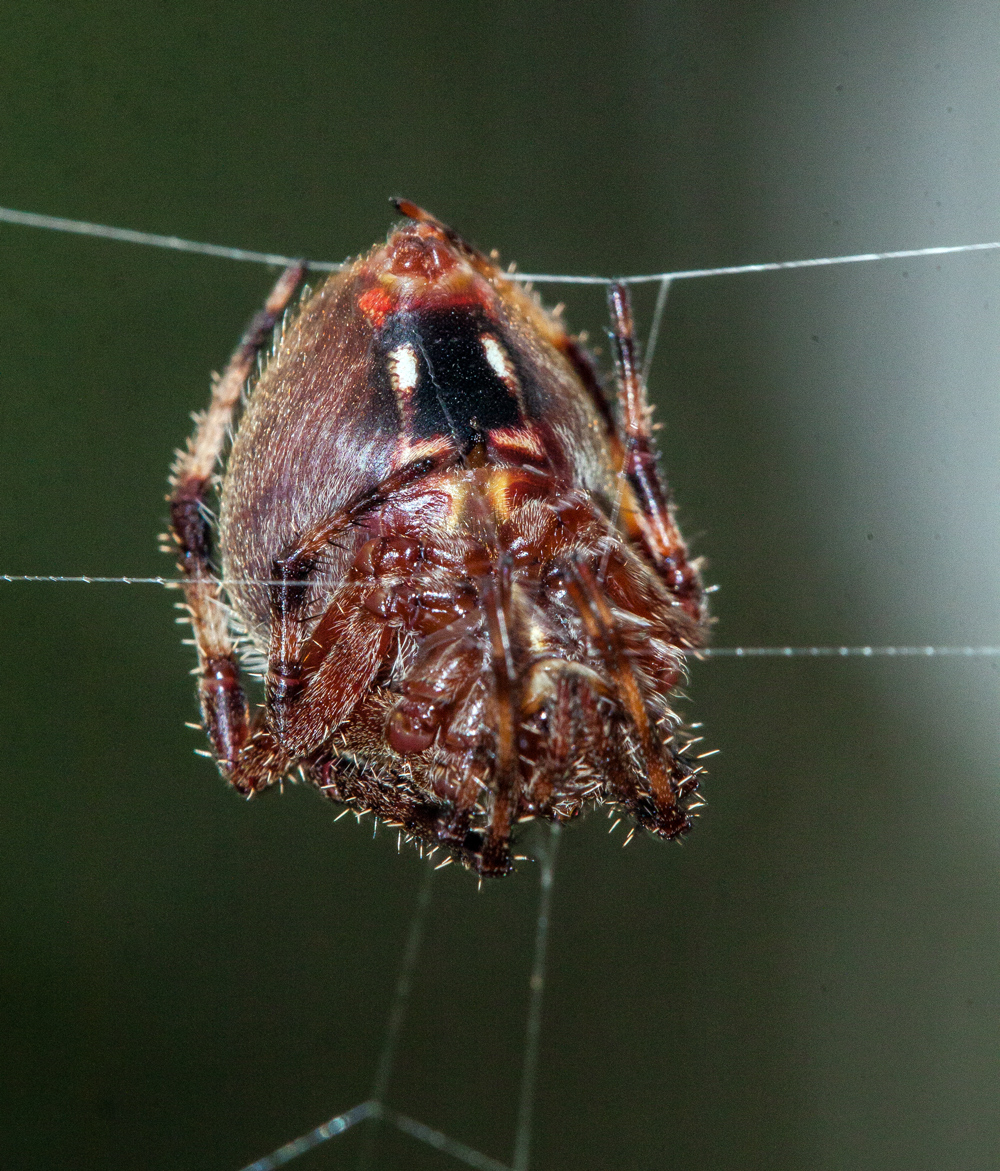
I first caught sight of this spider yesterday when I almost walked into it—it was hanging in mid-air at eye level across a path and we were less than a foot apart when I encountered it.

Initially the spider scampered up a bit and then seemed to run out of web and came to a stop, giving me some time to change to my macro lens. The spider, which I think is a kind of orb weaver (Neoscona crucifera) that is sometimes called a barn spider, was about seven feet off the ground by this time, so it was quite a challenge getting a stable shooting position. I raised the ISO and used the pop-up flash and managed to get some reasonably sharp images.

These are my favorite two images. I really like the detail in the first shot, but like the background and angle of view more in the second shot. Which one is better? I vacillate in trying to decide, so included them both.

orbweaver spider

orbweaver spider

© Michael Q. Powell. All rights reserved.

Read Full Post »

One of the highlights for me of a short visit yesterday to Meadowlark Botanical Gardens in Vienna, Virginia was spotting this spectacular dragonfly, which I think is a female Banded Pennant (Celithemis fasciata).

Earlier this summer, I spotted a male Banded Pennant, whose body was blue, but the coloration of this one suggests to me that it is a female. The dragonfly was perched on the highest branches of a small tree, which allowed me to isolate it against the beautiful blue sky. You may notice that the branches are different in the two photos—the dragonfly flew away a few times, but returned to the same tree a short time later.

CORRECTION: My initial identification was incorrect. My local dragonfly expert, Walter Sanford, with whom I neglected to consult in advance, provided a correct identification. This is a female Halloween Pennant (Celithemis eponina), not a Banded Pennant.


Banded Pennant

Banded Pennant

© Michael Q. Powell. All rights reserved.

Read Full Post »

Most dragonflies appear to like the sunlight, but this Mocha Emerald dragonfly (Somatochlora linearis) that I encountered yesterday seemed to prefer the heavy shade, which made it a bit of a challenge to photograph.

I was walking along a small stream, moving in an out of patches of sunlight when I first spotted the dragonfly. I had my long telephoto lens on my camera and took some initial shots, which turned out blurry—there didn’t seem to be enough light for my camera’s autofocus to function well. I quickly set up my tripod and tried to focus manually, but that didn’t work out too well either.

Fortunately, the dragonfly seemed oblivious to my actions. I switched to my 180mm macro and moved in closer and finally was able to see well enough to focus. Because of the limited amount of light, I had the ISO cranked up to 1600 and used the pop-up flash.

As I moved about trying to get a better angle, I slid twice down the slippery bank of the stream into the shallow water and somehow managed to lose one of the little rubber feet of my tripod, but managed to get a couple of decent shots of this shadow-dwelling dragonfly.

Mocha Emerald

Mocha Emerald

© Michael Q. Powell. All rights reserved.

Read Full Post »

I love looking at the world through my macro lens and finding beauty on a tiny scale, like this gorgeous green bee that I spotted this past weekend in the garden of my neighbors.

I am not certain of the exact identification of this bee, but I think it is part of the genus Agapostemon that includes a variety of green sweat bees.


green bee

© Michael Q. Powell. All rights reserved.

Read Full Post »

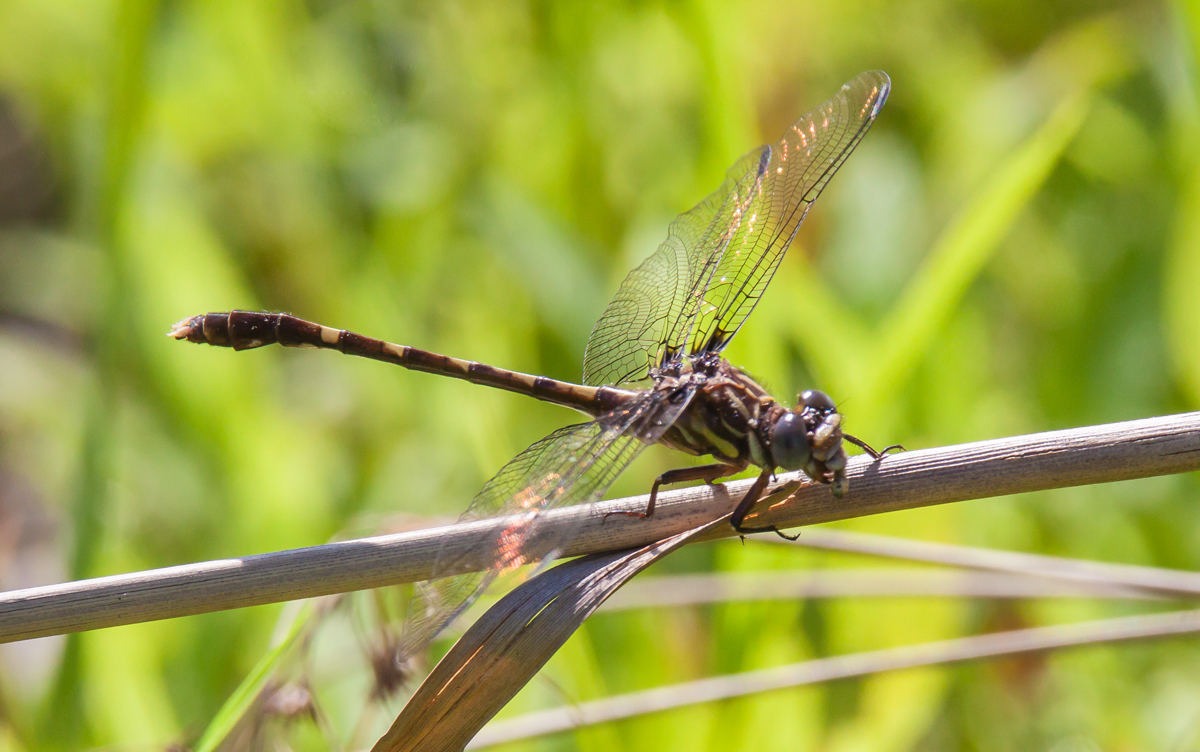
Last Saturday at Lilypons Water Gardens in Adamstown, Maryland I spotted a large dragonfly that I had never seen before, a Black-shouldered Spinyleg (Dromogomphus spinosus). That’s definitely a cool (and descriptive) name for a spectacular-looking dragonfly.

The dragonfly remained perched in the vegetation surrounding a small pond long enough for me to get shots from a few different angles and distances with my macro lens. I was particularly struck by the length of the long black legs, which somehow reminded me of those of a spider.

Black-shouldered Spinyleg

Black-shouldered Spinyleg

Black-shouldered Spinyleg

© Michael Q. Powell. All rights reserved.


Read Full Post »

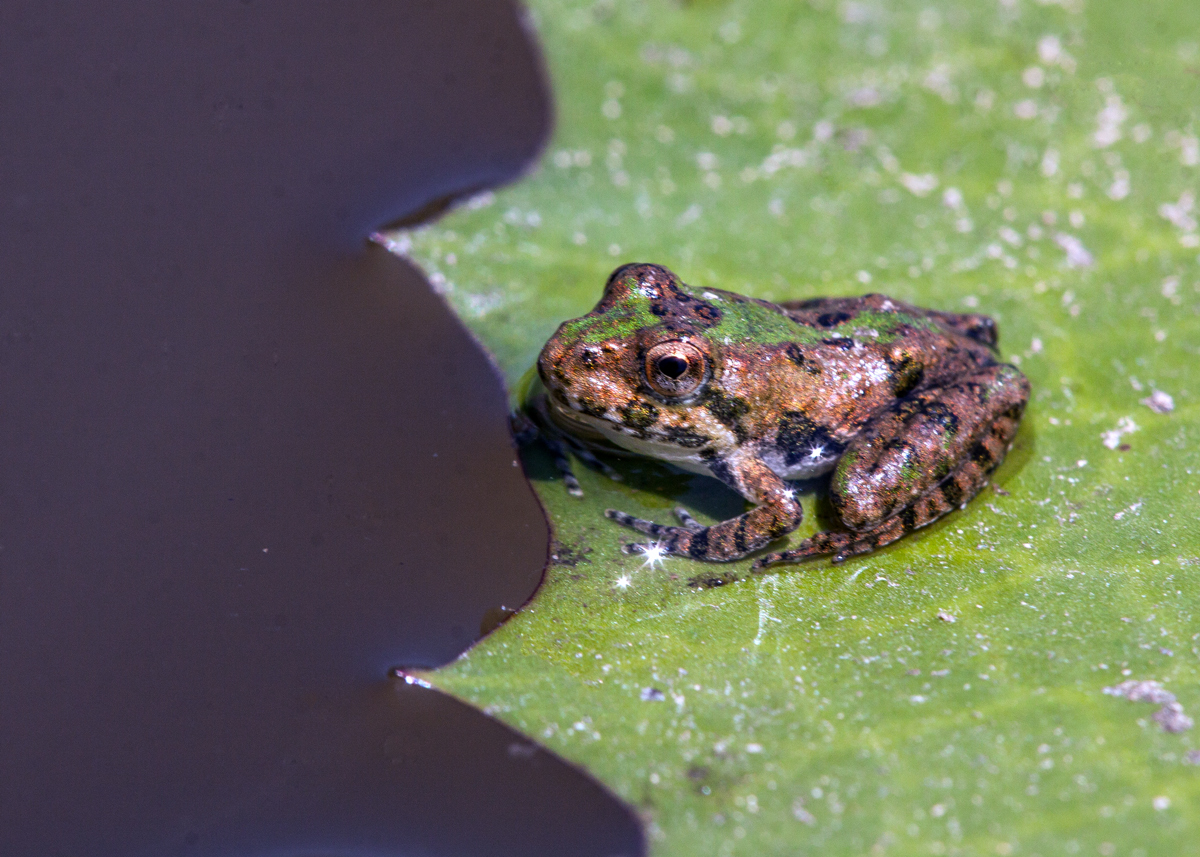
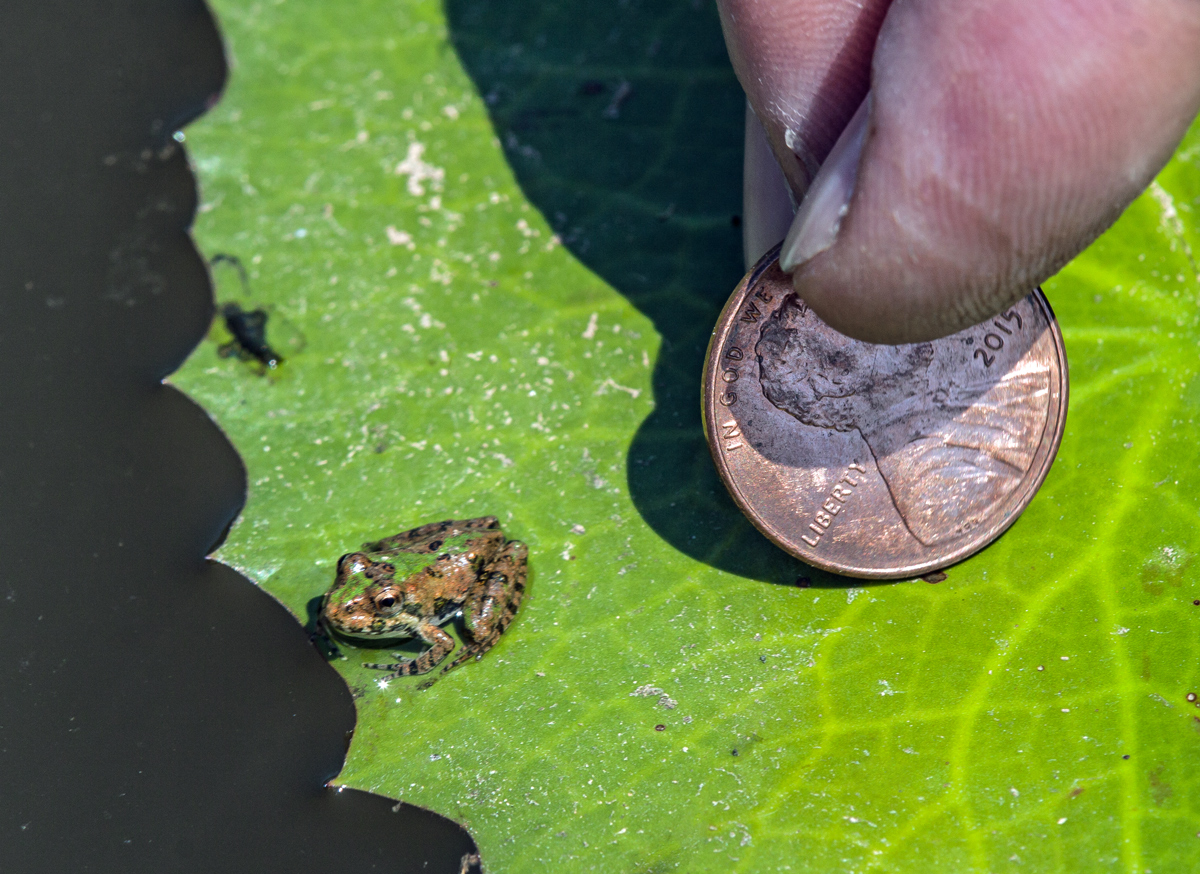
Perched at the edge of a lily pad, this frog at Lilypons Water Gardens was so small that I doubt I would have seen it by myself. However, one of my sharp-eyed fellow photographers spotted it and served as the hand model for the shot with the penny.

A helpful Facebook reader suggested that this is probably a Northern Cricket frog (Acris crepitans) and it certainly does look like the photos that I can find on the internet. Judging from the size of the penny, which is 3/4 of an inch in diameter (19 mm), I’d guess that the frog was less than 3/8 of an inch (9.5 mm) in size.

My fellow photographer tried to move the penny slowly into position, but, as I suspected would happen, the frog jumped away shortly after the second shot below. I would have liked to capture the frog in motion, but ended up instead with a shot of the vacant lily pad—the frog had jumped right out of the frame.

Northern Cricket frog

tiny2_frog_blog

© Michael Q. Powell. All rights reserved.


Read Full Post »

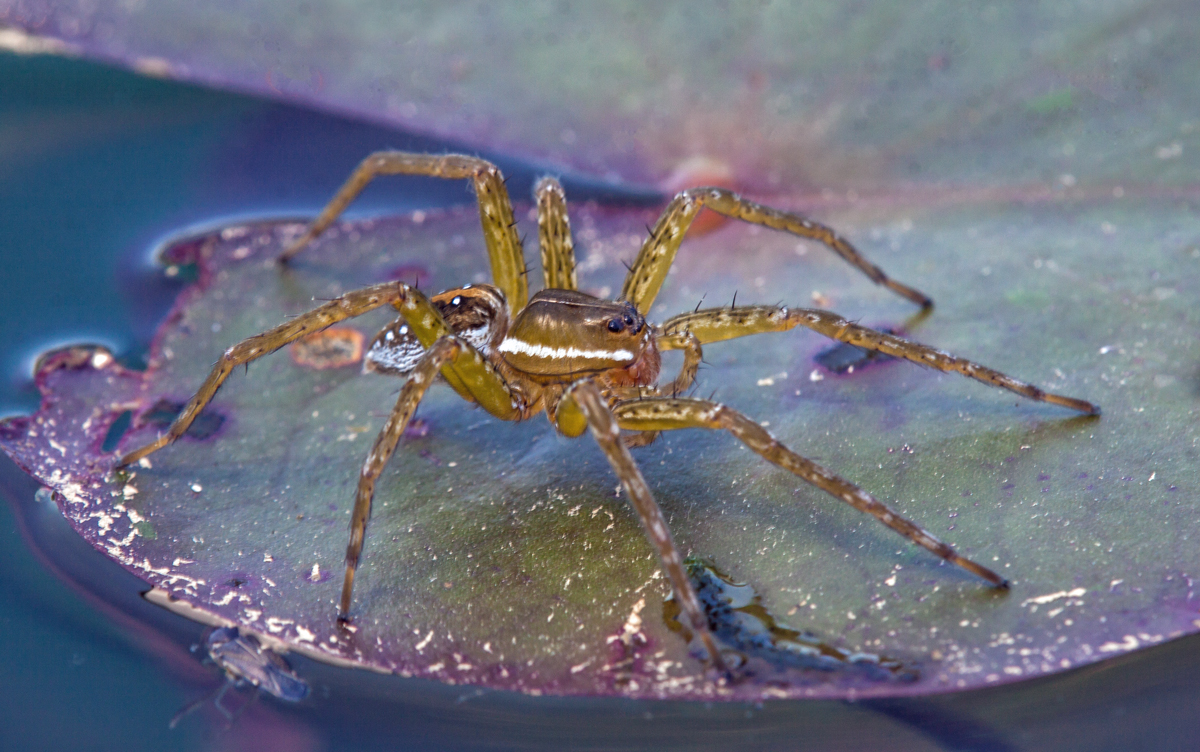
When shot from a relatively low angle, this Six-spotted Fishing spider (Dolomedes triton) looks especially fearsome, although it was actually pretty small, only about an inch (25 mm) or so in length. The spider was perched on a lily pad at Lilypons Water Gardens in Adamstown, Maryland.

Six-spotted Fishing spider

© Michael Q. Powell. All rights reserved.

Read Full Post »

I haven’t taken very many damselfly photos this summer, in part because often I have been attempting to shoot dragonflies with my long telephoto lens. That lens has a minimum focusing distance of almost nine feet (2.7 meters) and it’s hard to see and focus on a tiny damselfly at that distance.

This past weekend, however, I was using my 180mm macro lens and was happy to be able to capture some images of this beautiful female Fragile Forktail damselfly (Ischnura posita) during a trip to Lilypons Water Gardens in Adamstown, Maryland.

Damselflies are really small, but they pack a lot of beautiful details and colors into that tiny package. This particular species is special to me this year, because way back in April a female Fragile Forktail was the first damselfly that I spotted this season and presented in this posting.

Fragile Forktail

© Michael Q. Powell. All rights reserved.

Read Full Post »

I really enjoy photographing familiar subjects, but there is still something really special about finding new ones, like this female Eastern Ringtail dragonfly (Erpetogomphus designatus) that I stumbled upon yesterday during a photo excursion with some friends to Adamstown, Maryland.

The goal of our visit was to explore Lilypons Water Gardens, a large facility that specializes in all kinds of aquatic plants and includes a series of interlocking ponds with waterlilies and lotuses. I suspected that there would be lots of dragonflies and I was not disappointed.

While my friends were photographing the flowers, I started walking along the barely trampled paths that had knee-high grass and other vegetation. Most of the dragonflies that I spotted were familiar friends: Widow Skimmers, Eastern Pondhawks, Slaty Skimmers, Common Whitetails, and Blue Dashers, but a couple that I saw immediately struck me as being new and different.

The very colorful and distinctive rings on the abdomen of today’s featured dragonfly, the Eastern Ringtail, really attracted my attention and somehow reminded me of the photos I had seen of a coral snake. Fortunately the dragonfly, unlike the snake, is not poisonous. I chased the dragonfly for quite a while but never managed to get a shot of it with an uncluttered background—it kept perching on vegetation low to the ground.

When I returned home, I didn’t have a clue where to start with identification, because I hadn’t gotten some of the kind of diagnostic shots that I need, as relative neophyte, to identify a dragonfly. So I did what I usually do in cases like this—I contacted Walter Sanford, my local dragonfly expert. He tentatively identified it as a female Eastern Ringtail and another expert in the Northeast Odonata Facebook group agreed with Walter.

I’m pretty happy with my newest dragonfly find, a species I might have trouble finding again. According to the Maryland Biodiversity Project, the Eastern Ringtail is designated S2, which means that it is rare in the state of Maryland.

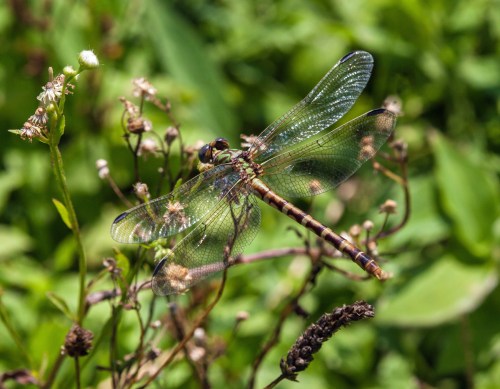
 

Eastern Ringtail

Eastern Ringtail

© Michael Q. Powell. All rights reserved

Read Full Post »
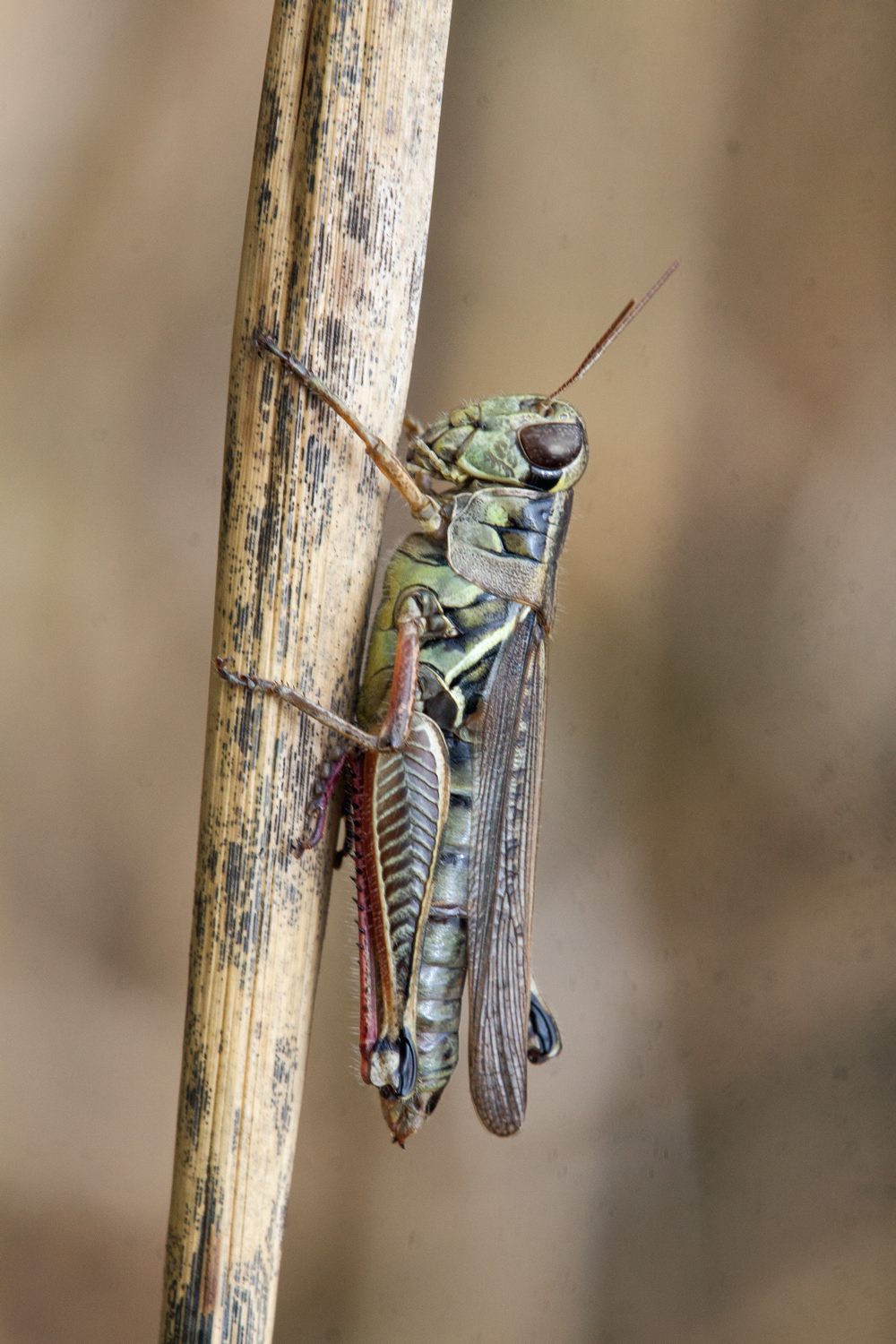
What do adventurous young grasshoppers do for fun? Hopping may be ok for the average grasshopper, but this little guy prefers the adrenaline rush he feels when he scales the sheer face of a rocky cliff with no ropes or other climbing gear.

grasshopper

The truth is a little less exciting than my fiction. The angle was not as steep as it looks in the shot and the “rock” is actually a rotten log.

I still choose to believe that grasshoppers like a little adventure in their lives. Who knows what they do when we are not watching?

© Michael Q. Powell. All rights reserved

Read Full Post »
When damselflies are connected in the tandem mating position, they are large enough to be noticed, especially when they fly right by me, as was the case this past Friday. They were pretty skittish, but I managed to get a couple of relatively clear shots.

My identification task was greatly eased by the fact that these were not one of the multiple blue species that inhabit my local marshland park—there was only a little blue on the tip of the male’s abdomen. Imagine my shock when I learned that these damselflies are Blue-tipped Dancers (Argia tibialis). In my experience, names generally are not that helpful when it comes to identification, but this is an obvious exception.

Sharp-eyed readers may notice that these damselflies look a bit like the one currently featured in the banner of my blog. That damselfly is a Violet Dancer, a subspecies of the Variable Dancer species (Argia fumipennis). Apparently damselflies do a lot of dancing!

If you are interested in seeing some photos and descriptions of the bluet family of damselflies at our local park, check out this recent posting by fellow blogger and photographer Walter Sanford entitled Blue for Bluets.

Blue-tipped Dancer

Blue-tipped Dancer

© Michael Q. Powell. All rights reserved


Read Full Post »

My neighbor, fellow photographer Cindy Dyer, always has such cool-looking flowers in her garden, like these frilly day lilies. Somehow they remind me of the ruffled tux shirts that were in style in the 70’s when I was growing up.

day lilies


© Michael Q. Powell. All rights reserved

Read Full Post »
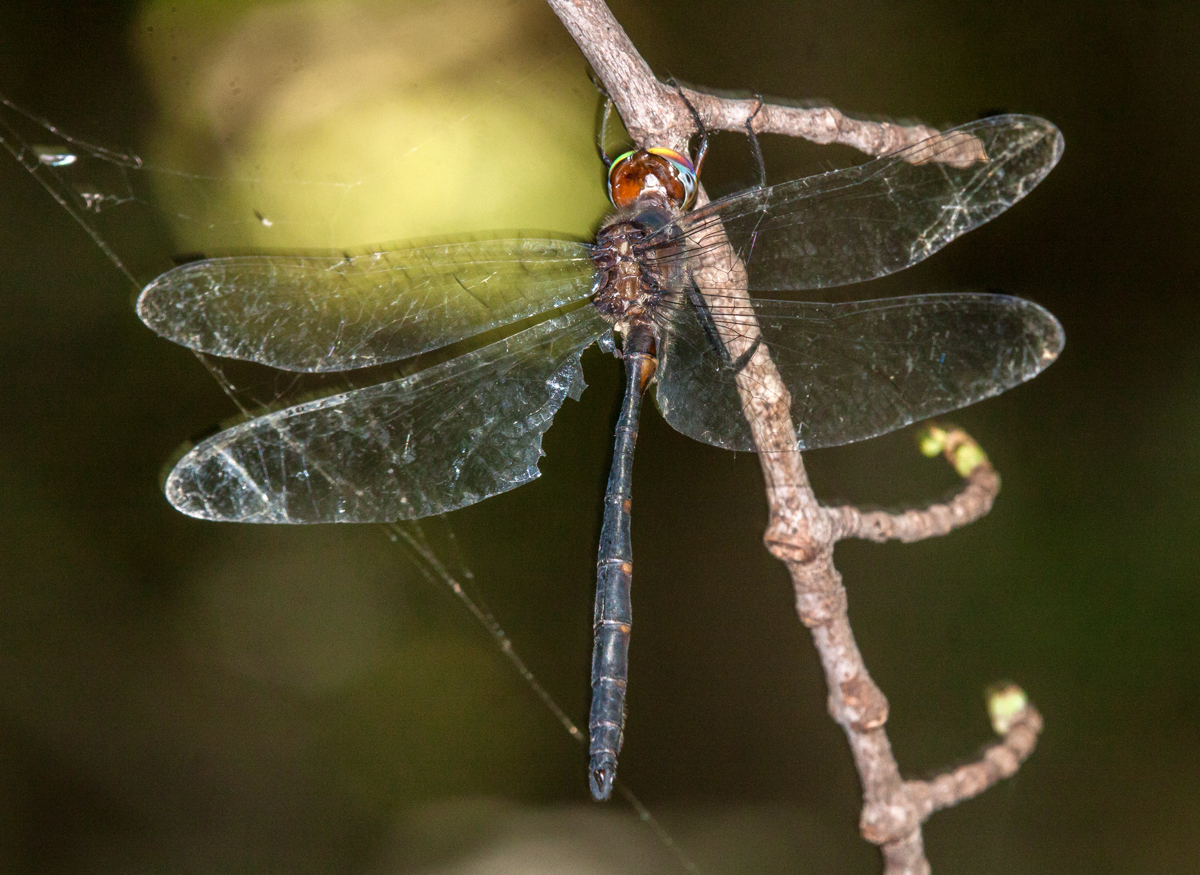
This young male Halloween Pennant dragonfly (Celithemis eponina) let me get close enough to use my macro lens to good effect, but an intermittent light breeze caused him to sway back and forth, greatly increasing the challenge of getting sharp shots.

Halloween Pennants are spectacular dragonflies with their two-toned eyes and patterned wings. They almost always choose to perch at the very tip of flimsy branches and blades of grass and often do look like pennant blowing in the wind.

I included a shot of the entire body of this dragonfly to give you a full appreciation of its wildly wonderful wings.

Halloween Pennant

Halloween Pennant

Halloween Pennant


© Michael Q. Powell. All rights reserved

Read Full Post »

Some movement in the muddy water right below my feet caught my attention yesterday as I was standing at the edge of a small stream at Huntley Meadows Park observing a dragonfly. A Six-spotted Fishing spider (Dolomedes triton) was walking on the water with its legs fully extended.

The other times that I seen one of these fishing spiders, they always had a few legs hanging onto the shore, but this one was moving across the surface of the water pretty quickly, perhaps chasing a potential prey. Unfortunately, overhanging vegetation prevented me from tracking the spider’s movement, so I don’t know if the hunt was successful.

Six-spotted Fishing spider

© Michael Q. Powell. All rights reserved


Read Full Post »

Lotuses are gorgeous flowers when they are in bloom, but the lotus that really drew my attention was this bud that is just starting to open, full of hope and promise, clothed in a sense of mystery and expectation.

lotus bud

© Michael Q. Powell. All rights reserved

Read Full Post »

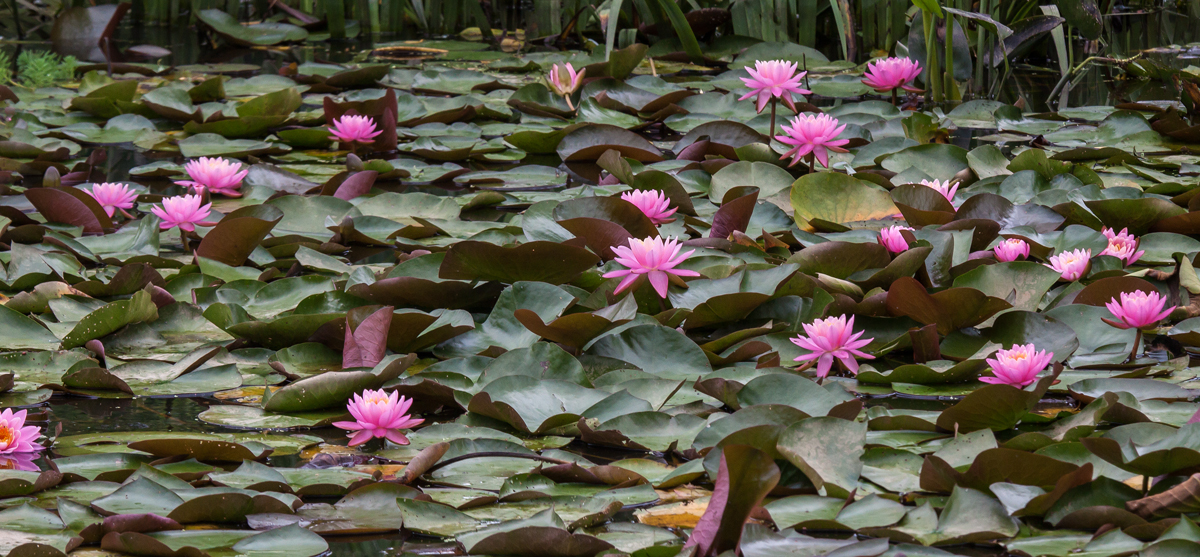
While I was at Kenilworth Park and Aquatic Gardens in Washington D.C. on Monday, it was easy to understand Monet’s endless fascination with water lilies. My opening image of a small wooden bridge brings to mind several of Monet’s paintings of the Japanese Bridge in his water garden at Giverny.

bridge at Kenilworth

Water lilies seem to draw me in and surround me with an overwhelming sense of beauty and tranquility. How can I possibly capture that feeling in a photo? Here are a few images to show you some of the different approaches that I used in attempting to show the irresistible attraction of water lilies.

water lily at Kenilworth

water lilies at Kenilworth

pink water lilies at Kenilworth

© Michael Q. Powell. All rights reserved

Read Full Post »

Dragonflies are colorful and flowers are colorful too, but it’s rare that I get to see the two of them together. I was thus thrilled when fellow photographer Cindy Dyer spotted a colorful Blue Dasher dragonfly (Pachydiplax longipennis) perching on a beautiful purple water lily during our recent trip to Kenilworth Park and Aquatic Gardens in the District of Columbia.

I took some initial shots with the 180mm macro lens that I had on my camera at that moment, but wasn’t really able to fill the frame with my subject and the background was a little distracting. (The second photo below was one of those first shots and it does a pretty good job of highlighting the water lily, but the dragonfly is merely an added bonus.) I couldn’t physically move any closer, because the water lilies were in a cement pond, surrounded by a three foot high wire fence.

I decided to change to a longer lens, though I sincerely doubted that the dragonfly would stay in place. Almost all of the times that I have done a rapid lens change in the field, the subject has departed before I was ready to shot. In this case, however, I got lucky and the Blue Dasher held his perch long enough for me to get a few shots with my 70-300mm lens.

I simply love the color combination of the different shades of blue of the dragonfly and the purple and yellow of the water lily.

Blue Dasher

Blue Dasher

© Michael Q. Powell. All rights reserved


Read Full Post »
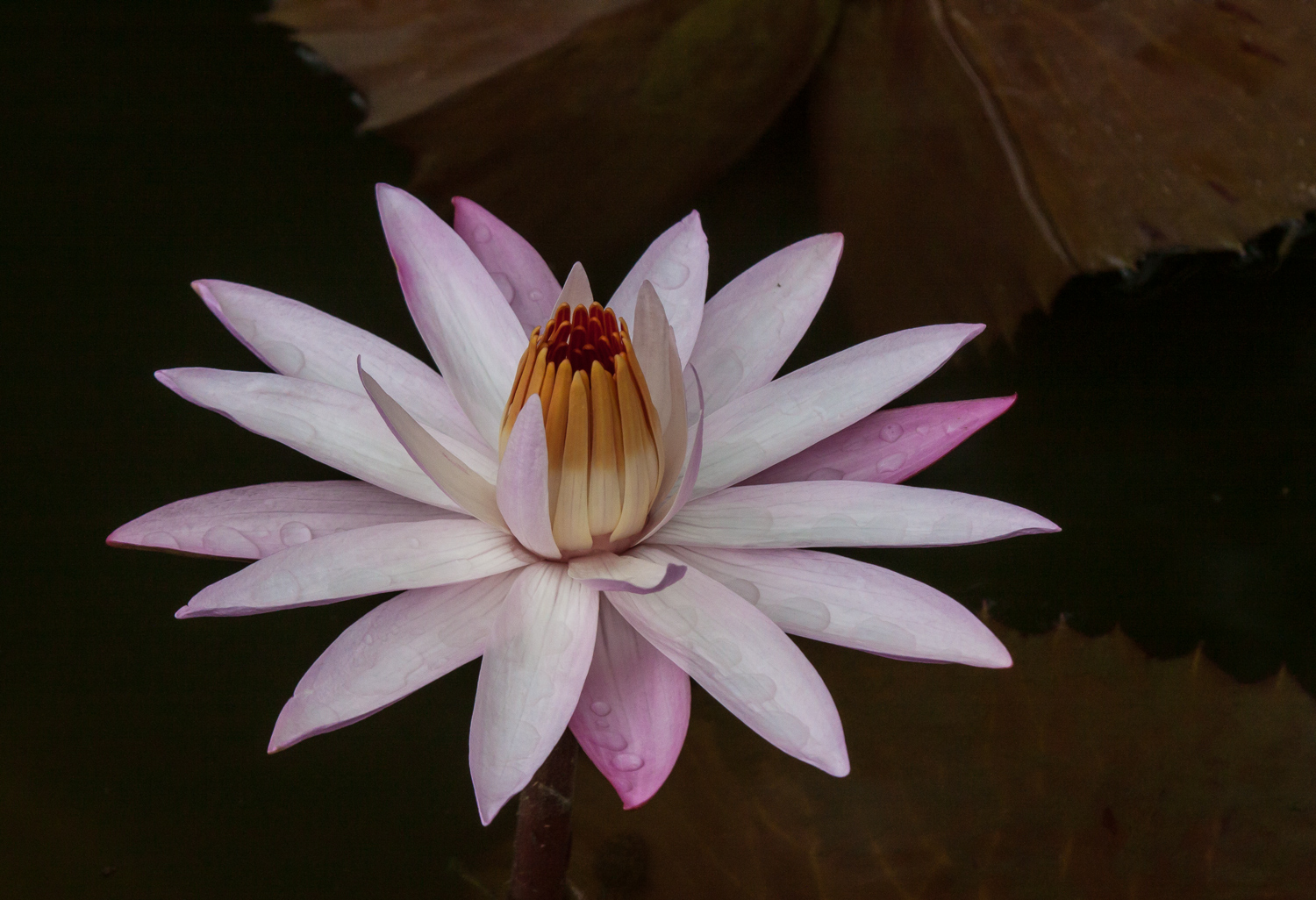
Yesterday morning I made a quick trip to Kenilworth Park and Aquatic Gardens in Washington D.C. with fellow photographer Cindy Dyer to check out the water lilies and lotuses. Many of the pathways in the park are flooded or muddy, thanks to a significant amount of recent rain. Wet feet, however, were a small price to pay to see so many beautiful flowers, including the two spectacular pink water lilies that I am featuring today.

Stay tuned for more water lily and lotus images later this week.

pink water lily

pink water lily


© Michael Q. Powell. All rights reserved

Read Full Post »

Everyone knows that Monarch butterflies love milkweed, but if you move in closer to the plants, you’ll discover a world of fascinating little creatures, like this Red Milkweed Beetle (Tetraopes tetrophthalmus) that I spotted this past weekend at Huntley Meadows Park in Alexandria, Virginia.

Almost three years ago I did a posting in which I acknowledged that I had become obsessed with shooting Red Milkweed Beetles. This weekend I realized that that my initial fascination with my colorful little friends has not diminished much over time when I saw this beetle in a small stand of swamp milkweed. I’m not sure if it is the long antennae or the bold pattern or the bright color that attracts me most—I just know that I love seeing them in all of their developmental forms (they go through several interesting instars as they grow).

The next time you see some milkweed, stop for a moment, examine it closely, and prepare to enter a fascinating little world as the scent of the flowers envelops you.


Red Milkweed Beetle

© Michael Q. Powell. All rights reserved


Read Full Post »
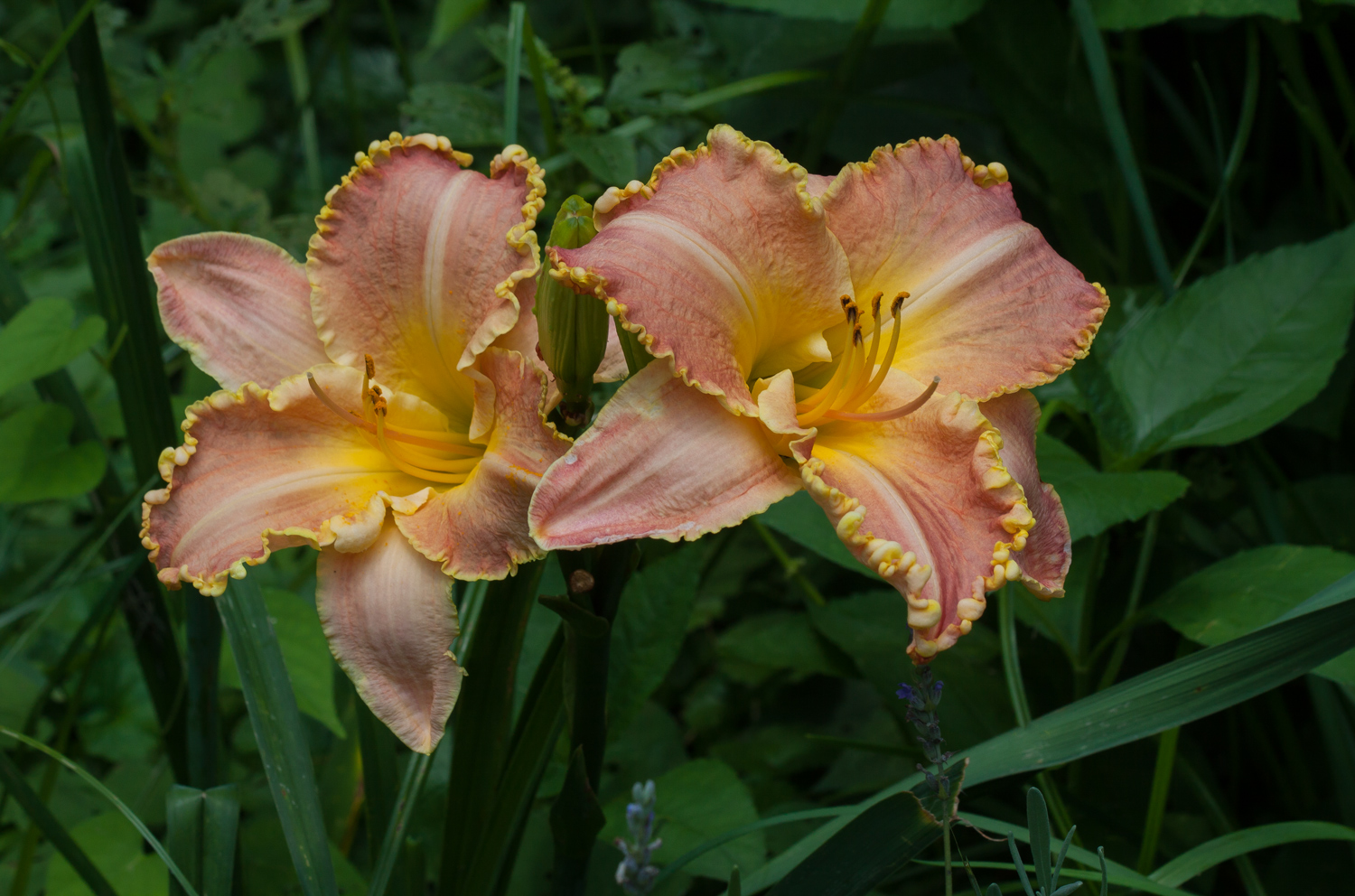
Where do you find beauty in your daily life? I often feel a sense of awe and wonder when I simply contemplate the gorgeous flowers in the garden of my neighbors.

I think the white flowers are a variety of coneflowers and the purple sphere in the upper right corner is a globe thistle.

Coneflowers

© Michael Q. Powell. All rights reserved.

Read Full Post »
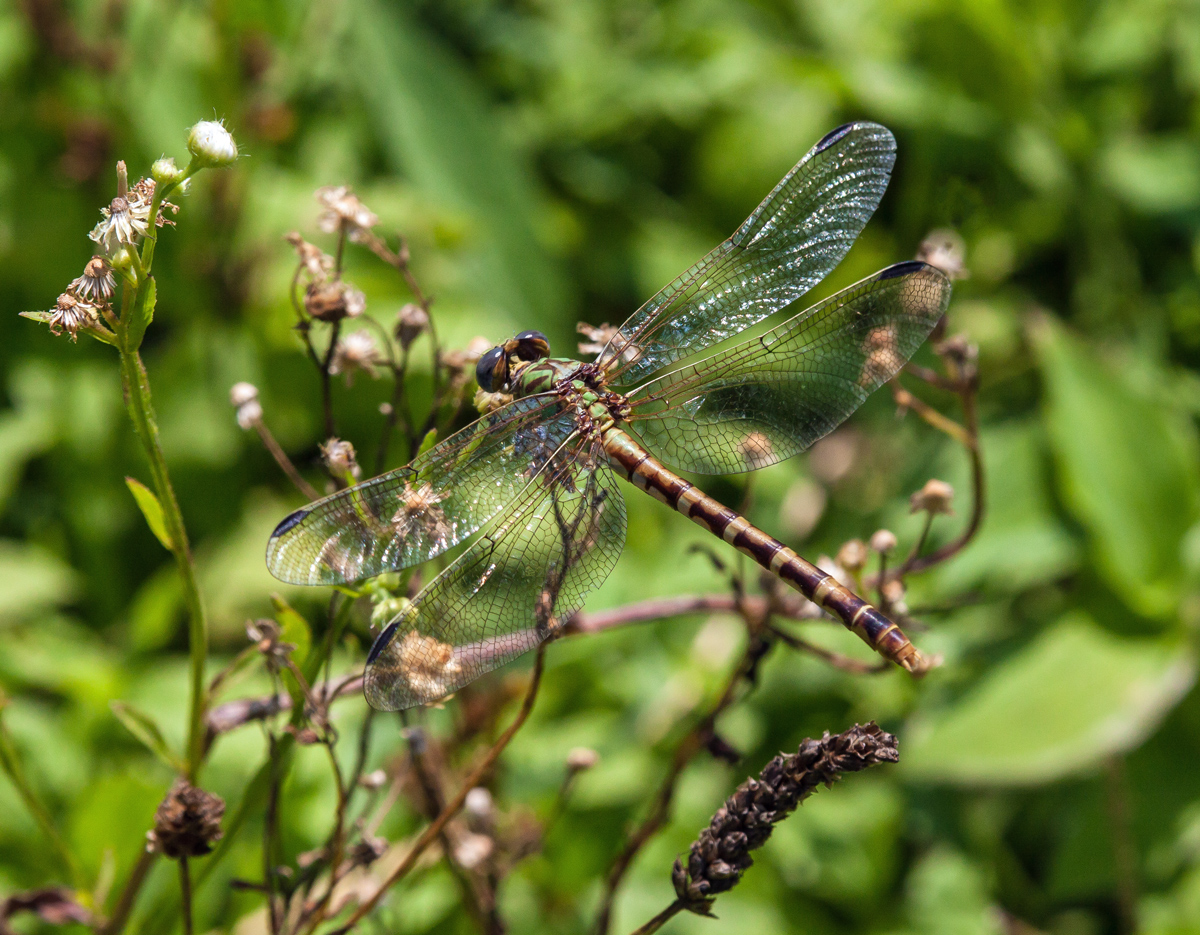
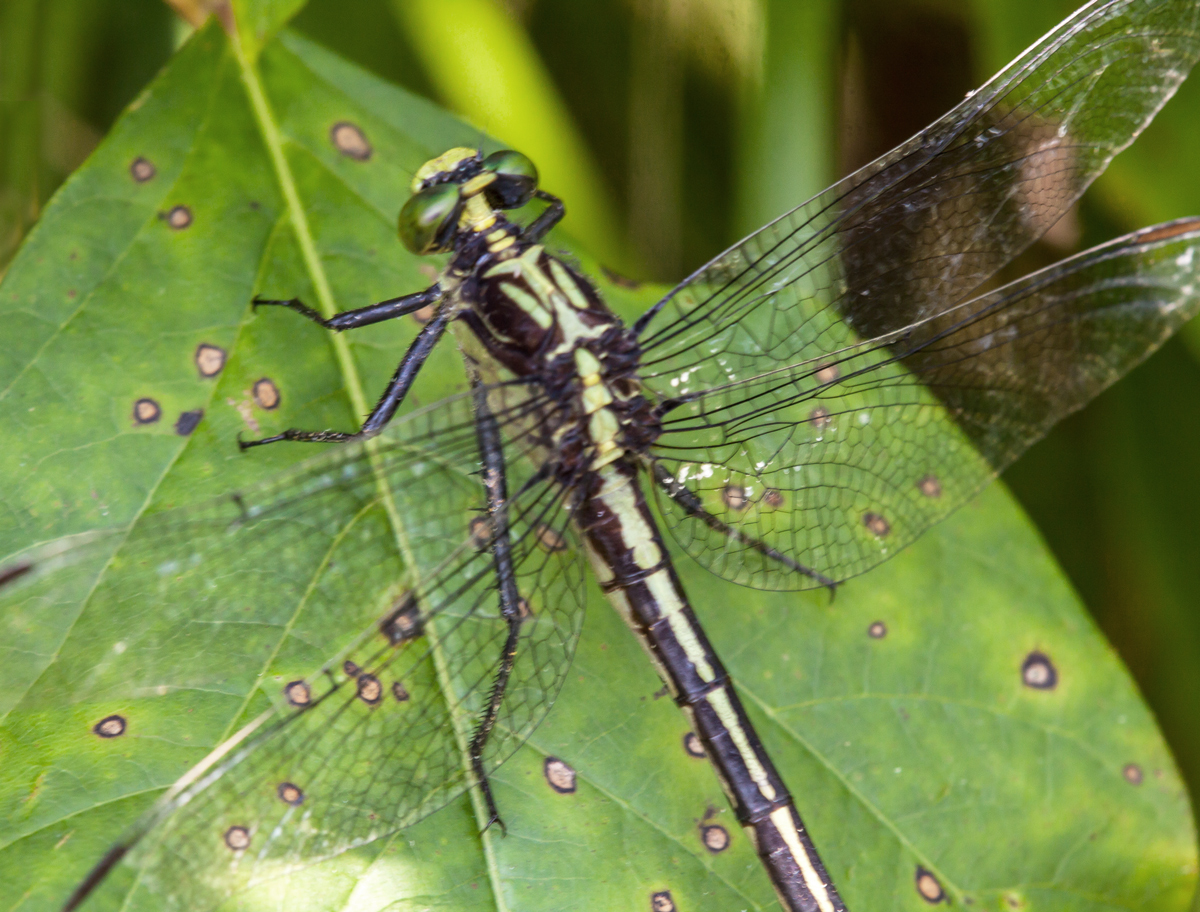
This spring I have been spending more and more time in remote areas of my marshland park and have had the opportunity to see dragonflies in earlier stages of development than in previous years. I was thrilled recently to spot a newly emerged male Common Sanddragon (Progomphus obscurus) and managed to get some shots of it with my macro lens.

Fellow dragonfly enthusiast Walter Sanford did a posting yesterday with some wonderful shots of adult male Common Sanddragon dragonflies and you can refer to that posting if you want to see what a mature male looks like.

When you look at this very young dragonfly, in a stage called “teneral,” a few things stand out. The colors of its eyes and its body are very pale and the wings are really clear. As the dragonfly is exposed to the air and to the sunlight, its colors become more pronounced and its wings more solid.

Many of you know that dragonflies spend most of their lives underwater as nymphs going through a series of transformations. Only in the later stage of their lives do they shed their exoskeletons one last time and become the aerial acrobats that we are used to seeing.

I’ve always wanted to see this transformation taking place, but have not yet had the chance to do so. When I was sharing this images with a friend, though, he pointed out something which I had missed—the dragonfly is perched on its cast-off skin. In the final photo, you can see that the dragonfly is now more than twice as long as when he first emerged, with a significantly lengthened abdomen. In the two close-up shots, it looks like the dragonfly’s front legs are astride the head of the exoskeleton and I think you can actually see the two eyes.

I am in awe when I think of the incredible metamorphosis that has just taken place and find this dragonfly, like all newborns, to be amazingly beautiful and precious.

Common Sanddragon

Common Sanddragon

Common Sanddragon

Michael Q. Powell. All rights reserved.

Read Full Post »

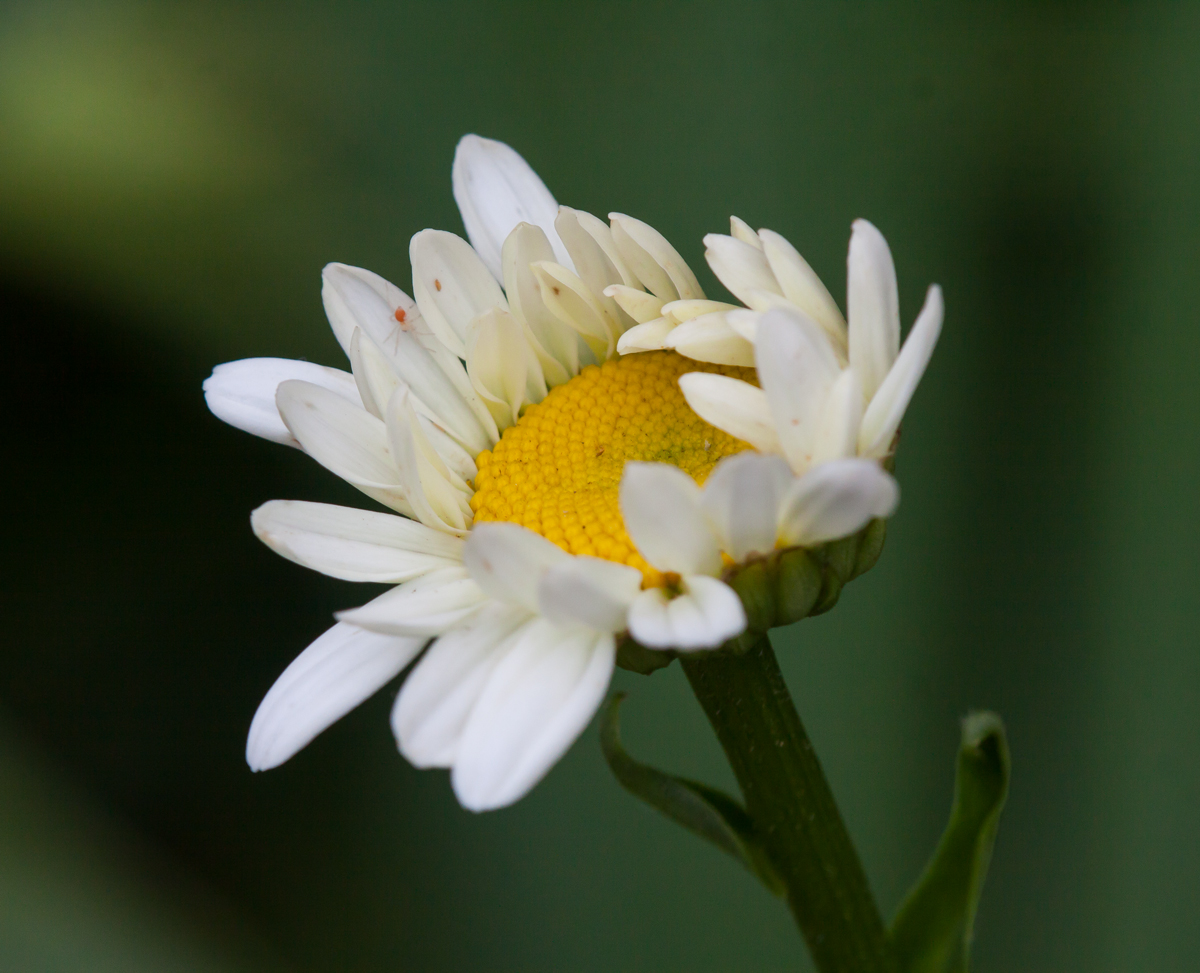
Shy or coy? Whatever the reason, this Shasta daisy seemed reluctant to reveal its whole self to the world and kept a row of petals raised like a fan to add protection and/or mystery.

Sharp-eyed viewers may note that this image has a “bonus bug,” i.e. an insect that you find when processing a photo that you didn’t notice when taking the shot. In this case there looks to be a tiny red insect on one of the white petals to the left of the tallest petal in the uppermost row of petals. (You may need to click on the photo to get a higher-resolution view.)

This is another photo that I took in my neighbor’s garden. Thanks, Cindy.

shy1_june_blog

Michael Q. Powell. All rights reserved.

Read Full Post »

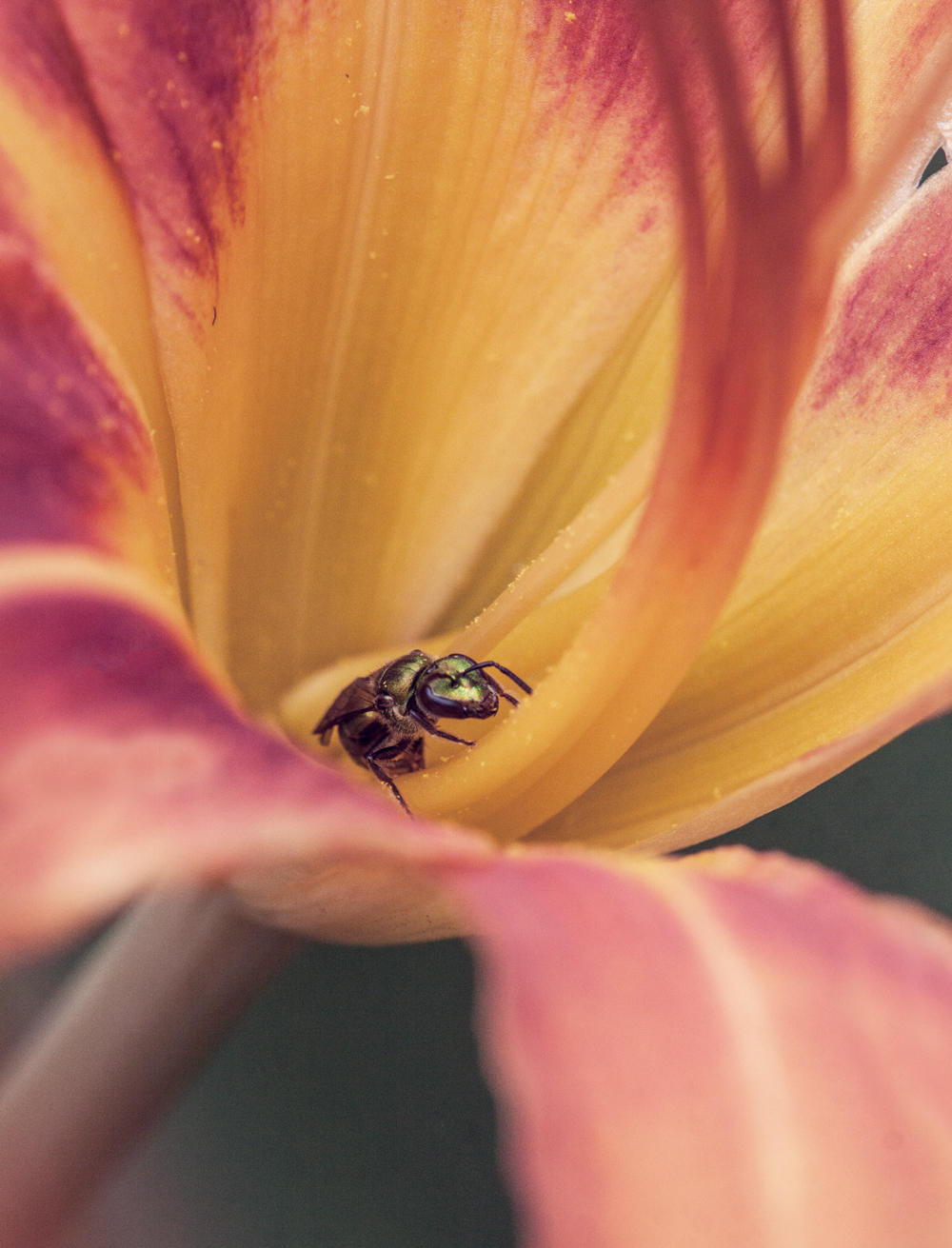
I don’t have a garden, but fortunately my neighbor and fellow photographer Cindy Dyer has a wonderful one. Earlier today I photographed this green metallic sweat bee (genus Agapostemon) coming out of one of her orange daylilies.

green metallic sweat bee

Michael Q. Powell. All rights reserved.

Read Full Post »

Simple compositions are often the basis for my favorite images. My subject was a Blue Dasher dragonfly (Pachydiplax longipennis), one of the most common dragonflies in our area. The vegetation on which it chose to perch was nothing special. Somehow, though, the shapes and colors of these elements work together to create an image that I find really pleasing.

Blue Dasher

Michael Q. Powell. All rights reserved.

Read Full Post »
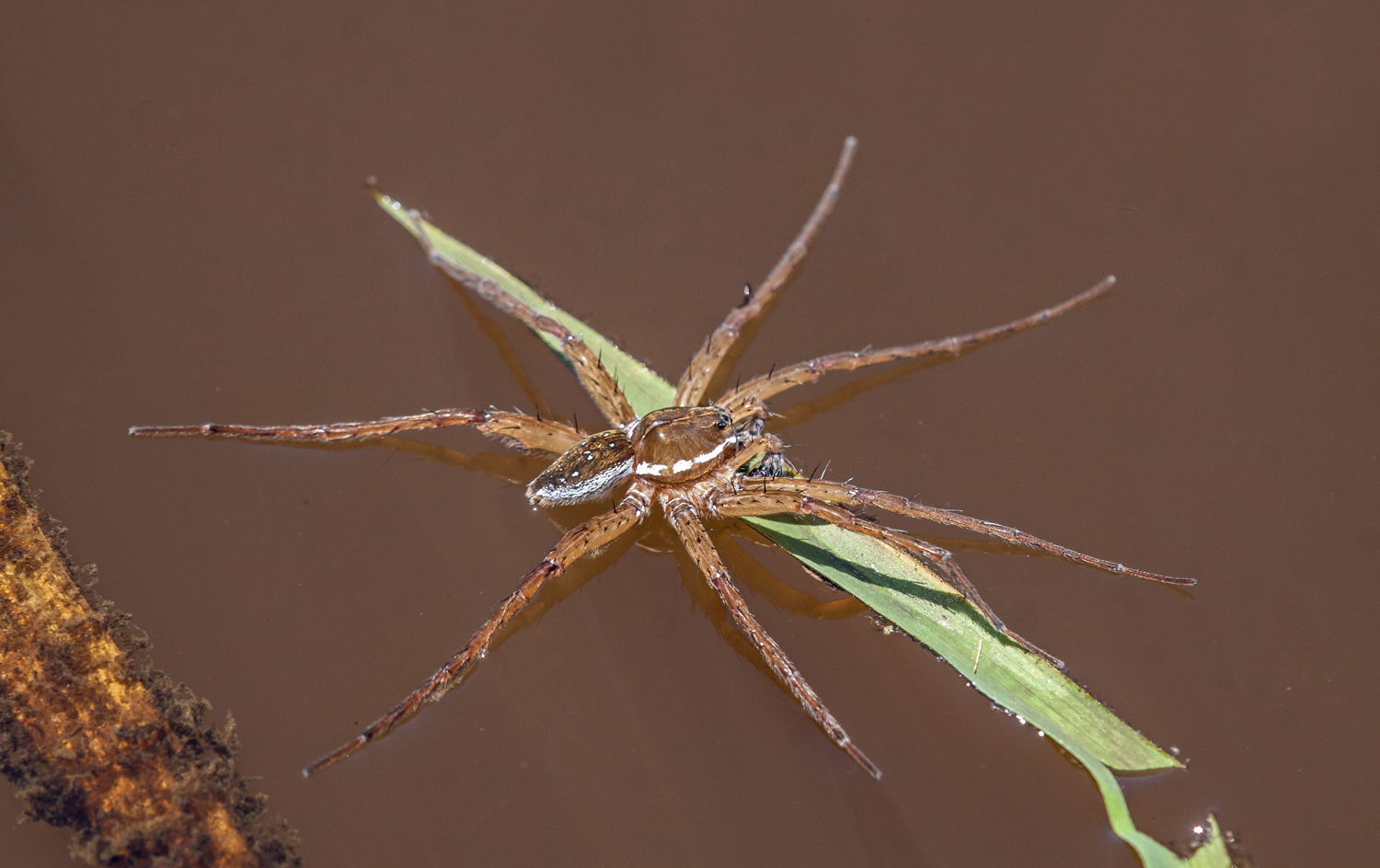
A Silver-spotted Skipper butterfly (Epargyreus clarus) kept returning to these purple flowers yesterday at the edge of a small pond at Brookside Gardens in Wheaton, Maryland. I am not sure what kind of flower this is, but the Silver-spotted Skipper, the only skipper that I can reliably identify, really seemed to like it.

Some of my fellow photographers with whom I traveled to the gardens really enjoy photographing flowers—I seem to have reached a point at which I enjoy shooting flowers primarily as a beautiful backdrop for showcasing insects.

There are a lot of gardens in the Washington D.C. area that provide for wonderful photographic opportunities, many of which, like this one, have no admission fee. Although I really enjoy shooting at the marshland park that I feature here so often, it’s nice to venture out a little for a bit of variety.

Silver-spotted Skipper

Michael Q. Powell. All rights reserved.


Read Full Post »

As a wildlife photographer, I sometimes wonder what it would be like to be a studio photographer. Imagine being able to control the intensity and direction of the light, to choose my own background, to have a responsive subject, and to be able to move around and carefully compose images in my viewfinder. What if there were no wet grass or thorns or mosquitoes or ticks? Perhaps a studio photographer has a sense of control—a wildlife photographer lives in a world of unknowns, never knowing for sure exactly when and how a shooting opportunity will present itself nor how long it will last.

This is the time of the year when I focus my attention and my camera on tiny subjects and dragonflies and damselflies are among my favorites. Some of them are pretty accommodating subjects and will perch and pose, though many are elusive and hard to capture.

I sometimes struggle with the question of how to create cool and dramatic shots of these beautiful little creatures. How do I capture then in action, especially when I am so often using a macro lens and shooting at close range?

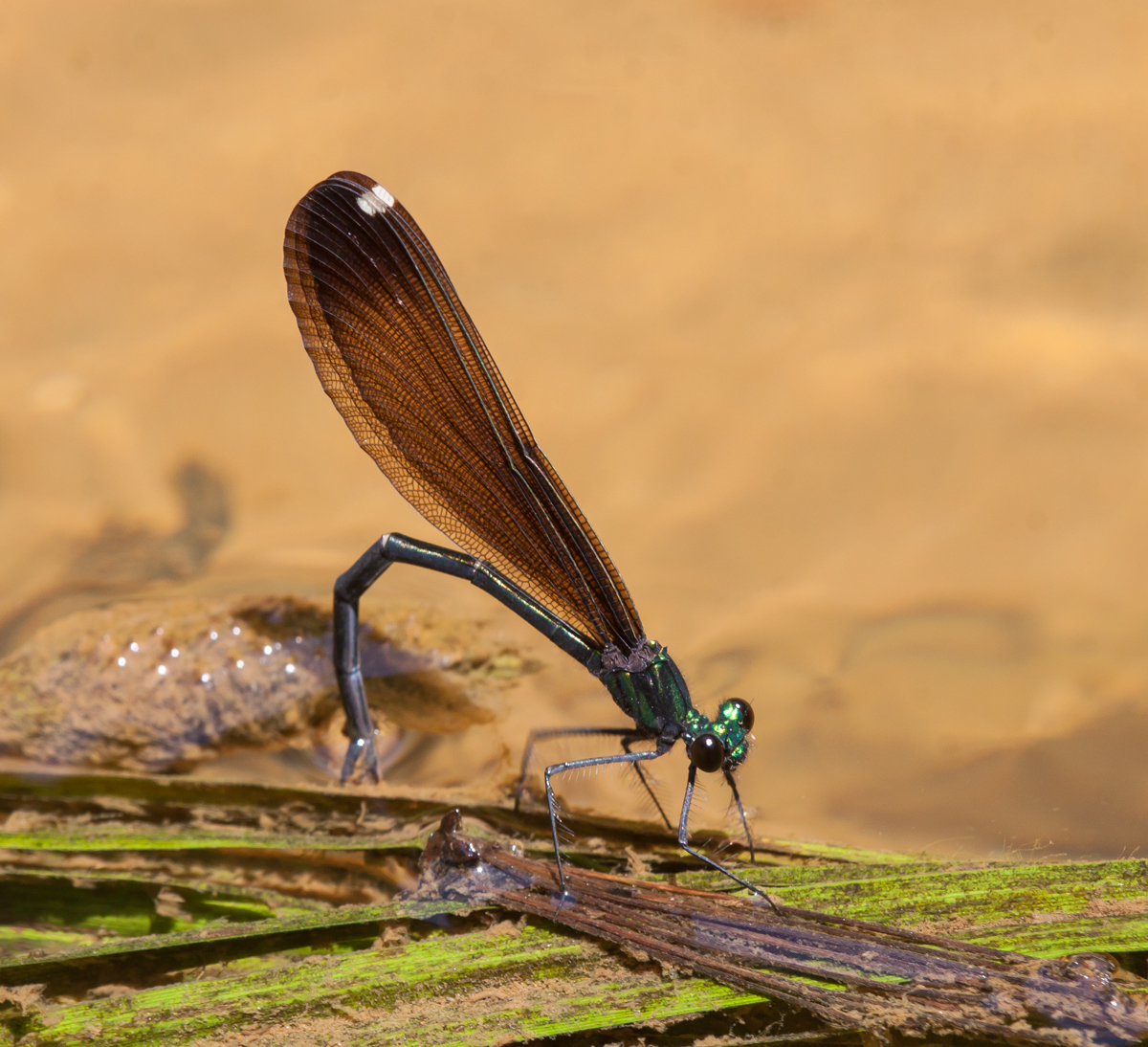
I wish I had an answer to these questions, a magical formula that would guarantee great results, but, of course, I don’t. Sometimes, though, things do come together and magic happens. That’s what I felt this past Monday when I was out looking for dragonflies. I was crouched on the wet sand trying to get some shots of a Common Sanddragon dragonfly, when a female Ebony Jewelwing damselfly (Calopteryx maculata) landed a few feet in front of me and began to oviposit in the vegetation at the edge of a small stream.

I was at a good distance to use the 180mm macro lens that I had on my camera. The lighting and background were beautiful. My subject was isolated, but there was enough of the environment in the foreground to give a sense of the location (and the green of the moss was wonderful).

Is it possible to create a dramatic macro action portrait with a two inch (50 mm) subject? For me, it’s rare that I am able to pull it off, but I’d like to suggest that it does happen and offer this image as evidence.

I go out with my camera with the hope that situations like this will arise in the uncontrolled environment in which I like to operate. I live for those moments.

Ebony Jewelwing

Michael Q. Powell. All rights reserved.

Read Full Post »

Where can I find a Common Sanddragon dragonfly? As its name suggests, this species is most often found  on the sandy banks of a stream and that is precisely where I found one earlier this week at my local marshland park.

Common Sanddragon

Almost exactly a year ago I stumbled onto a Common Sanddragon (Progomphus obscurus) as I wandered through a remote area of the park, so I had a pretty good idea where to look for one this year. That find was especially cool, because it was the first time that the species had been spotted in the park and it has since been added to the species list for Huntley Meadows Park.

However, this was not the first Sanddragon that I spotted this spring. A week earlier, I spotted one in the marsh vegetation, about halfway between the treeline and a little stream. It was definitely unusual to see this dragonfly away from the sand and perching above the ground.

Common Sanddragon

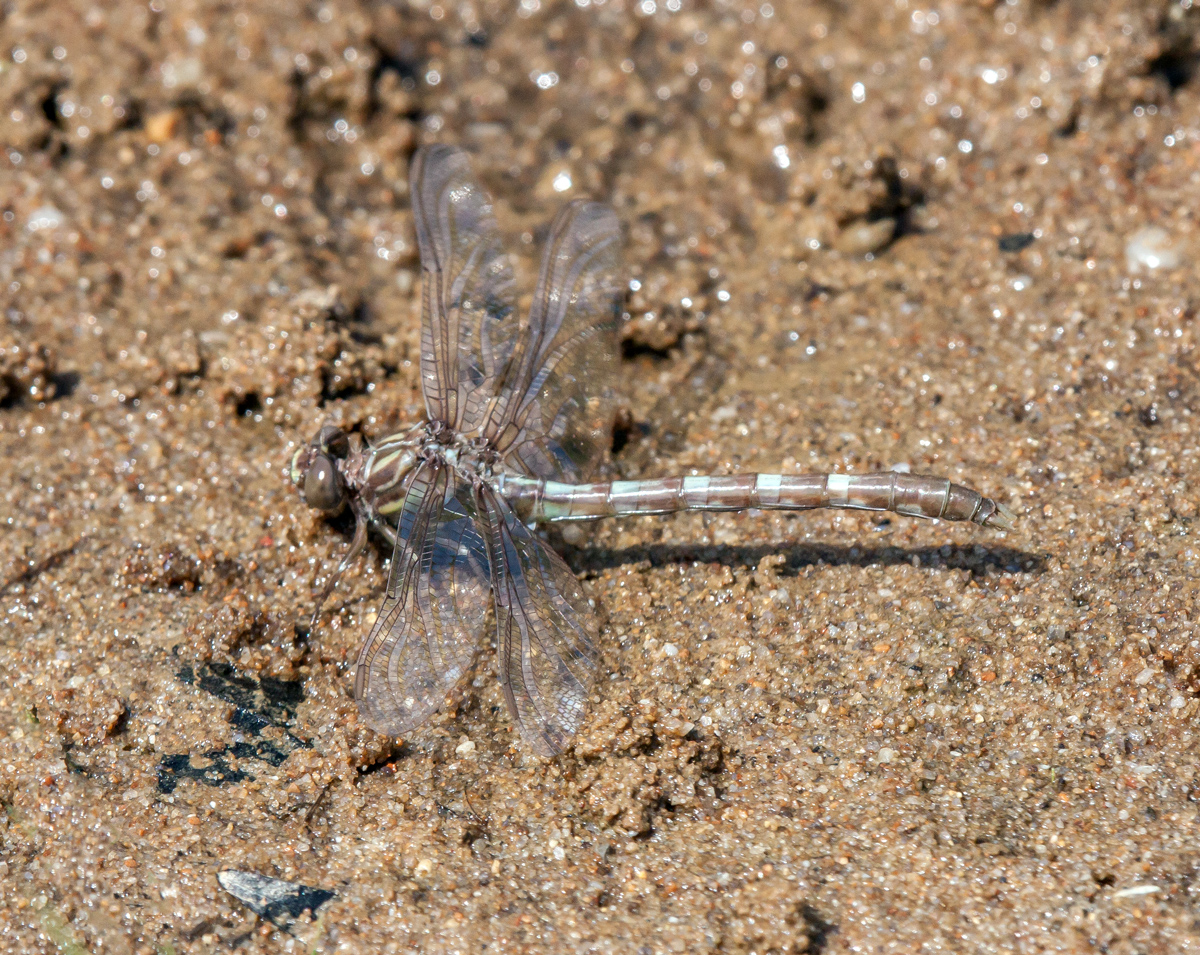
That find was unusual, but it was perhaps not as unusual as the teneral male Common Sanddragon that I saw the same day as the dragonfly in the first image. When dragonflies shed their exoskeletons and are transformed from aquatic nymphs to acrobatic flyers, they are initially pale in color and their wings are very fragile and shiny. The coloration on this one was so much different from that of a mature adult, that I had to consult with a more experienced friend to reassure myself that this in fact was a Common Sanddragon.

Common Sanddragon

I went out yesterday morning to search again for Common Sanddragons and was disappointed to see that all of the sandy banks were under water following several days of rain. Perhaps I will have better luck today.

Michael Q. Powell. All rights reserved.

Read Full Post »

I wouldn’t have thought that a moth would taste very good, even for a dragonfly, but this young male Eastern Pondhawk (Erythemis simplicicollis) would probably disagree.

I knew that dragonflies are fierce predators and ate other insects, but somehow I didn’t imagine that their diet included moths, which I would think would be dry and not have much nutritional value.

Of course, I have been known to consume chicken wings, which require a lot of work in order to get a very small amount of meat, so who am I to criticize a dragonfly’s diet. I might offer him one suggestion—the moth would probably taste better if he coated it with a spicy sauce.

Eastern PondhawkEastern Pondhawk

© Michael Q. Powell. All rights reserved.


Read Full Post »

« Newer Posts - Older Posts »