Feeds:
Posts
Comments

Posts Tagged ‘Sigma 135-400mm telephoto zoom lens’

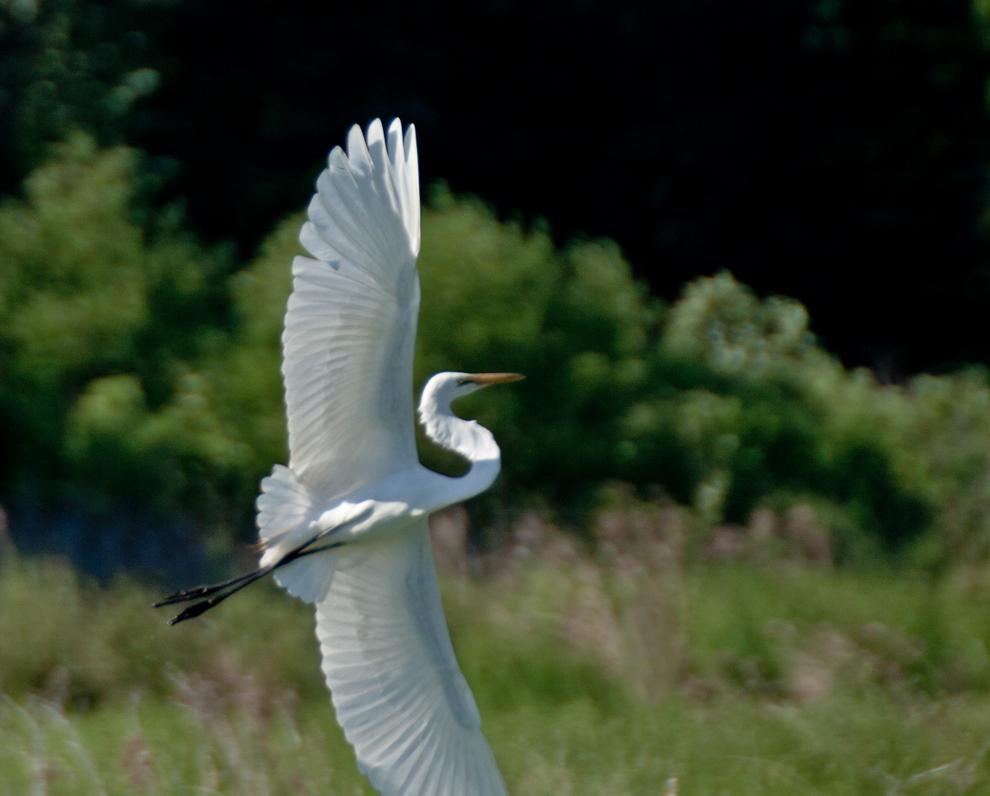
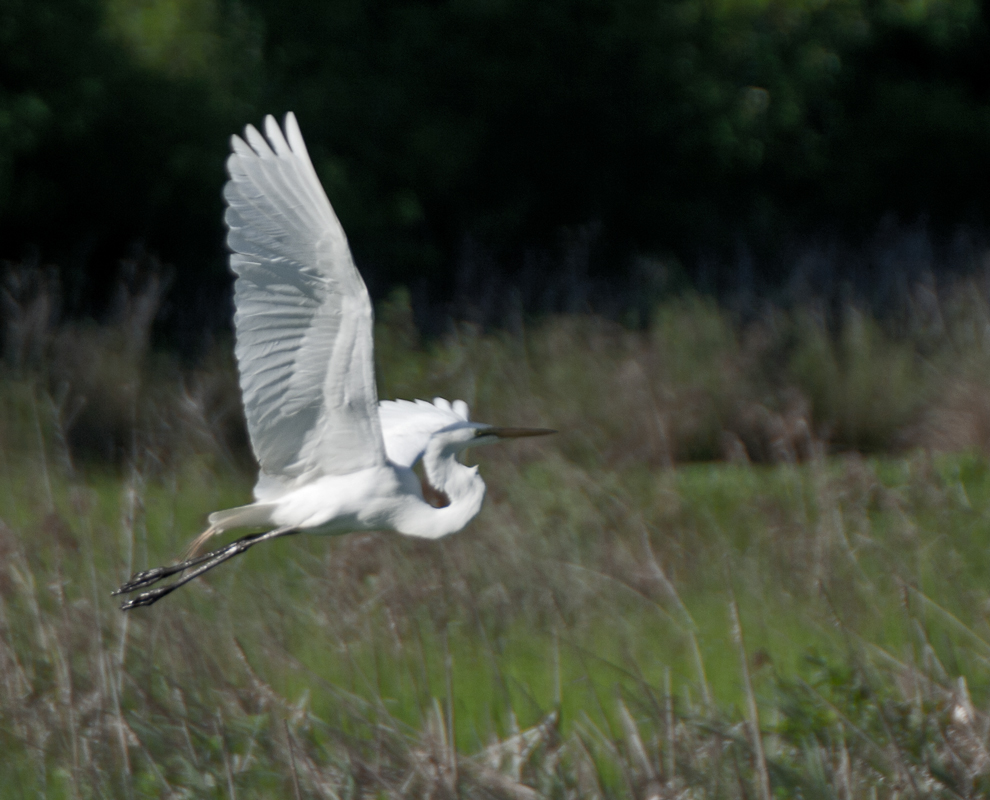
Although I observed as many as eight Great Egrets (Ardea alba) foraging at the same time in my local marshland park this weekend, they were mostly in the distance, but I came up one that was closer and got these shots as it was taking off.

The Cornell Lab of Ornithology notes that these birds have “impressive wingspans,” and I was really treated to a display of those wings. The wings were spread so wide, in fact, that I couldn’t fit them entirely in the frame in the first photo. The impressive set of wings in the second photo remind me of those were associated with Pegasus, the mythological winged horse.

egret_wings2_blogegret_wing1_blog

Michael Q. Powell. All rights reserved

Read Full Post »

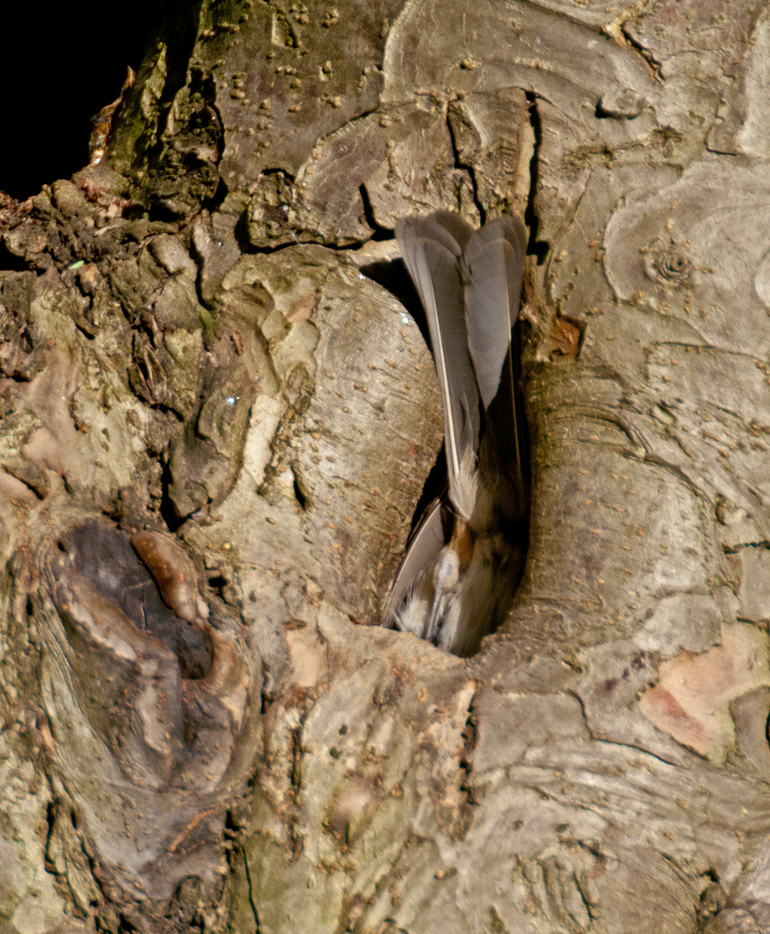
As I stalked the nest of the rescued baby bird featured in a posting last week, hoping to catch sight of its parents, I took this shot. Can you identify the bird from this photo of it entering the nesting cavity?

mom7_blog

Let me back off a little and explain. The nest in question is inside of a crabapple tree in the front yard of a neighbor’s house, about a yard or so (one meter) above the ground. There are two openings and you can sometimes see the baby birds’ heads pop up through the lower opening, which serves as a window. I learned that the upper opening serves as an entry door for the parents. This is one of my initial shots with my 100mm macro lens of the tree, with one of the parents entering the “door.”

mom9_blog

I came back at a later time with my 135-400mm lens and set up my tripod on the sidewalk and waited. It was mid-afternoon and the sun was shining almost directly into the opening, which complicated the exposure, but my patience was rewarded when the parents made multiple trips into the nest. This is another shot of one of them entering the nest, which you can see is a pretty tight squeeze.

mom5_blog

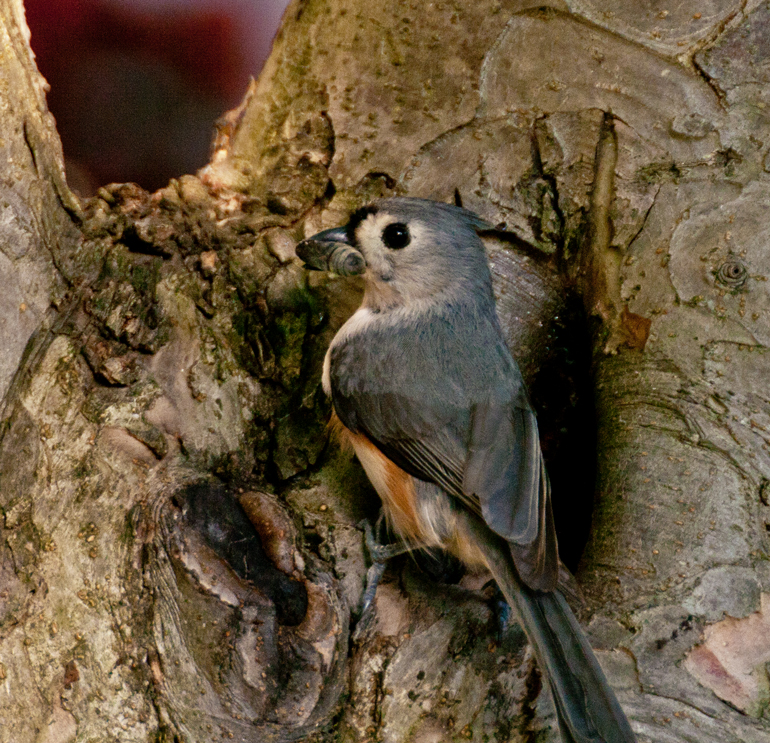
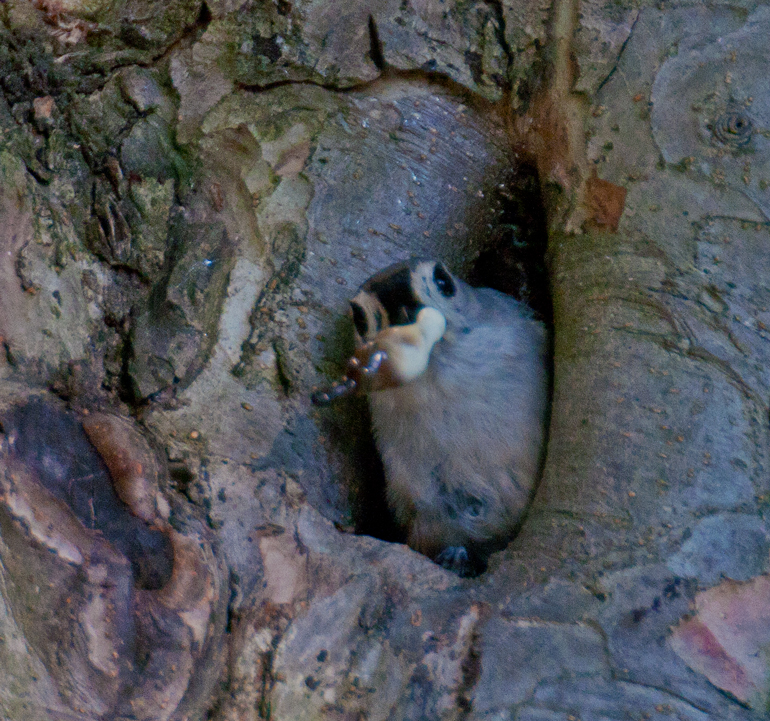
I am not that great at making bird identifications from the rear, so my job was greatly facilitated when one of the birds paused and turned to the side prior to entering the nest. The mystery birds are Tufted Titmice (Baeolophus bicolor). I can’t quite figure out what the little bird has in its bill, but assume that it is something edible. Can anyone else tell what it is?

mom1-BLOG

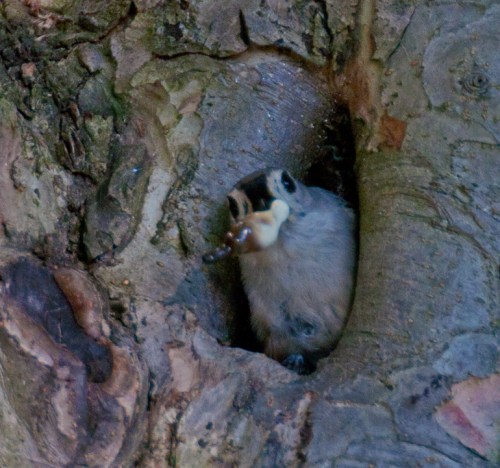
Timing was tricky as I tried to maintain my focus and the sidewalk was not all that comfortable. (I should bring a cushion next time.) Sometimes the parents would signal their imminent arrival with a call, but sometimes they would fly in out of nowhere. I attempted to capture the birds flying in and then flying out of the nest. Here is one of the few shots I was able to get of one of the parents preparing to leave the nesting cavity.
mom2_blog

Sometimes when processing my photos, I come across one that I really like, even though it has all kinds of technical problems. I decided to end this posting with such a photo. The bird has already flown out of focus, but is clearly visible and is casting a cool shadow just below the entry into the nest.

mom6_blog

Michael Q. Powell. All rights reserved

Read Full Post »
Yesterday was cloudy and rainy and the wildlife seemed to have sought shelter, but I spotted one bird circling over the largest body of water at my marshland park. Judging from the way that it flew, I initially thought it might be some kind of seagull.

From different angles, though, it looked a little bit like some kind of a hawk. I managed to get some photos of the various wing positions while the bird was flying and find them to be fascinating. Eventually I got a somewhat blurred shot of the entire bird and have concluded that it probably is an osprey (Pandion haliaetus), a bird that I have never before encountered, but definitely one I hope to see again in the near future.

osprey1_blogosprey5_blogosprey3_blogosprey4_blogosprey2_blog

Michael Q. Powell. All rights reserved

Read Full Post »
When I was a boy, I had hair that would stand up in a cowlick and refuse to lie flat, and that’s what I immediately thought of when I saw this Tree Swallow (Tachycineta bicolor) with frizzy feathers.

My Mom’s solution to my hair problem was a little saliva on her fingers that she would apply to my hair and smooth it down.

I thought of doing the same to this little bird, but I am not sure that it would appreciate my efforts.

frizzy_blog

Michael Q. Powell. All rights reserved

Read Full Post »
Spotting the camera around my neck, an attractive young lady excitedly pointed out this frog to me, calling it a “Hollywood Frog,” because it reminded her of the ones in the movies.

I couldn’t resist asking her if she was going to kiss the frog to see if it would turn out to be a prince. She smiled a little, shook her head, and responded, “No, I’ve already kissed my fair share of frogs.”

greenfrog_blog

Michael Q. Powell. All rights reserved

Read Full Post »

Six-spotted Fishing Spiders (Dolomedes triton) are a particularly fascinating kind of spiders and I was really excited to see one yesterday at my local marsh.

Fishing spiders don’t build a web, but use the surface of the water in the same way that other spiders use a web. They extend some of their legs onto the surface of the water and when they feel the vibrations of a prey, they run across the surface of the water to snatch it. According to Wikipedia, the very sensitive hairs on their legs and feet help them to interpret the vibrations they sense and determine distance and direction. Their eyes play a secondary role in hunting, particularly because they do much of their hunting at night.

This spider was a couple of feet below the level of the boardwalk and several feet away and I was able to use my tripod to help steady the shot. In fact, the spider was cooperative enough that I made attempts with my 135-400mm zoom, my 55-250mm zoom, and my 100mm macro lens. Of the images that I am posting, the first image was shot with the longer zoom and the second with the macro lens. The macro lens let me hang over the edge of the boardwalk a little, which let me get a little closer, but made it tough to brace myself.

If you want to see a few more images of these interesting spiders, check out my previous postings Fishing spider waiting for prey and Fishing in the swamp.

fishing_spider1_blogfishing_spider2_blog

Michael Q. Powell. All rights reserved

Read Full Post »

I love taking photos of frogs (I can blame the Muppets and Kermit the Frog) and captured this image of a Northern Green Frog (Rana clamitans melanota) this morning at my local marshland park. I am not sure what was floating on the surface of the water, but it provides a nice contrast to the color of the frog.

frog2_blog

Michael Q. Powell. All rights reserved

Read Full Post »
I captured this close-up image of a Barn Swallow (Hirundo rustica) as it rested on a perch a short distance from the location of its nest, underneath a raised portion of the boardwalk at my local marshland park.

I have posted a number of close-up shots of Barn Swallows in the last few weeks (including one that I entitled Too Close), but this one is distinctive for a couple of reasons. The swallow is in the midst of working on its nest, and the mud and twigs in its bill show clearly its primary building materials. Most of my other photos have showed a swallow posing as it took a break from chasing insects.

The other notable feature of this image that I really like is its narrow depth of field. Although I included the sparrow’s entire body in the shot, only a small part of it is in sharp focus, essentially the forward half of its head, including the one visible eye. I think that the limited area of sharp focus really helps to draw attention to the eye and to the muddy bill.

closer_blog

Michael Q. Powell. All rights reserved

Read Full Post »
Although I never saw the Tree Swallow (Tachycineta bicolor) enter the nesting box, she poked her head inside of it and was checking it out as a prospective home.

box1_blog

Michael Q. Powell. All rights reserved

Read Full Post »

I was thrilled yesterday when I spotted this Red-spotted Purple butterfly (Limenitis arthemis astyanax), which brought to mind the two things that bothered me about this butterfly last year when I first encountered it.

The first thing is that the name makes no sense at all—there is not purple at all in the Red-spotted Purple butterfly. Secondly, I recalled that it was almost impossible to get a photogenic background with this butterfly. Bugguide notes that adult butterflies of this type take moisture from mud puddles, rotten fruit and animal feces and last year I always found them in the latter situation. I guess I should be happy that the background for these photos was a concrete path!

I took these shots with my telephoto zoom at close to 400mm and realize the limitations of the lens for this type of shot. Most significantly, I couldn’t get close enough to be able to frame this better and the size of the lens limited my agility, the more so because I had it on a tripod. Still, I am happy to capture colors like this that always help to brighten my day.

butterfly2_blogbutterfly1_blogbutterfly3_blog

Michael Q. Powell. All rights reserved

Read Full Post »

This tiny shorebird cooperated for me by posing on the boardwalk, allowing me to determine that it is a Least Sandpiper (Calidris minutilla), the smallest shorebird in the world.

Shorebirds are notoriously hard to identify, because so many of them are similar in coloration and relative size is a tough measure when a bird is not in a group. For small sandpipers, the color of the  legs is one of the key distinguishing characteristics. In this case, the yellow legs help to identify it as a Least Sandpiper and not a Western or Semipalmated Sandpiper, which have black legs. I am definitely no expert on this subject (and have no clue what Semipalmated means), but the articles on the Cornell Lab of Ornithology website are full of fascinating information about birds.

Eventually the sandpiper jumped into the water, but remained close to the shore, as if it knew that I wanted to get a few shots before it flew away. I can’t overemphasize how small this bird is at about 6 inches (15 cm), especially compared to something like a Greater Yellowlegs at 14 inches (36 cm), so I was glad it was not immediately spooked by my presence.

As someone who pays a lot of attention to grammar, I must confess that I find the name of this bird a little troubling. There seems to be be a missing adjective to go with the superlative “least.” However, I have given up trying to understand the reasoning behind the names of birds—the names are a hodgepodge of approaches, certainly not a scientific method.

The correctness of the name is the least of my worries when trying to photograph these small birds.

least2a_blogleast1a_blog

Michael Q. Powell. All rights reserved

Read Full Post »

Although it is usually best not to take head-on shots of birds, I can’t help but post this image of a Barn Swallow (Hirundo rustica) looking at me with angry eyes. I don’t know if the swallow qualifies as an Angry Bird, but there is no denying the intensity of the stare.

I grew up with the music of Loggins and Messina and one of their popular songs entitled “Angry Eyes”  opens with these words:

Time, time and again
I see you staring down at me
Now, then and again
I wonder what it is that you see

With those angry eyes
Well, I bet you wish you could cut me down
With those angry eyes

(Lyrics from www.elyrics.net)

What does go on in the minds of barn swallows when they encounter us?

eyes_blog

Michael Q. Powell. All rights reserved

Read Full Post »

Swans have Swan Lake, so why shouldn’t shorebirds have Shorebird Ballet?

It looked like these Lesser Yellowlegs (Tringa flavipes) were practicing their dance moves in the water one day recently. As you can see, it requires great balance and, as the second photo shows, attention to the foot position—you have to keep the toes pointed. (One or more of these might be Greater Yellowlegs (Tringa melanoleuca), but my identification skills are not honed enough to be able to distinguish between the two with any great certainty.)

You can’t turn on the television these days without seeing commercials for dance competition programs like Dancing With the Stars or So You Think You Can Dance.  These birds could be at the leading edge of a new dance craze, Dancing With the Birds.

They already have a leg up on their competition.

ballet2_blogballet1_blog

Michael Q. Powell. All rights reserved

Read Full Post »

All alone, this Hooded Merganser duckling sought refuge on a floating log, separated from his family. I don’t know for sure what happened to the rest of the ducklings and the mother, but I had heard some reports of dwindling numbers of ducklings.

The duckling seemed to feel safe on the log and appeared to relax a little, but kept looking forlornly out into the distance. Eventually he was joined by a turtle on the log. For a brief moment, perhaps, he felt a little less alone. Deep inside, though, he felt a desire to grow stronger, so he stretched out his wings, fervently believing that someday he would be able to fly.

Alone_blog

Where are the others?

alone2_blog

Feeling a little more comfortable

alone3_blog

Someday I’ll be able to fly

Michael Q. Powell. All rights reserved

Read Full Post »

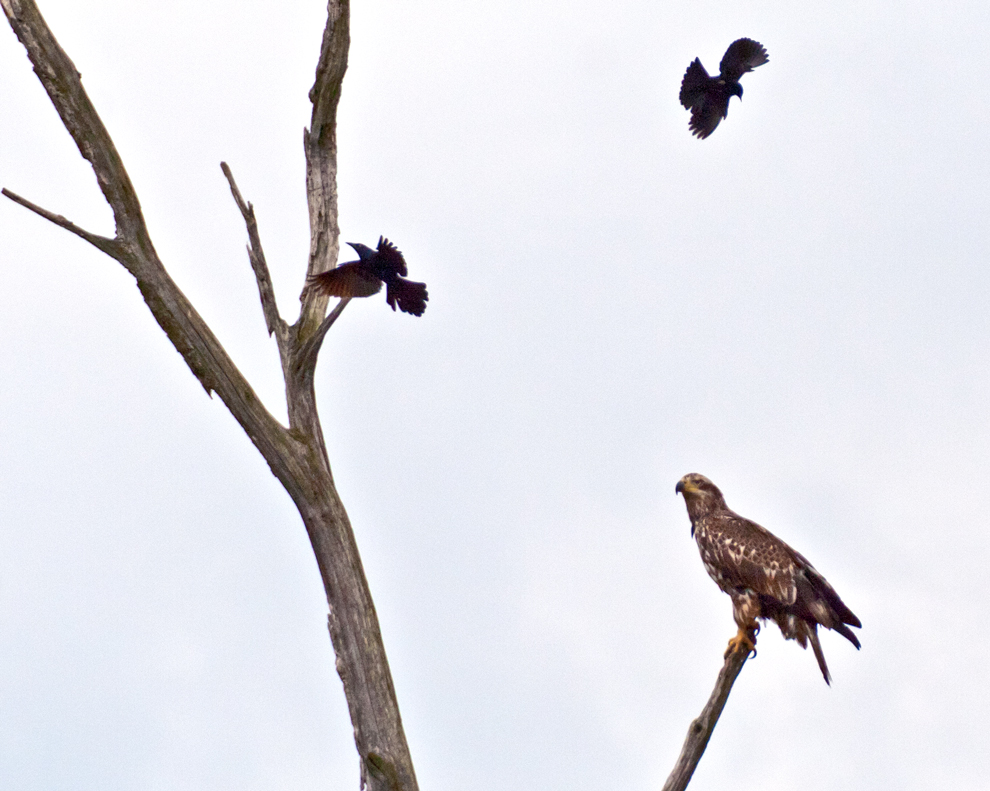
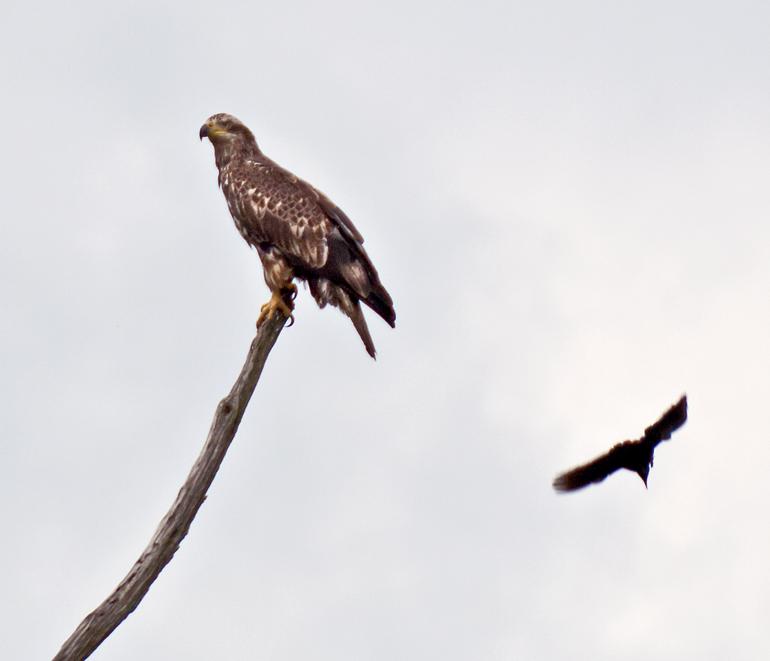
After doing an initial posting earlier this week on an encounter between a young Bald Eagle (Haliaeetus leucocephalus) and group of Red-winged Blackbirds (Agelaius phoeniceus), I reviewed my photos and came up with a few more to share.

These shots show various moments in the assault of the blackbirds, which seemed determined to harass the much larger eagle. I naturally paid the most attention to the juvenile eagle and tried to capture his attitude of alertness and wariness. After a few minutes of the off-an-on attacks, the eagle finally took off, seemingly in pursuit of the blackbirds.

It was amazing to watch this action and I am glad I managed to get some photos to document the encounter.

eagle3_blog

Buzzing the eagle (click on photo for higher resolution view)

eagle7_blog

Circling around for the next attack

eagle6_blog

Ever vigilant

eagle5_blog

Alert for the next attack

eagle4_blog

Relaxed but wary

Michael Q. Powell. All rights reserved

Read Full Post »

I hadn’t intended to do a head-and-shoulders portrait of this Barn Swallow (Hirundo rustica), but my telephoto zoom was near the far end when I carefully placed my tripod on the boardwalk and focused on the swallow.

Sensing that the bird was not going to remain perched for very long, I quickly snapped off a few exposures. My left hand was adjusting the ballhead of my tripod and my right hand was pressing the shutter, so zooming out was not really an option at that moment. The image that you see is as much of the bird as I was able to capture.

I did manage to get some good detail in the eye (and I recommend clicking on the photo for a higher resolution view) and I am happy with the background, which once again looks like a studio setting—it may not be very exciting, but it sure is uncluttered.

I suppose that the lesson for me is to have my camera fully adjusted as I am sneaking up on birds, but sometimes “mistakes” turn out pretty well too.

headandshoulders_blog

Michael Q. Powell. All rights reserved

Read Full Post »

I was checking out a location this morning where I had previously seen an eagle, when suddenly a juvenile Bald Eagle (Haliaeetus leucocephalus) landed on the tree at which I was staring. He seemed a little flustered and I soon found out why—he was being harassed by a group of Red-winged Blackbirds (Agelaius phoeniceus). They may have been crows, but one of my shots seems to show a flash of red on one of the black birds.

I have a few more shots that I am working on, but thought I’d give you an idea of the scene that I witnessed. I am pretty sure that this is a juvenile Bald Eagle, but would welcome a correction if I am wrong. In any case, it was pretty exciting for me.

eagle1_blogeagle2_blog

Michael Q. Powell. All rights reserved

Read Full Post »

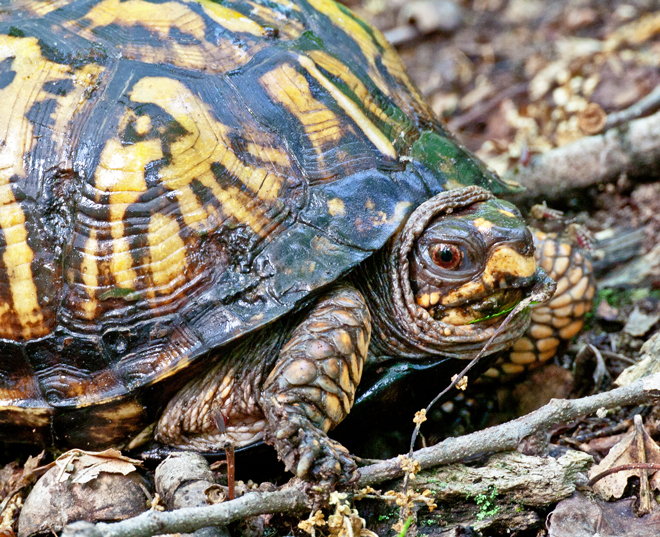
Previously I have seen turtles only in the water or sunning themselves on logs, but this weekend I encountered this cool-looking turtle, which I have identified as an Eastern Box Turtle (Terrapene carolina carolina), while I was walking through the woods.

As I was searching to identify the turtle, I came across all kind of interesting factoids, like the box turtle’s ability to close itself up entirely in its shell and its normal lifespan of 25-30 years. The Eastern Box Turtle is so popular that, according to Wikipedia, it is is the official state reptile of North Carolina and Tennessee.

As for me, I am particularly attracted to its eyes, which somehow remind me of those of Yoda, the Star Wars character.

turtle2_blogturtle1_blog

Michael Q. Powell. All rights reserved

Read Full Post »

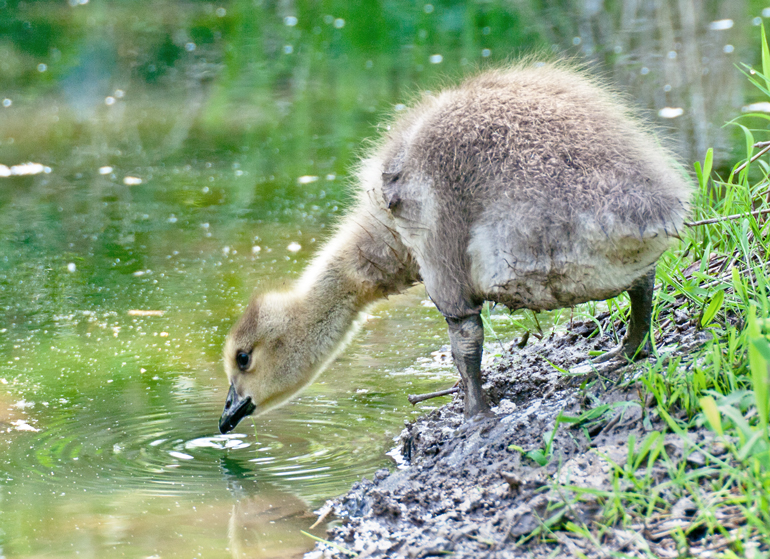
The last few weeks I have been following the adventures of a family of Canada Geese (Branta canadensis) at my local marshland and encountered them this morning as they were foraging in the muddy grass.

There are currently four goslings (there may have been six initially if this is the same family I saw previously) and it was fun to watch them as they would wander off a little from their parents and then scurry back quickly.

It was hard to get clear shots of the youngsters, but I did manage to get this shot that I like when one of the goslings walked to the water’s edge to get a drink.

gosling1_blog

Michael Q. Powell. All rights reserved

Read Full Post »

On a heavily overcast day with intermittent rain, most birds seemed to be in hiding, but this male Red-winged Blackbird (Agelaius phoeniceus) took the opposite approach by flying to the highest tree and loudly announcing his presence to the world with his distinctive call.

I like the way that the limited lighting caused this profile shot to turn into almost a silhouette, but somehow the colorful shoulder markings managed to show through.

blackbird_whitesky_blog

Michael Q. Powell. All rights reserved

Read Full Post »

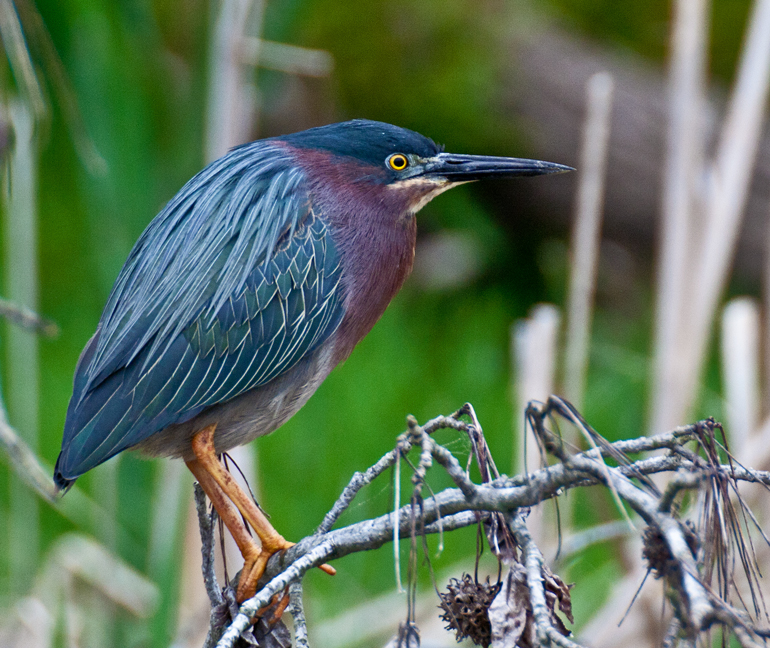
I stopped dead in my tracks on Monday when I spotted this Green Heron (Butorides virescens) as I was walking along the boardwalk at my local marshland park.

Only rarely have I had such an unobstructed view of this beautiful bird. My camera was already affixed to my tripod and I slowly opened its legs and set it down, all the while keeping my eyes on the Green Heron. I didn’t dare to make any sudden movements and felt like I was moving in slow motion as I inched my way forward to the edge of the boardwalk.

I don’t know if the heron was actively hunting for prey, but he seemed really focused and unaware of my presence (or was willing to ignore me). Initially upright, the heron gradually leaned more and more forward and appeared to be focusing even more intently.

My breathing seemed loud in my ears and my shutter sounded like a machine gun to me, but the heron hung around long enough for me to get some pretty good photos. Eventually, though, he got spooked and flew away, but I think I have an idea of the general area in which he hangs out, so I hope to encounter him again.

greenheron1_bloggreenheron2_bloggreenheron3_blog

Michael Q. Powell. All rights reserved

Read Full Post »

There is a spot in a back corner of my marshland park that I love to visit in the early morning, when the light produces beautiful reflections in the still waters of a small pond.

It’s accessible only by an informal muddy trail, so I don’t have to share the moments of tranquility with the baby strollers and power walkers that interrupt my conversations with nature when I am on the boardwalk. Sometimes I will see ducks and geese here and I have even spotted a bald eagle perching in a tall tree, but the main draw for me is not the wildlife—it’s the sense of peace that envelopes me when I am here.

Sometimes I like reflections in which you can easily identify the objects being reflected, like the two trees in the first image. Other times, I get lost in the reflections themselves, which can result in a Monet-like abstract image like the second image below.

All of us are looking for an inner peace—this is one place in which I am able to experience a few moments of that peace.

reflection1_blogreflection2_blog

Michael Q. Powell. All rights reserved

Read Full Post »

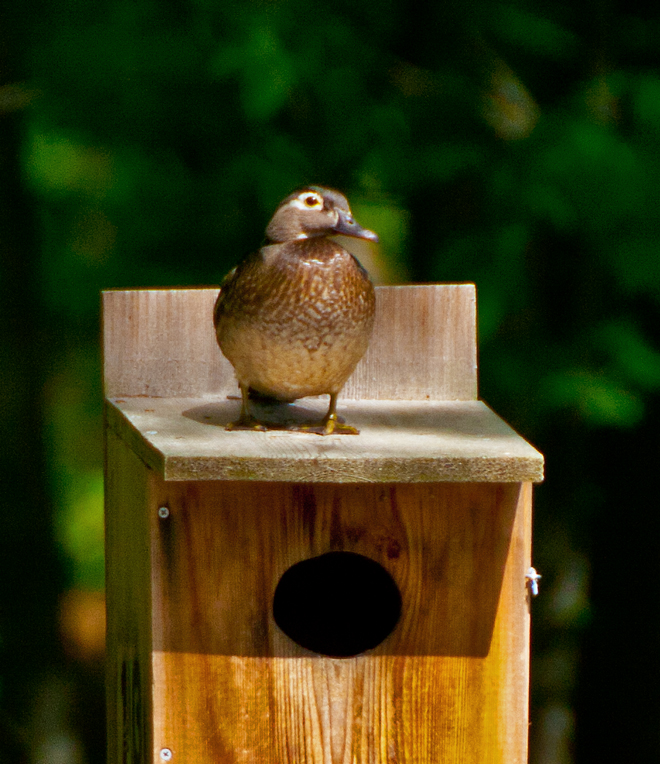
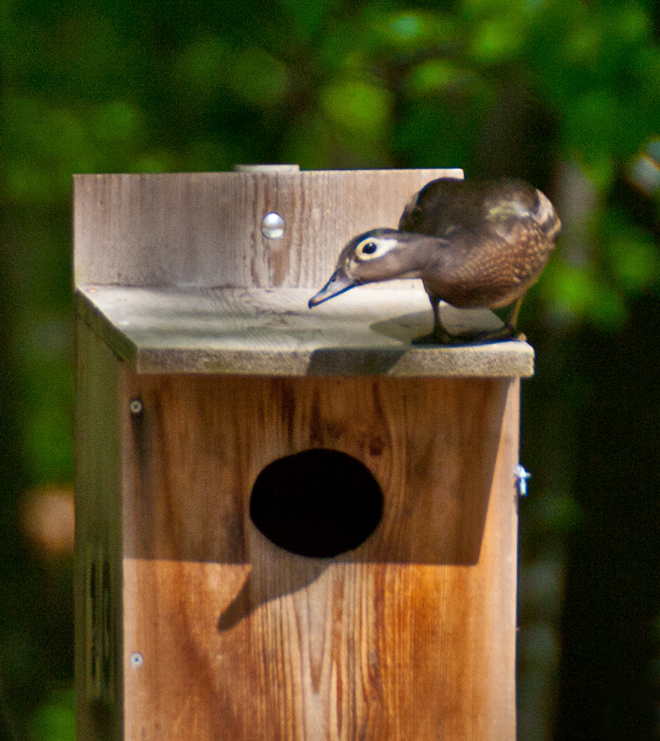
Yesterday I watched and waited as a female Wood Duck (Aix sponsa), perched on top of a nesting box at my local marsh park, decided when it was the right moment to enter into the box and work on her nest.

Initially I was surprised when I spotted the duck atop this particular nesting box, because Hooded Merganser babies had exited from the box only a week earlier. The female moved around a bit on top of the box, looking in both directions (second photo). Eventually she bent her head lower and lower, as if checking to see that the entrance to the box was clear (third and fourth photos.

When she finally did take off, she flew a little to one side (fifth photo) and made a tight little circle in the air. In the final shot, you can see the female duck with her eyes on the target, approaching it from just below the level of the bottom of the nesting box.

I led with the shot that I like the most. I am amazed that the duck can synchronize her movements so well and arrest her forward momentum to keep from banging into the back of the box (and to keep her wings from getting stuck).  The lighting kept changing as waited for the action to develop, to the point that I moved into manual mode, something that I only rarely do. I am happy that the sun was shining at the moment when she entered the box, because I think the shadow adds to the interest of the photo.

I missed seeing the Hooded Merganser duckings leaving the box—maybe I will be luckier with these Wood Ducks.

woody5_blogwoody1_blogwoody2_blogwoody2a_blogwoody3_blogwoody4_blog

Michael Q. Powell. All rights reserved

Read Full Post »

With the arrival of blue skies, I was finally able to a close-up shot of a Barn Swallow (Hirundo rustica) with a natural backdrop (vice the white background of the overcast days).

The lighting was beautiful and the swallow cooperated by turning its head slightly, enabling me to capture the catch light in its eye. The shadows are pretty minimal, but help to keep the image from being too flat.

I even like the serious expression on the swallow’s face, as though he had decided that this was a formal portrait.

barn_sky_blog

Michael Q. Powell. All rights reserved

Read Full Post »

Wood Ducks (Aix sponsa), especially the males, are probably the coolest-looking ducks, but in the past few months the only ones that I have seen have been flying away from me, generally from branches on which they were perched.

I was not really expecting that I would see any Wood Ducks on the ground when I approached a tiny pond earlier this week. However, I did notice a little movement at the water’s edge and had just focused on that area, when suddenly a pair of wood ducks took off. I snapped off a few shots, not really expecting that they would be in focus and was pleasantly surprised at the result

The ducks in this image ended up pretty much in focus, especially the male’s head, his most prominent and colorful feature. The wings have some motion blur, but it’s not too distracting.

I’d like to say that my focusing skills are getting better, but I know that this shot was primarily the result of luck. It doesn’t really matter that much how I got the shot—what matters more to me is that I like the result.

woodduck_flying_blog

Michael Q. Powell. All rights reserved

Read Full Post »

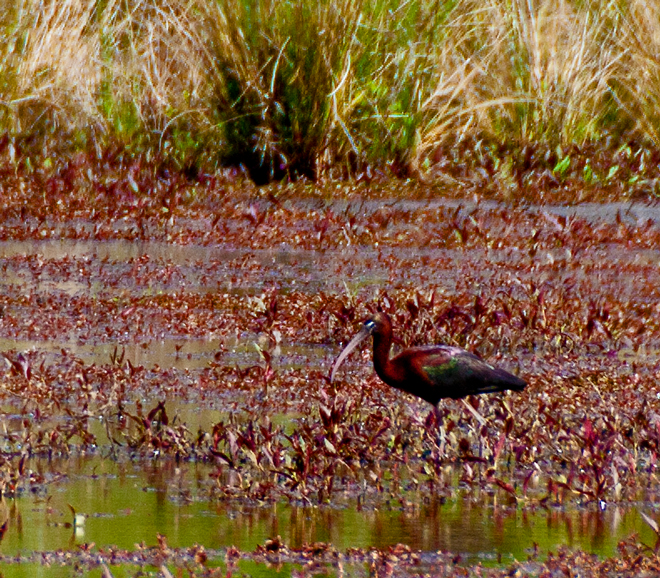
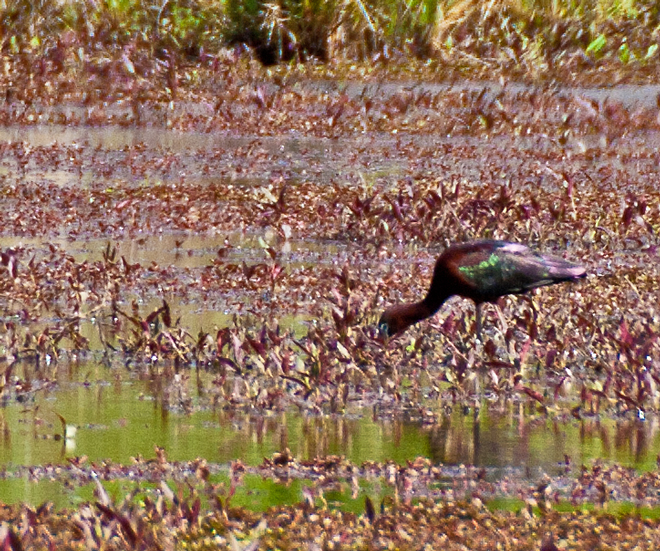
Yesterday at my local marsh, several birders were really excited about the unexpected presence of a pair of Glossy Ibises (Plegadis falcinellus). I missed seeing them fly in, but spent almost an hour watching them forage in the distance, listening to the debate among the birders about whether these were Glossy Ibises or White-faced Ibises—they concluded the birds were Glossy Ibises.

I think that these strange-looking wading birds tend to be found nearer the coast and it is relatively rare, though not unprecedented, to have them at our marsh. I was not able to get any close-up shots, but I did manage to take some photos that show their downward-curved bills and colorful breeding plumage. The last shot really gives you a sense of the color—one of the ibises opened its wings to hop over a little patch of water.

ibis3_blogibis2_blogibis1_blogibus4_blog

Michael Q. Powell. All rights reserved

Read Full Post »

Today I got this shot of a Tree Swallow (Tachycineta bicolor) gathering materials for a nest. I suspect that the swallow is using the nest that is attached to the metal pole on which it is perched, although I never actually saw the swallow enter the box.

nesting1_blognesting2_blog

Michael Q. Powell. All rights reserved

Read Full Post »

Is it just me, or does this image look like it came from a low budget science fiction movie, with a strange-looking alien creature hovering over a Martian landscape?

I was chasing dragonflies again this past weekend, trying to capture images of them in flight, and ended up with this image of a female Common Whitetail dragonfly (Plathemis lydia). It’s pretty tough to try to track these flying insects with a hand-held telephoto zoom lens extended to almost 400mm. My autofocus seemed too slow and I adapted a technique of trying to focus manually, while trying to keep the lens steady. I can’t tell for sure if this image was auto-focused or was manually focused.

Female Common Whitetail dragonflies do not have a white tail and in many ways that makes them a little easier to expose correctly. The wings are blurred, but you can still see the brown markings that identify this as a female, and not an immature male.

Last summer I was content to get a shot of a dragonfly when it was stationary, but this summer I am going to work hard to capture some more images of dragonflies in flight.

whitetail2_blog

Michael Q. Powell. All rights reserved

Read Full Post »

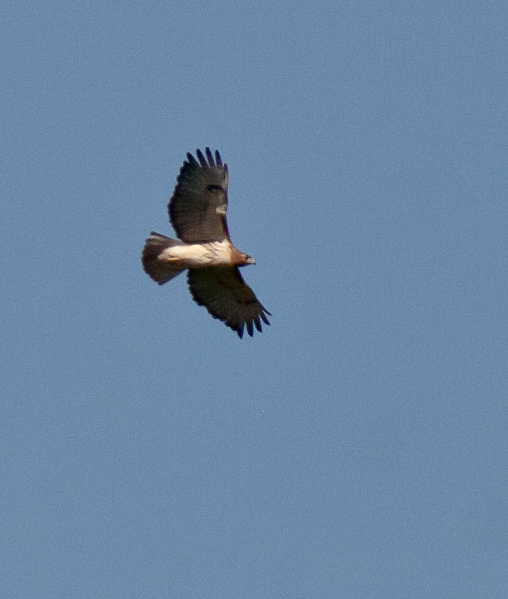
I haven’t seen many hawks in the last month or two, so I was delighted when I spotted this Red-tailed Hawk (Buteo jamaicensis) circling in the distance this past weekend.

Most of the hawks that I had previously seen at my local marsh have been Red-shouldered Hawks, but I am pretty sure this one is a Red-tailed. The hawk never came close enough for me to get a really good shot, but I am content that I was able to get some shots in which the hawk is recognizable as more than an indistinct blob in the distance. Several of the shots I am posting look almost like they have a rock formation in the background—it was only, however, a dead tree.

These images are aspirational ones for me. They represent the kind of photographs that I am working to be able to produce in the future with greater sharpness and more pixels (I had to do a lot of cropping). They are a step on the path of my journey into photography.

hawk1_bloghawk2_bloghawk3_bloghawk4_blog

Michael Q. Powell. All rights reserved

Read Full Post »

I was thrilled this past Saturday when I caught sight of this Green Heron (Butorides virescens), because green herons have only recently returned to the area after spending their winter in warmer locations.

The lighting situation, however, was really problematic. There was beautiful dappled sunlight in the background, but the heron was mostly in heavy shade and his back was illuminated with harsh sunlight. I played around with a number of different settings and this was one of the better images.  I still had to make some adjustments in post-processing to pull some of the details out of the shadows, which made the final image a bit grainy.

I really like the Green Heron’s pose, as he looks off into the distance. I don’t think that he was actively fishing, but was merely relaxing in the shade of the tree.

greenheron1_blog

Michael Q. Powell. All rights reserved

Read Full Post »

The Great Blue Heron was too far away for me to capture many details, but the light early yesterday morning was especially beautiful, so I decided to pull back and try to capture the landscape, something that I don’t do very often.

I love the rich bands of color that I managed to capture in this shot and the gorgeous reflections in the water at my local marshland park. The red color, I believe, is from buds that were stripped from the trees by winds and rain this past week.

heron_blog

Michael Q. Powell. All rights reserved

Read Full Post »

« Newer Posts - Older Posts »