Feeds:
Posts
Comments

Posts Tagged ‘Pachydiplax longipennis’

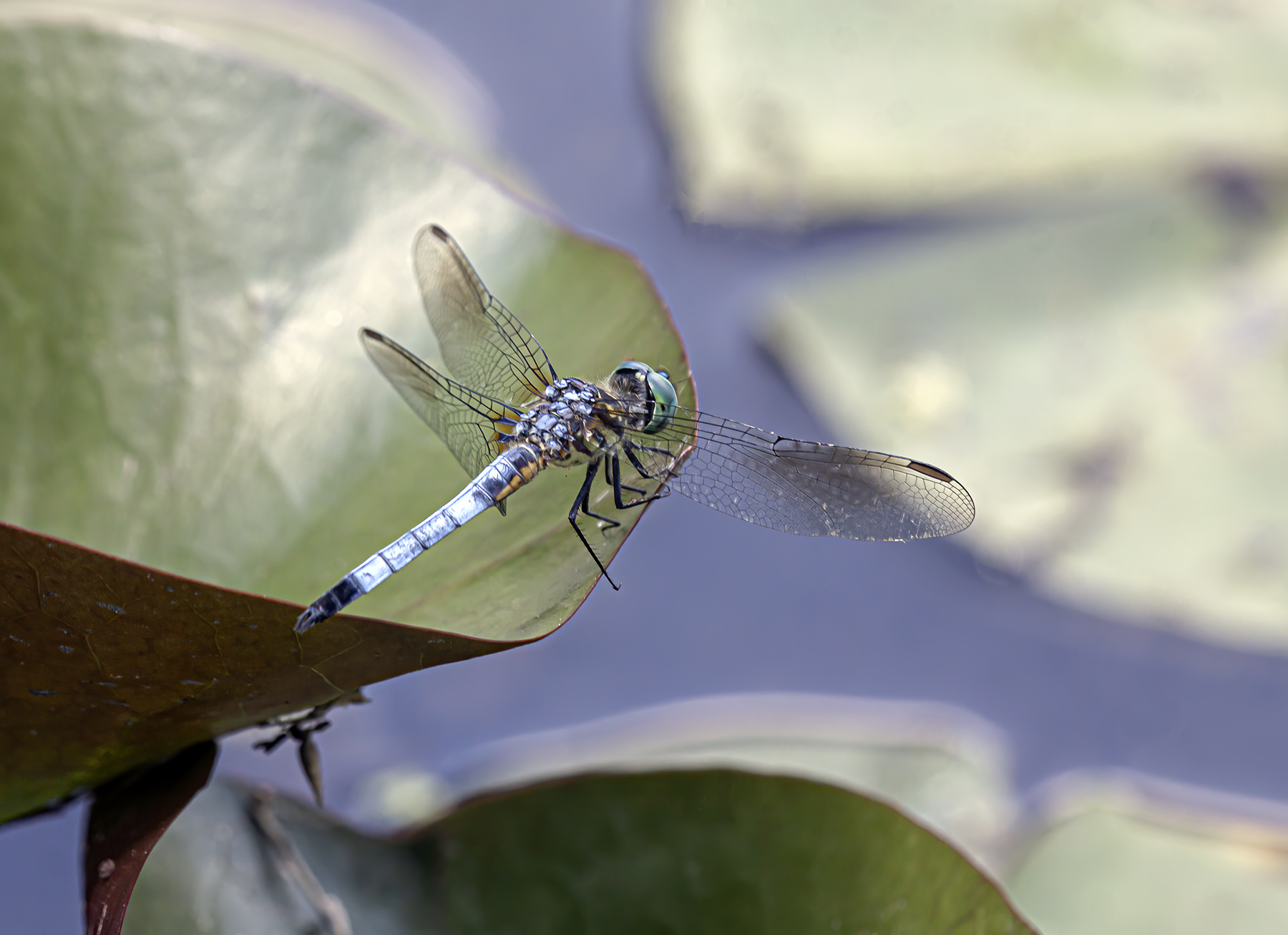
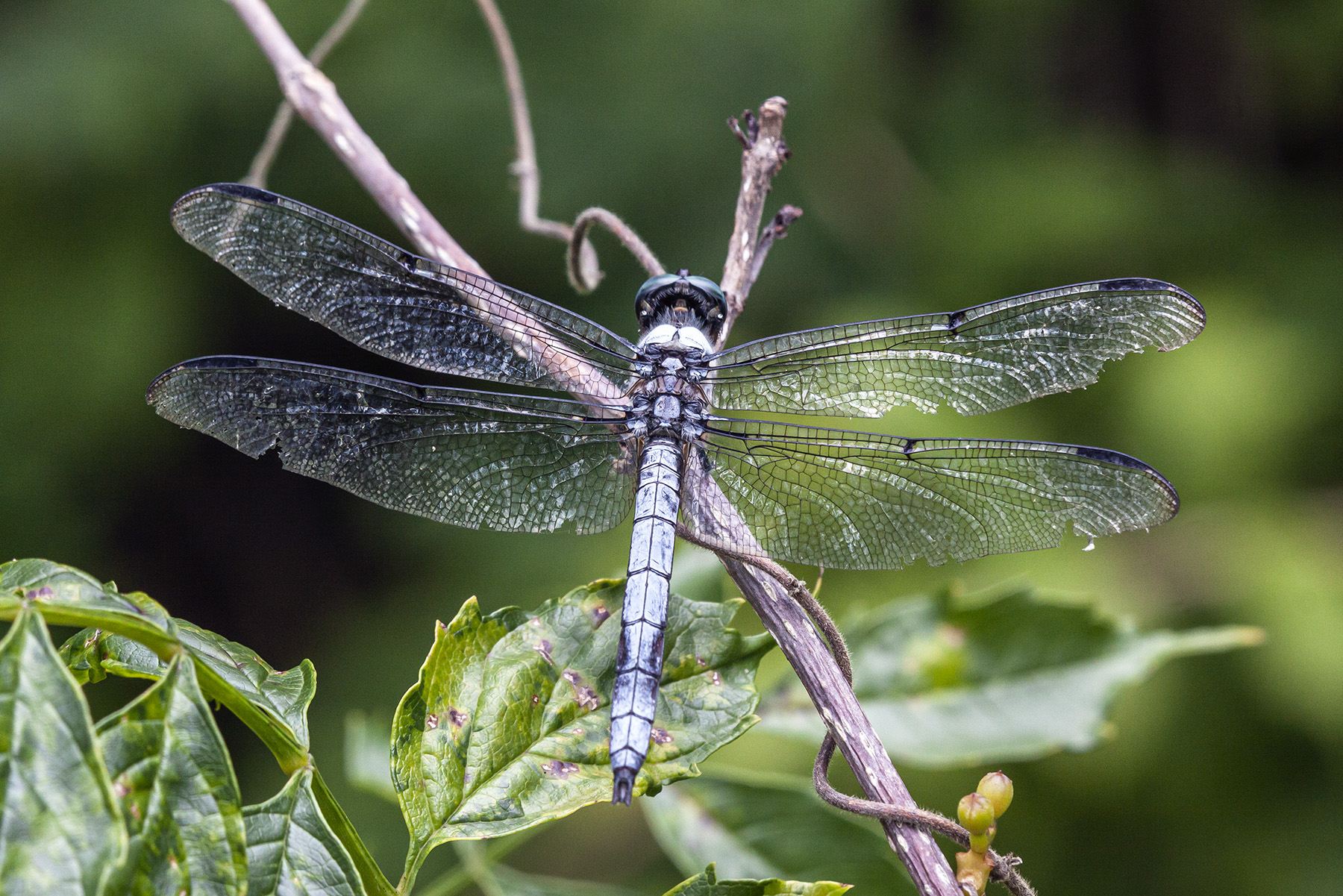
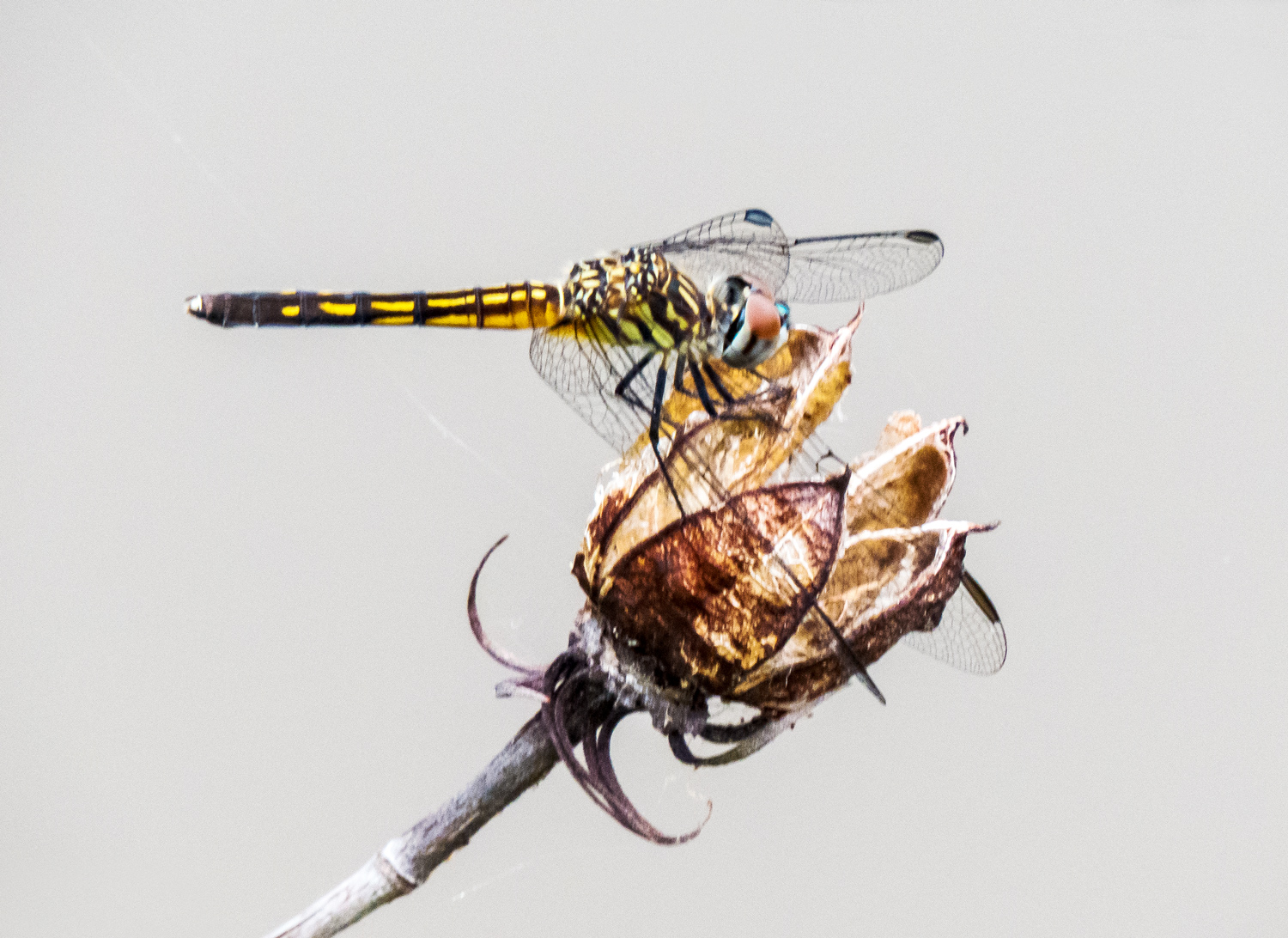
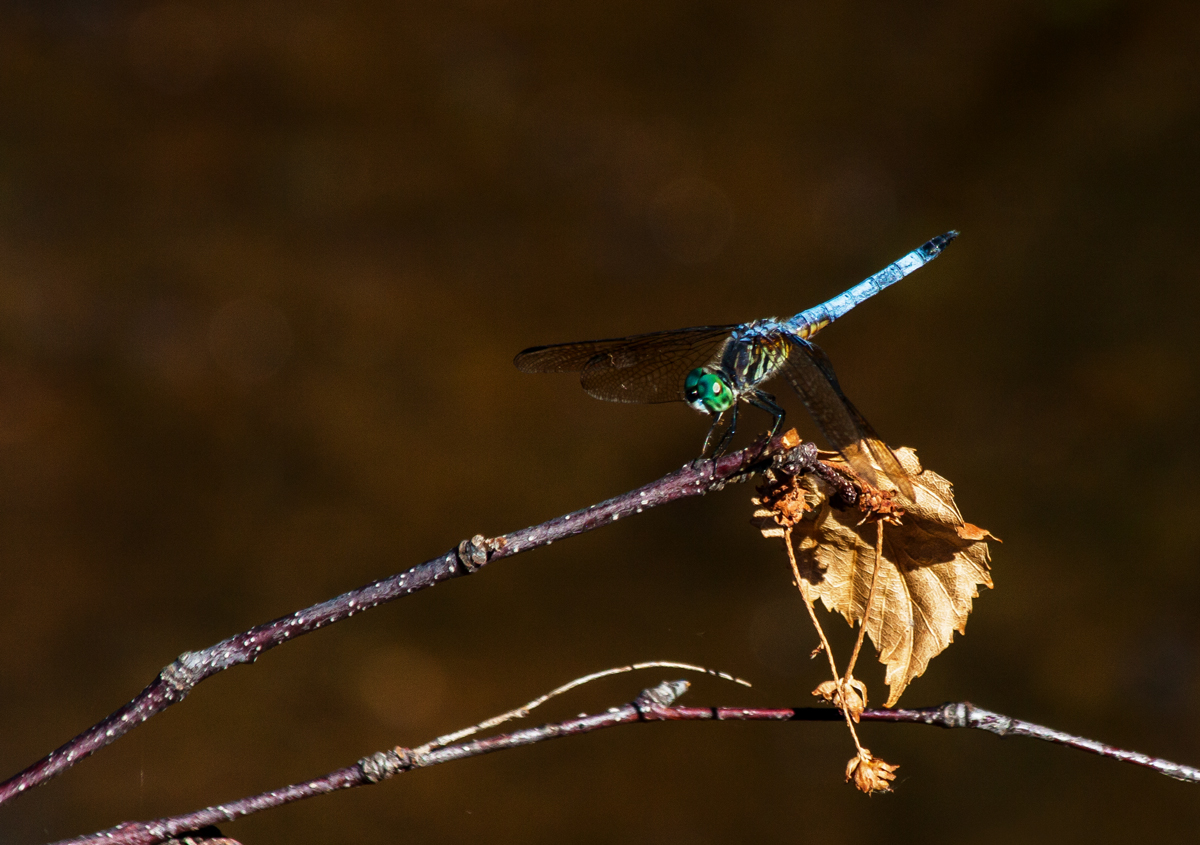
The countdown continues as we gradually move towards the end of the dragonfly season in my area. The Blue Dasher dragonfly (Pachydiplax longipennis) is one of the first dragonflies to appear in the spring and one of the last dragonflies to disappear in the autumn.

I spotted this tattered male Blue Dasher dragonfly during a recent visit to Jackson Miles Abbott Wetland Refuge. This was one of only a handful of dragonflies that I saw that day. The end is nearing, but I am not ready to call it quits quite yet for my dragonfly photography.

Blue Dasher

© Michael Q. Powell. All rights reserved.

Read Full Post »

I usually try to get close-up shots of dragonflies, but sometimes that is not possible. In those cases, I try to be creative and frame and/or isolate the subject with elements of the environment, as I did with this Blue Dasher dragonfly (Pachydiplax longipennis) that I spotted last Monday at Occoquan Bay National Wildlife Refuge, the first one that I have spotted this year.

I really like this composition, despite the fact that the dragonfly is very small in the photo, thanks largely to the undulating green waves of the leaves and the out-of-focus branches in the background. What do you think? Should I have cropped the photo a bit more?

Blue Dasher

© Michael Q. Powell. All rights reserved.

Read Full Post »

I know that there should be more dragonflies still around, but this past Wednesday, this Blue Dasher (Pachydiplax longipennis) was the only dragonfly that I spotted during a visit to Occoquan Bay National Wildlife Refuge. The day was cool and gloomy with intermittent drizzle, which almost certainly contributed to the relative scarcity of dragonflies. This month the number of dragonflies will continue to drop, but there still should be some Autumn Meadowhawks and Blue-faced Meadowhawks flying into November.

Blue Dashers are one of our most common dragonfly species and are usually among the first species to emerge in the spring and to disappear in the fall. The dragonfly in this photo was perched at the edge of a small pond. I was happy to capture this shot, considering that I had switched to my longer Tamron 150-600mm lens, which sometimes is a bit soft when extended to 600mm. I had changed lens in anticipation of seeing more birds, which largely was not the case that day.

Blue Dasher

© Michael Q. Powell. All rights reserved.

Read Full Post »

Some dragonflies will look me straight in the eye, but others, like this male Blue Dasher dragonfly (Pachydiplax longipennis), seem to prefer sidewards glances. I spotted this cute little dragonfly last Thursday at Jackson Miles Abbott Wetland Refuge. Blue Dasher dragonflies are among the first dragonflies to appear on the scene in the spring and among the last ones to disappear in the autumn.

The vegetation at this time of the year is always interesting, a combination of new growth and dried-out stems. I love both the colors and textures of the perch that this dragonfly had selected and the visible cobwebs add a nice touch of visual interest to the image.

Blue Dasher

© Michael Q. Powell. All rights reserved.

Read Full Post »

I really like Blue Dasher dragonflies. They are quite common and visible throughout most of the summer. Unlike some other dragonfly species that require specific habitats, Blue Dashers (Pachydiplax longipennis) can be found almost anywhere.

I really like the description of the species on the Dragonflies of Northern Virginia website, one of my favorite resources for information about the dragonflies in my area:

“A very little guy in a big hungry world, Blue Dashers make up for their small size with plenty of moxie. Just about everything eats them…but it certainly hasn’t affected their numbers. The most abundant dragonfly in our area, they face their predator-filled worlds head on. Males aggressively defend their small, shore-line territories against larger skimmers, and spend a great deal of time with their black-tipped abdomens pointed high in the air – an aggressive threat display. It’s also a technique used to cool down by reducing surface area to the sun, called the obelisk position. However, Dashers use it more than other species, and half the time it appears to be done for the purpose of territorial display, rather than temperature control.”

I spotted this Blue Dasher on Monday at Jackson Miles Abbott Wetland Refuge. I couldn’t get really close to the dragonfly, but like the way that the abundant vegetation helped to frame the dragonfly.

Blue Dasher

© Michael Q. Powell. All rights reserved.

Read Full Post »

As I watched television coverage of the Olympic Games in Paris, I could not help but notice the numerous handstands in almost all of the gymnastic events for the men. There were handstands on the floor, on the rings, on the parallel bars, the high bar, and even on the pommel horse.

When I spotted this male Blue Dasher dragonfly (Pachydiplax longipennis) doing a handstand last Thursday at Jackson Miles Abbott Wetland Refuge, I immediately thought of those Olympic gymnasts.

This position is sometimes referred to as the “obelisk” pose for dragonflies. Many scientists believe that it is used as a form of thermoregulation to keep the body cooler by reducing the amount of surface exposure to direct sunlight. Several other dragonfly species use this pose, but I observe it most often with the male Blue Dasher dragonflies.

Blue Dasher

© Michael Q. Powell. All rights reserved.

Read Full Post »

I love photographing dragonflies as they perch on lotus flowers and lotus buds. Alas, the lotuses were not yet in bloom last week when I visited Green Spring Gardens, a nearby county-run garden that has a small pond with a few lotuses and water lilies.

Fortunately quite a few dragonflies were buzzing around the pond and I managed to capture this image of a male Blue Dasher dragonfly (Pachydiplax longipennis) as he perched on the tip of a rolled-up lotus leaf. I like the way that the texture of the leaf adds visual interest to the image, something that would be absent if the dragonfly had perched on a bare branch.

I will probably return to the gardens in a few weeks to see if I can get some shots of the lotuses when they are blooming. As I recall, lotuses seem to enjoy the hazy, hot, and humid days that are far too common during the summer in the Washington D.C. area.

Blue Dasher

© Michael Q. Powell. All rights reserved.

Read Full Post »

I know that summer is almost here when I start to see Blue Dasher dragonflies (Pachydiplax longipennis) at my local ponds and they will some become our the most abundant dragonfly species in our area. Mature Male Blue Dashers are blue, as their name suggests, but females have a black and yellow pattern on their abdomens, like the one pictured below that I photographed on Tuesday at Jackson Mile Abbott Wetland Refuge.

Quite often Blue Dashers perch on vegetation in the “obelisk” pose, with their abdomens raised up into an almost vertical position. It is thought that this pose is a type of thermoregulation, with the raised abdomen reducing the amount of exposure to the direct sunlight and thereby keeping the dragonfly’s body a bit cooler.

Blue Dashers are sentimentally special to me because my very first posting on this blog on July 7, 2012 featured a male Blue Dasher dragonfly in an obelisk pose. In case you are curious, here is a link to that posting that was simply entitled Blue Dasher dragonfly.

Blue Dasher

© Michael Q. Powell. All rights reserved.


Read Full Post »

Wings are tattered. Flowers have faded. Summer is ending. (Blue Dasher dragonfly (Pachydiplax longipennis) photographed on 6 September at Jackson Miles Abbott Wetland Refuge.)

Blue Dasher

© Michael Q. Powell. All rights reserved.

Read Full Post »

I don’t often see dragonflies perch on flowers, so I was delighted when this female Blue Dasher (Pachydiplax longipennis) decided to rest for a moment on an aster plant in bloom last week at Jackson Miles Abbott Wetland Refuge.

I decided not to crop this photo to show the dragonfly better, because I really like the sweep of bright color on the left side of the image and the more muted out-of-focus colors on the right side. I am growing to love this type of environmental portrait, which goes against my normal approach of trying to fill as much of the frame as possible with my primary subject.

Blue Dasher

© Michael Q. Powell. All rights reserved.

Read Full Post »

The clock is ticking as we move towards the end of the dragonfly season and I see a lot of mating dragonflies that appear to be driven by the biological imperative of ensuring the perpetuation of their species. Late in August I observed this pair of Blue Dasher dragonflies (Pachydiplax longipennis) at Occoquan Regional Park in the mating position that is sometimes referred to as “the wheel.”

When mating is completed, the female, the lower dragonfly in the photo, will may lay 500 or more eggs by flying low over the water usually near a heavily vegetated pond edge and repeatedly tapping her abdomen to the surface. Once the eggs hatch, the life cycle of a dragonfly larva begins as a nymph that live underwater and eat smaller aquatic insects. The nymphs, also referred to as naiads, live underwater for up to two years and shed their exoskeletons six or more times.

According to an article in Cambridge Day, “When a naiad is ready to metamorphose into an adult dragonfly, it swims to the surface at night. There, it lifts its head out of the water as its body adapts to breathing air, then climbs a plant stem out of the water, where its skin splits behind its head and the adult dragonfly emerges. The adult swallows air to plump up its body and pumps hemolymph, the bloodlike substance of insects, into its wings.”

For more information about the life cycle of Blue Dasher dragonflies, check out these postings at Life on CSG Pond and at Cambridge Day.

Blue Dasher

© Michael Q. Powell. All rights reserved.


Read Full Post »

Although Blue Dashers (Pachydiplax longipennis) are among the most common dragonflies in my area during the summer, they are very special to me. I remember visiting a photography show by my dear friend Cindy Dyer in 2012, I believe, and marveling at the photos that she had taken of Blue Dasher dragonflies. I decided that I wanted to be able to take photos like hers of these beautiful creatures.

I went out on numerous occasions and she taught me a lot about both the creative and technical sides of photography. She also served as a muse to me, encouraging me and gently pushing me along my path. She had a well-established blog and decided that I needed one too, so on 7 July 2012, she sat me down I created my blog. My first blog posting on the same day was entitled Blue Dasher dragonfly and it featured a male Blue Dasher dragonfly in the obelisk position, similar to the pose of the dragonfly in the final photo in today’s post. That’s one of the main reasons why Blue Dashers are so special to me.

I spotted these Blue Dashers, all of which are males, on Monday during a brief visit to Jackson Miles Abbott Wetland Refuge. Each of the three photos represents a different approach I used in attempting to capture the”feel” of my encounters with these dragonflies. The first image shows the details of colors and patterns of the body quite well. The second image gives you a sense of their environment. The final photo focuses on the obelisk pose that is believed to be a form of thermoregulation—by raising its abdomen the dragonfly reduces its exposure to the direct sunlight on hot days.

Some days I will post only a single photo, but most often I enjoy posting a small set of photos that complement each other and provide different perspectives on the living creatures that I love to photograph. Beauty is everywhere.


Blue Dasher

Blue Dasher

Blue Dasher

© Michael Q. Powell. All rights reserved.

Read Full Post »

You can’t get much more basic than this shot of a Blue Dasher (Pachydiplax longipennis), one of the most common dragonflies where I live, that I spotted last Tuesday at Occoquan Bay National Wildlife Refuge.. I find, though, that there is a really beauty in that simplicity that allows me to immerse myself in the details of my subject.

I am able to notice the two-toned eyes, the pattern on the abdomen, and the yellowish portions of the legs where they are connected to the body. Even the perch, which I think is stalk of Eastern Gamagrass (Tripsacum dactyloides), has fascinating details.

Beauty is everywhere.

Blue Dasher

© Michael Q. Powell. All rights reserved.

Read Full Post »

Today I am featuring the Blue Dasher dragonfly (Pachydiplax longipennis), one of the most common dragonflies in my area. The Blue Dasher is special to me because my very first posting on this blog in July 2012 included a shot of a Blue Dasher. Click on this link if you are curious to see what my photography looked like ten years ago.

I took these shots at two different locations in July, prior to my road trip, and am only now catching up on some of my backlog of shots. Blue Dashers seem to be quite adaptable and can be found in a wide variety of habitats, so it is not hard to find one.

These images show Blue Dashers in a variety of poses, including the “obelisk” pose in the final image, one of the signature poses of this species.

Blue Dasher

Blue Dasher

Blue Dasher

© Michael Q. Powell. All rights reserved.

Read Full Post »

Most of the dragonflies that I spotted during my most recent visit to Occoquan Bay National Wildlife Refuge were common species that I have been seeing for months. Some photographers are driven to search for rare and exotic species and ignore the everyday ones. I am usually content with trying to capture the beauty of the ordinary ones.

In the first photo, I love the ways that the shadows of the wings of this female Common Whitetail dragonfly (Plathemis lydia) create the optical illusion that the dragonfly has extra wings. In the second photo, the female Blue Dasher dragonfly (Pachydiplax longipennis) is quite beautiful herself and the stunning background enhances that beauty.

The final photo shows a pair of Eastern Amberwing dragonflies (Perithemis tenera), the smallest dragonflies in our area. I love the way that the two dragonflies are reflected in the water.

Beauty can be found in the rare and exotic species, but I think that these images demonstrate that beauty can also be found in ordinary things. When we slow down and look closely, we discover that beauty is everywhere.

Common Whitetail

Blue Dasher

Eastern Amberwing

© Michael Q. Powell. All rights reserved.

Read Full Post »

Dragonflies perch in many different ways and in many different places. Here are some simple shots of three dragonflies that I encountered last Thursday at Occoquan Bay National Wildlife Refuge.

The first one is a Needham’s Skimmer (Libellula needhami) and I love the way that its coloration contrasts so well with the sea of green vegetation in which it is perched. The dragonfly in the second photo, my personal favorite of the three images, is a Blue Dasher (Pachydiplax longipennis). When it’s hot outside, some dragonflies, like this one, like to assume a handstand-like pose, often called the “obelisk” position, to reduce their exposure to the direct sunlight. The final photo shows a Great Blue Skimmer (Libellula vibrans) perched on the tip of a leaf.

Each of these shots represents my efforts to isolate a dragonfly a bit from its surroundings and to highlight its beauty and its behavior. None of theme is spectacular or award-worthy, but they are pleasing little portraits of some of my summer companions.

Needham's Skimmer

Blue Dasher

Great Blue Skimmer

© Michael Q. Powell. All rights reserved.

Read Full Post »

Ten years ago today I started this blog. After reviewing some of my photos from earlier that fateful day, my dear friend and photography mentor Cindy Dyer told me I needed a blog. I was a little skeptical, but we sat down at a computer and she helped me to set up this blog. I could not come up with a cute or creative name, so I simply called it “Mike Powell—My journey through photography.”

My first posting was a modest one that showcased a single photo of a Blue Dasher dragonfly (Pachydiplax longipennis). In case you are curious, here is a link to that first posting that was entitled “Blue Dasher dragonfly.”

I figured that my blog would be primarily a place to display my photos. I rapidly realized, however, that I enjoyed expressing myself with my words as much as with my images. My postings are often a direct reflection of my thoughts or feelings at the very moments when I am composing the post. I do not compose them in advance, so my postings sometimes ramble around a bit, but I have found that many of my readers enjoy this conversational, stream-of-consciousness style.

According to WordPress statistics, I have done 4462 postings, with almost three hundred sixty thousand total views. I have written most of these postings myself, though occasionally I have reblogged the postings of others. My favorite subjects over the years have been insects and birds, but I have also done postings on a wide range of other topics including animals, travel, poetry, and painting.

Today it seemed appropriate to post a photo of a male Blue Dasher—the dragonfly that started it all—that I photographed yesterday at Green Spring Gardens, a local, county-run historical garden. When I was starting to get more serious about photography ten years ago, Cindy and I would often photograph flowers and insects at this garden.

I owe a special debt of gratitude to Cindy for the initial push to start this blog and for her continued encouragement and inspiration. However, I am equally indebted to so many readers who have provided thoughtful comments, support, and motivation as we have made this journey together. Thanks to all of you—I could not have done it without you.

Blue Dasher

© Michael Q. Powell. All rights reserved.

Read Full Post »

I am still on the lookout for summer dragonfly stragglers and survivors. There are certain dragonfly species that I expect to see during the autumn, but there are also a few particularly hard individuals from the summer species that are managing to hang on. Over the past week and a half I have spotted one Great Blue Skimmer (Libellula vibrans), one Eastern Pondhawk (Erythemis simplicicollis), and one Blue Dasher (Pachydiplax longipennis), as shown in the photos below.

It is interesting to note that all three of these dragonflies appear to be females. I wonder if female dragonflies tend to outlive their male counterparts, as is the case with humans.

I went looking for dragonflies today, after several frosty nights, and did not see a single dragonfly. The daytime temperature was only about 52 degrees (11 degrees C), which is a bit cold for dragonfly activity. Temperatures are forecast to rise to 68 degrees (20 degrees C) early next week and I anticipate that I will see a few dragonflies then.


Great Blue Skimmer

Eastern Pondhawk

Blue Dasher

© Michael Q. Powell. All rights reserved.

Read Full Post »

Although dragonflies do not actually have teeth, I could not help thinking that this female Blue Dasher dragonfly (Pachydiplax longipennis) had a bit of an overbite problem when she smiled and posed for me on Wednesday at Occoquan Bay National Wildlife Refuge. I wonder if an orthodontist would recommend Invisalign treatment for her problem—I cannot imagine seeing a dragonfly with traditional metallic braces on its mouth.

Have a happy Friday and a wonderful weekend.Blue Dasher

© Michael Q. Powell. All rights reserved.

Read Full Post »
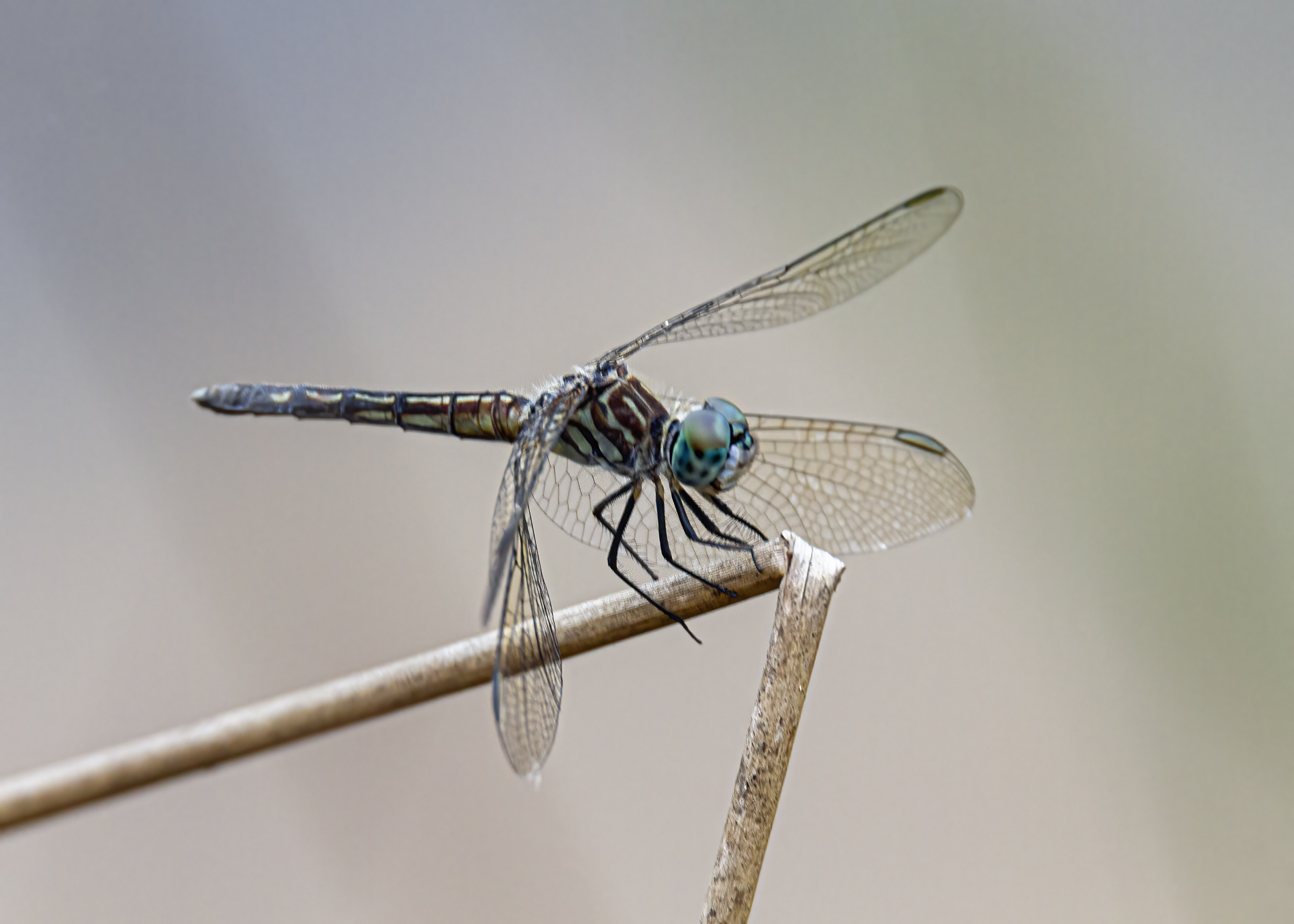
What is the most common dragonfly that you see in the summer? One of the most frequently seen dragonflies where I live is the Blue Dasher (Pachydiplax longipennis). As some of you know, I have long had a “thing” for Blue Dashers and my very first posting on this blog over nine years ago featured a Blue Dasher.

Blue Dasher dragonflies can be quite striking in appearance, especially when they choose photogenic perches. This past Saturday I visited Kenilworth Aquatic Park and Gardens in Washington D.C. with some friends and noted that there were lots of Blue Dashers buzzing about amidst the lotuses and water lilies. One of my goals for the day was to photograph these cool little dragonflies in as interesting a way as I could.

Dragonfly photographers and bird photographers often have a common problem—their subjects like to perch on bare branches and there is only so much they can do to make the photos interesting. I tried hard to capture images of Blue Dashers when they perched, often momentarily, in an unusual spot. In these three images, I think the vegetation and backgrounds add visual interest to the shots without taking attention away from the primary subject.

Blue Dasher

Blue Dasher

Blue Dasher

© Michael Q. Powell. All rights reserved.

Read Full Post »

Six-spotted Fishing Spiders (Dolomedes triton) sense their prey through vibrations in the water, so generally when I see them they have several legs lighting touching the surface of the water. When I spotted this one yesterday at a small pond in Fairfax County, however, it was perched on top of some vegetation several inches above the water.

I have no idea why it was there, though there were plenty of dragonflies buzzing around that would occasionally perch on the same type of vegetation. Could it possibly be hoping to catch a dragonfly? I have included a photo of a male Blue Dasher dragonfly (Pachydiplax longipennis) from a previous day that was perched in the same area to give you an idea of the spider’s potential prey. I would think that a dragonfly’s excellent vision would allow it to spot the spider and avoid it—I can’t imagine that a dragonfly would deliberately choose to land on top of the spider, but who knows?

If you look closely at the first photo, you may also notice what appear to be several spider legs poking out from underneath the edge of the vegetation. Was there another spider there and if so, why? Nature is full of mysteries and intrigue, with lots of unanswered questions.

Six-spotted Fishing Spider

Blue Dasher

© Michael Q. Powell. All rights reserved.


Read Full Post »

Blue Dashers are one of our most common dragonflies where I live and it is easy to pass them by and take them for granted. When I stop and look closely at them, however, I am reminded of their beauty. I spotted this striking male Blue Dasher dragonfly (Pachydiplax longipennis) on Tuesday at Jackson Miles Abbott Wetland Refuge.

There is a lot of detail in this image—like the little amber patch on the wings and a tiny orange simple eye (ocellus) in the middle of the “face” adjacent to the larger compound eyes—and I recommend that you double-click on the image to get a closer view. (If you want to learn more about dragonfly eyes, check out this fascinating article entitled “Dragonflies: eyes and a face” at benkolstad.net.)

Beauty is everywhere.

Blue Dasher

© Michael Q. Powell. All rights reserved.


Read Full Post »

What do you do to cope on a hot sunny day? Most of us stay indoors in an air-conditioned space, possibly with a cold beverage. Dragonflies do not have those options, so many of them assume a pose, often known as the obelisk posture, in an attempt to regulate their temperature by reducing exposure to the direct sunlight.

You may seen dragonflies in a handstand-like pose, looking like gymnasts in training—that is the obelisk posture. The dragonfly lifts its abdomen until its tip points to the sun, thereby minimizing the amount of surface area exposed to solar radiation. At noontime, the vertical position of the dragonfly’s body suggest an obelisk, which in my area immediately brings to mind the Washington Monument. According to Wikipedia, scientists have tested this phenomenon in a laboratory by heating Blue Dasher dragonflies with a lamp, which caused them to raise their abdomens and has been shown to be effective in stopping or slowly the rise in their body temperature.

While visiting Green Spring Gardens last week on a hot humid day, I observed obelisking behavior in a male Blue Dasher (Pachydiplax longipennis) and a male Eastern Amberwing (Perithemis tenera). I have always been intrigued by this pose and would love to try it out to see if it works for thermoregulation in humans too. Alas, I lack both the upper-body strength and the lower body flexibility to make a go of it, so I’ll continue to be merely a spectator of these beautiful little acrobats.

Blue Dasher

Eastern Amberwing

© Michael Q. Powell. All rights reserved.


Read Full Post »

Blue Dashers (Pachydiplax longipennis) are one of our most common dragonflies and were an early favorite when I started to get more serious about my photography eight years ago. I still enjoy capturing images of them, especially when the lighting is as interesting as it was last Tuesday during a visit to Green Spring Gardens with my friend and photography mentor Cindy Dyer.

I had a lot of fun trying to track the male Blue Dasher dragonflies as they flew among the lotuses and water lilies at a small pond. Most of the time they would perch on distant plants, out of range of my macro lens, but on a few occasions they came closer. The first image shows one perched on the broken-off stalk of a lotus, partially in the shadow of other lotuses. The second image shows a Blue Dasher perched in the light, atop what I believe is one of the lily pads, though there is a slight chance that it might be a lotus leaf.

Yes, Blue Dashers are still among my favorites, even after all of these years.

Blue Dasher

Blue Dasher

© Michael Q. Powell. All rights reserved.


Read Full Post »
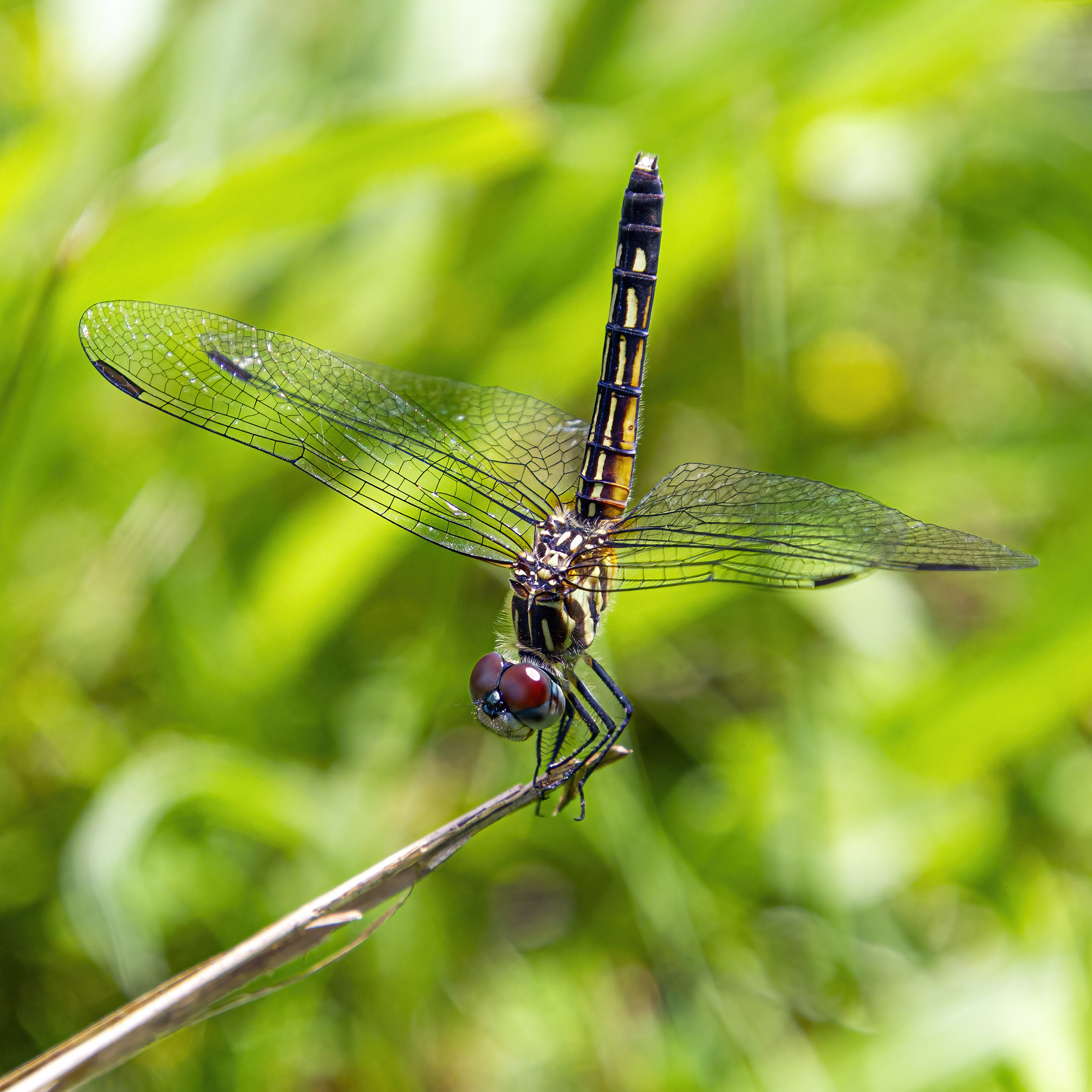
The shape of the silhouette is familiar and if the lighting is bad, you might be able to convince yourself that a Great Blue Heron (Ardea herodias) is standing in the corner of a small pond at Green Spring Gardens. I have visited the pond dozens of times, so I know that the heron is not real, but it still makes for a fun subject to photograph.

I love the heron’s distorted reflection in the first photo and the touches of green provided by a small tree to the side and the duckweed floating on the surface of the water. I was equally thrilled when a male Blue Dasher dragonfly (Pachydiplax longipennis) perched on the heron’s head after I had moved in closer. I doubt that a real heron would have been quite as accommodating in permitting the dragonfly to perch and seem to recall having seen a Great Blue Heron attempt to snatch a dragonfly out of the air as it flew by.

Great Blue Heron

Blue Dasher

© Michael Q. Powell. All rights reserved.


Read Full Post »

Great Blue Skimmer dragonflies (Libellula vibrans) are really common, but I enjoy photographing them anyways, like this grizzled male that I spotted earlier this week at Jackson Miles Abbott Wetland Refuge. The curling vines of the plant on which this dragonfly chose to perch add some additional visual interest to these photos.

I must confess that ordinary blue dragonflies have a special place in my heart, because my very first blog posting on July 7, 2012 featured a photo of a Blue Dasher, another common species. My photography skills and my knowledge about dragonflies have increased significantly since that time, though I am still quite proud of that initial photo that started me on this long journey into photography.


blue dasher

Blue Dasher

© Michael Q. Powell. All rights reserved.

Read Full Post »

Do you remember the first blog post that you ever wrote? In my first blog posting on July 7, 2012, I featured a photo of a Blue Dasher dragonfly (Pachydiplax longipennis). Every year since then whenever I see my first Blue Dashers of the season, I recall my excitement I experienced in being able to photograph that first dragonfly. I did not realize at that time how “addicted” I would get to photographing these beautiful little creatures.

I spotted this handsome male Blue Dasher this past Tuesday at the edge of a small pond at Jackson Miles Abbott Wetland Refuge.

Blue Dasher

© Michael Q. Powell. All rights reserved.


Read Full Post »

Happy 4th of July! It is Independence Day here in the USA and in honor of this holiday I thought I’d post this shot of a patriotic Blue Dasher dragonfly (Pachydiplax longipennis) that was sporting a bit of red, white, and blue on its head this past Monday at Occoquan Bay National Wildlife Refuge. (Be sure to click on the image to see a higher resolution version of the dragonfly that shows the tiny hairs on its thorax (the torso) and its legs.)

Blue Dasher

© Michael Q. Powell. All rights reserved.


Read Full Post »

Blue Dasher dragonflies (Pachydiplax longipennis) are one of the most common and widespread dragonfly species in my area. You can get so used to their presence that you stop paying attention to them, which I think is a mistake, for in doing so you will miss their amazing beauty. The colors and patterns of this little dragonfly are stunning.

Here are a couple of shots of Blue Dashers that I captured this past weekend at Jackson Miles Abbot Wetland Refuge. This early in the season, when the dragonflies are newly emerged, the colors seem really saturated and fresh—later in the season the colors tend to become duller and more faded. I was shooting at the edge of a small pond and the water in the background turned into a neutral gray that gives the images an artistic feel, almost like they were shot in a studio environment. The uncluttered background helps to draw your attention to the dragonflies themselves and especially to those wonderful two-toned eyes. (The male’s eyes will eventually turn into a more uniform turquoise blue shade.)

In case you are curious, the Blue Dasher in the first shot looks to be a female and the one in the second image appears to be an immature male.

Blue Dasher

Blue Dasher

© Michael Q. Powell. All rights reserved.

Read Full Post »

Blue Dashers (Pachydiplax longipennis) are one of my favorite summer dragonflies. I spotted this one recently at Huntley Meadows Park, perched on the railing of an observation deck in the obelisk pose.

The dragonfly was pretty cooperative and I was able to try few different angles and shooting positions. Although I had my camera’s aperture set to f/10, you can see that the depth of field was relatively shallow and I tried to take advantage of that to isolate the subject and the specific rail on which it was perched.

Blue Dasher

Blue Dasher

Blue Dasher

© Michael Q. Powell. All rights reserved.

Read Full Post »

It was really easy to find Blue Dasher dragonflies (Pachydiplax longipennis) near the hotel where I stayed in Woburn, Massachusetts this past weekend. The challenge was capturing them in interesting poses, which was a bit more difficult than usual because they were unusually skittish—maybe they are not used to seeing people.

Blue Dasher

Blue Dasher

Blue Dasher

© Michael Q. Powell. All rights reserved.

Read Full Post »

Older Posts »