Feeds:
Posts
Comments

Posts Tagged ‘Occoquan Bay National Wildlife Refuge’

Warblers are migrating southward through my area at this time of the year. Although I can sometimes hear them, most often they stay hidden behind the foliage. I was happy therefore when I caught site of this Palm Warbler (Setophaga palmarum), one of our most common warblers, this past week at Occoquan Bay National Wildlife Refuge.

When I initially spotted this little bird, it was feeding in the grass, as shown in the second image. The warbler was part of a small group and all of them appeared to be really skittish and took to the air when I was still a long way off. Fortunately one of them flew into a tree and paused momentarily, allowing me to get a mostly unobstructed shot of it.

Most of the warblers remain in our area for a short period of time, so I am never confident when or if I will see any of them. I guess that the best way to increase my odds is to spend more time outside with my camera at the ready.

Palm Warbler

Palm Warbler

© Michael Q. Powell. All rights reserved.

Read Full Post »

This female Great Blue Skimmer dragonfly (Libellula vibrans) seemed to be grinning at me one morning this past week at Occoquan Bay National Wildlife Refuge. Smiling is contagious, I have found.

I hope that your Sunday brings an equivalent smile to your face.

Great Blue Skimmer

© Michael Q. Powell. All rights reserved.


Read Full Post »

I do not know where the Wild Turkeys (Meleagris gallopavo) were hiding, but I don’t think that I spotted a single one all summer. All of the sudden they seem to be back and I have seen them repeatedly during my most recent visits to Occoquan Bay National Wildlife Refuge.

During most of my encounters, I have spotted them in the distance, pecking away at the side of the trail. Before I can get within camera range, they usually sense my presence and waddle into the undergrowth. I was fortunate, however, to capture a shot of this one turkey who had lingered in the open a bit longer than his compatriots.

Wild Turkey

© Michael Q. Powell. All rights reserved.

Read Full Post »

I am blessed to live in an area in which Bald Eagles (Haliaeetus leucocephalus) are present throughout most of the year. During the summer, however, my encounters have been pretty infrequent, so I was excited to spot this one on Monday while visiting Occoquan Bay National Wildlife Refuge. I was looking for dragonflies that day and had a macro lens on my DSLR camera and I realized the eagle was too far away for me to capture a decent image.

It was precisely for situations like this that I also carry my Canon SX50 super-zoom camera. The resolution of this camera is not as good as that of my “big” camera, but it gives me a lot of reach. After I had zoomed in to take the first shot, I zoomed out and realized that there was a second bald eagle perched above the one I had just photographed. The second shot shows the relative positions of the two eagles.

I was hoping for better head positions for the two eagles, but they flew away shortly after I took the second shot. I have discovered that it is usually best to get a shot as early as possible in such encounters and then work to get a better shot. If I had waited for the “perfect” moment, I almost certainly would have come up empty-handed.

Bald Eagle

Bald Eagles

© Michael Q. Powell. All rights reserved.

Read Full Post »

On Monday I was really happy to spot this male Twelve-spotted Skimmer dragonfly (Libellula pulchella) at Occoquan Bay National Wildlife Refuge. Most dragonflies have clear wings and it is always special to see one with boldly patterned wings, like the Twelve-spotted Skimmer. This species is not particularly rare, but this is the first one that I have photographed this season.

Those of you who are mathematically inclined may wonder why this species is called “twelve-spotted” when there are clearly more than twelve spots. For the purposes of counting, however, only the dark spots matter and there are three on each wing. The female of the species also has twelve spots, but lacks the distinctive white spots of the male.


Twelve-spotted Skimmer

© Michael Q. Powell. All rights reserved.

Read Full Post »

Although the astronomical calendar indicates that it is now autumn, the summer season continues for many dragonflies. Many of them are showing a lot of wear and tear, like this female Great Blue Skimmer (Libellula vibrans) with tattered wings that I spotted last week at Occoquan Bay National Wildlife Refuge.

At this time of the year it is not uncommon to see dragonflies and butterflies with damaged wings, but this is one of the most extreme cases that I have ever witnessed. Amazingly, she was still able to fly.

Great Blue Skimmer

© Michael Q. Powell. All rights reserved.

Read Full Post »

For those of us in the Northern Hemisphere, today is the first day of autumn. In my area, today’s high temperature is forecast to reach 90 degrees (32 degrees C), so it does not really feel like autumn yet. However, it is beginning to look like autumn, with browns and orange tones starting to appear in the landscape.

Fortunately there are still lots of butterflies around, like this Viceroy Butterfly (Limenitis archippus) that I spotted last Wednesday at Occoquan Bay National Wildlife Refuge. The color palette of this shot really speaks to me of this new season.

Given that seasons are determined differently in different places by using meteorological or astrological calendars, I probably should try to be scrupulously inclusive and wish everyone a Happy September Equinox Day rather than Happy Autumn.

UPDATE: I took this shot while photowalking with fellow photographer and blogger, Walter Sanford. We did not talk about when we/if we might post an image of this butterfly, but it turns out he also posted one today. Checking out his posting if you like to read another take on our adventure and see a slightly different approach to photographing this butterfly. Walter and I have different backgrounds that affect the way we express ourselves in our words and in our images. Our complementary posts help to remind me that “reality” is as much subjective as it is objective.

Viceroy

© Michael Q. Powell. All rights reserved.

Read Full Post »

I spotted this large Snapping Turtle (Chelydra serpentina) in the grassy vegetation at the edge of one of the trails at Occoquan Bay National Wildlife Refuge on Monday. The turtle seemed to notice me as I bent down to take the shot, but made no attempt to move away (or to snap at me). Still. I decided to play it safe, kept a healthy distance from the turtle, and departed from the turtle without disturbing it from its comfortable resting spot.

In the past I have seen snapping turtles out of the water only in the spring, when they emerge from the muddy pond bottoms where they spend their winters, and when they are laying their eggs. I am not at all sure why this one decided to spend some time on dry land.

snapping turtle

© Michael Q. Powell. All rights reserved.

Read Full Post »

I will often shoot the same subjects over and over again. Each photo opportunity offers the possibility of a difference setting, a different pose, and different lighting conditions. I guess that is why I like the excitement and unpredictability of nature photography versus the more controlled environment of studio photography.

Last week I captured this image of a female Big Bluet damselfly (Enallagma durum) at Occoquan Bay National Wildlife Refuge. The single leaf on which the damselfly is perched makes for a simple composition that helps the subject to stand out, which is really important when the subject is so small. The sunlight helped to create a cool elongated shadow on the leaf that add additional visual interest to the shot. The minimal color palette works well too, I think.

Sometimes it is nice to have a little extra drama in our lives, even if it is only a dramatic damselfly.


Big Bluet

© Michael Q. Powell. All rights reserved.

Read Full Post »

On Monday I spotted this freshly emerged female Common Green Darner dragonfly (Anax junius) at Occoquan Bay National Wildlife Refuge.  It won’t be long before it will be time for her to migrate southward. Yes, some dragonflies actually migrate.

When I first started getting into dragonflies, it never struck me that dragonflies could travel long distances. I figured that they lived and died in a relatively confined geographic area. Although that may be true for some dragonfly species, that is not the case for the Common Green Darner. One of my favorite websites, Dragonflies of Northern Virginia, describes the amazing saga of this species in these words:

“They emerge in the Southeast and fly north, arriving here late March thru May. After their long flight, they mate, lay eggs and die. Their young emerge in July and August. Congregating in large swarms, this 2nd generation begins flying south in September. They lay eggs that fall, after arriving in their southern destinations, and die. When their young hatch in March, they fly back to Northern Virginia and it starts again – a two generation migration.”

Many of us have gotten used to using Global Positioning System (GPS) devices to help us navigate or use Google Maps. How do these dragonflies know where to go? How do they find a destination that they have never visited before? It boggles my mind and fills me with awe and wonder when I contemplate questions like these.

Common Green Darner

Common Green Darner

© Michael Q. Powell. All rights reserved.


Read Full Post »

When I first spotted two small dark shapes in the the waters of Occoquan Bay, I wasn’t sure what I was seeing. As I zoomed in and saw that it was two birds, I assumed that they were cormorants or some similar bird. When the birds changed position and the sun reflected off their white heads, I was shocked to realize that it was two adult Bald Eagles (Haliaeetus leucocephalus) perched on a floating log.

The photo is a little deceptive because it makes it look like the foreground is a beach. The tide was fairly low when I took this shot and the shallower water was covered with some kind of floating debris—it was definitely not solid ground.

Why were the eagles on the log? I thought that maybe they were feeding, but when I scanned the log, I could not see any evidence of a fish. It looks to me like this is a couple, with the larger female on the left, that is involved in some kind of marital dispute. She seems to be telling her mate something and he seems to be a bit cowed and defensive.

What do you the conversation is about between these two eagles?

bald eagles

© Michael Q. Powell. All rights reserved.

Read Full Post »

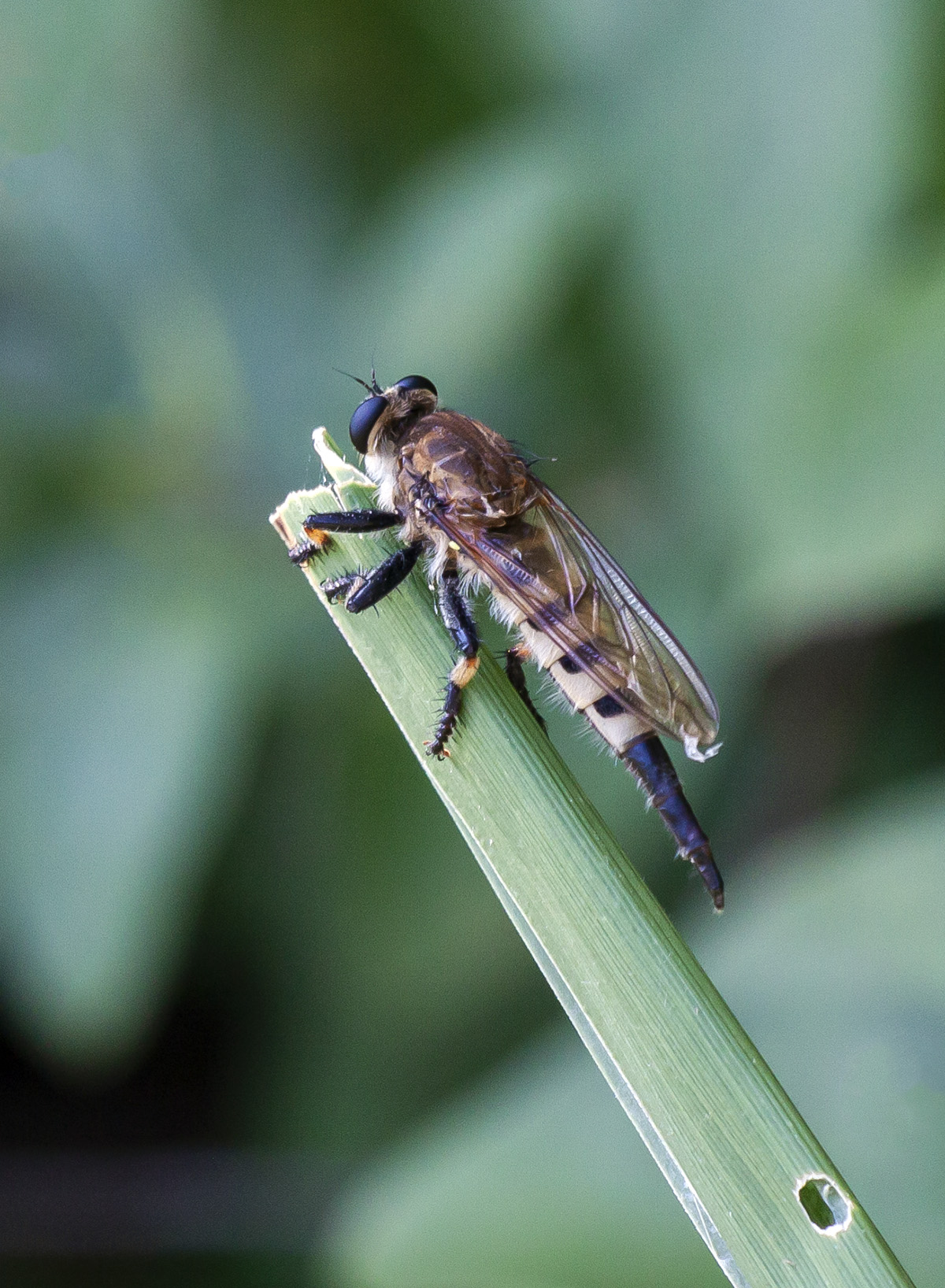
The Red-footed Cannibalfly (Promachus rufipes), a kind of robber fly has just about the coolest (and creepiest) name of any insect. I spotted this female Red-footed Cannibalfly last week at Occoquan Bay National Wildlife Refuge. If you look very closely at the image, you can actually see some of its tiny red feet. However, this insect is not known for being cute—it is a particularly fierce predator that can take down much larger prey, reportedly including hummingbirds.

On a personal basis, I have a particular fondness for the Red-footed Cannibalfly. On 31 August 2013, I did a posting called simply Red-footed Cannibalfly. The posting had some decent photos and and some interesting information and had a modest degree of success, with a total of 44 likes.

Amazingly, though, the posting has been viewed 2530 times to date. Apparently when folks go searching with Google, Bing, or some other search engine, they come across my posting and are intrigued enough to view it. I know that search engine algorithms are closely-guarded secrets, but for this one particular topic, I seem to have broken the code. If you do a search for “red-footed cannibalfly,” you might see my name pop up on the first page of results—it’s a weird claim to fame, but life on the internet is often a mystery.


Red-footed Cannibalfly

© Michael Q. Powell. All rights reserved.

Read Full Post »

Do you have a favorite insect? Although I like dragonflies a lot, my favorite insect is probably the rainbow-colored Handsome Meadow Katydid (Orchelimum pulchellum). I was thrilled to spot this beauty on some colorful vegetation last Saturday at Occoquan Bay National Wildlife Refuge.

I remember well the sense of incredulity that I felt when I saw one of these insects for the very first time—I simply could not believe that the bright colors were real. The beautiful curling leaves hide the details of the katydid’s body a little, but add a wonderful artistic element to this image. If want to see the brilliant colors of a Handsome Meadow Katydid on full display, check out this link to a 2013 posting that I entitled Rainbow Grasshopper—it is one of my most popular posts to date with over 315 views.

The vivid colors of this katydid are sure to grab your attention, but you should also be sure to check out its eyes. I am still blown away every time that I see those amazing eyes that seem to be looking deeply into me.  Here’s looking at you, kid.

Handsome Meadow Katydid

© Michael Q. Powell. All rights reserved.


Read Full Post »

If you were to pit a mantis against a spider, which one would have the advantage? I thought it would be the mantis, but that was clearly not the case this past week at Occoquan Bay National Wildlife Refuge. This spider had a large web stretched over a path on which I was walking, and I guess the mantis was unlucky enough to get stuck in its sticky strands as it was moving through the air.

mantis versus spider

© Michael Q. Powell. All rights reserved.

Read Full Post »

What signposts mark for you the transition from summer to autumn? Many folks might point to changes in the foliage colors or cooler weather, but for me the spotting of my first Fine-lined Emerald dragonfly (Somatochlora filosa) marks an unofficial beginning to the new season.

Fine-lined Emeralds are a relatively uncommon dragonfly species, both locally as well as nationally. They seem to prefer a coastal plain and are active for only about a month, generally the month of September. Yesterday I visited Occoquan Bay National Wildlife Refuge, a place where I have seen Fine-lined Emeralds in the past, and I was thrilled when I eventually spotted one. However, it took me several hours before I was able to capture this shot, because most of the Fine-lined Emeralds that I saw flew by me without stopping and I would lose them when I gave chase.

You probably noticed a few things about this dragonfly when you looked at the photo. First, it is clear why the family to which this dragonfly belongs is called “Emerald”—those brilliant green eyes are mesmerizing. Secondly, you can’t help but notice that Fine-lined Emeralds do not perch horizontally like most dragonflies you are likely to encounter. Instead, they hang almost vertically from bare branches. As a result, their slender bodies are hard for the eye to detect and also tend to confuse a camera’s autofocusing system. Most of the time I end up having to manually focus, as I did in this situation. Lastly, if you click on the image, you can see this dragonfly’s beautiful markings on the thorax (the “chest”) and the abdomen (the “tail”).

So, for me autumn has begun with the arrival of the Fine-lined Emerald dragonfly. Has autumn started for you yet or are you waiting for some additional personal signs of the season?

Fine-lined Emerald

© Michael Q. Powell. All rights reserved.

Read Full Post »

With a name that includes the word “bluet,” you might expect that this female Big Bluet damselfly (Enallagma durum) would be blue, but obviously that is not the case here. There is a blue female variant in this species, but this one appears to be the olive variant.  Damselfly identification is difficult under the best of circumstances, because so many of them share the same colors—only the patterns help you distinguish among them. In this case, size helps a bit too, because Big Bluets are in fact larger than many other damselflies.

As I was exploring Occoquan Bay National Wildlife Refuge a few days, I was fortunate that this damselfly chose to perch at almost eye level on a stalk of Eastern Gamagrass, which let me get a clear shot with the sky in the background.  Most of the time damselflies like this perch lower to the ground in areas with denser vegetation.

Big Bluet

© Michael Q. Powell. All rights reserved.


Read Full Post »

The only other time that I can remember a butterfly perching on me was when I was in an indoor enclosed butterfly garden. This time, though, it was out in the wild and I was a bit shocked when Walter told me that there was a butterfly on my head. Thanks to Walter Sanford, my friend and fellow dragonfly enthusiast, for capturing this encounter. Be sure to check out his blog for lots of wonderful images of dragonflies and other cool creatures.

waltersanford's avatarwalter sanford's photoblog

There’s a butterfly on your hat. A Red-spotted Purple butterfly (Limenitis arthemis astyanax).

16 AUG 2019 | Occoquan Bay NWR | Red-spotted Purple butterfly

This comical butterfly-man union was observed during a photowalk with Michael Powell at Painted Turtle PondOccoquan Bay National Wildlife Refuge, Prince William County, Virginia USA.

16 AUG 2019 | Occoquan Bay NWR | Red-spotted Purple butterfly

The weather was extremely hot and humid. (Notice the Cumulus congestus clouds building in the background.) Both Mike and I were soaked with sweat as soon as we started our photowalk earlier the same day at another site. The butterfly was feeding upon mineral salts on Mike’s “Duck Dynasty” hat.

Copyright © 2019 Walter Sanford. All rights reserved.

View original post

Read Full Post »

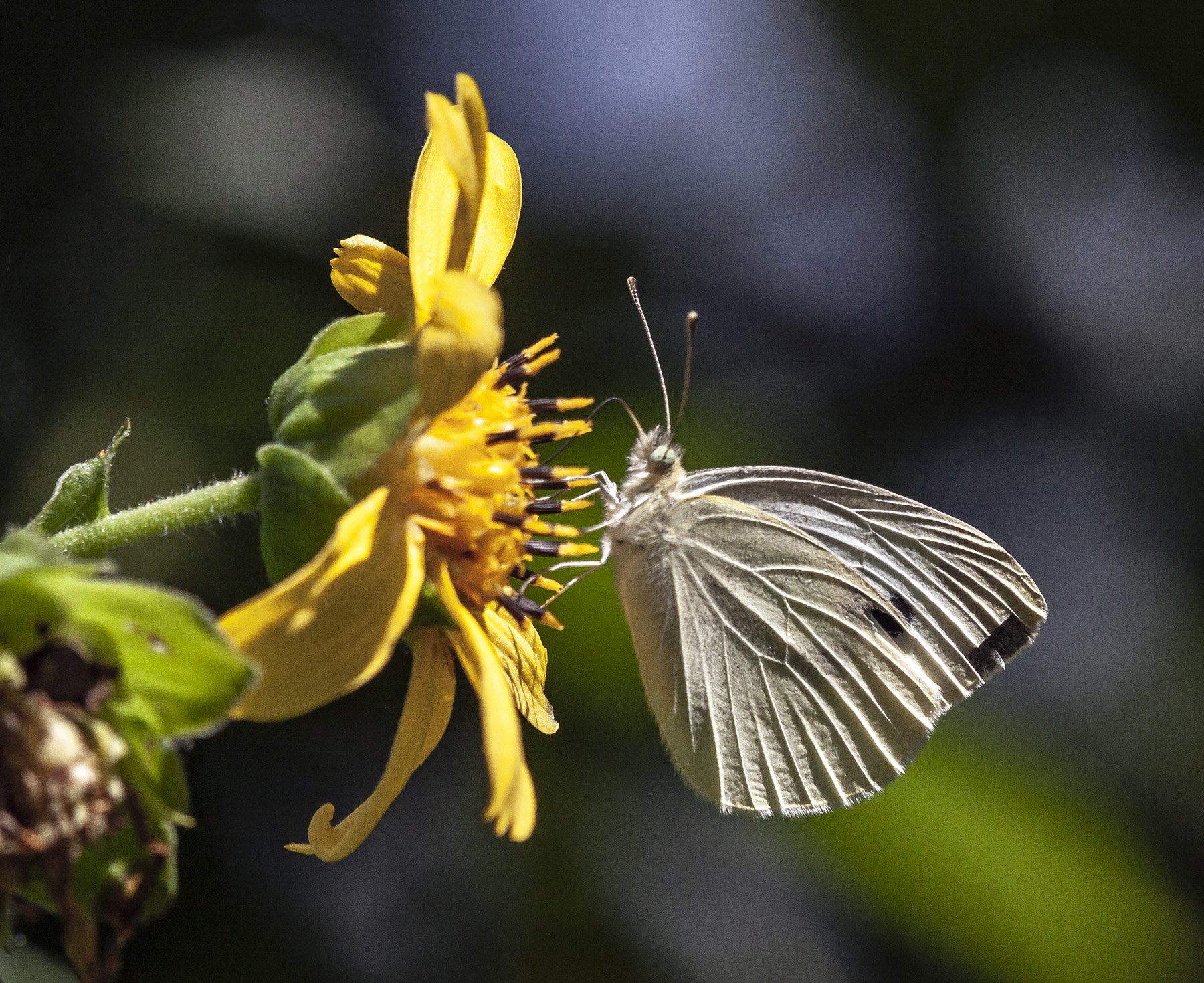
Cabbage White butterflies (Pieris rapae) are small, plain, and common, yet I find a real beauty in their elegant simplicity, especially when I get a view of their speckled green eyes. I spotted this Cabbage White last weekend when I was exploring Occoquan Bay National Wildlife Refuge. As always, my biggest challenge was getting into a shooting position in which the butterfly’s body was on a single plane in order to get most of it in focus—in this case I more or less succeeded in doing so.

Cabbage White

© Michael Q. Powell. All rights reserved.

Read Full Post »

There were quite a few grasshoppers yesterday at Occoquan Bay National Wildlife Refuge and this one cooperated for me by posing momentarily. Initially the grasshopper hung upside down as shown in the first image, but eventually it climbed around on the stalk of vegetation and assumed a more upright pose.

I couldn’t help but notice that the background of the two shots seems really different. I think this was caused by the fact that I shot them from very different angles, even though I remained more or less in the same spot.

grasshopper

grasshopper

© Michael Q. Powell. All rights reserved.

Read Full Post »

Last Friday I spotted this handsome adult male Calico Pennant dragonfly (Celithemis elisa) while exploring Occoquan Bay National Wildlife Refuge with my friend and fellow dragonfly enthusiast Walter Sanford.  Earlier this month I did a posting entitled Mosaic Wings that featured a photo of an immature male of this same species that had a bright yellow body. This image gives you an idea of how the body color changes to red as the male Calico Pennant dragonfly matures.


Calico Pennant

© Michael Q. Powell. All rights reserved.

Read Full Post »

I was really thrilled to spot this spectacular Black Swallowtail butterfly (Papilio polyxenes) last week as it fed on some kind of thistle plant at Occoquan Bay National Wildlife Refuge. There are several dark swallowtail species in our area and I often have trouble telling them apart. In this case, though, I could see the distinctive back dot inside the orange dot which is telltale sign that this is Black Swallowtail. I highly recommend a helpful posting by Louisiana Naturalist that points out way to distinguish among four dark swallowtails—it is a reference that I repeatedly return to when I have a question about a dark swallowtail.

Black Swallowtail

© Michael Q. Powell. All rights reserved.

Read Full Post »

I don’t see rabbits very often during my visits to various wildlife parks. Perhaps the numerous hawks and eagles in the area keep the rabbit population under control, or at least make the rabbits especially cautious and stealthy. I was happy therefore when I spotted this Eastern Cottontail (Sylvilagus floridanus) during a recent visit to Occoquan Bay National Wildlife Refuge and thrilled when he posed momentarily for me.

This rabbit looks to be an adult, but somehow all rabbits are “bunnies” to me. I suspect that is because I had a rabbit as a pet for several years and got used to playing with him every day. I would let Prime Rib (yes, that really was his name) out of his cage and he would happily run around me as I sat on the living room floor, periodically bounding over my outstretched legs.

It was a sad moment for me when Prime Rib died and I can’t help but think of him every time that I see one of his cousins in the wild.

Eastern Cottontail

© Michael Q. Powell. All rights reserved.


Read Full Post »

On Monday I spotted this beautiful Zebra Swallowtail butterfly (Protographium marcellus) at Occoquan Bay National Wildlife Refuge. Normally Zebra Swallowtails are very skittish and are in almost constant motion. This one, however, was so involved with the flower that it did not immediately fly away and allowed me to capture this image.

Zebra Swallowtail

© Michael Q. Powell. All rights reserved.

Read Full Post »

I haven’t seen many Monarch butterflies (Danaus plexippus) this season, so I was thrilled when I spotted this one on some goldenrod on Monday at Occoquan Bay National Wildlife Refuge.

The habitat of Monarch butterfly has been threatened in recent years both in the United States and in the areas to which Monarchs migrate. According to an article yesterday at oregonlive.com, the Monarch butterfly is currently under government consideration for listing under the U.S. Endangered Species Act.

Monarch butterfly

© Michael Q. Powell. All rights reserved.

Read Full Post »

This tattered male Great Blue Skimmer dragonfly (Libellula vibrans) seemed to be auditioning for a role as a replacement for the goose on this sign on Monday at Occoquan Bay National Wildlife Refuge. Or perhaps he was merely seeking a place of refuge—all dragonflies are welcome here.

Great Blue Skimmer

© Michael Q. Powell. All rights reserved.

Read Full Post »

Liaison dangereuse? Living life on the edge? That’s how I would characterize these mating Big Bluet damselflies (Enallagma durum) that I spotted on Monday at Occoquan Bay National Wildlife Refuge. Neither of them was harmed during their “activity,” though those thorns look really menacing.

It is definitely not what I would call “safe sex.”

Big Bluet

© Michael Q. Powell. All rights reserved.

Read Full Post »

I have seen birds and bees stick their heads inside tubular flowers, but I had never before seen a small butterfly do so. I watched this Cloudless Sulphur butterfly (Phoebis Sennae) yesterday at Occoquan Bay National Wildlife Refuge almost bury itself inside this flower as it searched for nectar. I love the way that the light was shining though its wings, illuminating some of the fine details of its tiny body.

I think that this is a Cloudless Sulphur butterfly, but I am easily confused because there is a similar-looking Clouded Sulphur butterfly. To borrow a line from Joni Mitchell, “I really don’t know clouds at all.”

Cloudless Sulphur

© Michael Q. Powell. All rights reserved.

Read Full Post »

I inadvertently spooked a Great Egret (Ardea alba) last week while exploring a small pond at Occoquan Bay National Wildlife Refuge. I thought that it was going to fly away, but instead it opted to perch in a nearby tree. The sun was really bright as I tried to track the bird in my camera’s viewfinder, so many of my shots were overexposed. As the bird was settling in among the tree branches, I was able to capture this shot.  I really like this shot because of the egret’s wing  positions that are  so  unusual  and  graceful.

Great Egret

© Michael Q. Powell. All rights reserved.

Read Full Post »

Dragonfly wings are amazing, but most of the time they are so transparent that it is hard to see all of the tiny little “cells” that make up the wings. Last Friday, though, I captured this shot of an immature male Calico Pennant dragonfly (Celithemis elisa) at Occoquan Bay National Wildlife Refuge that really highlights the beautiful mosaic-like pattern of its hind wings. Wow!

Calico Pennant

© Michael Q. Powell. All rights reserved.


Read Full Post »

Does you mood affect how you react to images? When I am reviewing images that I have captured, most of the time I use an analytical approach. I seek to identify the species of my subject and then look at the technical aspects of the photo, such as the sharpness of the focus. Finally I will see if I can improve the composition by cropping the image.

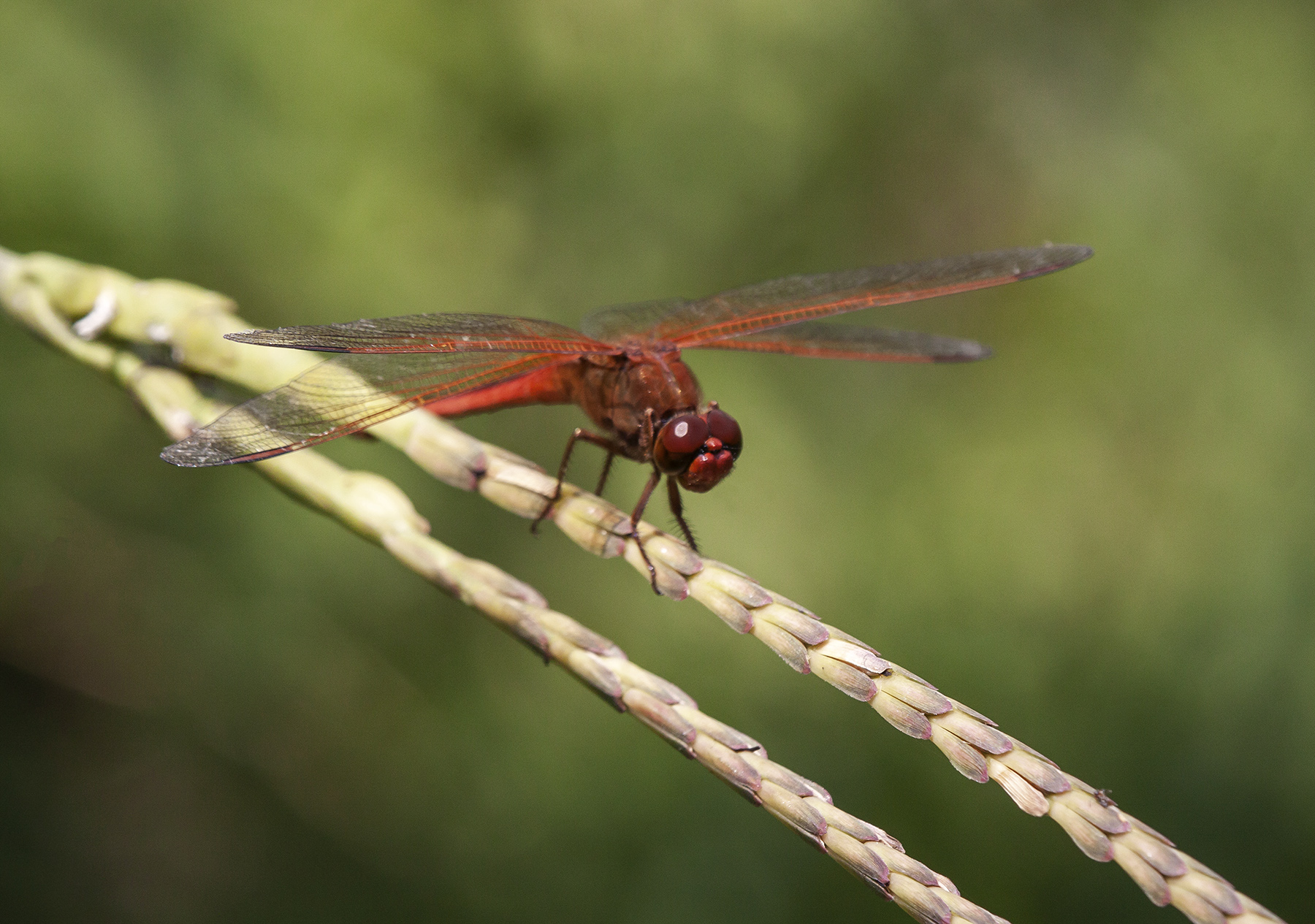
For some images, though, I respond initially with my heart and not my head. I don’t worry about “what” it is and simply enjoy the beauty of the shapes and colors that make up the image. That was the case with this shot of a male Needham’s Skimmer dragonfly (Libellula needhami) that I captured during a recent visit to Occoquan Bay National Wildlife Refuge.

I love the contrast between the orangish-red of the dragonfly’s body and the green background. The shape and texture of the vegetation, which I believe is Eastern Gamagrass (Tripsacum dactyloides), also really grabbed my eye (in part because I missed focus a little and the sharpest part of the image is the grass in front of the dragonfly). The composition is simple and straightforward and is pretty much the way I shot it.

We all like what we like. Most often we don’t even ask ourselves why we like something. I personally find it beneficial to try to articulate why I like something. Words fail me quite often when attempting to describe with words what is primarily an emotional reaction, but I think that the effort itself makes the process worthwhile.

Needham's Skimmer

© Michael Q. Powell. All rights reserved.

Read Full Post »

Are you always in search of new subjects or are you content to photograph the same subjects over and over again? Several years ago I came across an author who described two different types of people—those who prefer to live “widely” and those who prefer to live “deeply.” Those in the first group are always seeking new experiences and traveling to new places and, as photographers, are constantly looking for new things to photograph. By contrast, those in the second group are looking for a deeper experience and are likely to repeatedly return to the same locations over and over and photograph the same limited set of subjects.

As you might suspect, I see myself primarily as a member of the second group. Many of you have undoubtedly noted that I tend to hang out a lot in the same wildlife refuges throughout the year and often photograph familiar subjects. Why? For me, each encounter is unique—the lighting is different, the poses are different, and the age and genders of my subjects vary. I enjoy documenting the seasonal changes in fora and fauna at these locations. Each time I strive to capture different and, if possible, better images.

So, I am posting another photo of a Halloween Pennant dragonfly (Celithemis eponina), even though I posted several images of this species last week. My angle of view for this image from this past weekend was better; the lighting was coming from a better direction; and the slight breeze prompted the dragonfly to move its wings in a way that created a better pose. Consequently, I like this image more than the ones I posted earlier.

My simple approach to blog postings is to present something that is interesting to viewers. The photos may be visually appealing or show details or behavior that you may not have noticed before. You may learn something from my words or may have a better understanding of how the images came into being. Each day we have new opportunities to fill our lives with beauty and meaning. Photography and blogging have become part of my daily journey and I feel blessed to be able to share my experiences with so many of you.

Halloween Pennant

© Michael Q. Powell. All rights reserved.

Read Full Post »

« Newer Posts - Older Posts »